HAL Id: hal-03033996
https://hal.archives-ouvertes.fr/hal-03033996
Submitted on 2 Dec 2020
HAL is a multi-disciplinary open access
archive for the deposit and dissemination of
sci-entific research documents, whether they are
pub-lished or not. The documents may come from
teaching and research institutions in France or
abroad, or from public or private research centers.
L’archive ouverte pluridisciplinaire HAL, est
destinée au dépôt et à la diffusion de documents
scientifiques de niveau recherche, publiés ou non,
émanant des établissements d’enseignement et de
recherche français ou étrangers, des laboratoires
publics ou privés.
Optimization of Electricity Consumption in a Building
Kahina Louadj, Fethi Demim, Abdelkrim Nemra, Mohamed Aidene, Philippe
Marthon, Hocine Iddir
To cite this version:
Kahina Louadj, Fethi Demim, Abdelkrim Nemra, Mohamed Aidene, Philippe Marthon, et al..
Op-timization of Electricity Consumption in a Building. 5th International Conference on Control,
De-cision and Information Technologies (CoDIT 2018), Apr 2018, Thessaloniki, Greece. pp.865–869,
�10.1109/CoDIT.2018.8394953�. �hal-03033996�
Optimization of Electricity Consumption in a building
Kahina LOUADJ 1,4, Fethi DEMIM2, Abdelkrim NEMRA 2, Mohamed AIDENE3Philippe MARTHON4 and Hocine IDDIR5
Abstract— The main objective of an energy regulation of a
building is to maintain internal thermal comfort, as well as minimize energy consumption, or reduce the peak of electrical consumption. The dynamic programming has been used to minimize a cost function, accounting for a high peak electricity tariff, under constraints related to comfort (minimal tem-perature, maximal temperature variation) and the maximum heating power. The proposed energy management consists in over-heating the building during the hours before the peak knowing in advance the weather, occupation and internal gains for the day. The method has been tested in a case study corresponding to a house of a four-person family with performance levels: high construction and poorly insulated old house.
I. INTRODUCTION
At the global level, energy demand is a tendency for high increase. As a result of population growth and economic growth, driven mainly by emerging countries, especially China and India take into account its demographics, its could to double by 2050. These countries, especially the big four emerging markets, which are BASIC [9] (Brazil, South Africa, India and China), but also those in the Middle East, far more than the OECD countries (Organization for Economic Cooperation and Development) [9], ” energy mar-kets and prices that will become more and more high. Fossil energies, first and foremost oil, now insure more than 80% of the supply. This situation marks the global dependence on Carbon energies and pose the question of its holding up, both environmentally and in terms of supply of raw materials. If global reserves fossil fuels appear abundant in terms of future needs, conditions of their access are increasingly difficult: the investments in infrastructure needed for the use of resources are massive and the geopolitical context is inherently uncertain. The climatic constraint change should also appear earlier than the geopolitics.
At European level, the dynamic is different, especially since population growth and economic growth are weaker, but it is still dependent on the rest of the world energetically, to try to achieve self-sufficiency or energetic mastery the European
*K.Louadj, F.Demim, A.Nemra, M.Aidene, P.Marthon, H.Iddir
1
Universit´e de Bouira. D´epartement de Math´ematiques. Bouira. Alg´erie.
louadj [email protected] 2
Laboratoire Robotique et Productique, Ecole Militaire Polytechnique, Bordj El Bahri,BP 17, 16111, Alger. Alg´erie.
[email protected], karim [email protected] 3
Laboratoire de Conception et Conduites Syst`emes de Production (L2CSP). Tizi-Ouzou, Alg´[email protected]
4
IRIT-ENSEEIHT. Toulouse, France.
Universit´e Mouloud Mammeri. D´epartement de Math´ematiques. Tizi-Ouzou. Alg´[email protected]
Union has implemented the pact ” Energy-Climate” , which sets 2020 binding objectives [6], [7], [8].
Two countries have carried out such Germany and the United Kingdom forward-looking exercises. Germany has made the exit from its priority as a result of the Fukushima accident. His program energy (Energiekonzept) [9], prior to the events in Fukushima, was already based on the goal of halving demand 2050.
The United Kingdom is developing an approach based on a broad portfolio of low carbon technologies, including without a priori renewable energies, nuclear power and CCS (capture and carbon storage), with a view to technological neutrality and optimum economic.
The energy situation in Algeria involves three challenges: diversify forms of energy, increase energy efficiency and give room for maneuver. What we are most interested in our work is the concept of energy efficiency.
In Algeria, the housing sector consumes more than half of national electricity production, which encourages the gov-ernment to take regulatory measures such as the elimination of electricity consumption, construction of low consumption or passive buildings and renovation old build which ensures the comfort, reduces the invoice energy, creates employment, reduces greenhouse gas emissions and avoids spikes in consumption that exceeds production capacity nationally.
Dynamic programming which is a branch in an Oper-ational research, provides us with sequential optimization algorithms necessary for the modeling of problems in the field of energy. Our work is summarized in the study of an optimal the elimination of peak power consumption in a building by the application of dynamic programming [3], [19].
The Bellman equation, also known as the Hamilton-Jacobi-Bellman equation (HJB), is a result of the method of dy-namic programming initiated by Richard Bellman in the 1950s to solve optimization problems. Ie problems where the best possible decisions must be made on each date for a given performance criterion. The equation of dy-namic programming generalizes William Hamilton-Jacobi-Bellman’s previous classical mechanics in recognition of the contribution of these three great scientific personalities. Historically applied in engineering and then in other fields of applied mathematics, the HJB equation has become an important tool in decision-making problems in economics and finance [3], [14], [19].
The article is divided into four sections, The first section, we gives us an overview of Bellman’s optimality principle, Bellman equation and application to the optimal control. And
after, formulate the problem to minimize the cost of the electricity energy in the second section. In the third section, a practical example of a house of family of four persons under thermal simulation and the design of an application that optimizes the heating and the elimination of power consumption during peak periods daily. Finally, we achieve by the results which are founded by the software C++ and conclusion is provided.
II. OPTIMIZATIONALGORITHM
The dynamic programming algorithm is a sequential op-timization algorithm for obtaining the overall optimum by scanning all the possible solutions, in this case, it is a question by determining a set of controls (heating on or off) Making it’s possible to minimize the cost function over the period considered. Let be noted u the control variable includingNc dimensions:
u(t) = ut∈ U, U ⊂ Rm (1) withUt all the possible commands.
The state equation at each time stept is then:
x(t) = xt, x(t + 1) = f (x(t), u(t), t) (2) wherex is the temporally discretized state variable
x(t) = xt∈ Xt, Xt⊂ Rn (3) the value function vt corresponding to the passage cost is defined as:
vt(xt, xt+1), xt+1∈ Γt(xt) (4) Γt is the set of possible states at t, the cost function is the sum of the values of functions on all time steps.
Vt 0 = t−1 X j=0 vj(xj, xj+1) (5) The optimization seeks to minimize the following objective function onN steps:
J = M in[VN] (6) This equation is the set of commands to go from x0 to x1. The optimization times can be long. Equation (6) then becomes:
J = M in[VN −1
0 ] = M in(v0(x0, x1)) + M in[V1N −1] (7) The objective is to find the set of commands U = (u1, u2, ..., uN) minimizing (7) with constraints on state variable (3) and control (1).
A. Optimality Principle’s
The dynamic programming is based on a technique that Bellman called ”Principle of Optimality”. This general prin-ciple states that the solution of a global problem can be obtained by decomposing the problem into sub problems easier to solve.
III. MATHEMATICALMODELING
The aim of mathematical modeling and finding the set of commands U = (u1, u2, ...., uN) which optimizes the cumulative cost over a given time intervalt ∈ [1, N ]. Let be consider the following constraints:
u(t) = ut, x(t) = xt, x(t + 1) = f (xt, ut, t), (8) Vt(xt, ut) Vt 1 = t X j=1 Vj(xt, xt+1), F = min[VN 1 ] • t : Time.
• u(t) : Control of the system (increase in temperature of xt, xt+1).
• x(t) : State of the system (temperatures in step t). • Vt : Cost passage of xt to xt+1.
• V1t: Cumulative cost of j = 1 to j = t. • F : The performance.
The objective is to optimize the heating cost of the day and maintain the internal comfort at a temperature of 19◦ Minimum and a temperature change of 2◦ Maximum per hour.
A. Program under C++:
The following program allows us to enter data concerning the building’s energy environment. Gives the cumulative cost for one day as well as the orderU.
• Minimum temperature of building19
◦
. • Maximum temperature of building25
◦
. • The variation is less than or equal to2
◦
/hour. • The fall in temperature in a supposedly isolated house
1◦
.
• The drop in temperature in a less isolated house2
◦
. • The Cost of heating power to increase the temperature
of1◦ is given in Table 1: TABLE I
Off Hours:1h → 8h 8 DA Full Hours:9h → 16h, 22h → midnight 12h Peak Hours:17h → 21h 25h
B. The performance:
The performance is defined as follows: F = min[VN 1 ] (9) Where VN 1 = PN t+1(ut+ β) ∗ G, ut = xt+1− xt,t = 1, ..., N + 1. (x1= xN +1), G = P rt∗ W.
• β : The step represents the temperature drop per hour (heating off).
TABLE II
CUMULATIVE COST WITHOUT ERASING ELECTRICITY CONSUMPTION IN A WELL INSULATED BUILDING
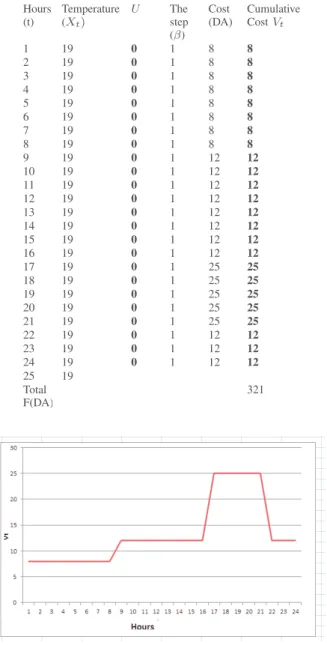
Hours (t) Temperature (Xt) U The step (β) Cost (DA) Cumulative Cost Vt 1 19 0 1 8 8 2 19 0 1 8 8 3 19 0 1 8 8 4 19 0 1 8 8 5 19 0 1 8 8 6 19 0 1 8 8 7 19 0 1 8 8 8 19 0 1 8 8 9 19 0 1 12 12 10 19 0 1 12 12 11 19 0 1 12 12 12 19 0 1 12 12 13 19 0 1 12 12 14 19 0 1 12 12 15 19 0 1 12 12 16 19 0 1 12 12 17 19 0 1 25 25 18 19 0 1 25 25 19 19 0 1 25 25 20 19 0 1 25 25 21 19 0 1 25 25 22 19 0 1 12 12 23 19 0 1 12 12 24 19 0 1 12 12 25 19 Total F(DA) 321
Fig. 1. Cumulative cost without erasing electricity consumption in a well insulated building
• P rt:The cost of using the electricity in KWh between t and t + 1.
• W : Heating power (+1
◦
).
C. Simulation results(cumulative cost)
The results of the execution of the previous program can be summarized in the following tables:
Tables of Cumulative of the objective function: Synthesis:
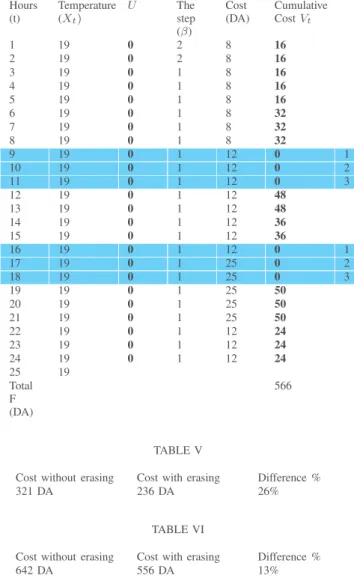
In a well insulated building: In the table V, a profit of26% was realized with an erasure of5/5 of the peak hours and 5/11 of the full hours. In a poorly insulated building:
In the table VI, a profit of 13% was realized with an erasure of3/5 of the peak hours and 3/11 of the full hours.
Algorithm 1 Program (Cumulative Cost)
# include <cstdlib> # include <iostream> using namespace std; int main() int i,b,n,a,f,p,pt,m,c,o,x,temp[24],price[24],pcum; cost<< ”\n”; cost<< ”\n”;
cost<< ”\n ******* The cumulative cost for one day**************;
cost<< ”\n”;
cost<< ”\n the step is the fall of the temperature in degree per hour : ”; cost<< ”\n”;
cost<< ”\n − 1 Degree for well insulated building ”; cost<< ”\n”;
cost<< ”\n − 2 Degree for badly insulated building ”; cost<< ”\n”;
while (n > 0)
cost<< ”\n do you want to seize you? If yes write 1 else 0 : ”;cin>> \n;
if(n == 0)return EXIT SUCCESS;
cost<< ”\n enter the step [1,2] : ” ;cin>> b; cost<< ”\n”;
cost<< ”\n the cost of off temperature: ”;cin>> c; cost<< ”\n” ;
cost<< ”\n The cost of full temperature: ”;cin>> p; cost<< ”\n”;
cost<< ”\n the cost of the peak temperature: ”;cin>>pt; cost<< ”\n”;
cost<< ”\n enter the temperature ”; for(i = 1; i < 9; i + +) cost[i]=c; for(i = 9; i < 17; i + +) cost[i]=p; for(i = 17; i < 22; i + +) cost[i]=pt; for(i = 22; i < 25; i + +) cost[i]=p; cost<< ”\n”;
cost<< ”\n For a classic control type without erasing enter 3 ”; cost<< ”\n”;
cost<< ”\n For a regulation type with erase enter 4 ”; cost<< ”\n”;
cost<< ”\n give the type ”;cin>> f ;
if(f == 3) cost<< ” Gives the constant temperature in the building ”;
cin>> a;
for(i = 1; i < 25; i + +) temp[i]=a;
if (f == 4) cost << ”\n give temperature minimum : ”;cin>> a;
cost<< ”\n give temperature max : ”;cin>> m ; cost<< ”\n” ;
for(i = 1; i < 25; i + +) if (cost[i]-cost[i+1]>= pt − p; o=i+1;
cost<< ”\n the temperature a ” << o << ”h est :”;cost<< a;
for(i = 0; i < o; i++) cost<< ”\n enter the temperature ” << o − i << ”h :”;
cin>> temp[o − i]; cost<< ”\n”;
for (i = 1; i < 25 − o; i + +) cost<< ”\n enter temperature” << 25 − i << ”h : ” ;
cin>> temp[25 − i]; for (i=1;i¡25;i++)cost<< ”\n the temperature” << i << ”h : ”; cost<< temp[i]; temp[25]=temp[1];
pcum=0;
for (i = 1; i < 25; i + +) pcum=pcum+(temp[i+1]-temp[i]+b)*cost[i]; cost<< ”\n” ;
cost<< ”\n The cumulative cost for One day is : ” << pcum << ”Dinars”;
cost<< ”\n The control U is ”; cost<< ”\n”;
for(i = 1; i < 25; i + +) cost<< ”\n - U (” << i << ”) = ” << temp[i + 1] − temp[i];
system(”PAUSE”); return EXIT SUCCESS;
TABLE III
CUMULATIVE COST WITH ERASING OF ELECTRICITY CONSUMPTION IN A WELL INSULATED BUILDING
Hours (t) Temperature (Xt) U The step (β) Cost (DA) Cumulative cost Vt 1 19 0 1 8 8 2 19 1 1 8 16 3 20 1 1 8 16 4 21 1 1 8 16 5 22 1 1 8 16 6 23 1 1 8 16 7 24 1 1 8 16 8 25 -1 1 8 0 1 9 24 -1 1 12 0 2 10 23 -1 1 12 0 3 11 22 -1 1 12 0 4 12 21 1 1 12 24 13 22 1 1 12 24 14 23 1 1 12 24 15 24 1 1 12 24 16 25 -1 1 12 0 1 17 24 -1 1 25 0 2 18 23 -1 1 25 0 3 19 22 -1 1 25 0 4 20 21 -1 1 25 0 5 21 20 -1 1 25 0 6 22 19 0 1 12 12 23 19 0 1 12 12 24 19 0 1 12 12 25 19 Total F (DA) 236
Fig. 2. Cumulative cost with erasing electricity consumption in a well insulated building
Fig. 3. Cumulative cost with elimination of electricity consumption in a poorly insulated building
From the preceding tables (V and IV), in a well-isolated house where the application of satisfactory results and a peak erase of 100%, on the other hand in the poorly insulated house the result is not very effective see Figures 1, 2 and 3. In Conclusion,
The function value must not only eliminate the consumption of electricity during peak period but also to take into account the cost differential between off-peak hours and peak hours. The cumulative cost does not increase either during all or part of the full hours following the day. Optimal regulation heats the building mainly during off hours, and can clear up to 15 h in a row the heating consumption.
IV. CONCLUSION
Optimization by the dynamic programming made to study an optimal energy management strategy of a building the heating was ordered to allow the erasure of its electricity consumption during the peak period going from 17h to 21h while maintaining the comfort inside the building. A case study on a low-energy building and another on a little isolated building showed that deletion of the tip is only possible on the house very well insulated.
Application of the sequential optimization algorithm has proved its effectiveness in optimizing dynamic problems. To obtain a result, one notices that the step plays a very interesting role, in the mechanism of optimization of the
TABLE IV
CUMULATIVE COST WITH ERASING OF ELECTRICITY CONSUMPTION IN A POORLY INSULATED BUILDING
Hours (t) Temperature (Xt) U The step (β) Cost (DA) Cumulative Cost Vt 1 19 0 2 8 16 2 19 0 2 8 16 3 19 0 1 8 16 4 19 0 1 8 16 5 19 0 1 8 16 6 19 0 1 8 32 7 19 0 1 8 32 8 19 0 1 8 32 9 19 0 1 12 0 1 10 19 0 1 12 0 2 11 19 0 1 12 0 3 12 19 0 1 12 48 13 19 0 1 12 48 14 19 0 1 12 36 15 19 0 1 12 36 16 19 0 1 12 0 1 17 19 0 1 25 0 2 18 19 0 1 25 0 3 19 19 0 1 25 50 20 19 0 1 25 50 21 19 0 1 25 50 22 19 0 1 12 24 23 19 0 1 12 24 24 19 0 1 12 24 25 19 Total F (DA) 566 TABLE V
Cost without erasing Cost with erasing Difference %
321 DA 236 DA 26%
TABLE VI
Cost without erasing Cost with erasing Difference %
642 DA 556 DA 13%
eradication of the peaks of electric consumption. The con-straint of controlling energy storage in the building mass or the thermal insulation of buildings is a crucial necessity in the program of effacement of high consumption of electrical energy. As perspective, we can extended the study for a week, or a month and try to find solutions for the consumption of electrical energy.
REFERENCES
[1] Claude Mandil. Jacques Percebois. Rapport ´en´ergie 2050 f´evrier 2012. Minist`ere Franc¸ais de l’´economie de finance et de l’industrie p 21-22. 2012.
[2] Bruno Peuportier, F. Berenger. Etude d’une strat´egie d’effacement
de la consommation ´electrique de pointe dans le bˆatiment par l’application de la programmation dynamique, XXXe Rencontres AUGC-IBPSA Chamb´ery, Savoie, 6 au 8 juin 2012.
[3] Art Lew, H. Mauch, Dynamic programming a computational Tool. Springer pages 379. 2007.
[4] Aur´elie Kaemmerlen. Transfert de chaleur `a travers les isolants
thermiques du bˆatiment. Th`ese de Doctorat, 2009.
[5] Didier Roux. L’efficacit´e ´energ´etique des bˆatiments: un d´efie strat´egique. pages 81-92. Revue AGIR N◦= 42, 2013.
[6] R. E. Bellman. Dynamic programming. Princeton University Press, Princeton, NJ, 1963.
[7] Braun J.E., Montgomery K.W., Chaturvedi N., Evaluating the
Per-formance of Building Thermal Mass Control Strategies, HVACR Research, vol. 7, n◦4, p. 403- 428,2001.
[8] Dounis A.I., Caraiscos C., Advanced control systems engineering for
energy and comfort management in a building environment A review
, Renewable and sustainable Energy Reviews, vol. 13, p.1246-1261, 2009.
[9] Oldewurtel F et al., Energy efficient building climate control using
Stochastic Model Predictive Control and weather predictions, Ameri-can Control Conference, Baltimore USA, 30 Juin - 2 Juillet, 2010. [10] Peuportier B., Sommereux I.B., Simulation tool with its expert
in-terface for the thermal design of multizone buildings, International Journal of Sustainable Energy, vol. 8, p 109-120, 1990.
[11] Sane H., Guay M., Minmax Dynamic Optimization over a Finite-time
Horizon for Building Demand Control, American Control Conference, Seattle USA, 11-13 Juin, 2008.
[12] Tyagi, V.V., Buddhi, D., PCM thermal storage in buildings : A State
of art., Renewable and sustainable Energy Reviews. vol. 11, p. 1146-1166, 2007.
[13] A. Ahmad, M. Hassan, M. Abdullah. A review on applications of
ANN and SVM for building electrical energy consumption forecasting. Renewable and Sustainable Energy Reviews Elsevier 2014. Volume 33, May 2014, Pages 102-109, 2014.
[14] F. Demim, A.Nemra, K.Louadj. Solution of an optimal control problem
of the robot with Bellman Principle’s. Conf´erence Internationale en Sciences et Technologies Electriques, October 26-28 , CISTEM’16, Morocco, Marakech, 2016.
[15] F.Demim, K.Louadj, M.Aidene, A. Nemra. Solution of an Optimal
Control Problem with Vector Control using Relaxation Method, Auto-matic Control and System Engineering Journal, Volume 16, Issue 2, ISSN 1687-4811, ICGST LLC, Delaware, USA, 2016.
[16] K.Louadj, P.Spit´eri, M.Aidene, F.Messine. An optimal control
prob-lem with free final time for aircraft flight with wind. Colloque sur l’optimisation et les syst`emes d’information (COSI 2014), Bejaia, 08/06/2014-10/06/2014.
[17] K.Louadj, P.Spit´eri, M.Aidene, F.Messine. Optimal command for the
control of the air navigation of an aircraft. The Second International Conference on Electrical Engineering and Control Applications, Con-stantine, 18/11/2014-20/11/2014.
[18] S.Titouche, P.Spiteri, F. Messine, M.Aidene. Optimal control of a large
thermic, Journal Control System, Vol.25, pp.50-58, January 2015. [19] F.Demim, A. Nemra, K.Louadj, M.Hamerlain. Simultaneous
localiza-tion, mapping, and path planning for unmanned vehicle using optimal control, Advances in Mechanical Engineering, 2018, Vol. 10(1) 1-25.