for Civil Wars
by
Noel Thomas Anderson
B.A. International Relations/Peace and Conflict Studies University of Toronto, 2009
SUBMITTED TO THE DEPARTMENT OF POLITICAL SCIENCE IN PARTIAL FULFILLMENT OF THE REQUIREMENTS FOR THE DEGREE OF
DOCTOR OF PHILOSOPHY IN POLITICAL SCIENCE AT THE
MASSACHUSETTS INSTITUTE OF TECHNOLOGY SEPTEMBER 2016
Noel Anderson 2016. All rights reserved.
The author hereby grants to MIT permission to reproduce and to distribute publicly paper and electronic copies of this thesis document in whole or in part in any medium now known or
hereafter created.
Signature of Author:
Signature redacted
Department of Political Science
29 August 2016
Signature redacted
Certified by:Roger D. Petersen Arthur and Ruth Sloan Professor of Political Science Thesis Supervisor
Signature redacted
Accepted by:MAAO SirTTsS INSTITUTE
F OGY
OCT 2 Z016
LIBRARIES
Ben Ross Schneider Ford International Professor of Political Science Chair, Graduate Program Committee
MITLibraries
DISCLAIMER NOTICE
Due to the condition of the original material, there are unavoidable
flaws in this reproduction. We have made every effort possible to
provide you with the best copy available.
Thank you.
for Civil Wars
by
Noel Thomas Anderson
Submitted to the Department of Political Science on 29 August 2016 in Partial Fulfillment of the Requirements for the Degree of Doctor of Philosophy in Political Science
ABSTRACT
This dissertation explores two interrelated puzzles about external intervention and internal war. The first asks why rebels, governments, and third party interveners often continue to invest in
costly and protracted conflicts rather than sue for peace and a negotiated settlement. The second considers the consequences of these behaviors for temporal variation in the average duration and global prevalence of civil wars. A central finding that emerges concerns the critical role of competitive intervention-two sided, simultaneous military assistance from different third party states to both government and rebel combatants-in the dynamics and intractability of civil wars across time and around the globe. Developing a generalizable theory of competitive intervention, the dissertation explains the distortionary effects this form of external meddling has on domestic bargaining processes, describes the unique strategic dilemmas it entails for third party interveners, and links its varying prevalence to international systemic change. In doing so, it moves beyond popular anecdotes about "proxy wars" by deriving theoretically-grounded propositions about the strategic logics motivating competitive intervention in civil wars. It also uncovers a heretofore overlooked feature of this form of intervention-namely, that "not losing" is often more important than "winning" from the perspective of third party interveners under the shadow of inadvertent escalation. The theory is tested with a mixed-method design that combines statistical analyses of all civil wars fought between 1975 and 2009 with detailed case studies of competitive intervention in Angola (1975-1991) and Afghanistan (1979-1992). The dissertation's theoretical and empirical results shed new light on the international dimensions of civil war, address ongoing debates concerning the utility of intervention as a conflict management tool, and inform policy prescriptions aimed at resolving some of today's most violent internal conflicts.
Thesis Supervisor: Roger D. Petersen
Title: Arthur and Ruth Sloan Professor of Political Science
List of Figures List of Tables Acknowledgments 1 Introduction
1.1 Puzzles and Motivation ...
1.2 Arguments and Contributions . . . . 1.3 Looking Ahead . . . . 2 Conceptual Foundations and Points of Departure
2.1 Concepts, Definitions, and Scope Conditions . . . . 2.2 The Existing Literature . . . . 2.2.1 Conflict Management and Third Party Intervention . 2.2.2 Lim ited W ar . .. . . . . 2.2.3 Civil W ar Duration . . . . 2.3 The Research Path Forward . . . . 3 A Theory of Competitive Intervention in Civil War
3.1 Microfoundations: External Military Aid and Civil War . . . 3.2 Macro Motivations: Interstate Competition in Civil Wars . . 3.2.1 The Dilemma of Competitive Intervention . . . . 3.2.2 Solving the Dilemma . . . .
7 7 9 11 12 16 20 23 . . . . 24 . . . . 27 . . . . 27 . . . . 32 . . . . 35 . . . . 38 41 . . . . 42 . . . . 44 . . . . 46 . . . . 48 3.3 Systemic Dimensions: The Varying Prevalence of Competitive Intervention and
C ivil W ar . . . . 3.4 Testable Hypotheses . . . . 3.5 Research D esign . . . . 4 Quantitative Models: Civil Wars, 1975-2009
4.1 The Dataset: Case Selection, Variables, and Measurement . . . . 4.2 Models and Methods . . . . 4.3 Em pirical Results . . . . 4.3.1 Changing Trends in Competitive Intervention . . . .
5 53 58 59 63 64 66 69 69
4.3.3 Addressing the Selection Effect Critique 81 4.4 Conclusion . . .· . . . 81
5 Competitive Intervention and the Angolan Civil War, 1975-1991 5.1 Origins of the Conflict: From Colonial to Civil War .. .
5.2 A BriefTimeline of the Angolan Civil War . . . .
5.3 Interveners and their Interests: Why Winning Mattered .. .
5.3.1 UNITA's Friends: South Africa and the United States
5.3.2 The MPLA's Patrons: Cuba and the Soviet Union ..
5.4 Strategic Restraint during Competitive Interventions in the Angolan Civil War .
5 4 1 . . "Ad . v1sory versus " "C om a b t" M' . 1ss1ons . . . . . 5.4.2 Force Postures: Advances and Retreats . . . . .
5.4.3 Geographic Areas of Contestation and Control
5.4.4 Targets . . . . 5.5 Restraint in the Final Months of the War . . . . .
5.6 Was Not Losing More Important Than Winning? .
5.7 Conclusion . . . .
6 Competitive Intervention and the Afghan Civil War, 1979-1992 6.1 Origins of the War . . . .
6.2 A Brief Overview of the War . . . .
85 89 91 97 97 101 103 104 108 109 111 114 121 124 127 131 136 6.3 Interveners and their Interests: Why Winning Mattered . 142
6.3.1 The Communists' Lifeline: The Soviet Union . . 142
6.3.2 The Mujahideen's Backers: Pakistan and the United States . 145
6.4 Intervener Restraint during the Afghan Civil War . . . 148 6.4.1 Geography, Borders, and Conflict Containment . . . 149 6.4.2 Force Postures: Avoiding Engagements and Communicating Restraint 155
6.4.3 Weapons, Military Aid, and Fears of Escalation 160
6.5 The Stinger and Escalation in Afghanistan . . . . 165 6.6 Was Not Losing More Important Than Winning? . 169
6. 7 Conclusion . . . 172
7 Conclusions and Implications 175
7.1 Summary of Arguments and Results . . . 176 7 .2 Competitive Intervention in Contemporary Conflicts: On Syria and Ukraine 178 7.3 Policy Implications . . . 184
7.3.1 Interventions to End Civil Wars: Assumptions and Realities 184
7.3.2 Sequencing of External and Internal Peace Agreements . 186
7.3.3 Policymaker Perceptions and Escalation Control 189
7.4 An Agenda for Future Research . . . 190
1.1 Trends in the global incidence, prevalence, and termination of intrastate conflicts,
1946-2009...
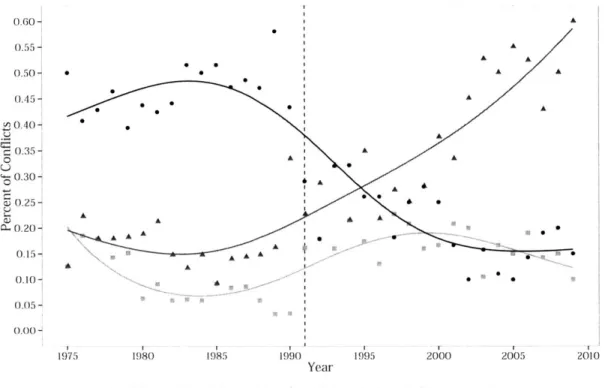
4.1 Aggregate patterns in external military assistance in the form of competitive interventions and one-sided support to civil war combatants, 1975-2009 . . . . 4.2 Superpower and non-superpower competitive interventions, 1975-2009 . . . . 4.3 Disaggregated patterns in external military assistance in the form of competitive
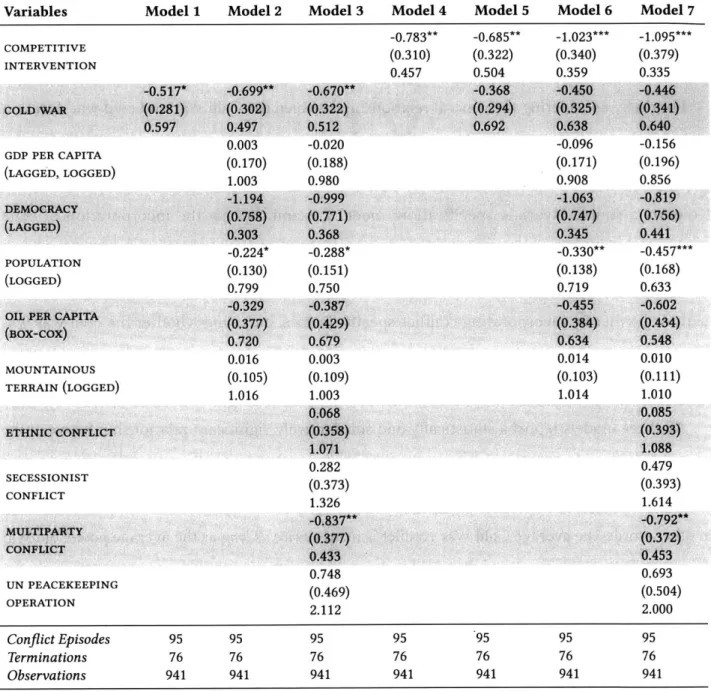
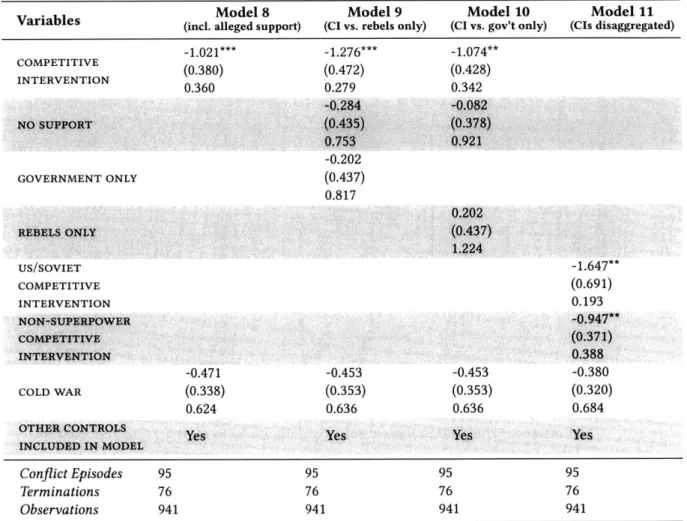
interventions and one-sided support to civil war combatants, 1975-2009 . . . . 4.4 Percent change in the hazard of a civil war terminating, Cold War vs. Cold War
with competitive intervention vs. competitive intervention . . . . 4.5 Percent change in the hazard of a civil war terminating, US-USSR competitive
intervention vs. non-superpower competitive intervention . . . . 4.6 Year of competitive intervention onset for civil wars that were afflicted by
com-petitive intervention at any time during their duration . . . . Relationships of major actors during the Angolan civil war . . .
Angola and its neighbors . . . . Southern Angola and the Cuban defensive line . . . .
Afghanistan and its neighbors . . . . Relationships of major actors during the Afghan civil war . . . . External aid network in support of the mujahideen insurgency .
. . . . 92 . . . . 93 . . . 110 . . . 133 . . . 137 . . . 138
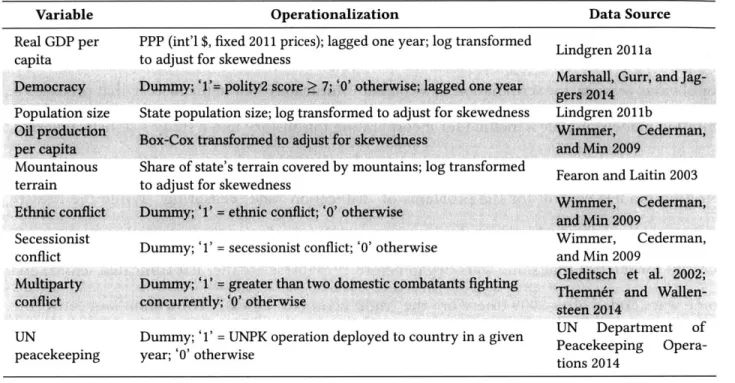
Control variables, their operationalization, and data sources . . . . Variable summary statistics . . . . Extended Cox model estimates, models 1-7 . . . .
67 67 76 7 15 70 71 73 78 80 82 5.1 5.2 5.3 6.1 6.2 6.3
List of Tables
4.1 4.2 4.3This dissertation reflects tremendous personal and intellectual growth over my years at MIT,
during which time I have accumulated a large number of personal and professional debts of
gratitude.
First and foremost, I thank my committee-Roger Petersen, Foini Christia, and Barry
Posen-for their unwavering suppurt throughout my time at MIT. Roger Petersen has served as my mentor
from day one. From our first meeting during my admit week to the final days of writing this
dissertation, he has always engaged my ideas in ways that not only improved my work, but
also encouraged me to think bigger, more creatively, and more carefully. I can't even begin to
count the number of papers, chapters, and applications Roger has read over the years, and
I am
deeply thankful for his constructive feedback, personal support, and friendship. Fotini Christia
has
likewise played a critical role in the completion of this project and in my graduate career. She
has
served as a model of cutting edge research, an advisor for the job market, and an endless source
of
motivation during my time at MIT. I am especially thankful for her insistence that I think
carefully
about the framing and broader importance of my research questions, as well as their implications
for the study of civil war. Finally, Barry Posen's encyclopedic knowledge of military affairs
has
not only improved this dissertation, but has fundamentally changed how I think about the use of
military force in international affairs. I have benefited greatly from working with him in research
and in teaching, and I am deeply thankful for his contributions to this project and to my career.
I also thank the incredible group of young scholars that nake up the MIT Political Science
Department in general and the MIT Security Studies Program in prticular. The sense of community
and collegiality I enjoyed at MIT was second to none, and my vork has benefited tremendously
from the input of thoughtful and incisive people like Dan Altnan, Lena Andrews, Chris Clary,
James Conran, Fiona Cunningham, Brian Haggerty, Sameer Laiwani, Marika Landau-Wells, Phil
Martin, Tim McDonnell, Andrew Miller, Nick Miller, Cullen Nutt, Reid Pauly, Amanda Rothschild,
Josh Shifrinson, Peter Swartz, Steve Wittels, Yiqing Xu, and Ketian Zhang. I owe a special debt
of
gratitude to Mark Bell and Alec Worsnop for their collaborations in the field, on related research,
and in life in general. There is not a doubt in my mind that I would have never survived graduate
school without their friendship and commiseration.
Over the past few years I have had the good fortune to aeet a number of talented
individ-uals that have in one way or another contributed to this dissertation, whether through helpful
discussions or constructive feedback. I am especially lucky to have benefited from engaging
conversations with Austin Carson, Gene Gerzhoy, Morgan Kaplan, Alexander Lanoszka, Julia
Macdonald, Evan Perkoski, Mike Poznansky, Kai Thaler, Rachel Whitlark, and Catherine Worsnop.
I thank Brian Balogh and the amazing team at the Miller Center for supporting me as a
pre-doctoral fellow during my final year of writing. I am glad to haye had the chance to meet the other
fellows that were a part of the National Fellowship program,including many I now very much
consider to be my friends. I am also deeply thankful for the time and effort of Stathis Kalyvas,
who served as my mentor during the program and whose conments and suggestions were both
extremely helpful for improving my work and deeply illuminating for future questions that will
push this project forward in the years ahead.
For their help and kindness during fieldwork, I thank Ana-Mart van Wyk and the staff at
Monash South Africa, who made my time in South Africa both engaging and productive. I also
thank the many interviewees who shared their time and experiences with me, often recalling
difficult pasts so that I might better understand the conflicts in which they fought.
I am deeply grateful for the financial support provided by the Harry Frank Guggenheim
Foundation, the MIT Center for International Studies, the MIT' Department of Political Science,
the Smith Richardson Foundation, the Social Sciences and Humanities Research Council, and the
Tobin Project.
Finally, I thank my family for their endless encouragement Iuring these graduate school years.
My parents, Gerry and Ian, are models of hard work and deteraination that I have always looked
up to and sought to emulate. Their boundless confidence in mn abilities pushed me to dream big
and to believe in myself. I would not be where I am were it notFcr their love and support. Thanks
also to my brothers Conor, E6in, and Cameron, whose curiofty and eagerness helped me stay
motivated, and whose friendship and camaraderie helped me
stay
grounded. Most of all, I thank
my wife Cassidy, who shared in the trials, tribulations, and mniy long nights of graduate school.
Her patience, optimism, and warm encouragement not only nade this dissertation possible, but
also made the writing process infinitely more enjoyable. She has provided me with more happiness
and love than I could possibly deserve. For this and for so much more, I am forever grateful.
Pressing international security and foreign policy concerns manifest as a consequence of civil
wars fought around the globe. The deliberate targeting of civilian populations in Syria and Iraq has
generated millions of refugees that have been forced to flee across international borders, generating
migration emergencies across the Middle East and in Europe; the growth of militant
jihadist
organizations in Africa has spawned war zones that spill over national boundaries, spreadinginstability across the continent; and the onset of separatist violence in Ukraine has not only
created the most prolonged and deadly domestic crisis in that country since its independence
from the Soviet Union, but has also sparked renewed international tensions between the West and
Russia. In an increasingly globalized and interconnected world, the consequences of internal wars
permeate the domestic boundaries of the states they afflict, resonating throughout international
politics and around the globe.
So too does interstate competition affect the dynamics and outcomes of intrastate conflicts.
Whether as direct participants or indirect suppliers, third party states regularly vie against one
another to influence the trajectory and outcomes of civil wars. This competition manifests in the
form of tens of thousands of troops that are deployed to foreign war zones, millions of rounds
of ammunition that are shipped to foreign combatants, and billions of dollars of aid that are
sent to support foreign governments and rebel militias alike. Whether motivated by altruism or
malevolence, interventions by external states often entail significant consequences for internal
wars.
While scholars have increasingly recognized that distinctions between inter- and intra-state
conflicts are often misleading, to date relatively little work has theoretically or empirically explored
the mechanisms underlying the inter/intra-state conflict nexus. In this dissertation, I endeavor to
fill this gap in our knowledge by situating civil wars within the broader geopolitical environment in
which they take place, exploring the connections between subnational conflict processes, interstate
competition, and the characteristics of the international system. I develop a generalizable theory
of external intervention in internal war that challenges the traditional inter/intra-state conflict
distinction while providing new inferential leverage on the behaviors of armed groups, states, and
third party interveners, as well as their impacts on the trajectories of internal wars.
A central finding that emerges concerns the critical role of what I call competitive
intervention-two sided, simultaneous military assistance from different third party states to both government
and rebel combatants-in the intractability and global prevalence of internal wars across time and
around the globe. It is the goal of this dissertation to provide a theoretical and empirical account
of competitive intervention that explains its pernicious effects, documents its consequences for
civil wars, and informs policy prescriptions to resolve the unique strategic dilemmas it entails.
1.1
Puzzles and Motivation
In this dissertation, I investigate two interrelated puzzles about external intervention and internal
war. The first puzzle concerns the strategic logics motivating domestic combatants and their
international backers when civil wars become drawn-out, protracted battles of attrition. Civil
wars are costly endeavors, requiring the mobilization of thousands of fighters, often for several
years; military materiel, such as weapons and ammunition; extensive logistical support and means
of resupply; medical supplies, nutritious food, and clean water; and miscellaneous spare parts,
oils, and fuels. These resources must be acquired by state and non-state combatant organizations
that are designed not to generate wealth, but instead to destroy it. Once the shooting starts,
rebels often struggle to locate a source of supplies to replace worn out equipment and replenish
expended ammunition.1 Governments in developing countries-the principal victims of intrastate
conflict-likewise struggle to sustain campaigns against rebels that employ asymmetric tactics,
operate in remote regions, or hide amongst sympathetic populations. For states and rebel groups
alike, acute resource problems are a challenge inherent in armed struggle.
Given the substantial costs associated with fighting a war, an important puzzle to be explained
concerns the conditions under which parties to a conflict would delay negotiated settlement
in favor of continued fighting. Indeed, precisely because the prosecution of a war is so costly,
opponents should have strong incentives to coordinate their expectations about a conflict's likely
outcome as soon as possible.2 Notably, this is the case not only for the rebel and government
forces that are directly engaged in a civil war, but for the third party interveners that support
them as well. While interveners rarely pay the direct costs of war-troop casualties, civilian
victimization, and the destruction of property-they nonetheless often invest substantial military
and financial resources to affect battlefield outcomes. These investments make sense when a
domestic combatant is provided a decisive military advantage that can quickly win the war,
but they become increasingly puzzling when interveners maintain their support for domestic
combatants over the course of many years, or even decades. Why do intervening states continue
to invest in stalemated conflicts? Why do they not do what is necessary to ensure their domestic
clients win?
I argue that answering these questions requires an account of external intervention in internal
war that not only describes the effects of external meddling on domestic conflict processes, but also
considers the wider strategic environment that shapes and constrains intervener decision-making
in foreign civil wars. To those ends, I develop a theory that integrates the microfoundations of
civil wars with the macro-motivations underlying third party interventions. My theory highlights
1. Scarcity of weapons and ammunition is a common theme in classical works on guerrilla warfare. For a discussion,
see: Marsh 2007: pp. 58-59.
the ways in which interstate competition can instigate divergent and contradictory intervention
responses by rival third party states, a phenomenon I call "competitive intervention." I then
describe the distortionary effects this form of external meddling entails for domestic bargaining
processes, model the unique strategic dilemmas it entails for intervening powers, and explain why
"not losing" can become more important than "winning" when interstate competition becomes
intertwined with intrastate wars.
The second puzzle that is explored in this dissertation concerns the consequences of changing
patterns of competitive intervention for systemic trends in the average duration and global
prevalence of intrastate conflict. While the number of ongoing civil wars saw a steady increase
throughout the Cold War era, it has declined in the post-Cold War period. The prevalence of civil
conflicts generating 25 battle-related deaths per year declined by over 20 percent between 1991
and 2009; civil wars generating 1000 battle-related deaths per year declined by 50 percent. These
reductions-together with analogous reductions in the prevalence of interstate conflict-have
inspired claims that the international community is "winning the war on war" and that the conflicts
that remain are merely "remnants of war"-opportunistic predation by criminals, thugs, and other
"residual combatants."
3Today, a growing body of scholarship has emerged to call attention to the
fact that, contrary to popular images of rampant warfare and suffering, the international system
has actually been experiencing a period of increasing peace.
4Curiously, however, those proclaiming the decline of civil war have overlooked puzzling and
contradictory trends in the incidence and prevalence of intrastate conflict over time. These trends
are documented in Figure 1.1, which plots the number of outbreaks, terminations, and ongoing
intrastate conflicts from 1946 to 2009. Two observations merit mention. First, the figure shows
that, despite a relatively constant rate of yearly conflict outbreaks, there was a gradual increase
in the total number of ongoing civil wars throughout the Cold War. In other words, states were
3. See Goldstein 2011 and Mueller 2004, respectively.
4. To the best of my knowledge, the first work to call attention to this phenomenon was Gurr, Marshall, and Khosla 2000. Since then, a growing number of studies have commented on the decline, including Human Security Centre 2005; N. P. Gleditsch 2008; Mueller 2009, 2011; Pinker 2011; Gat 2012; Human Security Report Project 2013. See also the forum discussion in Gleditsch et al. 2013, as well as recent work by Hegre et al. 2013, who predict a continued decline in armed conflict between 2010 and 2050.
INTRODUCTION 0 a-) -0 E z 15 50 - - Total Loess New Wars 40 - - - Wars Ending 30-20 - 10-0 - 'J, 1945 1950 1955 1960 1965 1910 1975 1980 1985 1990 1995 2000 2005 2 Year 010
Figure 1.1: Trends in the global incidence, prevalence, and termination of intrastate conflicts, 1946-2009. Compiled using data from the UCDP Armed Conflict Dataset.
subject to more or less the same risk of civil war onsets during this period; the increase in the
prevalence of civil war was driven by a gradual accumulation of conflicts over time.5 Second-and
in contrast to the Cold War period-the figure shows that the decline in the total number of
ongoing civil wars that took place between 1991 and 2009 occurred despite a notable up-tick in
the rate of conflict outbreaks each year.6 Indeed, the incidence rate nearly doubled during this
period, rising from a Cold War yearly average of 3.36 outbreaks per year to a post-Cold War yearly
average of 6.37 outbreaks per year.7 That the global decline in the prevalence of civil war occurred
despite an increase in the rate of outbreaks in the post-Cold War period begs the question: What
5. This observation was first made by Fearon and Laitin 2003: p. 75, who note that "contrary to common opinion, the
prevalence of civil war in the 1990s was not due to the end of the Cold War and associated changes in the international system," but rather "resulted from a steady, gradual accumulation of civil conflicts that began immediately after World War IV"
6. Note that outbreaks here include the initiation of new civil conflicts as well as the resumption of violence in
conflicts that had previously fallen below a 25 annual battle-death threshold.
7. This increase is not simply a function of the spike in new conflicts immediately following the end of the Cold War. For example, the rate of outbreaks since 1995 has been 5.2 conflicts per year, on average.
explains changing trends in the prevalence of civil war?
I argue that answering this question necessitates a consideration of the systemic dimensions
of geopolitical competition in intrastate conflicts. To those ends, I examine whether changes in
the international distribution of power have affected patterns of external intervention in civil
wars over time. This exercise uncovers a striking discontinuity in the prevalence of competitive
intervention that coincides with the waxing and waning of civil war in the international system,
suggesting a fascinating proposition-namely, that the dominant driver of trends in the global
prevalence of civil war has not been conflict outbreaks, but rather conflict durations. Here again,
understanding the strategic dilemmas inherent in competitive intervention is central to explaining
why this has been the case.
Having laid out the puzzles that motivate this dissertation, I now turn to outline my theoretical
arguments in brief, discuss their contributions for scholarship and for policy, and offer a road map
for what lies ahead.
1.2 Arguments and Contributions
What effect do competitive interventions have on domestic bargaining processes during civil wars?
What is the strategic logic motivating third party states during these interventions? And what are
the implications of changing patterns of competitive intervention for the average duration and
global prevalence of civil war over time? To answer these questions, this dissertation develops
a generalizable theory that explores the microfoundations of external military assistance and
internal wars, the macro-motivations that shape and constrain third party interventions, and the
systemic dimensions of geopolitical competition in intrastate conflicts.
I present the theory in three steps. I begin at the micro-level, applying a dynamic bargaining
model of civil war termination to explore how external military assistance distorts the bargaining
process between government and rebel factions. Conceiving of violent armed struggle as a coercive
bargaining process that ends when opponents coordinate their expectations about the likely
First, external support decreases the domestic combatants' anticipated costs of war, thereby
incentivizing continued fighting today in the interest of greater concessions in the future. Second,
external support balances the domestic combatants' capabilities, thereby increasing uncertainty
about the likely outcomes of future battles. Third, external support enhances informational
asymmetries about the domestic combatants' willingness and ability to continue fighting, thereby
complicating the coordination of expectations during negotiations to end the war. Taken together,
these distortions increase the domestic combatants' value for fighting while decreasing the range
of mutually acceptable settlements between them. The end result, I argue, is a prolonged civil war.
Next, I turn to the macro-level of the third party interveners, modeling competitive
interven-tion as a mixed-motive strategic game of interdependent decision-making. I argue that while
competitively intervening states have conflicting interests over the outcomes of civil wars, they
also have common interests in the avoidance of mutual destruction of potential gains. The
chal-lenge for both interveners is to pursue their individual interests while avoiding damaging and
dangerous escalation with one another. I explain how interveners navigate this dilemma by tacitly
and explicitly communicating to establish limits in the scope of their interventions. By signaling
restraint through the force postures they adopt, the targets they attack, and the types of aid they
provide domestic combatants, competitive interveners find ways to control escalation vis-A-vis
one another, thereby avoiding costly confrontations. Yet while these limits regulate competition, they simultaneously-and paradoxically-prevent interveners from conferring decisive military
advantages on their domestic clients. In effect, the contradiction inherent in the need to intervene
and the need to control escalation warps interveners' positive objectives of "winning" into negative
objectives of "not losing" This, I argue, generates protracted civil wars with little hope of decisive
military victory or defeat.
This framework enables me to account for changing trends in the global prevalence and
average duration of civil wars by highlighting variation in patterns of competitive intervention
over time. I point to the importance of the end of the Cold War and the attendant termination of
understanding the reversal in trends. However, I also document temporal shifts in the prevalence
of competitive interventions by less powerful states, suggesting that the Cold War's influence
on civil wars extended well beyond US-Soviet proxy warfare. I point to the consequences of the
superpowers' reliance on military aid for projecting power and asserting influence and show how
this assistance empowered otherwise weak client states to pursue independent foreign policy
objectives. With the end of the Cold War and the dawn of the "unipolar moment," competitive
interventions have become less common and less potent. However, the causal mechanisms that
link the Cold War to protracted internal conflicts continue to impact some of today's most violent
civil wars, suggesting that the much touted "decline in war" is not guaranteed to continue in the
future.
By developing these arguments and testing them against the empirical record, this dissertation
makes a number of novel contributions to scholarship and to policy. First, it contributes to a
growing body of literature that explores the ways in which the international system conditions
intrastate conflicts. To date, existing research has linked the dynamics of the international
system to changes in conflict intensities,
8outcomes,
9and technologies of rebellion.1
0My theory
of competitive intervention complements these findings, developing an argument that moves
beyond popular anecdotes about Cold War era "proxy war" by deriving theoretically-grounded
propositions about the strategic logics motivating competitive interventions in civil wars. In doing
so, it uncovers the conditional nature of intervention under the shadow of inadvertent escalation."
By drawing attention to the pernicious role that competitive interventions by lesser powers have
8. Lacina 2006.
9. Kreutz 2010.
10. Kalyvas and Balcells 2010.
11. By "inadvertent escalation' I refer to an escalatory dynamic that occurs when an intervener takes actions that
are not intended to be provocative, but that are nonetheless interpreted as such by an opponent. This can occur as a result of accidental confrontations, unauthorized actions, or misinterpretations of behaviors adopted by one or both sides. It can also be a consequence of a decision to violate previously established norms or informal rules that bounded a conflict in some way. Notably, this conception of the term is somewhat broader than those found in other work on escalation. Posen, for example, considers the ways in which nuclear-armed powers that are locked in a conventional military conflict might move to the use of nuclear weapons. Because his analysis is concerned with the unintended consequences of a decision to fight a large-scale conventional war, he excludes occasional and/or
accidental encounters between conventional and nuclear units, focusing instead on military operations that threaten
played in civil wars, it also underscores the importance of a generalizable theory of competitive
intervention that not only explains past conflicts, but also informs contemporary policy.
Second, by examining competitive intervention from micro, macro, and systemic perspectives,
this dissertation demonstrates the importance of linking multiple levels of analysis in order to
advance our understanding of civil war. To date, much of the existing literature has juxtaposed
the study of micro- and macro-level processes, as though they were mutually exclusive. This is
problematic not only because it is illusory, but also because it has limited how researchers have
conceptualized, studied, and understood civil wars. By calling attention to the inferential leverage
to be gained through multi-level theoretical integration in the study of civil war, this dissertation
helps to fill a gap in the existing literature while also contributing to the theoretical and empirical
development of both the interstate and civil conflict research fields.
Third, my theory and empirics draw attention to a problematic assumption held among pundits,
policymakers, and political scientists alike-that external interventions into civil wars help one
side win militarily or contribute to the resolution of conflict by facilitating negotiated settlement.1 2
To the contrary, I demonstrate that interventions designed to mitigate conflict often instigate
countervailing interventions by interstate rivals that block the resolution of civil wars. The
importance of this contribution for the policy and practice of conflict management is manifest in
current debates over US policy in Syria and Ukraine. Understanding the ways in which American
engagement in these civil wars is hostage to US relations with Russia is critical to the settlement of
both conflicts. While the US is rightly concerned about inadvertent escalation vis-i-vis its former
Cold War rival in these wars, solving the strategic dilemma competitive intervention entails is a
necessary prerequisite to their termination.
Fourth, my results speak to ongoing debates over the utility of military assistance as a foreign
policy instrument in an age of reduced military expenditure and shifting security strategies. To
date, existing research has been overly narrow in scope, almost entirely concerned with the
12. See, for example: Licklider 1995; Walter 1997; Carment and Rowlands 1998; Regan 2002; Walter 2002; Siqueira
effect of boots-on-the-ground military operations." More generally, no study has yet explored
how rates of intervention have varied, nor have any studies examined whether the types of
military assistance provided to civil war combatants have changed. By considering a broader
conceptualization of military assistance and external meddling in civil wars, this dissertation can
track temporal trends in patterns of military aid to uncover their varying effects on civil wars
over time.
Finally, this dissertation contributes to our understanding of the continued evolution of the
security landscape of the 21st century. A central question for scholars and policymakers alike is
whether Russia's renewed foreign policy assertiveness and China's rise in relative power will be
accompanied by the initiation of new forms of interstate competition and a reversal of the recent
decline of internal war. By studying the processes driving trends in the global prevalence and
average duration of intrastate conflict, this dissertation stands to inform new policy solutions that
can guide American engagement with international competitors in future third party civil wars.
1.3
Looking Ahead
The remainder of this dissertation is organized into six chapters. Chapter 2 identifies points of
departure for my research questions, establishing a conceptual foundation on which to build my
theory of competitive intervention in civil war. It defines key terms, discusses my theory's scope
conditions, and reviews the contributions and limitations of existing approaches to the study of
third party intervention, limited war, and intrastate conflict.
Chapter 3 builds off this foundation by developing a theoretical framework to understand
competitive intervention and its consequences for civil wars. I present the theory in three
steps, beginning with the microfoundations of external military assistance and internal conflict,
progressing to the macro-level motivations of third party interveners, and finally considering
the systemic dimensions of geopolitical competition in civil wars. I conclude by describing the
research design I employ to test the theory in later chapters, which combines large-N quantitative
13. See for example: Balch-Lindsay and Enterline 2000; Cunningham 2010. An exception, Regan 2002, suffers fromanalyses with small-N qualitative case studies.
Chapters 4 through 6 provide an empirical assessment of the theory. Chapter 4 presents the
quantitative component of the dissertation, testing my arguments against rival explanations and
generating estimates of the relationships between key variables of interest. It analyses a dataset
of external military assistance to civil war combatants that is global in scope for all civil wars
fought between 1975 and 2009; it documents changing patterns in the prevalence of competitive
intervention over time; and it provides statistically and substantively significant evidence in
support of my theory's hypothesized relationships.
Chapter 5 builds on this statistical evidence by examining the dynamics of competitive
inter-vention in a specific case: the Angolan civil war (1975-1991). I show that while winning the war
was undoubtedly the primary objective for Angola's domestic combatants, fears of uncontrolled
escalation led third party interveners to pursue more limited objectives. I document how the need
to avoid direct confrontations led South Africa and the United States, on one side, and Cuba and
the Soviet Union, on the other, to condition the scope of their support for rebel and government
forces alike. I argue that while this restraint was successful in helping the interveners contain
the risk of confrontation with one another, it simultaneously prevented them from conferring
decisive military advantages on their domestic clients. The net result was a stalemated conflict
that would go on for decades, inflicting hundreds of thousands of deaths, displacing millions, and
decimating Angola's economic, political, and social institutions.
Sadly, this narrative of protracted death and destruction is repeated in Chapter 6, which takes
the analysis to another battlefield afflicted by competitive intervention: the Afghan civil war
(1979-1992). I unpack the strategic logic motivating the Soviet Union's intervention in support of
the Afghan Communist regime as it faced off against the mujahideen rebels that were backed by
Pakistan and the United States. I explain how the interveners navigated the strategic dilemmas
inherent in competitive intervention in this case by signaling restraint through the imposition of
limitations on the scope of their support to the domestic combatants. While this restraint proved
outcomes of the Afghan conflict were significant: with the aid of their external backers, neither
rebel nor government forces faced the resource constraints inherent in war; yet precisely because
the interveners sought to avoid escalation, neither side was conferred a decisive military advantage
that could help them attain victory. As was true in Angola, this resulted in a bloody and protracted
conflict, with little hope for compromise or negotiated agreement.
Finally, Chapter 7 concludes this dissertation by reviewing its main theoretical and empirical
findings and deriving their policy implications for contemporary civil wars afflicted by competitive
intervention. It presents brief shadow cases of the ongoing US and Russian interventions in Syria
(2011-present) and Ukraine (2014-present) and suggests practical policy proposals for international
engagement in these conflicts. The chapter closes by mapping out fruitful paths for future research
on civil war, interstate competition, and competitive intervention.
Points of Departure
This dissertation explores how interstate competition affects intrastate conflict through the
mech-anism of competitive intervention. It develops a theory that explains the behaviors of domestic
combatants and third party interveners when conflicts become costly, protracted wars of attrition,
and it tests whether those behaviors have been a driving force in the waxing and waning of civil
war over time. In doing so, it sheds new light on the international dimensions of civil wars, the
determinants of intractable conflicts, and ultimately, the processes that underlie changing trends
in the global prevalence and average duration of civil wars.
To lay a foundation for this theory, it is first necessary to identify core concepts and situate
my research questions in the context of existing approaches to the study of external intervention
and internal war. To those ends, this chapter introduces the concept of competitive intervention,
defines the term and its component parts, and then discusses its similarities to and differences
from the broader concept of proxy war. I also define the concept of civil war as it is employed in
this dissertation and establish scope conditions on the generalizability of my theory.
Next, I review the existing literature that relates to the research questions at hand. As an
organizing heuristic, I divide this research into three categories: (1) the conflict management and
third party intervention literature; (2) the limited war literature; and (3) the civil war duration
literature. I review existing theories, discuss their contributions and limitations, and identify gaps
in our knowledge that are to be addressed in the chapters that follow.
2.1
Concepts, Definitions, and Scope Conditions
This dissertation introduces a new concept to the study of civil war: a particular configuration of
external support to domestic combatants that I have dubbed "competitive intervention." I define
competitive interventions as
opposing, simultaneous transfers of military assistance from different
third party states to both government and rebel combatants engaged in a civil war.
Competitive interventions are competitive insofar as they are attempts by third party states to
secure competing, rather than shared, interests in the outcome of a civil war. Thus, interventions
in which two or more states compete with each other for the patronage of a single rebel group or
government are not considered competitive interventions. Nor are interventions in which two or
more states back different rebel groups considered competitive interventions. To fall within the
scope of my theory, the domestic combatants must be opposing one another in the civil war and
their external support must come from competing third party states.
Competitive interventions are interventions insofar as they employ military and/or economic
instruments to influence the dynamics and outcomes of civil wars in foreign countries by affecting
the balance of power between government and opposition forces. This definition is in line with
those regularly adopted in the literature, but note that my conception of external assistance is
broader than most studies. I consider external aid to encompass traditional boots-on-the ground
military operations, in which third party states intervene with their own forces to directly assist
one side of a civil war, but I also include other forms of support that fall below the level of
troop deployments, including: access to military or intelligence infrastructure; access to territory
for staging and operation preparations; weapons and ammunition transfers; war materiel and
logistical support; training and advising; financial aid; and recruitment opportunities, gun running, and harboring. This broad conceptualization of external aid is important because, as I elaborate in
the next chapter, competitively intervening states often constrain the scope of their support to
domestic combatants in an effort to signal restraint to the other side. Consequently, a conception
of external intervention focused exclusively on boots-on-the-ground military operations stands to
miss much of the intervention behavior undertaken by third party states in foreign civil wars.
The concept of competitive intervention is closely related to the concept of proxy war, but it is
a limited variety of this form of warfare. While many conflicts around the globe and across time
have been labeled proxy wars by pundits, politicians, and political scientists alike, surprisingly
little theoretical work has been done to identify the defining properties of this form of conflict.
An important consequence of this omission has been the conceptual stretching of the proxy war
concept to a myriad of often decidedly dissimilar cases.' For example, the term has been used
to describe conflicts where two or more "junior" states fight each other at the behest of their
opposing senior allies. This application of the concept was especially popular during the Cold
War, when scholars sought to interpret the role of the United States and Soviet Union in regional
conflicts, such as the Arab-Israeli and Indo-Pakistani wars.2 Proxy war has also been used as a
label for cases where a non-state actor fights a state opponent at the behest of another state patron.
This conceptualization is common in the "delegation of war" literature, which posits that states
delegate war to rebel groups to reduce the costs inherent in conflict.3
Most troubling of all, proxy war has sometimes been used to describe cases in which any
type of external party has indirectly engaged in a conflict to affect its outcome. One recent study,
for example, includes under the rubric of "proxy wars" conflicts as diverse as the Thirty-Years
War, the American Civil War, and the First World War; describes the American deployment of
the Stuxnet virus against Iranian nuclear facilities as an "example of a proxy war strategy [...] in the cyber realm"; categorizes the US alliance with Taiwan as a "preventative proxy war" against
China; and stylizes al-Qaeda's war against the West as "a religiously inspired proxy war" insofar
as jihadists see themselves as "proxy clients of God."4 Another recent volume extends the concept
1. On conceptual stretching, see: Sartori 1970; Collier and Mahon 1993.
2. See, for example: Stein 1980; Bar-Siman-Tov 1984.
3. See, for example: Abbink 2003; Prunier 2004; Tubiana 2008. On the delegation of war, see: Salehyan 2010.
to include state sponsored terrorism, private military contractors, multinational corporations,
remotely piloted drones, and suicide bombers who are coerced to undertake such operations
by organizations they do not themselves support.
5Such a broad conceptualization not only
makes comparisons across cases exceedingly difficult, it risks rendering the proxy war concept
meaningless.
My definition of competitive intervention is considerably more narrow in scope. First, I restrict
the class of interveners to opposing third party states; second, I restrict the class of recipients of
external support to rival rebel and government combatant forces; and third, I restrict the class
of conflicts under examination to ongoing civil wars-that is, a competitive intervention can
only take place in a civil war that is experiencing active warfare between government and rebel
forces. While these restrictions do scope out many of the "proxy wars" noted above, they ensure
meaningful comparisons can be drawn across cases.
By "civil war, I refer to organized armed conflict between a state and domestic political actors
which results in fatalities. The question of "how many" fatalities are required to deem intrastate
violence a civil war is an important one, not least because it has proven to be a contentious
subject in the literature. Higher death thresholds help set civil wars apart from other forms of
intrastate violence-for example, riots, terrorism, and coups-but it is well known that they also
risk excluding conflicts that may be major wars for smaller countries. A lower death threshold
guards against this selection bias, but it suffers from an opposite complication: the threshold is so
low that it is not limited to civil wars.
6In an effort to minimize these trade-offs, this dissertation adopts a fatality threshold criteria
that includes both yearly minimums and cumulative totals. To be included within the scope
conditions of my theory, conflicts must (1) inflict at least 25 battle-related deaths per year, and
(2) inflict a minimum of 1000 cumulative battle-related deaths over the course of its full duration.
While these criteria do reduce the generalizability of my theory of competitive intervention, they
are important for reducing concerns over the heterogeneity of cases examined in the empirical
5. See the contributions in Innes 2012.
chapters of this dissertation.
A further scope condition I adopt is the exclusion of coup d'tat. From a theoretical point
of view, it is debatable whether coups are civil wars-after all, they are confrontations within a
government rather than between a government and a rebel group. From a methodological point of
view, the inclusion of coups risks the introduction of bias insofar as bloodless coups would be
omitted. For these reasons, I exclude coups from my universe of cases, irrespective of the number
of fatalities they inflict.
Having defined key concepts and identified the scope conditions of my theory, I now turn to
situate my main research questions within the context of the existing literature.
2.2
The Existing Literature
While this dissertation introduces competitive intervention as a new concept in the study of civil
war, a variety of extant research in the international relations and comparative politics fields have
substantial bearing on its theoretical development. To identify these contributions, this section
reviews the literature on conflict management and third party intervention, limited war, and civil
war duration. I summarize existing theories, discuss their strengths and limitations, and identify
gaps in our knowledge that are to be addressed in the chapters that follow.
2.2.1
Conflict Management and Third Party Intervention
A natural point of departure for any study on external intervention in internal war is the existing conflict management and third party intervention literature. At the heart of this extensive body of
research lies questions about the effects and motivations of outside participation in foreign civil
wars.
One prominent perspective holds that external interventions help to end civil wars by
facili-tating bargaining and negotiated agreements between domestic combatants. Scholars argue that
peace settlements arranged internally by a government and its rebel challengers are likely to be
in-dependent military forces. A central element of any peace negotiation must be the demobilization
and disarmament of at least one side of the war, yet once they lay down their weapons, it becomes
impossible for those combatants to defend themselves or to enforce future cooperation with the
other side. This incentivizes continued fighting and the avoidance of a negotiated settlement, as
neither the government nor the rebels can credibly commit to abide by a peace treaty's terms,
and both sides stand to benefit from unilateral defection from the agreement. A solution to this
problem, it is argued, is provided by third party intervention: outside actors can guarantee the
terms of a domestic settlement, monitor compliance of an agreement's terms, and-most important
of all-protect against defections from a treaty. These contributions help domestic combatants
overcome the credible commitment problem that prevents them from committing to peace, and in
this respect, third party intervention can play a critical role in helping to end civil wars.
7Support for these arguments can be found in studies that examine peacekeeping operations
undertaken by international organizations like the United Nations (UN). In the post-Cold War
period, the UN has moved beyond "traditional peacekeeping" by expanding the civilian component
of its operations to include electoral observations, police training, and civilian administration. This
new wave of "robust" peacekeeping, it is argued, has had a significant impact on the recidivism
rate of civil wars: it has been shown that post-Cold War peacekeeping deployments reduce
the risk of another round of fighting by almost 70 percent. Here again, the key mechanisms
pointed to in the literature to explain this outcome are third party monitoring, reporting, and
security guarantees. By raising the costs of returning to the battlefield, reducing uncertainty
between domestic combatants, and preventing an accidental return to fighting, interventions by
international organizations like the UN facilitate lasting peace agreements.
9While these arguments have shed important light on the barriers to peace negotiations in
the aftermath of civil war, two limitations qualify their contributions. First, the perspectives
outlined above tend to focus on the duration of post-conflict peace, rather than the dynamics of
7. Walter 1997, 2002. 8. Fortna 2004: p. 282. 9. Fortna 2008.
intervention in an ongoing civil war." Peacekeepers, for example, are more often deployed to deter
the resumption of conflict than to end an ongoing one, and while UN missions can be effective
when supporting domestic actors committed to peace, they have been found to be "remarkably ill
suited" to peace enforcement strategies involving the strategic employment of coercive force."
A second limitation, which arguably stems from the first, is this perspective's assumption that interventions are intended to expedite the resolution of conflict by either suppressing violence or
by improving the prospects for negotiation. While this conception of third party interveners as generally benevolent "conflict managers" may be a reasonable view in the case of international
organizations like the UN, it becomes untenable when the set of third party interveners is expanded
to include another important type of external actor: self-interested states.
Indeed, the conflict management perspective is challenged by studies that have identified
a range of political and strategic, as opposed to humanitarian, motivations underlying state
interventions in civil wars." Rather than serve as impartial mediators, external states often choose
sides, throwing their support behind government or rebel forces in an effort to secure their own
interests in the outcome of a civil war. Some scholars have suggested that biased interventions
of this form may be a good thing from the perspective of conflict management, arguing that
interventions can be neither limited nor impartial if they are to have any hope of ending a civil
war." While this view cuts against theories that highlight the importance of third party security
guarantees for civil war termination, it has found empirical support in the literature: evidence
suggests that sending troops to help one side of a civil war can shorten a conflict by increasing
the probability the supported side will win the conflict outright. However, balanced interventions,
in which multiple external states deploy troops to support opposing sides of a civil war, lead to
longer conflicts by creating strategic stalemates between combatants.1 4
10. Fortna is explicit about this in her study on the effectiveness of UN peacekeeping: "I am examining the effects
of whether peace lasts, not on whether peace is achieved in the first place." See: Ibid.: p. 6.
11. Doyle and Sambanis 2006: p. 185.
12. See, for example: Byman et al. 2001; Findley and Teo 2006; Byman 2007; Salehyan 2009; Cunningham 2010; Bapat 2012; Findley and Marineau 2015.
13. Betts 1994.
While there is firm empirical support for arguments concerned with the effects of troop
de-ployments on the duration of civil wars, evidence on the effects of interventions of other forms is
less clear." To date, only one study has comprehensively examined the effects of external military
assistance below the level of troop deployments, such as weapons transfers, financial aid, and
advisers.
16It finds that both two-sided and biased transfers of military assistance increase expected
civil war duration. Unfortunately, methodological complications-specifically, the problem of
monotone likelihood-render these results suspect. Monotone likelihood is observed in the fitting
process of a duration model when one or more independent variables perfectly predict (or nearly
perfectly predict) a binary dependent variable." This problem manifests in the aforementioned
study in the form of inflated coefficient estimates on the explanatory variables of interest,
sug-gesting that a re-examination of the effect of external military assistance on the dynamics and
duration of intrastate conflict stands to make a meaningful contribution to the existing literature.
8There are also opportunities to improve the theoretical foundations of our understanding
of third party intervention in civil war. To date, most existing studies have adopted either a
"phenomenon-centric" approach, with a focus on the consequences of intervention in civil war,
or an "actor-centric" approach, with a focus on the patron-client relationship of interveners and
domestic combatants.
19Consequently, they have failed to consider the interaction of interveners
and the ways in which their competition with one another can shape and constrain civil wars.
Exploring this additional dimension of the intervention process, and integrating it with the
existing "phenomenon-centric" and "actor-centric" approaches, stands to shed new light on the
international dimensions of intrastate conflict, as well as the determinants of intervener strategy
and behavior.
15. An important exception is the provision of sanctuary to rebel groups. Salehyan 2009 shows that states that
provide rebel organizations with cross-border basing access increase civil war duration in a neighboring country by enabling rebel groups to evade the repression of opposing government forces.
16. Regan 2002.
17. I elaborate on this problem and discuss a solution to overcome it in Chapter 4.
18. For example, external military aid to one side of a civil war is estimated to increase duration by over 80,000
percent; military support to both sides is estimated to increase duration by 80,820-120,570 percent; and economic support to either side is estimated to increase duration by over 3 x 10⁹ percent. See: Regan 2002: p. 69.
Second, a common assumption found in the existing literature holds that backing friendly
governments or rebel movements can help to end civil wars by manipulating the costs of fighting
and the benefits of negotiated settlement. By facilitating a "mutually hurting stalemate" through
the selective application of butter and guns, it is argued, interveners can create the preconditions
necessary for peace." Yet empirical evidence suggests that this rarely occurs in practice; even when
a civil war has become a costly, protracted battle of attrition, rebel and government forces regularly
choose to continue to bear the human and financial costs of war. This suggests that conceiving of
external military aid as a tool to manipulate the payoffs of war and peace is incomplete; there
is a need to more rigorously identify the mechanisms that link external aid to the micro-level
dynamics of the civil war bargaining process.
Finally, the existing literature struggles to explain a lingering puzzle of external intervention
and internal war: interveners often remain engaged in conflicts for very long periods of time,
sending money, materiel, and sometimes troops for many years or even decades. This behavior
is hard to explain in the case of a humanitarian intervener that aims to end the violence and
destruction of an internal conflict as quickly as possible; it is arguably even more difficult to
explain in the case of a self-interested intervener that aims to benefit through its participation in a
foreign civil war. If the "spoils of war" can be captured with decisive military advantages that tilt
the balance of power between domestic combatants, why do external states often constrain the
scope of their support? Why don't they do what is necessary to help their favored side win? In
the next section, I suggest that clues to answer these questions can be found in an older literature,
prevalent in the 1950s and 1960s, on the means and ends of what has come to be called "limited
war.
20. See, for example: Licklider 1995; Carment and Rowlands 1998; Regan 2002; Siqueira 2003; Amegashie and
Kutsoati 2007. "Mutually hurting stalemate" refers to a situation "when the parties find themselves locked in a conflict from which they cannot escalate to victory and this deadlock is painful to both of them (although not necessarily in equal degree or for the same reasons)." See: Zartman 2001: p. 8.