Changed Climate:
Networking, Professionalization, and Grassroots Organizing in U.S. Environmental Organizations
by
Nathaniel S. Deshmukh Towery A.B., History and Science
Harvard College, 2003
MASSACHUSET INST TE,
OF TECHNOLOGY
JUN
03 2014
LIBRARIES
Submitted to the Program in Science, Technology, and Societyin Partial Fulfillment of the Requirements for the Degree of
Doctor of Philosophy in History, Anthropology, and Science, Technology, and Society at the
Massachusetts Institute of Technology June 2014
0 2014 Nathaniel S. Deshmukh Towery. All Rights Reserved.
The author hereby grants to MIT permission to reproduce and distribute publicly paper and electronic copies of this thesis document in whole or in part in any medium now
known or hereafter created.
Signature of Author:
Si
Certified by:Signature redacted
History, Anthropology, and t -ence, Technology, and Society
I'
May 19, 2014gnature redacted
Susan S. Silbey Leon and Anne Goldberg Professor of Sociology and Anthropology;
Behavioral and Policy Sciences, Sloan School of Management; Head, Anthropology Thesis Supervisor
Signature redacted
Certified by:
Christine J. Walley Associate Professor of Anthropology Thesis Committee Member
Signature redacted
Certified by: _
Hahrie C. Han Associate Professor of Political Science
Wellesley College Thesis Committee Member
Signature redacted
Accepted by:
-Heather
Paxson Associate Professor, Anthropology Director of Graduate Studies, History, Anthropology, and STS
Signature redacted
Accepted by:
David Kaiser Germeshausen Professor of the History of Science, STS Director, Program in Science, Technology, and Society Senior Lecturer, Department of Physics
Changed Climate:
Networking, Professionalization, and Grassroots Organizing in U.S. Environmental Organizations
by
Nathaniel S. Deshmukh Towery
Submitted to the Program in Science, Technology, and Society on May 27, 2014 in Partial Fulfillment of the Requirements
for the Degree of Doctor of Philosophy in
History, Anthropology, and Science, Technology, and Society ABSTRACT
My dissertation, "Changed Climate: Networking, Professionalization, and Grassroots
Organizing in U.S Environmental Organizations," explores the efforts of four established
U.S. environmental NGOs to change their organizational cultures and routine practices to
develop grassroots activism for climate change advocacy. I find that although actors within and outside the environmental movement recognize a collective failure to influence the
U.S. policy process on climate change issues, their organizations have been unable to
adapt to the current political environment. My data derives from extensive participant observation, semi-structured interviews with organizational staff and experts, and statistical analysis of organizational efforts to recruit volunteer participants and develop their leadership over a two-year period. I follow four environmental organizations as they sought to create of a national climate-focused social movement. Working in collaborative partnership with other state- and national-level NGOs under the moniker of the "Climate Coalition," they initiated pilot organizing campaigns in June 2011 in three U.S. cities toward three intertwined goals of 1) building social movement power via local coalitions, 2) developing volunteer leadership capable of forging a social movement community, and
3) mobilizing the resources of that constituency in collective action to effect change.
In Chapter 1, looking first at the network of organizations that comprised the Climate Coalition, I show that the network's novel configuration - a third party network administrator both coordinated the activities of the participating organizations and worked with them to set the network's strategy - produced rather than diminished the tensions inherent in inter-organizational collaboration. Turning next to the organizations themselves in Chapter 2, I explore the challenges of integrating new types of experts and expertise into existing organizational structures. In particular, I suggest that the focus on involving volunteer expertise through community organizing disrupted existing
organizational notions of expertise and prevented large-scale organizational embrace of the movement building work. Finally, in Chapter 3 1 examine the experiences of the volunteers on one of the movement building campaigns, and argue that the role of the
community organizer in cultivating and developing volunteer leadership is essential for understanding the long-term success of movement building work.
Acknowledgements
I am deeply thankful to the many individuals who gave me their time and energy in
interviews, emails, and at the many meetings, hearings, and protests I attended as part of this diverse body of research. Without you, this project would never have been possible. As
I promised to keep some of your names anonymous, I cannot individually thank you here. A collective thank you, although sorely insufficient, must suffice. Thank you all so very
much.
I have been incredibly fortunate to have the support and guidance of many wonderful
professors here at MIT. My dissertation committee members Susan, Chris, and Hahrie -have been supportive, helpful, and kind as I slowly shaped the ideas behind this research project into the dissertation it is now. I would like to especially thank Susan Silbey, my advisor, for her mentorship, patience, and encouragement throughout my time at MIT. Thank you to Stefan and Harriet, who sat on my general examinations committee and then graciously allowed me to chase my constantly changing ideas with nothing but kindness and encouragement. My thanks as well to those who got me started on this journey, in particular to my undergraduate advisor, Maria Trumpler. And my friends and colleagues -in particular, my cohort of Ellan, Michaela, Teasel, and Ben, and officemates Lan, Tom, Rebecca, Canay, and others - who helped make the HASTS Program a supportive intellectual community.
This dissertation, and my entire graduate school experience, would not have been possible without the unwavering support of my family - who thoughtfully do not ask too many questions - and my amazing partner. Ila, you've shared all the ups and downs of graduate school with me. I couldn't have done it without you.
Table of Contents
A bstract... 3 Acknowledgements... 5 Introduction... 9
Chapter 1. Networking a Movement: Structuring and managing
an action network across environmental organizations... 31
Chapter 2: (Not) Getting from Us to We: Expertise as a roadblock
to change in U.S. environmental organizations... 69
Chapter 3: Making the Collective: Pathways to volunteer
involvement in social movement organizations... 101
Conclusio n ... 133 References... 147
Changed Climate:
Networking, Professionalization, and Grassroots Organizing
in U.S. Environmental Organizations
Introduction
"Climate policy is gridlocked, and there's virtually no chance of a breakthrough... Climate change has become an ideologically polarizing issue." - Thomas Homer-Dixon (2010)
"Governments are acting as if they are oblivious to the fact that there is a limit on how much fossil fuel carbon we can put into the air... if [new carbon-based energy sources] are thrown into the mix it is essentially game over." - James Hansen (2010)
"Nature has a vote now. People can look out their window and see that the climate is changing."- Chris Lehane (2014)
While carbon dioxide (C0 2) emissions worldwide continue to rise, public policies to address the resulting global warming and climate change are, at best, stalled (IPCC 1990; 2007).
Why? One possible explanation for this policy logjam in the United States arises from
arguments that the scientific data on global warming is too uncertain to serve as the basis for immediate action on climate change (Gore 2006; Callison 2010). The scientific
community has shown such claims to be meritless, yet a substantial fraction of the U.S. public continues to doubt the urgency of addressing CO2 emissions and global warming
(Saad 2004; Oreskes & Conway 2010; Muller 2011). Improving the quantity and quality of climate change science has not broken the stalemate, nor have efforts to bolster science communication via media and improved scientific literacy (Durant 1993; Schudson 1998). Other potential reasons for the stall include the unwillingness of political elites to force policy action on climate change (Klein 2011), and the structural contentiousness of expertise and advocacy in the U.S. policy domain (Jasanoff 1998; Mooney 2005; Pielke
2010; UCS 2004). Historically, in the face of inaction around challenging political, economic,
and cultural conditions, publics have mobilized to seek structural and political change (Andrews 2004; Morris 1984; Skocpol et al. 2000). These mobilizations - social movements
- emerge as a result of citizens and organizations acting to assert shared values and "make
(Ganz 2009a; 509). To date, however, such a mobilization around global warming and climate change has not materialized, and U.S. publics have been mostly absent from the process of making climate policy (Shellenberger & Nordhaus 2004).
Why are individuals and communities in the United States not yet involved in advancing
public policy to address climate change, given arguments for the potentially catastrophic impact of global warming on human societies? If social movements can foster public voice on climate policy, what would a climate change-focused social movement look like, and how would it form? Would this movement require collaboration between existing environmental organizations, or germination through the work of new organizations? Finally, taking participants in previous social movements as points of comparison, who might participate in a climate-change-focused social movement? How does participation in these movements impact citizens' views on climate, energy, risk, and expertise?
In this dissertation, I explore possible answers to each of these questions by following grassroots community organizing work undertaken in concert by four environmental non-governmental organizations (NGOs) between April 2010 and December 2013. In April
2010, these organizations - Texas NGO, North Carolina NGO, Ohio NGO, and California NGO - began planning the creation of a national climate-focused social movement.
Working in collaborative partnership with other state- and national-level NGOs under the moniker of the "Climate Coalition,2" they initiated pilot organizing campaigns in June 2011
in three U.S. cities - Austin TX, Charlotte NC, and Cleveland OH - toward three intertwined goals of building social movement power via local coalitions, developing volunteer
leadership capable of forging a social movement community, and mobilizing the resources of that constituency in collective action to effect change. The four pilot campaigns aimed to force the closure of coal-fired power plants in each city as a short-term objective on which to build the base for a national climate movement. Does participation in these four
I I have anonymized the names of the NGOs, the collaborative network, and all respondents throughout the dissertation because several respondents (e.g, the community organizers) are easily recognizable through their organizational affiliation.
2 I also refer to the Climate Coalition as the "Coalition" throughout the dissertation.
grassroots campaigns turn individuals into committed activists and volunteer experts? And what changes do U.S. environmental organizations need to make in order to support citizen activism in a climate change-focused social movement? By examining these emergent movement-building organizing campaigns, I sought to understand possible impacts of social movement participation on actors and organizations coming together to challenge risks posed by climate change.
I focus on these four NGOs in particular for several reasons: not only do they represent the
diversity of U.S. environmental organizations by most metrics, but also they were the among the few environmental groups willing to made a substantive commitment to an organizing framework they had little recent experience with. The four organizations that are the focus of this dissertation vary substantially in terms of structure, resources, and expertise, though I can provide only general details about each organization in service of preserving the anonymity of my respondents within each organization. Each of the four works on different issues under a broad "environmental" umbrella: one has expertise in wildlife preservation, while another focuses on corporate environmental impacts and a third works primarily on fossil fuel extraction. Two of the organizations boast a federated structure, with a national office and a plethora of local chapters that blend paid and volunteer staff members. The third works on issues within a single state, and while it has a large base of contributors, it has no volunteer staff members. The fourth has deep
expertise in online activism but no experience mobilizing and organizing in local
communities. Financially, the four organizations varied substantially. One of the federated national organizations has an annual budget of approximately $90 million dollars, while the smaller, state-based organization spends less than five percent of that amount
annually. Though each had substantial expertise in a variety of environmental issues, none of the four was working actively on climate change at the time they joined the Climate Coalition. In addition, though all four organizations employed staff members in an "organizer" role, none had recent experience with the movement-building organizing model that they agreed to use as part of the Climate Coalition.
This dissertation, then, captures the efforts of national and state-level environmental organizations to (re)learn local organizing and reach beyond their existing constituencies. The differences in organizational form, available resources, organizational capabilities, and institutional histories across the participating organizations in the Climate Coalition
generated different constituencies for each campaign. These organizational differences also intersected with the cultural context of each location to shape the collective
experiences and interpretations of movement volunteers regarding future energy and climate decisions. In brief, this dissertation makes the following three arguments as to how foundational both the organizations and volunteer participants found this movement
building effort. Looking first at the network of organizations that comprised the Climate Coalition, I show that the network's novel configuration produced rather than diminished the tensions inherent in inter-organizational collaboration. Turning next to the
organizations themselves, I explore the challenges of integrating new types of experts and expertise into existing organizational structures. In particular, I suggest that the focus on involving volunteer expertise through community organizing disrupted existing
organizational notions of expertise and prevented large-scale organizational embrace of the movement building work. Finally, I examine the experiences of the volunteers on one
of the movement building campaigns, and argue that the role of the community organizer as a professional recruiting agent is essential for understanding the long-term success of
movement building work. In the remainder of this introduction, I explore the relevant theoretical frameworks and previous research on collective behavior and social
movements, expertise, organizational collaboration, and political participation. After describing my two primary field sites and reviewing the research methods employed in this dissertation, I offer a longer summary of each of my three chapters.
Theoretical Framings: Climate Change, Political Participation, and Collective Action
Why coal? Greenhouse gas emissions, public health, and a new approach
Because the greenhouse gas emissions - mostly carbon dioxide (C0 2) - that drive climate change emerge from multiple distributed sources and economic sectors in the United States and globally, one of the primary challenges facing environmental organizations and other groups seeking to mobilize publics on the risks of climate change is the choice of where to focus their limited resources and attention. After the failure of "cap and trade" legislation in 2009 - the most recent concentrated push by the U.S. environmental
movement to influence climate policy - several environmental organizations turned their focus to one of the largest sources of greenhouse gas emissions: coal-burning electricity generation. The electricity sector of the U.S. economy generates the largest percentage of the country's greenhouse gas emissions: 33% (EPA 2011). Of the fossil fuels most common to electricity production, coal combustion is generally more carbon intensive than burning natural gas or petroleum for electricity (lEA 2012). Although coal-fired generation produces approximately 42% of the electricity generated in the United States in 2011, it accounts for about 80% of CO2 emissions from the sector (EPA 2011).
As of 2008, there were 522 coal-fired power plants operating in the United States capable of generating 343,012 mega-watts of electricity (Sierra Club 2012). Several U.S.
environmental organizations initiated or expanded their efforts between 2007 and 2008 to target these existing coal-fired power plants, in response to plans by the Bush
administration to expand the use of coal in the U.S. electricity-generation sector.3 However, these organizations fashioned their coal campaigns to their existing constituencies and to best take advantage of their organizational strengths. As a result, each explained their focus on coal for reasons other than its impact on climate change. For example, of the four environmental NGOs I follow in this dissertation, one cites the impact of burning coal on
3 For more on this political shift to coal, see: http://online.wsi.com/article/SB122506399213970419.html. Accessed 8 April 2014.
"mining communities," another describes the impact of coal-fired power production on the health of low-income constituencies surrounding Ohio coal plants, and the two others describe the toxic coal ash and mercury byproducts of coal-fired electricity production. Thus, while some of the organizations comprising the U.S. environmental movement turned their attention to coal-fired power plants as promising levers to addressing climate
change, they also leveraged the multiple impacts of coal-fired electrical production to broaden their constituent pool for a climate-focused social movement.
Why climate? Integrating risk, expertise, and collective action
Climate change is a fertile arena for exploring differential and contentious understandings of risk and expertise. A primary focus of the environmental consciousness that emerged in the United States following the publication of Rachel Carson's Silent Spring was the risk to human health and natural environments posed by toxics and pollution (Carson 1962; Davis 2004; Nash 2006; Rome 2001; 2010). Asserting an expansive vision of citizenship set local
knowledge on par with scientific expertise (Wynne 1992; 1996), the local groups, coalitions, and organizations that organized in response to these risks also argued for a precautionary approach potential environmental harms (Brown & Mikkelsen 1990,2007; Winner 1986). Looking forward to the present, while environmental health concerns that encompass toxics and pollution remain a focus of U.S. environmental organizations (Rootes 2004; Checker 2005)4, energy production (Wylie 2011), transport (Hansen 2011), and
consumption (Ehrhardt-Martinez et al. 2010) have emerged to become key sites of discussion and activism about environmental risk. Debates about risk - especially those focusing how risks are weighed and who participates in that process - intersect with questions of expertise and democracy in the project of thinking critically about a modern scientific future (Beck 1992; 2008; Collins and Evans 2007; Jasanoff 2002; Durant 2011).
4 Environmental organizations and activism on toxics and pollution highlight a perceived if not real split
between organizations focused on environmental justice and others advancing a more "holistic" if not elitist perspective on environmental advocacy and activism (Agyerman 2005; Sandler & Pezzullo 2007).
These debates about the potential harms of existing energy systems in terms of global and future climate realities suggest the need for an active role for citizens and publics. This
dissertation focuses on the role of the "public" - individual participants in civic life that consider themselves part of a broad, common whole (Habermas 1964) - in public policy, addressing at the most general level how citizens' experiences and interpretations of energy, environment and climate shape policy decisions on those very topics. Individual decisions about energy use, when scaled nationally and globally, have the potential to play a key role in reducing CO2 emissions that drive global climate change (Friedman 2001; NRC
2009a; 2009b). But linking individual action to the reduction of greenhouse gas emissions (Goldstein et al. 2008) has not yet produced the global reductions of carbon dioxide that climate science shows to be necessary to limit the effects of global warming (McKinsey
2009; Ehrhardt-Martinez et al. 2010). And individual action on climate change does not
take place in a social vacuum, but is instead mediated and made meaningful through the commitments, understandings, and networks of their social groups (Callison 2010). Thus, this dissertation examines social movements as a mechanism for scaling citizens' action to challenge the present and future risks posed by climate change. Specifically, I follow and describe the implementation of a grassroots movement-building framework around coal plants and climate change to explore the ways in which citizens mobilize against policy inaction on the existing risks of coal plants and the possible future implications of global warming.
Citizens into social movements
Social movements have historically entered the U.S. political system as individual voices made influential by aggregation. Structural theories of social movement mobilization focus on the ways in which movements take advantage of available resources (McCarthy & Zald 1977) and favorable political contexts (Kriesi 1995; Kitschelt 1986). Meanwhile, cultural studies of mobilization highlight the ways that movements and their participants construct and mobilize collective identities (Polletta 2001; Polletta & Jasper 2000) and framing
movements have sought to directly impact public policy decisions through mass
mobilization and by altering public preferences on specific issues (Gamson 1992; Burstein
1999). But prior to such action, social movements recruit actors to participate and build
consensus on goals and strategic capacity (Ganz 2009). Researchers have shown that actors join movements not because they identify strongly with the goals/mission/values of the movement, but rather because their social networks bring them into contact with other movement participants (Klandermans 1993; Diani 2004; Munson 2009; Callison
2010). Grassroots movement building campaigns like those I follow in this dissertation rely
heavily on both of these processes, as they must build a citizens' collective "from scratch" rather than merely socializing actors into existing movements.
The narrative, dialogue, and discourse of movements and their participants offer another area for examining social movement mobilization. For example, Francesca Polletta (1998) describes the stories that civil rights movement protesters told about their participation in sit-ins around the South. She argues that the ways in which these stories did and did not align with other accounts of the movement led to mobilization in advance of most
collective action frames and organizational efforts. Faye Ginsburg (1998) echoes these links between personal narratives, group-level frames, and collective action in her account of an abortion clinic in Fargo, North Dakota. Drawing on life histories of activists from both sides of the abortion debate, Ginsburg highlights the connection between personal narratives and collective narratives while observing generational differences between the actors in
her ethnographic portrait. Put differently, the stories people tell about problems in the world and how to act on it come from experiences in their own life histories (Ewick & Silbey
1995). But these narratives simultaneously produce the foundation on which their
mobilization takes place, sometimes leading to collective action that could be seen as changing the course of these life histories! Finally, citizen narratives can also act to subvert wider cultural norms. Brian Wynne's (1992) account of Cumbrian sheep-farmers highlights the ways in which the expertise and narratives of everyday practice served as the basis for sheep-farmers to question the dominant scientific explanations of radioactivity risk.
Finally, social movement mobilization has a clear affinity with the social networks of movement participants. Klandermans & Oegema (1987) suggest that movements primarily mobilize the set of a population that already shares their core beliefs. In this framework, mobilization follows two stages: movement organizations and participants identify
existing attitudes in a target group, and second, they generate collective action of citizens in that group. From his study of the anti-abortion movement, Munson (2009) suggests a different underlying explanation for mobilization, arguing that the core beliefs and
attributes of activists do not necessarily precede participation and mobilization. Rather, he shows that beliefs crystalize as a result of movement participation, which is often
facilitated through social networks as personal contacts produce mobilization. For some movements, at least, it seems that reality falls somewhat between these two positions. For example, Aldon Morris's study of the sit-ins of the Civil Rights movement highlights the ways in which existing organizational networks - specifically, those between religious
institutions - publicized and facilitated rapid mobilization. However, looking at the public discourse of charismatic movement leaders, Morris also suggests that internal
organizational networks were both necessary and limiting to mobilization and action. But much of the literature focuses on how citizens have joined existing movements, rather than looking at how new movements are created (McAdam & Boudet 2012). How has mobilization of new movements happened in the past, and what can those experiences tell us about the climate movement building efforts today? One place to look is the role of organizations large and small in social movement mobilization.
Organizations and movement infrastructure
Social movements are not monolithic blocs of mobilized actors, but rather a dense constellation of citizens and organizations working not necessarily in concert but with common goals of affecting policy change. Put a different way, social movements are relatively diffuse and unbounded collectivities "acting with some degree of organization and continuity outside of institutional or organizational channels" (Snow et al. 2006) that may but do not necessarily incorporate the resources of formal organizations. Tarrow
(1998) describes several forms of this combination of movement structures: "[movements]
can either be controlled by formal organizations, by coalitions of organization, or by no one in particular," going on to argue that effective movements "are based on partly autonomous and contextually rooted local units linked by connective structures, and coordinated by formal organizations" (124). Social movement organizations (SMOs) collect and distribute resources to support movements (McCarthy & Zald 1977), often insulating movements against unfavorable cultural and political contexts (Morris 1984; Andrews
2010). The initial formation of an SMO requires a variety of strategic choices about the
goals, structure, and forms of collective actions that its organizational structure and activities will embody (Edwards & McCarthy 2004). In organizations with more formal structures, such choices are governed in part by organizational rationality (McCarthy & Zald 2002) and by mimetic and normative institutional processes (DiMaggio & Powell
1983).
There are several established frameworks for examining social movement organizations. Macro-organizational analysis, which borrows from organizational ecology (Hannan & Freeman 1977) to study linkages between a population of SMOs and changes in their external environment, offers a broad understanding of external pressures on social
movement mobilization but without a rich examination of the roles of intra-organizational practices (Minkoff 2002). Looking at "movement infrastructures" shifts the focus to the organizational structure and resources of movements (Andrews 2004). As Andrews emphasizes, "leaders and organizations often carry particular repertoires of action and
ideologies" (2004; 22) that align and intersect with existing institutions within a
community. The resulting embedded, "indigenous" networks (Morris 1984) of volunteer leaders can serve as a bridge between formal institutions and the community targeted by a movement for mobilization (Andrews 2004). Trusted members of an organization or a network are able to "translate" unfamiliar knowledge claims across what might otherwise be structural impediments to movement building, making them essential to any
consideration of movement infrastructure (Callison 2010). More importantly, looking at infrastructure moves beyond examining tactics of disruption (Piven & Cloward 1977; Morris
1984), persuasion (Burstein 1999), and negotiation (Burstein 1999; Diani 2004) to look at the complex relationships between movements and organizations supporting them. It also allows for the consideration of allies and the "complex, multi-organizational field" in which each movement takes place (Klandermans 1993; Clemens & Minkoff 2004; Rucht 2004).
To create a national movement infrastructure around climate change, the Climate Coalition draws explicitly on a framework of grassroots community organizing. First articulated by Saul Alinsky in the 1930s, this model of community organizing demands an organizer or organizers work directly in a community to empower members of that community to create their own change (Alinsky 1972; Osterman 2003; Warren 2010). Put
succinctly, community engagement organizing aims to develop leadership, build
community around that leadership, and mobilize community power for the resources of that community (Ganz 2009). The ideal type of the model envisions the development of
citizen leaders from within communities through campaigns organized to take on an issue or set of issues that the community finds most important to tackle. These volunteer leaders then take ownership of the campaign: planning the strategy, deciding on and
implementing tactics, and recruiting and developing new volunteers. As a result, when the campaign ends, it ideally will have produced not just the desired victory but also a group of empowered citizens with the skills to continue organizing on emergent issues in their communities. This framework for organizing grew out of an integration of Ganz's and others' experience in the Civil Rights Movement, organizing farm workers with Cesar Chavez in California, and more recently, on the 2008 presidential campaign of Barack Obama (Ganz 2000; Skocpol et al. 2000). Though national environmental groups like the National Resources Defense Council, the Sierra Club, Greenpeace, and others may be familiar with the potential of grassroots community organizing and have deployed some forms of it in the past (Ganz et al. 2008; Rome 2010), none have deployed it in a systematic way to build a base of committed volunteer activists out of local environmental
The U.S. environmental movement: from national to local
The environmental movement in particular is best characterized as a complex multi-organizational field comprising large NGOs, state-level citizen action groups, and local coalitions, each with different relationships to the politics and structure of the movement. National and international environmental organizations such as the Sierra Club,
Greenpeace, Friends of the Earth, and EarthFirst! have historically been credited with supporting the emergence of the "modern environmental movement" (Shaiko 1993; Brulle 2000; Herring 2001; Rootes 2004). The mobilization of communities around local
environmental harms - combined with a strong discourse of citizenship and citizen action of the 1970s that saw a prominent role for "citizen environmentalists" to drive
environmental action and policy at the local level - also contributed to the emergent environmental movement (Cotgrove & Duff 1980; Longhurst 2011). Of course, the constellation of organizations large and small that comprises the environmental movement includes both these local groups established to address localized
environmental harms as well as national environmental groups that focus on shaping environmental policy at the federal level. Despite the varied locational and political terrain each of these groups navigates, each seeks to mobilize a particular constituency to
advance its normative perspective on environmental concerns (Andrews & Evans 2004; Bosso 2005). This mobilization does not occur in a vacuum, but most often in an adversarial process of some type. As Jasanoff summarizes, "in America's decision-making culture, founded on the common law's adversary system, information is typically generated by interested parties and tested in public through overt confrontation between opposing, interest-laden points of view" (Jasanoff 2010; 135). Environmental groups large and small, local and national have found themselves at the forefront of these confrontations with opposing interests - e.g., state and federal government agencies, multinational
corporations and small businesses - but often drawing on very different constituencies and arguments along the way.
Bridging the gap between local groups working at a community-by-community level on justice-related environmental issues and national environmental organizations has proved
a consistent challenge. Though many large U.S. environmental organizations have reached out to local environmental groups around specific events and issues - and have taken organization-wide positions supporting environmental justice concerns (Sandler & Pezzullo 2007) - the strategies, targets, and tactics of large and small environmental organizations remained fundamentally distinct (Andrews 2005; Corburn 2005). Perhaps expectedly, the most effective interactions between local grassroots campaigns and national environmental organizations successfully blended the varying expertises of professional staff and volunteers (Andrews & Edwards 2005). But large U.S. environmental organizations have struggled to integrate environmental justice activism with their existing modes of advocating for environmental issues. And beginning in the mid-1 980s, mass media and policymakers began to characterize local grassroots environmental groups as uninformed and un-knowledgeable about the "true" risks and costs of local development, tagging their perspective as NIMBY or "not-in-my-backyard" (Kasperson
1986; Marks & von Winterfeldt 1984; Slovic 1987).
But limiting a discussion of localized mobilization to NIMBY arguments leaves out the rich motivations of the individuals and organizations seeking to build a climate movement. In addition, analyses of the NIMBY characterization of individual and community
mobilization5 against projects on the basis of environmental risk remain focused at the local level, leaving little space for exploring their intersections with social movement-based arguments about the role for individual voices in public processes (Carmin 1999). This dissertation, captures the efforts of national and state-level environmental
organizations to (re)learn local organizing and reach beyond their existing constituencies. The differences in organizational form, available resources, organizational capabilities, and
I Local communities mobilizing to oppose proposed or existing projects on the basis of their potential risks share a number of common factors, including: distrust of government, limited information about potential
risks, local and parochial perspectives on the benefits and costs, overly emotional project assessment, and high level of risk aversion (Kraft & Clary, 1991; 302-3). More recent studies have found that factors such as proximity to existing projects and belief in climate change directly influence response to sited projects (Wexler 1996; Wolsink 2000).
institutional histories across the participating organizations in the Climate Coalition generated different constituencies for each campaign. These organizational differences also intersected with the cultural context of each location to shape the collective experiences and interpretations of movement volunteers regarding future energy and climate decisions.
Methods and research sites: A brief overview
Interested in the phenomenon of community-level mobilization and the challenges facing the environmental movement around the issue of climate change, I joined the Climate Coalition as a researcher responsible for "knowledge capture" across the network of environmental organizations. Thought the Coalition had created my position with at least some expectation that the organizing work would generate lessons worth learning, they had no sense initially of what those lessons would be. As a result, I participated in all Climate Coalition phone and in-person meetings, primarily to listen and observe. As the Coalition finalized a technological reporting system for the organizers and managers to capture and share their weekly activities with one another, I coordinated and reported the data on a weekly basis across the organizations. After the Coalition disbanded, I continued to maintain relationships with the organizers, their managers, and other staff within the
participating organizations. I provided technical assistance on capturing and communicating the full scope of community organizing activities within each
organization, and conducted multiple interviews with several organizers, managers, and staff members over the course of my involvement.
As a result of this access, I position this research at multiple levels of aggregation, situating it both within and outside of the four U.S. environmental non-profit organizations engaged in the creation of pilot campaigns to force the closure of high-polluting coal-fired power plants in three cities: Cleveland OH, Austin TX, and Charlotte NC. I look comparatively across the four organizations as they collaborated and shared knowledge on campaign activities, strategies, and successes through the boundary structures of the Climate
Coalition (Star & Griesemer 1989; Kellogg et al. 2006; O'Mahoney & Bechky 2008). Within each organization, I examine the processes by which they took on characteristics of
movement organizations: by supporting social movement building campaigns, and by extending and re-aligning their existing activities and structures to fit new activities, goals, and constraints. Finally, I look at the campaigns and at the actors within them, seeking to
understand the impact of their participation on group and community understandings of risk and intersections with expertise on climate change.
Organizing Context: The Climate Coalition
The Climate Coalition is a collaborative working group comprised of senior leadership staff from ten national NGOs that aims to build a social movement to influence American
attitudes and policies about climate change. It first met in April 2010 after the failure of global climate policy negotiations in Copenhagen6 and after the U.S. Congressional
elections in November 2010 produced a Republican Congressional majority that sought to block any new climate policy efforts.7 The Coalition currently consists of representatives from ten NGOs, including a diverse collection of national, state, and local organizations. At that initial April 2010 meeting and in the two that followed in December 2010 and April
2011, the Coalition began planning the four pilot campaigns as a first strategic step toward
a climate movement.
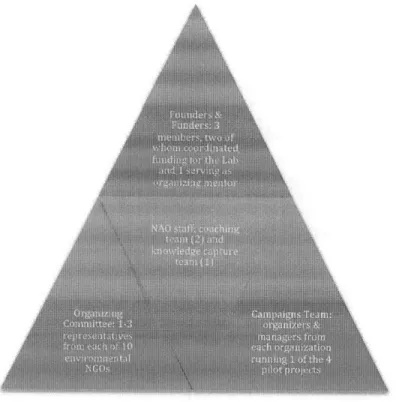
In addition to drawing on the resources of its member organizations, the Climate Coalition maintains two structures to both coordinate its activities and offer a collaborative,
relational space (Kellogg 2009; Polletta 1999) for staff from each pilot campaign to negotiate and learn from the challenges of implementing a grassroots community organizing framework of movement building. The first of these, the Organizing
Committee, coordinates resource allocation, fundraising, and knowledge management for
6 These negotiations, held in December 2009, are known as COPI 5: the 1
5th Conference of the Parties to the
United Nations Framework Convention on Climate Change. More information is available from: http://unfccc.int/meetings/copenhagen dec 2009/meeting/6295.php. Accessed 10 May 2014.
each of the four pilot projects and for the Coalition itself. The Organizing Committee meets
by phone or videoconference once per month for 90 minutes, and in person every six
months for one and a half days. Over the course of my dissertation research, I participated in two multi-day, in-person meetings and four phone meetings. The Organizing
Committee works to balance the Coalition's short-term goals of running campaigns to close a small number of coal-fired power plants with the long-term vision of a climate-focused social movement. The second structural element of the Climate Coalition, the Campaigns Team, brings together the staff organizers of each of the four pilot projects and their direct supervisors for weekly 60-minute meetings on issues relevant to each
campaign. This group offers a venue for the organizational leaders of the four pilot project to share stories, compare organizing and campaign strategies and tactics, and learn from one another together about how to implement the volunteer leadership framework of movement building. It is also a space to explore the challenges facing a particular campaign in terms of resource commitments, volunteer activities, or interactions with local- or state-level political or regulatory bodies. Over the course of my research, I
participated in one, multi-day, in-person campaigns team activity - a kick-off training - and
29 weekly videoconference meetings of the Campaigns Team.
Though the Climate Coalition supported four environmental NGOs running movement-building campaigns in three U.S. cities, my dissertation focuses closely on two of those four campaigns. Specifically, I followed campaigns in Austin, TX and Charlotte, NC, the former directed by a NGO I call "Texas NGO" and the latter run by a NGO I call "North Carolina
NGO." In the remainder of this section, I describe each site in as much detail as is possible
while keeping the organizations anonymous.
Sites: Austin, TX
Texas NGO is one of the largest environmental non-profit organizations in the United States. Founded over 50 years ago, Texas NGO is a national organization with a presence in many states; its size and resources offer it the capacity to coordinate local, state and
national activity on a scale unavailable to most other U.S. environmental groups. The organization has participated in the U.S. political system extensively throughout its history, mostly in electoral campaigns and lobbying efforts on wilderness preservation. Though it boasts a more active membership base than many U.S. environmental NGOs, Texas NGO has faced challenges similar to those of other federated civic association, most notably a tension between centralized authority and volunteer participation (Warren 2001; 34).
In 2010, the organization initiated a nation-wide campaign against coal-fired power plants. The campaign has to-date focused on blocking the construction of new coal-burning
power plants in the U.S. In its coal campaign, Texas NGO has begun to incorporate what it describes as "grassroots organizing" efforts alongside legal and regulatory pressure as strategies to draw on in attacking coal-fired power plants. One element of this national effort, the local campaign in Austin, Texas that is one of the sites for this research, aims to shut down the Fayette Power Project, a large8 coal-burning facility that began operating in
1980 on Fayette Lake, approximately 60 miles southeast of Austin. The Fayette plant is
co-owned by the local utility company Austin Energy and the quasi-governmental Lower Colorado River Authority.
Sites: Charlotte, NC
North Carolina NGO is also a large environmental organization in the United States. Founded over 40 years ago, North Carolina NGO works on a variety of issues including nuclear power and waste, wildlife protection, and pollution using lobbying, corporate campaigns, and direct action. Like Texas NGO, in 2010 North Carolina NGO initiated a nationwide campaign against coal-fired power plants. As a federated organization with a national office and local chapters and groups, North Carolina NGO has the capacity and resources to mobilize coordinated local, state and national activity on a large scale. It has long sought to actively engage its membership - which also provide the majority of its
8 The Fayette plant has the capacity to produce 1,641 mega-watts (MW) of electricity when running at full
funding - in the activities of the organization. As an organizationally-supported test of the utility of community organizing-driven movement building techniques, North Carolina initiated its campaign in the city of Charlotte, NC in September 2011 to close four coal-fired power plants in and around Charlotte: Buck, Riverbend, Marshall, and Allen. All of the plants are owned and operated by Duke Energy, the largest electrical utility company in the United States, which after merging with Progress Energy in 2011 operates 27 coal-fired power plants in the U.S.9
Methods in brief
This is a mixed methods dissertation that draws on a variety of data sources. Because I offer a detailed discussion separately in each chapter of the methods used to support the
analysis and arguments, this section presents an overview of the research approach rather than a detailed discussion of each method. Seeking to study social movement building in action across multiple sites, this dissertation uses a comparative case study approach to both investigate a phenomena within its real-life context - the application of a grassroots organizing framework on social movement participation within and outside organizational frameworks - and because "the boundaries between phenomena and context are not clearly evident" (Yin 1998, 13). The community organizing and movement building
campaigns I follow featured multiple sources of variation, most easily captured through in-depth, comparative case studies. The organizations running each of the pilot campaigns under the auspices of the Climate Coalition varied in terms of mission, resources, existing constituency, and ability to support and create space within their organization for a different type of activity - grassroots organizing of volunteer leadership teams - to take place. The paid organizers varied not only demographically but also in their abilities to mobilize the multiple constituencies of their communities around the closure of the coal-fired power plants at each site. Volunteer leadership teams varied significantly in their ability to function effectively both internally with regard to norms, and goals as well as
9 Of approximately 379 total as of Oct 1, 2011. Data compiled from Duke Energy and Progress Energy
websites: httP://www.duke-energy.com/progress-energy-mr ger. Accessed 15 April 2014.
externally in working to achieve broader campaign objectives. Finally, participants on each campaign also varied across multiple attributes. As a result, this dissertation draws on a variety of complementary data collection methods: internal campaign metrics, surveys of volunteers, focus groups, semi-structured interviews, and participant observations (Kritzer
1994; Snow & Trom 2004; Yin 2003).
In sum, I describe social movement building campaigns based on a grassroots community-organizing framework. I seek to be responsive to increased calls for social movements researchers to look broadly at movement "outcomes" rather than simply at success and failure (Gamson 1990; Tarrow 1994; McAdam et al. 2001; Andrews 2004). Each of these
campaigns sought to build community power aimed at closing one or more coal-fired power plants in order to create the impetus and framework for a national climate-focused social movement. The volunteer leadership framework of grassroots organizing adopted
by the Climate Coalition and its pilot projects emphasizes the role of organizers in
catalyzing relationships among constituent leadership as well as the constituency itself on the basis of shared values communicated through narrative. Organizers recruit individuals in a community to form leadership teams of volunteers who, ideally, then become hubs of local campaign activity, recruiting more volunteers and managing new teams of volunteer leaders (NOI 2011). Using story-telling to reveal shared interests and resources on which commitments to work together may be developed, organizers seek out face-to-face meetings with potential volunteers as the setting in which these stories may be shared. The volunteer leadership model of organizing adopted by the Coalition places much of the onus for executing the day-to-day activities of a movement in the hands of the volunteer leaders identified and tested in the base-building phase of the campaign (Ganz et al. 2008).
Chapter Overview
Chapter 1 examines the collaborative network of environmental NGOs known as the Climate Coalition. In this chapter, I describe a collaborative action network comprised of 10
Collaborations between organizations frequently end in failure. The literature on strategic alliances between firms and cross-sector partnerships between firms, NGOs, and local government offers multiple perspectives on why these collaborations form, a set of
tensions they must negotiate, and examples of failure. This literature, however, has little to say about collaborations between NGOs, where competition between organizations is minimal. The research on NGO partnerships and networks, on the other hand, focuses primarily on the structures and governance of these organizational collaborations, but does not connect these structures and governance mechanisms to failed collaborations.
Drawing on participant observation and semi-structured interviews, I argue that the failure of this NGO-NGO collaboration shared its basis with the failures of other types of
organizational collaborations. Finally, I discuss how the hybrid governance system of this network was the mechanism by which the network's internal tensions were made visible.
Chapter 2 analyzes two of the environmental NGOs participating in the Climate Coalition to understand the organizational implications of adopting a new approach to their activities on climate change. How organizations undertake - and resist - change remains
highly contested and uncertain; in this chapter, I compare the struggles of two large U.S.
environmental NGOs to more actively involve their members in organizational activities than they had done in the past. I specifically examine the use of community engagement organizing - where an organizer identifies, recruits, and develops volunteer leadership within a community to produce change - as a mechanism for democratizing
organizational decision-making. In answer to the question why these NGOs were ultimately unable to meaningfully incorporate community organizing - even as they devoted substantial resources to its adoption - I show that existing organizations relied on a model of professional expertise for their legitimacy and historical policy successes. As such, they excluded public participants from meaningful roles and as a result, failed to sustain commitments to new structures and practices.
Chapter 3 looks closely at the volunteer members of one of the environmental NGOs from the Climate Coalition, and explores the role of community organizers in recruiting,
retaining, and cultivating volunteer expertise and leadership in movement organizations. In it, I examine one U.S. environmental organization's efforts to identify, recruit, and sustain a volunteer base for activism on climate change. I look specifically at the NGO's community organizing activities to understand their community organizer's role in catalyzing
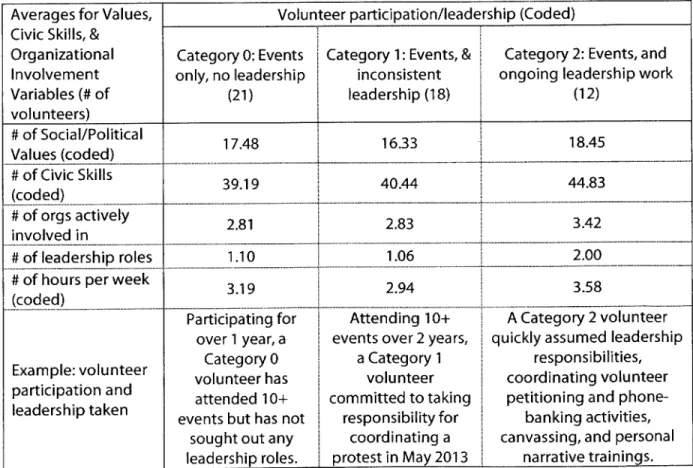
volunteer engagement in nascent social movements in sites with little history of activism. Drawing on two years of participant observation with the NGO's organizer and volunteers, a survey of the active volunteers, and semi-structured interviews with organizational staff and volunteers, I show that for this site, volunteer recruitment follows similar patterns as in past social movements. The most active and committed volunteers in my research had greater civic skills, organizational ties, and experience with activism. But these attributes did not translate into helping the NGO grow a bigger base of volunteer activists. Building on the literature on volunteer recruitment to low and high-risk activism and the research on political participation, I look at the community organizer as not only a professionalized recruitment mechanism, but also as a volunteer leadership and expertise development agent. I argue that professionalized recruitment and management of volunteer
participation within a movement organization by a trained, paid organizer produces long-term volunteer retention and satisfaction alongside positive movement outcomes. For the case of the North Carolina movement organization, the arrival of an experienced organizer in 2011 helped to establish and cultivate a thriving, committed base of volunteer leaders in a challenging environment for activism.
Chapter 1
Networking a Movement: Structuring and managing an action network across environmental organizations
"When you're willing to leave your branding and your organizational objective aside and work together, you're also much more focused just on your purpose. But I think that also does pose a hard thing for our organizations, to be willing to commit resources to something that may not actually grow our brand or whatever, but [the Climate Coalition] may in fact be the type of environment to push that edge." - Beth (10.19.2011)
"I think that we actually were somewhat intentional in saying that this wasn't going to be a body that coordinated the movement. And we're very intentional about calling this an
experiment: we were all really focused on doing learning a new way to coordinate and mobilize and change the organizations that we're working in." - Jessica (10.19.2011)
In this chapter, I explore the turn within the U.S. environmental movement from policy networks to action networks as forms of organizational collaboration. While U.S.
environmental organizations have previously collaborated in coordinated networks to advance shared interests through policies at local, state, and national levels of government (Bosso 2005; Kroll 2013; Vig & Kraft 1994), these organizations have rarely, if ever, joined together in action networks to develop and deploy grass-roots human capital for activism and advocacy. As NGOs in all sectors increasingly seek to leverage their limited resources and to actively learn best practices from one another, they turn more frequently to action networks as a mechanism for doing so (Saz-Carranza 2012). However, most scholarship on inter-organizational networks focuses on the impacts - rather than the management and governance - of these networks, leaving U.S. environmental organizations with little guidance as to how they might most effectively form, operate, and sustain these action-focused collaborations. But the difficulty of re-configuring network structures after establishment - and the tight coupling between network governance and organizational
commitment to network goals and activities - suggests a focus on governance is essential to the effectiveness, and survival, of inter-organizational networks.
I focus here on one such network of organizations - the Climate Coalition - working
collaboratively to accomplish more than each NGO could achieve on its own, and I argue that the structure and management of action networks significantly impacts network
longevity, and indirectly, impact. I analyze the possible explanations for why this alliance collapsed only nine months after its inception to understand the possible barriers to future
networks of environmental organizations, a potentially necessary precondition of a climate movement in the U.S. and globally (Skocpol 2013). Drawing on ten months of
ethnographic research on the formation, operation, and disintegration of this network, I show that despite selecting the most appropriate governance mechanism for the network
- on the basis of the trust, size, goal consensus and network-level competencies - the
alliance collapsed prematurely. I describe the management of tensions inherent in inter-organizational collaborations to show what appeared to be reasonable and appropriate governance structures are nonetheless incompatible with each organization's day-to-day activities, inhibiting forward-moving organizational progress. I analyze the possible explanations for why this alliance collapsed to understand the possible barriers to future networks of environmental organizations, a potentially necessary precondition of a climate movement in the U.S. and globally.
Network Structure and Governance
Research on networks offers a distinct perspective on inter-organizational collaboration. Though the vast majority of research on networks frames them as an analytic perspective on relations between actors (Granovetter 1985, Burt 2004), networks can also be analyzed as an organizing logic alongside hierarchies and markets (Kilduff & Tsai 2003; Knight 2005; Powell 1990; Powell et. al, 2005). An inter-organizational network is "a long-term
cooperative relationship among organizations in which each entity retains control over its own resources but jointly decides with others on their collective use (Saz-Carranza 2012, 2).
While inter-organizational collaborations in the form of alliances and cross-sector partnerships use contractual mechanisms or formal agreements to resolve tensions and coordinate activities, networks typically mediate conflict through negotiation and
reciprocity, and imply mutual adjustment between interdependent organizations (Powell
1990). In the face of complex, "wicked" problems (Rittel & Webber 1973; Roberts 2000)
-like collective action in the face of uncertainty on issues such as climate change - goal-directed inter-organizational networks are important "formal mechanisms for achieving multi-organizational outcomes, especially in the public and nonprofit sectors where collective action is often required for problem solving" (Provan & Kenis, 2008; 231).
Much of the scant research on inter-organizational networks has sought to theorize and characterize their structures and key points of tension rather than produce explanations for network instability or dissolution. Though some inter-organizational networks may be passive knowledge-sharing mechanisms, I focus here on the more common goal-directed networks, which can take four potential forms: informational, developmental, outreach, and action (Agranoff 2007). In this schema, informational networks exist to exchange information between organizational members of the network; developmental networks add education and member services, while outreach networks additionally "sequence programming, exchange resource opportunities, and pool contacts" (Saz-Carranza 2012,
6). Action networks are the most 'directed'form of inter-organizational networks, offering
both the greatest potential leveraging of organizational resources through collaborative action but also requiring the greatest amount of coordination and governance.
The decision on an action network's governance mechanism at the time of formation shapes not only the activities of the network but also the relationships between
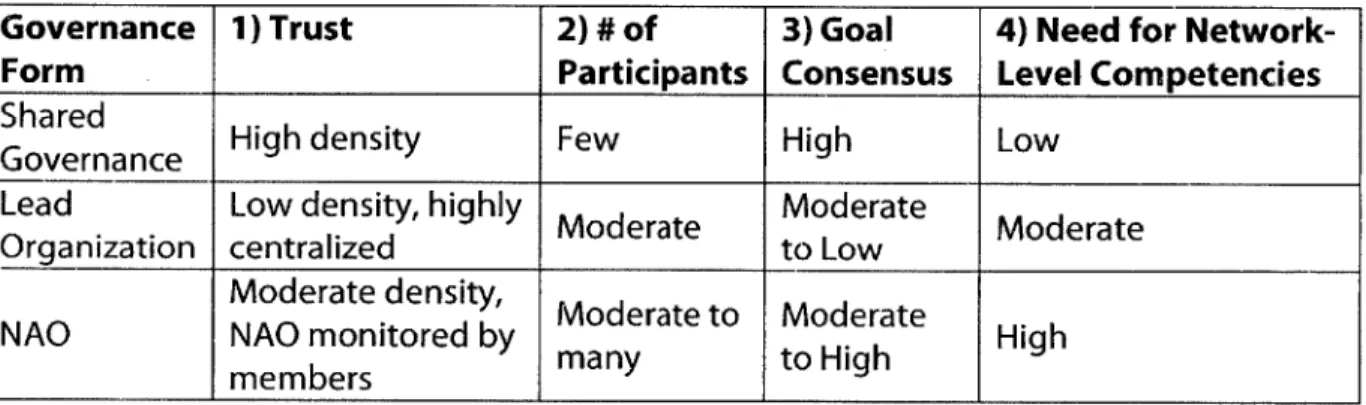
organizations within the network. As Table 1 below illustrates, Provan and Kenis (2008) describe three modes of network governance: shared governance, governance by a single "lead" organization, and governance by a network administrative organization (NAO), "a separate entity... set up specifically to govern the network" (236). Put a different way, while inter-organizational network governance can be shared informally across network
members or undertaken by a single network member, it can also be delegated to a separate entity created specifically to oversee and coordinate the network (Saz-Carranza 2012; 7). This third form of network governance, via NAO, removes network-level
administrative responsibilities and any resulting tensions from each participating organization (Provan et al. 2004). Instead, the network typically establishes a governing
board - with representatives from most if not all members of the network - to oversee the strategic elements of the network, leaving the NAO with solely operational and
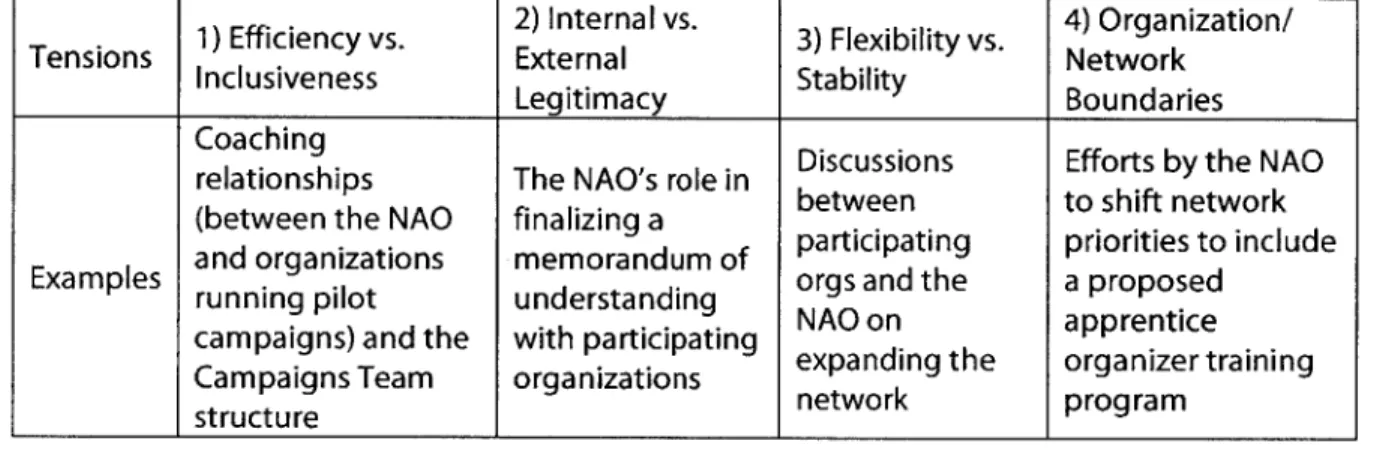
administrative responsibilities (Goldsmith & Eggers 2004). However, by inserting a third party into coordinated activities between organizations and decisions on organizational involvement in the network, selection of a NAO mechanism introduces the possibility of tensions arising between the NAO and network organizations that are not present in the other forms of network governance.
Table 1: Four Criteria for Network Governance Mechanism Selection'0
Governance 1) Trust 2) # of 3) Goal 4) Need for
Network-Form Participants Consensus Level Competencies
Shared
Governance High density Few High Low
Lead Low density, highly Moderate Moderate Moderate
Organization centralized to Low
Moderate density, Moderate to Moderate
NAO NAO monitored by many to High High
members
The literature on network effectiveness and network governance proposes a set of criteria
by which each network should be structured. Provan and Kenis (2008) argue that the
choice of governance mechanism should be connected to a network's position on four continuums: trust, number of network participants, consensus on common goal, and need for network level competencies (237). The first, trust, can spread asymmetrically across the
network and be concentrated between groups of organizations, but networks are most effective when trust is distributed relatively equally across them. Most of the research on 10 Drawn from Provan & Kenis 2008; Saz-Carranza 2012).
organizational trust has focused on the general desire for trust within collaborations and the different ways in which trust is demonstrated, focusing mostly on reputational effects based on trust of individual network members (Uzzi 1997). Still, a brokered network can deemphasize trust somewhat, as instead of monitoring one another, the organizations in the network merely need to monitor the NAO. The second, size, finds an NAO governance mechanism most appropriate for large networks simply because of the challenge of coordinating large numbers of organizations (Human & Provan 2000). The third, goal consensus, blurs the distinction between shared goals and organizational homophily, as
low goal consensus begs the question of network participation in its entirety. Moderate goal consensus is then the baseline for participation, and only the need for high goal consensus demands a highly-brokered, NAO form of governance; this category is where the difference between organizational goals and network goals is made manifest (Provan
& Kenis 2008). The final continuum, network-level competencies, centers on the added
value of the collaboration to the organizations participating; some researchers suggest that NAO governance fits networks with an outsized need for network-level competencies
(Saz-Carranza 2012). But while the nature of these competencies remains unexplored, their impact on network effectiveness cannot be understated.
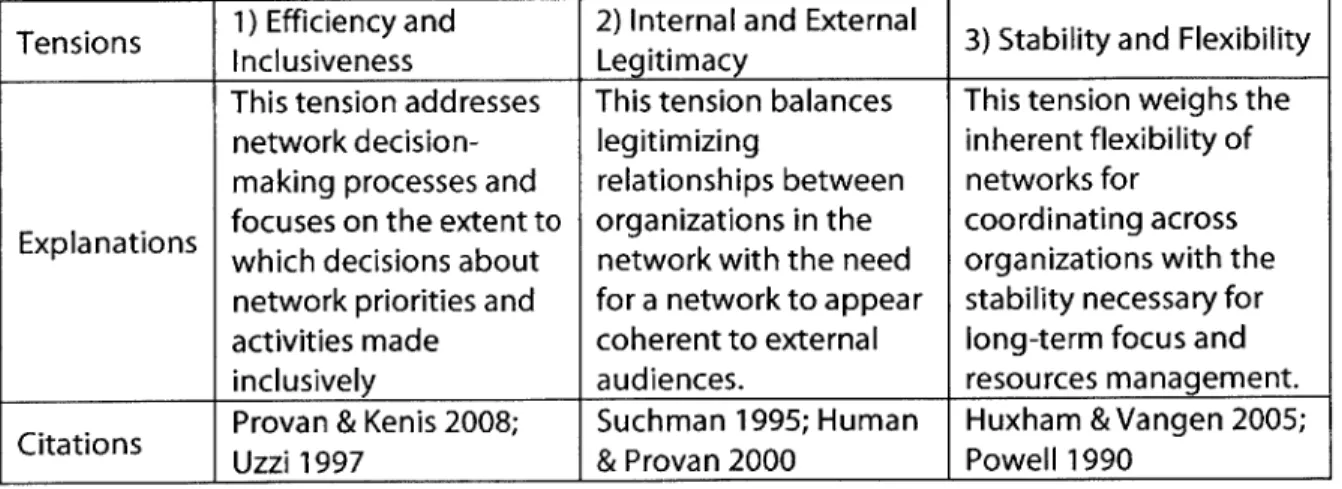
Table 2: Inherent Tensions in Inter-Organizational Networks and Collaborations
Tensions 1) Efficiency and 2) Internal and External 3) Stability and Flexibility
Inclusiveness Legitimacy
This tension addresses This tension balances This tension weighs the network decision- legitimizing inherent flexibility of making processes and relationships between networks for
Explanations focuses on the extent to organizations in the coordinating across
which decisions about network with the need organizations with the
network priorities and for a network to appear stability necessary for activities made coherent to external long-term focus and
inclusively audiences. resources management.
Provan & Kenis 2008; Suchman 1995; Human Huxham &Vangen 2005;
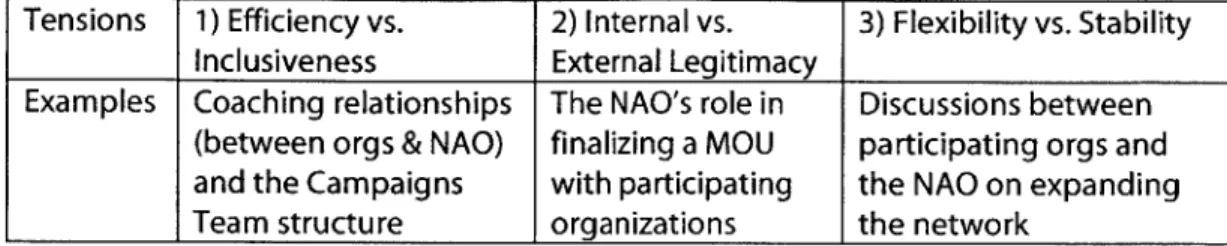
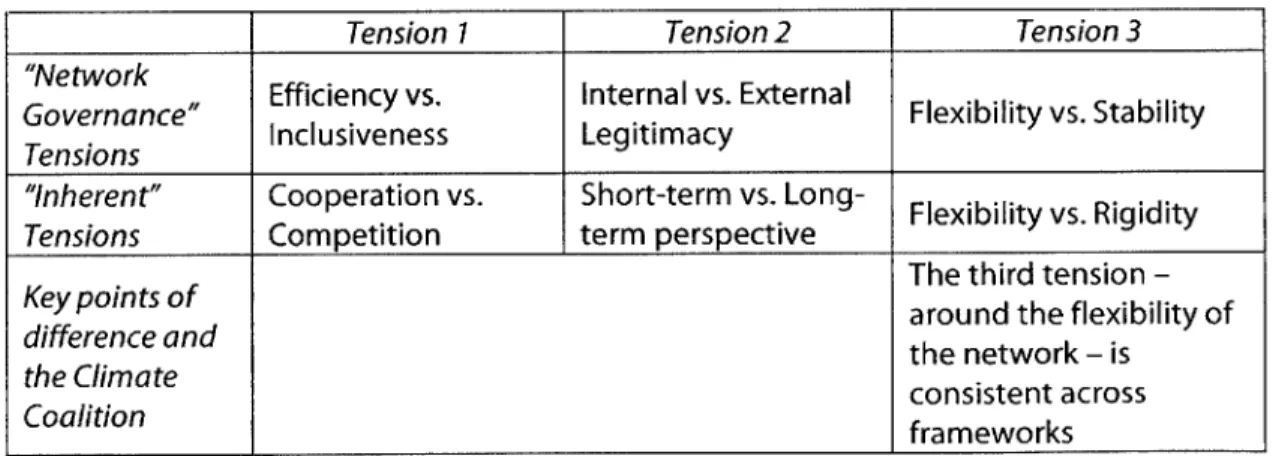
The effectiveness of an inter-organizational action network - and its survival - derives from matching a network's position on the four continuums with its choice of governance mechanism. With the appropriate governance structure, a network balances three primary tensions - between efficiency and inclusiveness, internal and external legitimacy, and
stability and flexibility - present in all networks (see Table 2, above). Relatedly, Saz-Carranza (2012) argues that efforts to balance these three network tensions are both
necessary and inherently paradoxical; the network governance mechanism needs to maintain unity across network members with regard to goals, strategy, and tactics, while allowing for sufficient inter-organizational diversity. In addition, research on network governance - particularly the limited research on NAO governance - generally assumes an action network to be stabilized and functional.
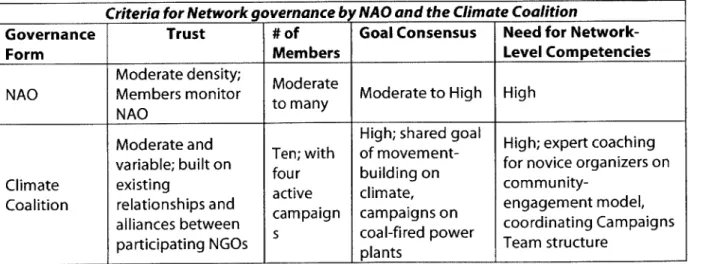
But for newly formed action networks, implementing a functional governance system, or having a network for an NAO to manage, is not a straightforward affair. A network's governance system needs to be implemented as well as selected, and the literature on network governance selection does not provide sufficient guidance with regard to implementation. In this paper, I present a case study of an inter-organizational action network, focusing on the implementation of network governance as an explanatory mechanism for understanding the failure of the network. I describe the Climate Coalition, the network of environmental organizations on which this paper focuses, as an "action" network that incorporates an explicit governance mechanism and sometimes (but not always) adopts a common collaborative course of action (Saz-Carranza 2012, 6). I describe the process by which the Coalition came select a NAO mechanism for network governance and then sought to implement a NAO governance structure formalize the nascent
network. Drawing on ten months of ethnographic research on the formation, operation, and disintegration of the Coalition, I show that despite selecting the most appropriate governance mechanism for the network - on the basis of the trust, size, goal consensus and network-level competencies - the Coalition failed to negotiate the expected set of tensions and ultimately dissolved.