READ THESE TERMS AND CONDITIONS CAREFULLY BEFORE USING THIS WEBSITE. https://nrc-publications.canada.ca/eng/copyright
Vous avez des questions? Nous pouvons vous aider. Pour communiquer directement avec un auteur, consultez la
première page de la revue dans laquelle son article a été publié afin de trouver ses coordonnées. Si vous n’arrivez pas à les repérer, communiquez avec nous à [email protected].
Questions? Contact the NRC Publications Archive team at
[email protected]. If you wish to email the authors directly, please see the first page of the publication for their contact information.
NRC Publications Archive
Archives des publications du CNRC
This publication could be one of several versions: author’s original, accepted manuscript or the publisher’s version. / La version de cette publication peut être l’une des suivantes : la version prépublication de l’auteur, la version acceptée du manuscrit ou la version de l’éditeur.
Access and use of this website and the material on it are subject to the Terms and Conditions set forth at Product modeling: helping life cycle analysis of roofing systems
Vanier, D. J.
https://publications-cnrc.canada.ca/fra/droits
L’accès à ce site Web et l’utilisation de son contenu sont assujettis aux conditions présentées dans le site LISEZ CES CONDITIONS ATTENTIVEMENT AVANT D’UTILISER CE SITE WEB.
NRC Publications Record / Notice d'Archives des publications de CNRC: https://nrc-publications.canada.ca/eng/view/object/?id=171780e1-5bec-4064-9c5f-672e46bba525 https://publications-cnrc.canada.ca/fra/voir/objet/?id=171780e1-5bec-4064-9c5f-672e46bba525
PRODUCT MODELING: HELPING LIFE CYCLE ANALYSIS OF ROOFING
SYSTEMS
Dana J. Vanier, National Research Council Canada ABSTRACT
The Building Envelope Life Cycle Asset Management (BELCAM) project is researching methods to predict the service life of roofing systems. Because the IT industry in construction has been “design centric” for a number of decades, very little has been done in the area of the life cycle analysis of existing facilities. However, the design and construction phases of these built assets occupy an insignificant time span in the life cycle of a building and the costs of these two phases are minor in comparison to the life cycle costs (including personnel wages, overheads, etc.) of the operations of that facility. Buildings and urban infrastructure are constructed and maintained to last decades, centuries, and at times, indefinitely. The data, models and supporting software systems that represent these built assets should also serve the facility owner for those same time frames.
However, it would be virtually impossible to find and regenerate a simple word processing file from 10 years ago (remember the CP/M operating system and Wordstar). How could a maintenance manager in the year 2020 retrieve data from AutoCAD 14 running on an antique Pentium Pro II from the year 1998. There are two major problems identified above: (1) how to handle the archival and retrieval of historic information, and (2) how to ensure the upwards compatibility of data, systems and models of our existing and proposed assets. This paper proposes using product models to address these issues. Although considerable work has been done in the STEP (STandard for the Exchange of Product model data) and IAI (Industry Alliance for Interoperability), very little can be used currently to address the needs of asset managers. This paper presents a state of the art for product modeling; the focus domain is roofing systems. It identifies the need for data integration, not only for CAD systems but also between financial, maintenance and inventory databases. A prototype product model is presented and discussed for roofing systems.
Keywords: Product Modeling, Roofing, Information Technology, Life Cycle Analysis
RESUME
Le projet de la gestion des biens au cours du cycle de vie de l’enveloppe des bâtiments (BELCAM) vise à trouver des méthodes pour la prévision de la durée de vie des systèmes de couverture. Les efforts de la technologie de l’information (TI) dans le domaine de la construction s’étant concentrés pendant plusieurs décennies sur la conception proprement dite, très peu de recherches ont été effectuées en ce qui concerne l’analyse de la durée de vie des installations existantes. Et pourtant, les phases de conception et de construction de ce type de biens n’occupent qu’un laps de temps réduit dans la durée de vie d’un bâtiment et les coûts de ces deux phases sont mineurs comparés aux coûts du cycle de vie (dont les salaires du personnel, les frais généraux, etc.) inhérents au fonctionnement de cette installation. Les bâtiments et les infrastructures urbaines sont construits puis entretenus pendant des
décennies, des siècles, voire une durée indéterminée. Les données, les modèles et les systèmes d’aide logicielle qui sont associés à ces constructions doivent aussi être à la disposition du propriétaire de l’installation pendant la même durée.
Il serait cependant impossible de retrouver et de produire un simple fichier de traitement de texte écrit dix ans plus tôt (rappelons-nous le système CPIM et le logiciel Wordstar). Comment un gestionnaire de maintenance pourrait-il en 2020 extraire des données d’AutoCAD 14 qui tournait sur Pentium Pro II en 1998 ? Deux problèmes majeurs sont donc soulevés : 1) comment traiter l’archivage et l’extraction de données historiques ? 2) comment assurer une compatibilité verticale des données, des systèmes et des modèles de nos biens existants et à venir ?
L’auteur propose une solution par le biais des modèles de produit. Un travail considérable a déjà été fait par le STEP (STandard for the Exchange of Product model data) et l’IAI (Industry Alliance for Interoperability), mais seule une partie infime de ce travail concerne les besoins des gestionnaires de biens. Cet article présente l’état actuel des connaissances dans le domaine de la modélisation de produits axée principalement sur les systèmes de couverture. Il souligne le besoin d’intégration des données, non seulement pour les systèmes CAD mais aussi entre les bases de données des systèmes de finances, de maintenance et de gestion des stocks. Un prototype de modèle de produit pour les systèmes de couverture y est présenté et analysé.
INTRODUCTION
The Building Envelope Life Cycle Asset Management (BELCAM) project addresses key, growing concerns of asset and building managers regarding when and how to repair their building stock. These managers must optimize the results of their maintenance expenditures, while maximizing the value of the asset over its life cycle. The dollar amounts involved are significant: a review of recent construction statistics shows that Canada spends $52 billion on building construction every year, while $8.5 billion of this amount is spent on repairs and maintenance to buildings! These numbers are ten times higher in the United States. In addition, some major property owners have forecast reductions in their operating and maintenance budgets. To make matters worse, economic trends suggest that the next 10 years will be times of decreased revenues and dwindling profit margins.
At present, managers have few tools, either as literature or intelligent computer software, to assist them in the decision-making process of how and when to maintain, repair or replace ageing and failing systems. The BELCAM project is addressing these needs by researching methods to predict the service life of building envelope systems (Vanier and Lacasse, 1996). The project concentrates on roofing systems, as a “proof of concept”, but will apply the tools, procedures and methods to other building envelope systems in future phases of the BELCAM project.
Asset Management
The Information Technology (IT) industry in construction has been “design centric” for a number of decades; as a result, very little has been done in the area of information technologies for the life cycle analysis of existing facilities. However, the design and construction phases of these facilities occupy an insignificant time span in the life cycle of a building and the costs of these two phases are minor in comparison to the life cycle costs
(including personnel wages, overheads, etc.) of the operations of that facility. Some researchers have estimated that operations, maintenance and repair costs for a facility account for over 80 % of the life cycle costs (Svensson, 1998).
Buildings and urban infrastructure are designed and constructed to last decades, centuries and at times indefinitely; however, proper maintenance, repair and rehabilitation must be carried out. The data, models and supporting software applications that represent the built environment must also have equivalent life spans. Some interesting numbers illustrate the dichotomy between life spans of facilities and their virtual equivalents: computer hardware has a component life span of 3 to 5 years; software has a life span of 2 to 10 years; users have a period of employment at one facility from 1 to 40 years, and information about one facility must span between 1 and 100 years (Svensson, 1998).
This poses a dilemma for the construction industry, when one remembers that it would be difficult, if not impossible, to find and regenerate a simple word processing file generated 10 years ago (remember the CP/M operating system and Wordstar). The author presents the following questions: (1) How can an asset manager in the year 2020 retrieve data from an AutoCAD 14 file that was last run on an obsolete (and unattainable) Pentium machine, and (2) what will it cost to constantly update all files, software and hardware approximately every 2 to 5 years?
Problem Identification
The BELCAM project has a number of immediate and long-term IT needs: interoperability between a number of sophisticated engineering applications, standard protocols for intercommunication with office support systems, and life cycle management of data.
In fact, there are two major problems identified above: (1) how to handle the archival, retrieval and integration of historical information, and (2) how to ensure the upwards compatibility of data, systems and models of our existing and proposed assets.
This paper proposes using product models to address these issues. Although considerable work has been done in the STEP (STandard for the Exchange of Product model data) and IAI (Industry Alliance for Interoperability) communities, it can be proven that very little is of use to asset managers.
Outline of Paper
This paper presents a state-of-the-art for product modeling; the focus domain is roofing systems. The paper identifies the need for data integration, not only between CAD systems but also among financial, maintenance and inventory databases. A prototype product model for roofing systems is presented and discussed.
This paper is the first “strawman” in the development of a comprehensive roofing maintenance product model. Subsequent papers will describe the evolution of the BELCAM product model (Vanier and Nesje, 1998).
PRODUCT MODELING AND ROOFING SYSTEMS
Product modeling in the building and construction domains has primarily concentrated on design and construction. However, product data models “should serve information handling throughout the design, manufacturing and usage phases of the life-cycle of the product with
the purpose of computer-integrated design of the product and/or computer-integrated manufacturing and/or computer integrated information handling within the usage phase” (Svensson, 1998). The product data model should permit the exchange of geometric data, as well as, the intercommunication of product data throughout a product’s life-cycle.
Problems with Existing Commercial Protocols
The software industry has served poorly the construction domain, in terms of compatibility and data exchange. New versions of software and hardware are being constantly delivered, with little consideration for the customers’ existing data files. In the meantime, vast amounts of time are being consumed by CAD managers in data conversion; which is proving to be both expensive and time-consuming, while providing unreliable results. This CAD data conversion may help designers, but neither does it address the long term needs of asset managers nor guarantee interoperability with related financial, maintenance and inventory databases.
The current commercial exchange protocols (DXF, etc.) are not sufficiently robust or ubiquitous to address all interoperability problems faced by asset managers, and they further limit the customers’ flexibility by compelling them to remain with one software vendor. On other fronts, considerable time and effort has been devoted to interchange standards such as the Initial Graphics Exchange Specification (IGES) and the Product Data Exchange Specification (PDES), but with limited acceptance in the construction domain.
DWG Unplugged and OpenDWG
Two protocols for interoperability are directly related to the AutoCAD “.dwg” file format; however, there are currently major debates over who can use these protocols. “DWG Unplugged Release 14 is a library and API that corporate developers, third-party software developers and system integrators use to programmatically access the data stored in AutoCAD® DWG and DXF® files” (DWG Unplugged, 1998). This protocol enables developers to distribute DWG data to third party client applications. “The architecture of AutoCAD Release 14 makes it possible to extract from the AutoCAD source base that portion of code which reads and writes AutoCAD DWG files ... Autodesk delivers this as a stand-alone library for third-party application developers to use in creating new software applications.” (DWG Unplugged, 1998).
“The OpenDWG Alliance began 2-1/2 months ago by releasing MarComp's AutoDirect 2 API (renamed the OpenDWG Toolkit), which allows programmers to read and write AutoCAD DWG files” (Gabrowski, 1998). However, there are considerable concerns regarding who can use the DWG Unplugged protocol discussed above: “Autodesk has a selective licensing process, where it only licenses DWG Unplugged to 'friendly' corporations. The list of [OpenDWG] alliance members consists of those who are denied -- by Autodesk -- access to DWG Unplugged" (Gabrowski, 1998).
It appears that from the confrontation described above, neither OpenDWG nor DWG Unplugged can fully address the interoperability needs of the construction industry.
Common Industry Material Identification Standard (CIMIS)
The Common Industry Material Identification Standard (CIMIS, 1998) is a inter-industry initiative providing common identifiers / standard descriptions for commodity materials used in the construction, maintenance and operations of components by Original Equipment Manufacture (OEM). CIMIS’s principal emphasis is for industrial facilities and process plant,
primarily piping equipment. CIMIS is essentially a commercial service that allows components or equipment suppliers to obtain unique identifiers for products from an agreed classification scheme held in a STEP-based repository (CIMIS, 1998). CIMIS was following a pragmatic incremental approach which had proved very successful, but there had been problems maintaining commercial commitment (CIMIS, 1998).
Product Modeling Initiatives
In the absence of readily available solutions, initiatives such as the Standard for the Exchange of Product Model Data (STEP, 1998) and the Industry Alliance for Interoperability (IAI, 1998), hold the only hope for data exchange for life cycle asset management.
Standard for the Exchange of Product Model Data (STEP)
“ISO 10303 is an International Standard for the computer-interpretable representation and exchange of product data. The objective is to provide a neutral mechanism capable of describing product data throughout the life cycle of a product, independent from any particular system. The nature of this description makes it suitable not only for file exchange but also as a basis for implementing and sharing for product databases and archiving” (ISO 10303, 1998) To date, most STEP efforts in the building field focus on structural engineering (CIMSteel, 1998) or the development of a Building Construction Core Model (BCCM, 1998); so there is little hope for the near-term interoperability of discipline domains such as roofing systems. The research done to date in the BCCM provides a vague start point for a roofing maintenance product model. The definitions in Table 1 appear in the research literature:
Table 1 Definitions of BCCM Roofing Terms (Part106, 1998)
Part Entity Description
4.2.208 Roof Construction that encloses a building from above. 4.2.209 RoofSection A part or section of a roof.
4.2.228 Storey An identifiable space in a building between two consecutive floors or between a floor and a roof which is normally identified according to its relative vertical position or level.
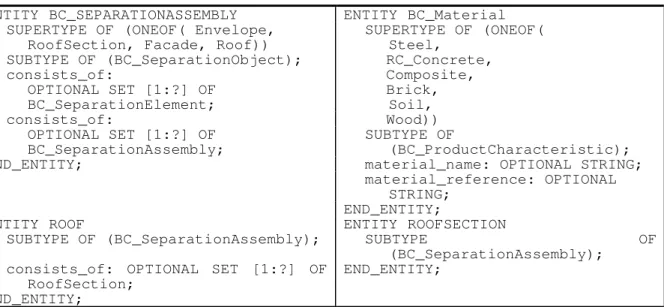
Table 2 EXPRESS Notation of Roofing Entities (Part106, 1998)
ENTITY BC_SEPARATIONASSEMBLY ENTITY BC_Material
SUPERTYPE OF (ONEOF( Envelope, RoofSection, Facade, Roof))
SUPERTYPE OF (ONEOF( Steel,
SUBTYPE OF (BC_SeparationObject); RC_Concrete,
consists_of: Composite, OPTIONAL SET [1:?] OF BC_SeparationElement; Brick, Soil, consists_of: Wood)) OPTIONAL SET [1:?] OF BC_SeparationAssembly; SUBTYPE OF (BC_ProductCharacteristic);
END_ENTITY; material_name: OPTIONAL STRING;
material_reference: OPTIONAL STRING;
END_ENTITY;
ENTITY ROOF ENTITY ROOFSECTION
SUBTYPE OF (BC_SeparationAssembly); SUBTYPE OF
(BC_SeparationAssembly); consists_of: OPTIONAL SET [1:?] OF
RoofSection;
END_ENTITY; END_ENTITY;
Karhu (1997) carried out research in a closely related area of precast facade components; his conceptual schema is based on a prototype using existing software. Karhu tested the prototype with architectural and structural designers, and a component manufacturer. The main conclusions of his report were that the data produced in the architectural design can be used in further design. Although the author investigated the use of product models for prefabricated building facade components, he did not venture into the area of roofing systems; and the maintenance aspects of the facade components were outside of the scope of his report. By his observation, many of the product models presented to date are theoretical in nature and not ready for implementation in practice (Karhu, 1997)
Industry Alliance for Interoperability (IAI)
The Industry Alliance for Interoperability (IAI, 1998) has started work on their Industry Foundation Classes (IFCs) in a number of design disciplines, as well as facilities management. Rather than start from a blank sheet of paper, the IAI decided that STEP’s Building Construction Core Model should be used as the basis for the development of its IFC Core Model. The continuing work on the IAI’s IFCs now provides results back to the enhancement of the BCCM, primarily by providing industry validation of model concepts.
Release version 2.0 of the IFCs will address some aspects of roofing design (See, 1998). This should include component breakdown to slabs, frames, drainage, joints, scuppers, etc. The roofing system (which is of interest to the BELCAM project) will be represented by a multi-layer set that defines the components. It is anticipated that the roofing design IFCs will be available in late 1999.
Integrating Facilities Management Information (KBS Model)
Recent work by Svensson (1998) focuses on the use of product and process models for integrating facilities management information. Svensson’s review and evaluation of product modeling in this domain encourages others to follow his lead; he feels that building product models would provide: great opportunities for modular development of systems, starting points for object-oriented methodology, possibilities for integration of data and methods, and better conditions for the application of innovative information systems technology such as open systems, client -server architectures and multimedia (Svensson, 1998).
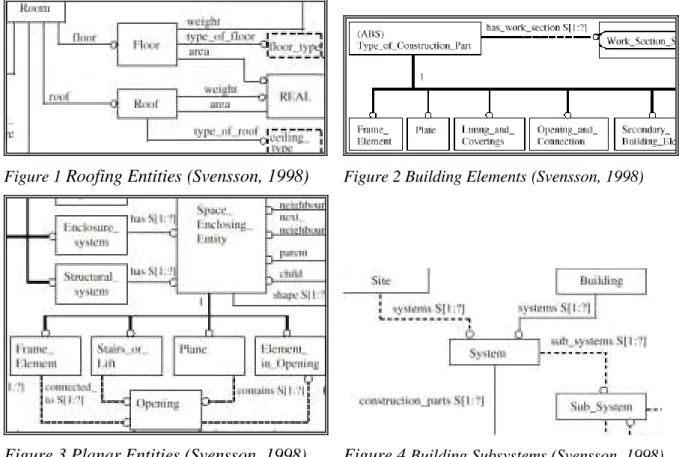
Although the author does not focus on roofing systems, his work presents potential schema representations in closely-related areas. Examples can be found in Figures 1 through 4 (only relevant portions of the EXPRESS-G notation is illustrated). Generally, these figures indicate a broad, but shallow approach to the classification of enclosure systems. Table 3 provides the EXPRESS notation for typical enclosure entities:
Figure 1 Roofing Entities (Svensson, 1998) Figure 2 Building Elements (Svensson, 1998)
Figure 3 Planar Entities (Svensson, 1998) Figure 4 Building Subsystems (Svensson, 1998)
Table 3 FM Entities (Svensson, 1998)
ENTITY Facility; ENTITY Space_Enclosing_Entity
surrounding : SET [1:?] OF
Surrounding; element : SET [1:?] OF Facility_Element; fulfils_opr : SET [1:?] OF SUPERTYPE OF (ONEOF(Frame_Element, Stair_or_Lift, Plane,Element_in_Opening)); Operational_Requirement; fulfils_enr : SET [1:?] OF surface : SET [1:?] OF Material_Surface; Environmental_Requirement; END_ENTITY; locates : SET [0:?] OF Space_Entity; ENTITY Plane shape : SET [1:?] OF Enclosing_Entity_Shape; SUBTYPE OF INVERSE (Space_Enclosing_Entity);
contains : OPTIONAL SET [1:?] OF Opening;
identification : SET[0:1] OF enc_id FOR item;
attribute : SET[0:?] OF
END_ENTITY; enc_attribute FOR item;
END_ENTITY;
Svensson (1998) also identifies some data requirements for facilities management applications including: tenancy codes, system code/type/class, maintenance work classification, cost of materials, and units of material measurement. Svensson also identifies data requirements for maintenance management: time and date of notification of defect, time and date of data
feedback, organization unit, and cost of work for own employees or contractors. These data provide a good starting block for the required asset management information.
In concluding, Svensson (1998) found it was possible to: • integrate existing FM systems to prototype systems,
• use as-built drawings and other important FM documents with the prototype,
• link graphical elements/construction parts in the drawings to information in the prototype database, and
• use the prototype system to generate feed-back on the tenant’s core business and on operation and maintenance cost.
However, Svensson’s (1998) evaluation of the prototypes highlights the fact that the generation of spatial data is problematic, if existing CAD drawings are used to provide the data input. These problems demonstrate the importance of manually checking and correcting the building product model.
Notwithstanding these problems, in a summary of the general situation for facilities management, Svensson (1998) identifies some of the many favourable conditions for the development of user-friendly and integrated applications to include PC-based computing, pen-based computers, object-oriented programming, database technology, the Internet, and product data technology.
DEVELOPING A ROOFING MAINTENANCE PRODUCT MODEL Systems Approach
It is evident from the research discussed above that there has been little work in the area of product model of roofing systems, and even less on the modeling of roofing maintenance management. The long term objectives of the BELCAM roofing maintenance product modeling are: (1) to develop a product model for a specific series of applications related to roofing inspection and maintenance, (2) to test the product data model in the required application domain, (3) to enhance the product model with flexibility and robustness in areas such as energy analysis, redesign, costing and inventory systems, and (4) to recommend the roofing maintenance product model for standardization. Subsequent reports by the BELCAM team will address points (3) and (4).
Research Hypotheses The author firmly believes that:
(1) Product models for the construction industry must be developed in individual construction domains, by the domain experts. CIMSteel (1998) was developed from requirements in one specific domain: the same should hold true for other application areas, such as roofing systems or maintenance management. This paper presents preliminary work to develop a roofing maintenance product model, to address the needs of the BELCAM project.
(2) The route to standardization begins with well-accepted protocols and procedures, and not from good intentions to create good standards. That is, standards bodies should standardize well-accepted practice, and not derive standards from hypothetical needs. The BELCAM project is developing a product model to address its needs, and after thorough
evaluation, testing and use, the BELCAM roofing maintenance product model will be recommended for acceptance by a wider community.
(3) Earlier work by the author (Vanier, 1994) identifies the value of thesauri in the development of classification systems for construction applications. A number of construction thesauri exist (TC/CS, 1978) and these have been used to develop a thesaurus of roofing terms (Kosovac, 1998). The logic behind using a thesaurus stems from the author’s belief that thesauri normalize the semantic meanings of technical terms, thus freeing the product modeler to deal with the syntax relationships of these terms. A roofing thesaurus is used to augment the roofing maintenance product model.
Integration Requirements for Roofing Maintenance Management
The BELCAM project has a number of immediate requirements (Vanier and Lacasse, 1996) including collecting data for a number of roofing surveys to take place across North America. It is anticipated that over 500 roofs will be surveyed in the course of the three year project, with inspections recurring on a annual basis. This will be accomplished in the following steps: (1) the regional survey crews obtain base building drawings (.bmp, .dwg or .dxf) from the building owner; (2) the crews collect electronic information about the existing condition of the roof, including digital images of distresses; (3) the crews collect information for individual roofs regarding past maintenance activities and the associated expenditures; (4) the new data are uploaded to a central server; (5) the operator queries the central database on issues regarding the remaining service life of specific roofing components, and (6) the remaining service life is calculated using the reliability data from surveyed roofs having similar characteristics and performance (Lounis et al, 1998).
To support these processes, the roofing systems maintenance product model has to communicate with the following applications:
• Condition assessment surveys (CAS) - MicroROOFER under MS Access, • Digital Images - Kodak DC 210 with JPEG interface under Win95, and
• Risk Analysis - Markov chain and multi-objective optimization (Lounis et al, 1998) Future integration requirements include the following (these applications are not included in this discussion, but will be discussed in subsequent papers:
• CAD - AutoCAD DWG or DXF format for base building drawings or scanned images, • Computerized maintenance management system (CMMS) - inventory system,
• Financial information management system (FIMS) -work order system, • Energy analysis tools - calculation of heat loss of roofing insulation, and • Geographical Information Systems (GIS).
It is hoped that by the end of the project that the BELCAM roofing maintenance product model will support a large portion of the needs of the roofing design, construction, maintenance and rehabilitation communities.
Application Tool
The conceptual modeling tool used for this exercise is EDMS 3.5 (EDMS, 1998), primarily because of the sophisticated EXPRESS-G capabilities of the program. The database management capabilities of EDMS 3.5 were not tested in the current phase of the project and
are not discussed in this paper. Unless otherwise indicated all EXPRESS notation and EXPRESS-G graphics in this paper were generated using EDMS 3.5.
Developing a Roofing Maintenance Product Model System Development
The object entities for the roofing maintenance product model were developed using the following steps:
1. use existing data from STEP/IAI/KBS conceptual models, whenever applicable,
2. model existing application data requirements (MicroROOFER, digital images, .bmp data), 3. model risk analysis requirements for Markov chain and multi-objective optimization (this
software is in the process of development),
4. enhance the model using the Kosovac (1998) roofing thesaurus,
The next stage of the research will populate the product data model. Once the product data model has been validated, the other required applications discussed earlier will be integrated (e.g. CAD, CMMS, FIMS, energy analysis, GIS).
Roofing Maintenance Product Model
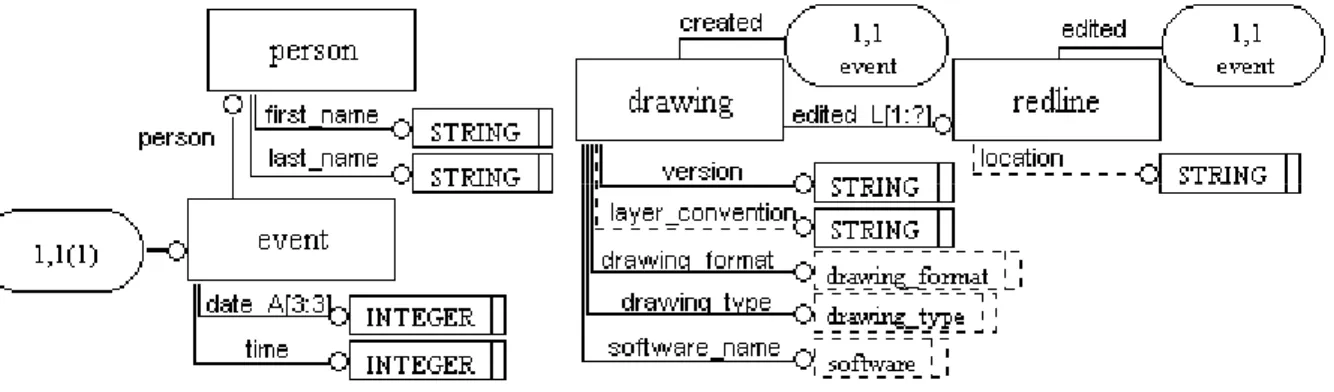
The results of this modeling work forms Figures 5 to 15. Figures 5, 6 and 7 deal with information related to background data required for the graphical images such as digital photos and CAD drawings. A key element in Figure 5 is the Event Entity which represents an activity completed by a person at a specific time and date, this is shared by a number of other Entities in the product model such as inspections, drawings, redlines, and images.
Figure 5 Event Entity Figure 6 Drawing and Redline Entities
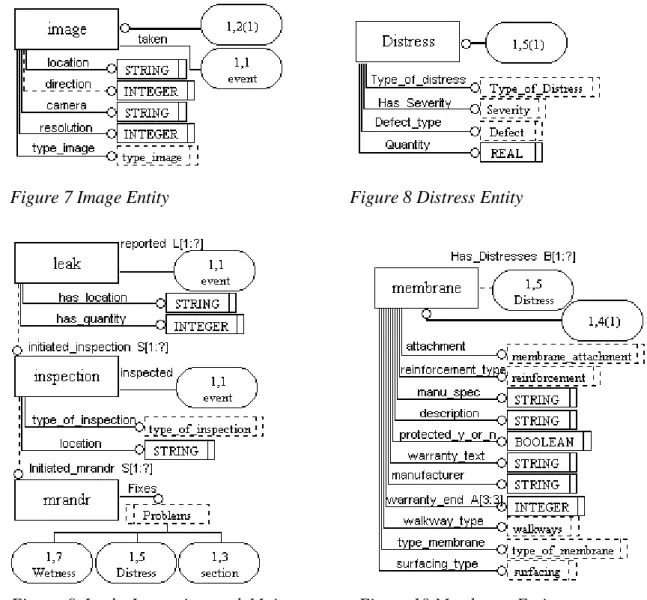
Distresses in a roofing system represent problems or potential problems with the insulation, membrane or flashings. Figure 8 depicts the Distress Entity required for the MicroROOFER application for calculating the Condition Index of inspected roofs.
The Inspection Entity in Figure 9 saves data about the type of inspection (cyclic, emergency, etc.), but is directly tied to a Leak Entity and a Maintenance, Repair and Replacement (MRANDR) Entity. Requirements from MicroROOFER dictate the need for a tie between the inspection reports and repair work orders. Figure 10 details the information requirements for tombstone data on the roofing membrane. The Leak Entity was created to address client needs to track reported leaks. The page reference (1,4(1)) in Figure 10 shows that the membrane is part of a section of the roof, as shown in Figure 12.
Figure 7 Image Entity Figure 8 Distress Entity
Figure 9 Leak, Inspection and Maintenance Repair and Replacement Entities
Figure 10 Membrane Entity
Figure 11 relates insulation to its wetness problems. The page reference (1,6(1)) in Figure 11 shows that the membrane is part of a section of the roof, as shown in Figure 12.
Figure 11 Insulation and Wetness Entities
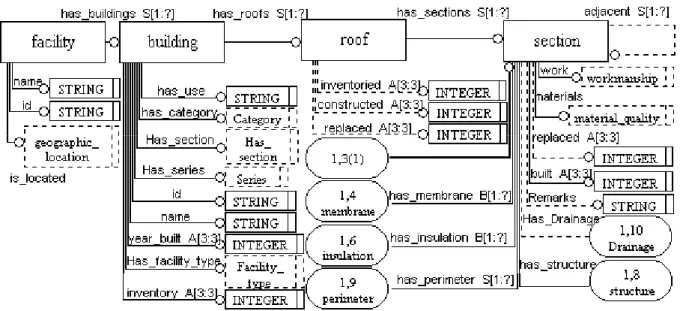
Figure 12 illustrates the hierarchical structure required for data input for the MicroROOFER software program for base building information. The Section Entity information has been
augmented with risk analysis data (workmanship, material_quality) required for the Markov Chain data collection (Lounis et al, 1998).
Figure 12 Facility, Building, Roof, and Section Entities
Figures 13 and 14 represent data requirements for the Perimeter, Flashing and Structure Entities for each Section Entity of a Roof Entity.
Figure 13 Perimeter and Flashing Entities Figure 14 Structure Entity DISCUSSION
This is the BELCAM project’s first product model “strawman” for roofing maintenance. In general, the model appears capable of storing the required information for the project. At this time, the model has not been used to store data regarding building inspections, but that portion of the work will take place over the next year.
Other portions of the project will include integration of applications such as CAD; this will test if the roofing maintenance product model is sufficiently robust to handle considerable alterations to the structure.
• Very little information in the related IAI and STEP and KBS models was useful in the roofing maintenance product model: those entities were used for general guidance only. The same will probably hold true for other maintenance management domains, and for other building subsystems such as window, electrical, mechanical and building envelope.
• The preliminary model was easy to construct because of the simplicity of the MicroROOFER data structure. The task required a full survey of required MicroROOFER data fields, and identification of the permissible entry data. Having a well-constructed set of integration applications made the conceptual modeling task easy at this stage.
• There is still more work required to integrate the roofing thesaurus into the BELCAM data structure. This will be accomplished in the next phase of the project.
• There still remains the requirement to build the risk analysis output, but having a roofing maintenance product model in place to collect the required data will make this task relatively easy. All the data requirements have been established (Lounis et al, 1998), the required fields have been embodied in the roofing maintenance product model, and the risk analysis tool can read directly from the STEP file.
• EDMS 3.5 proved to be a comprehensive, stable and flexible EXPRESS-G modeling tool. The software made it relatively easy to create the required EXPRESS files. The software is quite robust and permits rapid prototyping of conceptual ideas into complete EXPRESS notation.
CONCLUSIONS
The first “strawman” roofing maintenance product model was relatively easy to construct. The existing work in related STEP and IAI models was of little use to the BELCAM modeling task, as very little related directly to roofing systems. The same will probably hold in the near and intermediate future for other building subsystems. Other stages of the project will include populating the data structure and expansion of the roofing maintenance product model to encompass domains such as computed aided design drawings, heat analysis, and computerized maintenance management systems. EDMS 3.5 proved to be a comprehensive, stable and flexible EXPRESS-G conceptual modeling tools.
It is difficult to ascertain at this early phase of the project, but it appears that the roofing maintenance product model should permit access to data create by a variety of applications at a variety of points in time. At this time, it is not known if it will be difficult or expensive to maintain the roofing maintenance data structure and roofing asset data described in this paper over long periods of time, but it is guessed that these expenses will be “part of doing business” in asset management in the future. It is hoped that product models will form the continuity, standard protocols and compatibility required in the complex interoperability of the electronic world of the 21st Century asset managers. Further research in this area by the BELCAM project should provide more insight into product modeling role in asset management and the long term maintenance of facility data.
ACKNOWLEDGMENTS
The author would like to thank the Jotne company of Norway and its subsidiary EPM Technology a.s. for the evaluation copy of the EDMS product modeling software and for their technical assistance during this project. The roofing maintenance product modeling task is supported by the BELCAM project and its collaborators and members. The author recognizes the contributions from the BELCAM team members, and specifically would like to thank
Brian Kyle, Mike Lacasse and Zoubir Lounis for their suggestions and contributions to the research behind this paper.
REFERENCES
BCCM (1998) Building Construction Core Model Home Page, http://www.tno.nl/instit/bouw/ project/Bccm/bccmhome.html, April.
CIMIS (1998) Common Industry Material Identification Standard, http://www.cimis.com, April.
CIMSteel (1998) CIMSteel Home Page, http://www.leeds.ac.uk/civil/research/cae/cimsteel/ cimsteel.htm, April.
DWG Unplugged (1998) Autodesk Product Home Page, www.autodesk.com/products/ acadr14/compapps/dwgunfaq.htm.
EDMS (1998) Instruction Manuals, Version 3.5, EPM Technology a.s., http://www.epmtech. jotne.no, Olso, Norway.
Gabrowski, R ( 1998) Why OpenDWG?, CAD Systems, May, reprinted from upFront.eZine (http://users.uniserve.com/~ralphg/current.htm), 100th issue.
IAI (1998) IAI Home Page, http://www.interoperability.com, April.
ISO 10303 (1998) http://www.nist.gov/sc4/step/parts/part106/wd1/part106.txt, April.
Karhu, V. (1997), Product Model Based Design of Precast Facades, Electronic Journal of
Information Technology in Construction, http://itcon.org/1997/1/.
Kosovac, B (1998) Roofing Thesaurus, Canadian Institute for Scientific and Technical Information, Internal Report, National Research Council Canada, Ottawa, Canada.
Lounis, Z, DJ Vanier, and MA Lacasse (1998), Discrete Stochastic Model for Performance Prediction of Roofing Systems, CIB World Building Congress 1998, Materials and
Technologies for Sustainable Construction, Gavle, Sweden.
Part106 (1998) http://www.vx.com/Other/STEP/DOCS/part106/wd1/part106.txt.html, April. See, R. (1998) Personal communications, May 7, 1998.
STEP (1998) STEP SC4 Home Page, http://www.nist.gov/sc4/step, April.
Svensson, K (1998) submitted Ph.D. Thesis, Integrating Facilities Management Information:
A Process and Product Model Approach, Royal Institute of Technology, Stockholm, Sweden. TC/CS, (1978) Canadian Thesaurus of Construction Technology and Science, Industry Canada (formerly Department of Industry, Trade and Commerce), Ottawa, Canada.
Vanier, DJ (1994) Ph.D. Thesis, A Parsimonious Classification System to Extract
Project-Specific Building Codes, Universite de Montreal, Montreal, Canada.
Vanier, DJ and MA Lacasse (1996) BELCAM Project: Service Life, Durability, and Asset Management Research, 7th International Conference on the Durability of Building Materials
and Components, Stockholm, Sweden.
Vanier, DJ and A Nesje (1998) Roofing Maintenance Product Model: Life Cycle Economic
Implications, abstract submitted to Second European Conference on Product and Process Modeling in the Building Industry, Watford, England.