Publisher’s version / Version de l'éditeur:
Powder Technology, 207, 1-3, pp. 396-400, 2010-12-03
READ THESE TERMS AND CONDITIONS CAREFULLY BEFORE USING THIS WEBSITE. https://nrc-publications.canada.ca/eng/copyright
Vous avez des questions? Nous pouvons vous aider. Pour communiquer directement avec un auteur, consultez la première page de la revue dans laquelle son article a été publié afin de trouver ses coordonnées. Si vous n’arrivez pas à les repérer, communiquez avec nous à [email protected].
Questions? Contact the NRC Publications Archive team at
[email protected]. If you wish to email the authors directly, please see the first page of the publication for their contact information.
NRC Publications Archive
Archives des publications du CNRC
This publication could be one of several versions: author’s original, accepted manuscript or the publisher’s version. / La version de cette publication peut être l’une des suivantes : la version prépublication de l’auteur, la version acceptée du manuscrit ou la version de l’éditeur.
For the publisher’s version, please access the DOI link below./ Pour consulter la version de l’éditeur, utilisez le lien DOI ci-dessous.
https://doi.org/10.1016/j.powtec.2010.11.025
Access and use of this website and the material on it are subject to the Terms and Conditions set forth at
Synthesis of LiNi1/3Co1/3Al1/3O2 cathode material with eutectic molten
salt LiOH-LiNO3
Chang, Zhao-Rong; Yu, Xu; Tang, Hong-Wei; Yuan, Xiao-Zi; Wang, Haijiang
https://publications-cnrc.canada.ca/fra/droits
L’accès à ce site Web et l’utilisation de son contenu sont assujettis aux conditions présentées dans le site LISEZ CES CONDITIONS ATTENTIVEMENT AVANT D’UTILISER CE SITE WEB.
NRC Publications Record / Notice d'Archives des publications de CNRC:
https://nrc-publications.canada.ca/eng/view/object/?id=92ad49c7-0e2e-432b-adb3-5df5f66fdcab
https://publications-cnrc.canada.ca/fra/voir/objet/?id=92ad49c7-0e2e-432b-adb3-5df5f66fdcab
Synthesis of LiNi
1/3
Co
1/3
Al
1/3
O
2
cathode material with eutectic molten
salt LiOH-LiNO
3
Zhao-Rong Chang
a,⁎
, Xu Yu
a, Hong-Wei Tang
a, Xiao-Zi Yuan
b, Haijiang Wang
ba
College of Chemistry and Environmental Science, Henan Normal University, Xinxiang 453007, P.R. China
bInstitute for Fuel Cell Innovation, National Research Council of Canada, Vancouver, British Columbia, Canada V6T 1W5
a b s t r a c t
a r t i c l e
i n f o
Article history:
Received 12 July 2010
Received in revised form 20 October 2010 Accepted 21 November 2010
Available online 3 December 2010
Keywords:
Cathode materials Eutectic molten salt Doping
LiNi1/3Co1/3Al1/3O2
A lithium-ion battery cathode material, LiNi1/3Co1/3Al1/3O2, with excellent electrochemical properties was
prepared by three-phase temperature sintering, using eutectic lithium salts (0.38LiOH.H2O-0.62LiNO3)
mixed with the precursor Ni1/3Co1/3Al1/3(OH)2. This method was simple and inexpensive, and the materials
could be mixed uniformly at the eutectic melting point without any grinding. A well-layered α-NaFeO2
structure was confirmed by X-ray diffraction (XRD). The ratio of characteristic diffraction peaks I(003)/I (104) reached 1.73. Charge–discharge testing of the synthesized powder showed an initial charge– discharge capacity of 151.5 mAh.g–1at a specific current of 0.2 C in the range 2.8–4.3 V up to 20 cycles with
no noticeable capacity-fading (94.5% of the first discharge capacity), and reversible capacities of 133.7 and 120.9 mAh.g–1for specific currents of 1 C and 2 C at room temperature. The discharge capacity and capacity
retention at 55 °C were substantially better than at room temperature.
© 2010 Published by Elsevier B.V.
1. Introduction
At present, most lithium-ion batteries on the market still use LiCoO2as the cathode material; however, cost and unsatisfactory
thermal stability seriously limit its use in electric vehicles[1–3]. From the viewpoint of environmental friendliness, finding a non-polluting cathode material with high capacity, good cycling performance, high thermal stability, and low cost has become the keystone in this area of research[4–6]. The Ni-based ternary cathode material LiNi1/3Co1/3Mn1/3O2seems promising for use in
applica-tions that require a power supply, e.g., electric vehicles, and has become a particular focus of research due to its high discharge capacity, good thermal stability, and low cost [7–13]. Recently, additional reports on Ni-based multi-doped lithium-ion battery cathode materials have been published. Major synthetic methods include the high-temperature solid-phase method, the sol-gel method, the coprecipitation method[14–16], and the molten salt method[17,18]. The main doping elements for improving thermal characteristics and cycling performance include cobalt, aluminum, manganese, titanium, magnesium, and gallium. Most recently, a new layer structure material, LiNi1/3Co1/3Al1/3O2, was successfully
syn-thesized by Lin et al. using the water-in-oil micro-emulsion method
[19]. Both thermal stability and cycling performance were improved,
and the discharge capacity at high temperatures was better than at room temperature, which is very important for electric vehicles. Unfortunately, that synthesis process is complicated and costly. No other reports on the structure and electrochemical properties of this new material have been found.
Our research team synthesized LiNi1/3Co1/3Mn1/3O2and LiNi0.8Co0.2O2
with excellent structure and electrochemical properties using eutectic lithium salts (0.38LiOH.H2O-0.62LiNO3) mixed with a precursor in a
controlled ratio of 1.1:1 Li/(Ni + Co+ Al) . This method enables uniform mixing at the eutectic melting point without any grinding, thereby avoiding a labor-intensive washing process and the waste of eutectic molten salt[17,18]. Based on our previous work[20], the cathode material LiNi1/3Co1/3Al1/3O2was prepared in the present study via
three-stage heating temperature sintering using eutectic lithium salts, in which the ratio of Li/(Ni + Co + Al) in the raw material Ni1/3Co1/3Al1/3
(OH)2and the eutectic molten salt (0.38LiOH.H2O-0.62LiNO3) with a
melting point of 175 °C) was controlled at 1.1:1. The LiNi1/3Co1/3Al1/3O2
powder prepared by this method demonstrated excellent electrochem-ical performance.
2. Experimental
The precursor Ni1/3Co1/3A1/3(OH)2 was obtained by dissolving
stoichiometric amounts of NiSO4·6H2O, CoSO4·7H2O, and Al2
(SO4)3·18H2O together in distilled water (transition metal ratio of Ni:
Co:Al = 1:1:1). The aqueous solution was precipitated by adding a NaOH solution of 4 mol.L−1with continuous stirring at 50 °C under an air
atmosphere. Synthesis of non-spherical LiNi1/3Co1/3Al1/3O2was carried
⁎ Corresponding author. Tel.: +86 373 3326335; fax: +86 373 3326336.
E-mail address:[email protected](Z.-R. Chang).
0032-5910/$ – see front matter © 2010 Published by Elsevier B.V. doi:10.1016/j.powtec.2010.11.025
Contents lists available atScienceDirect
Powder Technology
out using a eutectic molten salt reaction. The lithium salt used was 0.38LiOH·H2O-0.62LiNO3(melting point 175.6 °C). The Ni1/3Co1/3A1/3
(OH)2precursor was mixed with eutectic lithium molten salt in a molar
ratio of 1:1.1. The mixtures were initially heated to 200 °C for 3 h and subsequently sintered in an air atmosphere at 600 °C for 5 h and 900 °C for 10 h. After heating, the resulting powders were cooled to ambient temperature.
To investigate their crystal structures, powders were analyzed by X-ray diffraction (XRD) using a D8 X diffractometer (Bruker, Germany) employing Cu Kα radiation. The scan data were collected in a 2θ range of 15–70°, with a step size of 0.02° and a counting time of 3 s. The prepared powders were also observed using scanning electron microscopy (SEM) with an SEM-6701 F (JEOL, Japan). The cells were cycled on a Land CT2001A battery tester (Wuhan Jinnuo Electronics Co. Ltd., China).
Coin cells (CR2016) were used to test the electrochemical performance of the samples. Positive electrodes were prepared by mixing the active material, Super S Carbon Black, and polyvinylidene fluoride (PVDF) in a weight ratio of 80:10:10. The solvent N-methyl-2-pyrrolidone (NMP) was added to these active materials, forming a slurry that was then coated on Al foil and dried at 120 °C under vacuum for 10 h. The coin cells were assembled in an Ar-filled glove box using metallic Li as the counter electrode, Celgard 2400 as the separator, and 1 mol.L− 1LiPF
6as the electrolyte. The cells were then
removed from the glove box and connected to a computer-controlled charging system by which they were initially charged and discharged at a C/5 rate of 2.8–4.3 V versus Li metal on a Land CT2001A battery tester at room temperature.
3. Results and discussion
3.1. Effects of lithium salts on the crystal structure and morphology of LiNi1/3Co1/3Al1/3O2
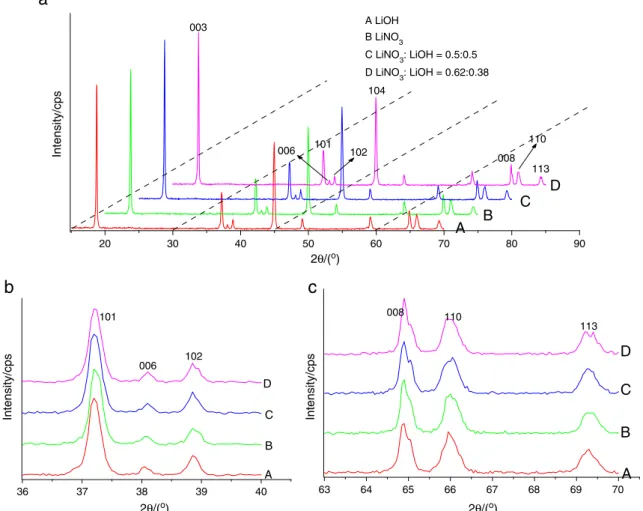
Fig. 1illustrates the XRD patterns of LiNi1/3Co1/3Al1/3O2sintered with
different lithium salts via three-stage heating temperature control. AsFig. 1shows, sintering different lithium salts had a significant impact on the target structure of the cathode materials. InFig. 1(a), the locations of the diffraction peaks perfectly match the standard α-NaFeO2layered structure, and there is no obvious miscellaneous peak.
Li locates at the 3a position in LiNi1/3Co1/3All/3O2, metal elements Ni,
Co, and Al at the 3b position, and oxygen atoms at the 6c position. Given the very similar radii of Ni2+(0.069 nm) and Li+(0.067 nm),
the Li+and Ni2 +located at the 3a and 3b positions will constantly be shuffling, leading to a decline in these materials’ electrochemical properties[21]. According to the literature, the I(003)/I(104) peak value ratio of a six-layered structure of lithium-oxygen-transition metal oxides in the XRD patterns may reflect the degree of cation order[22]: the larger the ratio of I(003)/I(104), the lower the amount of cation shuffling. If the I(003)/I(104) ratio is below 1.2, the increased cation shuffling will interfere with the lithium ions de-embedding from the material. As indicated in Fig. 1, the I(003)/I(104) peak intensity ratios of samples A–D are 1.65, 1.64, 1.70, and 1.73, respectively. Apparently, mixed lithium salts are superior to single lithium salts, and a eutectic mixed lithium salt is superior to simple mixed lithium salts. In addition, the splitting observable in the XRD patterns between the (006) and (102) peaks and the (008) and (110)
20 30 40 50 60 70 80 90
a
A LiOH B LiNO3 C LiNO3: LiOH = 0.5:0.5 D LiNO3: LiOH = 0.62:0.38 113 101 110 008 102 006 104 003D
C
B
A
Intensity/cps 2θ/(o) 36 37 38 39 40b
102 006 101 D C B A Intensity/cps 2θ/(o) 63 64 65 66 67 68 69 70c
110 008 113D
C
B
A
Intensity/cps 2θ/(o)peaks enables us to measure the degree to which a layered structure developed: the greater the number of peak splits, the more orderly the layered structure. InFig. 1(b) and (c), the number of splits between (006)/(102) and (008)/(110) increases gradually from A to D, which indicates that the eutectic mixed lithium salt had a more satisfactory layered structure and better electrochemical performance. The melting point of the eutectic mixed lithium salt 0.38LiOH·H2
O-0.62LiNO3is only 175.7 °C, which may be the main reason why it can
form a complete layered structure with a high degree of crystallinity and low cation shuffling. When it was sintered in the first phase at 200 °C for 3 h, the molten liquid lithium salt could easily permeate and infiltrate to the solid precursor Ni1/3Co1/3Al1/3(OH)2 particle
surface and then inside, resulting in extensive, even mixing and distribution of lithium ions and solid oxide metal ions, which is key for preparing cathode materials with ideal structures.
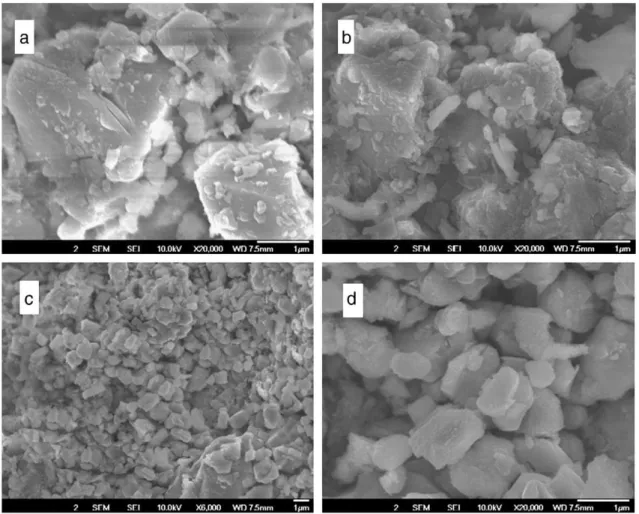
Fig. 2shows scanning electron micrographs of LiNi1/3Co1/3Al1/3O2
samples prepared with eutectic lithium salts. A and B are the SEM images for LiNi1/3Co1/3Al1/3O2from single lithium salts of LiOH • H2O
and LiNO3, respectively, while C and D show different magnifications
of SEM images for the same sample synthesized using a eutectic mixture of 0.38LiOH • H2O-0.62LiNO3.
As can be seen inFig. 2, samples synthesized using a single lithium salt had larger particle sizes(about 2 μm) and a varied size distribution (about 2–0.2 μm). The sample prepared using a eutectic mixed lithium salt had a more regular particle morphology with a more uniform particle size (about 1–0.5 μm). This is consistent with the XRD results above.
3.2. Effects of crystallization temperature on the crystal structure of LiNi1/3Co1/3All/3O2
In this study, a three-stage heating temperature sintering process was adopted. The first phase was to melt the eutectic lithium salts above their melting point and evenly mix them with the solid transition metal oxide particles. In the second stage (at a constant temperature of 600 °C) the lithium salts and solid oxide reacted to generate LiNi1/3Co1/3All/3O2. According to our previous study,
al-though LiNi1/3Co1/3All/3O2with a certain stoichiometric ratio can be
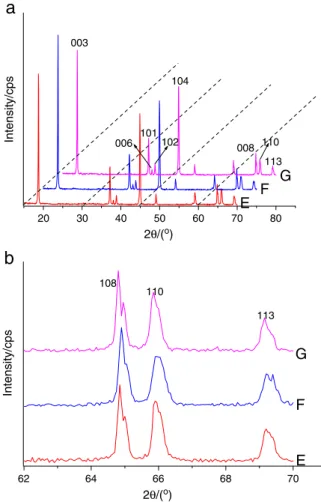
produced in this temperature range, its crystal structure is not completely developed. Further crystallization at a certain temperature is required to adjust the atomic arrangement in the crystal structure.Fig. 3(a) illustrates the XRD patterns of LiNi1/3Co1/3Al1/3O2
heated at (E) 850 °C, (F) 900 °C, and (G) 950 °C.
It has been demonstrated that crystallization temperature has a significant effect on crystal structure development. The ratios of the characteristic diffraction peaks I(003)/I(104) are 1.43, 1.73, and 1.40 at crystallization temperatures of 850 °C, 900 °C, and 950 °C, respectively. Raising the crystallization temperature to 900 °C yielded the highest ratio, indicating the smallest cation shuffling effect and the highest degree of crystallinity. As is evident in the magnified XRD pattern (Fig. 3(b)), in all cases there is not much difference in the split level of the (108) and (110) peaks. However, a clear split occurs in the (113) peak when the crystallization temperature is 900 °C, indicating that this sample has the most complete layered structure.
Fig. 2. SEM images of LiNi1/3Co1/3All/3O2samples synthesized using different lithium salts. (a) LiOH·H2O; (b) LiNO3; (c and d) 0.38LiOH·H2O-0.62LiNO3. (a), (b), (d) ×20,000;
3.3. Electrochemical characterization
The electrode was cycled over 2.8–4.3 V at a constant current density of 0.2 mA.cm–2. The first discharge curves and the discharge
curves after 20 cycles of the LiNi1/3Co1/3Al1/3O2samples synthesized
with different lithium salts are shown in Fig. 4(a) and (b),
respectively.
The initial maximum discharge capacities of samples A, B, C, and D were 131.9 mAh.g–1, 136 mAh.g–1, 146.2 mAh.g–1, and 151.5 mAh.g–1,
respectively. The reversible capacities of samples A, B, C, and D after
20 cycles were 109.1 mAh.g–1 (82.7% of the maximum discharge
capacity), 117.6 mAh.g–1 (86.4%), 133 mAh.g–1 (90.9%), and
143.2 mAh.g–1 (94.5%), respectively. This result indicates that the
eutectic mixture of lithium salts 0.38LiOH • H2O-0.62LiNO3 was
superior to both the simple mixture of lithium salts and the single lithium salt, which agrees very well with the XRD analysis. Furthermore, the discharge capacity of LiNi1/3Co1/3All/3O2 sintered
with the eutectic mixture 0.38LiOH • H2O-0.62LiNO3exceeded the
130.7 mAh.g–1capacity reported in the literature[19], with a higher
discharge platform and better cycling performance.
Fig. 5shows the discharge curves, at different discharge rates, of the LiNi1/3Co1/3Al1/3O2 sample synthesized using eutectic mixed
lithium salts (0.38LiOH • H2O–0.62LiNO3) and sintered at a
crystal-lization temperature of 900 °C.
The test batteries were charged to 4.3 V at a constant current of 0.2 C, then discharged to 2.8 V at constant currents of 0.2 C, 0.5 C, 1 C, and 2 C. The theoretical capacity of the cathode material LiNi1/3Co1/3All/3O2for a
lithium-ion battery was calculated to be 205 mAh.g–1. As indicated in
Fig. 5, the discharge capacities were 151.5 mAh.g–1, 144.7 mAh.g–1,
133.7 mAh.g–1, and 120.9 mAh.g–1 at the respective discharge rates.
Compared with the discharge capacity at 0.2 C, the retention rates at 0.5 C, 1 C, and 2 C were 94.5%, 88.3%, and 79.8%, respectively, indicating improved rate performance. As the discharge rate increased, the downward trend of the material's discharge capacity gradually increased and the discharge platform gradually decreased. This result stemmed primarily from the polarization caused by the high discharge rate. Effective methods of improving the material's magnification performance might be to reduce its average particle size or increase its electrical conductivity.
20 30 40 50 60 70 80
a
113 102 006 101 110 008 104 003G
F
E
Intensity/cps 62 64 66 68 70b
108 110 113G
F
E
Intensity/cps 2θ/(o) 2θ/(o)Fig. 3. XRD patterns of LiNi1/3Co1/3All/3O2sintered using 0.38LiOH·H2O-0.62LiNO3at
different temperatures. (a) full XRD 3D-diagram; (b) locally magnified XRD patterns (E) 850 °C; (F) 900 °C; (G) 950 °C. 0 20 40 60 80 100 120 140 160 0 20 40 60 80 100 120 140 160 2.6 2.8 3.0 3.2 3.4 3.6 3.8 4.0 4.2 4.4 U / V
Specific capacity mAhg-1
Specific capacity mAhg-1 A LiOH B LiNO3 C LiNO3 :LiOH = 0.5:0.5 D LiNO3: LiOH = 0.62:0.38
a
A B CD
2.6 2.8 3.0 3.2 3.4 3.6 3.8 4.0 4.2 4.4 U / Vb
A LiOH B LiNO3 C LiNO3: LiOH = 0.5:0.5 D LiNO3: LiOH = 0.62:0.38A
B
C
D
Fig. 4. Discharge curves of samples A, B, C, and D: (a) initial and (b) after 20 cycles.
0 20 40 60 80 100 120 140 160 2.6 2.8 3.0 3.2 3.4 3.6 3.8 4.0 4.2 4.4 U / V 2c 1c 0.5c0.2c
Specific capacity mAhg-1
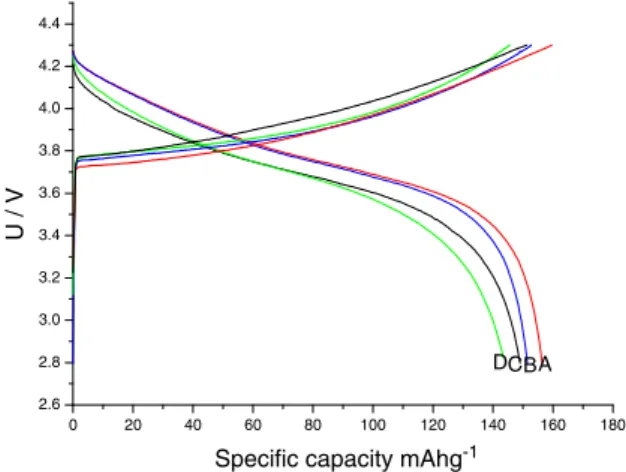
As sample D had best electrochemical properties and an even particle size distribution, we compared its performance at 55 °C.Fig. 6
shows the discharge curves of LiNi1/3Co1/3Al1/3O2initially and after 20
cycles at room temperature and 55 °C, respectively.
The initial discharge capacities at room temperature and 55 °C were 151.5 mAh.g–1and 156.4 mAh.g–1, respectively. After 20 cycles,
the discharge capacity retention rates at room temperature and 55 °C were 94.5% and 95.3%, respectively. Clearly, the discharge capacity and capacity retention at 55 °C were better than at room temperature when the batteries were cycled between 2.8 V and 4.3 V. Owing to this perfect layer structure, the products by eutectic molten salt are not only beneficial to extraction and insertion of Li+ion but also improve
thermal stability of materials. In addition, the discharge curve at 55 °C indicates that the discharge platform increased with a longer discharge. This is a very important observation for batteries used in applications such as electric vehicles.
4. Conclusion
A lithium-ion battery cathode material, LiNi1/3Co1/3Al1/3O2, with
excellent electrochemical properties was prepared via three-phase temperature sintering (200 °C for 3 h, 600 °C for 5 h, and 900 °C for 10 h) using eutectic lithium salt (0.38LiOH.H2O–0.62LiNO3) mixed
with the precursor Ni1/3Co1/3Al1/3(OH)2. This method is procedurally
simple and inexpensive, and the materials can be uniformly mixed at the eutectic melting point without grinding. The synthesized material, LiNi1/3Co1/3Al1/3O2, demonstrated better performance than samples
synthesized using a single lithium salt (LiOH or LiNO3) or a 1:1
mixture of lithium salts with a typical α-NaFeO2layered structure.
The characteristic peak ratio of I(003)/I(104) reached 1.73, indicating high crystallinity and small cationic shuffling. The obvious splits in the characteristic diffraction peak pairs (006)/(102) and (008)/(110) and in the (113) peak demonstrated the material's well-developed layer structure. As a result, the synthesized LiNi1/3Co1/3Al1/3O2 had an
excellent discharge capacity of 151.5 mAh.g–1(at 0.2 C) for the first
cycle and a very fine capacity retention rate of more than 94.5% after 20 cycles at room temperature. The reversible capacity reached 133.7 mAh.g–1 and 120.9 mAh.g–1 at charge–discharge rates of 1 C
and 2 C, respectively. At 55 °C, the initial capacity of the material was 154.9 mAh.g–1(at 0.2 C) with a capacity retention rate more than
95.3% after 20 cycles, which was better than at room temperature. These results show that the material has good discharge performance, cycling reversibility, and rate performance, making it promising for future lithium-ion battery applications.
Acknowledgements
This work is financially supported by the Natural Science Foundation of China under approval No. 21071046, and by Henan Provincial Department of Science and Technology Key Research Project under approval No. 080102270013.
References
[1] Z.S. Peng, C.R. Wan, C.Y. Jiang, J. Power Sources 72 (1998) 215. [2] S. Bruno, Electrochim. Acta 45 (2000) 2461.
[3] E. Antolini, Solid State Ionics 170 (2004) 159.
[4] G.X. Wang, M.J. Lindsay, M. Ionescu, D.H. Bradhurst, S.X. Dou, H.K. Liu, J. Power Sources 97–98 (2001) 211.
[5] H.M. Wu, J.P. Tu, X.T. Chen, Y.F. Yuan, Y. Li, X.B. Zhao, G.S. Cao, J. Power Sources 586 (2006) 180.
[6] W.B. Luo, J.R. Dahna, Electrochim. Acta 54 (2009) 4655.
[7] H. Joachin, J. Prakash, J. Liu, K. Amine, J. Power Sources 163 (2007) 1074. [8] X.Y. Han, Q.F. Meng, T.L. Sun, J.T. Sun, J. Power Sources 195 (2010) 3047. [9] T.H. Cho, S.M. Park, M. Yoshio, T. Hirai, Y. Hideshima, J. Power Sources 142 (2005)
306.
[10] J.H. Yoon, H.J. Bang, J. Prakash, Y.K. Sun, Mater. Chem. Phys. 110 (2008) 222. [11] S. Zhang, C. Deng, B.L. Fu, et al., Powder Technol. 198 (2010) 373.
[12] P.S. Whitfield, I.J. Davidson, L.M.D. Cranswick, I.P. Swainson, P.W. Stephens, Solid State lonics 176 (2005) 463.
[13] S.B. Jang, S.H. Kang, K. Amine, Y.C. Bae, Y.K. Sun, Electrochim. Acta 50 (2005) 4168. [14] S.H. Kang, J. Kim, M.E. Stoll, et al., J. Power Sources 112 (2002) 41.
[15] Z.R. Chang, X. Qi, F. Wu, H.W. Tang, J.L. Wang, Chem. Eng. 34 (2006) 50. [16] R. Santhanam, B. Rambabu, J. Power Sources 195 (2010) 4313.
[17] Z.R. Chang, Z.J. Chen, F. Wu, H.W. Tang, Z.H. Zhu, Acta Phys. Chim. Sin. 24 (2008) 513.
[18] Z.R. Chang, Z.J. Chen, F. Wu, X.Z. Yuan, H.J. Wang, Electrochim. Acta 54 (2009) 6529.
[19] Y.K. Lin, et al., J. Power Sources 146 (2005) 594.
[20] H.W. Tang, Z.H. Zhu, Z.R. Chang, Z.J. Chen, Acta Phys. Chim. Sin. 23 (2007) 1265. [21] T. Ohzuku, A. Ueda, M. Kouguchi, J. Electrochem. Soc. 142 (1995) 4033. [22] Y. Gao, M.V. Yakovleva, W.B. Ebner, Solid State Ionics 1 (1998) 117.
0 20 40 60 80 100 120 140 160 180 2.6 2.8 3.0 3.2 3.4 3.6 3.8 4.0 4.2 4.4 U / V DCBA
Specific capacity mAhg-1
Fig. 6. Discharge curves: at 55 °C initially (A) and after 20 cycles (C); at room temperature initially (B) and after 20 cycles (D).