Regular Article
TRANSPLANTATION
A phase 3 randomized trial comparing inolimomab vs usual care in
steroid-resistant acute GVHD
G ´erard Soci ´e,1-3St ´ephane Vigouroux,4Ibrahim Yakoub-Agha,5Jacques-Olivier Bay,6Sabine F ¨urst,7Karin Bilger,8 Felipe Suarez,9Mauricette Michallet,10Dominique Bron,11Philippe Gard,12Zakaria Medeghri,12Philippe Lehert,13 Chinglin Lai,14Tim Corn,15and Jean-Paul Vernant16
1Service d’H ´ematologie-Greffe, Assistance Publique–H ˆopitaux de Paris, H ˆopital St-Louis Lariboisi `ere, Paris, France;2Department of Medicine, Universit ´e
Paris 7 Denis Diderot, Paris, France;3INSERM UMR 1160, Paris, France;4Service d’h ´ematologie clinique et th ´erapie cellulaire, H ˆopital Haut-L ´ev ˆeque,
Pessac, France;5CHU de Lille, LIRIC INSERM U995, Universit ´e Lille2, Lille, France;6Service th ´erapie cellulaire et h ´ematologie clinique, CHU,
Clermont-Ferrand, France;7Unit ´e de Transplantation et de Th ´erapie Cellulaire, Institut Paoli Calmettes, Marseille, France;8Service d’Onco-H ´ematologie, CHU
Hautepierre, Strasbourg, France;9Service d’h ´ematologie adulte, H ˆopital Necker, Paris, France;10Service d’h ´ematologie, H ˆopital Lyon Sud, Lyon, France; 11Service d’h ´ematologie, Institut Jules Bordet (ULB), Bruxelles, Belgium;12EUSA Pharma (Europe) Limited (a Jazz Pharmaceuticals company), Lyon,
France;13Faculty of Medicine, University of Melbourne, Melbourne, VIC, Australia;14Jazz Pharmaceuticals, Palo Alto, CA;15Jazz Pharmaceuticals, Oxford,
United Kingdom; and16Service d’h ´ematologie clinique, H ˆopital Piti ´e Salp ˆetri `ere, Paris, France
Key Points
• In steroid-resistant acute GVHD 1-year survival without changing baseline therapy was not different after inolimomab vs ATG. • Using current care, the
expected 1-year survival of these patients lies in the 55% range.
Treatment of steroid-resistant acute graft-versus-host disease (GVHD) remains an unmet clinical need. Inolimomab, a monoclonal antibody to CD25, has shown encouraging results in phase 2 trials. This phase 3 randomized, open-label, multicenter trial compared inolimomab vs usual care in adult patients with steroid-refractory acute GVHD. Patients were randomly selected to receive treatment with inolimomab or usual care (the control group was treated with antithymocyte globulin [ATG]). The primary objective was to evaluate overall survival at 1 year without changing baseline allocated therapy. A total of 100 patients were randomly placed: 49 patients in the inolimomab arm and 51 patients in the ATG arm. The primary criteria were reached by 14 patients (28.5%) in the inolimomab and 11 patients (21.5%) in the ATG arms, with a hazard ratio of 0.874 (P 5 .28). With a minimum follow-up of 1 year, 26 (53%) and 31 (60%) patients died in the inolimomab and ATG arms, respectively. Adverse events were similar in the 2 arms, with fewer viral infections in the inolimomab arm compared with the ATG arm. The primary end point of this randomized phase 3 trial was not achieved. The lack of a statistically significant effect confirms the need for development of more effective treatments for acute GVHD. This trial is registered to https://www.clinicaltrialsregister.eu/ctr-search/search as EUDRACT 2007-005009-24. (Blood. 2017;129(5):643-649)
Introduction
Despite prophylaxis with immunosuppressive therapy agents, nearly 50% of patients have acute graft-versus-host disease (aGVHD) after allogeneic hematopoietic cell transplantation.1-3 For decades, thefirst-line treatment of aGVHD remains the use of 1-2 mg/kg per day methylprednisolone or prednisone and, unfortunately,;30% of patients will not respond to initial treatment with steroids.4 However, despite many studies, no agents for treatment of glucocorticoid-resistant or refractory graft-versus-host disease (GVHD) have clearly emerged as a gold standard. Experts have recognized the lack of progress and recognized the absence of standard of care for secondary treatment of aGVHD.4The American Society of Blood and Marrow Transplantation has developed recommendations for treatment of aGVHD based on a comprehen-sive and critical review of published reports.4
Most reports on the treatment of steroid-resistant (SR) aGvHD are retrospective, single-arm phase 2 studies. Comparison of results
between these studies is complicated by the lack of standardized end points, and the small numbers of patients and survival rates do not support the choice of any specific agent.4
because 1-year survival has remained in the range of;30% for decades.1,5,6Despite this unmet clinical need, it may be surprising that, to the best of our knowledge, only 2 randomized phase 2/3 studies have ever been performed in the setting of SR aGVHD.7,8 Both studies showed that neither early introduction of antithymocyte globulins (ATG) nor the substitution of ATG by an investigational drug improved the dismal outcome for these patients.
Inolimomab, a monoclonal antibody against a-chain of the interleukin-2 receptor (CD25) has been associated with encourag-ing response and short-term survival rates in the settencourag-ing of SR aGVHD.5,9-14 Thus, a randomized, open-label trial comparing inolimomab with standard of care was designed. Rabbit ATG was chosen for all patients in the control arm based on previous
Submitted 8 September 2016; accepted 11 November 2016. Prepublished online as Blood First Edition paper, 29 November 2016; DOI 10.1182/blood-2016-09-738625.
The online version of this article contains a data supplement.
The publication costs of this article were defrayed in part by page charge payment. Therefore, and solely to indicate this fact, this article is hereby marked “advertisement” in accordance with 18 USC section 1734. © 2017 by The American Society of Hematology
BLOOD, 2 FEBRUARY 2017xVOLUME 129, NUMBER 5 643
reports4,15-17and centers’ experiences. Here we report the results of this trial with 1-year minimum follow-up.
Patients and methods
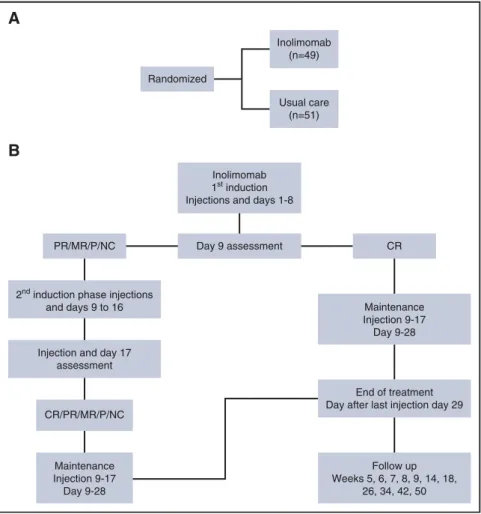
The primary objective of this study was to demonstrate a higher therapy success rate with inolimomab treatment compared with usual care in patients presenting with SR aGVHD. Therapy success was defined as overall survival at 1 year without replacement of the baseline allocated treatment. Treatment of subsequent chronic GVHD, if any, was not considered as a treatment failure. The secondary objectives of this study are the overall response rate (complte response1 partial response) at day 29, the effect of inolimomab on survival at intermediate periods, the incidence and consequence of chronic GVHD, infections and post-transplant lymphoproliferative disease and relapse of hematologic malignancy, total amount of steroids used duration of hospital stay, and the safety profile of inolimomab. The dose and schedule of inolimomab and of ATG are detailed in Figure 1. All patients in the control arm received rabbit ATG (Genzyme, a Sanofi company). The prespecified statistical plan is provided in the supplemental Appendix, available on the Blood Web site.
Inclusion and exclusion criteria
Adult patients ($18 years) who underwent a first allogeneic bone marrow or peripheral stem cell transplant (SCT) from human leukocyte antigen (HLA)-matched sibling donor or 10/10 and 9/10 HLA unrelated donor for treatment of hematologic malignancy were eligible. Patients received either a myeloablative or reduced-intensity conditioning regimen. Patients had to be in complete remission or in chronic phase or at least with stable disease (concerning chronic lymphocytic leukemia [CLL], high- and low-grade non-Hodgkin lymphoma,
myeloma, and myelodysplastic syndrome) at the time of the hematopoi-etic SCT (HSCT). GVHD prophylaxis with short methotrexate and cyclo-sporine or tacrolimus or mycophenolate mofetil (MMF) and cyclocyclo-sporine were eligible.
The study included patients with afirst episode of grades II to IV aGVHD (according to the consensus scoring system)18developing within 100 days after HSCT (thus excluding late acute GVHD). Patients must have already received methylprednisolone (MP) at a daily dose of 2 mg/kg as GVHD treatment and must have shown a resistance as defined by one of the following: GVHD progressing after$3 days of MP treatment, or GVHD persisting without improvement after 7 days of MP treatment. Patients were excluded from the study if one or more of the following statements were applicable: post– donor lymphocyte infusion GVHD; HLA-mismatched unrelated donor; trans-plantation other than for hematologic malignancy; cord blood transfusion; patients who received prophylactic regimens of GVHD with corticosteroids; patients on mechanical ventilatory support; progression of the malignancy at the time of inclusion; serum creatinine.30 mg/L; patients with vasopressor treatment; or uncontrolled infection(s) (ie, documented bacterial, parasitic, or fungal infection) within 72 hours before study entry despite adapted treatment. Neither continuation of antibiotics for a controlled infection nor prophylactic/ empiric antibiotics warranted exclusion; pregnant or lactating females; any history of hypersensitivity/allergy to murine products and any other component of study drug; positive HIV serology; ECOG.3; aspartate aminotransferase or alanine aminotransferase.103upper limits of normal; serumalbumin#15g/L; or minor patient and those incapable of giving informed consent.
Statistical analyses
This was an open-label, controlled, multicenter, randomized trial comparing inolimomab with standard of care. All centers agreed to use ATG as the control (Figure 1). The randomization was based on an a priori list of 150 binary
Inolimomab (n=49) Usual care (n=51) Randomized
A
Day 9 assessment PR/MR/P/NC2nd induction phase injections and days 9 to 16
Injection and day 17 assessment CR/PR/MR/P/NC Maintenance Injection 9-17 Day 9-28 CR Maintenance Injection 9-17 Day 9-28 End of treatment Day after last injection day 29
Follow up Weeks 5, 6, 7, 8, 9, 14, 18,
26, 34, 42, 50 Inolimomab
1st induction Injections and days 1-8
B
Figure 1. Study design. (A) All patients in the control arm received rabbit ATG (Genzyme, a Sanofi company) at the same dose of 2.5 mg/kg for 4 consecutive days. Inolimomab was delivered IV at a dose of 0.3 mg/kg per day for the induction phase and 0.2 mg/kg per day for maintenance. (B) Study design for the inolimomab arm.
numbers, with a block size of 2, without stratification. The significance of the effect of inolimomab compared with control has been assessed through Kaplan-Meier estimates and by using a proportional hazards CPH Cox survival regression analysis adjusted for baseline severity. A prespecified list of variables measuring the severity at baseline has been provided in this statistical analysis plan. The assessment of treatment effect has been tested at the 1-sided .05 type 1 level. Assuming use of proportional hazard regression, a target hazard ratio (HR) of 1.33, expected control success rate of 20% (thus, a difference as large as 15% favoring inolimomab vs control) would be detected with at least 75% power at 95% 2-sided confidence, when the sample size is .50 patients per group, by taking a reasonable assumption of correlation between baseline conditions and outcome of at least R5 0.7. Variables considered for adjustment were HLA mismatch; use of an unrelated donor; skin, gut, and liver severe involvement (stage 3 and 4); and remission status of the malignancy. With this model being considered as reference, at a second step we completed model I by model II in assessing the effect of other potential predictors. These variables were: age, number of identified viral infections, body mass index, sex, myeloablative treatment, and Karnofsky index at randomization. Missing data were imputed by variables calibration maximizing the correlations. For secondary end points, the Fine and Gray model was used both for univariate and multivariate analyses. Statistical analyses were conducted at a 0.05 2-sided significance, unless otherwise stated. R statistical package (R, v2.12.2) was used.
The protocol was approved by the institutional ethics review boards and the study was performed per the Declaration of Helsinki guidelines. This trial has been registered as EUDRACT 2007-005009-24.
Results
Forty-nine and 51 patients were randomly selected for the inolimomab and ATG arms, respectively. All patients were analyzed for safety and in the intention-to-treat analysis. Median time to onset of aGVHD was day 23 (range, 15-52). The second-line treatment was started 6 days after initial steroid treatment (range, 3-9) without significant difference between patients allocated to inolimomab or ATG. Nineteen patients (38.8%) and 17 patients (33.3%) completed the study at 1 year. Reason of failure was mainly death before 1 year (26 and 31 in the inolimomab and ATG arms, respectively; other causes were withdrawal by the investigator in 3 patients in the inolimomab and 2 in the ATG arms, mostly because of worsening of clinical condition).
Patient, transplant, and disease characteristics are summarized in Table 1. Many of the patients were transplanted for acute leukemia using peripheral blood stem cells. More than 60% have been transplanted from an unrelated donor and the conditioning regimen pre-transplant was myeloablative in;40%. None of the characteristics described in Table 1 was statistically different between patients assigned to inolimomab or the control arm. The GVHD grade at randomization was III (36 patients [36%] had stage 3 or 4 skin involvement; 51 [51%] had stage 3 or 4 gut disease; and 5 [5%] had stage 3 or 4 liver involvement, without imbalance between treatment arms). There was no imbalance per disease stage or grade between the 2 arms.
Analyses of the primary end point
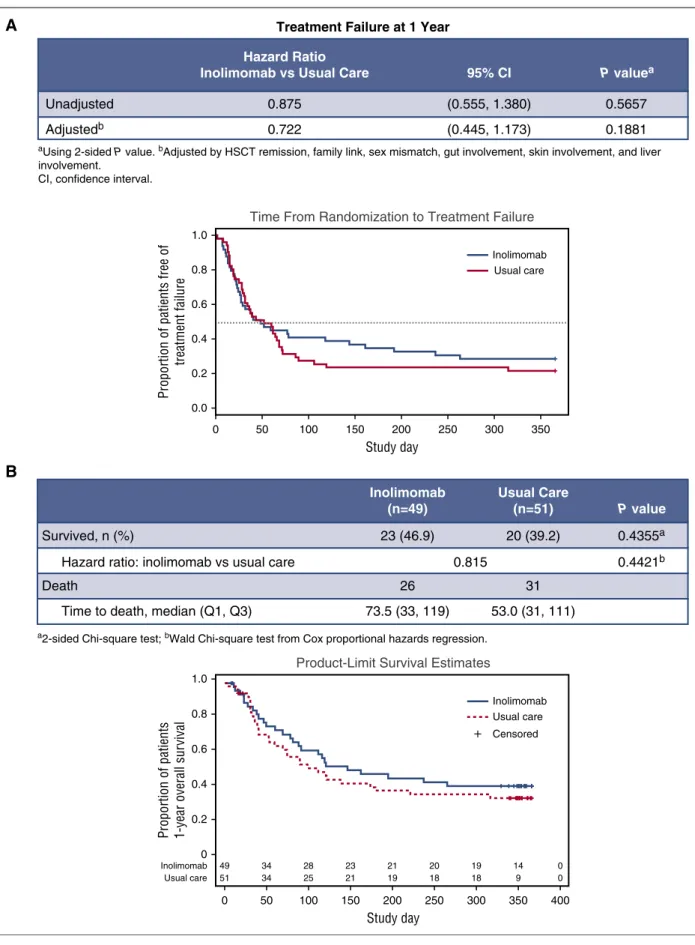
Forty-nine and 51 patients were allocated to receive inolimomab or ATG, respectively. All patients in both arms were analyzed for safety and in the intention-to-treat analyses. Premature death or withdrawals (before 1 year) were recorded in 30 and 34 patients in the inolimomab and ATG arms, respectively. This was mainly related to death before 1 year post-randomization (26 and 31 deaths after inolimomab and ATG, respectively). All surviving patients were followed for a minimum of 1 year after randomization unless death occurred. Twenty-three
(46.9%) and 20 (39.2%) patients survived 1 year after being treated with either inolimomab or ATG, respectively. The time to treatment failure (defined as death or change of baseline treatment regimen) is shown in Figure 2A. No significant difference was found between the 2 treatment arms (inolimomab adjusted HR 0.7 (95% confidence interval [CI], 0.4-1.1; P 5 .56].
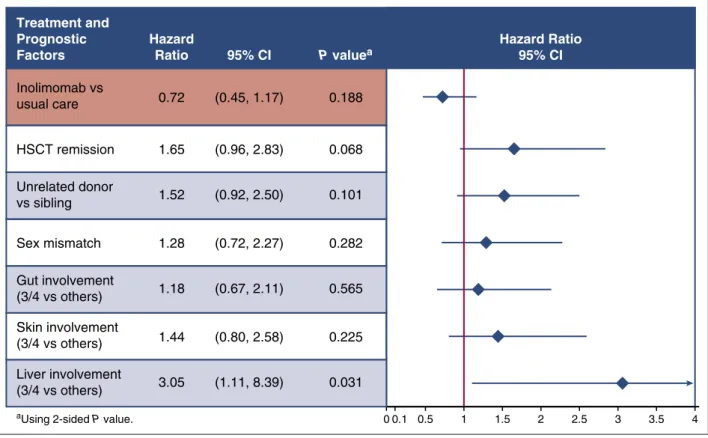
The 1-year survival estimates depicted in Figure 2B were not statistically different between the 2 treatment arms (in the 45% range 1-year survival rate). The difference in the estimate between survival and time to treatment failure (10%-15%) merely reflects treatment failure in both arms (that do not differ significantly). Finally as stated in the method section, prespecified Cox regression analyses were performed to take into account confounding factors. As depicted in Figure 3, even after adjustment, inolimomab was not associated with improved outcome, compared with ATG (HR5 0.7 [95% CI, 0.4-1.1]; P 5 .18). Among other tested factors (see Material and methods) only liver stage at randomization was associated with a significant worse out-come (HR5 3.0 [95% CI, 1.1-8.4]; P 5 .03). Thus, although associated with a slight but nonsignificant survival advantage, inolimomab failed to reach the specified composite primary end point. Finally, 80.2% and 75.4% (P . .5) of patients alive at 1 year had evidence of severe chronic GVHD after ATG and inolimomab treatment, respectively.
We took advantage of the randomized control setting of the trial to gain insight into prognostic factors that could influence outcome in this dismal setting. Using Cox proportional to analyze 1-year survival, patients transplanted from an unrelated donor (HR5 2.2 [95% CI, 1.2-3.8]; P 5 .006) did worse, as did patients older than 60 years of age (HR5 2.5 [95% CI, 1.3-4.9]; P 5 .006).
Table 1. Patient, disease, and transplant characteristics according to treatment arm
Characteristic Inolimomab (n5 49) ATG (n5 51) P
Sex, n (%) .555 Male 22 (44.9) 26 (51) Female 27 (55.1) 25 (49) Age, mean (SD) 46.2 (12.6) 47.1 (12.96) .727 Disease AML/MDS/MPD 14/4/2 10 / 7 / 2 ALL 7 6 NS CLL/lymphoma/myeloma 4 / 8 / 4 6 / 10 / 7 Other 8 3 CR at HSCT, n (%) 26 (53.1) 28 (54.9) .905 Source of cells, n (%) Peripheral blood 40 (81.6) 39 (76.5) .698 Marrow 9 (18.4) 12 (23.5) GVHD prophylaxis, n (%) CSA1 MTX 23 (46.9) 21 (41.2) .704 CSA1 MMF 22 (44.8) 19 (37.3) .566 ATG 13 (26.5) 11 (21.5) .72 Donor type, n (%) Matched sibling 15 (30.6) 20 (39.2) .489 Matched UD (10/10 allelic) 31 (63.3) 30 (58.8) .802 9/10 UD 3 (6.1) 1 (2) .581 Donor characteristic Age, mean (SD) 39.3 (12.5) 37.0 (12.3) .821 Sex (M/F) 31/18 37/14 .435 Conditioning regimen, n (%) Myeloablative 21 (42.9) 19 (37.3) .713 Reduced intensity 28 (57.1) 32 (62.7) .713 Irradiation-based 18 (36.7) 14 (27.4) .435 ALL, acute lymphoblastic leukemia; AML, acute myelogenous leukemia; CLL, chronic lymphocytic leukemia; CSA, cyclosporine; MDS, myelodysplastic syndrome; MPD, myeloproliferative disorders; MTX, methotrexate; SD, standard deviation; UD; unrelated donor.
Inolimomab (n=49)
Usual Care
(n=51) P value
Survived, n (%) 23 (46.9) 20 (39.2) 0.4355a
Hazard ratio: inolimomab vs usual care 0.815 0.4421b
Death 26 31
Time to death, median (Q1, Q3) 73.5 (33, 119) 53.0 (31, 111)
+ Censored
Proportion of patients 1-year overall sur
vival Study day 1.0 0.8 0.6 0.4 0.2 0
Product-Limit Survival Estimates
0 50 100 150 200 250 300 350 400
a2-sided Chi-square test; bWald Chi-square test from Cox proportional hazards regression.
49 34 28 23 21 20 19 14 0 Inolimomab 51 34 25 21 19 18 18 9 0 Usual care
B
Inolimomab Usual careTime From Randomization to Treatment Failure
Unadjusted 0.875 (0.555, 1.380) 0.5657
Adjustedb 0.722 (0.445, 1.173) 0.1881
aUsing 2-sided P value. bAdjusted by HSCT remission, family link, sex mismatch, gut involvement, skin involvement, and liver
involvement.
CI, confidence interval.
1.0 0.8 0.6 0.4 0.2 0.0 0 50 100 150 200 250 300 350
Proportion of patients free of
treatment failure
Study day
Treatment Failure at 1 Year
Hazard Ratio
Inolimomab vs Usual Care 95% CI P valuea
Inolimomab Usual care
A
Figure 2. Main study endpoints. (A) Time from randomization to treatment failure (defined as death or change of baseline treatment regimen). (B) 1-year overall survival by treatment arm.
The analysis of cause of death revealed, as expected, that GVHD-related death and/or infection accounted for 80% of deaths, but relapse-related death remained of concern because 11 patients overall died of relapse.
Analyses of secondary end points
The cumulative incidence of relapse of the underlying malignant disease was not statistically significant in the 2 arms (13% and 6% after inolimomab and ATG, respectively; P 5 .06; number of relapsed patients5 6 and 3, respectively). Thisled toa 1-year postrandomization progression-free survival estimate rate of 28.6% and 21.6% after inolimomab and ATG, respectively. There was no statistical evidence that inolimomab did better for the primary end point in patients with skin (HR5 1.62) or gut (HR 5 0.65) involvement. As expected in this setting, the rate of overall infection and adverse event was high. However, there was no difference between the 2 treatment arms, except for slightly less serious viral infections after inolimomab (Table 2).
Discussion
Clinical trials using inolimomab or other drugs targeting the IL-2 receptor have shown promising results in phase 2 studies for treatment of SR aGVHD.5,9-14,19,20,21-24However, none of these previous trials were randomized. This phase 3 study was developed to compare outcome between inolimomab and standard therapy. Because there were no approved second-line therapies for aGVHD, we chose the optimum standard therapy for the comparator arm. After reviewing the literature and discussion on transplant center preferences, we chose ATG because it was the most widely used agent and found no evidence that any alternatives would provide higher response rates.4Although
ATG treatment given for SR aGVHD has never been formally tested in the setting of a double-blinded, placebo-controlled randomized trial, investigators who designed this study agreed that ATG had been studied in the largest numbers of SR GVHD patients for toxicity, efficacy, and overall survival. The primary objective of this study was to evaluate overall survival at 1 year without replacement of baseline allocated therapy. Although the primary end point of this randomized phase 3 trial was not achieved, these results suggest improved 1-year overall survival with inolimomab or ATG compared with previously reported outcomes.4The results of this prospective randomized study show that inolimomab, like ATG, is generally well tolerated with a similar incidence of adverse events when given as therapy for SR aGVHD.
Although the response rate for inolimomab was similar to that observed in other phase 2 trials,4there was no clinically or statistically significant advantage using inolimomab compared with ATG on survival rate in this randomized trial. The clinical responses to ATG observed in this study were like previous nonrandomized studies for patients with SR GVHD. A report at a single institution in the 1990s described an overall response rate of 54% in patients receiving ATG for SR aGVHD, and durable complete responses in 20% of patients.17The results of the only other randomized multicenter trial comparison (ABX-CBL vs ATG) also provided similar rates nearly 10 years ago.7 The current randomized trial provides evidence that, using current supportive treatment, the 1-year expected survival rate is within the 45%, which seems to be higher than the expected 30% rate usually reported. Other IL-2 and IL2-R targeted therapies have been used in the setting of SR aGVHD including denileukin diftitox or dacluzimab (alone or in combination with anti–tumor necrosis factor-a monoclonal antibodies).4As in the case of inolimomab, these latter 2 compounds gave promising results in the setting of phase 2 trials but have never been tested in randomized trials thus far. Correlation of disease response
0 0.1
aUsing 2-sided P value. 0.5 1 1.5 2 2.5 3 3.5 4 Inolimomab vs usual care HSCT remission Unrelated donor vs sibling Sex mismatch Gut involvement (3/4 vs others) Skin involvement (3/4 vs others) 0.72 Hazard Ratio Treatment and Prognostic Factors 1.65 1.28 1.44 (0.45, 1.17) 95% CI P valuea (0.96, 2.83) (0.72, 2.27) (0.80, 2.58) 0.188 0.068 1.52 (0.92, 2.50) 0.101 1.18 (0.67, 2.11) 0.565 0.282 0.225 Hazard Ratio 95% CI Liver involvement (3/4 vs others) 3.05 (1.11, 8.39) 0.031
Figure 3. Primary end point: 1-year treatment failure using Cox regression analysis.
(or failure) with lymphocytes subsets (either effector or regulatory T cells) would be useful to confirm the biological effect of any new therapy in this context. Thus, results of this randomized trial may be used as a benchmark for future randomized trials.
We also took advantage of this trial to test factors that can adversely affect the outcome if they are not well balanced in the 2 arms. Only liver stage at randomization was associated with a significant worse outcome, as previously reported.5,6,25We also sought factors that could influence outcome in this dismal setting and found that patients transplanted from an unrelated donor did worse, as did patients older than 60 years of age. Although older age might be expected, thefinding of worse outcome in patients transplanted from unrelated donors has not been described thus far. Given the paucity of data coming from randomized trials in the setting of SR aGVHD, we performed additional post hoc analyses on nonrelapse mortality and GVHD relapse rate (supplemental Appendix). Only older patients’ age was significantly associated with nonrelapse mortaility (HR, 1.054; 95% CI, 1.015-1.09; P 5 .006).
Exclusion of patients with major liver functional test abnormalities (that could be considered as marker of hepatic GVHD), and of patients with performance status.3 led to selection against “excessively sick” SR GVHD patients, should also be considered when reviewing our data. We cannot rule out that this study was underpowered to detect a statistical difference between the 2 arms and would have needed more patients to do so. Indeed, to detect a difference of 15%, we needed 434 patients per group. This lack of a statistically significant effect confirms the deep need for development of more effective treatments for SR aGVHD, and we urge physicians to test any promising drug in the setting of a controlled, randomized trial.
Acknowledgment
This study was funded by Jazz Pharmaceuticals.
Authorship
Contribution: J.-P.V., G.S., and EUSA Pharma designed the study; P.L. and G.S. designed the statistical plan; G.S. wrote the manuscript; Jazz Pharmaceuticals collected data and supervised the analysis; G.S., S.F., I.Y.-A., F.S., K.B., M.M., D.B., and J.-P.V. included patients; and all authors critically read and approved the manuscript.
Conflict-of-interest disclosure: G.S., M.M., and I.Y.-A. have received speaker fees from Jazz Pharmaceuticals. J.O.-B. and F.S. have been invited to a conference by Jazz Pharmaceuticals. P.G., Z.M., C.L., and T.C. are employees of Jazz Pharmaceuticals, and in the course of employment have received stock options exercisable for, and other stock awards of, ordinary shares of Jazz Pharmaceuticals. The remaining authors declare no competingfinancial interests.
Correspondence: G´erard Soci´e, Hematology Transplantation, APHP, Hˆopital St Louis, 1 Ave Claude Vellefaux, 75475 Paris Cedex 10, France; e-mail: [email protected].
References
1. Deeg HJ. How I treat refractory acute GVHD. Blood. 2007;109(10):4119-4126.
2. Ferrara JL, Levine JE, Reddy P, Holler E. Graft-versus-host disease. Lancet. 2009;373(9674): 1550-1561.
3. Soci ´e G, Blazar BR. Acute graft-versus-host disease: from the bench to the bedside. Blood. 2009;114(20):4327-4336.
4. Martin PJ, Rizzo JD, Wingard JR, et al. First- and second-line systemic treatment of acute graft-versus-host disease: recommendations of the American Society of Blood and Marrow Transplantation. Biol Blood Marrow Transplant. 2012;18(8):1150-1163.
5. Xhaard A, Rocha V, Bueno B, et al. Steroid-refractory acute GVHD: lack of long-term improved survival using new generation anticytokine treatment. Biol Blood Marrow Transplant. 2012;18(3):406-413.
6. Robin M, Porcher R, de Castro R, et al. Initial liver involvement in acute GVHD is predictive for nonrelapse mortality. Transplantation. 2009; 88(9):1131-1136.
7. Macmillan ML, Couriel D, Weisdorf DJ, et al. A phase 2/3 multicenter randomized clinical trial of ABX-CBL versus ATG as secondary therapy for steroid-resistant acute graft-versus-host disease. Blood. 2007;109(6):2657-2662.
8. Van Lint MT, Milone G, Leotta S, et al. Treatment of acute graft-versus-host disease with prednisolone: significant survival advantage for day15 responders and no advantage for nonresponders receiving anti-thymocyte globulin. Blood. 2006;107(10):4177-4181.
9. Bay JO, Dh ´edin N, Goerner M, et al. Inolimomab in steroid-refractory acute graft-versus-host disease following allogeneic hematopoietic stem cell transplantation: retrospective analysis and comparison with other interleukin-2 receptor antibodies. Transplantation. 2005;80(6): 782-788.
10. Cahn JY, Bordigoni P, Tiberghien P, et al. Treatment of acute graft-versus-host disease with methylprednisolone and cyclosporine with or without an anti-interleukin-2 receptor monoclonal antibody. A multicenter phase III study. Transplantation. 1995;60(9):939-942. 11. Girerd S, Renaud M, Guilhot J, et al. Long-term
follow-up of corticosteroid refractory acute GVHD treated with an Inolimomab-based algorithm: a single center experience. Bone Marrow Transplant. 2013;48(9):1243-1248. 12. Herbelin C, Stephan JL, Donadieu J, et al.
Treatment of steroid-resistant acute graft-versus-host disease with an anti-IL-2-receptor monoclonal antibody (BT 563) in children who received T cell-depleted, partially matched,
related bone marrow transplants. Bone Marrow Transplant. 1994;13(5):563-569.
13. Herv ´e P, Wijdenes J, Bergerat JP, et al. Treatment of corticosteroid resistant acute graft-versus-host disease by in vivo administration of anti-interleukin-2 receptor monoclonal antibody (B-B10). Blood. 1990; 75(4):1017-1023.
14. Pi~nana JL, Valc ´arcel D, Martino R, et al. Encouraging results with inolimomab (anti-IL-2 receptor) as treatment for refractory acute graft-versus-host disease. Biol Blood Marrow Transplant. 2006;12(11):1135-1141.
15. Remberger M, Aschan J, Barkholt L, Tollemar J, Ringd ´en O. Treatment of severe acute graft-versus-host disease with anti-thymocyte globulin. Clin Transplant. 2001;15(3):147-153.
16. McCaul KG, Nevill TJ, Barnett MJ, et al. Treatment of steroid-resistant acute graft-versus-host disease with rabbit antithymocyte globulin. J Hematother Stem Cell Res. 2000;9(3):367-374.
17. MacMillan ML, Weisdorf DJ, Davies SM, et al. Early antithymocyte globulin therapy improves survival in patients with steroid-resistant acute graft-versus-host disease. Biol Blood Marrow Transplant. 2002;8(1):40-46.
18. Przepiorka D, Weisdorf D, Martin P, et al. 1994 Consensus Conference on Acute GVHD
Table 2. Adverse events by treatment arm
1-year AE
Inolimomab, n (%) (n5 49)
Usual care, n (%) (n5 51) At least one serious AE 47 (96) 46 (90) At least one grade 3, 4, or 5 AE 49 (100) 50 (98) At least one AE related to treatment 7 (14) 21 (41) At least one AE resulting in treatment
discontinuation
7 (14) 2 (4) At least one AE resulting in death 26 (53) 30 (59) At least one viral infection 38 (78) 47 (92) CMV reactivation 21 (42.9) 17 (33.3) EBV reactivation 24 (49.0) 27 (52.9) Other viral infection 22 (44.9) 34 (66.7) At least one bacterial infection 40 (82) 43 (84) At least one fungal infection 17 (35) 19 (37) At least one parasitic infection 3 (6) 4 (8) Sepsis 7 (14) 12 (24) Septic shock 2 (4) 8 (16)
AE, adverse event; CMV, cytomegalovirus; EBV, Epstein-Barr virus.
Grading. Bone Marrow Transplant. 1995;15(6): 825-828.
19. Remlinger K, Martin PJ, Hansen JA, et al. Murine monoclonal anti-T cell antibodies for treatment of steroid-resistant acute graft-versus-host disease. Hum Immunol. 1984;9(1):21-35.
20. Wolff D, Roessler V, Steiner B, et al. Treatment of steroid-resistant acute graft-versus-host disease with daclizumab and etanercept. Bone Marrow Transplant. 2005;35(10):1003-1010.
21. Bruner RJ, Farag SS. Monoclonal antibodies for the prevention and treatment of graft-versus-host disease. Semin Oncol. 2003;30(4):509-519. 22. Busca A. The use of monoclonal antibodies for the
treatment of graft-versus-host disease following allogeneic stem cell transplantation. Expert Opin Biol Ther. 2011;11(6):687-697.
23. Hiscott A, McLellan DS. Graft-versus-host disease in allogeneic bone marrow
transplantation: the role of monoclonal antibodies
in prevention and treatment. Br J Biomed Sci. 2000;57(2):163-169.
24. Miano M, Cuzzubbo D, Terranova P, et al. Daclizumab as useful treatment in refractory acute GVHD: a paediatric experience. Bone Marrow Transplant. 2009; 43(5):423-427.
25. Westin JR, Saliba RM, De Lima M, et al. Steroid-refractory acute GVHD: predictors and outcomes. Adv Hematol. 2011;2011:601953.