Advance Access publication 7 September 2013
The Erasmus programme for postgraduate education in
orthodontics in Europe: an update of the guidelines
†J. Huggare
*
, K.A. Derringer
**
, T. Eliades
***
, M. P. Filleul
****
, S. Kiliaridis
*****
,
A. Kuijpers-Jagtman
******
, R. Martina
*******
, P. Pirttiniemi
********
,
S. Ruf
*********
, R. Schwestka-Polly
**********
*Department of Dental Medicine, Karolinska Institutet, Huddinge, Sweden, **Department of Orthodontics, King’s College London Dental Institute, UK, ***Orthodontic and Paediatric Dentistry Clinics, University of Zurich, Switzerland, ****Department of Orthodontics, University Henri Poincaré of Nancy, France, *****Department of Orthodontics, University of Geneva Dental School, Switzerland, ******Orthodontics and Craniofacial Biology, Radboud University Nijmegen Medical Centre, The Netherlands, *******Scienze Odontostomatologiche, Università di Napoli Federico II, Italy, ********Oral Development and Orthodontics, Institute of Dentistry, University of Oulu, and Oulu University Hospital, Finland, *********Orthodontics, Justus-Liebig University, Giessen, Germany, **********Department of Orthodontics, Hannover Medical School, Germany
Correspondence to: Jan Huggare, PO Box 4064, Alfred Nobels Allé 8, SE-14104 Huddinge, Sweden.
E-mail: [email protected]
SUMMARy
In 1989, the ERASMUS Bureau of the European Cultural Foundation of the Commission of the European Communities funded the development of a new 3-year curriculum for postgraduate education in ortho-dontics. The new curriculum was created by directors for orthodontic education representing 15 European countries. The curriculum entitled ‘Three years Postgraduate Programme in Orthodontics: the Final Report of the Erasmus Project’ was published 1992. In 2012, the ‘Network of Erasmus Based European Orthodontic Programmes’ developed and approved an updated version of the guidelines. The core pro-gramme consists of eight sections: general biological and medical subjects; basic orthodontic subjects; general orthodontic subjects; orthodontic techniques; interdisciplinary subjects; management of health and safety; practice management, administration, and ethics; extramural educational activities. The pro-gramme goals and objectives are described and the competencies to be reached are outlined. These guidelines may serve as a baseline for programme development and quality assessment for postgradu-ate programme directors, national associations, and governmental bodies and could assist future resi-dents when selecting a postgraduate programme.
Introduction
The ‘Network of Erasmus Based European Orthodontic Programmes’ (NEBEOP) was founded in 2009. It comprises a group of orthodontic postgraduate training programmes in Europe represented by programme directors or orthodontists assigned by institutes, which deliver a structured programme in orthodontics. The primary concern of the Network is education, specific to the specialty of orthodontics, and the main purpose is the advancement of orthodontic postgradu-ate training in Europe. In 1989, the ERASMUS Bureau of the European Cultural Foundation of the Commission of the European Communities funded the development of a new 3-year curriculum for postgraduate education in orthodontics. The curriculum was created by directors for orthodontic education representing 15 European countries. It was published in 1992, entitled ‘Three years Postgraduate Programme in Orthodontics: the Final Report of the Erasmus Project’ (van der Linden, 1992).
The next two decades the orthodontic profession has under-gone substantial changes with regard to education. New diag-nostic tools, materials, and clinical advancements as well as broadened interdisciplinary demands should be reflected in new recommendations for the speciality training. Therefore, at the general meeting of NEBEOP 2010 in Portorož, Slovenia, a Task Force was installed with Professor JH (Sweden) as the coordinator to make proposals for an update of the Erasmus programme. The commission was to update ‘Objectives of compulsory elements of theoretical education of orthodontists’, dealing with obligatory courses for education of orthodontists. After presenting the proposal to the Council of NEBEOP where further amendments were made, the revision was pre-sented to the general assembly of NEBEOP 2011 in Istanbul (Turkey) and was finally approved by NEBEOP assembly 2012 at the meeting held in Santiago de Compostela (Spain).
It should be noted that the revision should be considered as guidelines, not as rules, as NEBEOP is not a legal authority, which can override the regulations and recommendations of the national boards in each country. The main objectives
of the programme, general and specific conditions, and the distribution of hours remain largely unchanged as compared with the 1992 version of the programme (van der Linden, 1992) and have only been adapted to be in agreement with the updated and revised content of 2012. A new section has been added about competency levels to be reached. The full guidelines for postgraduate education in orthodontics in Europe are presented below.
Programme objectives
The general objective of the programme is to educate den-tists to become specialists in orthodontics with a solid and broad academic background and adequate clinical experi-ence in different treatment methods. Upon completion of the programme, the graduate must be able to:
1. Diagnose anomalies of the dentition, facial structures, and functional conditions
2. Detect deviations of the development of the dentition, facial growth, and functional conditions
3. Formulate a treatment plan and predict its course 4. Evaluate psychological aspects relevant to orthodontics 5. Conduct interceptive orthodontic procedures
6. Execute treatment for all types of malocclusions 7. Collaborate in the interdisciplinary treatment of
medi-cally and dentally compromised patients, patients with syndromes and craniofacial anomalies, including orthognathic surgery care and craniomandibular disor-ders (CMDs)
8. Assess the need for orthodontic treatment on individual and societal levels
9. Practice orthodontics according to professional and ethical standards
10. Comprehensively review, understand, and evaluate the literature pertinent to orthodontics in a wide array of disciplines relevant to the speciality
11. Formulate a research hypothesis, design a methodologi-cal study, conduct the research, and present the findings 12. Use available opportunities for improving professional
skills and lifelong learning
General conditions
1. The education of orthodontists must take place within universities or institutions with academic affiliation under responsibility of appointed academic teachers in orthodontics
2. The basic objective of the programme is to educate clini-cians; additional education is needed for those who also want to become a teacher and/or researcher
3. Candidates must be registered as a dentist in the country where the degree was obtained or in which the candidate is presently practicing
4. The programme requires fulltime attendance of the residents
5. Residents should receive a stipend for living expenses 6. Specification of the minimal number of hours is
pro-vided for the obligatory courses, but is not indicated in detail for the preclinical and clinical activities
7. The core programme requires 75 percent of the availa-ble time and must be supplemented by additional activi-ties (electives)
8. The minimal number of clinical treatment hours is 16 hours per week (not including clinical seminars and discussion of treatment plans). The minimal number of hours over the 3-year period devoted to clinical practice (including preclinical course works) is 2000
9. Each resident must start a minimum of 50 well-docu-mented patient cases
10. Residents must treat patients under continuous supervi-sion of qualified orthodontists
11. The clinical staff–student ratio in supervising treatment must be a maximum of eight residents per supervisor 12. Dental laboratory work should be limited to learning
experiences
13. Teaching of undergraduate students can be part of the programme, but not for more than 10 percent of the time 14. Residents must conduct a research project leading to a
publication or a congress presentation
15. Results of research and other activities undertaken in the postgraduate programme can be used without limitation as partial fulfilment of requirements for an advanced degree
16. All theoretical courses must be concluded with an assessment of the acquired understanding and knowledge
17. At the end of the programme, there must be a final examination by a committee including at least one external examiner
18. Part of the final examination is the presentation of 10 fully documented cases, representing different maloc-clusions and treatment procedures, started and com-pleted by the resident
Specific conditions
1. The director of the programme must be:
Registered as a specialist in orthodontics for at least 5 years
Actively practising the specialty
Appointed for at least 80 percent of the working week 2. Besides the director, the equivalent of one fulltime
posi-tion for an orthodontist must be present. When more than a total of four residents are present, additional orthodon-tic staff are required
3. Adequate library, laboratory, clinical, research, and administrative facilities must be available
4. Sufficient non-academic staff must be available to realize an efficient conduct of the programme and patient care
5. An established connection with centres for oral and max-illofacial surgery, periodontology, and restorative den-tistry is required
6. Sufficient expertise must be available to realize the objectives of the theoretical courses
7. Research opportunities, methodological support, and statistical guidance must be available
Distribution of hours
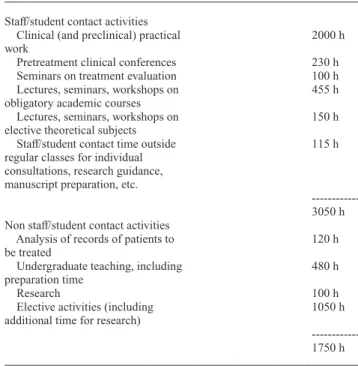
The academic programme is based on a minimum of 40 weeks a year and 40 hours a week, which totals 4800 sched-uled hours for 3 years.
Assignment of the 4800 scheduled hours
In addition, students are required to put in a considerable number of hours of their own time for studying. For exam-ple, for every class hour on academic subjects, on an aver-age 2 hours studying time are required.
Objectives of compulsory elements of theoretical education of orthodontists
The hours indicated in parentheses in the following sec-tions are the minimum number of hours necessary for the average student to devote to the subject in order to achieve the required level of knowledge equivalent to ‘be familiar with’ and ‘have knowledge of’ according to the Association for Dental Education in Europe (Cowpe et al., 2009). The
number of hours devoted to each of the subjects are shown in Table 1. In addition, the students are required to achieve a level of competency in the subjects indicated in ‘Essential competency levels for postgraduate education in orthodon-tics’. The term ‘competent to’ means that students should have a sound theoretical knowledge and understanding of the subject together with adequate clinical experience to be able to independently resolve clinical challenges encoun-tered. The number of hours to reach these competencies is not predefined.
At least one-third of the theoretical education hours must be spent in staff–student contact activities (lectures, semi-nars, workshops, etc.).
General biological and medical subjects (310 hours)
Paediatrics (20 hours). Knowledge of the implications of
the following to orthodontics:
1. Somatic growth and its variations
2. Adolescent growth spurt and its relationship to growth of the craniofacial complex
3. Genetic and environmental factors that influence somatic growth
4. Concept of biological age, skeletal age, dental age, and stages of sexual development
5. Endocrine-related problems in growth and development 6. Allergies related to orthodontics
7. Eating and weight issues in children and adolescents 8. Blood diseases including leukaemia
9. Diabetes
10. Deficits in attention, motor control, and perception 11. Non-accidental injury in children
Anatomy and embryology of craniofacial structures (40 hours). Knowledge of embryology of craniofacial
struc-tures for understanding of:
Table 1 Subjects and number of hours in ‘Objectives of compulsory elements of theoretical education of orthodontists’.
Part Name Number of hours
A General biological and medical
subjects 310
B Basic orthodontic subjects 325 C General orthodontic subjects 340 D Orthodontic techniques 195 E Interdisciplinary treatment
procedures
125 F Management of health and safety 25 G Practice management,
administration, and ethics 45 H Extramural educational activities Elective
Total theoretical hours 1365
The contents of the programme can be restructured to larger modules for which each university may approve European Credit Transfer (ECT) credits. Staff/student contact activities
Clinical (and preclinical) practical work
2000 h Pretreatment clinical conferences 230 h Seminars on treatment evaluation 100 h Lectures, seminars, workshops on
obligatory academic courses 455 h Lectures, seminars, workshops on
elective theoretical subjects 150 h Staff/student contact time outside
regular classes for individual consultations, research guidance, manuscript preparation, etc.
115 h
---3050 h Non staff/student contact activities
Analysis of records of patients to
be treated 120 h
Undergraduate teaching, including preparation time
480 h
Research 100 h
Elective activities (including
additional time for research) 1050 h ---1750 h
1. Normal growth and development of the face, jaws, and teeth
2. Teratogenesis
3. Development of clefts and other facial congenital malformations
4. Growth of the craniofacial skeleton 5. Development of skeletal deformities
6. Orthognathic surgical correction of facial dysmorpholo-gies and malocclusions
Genetics (25 hours). Knowledge of genetic principles
essential for comprehension of:
1. Normal development of the craniofacial complex 2. Craniofacial malformations
3. Pre- and postnatal diagnosis of craniofacial anomalies 4. Genetic counselling
5. Molecular genetic methods
Cell and molecular biology, immunology, and micro-biology (30 hours). Knowledge of cytological,
histo-chemical, and microbiological principles essential for the understanding of:
1. Cell metabolism under normal and abnormal conditions 2. Tissue formation and proliferation
3. Development of bone, cartilage, teeth, and muscle 4. Bone growth
5. Tooth eruption, movements and reactions in tooth sup-porting tissues
6. Soft tissue changes related to orthodontics 7. Mechanisms of root resorption
8. Biofilms
Oral pathology and medicine (20 hours). Knowledge of the
most common oral pathologic conditions and their impact on the orthodontic treatment:
1. Oral cancer and pre-cancer
2. Oral manifestations in immunocompromised patients 3. Oral manifestations of diseases
4. Oral ulceration 5. Oral candidosis
6. Periodontal manifestations of systemic diseases 7. Salivary gland diseases
8. Facial trauma
9. Head and neck tumour
Pharmacology (10 hours). Knowledge of pharmacological
agents with relevance to orthodontic treatment: 1. Antibiotics, antiviral and antifungal agents 2. Prostaglandin inhibitors
3. Non-steroidal anti-inflammatory drugs
4. Calcium regulators (parathyroid hormone, thyroid hor-mones, estrogens, bisphophonates)
5. Anti-epileptics
6. Immunosuppressive agents 7. Growth hormone substitutes 8. Psychiatric drugs and tranquillizers 9. Agents affecting salivation
ENT and speech (20 hours). Knowledge of basic principles
of normal function and ENT-pathophysiology related to orthodontics and/or craniofacial growth:
1. Of the nose and para-nasal sinuses 2. Of the pharynx, epipharynx, and larynx 3. External, middle, and inner ear
4. Normal and compromised nasal breathing
5. Sleep disorders, particularly snoring and obstructive sleep apnoea (OSA)
6. Diagnostic tools for sleep disorders and how to interpret the results
7. Normal and abnormal speech 8. Velopharyngeal function
Craniofacial syndromes (20 hours). Knowledge of the
most common types of orofacial clefts, craniofacial anoma-lies, and syndromes in which the head is involved with respect to:
1. Aetiology 2. Classification
3. Effect on craniofacial growth 4. Psychosocial development
Psychology of the child, adolescent, and adult (35 hours). Knowledge of concepts and principles of
develop-mental psychology essential for the understanding of: 1. Patient motivation and assessment of co-operation 2. Psychological aspects of puberty and adolescence 3. Psychosocial impact of dental and facial appearance 4. Psychological aspects of orthognathic treatment 5. Development of cognition, language and communication Knowledge of concepts of psychopathology and mental disorders essential for the understanding of their impact on orthodontic treatment:
1. Delayed learning, dyslexia
2. Eating disorders, anorexia nervosa, psychiatric disorders 3. Attention-deficit/hyperactivity and other behavioural
disorders
4. Autistic spectrum disorders
5. Conduct disorders, oppositional defiant disorders, self-harming behaviour
6. Suicidal thoughts and attempts
Research methodology and biostatistics (90 hours).
Knowl-edge of general principles, theory and practice of research designs, and commonly used statistical methods in:
1. Diagnostic studies
2. Intervention and experimental studies 3. Aetiological research
4. Epidemiologic surveys
5. Systematic reviews and meta-analyses Knowledge of:
1. Philosophy of science
2. Ethical and legal aspects in research involving animals and humans
3. Scientific integrity 4. Scientific misconduct
5. Evidence-based decision making
Basic orthodontic subjects (325 hours)
Development of the dentition (normal and abnormal; 70 hours). Knowledge of:
1. Normal and abnormal development of the dentition from birth to adulthood
2. Abnormalities in number, size, form, and position of the teeth
3. Genetic and environmental factors relevant to the devel-opment of the dentition
4. Orthodontic consequences of abnormalities of the dentition
5. The impact of interceptive orthodontic measures
Facial growth (normal and abnormal; 50 hours).
Know-ledge of:
1. Growth sites in the craniofacial skeleton
2. Postnatal growth changes in the craniofacial region, including soft tissues
3. Variations within the craniofacial region relevant to facial growth
4. Influence of genetic and environmental factors on facial growth
Physiology and pathophysiology of the stomatognathic sys-tem (35 hours). Knowledge of:
1. Normal and abnormal mastication and swallowing 2. Normal and abnormal functional dental occlusion 3. Normal and abnormal behaviour of soft tissue structures 4. Normal and abnormal function of the
temporomandibu-lar joint
Aspects of tooth movements and dentofacial orthopaedics (35 hours). Knowledge of:
1. The process of tooth eruption and spontaneous tooth movement
2. Biological response to different types of force application 3. Influence of force systems and force magnitude
4. Post-treatment changes
Oral and maxillofacial radiology and other imaging tech-niques (30 hours). Knowledge of:
1. Abnormalities and pathological conditions that can be diagnosed on radiographs
2. Health and safety guidelines with respect to oral and maxillofacial radiology
3. Digital oral and maxillofacial radiographic and other imaging techniques
4. 3D imaging (computed tomography, cone beam com-puted tomography, magnetic resonance, stereophoto-grammetry) and their indications
Cephalometric radiography (45 hours). Knowledge of:
1. Head and neck anatomy as applied to radiology 2. Cephalometric analyses
3. Limitations of cephalograms and their analyses
Orthodontic materials (25 hours).
Knowledge of:
1. Properties, composition, and uses of orthodontic materials
Orthodontic biomechanics (35 hours). Knowledge of:
1. Force systems produced by different orthodontic appliances
2. Force systems produced by dentofacial orthopaedic devices
General orthodontic subjects (340 hours)
Aetiology and epidemiology of malocclusions (25hours). Knowledge of:
1. Genetic and environmental factors that influence postna-tal development of the dentition and facial complex 2. Unfavourable environmental influences and their
interception
3. Prevalence of malocclusions and ethnic variations
Need and demand for orthodontic treatment (15 hours).
Knowledge of:
1. Validity of indices in estimating need for treatment 2. Models to determine the demand for treatment 3. Influence of society on demand for treatment 4. Aspects involved in subjective need for treatment 5. Role played by orthodontists in establishing demand for
treatment
6. Factors involved in estimating objective need
Diagnostic procedures (15 hours).Knowledge of:
1. Taking a patient history and performing a clinical examination
2. Prerequisites for high quality diagnostic records (impres-sions of the dentition, photographs, and necessary radio-graphic images)
Orthodontic diagnostic assessment, treatment objectives, and treatment planning (60 hours). Knowledge of:
1. Principles of orthodontic diagnostic assessment, treat-ment objectives, and systematic treattreat-ment planning
Growth and treatment analysis (45 hours). Knowledge of:
1. Indices to measure occlusal and aesthetic outcomes of orthodontic treatment
2. Growth analyses based on serial radiographic images 3. Limitations of analyses of growth and treatment changes
(including computerized prediction)
Long-term effect of orthodontic treatment (30 hours). Knowledge of:
1. The long-term effect of orthodontic treatment in individ-ual patients, also in relation to ageing effects on the face and dentition
Iatrogenic effects of orthodontic treatment (30 hours). Knowledge of:
1. The development of demineralization, pulp necrosis, root resorption, recession, and periodontal disease dur-ing orthodontic treatment
2. Caries risk evaluation and preventative measures during orthodontic treatment
3. Pain and discomfort related to orthodontic treatment 4. The possible influence of treatment on dentofacial
aesthetics
5. The possible influence of orthodontic treatment to CMDs
Orthodontic literature (120 hours). Knowledge of:
1. Methods to evaluate the methodological quality of scien-tific publications
Orthodontic techniques (195 hours)
A level of competency is required for the topics D1–D8. The requirements are described in detail in ‘Essential com-petency levels for postgraduate education in orthodontics’. D1. Removable appliances (30 hours)
D2. Functional appliances (20 hours) D3. Extra-oral appliances (20 hours) D4. Partial fixed appliances (20 hours)
D5. Fixed labial and lingual appliances (60 hours) D6. Retention appliances (15 hours)
D7. Skeletal anchorage devices (20 hours) D8. Oral devices for OSA treatment (10 hours)
Interdisciplinary treatment procedures (125 hours)
Adult orthodontics (20 hours).Knowledge of:
1. Indications and specific aspects of orthodontic treatment in adults
Treatment of patients with orofacial clefts and craniofacial anomalies (25 hours). Knowledge of:
1. Interdisciplinary aspects of treatment
2. Indication, timing, and process of interdisciplinary treatment
3. Orthodontic treatment in cleft lip and palate patients
Orthodontic-surgical treatment (20 hours). Knowledge of:
1. Minor surgical procedures in relation to orthodontic treatment
2. Indication and application of different types of orthog-nathic procedures
3. 2D and/or 3D treatment planning
Orthodontic-periodontal treatment (20 hours). Knowledge
of:
1. The effect of orthodontic treatment on the periodontium 2. Specific aspects of orthodontic treatment in
periodon-tally compromised dentitions
Orthodontic-restorative treatment (20 hours). Knowledge
of:
1. Principles of combined orthodontic-restorative treatment 2. Orthodontic implications of implants
Craniomandibular disorders (20 hours). Knowledge of:
1. Aetiology of CMDs
2. Methods for clinical assessment of the temporomandib-ular joint
3. General measures to improve CMDs
Management of health and safety (25 hours)
Management of oral health (10 hours). Knowledge of:
1. Procedures to detect a high risk of developing periodon-tal problems, enamel demineralization, and denperiodon-tal caries in orthodontic patients
A major part of this subject is incorporated in ‘Iatrogenic effects of orthodontic treatment’.
Health and safety in orthodontic practice (10 hours). Knowledge of:
1. Guidelines and recommendations for preventing and controlling infectious diseases in orthodontic settings and complying with these guidelines
Multicultural health and health care behaviour (5 hours). Knowledge of:
1. Cultural differences in patient expectations
2. Cultural differences in communication skills in a patient– care provider relationship
Practice management, administration, and ethics (45 hours)
Office management (15 hours). Knowledge of:
1. Design of an orthodontic practice
2. Equipment and instruments needed in an orthodontic practice
3. Recruitment and selection of auxiliary personnel
4. Personal and professional development of auxiliary personnel
5. Financing and administration of an orthodontic practice 6. Public relationships
7. Quality management certification
Communication (10 hours). Knowledge of:
1. Principles of effective communication with patients, par-ents, staff, and third parties
Ergonomics (5 hours). Knowledge of:
1. Principles of ergonomic positioning of patient, ortho-dontist, chairside assistant, instruments
Legislation (10 hours). Knowledge of:
1. Laws and regulations that apply to orthodontic practice 2. Aspects of litigation in orthodontic practice
Professional ethics (5 hours). Knowledge of:
1. Behaviour and conduct expected of an orthodontist as a health-care provider
2. Ethical standards that apply to relationships with person-nel, patients, and colleagues
Extramural educational activities
It is highly recommended to:
1. Participate in European Orthodontic Society Distin-guished Teacher’s Lectures where possible
2. Participate in meetings and congresses arranged by national and international orthodontic societies
Essential competency levels for postgraduate education in orthodontics
In addition to the theoretical knowledge levels indicated in ‘Objectives of compulsory elements of theoretical education of orthodontists’, the students are required to achieve a level of competency in the below-mentioned subjects. The term
‘competent to’ means that students should have a sound theoretical knowledge and understanding of the subject together with an adequate clinical experience to be able to independently resolve clinical challenges encountered.
The minimal number of hours necessary for the aver-age student to devote to the subject in order to achieve the required level of comprehension (= a sound knowledge and understanding of all subjects) are indicated in ‘Objectives of compulsory elements of theoretical education of ortho-dontists’. The competency level ‘competent to’ should be achieved throughout the education without specified hours.
General biological and medical subjects
Research methodology and biostatistics. Competent to:
1. Apply the principles of evidence-based medicine 2. Assess the quality of evidence and validity of conclusions 3. Use electronic databases efficiently to obtain the
evi-dence to answer a clinical or research question
4. Understand and evaluate statistical methods and inter-pretation of findings in current literature
5. Perform an analytical review of research papers 6. Write a protocol for a research project
7. Apply data processing procedures 8. Interpret own research findings
9. Present research findings in oral and written form
Basic orthodontic subjects
Development of the dentition (normal and abnor-mal). Competent to recognize and identify:
1. Normality or abnormality of growth and development 2. Developmental stage attained
3. Potential future development
4. Possibilities for interceptive measures to improve the current and future situation
Competent to:
1. Plan and undertake interceptive orthodontic treatment
Facial growth (normal and abnormal). Competent to
rec-ognize and identify:
1. Postnatal growth changes in the craniofacial region, including soft tissues
2. Variation in the function of components within the crani-ofacial region relevant to facial growth
3. Individual variation in facial morphology
4. Influence of genetic and environmental factors on facial growth
Aspects of tooth movements and dentofacial orthopae-dics. Competent to recognize and identify:
1. The process of tooth eruption and spontaneous tooth movement
2. Biological response to different types of force application 3. Influence of force systems and force magnitude
4. Post-treatment changes
Oral and maxillofacial radiology and other imaging techniques. Competent to:
1. Recognize and identify abnormalities and pathological conditions that can be diagnosed on radiographs
2. Apply the As Low As Reasonably Achievable principles for radiation protection
3. Judge and improve the quality of radiographs for ortho-dontic purposes
4. Apply health and safety guidelines with respect to oral and maxillofacial radiology
Cephalometric radiography. Competent to:
1. Describe the radiographic anatomy of the head
2. Identify relevant anatomical structures on cephalograms 3. Undertake digital or manual tracings of lateral and AP
cephalograms
4. Undertake cephalometric diagnostic analyses and draw appropriate conclusions
Orthodontic materials. Competent to:
1. Select appropriate materials for orthodontic procedures 2. Handle and use orthodontic materials appropriately
Orthodontic biomechanics. Competent to:
1. Apply principles of mechanics to clinical problems 2. Calculate force systems produced by different
orthodon-tic appliances
3. Estimate force systems produced by dentofacial ortho-paedic devices
General orthodontic subjects
Aetiology and epidemiology of malocclusions.
Competent to:
1. Assess orthodontic treatment need and perform screen-ing procedures
Diagnostic procedures. Competent to:
1. Obtain a relevant patient history 2. Perform a thorough clinical examination
3. Determine habitual occlusion, evaluate functional occlu- sion, and different jaw relationships
4. Evaluate influence of functional components of soft tis-sues on dentofacial morphology
5. Take high quality impressions of the dentition 6. Take high quality photographs
7. Take high quality radiographic images
Orthodontic diagnostic assessment, treatment objectives, and treatment planning. Competent to:
1. Arrive at a tentative diagnosis and classification based on the initial clinical examination of a patient
2. Provide advice after an examination concerning feasibil-ity of treatment, need for a more detailed analysis and treatment planning, or further consultation with other specialists
3. Arrive at a proper diagnosis on the basis of anamnes-tic data, patient examination, dental casts, photographs, radiographs, and other relevant data
4. Predict the likely effect if no therapy is implemented 5. Define objectives of treatment with due consideration of
the alternatives
6. Define a treatment plan for various types of orthodontic and dentofacial abnormalities, including treatment and retention strategies, therapeutic measures, timing and sequence of their application, prognosis, and estimated treatment and retention time
7. Undertake a cost/benefit assessment for different treat-ment and retention procedures
8. Assess scope, limitations, and stability of orthodontic treatment
9. Communicate the treatment plan to patients (and their parents if the patient is under the age of consent)
Growth and treatment analysis. Competent to:
1. Use indices to measure occlusal and aesthetic outcomes of orthodontic treatment
2. Undertake growth analyses based on radiographic images
3. Describe treatment changes by analysis of before and near end of treatment records
4. Understand the benefits and limitations of analyses of growth and treatment changes
Long-term effect of orthodontic treatment. Competent to:
1. Describe the potential long-term effect of orthodontic treatment in individual patients, also in relation to age-ing effects of the face and dentition
2. Inform the patients about potential post-treatment changes associated with different anomalies and treat-ment procedures
Iatrogenic effects of orthodontic treatment. Competent to:
1. Identify factors involved in development of deminerali-zation, pulp necrosis, root resorption, gingival recession, and periodontal disease during orthodontic treatment 2. Prevent or manage intra- and extra-oral lesions due to
orthodontic treatment
3. Make a caries risk evaluation and apply preventive meas-ures during orthodontic treatment
4. Advise patients how to manage pain and discomfort related to orthodontic treatment
5. Describe the possible influence of treatment on dentofa-cial appearance and aesthetics
6. Evaluate the influence of treatment on CMDs
Orthodontic literature. Competent to:
1. Detect essential publications in the current literature (taught in specific literature review sessions)
2. Evaluate the methodological quality of scientific publications
3. Develop and present a critical appraised topic
Orthodontic techniques
Removable appliances. Competent to:
1. Describe the use of removable appliances, including advantages and limitations
2. Identify indications and contraindications for removable appliance use
3. Design appliances and describe and evaluate their construction
4. Undertake limited repairs
Functional appliances. Competent to:
1. Describe the use and the limitations of removable and fixed functional appliances
2. Identify indications and contraindications
3. Design appliances and describe and evaluate their construction
4. Undertake limited repairs
Extra-oral appliances. Competent to:
1. Describe the use and the limitations of various types of headgears, face masks, chin cups, and combined extra-oral/functional appliances
2. Identify indications and contraindications
3. Design appliances and describe and evaluate their construction
4. Identify safety aspects of extra-oral appliances
A major part of the section is covered in ‘Aspects of tooth movements and dentofacial orthopaedics’.
Partial fixed appliances. Competent to:
1. Describe the use of partial fixed and semi-removable appliances
2. Identify indications and contraindications, and design appliances
3. Describe the different concepts and treatment approaches in partial fixed appliance therapy
Fixed labial and lingual appliances. Competent to:
1. Describe the use of labial and lingual fixed appliances, including their limitations
2. Identify indications and contraindications
3. Describe different concepts and treatment approaches in design and biomechanical principles
4. Use at least one fixed appliance system
Retention appliances. Competent to:
1. Describe the uses and limitations of retention appliances 2. Identify indications and contraindications
3. Design the appliance and describe and evaluate its construction
4. Describe the most appropriate duration of retention 5. Undertake limited repairs
Skeletal anchorage devices. Competent to:
1. Recognise when temporary anchorage devices or skel-etal anchorage devices should be considered as part of the management of a malocclusion
Oral devices for OSA treatment.
1. The achievement of a competency level is encouraged, but is not obligatory
Interdisciplinary treatment procedures
Adult orthodontics. Competent to:
1. Describe indications and specific aspects of orthodontic treatment for adults
2. Collaborate in the diagnosis and treatment planning of adult patients with general dental practitioners and other specialists
Treatment of patients with orofacial clefts and craniofacial anomalies.
1. The achievement of a competency level is encouraged, but is not obligatory
Orthodontic-surgical treatment. Competent to:
1. Describe aspects of orthodontic treatment specific for patients requiring orthognathic surgery
2. Collaborate in the diagnosis and treatment planning of patients who require minor surgical procedures or orthognathic surgery
Orthodontic-periodontal treatment. Competent to:
1. Describe how orthodontic treatment may benefit patients who have a history of periodontal disease
2. Describe aspects of orthodontic treatment specific for periodontally compromised dentitions
3. Evaluate indications and contraindications for orthodon-tic treatment in periodontally compromised dentitions 4. Collaborate in the diagnosis and treatment planning of
periodontally compromised dentitions
Orthodontic-restorative treatment. Competent to:
1. Identify indications and contraindications for combined orthodontic-restorative treatment
2. Describe orthodontic implications of implants
3. Describe aspects of orthodontic treatment specific for combined orthodontic-restorative patient care
4. Collaborate in the diagnosis and treatment planning of patients requiring orthodontic-restorative treatment
Craniomandibular disorders. Competent to:
1. Describe indications and contraindications for orthodon-tic treatment in patients with CMDs
2. Identify possible implications of orthodontic treatment in the presence of a CMD
3. Collaborate in the diagnosis and treatment planning of patients with a CMD by a team of specialists
Management of health and safety
Management of oral health. Competent to:
1. Instruct patients to maintain optimal oral hygiene as a preventative measure for gingival and dental lesions
Health and safety conditions in an orthodontic practice. Competent to:
1. Implement guidelines and recommendations for prevent-ing and controllprevent-ing infectious diseases in an orthodontic setting and comply with them
2. Implement guidelines and recommendations for managing personnel health and safety concerns related to infection control in an orthodontic practice and comply with them
3. Evaluate systematically the practice infection-control programme to ensure procedures are followed accurately 4. Control exposure to substances hazardous to health for
patients and personnel
Practice management, administration, and ethics
Office management. Competent to:
1. Implement a quality management system in an ortho-dontic practice
Communication. Competent to:
1. Communicate effectively with patients, parents, staff, other medical personnel, and third parties
2. Utilize effective communication tools and different pres-entation modes
Ergonomics. Competent to:
1. Position patient, orthodontist, chairside assistant, and instruments in an ergonomic optimal manner
2. To perform specific clinical procedures in the most effi-cient sequence
Acknowledgements
The authors would like to express their gratitude to the members of the Network of Erasmus Based European Orthodontic Programmes (NEBEOP) for their valuable input to this document. Furthermore, they are grateful to the European Orthodontic Society for providing support to the meetings.
References
Cowpe J, Plasschaert A, Harzer W, Vinkka-Puhakka H, Walmsley A D 2009 Profile and competences for the graduating European dentist – update 2009. European Journal of Dental Education 14:193–202 van der Linden FPGM 1992 Three years Postgraduate Programme in
Orthodontics: the Final Report of the Erasmus Project. European Journal of Orthodontics 14: 85–94