
An Analysis Method for Conceptual Design of Complexity and
Autonomy in Complex Space System Architectures
by
Brandon C. Wood B. S. Astronautical Engineering United States Air Force Academy, 1996
Submitted to the Department of Aeronautics and Astronautics and the Engineering Systems Division
in Partial Fulfillment of the Requirements for the Degrees of Master of Science in Aeronautics and Astronautics
and
Master of Science in Technology and Policy at the
Massachusetts Institute of Technology June 2001
2001 Massachusetts Institute of Technology All rights reserved
Signature of Author . . . . May 28, 2001 Certified by. . . .
Joyce M. Warmkessel Senior Lecturer, Department of Aeronautics and Astronautics Thesis Supervisor Accepted by . . . .
Wallace E. Vander Velde Professor of Aeronautics and Astronautics Chair, Committee on Graduate Students Accepted by . . . .
Daniel E. Hastings Professor of Aeronautics and Astronautics Professor of Engineering Systems Director, Technology and Policy Program
An Analysis Method for Conceptual Design of Complexity and
Autonomy in Complex Space System Architectures
by
Brandon C. Wood
Submitted to the Department of Aeronautics and Astronautics and the Engineering Systems Division on May 25, 2001 in Partial Fulfillment of the Requirements for the Degrees of
Master of Science in Aeronautics and Astronautics and Master of Science in Technology and Policy
Abstract
Recent research by the Massachusetts Institute of Technology (MIT) Space Systems Laboratory has demonstrated a system engineering and architecting framework that enables the creation and quantitative comparison of numerous, unique space system architectures. The foundation for this method is the belief that all satellite systems are information disseminators that can be represented as information transfer networks. This paper uses that work as a foundation and addresses its inadequacy in accounting for the more difficult to quantify operational issues associated with space systems. The Lean Aerospace Initiative, in concert with the Space Systems, Policy, and Architecture Research Center, supported this research.
The first phase of this research involved a series of structured interviews with major civil, defense, and commercial satellite manufactures. System engineers, at a variety of organizational levels, were questioned about the current set of techniques used to evaluate spacecraft command and control system designs. In addition, data was
collected on how operational concerns were addressed in the conceptual and preliminary design phases of development. This results shows that operational issues, although beginning to play a significant role in preliminary space system design, do not play a significant role in conceptual space system design. These interviews supported the development of an operations complexity metric that can be used to evaluate intelligent command and control schemes in complex, multi-satellite space systems.
A space mission was studied, in the second phase of this research, using the previously demonstrated system engineering and architecting framework but with the inclusion of the new operations complexity metric to compare different architectures. The space system’s mission was to collect data on ionospheric disturbances for use in ionospheric weather forecasting. A computer model was developed that produced a frontier of
optimal space system architectures given the specific objectives of the satellite constellation.
This effort has developed and demonstrated an operations complexity metric to expand the viability of quantitative space architecture analysis. This metric is robust enough to accommodate advanced command and control technology, such as software agents, that are poised to revolutionize space operations and enable highly autonomous
constellations of satellites. The use of the metric showed that it quantified operational issues with relatively easily collectable data, minimized misinterpretation of the design method, and relied on reasonable assumptions.
Thesis Supervisor: Dr. Joyce M. Warmkessel
Acknowledgements
Our life’s experiences can be equated by the sum of our brief encounters with others. It is this perspective that I find most useful to frame the many people and events that have defined my graduate engineering experience. Each classmate, professor, interviewee, and friend has made a lasting mark on my life. Listing everyone to which I am indebted is only a fanciful desire, so if the reader feels I have been too brief in the following paragraphs, rest assured you most undoubtedly should be included, yet I must still summarize!
I was given this chance to excel, in part, because of the confidence of a number of people I have had the opportunity to work with in the Air Force. My USAF Academy advisor, Dr. Paul Verges, helped guide my undergraduate work. Lee Bain, Bob Mercier, and Dick Culpepper introduced me the world of Defense acquisitions and the hypersonic community. Col Row Rogacki will always be a model for professional leadership. They all had a key role in helping me achieve my goals and I thank them.
I am grateful to the Lean Aerospace Initiative, not only as a sponsor for this research but also for providing the framework for a rich learning experience at MIT. Dr. Joyce Warmkessel, as my academic and research advisor, cannot be thanked enough for her well-founded insight and advice that she has shared with me over the last two years. The flexibility that she allowed this research to have is very much appreciated.
The Technology and Policy Program also deserves much credit for my positive
experience at MIT. This broad-based program has widened my perspective on a variety of topics. Prof. Dan Hastings, who leads this program, has graciously provided guidance on space policy issues.
My wife has been my most ardent supporter. For believing in me when times were tough and allowing me to maintain my focus, I can never show Penny sufficient gratitude to justify her efforts—though I will continue to try. I could not have done it without her.
My greatest motivator has been a person who has no idea what I am doing. My son’s gleeful excitement when I return home has kept the always-demanding graduate school experience in focus. I thank Alex for his never-ending smiles.
Biographical Note
Brandon Charles Wood, a native of Beaverton, Oregon, spent his teenage years in Heber City, Utah. He graduated from Wasatch High School in 1992 with aspirations for military service and an interest in aerospace engineering. These proved to be necessary traits for successful graduation from the United States Air Force Academy in 1996. Brandon enjoyed the unique challenge a service academy provided and left Colorado Springs with a Bachelors of Science Degree in Astronautical Engineering and renewed vigor to develop and implement aerospace technology. His first assignment as a Lieutenant in the US Air Force was to Wright-Patterson Air Force Base, in Dayton, Ohio. As an engineer in the Air Force Research Laboratory’s Propulsion Directorate, Brandon helped develop hypersonic propulsion technology before serving as the Directorate’s Executive Officer. He also took the opportunity to supplement his engineering skills and attend the Air Force Institute of Technology as a part-time student. With the belief that tomorrow’s aerospace leaders must be technically as well as managerially competent, Brandon pursed graduate education at the Massachusetts Institute of Technology (MIT). This thesis completes the requirements for a Masters of Science in Aeronautics and Astronautics and a Masters of Science in Technology and Policy. He has enjoyed the new challenges that graduate school offered and feels honored to share friendship with his classmates. Upon graduation, Brandon, now a Captain in the US Air Force, will strive to excel at systems engineering and program management responsibilities at the National Reconnaissance Office in Chantilly, Virginia.
Brandon Wood is a member of Tau Beta Phi (National Engineering Honor Society), Sigma Gamma Tau (National Honor Society in Aerospace Engineering), Sigma Xi (International Honor Society of Scientific and Engineering Research), in addition to the US Air Force Academy Engineering Honor Society. He holds membership in the American Institute of Aeronautics and Astronautics, the Aircraft Owners and Pilots Association, and the USAF Academy Association of Graduates. When not dreaming about technology to expand the space frontier, he enjoys spending time with his wife, Penelope Ann, and two-year old son, Alex.
Table of Contents
Abstract . . . 3 Acknowledgements. . . .5 Table of Contents . . . 7 List of Figures . . . 9 List of Tables . . . .10 Chapter 1: Introduction . . . 13Motivation and Objectives. . . 13
Roadmap. . . 15
Chapter 2: Research Design . . . .17
Problem Identification. . . 17
Problem Approach . . . .18
Summary. . . 22
Chapter 3: Space Systems Engineering Framework . . . 23
Space Systems Engineering Process Overview. . . 23
Interview Results Discussion. . . 25
National Space Acquisition Policy . . . 34
Summary. . . .41
Chapter 4: Conceptual Architecture Analysis Processes . . . 43
Conceptual Space Systems. . . 43
Motivation for Analytical Methods . . . .45
GINA Methodology Overview . . . 45
Space Architecture Analysis Process . . . 47
Summary. . . .56
Chapter 5: Space System Autonomy. . . 57
Autonomy: A Definition . . . 57
Autonomy and Intelligent Agents . . . 60
Implications of Autonomy to Space Mission Design . . . 62
Barriers to Space System Autonomy. . . 67
Chapter 6: Model Development and B-TOS Case Analysis. . . 71
B-TOS Overview. . . 71
Additional Model Functionality . . . 81
Model Verification. . . 87
Results Analysis. . . 88
Summary. . . 92
Chapter 7: Concluding Remarks. . . 93
Recommendations for Further Work. . . .94
Final Thoughts on Conceptual Space Mission Design . . . 95
References. . . 97
Systems Engineering and Policy. . . 97
Autonomy: Software Agents. . . .98
List of Figures
Figure 1-1: Thesis Roadmap. . . 16
Figure 2-1: Research Process Flow. . . .19
Figure 2-2: Structured Interview Questions. . . 21
Figure 3-1: Cost Commitment and Incursion in the System Lifecycle. . . 24
Figure 4-1: Concept Exploration Flow . . . 44
Figure 4-2: Space Architecture Analysis Process . . . 49
Figure 4-3: Model Information Flow . . . .55
Figure 5-1: Distributed Agent Concept. . . 66
Figure 6-1: Ionosphere Measurement Techniques. . . .73
Figure 6-2: B-TOS Space System Model Structure. . . 75
Figure 6-3: Notional Swarm Configuration. . . 77
Figure 6-4: B-TOS Tradespace. . . 79
Figure 6-5: B-TOS Operations Sensitivity . . . 80
Figure 6-6: Updated Space System Model Structure. . . .81
Figure 6-7: Operations Complexity Block Diagram. . . .82
Figure 6-8: Complexity Metric Integrated into Operations Model . . . 83
Figure 6-9: Updated Tradespace . . . 89
Figure 6-10: Impact of Autonomy on Lifecycle Cost. . . 90
List of Tables
Table 4-1: Project Priority Matrix. . . 51
Table 5-1: Goal-Oriented Autonomy. . . 58
Table 5-2: Software Agent Characteristics. . . 62
Table 5-3: Impediments to Satellite Autonomy . . . 68
Table 6-1: Baseline Enumeration Matrix . . . 76
Table 6-2: Configuration Studies Matrix. . . 78
Table 6-3: Labor Matrix Output . . . 84
Table 6-4: Autonomy Levels. . . 86
Table 6-5: Software Size Estimates . . . 87
"The Tall Office Building Artistically Considered"
Louis Sulliman, 1896
It is my belief that it is of the very essence of every problem that it contains and suggests its own solution. This I believe to be natural law. Let us examine, then, carefully the elements, let us search out this contained suggestion, this essence of the problem. (…)
All things in nature have a shape, that is to say, a form, an outward semblance, that tells us what they are, that distinguishes them from ourselves and from each other. -- Unfailingly in nature these shapes express the inner life, the native quality, of the animal, tree, bird, fish, that they present to us; they are so characteristic, so
recognizable, that we say, simply, it is 'natural' it should be so. (...)
Whether it be the sweeping eagle in his flight or the open apple-blossom, the toiling work-horse, the blithe swan, the branching oak, the winding stream at its base, the drifting clouds, over all the coursing sun, form ever follows function, and this is the law. (...) It is the pervading law of all things organic and inorganic, of all things physical and metaphysical, of all things human and all things superhuman, of all true manifestations of the head, of the heart, of the soul, that life is recognizable in its expression, that form ever follows function. This is the law. -- Shall we, then, daily violate this law in our art? Are we so decadent, so imbecile, so utterly weak of eyesight, that we cannot perceive this truth so simple, so very simple? (...)
Is it really then, a very marvelous thing, or is it rather so commonplace, so everyday, so near a thing to us, that we cannot perceive that the shape, form, outward expression, design or whatever we may choose, of the tall office building should in the very nature of things follow the functions of the building?
The decision to reject one paradigm is always simultaneously the decision to accept another, and the judgment leading to that decision involves the comparison of both paradigms with nature and with each other.
- Thomas S. Kuhn
Chapter 1: Introduction
This chapter will lay the essential groundwork required to understand the motivation and objectives of this research. This chapter will also provide a roadmap that describes the direction of the remaining chapters.
Motivation and Objectives
The engineering process is focused on trading different design elements. How these tradeoffs or design decisions are made impact the efficiency or usefulness of a given product for a given user. Each user is different; often having wildly varying needs and uses for the product. Automobiles, as an example, are made large and small, roomy and tight, fast and slow, plus expensive or cheap. There is frequently close competition within niches but, generally, each car model is unique. With the addition of specific options, to include nonfunctional choices such as color, a car can be ordered to suit very specific needs.
As complex systems, spacecraft have similar design choices as automobiles. A spacecraft can have different means for attitude control, different power generation capabilities, and different levels of redundancy. A spacecraft engineer can be assisted by a host of tools to assist in the most effective design, but personal experience often plays a significant role.
Automobile design decisions are disparate from space systems. The infrastructure for each automobile is in place. Roads and gas stations have already been built. Mechanics, when repairs are necessary, are always waiting for business. There is a commonly accepted means of driving each automobile, so learning how to drive is a once in a lifetime event and need not be relearned for each vehicle. All of these components; the car, gas station, road, mechanic, and user; can be conglomerated into an “automotive transportation architecture.” Design decisions have been made, over many decades, that impact how a new component fits into this architecture; an example of this design evolution are drivers sitting on the left and driving on the right side of U.S. roads.
Space systems often follow a similar evolution. A common set of components or techniques may be purposefully reused to fit into a predefined architecture. This is, in fact, a major emphasis of manufactures. Redesigning components for each new vehicle is expensive, just as inventing a new type of steering wheel for each new car model would not be cost effective.
Yet, automobile engineers are fortunate in that they have a stable architecture. In fact, it has been demonstrated with the drive for alternate fueled vehicles that changing the system architecture is difficult, for a variety of technical, social, political reasons. Many space systems do not have the luxury of a stable architecture. New technology is
developed, creating the potential for new missions and often requiring different “space architectures.” The space system architectures under examination are much more complex than today’s designs. These architectures, often relying on distributing tasks among multiple satellites and therefore present unique problems for space operations, are made possible by evolutionary and revolutionary technology and are the focus of this research.
Three objectives guide this thesis. The first objective is to document the real-world integration of space operations into conceptual space system design, using current systems engineering practices and political framework. The second objective is to develop a quantitative means to assess different space system architectures, with of focus on distinguishing those that account for operations issues; e.g. designed for operability. The final objective is to demonstrate this newly developed analytical method in the design of complex space system architecture. This demonstration is framed to highlight the implementation process, not the specific architectural results.
Roadmap
Chapter 1 has provided the rough framework for this research. This framework will be further developed in Chapter 2 by a more bounded problem definition and approach. The two subsequent chapters focus on space system engineering; the first dedicated to
the current state of space systems engineering while developing policy
recommendations, with the second highlighting novel system engineering processes. Chapter 5 discusses the core technology area of future space operations: space system autonomy. Chapter 7 develops and analyses the results the conceptual space system model. Chapter 8 provides recommendations for further work and concluding thoughts. Figure 1-1 is a graphical representation of the chapter flow.
Figure 1-1: Thesis Roadmap Chapter 2 Research Design Chapter 5 Space System Autonomy Chapter 3 Space Systems Engineering and Policy
Chapter 8
Conclusion
Chapter 6
Model Development & Case Analysis Chapter 1 Introduction Chapter 4 Conceptual Space System Design
Whether you believe you can do a thing or not, you are right.
- Henry Ford
Chapter 2: Research Design
This chapter covers both the identification of the research problem and a review of the processes used to complete the research. The first section provides a boundary for the work by defining the specific research questions and hypotheses. The second section reviews the formal research methods, including the structured interview questions and motivation for the use of parametric modeling.
Problem Identification and Scope
This research is predicated on two hypotheses. The first hypothesis is that spacecraft command and control schemes are currently designed to address development time and costs with designers placing less than adequate emphasis on meeting operational requirements. The second hypothesis states intelligent command and control technology, which allows high degrees of space system autonomy, is an enabling technology for highly complex space architectures. A premise is that modeling conceptual space system architectures provides is an easy means to assess a large numbers of unique space architectures.
The focus on conceptual space mission design was carefully chosen because, as will be demonstrated in Chapter 3, it is this phase in a system’s lifecycle where the magnitude of the cost is solidified. A tighter focus is required for a precise definition of the scope of this research. The research boundary is not entire conceptual design process but it rather concentrates on integrating autonomy and complexity into space operations modeling. The intent of this research is not to quantitatively address the policy issues but to first develop and demonstrate an analysis method that is robust enough to accommodate revolutionary command and control technology. The final dimension to the research scope is the type of space systems. Concentration was placed on Earth-orbiting civil, commercial, and defense space missions. The decision to exclude interplanetary spacecraft was motivated because of the unique requirements for spacecraft autonomy due to communication latency.
Problem Approach
The research approach is multifaceted, being based on both structured interviews and analytical method design. Figure 2-1 depicts the process the author followed for this thesis. Like many other research endeavors the early stages of this research was characterized by a narrowing of potential research areas.
Figure 2-1: Research Process Flow
Reassess Research Objectives
Enhance Understanding of Conceptual Space System Design Develop Conceptual Space
System Design Interview Questions
Site Visits to Conceptual Space System Design
Centers Collaborate with SSPARC on
Development and Implementation of new Design
Process in A-TOS
Integrate Lessons Learned into Operations Complexity Model
Document Process and Findings Integrate Model with
SSPARC’s Design Process in B-TOS
Identify Research Topic and Objectives
Enhance Understanding of Space Operations Develop Space Operations
Interview Questions
Site Visits to Space Operations Centers Collaborate on Development
and Implementation of GINA-based Design Process in
This led to the investigation of autonomous systems for space operations and the first series of interviews. During this first phase, the broad objective was a deeper
understanding of how space systems are operated. However, the focused goal was a greater understanding of the cost and performance implications of autonomy on
spacecraft. In particular, the implementation difficulties of spacecraft automation were of interest. A set of questions were developed that helped facilitate interviews with operators and spacecraft engineers at space operations centers. These questions attempted to capture how autonomy was impacting morale; satellite knowledge base, e.g. “corporate knowledge;” and anomaly resolution. The ensuing site visits included a prolonged visit to one National Aeronautics and Space Administration (NASA) facility, and brief visits to five U.S. Air Force facilities.
In this phase of the research process, the author was involved in a space operations modeling effort called the Conceptual Operations Design Evaluator (CODE). This project, the result of a class guided by this thesis supervisor Dr. Joyce Warmkessel, designed and created a working software package to perform parametric evaluations of unique operational architectures for different space missions. To do so, the class developed a generic modeling framework that attempted to capture the key functional relationships of space operations. This effort proved influential in that it attempted mold the Generalized Information Network Analysis (GINA) methodology, which will be introduced more appropriately in Chapter 4, into a unique design construct, that of continuous space operations.
As a result of the marginally successful translation of the GINA methodology and the feedback gained from the operations center site visits, a objectives of the research were fined tuned to included the development of an analysis technique for including
operations in conceptual space mission design. This led to a second series of interviews and closer involvement with MIT’s Space Systems, Policy, and Architecture Research Consortium (SSPARC).
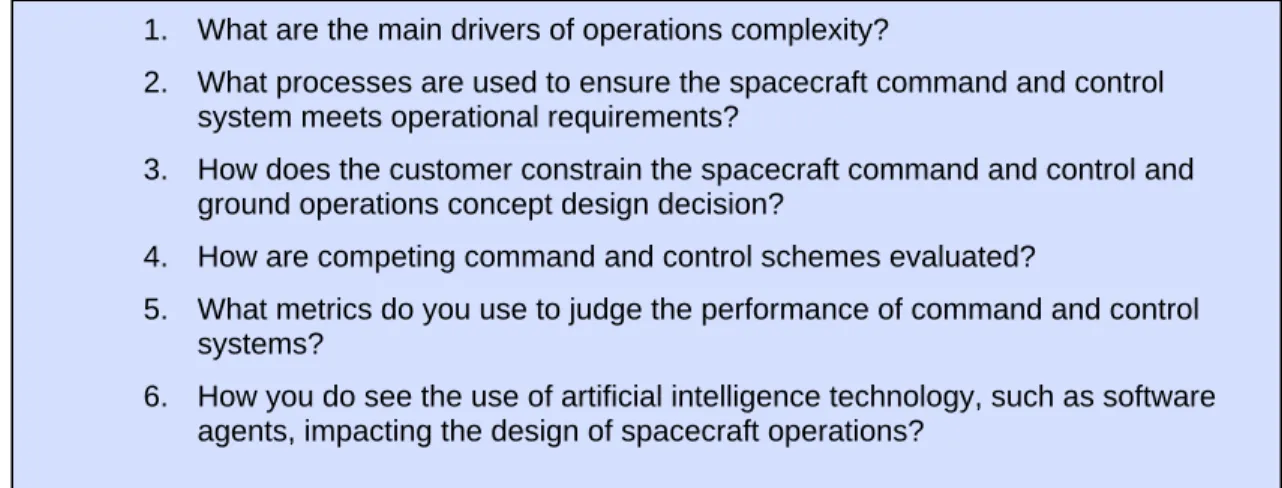
The second set of interviews, more structured than the first, were focused on spacecraft manufacturers. The targets for these interviews were personnel that had a holistic perspective on spacecraft design yet maintained a knowledge base of operational issues and solutions. Each interview began with introductory remarks and general questions to record the organizational background and experience, to ascertain both the interviewees’ level of technical knowledge, to determine which space systems he or she was most familiar. The questions listed in Figure 2-2 were then addressed, as relevant, to each interviewee.
Figure 2-2: Structured Interview Questions
1. What are the main drivers of operations complexity?
2. What processes are used to ensure the spacecraft command and control system meets operational requirements?
3. How does the customer constrain the spacecraft command and control and ground operations concept design decision?
4. How are competing command and control schemes evaluated?
5. What metrics do you use to judge the performance of command and control systems?
6. How you do see the use of artificial intelligence technology, such as software agents, impacting the design of spacecraft operations?
This structured interview process proved very valuable as a flexible yet focused means to collect data from a variety of individuals. In total this round of interviews included nine sites; including seven aerospace contractors, two NASA, and one USAF locations; and 33 interviewees. The interviewees ranged from former CEO’s and Chief Engineers to lower-level spacecraft subsystem engineers. The triangulation of themes; based on contractor, USAF, and NASA perspectives; provided a broad survey of the current state of conceptual space system design.
The final phase of the research was devoted to developing and implementing a
conceptual space system analytical method. This method was integrated with the second instantiation of the SSPARC Space Architecture Analysis Process. The subject of this design effort was call Terrestrial Observing Swarm-B, or B-TOS.
Summary
This three-phase research project was conducted over two years to fulfill the author’s graduate degree requirements. It included two sets of interviews, one with space operations personnel, and the other with conceptual spacecraft designers. The results from these interviews were combined with experience in conceptual space system modeling to produce an analytical method for the conceptual design of complexity and autonomy in complex space system architectures.
Form follows function
- Louis Sullivan
Chapter 3: Space Systems Engineering Framework
The concept of systems engineering has been alluded to in the previous chapter. The following is intended to place a boundary on systems engineering and introduce the system engineering process, focus on the results of the structured interviews, then address policy recommendations for successful conceptual design in the context of national security needs.
Space Systems Engineering Process Overview
The term systems engineering is a product of the Bell Telephone Laboratories. Its processes have been refined since the early 1900’s but gained wider use after successful application during World War II [Hall, 1962]. A system is typically defined as a
collection of hardware, software, people, facilities, and procedures to accomplish some common objective [Buede, 2000]. System engineering is the integration of multiple disciplines with multiple objectives to create synergistic and successful combinations of subsystems. (Buede [2000] provides a table with six other, somewhat loquacious, definitions.) The Institute of Electrical and Electronic Engineers (IEEE) and the
Electronic Industries Alliance (EIA), among other organizations, maintain standards for systems engineering processes. These standards describe a system lifecycle that begins with requirements generation transitions into concept development. The concept
development phase is often when engineers make the first design choices that define the level of autonomy in a system.
The concept definition process in the concept development phase can short circuit the creative process and let the system designer unknowingly rule out potential solutions. Although the purpose is not to reduce the tradespace, this often occurs in complex systems to provide a more accessible boundary to a very complex tradespace.
The importance of the concept development phase is emphasized because of the amount of cost commitment incurred during this phase in relation to the subsequent phases. As depicted in Figure 3-1, the Conceptual Design Phase oftentimes represents over half of
Time Cost 100% 75% 50% 25% 0
Use, Refinement & Disposal Production Detailed Design & Integration Conceptual Design CostIncurred CostCommitted
the cost commitment while the significant portion of the cost incurred typically occurs during production. This should motivate the systems engineer to take special care in the initial concept development and analysis. Unfortunately, this is all too often not the case. Political, institutional, or social pressures are prevalent and force early reduction in the tradespace to make the new system conformable to current systems. This research will concentrate on this early stage of system design; the difficult stage where system parameters are most fluid and the tradespace is largest, but one in which disciplined decision making can be best leveraged.
Interview Results and Discussion
In this section, each of the six interview questions will be addressed individually followed by themes common to many of the interviews.
What are the main drivers for operations complexity?
The interviewees answered this question on a variety of levels based on their personal space operations experience. The need to maintain proper service was a repeated ideal. Many described typical customers as very conservative with a desire to only use
operations concepts based on heritage in order to reduce complexity. Reducing lifetime and/or system redundancy could also decrease this complexity. The responses are summarized in the following list, not necessarily in order of impact:
• Spacecraft mass. Mass acts as a surrogate for many hard to identify factors that increase complexity when a spacecraft grows heavier. These spacecraft usually contain more systems that have more complex interfacing constraints.
Nevertheless, the opposite may be true as well; in one circumstance, two computers were used for power management and control functions in order to
reduce mass. The interface for these two computers lead to more a more
complex operational environment but the design reduced total spacecraft mass, or alternatively allowed more payload mass.
• Date rate: Data rate drives the ground communication network requirements and spacecraft data recorder size.
• Operations concept: In a similar vein as data rate, the operations concepts driver requirements by dictating the number and location of the ground antennas and how they are integrated into the operations center.
• Length of time the system is supposed to operate autonomously: This directly effects the complexity of the autonomous systems and therefore operations complexity.
• Orbit: The type of spacecraft orbit will define the frequency of propellant burns for maneuvers or station keeping.
• Payload: The type of data collected, the level of command planning (for example, turning off a ground sensor over an ocean), and payload instrument complexity all impact the operations complexity.
Unrecognized complexity was seen as major cause of ground segment design problems. This manifested itself as difficulties troubleshooting errors in the system.
What processes are used to ensure the spacecraft command and control system meets operational requirements?
As was expected, the space system specifications were used by many designers to ensure the command and control systems meet requirements. Often these specifications, or predictions of these specifications, were derived from previous space system designs.
This question was anticipated, but failed, to frame the boundary between operational requirements and political forces driving space system design. From a contractor
perspective, the requirements and derived specifications were by far the most significant influences on spacecraft design.
How does the customer constrain the spacecraft command and control and ground operations concept design decision?
The responses to this question varied based on the type of customer. Defense missions were very restrictive and place many constraints on which operations concept to use. The civil science mission varied based on the necessity to process real-time data. Commercial users usually did not have the in-house expertise to place large constraints on specific design decisions.
How are competing command and control schemes evaluated?
On a system level, little evidence indicated that command and control schemes are effectively evaluated. This is often driven by different parts of the customer’s
organization funding different parts of the space system lifecycle. For Department of Defense missions, the acquisition contracts typically originate from a different unit and use different “color” of money than the operational contract. This has created
suboptimal solutions in the opinion of many interviewees. There is not an adequate closed feedback loop for operational issues, the negative aspects of operational design are communicated from the operator to the designers but positive feedback is
On a spacecraft level, different schemes are evaluated based on a trade off between cost, schedule, and development risk. The initial trades usually focus on the spacecraft’s ability to maintain proper communication and then their ability to maintain attitude control. The resulting attitude control system design drives the software requirements. After throughput and interface requirements are developed, the design team reviews existing systems available and selects the components based on the needed abilities.
What metrics do you use to judge the performance of command and control systems?
This question was expected to define the quantitative measures used to distinguish potential system designs. Unfortunately, the overwhelming response, for the conceptual design of space systems, was that only minimal analysis is done to evaluate different command and control schemes. The design decisions were primarily based on system requirements, such as having the capability for 90-day autonomous operations and a 2-hour recovery period from anomalies. The mission goals, such as data timeliness goals, drove communication link sizing and on-board collection rate and data dump times. Other time-based mission goals included mean time between downtime events and mean time to restore function. Unfortunately, these metrics would be particularly hard to estimate during conceptual spacecraft design. Cost was another metric used to judge operations schemes. Three costs were listed in order of priority: cost of normal operations, cost of operations crew training, and cost of the hardware and software operating licenses.
The most pessimistic perspective voiced was that the trades were done ad hoc, with no real consideration to the system wide impacts. Every design team uses their own
experts, made possible by a small “brotherhood” of engineers that have experienced a variety of programs and therefore have sufficient intuition to make the tradeoffs.
From the console operator perspective, the most effective operations schemes are those that reduce loading on individual operators, automate data sharing, reduce operations fatigue through have autonomous warnings and operator control over computer screen layout. They maximize spacecraft autonomy and require simple training that is easy to assess.
Unfortunately, all of these metrics were accessible on from the perspective of a
thoroughly designed system. Abstracting these measurements to the level required for conceptual system design proves difficult.
How you do see the use of artificial intelligence technology, such as software agents, impacting the design of spacecraft operations?
One objective of the initial interviews associated with this research was to qualify the current level of autonomous technology in use today. The results of the second interviews collaborated the finding that very few systems have a significant level of automation, either on board the spacecraft or in the ground system. Therefore, the system engineers had limited first-hand experience integrating advanced autonomous technology into space system designs. The experience base of many was at the level of expert systems, a technology that provides a set of recommendations if a predetermined event occurs.
The interviewees proposed many explanations for why autonomous technology has not been more fully integrated with spacecraft design. Perhaps the most significant reason was low risk tolerance. Large space systems do use deterministic based anomaly
detection and resolution systems or redundancy management systems, but only when the mission length or criticality allows the development of such systems. Even if the lack of available on-board processing capability does not steer the design team away from autonomy technology, the inherent difficulty in testing the software in an operational environment is significant hurtle. Lack of insight into the exact nature of a problem, when one arises, also demotivates operators from allowing space systems to run autonomously.
One interviewee made a particular point that is significant to this research. The analysis of conceptual space mission design should be focused on the highest-level design decisions. Knowing what should be included as significant tradeoffs is gained by personal experience. The interviewee agreed that autonomy technology drives selection of spacecraft components, but questioned whether it actually drives architecture
selections.
Overarching Themes
The interviews facilitated discussion on issues separate from those specifically addressed in the questions. The themes of these discussions revolved around 1) making
design centers, and 4) the pros and cons of using autonomous system. Since these themes are germane to the architecture analysis process, they are addressed in the following paragraphs.
Architecture Decisions: The early architectural decisions have been, from one
perspective, the result of negotiations between the user, the acquiring organization representing the user, and the prime contractor. In the Department of Defense and NASA cases, the government entity has in the past dictated the architecture for the mission. The launch vehicle is selected and the ground operations scheme is selected and guides the spacecraft conceptual design. This has especially been the case with relatively simple space missions. With larger systems, more common in the DoD than NASA, new ground operation facilities are constructed to support the new space missions. With the simpler designs, the major tradeoffs involve satellite bus selection and outfitting that bus to support the specific payload. The Rapid Spacecraft
Development Office at NASA’s Goddard Space Flight Center is an example of an organization that uses bus databases to make quick assessment of conceptual designs. They are not trading the architectures necessary to carry out the missions, just the space components that integrate into the already operations centers. This rapid design
technique is also used in commercial systems such as geostationary communication satellites. The contractors are able to reuse flexible spacecraft busses to reduce development time and cost.
Using spacecraft bus databases is not an option the more complex space systems, many of which are funded by the DoD. In these cases, when architecture decisions were made, the early involvement of contractors in key decisions was helpful to resolve technical conflicts. The integration of space operations issues early in the design process has been hindered by program managers trying to reduce near-term costs or due to general lack of foresight. In cases where operations have been a key part of space mission design, it has been dictated and not evaluated in the context of the entire space system.
No space system has the luxury of beginning with a clean sheet of paper. All space system must fit into larger “systems” that integrate the products of the mission. New communication satellites must be able to communicate with old ground terminals, especially if replacing or updating the terminals is cost prohibitive.
Conceptual Design Centers: Spacecraft manufacturers have been using novel
techniques to quickly assess conceptual space designs. These design centers are structured to provide a quick look at what is feasible to build and how much it could cost. The goal is to gain high-level insight in a potential system, not to specific precise values for each component. Concurrent design tools are used in these design centers to facilitate the quick day- to week-long exercises that focus on one design solution. They typically use integrated spreadsheets with engineering and cost models to determine rough performance and lifecycle cost numbers. The results have been successful in exploring the impact of undemonstrated technology. The process does not, however,
lend itself to studying large quantities of architectures, but they are able to look at a small number in greater detail than without concurrent engineering tools and techniques.
COTS Software: The reuse of software is another key decision that spacecraft
engineers must make. This decision directly impacts the integration of the system into current operations centers. The use of commercial-off-the-shelf (COTS) software products has been motivated by the drive to reduce space mission costs and to allow a contractor to focus on its key profit sector, satellite manufacturing; but some programs have been unsuccessful in their attempt to efficiently COTS software. If the COTS vendor is incapable of modification, it was recommended to not procure that software and develop a new product. The cost savings does not sufficiently outweigh the decrease in software stability. Increase functionality may motivate software
modification but oftentimes the cost savings is only realized if standardized software is used on all satellites in a multiple satellite space system. Even if many satellites are purchased together, they are constructed at different times and components change or evolve. These differences are often sufficient to require software changes, which can increase the integration of COTS software cost to above in-house software development cost levels. An additional issue associated with COTS software use was the lack of pedigree. Software not tested with a contractor’s components requires more, often expensive and time consuming, testing. Even with more testing, higher infant mortality rates have been witnessed with COTS products
Automation: The proper use of automation was, of course, an overarching theme.
autonomy is able to reduce operations costs. It allows operations teams to be populated by less skilled personnel. It is easier to hire and adequately train these personnel. The automation should not be at the expense of reliability. Virtually all interviewees, mentioned, in one way or another, that system reliability was key to performance. The defense sector is motivated to maintain the correction operation of the system to assure it is available when required. The civil sector was motivated to not disrupt their revenue stream. Simple robust design was highlighted as the avenue to achieve this reliability. Insofar as autonomy increases system reliability, it should be considered, but it can never be at the expense of reduce system reliability.
Another comment about proper use of autonomy was focused on the spacecraft level of design. Autonomous capability should only be used when it is most critical, such as attitude control or satellite formation maintenance. Other systems do not realize the savings from automation. For example, a battery might fail over a 2-year timeframe. It is relatively easy for an operations team to plan for its replacement, if it is available on board. Automation, with its cost in software development and complexity, would not be justifiable.
National Space Acquisition Policy
After decades of spacecraft development, there are few architectural decisions for
relatively simple satellites. Small satellites, and many large satellites, fit relatively easily into their respective organizations operational capabilities. The acquisition of many DoD space missions follow a different path due to their inherent complexity. These systems can benefit greatest from a top-level architectural analysis that includes an
examination of the operations techniques. Unfortunately, a number of political and organizational barriers prevent this from smoothly occurring. The following analysis will review the key stakeholders in this policy environment, summarize the relevant political environment, and provide recommendations for improved conceptual spacecraft design.
Policy Stakeholders
Warfighter: This broadly used ambiguous term refers to men and women closest to
combat. These people deliver the weapons during war or play a first hand role in carrying out tactical operations. They are the ultimate user of defense space systems. They sometimes use data directly from satellites, as in the signals from the Global Positioning System constellation, or processed data from the Defense Support System satellites that tells them the potential target for a Scud missile. They have no concern about the acquisition schedule or cost of the space assets; they only desire assurance that when needed the space system will be working properly.
Air Force Space Command: This is the major command that launches and operates a
majority of the nations satellites. It supports the warfighter by providing weather, communications, intelligence, missile warning, and navigation information and
capabilities. The Directorate of Requirements (AFSPC/DR) has a large impact on future space mission design. It is charted to develop strategic technology roadmaps to evolve current systems to meet future warfighter needs. Specifically it develops and processes
the appropriate requirements documents such as the Mission Needs Statement and Operational Requirements Document. [AFSPCI10-120104, 1998]
Space and Missiles Systems Center: This product center has been a part of the Air
Force Materiel Command and is the hub for the acquisition of Air Force launch vehicles and spacecraft. The Directorate of Developmental Planning (SMC/XR) coordinate new technology and system development with the needs as stated by the user community. SMC/XR, has the capability, with support from the Aerospace Corporation, to perform architecture analyses to guide future space system development. These efforts focus on users needs 5 to 10 years into the future. The mission solution analysis done in
SMC/XR and is translated back to AFSPC/ DR.
National Security Space Architect: The NSSA is a joint DoD and Central Intelligence
Agency organization charted to study and recommend space architectures to achieve the nations national security objectives. Since it has a broad perspective, it is able to provide guidance on which type of systems need to be explored with conceptual design efforts.
National Reconnaissance Office: The NRO is an organization that has been cloaked in
secrecy for most of the past four decades. It is responsible for developing, acquiring, and operating the nation’s national security assets that acquire imagery and signals intelligence from space platforms. This organization has been culturally separated from the Air Force units performing similar functions and has developed a reputation for fast and efficient acquisition strategies.
Aerospace Contractors: The prime contractors for the defense space industry comprise
a small subset of the aerospace industry. Companies such as Boeing and Lockheed Martin work very closely with the acquisition organizations to develop conceptual space system designs that meet needs stated by AFSPC.
Other Space Organizations: There is, of course, a large list of organizations that
interact with the above entities to facilitate conceptual space mission development in the Air Force. NASA and NOAA have collaborated extensively with DoD on space
missions. The user community goes beyond uniformed warfighters to the intelligence community and even the public in the case of GPS.
Political Climate
The Honorable Donald Rumsfeld, as the newly appointed Secretary of Defense, has placed renewed emphasis on DoD space programs. Two significant reports have been released that foreshadowed structural changes to the national security space community. The NRO Commission, in its November 2000 report, reiterated the successes of the NRO and supported increased visibility of its programs to the President. It advocated the creation of new, highly secretive Office of Space Reconnaissance. It recognized the NRO’s evolving user community and the need for flexibility to meet both strategic and tactical needs. Above all else, this report emphasizes the NRO’s past accomplishments and highlights its need to continue adapting to new situation. In January 2001, the Commission to Assess United States National Security Space Management and
Organization released the second and arguably more far-reaching report. This
commission, that was until the final months lead by Donald Rumsfeld, recommended a series of organizational changes for DoD and the NRO. One recommendation was to realign the Air Force and NRO space programs. Since the release of the report, Secretary Rumsfeld has appointed a single official within the Air Force with authority over both Air Force and NRO space programs. The National Security Space Architect (NSSA) will also be realigned to report to the Under Secretary of the Air Force and Director of the NRO. [Space Commission Report, 2001, and Space Initiative News Release, 2001]
Strategies for Improved Conceptual Design
The Space Commission Report calls for the “best practices” of the Air Force and the NRO space organizations to be integrated together. Identifying the “best practices” that relate to space operations and conceptual design will guide the development of policy recommendations for improved conceptual design.
Having high quality personnel available for conceptual design motivated the first policy recommendation. The Air Force and NRO developed in quite different environments and have dissimilar cultures. Because the NRO needed to remain behind a black veil, transfer of personnel into and out of the organization was not as easy as in the Air Force. As a result, the NRO encouraged rotation amongst specialty areas within specific
programs. The Air Force personnel system encouraged its members to transfer between bases and gain experience with a wide variety areas not necessarily focused on space
systems, especially not on one particular space system. Since the acquisition and operational units were in different major commands, it was also difficult to transfer between these two specialty areas. Because of these dynamics, the NRO developed personnel were highly knowledgeable about their space system. The Air Force personnel model developed personnel with a wider variety of experiences, but less capable in each. The conceptual design of space systems is most effective when the designers have first hand experience with similar systems at all phases of the lifecycle. The NRO model encouraged this and therefore has the experienced personnel for conceptual design that considers not only the issues that typically surface before initial operational capability (IOC) but also normal and “fly-out” operations, the whole
lifecycle. Policy Recommendation #1 should facilitate the development of the required expertise.
The second policy recommendation centers on the NRO’s tolerance for risk exposure. From its inception, the NRO has encouraged the focused development of leap-ahead technologies. It has encouraged development efforts that by Air Force standards would be too risky. Although the recent trend has shifted towards evolutionary, as apposed to revolutionary, technology development, this “best practice,” as demonstrated by the NRO in years past would facilitate advance operations technology development. This risk exposure was tolerated because of the secrecy surrounding the programs. The Air
POLICY RECOMMENDATION #1: Populate conceptual design teams with personnel that understand all aspects of the system lifecycle. Use the NRO model to encourage this exposure.
mentality. Failure was not an acceptable solution, even if much was learned in the process. Paradigm breaking technologies, such as some proposed to automate spacecraft should be developed to reduce system lifecycle costs, thus:
The final recommendation does not come from a “best practice,” because neither the Air Force nor the NRO places sufficient priority on quantitatively analyzing system-level space architectures. The NRO and the Air Force have system engineering teams at the program office, or equivalent, level. The NSSA does do high-level architecture analysis, but these results are focused on single architectures, a wide variety that quantitative analysis facilitates.
Air Force and NRO leadership have been motivated to change their organizations. Secretary Rumsfeld is driven by the results of the Space Commission and to a lesser extent the NRO Commission and has empowered this leadership to change or merge the respective organizations. This opens a critical opportunity to implement the above policy recommendations, in tune with many other far-reaching changes the Space Commission recommended. These strategies are key to implementing a conceptual
POLICY RECOMMENDATION #2: Encourage a revolutionary concept design mentality by minimizing the negative career impact of single failures.
POLICY RECOMMENDATION #3: Empower a joint organization, lower than the NSSA but above program office levels, that can quantitatively assess conceptual space architectures and incubate potential solutions with more detailed design studies.
design process that effectively analyses system level trades to meet the needs of both the defense and intelligence communities.
Summary
This chapter develops the framework for space architecture analysis. The foundation for the analysis is space systems engineering. The interview provided key insight into the current state of conceptual space mission design and highlighted the need for effort to integrate operations earlier in the design process. These results led to policy
recommendations for the national security space sector to best to leverage quantitative conceptual space system analysis.
What, Sir, would you make a ship sail against the wind and currents by lighting a bonfire under her deck? I pray you excuse me. I have no time to listen to such nonsense.
- Napoleon to Robert Fulton
Chapter 4: Conceptual Architecture Analysis Processes
This chapter begins by laying the framework for the analytical analysis of space mission architectures. After a review of the motivations for such analysis, the historical
processes, and weaknesses thereof, are provided as a baseline for the process exemplified in Chapter 6.
Conceptual Space Systems
A system concept can be defined as one of many engineering solutions that meets the end user’s needs. During the Concept Design Phase of a space system acquisition process, many such concepts are developed. The system boundaries and key interfaces between components in the system are explored and specified. Risk is identified and quantified plus preliminary specifications are completed for each of these alternative concepts. A single design, or a small set of alternative designs, becomes the baseline for the detailed design in the next phase of system lifecycle, the Detailed Design and
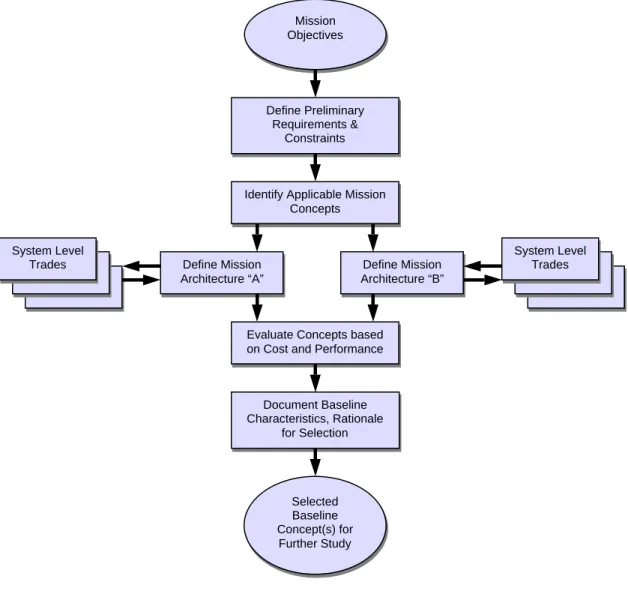
Integration Phase. [IEEE 1220] Figure 4-1, on the next page, depicts the Concept Exploration Flow in a diagram adapted from Space Mission Analysis and Design [1999].
Some system engineers advocate defining a single space system as a reference, or point design. The goal is not to narrow down the potential solutions, or tradespace, but to allow a common framework for discussion and further analysis. This reference, however, may create cause unexpected consequences and many express concern that defining this one solution too early in the concept exploration process will overly
constrain the eventual design solution. Engineers, having devoted effort to the design of a particular solution, can become reluctant to accept other, potentially better-optimized, system concepts. A system design team who creates a point solution runs the risk of
Mission Objectives
Define Preliminary Requirements &
Constraints
Identify Applicable Mission Concepts
Evaluate Concepts based on Cost and Performance
Document Baseline Characteristics, Rationale for Selection Selected Baseline Concept(s) for Further Study System Level Trades System Level Trades Define Mission Architecture “A” Define Mission Architecture “B”
creating a design legacy. System engineers must strive to maintain an unbiased perspective when choosing the globally optimum system design.
Motivation for Analytical Methods
An analytical method, which involves the construction of a parametric model, is advantageous because it explicitly states, through the specific equations, the defining relationships between parts of the system. A quantitative method also maintains an open tradespace, therefore alleviating some of the issues associated with a defining a point solution too early. Models provide a common baseline that is helpful when engineers have conflicting views about the results. The assumptions that define the relationships and are debated but the actual relationships, because they are quantitatively defined in the model, are not a point of contention.
GINA Methodology Overview
The Space Systems Laboratory at the Massachusetts Institute of Technology has done significant work in the area of conceptual distributed satellite system design. A major effort has revolved around a systematic analysis process outlined by Dr. Graeme Shaw [1999]. This methodology generalizes space systems and allows the adoption of the metric parameters of information network theory. Titled the Generalized Information Network Analysis (GINA) Methodology, it provides the framework for parametric analysis of multiple space architectures. Specifically it abstracts space systems to information networks, with associated source nodes and sink nodes that addresses the demand for information transfer between them. The initial product of the GINA method is computer code that equates specific design characteristics with metrics that define the
quality of service provided by the system. There are four quality-of-service parameters: isolation, information rate, integrity, and availability.
The quality-of-service parameters are key to understanding the application of the GINA methodology. Isolation characterizes the space system’s ability to distinguish and identify multiple sources of information. Using a space telescope as an example,
isolation refers to the optical resolution. Information rate is defined as the speed at
which information is transferred over the system. For a space system, this is simply the telecommunications data rate. Integrity characterizes the probably that the information transferred through the system becomes corrupted or is based on an erroneous data collection. With the space telescope example, the integrity would be quantified as the bit error rate. The availability quality-of-service parameter is the instantaneous probability that information is being transferred through the network.
The GINA methodology is a framework in which to analysis multiple space system architectures but it fails to precisely define the architecture analysis process. This methodology as prescribed by Shaw is in the amorphous region between a model
algorithm and a design process. GINA is notable in that it discourages premature “point designs,” which, as stated above, may cause the design team to overlook more
innovative, elegant, or cost-effective design solutions.
In the case studies performed the GINA methodology (the conceptual design of a space-based optical interferometry constellation, a space-space-based radar constellation, and a space
operations architecture) the autonomy trades were exterior to the design space, i.e. the level and type of autonomous control and operations were held constant. Swartz’ thesis [1997] predates GINA slightly but is relevant because it does offer a probabilistic model of the effects of automation on system availability and costs, two key design metrics. This study is, however, not prescriptive, and concludes with little guidance for a system engineer in the conceptual phase of a space system design. The integration of
autonomous control design choices into the systems engineering processes is incomplete in the current literature.
Space Architecture Analysis Process
One of the primary objectives of the Space Systems, Policy, and Architecture Research Consortium (SSPARC) is the development of a system engineering process that
parametrically compares multiple space architectures. The GINA methodology was the baseline for this process the author will refer to as the Space Architecture Analysis Process (SAAP).
Realizing that the process can only be developed iteratively, the SSPARC members have used multiple design exercises to understand the interaction of the space system
engineers with the customer(s) and each other. These multiple iterations have been focused on the development of an ionospheric mapping satellite system or Terrestrial Observer Swarm (TOS). The different iterations are distinguished by affixing alphabetic prefixes: A-TOS, B-TOS, etc. The first design exercise, A-TOS, was performed by a concentrated team of approximately seven members, including the author, during the fall and winter of 2000. Since no one on the design team was a subject expert in ionosphere
sensing, but effort was devoted to understanding the issues associated with designing a space system with this objective. Close interaction with the Air Force Research Laboratory (specifically, AFRL/VSB, the Battlespace Environment Division of the Space Vehicles Directorate at Hanscom AFB, MA) helped the team understand the issues. Personnel from AFRL/VSB served as the customer for this science mission. The A-TOS team chose to use in situ instrumentation and performed architecture studies for the conceptual design of such a space system.
The second design exercise, B-TOS, used a slightly larger team (besides the author, only one other member was also in A-TOS team) and a different ionosphere instrumentation technique. The lessons learned from A-TOS were incorporated into an updated design process. The use of a multi-attribute utility analysis was the major addition to the B-TOS process. The remainder of this chapter will focus on a prescriptive design process very similar to that used in B-TOS but incorporating many lessons learned. The
significant differences will be noted. Chapter 6 contains more specific information about B-TOS, including results.
SAAP Phase I: Understand Needs
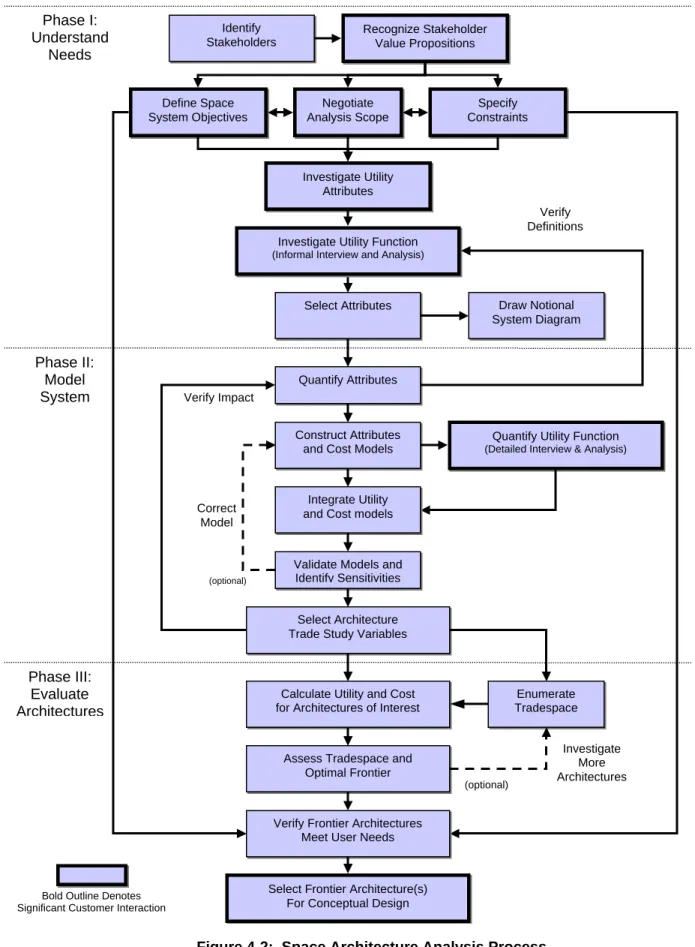
SAAP is depicted in Figure 4-2 on the following page. The process is divided into three phases. The goal for Phase I is to understand the user needs. The design team and user representatives are two of the key stakeholders, or people that are affected by the process results. After the design team identifies all relevant stakeholders, each group needs to elucidate its value proposition. These value propositions should capture the value each
Phase I: Understand Needs Phase II: Model System Phase III: Evaluate Architectures Define Space System Objectives Specify Constraints Investigate Utility Attributes Select Attributes Investigate Utility Function
(Informal Interview and Analysis)
Quantify Attributes
Construct Attributes and Cost Models
Select Architecture Trade Study Variables
Quantify Utility Function
(Detailed Interview & Analysis)
Verify Impact
Verify Definitions
Calculate Utility and Cost for Architectures of Interest
Select Frontier Architecture(s) For Conceptual Design
Validate Models and Identify Sensitivities Correct
Model
Assess Tradespace and Optimal Frontier
Verify Frontier Architectures Meet User Needs
Enumerate Tradespace Integrate Utility
and Cost models
(optional) (optional) Investigate More Architectures Draw Notional System Diagram Recognize Stakeholder Value Propositions Identify Stakeholders Negotiate Analysis Scope
Bold Outline Denotes Significant Customer Interaction
stakeholder will provide to the analysis effort and explicitly state the desired outcomes and why those are useful to that particular stakeholder. This process structures the approach to the design effort and facilitates the subsequent scope negotiations by ensuring each stakeholder understand the desires and motivations of the others. The customer, by interpreting the needs of the user and external systems, will provide the constraints for the space system design. These could include cost limitations, risk tolerance, or any legacy systems that might need to be incorporated into the new design. The constraints could also include specific design characteristics that narrow the design tradespace to reduce the analysis scope.
The customer also provides the top-level space system objectives. This is the broadest level of tradespace reduction. It could specific a space system over a ground or aerial system, but not necessarily. As there could be multiple approaches to fulfilling the objectives, these need to be specific enough so that one model can realistically include the tradespace. As an example, the ionosphere mapping mission can be accomplished using in situ measurements (A-TOS), top-side sounding measurements (B-TOS),
ground-based beacon measurement (B-TOS), GPS occulation, or UV radiation detection. The particular techniques are not of interest here but specifying an in situ instrument verses a sounding instrument changes the space system so drastically that, in the SSPARC design efforts, the team decided to focus on modeling one at a time and not concurrently. The customer and design team must understand their capabilities. The customer is required to interact, often rather closely, with the design team at various stages in the process. The design team, will need to understand its skill and resource
limitations to meet an agreed upon schedule and cost with the specified level of model fidelity. The relative priority can be captured using a chart similar to Table 4-1.
Table 4-1: Project Priority Matrix
High Priority Medium Priority Low Priority
Scope X
Schedule X
Fidelity X
Resources X
Defining and agreeing upon these priorities early provides guidance for the effort when the inevitable conflicts arise.
Arguably, the most critical part of this analysis process is the correct selection of utility attributes. These attributes serve as a metric for mission performance as defined by the customer. In very precise form, they describe what the system should accomplish; but they are not single goals, rather they are ranges of values. Since the customer will most likely not be familiar with this process, and not have a well defined set of attributes available. The attribute selection process should be iterative with the design team remaining flexible.
Multi-Attribute Utility Analysis
It is at this point in the process that the design team should introduce the multi-attribute utility analysis (MAUA) method to the customer. The MAUA provides a systematic technique for assessing customer “value”, in the form of preferences for the attributes. The value of an architecture will, using the utility analysis, be translated into a utility metric. The utility metric, the product of the MAUA method, is measured on a scale
between zero and one. Each architecture can have different level of utility and, combined with architecture lifecycle cost estimates, will provide the distinguishing metric for architecture selection. The customer preferences are quantified after a very structured interview. Since this interview, and subsequent analysis, requires
considerable effort, the attributes must be well defined and understood by both the design team and customer beforehand. In order to facilitate defining the attributes, the design team should accomplish an initial utility interview with the customer.
The multi-attribute utility analysis is helpful because it provides visibility into the architecture selection process by quantifying the otherwise qualitative value of each architecture into a single score. The single score eliminates the difficult task of
determining weights for different attributes. It is an iterative process so it facilitates the capture of decision rationale. Since architecture value is a focus of the interview
process, it provides a good mechanism to concentrate on the important design issues and weed out the irrelevant.
The MAUA does, however, require considerable time commitment by the customer. Representatives on the design team must understand the utility process well and be able to adequately guide the interview and discussions. Finally, the architecture selection can be highly sensitive to the relative weighing factors that govern the utility function. Care must be taken to educate the customer on these sensitivities and to correctly identify and capture the customer’s values. (The reader is referred to Richard de Neufville’s book,


![Figure 3-1: Cost Commitment and Incursion in the System Lifecycle [Buede, 2000]](https://thumb-eu.123doks.com/thumbv2/123doknet/13954160.452489/24.918.166.759.705.1029/figure-cost-commitment-incursion-lifecycle-buede.webp)

![Table 5-1: Goal-Oriented Autonomy [Martin and Barber, 1996a]](https://thumb-eu.123doks.com/thumbv2/123doknet/13954160.452489/58.918.128.775.797.968/table-goal-oriented-autonomy-martin-barber-a.webp)
![Table 5-2: Software Agent Characteristics [Khosla and Dillon, 1997, and Knapik, 1998]](https://thumb-eu.123doks.com/thumbv2/123doknet/13954160.452489/62.918.131.799.129.385/table-software-agent-characteristics-khosla-dillon-knapik.webp)
