Building E-education Platform for Design-Oriented Learning
byHai Ning
Master of Science in Architecture Studies, Massachusetts Institute of Technology, 1999 Bachelor of Architecture, Tsinghua University, 1997
Bachelor of Engineering in Computer Science, Tsinghua University, 1997 SUBMITTED TO THE DEPARTMENT OF CIVIL AND ENVIRONMENTAL ENGINEERING
IN PARTIAL FULFILLMENT OF THE REQUIREMENTS FOR THE DEGREE OF DOCTOR OF PHILOSOPHY IN INFORMATION TECHNOLOGY
AT THE
MASSACHUSETTS INSTITUTE OF TECHNOLOGY
JUNE 2004
C 2004 Massachusetts Institute of Technology. All rights reserved.
Signature of A uthor ... ... ... ... Department of Ciul dnd Environmental Engineering
May 7, 2004
C ertified by...
A ccepted by...
...
...John R. Williams Professor of Civil and Environmental Engineering Thesis Supervisorl Heidi M. Nepf
Professor of Civil and Environ ental Engineering Chairman, Committee for Graduate Students
MASSACHUSETTS INSTRUTE OF TECHNOLOGY
BUILDING E-EDUCATION PLATFORM FOR DESIGN-ORIENTED LEARNING
by
Hai Ning
Submitted to the Department of Civil and Environmental Engineering in June 2004 in Partial Fulfillment of the Requirements for the Degree of
Doctor of Philosophy in Information Technology
Abstract
Design-oriented learning requires tools that support creative processes and student-to-student and student-to-faculty interactions. While most present E-Education systems perform as the asynchronous distribution channel for teaching material, they usually offer little support for project based design processes.
This research maps out the key learning events in design classes at MIT's Department of Mechanical Engineering, and proposes guidelines for building E-Education systems to support the unique characteristics of design-oriented learning. Two creative learning processes are identified and two independent, yet tightly related, software systems are implemented and evaluated. The first application, the Peer Review and Engineering Process (PREP), is a web system that helps instructors and students conduct and manage peer review evaluation of design concepts. The second is a real time application called InkBoard that leverages the Tablet PC and Ink medium to provide real-time collaborative sketching over TCP/IP networks. A new streaming network protocol for transferring Ink objects is proposed and implemented. A comparative study
against other ink-enabled protocols is also presented.
Thesis Supervisor: John R. Williams
Title: Professor of Civil and Environmental Engineering, MIT.
Thesis Committee Memers: Professor Alexander H. Solcum, Professor Jerome J. Connor, Professor Keven Amaratunga.
Table of Contents
TABLE O F C O N TEN TS ... 1
C H A PTER 1 IN TR O D U C TIO N ... 7
PEDAGOGICAL O BJECTIVES: ... 7
Exploring the uniqueness of design oriented-learning ... 7
Propose the requirements of e-education platforms supporting design-oriented learning ... 8
TECHNOLOGICAL O BJECTIVES: ... ,... 9
InkBoard M essaging Protocol for Ink data network comm unication ... 9
Service oriented application architecture... 9
O UTCOM ES AND CONTRIBUTIONS... 9
THE STRUCTURE OF THE THESIS ... 10
CH A PTER 2 PR O BLEM D EFIN ITIO N ... 13
EXISTING E-EDUCATION PLATFORM SURVEY... 13
COM M AND ... 14
S te lla r ... 1 7 Blackboard Learning Systems... 19
O BSERVATIONS ... 20
M OTIVATION OF THE THESIS ... 22
M ETHODOLOGY ... 23
CHAPTER 3 DESIGN-ORIENTED LEARNING... 25
LEARNING STRATEGY IN G ENERAL ... 25
Learning Styles ... 25
Felder-Silverm an M odel... 25
Kolb M odel... 27
Teaching to All Types ... 28
D ESIGN AND LEARNING D ESIGN... 30
What Is D esign... 30
Learning Theory and Teaching D esign ... 32
Teaching styles in design-oriented learning environment ... 35
THE DESIGN-ORIENTED LEARNING APPROACH ... 36
Creative problem solving... 36
Team collaboration... 38
Project management... 38
ELECTRONIC PLATFORM SUPPORT FOR DESIGN-ORIENTED LEARNING ... 39
Encourage independent design thinking... 39
Facilitate comm unication ... 40
Build the sense of com m unity... 41
Provide project managem ent functions... 41
CHAPTER 4 PEER REVIEW EVALUATION PROCESS... 43
INTRODUCTION ... 43
PROJECT BACKGROUND INFORMATION... 43
2.007 Introduction to D esign... 44
International D esign Contest (ID C) 2002... 45
2.993. D esigning Paths to Peace ... 45
CHALLENGE: TAKING ROHRBACH ONLINE ... 45
Engineering D esign Process... 45
Idea-generation M ethods ... 46 Rohrbach 635.... ... ... 47 Technology Background ... 48 W eb S erv ices ... 4 8 Service-oriented Architecture... 49 T ab let P C ... 5 0 SYSTEM A RCHITECTURE ... 51
Stakeholders and roles... 52
Developers and development platform ... 52
Users and client environment... 52
UM L diagrams... 53
Use case diagram for site group and project team ... 53
Sequence diagram for Rohrbach process... 54
Rendering engine ... 56
User management VVTUC ... 57
PREP M atrix W FUC ... 57
D iscu ssio n NNT U C ... 59
WeblWindows Services ... 59
Registration web service ... 59
Document web service ... 61
Discussion web service ... 61
Email alert W indows service ... 61
Email web service ... 62
CH A PTER 5 IM PA CT O F PREP ... 63
ID C 2002 ... 63
2.993 PATHS TO PEACE ... 65
D ESIGN OF A TOTALLY BURIED DISTRACTION DEVICE ... 67
OBSERVATIONS ... 69
CH A PTER 6 SK ETCH AND DESIGN ... 71
THE RELATIONS OF DRAW ING TO PROBLEM SOLVING ... 71
To archive the geom etricform of the design ... 71
To communicate ideas ... 72
To act as an analysis tool ... 72
To sim ulate the design ... 72
To serve as a completeness checker ... 73
To act as an extension of designer's short-term mem ory ... 73
ROLE OF SKETCHING ... 73
Cognitive analysis ... 74
Visual Thinking ... 75
BACK TO THE D RAW ING BOARD ... 76
Loss ofPublic Forum ... 77
Lack of abstraction, ambiguity, vagueness and imprecision ... 77
A b straction ... 77
Ambiguity and vagueness ... 78
Im p recision ... 7 8 No incrementalformation process support ... 78
No easy wayfor rapid exploration of alternatives ... 78
THE PROMISE OF THE TABLET PC ... 79
Pen-based natural user interface ... 79
Advanced operating system ... 80
Enhanced mobility andjeature-rich applications ... 80
Integration with Office suite ... 81
P erso n a liza tio n ... 8 1 Extend Existing Applications with Digital Ink Handwriting ... 81
SUMMARY ... 82
CHAPTER 7 INKBOARD SOFTWARE DESIGN ... 83
M OTIVATION AND GOALS ... 83
M o tiv a tio n ... 8 3 G o a ls ... 8 4 Design-oriented education needs ... ... ... 84
S c a la b ility ... 8 4 A pp lication u sab ility ... 85
RELATED WORKS ... 85
C o nf ere n c e X P ... 8 5 ReM arkable Texts ... 86
TABLET PC SDK ... 87
O v e rv ie w ... 8 7 M anaged APLs ... 88
In k co n tro ls ... 8 9 COM A utomation APIs ... 89
INK - THE NEW NATIVE DATA TYPE ... 90
CHALLENGE: BUILDING fNK-ENABLED COMMUNICATION TOOLS ... 91
SYSTEM ARCHITECTURE ... 92
P2P or clientlserver? ... 92
InkBoard Client Architecture ... 94
InkBoard drawing area ... 94
Other U1 tools and thread safety ... 97
Network M anager ... 98
N etw o rk M an ag er ... 100
In k S tu d io d atab a se ... ... 10 1 INKBOARD U SABILITY ... 103
Sign-in dialog box ... 104
InkBoard toolbar ... 105
C o lo r p ic k e r ... 1 0 6 T im e lin e ... 1 0 7 Presence and ink layers ... 107
CHAPTER 8 INKBOARD MESSAGING PROTOCOL ... 109
THE ANATOM Y OF IM P ... 109
Base class InkBoardM essage ... ... 109
Derived class IBM Stroke ... 112
Derived class IBM StudioInfo ... ... ... 113
InkBoard m essage helper class ... 113
Transferring InkBoardM essage ... 114
Asynchronous client socket ... 115
Preserve message boundary ... 116
A COMPARATIVE STUDY OF IM P vs. REM ARKABLE TEXTS ... 117
ReM arkable Texts ... 11 ... 118
R T P ... 1 1 8 RTDocs and RTInk ... 118
M u lticast n etw o rk ... ... ... 1 19 IM P Assessment Tool ... 121
Software architecture ... 121
The synchronization of time ... 122
C o llected d ata ... 124
Analysis of the IM P in comparison with RTD ocument + RTP ... 127
A d van tag es ... 12 7 D isad v an tag es ... 12 8 CHAPTER 9 INTEGRATING CONFERENCE XP WITH INKBOARD ... 131
CONFERENCE XP & INKBOARD ... 131
TECHNOLOGY OVERVIEW OF CONFERENCE XP ... 131
M anaged DirectShow layer ... 132
R T P la y e r ... 1 3 2 INTEGRATION WITH INKBOARD ... 133
A c tiv eX co n tro ls ... 1 3 3 U I co n sid era tio n ... 1 3 4 FUTURE IMPLEMENTATIONS ... 135
Provide supportfor unicasting ... ... 135
Record conference sessions forfuture playback ... 135
CH APTER 10 CONCLUSION ... 137 SUMMARY ... 137 CONTRI13UTIONS ... 137 Pedagogical contribution ... 138 P R E P ... 13 8 In k B o ard ... 13 9 Technological contribution ... 140
Service-oriented software architecture.. ... 140
InkBoard messaging protocol ... 141
FUTURE PCESEARCH ... 142
D esig n a d v iso rs ... 1 4 2 Shape recognition ... 142
Unicast conferencing ... 143
C a se stu d ies ... I ... 1 4 4 Deployment and integration ... 144
APPENDICES ... 147
ACKNOWLEDGEMENT ... 147
SELECTED B113LIOGRAPHY ... 149
Chapter 1 Introduction
The Internet has largely changed the higher-education landscape since the late 1990s. With the advance of the technology, the barrier-to-entry of building web sites for education has come down quite considerably over the past few years. Universities as well as corporate training programs are aggressively exploring the opportunities of leveraging the power of the Internet to facilitate higher-education.
Learning style theory proposes that different people learn different types of subject in different ways. It is to the learners' advantage that they chose the most comfortable way to learn, that is efficient and productive. It is also known that particular learning objectives sometimes dictate specific learning activities. For example, the only way to learn to ride a bicycle is by practicing riding it, not by watching other people riding it, nor by reading instruction of how to ride it, nor by listening to instructions from experienced riders. The same is true for several other fields of
study, and learning how to design artifacts is one of them.
This thesis focuses on design-oriented learning, and aims to achieve the following pedagogical and technological objectives.
Pedagogical Objectives:
On of the goals of the thesis is to study the unique characteristics of design-oriented learning, and in turn, propose requirements for building e-education platforms that support these unique aspects.
Exploring the uniqueness of design oriented-learning
Archer notes "Design is that area of human experience, skill and knowledge which is concerned with man's ability to mould his environment to suit his material and spiritual needs".' Design, and particularly artifacts design, is an unique activity. It is an open-ended problem-solving process that often forces the designer to choose the solution that best satisfies the requirements among all the possible options. The process of generating novel design concepts and selecting
the attributes of the final product is the focus of design-teaching in fields such as mechanical engineering, architecture, urban planning, etc.
Study of design courses offered by MIT's Department of Mechanical Engineering, reveals that there are three unique characteristics associated with design-oriented learning that are not found in other courses, namely,
1. Creative problem solving
2. Team collaboration
3. Project management
Propose the requirements of e-education platforms supporting
design-oriented learningBased on these studies, we propose that an e-education platform for design-oriented learning, should address the following issues:
1. Encourage creative, independent design thinking. 2. Provide tools for publishing an individual's ideas.
3. Implement tools for synchronous and asynchronous communication among students.
4. Provide private space for small design teams to exchanging information that builds a sense of community.
5. Provide tools for project management.
Two proof-of-concept software systems were built based on the above requirements. Peer Review Evaluation (PREP) system is a web tool enabling design teams to conduct peer review of the design concepts. InkBoard, a desktop application running on Tablet PCs, is a sketch-sharing tool for teams to communicate their design concepts using ink stokes on Tablet PC screens. It also leverages video and audio conferencing capabilities. Both systems are targeted to provide a set of much more effective tools to augment present web-based e-education platforms in the context of design-oriented teaching and learning.
Technological Objectives:
InkBoard Messaging Protocol for Ink data network communication
In the process of designing and building the PREP system and InkBoard application, a number of challenging technical issues arise. In particular, "ink", is a new data type for the Tablet PCs to record digital pen strokes. Protocols for exchanging Ink in a network environment have not been extensively studied, particularly, serializing Ink and streaming it across the network. Here the Ink Messaging Protocol (IMP) is proposed and tested. It is compared with related technologies and an analysis of advantage and disadvantages is presented.
Service oriented application architecture
Component-based and service-oriented design for web development is proposed as a solution to the issues of the current typical web systems, namely flexibility, maintainability, and scalability. PREP system follows the philosophy of component-based and service-oriented. This thesis develops a web programming framework that constructs web portals from reusable web components. These web components or building blocks are in turn supported by a range of web services that can be updated or even exchanged without affecting the client layers.
Outcomes and contributions
The PREP system was built and used in a variety of environment including design contest, design classes, and real collaborative design tasks. It improved the teaching and learning experience in the design courses conducted by Department of Mechanical Engineering at MIT.
InkBoard generated attentions from education communities outside MIT, as well as from Microsoft Research teams. It is publicly available for download, and is being test-driven by a number of institutions as of the writing.
Using an assessment tool we built, we observed that the performance level of Ink Board Messaging protocol is within the same range of Real Time Protocol running in Multicasting
networks, and it has the advantage of being able to operate in less-restrictive network environment supported by most educational institute and ISPs. The proposed and implemented service-oriented software architecture also proves to enhance the flexibility, scalability and customizability of web systems in general.
The Structure of the Thesis
This thesis has ten main chapters that cover the major topics of building e-education platform to support design-oriented learning.
" Chapter 1, Introduction, outlines the objectives and summarizes the contributions of the thesis.
* Chapter 2, Problem Definition, surveys the existing e-education platforms, analyzes their merits, and provides motivations for the thesis.
* Chapter 3, Design-oriented Learning, discusses in detail the three unique features of design-oriented learning, and proposes guidelines for building e-education platforms to support such learning activities.
* Chapter 4, Peer Review Evaluation Process, introduces PREP, the first web application that addresses the peer review process, a widely-practiced design methodology.
* Chapter 5, The Impact of PREP, presents the user data collected with the PREP system, analyzes the results.
* Chapter 6, Sketching in Design, analyzes the importance of drawing, preliminary sketches in particular, in the early phases of design, and provides the motivation of building the
InkBoard application.
* Chapter 7, InkBoard, presents the architecture of first Tablet PC application designed to
" Chapter 8, Ink Messaging Protocol, analyze in detail the protocol designed for transporting Ink data across a TCP/IP network, provides a comparative study with other similar technologies, and describes the advantages and disadvantage of the Ink Messaging Protocol.
* Chapter 9, Integrating Conference XP with InkBoard, describes the integration of Conference XP audio/video conferencing components with the InkBoard application.
" Chapter 10, Contributions, summarizes the pedagogical and technological contributions of this thesis, and proposes the next steps for design-oriented learning support.
Chapter 2 Problem Definition
With the advance of computer technologies, the quest for e-learning, or computer-mediated education, began in the 1980s. Initially, it was limited to educational software being stored on magnetic tapes and run on stand-alone PCs. The media has since moved on to magnetic disks, CDs and DVDs. In the meantime, the communication mechanism between computers has gone through much more fundamental changes. From local area networking (LAN) leading up to the Internet that connects computers all over the world, from archaic command-line based telnet sessions to rich multimedia-packed HTML web pages filled with images, video clips and colorful animations, it gives rise to e-leaming a huge up-lift at the global scale, and creates an unprecedented learning experience. Online Web-based Learning (OWL) has emerged as one of the fastest moving trends in educational technology today2. Chris Dede states that "In developed countries, sophisticated computes and telecommunications are on the verge of reshaping the mission, objectives, content, and processes of schooling."3 In this chapter, we will discuss the merits and shortfalls of popular e-learning tools and explains the motivation of the thesis.
Existing E-education Platform Survey
Today, setting up a web server and authoring HTML documents online has become as easy as developing and distributing paper-copy class notes. Finding a class at MIT that does not have a web site where students can go and look for information is increasingly difficult. In fact, the Open Course Ware project (OCW) at MIT has announced that they have put 500 MIT courses online, including all syllabi, reading lists, lecture notes and assignments, free and open to the whole world.
For something as simple as putting up a web page online, to do it on such a scale - considering MIT alone offers more than 600 courses per semester - would require a complex yet powerful information system in place. OCW admits that "brute-force HTML" was not scalable after the initial pilot that published 32 subjects by just doing that. Electronic platforms, or web-based course content management tools to be more precise, are the inevitable choice for such tasks. To
get a closer view at the existing e-education platforms, their strength and weakness, we analyze three typical course content management systems that have been popular at MIT: COMMAND, a successful home-grown solution coming out of a small research lab; Stellar, an institute-backed operation with a fair amount of resources and ambitious goals in a research-oriented academic environment; and finally Blackboard Learning Systems, the leading commercial software vendor for course management systems targeting at global education market.
COMMAND
Course Management and Delivery System, or COMMAND, was built by the Intelligent Engineering Systems Lab in the MIT Department of Civil and Environmental Engineering in 1997. It started with one software engineering course in the Department of Civil and Environmental Engineering, and spread out to the whole MIT, including the Schools of Architecture, Engineering, Management (Sloan School) as well as Humanity. In the early days of web facilitated education, it was a wild success within MIT, considering it was created by a group of four students and one professor in three months with virtually no marketing campaign other than the word of mouth, emails and was supported by one, sometimes two, graduate students.
The design guideline behind the COMMAND system was to create a universal template, or container, for lecture-based courses with basic functionalities such as content storage and retrieval so that professors can easily create a course web site driven by database out of the template and put his/her content online for students to review. This simplistic approach is probably the main reason that Command was so successful. Back in 1997, not many easy-to-leam yet powerful tools were out there to enable teachers to build content-rich course web sites. Electronic versions of the teaching materials were already available for most of the courses; but it was the difficulty of putting them online in a well-organized fashion and the burden of having to learn coding up HTML or sometimes writing database-driven web applications by themselves, that drove the teaching staff to Command.
COMMAND was built on Lotus Domino, a rapid database/web site development environment. A template database that holds all the business logic functionalities sits on the server waiting for
request. Professor/TA can send a request through the web interface, and a course database would be created out of the template after the verification of the authenticity of the request. The course database will hold all the content later being created by its users.
The basic functions Command provides are:
* Course Documents * About Course * Readings * Lecture Notes * Assignments 0 Solutions
* Course Help Files
* Homework Administration " Homework Submission " Grading " Release of Grades " Grade History * Collaboration " Class Discussion
" Private Group Discussion
* Chat
" Contact Info (Directory) * Administration Tools " Sections " Announcements " Calendar * Team Formation " Presentation Scheduler
* Video Streaming
* Lectures
* How-To
As of Spring 2003, COMMAND had 16,199 users, 476 course web sites, 84 team spaces, 2794 administrative email messages, and over 200,000 pages of content.
Table 1 Sample COMMAND course site sizes in megabytes
1.00 5.44 MB 1.041 30.91 MB 1.00Fall01 7.43 MB 1.070 0.18 MB 1.00Spr02 14.6 MB 1.103 4.05 MB 1.010 0.17 MB 1.118 59.33 MB 1.012 127.8 MB 1.118FO1 112.08 MB 1.013 118.41 MB 1.120F99 39.1 MB 1.033 104.29 MB 1.124 20.11 MB 1.040 43.39 MB 1.124_FOO 6.47 MB 1.040 43.39 MB 1.125 11.62 MB
Table 2 Sample COMMAND course site file types
* Document folder: Assignments * Document folder: Lecture Notes
* HTML, 1 * PPT, 24
" Document folder: By Category 0 PDF, 3
0 HTML, 2 ZIP,
" Document folder: Course Material * HTML, I
* HTML, 1 * Total: 29
* Document folder: HomeworkByNumber * Document folder: Readings
" XLS, 3 * XLS, 2
* PDF, 1 * PDF, 14 * ZIP, 14 * PS, 2 * HTML, 50 0 ZIP, 7 * GZ, 2, * EXE, 2 * VSD, 3 0 HTML, 2 * Total: 80 0 HTM, 14 * Total: 44
* Document folder: Solutions " HTML, 1
" HTM, 1 " Total: 2
COMMAND was switched off on August 2003, and replaced by a new system called Caddie.NET. One of the exemplary tools presented in this thesis, Peer Review Evaluation Process System, was built on the platform of Caddie.NET. The details are discussed in Chapter
4.
Stellar
Stellar is another course management system supporting teaching and learning across MIT which begans in Fall 2001. It is currently on version 1.5. Unlike COMMAND which was a spontaneous research project with very limited resource that had grown big, Stellar is formally endorsed by MIT, developed by Academic Media Production Services (AMPS), and deployed institute-wide to support over 650 courses as of the writing.
The main functions offered by Stellar include:
" Integrated authentication with MIT web certificates. * Teaching Materials:
" Lecture Notes
" Lab
" Assignments " Readings
* Exams
* Resouces
* Discussion
* Membership (Staff, students directory) " Schedules
" Homework Submission " Search
Stellar adopts the same model as COMMAND did, taking requests from professors/TAs over the web, creating course lockers upon verification of the requests. It offers an easy way for faculty, instructors and teaching assistants to create secure class web sites, organize class materials for students, handle homework assignments, and engage students in discussion using the online tools. It also boasts production quality software, with usability reviews and full-scale software quality assurance procedures. The features such as customizable look and feel with distinctive logos and color schemes also appeal to many MIT faculties and students. Stellar also has actively-updated user help files, documentations, FAQs that help users to fully leverage its functionalities. It even runs a few workshops during the summer, training interested faculties and teaching staffs to prepare for the subsequent fall semester courses.
The system behind Stellar consists of two Linux servers running Apache web servers, one 4-processor Linux Server running Tomcat, a Java Servlet application server, and two Oracle database servers for data redundancy. The actual content is stored in the Oracle database, upon requests from the client browser which are relayed by the Apache servers to the Tomcat server, the Java servlets perform the necessary calculation and retrieve data from Oracle database, assemble the result into XML strings back to the Apache server. The XML strings are then translated into HTML pages by Java XML API functions with pre-defined XSLT files before being passed back to the client browser.
20
Figure 1 Stellar usage over the week of 9/28/2003 ~ 10/6/2003
Stellar apparently has been successful so far, attracting increasing number of participating courses around MIT. However, considering the amount of resources, and the high profile it maintains being the official MIT course management system, it seems fair for one to expect Stellar to offer much more functions and much better services than COMMAND did. However, this remains to be seen.
Blackboard Learning Systems
Blackboard is a leading enterprise software company for e-education, offering course content management systems for high education, K-12 education, as well as corporate and government training. According to their website, currently there are more than 2,000 colleges and universities in over 100 countries that use its Blackboard course management system4. Its flagship product -Blackboard Learning System -
just
released in version 6, boasts "feature-rich learning environment, pedagogical flexibility, complete control of the course design and unmatched ease-of-use"5.For a leading commercial software vender of course management system, Blackboard Learning Systems offer a wide range of features with rich user experiences including the following:
" Content Management
* User-controlled, text-based naming and navigation for course content areas
* Move and copy content items, folders and learning units within course content area and between distinct courses
* Ability to include SCORM-compliant Microsoft LRN content in any content area. * Integrated math and science notation.
* Grade book and homework capabilities.
* Assessment Management
* Assessment engine offers dynamic, rule-based assessment authoring tool. " Expanded feedback and delivery options.
* Collaboration
" Free-form chat, chat lectures, questions and answer chats. " Class tours and group web browsing.
The success of Blackboard, a company only started around 1997, gained momentum during the dot com frenzy, survived the economic downturn and started to generate profit. Technology superiority seems to be the first thing it has to be able to achieve. And yet in today's web platform backend turf war between Microsoft enterprise systems and J2EE technology backed up by Sun Microsystems, joined occasionally by other big names like IBM and Oracle from time to time, it is very surprising to see Blackboard's platform rest its complicated business logic on PERL, a widely acknowledged development tool suitable for quick and dirty solutions as opposed to enterprise-level scalability and maintainability.
Observations
The majority of our classroom learning experience today in most education institutes is an authority-based, lecture-centered environment. And this fact has clearly shown its influence in
designing and implementing the e-education platforms that serve as auxiliary tools for classroom learning. All three different course management systems show very similar focus on functionalities of document storage and retrieval made easy for instructors and students. Granted, lecture-centered classroom learning is useful for introducing students to concepts, or for providing information about specific topics. With the supplement of actual hands-on exercises
the lectures can be a very effective teaching approach.
However, there are problems with the lecture-centered classroom approach with learning materials that deals with experience-oriented, "knowing-how" type of tacit knowledge 6 as opposed to concept-oriented, "knowing-what" type of explicit knowledge. The traditional classroom is designed as a broadcasting medium where instructors present their knowledge on a certain subject. There is no guarantee that the broadcasting has achieved its purpose of transferring information to the students sitting in the classroom, let alone making sure that information be internalized by the students at the same time. In-class discussion sessions are not feasible particularly in larger classes with many students. The commonly used assessment tools such as after-class assignments and quizzes can only be practiced after the lecture, which leaves a time gap in-between when immediate feedback could be more favorable.
With limited teaching resources it is difficult to generate direct interaction between instructors and students. With no effective communication channels that are established off lecture time among students themselves before the popularity of the Internet in educational environment, there was very little the instructor could do. The advancement in technology and rapid adoption of the learning technology provide instructors the means they need to address the inadequacy of the broadcast teaching method. Modern effective learning environments should integrate four
dimensions 7 learner-centered, knowledge-centered, assessment-centered and
community-centered. The old teacher-centered approach, though it has been practiced for the most part in the history of contemporary education, no longer has the capability to create and deliver the integrated learning environment necessary in the design for innovative teaching today. E-education platforms, built on the nowadays ubiquitous Internet, should be able to address the aforementioned four aspects instead of merely replicating the old lecture-based teacher-centered approach electronically.
Granted, the COMMAND system, Stellar as well as Blackboard Learning System all provide some mechanism for encouraging interactions between students and instructors. However, most of them are limited in the form of online discussion forums. While general discussion board does fulfill some requirements of indirect communication and in some case generate fair amount of traffics among interested parties, without an accountable moderator, its generality often leads the conversation out of focus. Also, all three systems use the similar model of generating course sites based on template sites, which contributes the ease and efficiency of getting new course sites up quickly, but at the same time suffers the consequence of forcing the organizational structure of the teaching materials belonging to difference courses conforming to the same hierarchy.
It is clear that a web-based course management system mirroring the lecture-centered classroom teaching approach has the above limitations even when the subject is concept-oriented or fact-based. In other types of learning subjects such as design-oriented courses where interactions between students and teachers as well as among students are vitally important and teaching materials are structured differently from course to course, this kind of cookie-cutter platform will not be able to help to generate the desired learning experience.
Motivation of the Thesis
The Motivation of this research is to explore how to build e-education platforms to support the needs of design-oriented learning. There are many design-oriented courses taught in different disciplines in MIT, such as architecture studios, building structure designs, and urban planning studies. One of the very interesting design fields is the robot design courses offered by the Department of Mechanical Engineering. This type of courses usually requires students create a solution to a problem within a well-defined boundary. Most of the time the solution itself is not the ultimate goal; rather, the instructors try to help students establish a systematic process of reaching a solution to the problem.
Admitted, the popular course management systems provide some level of support in this particular type of learning. However, the main elements in design-oriented learning can not be addressed simply by document storage and retrieval system. Before we dive into the distinct
features of an e-education platform that supports the requirements of design-oriented learning, we need to study the uniqueness of design-oriented learning.
Methodology
The principle methodology of this research can be summarized in 6 steps.
" Step 1: Study the learning theories in existing literatures regarding design-oriented learning.
* Step 2: Gather teacher and student experiences on a few typical design-oriented courses taught at MIT Mechanical Engineering Department. Identify some of the key learning events.
* Step 3: Find out the unique characteristics of design-oriented learning courses in comparison with non design-oriented courses.
* Step 4: Propose the requirements of an E-Education platform that targets supporting design-oriented learning.
* Step 5: Build experimental systems based on the proposed guidelines.
Chapter 3 Design-oriented Learning
It is crucial to understand the activity of design before the unique characteristics of design-oriented learning can be explored. This chapter tries to define what is design-design-oriented learning, what is different from other types of learning and how to deal with these unique characteristics when design an e-education platform to support design-oriented learning.
Learning Strategy in General
Learning Styles
Most people approach something new in a similar fashion each time; they usually develop a pattern of behavior they use for learning new things. They learn in many ways - by seeing and hearing; reflecting and acting; reasoning logically and intuitively; memorizing and visualizing and drawing analogies and building mathematical models. This pattern is called learning style. Although with different learning tasks, typical learners don't approach them in exactly the same way, they usually develop a set of behavior patterns overtime that is relatively consistent and they feel most comfortable with. Information about learning styles can serve as a guide to the
design of learning experiences that match learner's learning style.
Felder-Silverman Model
Richard M. Felder proposes that a student's learning style may be defined in general by answers to five questions':
* What type of information does the student preferentially perceive: sensory (external)
-sights, sounds, physical sensations, or intuitive (internal) - possibilities, insights, hunches?
" Through which sensory channel is external information most effectively perceived: visual
channels - taste and smell, with the exception of touch - are relatively unimportant in most educational environments and will not be considered here.)
* With which organization of information is the student most comfortable: inductive - facts
and observations are given, underlying principles are inferred, or deductive - principles are
given, consequences and applications are deduced?
* How does the student prefer to process information: actively through engagement in physical
activity or discussion, or reflectively - through introspection?
* How does the student progress toward understanding: sequentially - in continual steps, or
globally - in large jumps, holistically?
Similarly teaching style by instructors can also be defined in terms of the answers to the above five questions:
* What type of information is emphasized by the instructor: concrete - factual, or abstract
-conceptual, theoretical?
* What mode of presentation is stressed: visual - pictures, diagrams, films, demonstrations, or
verbal - lectures, readings, discussions?
" How is the presentation organized: inductively - phenomena leading to principles, or
deductively - principles leading to phenomena?
* What mode of student participation is facilitated by the presentation, active - students talk,
move, reflect, or passive - students watch and listen?
* What type of perspective is provided on the information presented, sequential - step-by-step
Table 3 Felder-Silverman model: dimensions of learning and teaching styles
Sensory Concrete
Intuitive Perception Abstract Content
V isual Visual
11nput Prsnaion
Inductive Inductive
Deductive Organization Deductive Organization
Processing tdnpaiip n
Sequential Sequential.
Global Understanding Global Perspective
Kolb Model
David Kolb proposed another well-known model in analyzing learner's learning styles9 . He classifies students as having a preference for 1) concrete experience or abstract conceptualization (how they take information in), and 2) active experimentation or reflective observation (how they internalize information). The four types of learners in this classification scheme are:
" Type 1 (concrete, reflective). A characteristic question of this learning style is "Why?" Type 1 learners respond well to explanations of how course material relates to their experience, their interests, and their future careers. To be effective with Type 1 students, the instructor should function as a motivator.
" Type 2 (abstract, reflective). A characteristic question of this learning style is "What?" Type 2 learners respond to information presented in an organized, logical fashion and benefit if they have time for reflection. To be effective, the instructor should function as an expert. * Type 3 (abstract, active). A characteristic question of this learning style is "How?" Type 3
learners respond to having opportunities to work actively on well-defined tasks and to learn by trial-and-error in an environment that allows them to fail safely. To be effective, the instructor should function as a coach, providing guided practice and feedback.
* Type 4 (concrete, active). A characteristic question of this learning style is "What if?" Type 4 learners like applying course material in new situations to solve real problems. To be effective, the instructor should stay out of the way, maximizing opportunities for the students to discover things for themselves.
Table 4 Kolb model: dimensions of learning and teaching style
Type 1: Concrete & Reflective "Why?" Motivator
Type 3: Abstract & Active "Howv?" Coach
By practicing respective teaching style targeted at different categories of learning style, the learners show better understanding of the learning material and achieve the learning objective successfully. This was demonstrated in Vanderbilt University Chemical Engineering department's Kolb Learning Style Inventory Program, Brigham Young University College of Engineering and Technology's program based on Kolb learning styles, as well as the Felder-Silverman learning style program at Civil Engineering Department in the University of Western Ontario0.
Teaching to All Types
Limited teaching resources in typical classes in a college teaching environment reflect the low ratio of teachers versus students. Most of the time, teacher has to accommodate a class of students with different learning styles. The instructor needs to ensure his/her courses present information that appeal to a range of learning styles. Felder suggests the following approaches to achieve the goal of teaching the same materials to all learning types."
" Teach theoretical material by first presenting the phenomena and problems that relate to the theory.
* Make extensive use of sketches, plots, schematics, vector diagrams, computer graphics, and physical demonstrations in addition to oral and written explanations and derivations in lectures and readings.
* To illustrate an abstract concept or problem-solving algorithm, use at least one numerical example to supplement the usual algebraic example.
* Use physical analogies and demonstrations to illustrate the magnitudes of calculated quantities.
* Occasionally give some experimental observations before presenting the general principle, and have the students see how far they can get toward inferring the latter.
* Provide class time for students to think about the material being presented and for active student participation.
* Encourage or mandate cooperation on homework.
* Demonstrate the logical flow of individual course topics, but also point out connections between the current material and other relevant material in the same course, in other courses
in the same discipline, in other disciplines, and in everyday experience.
Naturally, although teaching style can be influenced learning style, it is also influenced by the nature of subject being taught. It is hard to imagine learning watercolor painting by merely reading text books because the student is a "verbal learner". And it is equally baffling to fathom studying theoretical math by only engaging group discussion among fellow learners simply because a student prefers peer interaction over reading text books. Before we explore the appropriate learning and teaching styles in the design field, we need to first understand what is design.
Design and Learning Design
What Is Design
Design was usually considered to be related to certain professions such as architects, engineers, industrial designers and others. Consequently design activity was naturally regarded as what these professions did in order to produce the physical products needed by their clients and by manufactures. However, since the global industrialization, attempts have been made by professional designers to redefine design activity and isolate the essence of design as a standard method, or recipe, that can be applied to most situations. Numerous literature dating to the tries to label the seemingly obvious and yet elusive definition of design activity. Here are some
excerpts.
"Finding the right physical components of a physical structure.,2 (Alexander, 1963)
"A goal-directed problem-solving activity."" (Archer 1965)
"Decision making, in the face of uncertainty, with high penalties for error."4 (Asimow, 1962)
"Simulating what we want to make (or do) before we make (or do) it as many times as may be necessary to
feel confident in the final result."'
5 (Booker, 1964)"The conditioning factor for those parts of the product which come into contact with people."6
(Farr, 1966)
"Engineering design is the use of scientific principles, technical information and imagination in the definition of a mechanical structure, machine or system to perform prespecified functions with the maximum economy and efficiency."7 (Fielden, 1963)
"Relating product with situation to give satisfaction."" (Gregory, 1966)
"The optimum solution to the sum of the true needs of a particular set of circumstances."20
(Matchett, 1968)
"The imaginative jump from present facts to future possibilities.",2 (Page, 1966)
"A creative activity - it involves brining into being something new and useful that has not existed previously"22 (Reswick, 1965)
It should be of no surprise that these definitions differs so much, since different writers see different design process from different perspectives in different contexts. One thing common to all the above descriptions though, is that they all emphasize not the outcome of the design, but the ingredients of design. If we look at design from an end-to-end stand point, the whole chain of events - beginning with the initial motivation, and moving through the actions of designers, manufacturers, distributors and consumers - leads to the ultimate result of something new, something different from what we have already. In that sense, Jones argues that the "definition of designing is the initiation of change in man-made things". This definition expands the design activity from traditional design professions such as engineers and architects, to other professions including economic planners, legislators, managers, publicists, applied researchers, politicians etc.
However, the objective of this research is to explore the better approaches for design education practiced in university environment, focusing on fields such as mechanical engineering and architectural design. Therefore, for the sake of this research work, we limit the definition of design to the traditional sense of producing recorded ideas, 2-D drawings or 3-D models that are representations of physical products, or the physical products themselves, that serve pre-defined purposes.
Design Disciplines
The common design disciplines practiced in schools can include the following areas and combinations thereof:
* Architectural design. This includes interior design, urban planning, structural and civil engineering, commercial and residential construction, business services, etc.
* Electronic design. This includes microprocessor computer hardware, software engineering, consumer electronics, telecommunications, robotics, etc.
* Mechanical design. This includes mechanical engineering and manufacturing.
* Industrial design in industry. This includes consumer product design, fashion design, etc.
* Graphic design. This includes communications technology, environmental signage,
broadcasting arts, animation, advertising, marketing, etc.
At the center of technology lies design. That "design is the very core of engineering" is affirmed by the requirement that all degree engineering courses should embody it. The design process in technology is a sequential process which begins with the perception of a need, continues with the formulation of a specification, the generation of ideas and a final solution, and ends with and evaluation of the solution.
The motivating factor behind all technological activity is the desire to fulfill a need. For this reason all designs should be made or realized - whether through prototype, mass-production or some form of three-dimensional or computer model - if the need is to be truly fulfilled, the design is to be legitimately evaluated, and the design activity is to have been purposeful and worthwhile.
Learning Theory and Teaching Design
Subconsciously, it is assumed that learning design is a very different activity from learning other subjects such as math, literature, or natural science. Learning can be thought of as "a relative permanent change in behavior that results from practice"2 . Objective/behavior learning theory believes in existence of reliable knowledge about the world24. As learners, the goal is to gain this
knowledge; as educator, to transfer it. Teachers serve as a pipeline and seek to transfer their thoughts and meanings to the passive students25.
To the stark contrast of the behaviorism that emphasizes observable, external behaviors and, as such, avoids reference to meaning, representation and thought, the other branch of learning theory - the constructivism - takes a more cognitive approach. Under this model, learners construct knowledge for themselves - each learner individually (and socially) constructs meaning
- as he or she learns26. This seemingly subtle difference has profound implications for all aspects of the learning theory. The way in which the knowledge is conceived and acquired, the types of knowledge, skills and activities emphasized, the role of learners and teachers, how goals are established: all of these factors are articulated differently in the constructivist perspective. In particular, two issues stand out.
1. The focus of the learning theory is the learner as opposed to the subject/lesson to be learned. 2. There is no knowledge independent of meaning attributed experience (constructed) by the
learner, or community of learners.
Design, as we have discussed before, is the activity of creating physical products that solve problems posed by a set of external parameters. Usually, there are a large number of possible paths a designer can choose, and hence large numbers of possible final outcomes a designer can produce, to reach the design objectives. It is unlikely for one designer to exhaust all the possibilities; and it is not desired to force a group of students come up with the exact same design. No one, not even the instructor, knows what the students' ultimate product will be like except that it is expected to function with in a certain boundary set up by the initial parameters. Hence, the design product is not something that independently existed outside the designer/learners, nor is the ability to reach that final product. Teaching the students to understand the design parameters can take an objectivist approach, since after all, most of the design parameters are objective. "Clearance to the ceiling can't be more than 8 feet", "surface material of the interior wall should be mahogany"; or even fuzzier parameters such as "the entrance hall needs to convey a sense of solemnity", are independent criteria that can exist separately from the designers, and therefore can be managed and transferred between designers the same way the idea of "pure water is made of hydrogen and oxygen" is transferred from chemistry teacher to students. This type of knowledge is commonly regarded as explicit knowledge, or information. Accessing to knowledge, in this context, is the same as accessing information. However, the actual design happens when designer creates something that doesn't
exist before out of the given set of parameters. This takes a qualitative leap from the objectivist learning of the design parameters.
Polanyi introduced the notion of tacit knowledge to describe knowledge that we take for granted and is difficult to express27, such as the ability to recognize a friend's face. It is irreducible to explicit propositional knowledge and it cannot be articulated. Therefore it cannot be taught the same way explicit knowledge is taught, although substantial evidence exists that it can be learned or acquired. Ryle gives an example of a surgeon. A man knowing little or nothing of medical science could not be a good surgeon, but excellence at surgery is not the same thing as knowledge of medical science; not is it a simple product of it. The surgeon must indeed have learned from instruction, or by his own inductions and observations, a great number of truths; but he must also have learned by practicing a great number of aptitudes28. The same can be said to an architect or a mechanical engineer. Learning how or improve an ability is not like learning that or acquiring information. Surely, there exist common practices, or procedures that lead to guaranteed satisfactory, if not necessarily elegant, solutions to the design problem. But "truths can be imparted, procedures can only be inculcated, and while inculcation is a gradual process, imparting is relatively sudden"29. It makes sense to ask at what moment someone became apprised of a truth, but not to ask at what moment someone acquired a skill. It is clear that design education needs to focus on facilitating students to acquire this tacit knowledge by repetitive practicing, or inculcation as pointed out by Ryle.
The objectivist teaching model is driven by "teacher-talk" and depends heavily on textbooks for the structure of a course. It assumes the knowledge that is expected to be internalized by students is actually information, and hence students are passive recipients of the information. Information is divided into parts and built into a whole concept. There is little room for student-initiated questions, independent thought or interaction between students. This is the basis of most e-education platforms that are put in use today, as it has been observed in Chapter 2. Clearly, it will not work well in a design-oriented learning environment.
Teaching styles in design-oriented learning environment
Having considered design as a special learning experience together with different dimensions of learning styles, we can match the skills required in learning design with desired learning styles to arrive at a set of teaching styles that would be most effective in design-oriented learning.
For sensory versus intuitive learning styles, design-oriented learning focuses on problem solving capabilities, and hence encourages direct interactions/perceptions with the world. But the unconscious activities such as speculation, imagination or hunch can play a vital role in creative thinking and hence should not be ignored.
For visual versus verbal learning styles, design-oriented learning heavily favors visual representation of physical object. 2-D drawings, 3-D scaled models or computerized models are such important tools to explore and express design ideas that in some curriculums themselves become independent training courses. On the other hand, verbal communication from instructors to students or among students themselves, and design theory text reading can be an effective auxiliary means to facilitate the visual representation.
Induction and deduction are interesting pairs in the human learning experience. Naturally we learn things by induction. We observe the world around us, draw inferences from past experiences, and generalize to arrive at principles and rules. Most of what we learn by ourselves originates in a real situation or problem that needs to be addressed or solved. On the other hand, we teach others naturally by deduction. Most of our teaching practices involve laying down the governing principles first and moving on to applications later. Consequently many design curriculums take the deductive approach which not only counters most learners' natural inductive learning style, but also suppress creativity by subconsciously suggesting similar if not identical design products. An effective design-oriented learning strategy should stimulate students' imagination and creativity by letting them explore possibilities within the design boundary and guide them with principles when necessary.
Active experimentation and reflective observation are two complex mental processes by which information is processed and converted into learner's knowledge. Again, by the nature of design,
"doing things" or "making things happen" is favored over merely "thinking about things". Moreover, active learners perform better in a group context which is encouraged with today's complex design problems, whereas reflective learners usually prefer working alone. Designers should be encouraged to engage initially in independent thinking for creative ideas, and subsequently collaborate with other team members and experiment with those ideas actively for assessment.
Sequential learning style follows linear reasoning process step by step to reach the solution of a problem. This would work well when the problem is clearly defined and there usually exist a limited number of, or some times the only, correct solution. Design tasks, however, are often ill-defined (except the simple samples given in class perhaps), and usually have no correct answer or unlimited amount of acceptable solutions. A global learning approach, given the freedom to device students' own methods and paths, as opposed to faithfully adopting instructor's pre-defined steps, is more likely to lead to an innovative and satisfactory result.
The design-oriented learning approach
Since design is a mix of understanding of explicit design parameters and conducting conscious and yet implicit creative activity, design-oriented learning takes a unique approach of a combination of objectivism/behaviorism and constructivism, with the emphasis on the following aspects.
Creative problem solving
Theoretical developments in cognitive science has provided us tools to analyze the information handling procedures that can be identified within the designer's operations. These tools, despite different angles of view, all point out the characteristic of design is the creative problem-solving process under the conditions of bounded rationality31. Of course, here "problem" refers to a much
wider definition of the literal meaning of the word itself, noted by Thorndike, as a situation where an organism wants something but the actions necessary to obtain it are not immediately obvious32
their solution requires provision of appropriate means3 3. They can be ill-defined - both the ends and the means of solution are unknown at the outset of the problem solving exercise. Or they can be wicked - they are problems without a definitive formulation, no explicit basis for the termination of the problem-solving activity, and no necessarily correct or incorrect answers".
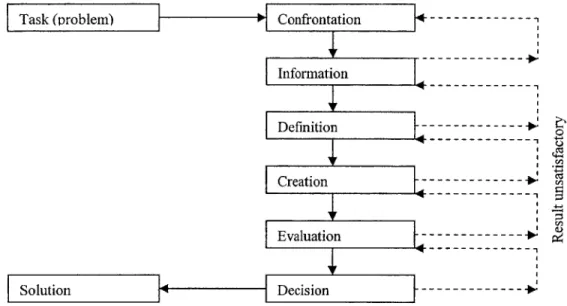
During the late 1950s and the 1960s, attempts were made to describe the creative problem-solving process at work in design by way of the logical structure of overt activities that appears to take place. In other words, design was regarded as a series of stages characterized by dominant forms of activity. Commonly practiced procedures usually include the sequential steps required to reach the final design. Since "solving the problem creatively" is such an abstract concept, it is natural for design instructors to resort to a somewhat concrete and linear process that can be more tangible and easier for students to grasp. Constant feed-back following each step ensures design decisions are made towards the right direction. Classroom experience tells us that the "creation" step usually is usually the hardest one for students, simply because that is the step where "something comes out of nothing" as pointed out by Alexander. Much research effort has been focused in this area and a number of proven methods are proposed and practiced in the design teaching environment. Chapter 4 will address this issue in greater detail.
Task (problem) Confrontation
FInformation
---Definition
---Creation --- - 2
Evaluation ---
#
Solution Decision