Publisher’s version / Version de l'éditeur:
Journal of Power Sources, 68, October 2, pp. 618-622, 1997
READ THESE TERMS AND CONDITIONS CAREFULLY BEFORE USING THIS WEBSITE. https://nrc-publications.canada.ca/eng/copyright
Vous avez des questions? Nous pouvons vous aider. Pour communiquer directement avec un auteur, consultez la première page de la revue dans laquelle son article a été publié afin de trouver ses coordonnées. Si vous n’arrivez pas à les repérer, communiquez avec nous à [email protected].
Questions? Contact the NRC Publications Archive team at
[email protected]. If you wish to email the authors directly, please see the first page of the publication for their contact information.
NRC Publications Archive
Archives des publications du CNRC
This publication could be one of several versions: author’s original, accepted manuscript or the publisher’s version. / La version de cette publication peut être l’une des suivantes : la version prépublication de l’auteur, la version acceptée du manuscrit ou la version de l’éditeur.
For the publisher’s version, please access the DOI link below./ Pour consulter la version de l’éditeur, utilisez le lien DOI ci-dessous.
https://doi.org/10.1016/S0378-7753(96)02571-2
Access and use of this website and the material on it are subject to the Terms and Conditions set forth at
Electrochemistry of LiMnO2 over an extended potential range
Shu, Z. X.; Davidson, Isobel; McMillan, Roderick; Murray, J. J.
https://publications-cnrc.canada.ca/fra/droits
L’accès à ce site Web et l’utilisation de son contenu sont assujettis aux conditions présentées dans le site LISEZ CES CONDITIONS ATTENTIVEMENT AVANT D’UTILISER CE SITE WEB.
NRC Publications Record / Notice d'Archives des publications de CNRC:
https://nrc-publications.canada.ca/eng/view/object/?id=b1461835-ea84-4568-b222-4fb8c3a50a86
https://publications-cnrc.canada.ca/fra/voir/objet/?id=b1461835-ea84-4568-b222-4fb8c3a50a86
E L S E V I E R Journal of Power Sources 68 ( 1997 ) 618-622
JOURflAL Of
POWER
SURGES
Electrochemistry of LiMnO2 over an extended potential range
Z.X. Shu, I.J.
Davidson *, R.S. McMillan, J.J. Murray
lnstttute for Chemwal Process and Envtronmental Technology, National Research Counctl, Ottaua, Ont. KIA OR6. Canada
Accepted 14 October 1996
Abstract
A kinetic study of potential versus composition was conducted on orthorhombic LiMnO2 over the voltage range of 1.0 to 4.6 V with a variety of electrolyte formulations. The broad potential range enabled studying the electrochemical behaviour of the material over composttions from LiMnO, to Llo ~MnO2. Substantial differences in the kinetics of the electrochemical processes associated with certain potentml ranges were observed. Crown in right of Canada © 1997 Pubhshed by Elsewer Science S.A.
Kevwords" Lithium battemes: Lithium, Manganese dioxide: Cathodes
1. Introduction
LiMnO2 is known to exist in several phases. Two phases, whose crystal structures have been well characterized, are a tetragonal spinel-related phase, usually written as A-Li2Mn204, and an orthorhombic phase. Guyomard and Tarascon [ 1 ] have demonstrated that lithium-ion cells with cathodes based on the spinel phase A-Li2_ ,Mn204 can hax e long cycle life at reasonable energy and power densities. More recently, it was found that cathodes made with ortho- rhombic LiMnO2 undergo a phase transition, on cycling, to form the spinel phase A-Li2_,Mn20 a in situ [ 2 - 4 ] . The orthorhombic form of LiMnO2 has the advantages of being easy to prepare and air stable [2] whereas the spinel phase, A-Li2 ,Mn204, is not air stable at small values of x and is more difficult to make in a fully lithiated form [5]. The use of orthorhombic LiMnO2 in a prototype lithium-ion cell with a coke anode was demonstrated previously 16]. Here, we investigate the kinetics of the electrochemical processes occurring in cathodes based on orthorhombic LiMnO2 in cells with metallic lithtum anodes.
2. Experimental
High temperature orthorhombic LiMnO2 was prepared in- house by a procedure described previously [6]. Scanning electron microscopy (SEM) showed that the LiMnO2 parti- cles were layered platelets of varying sizes, typically between
* Corresponding author.
5 and 20 I~m. A measurement of the surface area by krypton gas adsorption, using a Micromeritics ASAP 2000, found an area of 0.306( 1 )
mZ/g
of LiMnO2. Electrodes were formed by mixing orthorhombic LiMnOz with carbon black ( Super- S, S. Ensagri) and poly(vinylidene fluoride) (PVDF) (301F, Elf Atochem) in a weight ratio of 88:9:3. The cath- odes had a diameter of 1.1 cm and a thickness between 0.005 and 0.010 cm. The LiMnO2 electrodes were cycled in NRC designed and fabricated 2325 coin cells having 23 mm diam- eter and 2.5 mm height and a polypropylene grommet. The anodes were punched from a 5 mm thtck sheet of lithium metal (Foote), and had a diameter of 1.65 cm. Two layers of microporous polypropylene ( Celgard 3501 ) were used as the separators. Stainless-steel disc springs (Belleville) and disc spacers were needed to establish enough force on the elec- trode assemblies ( 18 kg) to ensure reliable internal contact. Fig. 1 is an exploded view of the cell assembly. The coin cells were assembled and crimp sealed in a dry box filled with helium. All cell cycling was done galvanostatically between voltage limits.Several electrolytes were used in the electrochemical char- acterization of orthorhombic LiMnO2. They were 1 M LiPF6 (Hashimoto) in ethylene carbonate ( EC, Aldrich )/dimethyl carbonate ( DMC ) ( 1/2), I M LiC104 in propylene carbonate (PC, Anachemia)/dimethoxyethane(DME, Anachemia) ( 1 / ] ), 1 M LiC104 in EC/diethyl carbonate (DEC, Aldrich ) ( 1 / 1 ) and 1 M LiCIO4 in P C / E C ( 1 / 1 ). The electrolyte solvents were first dried for 24 h over activated molecular sieves and were then distilled using a spinning band column. In the case of PC and EC, distillations were carried out under vacuum. LiPF6 was used without further purification. LiClO4
0378-7753/97/$17 00 Crown m mght of Canada ~ 1997 Pubhshed by Elsevier Science S A.
Z.X. Shu et al. / Journal o f Power Sources 68 (1997) 618-622
619
A
' ~ w ~ - • ~ - - b dCell Seal • Polypropylene
, Spring , Spacer(s) • A n o d e : Lithtum Metal • - - - Separator : Celgard 3501
.,--
Cathode" L=MnO2 ~ * - B a s eFig. 1. Exploded view of corn cell assembly used for these studies.
was dried under vacuum at 120 °C overnight. The water contents of the electrolyte solutions were measured using Karl-Fisher titration and were less than 50 ppm.
X-ray powder diffraction (XRD) patterns were obtained on cathodes extracted from previously cycled coin cells. A Scintag XDS 2000 with a 0-0 geometry and a copper X-ray tube was used to obtain the data. The diffractometer has a pyrolytic graphite monochromator in front of the detector. The samples were mounted on a zero background sample holder made from an oriented silicon wafer. The air-sensitive samples were removed from the cells in an argon filled dry box and heat-sealed in a polyethylene bag for the diffraction studies. In some cases, the cathodes could not be removed from the microporous polypropylene separator film. For these diffraction patterns, the second layer of separator from the same cell was used to establish an appropriate background correction which also includes contributions from dried elec- trolyte. Lattice parameters were calculated from the measured peak positions with the program TREOR [ 7]. Relative inten- sities of peaks were obtained by profile fitting to a Pearson VII curve shape. Since the diffraction patterns of ex situ cathodes have very broad peaks, no attempt was made to correct the relative intensities for Lorentz-polarization or absorption.
3. Results and d i s c u s s i o n
Lithium-ion cells with coke anodes and a cathode of either orthorhombic LiMnO2 or A-Li2_xMn204 have previously been shown to have a first cycle, coulombic inefficiency of 45-80 m A h / g of active material [5,6]. This irreversible loss of capacity was attributed to the formation of a passivation film on the surface of the coke.
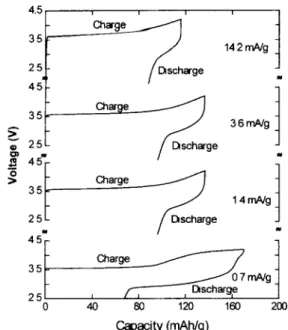
Fig. 2 shows voltage profiles of the first cycle for several Li/LiMnO2 cells cycled at different rates in 1 M LiPF6 E C / DMC ( 1 / 2 ) between 2.5 and 4.2 V. The most remarkable
4 . 5 35 25
45'
35
A 2 5 "625
m45
25
0
i i i i | 142 mA/gJ
D s c h a r g e ..Ch~'ge ~
36mNg t
Dscharge Charge~
14 rang 1
g em
C arge
]
~ 07rnA/g I ~ , Dlscharg~L 40 80 120 160 200Capacity (mAh/g)
Fig. 2. Voltage profiles of the first cycle for several Li/LiMnO2 cells cycled at different rates m 1 M LIPF6 EC/DMC ( 1/2) between 25 and 4.2 V feature of these plots is that, even with a lithium anode, there is a large difference in the capacity of the first charge and the first discharge. Both the charge and discharge capacities are very dependent on the current. Constant-rate studies in a coke/LiMnO2 cell showed that the discharge capacity is crit- ically dependent on charging the cell enough to convert the orthorhombic LiMnO2 to spinel LiMn~O4 [6]. It appears that this phase transition has slow kinetics and the extent of the phase transition during the first cycle is highly dependent on the cycling rate. At a current of 14.2 m A / g of LiMnO> only a very small amount of orthorhombic LiMnO2 is converted to the spinel phase on the first charge. This is evident from the fact that the charge voltage increases with a steep slope at the cut-off voltage of 4.2 V and the subsequent discharge shows very little reversible capacity from the cell. On the other hand, the cell cycled at 0.7 m A / g shows a clear differ- ence in that the charge voltage curves over to form a plateau before it reaches the cut-off voltage of 4.2 V. In addition, a substantial amount of reversible capacity is obtained on the subsequent discharge. The cells cycled at 3.6 and 1.4 m A / g fall between the two extreme cycling rates mentioned above. At higher currents the phase conversion takes several cycles to complete.
It is not surprising that the kinetics of the phase conversion is slow since it involves a massive rearrangement of the cations in the structure. A detailed mechanism has been pro- posed by G u m m o w et al. [4]. The first cycle capacity loss in Li/LiMnO2 cells was somewhat unexpected. The rate dependence of the capacity loss suggests that it is a kinetic rather than a thermodynamic limitation.
After a few cycles in which the spinel phase was formed in situ, some cells were cycled progressively to a higher charge cut-off voltage. Fig. 3 shows typical voltage profiles of an Li/LiMnO2 cell cycled at 3.56 m A / g of LiMnO2 in ! M LiPF6 in E C / D M C ( 1 / 2 ) to different charge voltage
620 Z X Shu et al. / Jounml o f Power Sources 68 (1997) 6 1 ~ 5 22
3
~
Di~harg
e
Ct~arge
45V
i ~ Dscharge 2 m1
3
- ~ " ~
Discharge2
~__ C, harge
~ 42vI
3
~"__.___..-J
E) scharge I I I I20
40
80
120
160
200
Capacity (mAh/g)Fig. 3 Voltage profiles of an Ll/kiMnO_, cell cycled at 3 56 m A / g ot LiMnO, m I M hPF~, EC/DMC ( I/2l between 2.5 V and charge voltage Illmts from 4 2 to 4.6 V
limits while keeping the discharge cut-off voltage at 2.5 V. The discharge profiles essentially follow the same shape as reported for A-Li2Mn,O4 with a first-order phase transition occurring in the relatively flat lower plateau near 3 V and a homogenous phase transition occurring in the more sloping upper plateau near 4 V [8]. The hysteresis in the voltage profiles is about the same regardless of the voltage limit on charge. Lithium removed from the cathode near 3.8 V, on charge, is re-inserted on discharge in the 2.9 V plateau. The change in slope associated with the hysteresis region of the charge profile suggests that a different crystallographic proc- ess is occurring. Not surprisingly, the capacity gain by cycling to a higher voltage mainly occurs at the higher voltage plateau near 4 V. The delithiation of the cathode is almost completely reversible for all voltage limits tested except a small loss ()f capacity when a cell is charged to a higher voltage presumably due to increased electrolyte decomposition at higher voltage. The charge and discharge capactties of the various cycles are listed in Table 1.
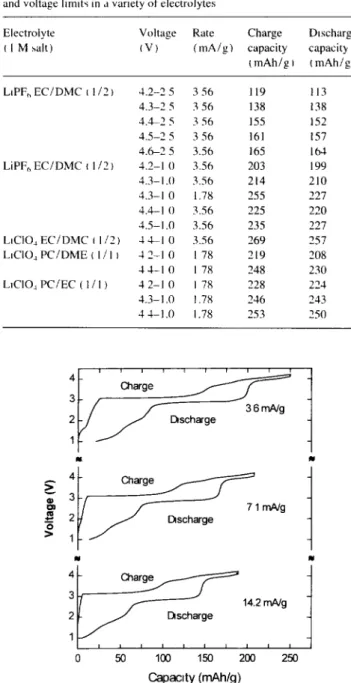
The electrochemical behaviour of LiMnO~ was further investigated at a voltage below 2.5 V after the spinel phase was formed in sltu. This was carried out by first charging the cell to 4.2 V in the manner described above, followed by discharging the cell to 1.0 V. Fig. 4 shows voltage profiles of a cell cycled between 4.2 and 1.0 V. Once again, the discharge plateau near 2.9 V is shown to be strongly rate dependent, but the charging hysteresis is independent of rate over the current range studied. In addition, a capacity of about 65 m A h / g is observed between the 2.5-1.0 V range. The di~- charge capacity below 2.5 V is independent of the cychng rates from 14.2 to 3.6 m A / g and is almost completely revers- ible. However, this "extra' capacity between 2.5 and 1.0 V
Table 1
Charge and discharge capacities of Ll/LiMnO 2 cells cycled at different rates and voltage limits in a variety of electrolytes
Electrolyte Voltage Rate Charge Discharge
(
1 M salt) IV) ( m A / g ) capacity capacity { m A h / g l ( m A h / g ) LIPF~ EC/DMC c 1/2) 4 . 2 - 2 5 356 119 113 4.3-2 5 3 56 138 138 4A-2 5 3 56 155 152 4.5-2 5 3 56 161 157 4.(>-2 5 3.56 165 164 LiPFs E C / D M C I 1/2) 4.2-1 l) 3.56 203 199 4.3-1.0 3.56 214 210 4.3-1 0 1.78 255 227 4.4-1 0 3.56 225 220 4.5-1.0 3.56 235 227 LICIO4 EC/DMC I 1/2) 4 4 - 1 0 3.56 269 257 LICIO4 PC/DME { I/1)
4 2-1 0 1 78 219 208 4 4-1 0 1 78 248 230 LICIO4 PC/EC ( 1 / 1 ) 4 2-1 0 I 78 228 224 4.3-1.0 1.78 246 243 4 4-1.0 1.78 253 250 m J~
--'~D
7 1 rnA/g
schargeT
4
C h a r ~
3 14
~
~
14,2 rnA/''g
~ ~ D s c h a r g e
I I I I I I I I I I I0
50
100
150
200
250
Capacity (rnAh/g)
Fig. 4 Vohage profiles of a cell cycled between 1.0 and 4 2 V at vanou~ rates.
appears in the recharge at 3.05 V. In fact, cells discharged to 1.0 V and then monitored for voltage changes in the absence of current flow were found to relax to greater than 2.0 V in 3.5 h, and reach a maximum of 2.94 V after about 80 h. Depending on the electrolyte used and the cychng rate, the total reversible capacity between 1.0 and 4.4 V, under our non-optimized conditions, can be as high as 90% of the theoretical capacity of LiMnO2. Table 1 lists charge and dis- charge capacities for several cells cycled in different electrolytes.
The spinel-related structure of LiMnO2 after the in situ phase transition was confirmed by XRD. This was carried out
Z.X. Shu et al. / Journal o f P o w e r Sources 68 ( 19971 6 1 8 - 6 2 2
Table 2
X-ray diffraction data for cathodes extracted from cycled coin cells after charging to 4.2 V and after discharging to 1.0 V
621
Cathode at 4.2 V Lh~87Mn204 Cathode at 1.0 V Li2Mn204
d c A ) ( hl, l ) Relative intensity d ( A ~ ( hkl ) Relative intensity
a = 8 . 1 7 4 ( I ) A F d 3 m Cu K a a = 5 . 6 5 8 ( 2 ) ,~ 141/amd Cu K ~ c = 9 . 2 3 2 ( 4 ) fi, 4 685 111 91 4.8 " 101 40 2 456 311 52 2.691 103 10 2 355 222 14 2 46 " 211 15 2.040 400 100 2.407 202 I 1 1.875 331 5 2 302 004 10 1.574 511 33 I 999 220 23 1 444 440 72 1.510 224 23 1.381 531 22 1.414 400 7 1.233 622 15 1 350 206 < 5 1.179 444 14 1 222 422 < 5 1 145 551 < 5 1 207 404 6 11164 553 + 73 l < 5 1.154 008 < 5 1 . 0 ~ 800 9
" Peaks marked with an asterisk overlapped with peaks from the separator and are not accurate. These peaks were not used in the calculation of the lattice parameters
by first cycling the cell for a number of cycles and allowing a complete phase transition as indicated by the voltage profile. A cell was then taken apart after charging it to 4.2 V. The cathode was completely extracted from the separator before obtaining the XRD data listed in Table 2. The XRD pattern indexed to a cubic crystallographic unit cell with a lattice parameter of 8.174( 1 ) A. This corresponds to a composition of Li,Mn204 in which x = 0.87 [8]. The relative intensities of the peaks are a reasonable match to the predicted diffrac- tion pattern except that the ( I 1 I ) reflection is weaker than expected. This is most probably due to X-ray absorption which will have the strongest effect on the lowest angle peak. Two other cells which had been cycled between 4.6 and 1.0 V were disassembled after being discharged to 1.0 V. The cathodes were extracted from the coin cells and sealed in polyethylene bags in an argon-filled glove box. Neither cath- ode could be removed from the attached separator. The peaks at 4.8 and at 2.46 ,~ overlapped with peaks associated with the separator and could not be resolved with any accuracy. These peaks were not used in the calculation of the lattice parameters. The XRD patterns of the two cathodes were quite similar. Both patterns indexed to tetragonal cells but the unit cells dimensions were slightly different. The diffraction pat- tern of the cathode from the first cell refined to lattice para- meters of a = 5.636( 4 ) A and c = 9.190(6) ~,, and that of the second cell, to a - 5 . 6 5 8 ( 2 ) ~, and c = 9 . 2 3 2 ( 4 ) A. These are comparable with the tetragonal lattice parameters of A- LizMn:O4 ata = 5.646 A and c = 9.250 A [ 8]. The diffraction pattern of the second cathode, listed in Table 2, is a good match to the pattern calculated for A-Li~Mn204 on the basis of the structural data in Ref. [ 8 ], with the notable exception that the (004) and (224) reflections are much more intense m our diffraction pattern. This may indicate that the crystals
of A-Li2Mn204 formed in situ in a pressed cathode are not randomly oriented.
4. Conclusions
Orthorhombic LiMnOz can be cycled over a large com- position range (about 90% of its theoretical capacity), but about 25% of this capacity is delivered below 2.5 V versus metallic lithium, In a lithium-ion cell, the LiMnO2 cathode capacity below 2.5 V is a good match to the irreversible capacity needed to passivate the carbon anode. However, improved anode/electrolyte formulations may. in future, lessen the capacity loss due to anode passivation. Therefore, it is important to understand the chemistry of the large voltage hysteresis at the end of discharge of an LiMnO2 cathode. Since the capacity below 2.5 V is not as sensitive to rate as the capacity of the 2.9 V plateau, we propose that the lower voltage capacity is due to the formation o f a metastable phase which is richer in lithium than the bulk of the cathode. Over time, normally several hours, the cell voltage rises to 2.9 V as the lithium concentration in the cathode equilibrates to form A-Li:_ ,Mn204. The identity of the proposed metastable phase is not yet known, but one possibility is, Li2MnO2. This phase has a trigonal crystal structure consisting of hexago- nally-close-packed anions with octahedrally coordinated Mn 2+ ions in alternate basal planes and Li + ions in tetra- hedral sites of the other basal planes [ 9 ]. A similar chemistry occurs in lithium cells with LiNiO2 cathodes m which Li2NiO2 is formed on over-discharge [ 10].
622 Z.X. Shu et al. /Journal of Power Sources 68 (1997) 6 1 8 4 2 2
The kinetics of the initial phase transition to the spinel form and of re-insertion of the last 25% or so of the Li ÷ ions into the h-Li2_xMn204 structure are undesirably slow. In the spinel phase LiMnzO4, small modifications to the stoichi- ometry have been shown to have a dramatic affect on the electrochemical performance in the 4 V region [ 11 ]. Clearly, similar studies on the orthorhombic phase are warranted. Alternatively, using a slightly higher temperature for the first forming cycle or preparing the material as crystallites of smaller size might improve the kinetics of both the phase conversion and the re-insertion process.
Acknowledgements
The authors wish thank Helen Slegr for technical assistance with moisture analyses, solvent distillation, electrolyte prep- aration and BET surface area measurement, and Tom Adams for the preparation of LiMnO2. Financial support from the Department of National Defense, Canada, is gratefully acknowledged.
References
[ 1 ] D. Guyomard and J.M. Tarascon, J. Electrochem. Soc., 139 (1992)
937-948.
[ 2] I.J. Davidson, R.S. McMillan and J.J. Murray, US Patent No. 5 506 078 (1996).
[3] J.N. Reimers, E.W Fuller, E. Rossen and J.R. Dahn, J Electrochem.
Soc., 140 (1993) 3396-3401
[4] R.J. Gummow, D.C. Liles and M.M. Thackeray, Mater. Res. BulL, 28 ( 1993 ) 1249-1256.
[5] J.M. Tarascon and D. Guyomard, d. Electrochem. Soc., 138 ( 1991 ) 2864-2868.
[6] l.J. Davidson, R.S. McMillan, J.J Murray and J.E. Greedan, J P o w e r
Source~, 54 ( 1995 ) 232-235.
[7] P.E. Werner, L Eriksson and M. Westdahl, J. Appl. Co'stallogr., 18 (1985) 367-370.
18] T Ohzuku, M Kltagawa and T Hlral, .L Electrochem. Soc., 137 (1990) 769-775.
[9] W.I.F. David, J.B. Goodenough, M.M. Thackeray and M G.S.R.
Thomas, Rev. Chlm. Mineral, 20 (1983) 636-642.
[ 10] J.R. Dahn, U. von Sacken and C.A Michal, Solid State lomcs, 44
(1990) 87-97.