HAL Id: hal-00303248
https://hal.archives-ouvertes.fr/hal-00303248
Submitted on 11 Jan 2008HAL is a multi-disciplinary open access
archive for the deposit and dissemination of sci-entific research documents, whether they are pub-lished or not. The documents may come from teaching and research institutions in France or abroad, or from public or private research centers.
L’archive ouverte pluridisciplinaire HAL, est destinée au dépôt et à la diffusion de documents scientifiques de niveau recherche, publiés ou non, émanant des établissements d’enseignement et de recherche français ou étrangers, des laboratoires publics ou privés.
Spatiotemporal variations of ambient PM10 source
contributions in Beijing in 2004 using positive matrix
factorization
S. Xie, Z. Liu, T. Chen, L. Hua
To cite this version:
S. Xie, Z. Liu, T. Chen, L. Hua. Spatiotemporal variations of ambient PM10 source contributions in Beijing in 2004 using positive matrix factorization. Atmospheric Chemistry and Physics Discussions, European Geosciences Union, 2008, 8 (1), pp.569-599. �hal-00303248�
ACPD
8, 569–599, 2008 Spatiotemporal variations of PM10 sources in Beijing S. Xie et al. Title Page Abstract Introduction Conclusions References Tables Figures ◭ ◮ ◭ ◮ Back CloseFull Screen / Esc
Printer-friendly Version Interactive Discussion
EGU
Atmos. Chem. Phys. Discuss., 8, 569–599, 2008 www.atmos-chem-phys-discuss.net/8/569/2008/ © Author(s) 2008. This work is licensed
under a Creative Commons License.
Atmospheric Chemistry and Physics Discussions
Spatiotemporal variations of ambient
PM
10
source contributions in Beijing in
2004 using positive matrix factorization
S. Xie1, Z. Liu1, T. Chen2, and L. Hua2 1
College of Environmental Sciences and Engineering, Peking University, Beijing 100871, P. R. China
2
Beijing Municipal Environmental Monitoring Center, Beijing 100044, P. R. China
Received: 1 October 2007 – Accepted: 8 November 2007 – Published: 11 January 2008 Correspondence to: S. Xie ([email protected])
ACPD
8, 569–599, 2008 Spatiotemporal variations of PM10 sources in Beijing S. Xie et al. Title Page Abstract Introduction Conclusions References Tables Figures ◭ ◮ ◭ ◮ Back CloseFull Screen / Esc
Printer-friendly Version Interactive Discussion
EGU
Abstract
Source contributions to ambient PM10 (particles with an aerodynamic diameter of 10µm or less) in Beijing, China were determined with positive matrix factorization
(PMF) based on ambient PM10 composition data including concentrations of organic carbon (OC), elemental carbon (EC), ions and metal elements, which were
simulta-5
neously obtained at six sites through January, April, July and October in 2004. Re-sults from PMF indicated that seven major sources of ambient PM10 were urban fugi-tive dust, crustal soil, coal combustion, secondary sulfate, secondary nitrate, biomass burning and vehicle emission, respectively. In paticular, urban fugitive dust and crustal soil as two types of dust sources with similar chemical characteristics were
differenti-10
ated by PMF. Urban fugitive dust contributed the most, accounting for 34.4% of total PM10 mass on an annual basis, with relatively high contributions in all four months, and even covered 50% in April. It also showed higher contributions in southwestern and southeastern areas than in central urban areas. Coal combustion was found to be the primary contributor in January, showing higher contributions in urban areas than in
15
suburban areas with seasonal variation peaking in winter, which accounted for 15.5% of the annual average PM10 concentration. Secondary sulfate and secondary nitrate combined as the largest contributor to PM10 in July and October, with strong seasonal variation peaking in summer, accounting for 38.8% and 31.5% of the total PM10 mass in July and October, respectively. Biomass burning contributions were found in all four
20
months and accounted for 9.8% of the annual average PM10mass concentration, with obviously higher contribution in October than in other months. Incineration sources were probably located in southwestern Beijing. Contribution from vehicle emission ac-counted for 5.0% and exhibited no significant seasonal variation. In sum, PM10source contributions in Beijing showed not only significant seasonal variations but also spatial
25
ACPD
8, 569–599, 2008 Spatiotemporal variations of PM10 sources in Beijing S. Xie et al. Title Page Abstract Introduction Conclusions References Tables Figures ◭ ◮ ◭ ◮ Back CloseFull Screen / Esc
Printer-friendly Version Interactive Discussion
EGU
1 Introduction
According to the Report on the State of the Environment in China issued by State Environmental Protection Administration (SEPA), from 2003 through 2006, there were 54.4%, 53.2%, 48.1% and 43.4% of Chinese cities where annual average daily con-centration of PM10 (inhaled particulate matter, particles with an aerodynamic
diam-5
eter of 10µm or less) exceeded the level II of National Ambient Air Quality Standard
100µg m−3(State Environmental Protection Administration (SEPA), 2005, 2007). PM 10 has become the primary air pollutant in cities of China. Therefore, source apportion-ment studies are of great significance for controlling ambient PM10pollution in China.
Research on sources of ambient particulate matter began with analyzing source
10
emission inventories and using dispersion models based on them. The focus shifted from source to receptor in the 1970s. Receptor models identify and apportion sources by analyzing aerosol chemical compositions and physical parameters at a sampling site (or receptor) without information about source strengths, do not rely on meteorological data, and can identify fugitive emission sources. With such advantages, receptor
mod-15
els have been developing fast from its birth. Based on whether source profiles should be known at first, receptor models can be divided into two categories: chemical mass balance model (CMB) and various forms of multivariate statistical models.
Wang (1985) performed the earliest source apportionment study for ambient aerosols in Beijing using factor analysis. Recently, Okuda et al. (2004) performed a
20
CMB study with daily concentrations of trace metals and ionic constituents in aerosols in Beijing from 2001 through 2003, and identified crustal soil and coal combustion as two primary sources. Dan et al. (2004) identified PM2.5 sources in Beijing by compar-ing concentrations of OC, EC and trace elements at receptor sites. Zheng et al. (2005) determined 9 sources of PM2.5in Beijing using CMB model with particle-phase organic
25
compounds as fitting tracers. Bi et al. (2005) performed a CMB source apportionment of ambient PM10 in six cities in northern China based on measured chemical profiles of local resuspended dust and coal combustion emission, and found resuspended dust
ACPD
8, 569–599, 2008 Spatiotemporal variations of PM10 sources in Beijing S. Xie et al. Title Page Abstract Introduction Conclusions References Tables Figures ◭ ◮ ◭ ◮ Back CloseFull Screen / Esc
Printer-friendly Version Interactive Discussion
EGU
and coal fly ash to be the primary PM10 sources. However, it is difficult to establish databases of specific local source profiles for CMB studies. Furthermore, similari-ties among some source profiles may easily cause problems of collinearity. The CMB studies above used a variety of source categories and profiles which led to the poor comparability of their results, due to the incomplete information on local source profiles.
5
Therefore, multivariate statistical methods have been used more extensively for source apportionment of ambient particles in China in recent years. Sun et al. (2004) performed a factor analysis for a preliminary discussion of ambient PM10 sources in Beijing. Wang et al. (2005) used Ca2+/Al ratio to estimate the mixing of different dust sources and roughly calculated PM2.5 source contributions by factor analysis. But
10
these traditional statistical methods could not identify sources elaborately and pre-cisely.
A new approach named positive matrix factorization (PMF) developed by Paatero and Tapper (1994, 1997) takes an explicit least squares approach by integrating non-negative constrains into the optimization process and utilizing the error estimates for
15
each data value as point-by-point weights. Due to the advantages over traditional factor analysis methods, during the last one or two decades, PMF was successfully used in source apportionment of airborne particulate matter in the United States (Kim and Hopke, 2006), Switzerland (Lanz et al., 2007), Spain (Zabalza et al., 2006), Mexico (Johnson et al., 2006), Canada (Lee et al., 2003), Korea (Han et al., 2005), as well as
20
in China (Lee et al., 1999; Yuan et al., 2006; Song et al., 2006, 2007). Most recently, Reff et al. (2007) reviewed the methods for using PMF model, and recommended future publications to fully document procedures for data preparation, PMF application, and result interpretation.
Since December 1998, a series of measures have been taken to control pollution of
25
SO2, NOx and PM10 in Beijing. However, compared with the significant decline of SO2 concentration, from 80µg m−3in 1999 to 53µg m−3, ambient PM
10mass concentration remained at a high level. From 1999 to 2006, annual average PM10 mass concen-trations were respectively 180, 162, 165, 166, 141, 149, 142 and 161µg m−3 (Beijing
ACPD
8, 569–599, 2008 Spatiotemporal variations of PM10 sources in Beijing S. Xie et al. Title Page Abstract Introduction Conclusions References Tables Figures ◭ ◮ ◭ ◮ Back CloseFull Screen / Esc
Printer-friendly Version Interactive Discussion
EGU
Environmental Protection Bureau, 2004, 2005, 2006), which were about 65% higher than National Ambient Air Quality Standard (level II) of 100µg m−3. These concentra-tions were also more than two times of those in magacities as New York, London, and Moscow. Previous control measures showed no significant effects at all, due to the complexity of PM10 sources in Beijing. With such background, we performed a source
5
apportionment study using PMF model for ambient PM10in Beijing in 2004, in order to provide scientific basis for controlling PM10 pollution more effectively.
2 Methods
2.1 Sampling and chemical analysis
Six PM10 sampling sites were set up at Ming Tombs (MT), Chegongzhuang (CGZ),
10
Gucheng (GC), Fangshan (FS), Yizhuang (YZ), and National Olympic Sports Center (AT) (Chen et al., 2006), as shown in Fig. 1. Ming Tombs (MT) site located in Changping District and 45 km northeast from central Beijing is currently a background air quality monitoring site for Beijing Environmental Monitoring Network. Chegongzhuang (CGZ) site near Chegongzhuang East Road and National Olympic Sports Center (AT) site
15
next to the Northern 4th Ring Road are two traffic sites representing different streets in urban areas. Yizhuang (YZ) as suburban site near the Southern 5th Ring Road with Beijing’s southeastern industrial emission sources on its north is a typical representa-tion for economic development area. It is also located on the aerosol transport path in southeastern Beijing. Gucheng (GC) site, an industrial site, is located next to the
20
Capital Iron and Steel Plant in western Beijing. Fangshan (FS), located in southwest-ern Beijing and surrounded by Beijing Yanshan Petrochemical Corporation as well as several building material plants producing cement, lime, and sandstones, is a typical representation of centralized area by petrochemical and building material industries. It is also a representative site on the southwestern aerosol transport path.
25
ACPD
8, 569–599, 2008 Spatiotemporal variations of PM10 sources in Beijing S. Xie et al. Title Page Abstract Introduction Conclusions References Tables Figures ◭ ◮ ◭ ◮ Back CloseFull Screen / Esc
Printer-friendly Version Interactive Discussion
EGU
Wuhan Tianhong Intelligence Instrumentation Facility simultaneously at these six sites on the middle ten days in January, April, July and October in 2004 with sampling dura-tion of 23 h and 30 min on each sampling day, from 09:00 a.m. to the next 08:30 a.m. Quartz fiber filters were used for analysis of organic carbon (OC), elemental carbon (EC), and Teflon filters were used for analysis of PM10 mass concentration, elements
5
and ions concentrations. Gravimetric method was used to determine PM10 mass con-centration. Inductively coupled plasma mass spectrometry (ICP-MS), graphite furnace atomic absorption spectrometry (GF-AAS), hydrogenation atomic fluorescent spec-trometry (HG-AFS) were used to determine concentrations of 19 elements: Al, As, Ba, Ca, Cd, Cr, Cu, Fe, Mg, Mn, Na, Ni, Pb, Sc, Se, Si, Ti, V, and Zn. Ion
Chromatog-10
raphy (IC) (Dionex, Model DX-500) was used for analyzing K+, NH+4, NO−
3, and SO 2− 4 concentrations. Organic carbon (OC) and elemental carbon (EC) were measured using a thermal/optical carbon analyzer produced by Sunset Laboratory Inc., USA.
2.2 Source apportionment by positive matrix factorization 2.2.1 Positive matrix factorization (PMF) model
15
Positive matrix factorization (PMF, Paatero and Tapper, 1994; Paatero, 1997) is an advanced factor analysis technique that uses non-negativity constraints and allows non-orthogonal factors. The bilinear factor analytic model denoted as PMF2 can be written as,
X = GF + E (1)
20
where X is the n×m matrix of species concentrations in ambient PM10; G is the n×p matrix of source contributions; F is the p×m matrix of source profiles, and the residual matrix E is defined as the difference between the observed concentration X and the modeled values,Y : eij = xij− yij = xi j− p X k=1 gi kfkj (2) 25
ACPD
8, 569–599, 2008 Spatiotemporal variations of PM10 sources in Beijing S. Xie et al. Title Page Abstract Introduction Conclusions References Tables Figures ◭ ◮ ◭ ◮ Back CloseFull Screen / Esc
Printer-friendly Version Interactive Discussion
EGU
wherei =1,. . . ,n samples; j =1,. . . , m species; k=1,. . . , p sources.
The model uses least-squares fit of the data to minimize the objective function,Q(E ),
which is defined as Q(E ) = n X i =1 m X j=1 (ei j/σi j)2 (3)
whereσi j is the standard deviation corresponding to the observed valuexij.
5
PMF was run in the robust mode, in order to decrease the impact of extreme values or outliers that are very common in environmental data (Paatero, 2004).
2.2.2 Data pretreatment
Concentration values for chemical species in PM10 samples at six sites were input to PMF model for analysis. Missing concentration values were replaced by the arithmetic
10
mean concentration of that species and four times of this mean value were assigned as the corresponding uncertainties. BDL values were replaced by half of the detection limit (DLj) for that species and the corresponding uncertainties were estimated as in Eq. (4) (Polissar et al., 1998). The uncertainties for determined values were estimated by the following Eqs. (5) and (6) (Jon Zabalza et al., 2006):
15 σ(xi j<DLj) = xij+ 2 3DLj (4) σ(DLj<xij<3DLj) = 0.2xi j + 2 3DLj (5) σ(xij>3DLj) = 0.1xij+ 2 3DLj (6) 2.2.3 Model trial
The first step in PMF analysis is to determine the number of factors. In practice, various
20
ACPD
8, 569–599, 2008 Spatiotemporal variations of PM10 sources in Beijing S. Xie et al. Title Page Abstract Introduction Conclusions References Tables Figures ◭ ◮ ◭ ◮ Back CloseFull Screen / Esc
Printer-friendly Version Interactive Discussion
EGU
most physically meaningful results will be used. The value ofQ, frequency distribution
of scaled residuals (eij/σi j), and multiple linear regression can be used to assess the performance of PMF (Lee et al., 1999). In this study, 7 explainable sources were identified after numerous runs.
The second step is to control rotation and find the optimal solution, using the
param-5
eters FPEAK and FKEY (or GKEY ) provided by the model (Paatero, 2004). Usually PMF is run with different FPEAK values to find the range within which the objective functionQ does not show a significant change. The optimal solution should lie in this
range (Paatero et al., 2002). Sometimes, the unrealistic concentration values in re-solved sources can be pulled down toward zero to obtain a reasonable profile through
10
the matrix “FKEY ”.
After numerous runs, FPEAK=0 and a FKEY matrix provided the most physically reasonable solution. In the FKEY matrix, values of all elements were set to 0 except for values of 3 and 5 for OC and EC in secondary nitrate; and values of 5, 3, 5, and 5 for SO2−4 in biomass burning, crustal soil, secondary nitrate, and vehicle emission,
15
respectively.
The results of PMF analysis were scaled to the measured concentration using a scaling constant sk, obtained by regressing the measured total PM2.5 mass against the factor scores,gik,determined by the model (Hopke et al., 1980), as described by Eq. (7) below, 20 xij = p X k=1 (skgik)(fkj/sk). (7)
ACPD
8, 569–599, 2008 Spatiotemporal variations of PM10 sources in Beijing S. Xie et al. Title Page Abstract Introduction Conclusions References Tables Figures ◭ ◮ ◭ ◮ Back CloseFull Screen / Esc
Printer-friendly Version Interactive Discussion
EGU
3 Results and discussions
3.1 Concentration and chemical composition of ambient PM10 in Beijing in 2004 The overall average PM10concentration of six sites through the sampling duration was 194µg m−3. Average PM
10 concentrations for January, April, July and October were 153µg m−3, 295µg m−3, 164µg m−3 and 166µg m−3, respectively. The highest PM
10
5
concentration 482µg m−3 appeared on April 15 at FS and the lowest concentration 33.8µg m−3 was on 21 October at MT. Average PM
10 mass concentrations at each site were 231µg m−3at FS, 227µg m−3at GC, 204µg m−3at YZ, 197µg m−3at CGZ, 195µg m−3 at AT and 146µg m−3 at MT, respectively, indicating that PM
10 pollution was growing more serious from northern Beijing to the south.
10
Based on the method by Christoforou et al. (2000): (1) concentrations of organics in PM10 were obtained from OC concentrations multiplied by 1.4; (2) total concentrations of crustal elements were obtained from sum of Al, Si, Ca, Fe, Ti, Mn, and K oxides concentrations; (3) total concentrations of trace elements were calculated from the sum of As, Cd, Cr, Cu, Mg, Na, Ni, Pb, Se, V, and Zn concentrations. And then the
15
monthly averages of PM10chemical compositions in Beijing in January, April, July, and October, 2004 shown in Fig. 2 were obtained. As seen in Fig. 2, the major chemical components of ambient PM10 in Beijing were crustal elements, organics, SO2−4 and NO−
3, accounting for 39.9%, 16.1%, 13.5% and 8.6% of total PM10mass, respectively. Figure 2 also indicates significant seasonal variations for PM10chemical compositions.
20
Crustal elements accounted for more than 40% of PM10mass concentration in January, April, and July. SO2−4 in July and NO−
3 in October accounted for 26.9% and 14.1% of PM10 mass concentrations in the corresponding months, which were obviously higher than in other months.
ACPD
8, 569–599, 2008 Spatiotemporal variations of PM10 sources in Beijing S. Xie et al. Title Page Abstract Introduction Conclusions References Tables Figures ◭ ◮ ◭ ◮ Back CloseFull Screen / Esc
Printer-friendly Version Interactive Discussion
EGU
3.2 Source identification for ambient PM10 in Beijing in 2004
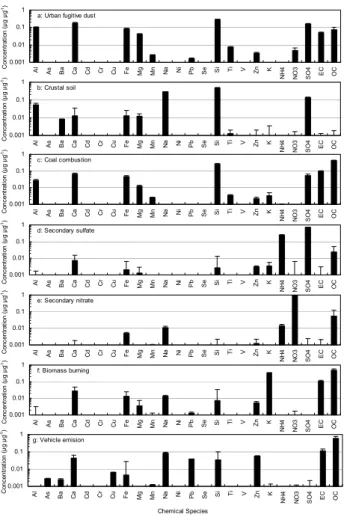
Seven sources of ambient PM10 in Beijing were resolved by PMF, which were ur-ban fugitive dust, crustal soil, coal combustion, secondary sulfate, secondary nitrate, biomass burning and vehicle emission, for which source profiles were shown in Fig. 3. The first source profile illustrated in Fig. 3a was characterized by high concentrations
5
of crustal elements, such as Si, Ca, Al, Fe, Mg, Mn and Ti, along with relatively high loadings of OC, EC, SO2−4 and NO−
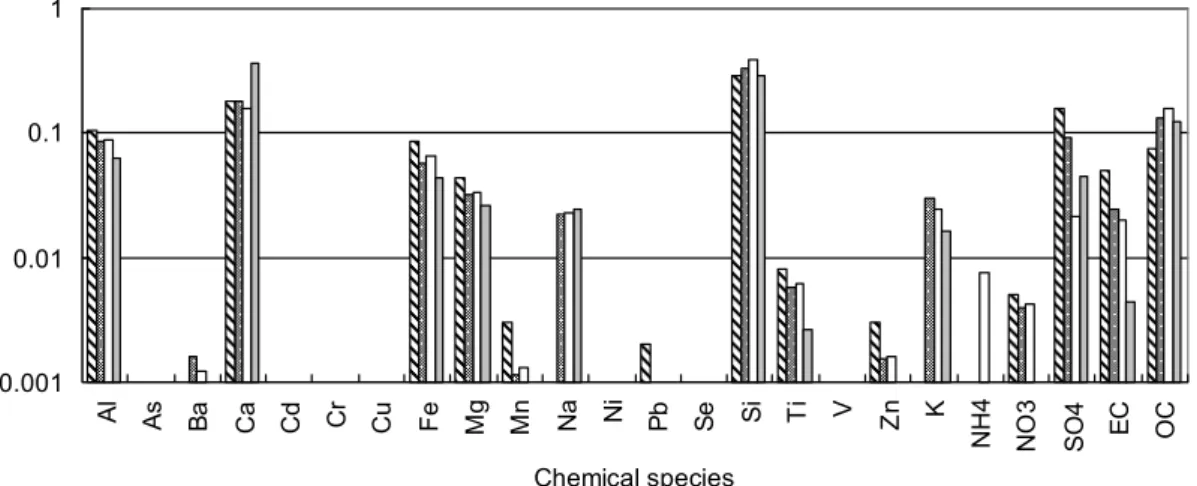
3, presenting significant characteristics of urban fugitive dust (Song et al., 2006). This source profile was displayed together with other three types of measured dust profiles in Beijing, namely, urban suspended dust, road dust and construction dust (Hua et al., 2006) in Fig. 4. It can be seen by comparing
10
the chemical profiles in Fig. 4 that concentrations of crustal elements, such as Si, Ca, Al, Fe, Mg, Ti and OC, NO−
3 were comparable in these four dust profiles, while PMF resolved dust profile exhibited higher loadings of SO2−4 , EC and lower loadings of K and Na than other three types of measured dust profiles. These differences might be caused by factor rotations and similar phenomenon has been reported by Lee and
15
Hopke (2006). The abundance of EC, OC and NO−
3 might be due to unavoidable influences from human activities, such as deterioration of waste and deposition of fly ashes from coal combustion. Therefore, this source represented fugitive emission of dust mainly from local roads traffic, agricultural tilling operations, aggregate storage piles, construction operations and was identified as “urban fugitive dust”.
20
The second source profile illustrated in Fig. 3b was one of the most stable factors during model trial, represented by high concentrations of crustal elements Si, Al, Ca, Fe, Mg with relatively high concentration of SO2−4 , showing similar pattern with urban fugitive dust. But the concentration values in this source differed from those in urban fugitive dust. OC and EC were not found in this source and Ca concentration was
25
lower than in urban fugitive dust, indicating fewer influences by human activities. High SO2−4 concentration in this source might be metal sulfates (e.g. CaSO4 and MgSO4) formed through atmospheric reactions between airborne H2SO4/SO2 and crustal
el-ACPD
8, 569–599, 2008 Spatiotemporal variations of PM10 sources in Beijing S. Xie et al. Title Page Abstract Introduction Conclusions References Tables Figures ◭ ◮ ◭ ◮ Back CloseFull Screen / Esc
Printer-friendly Version Interactive Discussion
EGU
ements (Lee et al., 1999). By all appearances, this source was identified as crustal soil.
PMF successfully indentified these two types of dust source with similar chemical characteristics in Beijing.
The third source profile was presented in Fig. 3c. The major chemical species of this
5
source were Si, Ca, Fe, Al, Mg, Ti, Mn and Zn with high concentrations of OC, EC and SO2−4 , revealing the main chemical composition with crustal elements and C. This is the typical pattern for emission from coal combustion (Song et al., 2006 and 2007).
The fourth source profile shown in Fig. 3d was characterized by high concentrations of SO2−4 and NH+4, along with certain amount of OC, which are characteristics of
sec-10
ondary sulfate. Such pattern has been reported in several PMF studies (Polissar et al., 2001; Kim and Hopke, 2006; Song et al., 2006 and Yuan et al., 2006). Secondary sulfate is formed by photochemical reactions, especially in the summer when solar radiation and the ambient temperature are high (Seinfield and Pandis, 1998). The cal-culated NH+4 to SO2−4 molar ratio of 2.1 in the profile indicated that (NH4)2SO4, instead
15
of NH4HSO4, was the major species formed by SO2−4 and NH +
4 (Lee et al, 1999; Wang et al., 2005). The presence of OC might be ascribed to that sulfuric acid can catalyze particle-phase heterogeneous reactions of atmospheric organic carbony species when secondary sulfate is formed, resulting in formation of secondary organic aerosols (Jang et al., 2002).
20
The fifth source profile shown in Fig. 3e contained high concentrations of NO− 3 and NH+4along with certain amount of OC, which were typical characteristics for secondary nitrate. Similar pattern has been reported by Li et al. (2004). NOx from traffic emission and stationary sources, such as power plants, is oxygenated to HNO3, and equilib-rium between HNO3 and NH3 in ambient air leads to the formation of NH4NO3. The
25
existence of OC was similar as secondary sulfate and suggested condensation of or-ganic matter on the NH4NO3 particles which was consistent with previous studies on individual particles (Liu et al., 2003).
ACPD
8, 569–599, 2008 Spatiotemporal variations of PM10 sources in Beijing S. Xie et al. Title Page Abstract Introduction Conclusions References Tables Figures ◭ ◮ ◭ ◮ Back CloseFull Screen / Esc
Printer-friendly Version Interactive Discussion
EGU
and K, along with EC, Si, Ca, Fe, Mg, Zn and Pb. OC and K as tracers are commonly used to identify biomass burning (Duan et al., 2004; Song et al., 2006; Lee et al., 2006). OC, EC, Zn, Pb, and K were also identified as signatures for municipal incinerators (Yoo et al., 2002). Considering only 3%–4% of waste in Beijing is treated by incineration, this source type was identified as biomass burning.
5
The seventh source profile in Fig. 3g was represented by high concentrations of EC and OC, with relatively high concentrations of Zn, Cu, Pb, Ca, Si and Fe. For diesel emissions, EC was higher relative to OC than in the gasoline vehicle source profile. Si, Fe, Zn and Pb have been detected in vehicle emission sources (Cadle et al., 1998). Fe can also be from muffler ablation. Ca is used as lubricating oil additives (Hwang
10
and Hopke, 2006); Cu is emitted from metal brake wear or could be generated from high-volume air sampling pumps (Lee et al., 1999); Si has been linked to heavy-duty diesel emissions (Lee and Hopke, 2006) or is from road dust. Zn has been found to be emitted by motor vehicles (Huang et al., 1994) and has been commonly associated with motor vehicle sources in recent PMF studies. Therefore, this source should be
15
identified as vehicle emission.
3.3 Temporal trends of ambient PM10source contributions in Beijing in 2004
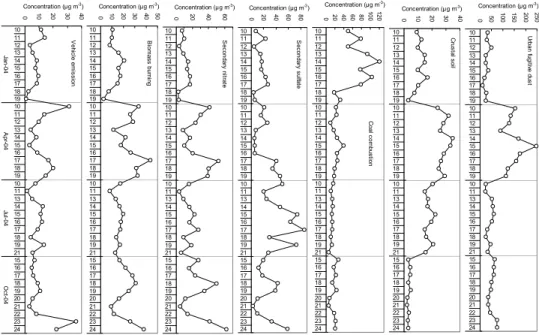
The daily average mass contributions of each source to ambient PM10in Beijing were calculated by averaging apportionment results at six sites on a daily basis and pre-sented in Fig. 5.
20
It can be seen in Fig. 5 that the daily average contributions of urban fugitive dust were in the range of 11 to 245µg m−3and relatively high on all the sampling days. Es-pecially in April, with the daily contributions from 75µg m−3 to 245µg m−3 which were significantly higher than in other months, urban fugitive dust contributed 50.2% of total PM10 mass on a monthly basis. According to statistical meteorological data in many
25
years, cyclone and front activities happened frequently in March and April in Beijing and caused the highest frequency of dust weather days in these two months. About 50% of dust weather days on an annual basis appeared in April, caused by external
ACPD
8, 569–599, 2008 Spatiotemporal variations of PM10 sources in Beijing S. Xie et al. Title Page Abstract Introduction Conclusions References Tables Figures ◭ ◮ ◭ ◮ Back CloseFull Screen / Esc
Printer-friendly Version Interactive Discussion
EGU
and internal dust (Xie et al., 2005). On 15 April 2004, strong windy weather domi-nated in Beijing and the maximum gust speed in the afternoon was as high as 40 mph
(www.wunderground.com). As expected, contribution from urban fugitive dust on this
day reached the extremely high concentration of 245.4µg m−3, reflecting serious local scale resuspended dust pollution. Therefore, the great contribution from urban
fugi-5
tive dust in April was due to high wind velocity and indicated high dust loading on the ground surface in Beijing. Oppositely in January, the urban fugitive dust contribution was relatively low as 27.6µg m−3, accounting for 18.0% of PM
10 mass concentration due to the cold weather, freezing ground surface, and relatively low dust loading.
By comparing the daily average contributions of urban fugitive dust with those of
10
crustal soil shown in Fig. 5, it was found that the daily average contributions of crustal soil, ranging from 2 to 35µg m−3
, showed a different variation pattern from urban fugi-tive dust. Monthly average contributions were 10.7µg m−3, 28.6µg m−3, 17.7µg m−3 and 3.3µg m−3 for January, April, July, and October, respectively, much lower than those of urban fugitive dust. Crustal soil mainly concentrated in April, followed by July
15
and January. In October, its contribution was almost none.
These two dust sources had similar chemical characteristics and were differentiated by PMF, contributing 42.2% of measured total PM10 mass concentration, which are consistent with the CMB results by Okuda et al. (2004) in which soil dust accounted for 47% and 42% of PM10concentrations in 2001 and 2002, respectively.
20
Daily average contributions of coal combustion to PM10in 2004 in Beijing showed in Fig. 5 ranged from 5 to 120µg m−3and displayed a pattern characterized by extremly higher level in January than those in other months. Monthly average contribution in January was 69.5µg m−3, covering 45.4% of PM
10 mass concentration, followed by 22µg m−3 in April and 17µg m−3 in October. Due to much less coal consumed in
25
summer, the contribution was only 12µg m−3 in July on a monthly basis.
Daily contributions from secondary sulfate ranged from 2.6 to 86µg m−3 with high peaks mainly in July. Monthly average contribution was as high as 49.2µg m−3in July and much higher than in other months, followed by 24.1µg m−3in October, 20.3µg m−3
ACPD
8, 569–599, 2008 Spatiotemporal variations of PM10 sources in Beijing S. Xie et al. Title Page Abstract Introduction Conclusions References Tables Figures ◭ ◮ ◭ ◮ Back CloseFull Screen / Esc
Printer-friendly Version Interactive Discussion
EGU
in April and 13.8µg m−3in January. The reason for this pattern is that strong solar ra-diation, high ambient temperature and relative humidity in July favored the formation of secondary sulfate from SO2 by photochemical reactions (Seinfield and Pandis, 1998). It can be seen in Fig.5 that daily contributions of secondary sulfate displayed a signifi-cant fluctuation, which might be related with the daily variations of meteorological
con-5
ditions. Specifically, the meteorological data in July 2004 (www.wunderground.com) revealed that the average wind velocities on 13, 14 and 18 July 2004 were in the range of 1.5–2 m s−1, with maximum gust speed of 10–12 m s−1, average temperature of 25–28◦, and moderate rain and thunder shower on 14 and 18 July 2004. These weather constituents went against the formation of secondary sulfate, resulting in the
10
low daily contributions of secondary sulfate. In contrast, fog events, low wind velocity and high ambient temperature occurred on other sampling days in July; such weather constituents were favorable for secondary sulfate formation. Hence, daily contribu-tions of secondary sulfate to PM10 reached as high as 85.7µg m−3 on 17 July. The source contribution of secondary sulfate replaced that of urban fugitive dust to become
15
the most in July, with the monthly average contribution of 49.2µg m−3, accounting for 29.9% of the PM10 mass. And the annual average contribution was 27.1µg m−3, ac-counting for 13.9% of the total PM10mass.
Daily average contributions from secondary nitrate varied from 2.2 to 62µg m−3and showed different variation pattern from secondary sulfate, as shown in Fig. 5.
Consid-20
erable differences for variation ranges were found to exist among sampling days and months, which might depend on different meteorological conditions. The monthly av-erage contributions were 28.4 and 27.9µg m−3in April and October, while merely 10.3 and 14.6µg m−3in January and July, respectively. In ambient air, NH
4NO3, known as a semi-volatile compound, is the major existence form for NO−
3 and NH +
4. Since low
tem-25
perature in January does not favor secondary nitrate formation, while high temperature in July leads to decomposition and volatilization of NH4NO3, nitrate concentration were not high in these two months. In contrast, in April and October, high nitrate concen-trations were observed due to moderate temperature in these two months. Besides,
ACPD
8, 569–599, 2008 Spatiotemporal variations of PM10 sources in Beijing S. Xie et al. Title Page Abstract Introduction Conclusions References Tables Figures ◭ ◮ ◭ ◮ Back CloseFull Screen / Esc
Printer-friendly Version Interactive Discussion
EGU
as seen in Fig. 5, the daily average contributions for secondary nitrate showed similar variation pattern with biomass burning and vehicle emission, which is understandable considering biomass burning and vehicle emission may be sources of NOx, which is an important precursor for secondary nitrate. Therefore, controlling biomass burning and vehicle emission is vital for reducing secondary nitrate contribution in Beijing.
5
It was seen from the daily contributions of biomass burning to ambient PM10in 2004 in Fig. 5 that the biomass burning contributed in the range from 2.6 to 43µg m−3 on a daily basis, and 12.1µg m−3 in January, 27.1µg m−3 in April, 15.2µg m−3 in July and 22.2µg m−3 in October, respectively on a monthly basis. Obviously, the daily average contributions in April and October were higher than in other months. The daily
contri-10
bution variations of this source were smooth in July but considerable in other months, especially in April and July. Furthermore, daily variations for source contributions of biomass burning in April were close to those of urban fugitive dust source. Specifically, it is the right time for spring ploughing in April; wheat straw burning intensifies from May to July; maize straw burning takes place during August through October and fallen
15
leaves are burned during November through next January. Therefore, PM10emitted by biomass burning source actually exist in all the months around Beijing and its contribu-tion to PM10 should not be neglected, which was different from the results of previous PM10 source apportionment studies in China (Bi et al., 2005; Okuda et al., 2004). Furthermore, it must be noted that in March and April, apart from local crop burning,
20
non-local biomass burning rendered PM10 might be transported to Beijing along with crustal soil, and lead to increase in the daily average contribution of biomass burning and appearing to be similar to the daily variation trend of daily average contribution of crustal soil and urban fugitive dust in April. It has also been found in earlier studies that a large quantity of fine particles were transported into Beijing with sand dust during
25
sand-dust storm periods (Xie et al., 2005), and that particles emitted by straw burn-ing in the large rural areas on south of Beijburn-ing, includburn-ing Hebei, Shandong, Jiangsu, and northern Anhui provinces, can be transported to Beijing along with southern wind, resulting in remarkable increase of particulate matter concentrations at several
moni-ACPD
8, 569–599, 2008 Spatiotemporal variations of PM10 sources in Beijing S. Xie et al. Title Page Abstract Introduction Conclusions References Tables Figures ◭ ◮ ◭ ◮ Back CloseFull Screen / Esc
Printer-friendly Version Interactive Discussion
EGU
toring sites in Beijing (Duan et al., 2004).
The daily average contributions from vehicle emission to PM10in 2004 presented in Fig. 5 showed no obvious fluctuation except on 10 April and 23 October. It was seen from Fig. 5 that vehicle emission contributed in the range from 0.6 to 36µg m−3 on a daily basis, and 7.0µg m−3 in January, 12.9µg m−3 in April, 8.1µg m−3 in July and
5
11.1µg m−3 in October on a monthly basis. It was a stable source with and the annual average contribution of 9.7µg m−3.
3.4 Seasonal and spatial variations of ambient PM10 source contributions in Beijing in 2004
Average source contributions on annual and monthly basis were calculated by
averag-10
ing apportionment results at six sites and shown in Table 1. On average, the contri-butions from seven sources resolved by PMF accounted for about 96.7% of observed PM10 mass concentration. Among them, urban fugitive dust which came from local road traffic, agricultural tilling operations, aggregate storage piles, and heavy construc-tion operaconstruc-tions contributed the most in Beijing, with the annual average contribuconstruc-tion of
15
66.9µg m−3, accounting for 34.4% of the total PM
10 mass. The second largest con-tributor was coal combustion source with contribution of 30.0µg m−3, accounting for 15.5% of the total PM10 mass on an annual basis. Contributions of secondary sulfate and secondary nitrate were 27.1µg m−3 and 20.0µg m−3, accounting for 13.9% and 10.3% of the total PM10 mass, respectively, which indicated considerably high
contri-20
butions of secondary sources to ambient PM10 in Beijing. Contribution from biomass burning was 19.1µg m−3, accounting for 9.8% of the total PM
10 mass. Crustal soil contributed 15.1µg m−3, accounting for 7.8% of the total PM
10 mass. Contribution from vehicle emission was relatively low at 9.7µg m−3. However, vehicles not only di-rectly emit particulate matter, but also emit large amount of gaseous pollutants, such
25
as NOx and VOC (Cai and Xie, 2007), which will transform to secondary aerosols, in-cluding secondary nitrate and organics (Lee and Hopke, 2006; Perrino et al., 2002).
ACPD
8, 569–599, 2008 Spatiotemporal variations of PM10 sources in Beijing S. Xie et al. Title Page Abstract Introduction Conclusions References Tables Figures ◭ ◮ ◭ ◮ Back CloseFull Screen / Esc
Printer-friendly Version Interactive Discussion
EGU
In addition, vehicle traveling also causes road dust which is also an important source for PM10. Based on this consideration, contribution from vehicles actually accounted for a much larger part than 5.0%. Besides, some existing industrial sources, such as Capital Iron and Steel Company, may be important contributors for iron elements such as Pb, Zn, and Cu, and large source of SO2, which is precursor for secondary sulfate.
5
All these potential sources cannot be neglected either and need more investigation. It was also found from Table 1 that the contribution of each source to PM10 in Bei-jing showed significant seasonal variations. In January, due to increasing demand for heat supply in winter, coal combustion dominated with the contribution of 69.5µg m−3, accounting for 45.4% of total PM10 mass. In April, urban and crustal soil became the
10
primary PM10 sources. Contribution from urban fugitive dust in this month was as high as 147.9µg m−3, accounting for 50.2% of total PM
10 mass. In July, secondary sources, including secondary sulfate and secondary nitrate, with the contribution of 63.8µg m−3, 38.8% were major PM
10 sources. In October, urban fugitive dust, sec-ondary sulfate and secsec-ondary nitrate were the major PM10 sources. Contribution from
15
biomass burning in October was also high due to the increase of leaves burned in fall. Overall, urban fugitive dust source contributed large portion of PM10 mass concentra-tion in every month and should be the priority to be controlled in Beijing.
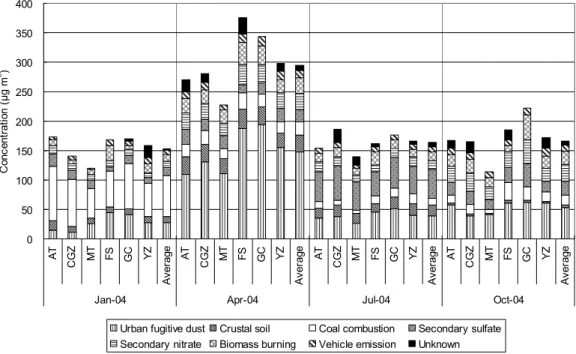
Monthly average source contributions for each site were illustrated in Fig. 6. It can be seen from Fig. 6 that PM10 source contributions in Beijing displayed not only
sea-20
sonal variations but also spatial differences. The contributions from urban fugitive dust were higher at suburban sites FS, GC, and YZ than at urban sites AT and CGZ. It was indicated that contributions from urban fugitive dust were higher than those from other sources in southeastern and southwestern Beijing, and that dust loading in urban areas was lower than in suburban areas. GC is near Capital Iron and Steel Company, where
25
aggregate storage piles of all kinds of materials might generate suspended dust. Con-struction materials plants and various roads emitted dust around FS. Coal combustion contributions at AT, CGZ and GC were higher than at other sites. Secondary sulfate and secondary nitrate contributions at AT, CGZ, FS and GC were higher than at other
ACPD
8, 569–599, 2008 Spatiotemporal variations of PM10 sources in Beijing S. Xie et al. Title Page Abstract Introduction Conclusions References Tables Figures ◭ ◮ ◭ ◮ Back CloseFull Screen / Esc
Printer-friendly Version Interactive Discussion
EGU
two sites. Biomass burning contribution at FS was much higher than at other sites. This was probably due to biomass burning activities in kilns around FS or transported PM10 from the southwest, considering FS was located on the southwestern transport path in Beijing.
Sums of PMF resolved source contributions on all the sampling days and sites were
5
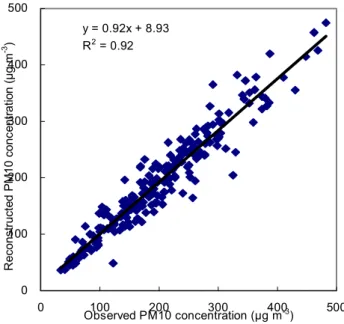
calculated to represent the reconstructed PM10 mass concentrations. And then recon-structed versus observed PM10 mass concentrations were plotted. As seen in Fig. 7, reconstructed PM10 concentrations showed good agreements with observed values, with aR2=0.92, a lope 0.92 and an intercept 8.93 µg m−3. These indicated a success-ful source apportionment and credible results.
10
4 Conclusions
The average PM10 concentration in Beijing during the sampling period in 2004 was 194µg m−3, which exceeded National Ambient Air Quality Standard (GB3095-1996) level II for PM10 (100µg m−3) and also exceeded level III (150µg m−3). PM10 in Bei-jing was mainly composed of crustal elements, organic matter, SO2−4 and NO−
3, which
15
accounted for 8.6%, 39.9%, 16.1% and 13.5% of total PM10mass on an annual basis. Crustal elements accounted for more than 40% of PM10 mass concentration in Jan-uary, April, and July. SO2−4 accounted for 26.9% in July and NO−
3 accounted for 14.1% of PM10 mass concentration in October, both of which were significantly higher than in other months.
20
Seven sources of ambient PM10in Beijing in 2004 were resolved by PMF, which were urban fugitive dust, crustal soil, coal combustion, secondary sulfate, secondary nitrate, biomass burning and vehicle emission. In paticular, urban fugitive dust and crustal soil as two types of dust sources with similar chemical characteristics were differentiated by PMF. Urban fugitive dust was the largest contributor with the annual average
contribu-25
tion of 66.9µg m−3, accounting for 34.4% of PM
combus-ACPD
8, 569–599, 2008 Spatiotemporal variations of PM10 sources in Beijing S. Xie et al. Title Page Abstract Introduction Conclusions References Tables Figures ◭ ◮ ◭ ◮ Back CloseFull Screen / Esc
Printer-friendly Version Interactive Discussion
EGU
tion was still an important source of PM10in Beijing. Especially in winter, its contribution reached 69.5µg m−3, accounting for 45.4% of the total PM
10mass. Secondary sources including secondary sulfate and secondary nitrate contributed 47.1µg m−3, accounting for 24.3% of the total PM10 mass, indicating quite serious secondary pollution in Bei-jing. Contributions of biomass burning and vehicle emission were 19.1µg m−3, 9.8%
5
and 9.7µg m−3, 5.0%, respectively. In spite of the relative low contribution from di-rect vehicle emission, considering secondary aerosols formed by oxidation of vehicles emitted gaseous precursors and resuspended dust caused by vehicle traveling, PM10 generated by vehicles, both directly and indirectly, were quite significant and should not be neglected.
10
The source apportionment results of ambient PM10 in 2004 in Beijing indicated that significant seasonal and spatial variations of PM10 sources in Beijing were found. Coal combustion was the primary source of ambient PM10 in winter which accounted for 45.4% of PM10 mass concentration. Higher contributions were found in urban areas than in suburban areas. Urban fugitive dust contributed 50.2% of PM10 mass
concen-15
tration in spring, and was significant in other months, too. Higher contributions from urban fugitive dust were found in southwestern and southeastern suburban areas than in central urban areas, indicating higher dust loadings in these areas. Secondary sul-fate and secondary nitrate combined to be the largest source in summer and fall, with percentages of 38.8% and 31.5%, respectively. Contributions from secondary sources
20
were higher in urban areas than in suburban areas. Biomass burning contributed more in fall than in other months, and more in southwestern Beijing than in other areas, which indicated biomass burning sources might locate in southwestern area of Beijing. In conclusion, it was found that ambient PM10 sources in Beijing showed significant seasonal variations as well as spatial differences.
25
Acknowledgements. This study was funded by National Basic Research Program of China
(Grant2002CB211600) and was a part of the Air Pollution Control Strategy research project funded by Beijing Municipal Science and Technology Commission. We also thank P. Paatero for providing valuable suggestions on PMF analysis.
ACPD
8, 569–599, 2008 Spatiotemporal variations of PM10 sources in Beijing S. Xie et al. Title Page Abstract Introduction Conclusions References Tables Figures ◭ ◮ ◭ ◮ Back CloseFull Screen / Esc
Printer-friendly Version Interactive Discussion
EGU
References
Beijing Environmental Protection Bureau: Report on the State of the Environment in Beijing in 2002,http://www.bjepb.gov.cn/bjhb/tabid/68/InfoID/2618/Default.aspx, 2004.
Beijing Environmental Protection Bureau: Report on the State of the Environment in Beijing in 2004,http://www.bjepb.gov.cn/bjhb/tabid/68/InfoID/2620/Default.aspx, 2005.
5
Beijing Environmental Protection Bureau: Report on the State of the Environment in Beijing in 2005,http://www.bjepb.gov.cn/bjhb/tabid/68/InfoID/7622/Default.aspx, 2006.
Bi, X., Feng, Y., Wu, J., Wang, Y., and Zhu, Tan: Source apportionment of PM10in six cities of northern China, Atmos. Environ, 41, 903–912, 2007.
Cadle, S. H., Mulawa, P., Hunsanger, E. C., Nelson, K., Ragazzi, R. A., Barrett, R., Gallagher,
10
G. L., Lawson, D. R., Knapp, K. T., and Snow, R: Measurements of exhaust particulate matter emissions from in-use light-duty motor vehicles in the Denver, Colorado area, report prepared for coordinating research council, Atlanta GA, 1998.
Cai, H. and Xie, S. D: Estimation of vehicular emission inventories in China from 1980 to 2005, Atmos. Environ., doi:10.1016/j.atmosenv.2007.08.019, 2007.
15
Chen, T., Hua, L., Jin, L., Xu, Z., Wang, H., Bai, J., Liu, W., Hu, Y., and Lin, A: Research on PM10source apportionment in Beijing, Environmental Monitoring in China, 22, 6, (in Chinese with abstract in English), 2006.
Christoforou, C. S., Salmon, L. G., Hannigan, M. P., Solomon, P. A., and Cass, G. R: Trends in fine particle concentration and chemical composition in southern California, J. Air Waste
20
Manag. Assoc., 50, 43–53, 2000.
Duan, F., Liu, X., Yu, T., and Cachier, H: Identification and estimate of biomass burning con-tribution to the urban aerosolorganic carbon concentrations in Beijing, Atmos. Environ., 38, 1275–1282, 2004.
Han, J. S., Moon, K. J., Lee, S. J., Kim, Y. J., Ryu, S. Y., Cliff, S. S., and Yi, S. M: Size-resolved
25
source apportionment of ambient particles by positive matrix factorization, Atmos. Chem. Phys., 6, 211–223, 2006,http://www.atmos-chem-phys.net/6/211/2006/.
Hopke, P. K., Lamb, R. E., and Natusch, D. F. C: Multi-elemental characterization of urban roadway dust, Environ. Sci. Technol., 14, 164–172, 1980.
Huang, X. D., Olmez, I., Aras, N. K., and Gordon, G. E: Emissions of trace-elements from
30
motor-vehicles-potential marker elements and source composition profile, Atmos. Environ., 28, 1385–1391, 1994.
ACPD
8, 569–599, 2008 Spatiotemporal variations of PM10 sources in Beijing S. Xie et al. Title Page Abstract Introduction Conclusions References Tables Figures ◭ ◮ ◭ ◮ Back CloseFull Screen / Esc
Printer-friendly Version Interactive Discussion
EGU
Hwang, I. and Hopke, P. K: Comparison of source apportionments of fine particulate matter at two San Jose Speciation Trends Network Sites, J. Air Waste Manag. Assoc., 56, 1287–1300, 2006.
Jang, M., Czoschke, N. M., Lee, S., and Kamens, R. M: Heterogeneous atmospheric aerosol production by acidcatalyzed particle-phase reactions, Science, 298, 814–817, 2002.
5
Johnson, K. S., de Foy, B., Zuberi, B., Molina, L. T., Molina, M. J., Xie, Y., Laskin, A., and Shut-thanandan, V.: Aerosol composition and source apportionment in the Mexico Metropolictan Area with PIXE/PESA/STIM and multivariate analysis, Atmos. Chem. Phys., 6, 4591–4600, 2006,http://www.atmos-chem-phys.net/6/4591/2006/.
Kim, E. and Hopke, P. K.: Characterization of fine particle sources in the Great Smoky
Moun-10
tains area, Sci. Total Environ., 368, 781–794, 2006.
Lanz, V. A., Alfarra, M. R., Baltensperger, U., Buchmann, B., Hueglin, C., and Pr ´evot A. S. H.: Source apportionment of submicron organic aerosols at an urban site by factor analytical modeling of aerosol mass spectra, Atmos. Chem. Phys., 7, 1503–1522, 2007,
http://www.atmos-chem-phys.net/7/1503/2007/.
15
Li, Z., Hopke, P. K., Husain, L., Qureshi, S., Dutkiewicz, V. A., Schwab, J. J., Drewnick, F., and Demerjian, K. L.: Sources of fine particle composition in New York city, Atmos. Environ., 38, 6521–6529, 2004.
Lee, E., Chan, C. K., and Paatero, P: Application of positive matrix factorization in source apportionment of particle pollutants in Hong Kong, Atmos. Environ., 33, 3201–3212, 1999.
20
Lee, P. K. H., Brook, J. R., Zlotorzynska, E. D., and Mabury, S. A.: Indentification of the major sources contributing to PM2.5 observed in Toronto, Environ. Sci. Technol., 37, 4831–4840, 2003.
Lee, J. H. and Hopke, P. K.: Apportioning sources of PM2.5 in St. Louis, MO using speciation trends network data, Atmos. Environ., 40, 360–377, 2006.
25
Liu, W., Hopke, P. K., Han, Y. J., Yi, S. M., Holsen, T. M., Cybart, S., Kozlowski, K., and Milligan, M.: Application of receptor modeling to atmospheric constituents at Potsdam and Stockton, NY, Atmos. Environ., 37, 4997–5007, 2003.
Okuda, T., Kato, J., Mori, J., Tenmoku, M., Suda, Y., Tanaka, S., He, K., Ma, Y., Yang, F., Yu, X., and Duan, F.: Daily concentrations of trace metals in aerosols in Beijing, China,
30
determined by using inductively coupled plasma mass spectrometry equipped with laser ablation analysis, and source identification of aerosols, Sci. Total Environ, 330, 145–158, 2004.
ACPD
8, 569–599, 2008 Spatiotemporal variations of PM10 sources in Beijing S. Xie et al. Title Page Abstract Introduction Conclusions References Tables Figures ◭ ◮ ◭ ◮ Back CloseFull Screen / Esc
Printer-friendly Version Interactive Discussion
EGU
Paatero, P.: Lest squares formulation of robust non-negative factor analysis, Chemometr. Intell. Lab., 37, 23–35, 1997.
Paatero, P.: User’s guide for positive matrix factorization programs PMF2 and PMF3, Part 1: tutorial, 2004.
Paatero, P. and Tapper, U.: Positive matrix factorization: a non-negative factor model with
5
optimal utilization of error estimates of data values, Environmetrics, 5, 111–126, 1994. Perrino, C., Catrambone, M., Di Menno Di Bucchianico, A., and Allegrini, I.: Gaseous ammonia
in the urban area of Rome, Italy and its relationship with traffic emissions, Atmos. Environ., 36, 5385–5394, 2002.
Polissar, A. V., Hopke, P. K., and Poirot, R. L.: Atmospheric aerosolover Vermont: chemical
10
composition and sources, Environ. Sci. Technol., 35, 4604–4621, 2001.
Polissar, A. V., Hopke, P. K., Paatero, P., Malm, W. C., and Sisler, J. F.: Atmospheric aerosol over Alaska, 2. Elemental composition and sources, J. Geophys. Res., 103, 19 045–19 057, 1998.
Reff, A, Eberly, S. I., and Bhave, P. V.: Receptor modeling of ambient particulate matter data
15
using positive matrix factorization: Review of exising methods, J. Air Waste Manag. Assoc., 57, 146–154, 2007.
Seinfeld, J. H. and Pandis, S. N.: Atmospheric Chemistry and Physics from Air Pollution to Climate Change, Wiley, New York, USA, pp. 649–655, 1998.
Song, Y., Zhang, Y., Xie, S. D., Zeng, L., Zheng, M., Salmon, L. G., Shao, M., and Slanina, S.:
20
Source apportionment of PM2.5 in Beijing by positive matrix factorization, Atmos. Environ., 40, 1526–1537, 2006.
Song, Y., Tang, X., Xie, S. D., Zhang, Y., Wei, Y., Zhang, M., Zeng, L., and Lu, S.: Source apportionment of PM2.5in Beijing in 2004, J. Hazard. Mater., 146, 124–130, 2007.
State Environmental Protection Administration: Report on the State of the
En-25
vironment in China, http://www.zhb.gov.cn/ztbd/sjhjr/2007hjr/tpbd56/200706/
P020070611461716557487.pdf, 2005.
State Environmental Protection Administration: Report on the State of the Environment in China,http://www.zhb.gov.cn/download/2004gb.pdf, 2007.
Sun, Y., Zhuang, G., Wang, Y., Han, L., Guo, J., Dan, M., Zhang, W., Wang, Z., and Hao,
30
Z.: The air-borne particulate pollution in Beijing–concentration, composition, distribution and sources, Atmos. Environ., 38, 5991–6004, 2004.
ACPD
8, 569–599, 2008 Spatiotemporal variations of PM10 sources in Beijing S. Xie et al. Title Page Abstract Introduction Conclusions References Tables Figures ◭ ◮ ◭ ◮ Back CloseFull Screen / Esc
Printer-friendly Version Interactive Discussion
EGU
73–81, 1985.
Wang, Y., Zhuang, G., Tang, A., Yuan, H., Sun, Y., Chen, S., and Zheng, A.: The ion chemistry and the source of PM2.5aerosol in Beijing, Atmos. Environ., 39, 3771–3784, 2005.
Xie, S. D., Yu, T., Zhang,Y. H., Zeng, L. M., Qi, L., and Tang, X. Y.: Characteristics of PM10, SO2, NOx and O3in ambient air during the dust-storm period in Beijing, Sci. Total Environ.,
5
345/1–3, 153–164, 2005.
Yoo, J. I., Kim, K. H., Jang, H. N., Seo, Y. C., Seok, K. S., Hong, J. H., and Jang, M.: Emission characteristics of particulate matter and heavy metals from small incinerators and boilers, Atmos. Environ., 36, 5057–5066, 2002.
Yuan, Z., Yu, J. Z., Lau, A. K. H., Louie, P. K. K., and Fung, J. C. H.: Application of positive
10
matrix factorization in estimating aerosol secondary organic carbon in Hong Kong and its relationship with secondary sulfate, Atmos. Chem. Phys., 6, 25–34, 2006,
http://www.atmos-chem-phys.net/6/25/2006/.
Zabalza, J., Ogulei, D., Hopke, P. K., Lee, J. H., Hwang, I., Querol, X., Alastuey, A., and Santamaria, J. M.: Concentration and sources of PM10and its constituents in Alsasua, Spain.
15
Water Air Soil Poll., 174, 385–404, 2006.
Zheng, M., Salmon, L. G., Schauer, J. J., Zeng, L., Kiang, C. S., Zhang, Y., and Cass, G. R.: Seasonal trends in PM2.5 source contributions in Beijing, China, Atmos. Environ., 39, 3967–3976, 2005.
ACPD
8, 569–599, 2008 Spatiotemporal variations of PM10 sources in Beijing S. Xie et al. Title Page Abstract Introduction Conclusions References Tables Figures ◭ ◮ ◭ ◮ Back CloseFull Screen / Esc
Printer-friendly Version Interactive Discussion
EGU
Table 1. Monthly and annual average PM10source contributions in Beijing, 2004.
Duration Source Urban Crustal Coal Secondary Secondary Biomass Vehicle Unknown contribution fugitive soil combustion sulfate nitrate burning emission
dust January µg m−3 27.6 10.7 69.5 13.8 9.5 12.1 7.0 2.8 % 18.0 7.0 45.4 9.0 6.2 7.9 4.6 1.8 April µg m−3 147.9 28.6 21.9 20.3 27.9 27.1 12.9 8.4 % 50.2 9.7 7.4 6.9 9.5 9.2 4.4 2.8 July µg m−3 39.7 17.7 12.2 49.2 14.6 15.2 8.1 7.6 % 24.2 10.8 7.4 29.9 8.9 9.2 4.9 4.7 October µg m−3 53.6 3.3 17.4 24.0 28.4 22.2 11.1 6.4 % 32.2 2.0 10.4 14.5 17.0 13.3 6.7 3.8 Annual µg m−3 66.9 15.1 30.0 27.1 20.0 19.1 9.7 6.3 % 34.4 7.8 15.5 13.9 10.3 9.8 5.0 3.3
ACPD
8, 569–599, 2008 Spatiotemporal variations of PM10 sources in Beijing S. Xie et al. Title Page Abstract Introduction Conclusions References Tables Figures ◭ ◮ ◭ ◮ Back CloseFull Screen / Esc
Printer-friendly Version Interactive Discussion
EGU
Fig. 1. Locations of the sampling sites in Beijing 1. Ming Tombs (MT) 2. National Olympic
Sports Center (AT) 3. Chegongzhuang (CGZ) 4. Yizhuang (YZ) 5. Gucheng (GC) 6. Fangshan (FS).
ACPD
8, 569–599, 2008 Spatiotemporal variations of PM10 sources in Beijing S. Xie et al. Title Page Abstract Introduction Conclusions References Tables Figures ◭ ◮ ◭ ◮ Back CloseFull Screen / Esc
Printer-friendly Version Interactive Discussion EGU EC, 6, 3. 9% Tr ace, . 2, 2. 7% NH4+, . 9, 2. 5% SO42-, 14. 5, 9. 5% NO3-, 7. 9, 5. 2% Or gani cs, 34. 6, 22. 6% Cr ust al , 69. 2, 45. 2% unknown, 12. 7, 8. 3% PM10 concentration in January, 2004, 153µg m-3 EC, 7, 2. 4% Tr ace, 9. 6, 3. 3% NH4+, 5. 3, 1. 8% SO42-, 28. 2, 9. 6% NO3-, 23. 2, 7. 9% Or gani cs , 33, 11. 2% Cr ust al , 128, 43. 4% unknown, 60. 7, 20. 6% PM10 concentration in April, 2004, 295µg m-3 EC, 3. 2, 1. 9% Tr ace, 5. 7, 3. 5% NH4+, 11. 8, 7. 2% SO42-, 44. 1, 26. 9% NO3-, 12. 2, 7. 4% Or gani cs , 19, 11. 6% Cr ust al , 65. 2, 39. 7% unknown, 3, 1. 8% PM10 concentration in July, 2004, 164µg m-3 EC, 5. 4, 3. 2% Tr ace, 3, 1. 8% NH4+, 7. 9, 4. 7% SO42-, 18. 5, 11. 1% NO3-, 23. 4, 14. 1% Or gani cs , 38. 6, 23. 2% Cr ust al , 48. 2, 29. 0% unknown, 21. 4, 12. 9% PM10 concentration in October, 2004, 166µg m-3
Fig. 2. Proportional ambient PM10chemical compositions in Beijing in January, April, July and
ACPD
8, 569–599, 2008 Spatiotemporal variations of PM10 sources in Beijing S. Xie et al. Title Page Abstract Introduction Conclusions References Tables Figures ◭ ◮ ◭ ◮ Back CloseFull Screen / Esc
Printer-friendly Version Interactive Discussion EGU 0.001 0.01 0.1 1 Al As Ba Ca Cd Cr Cu Fe Mg Mn Na Ni Pb Se Si Ti V Zn K N H 4 N O 3 SO 4 EC OC C o n c e n tr a ti o n ( µ g µ g -1)
a: Urban fugitive dust
0.001 0.01 0.1 1 Al As Ba Ca Cd Cr Cu Fe Mg Mn Na Ni Pb Se Si Ti V Zn K N H 4 N O 3 SO 4 EC OC C o n c e n tr a ti o n ( µ g µ g -1) b: Crustal soil 0.001 0.01 0.1 1 Al As Ba Ca Cd Cr Cu Fe Mg Mn Na Ni Pb Se Si Ti V Zn K N H 4 N O 3 SO 4 EC OC C o n c e n tr a ti o n ( µ g µ g -1) c: Coal combustion 0.001 0.01 0.1 1 Al As Ba Ca Cd Cr Cu Fe Mg Mn Na Ni Pb Se Si Ti V Zn K N H 4 N O 3 SO 4 EC OC C o n c e n tr a ti o n ( µ g µ g -1) d: Secondary sulfate 0.001 0.01 0.1 1 Al As Ba Ca Cd Cr Cu Fe Mg Mn Na Ni Pb Se Si Ti V Zn K N H 4 N O 3 SO 4 EC OC C o n c e n tr a ti o n ( µ g µ g -1) e: Secondary nitrate 0.001 0.01 0.1 1 Al As Ba Ca Cd Cr Cu Fe Mg Mn Na Ni Pb Se Si Ti V Zn K N H 4 N O 3 SO 4 EC OC C o n c e n tr a ti o n ( µ g µ g -1) f: Biomass burning 0.001 0.01 0.1 1 Al As Ba Ca Cd Cr Cu Fe Mg Mn Na Ni Pb Se Si Ti V Zn K N H 4 N O 3 SO 4 EC OC Chemical Species C o n c e n tr a ti o n ( µ g µ g -1) g: Vehicle emision
ACPD
8, 569–599, 2008 Spatiotemporal variations of PM10 sources in Beijing S. Xie et al. Title Page Abstract Introduction Conclusions References Tables Figures ◭ ◮ ◭ ◮ Back CloseFull Screen / Esc
Printer-friendly Version Interactive Discussion EGU 0.001 0.01 0.1 1 Al As Ba Ca Cd Cr Cu Fe Mg Mn Na N i Pb Se Si T i V Z n K N H 4 N O 3 SO 4 EC OC Chemical species C o n c e n tr a ti o n ( µ g µ g -1 )
PMF urban fugitive dust Urban suspended dust Road dust Construction dust
A
CPD
8, 569–599, 2008 Spatiotemporal v ariations of PM 10 sour ces in Beijing S . Xie et al. Title P age Abstr act Introduction Conclusions Ref erences T ab les Figures ◭ ◮ ◭ ◮ Bac k Close Full Screen / Esc Pr inter-fr iendly V ersion Inter activ e Discussion EGU U rb a n fu g iti ve d u s t 0 50 100 150 200 250 10 11 12 13 14 15 16 17 18 19 10 11 12 13 14 15 16 17 18 19 10 11 13 14 15 16 17 18 19 21 15 16 17 18 19 20 21 22 23 24 Ja n -0 4 A p r-0 4 J u l-0 4 O c t-0 4 Concentration (µg m-3) C ru s ta l s o il 0 10 20 30 40 10 11 12 13 14 15 16 17 18 19 10 11 12 13 14 15 16 17 18 19 10 11 13 14 15 16 17 18 19 21 15 16 17 18 19 20 21 22 23 24 J a n -0 4 A p r-0 4 Ju l-0 4 O c t-0 4 Concentration (µg m-3) C o a l c o m b u s tio n 0 20 40 60 80 1 0 0 1 2 0 10 11 12 13 14 15 16 17 18 19 10 11 12 13 14 15 16 17 18 19 10 11 13 14 15 16 17 18 19 21 15 16 17 18 19 20 21 22 23 24 J a n -0 4 A p r-0 4 Ju l-0 4 O c t-0 4 Concentration (µg m-3 ) S e c o n d a ry s u lfa te 0 20 40 60 80 10 11 12 13 14 15 16 17 18 19 10 11 12 13 14 15 16 17 18 19 10 11 13 14 15 16 17 18 19 21 15 16 17 18 19 20 21 22 23 24 J a n -0 4 A p r-0 4 Ju l-0 4 O c t-0 4 Concentration (µg m-3) S e c o n d a ry n itr a te 0 20 40 60 10 11 12 13 14 15 16 17 18 19 10 11 12 13 14 15 16 17 18 19 10 11 13 14 15 16 17 18 19 21 15 16 17 18 19 20 21 22 23 24 Ja n -0 4 A p r-0 4 Ju l-0 4 O c t-0 4 Concentration (µg m-3) B io m a s s b u rn in g 0 10 20 30 40 50 10 11 12 13 14 15 16 17 18 19 10 11 12 13 14 15 16 17 18 19 10 11 13 14 15 16 17 18 19 21 15 16 17 18 19 20 21 22 23 24 J a n -0 4 A p r-0 4 Ju l-0 4 O c t-0 4 Concentration (µg m-3 ) V e h ic le e m is s io n 0 10 20 30 40 10 11 12 13 14 15 16 17 18 19 10 11 12 13 14 15 16 17 18 19 10 11 13 14 15 16 17 18 19 21 15 16 17 18 19 20 21 22 23 24 J a n -0 4 A p r-0 4 Ju l-0 4 O c t-0 4 Concentration (µg m-3 ) Fig. 5. Daily var iations of PM 10 source contr ib utions in Beij ing. 597ACPD
8, 569–599, 2008 Spatiotemporal variations of PM10 sources in Beijing S. Xie et al. Title Page Abstract Introduction Conclusions References Tables Figures ◭ ◮ ◭ ◮ Back CloseFull Screen / Esc
Printer-friendly Version Interactive Discussion EGU 0 50 100 150 200 250 300 350 400 AT C G Z MT FS GC YZ Av e ra g e AT C G Z MT FS GC YZ Av e ra g e AT C G Z MT FS GC YZ Av e ra g e AT C G Z MT FS GC YZ Av e ra g e
Jan-04 Apr-04 Jul-04 Oct-04
C o n c e n tr a ti o n ( µ g m -3 )
Urban fugitive dust Crustal soil Coal combustion Secondary sulfate Secondary nitrate Biomass burning Vehicle emission Unknown
Figure 6. Monthly average PM10 source contributions in January, April, July, and October
Fig. 6. Monthly average PM10source contributions in January, April, July, and October for each
ACPD
8, 569–599, 2008 Spatiotemporal variations of PM10 sources in Beijing S. Xie et al. Title Page Abstract Introduction Conclusions References Tables Figures ◭ ◮ ◭ ◮ Back CloseFull Screen / Esc
Printer-friendly Version Interactive Discussion EGU y = 0.92x + 8.93 R2 = 0.92 0 100 200 300 400 500 0 100 200 300 400 500 Observed PM10 concentration (µg m-3) R e co n s tr u ct e d P M 1 0 co n c e n tr a ti o n ( µ g m -3 )