HAL Id: hal-02521818
https://hal.archives-ouvertes.fr/hal-02521818
Submitted on 27 Mar 2020
HAL is a multi-disciplinary open access
archive for the deposit and dissemination of
sci-entific research documents, whether they are
pub-lished or not. The documents may come from
teaching and research institutions in France or
abroad, or from public or private research centers.
L’archive ouverte pluridisciplinaire HAL, est
destinée au dépôt et à la diffusion de documents
scientifiques de niveau recherche, publiés ou non,
émanant des établissements d’enseignement et de
recherche français ou étrangers, des laboratoires
publics ou privés.
NaMoO2 : a layered oxide with molybdenum clusters
Laura Vitoux, Marie Guignard, Nicolas Penin, Dany Carlier-Larregaray,
Jacques Darriet, Claude Delmas
To cite this version:
Laura Vitoux, Marie Guignard, Nicolas Penin, Dany Carlier-Larregaray, Jacques Darriet, et al..
NaMoO2 : a layered oxide with molybdenum clusters. Inorganic Chemistry, American Chemical
Society, 2020, 59 (6), pp.4015-4023. �10.1021/acs.inorgchem.9b03688�. �hal-02521818�
NaMoO
2
: a layered oxide with molybdenum clusters.
Laura Vitoux, Marie Guignard*, Nicolas Penin, Dany Carlier, Jacques Darriet, Claude Delmas
CNRS, Université de Bordeaux, Bordeaux INP, ICMCB UMR 5026, 33600 Pessac, France.
Supporting Information Placeholder
ABSTRACT: NaMoO2 was synthesized as a layered oxide
from the reaction between the layered oxide Na2/3MoO2 and
metal sodium. Its structure was determined from high-resolu-tion powder X-ray diffrachigh-resolu-tion and it can be described as an α-NaFeO2 distorted structure in which sodium ions and
molyb-denum atoms occupy octahedral interstitial sites. Chains of “diamond-like” clusters of molybdenum were evidenced in the [MoO2] layers resulting from the Peierls distortion expected in
a two-dimensional triangular lattice formed by transition metal atoms with a d3 electronic configuration.
Molybdenum-molybdenum distances as short as 2.58 Å were found in these clusters. The magnetic moment recorded at low temperature and at room temperature showed that NaMoO2 presents a
very low magnetic susceptibility compatible with the localiza-tion of the 4d electrons in the Mo-Mo bonds. This localizalocaliza-tion was confirmed by DFT calculation that showed the NaMoO2 was diamagnetic at 0 K. A sodium battery was built using Na-MoO2 as the positive electrode material and we found that
so-dium ions can be reversibly deintercalated and intercalated in NaMoO2 indicating that this compound is one of the many
phases existing in the NaxMoO2 system.
1) Introduction
For a decade, sodium layered oxides NaxMO2 (M: 3d or 4d
transition metal) are being revisited in search of new electron correlated materials. Their layered structure enables to tune the physical properties by intercalating or deintercalating so-dium between the [MO2] layers made of edge-sharing MO6
oc-tahedra. The redox reaction, associated to the change in the sodium content, leads to modifications in the electronic prop-erties. Moreover, the sodium/vacancy ordering, which can oc-cur between the [MO2] layers for specific compositions due to
electrostatic repulsions, can lead to a charge ordering within the [MO2] layers.1 The electronic configuration of the M
ele-ment (spin state, Jahn-Teller effect, tendency to form M-M bonds) plays also obviously an important role. Recently, our study of layered NaxVO2 phases shows that for the Na1/2VO2
composition there can be the formation of either vanadium dimers or vanadium trimers in three different polymorphs and that the existence of these clusters considerably effect the transport and the magnetic properties.2-5 The existence of
va-nadium trimers was already found in LiVO2 at room
temper-ature associated to a low magnetic susceptibility.6,7 More
gen-erally, the tendency for vanadium to form short V-V bonds is well known in vanadium oxides.8,9 Molybdenum 3+ and 4+ are
also well known to form direct bonds thanks to the overlap-ping of t2g orbitals through edge-sharing MoO6 octahedra.10
In the NaxMoO2 layered oxide system only three phases
were obtained by solid-state synthesis: Na2/3MoO2,11-14
Na1/2MoO215,16 and NaMoO2.17 Among these phases, the
struc-ture has only been reported for Na1/2MoO2 from single crystal
X-ray diffraction and a specific arrangement of short Mo-Mo bonds (2.53 Å) in zig-zag chains separated from each other by long Mo-Mo distances (3.20 Å) has been found.15 We have
re-cently investigated the sodium electrochemical (de)intercala-tion in the Na2/3MoO2 phase and we have reported the
exist-ence of 16 single phases in the composition range: 0.3 ≤ x < 1.18,19 The very small difference in composition and the
revers-ibility of the (de)intercalation process suggest that these phases do not only differ from one to the other in the sodium patterning but also in the molybdenum clustering. Even though we could not solve any of their complex structure, one can expect to find molybdenum clusters within the [MoO2]
layers, given the rich chemistry of molybdenum clusters ob-served in sulfurs, selenides, halogens and oxides.20-23 The fully
intercalated phase, NaMoO2,has been the subject of a sole
sci-entific paper 50 years ago reporting on its synthesis from the reaction of metal sodium on MoO2 at 400 °C under vacuum.17
Its structure, α-NaFeO2 type structure, referred as an O3-type
structure, according to Delmas’s nomenclature,24 is formed by
three [MoO2] layers constituted of edge-sharing MoO6
octa-hedra, between which sodium is intercalated in octahedral in-terstitial sites. However, the magnetic susceptibility measure-ments performed on this material revealed a Pauli paramag-netism, whose origin remains unclear. The existence of mo-lybdenum clusters within the [MoO2] layers has been put
for-ward by the authors. In this work, we decided to revisit the synthesis and the characterization of NaMoO2. We developed
a new synthesis method and we succeeded in obtaining for the first time highly crystalline NaMoO2 which presents an
origi-nal Mo-Mo bond network (“diamond-like” clusters) never re-ported in an oxide.
2) Experimental methods
NaMoO2 synthesis was achieved by two synthesis routes.
NaMoO2 was synthesized by the reaction of metal sodium Na
(30% excess compared to the stoichiometric ratio Na/MoO2 =
1) on MoO2 (Sigma Aldrich, 99%) in an open nickel crucible
contained in a glass tube sealed under vacuum. It will be re-ferred to NaMoO2 (ex MoO2) in the manuscript. NaMoO2
(highly crystalline) was synthesized by the reaction of metallic sodium Na (30% excess compared to the stoichiometric ratio Na/Na2/3MoO2 = 1/3) on a Na2/3MoO2 powder (see below) in a
nickel tube sealed under argon. It will be referred as NaMoO2
(ex Na2/3MoO2) in the manuscript. For both syntheses,
metal-lic sodium was cut in small cubes of approximately 10 mm3 and
it was gently mixed with the molybdenum oxides. Both prod-ucts were obtained after the same heat treatment of 100 hours at 400°C. The excess of metal sodium was easily eliminated as
it condensed at one the extremities of the tubes, which was maintained at a slightly lower temperature during the cooling process. No trace of metal sodium was found in the obtained materials at the end of the heat treatments.
Na2/3MoO2 was synthesized by solid state reaction from the
stoichiometric mixture of Na2MoO4, MoO2 (Sigma Aldrich,
99%) and Mo (VWR, 99,9%), as previously reported for Na2/3MoO2.12,14 Na2MoO4 was obtained by dehydration of the
commercial product Na2MoO4, 2H2O (VWR, 98%). The
reac-tants were previously ground together by ball milling, 400 rpm/min for 3 hours, and heated in a gold tube sealed un-der argon at 700°C for 90 hours. The material was recovered in a glovebox under argon atmosphere to prevent oxidation and reaction with air moisture. It was obtained as a black pow-der.
High resolution X-ray powder diffraction was performed at the high resolution powder diffraction beamline (11-BM) at the Advanced Photon Source (APS) of the Argonne National La-boratory using a wavelength of 0.4142 Å, in the 0.5-50° 2θ range with a 0.001° step. NaMoO2 (ex Na2/3MoO2) was loaded
in a sealed 0.8 mm diameter Kapton capillary sealed with epoxy. Structure refinements using the Rietveld method were carried out using Jana2006 program.25
Pair distribution functions (PDFs) were generated for Na-MoO2 (ex MoO2) from X-ray powder diffraction data recorded
at 11-ID-B beamline at the APS using a wavelength of 0.2114 Å. The diffraction data recorded on an empty Kapton capillary in the same conditions have been used to correct the diffracted intensity from the background. The measured diffracted in-tensity has been corrected from the incoherent scattering, the background, the polarization and the absorption using the ad-hoc method provided by PDFgetX3 software.26 The corrected
intensity I(Q) and the structure function S(Q) have been cal-culated using this program, with Q = 4sinθ/ λ. Reduced PDFs G(r) have been obtained by Fourier transforming S(Q) func-tions over the 0.5-24 Å-1 Q-range. Calculated PDFs have been
obtained using the PDFgui software.27
Electrochemical studies were carried out on Na | NaPF6 +
2% fluoroethylene carbonate (FEC) in propylene carbonate (PC) (1M) | NaxMoO2 batteries assembled in airtight 2032 type
coin cells. At the positive electrode, the active material was mixed with carbon black to improve its electronic conduction and with PTFE (polytetrafluoroethylene) used as binder in a 88:10:2 weight ratio. Sodium batteries were galvanostatically charged and discharged at C/100 rate (1 Na+ per formula unit
(de)intercalated in 100 hours) between 1.7 V and 3.5 V. For transport measurements, sintered pellets of NaMoO2
(ex Na2/3MoO2) were used in an air-tight apparatus and the
electrical resistance was measured using the four-probe tech-nique in the 77-300 K temperature range. The resistance of the pellet was measured while it was continuously heated up. Na-MoO2 pellets were obtained by reacting sodium metallic on 8
mm Na2/3MoO2 pellets in a nickel crucible contained in a glass
tube sealed under vacuum.
Magnetic Measurement were made on a SQUID magnetom-eter on approximately 40 mg of NaMoO2 (ex Na2/3MoO2)
pow-der. The magnetic susceptibility was measured in an applied field of 1 kOe between 5 and 100K (ZFC/FC). The correction of the diamagnetic contribution was evaluated using Pascal’s constant.
Total energies and electronic structure have been calculated within GGA (PBE),28 using the Projector Augmented Wave
(PAW) method29 as implemented in the Vienna Ab Initio
Sim-ulation Package (VASP).30 A plane wave cutoff energy of 500
meV and a 6x6x6 k-point grid was used for the NaMoO2 cells
to let the total energy converge by less than 5 meV/unit cell. The atomic positions and the lattice parameters of the exper-imental cell were fully relaxed using a spin polarized ap-proach. For the plot of the partial DOS around Mo, a sphere radius of 0.6 Å was used for the integration. The method de-veloped by R. Bader to divide molecules into atoms was used in order to determine partial charges on Mo ions.31 The
imple-mentation of this method to the VASP output is described in reference.32-34 The Electron Localization Function (ELF)35 is
di-rectly available from the VASP code30 The VESTA code was
used to plot the 3D spin or ELF maps.36
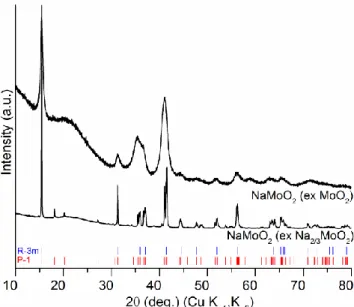
Figure 1. Powder X-ray diffraction patterns of NaMoO2 (ex
MoO2) (top) and NaMoO2 (ex Na2/3MoO2) (bottom). Bragg
peak positions are given for two unit cells. In blue: a = 2.95 Å, c = 16.95 Å (Space group: R-3m). In red: a = 5.1067 Å, b = 2.9056 Å, c = 5.9655 Å, α = 90.157°, β = 106.745°, γ = 89.651° (Space group: P-1).
3) Results and discussion
In a first step NaMoO2 material was synthesized by reacting
metallic sodium with MoO2 powder under vacuum, as
previ-ously reported.17 Its powder X-ray diffraction pattern exhibits
however very large diffraction peaks, making difficult a precise structural characterization (Figure 1). Nevertheless it can be indexed in a first approach using the unit cell of an O3-type structure with the space group R-3m and cell parameters a 2.95 Å and c 16.95 Å. Pair function distribution (PDF) analy-sis were then undertaken to obtain information on the local structure and especially on the molybdenum environment. The experimental G(r) is shown in Figure 2.a. The calculated G(r) function, based on the ideal hexagonal O3-type structure, is superimposed on the experimental one (Figure 2.b). Signif-icant differences between the two functions question the va-lidity of the published model. Moreover, the rapid loss of in-tensity and peaks resolution observed on the experimental G(r) function suggests the presence of high degree of disorder. Finally, the experimental intensity becomes non-existent for
correlation distances r > 40 Å suggesting nano-sized coherent domains. Structural disorder and nano-sized domains both lead to the broadening of the peaks on the X-ray diffraction pattern.
Figure 2. (a) and (b) Experimental reduced pair distribution
function (PDF), G(r), of NaMoO2 (ex MoO2) (in black). (b)
Calculated G(r) of NaMoO2 considering an O3-type structure with the cell parameters a = 2.95 Å, c = 16.95 Å (Space group: R-3m) (in red).
Crystal growth by thermal annealing was attempted to en-hance the quality of the X-ray diffraction pattern in order to propose a new structural model using the Rietveld method. Unfortunately, thermal treatment above 475°C results in the decomposition of NaMoO2 into Mo and Na2MoO4 due to the
tendency of Mo3+ to dismute into Mo0 and Mo6+. Another
syn-thesis method was therefore undertaken to obtain a highly crystalline NaMoO2 powder.
As part of the investigation of the NaxMoO2 system, a
well-crystallized pristine material Na2/3MoO2 has been synthesized
by solid state synthesis. The sodium electrochemical interca-lation or deintercainterca-lation in a sodium battery made with this material as the positive electrode has been used as a powerful technique to explore the phase diagram in the NaMoO2-MoO2
system.14,18,19 More specifically, our in situ X-ray diffraction
ex-periment performed during sodium electrochemical interca-lation showed that a composition close to Na1MoO2 existed at
very low voltage (< 1V vs Na+/Na).18 Nevertheless, the organic
liquid electrolyte (NaPF6 in propylene carbonate) was not
sta-ble at this low voltage and it decomposed before all the Na
x-MoO2 (x 0.9) phase could be transformed into NaMoO2,
making the electrochemical method not adequate for Na-MoO2 preparation. Chemical sodium intercalation in soft
con-ditions from Na2/3MoO2 was therefore considered to obtain
highly crystalline NaMoO2.
Chemical intercalation of sodium ions between the [MoO2]
layers of the Na2/3MoO2 structure has been achieved by
react-ing sodium metal on the pristine material at 400°C. The X-ray diffraction pattern of the obtained black powder presents sharp diffraction peaks, indicating a high degree of crystallin-ity of the material (Figure 1). The hexagonal cell (Space group: R-3m) reported in 1969 for the structure of NaMoO2 (ex
MoO2) cannot allow a correct indexation of the X-ray pattern
of NaMoO2 (ex Na2/3MoO2). For each Bragg peak generated in
this space group, actual diffraction peaks seem to be split in-dicating a lowering of the symmetry. Monoclinic distortions are common in sodium layered oxides and result generally from Jahn-Teller effect or slab gliding or sodium/vacancy or-derings or metal-metal bonding during sodium electrochemi-cal (de)interelectrochemi-calation. An O3-type structure is then described in a C2/m space group and denominated O’3.37 However, in
this case, a monoclinic cell cannot allow a correct indexation of the X-ray diffraction pattern of NaMoO2 (ex Na2/3MoO2)
(See Supporting Information). A triclinic distortion of the cor-responding monoclinic cell was then considered with alpha and gamma varying slightly from 90° (a = 5.1067(2) Å, b = 2.9056(1) Å, c = 5.9655(3) Å, α = 90.157(4) °, β = 106.745(3) °, γ = 89.651(3) °). The Bragg peak positions of the triclinic cell (Space group: P-1) are indicated by red ticks and they enable to index all the main peaks on the X-ray dif-fraction pattern of NaMoO2 (Figure 1)
Figure 3. First galvanostatic cycle of electrochemical sodium
cells made with NaxMoO2 phases as the positive electrode
ma-terial. (a) With NaMoO2 (ex MoO2) (in blue) and with
Na-MoO2 (ex Na2/3MoO2) (in red). (b) With Na2/3MoO2 (in black)
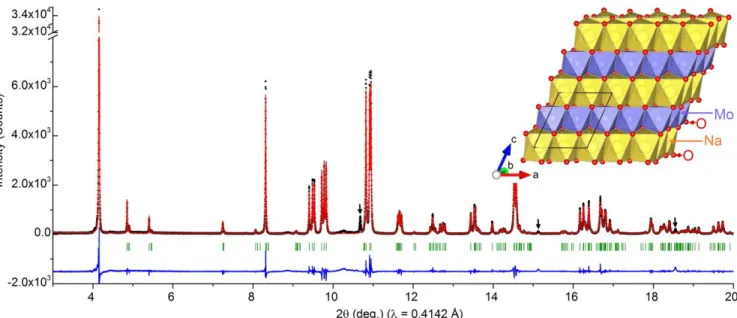
Figure 4. Experimental high resolution X-ray powder diffraction pattern of NaMoO2 (ex Na2/3MoO2) (black diamonds), calculated
pattern obtained from the Rietveld refinement (red line) considering the O’’3 triclinic cell with the cell parameters: a = 5.8113 Å, b = 5.8603 Å, c = 6.6291 Å, α = 63.907 °, β = 64.154 °, γ = 60.620 °. The difference between the calculated pattern and the experi-mental one is shown by the blue line. Green vertical bars show the position of the Bragg reflections for the O3’’ triclinic cell. The inset shows a three-dimensional representation of the structure of NaMoO2 (ex Na2/3MoO2) obtained from the Rietveld refinement.
Black arrows indicate diffraction peaks for molybdenum metal impurity. Both NaMoO2 phases, obtained from either MoO2 or
Na2/3MoO2, were used as positive electrode materials in
so-dium batteries. Galvanostatic electrochemical curves present in Figure 3 the evolution of the cell voltage as a function of the sodium amount x in the layered phase NaxMoO2. Structural
differences between the two NaMoO2 materials, highlighted
by X-ray diffraction, lead to significant differences on the elec-trochemical responses of the two phases (Figure 3.a). The high structural disorder in NaMoO2 (ex MoO2), suggested by both
the broadening of the diffraction peaks and the loss of corre-lation on the G(r) function, prevents any orderings (so-dium/vacancy ordering or molybdenum clustering). There-fore, the smooth aspect of the electrochemical curve, charac-teristic of a solid solution behavior, indicates that no phase transition occurs upon sodium electrochemical deintercala-tion.
On the other hand, the electrochemical curve recorded for NaMoO2 (ex Na2/3MoO2) is more complex with several voltage
drops and plateaus, very similar to those observed on the elec-trochemical galvanostatic curve of the sodium battery made with Na2/3MoO2 as the positive electrode(Figure 3.b). This
in-dicates that the sodium chemical intercalation in Na2/3MoO2
is highly effective to maintain the layered host structure to
form NaMoO2. It should be noticed however that the initial
voltage of the battery made with NaMoO2 (ex Na2/3MoO2)
does not correspond to the fully intercalated material x = 1. It lies on the voltage plateau between Na0.82MoO2 and NaMoO2.
This initial loss of sodium probably results from the reaction of the very reductive NaMoO2 with the electrolyte when the
battery was first assembled in the glovebox.
The structure of NaMoO2 (ex Na2/3MoO2) was determined
from the high-resolution X-ray powder diffraction data using the Rietveld method (Figure 4). Due to the high signal to noise ratio achieved at the synchrotron, several diffraction peaks are visible at small angles. They can be indexed using a supercell resulting from the doubling of the monoclinic cell parameters in the three directions a, b and c. However, this lead to nu-merous Bragg reflections, for which there is no diffracted in-tensity. A smaller triclinic cell (a = 5.8113(2) Å, b = 5.8603(3) Å, c = 6.6291(4) Å, α = 63.907(3) °, β = 64.154(3) °, γ = 60.620(3) °) was then found to index each superstructure peaks without generating any superfluous reflections. The relationship be-tween the initial monoclinic cell and the final triclinic super-cell is described in Supplementary Information (Figure S1). Structural parameters determined from the Rietveld refine-ment are reported in supporting Information in Table S1.
Figure 5. Projection of the structure of NaMoO2 parallel to the [MoO2] layers. (a) Single [MoO2] layer made of MoO6 octahedra
highlighting the existence of “diamond-like” clusters. Mo-Mo bonds are reprented by pink-purple bicolor solid sticks and shortest Mo-Mo distances are given in Å. (b) Same as (a) with a single layer of Na+ ions on top of the [MoO2] layer. Shortest Na+-Na+
distances are reprented by yellow-orange bicolor solid sticks. The values of these distances are given in Å. (c) Mo-Mo distances given in Å. (d) Na-O distances given in Å. Oxygen atoms are represented by red circles and the limits of the O’’3 triclinic unit cell are shown with solid black lines.
The structure can be described as a distorted O3-type struc-ture in which sodium fully occupies octahedral interstitial sites sharing edges with MoO6 octahedra in the [MoO2] slabs
(Inset Figure 4). This triclinic structure will be referred as O’’3-type structure in the following text. The interesting feature of this structure is the displacement of the molybdenum atoms from the center of MoO6 octahedra to form shorts Mo-Mo
bonds (Figure 5.c). MoO6 octahedra are also distorted leading
to a slight undulation of the [MoO2] layers. As it could be
ex-pected 4d3 cation, each Mo3+ ion forms three short Mo-Mo
bonds with their neighboring Mo3+ ions resulting in infinite
chains of diamond-like clusters along the a-axis (Figure 5.a). Such metal clustering would be due to a Peierls distortion as-sociated with the partial occupation of the t2g block for d3
metal ions.38 The shortest Mo-Mo bond, dMo1-Mo1 = 2.577 Å, is
in the center of the diamond shaped by Mo1-Mo2 bonds, d Mo1-Mo2 = 2.648 Å and 2.688Å. “Diamond-like” clusters are linked
together by the slightly longer Mo2-Mo2 bond (dMo2-Mo2 =
2.704 Å). Chains are separated by long Mo-Mo distances of ap-proximately 3.2 Å. Between the [MoO2] layers, sodium ions are
also slightly shifted off the center of the NaO6 octahedra to
minimize Na+/Mo3+ repulsions (Figure 5.d). It results in short
(~ 2.82 Å and 2.85 Å) and long (~ 3.0 Å) Na-Na distances, which form the same pattern as Mo-Mo bonds within the [MoO2] slabs, but shifted to minimize electrostatic repulsions
(Figure 5.c). The driving force of this unusual sodium arrange-ment is the formation of the Mo-Mo clusters.
Similar metallic clusters were observed in sulfides where the transition metal has a d3 electronic configuration, like
molyb-denum in NaMoO2. It was first reported for ReX2 (X = S, Se) 39-43 and TcS239,41 and then for MMo2S4 (M=Co,Fe),44 Mo2S3,45 and
LiMoS2.46,47 Theoretical calculations confirmed that the metal
arrangement to form “diamond-like” clusters was favorable in ReX2 (X = S, Se),48-50LiMoS251and NaMoS2.52 In all cases, the
interlayer space is either empty or fully occupied confirming that the origin of the ”diamond-like” clusters is the 4d3 or 5d3
electronic configuration of the transition metal. This molyb-denum arrangement has never been observed in LiMoO2,
which also contains Mo3+ ions.53-56 More precisely, the
exist-ence of molybdenum zig-zag chains has been evidexist-enced by EXAFS55 and neutron diffraction and total neutron
scatter-ing.56 As ionic radii of Mo3+ (ri = 0.69 Å) and Li+ (ri = 076 Å)
are close,57 there is a mixed occupancy of Mo and Li within the
[MoO2] layers. This prevents from a long range ordering of
the molybdenum atoms within the [(Mo, Li)O2] layers, and it
induces an uncertainty on the oxidation state of the molyb-denum.58 In NaMoO
2, because Na+ ions are significantly larger
than Mo3+ (ri(Na+) = 1.02 Å), we think that no Na/Mo mixing
occurs and that the [MoO2] layers are free of sodium. Na/Mo
as it is the case for electrochemical curves recorded for lithium batteries using LiMoO2 as the positive electrode material.58
To the best of our knowledge, this is the first time that such “diamond-like” Mo clustering is observed in an oxide. To en-sure that the structural description resulting from the Rietveld refinement based on the X-ray powder diffraction data was correct, structural optimization by DFT calculations were per-formed. Subsequently, the study of the electronic structure of NaMoO2 (ex Na2/3MoO2) was performed.
The cell parameters and atomic positions were fully relaxed using GGA starting from the experimental parameters given in Table S1. As seen in Table S2 (See Supporting Information), the optimized structure is in good agreement with the exper-imental data. In particular, the “diamond-like” Mo clustering is maintained and the oxygen atomic positions found from X-ray powder diffraction are confirmed. The optimized Mo-Mo distances are given Table S3 (See Supporting Information) and they are in good agreement with the experimental values. The energy of a hypothetical O3-NaMoO2 cell without Mo clusters
(Space group: R-3m) was also computed in order to get a sense of the stability increase induced by the cluster formation. It appears that the “diamond-like” Mo clusters strongly stabi-lized the phase by 600 meV per formula unit. For LiMoS2, the
stabilization of the “diamond–like” chains was also reported due to a charge density wave (CDW) using FP-LAPW calcula-tions.51 The DOS modelling of an undistorted O3-NaMoO
2
phase was also recently reported, without considering possi-ble Mo clusters formation.59
Even if we initiated spin polarized DFT calculations using initial magnetic moment on Mo sites, the calculations con-verged to a diamagnetic solution, with equivalent “up” and “down” states due to the formation of Mo-Mo bonds and elec-tron pairing. All the calculations made using the GGA + U
method, even with a U value as low as 2 eV applied to the Mo d orbitals, led to a disappearance of the molybdenum clusters. In order to investigate the electronic structure of NaMoO2, the
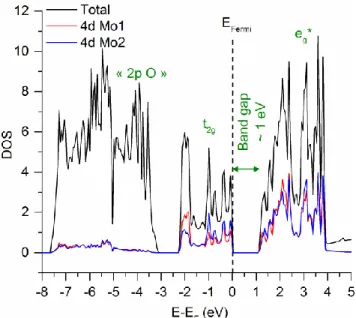
total Density of States (DOS) and partial DOS on Mo ions are presented in Figure 6. Note that the partial DOS of the two molybdenum ions in the structure are quite similar, as well as the Bader charges (around +1.44). A 1.1 eV electronic gap is cal-culated using GGA for this material.
Figure 6. Total and partial Density of State (DOS) calculated
Figure 7. Electron Localization Function (ELF) three-dimensional maps. (a) and (b) With an isotropic surface value of 0.15 e/Å3.
(c) With an isotropic surface value of 0.20 e/Å3.
Calculated Electron Localization Function (ELF) 3D maps are shown in Figure 7 were plotted using two different iso-tropic surface values and different orientation, in order to vis-ualize the Mo-Mo bonds.Strong electronic density clearly ap-pears in between the molybdenum ions forming the “dia-mond-like” cluster chains along the a-direction, and none be-tween those cluster chains. Note that the electronic density is not equivalent between all molybdenum ions: it is stronger between Mo forming the “diamond-like” figure and weaker between Mo of adjacent “diamond” in agreement with the ex-perimental and calculated bond lengths. The presence of elec-tronic density nearby the center of the Mo triangles of the di-amond is due to the recombination of the t2g orbitals
stabiliz-ing the system.
The formation of Mo-Mo bonds within the [MoO2] layers
should influence the physical properties of the material. The measurement of the magnetic susceptibility showed a low par-amagnetism (Figure S2). This is in agreement with the pro-posed structure of chains of “diamond-like” Mo clusters and this is coherent with the diamagnetic properties determined at 0 K from DFT calculations. According to resistivity meas-urements, NaMoO2 is a semi-conducting material (Ea =
0.122 eV) with a low conductivity at ambient temperature (σ = 2.4.10-4 S.cm-1) (Figure S3). Similar semi-conducting properties
were reported for MMoS4 (M = Fe, Co) and a mechanism of
charge hopping along the short Mo-Mo bonds was sug-gested.44 Both magnetic and electronic characterizations are
in good agreement with the proposed structure. In addition, no electronic or magnetic transition was observed below room temperature, indicating a good stability of this molybdenum arrangement at low temperature.
4) Conclusion
Highly crystalline NaMoO2 was synthesized for the first
time and its structure was solved using the Rietveld method based on high resolution X-ray powder diffraction. Chains of “diamond-like” clusters of molybdenum were evidenced in the [MoO2] layers resulting from the Peierls distortion expected in
a two-dimensional triangular lattice formed by transition metal atoms with a d3 electronic configuration. It is to our
knowledge the first time that this metal clustering has been found in an oxide. Its stability was confirmed by DFT calcula-tions.
Sodium electrochemical deintercalation from NaMoO2 in a
sodium battery lead to the formation of several NaxMoO2
lay-ered phases with specific composition, highlighted by voltage drop on the multiple-step electrochemical curve. This curve is very similar to the one recorded for a battery made of Na2/3MoO2 as the positive electrode. In conclusion, the
struc-tural characterization of NaMoO2 gives valuable information
on the NaxMoO2 phase diagram and a new example of
transi-tion metal ordering in the [MoO2] layers that can occur upon
cycling, since no structure apart from that of Na1/2MoO2 has
been reported yet. ASSOCIATED CONTENT
Supporting Information
The relationship between the initial monoclinic cell and the final triclinic supercell is described in Supporting Information. The cell parameters and atomic positions relaxed using GGA
starting from the experimental parameters are given in Sup-porting Information. Evolution of the magnetic susceptibility and of the electronic resistivity as a function of the tempera-ture are given Supporting Information. This material is avail-able free of charge via the Internet at http://pubs.acs.org.
AUTHOR INFORMATION
Corresponding Author
Marie GUIGNARD, [email protected].
Author Contributions
The manuscript was written through contributions of all au-thors. All authors have given approval to the final version of the manuscript.
Funding Sources
This work was supported by the Agence Nationale de la Re-cherche through the grant ANR-14-CE05-0011. This research used resources of the Advanced Photon Source, a U.S. Depart-ment of Energy (DOE) Office of Science User Facility operated for the DOE Office of Science by Argonne National Laboratory under Contract No. DE-AC02-06CH11357.
ACKNOWLEDGMENT
MG would like to thank Olag Borkiewicz from the Advanced Photon Source for collecting the pair distribution function data.
REFERENCES
(1) Roger, M.; Morris, D. J. P.; Tennant, D. A.; Gutmann, M. J.; Goff, J. P.; Hoffmann, J.-U.; Feyerherm, R.; Dudzik, E.; Prab-hakaran, D.; Boothroyd, A. T.; Shannon, N.; Lake, B.; Deen, P. P. Patterning of Sodium Ions and the Control of Elec-trons in Sodium Cobaltate. Nature 2007, 445 (7128), 631– 634.
(2) Didier, C., Guignard, M., Darriet, J. & Delmas, C. O′3– NaxVO2 System: A Superstructure for Na1/2VO2. Inorg. Chem. 2012, 51, 11007–11016.
(3) Guignard, M.; Dider, C.; Darriet, J.; Bordet, P.; Elkaïm, E.; Delmas, C. P2-NaxVO2 System as Electrodes for Batteries
and Electron-Correlated Materials. Nat. Mater. 2013, 12, 74−80.
(4) Guignard, M.; Carlier, D.; Didier, C.; Suchomel, M. R.; Elkaïm, E.; Bordet, P.; Decourt, R.; Darriet, J.; Delmas, C. Vanadium Clustering/Declustering in P2–Na1/2VO2 Layered
Oxide. Chem. Mater. 2014, 26 (4), 1538–1548.
(5) Guignard, M.; Delmas, C. Using a Battery to Synthesize New Vanadium Oxides. ChemistrySelect 2017, 2, 5800– 5804.
(6) Imai, K.; Sawa, H.; Koike, M., Hasegawa, M.; Takei, H. Su-perstructure Analyses on Single Crystals of Li0.8VO2. J. Solid State Chem. 1995, 114, 184–189.
(7) Pourpoint, F.; Hua, X. ; Middlemiss, D. S.; Adamson, P.; Wang, D.; Bruce, P. G.; Grey C. P. New Insights into the Crystal and Electronic Structures of Li1+ xV1– x O2 from Solid
State NMR, Pair Distribution Function Analyses, and First Principles Calculations. Chem. Mater. 2012, 24, 2880–2893. (8) Longo, J. M.; Kierkegaard, P. A. Refinement of the Structure
of VO2. Acta Chem. Scand. 1970, 24, 420–426.
(9) Dernier, P. D. The Crystal Structure of V2O3 and
(V0.962Cr0.038)2O3 near the Metal-Insulator Transition. J.
(10) Burdett, J. K.; Hughbanks, T. Aspects of Metal-Metal Bond-ing in Early-Transition-Metal Dioxides. Inorg. Chem. 1985, 24 (12), 1741–1750.
(11) Hubert, P.-H. Sur l’Obtention du Molybdite de sodium. C. R. Acad. Sc. Paris, Série C 1966, 262, 1189–1191.
(12) Réau, J.-M.; Fouassier, C.; Hagenmuller, P. Les Systèmes MoO2-A2O et WO2 -A2O (A = Li, Na, K). Bull. Soc. Chim. Fr., 1970, 11, 3827–3829.
(13) Hirano, S.; Kozima, M.; Naka, S. Hydrothermal Synthesis and Properties of NaxMoO2 Single Crystal. Toyota Kenkyu Hokoku 1984, 37, 32–38.
(14) Tarascon, J. M.; Hull, G. W. Sodium Intercalation into the Layered Oxides NaxMo2O4. Solid State Ion. 1986, 22, 85–96.
(15) McCarley, R. E.; Lii, K.-H.; Edwards, P. A.; Brough, L. F. New Extended Clusters in Ternary Molybdenum Oxides. J. Solid State Chem. 1985, 57, 17–24.
(16) Aleandri, L. E. Synthesis and characterization of reduced ternary alkali metal molybdenum oxides. Iowa State Uni-versity (1987).
(17) Ringenbach, C.; Kessler, H.; Hatterer. A. Un Nouveau Com-posé Oxygéné du Molybdène NaMoO2. Propriétés
Cristal-lographiques et Magnétiques. C. R. Acad. Sc. Paris, Série C 1969, 269, 1394–1397.
(18) Vitoux, L; Guignard, M.; Suchomel, M. R.; Pramudita, J. C.; Sharma, N.; Delmas, C. The NaxMoO2 Phase Diagram (1/2 ≤ x < 1): An Electrochemical Devil’s Staircase. Chem. Mater. 2017, 29 (17), 7243–7254.
(19) Vitoux, L. ; Guignard, M.; Darriet, J.; Delmas, C. Exploration of the NaxMoO2 phase diagram for low sodium contents (x
≤ 0.5). J. Mater. Chem. A 2018, 6, 14651–14662.
(20) Tkachenko, E. A. & Fedorov, P. P. Lower Rare-Earth Molyb-dates. Inorg. Mater. 2003, 39, S25–S52.
(21) Simon, A. Metal clusters inside out. Philos. Trans. R. Soc. A-Math. Phys. Eng. Sci. 2010, 368, 1285–1299.
(22) Sokolov, M. N., Naumov, N. G., Samoylov, P. P. & Fedin, V. P. in Comprehensive Inorganic Chemistry II (Second Edi-tion) 271–310 (Elsevier, 2013).
(23) Peña, O. Chevrel phases: Past, present and future. Physica C 2015, 514, 95–112.
(24) Delmas, C.; Fouassier, C.; Hagenmuller P. Structural Classi-fication and Properties of the Layered Oxides. Physica B + C 1980, 99 (1–4), 81–85.
(25) Petříček, V.; Dušek, M.; Palatinus, L. Crystallographic Com-puting System JANA2006: General Features. Z. Für Krist. - Cryst. Mater. 2014, 229 (5), 345–352.
(26) Juhas, P.; Davis, T.; Farrow, C. L.; Billinge, S. J. L. PDFgetX3: A Rapid and Highly Automatable Program for Processing Powder Diffraction Data into Total Scattering Pair Distri-bution Functions J. Appl. Cryst. 2013, 46, 560–566. (27) Farrow, C. L.; Juhas, P.; Liu, J. W.; Bryndin, D.; Bozin, E. S.;
Bloch, J.; Proffen, T.; Billinge, S. J. L. PDFfit2 and PDFgui: Computer Programs for Studying Nanostructure in Crys-tals. J. Phys.: Condens. Matter 2007, 19 (33), 335219. (28) Perdew, J. P.; Burke, K.; Ernzerhof, M. Generalized Gradient
Approximation Made Simple. Phys. Rev. Lett. 1996, 77, 3865–3868.
(29) Kresse, G.; Joubert, D. From Ultrasoft Pseudopotentials to the Projector Augmented-Wave Method. Phys. Rev. B 1999, 59, 1758–1775.
(30) Kresse, G.; Furthmüller, J. Efficient Iterative Schemes for Ab Initio Total-Energy Calculations using A Plane-Wave Basis Set. Phys. Rev. B 1996 54, 11169–11186.
(31) Bader, R. F. Atoms in molecules: a quantum theory. (Clar-endon Pr, 1990).
(32) Tang, W.; Sanville, E. ; Henkelman, G. A grid-based Bader Analysis Algorithm without Lattice Bias. J. Phys. Condens. Matter 2009 21, 84204.
(33) Sanville, E.; Kenny, S. D.; Smith, R.; Henkelman, G. Im-proved Grid-Based Algorithm for Bader Charge Allocation. J. Comput. Chem. 2007, 28, 899–908.
(34) Henkelman, G.; Arnaldsson, A.; Jónsson, H. A Fast and Ro-bust Algorithm for Bader Decomposition of Charge density. Comput. Mater. Sci. 2006, 36, 354–360.
(35) Becke, A. D.; Edgecombe, K. E. A Simple Measure of Elec-tron Localization in Atomic and Molecular Systems. J. Chem. Phys. 1990, 92 (9), 5397–5403.
(36) Momma, K.; Izumi, F. VESTA 3 for Three-Dimensional Vis-ualization of Crystal, Volumetric and Morphology Data. J. Appl. Crystallogr. 2011, 44, 1272–1276.
(37) Delmas, C.; Braconnier, J.-J.; Maazaz, A.; Hagenmuller, P. Soft Chemistry in AxMO2 Sheet Oxides. Rev. Chim. Minérale 1982, 19, 343–351.
(38) Peierls, R. Quantum theory of solids. (Oxford Univ. Press, 2001).
(39) Lamfers, H. J.; Meetsma, A.; Wiegers, G. A.; de Boer, J. L. The Crystal Structure of some Rhenium and Technetium Dichalcogenides. J. Alloys Compd. 1996, 241, 34–39. (40) Alcock, N. W.; Kjekshus, A. The Crystal Structure of ReS2.
Acta Chem. Scand. 1965, 19 (1), 79–94.
(41) Wildervanck, J. C.; Jellinek, F. The Dichalcogenides of Technetium and Rhenium. J. Less -Common Met. 1971, 24 (1), 73–81.
(42) Murray, H. H.; Kelty, S. P.; Chianelli, R. R. Structure of Rhe-nium Disulfide. Inorg. Chem. 1994, 33, 4418–4420. (43) Friemelt, K.; S. Akari, S.; Lux-Steiner, M.-C.; Schill, T.;
Bucher, E.; Dransfeld, K. Scanning Tunneling Microscopy with Atomic Resolution on ReS2 Single Crystals grown by
Vapor Phase Transport. Ann. Phys. 1992, 504, 248–253. (44) Guillevic, J. ; Le Marouille, J.-Y. ; Grandjean, D. Etude
Struc-turale de Combinaisons Sulfurées et Séléniées du Molyb-dène. IV. Structures Cristallines de CoMo2S4 et de FeMo2S4. Acta Crystallogr. B 1974, 30, 111–117.
(45) Deblieck, R.; Van Landuyt, J.; Van Dyck, D.; Van Tendeloo, G.; Amelinckx, S. The Modulated Structure of Mo2.065S3. J. Solid State Chem. 1987, 70 (1), 108–120.
(46) Dungey, K. E.; Curtis, M. D.; Penner-Hahn, J. E. Structural Characterization and Thermal Stability of MoS2
Intercala-tion Compounds. Chem. Mater. 1998, 10 (8), 2152–2161. (47) Petkov, V.; Billinge, S. J. L.; Larson, P.; Mahanti, S. D.; Vogt,
T.; Rangan, K. K.; Kanatzidis, M. G. Structure of Nanocrys-talline Materials using Atomic Pair Distribution Function Analysis: Study of LiMoS2. Phys. Rev. B 2002, 65, 092105.
(48) Kertesz, M.; Hoffmann, R. Octahedral vs Trigonal-Pris-matic Coordination and Clustering in Transition-Metal Dichalcogenides. J. Am. Chem. Soc. 1984, 106, 3453–3460. (49) Canadell, E., LeBeuze, A., El Khalifa, M. A., Chevrel, R.;
Whangbo, M. H. Origin of Metal Clustering in Transition-Metal Chalcogenide Layers MX2 (M= Nb, Ta, Mo, Re; X= S,
Se). J. Am. Chem. Soc. 111, 3778–3782 (1989).
(50) Fang, C. M.; Wiegers, G. A.; Haas, C.; de Groot, R. A. Elec-tronic Structures of ReS2, ReSe2 and TcS2 in the Real and the
Hypothetical Undistorted Structures. J. Phys. Condens. Matter 1997, 9 (21), 4411–4424.
(51) Roquefelte, X.; Boucher, F.; Gressier, P.; Ouvrard, G. Mo Cluster Formation in the Intercalation Compound LiMoS2. Phys. Rev. B 2000, 62 (4), 2397–2400.
(52) He, H.; Lu, P.; Wu, L.; Zhang, C.; Song, Y.; Guan, P.; Wang, S. Structural Properties and Phase Transition of Na Adsorp-tion on Monolayer MoS2. Nanoscale Res. Lett. 11, (2016).
(53) Aleandri, L. E.; McCarley, R. E. Hexagonal LiMoO2: A
Close-Packed Layered Structure with Infinite Mo-Mo-Bonded Sheets. Inorg. Chem. 1988, 27 (6), 1041–1044.
(54) Ben-Kamel, K.; Amdouni, N.; Groult, H.; Mauger, A.; Zaghib, K.; Julien, C. M. Structural and electrochemical properties of LiMoO2. J. Power Sources 2012, 202, 314–321.
(55) Hibble, S. J.; Fawcett, I. D. Local Order and Metal-Metal Bonding in Li2MoO3, Li4Mo3O8, LiMoO2, and H2MoO3,
De-termined from EXAFS Studies. Inorg. Chem. 1995, 34 (2), 500–508.
(56) Hibble, S. J.; Fawcett, I. D.; Hannon, A. C. The True Struc-ture and Metal-Metal-Bonded Framework of LiMoIIIO
2
De-termined from Total Neutron Scattering. Inorg. Chem. 1997, 36 (9), 1749–1753.
(57) Shannon, R. D. Revised Effective Ionic Radii and Systematic Studies of Interatomic Distances in Halides and Chaleogen-ides. Acta Cryst. A 1976, 32, 751–767.
(58) Mikhailova, D.; Bramnik, N. N.; Bramnik, K. G.; Reichel, P.; Oswald, S.; Senyshyn, A.; Trots, D. M.; Ehrenberg, H.
Lay-ered LixMoO2 Phases with Different Composition for
Elec-trochemical Application: Structural Considerations. Chem. Mater. 2011, 23, 3429–3441.
(59) Assadi, M. H. N.; Shigeta, Y. The effect of octahedral distor-tions on the electronic properties and magnetic interac-tions in O3 NaTMO2 compounds (TM = Ti–Ni & Zr–Pd). RSC Adv. 2018, 8, 13842–13849.
10
FOR TABLE OF CONTENT ONLY
Chains of “diamond-like” clusters of molybdenum existing in NaMoO2 in the [MoO2] layers formed by edge-sharing

![Figure 5. Projection of the structure of NaMoO 2 parallel to the [MoO 2 ] layers. (a) Single [MoO 2 ] layer made of MoO 6 octahedra highlighting the existence of “diamond-like” clusters](https://thumb-eu.123doks.com/thumbv2/123doknet/14487826.525375/6.918.95.845.55.531/figure-projection-structure-parallel-octahedra-highlighting-existence-clusters.webp)