HUZO
.M414
/V3.
t-o
Dewey
WORKING
PAPER
ALFRED
P.SLOAN
SCHOOL
OF
MANAGEMENT
Dynamic
Scheduling
of
a
Two-Class
Queue
with Setups
MartinL
Reiman
Lawrence
M.
Wein
#3692-94-MSA
May
1994
MASSACHUSETTS
INSTITUTE
OF
TECHNOLOGY
50
MEMORIAL
DRIVE
CAMBRIDGE,
MASSACHUSETTS
02139
Dynamic
Scheduling
of
a
Two-Class
Queue
with Setups
Martin
I.Reiman
Lawrence
M. Wein
M.I.T.
LIBRARiES
:'
JUN
2
1994
Dynamic
Scheduling
of
a
Two-Class
Queue
with Setups
Martin
I.Reiman
AT&T
Bell LaboratoriesMurray
Hill,NJ
07974
Lawrence
M.
Wem
Sloan School of
Management,
M.I.T.Cambridge,
MA
02139ABSTRACT
We
analyzetwo
schedulingproblems
for aqueueing system
with a single serverand two
cus-tomer
classes.Each
class has itsown
renewal arrival process, general service timedistributionand
holding cost rate. In the first problem, a setup cos* is incurredwhen
the server switchesfrom one
class to the other,and
the objective is tominimize
the long run expected averagecost ofholding
customers and
incurring setups.The
setup cost is replacedby
a setup time inthe second problem,
where
the objective is tominimize
the average holding cost.By
assuming
that thequeueing
system
operatesunder
standardheavy
traffic conditions,we
approximate
thedynamic
schedulingproblems by
diffusion control problems. Forboth
problems, considerableinsight is gained into the nature of the optimal policy,
and
thecomputational
resultsshow
that the
proposed
scheduling policy is within several percent ofoptimalover abroad
range ofproblem
parameters.We
considertwo
dynamic
schedulingproblems
for asingle serverqueueing system
withtwo
classes of customers. In
both
problems, each class possesses itsown
renewal arrival process, general service time distributionand
holding cost rate,and
the server incurs a setupwhen
switchingfrom
one class to the other. In the setup cost problem, a setup cost is incurredand
the objective is tominimize
the long run expected average setupand
holding cost. In the setup time problem, arandom
setup time is incurredwhen
the server switches class,and
the objective is tominimize
the long run expected average holding cost. Inboth
problems, the server has threeoptions at each point in time: serveacustomer
from
the class that iscurrentlyset up, switch to the other class (and
immediately
begin service in the setup cost problem), orsit idle.
These
schedulingproblems
havenumerous
applications,most
notably formanufacturing
systems
and
polling systems incomputer communication
networks.The
setup timeproblem
is
more
realisticthan
the setup costproblem
inmost
situations, but is also n^rre difficult toanalyze.
However,
thesetup costproblem
is relevant forsome
manufacturing systems
because,motivated
by
just-in-time (JIT) manufacturing,many
facilities have internalized their setuptimes; that is, they have essentially
ehminated
their setup times at theexpense
of incurringsignificant material, labor
and/or
capital costs.Although
many
studies have analyzed theperformance
of pollingsystems
under
variousscheduling policies (see Takagi 1986,
Boxma
and
Takagi 1992and
references therein), relatively few papers have considered the optimal scheduling of polling systems.The
seminalpaper
in this research area is Hofriand Ross
(1987),who
analyze a two-classsystem
with setup costsand
times. Let c,and
//, denote the holding cost rateand
service rate, respectively, for class i customers.When
ci^i=
C2H2, theyshow
that a double threshold policy,where
the server serves each class until itsqueue
isexhausted
and
the length of the otherqueue
achieves a certain threshold level, minimizes the cost of setupsand
holding customers,under
both
thediscounted
and
average cost criteria.Very
little isknown
about
the pollingproblem
when
ciMi ¥" f2M2, aside
from
the fact that the class with the larger cfi index shouldbe
served toexhaustion.
Several authors have studied the setup time
problem
inwhich
more
than two
classes are present. Structural results forsymmetric systems
are derived by Liu,Nain
and Towsley
(1991)and
references therein.Browne
and
Yechiali (1989) derivequasi-dynamic
index policies,which
allow the server to choose the sequence ofclasses to visit at the beginning of each cycle, thatminimize
ormaximize
themean
cycle length.Boxma,
Levy
and Westrate
(1991) derivean
efficient polling table (a
predetermined
fixed visit sequence) forminimizing
themean
waiting cost.Bertsimas
and
Xu
(1993) derive lowerbounds
and
construct static policies thatperform
close to the
bound
when
all classes have identical c/i indices.Van Oyen
and
Duenyas
(1992)develop a
dynamic
scheduling heuristic basedon myopic reward
rates;Duenyas
and
Van
Oyen
(1993) also construct adynamic
policy for the setup cost problem.Since the two-class
asymmetric problem
appearsto be analytically intractable,heavy
trafficapproximations
areemployed
inan
attempt
tomake
furtherheadway.
T'lat is,we
make
the heavy trafficassumption
that the servermust
bebusy
the great majority ofthetime
to satisfydemand.
In thesetup cost problem,we
also need toassume
that the setupcosts are very large, roughlytwo
orders ofmagnitude
largerthan
the holding cost rate. Following in the tradition of Foschini (1977)and
Harrison (1988),we
study the diffusion controlproblem
that arises as aheavy
trafficHmit
of a sequence ofqueueing
scheduling problems.These
limiting controlproblems
tend tobe
more
tractablethan
theirqueueing
counterpartsand
have led tonetwork
scheduling policies (see, for example, Harrison
and
Wein
1990and
Wein
1990b) thathave
a surprisingly simpleform and appear
toperform
well.Using
theheavy
traffic averaging principle derived inCoffman,
Puhalskiiand
Reiman
(1993),we show
in Section 1 that the setup costproblem
simplifies rather dramatically in the limitingheavy
traffic regime: thedimension
of the state space collapsesfrom
three (queue length ofeach clcissand
the position of the server) toone
(total workload).This
result alsoallows our analysis to naturally
decompose
ontotwo
different time scales.On
the very fast time scale overwhich
individualqueue
lengths change,we
myopically optimize a control thatspecifiesthe
amount
oflowprioritywork
toserve as a function of thetotal workload.This
state-dependent
control is derived in closedform
and
offers considerable insight.On
the slower timescale over
which
the totalworkload
varies, a singular controlproblem
is solved that specifies abusy/idle pohcy.
The
solution to this controlproblem
leads to a rathercomplex
equation forone
variable,which
represents a threshold level, that can easily be solved numerically.The
setup timeproblem
is addressed in Section 2,and
the averaging principle inCoffman,
Puhalskii
and Reiman
(1994) leadsto a limiting controlproblem
that again isone-dimensional, although herewe
obtainan
explicit diffusion control problem.The
control,which
represents theamount
oflowprioritywork
toserve as a function of the total workload,appears
inthe driftterm
ofthe diffusion process in a nonlinear fashion,and
consequently theoptimahty
equationleads to a nonlinear ordinary differential equation
(ODE)
thatcannot be
solved explicitly.However,
we
use asymptotics to obtain a scheduling policy; the asymptotics also reveal asubstantial qualitative difference
between
the optimalpolicies in the setupcostand
setup time cases.For
both
problems,we
use the value iteration algorithm to obtain "exact"optimal
policies foravarietyoftestcases,and
show
inSection 3 that thesuboptimalityoftheproposed
policies is within several percent ofoptimal over abroad
range ofproblem
parameters.Our
presentation ofthe analysis,and
indeed the analysis itself, is rather informalthrough-out. For example,
we
do
not prove that the limiting controlproblems
are theheavy
trafficlimit ofa sequence of
queueing
scheduling problems. Also, several of our claims regarding the nature ofthe limiting controlproblems
and
their optimal solutions are not proved. Providinga rigorous presentation of our results
would
be extremelydemanding,
and would
take us far afieldfrom
ourtwo
main
objectives: to obtainfundamental
insights into the nature of theoptimal
policiesand
to develop effective scheduling policies for these systems.However,
much
ofour analysis relies
upon
observations that havebeen
rigorously proven for simpler systems,and
we
haveno
doubt
that our results are essentially correct.We
hope
that thisapproach
increases the accessility ofthepaper
withoutsacrificing the persuasiveness ofourarguments.
1
THE
SETUP COST
PROBLEM
1.1
Problem
Description
Customers
ofclass i=
1,2 arrive according toindependent
renewal processes,where
A,and
c^j
denote
respectively the arrival rateand squared
coefficient of variation (variance dividedby
the square of themean)
of the interarrival times.Each
class has itsown
general servicetime
distribution with service rate /Xjand
squared
coefficient of variation c^j,and
we
define thesystem's traffic intensity
by
p=
Yn=i{^i/f^i)-A
cost c, is incurred per unit time for holdinga class i
customer
in the system.A
setup costK/2
isimposed
whenever
the server switchesfrom one
class to the other, so that A' is the setup cost per cycle.The
server hcis three scheduling options at each point in time: serve the class that iscurrently set up, switch to the other class
and
initiate service, or sit idle. Since a switchoverconsidered.
We
assume
that the serverworks
in apreemptive-resume
fashion, although theheavy
traffic analysis is too crude to capture the effects ofthenonpreemptive
discipline asan
alternative assumption. Let Qi{t) be thenumber
ofclass icustomers
inqueue
or in service at time t,and
let J{t) denote thenumber
of times the server setsup
in the time interval \0,t\.Then
our objective is to find a nonanticipating (with respect to thequeue
length process)scheduling policy to
minimize
limsup
—;E
r-.ooT
rY,c,Q,{t)dt+^^J{T)
Jo
~1
^(1.1)
1.2
The Heavy
Traffic
Normalizations
A
precise formulation oftheapproximating
diffusion controlproblem
requiresmuch
nota-tion thatwould
notbe
subsequently used. In addition, the limiting controlproblem
will not be explicitly solved; rather,we
optimize over a specificform
of policy that is introduced in Subsection 1.4.Hence
theheavy
traffic controlproblem
will not be precisely formulated,and
a description of the
heavy
traffic conditionsand
normalizations will suffice for our purposes.The
approximating
controlproblem
is the limit of a sequence ofschedulingproblems
in-dexed by
theheavy
traffic scalingparameter
n,where
n
—> oo. Since aheavy
traffic limittheorem
will notbe
proved here,we
avoid unnecessary notation by considering a single large integern
satisfying y/n{l—
p)=
c,where
c ispositiveand
ofmoderate
size (that is, 0(1)); thisstandard heavy
traffic condition requires the server to bebusy
the great majority of the timeover the long run.
As
we
willsee later, theschedulingpolicy that arises out ofourheavy
trafficanalysis is
independent
ofthesystem parameter
n. Let V,be
the unfinished workload process forclass i; Vi{t) istheamount
oftimea continuouslybusy
server requires to clearalloftheclassi
customers
who
are present in thesystem
at time t.The
normalized, or scaled,queue
lengthprocess is defined
by
Zj(i)=
Qt{nt)/y/n- similarly, W,(t)=
V't(ni)/v^ denotes thenormalized
workload
process.We
approximate
these normalized processesby
the appropriate,and
yet tobe
defined, fimiting processes.Although
Vi{t) is not directly observableby
the scheduler at time i, the normalizedworkload
process ismore
convenient toemploy than
thenormalised
queue
length process in theapproximating
heavy
traffic control problem.However,
we
use the linear identity Zj=
HiW^
to translate the solution of theapproximating
controlproblem
into a scheduling policy that is expressed interms
ofthe originalqueue
length process (Qi, Q2)-This
linear identity isjustified
by
extantheavy
traffic limittheorems
formany
queueing
systems.In addition to speeding
up
timeby
a factor ofn
and
reducing thequeue
lengthsby
afactor of y/n,
we
alsoneed
to rescale the costparameters
C;and
A'.The
crux ofproblem
(1.1) is the tradeoff
between
setup costsand
holding costs,and
hence to obtain a nontrivial solution to theapproximating
control problem, thesetwo
costs need to be of thesame
orderof
magnitude.
Since only the ratio of thesetwo
costs matters,without
loss of generalitywe
leave the holding cost rates ciand
C2 unsealed at 0(1),and
only scale the setup costK.
The
following
thought
experiment
allows us to conclude that the setup costK
needs tobe
dividedby n
in theapproximating
control problem.The
heavy
traffic condition implies that there are0(^/n) customers
in the originalqueueing
system,and hence 0(1)
scaledcustomers
in theheavy
traffic system.The
holding cost rate is eff'ectively multipliedby
n
because of thetime
scaUng, so holding costs are incurred in the limiting control
problem
at the rate of0{n^'^) perunit time. Since
0{y/n) customers
are in the system, the server switches class every0{\/n)
unsealed
time
units,on
average, implying that setup costs are incurred at the rate of0{^)
and
setup costs areincurred at rate0{y/n), the setup costK
must
be
0{n)
for these cost ratesto
be
ofthesame
order,and
to getan 0(1) Hmiting
setup cost,we
must
divide the setup costK
by
theheavy
trafficscahng parameter
n. Consequently, let k= K/n
denote the normalized setup cost.Thus, heavy
traffic conditions for the setup costproblem imply
that the trafficintensity should
be
near oneand
the setup cost should be large.A
canonicalexample
is to setn
=
100and
set c,ci,C2and
k all equal to one, so that p=
0.9and
the setup cost A'=
100.1.3
A
Preliminary
Heavy
Traffic
Result
The
starting point for thesetup costproblem
is arecentheavy
traffic resultdue
toCoffman,
Puhalskii
and
Reiman
(1993),which
will be referred to hereafterastheCPR
result.We
presentan
informal statement ofa special case ofthisheavy
traffic limittheorem
that will suffice for our purposes.As
inproblem
(1.1), consider aqueueing
system
with a single serverand
two
customer
classes.The
CPR
result is derivedunder
a specificqueue
discipline: the server serveseach class to exhaustion,
and
then switches class.The
work
conserving nature ofthe disciphneimplies that the total
workload
processW
=
Wi
+
W2
isidentical to the corresponding processunder
theFCFS
policy. It followsfrom
theheavy
trafficumit theorem
ofIglehartand Whitt
(1970) that this process is wellapproximated under heavy
traffic conditionsby
RBM(—
c, cr^),which
is a reflectedBrownian
motion
(see Harrison 1985 for a definition)on
[0,oc)with
drift—
cand
varianceIt turns out to
be
impossible to obtain a limit process for (M^i,W2)
in the usualsense,because
in the
heavy
traffic limit, the two-dimensional processmoves back
and
forth along the crossdiagonal at
an
infinite rate, the direction beingdetermined by
which
of thetwo queues
isbeing served; see Figure 1.
The
CPR
result providesan
averaging principle that implies the following: given thenormahzed
totalworkload
W
, the two-dimensionalworkload
(H^i,W^2)can be
treated as if it is uniformly distributed along the constantworkload
linefrom
(0,W)
to (ly, 0).
That
is, the two-dimensional distribution is{UW,
(1— U)W),
where
U
is auniform
[0,1]
random
variable that isindependent
ofW
.
This
averaging principle isdue
to a time scale decomposition.On
the timescale giving riseto reflected
Brownian
motion
for the total workload, the two-dimensionalworkload
processmoves
(asymptotically) infinitely quickly. Ifwe
slow timedown
so that the two-dimensionalworkload
moves
at a flniteand
positive rate, the totalworkload
stays fixed,and
themovement
of the two-dimensionalworkload
is deterministic.Although
this result hasbeen
proved onlyunder
the exhaustive policy,we assume
that it holdsmore
generally. This has far-reaching implications for theheavy
traffic analysis ofour control problem. In particular, it allows us tocollapse the state space of the control
problem from
three dimensions (thenumber
ofcustomers
ofeach class inthesystem and
the location of the server) toone dimension
(the total workload).1.4
The
Form
of the
Optimal
Policy
The
traditionalheavy
trafficapproach
to schedulingproblems
is to precisely formulate thequeueing
system
scheduling problem, find the limiting controlproblem
thatapproximates
thescheduling
problem
\ni(lorheavy
traffic conditions,and
solve the latter problem.The
approach
taken here is slightly different:
we
first argue that the optimal policy should be of a specificform
in theheavy
traffic limit,and
then optimize theapproximating system
over this class of(H^,0)
(1
-
U)W
serving
queue
1W
=
Wi
+
W-, :REM
W,
Figure 1:
The
heavy
traffic averaging principle ofCoffman,
Puhalskiiand
Reiman
(CPR).
Without
loss ofgenerahty,we
assume
that ci/xi>
c^fJ-jand sometimes
refer to classes 1and
2 as the highand
lowpriority classes, respectively. Existing results (Hofriand Ross
for Poisson arrivalsand
exponential service times,and
Duenyas
and
Van Oyen
for Poisson arrivalsand
general service times) as well as intuition suggest that class 1 shouldbe
served to exhaustion.(It is possible to construct
examples
where
thispohcy
is not optimal.Our
contention is thatit is asymptotically optimal in
heavy
traffic.)When
the server is setup
for class 1, the onlyother decision is to specify
whether
the server should idle or switch to class 2when
no
class 1customers
are present. Sincewe
work
with the normalizedworkload
process (1^1,^2), theonly reasonableform
ofthe optimal policy is to switchwhen
W^jit)>
W2
forsome
scaled threshold level ^2.Since switching is instantaneous, Wi{t)
=
and
W2{t)=
.r at themoment
of switching,where x
must
be greaterthan
or equal to the threshold W2-Because preemption
is allowed, the server should never idle at class 2when
class 2customers
are present.The
CPR
resultimplies that the total
workload
W
= Wi
+
W2
remains
constant in theheavy
traffic time scale while the server is serving class 2 customers. Hence, our decisioncan
be expressed as theamount
u(x)by which
the server depletes class 2's original work.That
is, class 2 is served untilWi{t)
=
u(.r)and V^^IO
=
.r-u{x).The
control u(x)must be between
zeroand
x,where
u
=
X
is the exhaustive policy. Figure 2 contains a picture with u{x)=
.r/3 for a particular value of X. Since a differentamount
u can be chosen for each value of the totalworkload
x,the control u{x)
can
generateany
possible switching curve in the nonnegative orthant,and
sois
without
loss ofgenerality.W^
Figure 2:
The
control u{x)=
x/3
for a fixed value of x.the server
immediately
switchesback
to class 1when
Wi{t)=
u(x)and W2{t)
=
x
-
u(x).However,
if u(x)=
x and
hence class 2 is served exhaustively, then the servermust
decidewhether
to idle or switchback
to class 1.Once
again, the obviousform
ofthe optimal policyin this case is to idle until Wi{t) is greater
than
or equal to wi. Notice that if the threshold levels wiand
^2were
both
zero, then infinite setup costswould
be incurred.In
summary,
the controls are the function u{x),which
specifiestheamount
ofclass 2'swork
to serve,
and
the threshold levelswi and
W2,which
dictate the server's busy/idle policy.The
form
of the optimal policy inheavy
traffic is: serve class 1 untilWi{t)
=
aridW2{t)
>
u'2,' switch to class 2. If W2{t)=
x
at themoment
of switching, then serve class 2 until Wi{t)=
u(x)
and
W2{t)=
x
—
u{x). Ifu{x)<
x, then switch to class 1; ifu{x)=
x, then do not switch untilWi{t)
>
vui.1.5
An
Overview
of
the
Analysis
The
analysis hingeson
the following crucial observation: since setups are instantaneous, the total workload process is only affected by the server's busy/idle policy, not byhow
oftenthe server switches class. Hence, the control u{x) only influencesthe total
workload
indirectly via the idling.However,
u{x) does affect the rate atwhich
holding costsand
setup costs areincurred
when
thetotalworkload
is x. Therefore, a two-step procedure isemployed
to find theoptimal
policy{u{x),wi,W2)
within the specified form. In the first step, the control u{x) ischosento
minimize
the cost rate for eachstate .r; this minimization isperformed
independently for each state x. In the second step,we
attempt
to find the optimal threshold levels u)\and
U'2,and
L.Mice the optimal totalworkload
process.Our
heavy
traffic analysis willshow
that theoptimal
totalworkload
process is aRBM(—
c,o"'^)on
[u;,oo),where
w
is aparameter
that is chosen tominimize
the total expected cost. Hence, theBrownian model
is toocrude
todistinguish
between
thetwo
thresholds wiand
W2,and
sowe
setboth
«'iand
»'2 equal to thederived value of (/'.
As
in previousheavy
traffic schedulingwork
(see Harrison 1988and
Wein
19y0a, for ex-ample), the analysis naturallydecomposes
ontotwo
time scales.On
the very fasttime
scale,where
individual ([ueues canchange
instantaneously fast,we
myopically optimize over ii{x).is solved to find the threshold, or reflecting barrier,
w
that specifies the busy/idle policy. 1.6The
Optimal
u{x)The
control u{x) is chosen tominimize
the cost rate that is incurredwhen
the normalized totalworkload
process is x.Under
the policy characterizedby
u(x), class 2'swork
is depletedby
theamount
u{x) if the totalworkload
when
the server arrives to class 2 is x.The
CPR
result implies that, forour purposes, it isas ifWi
is uniformlydistributedbetween
and
u{x),and
W2
is uniformly distributedbetween
x
-
u(i)and
x. Since Zj—
^jV^j, the holding cost ratewhen
in statex
isV"
rrn/i "(^) ,f2x-u{x)
2^
C^|I^E\VV^\=
Cl/Xl— hC2M2 I 'Au(x)
, ,=
C2M2-r+
—
-—
, (1-3)where
A
=
ci/xi -C2/X2 (1-4)To
find the setup cost ratewhen
in state ;c,we
need to find the cycle length. For a fixed total unfinishedworkload
.r, the two-dimensionalworkload
process (^1^1,^2)moves back and
forth deterministically at
an
asymptotically infinite rate along the linesegment from
(0,x) to((/(.r),x
-
u(x)); hence, the cycle length is deterministic.We
determine
the deterministic cycle length,and
hence the setup cost rate, as a function ofthe normalizedworkload by
slowingdown
the time scale. Ifthe server findsx
units ofwork
in class 2
upon
arrival, then thiswork
willbe
depleted at rate \—
p^-The
serverworks
until 'W\[t)=
u{x)and
W2{t)=
x
-
u(x),which
occurs after u(x)/(l-
P2) time units.As we
willsee later, the normalized total
workload
processW
neverspends
any
timebelow
max(it;i,«;2),and
sowe
need
not includeany
unnecessary inserted idle time into the cycle lengthcalculation.Therefore, it takes u(x)/{l
-
p\) time units to deplete class 1and complete
the cycle, resultingin a cycle oflength u(.r)/(l
-
P2)+
u(x)/(l—
p\). Since the holding costs are estimated usinga
heavy
trafficapproximation
and
the schedulingproblem
essentially trades offthe setupand
holding costs, a
more
accurate analysis results ifwe
assume
that p=
1 in our cycle lengthexpression,
which
simplifies the cycle length to u{x)/pip2.Because
two
setups are incurred in each cycle, the setup cost ratewhen
in statex
is pip2K/u{x).Now
we
find the optimal u{x) by solving;mm
C2P2-r+
—
-—
+
, , . (1-5)u(x)e[o,x] 2 u(x)
If
we
define2piP2K,
then straightforward calculus leads to
t/'(.r)
=
min(x,u;) . (!•")Hence,
w
is the largest value of the totalworkload
forwhich
class 2 is served exhaustively.Notice that
w
=
00when
A
=
0,and
so the optimal control in the balanced case is u*(.r)=
.c1.7
The
Optimal
Threshold
Level
In thissubsection,
we
analyze the normalized totalworkload
processunder
theform
of theproposed
policy, using the control u*{x) in (1.7). This analysisshows
that the totalworkload
process
W
is aRBM(—
c,a^)on
[w,oo),where
w
is aparameter
that will be optimized over.In the balanced case, the control u*{x) implies that the
form
of the optimal policy is to switchfrom
class 1 to class 2when
Wi{t)=
and
W2{t)>
W2,and
switchfrom
class 2 toclass 1
when
W2{t)
=
and
Wi{t)>
u;i. Let us beginby
assuming
that wi<
W2-When
thetwo-dimensional
workload
process hits the point (x, 0),where x 6
[wi,W2), then theserver will switch to class 1and
the process instantaneouslymoves
to the point (0,z). Sincex
<
W2, the server will notimmediately
switchback
to class 2. Rather, the server servesnewly
arrivingclass 1
customers
orsits idle until class 2'sworkload
reaches W2- In theheavy
traffic limit, timeis
sped
up
by
a factor ofn
and
the two-dimensionalworkload
process instantaneouslymoves
from
the point (0,x) to the point (0,^2)- Consequently, the totalworkload
process neverspends
any time below
the value of u;2.A
similarargument
when
wi>
u'2 implies that thetotal
workload
process is aRBM(—
c,a^)on
[ma.x{wi, W2),00).Thus,
theheavy
traffic analysisis too crude to distinguish
between
the thresholdsw\
and
W2,and
we
follow the convention of settingthem
both
equal to w; later in this subsection, the costminimizing
value ofw
willbe
derived. Hence, the setup costproblem decomposes
in the balanced case,and
we
can
optimizeover a single threshold
parameter
w
independently of u*{x).For the
imbalanced
case, the totalworkload
process needs tobe
investigatedunder
fourdifferent cases,
depending
upon
the relative values of the normalized threshold levels u'i,W2and
id.Case
1:<
wi,W2
<
w-The
curves for switchingfrom
class 2 to class 1 for all four cases are pictured in Figure 3,where
the vertical portion of the switching curve followsfrom
(1.7).The
argument
put forth in the balanced case implies that the totalworkload
process in thiscase is a
RBM(—
c, cr^)on
[m.a.x{wi,W2),oo).We
again setwi and
IU2 equcd to theparameter
w,
and
model
the optimal totalworkload
process as aRBM(—
c, cr^)on
[u',00); in this case, theparameter
w
is optimized over the region<
w
<
w.Case
2:w <
wi,W2.The
state (u'i,0) is never reached,and
hence theparameter wi
does not play a role here.By
a similarargument
as above,W
is aRBM(—
c, cr^)on
[w2,oo).Thus,
once
again,we
setwi
and
W2 equal to aparameter
w, letW
be
an
RBM(—
c, cr-)on
[iti,c»),and
optimizew
over the regionw
>
w.Case
3:<
wj
<
w
<
102-The
totalworkload
W
isan
RBM(-c,
a^)on
[ii'2,00),and
sowe
set
wi
and W2
equal tow
and
optimize overw >
w.Thus,
case 3 reduces to case 2.Case
4:<
W2
<
w
<
wi.The
parameter
wi is not a factor,and
W
isan
RBM(—
c,cr-)on
[u,'2,oo). Hence, case 4 reduces to case 1.
In
summary,
it suffices to restrict our attention to cases 1and
2; thus, as in the balancedcase, the single threshold
parameter
w >
canbe
optimized independently of u*{x).Now
we
derive the optimal value of theparameter
w. Substituting theoptimal
controlCase
1. li'i,u'2< w
2 -^ 1W9
"-^
^•Case
2.w
<
wi, W2W2
U^2 n2^1
a
u'l v^iCase
3. wi<
w
<
W2^
W2
t 2—
1Wo
wi
w
W,
Case
4. W2<
w <
wiV2
1+
^/2fHP2^
[
e-^^dxj
. (1.11)Setting the derivative of the total expected cost with respect to
w
equal to zero yields=
c(^l-(aw
+
l)e''^'"-'^'^)+apip2n(ae°'^{Ei{aw)-Ei{aw))~
-)
+
a^2pi/92A/ie"("'-'^)+
C2fi2{aw+
l)e"('"-'^) , (1.12)or,
upon
simpUfication,+
a'^pip.K.(e^'^iEiiaw)
-
Ei{aw))
-
—]
, (1.13)V
aw
Jwhere
E^{x)
=
/—dt,
x>0
(1.14)Jx t
is the exponential integral. It turns out that
C{w)
is not convex; however, the solution to (1.13) is wellbehaved
numerically,and
yields the globalminimum
ofC(w)
for the caseswe
consider.We
denote this solutionby w*
and
refer to it as the optimal threshold level. SinceCK;e-°"'
+
piP2^
, (1-15)it follows that the optimal total expected cost is
Cinj*)
=
Cw*
+
P^P^.
(1.16)w*
In the balanced case
where
A
=
0, the first order condition (1.13) reduces to—
-
e'''"Ei{aw)
=
.5^^^ (1.17)aw
a-pip2K
Moreover,
C"{w)
=
a^pxP2K (e^^'Eiiaw)
+
—^
-
—)
, (1.18)V
(aw)-
aw
Jand
the convexity ofC{w)
followsfrom
thebound
e^Ei{x)
>
l/(x+
1). Replacing e°""Ei{aiu)by
its lowerbound
1/(001+
1) in (1.17) gives a simpleapproximate
expression for theoptimal
threshold level:
M
1 , /l ,a-pip2K\
""-
=
a|^-2 +
Vi
+
^:;]irj
• ^'-''^1.8
The
Proposed
Scheduling
Policy
The
heavy
traffic solution is givenby
the control «*(.r) defined in (1.7),which
specifics aswitching curve,
and
the threshold level w* satisfying (1.13) or (1.17).We
use this solution topropose
a scheduling policy in terms of the three-dimensional state of the original problem,which
is the two-dimensional cjueue length process(Qi.Qo), and
the server location. Sinceboth
u*{x)and w*
are expressed in terms of the normalizedworkload
W,
several steps are required to translate thisheavy
traffic solution into aproposed
policy. First,we
reverse theheavy
traffic scaling to express the quantities «*(.r)and
lu* in terms ofthe unsealedworkload
V. Since
W{t)
=
V{nt)/\/n,when
the normalizedworkload
W
equals x, then the originalworkload
V
equals y,where
y=
^ynx.The
control u*{x) requires the server to serve class 2 untilWi
=
u*{x), or equivalently, until V'l/^/n=
u*{y/y/n-). Ifwe
substitute A'/n for thenormalized setup cost k in (1.6), then
when
the totalworkload
V
equals y, class 2 is served untilV]
=
\/nu=
wninm
By
(1.20), class 2 is served exhaustively as long as the totalworkload
V
is lessthan
or equalto
which, not surprisingly, ecjuals ^/nw. Similarly, if
we
define the unsealed threshold v*=
\/nw*, then substitution of v/s/n. for w,K/n
for k,,and
2>/n(l-
p)/a^ fora
in (1.13)and
(1.17) yields, respectively.=
C
+
e''(—
>(^v^^I^^A^-^i^
+
e-p,p2K
(^e'^E,{ev)-
EiiOd))-^)
(1.22)and
^-e'^'E,{0v)
=
-^^,
(1.2.3) Bv0^pip2K
where
. 2(1-p)
(1.24)Similar substitutions into (1.19) gives
1/1
/I«w^
,,^,,
„ ^ 2 V 4 C1//1 I
Finally, the predicted optimal average cost for the original scheduling
problem
is\/nC{w
)=
Cv
H . (1-26)V*
Noticethatthe quantitiesin (1.20)-(1.26) are independent ofthe heavy traffic scaling
parameter
n,
and
are expressed solely in terms of the primitiveproblem
parameters.Now
that the optimal control hasbeen
translated into unsealed workloads,we
use thesimple
heavy
traffic relationshipPiW^
=
Z,between
workloadsand queue
lengths to exp'essthe switching curve
and
thresholdlevel in termsofqueue
lengths.The
onlyremaining
hurdle isthat theresulting quantities are continuous,
whereas
the two-dimensionalqueue
length processresides
on
a lattice.We
naively ignore this differencebetween
our continuous solutionand
the discrete state space,which
essentiallyamounts
torounding
the threshold levelup
to the nexthighest integer,
and rounding
the switching curve out to the next largest lattice points. Inaddition to being the
most
natural translation of the continuous solution, it also prevents usfrom rounding
a threshold leveldown
to zero,where
infinite setup costswould be
incurred.In the balanced case, the critical value v in (1.21) equals infinity,
which
corresponds to exhaustive service.The
proposed
policy is:when
Qi{t)=
and
Q2{t)>
112V*, then switchfrom
class 1 to class 2;when
Qiit)=
and
Q\{t)>
tx\v*, then switchfrom
class 2 to class 1.The
parameter
v* is the solution to (1.23). This policy is a special case of the double thresholdpolicy introduced by Hofri
and
Ross,who
prove that the optimal policy is of thisform
in thebalanced case
when
arrivals are Poisson.Q2
M21' 2 -^ 1
Ml"
Ml"
Qi
Figure 4:
The
proposed
scheduling policywhen
ci/ii>
C2^i•2By
(1.20), theproposed
policy for theimbalanced
case has a particularly simple form,and
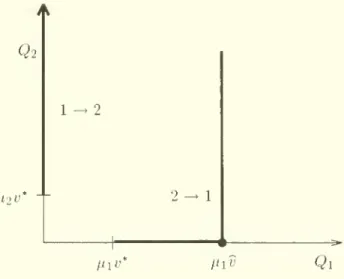
is pictured in Figure 4: -when Q\{t)
=
and
Q2{i)>
M2^*i then sivitchfrom
class 1 to class 2.When
Q\{t)>
^iv
or (Q2{t)=
and
Qi(t)>
ij,\v*), then switchfrom
class 2 to class 1.The
parameters
vand
v* are defined in (1.21)and
(1.22), respectively. Hence, the serverswitches to the high priority class as
soon
as thequeue
length of that classgrows
to the levelHiv.
By
(1.4)and
(1.21), this critical level increases with the setup costK
and
decreases as thec^
differentialbetween
thetwo
classes gets larger.Although
onemight
have expected a general nonlinear switching curve, the verticalboundary
in Figure 4 is obtained. It isworth
noting that the heuristic policy ofDuenyas
and
Van
Oyen
is also of this general form.2
THE
SETUP TIME
PROBLEM
2.1
Problem
Description
The
only differencebetween
thesetup timeproblem
considered in thissectionand
the setupcost
problem
is that arandom
setup time ratherthan
asetup cost is incurredwhen
the serverswitches
from one
class to the other; all relevant notationfrom
the setup costproblem
willbe
retained.
By
CofFman,
Puhalskiiand
Reiman
(1994), theperformance
ofthissystem
inheavy
traffic
depends
upon
the setup timedistributions onlythrough
tliemean
setup time per cycle,which
we
denoteby
s.The
server has three scheduling options at each point in time: serve acustomer from
the class that is currently set up, initiate a setup or sit idle.The
objective isto find a preemptive-resume, nonanticipating scheduling policy to
minimize
lim
sup
—
E
T—oo
T
T
2(2.1)
2.2
The
Approximating
Diffusion
Control
Problem
Unlike, for example, the server vacation times in Kella
and
Whitt
(1990), the setup times arenot rescaled as the
heavy
traffic limit is approached; that is,we
assume
that the setup timesare 0(1).
The
lack ofsetup costs has eliminated the incentive to insert unnecessary idlenessin
heavy
traffic; inserted idleness increases the workload,which
in turn increases the holding costs. Hence, theproposed
form
oftheoptimal policyissimplerthan
in the setupcost problem:serve class 1 to exhaustion
and
then setup
for class 2. If class 2's normalized unfinishedworkload W-iit)
=
x
at the setup completion epoch, then serve class 2 until Wi{t)—
u{x)and
W2{t)
=
X
—
u{x),and
immediately switch back to class 1.As
in the setup cost problem, the control {u{x),x>
0} can generateany
arbitrary switching curve in the nonnegative orthant.Sincethesetup times are 0(1), switchovers occur instantaneously in the
heavy
traffic limit.Hence, the two-dimensional normalized unfinished
workload
process (M^i, VV2) willmove
atan
asymptotically infinite rate
back
and
forthbetween
(0,.z:)and
(u(.r),x—
u{x))when
the totalnormalized
workload
W
=
x, just as in the setup cost problem.We
now
present a heuristicargument
for the characterization of the normalized total unfinishedworkload
processW.
Ifsetup times are zero
and no
unnecessary idleness is inserted, recall that the the limiting processis a
RBM
on
the nonnegative orthant with drift s/n{p-
1)and
variance a'- givenby
(1-2).When
setup times are positive,we
claim that the limiting process is a diffusion processon
the nonnegative orthant with variance a^and
a state-dependent drift,which
we
denote /u(x').Since the
system
is heavily congested, setups are incurred relatively rarelyand
themean
and
varianceofthesetup times
do
notappear
in the varianceterm
ofthe limiting diffusion process.As
explained in Harrisonand
Nguyen
(1990), the drift ofthe stochastic process underlying aheavy
trafficapproximation
ec}uals the expectedgrowth
rate of the normalized workload netfiowprocess,which
is the arrival rate ofwork minus
the potential (that is,assuming
work
is always available) depletion rate ofwork.With
zero setup times, unsealedwork
arrives at ratep
and
is potentially depleted at rate one.With
timesped
up by
a factor of nand workloads
reduced by
a factor of\/n, theexpectedgrowth
rateofthe normalizedworkload
netfiow processis \/n{p
—
1).When
setup times are positive, the potential depletion rate ofwork
is strictlyless
than one
and
will equal the fraction oftime that the serverspends
doing useful work; thatis, the fraction of time the server actually serves customers, rather
than
incurring setups.We
claim that the drift
when
the normalized totalworkload
isx
equals/x(.r)
=
y^(p-/(.T))
, (2.2)where
/(.r) isthe fraction oftimethat the serverspends
doing usefulwork
when
the normalized unfinishedworkload
W
ecjuals x. Since cycles occur rapidly inheavy
traffic, only averagesmatter
and
we
can
carry out the calculation of f{x) over one cycle. Let us begin the cyclewhen
ally/nx
units of unsealed unfinishedwork
V
is of class 2. Class 2work
is depleted atrate 1
-
p2 until V\{t)=
^/nu{x)and
V2{t)—
\/n(x-
u{x)),which
takes y/nu{x)/{l-
P2) timeunits. Similarly, y^u(:c)/(l
-
pi) time units are required to serve class 1 customers, therebycompleting
the cycle. Hence, ifwe
assume
p=
1 (see Section 1 for the rationalebehind
this assumption), then the length of the cycle is\/nu(x) \/n.u(x)
^-^
+
~
-^
+
s,
(2.3)
P2 Pi
and
the fraction of time the serverspends
doing usefulwork
isfix)
=
\/nu{x) _. \/nu{x) P2 Pi Vnu(x) v/nM(x) ^ P2 P\ \/nu(x) ynu(.r)+
spip2 ' (2.4)By
(2.2), fi{x)=
v/^(/9-l)+
y^(l-/(x))
=
-c+v^(l-/(.r)).
(2.5) Sincern
tiw
Vnpip2S
PIP2SV"(l
-
jyx))=
^
—
-—
as 71 -> oo , (2.6) ^/nu{x)+
P1P2S u(x)we
have H{x)=
—-—-c.
(2.7) U[X)In
summary, we
approximate
the normalized total unfinishedworkload
processW
by
a (p{x),a'^) diffusion. In the special case of exhaustive service (that is, u{x)=
x
for all .r),Coffman,
Puhalskiiand
Reiman
(1994)show
that the normalized total unfinishedworkload
process
weakly
converges to ^his diffusion process as p—
> 1. If, in addition, c=
(that is, p=
1), this diffusion process is a Bessel process.As
we
mentioned
earlier, givenW{t)
=
x, the two-dimensional process(^1,^2)
behaves
thesame
with orwithout
setup times; hence the holding cost ratewhen
in state .r is givenby
(1.3). Therefore, theapproximating
diffusion controlproblem
is to choose {u(-i')i-'''^
0} ^^minimize
limsup
—E
T—tooJ-T
( ^^^^^ ,Au(X(0)
a
C2P2X{t)
+
V^^
dt (2.8)where
X
is a {p{x),a'^) diffusion processand
u{x)G
[0,x] for allx
>
0.The
previous literatureon heavy
trafficapproximations
ofqueueing
schedulingproblems
assumes
zero setup times,and
the time scaledecomposition
described in Section 1 leads to adeterministic pathwise optimizationfor theoptimal
queue
length processc^d
a singular controlproblem
for the optimal cumulative idleness process.The
presence of setup times destroys this simplifying structure,and
(2.8) provides the firstexample
of a schedulingproblem
for aqueueing
system
that isapproximated
inheavy
trafficby
a drift control problem.2.3
Analysis
of
the
Diffusion
Control
Problem:
The
Balanced
Case
Problem
(2.8) simplifies considerablywhen
each class has thesame
cp index. SettingA
equal to zero in (2.8)
shows
that theproblem
reduces to choosing u{x) tominimize
themean
ofthe stationary distribution of the diffusion process A'. This goal is achieved by
minimizing
thedrift fi(x) in (2.7),
and
hence the optimal control is u{x)=
x
for all x; therefore, the proposedscheduling policy for the balanced case is to serve each class to exhaustion,
and
immediatelyswitch class.
The
resulting diffusion process is a Bessel process withan
additive drift.The
long run average cost ofany
stationary policy can be obtainedfrom
the stationary distribution (invariant measure) of the diffusion process 'induced' (via the resulting /i(x-)) bythe policy. Fortunately, the subject of stationary distributions of one dimensional diffusions
is old
and
wellunderstood
(c.f.Mandl
1968, orKarhn
and
Taylor 1981).Given
a positive recurrent diffusion processon
the nonnegative half line with drift //,(.r)and
variance a^, thestationary density satisfies the ordinary differential equation
(j^ d'^Txix) d , , , , ,,
Y^y-
-
^(/'(^)''^-'^))=
°' •">
'^ (--^^Associated with a reflecting
boundary
at zero, there is aboundary
conditiona^ dTT{x)
~2
Jx~
There
is also the normalization condition=
/x(x)7r(x),x-0.
(2.10)oo
7r(.r)dx
=
1 . (2.11)The
solution of (2.9)-(2.11) can be obtained using integrating factors. For the Besselprocess with
an
additive drift,where
/x(x)=
p\P2s/x
—
c, it can beshown
by
abound
involvingBrownian
motion
that this process is positive recurrentwhen
c>
0.The
solution of(2.9)-(2.11) for this process is the
gamma
densitywhere
a
=
2c/cr^ is the scaleparameter and
/i=
2pip2s/c^ is theshape
parameter. (It is straightforward to verify that (2.12) solves (2.9), (2.10),and
(2.11).Standard
resultsfrom
the theory ofordinary differential equations yield that (2.9)-(2.11) have a unique solution.) It
turns out that the Bessel process reaches the origin only if /3
<
1; if /3>
1 the process will never reach zero.The
solution (2.12) is valid forboth
of these cases.Under
the exhaustive policy, the expected average cost incurred for the originalsystem
is \/n{c2P2+
A/2)£'[A'(oo)],where
A' is a {pip2s/x—
c,a") diffusion. SincerFlXI
.1^C^
+
O
2p,p2S
+
a^ ,^^„,
7T-the
expected
average cost isC{2pip2S
+
a'^) 2(1-p)
(2.14)
where
the costparameter
C
was
defined earlier as (cipi+
C2^2)/2.Forthebalanced case,
we
can alsointroducesetup costs into thesetup timeproblem without
sacrificing tractability.
We
again let k=
K/n
denote the normalized setup cost per cycle.As
in the balanced case of the setup cost problem, the
proposed
policy is a double threshold policycharacterized
by
thenormahzed
threshold level w.We
now
derive the optimal threshold valueunder
the generalimbalanced
case, although thispolicy is onlyproposed
forthe balancedcase.Under
the threshold level lo, the diffusion process with drift fi{x)=
pip2s/x
-
cbehaves
as before but isnot allowed to gobelow
w.The
stationary density 7r(x) ofthetruncated processisobtained
by
solving equations analogous to (2.9), (2.10),and
(2.11) with the reflecting barrierat A'
—
lu.The
solution,which
yields the stationary density for the normalizedworkload
W,
is ^(^)
=
^^?TT^
forx>«;,
• (2.15)where
/•OO r(/?,a)=
/ t'^-^e-^dt (2.16)is the incomplete
gamma
function.Note
that (2.15) reduces to (2.12)when
it)=
0.As
in the setup cost problem, setup costsare incurred at the rate p\p2i\./u(x)when
W
=
x. Therefore, the expected setup cost per unit time isJw
1(13+
I,aw)
],/3+1^/3-i^-ax
r{/3,awj
l(p
+
l,Qu;)r{p
+
l,aw)
p,P2aK
{aw)l'e--
\where
the lastequahty
followsfrom
the identity f3T{f3,aw)
=
T{p
+
1,aw) -
{aw)^
e~°'^.The
expected holding cost per unit time is
C
J^
X7r{x)dx,where
/•OO
CV^"*"^
f^
/ X7:lx)dx—
-
—
;
/ .c^"*"
e~^^dx
Ju_, ^ ' T{l5
+
l,aw)
Ju, r{(3+
2,aw)
ar{l3+
I,aw)
a
r(p
+
I,aw)
Hence, the expected total cost rate is
'g -aw
a[^^'^
TH3
+
l,aw)
r
P
V
FiP
+
^aw)^'
^'''''If
we
define the constant k=
pip2QK/
13, then it suffices tominimize
{Cw -
K)(cvw)^e-""^r(/?
+
l,m/;)(2.20)
Using
the fact that^r(/9
+
l,au;)=
-ae
°'^{aw)^, considerablemanipulation
leads to the following first order optimality condition for lu*:iau,Y>e-"
,
(,_
AU
_^.
. (2.21)r(/i+l,ouO
Vawj
a{K
— Cw)
Substituting v/y/ri. for w,
K/n
for k,and
^lO
fora
(see (1.24)) into (2.21) gives=
h
-
^
+
7T7 W7-' ITTT-, (2-22)
r(^
+
1,^(0 VOv)
eipxpoOK
-
(3CvAlthough
we
have notbeen
able to prove the existence ofa unique positive root v* to (2.22),the numerical solution to this equation
was
wellbehaved
for our test examples.In
summary,
for the balanced case with setup timesand
setup costs,we
propose
thefol-lowing
scheduhng
policy for the original problem:when
Qi{t)=
and
Q2{t)>
H2V*, switchfrom
class 1 to class 2;when
Q2{t)—
and
Qi(t)>
^i\v*. then switchfrom
class 2 to class 1.The
threshold v* is found by solving (2.22).2.4
Analysis
of
the Diffusion
Control
Problem:
The
Imbalanced
Case
Notice that (2.8) is nonstandard, in the sense that the drift isunbounded
at zeroand
will
be
unbounded
whenever
the control u{x)=
0. Nonetheless,we
proceed as if standardarguments
apply (see, for example,Mandl
1968),and
write theHamilton-Jacobi-Bellman
optimality equation for
problem
(2.8) asu{x)e[o,x]
[
2 V u{x) J 2
J
Hence, if
we
can find a constant g,which
is referred to as the gain,and
a potential (relativevalue) function
V{x)
that solves (2.23), then the control u'(.c) thatminimizes
the expressionin brackets in (2.23) is optimal
and
g is theminimal
average cost per unit time (independentof initial state).
The
resulting potential functionV{x)
represents the cost incurredunder
theoptimal policy
when
the initialstate is.rminus
the costincurredunder
theoptimal policywhen
the initial state is zero.
We
assume
thatV
GC^
and, to avoid notational confusionbetween
the potential function
and
the unsealedworkload
process,we
employ
the first derivative ofthe potential function,which
isdenoted
by
p{x)=
V'{x).Rewriting (2.23) as
Au{x)
pip2sp{x)mm
u(x)€[0,x] t 2 u(x)
we
obtain the following first order optimality condition for u{x):C2H2-r
-
g-
cp(x)+
—p'{x)
=
, (2.24)uix)
=
^?^i^
. (2.25)Since greater initial
workload
implies greater cost,we
have p{x)>
and
the function in brackets in (2.24) isconvex
with respect to u{x). Hence, the optimal control is givenby
*l \ J /2/9l/32gp(-r) , ,„.-,„.
u (x)
=
mm
<^ .r,
W
V . (2.26)It is interesting to
compare
(2.26) with the correspondingsolution (1.6)-(1.7) in the setupcost problem.
The
solutions are identical except that the normalized setup cost per cycle k. in (1.6) is replaced by the expected setup time per cycle s multipliedby
p{x). Hence, thetwo
optimal controls will
be
qualitatively similar if the potential functionV{x)
is linear,which
will turn out not to be the case.
Thus,
solutions to thetwo
problems
lead tofundamentally
different quahtative behavior.
We
assume
that2pip2sp{x)/A
ismonotone
enough
(e.g.,p
is nondecreasing)and
is greaterthan
x^ as a:—
> 0, so that{X
ifX
<
u) ,r,
TT
(2-27)where
the normalized threshold levelw
isunknown
at this pointand
satisfies the fixed pointequation
2piP2Sp(w)
If
we
substitute (2.27) into (2.23), then theoptimahty
equation reduces totwo
ordinary differential equations(ODE's)
for p{x):—p'{x)
+
(^IM.
_
c\p{x)=
g-Cx
forx €
[0,w\ (2.29)and
-—p'{x)
-
cp{x)+
\j2p\p2Asp{x)
=
g-
C2P2-r forx
>
w
. (2.30)The
ODE
in (2.29) is linearand
possessesan
explicit solution (that satisfies the propertiesassumed
above). Unfortunately, theODE
in (2.30) is nonlinearand
does notappear
toadmit
an
analytical solution. Hence,we
resort toapproximate
analyticalmethods
and
numericalmethods
in theremainder
ofthis section.It is
worth
noting the similaritybetween problem
(2.8)and
the singular controlproblem
for multidimensional
Brownian
motion
analyzedby
Cox
and Karatzas
(1985). Their controlproblem
gives rise to a Bessel process with a controllable additivedrift,which
leads to a pair of linearODE's
analogous to (2.29)-(2.30),and
hence toan
explicit solution.Our
problem
can be expressed as a multiplicative, ratherthan
additive, control of a Bessel processwith
drift,which
leads to the intractable nonlinearODE
in (2.30).We
conclude this subsection withan
asymptotic result.Although
(2.30)cannot
be solvedanalytically, first hitting time
arguments
can beemployed
to obtain theasymptotic
value ofp{x) as .r -^ oo.
A
derivation in theAppendix
shows
that the derivative of the potentialfunction satisfies
p{x)
=
ho{x) asX
—
* oo . (2.31)c
This asymptotic
result allows us to seehow
the control u*(a')behaves
asx
—
> oo.More
specifically, (2.26)
and
(2.31)imply
that—
1= >\/ as
X
—
» oo . {1.61}s/x V
cA
This
result is in direct contrast to the solution (1.6) (1.7) of the setup cost problem,which
implies thatu*{,) -.
^^-^
asx-oo.
(2.33)Equations
(2.32)-(2.33)summarize
the contrasting (|ualitative behaviorbetween
the solutions to thetwo
problems: u*(x)grows
as >/x in the setup time i)rolik'mand
is a constant for large.r in the setup cost problem.
2.5
An
Approximate
Analytical Solution
One
of our goals is to find a scheduling policy that performs welland
is relatively easy to derive.One
possibleapproach
is to derive a policy that is optimal (inheavy
traffic) within a certain class of policies.Perhaps
the simplest policy to consider is a single threshold policy that possesses a single parameter, w: serve class 1 to exhaustion,and
theji siuitch to class 2.Switch
from
class 2 to class 1whenever
W-iit)=
orWi{t)
>
u).The
optimal policy for thesetup cost
problem
reduces to the single threshold policywhen
theparameter
w*
in (1.13),and hence
i;*, equals zero; see Figure 4.Although
it is straightforward to derive the optimalvalue of the
parameter
w
inheavy
traffic,we
do
not pursue this here, primarily because ourasymptotic
result (2.32) suggests that the policy is not very close to optimal.Instead,
we
investigate another simple class of policies,which
we
refer to as asymptotic policies; these policiescan
be constructed by patching together the asymptotic result (2.31)with the first part of solution (2.27). In particular,
we
assume
that u{x)=
x
forx
lessthan
or equal to
some
unknown
threshold iD,and
u{x)/y/x equals a constant thereafter; hence,we
areassuming
that the asymptotic result holds not only for veiy large x, but for all .r>
lu. Continuity atw
givesf
X
ifX
<
w
,u{x)
=
^^
.^^ ^ (2.34)
wx
ifX
>
w
This
control,and
hence the resulting schedulingpolicy, is characterizedby
a single parameter,the threshold level w.
We
offertwo
estimates forw
that are of increasing complexity.Both
estimatesassume
thatthis
parameter
satisfies the fixed point equation (2.28),and
are basedon approximating
theunknown
function p{x) in this equation.The
simpler estimate forw
employs
theasymptotic
approximation
p{x)=
C2P2x/c
in (2.31),and
setsw
equal to the solution to the fixed pointequation .?•
=
\j2c2P2P\P2S-i'I[c^),
which
yieldsw
=
2c2P2Pip2s/{c^)-The
correspondingunsealed threshold level is
^^
'^C2P2P\P2S >V
=
^,rw
=
——-
. (2.35)A(l
-
p)As
in Section 1,when
the unsealed totalworkload
V
equals (/, the control u*(.r) recfuires theserver to serve class 2 until the unsealed class 1
workload
V\—
^/nu*[yIs/n). Substitutingvjs/n
forw
in (2.34) gives„..|i)
=
(
'''';!•
(2^36)Vv"/
[ \/vy if y>
V .Translating
workloads
intoqueue
lengths gives the following scheduling policy: serve class 1to exhaustion
and
then switch to class 2; serve class 2 until(
p^'Qy(t)+p^'Q2{t)
ifP^'Ql(t)
+
P2'Q2{t)<V
.Pi'Qiit)
>
{ (2.37)[ sJv{pY'Q,it)