Annual Technical Report
DISCRETE CONTROL OF CONTINUOUS PROCESSES
Contract F49620-80-C-0002 (as amended)
10/1/80-9/30/81
To:
Directorate of Mathematical and Information Sciences
Air Force Office of Scientific Research
Building 410
Bolling Air Force Base, D.C. 20332
From:
Laboratory for Information and Decision Systems
Massachusetts Institute of Technology
Room 35-205B
Cambridge, Massachusetts 02139
Acting Contract Monitor:
Dr. Bernard Epstein
Principal Investigators:
Timothy L. Johnson, Visiting Research Scientist and Lecturer
Massachusetts Institute of Technology
Department of Electrical Engineering and Computer Science
Martin E. Kaliski, Professor
Northeastern University
I.
Cover and Title Page (Form DD1473), including Abstract
1
II.
Statement of Research Objectives
2
III.
Status of Research Effort
3
A. Research at M.I.T.
3
1. Coder Synthesis for Synchronous Systems
3
2. Discrete Control of Synchronous Systems
7
3. Analysis of Asyncrhonous Feedback Systems
11
B. Research at Northeastern University
13
1. Well-Behaved Coders from the Input/Output Viewpoint
13
2. Well-Behaved Coders from the Decomposition Viewpoint
15
3. "Similarity" of Coders and Related Notions
16
4. Asynchronous Coders...The Underlying Framework
16
5. Concluding Remarks:
Software Realizations/Implementation
of Coder Concepts
17
References
IV.
Publications and Reports
18
V.
Personnel
18
VI.
Interactions
18
VII.
New Discoveries, Inventions and Specific Applications
19
VIII. Appendices and Supporting Documents
20
A. D. G. Wimpey, T. L. Johnson and M. E. Kaliski,
"Realization of A/D and D/A Coders", Proc. 1981
Joint Auto. Control Conf., Charlottesville, Va.,
June 1981.
B. M. E. Kaliski, "On Intrinsic Lipschitz Constants and
Bounds in Nonlinear One-Dimensional Discrete-time
Realizations of Input/Output Maps", submitted to 1982
Automatic Control Conference (AC
2), Washington, D.C.,
June 1982.
C. T. L. Johnson, "Stability of Diced Systems", Proc.
19th IEEE Conf. on Decision and Control, Albuquerque,
N.M., Dec. 1980.
D. T. L. Johnson, "Analytic Models of Multitask Processes",
20th IEEE Conf. on Decision and Control, San Diego, Calif.
Dec. 1980 (preprint).
E. T. L. Johnson, "Multitask Control of Distributed Systems",
submitted to 3rd IFAC Symposium on Control of Distributed
Parameter Systems, Toulouse, France, June 1982.
F. T. L. Johnson, "On Feedback Laws for Robotic Systems",
Proc. 8th IFAC World Congress, Kyoto, Japan, August 1981.
G. M. E. Kaliski, "Essentially Continuous Functional Real
Coders", unpublished report.
H. D. G. Wimpey, "Finite-State Control of Discrete-Time
Con-tinuous Processes", M.I.T., Dept. of Electrical Engineering
and Computer Science, Nov. 1981 (preliminary copy).
C. Statement of Research Objectives
The research objectives, as stated in the amended contract, are:
(a) Investigate real language extensions
(b) Develop control design methodology
(c) Develop asynchronous coding
(d) Study the representation of states (in asynchronous hybrid systems)
(e) Formulate improved controller design procedures for synchronous
-3-III.
Status of the Research Effort
The objectives of this phase of the proposed research on discrete
control of continuous processes have been substantially achieved. This
annual technical status report is divided into two unequal segments,
deal-ing with research at M.I.T. and at Northeastern University. The second
and shorter segments constitute the final report of the Northeastern
Uni-versity Subcontract, under the direction of Professor Kaliski; however,
only 4 weeks' effort was budgeted due to his sabbatical leave of absence.
A. Research at M.I.T.
1. @oder -&)ntfP0sis
f-4
n
hcroWYfeinystems
We have already motivated our study of coders in the context of
digital control systems; in fact, in many cases the entire system in the
feedback loop may be viewed as a coder. To recapitulate, we viewed a
coder simply as a map
G:
R
P -W
where R
P *is the free monoid generated by R
P(p-dimensional real Euclidean
Space) and W is an alphabet (a finite set).
Some examples of coders are
(memoryless) A/D convertors (or more generally quantizers) and delta
modu-lators.
In a more theoretical view we may wish to model our digital
con-troller as a quantizer followed by a transducer (such as a finite-state
transducer or a pushdown transducer, etc.) with the following implications:
That all coders may be decomposed into the cascade connection of a
memory-less quantizer followd by a transducer, and that the most general coder
may be represented as a quantizer in cascade with a Turing transducer.
Simple counter-examples show, however, that not all coders may be realized
canonical realizations for coders.
We have identified three basic approaches for the development of the
realization theory which we loosely term the analytic, the algebraic and
the linguistic (or syntatic) approaches. The former approach involves
obtaining physical realizability constraints for Kaliski's general coder
decomposition theorem [1]; this viewpoint is currently being pursued
although no results have yet been obtained. We summarize here the results
of the last two approaches. Here we have begun to develop a hierarchy of
coders of increasing complexity, motivated by the already existing hierarchy
of automata.
The success of the algebraic approach hinges on the definition of
appropriate right-congruence relations on R
P *.
We have defined a
gen-eralized Nerode equivalence relation -a for C which may have finite index
even though the minimal realization of C is not finite-state. The relation
is defined as follows:
u _ v iff C
(y) =
C
(y)
for all
ycR
Pwhere the shift-conjugate function Cu
· : R
+W is defined below.
u,0
C
(y)
=
CTa
(y)
yR
P *with
0 <
9(y)
<
Z(0)
C
(y)
=
CTU(y)
yER
with
k(y)
>
Z(8)
8eR
P *is a parameter. Then a coder is defined to be shift-finitary if the
minimum length
O8R
p *for which -
has finite index is one (with the
impli-cation such that a
0
exists). Special cases are as follows:
(i)
The index of _ is 1; C is said to be shift unitary
(ii) _= has finite index and the minimum length of
8
is zero; C
is said to be finitary
(iii)
-E has unit index and the minimum length of
8
is zero; C is
said to be unitary.
The most general coder in this hierarchy, the shift-finitary coder, has a
minimal hybrid state-space RnxQ, where n
=
S(8) and Q is a finite set. The
structure of the coder is shown in Figure 1. In the case of a shift-unitary
coder, the finite-automaton in Figure 1 has only one state. Clearly, the
shift-register of Figure 1 is not present in the realization of unitary and
finitary coders; these coders are finite-state realizable, and may be
decomposed into the cascade connection of a quantizer followed by a
finite-state transducer.
In the linguistic or syntatic approach we view the coder as an
ac-ceptor of a real language L, which is a subset of RP.
Here we take W to
be the two element set {0,1}, and C accepts L as follows:
C(y)
=1
if y£L
0
otherwise
The most general grammars that we have studied for generating real languages
are the real context-free grammars; these are a generalization of the real
context-free grammars of Lemone [2].
We have generalized the notion of a
pushdown automaton to accept real-valued signals; this new "machine" has
a hybrid control module (state-space QlxR
nfor
Q1
an alphabet) and a stack
with a hybrid stack set Q
2xR
P, with
Q2
an alphabet. Since context-free
languages are nondeterministic in general, this acceptor is also
non-deterministic.
YkER R
Figure 1.
T
'
Realization of a shift-unitary coder.
L is a multiplexor,
M
Tis a finite automaton and qi:
Rn +Z is a quantizer.
-6-dimensional, the coder may be considered unrealizable, unless of course an
equivalent finite-dimensional realization can be found.
In principle this
can always be done (according to Kaliski's general coder realization theorem
mentioned above), but in practice this may only be feasible for special
examples. A subset of the real context-free languages are the "bounded real
embedding
"t
(BRE) context-free languages, where the acceptors for these
languages have a finite stack set.
These languages may thus be viewed as
the largest general class of real context-free languages which represent
realizable coders (although for the purposes of coding we should restrict
ourselves to the deterministic subset of these languages).
The right-linear real languages* are a proper subset of the
deter-ministic BRE context-free real languages. Here there is no stack at all
in the acceptor realization; the coder is finite dimensional (with a
state-space QxR
n, Q an alphabet; see Figure 2).
An acceptor of a right-linear
real language is only finite-state realizable if the grammar is of order
one (the order of a grammar was defined by Lemone [2]).
In fact the coders
which accept languages generated
by
first order grammars are precisely those
coders referred to above which may always be decomposed into the cascade
connection of a memoryless quantizer and an automaton.
The syntactic approach to coder synthesis has clearly been
illuminat-Productions of a right-linear real grammar take the form
A +
wB
or
A
B
where A, B are nonterminals, w is a string of terminal symbols of length
k
2
iikr
Figure 2.
Structure of a Coder Specified by a Right Linear
Real Language
-7-ing. We note that our extension from finitary to shift-finitary by the
addition of a shift-register appears natural in the context of right-linear
real languages (any language describing a shift-finitary acceptor is
right-linear).
It would be premature though to say that the natural structure
of coders are those corresponding to acceptors. Further developments are
needed along the lines of the analytic approach mentioned above and an
extension in the syntatic approach to more general phrase-structure grammars.
2. Discrete Control of Synchronous Systems
The design of a digital controller for a continuous-state system
usually involves the design of three subsystems:
a coder, a control
algo-rithm (e.g., to reside in a digital computer) and a decoder. If the coder
and decoder are allowed to be dynamic systems and the control algorithm
is modelled as an automaton, then it is clear that the digital controller
may be viewed as a coder connected directly to a decoder. The structure
theory we have developed for coders, some of which may be extended to
decoders, then provides general models for the controller. An
interest-ing viewpoint yet to be fully explored is to view the controller as a
translator T of real-valued sequences into real-valued sequences
(To Rp
+Rm*) using syntax-directed schemas [3] to describe T (these
consist of pairs of real grammars, one called an input-grammar and the
other called the output grammar).
In the case where the coder and decoder are constrained to be finitary,
the entire controller may be viewed as a finitary coder C:
R
P +W where
W is
a
finite subset of R
m, the plant input set. A finitary controller
may thus always be decomposed into the cascade connection of
a
memoryless
quantizing coder, a finite-state transducer and a memoryless decoder, the
latter being simply a realization of a mapping from the finite output
alpha-bet of the transducer to W. All of the procedures discussed in the literature
for designing finite-state controllers concentrate on designing the
trans-ducer; the design of the coder and decoder are omitted. Also, since these
schemes involve either approximation or learning via ad hoc adaptive
algo-rithms, the theories provide no performance guarantees.
We have developed an algorithm for designing finitary coders for a
very general class of nonlinear deterministic discrete-time systems:
those
that are piecewise continuous. The algorithm provides an effective procedure
for computing the coder, transducer and decoder for the following problem
formulation: Given the plant F,
find a finitary feedback controller that
will drive the plant state, starting initially in XO, to the target set Z
in a finite number of steps. This is the finite-horizon problem; in the
infinite horizon problem, the plant state is required to remain in Z for
an infinite period of time once it has reached Z. In both of these cases
the regulator initial state is fixed and depends on X
.
This has been
0
termed the synchronous control problem by Gatto and Guardabassi [4] and the
weak regulator problem by Sontag [5].
The controller is designed in two steps: First an aggregate finitary
model of the plant is obtained, and second, a finitary controller is designed
for this aggregate model. The aggregate model has the following properties:
(i) it is a nondeterministic finite-state system
(ii) the states of the model are in one-to-one correspondence with
-9-and
(iii) the set of possible states that the model may be in at any time
k, viewed as a subset of X, always contains the actual plant
state at time k.
It is the task of the designer to choose the partition P. Once this
par-tition is chosen, the aggregate model may be completely specified. At
this stage in the design, the only requirement on the choice of P is that
the aggregated sets X and Z--specified new in terms of blocks of P--still
provide an acceptable aggregate control problem formulation (e.g P is
well-suited to the approximation of XO and Z).
The solution of the aggregate control problem requires the design of
a finite-state controller for a nondeterministic finite-state plant. The
problem formulation now appears to have similarities with the usual
"un-known but bounded" stochastic control problems (see Sira Ramirez [6]) and
the control problems for deterministic finite automata (Gatto and Guardabassi
[4]), although neither of the solutions to these problems are directly
applicable.
Since the states of the controller may be viewed as state-estimates
of the aggregate model, the specification of P also provides us directly
with the coder (since there are only finitely many different state
estimates).
The remainder of the controller is designed in three stages
(for the infinite horizon problem).
The first part involves the computation
of all those state-estimates contained within Z for which there exist
control inputs, guaranteeing that future state estimates have the same
property. Specification of these admissable control inputs defines a
all possible state-estimates is finite, and this partition partially
specifies the decoder. The second part involves sequentially identifying
all those state estimates that are controllable in finite time to the
estimates computed already, until a state-estimate is obtained that contains
X .
Again, the admissable control inputs define a finite partition on
the plant input space. The design is completed by selecting from each of
the blocks of the input space partition (obtained in the first two parts
of the design procedure) a representative input. This completes the design
of the decoder.
The straightforward application of this algorithm has the following
potential disadvantages:
(i) A controller may not exist for a particular partition P
(ii) If P has a large number of blocks, it may be impractical to
compute the controller because it will have too many states.
To keep the design feasible, the number of blocks in P must be kept as
small as possible. However with coarser partitions it becomes unlikely
that a controller may be found. To overcome this dilemma, we have
develop-ed a hierarchical design procdevelop-edure, wherein the controller is computdevelop-ed in
stages. A two stage design proceeds as follows (the extension to an
n-stage design is obvious).
A coarse partition P
1is chosen, together with
a "large" target set
Z
1D
Z, and a controller is designed for F, X and
Z1' based on P
1.
Then, a refinement of P
1; called P
2, is chosen, and a
controller is designed for F, Z
1, and Z. Note that if at either stage
no controller can be found, it becomes necessary to try to finer
will clarify what choice may be appropriate. At each stage in the
hierar-chical design procedure, the controller with the fewest* states is sought
by choosing the coarsestpartition possible. At each stage then we are
dealing with a nondeterministic automaton as an aggregate model of the
plant, which has a state set which is not too large to make the controller
design impractical. Details
'of these results appear in Appendix H.
3. Analysis of Asynchronous Feedback Systems
The most important phenomenon encountered in asynchronous hybrid
systems which does not occur in synchronous systems is sliding mode
behavior--"infinitely fast" switching which may occur along a
discon-tinuity in the state transition function and which results in a trajectory
shape which could not occur in the absence of the discontinuity.
An-other phenomenon is that the class of systems which admit
finite-dimensional realizations is less pervasive in practice than for synchronous
systems.
The problem of representing sliding mode behavior in asynchronous
hybrid systems arose even in the restricted context of diced systems
(Appendix C) in the form of a condition that the sequence of switching
times for such a system be "asymptotic"--i.e. have an infinite limit.
We have constructed a counter-example of a diced system which is not
asymptotic (included in the continuation proposal for this research).
This shows that there are cases where sliding mode behavior may achieve
exact equilibrium in finite time; however there are other cases of
slid-ing where this does not occur.
In such non-asymptotic cases, the use
of switching-times as hybrid state variables is not sufficient to fully
This paradox implies that care must be taken in developing a
realization theory for asynchronous (continuous-time) hybrid systems.
One possibility is to consider a class of realization which enforces
a separation of control and that flow at inputs and outputs and to
place conditions on the maximum switching rate of control signals.
Many problems are known to arise when both control and dtat are combined
on a single channel (e.g. Witsenhausen's counterexample in stochastic
control).
Some examples of hybrid systems which arise naturally in
robotics are given in Appendix F.
An important class of applications which can be represented as
asynchronous hybrid systems arise in multitasking systems where the
tasks involve interaction with continuous processes (timing processes).
It has been shown (Appendices D,E) that under certain conditions such
systems admit a synchronous hybrid representation. These conditions
place a limit on the number of tasks (to ensure finite-dimensionality),
on the minimum delay in switching tasks, and on the degree of continuity
of the continuous processes. An example of representing a
-13-B. Research at Northeastern University
Much of our work is based upon the key decomposition result reported
in
[
1].
Specifically we cite the following Theorem:
Let C:
R*
3
[0,1]
be an arbitrary coder. Then for any n
>
1, C may be decomposed as
C
=
C
2-C
1where
·
is functional composition.
C
1:
R*
+R
nand C
2: R
n -[0,1]
Further C is realizable by a finite-dimensional discrete-time system of
dimension
n.
Although such a result is primarily only of theoretical
interest it serves as a starting point for relating properties of
C
1and
C
2to those of C and conversely.
1. Well-Behaved Coders from the Input/Output Viewpoint
The research undertaken here sought to identify and, if possible,
make rigorous, the notion of a physically well-behaved coder.
This notion
is an intuitive one, e.g. the coder defined by
C(u
1...uk)
=
JO
if ul
+ ...
+ uk
>
0or if
u
is null
t1
otherwise
is intuitively well-,behaved, but the cpder C defined
by
C (u*.. A
OU
u
=
A,
the null string
O
UUl...u
kis a palindrome
(1
otherwise
is not. Clearly some implicit notion of continuity is involved here,
although we must be careful in using the term "continuity", as the range
of the coder is discrete. We developed several potential definitions of
"well-behaved" during this research period that embody these concepts.
Further research should try
to
relate these various definitions to one
another and to the more formal algebraic/topological approaches already
explored. We give some of these definitions below
Definition 1:
C is well-behaved at ul...ukif 3
£ >O,
dependent upon
k
ul...Uk,
such that if
V
1...vk
£R* obeys
ljui-vil
< c
then C(u
...
uk)
C(l...v
k).
Definition 2:
C is strongly well-behaved of order k
>
1 at
u
1... uk
if
3 EL> 0, dependent upon both ul...uk and L, such that if vl...vk
CR*
k
obeys
I
lui-vil
<
EL
and wl...wp E R* is arbitrary, p
<
L then
C(ul...uk
w
1... Wp) =
C(vl...Vkwle..w
p).
We say C is strongly well-behaved
at ul...uk if it is strongly well-behaved of order L at ul...uk for all
L
>
1 and E*
=
min
{
L} >
0.
L
L
Note that this latter concept embodies the notion that "close together
strings" (within
£*)of the same length map to the same values regardless
of what is appended onto their ends. The values, of course, depend upon
£*-neighborhood of ul..,uk consists of length k strings that are Nerode
equivalent to ul...uk (as well as other strings, possibly, of length
dif-ferent from k).
Interpreting, correctly, "well-behaved" (Def. 1) as
strong-ly well-behaved of order 0, we see that each of these properties are
successively more stringent.
We posit two other difenitions that follow a somewhat different tack.
Definition 3:
C
is causally well-behaved of order
F> 0
if-whenever
C(ul..u
C(vl...vk
)
then if
wl..,w
in R* obeys
,Wl
W
+
..+ !wl
<1
k
1
p
1'
wp'
-then C(ul...uklwl..wp
)
=
C(vl...vk wl..wp). If the above is true for
any
C
> 0
then we say that C is causally well-behaved.
Note that all of the above definitions are "independent"
of
the
decomposition maps C
1and
C
2discussed earlier. They are suggested to
indicate the flavor of the thinking undertaken here, and must be viewed as
'first efforts".
2. Well-Behaved Coders from the Decomposition Viewpoint
A second area of research involved the problem of "behavior" attacked
via the decomposition maps C
1and C2, The one-dimensional case (n=l), being
general, was studied. Appendix B to this report details a theory of "good
behavior" for the map C, oriented about the constraints of boundedness and
Lipschitz continuity. We thus do not discuss the details of this here.
Work during our first contract year sought to characterize intuitively
well-posed "threshold" maps C
2, and such work was reported last year. Some
effort was made during the current contract year to topologize {0,l}* so
as to generalize the bounded uniform Lipschitz constraint to C
3.
"Similarity" of Coders and Related Notions
The notion of similarity of coders C and CR is an important one. As
seen elsewhere in this report many synthesis results for finitary
and other types of coders have been developed.
Knowing that a given coder is "similar" to one of these "canonical" forms
is useful, for, within the allowable tolerance of "practical realizations"
it may be sufficient to realize the similar, canonical coder in lien of
the given one.
Furthermore placing a metric on coders may allow us to
appropriate arbitrary coders C: R*
+{0,1} by (sequences of) coders with
finite domain ([
2] has pursued a similar approach using formal grammars)
For these reasons a brief study of coder sililarity was undertaken,
motivated by work in pattern recognition theoretic similarity
([
7]).
By
positing the definition that two coders Ca and C are similar if their
associated languages L(C
)
and L(CB) are similar as sets of strings of
real numbers (recall that for C: R*+*{0,1
a coder L(C)
=
C- {l}), the
problem can be reduced to exploring similarity measures amongst subsets
of R*.
These can be generalized from notions already developed in finite
set similarity theory or from similarity measures of singleton sets (i.e.
between strings).
4. Asynchronous Coders...The Underlying Framework
Asyncrhonous systems must explicitly incorporate the notion of
time--for it is at irregular often event-driven times that transitions can take
place, etc. Several approaches to this incorporation are possible. One
method involves explicitly adding a time variable to the input and induced
-17-future research and as such will not be presented here. The second involves
eliminating, atleast formally, the notion of discrete time and working with
coders whose domains are functions, instead of sequences.
Appendix
G
to this report examines such a construct called a functional real
coder. We chose the range to be real to simplify the overall flow and to
better isolate the theoretical constructs needed. This appendix attempts
to generalize the fundamental notion of unitary coder to the functional
coder case and shows that an "extra" condition, that of essential continuity,
must be introduced.
5. Concluding remarks:
Software Realizations/Implementation of Coder
Concepts
Many useful algorithms constructs have been developed over the past
two years. Although the work reported above was theoretical, the potential
for syntax-directed, linguistic models for coders can be made a reality.
Further research can, and should be undertaken, to help completely automate
C. References
[1]
Kaliski, M.E. and Lemone, K., "Discrete Codings of Continuous-Valued
Signals", Proc. 14th Annual Conference on Information Sciences and
Systems, Johns Hopkins University, Dept. of Electrical Engineering,
March 1980.
[2]
Lemone, K., "Languages Over the Real Numbers", Ph.D. Thesis, Dept.
of Math., Northeastern University, Boston, Mass., 1979.
[3]
Aho, A.V. and Ullman, J.D., The Theory of Parsing Translation, and
Compiling, Vol. I: Parsing, Prentice Hall, 1972.
[4]
Gatto, M. and Guardabassi, G., "The Regulator Theory for Finite
Automata", Information and Control, V. 31, N. 1, 1976.
[5]
Sontag, E. D., "Nonlinear Regulation, the Piecewise Linear Approach",
IEEE Trans. on Auto. Control, Vol. AC-26, No. 2, April, 1981.
[6]
Sira Ramirez, H.J., "Set Theoretic Control of Large Scale Uncertain
Systems", M.I.T., Ph.D. Thesis, Dept. of Electrical Engineering and
Computer Science, May 1977.
[7]
Lemone, K., "Similarity Measures Defined Over Sets of Strings of
Real Numbers", submitted for publication to IEEE Trans. of Pattern
Recognition and Machine Intelligence, 1981.
-18-IV.
Publications and Reports
See citations of Appendices A-H in the Table of Contents of this
report.
V.
Personnel
The personnel participating in this project have been Dr. T. L.
Johnson, Professor M. E. Kaliski, and Professor D. G. Wimpey, whose
doctoral research has been completed during this contract.
VI.
Interactions
Regular meetings (and correspondence, with Professor Kaliski,
during his sabbatical leave in France) have been held throughout the
course of this research, and a strong interaction has been maintained
amont the participants.
In June, 1981, we initiated an Invited Session on Discontinuous
Processes at the Joint Automatic Control Conference held in
Charlottes-ville, Va., which also provided a unique opportunity for discussion
among workers in this field of research. The results of Appendix A
were presented here.
The results of Appendices B-F have or will be
also presented at conferences according to the citations given.
Professor Kaliski had the opportunity to discuss the results of
this research with French scholars and students during his sabbatical
leave in Paris, and to explore the relationship to Petri-net methods
used there with asynchronous control representations explored in this
VII,.
New Discoveries, Inventions and Specific Applications
The coder realization theories presented in Appendix A lead to
practical synthesis algorithms for an important class of devices.
Comparable algorithms already find very wide use in analog filter
and linear circuit design and in digital circuit design, and we
recommend that the development of algorithms for automatic synthesis
of coders and decoders be pursued as an important technical advance.
Algorithms for feedback control design have also been suggested
in Appendix H. While these results are more preliminary, they should
definitely be pursued because they represent a synthesis method for
global nonlinear feedback laws, and no simple or effective general
solution to this problem are currently available.
Potential applications to robotics and multitasking computer
-20-VIII. Appendices
REALIZATION OF A/D AND D/A CODERS
D.G. Wimpey, Graduate Student, Laboratory for In-formation and Decision Systems, Massachusetts Insti-tute of Technology, Cambridge, Mass.
T. L. Johnson, Visiting Scientist, Laboratory for Information and Decision Systems, Massachusetts In-stitute of Technology, Cambridge, Mass.
M. E. Kaliski, Associate Professor, Department of Electrical Engineering, Northeastern University, Boston, Mass.
ABSTRACT
The notion of a discrete-time coder as a device which converts real vector-valued sequences into sequences over a finite alphabet is formalized. A hierarchical classification of all coders, in terms of their input-output mappings, is sought. This classification is based on a canonical structure theory being developed for coders. An algebraic approach is used to define three classes of coders which have simple canonical realizations, i.e., ones for which known synthesis procedures may be used. It is proposed that coders be viewed as acceptors of real languages, and the hierarchy of the real lan-guage be used in conjunction with the hierarchy suggested by these three coders to achieve a com-plete classification.
NOMENCLATURE into sequences of symbols over some finite alphabet and vice-versa. They form the interconnection
be-C coder mapping Rp * W tween systems whose variables evolve on the continuum
Z(u) the length of a sequence u, Z(A) 0 and systems, such as digital computers, which have a q a memoryless quantization mapping, q: RP + W discrete state and input set. Coders and decoders RP p-dimensional real Euclidean space are therefore inherent subsystems in hybrid control W finite set of coder output symbols systems (1), where the plant state variables and
out-puts take values in the reals, and the controller is
s set membership symbol modelled as an automaton.
next-state mapping of a finite state system B readout mapping of a finite state system
$ readout happing of a finite state system In the development of any general compensation
T right shift transformation scheme involving ani automaton as controller, the choice
o left shift transformation
of the coder and decoder should be included in the
A the empty string overall design process; the design of the coder and
de-the empty set
i an' equivalence relation coder is in fact central in the compensator synthesis.
XAo the set whose elements are the equivalence clas- While various hierarchies of automata structures exist
ses of X modulo x. (finite-state, linear-bounded, pushdown, etc.)
pro-o denotes function composition viding the necessary design constraints, no such
classifications exist for coders and decoders. A
con-V for all
straint on the coder may be that its
"continuous-SUPERSCRIPTS state part" must be in the same class as the plant
(for example finite-dimensional) and its "discrete-X* the free monoid generated by the set X state part" in the same class as the automaton. Thus
it becomes necessary to develop a canonical structure X+ the free semigroup generated by the set X theory for these systems.
f* the causal extension of the function f
Some examples of coders commonly found in
prac-INTRODUCTION tice are memoryless quantizers, quantizers with
hystersis (2), differential quantizers (3) and re-Coders and decoders here are devices (such as settable integrators. A quantizer with hystersis
A/D and D/A converters) which transform real-valued is shown in Figure 1 below and may be realized as a
sequences1 quantizer (different from q) followed by a finite
automaton. We will call coders which can be decom-lAny sampling in time is assumed to have taken place posed this way finitary coders. A coder which is
prior to conversion. not finitary is given in Figure 2.
We will view a coder as a map
C: RP *I W
where RP * is the set of all finite length sequences of vectors in RP, and '" is the finite set of output
coder may be realized, for n > 1, as a composition of conjugate transformations C = {CTU:uERP*. If C
of an n-dimensional discrete-time system followed by is finite we say C is finitar<, and if C = {C} we say a memoryless quantizer (Figure 3), i.e., as a com- C is unitarv.
position of maps C: RP + R and q: Rn _ W. While
This definition is just Raney's (5) definition this decomposition is completely general it is not
the most useful one in terms of coder synthesis. modified to handle sequences over Rp. Note that this This is since any part of the coder that would nor- notion of a unitary coder is only useful if the domain mally be synthesized using digital logic circuitry of C is RP. A minor modification in the definition is treated as part of the discrete-time system with is necessary if one wishes to define unitary coders input output map C1, with states taking values in R
n
. on Rp *. We will clarify this later on. Our aim will be to develop conditions on the mapping
C for the coder to be synthesized using standard Example
circuit synthesis techniques. It is thus desirable + A quantizer is a memoryless coder with domain that these conditions result in realizations of C in RP given by
which the inherently analog and inherently discrete
parts are identifiable. The results that are pre- C(yl1.. yk) q(Yk) sented here are preliminary and pertain to certain
"simple but practically useful" coders; in general where q: RP * W. C is clearly unitary. the problem concerns the realization of nonlinear
discontinuous mappings and is difficult. The results Example
for decoders are similar and are not given. C: R* - W is defined as
NOTATION AND DEFINITIONS C(A) = 1
Definition C(y ...y 0 if y > 0 and the number of
non-A coder is any function k t--1 k
...*~~~~~~~~~
~negative
terms in yl .yk_ isC: RP * - W either even or zero
where W is a finite set consisting of the coder out- 1 otherwise put symbols.+ Sometimes the domain of C will be the
semigroup RP = RP*-{A} where A is the empty string. Then C = {C1,C2,C3}, Ci: R* - {0,1} where
In the sequel the domain of C is always assumed to u
C. = CT, uUiCR* for i = 1,2,3, and
be R* unless otherwise indicated. 1 .
U1 = {ucR*: the number of nonnegative terms in To view a coder as a mapping from strings to u is odd, and the last term is negative} strings we define the causal extension of C to be the
mapping U2 = {ueR*: the number of nonnegative terms in
C": P* W4* -~ u is odd, and the last term is nonnegativel
*: RP ,W+
U3 = {ueR*: the number of nonnegative terms in
obtained by extending C as follows: u is even or zero}U{A}
and thus C is finitary.
C*(A) = C(A)
Example
C*(Yl--.Yk) = C(A)C(yl)... C(Yl...Yk) The quantizer with hystersis of Figure 1 is defined as
Definition
Let X be any set, C(A) = w
(a) The left shift transformation a: X* + X* is C(y) = q(y + ad(w )) yeR defined as follows:
C(yl'".Yk = q(Yk + ad{C(yl '. y )}) k =2,3....
ax = x(2)....x(k) if x = x(l)x(2)...x(k) for k-l
x(i)cX, k > 1 where aeR, wcW are given and d is an injection of W
A if xcXU {A} into R. Suppose W = {a,}, d(a) = -2, d(S) = 1,
a = 1, w = a and q: R-{a,f} is the mapping We extend this to multiple shifts by defining o° to q(y) = a if y > O
be the identity map, aI =y and n+l = a . otherwise. Then it is easy to see
that the finite state system of Figure 4 is a realiza-(b) The right shift transformation T: X* + X* is tion of C. We will see that this implies C is finitary.
defined as Note that a decomposition of this coder in the form
of Figure 3 appears unnatural. Tx = UX YU, xX*
Alternate descriptions of unitary and finitary coders may be obtained via the mechanism of Nerode
equivalence. W - the finite output set, ¥ = {w1 wm
Definition * 6: QxY-+ is the next-state function given by
Let u,v be sequences in RP and define the 6(q ,y) = qj if yE&A..C Y (Nerode) equivalence relation (6) : on Rp * as Q-W is the readout function-:
u v 4 C(ux) = C(vx) Y xeRp A finite automaton (6) is defined similarly except
that Y is a finite set and the notation M is used It is immediate that ~ is a right-congruence on instead of A.
Rp * . The following proposition is also evident, and
te The following proposition is also evident, and Note that the specification of d defines the sets the proof is left to the reader. A.i, and that for fixed i, the sets Aij, j = ... r
Proposition form a partition of Y.
C is finitary iff = has finite index.
For a particular initial state q1CQ, the re-A coder which is not finitary is the shift-a
unitary coder defined below. sponse function of is the map
Definition *+ q: RP W
For each usRP * and some fixed 8R p define the
shift-conjugate functions CU: Rp *+ W of C as follows: given by u
C (14
= . CT(A)
.
MT~q1(Y1 . irk)
(
(q1SY1sXY k)) 'k=
1,2,.CU(Y1 Yk... ) = CT (Y1 . . .Y k )
k
=1,2 .... ,()1 (q )
CU(Yl...Y k ) = C Ur1...- Yk) k= :(8), z()+1, ...
Definition
Then we say Chis shift-unitary i f {C U udERP = {C} C has memory span N if N is the smallest
non-for some 8cRP . negative integer such that
Exarnple C(Y". Y). = C(Yk-N .... k = N+1,N+2,....
Consider the coder C given by
If no such N exists, then we say that C has infinite
C(A) = o memory span.
C(y) = sgn(y -1) yER CODER REALIZATION, SYNTHESIS
2 2
C(Y1'.Yk) - sgntk-Yk 1) yiyR; k - 2,3,... A unitary coder is the simplest of all coders; it is memoryless. This is the statement of the
fol-whnere sgn: R+{0,1} is the mapping lowing Theorem.
Theorem +
sgn~y) = 1 if Y > 0
sgn if y > (Y) O = |1 C: RP + W -s unitary iff there exists m. rap
0 otherwise q: R -+ W such that for all YlYk RP
Then C is shift-unitary with 9 = (81,1) for any C(y1 .-.. y k) = Yy 1 -...Yk) k = 1,2,... 31>1.
Proof. Necessity.
The definition of a shift-unitary coder for the First define the sets A. for each w.gW as follows: case where Z(8) = 1 is precisely the definition of a
unitary coder with domain RP* . The fact that a A = {yRP: C(y) = Wi} shift-unitary coder is not finitary (except for when
it is unitary) will become evident in the next section. Then
The following definition will be useful in char- C(Y1. .yk) (CT Y k - (r. acterizing finitary coders.
Definition - = C(Yk) since C is unitary
A threshold finite automaton (TFA) is the
5-tuple = Wi if YkZci
.r = (QYWd,G, ) Now define the function q: RP - W as
,here q(Y) = w. if yeA.
Q - the finite set of states, Q = {ql,...r} Then
Y = the input set, Y C RP =
C(Y1" qYX3 - qY1i--'Yk'= ) S(6*Cql'Y1-'Yk))1k
C(y iP..y) q= kiyi..y1 k MqY* = ( Y1 ,
for some map q: RP W. Then for LRE , cA yl Y
(CTU) (y ' ) = q(a (U) a1u)'k-Yk= +k- i y k) y k = C(yl .C(i"' jY))
k = 1,2,... and M'Tq(A) = (6*(ql,A)) = C(A).
and hence C is unitary. Q.E.D. The proof of the converse is left to the reader. Q.E.D.
The synthesis of a unitary coder therefore in- The coder of Figures 1 and 4 is therefore fin-volves the synthesis of the map q: R W. Note itary. The following result separates out the
v that this may not always be practical; consider for threshold-type operations that occur in the TFA
real-example the nap ization of a finitary coder from the dynamic part,
and hence tells us how to go about synthesizing the
q(Y) = 1 if y is rational coder. This decomposition should be compared with
that of Figure 3.
0 otherwise
Theorem
' We will not attempt to define a "well-behaved" quan- C is finitary iff C may be realized as the
com-tizer here. position of maps
Finitary coders are more interesting; they are C = C OC* dynamic and in general have infinite memory spaa. 1 2
The finitary coders are precisely those coders which *
are finite-state realizable. This is stated in the where C2: Rp - V is unitary, V is a finite set, and following theorem; the equivalent result in automata C V*- W is finite-state realizable.
theory is standard (6),(73).
Proof. Suppose that C is finitary. Then by the
Theorem previous theorem, C is the response function of a
re-C is finitary iff C is the response function of
~some
TE~A. (m~inimal) duced TFA MT = (Q,RP,W,S, ). Define the functionssome (minimal) TFA.
q. as follows: Proof. Suppose C is finitary. Define the sets i as follows:
A
ij
={yRP: uy Uj Yu c U
i}Ai. = {ycR9: uycU. E VU u.} R q. {1,...,r} i
via where the U.C RP * are the congruence classes of the
right congruence -. For fixed i, the sets A.i, qi(Y) = j if YeAij j = , ....,r cl.arly form a partition of RP. We now
where the A..C Rp were defined in the proof of the
construct the (minimal) TFA
M
= (Q,RP,W,6,) as 13follows: previous theorem, r is the cardinality of Q. Now
de-Qi~
-u~ .~~~~.
fine q: Rp + {1,...,r} r V asCQ , i.e., qi -= C.= i = CTU for ucU~ qUi(y) = (q (y),.,q (y
6: QxRP-Q via
and take C2: RP * V to be the map 6(Ci'y) = if.-Ty
C (A) = v
B: Q"I via 2
C i)
= C i (A) C2(Y... Yk) = q(k) k= 1,2,...
Then where v is any vector in V with v1 = 1.
_T>' for u =
~UV'
cli. Clearly C2 is unitary. Define the finite automatonTY = CT i M = (C,V,W,5,$) as follows:
=
~C~~j
~
if~ye~Aij
(a ) 6: C x V + C viaand
6(Cilv) C VEV
c(
i) (=)(A)
Pi (V=
~CTMMA)
~where
for Pi: V £Ui~ + {l, ... r} is the projection mapping= cru[A) for usU.
=.C(u)·. ... Pi(V) = ith component of v- ...
(b) 3: C -W via C(A) = q(8)
a(c)
p. ) = - where Rp is the sequence (of length N > 1) appear-ing in the definition of a shift-unitary coder.Let C1 be the response function M : V* - W where +
Then we Proof. For any sequence v ...yk£RP and
q1 = C1 (suppose AzUl). Then we nave that, for 1 < i, j < k define B(y; i,j) = Yi'".Yj
°(Ci'q(Y)) = Cpi(q(y)) Also define the sets Yi,A i for each w.cW as follows:
= C--(Y) _ Yi {fyRP : Z(y) > N and C(B(y; 1,N)) = wi}
-= C if YsAij A. A {B(y; ,N) : yYi}.
36(C ) ' 13Now define the map q: RPxRN-·4 as
q(y) = w. if yEA.
Now, 1 + 1
Then, for yeRP with A(y) = N, (C1C 2*)(Yl ... k) = C1(C2(A)C2(Y1)C2(YY2... N
a
C*(y)(I) = C(yl-- YN) = wi q(B(y; 1,N)) = w. ..C (yr12. *Yk) and for yR+P , with Z(y) = k = N+m for some integer= C1(v (Yl)Q...(Yk)) m > 0,
- 8(S*(q,ir 7(yl). ..(yk)) 1 C*(Y)(1) = C(Y1.Y.. ) = C = CT 1
-- com~yl...yk) g~o since yl..k) -(6(qlq(y ...q(y )) )Co(y.. since k since Z(a" Y1 -Yk) > gC8)
N m 6(ql'v
) ql = 0 a C*(a y)(l) by defn. of C*
(6,*(qlYl.. -yk)) q(B (a ; 1,N)) since (omy)= N
C(Y)... = q(B(y; k-N+l,k))
The proof of the converse is left to the reader. For (y) = k, 1 < k < N, Q.E.D. C(y) - Cu(y)
Application of these results to the coder of = Ct8(y) Figure 4 results in the realization shown in Figure
C ' k ' ( kaO)
Not all coders with inherently discrete: dynamics k
a
are finitary; the coder of Figure 2 has a countable C(a X y) since (a -r y) > R(e) state set. Extensions of the above decomposition
result, where the isolated automaton is a determin- = q(B (a kTy; 1,N))
istic pushdown automaton (6) are currently being k
investigated. Note that in this case a feedback- = q(s 8y) free decomposition cannot be obtained in general.
The shift-unitary coders are perhaps the sim- Finally, for y = A
plest class of coders with realizations that have 9
inherently analog dynamics and are finite-dimension- C(A) = C(A) = C
(A)
al. These coders have finite memory-span (i.e.nil-potent) and may be implemented with a single (real = C()
number) storage register and a quantizer. This is
the result of the following theorem. q(B(e;l,))
Theorem = q(3). Q.E.D.
TIfNC is shift-unitary then there exists a map It should be clear that the memory span of a
q: RpxRN + W such that shift-unitary coder is finite, and is equal to 2(8)-1.
(Note that although 3 may not be unique, t(9) is.) C(Y1 · Yk) Y ; .y(Yk-YQl k) k > N For these coders, u v is equivalent to the statement
q( k+l-Y) l k <N a (U)8u = o<(v)8 v
vestigation. 1969, pp. 2583-2599.
The example of the shift-unitary coder given 4. Kaliski, M.E., and Lemone, K., "Discrete above may be realized as shown in Figure 6. Codings of Continuous-Valued Signals," Proc. 14th
Annual Conference on Information Sciences and Systems,
CONCLUSIONS AND DISCUSSION Johns Hopkins University, Dept. of Electrical
Engi-neering, March 1980. We have formalized the notion of a
discrete-time coder and have exhibited canonical structures S. Raney, G., "Sequential Functions," Assoc. for three classes of coders, the unitary, finitary for Comp. Mach. Journal, No. 5, 1958, pp. 177-180. and shift-unitary coders. We have indicated that,
from the point of view of synthesis, coders and de- 6. Arbib, M.A., Theories of Abstract Automata coders should be viewed as hybrid-state systems; the Prentice-Hall, Englewood Cliffs, N.J., 1969.
major task is to define classes of coders and
de-coders which have identifiable discrete-state and 7. Hellerman, L., Duda, W.L., and Winograd, S., continuous-state parts. A finitary coder realized "Continuity and Realizability of Sequence Transfor-in the general form shown Transfor-in Figure 3 may still be mations," IEEE Trans. Elec. Comp., Vol. EC-15S, No. 4, easily synthesizable (the coder of Figure 7 is an 1966, pp. 560-569.
example). However, this is not always the case and
is the reason for the algebraic approach we have 8. Lemone, K., "Languages Over the Real Numbers'",
adopted. Ph.D. Thesis, Dept. of Math., Northeastern Univ.,
We have also shown that a definite hierarchical Boston, Mass., 1979. classification of coders exists. To aid in this
classification, a coder may be viewed as an acceptor 9. Wimpey, D.G., "Towards a Structure Theory L6) of real languages. A hierarchy of these lan- for Coders of Real-Valued Signals," LIDS-TM-1052, guages exists similar to the hierarchy of languages Oct. 1980, Mass. Inst. of Tech., Laboratory for Inf. studied in the computer science literature (regular, and Decision Systems, Cambridge, Mass.
context-free, context-sensitive, etc.). Real con-text-free languages and their generating grammars have been studied by Lemone (8). The language ac-cepted by the coder of Figure 2 can be shown to be context-free, while no language accepted by a shift-unitary coder is context-free unless the coder is unitary. The real regular languages form a proper subclass of the real context-free languages, and are precisely the languages accepted by the finitary
coders (9).
Coders form one subclass of the nonlinear dis-continuous mappings for which a. realization theory can be developed. It is the fact that the domain of a coder mapping is a finite set that has enabled us to draw on many of the ideas and results in the field. of computer science.
ACKNOWLEDGEMENTS
This research has been performed at the M.I.T. Laboratory for Information and Decision Systems and the Northeastern University Department of Electrical Engineering with support provided by the U.S. Air Force Office of Scientific Research, under contract number'F49620-80-C-0002.
The views expressed in this paper do not neces-sarily represent those of the U.S. Government.
REFERENCES
1. Johnson, T.L., "Finite-State Compensation of Continuous Processes," Proceedings of the IFAC Triennial World Congress, June 1978, Helsinki, Fin-land, pp. 1823-1828.
2. Widrow, B., "Statistical Analysis of ampli-tude Quantized Sampled-Data Systems," Transactions of tie A[EE (Appl. i Ind.), Vol. 79, Jan. 1961, pp. 55S-568.
c~b
Y1~R
Y
C
bc
'
+1
kk
k
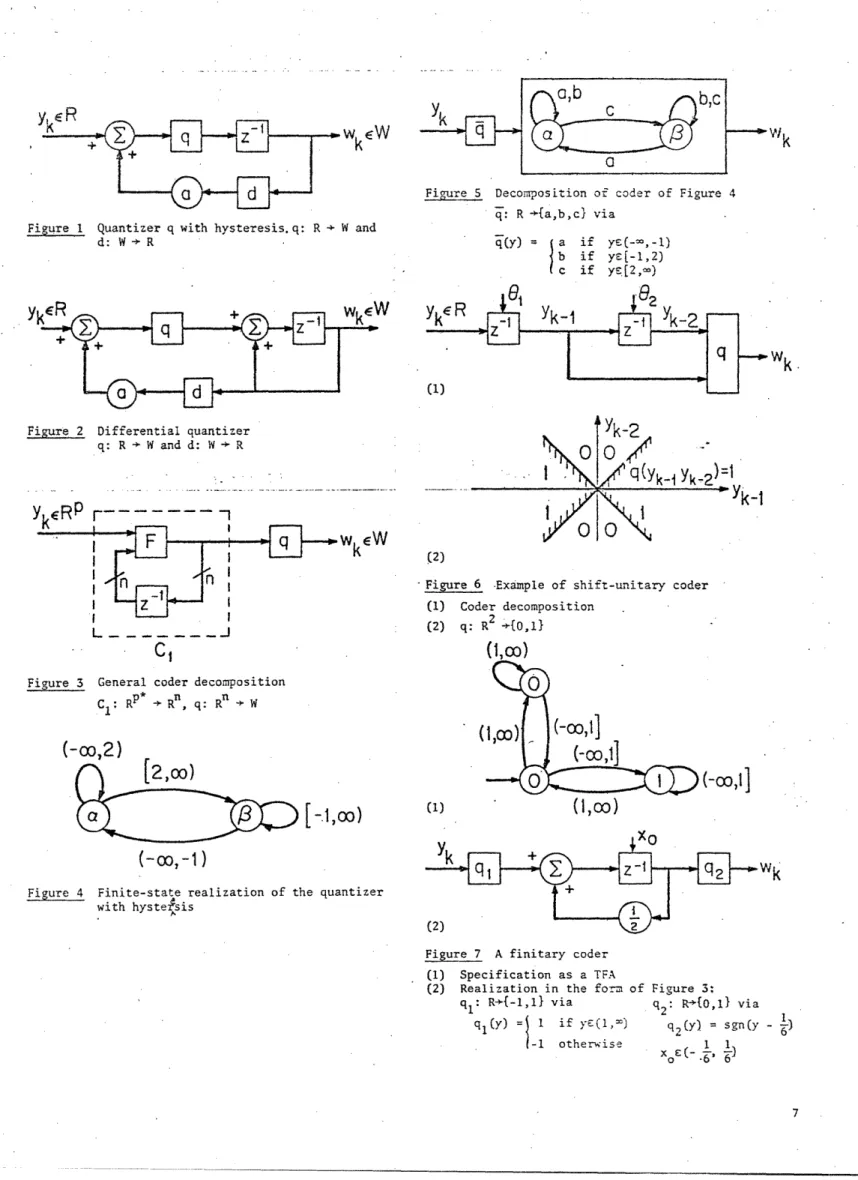
Figure 5 Deco-mposition of coder of Figure 4 q: R +{a,b,c} via
Figure 1 Quantizer q with hysteresis.q: R + W and
d: W + R q(y) = a if yC(--,-I)
b if y{[-l,2) .
c if yC[2,3)
_y
; -Wk.
Figure 2 Differential quantizer
Yk-2
q: R W and d: W - R
1
0
.,"
..
'"f'"
':
.: - .'
~~-
.
._
Yk-2
=X(Yk-
) 1Y
ERP
r
'
I
Wk
fW'
J
EW
°1Wk
k
~
(2)
n
, -Figure 6 Example of shift-unitary coderI lf~ --
f (1) Coder decomposition
.3 R 2
(2) q: R +{0,1}
C,
(1o)
Figure 3 General coder decomposition
C1: Rp * R, q: Rn W
(-GG,2)
,oo)
(-oo1]
a=
>[-1,co)
/>
(1)
(I,00)
XO
-(-oo,-l
)
-Wk
Figure 4 Finite-state realization of the quantizer with hystetsis
Figure 7 A finitary coder (1) Specification as a TFA
(2) Realization in the form of Figure 3:
ql: R+{-1,l} via q2: R+{O,1} via
ql(Y) 1 if YE(1,) } q2(y) sgn(y
-- otherwise I 1