HAL Id: hal-03048742
https://hal.archives-ouvertes.fr/hal-03048742
Submitted on 9 Dec 2020HAL is a multi-disciplinary open access archive for the deposit and dissemination of sci-entific research documents, whether they are pub-lished or not. The documents may come from teaching and research institutions in France or abroad, or from public or private research centers.
L’archive ouverte pluridisciplinaire HAL, est destinée au dépôt et à la diffusion de documents scientifiques de niveau recherche, publiés ou non, émanant des établissements d’enseignement et de recherche français ou étrangers, des laboratoires publics ou privés.
To cite this version:
Paul Iannetta, Laure Gonnord, Lionel Morel. On optimizing scalar self-rebalancing trees. COMPAS 2020 - Conférence francophone d’informatique en Parallélisme, Architecture et Système, Jun 2020, Lyon, France. pp.1-7. �hal-03048742�
On optimizing scalar self-rebalancing trees
Paul Iannetta†, Laure Gonnord† et Lionel Morel‡† Univ Lyon, Université Claude Bernard Lyon 1 CNRS, ENS de Lyon, Inria,
LIP, F-69342, LYON Cedex 07, France pré[email protected]
‡ Univ Grenoble Alpes, CEA, F-38000 Grenoble, France [email protected]
Résumé
Balanced trees are pervasive and very often found in databases or other systems which are built around querying non-static data. In this paper, we show that trees implemented as a collection of pointers shows bad data locality, poor cache performance and suffer from a lack of parallelism opportunities. We propose an alternative implementation based on arrays. Both implementations appear to be equivalently efficient time-wise. This new layout exposes new parallelism opportunities which can be then exploited by an optimizing polyhedral compiler. Mots-clés : arbres équilibrés, parallélisme, modèle polyédrique, calcul haute performance
1. Introduction
Trees, especially balanced trees, are pervasive and are often found behind data strutures which need to be frequently queried such as sets, maps or dictionaries. Hence, they are often found in traditional databases as T-Trees [12] (a kind of balanced tree built on AVL trees [1,11]) or B-Trees [11]. The growing need of analyzing large amount of data, gathered from the internet and stored in gigantic databases require harnessing the computing power of high performance par-allel machines at their fullest. Improving the processing of trees is part of this endeavor and, a first step in this direction has been made by Blelloch et al. [2,13,14] who investigated the bene-fits of bulk operations to increase parallelism. In this paper, we claim that there is still room for optimizations addressing better cache locality. Indeed, traditional approaches implement trees as collections of pointers. We show that such implementations demonstrate poor data locality, leading to bad performances. Then we explore an alternative representation of those trees with the goal of providing better memory locality, while enabling fine-grained parallelism. Our ap-proach here is to build a memory layout with good properties with respect to the current state of the art compilers and their optimization schemes. This memory layout uses an array instead of a collection of pointers. This induces deep changes to the underlying mechanisms and their complexity (seeSection 3). Our goal is to make that this changes in complexity is amortized by better data locality and compiler support for our programs. In particular, not only we will exhibit better opportunities for vectorization, but also we plan to use polyhedral-model based optimizing compilers as backend. The polyhedral model [7, 8,10] is a framework which aims
at increasing the code locality of affine loop by rescheduling their instructions using various methods such as tiling and pipelining. As far as we know, the polyhedral model has never been considered to address programs using complex data structures relying on pointers such as trees, apart from the work of Paul Feautrier and Albert Cohen [5,6,9] which uses algebraic languages to describe the iteration space over trees. However, unlike Feautrier and Cohen, our approach does not extend the polyhedral model to tree like data structures. Rather, we try and make fit trees into arrays and see to what extent the operations like insertion, find or deletion can be written so as to fall within the reach of the polyhedral model. Our work focuses on stan-dard operations and their parallelization opportunities before tackling bulk operations which is left for the future.
The rest of the paper is organized as follows.Section 2recalls some background knowledge on AVL trees and the different ways of storing a tree as an array. Section 3explains in depth our approach andSection 4presents the optimizations that can be performed and to what extent our redesigned operations fit the polyhedral model. Finally,Section 5concludes and discusses plans for future work.
2. Background 2.1. AVL Trees
An AVL tree [1,11] is a binary search tree such that both of its children are AVL trees and that the absolute difference of theirs heights is strictly less that two. Those trees support the same operations as standard binary search trees (insert, delete and find). However, in order to keep those trees balanced when inserting or removing an element, they also provide a mechanism called rotation (seeFigure 1for simple or double rotation examples). An insertion needs at most one rotation to preserve the balance while a deletion may require as much as O(lg n) rotations. Nevertheless, since a rotation is an O(1) operation, and that both insertion and deletion inspect the balance ratio of O(lg n) nodes, the complextity of both operations is O(lg n). It is important to note that this will not be the case anymore when AVL trees will be stored as arrays because rotations will not be constant time operations anymore. The find operation is also O(lg n) due to the balanced nature of AVL trees.
x T1 y
T2 z
T3 T4
(a) A binary tree T
y z x T1 T2 T3 T4 (b) T after L-rotation x y T4 T1 z T2 T3 (c) A binary tree T0 y z x T1 T2 T3 T4 (d) T0after LR-rotation
Figure 1:Left (L) rotation applied on to the unbalanced tree T, and a left-right (LR) rotation applied to the unbalanced tree T’
2.2. AVL trees as arrays
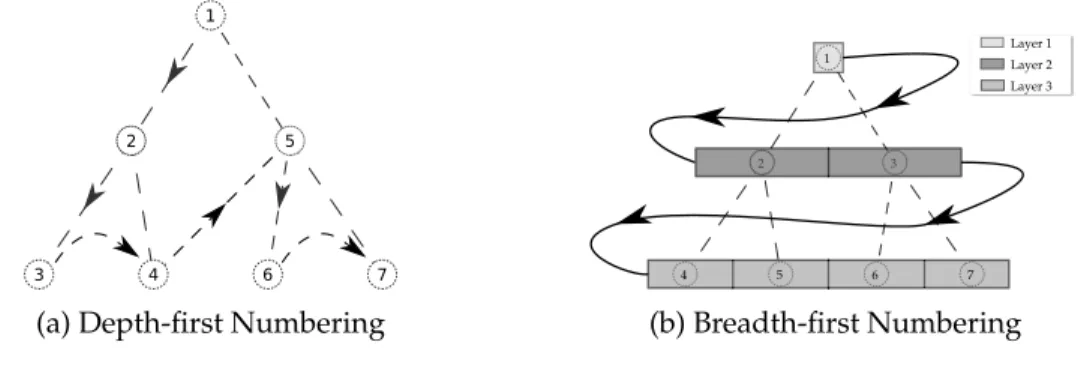
There are two natural categories of tree traversals: breadth-first and depth-first traversals. Each of them induces a linear order which can be used to index the elements of a tree. This order is not unique and depends on the order in which the children are visited.
Depth-first numbering. The depth-first traversal of a tree starts from its root, then recursively visits its left child before recursively visiting its right child. This traversal induces an order on the elements of the tree which can then be used to arrange the elements as an array. However,
there is no cheap way to recompute the structure of the tree from this numbering. This is a huge limitation because, in order to perform insertions, deletions, or searching for an element the structure of the tree is needed. A way to keep the structure of the tree is to store two additional arrays: one with the indexes of each node’s father and the another with the indexes of each node’s right child. Nevertheless, such book keeping is pretty expensive.
Breadth-first numbering. The breadth-first traversal of a tree starts from its root, then it visits each node at distance 1 of the root, then all nodes at distance 2 of the root, and so on until all nodes have been visited. Again, this traversal induces an order on the elements. This time, however, the structure of the array can be easily conserved if we also keep free holes for un-used nodes. This way, the numbering induces layers where the ithlayer is 2i-wide. The main
advantage of this layered representation is to provide an easy way to recover the tree structure from array indices.
(a) Depth-first Numbering
1 2 3 4 5 6 7 Layer 1 Layer 2 Layer 3 (b) Breadth-first Numbering
Figure 2: Array Numberings
We propose to evaluate in the rest of the paper how this new breadth-first memory layout can expose optimization opportunities, in particular during the construction of the tree where ro-tations are the crucial operations.
3. Rotations on breadth first arrays
Traditionally, a rotation is a cheap operation which: 1. moves around two pointers and 2. up-dates the information about the heights and the balance ratio of the nodes. However, when trees are internally represented as arrays, rotations become much more expensive because, now, part of the array has to be actually moved from one memory location to another. Hence, the cost of a rotation in the worst case becomes O(n). This section describes each operation (left and right rotation, but also left-right and right-left rotations) as a sequence of low-level operations on breadth-first array, namely shifts and pulls. On the other hand, the next section will explore how those low-level operations can be more efficient.
3.1. Low-level operations on breadth-first arrays
As presented in Section 2.2, breadth-first arrays provide a convenient index scheme which allows to view the array as a collection of layers. The next paragraphs will explain the action of rotations on those layers. First, we present a collection of low-level operations (shifts and pulls), then, we describe how those low-level operations can be combined to implement rotations. It should be noted that those low-level operations can be applied on all kinds of breadth-first arrays, by themselves they do not preserve the balancing property of AVL. The combinations presented inSection 3.2do preserve the balancing property.
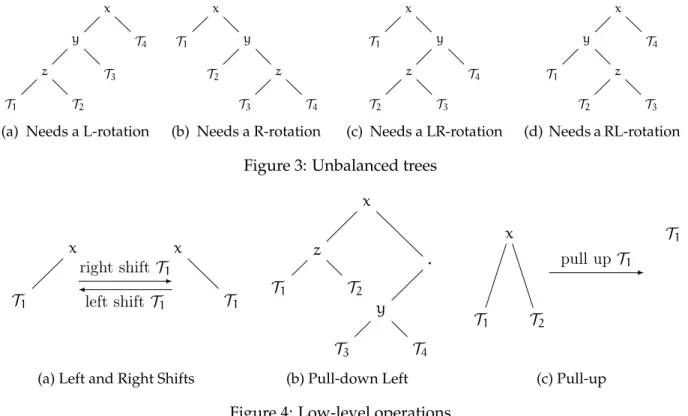
Left and right shifts (Figure 4a).A shift moves a subtree at a certain depth to the left or to the right. The tree is moved such that it is still on the same depth. If we move left the left-most
x y T4
z T3
T1 T2
(a) Needs a L-rotation
x T1 y T2 z T3 T4 (b) Needs a R-rotation x T1 y z T4 T2 T3 (c) Needs a LR-rotation x y T4 T1 z T2 T3 (d) Needs a RL-rotation
Figure 3: Unbalanced trees
x T1 x T1 right shift T1 left shift T1
(a) Left and Right Shifts
x z . y T1 T2 T3 T4 (b) Pull-down Left x T1 T2 pull up T1 T1 (c) Pull-up
Figure 4: Low-level operations
subtree or move right the right-most subtree of a depth then this subtree is removed from the tree. The following picture might suggest that this operation is an involution. Nevertheless, this is not the case. First, the values which are moved overwrite previous values if any. Second, a subtree which is moved out of the tree it is forever lost.
Pull up (Figure 4c). A pull up takes a subtree and graft it in place of its father. This is a de-structive operation in the sense that the father’s node as well as one of his children’s tree is overwritten. This operation can’t be performed on the root because it does not have a father. Left and right pulls down (Figure 4b). A pull down takes a subtree and graft it at the place of its right (in the case of a right pull down) or left (in the case of a left pull down) children. Conceptually this operation is not destructive, however, in practice, if the array which is used to represent the tree is of fixed size it is. This can be avoided by padding the tree with an empty layer at the bottom.
3.2. Rotations as sequences of low-level operations
Now that the elementary operations have been defined, we can use them to implement rota-tions as is explained in the following table.
Rotation Right Left Right-left Left-right
Initial Configuration Figure 3a Figure 3b Figure 3c Figure 3d
Steps
1. pull down T4 pull down T1 pull down T1 pull down T4
2. shift right T3 shift left T2 shift left T2 shift right T3
3. pull up z pull up z pull up T2 pull up T2
4. relabel x, y, z relabel x, y, z relabel x, y, z relabel x, y, z Unlike the depth-first representation, this time the rotations are not a single in-memory shift but several independent in-memory shifts which are all performed on the same array. The independence of those shifts will be explored in more details inSection 4.
3.3. Performance analysis
The goal here is to present and analyze the benchmarks, summarizing the time and the percent-age of cache misses during the creation of random trees. The experiments have been done on a machine equipped with an Intel®Core™i5-5300U CPU @ 2.30GHz with 3072KB of cache. Each
test has been run 10 times. The following table records the mean of the results across those 10 calls.
avl-tree avl-bf
size density time (s) cache-misses (%) time (s) cache-misses (%)
64 0.55 0.001812 45 0.001659 41 512 0.33 0.001955 48 0.001792 43 1024 0.33 0.001754 48 0.001943 43 65536 0.13 0.031252 17 0.047713 36 524288 0.17 0.517095 46 0.648161 60 1048576 0.13 1.192258 47 1.509468 63 2097152 0.06 3.027440 47 3.779821 63
As can be seen from the above results neither the tree implementation, nor the array imple-mentation are very good with respect to cache utilization. The number of cache misses is not constant for the tree implementation as may suggest the table. The huge number of cache misses in the array implementation is mostly due to the fact that the addresses are not aligned. The density of breadth first arrays is also a huge concern as the more elements they have, the sparser they become.
However, an interesting fact is that both require almost the time to construct an AVL tree from scratch. For this reason, we decided to investigate the opportunities that could be brought by a more efficient array implementation.
4. Optimizing breadth-first arrays
The previous section showed that the usual operations on AVL trees can be performed as a combination of low-level operations on breadth-first arrays. This section will focus on the internal mechanisms of those low-level operations and explore how they could be made more efficient. Most of what is presented focuses on the shift operations, optimizations relative to pulls are only sketched.
4.1. Shifts
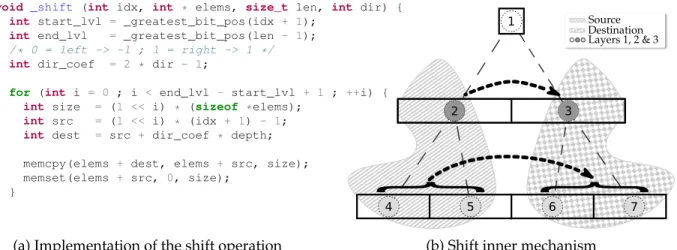
A shift is an operation which moves internally a subtree to the left or to the right, erasing any previous data and zeroing the source location. Figure 5billustrates how data moves when the subtree whose root is 2 (the striped region on the figure) is moved to the right into the subtree whose root is 3 (the checkerboard-like region on the figure). Shifting a subtree only modifies the source and destination region, that is why node 1 on the figure remains untouched. It can also be seen that the source region does not overlap with the destination region, this can be hinted to the compiler by using memcpy which provides an interface with restrict pointers since C99. The code listing inFigure 5a1makes use of that property.
Another point that should be noted is that layers can be moved independently from one an-other. More precisely, each node can be moved independently of the others. This means that it 1
This implementation cannot be used to shift a subtree out of an array. idx is the index of the root of the subtree to be shifted, elems is a breadth-first array, len its length, and dir is the shift direction (0 is left and 1 is right.)
void _shift (int idx, int * elems, size_t len, int dir) {
int start_lvl = _greatest_bit_pos(idx + 1);
int end_lvl = _greatest_bit_pos(len - 1); /* 0 = left -> -1 ; 1 = right -> 1 */
int dir_coef = 2 * dir - 1;
for (int i = 0 ; i < end_lvl - start_lvl + 1 ; ++i) {
int size = (1 << i) * (sizeof *elems); int src = (1 << i) * (idx + 1) - 1;
int dest = src + dir_coef * depth;
memcpy(elems + dest, elems + src, size); memset(elems + src, 0, size);
} }
(a) Implementation of the shift operation
Source Destination Layers 1, 2 & 3
(b) Shift inner mechanism
Figure 5: Shift internals
is possible to massively parallelize the shift mechanism. Indeed, thefor is a parallel for and memcpyand memset can be distributed over multiple threads as well as vectorized.
While it is possible to add openmp#pragmamanually our end goal is that an optimizing com-piler should be able to detect itself the parallelization opportunities, as well as the vectorization opportunities and to harness them.
When we want to try to expose the inner parallelism of a code mainly using arrays, we cannot help but think of the polyhedral model [7,8,10]. However, our code does not quite fit the model because the iteration variable of theforloop does not follow a linear pattern. PLUTO [3,4] a
polyhedral loop parallelizer is able to detect and parallelize memcpy and memset2but fails to optimize the parallel for.
Another room for improvement comes from the fact the data could be moved in small chunks whose size should depend on the features of the processor such as its cache size and the size of the registers used by its vector unit.
4.2. Pulls
Like shifts, pulls also offer parallelism and pipelining opportunities. However, unlike for shifts, data is moving from one layer to another and the order of operations becomes important. This leads to more complex moving patterns that will be studied in detail in the future.
5. Conclusion
In order to address the parallelism issues of self-rebalancing trees, we proposed to change the memory layout to a collection of pointers to an array. Time-wise, the new memory layout per-forms almost the same as the traditional implementation based on a collection of pointers. We also pointed out that the cost of rotations is higher with this layout but it is possible to alleviate this cost since those can be massively parallelized. In the future, we plan to improve on this work on several directions : first of all, we are working on breath-first arrays compression to improve cache performance. Second, the very predictable data layout of these arrays should enable us to push the limits of polyhedral-based compiler optimisations so that to automati-cally perform bulk operations.
2
We have rewritten these two functions as loops operating on single elements, as PLUTO is unable to deal with function calls.
Bibliographie
1. Adel’son-Vel’skii (G. M.) et Landis (E. M.). – An algorithm for organization of information. Dokladi Akademia Nauk SSSR, vol. 146, n2, April 1962, pp. 263–266.
2. Blelloch (G. E.), Ferizovic (D.) et Sun (Y.). – Just join for parallel ordered sets. – In Proceed-ings of the 28th ACM Symposium on Parallelism in Algorithms and Architectures, SPAA ’16, p. 253–264, New York, NY, USA, 2016. Association for Computing Machinery.
3. Bondhugula (U.), Baskaran (M.), Krishnamoorthy (S.), Ramanujam (J.), Rountev (A.) et Sa-dayappan (P.). – Automatic transformations for communication-minimized parallelization and locality optimization in the polyhedral model. – In International Conference on Compiler Construction (ETAPS CC), April 2008.
4. Bondhugula (U.), Hartono (A.), Ramanujam (J.) et Sadayappan (P.). – A practical automatic polyhedral parallelizer and locality optimizer. – In Proceedings of the 29th ACM SIGPLAN Conference on Programming Language Design and Implementation, PLDI ’08, pp. 101–113, New York, NY, USA, 2008. ACM.
5. Cohen (A.). – Analyse de flot de données pour programmes récursifs à l’aide de langages algébriques. Technique et Science Informatiques, 1999.
6. Cohen (A.). – Program Analysis and Transformation: From the Polytope Model to Formal Lan-guages. – Theses, Université de Versailles-Saint Quentin en Yvelines, December 1999. 7. Feautrier (P.). – Some efficient solutions to the affine scheduling problem, I,
one-dimensional time. International Journal of Parallel Programming, vol. 21, n 5, October 1992, pp. 313–348.
8. Feautrier (P.). – Some efficient solutions to the affine scheduling problem, II, multi-dimensional time. International Journal of Parallel Programming, vol. 21, n6, December 1992, pp. 389–420.
9. Feautrier (P.). – A parallelization framework for recursive tree programs. – In Pritchard (D.) et Reeve (J.) (édité par), Euro-Par’98 Parallel Processing, pp. 470–479, Berlin, Heidelberg, 1998. Springer Berlin Heidelberg.
10. Feautrier (P.). – Encyclopedia of Parallel Computing, chap. Polyhedron Model, pp. 1581–1592. – Springer, 2011.
11. Gonnet (G. H.) et Baeza-Yates (R.). – Handbook of Algorithms and Data Structures in Pascal and C. – Addison-Wesley Pub (Sd), 1991, 2nd édition.
12. Lehman (T. J.) et Carey (M. J.). – A study of index structures for main memory database management systems. – In Proceedings of the 12th International Conference on Very Large Data Bases, VLDB ’86, p. 294–303, San Francisco, CA, USA, 1986. Morgan Kaufmann Publishers Inc.
13. Sun (Y.) et Blelloch (G.). – Implementing parallel and concurrent tree structures. – In Pro-ceedings of the 24th Symposium on Principles and Practice of Parallel Programming, PPoPP ’19, p. 447–450, New York, NY, USA, 2019. Association for Computing Machinery.
14. Sun (Y.), Ferizovic (D.) et Belloch (G. E.). – Pam: Parallel augmented maps. SIGPLAN Not., vol. 53, n1, February 2018, p. 290–304.