HAL Id: hal-00149120
https://hal.archives-ouvertes.fr/hal-00149120
Submitted on 24 May 2007
HAL is a multi-disciplinary open access
archive for the deposit and dissemination of
sci-entific research documents, whether they are
pub-lished or not. The documents may come from
teaching and research institutions in France or
abroad, or from public or private research centers.
L’archive ouverte pluridisciplinaire HAL, est
destinée au dépôt et à la diffusion de documents
scientifiques de niveau recherche, publiés ou non,
émanant des établissements d’enseignement et de
recherche français ou étrangers, des laboratoires
publics ou privés.
A Logic of Reachable Patterns in Linked
Data-Structures
Greta Yorsh, Alexander Rabinovich, Mooly Sagiv, Antoine Meyer, Ahmed
Bouajjani
To cite this version:
Greta Yorsh, Alexander Rabinovich, Mooly Sagiv, Antoine Meyer, Ahmed Bouajjani. A Logic of
Reachable Patterns in Linked Data-Structures. FOSSACS 2006, Mar 2006, Vienne, Austria. p.
94-110, �10.1007/11690634_7�. �hal-00149120�
hal-00149120, version 1 - 24 May 2007
A Logic of Reachable Patterns
in Linked Data-Structures
Greta Yorsh1⋆, Alexander Rabinovich1, Mooly Sagiv1, Antoine Meyer2, and Ahmed Bouajjani2
1 Tel Aviv Univ., Israel.{gretay,rabinoa,msagiv}@post.tau.ac.il 2 Liafa, Univ. of Paris 7, France.{ameyer,abou}@liafa.jussieu.fr
Abstract. We define a new decidable logic for expressing and checking
invari-ants of programs that manipulate dynamically-allocated objects via pointers and destructive pointer updates. The main feature of this logic is the ability to limit the neighborhood of a node that is reachable via a regular expression from a des-ignated node. The logic is closed under boolean operations (entailment, negation) and has a finite model property. The key technical result is the proof of decidabil-ity.
We show how to express precondition, postconditions, and loop invariants for some interesting programs. It is also possible to express properties such as dis-jointness of data-structures, and low-level heap mutations. Moreover, our logic can express properties of arbitrary data-structures and of an arbitrary number of pointer fields. The latter provides a way to naturally specify postconditions that relate the fields on entry to a procedure to the fields on exit. Therefore, it is possible to use the logic to automatically prove partial correctness of programs performing low-level heap mutations.
1
Introduction
The automatic verification of programs with dynamic memory allocation and pointer manipulation is a challenging problem. In fact, due to dynamic memory allocation and destructive updates of pointer-valued fields, the program memory can be of arbitrary size and structure. This requires the ability to reason about a potentially infinite number of memory (graph) structures, even for programming languages that have good capabil-ities for data abstraction. Usually abstract-datatype operations are implemented using loops, procedure calls, and sequences of low-level pointer manipulations; consequently, it is hard to prove that a data-structure invariant is reestablished once a sequence of op-erations is finished [19].
To tackle the verification problem of such complex programs, several approaches emerged in the last few years with different expressive powers and levels of automation, including works based on abstract interpretation [27, 34, 31], logic-based reasoning [23, 32], and automata-based techniques [24, 28, 5]. An important issue is the definition of a formalism that (1) allows us to express relevant properties (invariants) of various kinds of linked data-structures, and (2) has the closure and decidability features needed for
automated verification. The aim of this paper is to study such a formalism based on logics over arbitrary graph structures, and to find a balance between expressiveness, decidability and complexity.
Reachability is a crucial notion for reasoning about linked data-structures. For in-stance, to establish that a memory configuration contains no garbage elements, we must show that every element is reachable from some program variable. Other examples of properties that involve reachability are (1) the acyclicity of data-structure fragments, i.e., every element reachable from nodeu cannot reach u, (2) the property that a
data-structure traversal terminates, e.g., there is a path from a node to a sink-node of the data-structure, (3) the property that, for programs with procedure calls when references are passed as arguments, elements that are not reachable from a formal parameter are not modified.
A natural formalism to specify properties involving reachability is the first-order logic over graph structures with transitive closure. Unfortunately, even simple decidable fragments of first-order logic become undecidable when transitive closure is added [13, 21].
In this paper, we propose a logic that can be seen as a fragment of the first-order logic with transitive closure. Our logic is (1) simple and natural to use, (2) expressive enough to cover important properties of a wide class of arbitrary linked data-structures, and (3) allows for algorithmic modular verification using programmer’s specified loop-invariants and procedure’s specifications.
Alternatively, our logic can be seen as a propositional logic with atomic proposition modelling reachability between heap objects pointed-to by program variables and other heap objects with certain properties. The properties are specified using patterns that limit the neighborhood of an object. For example, in a doubly linked list, a pattern says that if an objectv has an an emanatingforwardpointer that leads to an objectw, then w has abackwardpointer intov.
The contributions of this paper can be summarized as follows:
– We define the Logic of Reachable Patterns (LRP) where reachability constraints
such as those mentioned above can be used. Patterns in such constraints are defined by quantifier-free first-order formulas over graph structures and sets of access paths are defined by regular expressions.
– We show that LRP has a finite-model property, i.e., every satisfiable formula has a
finite model. Therefore, invalid formulas are always falsified by a finite store.
– We prove that the logic LRP is, unfortunately, undecidable.
– We define a suitable restriction on the patterns leading to a fragment of LRP called
LRP2.
– We prove that the satisfiability (and validity) problem is decidable. The fragment
LRP2 is the main technical result of the paper and the decidability proof is non-trivial. The main idea is to show that every satisfiable LRP2formula is also satisfied by a tree-like graph. Thus, even though LRP2expresses properties of arbitrary data-structures, because the logic is limited enough, a formula that is satisfied on an arbitrary graph is also satisfied on a tree-like graph. Therefore, it is possible to answer satisfiability (and validity) queries for LRP2using a decision procedure for monadic second-order logic (MSO) on trees.
– We show that despite the restriction on patterns we introduce, the logic LRP2 is still expressive enough for use in program verification: various important data-structures, and loop invariants concerning their manipulation, are in fact definable in LRP2.
The new logic LRP2forms a basis of the verification framework for programs with pointer manipulation [37], which has important advantages w.r.t. existing ones. For instance, in contrast to decidable logics that restrict the graphs of interest (such as monadic second-order logic on trees), our logic allows arbitrary graphs with an arbi-trary number of fields. We show that this is very useful even for verifying programs that manipulate singly-linked lists in order to express postcondition and loop invariants that relate the input and the output state. Moreover, our logic strictly generalizes the decidable logic in [3], which inspired our work. Therefore, it can be shown that certain heap abstractions including [16, 33] can be expressed using LRP2formulas.
The rest of the paper is organized as follows: Section 2 defines the syntax and the semantics of LRP, and shows that it has a finite model property, and that LRP is unde-cidable; Section 3 defines the fragment LRP2, and demonstrates the expressiveness of
LRP2on several examples; Section 4 describes the main ideas of the decidability proof for LRP2; Section 5 discusses the limitations and the extensions of the new logics; fi-nally, Section 6 discusses the related work. The full version of the paper [36] contains the formal definition of the semantics of LRP and proofs.
2
The LRP Logic
In this section, we define the syntax and the semantics of our logic. For simplicity, we explain the material in terms of expressing properties of heaps. However, our logic can actually model properties of arbitrary directed graphs. Still, the logic is powerful enough to express the property that a graph denotes a heap.
2.1 Syntax of LRP
LRP is a propositional logic over reachability constraints. That is, an LRP formula is a
boolean combination of closed formulas in first-order logic with transitive closure that satisfy certain syntactic restrictions.
Letτ = hC, U, F i denote a vocabulary, where (i) C is a finite set of constant
sym-bols usually denoting designated objects in the heap, pointed to by program variables; (ii)U is a set of unary relation symbols denoting properties, e.g., color of a node in a
Red-Black tree; (ii)F is a finite set of binary relation symbols (edges) usually denoting
pointer fields.3
A termt is either a variable or a constant c∈ C. An atomic formula is an equality t = t′
, a unary relationu(t), or an edge formula t → tf ′
, wheref ∈ F , and t, t′ are terms. A quantifier-free formulaψ(v0, . . . , vn) over τ and variables v0, . . . , vnis an arbitrary boolean combination of atomic formulas. LetF V(ψ) denote the free variables
of the formulaψ.
Definition 1. Letψ be a conjunction of edge formulas of the form vi f
→ vj, where
f ∈ F and 0 ≤ i, j ≤ n. The Gaifman graph of ψ, denoted by Bψ, is an undirected
graph with a vertex for each free variable ofψ. There is an arc between the vertices
corresponding toviandvjinBψif and only if(vi f
→ vj) appears in ψ, for some f ∈ F .
The distance between logical variablesviandvj in the formulaψ is the minimal edge
distance between the corresponding verticesviandvjinBψ. For example, for the formulaψ= (v0
f
→ v1) ∧ (v0 f
→ v2) the distance between v1and
v2inψ is2, and its underlying graph Bψlooks like this:v1—v0—v2.
Definition 2. (Syntax of LRP) A neighborhood formulaN(v0, . . . , vn) is a
conjunc-tion of edge formulas of the formvi f
→ vj, wheref ∈ F and 0 ≤ i, j ≤ n.
A routing expression is an extended regular expression, defined as follows:
R::= ∅ empty set
| ǫ empty path
| →f f ∈ F forward along edge
| ←f f ∈ F backward along edge | u u∈ U test if u holds
| ¬u u∈ U test if u does not hold | c c∈ C test if c holds
| ¬c c∈ C test if c does not hold | R1.R2 concatenation
| R1|R2 union
| R∗ Kleene star
A routing expression can require that a path traverse some edges backwards. A routing expression has the ability to test presence and absence of certain unary relations and constants along the path.
A reachability constraint is a closed formula of the form:
∀v0, . . . , vn.R(c, v0) ⇒ (N (v0, . . . , vn) ⇒ ψ(v0, . . . , vn))
wherec ∈ C is a constant, R is a routing expression, N is a neighborhood formula,
andψ is an arbitrary quantifier-free formula, such that F V(N ) ⊆ {v0, . . . , vn} and
F V(ψ) ⊆ F V (N ) ∪ {v0}. In particular, if the neighborhood formula N is true (the
empty conjunction), thenψ is a formula with a single free variable v0.
An LRP formula is a boolean combination of reachability constraints.
The subformulaN(v0, . . . , vn) ⇒ ψ(v0, . . . , vn) defines a pattern, denoted by p(v0). Here, the designated variablev0denotes a “central” node of the “neighborhood” reach-able fromc by following an R-path. Intuitively, neighborhood formula N binds the
variablesv0, . . . , vn to nodes that form a subgraph, andψ defines more constraints on those nodes.4
4
In all our examples, a neighborhood formula N used in a pattern is such that BN(the Gaifman
We use let expressions to specify the scope in which the pattern is declared:
letp1(v0)
def
= N1(v0, v1, . . . , vn) ⇒ ψ1(v0, . . . , vn) in ϕ
This allows us to write more concise formulas via sharing of patterns.
Shorthands We usec[R]p to denote a reachability constraint. Intuitively, the
reachabil-ity constraint requires that every node that is reachable fromc by following an R-path
satisfy the patternp.
We usec1[R]¬c2to denote letp(v0)
def
= (true ⇒ ¬(v0 = c2)) in c1[R]p. In this simple case, the neighborhood is only the node assigned tov0. Intuitively,c1[R]¬c2 means that the node labelled by constantc2 is not reachable along an R-path from the node labelled byc1. We usec1hRic2 as a shorthand for¬(c1[R]¬c2). Intuitively,
c1hRic2 means that there exists anR-path from c1 toc2. We usec1 = c2 to denote
c1hǫic2, andc16= c2to denote¬(c1= c2). We use c[R](p1∧ p2) to denote (c[R]p1) ∧
(c[R]p2), when p1 andp2agree on the central node variable. When two patterns are often used together, we introduce a name for their conjunction (instead of naming each one separately): letp(v0)
def
= (N1⇒ ψ1) ∧ (N2⇒ ψ2) in ϕ. In routing expressions, we useΣ to denote(f1
→ | f2
→ | . . . |fm
→), the union of all the
fields inF . For example, c1[Σ∗]¬c2means thatc2is not reachable fromc1by any path. Finally, we sometimes omit the concatenation operator “.” in routing expressions.
Semantics An interpretation for an LRP formula over τ = hC, U, F i is a labelled
directed graphG= hVG, EG, CG, UGi where: (i) VGis a set of nodes modelling the heap objects, (ii)EG: F → P(VG × VG) are labelled edges, (iii) CG: C → VG provides interpretation of constants as unique labels on the nodes of the graph, and (iv)UG: U → P(VG) maps unary relation symbols to the set of nodes in which they hold.
We say that nodev∈ G is labelled with σ if σ ∈ C and v = CG(σ) or σ ∈ U and
v ∈ UG(σ). In the rest of the paper, graph denotes a directed labelled graph, in which nodes are labelled by constant and unary relation symbols, and edges are labelled by binary relation symbols, as defined above.
We define a satisfaction relation|= between a graph G and LRP formula (G |= ϕ)
similarly to the usual semantics the first-order logic with transitive closure over graphs (see [36]).
2.2 Properties of LRP
LRP with arbitrary patterns has a finite model property. If formulaϕ ∈ LRP has an
infinite model, each reachability constraint inϕ that is satisfied by this model has a
finite witness.
Theorem 1. (Finite Model Property) Every satisfiable LRP formula is satisfiable by
a finite graph.
Sketch of Proof: We show that LRP can be translated into a fragment of an infinitary
conjunction of universal first-order sentences. Therefore, ifG is a model of c[R]p then
every substructure ofG is also its model. Dually,¬c[R]p is equivalent to an infinite
disjunction of existential first-order sentences. Therefore, ifG is a model of¬c[R]p,
thenG has a finite substructure G′such that every substructure of
G that contains G′is a model of¬c[R]p. It follows that every satisfiable boolean combination of formulas of
the formc[R]p has a finite model. Thus, LRP has a finite model property.
The logicLRP is undecidable. The proof uses a reduction from the halting problem
of a Turing machine.
Theorem 2. (Undecidability) The satisfiability problem of LRP formulas is
undecid-able.
Sketch of Proof: Given a Turing machineM , we construct a formula ϕM such thatϕM is satisfiable if and only if the execution ofM eventually halts.
The idea is that each node in the graph that satisfiesϕM describes a cell of a tape in some configuration, with unary relation symbols encoding the symbol in each cell, the location of the head and the current state. The n-edges describe the sequence of
cells in a configuration and a sequence of configurations. Theb-edges describe how the
cell is changed from one configuration to the next. The constantc1marks the node that describes the first cell of the tape in the first configuration, the constantc2marks the node that describes the first cell in the second configuration, and the constantc3marks the node that describes the last cell in the last configuration (see sketch in Fig. 1).
Fig. 1. sketch of a model.
The most interesting part of the formulaϕM ensures that all graphs that satisfy
ϕM have a grid-like form. It states that for every nodev that is n-reachable from c1, if there is ab-edge from v to u, then there is a b-edge from the n-successor of v to the n-successor of u: let p(v)= (vdef → u) ∧ (vb → vn 1) ∧ (u n → u1) ⇒ (v1 b → u1) in c1[( n →)∗ ]p (1)
Remark. The reduction uses only two binary relation symbols and a fixed number of
unary relation symbols. It can be modified to show that the logic with three binary relation symbols (and no unary relations) is undecidable.
3
The LRP
2Fragment and its Usefulness
In this section we define the LRP2 fragment of LRP, by syntactically restricting the patterns. The main idea is to limit the distance between the nodes in the pattern in certain situations.
Definition 3. A formula is in LRP2 if in every reachability constraintc[R]p, with a
patternp(v0)
def
= N (v0, . . . , vn) ⇒ ψ(v0, . . . , vn), ψ has one of the following forms:
– (equality pattern)ψ is a an equality between variables vi= vj, where0 ≤ i, j ≤
n, and the distance between vi andvj inN is at most2 (distance is defined in
Def. 1),
– (edge pattern)ψ is of the form vi
f
→ vj wheref ∈ F and 0 ≤ i, j ≤ n, and the
distance betweenviandvjinN is at most1.
– (negative pattern) atomic formulas appear only negatively inψ.
Remark. Note that formula (1), which is used in the proof of undecidability in
Theo-rem 2, is not in LRP2, becausep is an edge pattern with distance3 between v1andu1, while LRP2allows edge patterns with distance at most1.
3.1 Describing Linked Data-Structures
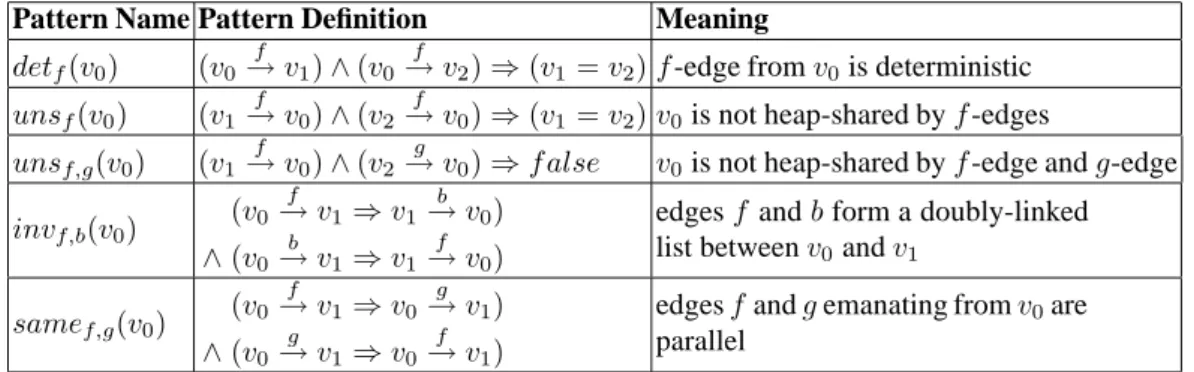
In this section, we show that LRP2can express properties of data-structures. Table 1 lists some useful patterns and their meanings. For example, the first patterndetf means that there is at most one outgoingf -edge from a node. Another important pattern unsf means that a node has at most one incomingf -edge. We use the subscript f to
empha-size that this definition is parametric inf .
Pattern Name Pattern Definition Meaning
detf(v0) (v0 f
→ v1) ∧ (v0 f
→ v2) ⇒ (v1= v2) f -edge from v0is deterministic
unsf(v0) (v1 f
→ v0) ∧ (v2 f
→ v0) ⇒ (v1= v2) v0is not heap-shared byf -edges
unsf,g(v0) (v1 f
→ v0) ∧ (v2 g
→ v0) ⇒ f alse v0is not heap-shared byf -edge and g-edge
invf,b(v0) (v 0 f → v1⇒ v1 b → v0) ∧ (v0 b → v1⇒ v1 f → v0)
edgesf and b form a doubly-linked
list betweenv0andv1
samef,g(v0) (v 0 f → v1⇒ v0 g → v1) ∧ (v0 g → v1⇒ v0 f → v1)
edgesf and g emanating from v0are parallel
Table 1. Useful pattern definitions (f, b, g∈ F are edge labels).
Well-formed heaps We assume thatC (the set of constant symbols) contains a constant
for each pointer variable in the program (denoted byx, y in our examples). Also, C
contains a designated constantnull that representsNULLvalues. Throughout the rest of the paper we assume that all the graphs denote well-formed heaps, i.e., the fields of all objects reachable from constants are deterministic, and dereferencing NULL yields
null. In LRP2this is expressed by the formula:
(^ c∈C ^ f ∈F c[Σ∗ ]detf) ∧ ( ^ f ∈F nullh→inull)f (2)
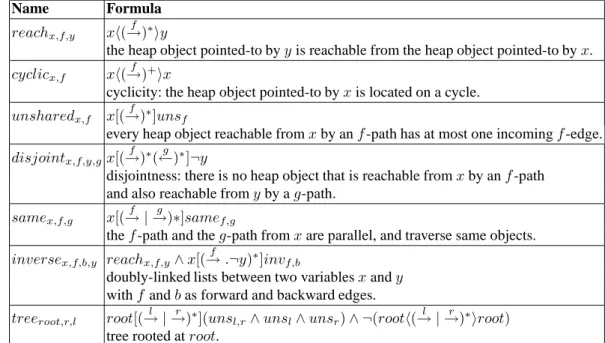
Name Formula
reachx,f,y xh( f
→)∗iy
the heap object pointed-to byy is reachable from the heap object pointed-to by x. cyclicx,f xh(
f
→)+ix
cyclicity: the heap object pointed-to byx is located on a cycle. unsharedx,f x[(
f
→)∗]uns f
every heap object reachable fromx by an f -path has at most one incoming f -edge. disjointx,f,y,gx[(
f
→)∗(←)g ∗]¬y
disjointness: there is no heap object that is reachable fromx by an f -path
and also reachable fromy by a g-path. samex,f,g x[(
f
→ |→)∗]sameg f,g
thef -path and the g-path from x are parallel, and traverse same objects. inversex,f,b,y reachx,f,y∧ x[(
f
→ .¬y)∗
]invf,b
doubly-linked lists between two variablesx and y
withf and b as forward and backward edges. treeroot,r,l root[(
l
→ |→)r ∗
](unsl,r∧ unsl∧ unsr) ∧ ¬(rooth( l
→ |→)r ∗iroot) tree rooted atroot.
Table 2. Properties of data-structures expressed in LRP2.
Using the patterns in Table 1, Table 2 defines some interesting properties of data-structures using LRP2. The formulareachx,f,y means that the object pointed-to by the program variabley is reachable from the object pointed-to by the program
vari-ablex by following an access path of f field pointers. We can also use it with null
in the place ofy. For example, the formula reachx,f,nulldescribes a (possibly empty) linked-list pointed-to byx. Note that it implies that the list is acyclic, because null is
always a “sink” node in a well-formed heap. We can also express that there are no in-comingf -edges into the list pointed to by x, by conjoining the previous formula with unsharedx,f. Alternatively, we can specify thatx is located on a cycle of f -edges:
cyclicx,f. Disjointness can be expressed by the formuladisjointx,f,y,gthat uses both forward and backward traversal of edges in the routing expression. For example, we can express that the linked list pointed to byx is disjoint from the linked-list pointed to
byy, using the formula disjointx,f,y,f. Disjointness of data-structures is important for parallelization (e.g., see [17]).
The last two examples in Table 2 specify data-structures with multiple fields. The formulainversex,f,b,ydescribes a doubly-linked with variablesx and y pointing to the head and the tail of the list, respectively. First, it guarantees the existence of anf -path.
Next, it uses the patterninvf,bto express that if there is anf -edge from one node to another, then there is ab-edge in the opposite direction. This pattern is applied to all
nodes on thef -path that starts from x and that does not visit y, expressed using the test
“¬y” in the routing expression. The formula treeroot,r,ldescribes a binary tree. The first part requires that the nodes reachable from the root (by following any path ofl and
r fields) be not heap-shared. The second part prevents edges from pointing back to the
root of the tree by forbidding the root to participate in a cycle.
3.2 Expressing Verification Conditions
Thereverseprocedure shown in Fig. 2 performs in-place reversal of a singly-linked list. This procedure is interesting because it destructively updates the list and requires two fields to express partial correctness. Moreover, it manipulates linked lists in which each list node can be pointed-to from the outside. In this section, we show that the verification conditions for the procedurereversecan be expressed in LRP2. If the verification conditions are valid, then the program is partially correct with respect to the specification. The validity of the verification conditions can be checked automatically because the logic LRP2is decidable, as shown in the next section. In [37], we show how to automatically generate verification conditions in LRP2for arbitrary procedures that are annotated with preconditions, postconditions, and loop invariants in LRP2.
Node reverse(Node x){ L0: Node y = NULL; L1: while (x != NULL){ L2: Node t = x->n; L3: x->n = y; L4: y = x; L5: x = t; L6: } L7: return y; } Fig. 2. Reverse.
Notice that in this section we assume that all graphs denote valid stores, i.e., sat-isfy (2). The precondition requires thatx point to an acyclic list, on entry to the
pro-cedure. We use the symbolsx0 andn0
to record the values of the variablex and the n-field on entry to the procedure.
predef= x0h(n
0
→)∗inull0
The postcondition ensures that the result is an acyclic list pointed-to byy. Most
impor-tantly, it ensures that each edge of the original list is reversed in the returned list, which is expressed in a similar way to a doubly-linked list, usinginverse formula. We use the
relation symbolsy7 andn7
to refer to the values on exit.
post= ydef 7h(→)n7 ∗inull7∧ inverse
The loop invariantϕ shown below relates the heap on entry to the procedure to the
heap at the beginning of each loop iteration (labelL1). First, we require that the part of the list reachable fromx be the same as it was on entry toreverse. Second, the list reachable fromy is reversed from its initial state. Finally, the only original edge
outgoing ofy is to x.
ϕdef= samex1,n0,n1∧ inversex0,n0,n1,y1∧ x0h
n0
→iy1
Note that the postcondition uses two binary relations, n0 andn7, and also the loop invariant uses two binary relations, n0
and n1
. This illustrates that reasoning about singly-linked lists requires more than one binary relation.
The verification condition ofreverse consists of two parts, V Cloop andV C, explained below.
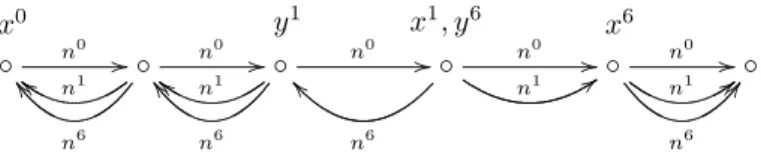
The formulaV Cloopexpresses the fact thatϕ is indeed a loop invariant. To express it in our logic, we use several copies of the vocabulary, one for each program point. Different copies of the relation symboln in the graph model values of the field n at
different program points. Similarly, for constants. For example, Fig. 3 shows a graph that satisfies the formulaV Cloop below. It models the heap at the end of some loop iteration ofreverse. The superscripts of the symbol names denote the corresponding program points. x0 y1 x1 , y6 x6 ◦ n 0 //◦ n0 // n1 cc n6 [[ ◦ n0 // n1 bb n6 [[ ◦ n0 // n1 :: n6 ^^ ◦ n0 // n1 ;; n6 CC◦
Fig. 3. An example graph that satisfies theV Cloopformula forreverse.
To show that the loop invariantϕ is maintained after executing the loop body, we
assume that the loop condition and the loop invariant hold at the beginning of the itera-tion, and show that the loop body was executed without performing a null-dereference, and the loop invariant holds at the end of the loop body:
V Cloop
def
= (x 6= null) loop is entered
∧ϕ loop invariant holds on loop head
∧(y6= x1) ∧ x1hn1ix6∧ x1hn6iy1 loop body
∧samey1,n1,n6∧ samex1,n1,n6 rest of the heap remains unchanged
⇒ (x16= null) no null-derefernce in the body
∧ϕ6 loop invariant after executing loop body
Here,ϕ6denotes the loop-invariant formula
ϕ after executing the loop body (labelL6), i.e., replacing all occurrences ofx1,
y1and
n1in
ϕ by x6,
y6and
n6, respectively. The formulaV Cloopdefines a relation between three states: on entry to the procedure, at the beginning of a loop iteration and at the end of a loop iteration.
The formulaV C expresses the fact that if the precondition holds and the execution
reaches procedure’s exit (i.e., the loop is not entered because the loop condition does not hold), the postcondition holds on exit:V C= pre ∧ (xdef 1= null) ⇒ post.
4
Decidability of LRP
2In this section, we show that LRP2is decidable for validity and satisfiability. Since LRP2 is closed under negation, it is sufficient to show that it is decidable for satisfiability.
The satisfiability problem for LRP2is decidable. The proof proceeds as follows: 1. Every formulaϕ ∈ LRP2 can be translated into an equi-satisfiable normal-form
formula that is a disjunction of formulas inCLRP2(Def. 4 and Theorem 3). It is sufficient to show that the satisfiability ofCLRP2is decidable.
2. Define a class of simple graphsAk, for which the Gaifman graph is a tree with at mostk additional edges (Def. 5).
3. Show that if formulaϕ∈ CLRP2has a model,ϕ has a model inAk, wherek is linear in the size of the formulaϕ (Theorem 4). This is the main part of the proof.
4. Translate formulaϕ∈ CLRP2into an equivalent MSO formula.
5. Show that the satisfiability of MSO logic overAk is decidable, by reduction to MSO on trees [30]. We could have also shown decidability using the fact that the tree width of all graphs inAk is bounded byk, and that MSO over graphs with bounded tree width is decidable [11, 1, 35].
Definition 4. (Normal-Form Formulas) A formula inCLRP2is a conjunction of
reach-ability constraints of the formc1hRic2andc[R]p, where p is one of the patterns allowed
in LRP2(Def. 3). A normal-form formula is a disjunction ofCLRP2formulas.
Theorem 3. There is a computable translation from LRP2to a disjunction of formulas
inCLRP2that preserves satisfiability.
Ayah Graphs We define a notion of a simple tree-like directed graph, called Ayah
graph.
LetG(S) denote the Gaifman graph of the graph S, i.e., an undirected graph
ob-tained fromS by removing node labels, edge labels, and edge directions (and parallel
edges). The distance between nodesv1andv2inS is the number of edges on the short-est path betweenv1andv2inG(S). An undirected graph B is in Tkif removing self loops and at mostk additional edges from B results in an acyclic graph.
Definition 5. Fork≥ 0, an Ayah graph of k is a graph S for which the Gaifman graph
is inTk:A
k = {S|G(S) ∈ Tk}.
Letϕ∈ CLRP2be of the formϕ3∧ ϕ2∧ ϕ=∧ ϕ→, whereϕ⋄ is a conjunction of constraints of the formc1hRic2,ϕ2is a conjunction of reachability constraints with negative patterns,ϕ=is a conjunction of reachability constraints with equality patterns, andϕ→is a conjunction of reachability constraints with edge patterns.
Theorem 4. Ifϕ∈ CLRP2is satisfiable, thenϕ is satisfiable by a graph inAk, where
k = 2 × n × |C| × m, m is the number of constraints in ϕ3,|C| is the number of
constants in the vocabulary, and for every regular expression that appears inϕ3there is an equivalent automaton with at mostn states.
Sketch of Proof: LetS be a model of ϕ : S |= ϕ. We construct a graph S′from
S and
show thatS′ |= ϕ and S′ ∈ A
k. The construction uses the following operations on graphs.
Witness Splitting A witness W for a formula c1hRic2 inCLRP2 in a graphS is a path inS, labelled with a word w∈ L(R), from the node labelled with c1to the node labelled withc2. Note that the nodes and edges on a witness path forR need not be distinct. Using W , we construct a graph W′
that consists of a path, labelled withw,
that starts at the node labelled byc1and ends at the node labelled byc2. Intuitively, we duplicate a node ofW each time the witness path for R traverses it, unless the node is
marked with a constant. As a result, all shared nodes inW′are labelled with constants. Also, every cycle contains a node labelled with a constant. By construction, we get that
W′ |= c
1hRic2. We say thatW′is the result of splitting the witnessW .
Finally, we say thatW is the shortest witness for c1hRic2if any other witness path forc1hRic2 is at least as long asW . The result of splitting the shortest witness is a graph inAk, wherek = 2 × n × |C|: to break all cycles it is sufficient to remove all the edges adjacent to nodes labelled with constants, and a node labelled with a constant is visited at mostn times. (If a node is visited more than once in the same state of the
automaton, the path can be shortened.)
Merge Operation Merging two nodes in a graph is defined in the usual way by gluing
these nodes. Letp(v0)
def
= N (v0, v1, v2) ⇒ (v1= v2) be an equality pattern. If a graph violates a reachability constraint c[R]p, we can assign nodesn0,n1, andn2tov0,v1, andv2, respectively, such that there is aR-path from c to v0,N(n0, n1, n2) holds, and
n1 andn2are distinct nodes. In this case, we say that merge operation of n1andn2
is enabled (by c[R]p). The nodesn1andn2can be merge to discharge this assignment (other merge operations might still be enabled after mergingn1andn2).
Edge-Addition Operation Letp(v0)
def
= N (v0, v1, v2) ⇒ v1 f
→ v2be an edge pattern. If a graph violates a reachability constraint c[R]p, we can assign nodesn0,n1, andn2 tov0,v1, andv2, respectively, such that there is aR-path from c to v0,N(n0, n1, n2) holds, and there is nof -edge from n1ton2. In this case, we say that edge-operation
operation is enabled (by c[R]p). We can add anf -edge from n1 andn2to discharge this assignment.
The following lemma is the key observation of this proof.
Lemma 1. The class ofAk graphs is closed under merge operations of nodes in
dis-tance at most two and edge-addition operations at disdis-tance one.
Sketch of Proof: If an edge is added in parallel to an existing one (distance one), it does
not affect the Gaifman graph, thusAkis closed under edge-addition. The proof thatAk is closed under merge operations is more subtle [36].
In particular, the classAkis closed under the merge and edge-addition operations forced by LRP2formulas. This is the only place in our proof where we use the distance restric-tion of LRP2patterns.
Given a graphS that satisfies ϕ, we construct the graph S′as follows:
1. For each constrainti in ϕ⋄, identify the shortest witnessWi inS. Let Wi′ be the result of splitting the witnessWi.
2. The graphS0is a union of allWi′’s, in which the nodes labelled with the (syntacti-cally) same constants are merged.
3. Apply all enabled merge operations and all enabled edge-addition operations in any order, producing a sequence of distinct graphsS0, S1, . . . , Sr, untilSmhas no enabled operations.
4. The resultS′ = S r.
The process described above terminates after a finite number of steps, because in each step either the number of nodes in the graph is decreased (by merge operations) or the number of edges is increased (by edge-addition operations).
The proof proceeds by induction on the process described above. Initially,S0is in
Ak. By Lemma 1, allSi created in the third step of the construction above are inAk; in particular,S′∈ A
k.
By construction ofS0, it contains a witness for each constraint inϕ3, and merge and edge-addition operations preserve the witnesses, thusS′
satisfiesϕ3. Moreover,
S0 satisfies all constraints in ϕ2. We show that merge and edge-addition operations applied in the construction preserveϕ2 constraints, thusS′
satisfiesϕ2. The process above terminates when no merge and edge-addition operations are enabled, that is,S′ satisfiesϕ=∧ ϕ→. Thus,S
′
satisfiesϕ.
The full proof is available at [36].
4.1 Complexity
We proved decidability by reduction to MSO on trees, which allows us to decide LRP2 formulas using MONA decision procedure [18]. Alternatively, a decision procedure for
LRP2 can directly construct a tree automaton from a normal-form formula, and can then check emptiness of the automaton. The worst case complexity of the satisfiability problem of LRP2formulas is at least doubly-exponential, but it remains elementary (in contrast to MSO on trees, which is non-elementary); we are investigating tighter upper and lower bounds. The complexity depends on the boundk ofAk models, according to Theorem 4. If the routing expressions do not contain constant symbols, then the boundk does not depend on the routing expressions: it depends only on the number
of reachability constraints of the formc1hRic2. The LRP2 formulas that come up in practice are well-structured, and we hope to achieve a reasonable performance.
5
Limitations and Further Extensions
Despite the fact that LRP2is useful, there are interesting program properties that cannot be expressed. For example, transitivity of a binary relation, that can be used, e.g., to ex-press partial orders, is naturally exex-pressible in LRP, but not in LRP2. Also, the property
that a general graph is a tree in which each node has a pointer back to the root is ex-pressible in LRP, but not in LRP2. Notice that the property is non-trivial because we are operating on general graphs, and not just trees. Operating on general graphs allows us to verify that the data-structure invariant is reestablished after a sequence of low-level mutations that temporarily violate the invariant data-structure.
There are of course interesting properties that are beyond LRP, such as the property that a general graph is a tree in which every leaf has a pointer to the root of a tree.
In the future, we plan to generalize LRP2while maintaining decidability, perhaps beyond LRP. We are encouraged by the fact that the proof of decidability in Section 4 holds “as is” for many useful extensions. For example, we can generalize the patterns to allow neighborhood formulas with disjunctions and negations of unary relations. In fact, more complex patterns can be used, as long as they do not violate theAk prop-erty. For example, we can define trees rooted atx with parent pointer b from every tree
node to its parent bytreex,r,l,b∧ let p(v0)
def = ((v1 l → v0) ∨ (v1 r → v0)) ⇒ (v0 b → v1)in x[( l → |→)r ∗](det
b∧ p). The extended logic remains decidable, because the pat-ternp adds edges only in parallel to the existing ones.
Currently, reachability constraints describe paths that start from nodes labelled by constants. We can show that the logic remains decidable when reachability constraints are generalized to describe paths that start from any node that satisfies a quantifier-free positive formula θ:∀v, w0, . . . , wm, v0, . . . , vn.R(v, v0) ∧ θ(v, w0, . . . , wm) ⇒
(N (v0, . . . , vn) ⇒ ψ(v0, . . . , vn)).
6
Related Work
There are several works on logic-based frameworks for reasoning about graph/heap structures. We mention here the ones which are, as far as we know, the closest to ours.
The logic LRP can be seen as a fragment of the first-order logic over graph structures with transitive closure (TC logic [20]). It is well known that TC is undecidable, and that this fact holds even when transitive closure is added to simple fragments of FO such as the decidable fragmentL2of formulas with two variables [29, 15, 13].
It can be seen that our logics LRP and LRP2 are both uncomparable with L2 + TC. Indeed, in LRP no alternation between universal and existential quantification is allowed. On the other hand, LRP2allows us to express patterns (e.g., heap sharing) that require more than two variables (see Table 1, Section 3).
In [3], decidable logicLr (which can also be seen as a fragment of TC) is intro-duced. The logics LRP and LRP2generalizeLr, which is in fact the fragment of these logics where only two fixed patterns are allowed: equality to a program variable and heap sharing.
In [21, 2, 26, 4] other decidable logics are defined, but their expressive power is rather limited w.r.t. LRP2 since they allow at most one binary relation symbol (mod-elling linked data-structures with 1-selector). For instance, the logic of [21] does not allow us to express the reversal of a list. Concerning the class of 1-selector linked data-structures, [6] provides a decision procedure for a logic with reachability constraints and arithmetical constraints on lengths of segments in the structure. It is not clear how
the proposed techniques can be generalized to larger classes of graphs. Other decidable logics [7, 25] are restricted in the sharing patterns and the reachability they can describe. Other works in the literature consider extensions of the first-order logic with fix-point operators. Such an extension is again undecidable in general but the introduction of the notion of (loosely) guarded quantification allows one to obtain decidable frag-ments such asµGF (or µLGF ) (Guarded Fragment with least and greater fixpoint
op-erators) [14, 12]. Similarly to our logics, the logicµGF (and also µLGF ) has the tree
model property: every satisfiable formula has a model of bounded tree width. However, guarded fixpoint logics are incomparable with LRP and LRP2. For instance, the LRP2 patterndetf that requires determinism off -field, is not a (loosely) guarded formula.
The PALE system [28] uses an extension of the monadic second order logic on trees as a specification language. The considered linked data structures are those that can be defined as graph types [24]. Basically, they are graphs that can be defined as trees augmented by a set of edges defined using routing expressions (regular expres-sions) defining paths in the (undirected structure of the) tree. LRP2allows us to reason naturally about arbitrary graphs without limitation to tree-like structures. Moreover, as we show in Section 3, our logical framework allows us to express postconditions and loop invariants that relate the input and the output state. For instance, even in the case of singly-linked lists, our framework allows us to express properties that cannot be ex-pressed in the PALE framework: in the list reversal example of Section 3, we show that the output list is precisely the reversed input list, whereas in the PALE approach, one can only establish that the output is a list that is the permutation of the input list.
In [22], we tried to employ a decision procedure for MSO on trees to reason about reachability. However, this places a heavy burden on the specifier to prove that the data-structures in the program can be simulated using trees. The current paper eliminated this burden by defining syntactic restrictions on the formulas and showing a general reduction theorem.
Other approaches in the literature use undecidable formalisms such as [17], which provides a natural and expressive language, but does not allow for automatic property checking.
Separation logic has been introduced recently as a formalism for reasoning about heap structures [32]. The general logic is undecidable [10] but there are few works showing decidable fragments [10, 4]. One of the fragments is propositional separation logic where quantification is forbidden [10, 9] and therefore seems to be incomparable with our logic. The fragment defined in [4] allows one to reason only about singly-linked lists with explicit sharing. In fact, the fragment considered in [4] can be translated to LRP2, and therefore, entailment problems as stated in [4] can be solved as implication problems in LRP2.
7
Conclusions
Defining decidable fragments of first order logic with transitive closure that are useful for program verification is a difficult task (e.g., [21]). In this paper, we demonstrated that this is possible by combining three principles: (i) allowing arbitrary boolean com-binations of the reachability constraints, which are closed formulas without quantifier
alternations, (ii) defining reachability using regular expressions denoting pointer access paths (not) reaching a certain pattern, and (iii) syntactically limiting the way patterns are formed. Extensions of the patterns that allow larger distances between nodes in the pattern either break our proof of decidability or are directly undecidable.
The decidability result presented in this paper improves the state-of-the-art signifi-cantly. In contrast to [21, 2, 26, 4], LRP allows several binary relations. This provides a natural way to (i) specify invariants for data-structures with multiple fields (e.g., trees, doubly-linked lists), (ii) specify post-condition for procedures that mutate pointer fields of data-structures, by expressing the relationships between fields before and after the procedure (e.g., list reversal, which is beyond the scope of PALE), (iii) express verifi-cation conditions using a copy of the vocabulary for each program loverifi-cation.
We are encouraged by the expressiveness of this simple logic and plan to explore its usage for program verification and abstract interpretation.
References
1. S. Arnborg, J. Lagergren, and D. Seese. Easy problems for tree-decomposable graphs. J.
Algorithms, 12(2):308–340, 1991.
2. I. Balaban, A. Pnueli, and L. D. Zuck. Shape analysis by predicate abstraction. In VMCAI, pages 164–180, 2005.
3. M. Benedikt, T. Reps, and M. Sagiv. A decidable logic for describing linked data structures. In European Symp. On Programming, pages 2–19, March 1999.
4. J. Berdine, C. Calcagno, and P. O’Hearn. A Decidable Fragment of Separation Logic. In
FSTTCS’04. LNCS 3328, 2004.
5. A. Bouajjani, P. Habermehl, P.Moro, and T. Vojnar. Verifying Programs with Dynamic 1-Selector-Linked Structures in Regular Model Checking. In Proc. of TACAS ’05, volume 3440 of LNCS. Springer, 2005.
6. M. Bozga and R. Iosif. Quantitative Verification of Programs with Lists. In VISSAS intern.
workshop. IOS Press, 2005.
7. M. Bozga, R. Iosif, and Y. Lakhnech. On logics of aliasing. In Static Analysis Symp., pages 344–360, 2004.
8. L. Burdy, Y. Cheon, D. Cok, M. Ernst, J. Kiniry, G. T. Leavens, K. R. M. Leino, and E. Poll. An overview of jml tools and applications. Int. J. on Software Tools for Technology Transfer, 7(3):212–232, 2005.
9. C. Calcagno, P. Gardner, and M. Hague. From Separation Logic to First-Order Logic. In
FOSSACS’05. LNCS 3441, 2005.
10. C. Calcagno, H. Yang, and P. O’Hearn. Computability and Complexity Results for a Spatial Assertion Language for Data Structures. In FSTTCS’01. LNCS 2245, 2001.
11. B. Courcelle. The monadic second-order logic of graphs, ii: Infinite graphs of bounded width. Mathematical Systems Theory, 21(4):187–221, 1989.
12. E. Gr¨adel. Guarded fixed point logic and the monadic theory of trees. Theoretical Computer
Science, 288:129–152, 2002.
13. E. Gr¨adel, M.Otto, and E.Rosen. Undecidability results on two-variable logics. Archive of
Math. Logic, 38:313–354, 1999.
14. E. Gr¨adel and I. Walukiewicz. Guarded Fixed Point Logic. In LICS’99. IEEE, 1999. 15. E. Graedel, P. Kolaitis, and M. Vardi. On the decision problem for two variable logic. Bulletin
16. L. Hendren. Parallelizing Programs with Recursive Data Structures. PhD thesis, Cornell Univ., Ithaca, NY, Jan 1990.
17. L. Hendren, J. Hummel, and A. Nicolau. Abstractions for recursive pointer data structures: Improving the analysis and the transformation of imperative programs. In SIGPLAN Conf.
on Prog. Lang. Design and Impl., pages 249–260, New York, NY, June 1992. ACM Press.
18. J.G. Henriksen, J. Jensen, M. Jørgensen, N. Klarlund, B. Paige, T. Rauhe, and A. Sandholm. Mona: Monadic second-order logic in practice. In TACAS, 1995.
19. C.A.R. Hoare. Recursive data structures. Int. J. of Comp. and Inf. Sci., 4(2):105–132, 1975. 20. N. Immerman. Languages that capture complexity classes. SIAM Journal of Computing,
16:760–778, 1987.
21. N. Immerman, A. Rabinovich, T. Reps, M. Sagiv, and G. Yorsh. The boundery between decidability and undecidability of transitive closure logics. In CSL, 2004.
22. N. Immerman, A. Rabinovich, T. Reps, M. Sagiv, and G. Yorsh. Verification via structure simulation. In CAV, 2004.
23. S. S. Ishtiaq and P. W. O’Hearn. Bi as an assertion language for mutable data structures. In
POPL, pages 14–26, 2001.
24. N. Klarlund and M. I. Schwartzbach. Graph Types. In POPL’93. ACM, 1993.
25. V. Kuncak and M. Rinard. Generalized records and spatial conjunction in role logic. In
Static Analysis Symp., Verona, Italy, August 26–28 2004.
26. S. K. Lahiri and S. Qadeer. Verifying properties of well-founded linked lists. In Symp. on
Princ. of Prog. Lang., 2006. To appear.
27. T. Lev-Ami and M. Sagiv. TVLA: A system for implementing static analyses. In Static
Analysis Symp., pages 280–301, 2000.
28. A. Møller and M.I. Schwartzbach. The pointer assertion logic engine. In SIGPLAN Conf. on
Prog. Lang. Design and Impl., pages 221–231, 2001.
29. M. Mortimer. On languages with two variables. Zeitschrift f¨ur Mathematische Logik und
Grundlagen der Mathematik, 21:135–140, 1975.
30. M. Rabin. Decidability of second-order theories and automata on infinite trees. Trans. Amer.
Math. Soc., 141:1–35, 1969.
31. T. Reps, M. Sagiv, and R. Wilhelm. Static program analysis via 3-valued logic. In CAV, pages 15–30, 2004.
32. J. C. Reynolds. Separation Logic: A Logic for Shared Mutable Data Structures. In LICS’02. IEEE, 2002.
33. M. Sagiv, T. Reps, and R. Wilhelm. Solving shape-analysis problems in languages with destructive updating. ACM Transactions on Programming Languages and Systems, 20(1):1– 50, January 1998.
34. M. Sagiv, T. Reps, and R. Wilhelm. Parametric shape analysis via 3-valued logic. ACM
Transactions on Programming Languages and Systems, 2002.
35. D. Seese. Interpretability and tree automata: A simple way to solve algorithmic problems on graphs closely related to trees. In Tree Automata and Languages, pages 83–114. 1992. 36. G. Yorsh, M. Sagiv, A. Rabinovich, A. Bouajjani, and A. Meyer. A logic of reachable
pat-terns in linked data-structures. Technical report, Tel Aviv University, 2005. Available at “www.cs.tau.ac.il/∼gretay”.
37. G. Yorsh, M. Sagiv, A. Rabinovich, A. Bouajjani, and A. Meyer. Verification framework based on the logic of reachable patterns. In preparation, 2005.