HAL Id: hal-01968804
https://hal.insa-toulouse.fr/hal-01968804
Submitted on 3 Jan 2019
HAL is a multi-disciplinary open access
archive for the deposit and dissemination of
sci-entific research documents, whether they are
pub-lished or not. The documents may come from
teaching and research institutions in France or
abroad, or from public or private research centers.
L’archive ouverte pluridisciplinaire HAL, est
destinée au dépôt et à la diffusion de documents
scientifiques de niveau recherche, publiés ou non,
émanant des établissements d’enseignement et de
recherche français ou étrangers, des laboratoires
publics ou privés.
M. Devillard, Carlos A. Lamsfus, V. Vreeken, Laurent Maron, J. van der Vlugt. Versatile coordination
of a reactive P,N-ligand toward boron, aluminum and gallium and interconversion reactivity. Dalton
Transactions, Royal Society of Chemistry, 2016, 45 (27), pp.10989-10998. �10.1039/c6dt02087a�.
�hal-01968804�
Dalton
Transactions
PAPER
Cite this:Dalton Trans., 2016, 45, 10989
Received 24th May 2016, Accepted 9th June 2016 DOI: 10.1039/c6dt02087a www.rsc.org/dalton
Versatile coordination of a reactive P,N-ligand
toward boron, aluminum and gallium and
interconversion reactivity
†
M. Devillard,
aC. Alvarez Lamsfus,
bV. Vreeken,
aL. Maron
band J. I. van der Vlugt*
aThe synthesis and reactivity of thefirst Group 13 complexes bearing a dearomatized phosphino-amido ligand L are reported,i.e. alane AlEt2(L) 1, gallane GaCl2(L) 2 and borane B(Cl)(Ph)(L) 3. The three com-plexes react very differently with Group 13 trihalogenides, providing access to zwitterionic anti-3·GaCl3 and the unique bis(metalloid) 5·BCl2, with the boron center part of a highly unusual anionic four-mem-bered ring (charge on C) and Ga bound to P. The coordination chemistry and the various transformations are supported by DFT calculations, X-ray crystallography and multinuclear NMR spectroscopic data.
Introduction
The synthetic chemistry and reactivity of Group 13 complexes has recently attracted much attention, both with respect to the preparation of unsaturated derivatives1and for application in bond activation processes and homogeneous catalysis,2 often in combination with a Lewis base as a“Frustrated Lewis Pair” (FLP).3At the same time, the bioinspired strategy to combine proton-responsive (‘reactive’) ligands and (transition) metal centers has become prominent, resulting in novel coordi-nation chemistry with applications in small molecule acti-vation and metal–ligand bifunctional catalysis.4
One particular strategy that has come to the forefront in this context is the use of lutidine- and picoline-based P,N donor ligands that can undergo reversible dearomatization.5 Many transition metals coordinate strongly to both phosphorus and nitrogen in these ligands,6and deprotonation of the ligand back-bone merely generates a nucleophilic carbon center that does not engage in any direct interaction with the metal coordination sphere. No examples of transmetallation on complexes bearing lutidine- or picoline-derived P,N-ligands are known, to the best of our knowledge.7The coordination chemistry of Group 13 metals and metalloids such as boron and aluminum is unexplored with this type of reactive ligand scaffold. Hence, the fundamental
reac-tivity of complexes bearing a dearomatized P,N ligand is currently unknown but it could be envisioned that other ligand coordi-nation modes may be accessible with these elements.
To address both challenges, we decided to exploit the reversible dearomatization chemistry of P,N-ligands to generate the first examples of Group 13 species with a dearomatized pyridine ligand (see Scheme 1). This approach has allowed access to highly reactive aluminum, gallium and boron compounds stabilized by an anionic P,N-scaffold and to study their versatile reactivity with G13 trihalogenides.
Results and discussion
Reaction of the known bidentate P,N-ligand 2-(diphenylphos-phinomethyl)-6-methyl-pyridine LHwith one molar equivalent of n-BuLi followed by electrophilic trapping with chlorodiethyl-aluminum (Scheme 2) resulted in the high yield synthesis of complex AlEt2(L) 1 as a red oil, which was characterized by
multinuclear NMR spectroscopy. Contrary to what was pre-viously observed for the anion of lutidine,8this reaction selec-tively generates an N-Group 13 element bond, with dearomatization of the N-heterocycle, rather than a C-Group 13 bond. The 1H NMR spectrum contained three different resonances in the olefinic region (δ 5.28, 6.07 and 6.42) and a broad signal atδ 3.46 attributed to the methine proton of the vCH–PPh2arm. Only one resonance was observed for the two
tert-butyl groups connected to phosphorus and both Et-groups at aluminum are also equivalent, confirming the Cssymmetry
of the molecule. This compound features a clear P→ Al inter-action, as evidenced by the broad31P NMR signal atδ −0.9 (Δδ −36.2 relative to LH) and the 27Al NMR resonance at δ 162,
which is characteristic of a four-coordinated amido-alane.9
†Electronic supplementary information (ESI) available. CCDC 1455266–1455269, 1481714. For ESI and crystallographic data in CIF or other electronic format see DOI: 10.1039/c6dt02087a
a
Homogeneous, Bioinspired and Supramolecular, van’t Hoff Institute for Molecular Sciences, University of Amsterdam, Science Park 904, 1098 XH Amsterdam, The Netherlands. E-mail: [email protected]
b
Laboratoire de Physique et Chimie des Nanoobjets, Université de Toulouse, INSA-UPS-CNRS (UMR 5215) 135, avenue de Rangueil, 31077 Toulouse cedex 4, France
Open Access Article. Published on 09 June 2016. Downloaded on 1/3/2019 10:47:14 AM.
This article is licensed under a
Creative Commons Attribution-NonCommercial 3.0 Unported Licence.
View Article Online
Strikingly, the analogous reaction of LH with AlCl
3 failed to
generate any well-defined product.
To get insight into the geometric and electronic features of 1, we optimized its structure using DFT calculations (Fig. 1).
The ligand framework adopts an almost planar configuration, with the phosphine and alane fragments slightly out of the N-heterocycle plane (∠P2–C4–C6–C7 177.8°, ∠Al1–N1–C6–C7 174.6°). The N-heterocycle shows clear alternation of C–C and CvC bonds. The HOMO is mainly located on the C1 carbon (64.1%), suggesting that this alane complex with an anionic P,N ligand would likely react with electrophiles at the methine site, as previously established for e.g. MeOTf, CO2 and nitrile
electrophiles with either Cu and Ru complexes bearing dearo-matized P,N pincers.10 However, common inorganic Lewis acids have not been employed as electrophiles, to the best of our knowledge.
We thus explored its reactivity toward gallium trichloride as a prototypical Lewis acid (Scheme 2). After addition of GaCl3to
a solution of 1 in toluene at room temperature and work-up, the31P NMR spectrum contained only a very broad resonance atδ −3.1, while the1H NMR spectrum still showed the charac-teristic pattern for a dearomatized P,N backbone, but was lacking any signals for an AlEt2fragment. These spectroscopic
data indicate a formal transmetallation from Al to Ga to gen-erate GaCl2(L) 2, which was detected by HR-MS data (FD+, m/z =
390.04338), and AlClEt2. The structure of this gallane complex
2 was confirmed by X-ray structure determination on air-sensi-tive orange crystals of GaCl2(L), obtained from a diethyl
ether-toluene solution at r.t. (Fig. 2). In the crystal structure, the geo-metry around gallium is strongly pyramidal due to the inter-action with the phosphine donor (sum of angles 331.9°). The N-heterocycle shows alternation of single and double C–C bonds, while the external C–C double bond lies in-between (C1–C2 = 1.394(2) Å) and the C1 carbon is clearly sp2
hybridized.
The intriguing conversion of 1 into 2 may be envisioned to involve initial formation of a bis-metalloid intermediate 1·GaCl3 with a C–Ga bond and a formally cationic Al-center,
but this proposed intermediate could not be detected using 1, despite various attempts. We hypothesized that such a
bis-Scheme 1 Dearomatized Group 13 complexes of ( phosphinomethyl)pyridine ligands described in this work, their reactivity with Group 13 trihalogenides and follow-up transformations.
Scheme 2 Preparation of the phosphorus-stabilized amidoalane 1 and subsequent transmetallation to form the parent gallane 2.
Fig. 1 (Top) HOMO and (bottom) LUMO frontier orbital plots (top and side views) for the phosphorus-stabilized amidoalane 1.
Open Access Article. Published on 09 June 2016. Downloaded on 1/3/2019 10:47:14 AM.
This article is licensed under a
metalloid structure could be more readily accessible with B instead of Al, as boron cations are known to be stable in tetra-coordinated environments (commonly termed boroniums).11 The boron analogue of 1 could be accessed via deprotonation of LHand subsequent addition of Cl2BPh (Scheme 3). Complex
B(Cl)(Ph)(L) 3 was obtained in 53% yield as a very air-sensitive red oil that was completely characterized by multinuclear NMR and HR-MS (CSI [M + H]+, m/z 374.1976). The31P NMR spec-trum of 3 shows a broad resonance atδ 24.5 (Δδ = −10.8 ppm) and the doublet in11B NMR is found in the typical region for tetracoordinated boron atoms (δ 5.1,1JBP= 106 Hz), confirming
its connectivity to phosphorus. The 1H NMR spectrum of 3 showed a doublet at δ 3.46 (2JHP= 5.1 Hz) attributed to the
proton of thevCH–PPh2arm.
Addition of 1 eq. of GaCl3 to 3 instantaneously yielded a
yellow precipitate, which was characterized by a broad signal at δ 34.0 in the 31P NMR spectrum (Δδ = 9.5 ppm) and a slightly upfield shifted11B NMR signal (δ 5.6); (Δδ = 0.5 ppm). The presence of a doublet atδ 3.67 in the1H NMR spectrum with a relatively large2JHPcoupling constant of 13.4 Hz (ΔJ =
8.3 Hz compared to 3) indicates rearomatization of the N-het-erocycle and supports addition of GaCl3 to the methylene
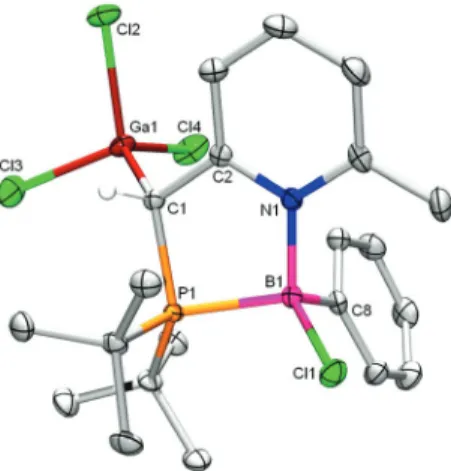
carbon spacer. Single crystal X-ray structure determination confirmed the diastereoselective formation of the formally
zwitterionic anti-3·GaCl3(anti refers to the relative positions of
the chloride at boron and the GaCl3fragment with respect to
the G13-pyridine plane, Fig. 3). The new C1–Ga1 bond is in the range of previously reported carbogallates.12 The boronium fragment is strongly pyramidalized (sum of angles 333.5°). DFT calculations (Gaussian 09, B3PW91, 6-31G**) show that the syn-3·GaCl3 diastereoisomer is 3.7 kcal mol−1 higher in
energy, which is within the upper limit of the precision of the methods. Heating a solution of anti-3·GaCl3for 10 h at 100 °C
led to partial isomerization to syn-3·GaCl3, as evidenced by
multinuclear NMR spectroscopy.
Although there is some precedent for nucleophilic attack of dearomatized pincer transition metal complexes on a Group 13 Lewis acid,13 this reactivity is unprecedented for main group elements or metalloids. Moreover, given the propensity of GaCl3to act as halide scavenger toward main group halides,
including boron for the generation of boron cations,14 the observed preference to act as electrophile in a carbon–gallium bond formation step is deemed highly remarkable. This bond is indeed reactive, as evidenced by the reaction of anti-3·GaCl3
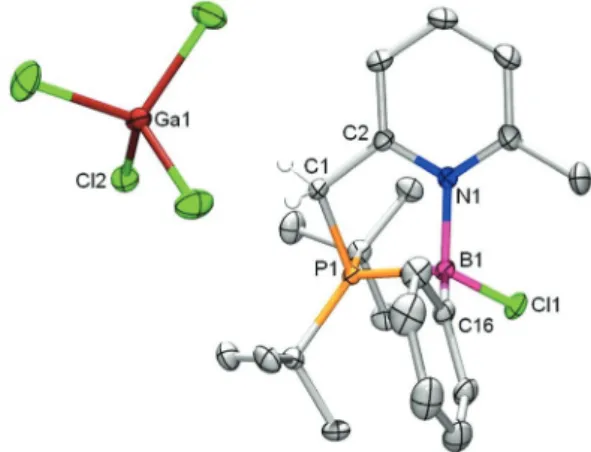
with HCl, which led to protonation at the methylene carbon with the formation of tetrachlorogallate salt 4 (Scheme 4), which was fully characterized, including by single crystal X-ray structure determination (Fig. 4).
Fig. 2 Displacement ellipsoid plot (50% probability level) of 2. Hydro-gen atoms (except for hydroHydro-gen on C1) are omitted for clarity. Selected bond lengths (Å) and angles (°): P1–Ga1 2.339(1); N1–Ga1 1.946(1); Ga1– Cl1 2.185(1); P1–C1 1.743(2); C1–C2 1.394(2); C2–C3 1.433(2); C3–C4 1.354(2); C4–C5 1.412(3); C5–C6 1.360(2); P1–Ga1–N1 90.0(1); P1– Ga1–Cl1 116.6(1); P1–C1–C2 120.8(1); P1–C1–C2–N1–1.3.
Scheme 3 Preparation of the phosphorus-stabilized amidoborane 3 and its reaction with GaCl3to form the zwitterionanti-3·GaCl3.
Fig. 3 Displacement ellipsoid plot (50% probability level) of anti-3·GaCl3. Hydrogen atoms (apart from those on C1) are omitted for clarity. Selected bond lengths (Å) and angles (°): P1–C1 1.830(2); C1–C2 1.501(3); P1–B1 2.021(2); N1–B1 1.602(3); B1–Cl1 1.869(2); B1–C8 1.596(3); C1–Ga1 2.030(2); P1–B1–N1 98.0(1); P1–C1–Ga1 126.4(1); N1–B1–Cl1 111.3(1); N1–B1–C8 110.1(2); P1–C1–C2–N1 22.5.
Scheme 4 Reaction ofanti-3·GaCl3with HCl to give 4.
Dalton Transactions Paper
Open Access Article. Published on 09 June 2016. Downloaded on 1/3/2019 10:47:14 AM.
This article is licensed under a
Creative Commons Attribution-NonCommercial 3.0 Unported Licence.
The electronegativity of Ga lies in-between that of B and Al. We decided to explore the reaction of gallane 2 with boron tri-chloride as Lewis acid in order to probe whether the resulting reactivity of these Group 13 elements bound to a dearomatized P,N ligand follows the same trend. Upon addition of BCl3to 2,
the bright orange reaction mixture turned colorless, which is diagnostic of re-aromatization (Scheme 5).
The broad 31P NMR signal appeared at lower field (δ 31.1 ppm,Δδ −10.8 ppm) with no evidence for P–B coupling, indicative that the phosphine is still connected to gallium. In the1H NMR spectrum, thevCH–PPh2proton is deshielded (δ
3.93 ppm) and broadened due to scalar proximity of a 11B nucleus (confirmed by 1H{11B} NMR analysis). Single crystal X-ray structure determination of 5·BCl2 confirmed the
incor-poration of both Ga and B (Fig. 5). However, concomitant with exchange of Ga for B for the coordination to the heterocycle nitrogen atom, the latter has undergone an unprecedented change from a P,N to a C,N binding pocket.
The boron atom is incorporated in a rare four-membered ring that is fused to a rearomatized pyridine ring ( judging from the almost identical carbon–carbon bond lengths in the ring). The carbon atom binds to boron while the pendant phosphine binds the trichlorogallane. The C1–B1 bond length of 1.682(3) Å likely reflects the ring-strain in this structure. To the best of our knowledge, this is the first example wherein the
methine spacer of a dearomatized lutidinylphosphine engages in direct coordination to a metal(loid). The only two structu-rally characterized fused heterobicyclic structures with boron and pyridine resulted either from (i) C–H activation of a luti-dine–borenium adduct in the presence of an external Lewis base15 or (ii) ring-closure of a bis( pentafluorophenyl)boryl derived FLP.16In both cases, extremely strong Lewis acids are involved.
Given its unique nature, we decided to get further insight into the bonding situation within 5·BCl2by DFT calculations.
Natural bond order (NBO) analysis demonstrated that the C1– B1 and the N1–B1 bonds are very polarized toward C and N (70% and 80%, respectively). In line with this observation, the Natural Population Analysis (NPA) showed a positively charged boron atom (+0.4). Interestingly, the C1 carbon atom bears a significant negative charge (−0.9). As a result, 5·BCl2 is best
described as the combination of a boronium and an anionic C,N ligand. The carbanion might be partially stabilized by negative hyperconjugation into the σ*(P–C) orbitals as in reported α-monolithiated17 and α-dilithiated18 phosphine-boranes, although second order NBO analysis does not provide clear evidence for this. The analogous 5·B(Cl)(Ph) was obtained as a mixture of diastereomers by reacting 2 with BCl2Ph.
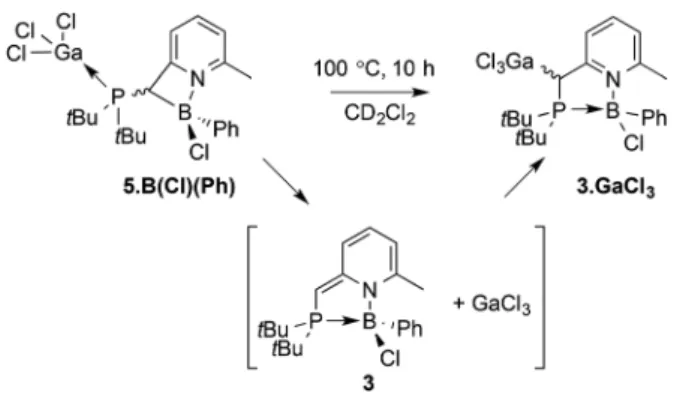
Compounds 3·GaCl3 and 5·B(Cl)(Ph) are linkage isomers
(Scheme 6). The average DFT calculated energy differences of the linkage isomers 3·GaCl3and 5·B(Cl)(Ph) (syn and anti) are
within the upper limit of the precision of the methods (3.6 kcal mol−1in favor of 5·B(Cl)(Ph)). Given this small energy difference, we speculated that 5·B(Cl)(Ph) could conceivably still be of relevance in the formal transmetallation of 2 with BCl2Ph to provide 3·GaCl3under forcing conditions. To verify
this hypothesis, a solution of 5·B(Cl)(Ph) in CD2Cl2was heated
in a pressure tube to 100 °C for 6 hours, which cleanly gener-ated 3·GaCl3 as a mixture of diastereoisomers. It is plausible
that this structural rearrangement, involving both C–B and
Fig. 5 Displacement ellipsoid plot (50% probability level) of 5·BCl2. Hydrogen atoms (apart from those on C1) are omitted for clarity. Selected bond lengths (Å) and angles (°): P1–C1 1.832(2); C1–C2 1.516(4); N1–C2 1.352(3); N1–B1 1.586(3); C1–B1 1.682(3); B1–Cl1 1.819(2); P1–Ga1 2.389(1); Ga1–Cl3 2.179(1); P1–C1–B1 132.2(2) (1); C2–C1–B1 84.4(2); C1–B1–N1 83.3(2); B1–N1–C2 93.9(2); N1–C2–C1 98.4(2); P1– C1–C2–N1–136.0.
Fig. 4 Displacement ellipsoid plot (50% probability level) of 4. Hydro-gen atoms are omitted for clarity. Selected bond lengths (Å) and angles (°): P1–B1 2.018(2); N1–B1 1.608(2); B1–Cl1 1.859(2); B1–C16 1.597(3); P1–C1 1.817(2); C1–C2 1.502(2); P1–B1–N1 97.4(1); P1–B1–N1 109.3(1); P1–B1–C16 113.7(1); P1–C1–C2 105.4(1); P1–C1–C2–N1–27.3.
Scheme 5 Preparation of 5·BCl2and 5·B(Cl)(Ph) by reaction of 2 with haloboranes.
Open Access Article. Published on 09 June 2016. Downloaded on 1/3/2019 10:47:14 AM.
This article is licensed under a
P–Ga bond cleavage and C–Ga as well as P–B bond formation, proceeds via reconstitution of a mixture of 3 (with the de-aromatized N-heterocycle) and GaCl3, which were found to
react instantaneously at room temperature.
With the well-defined coordination chemistry for the heterodinuclear species in hand, we wondered if the reaction of 1 with boron trichloride would also lead to selective trans-metallation and generation of product BCl2(L) (as observed
with GaCl3) or an analogous reaction as observed for 3 to 5 but
with a phosphino-alane pendant arm. The addition of one equivalent of BCl3to a solution of alane 1 at room temperature
led to only 50% conversion of starting material, but the reac-tion smoothly went to complereac-tion when two equivalents of BCl3were used (Scheme 7).
The new species gives rise to a quadruplet in31P NMR atδ 22.8, which is characteristic of the direct coordination of the phosphine to a boron atom. In line with the required stoichio-metry, the11B NMR shows two signals, a doublet atδ 4.7 with a1JBP = 139.4 Hz and a broad singlet atδ 6.6. Single crystal
X-ray structure determination of 6 confirmed the incorporation of two boron atoms in the molecule (Fig. 6). Complex 6 is structurally related to borane–gallane 5.BCl2, with the same
strained four-membered ring including the boron atom, but featuring a trichloroborane-coordinated phosphine arm. It is likely that the interaction of AlClEt2 with the pendant
phos-phine is relatively weak (perhaps partly due to steric hindrance), resulting in facile displacement by an additional equivalent of BCl3.
In summary, we demonstrate the first examples of Group 13 complexes (boron, gallium and aluminum) stabilized by a dearomatized P,N ligand. Depending on the nature of the metal(loid) involved, very different reactivity toward Group
13 halogenides is observed. The rich coordination chemistry of this reactive ligand scaffold with G13 elements may open up e.g. new avenues for non-transition metal based small mole-cule activation and cooperative catalysis. Research in this direction is currently ongoing in our laboratories.
Experimental section
General commentsAll reactions and manipulations were carried out under an atmosphere of dry dinitrogen using standard Schlenk tech-niques or in a glove-box. All solvents were purged with dinitro-gen and dried using an MBRAUN Solvent Purification System (SPS).1H,13C,31P,11B and27Al NMR spectra were recorded on Bruker AV 300, Bruker DRX 300 or Bruker AV 400 spec-trometers. Chemical shifts were expressed in positive sign, in parts per million, calibrated to residual1H (5.32 ppm) and13C (53.84 ppm) solvent signals, external BF3·Et2O, 85% H3PO4
and Al(NO3)31 M in D2O (0 ppm) respectively. Mass spectra
were recorded on an AccuTOF LC, JMS-T100LP or an AccuTOF GC v 4 g, JMS-T100GCV Mass spectrometer. Di-(tert-butylphos-phino)methyl-6-methyl-pyridine LHwas prepared according to a literature procedure.19
Complex 1. A solution of nBuLi (2.5 M in hexanes, 0.25 mL, 0.63 mmol, 1 eq.) was added dropwise to an ice-cooled stirred solution of 2-(di-tert-butylphosphino)methyl-6-methyl-pyridine LH (157 mg, 0.63 mmol) in diethylether (6.5 mL) and the resulting orange solution was allowed to react for 1 h at the same temperature. Then, the reaction mixture was cooled down to −78 °C and chlorodiethylaluminum (0.32 M in toluene, 1.98 mL, 1.01 eq.) was added dropwise. The reaction mixture was allowed to warm up to room temperature over 1 h, giving an orange solution and a white precipitate. After elimination of the salts by filtration and removal of the volatiles under reduced pressure, 1 was obtained as a red oil in 95% yield.
Scheme 6 Thermal linkage isomerization of 5·B(Cl)(Ph) into 3·GaCl3, proposedly with intermediacy of 3 and free GaCl3.
Scheme 7 Synthesis of 6 by transmetallation of 1 with 2 equiv. BCl3.
Fig. 6 Displacement ellipsoid plot (50% probability level) of 6. Hydro-gen atoms (apart from those on C1) are omitted for clarity. Selected bond lengths (Å) and angles (°): N1–B1 1.5805(25); B1–C1 1.6841(26); P1–B2 2.0441(21); C1–C2 1.5188(25); B1–Cl1 1.8220(21); B1–Cl2 1.8481(22); P1–C1 1.8419(19); N1–B1–C1 83.64(12); P1–C1–B1 133.05(13); N1–B1–Cl1 113.40(13); C1–P1–B2 105.87(8); P1–C1–C2–N1–135.23.
Dalton Transactions Paper
Open Access Article. Published on 09 June 2016. Downloaded on 1/3/2019 10:47:14 AM.
This article is licensed under a
Creative Commons Attribution-NonCommercial 3.0 Unported Licence.
Csp–H), 118.1 (d, 1C, JCP= 12.4 Hz, Csp–H), 133.9 (d, 1C, JCP=
2.5 Hz, Csp2–H), 150.9 (d, 1C, JCP= 4.4 Hz, Cquat.), 167.2 (d, 1C,
JCP= 14.9 Hz, Cquat.). The highly air-sensitive nature of this oil
(slow decomposition even in an N2-filled glovebox) interfered
during our repetitive attempts to obtain high-resolution mass analysis and elemental analysis.
Complex 2. Gallium trichloride (350.3 mg, 1.99 mmol, 1 eq.) in toluene (5 mL) was added dropwise to an in situ prepared solution of 1 (667.3 mg, 1.99 mmol) in diethyl ether (25 mL) under stirring at room temperature and the resulting mixture was stirred for an additional 4.5 h. Then, volatiles were removed under vacuum leading to an orange residue. This residue was extracted with a mixture of dichloromethane/ pentane (0.3 mL/10 mL) and filtered. The resulting solution was concentrated to 2 mL, resulting in the crystallization of 2 at room temperature as sticky orange blocks in 96% yield. Crystals suitable for X-ray crystallography were obtained from a saturated solution of 2 in a toluene/diethylether mixture at room temperature. 1H NMR (300 MHz, CD2Cl2, δ): 1.40 (d, 18H,3JHP= 16.1 Hz, tBu), 2.35 (s, 3H, CH3), 3.46 (d, 1H,2JHP= 3.3 Hz, CvC(H̲)(PtBu2)), 5.53 (d, 1H, JHH = 6.6 Hz, Csp2–H), 6.24 (d, 1H, JHH= 9.0 Hz, Csp2–H), 6.62 (ddd, 1H, JHH= 9.0 Hz, JHH= 6.6 Hz, JHP= 1.3 Hz, Csp2–H).31P {1H} NMR (121 MHz, CD2Cl2,δ): −3.1 (br.).13C {1H} NMR (75 MHz, CD2Cl2,δ): 22.7 (s, 1C, CH3), 28.9 (d, 6C,2JCP= 2.8 Hz, CH3tBu), 36.8 (d, 2C,1JCP = 30.4 Hz, P–CtBu), 50.7 (d, 1C,1JCP= 67.6 Hz, P–Csp2), 105.5 (d, 1C, JCP = 1.2 Hz, Csp2–H), 119.2 (d, 1C, JCP= 12.0 Hz, Csp2–H), 135.7 (d, 1C, JCP= 2.3 Hz, Csp2–H), 151.2 (d, 1C, JCP= 4.3 Hz,
Cquat.), 166.7 (d, 1C, JCP = 6.7 Hz, Cquat.). HRMS (FD): exact
mass (monoisotopic) calcd for [C15H2569GaNP35Cl2 + H]+,
390.04357; found 390.04338. Despite several attempts, no satis-factory combustion analysis data was obtained for this com-pound, likely as a result of its air-sensitive nature.
Complex 3. A solution of nBuLi (2.5 M in hexanes, 0.21 mL, 0.52 mmol, 1 eq.) was added dropwise under stirring to an ice-cooled solution of 2-(di-tert-butylphosphino)methyl-6-methyl-pyridine (150 mg, 0.52 mmol) in diethylether (5 mL) and the resulting orange solution was allowed to react for 1 h at the same temperature. Then, the reaction mixture was cooled down to−78 °C and dichlorophenylborane (77 μL, 0.52 mmol, 1 eq.) was added dropwise. The reaction mixture was allowed to warm up to room temperature over 30 minutes and was further stirred for 1 h at room temperature, giving an orange solution and a white precipitate. Only 3 was detected in the crude mixture by31P{1H} NMR analysis. After removal of the volatiles, the residue was extracted with pentane (3 mL) and
24.5 (s br.). C {H} NMR (75 MHz, CD2Cl2,δ): 22.6 (s, 1C, CH3), 28.7 (s, 3C, CH3tBu), 29.4 (s, 3C, CH3tBu), 34.7 (d, 1C,1JCP = 24.4 Hz, P–CtBu), 38.8 (d, 1C,1JCP= 23.1 Hz, P–CtBu), 53.0 (d, 1C,1JCP= 65.2 Hz, P–Csp2), 106.0 (d, 1C, JCP= 1.7 Hz, Csp2–H), 116.2 (d, 1C, JCP= 14.3 Hz, Csp2–H), 127.2 (d, 1C, JCP= 1.2 Hz, Csp2–H), 127.3 (d, 1C, JCP= 2.3 Hz, Csp2–H), 127.8 (d, 1C, JCP= 1.6 Hz, Csp2–H), 133.4 (d, 1C, JCP = 2.9 Hz, Csp2–H), 135.0 (d, 1C, JCP = 2.1 Hz, Csp2–H), 136.0 (d, 1C, JCP = 2.3 Hz, Csp2–H), 151.3 (d, 1C, JCP = 9.1 Hz, Cquat.), 167.6 (d, 1C, JCP= 13.8 Hz,
Cquat.), the aromatic carbon connected to boron is not
observed. HRMS (CSI, −30 °C): exact mass (monoisotopic) calcd for [C21H30BClNP + H]+, 374.1976; found 374.1980. This
compound proved too hydrolysis-sensitive for satisfactory com-bustion analysis data.
Complexanti-3·GaCl3. A solution of 3 (445 mg, 1.19 mmol)
in ether (15 mL) was added slowly to a solution of gallium tri-chloride (210 mg, 1.19 mmol, 1 eq.) in toluene (4 mL) at r. t. under stirring. The reaction mixture was then further stirred for 30 minutes leading to an orange solution and a yellowish precipitate. After removal of the mother liquor via cannula filtration, the precipitate was extracted with dichloro-methane (20 mL), filtered and the limpid dichlorodichloro-methane solution thus obtained was layered with pentane (21 mL), affording colorless crystals of anti-3·GaCl3 in a yield of 40%.
Crystals suitable for X-ray diffraction analysis were obtained under the same conditions. 1H NMR (300 MHz, CD2Cl2, δ):
1.31 (d, 9H,3JHP= 15.8 Hz, tBu), 1.50 (d, 9H,3JHP= 13.6 Hz,
tBu), 2.42 (s, 3H, CH3), 3.67 (d, 1H,2JHP= 13.4 Hz, P–C(H̲)–Ga),
7.04 (m, 1H, Harom.), 7.18 (m, 1H, Harom.), 7.29 (m, 1H, Harom.),
7.34 (m, 1H, Harom.), 7.43 (m, 1H, Harom.), 7.96–8.05 (m, 2H, Harom.), 8.51 (d, 1H, 3JHH = 8.2 Hz, Harom.). 31P {1H} NMR (121 MHz, CD2Cl2, δ): 34.0 (br.). 11B {1H} NMR (96 MHz, CD2Cl2,δ): 5.6.13C {1H} NMR (75 MHz, CD2Cl2,δ): 23.4 (s, 1C, CH3), 28.8 (s, 3C, CH3tBu), 30.0(s, 3C, CH3tBu), 32.6 (br., P– C̲(H)–Ga), 36.6 (d, 1C,1JCP= 24.4 Hz, P–CtBu), 39.6 (d, 1C,1JCP = 23.1 Hz, P–CtBu), 123.5 (d, 1C, JCP= 9.2 Hz, CHarom.), 127.1 (d, 1C, JCP = 1.9 Hz, CHarom.), 128.4 (s, 2C, CHarom.), 129.2 (d, 1C, JCP= 2.3 Hz, CHarom.), 134.7 (d, 1C, JCP= 2.2 Hz, CHarom.), 135.1 (d, 1C, JCP= 2.9 Hz, CHarom.), 143.0 (d, 1C, JCP= 1.7 Hz, CHarom.), 157.9 (d, 1C, JCP= 7.4 Hz, Cquat.), 164.5 (d, 1C, JCP=
3.7 Hz, Cquat.), the aromatic carbon connected to boron is not
observed. Anal. Calcd For C21H30BCl4GaNP; C, 45.88; H, 5.50;
N, 2.55. Found: C, 45.81; H, 5.43; N, 2.49. M. p.: decompo-sition above 200 °C.
Isomerization of anti-3·GaCl3. A solution of anti-3·GaCl3
(14.6 mg, 26.6μmol) in CD2Cl2(0.4 mL) was heated at 100 °C
Open Access Article. Published on 09 June 2016. Downloaded on 1/3/2019 10:47:14 AM.
This article is licensed under a
for 10 h, leading to partial isomerization to its diastereoisomer syn-3·GaCl3in a 0.70/1.0 (anti/syn) ratio (as determined by
inte-gration of eachvCHPPh2signal in the1H NMR spectrum, D1
= 10 s). The mixture of diastereoisomers was fully character-ized by NMR spectroscopy: anti-3·GaCl3 = A; syn-3·GaCl3 =
B.1H NMR (400 MHz, CD2Cl2,δ): 1.29 (d, 9H,3JHP= 15.2 Hz,
tBu(B)), 1.31 (d, 9H,3JHP= 15.5 Hz, tBu(A)), 1.50 (d, 9H,3JHP=
13.3 Hz, tBu(A)), 1.53 (d, 9H,3JHP= 12.7 Hz, tBu(B)), 2.42 (s,
3H, CH3(A)), 2.53 (s, 3H, CH3(B)), 3.27 (d, 1H,2JHP= 13.6 Hz,
P–C(H̲)–Ga (B)), 3.68 (d, 1H,2JHP= 13.5 Hz, P–C(H̲)–Ga (A)),
6.44 (d, 1H,3JHH= 7.7 Hz, Harom.(B)), 7.04 (m, 1H, Harom.(A)),
7.14–7.21 (m, 1Harom.(A) + 1Harom.(B)), 7.26–7.37 (m, 2Harom.(A)
+ 1Harom.(B)), 7.95–8.04 (m, 1Harom.(A) + 1Harom.(B)), 8.07 (d
br., 1H,3JHH= 7.4 Hz, Harom.(B)), 8.13 (t, 1H,3JHH = 8.0 Hz,
Harom.(B)), 8.51 (d, 1H, 3JHH = 8.5 Hz, Harom.(A)), 8.60 (d, 1H, 3J
HH= 8.1 Hz, Harom.(B)).31P {1H} NMR (162 MHz, CD2Cl2,δ):
34.1 (br., A), 43.4 (br., B).11B {1H} NMR (128 MHz, CD2Cl2,δ):
5.3 (br.). 13C {1H} NMR (101 MHz, CD2Cl2, δ): 23.4 (s, 1C,
CH3(A)), 24.4 (s, 1C, CH3(B)), 28.1 (br., 1C, P–C̲(H)–Ga(B)), 28.8
(s, 1C, CH3tBu(A)), 29.3 (s, 2C, CH3tBu(B)), 30.0 (s, 1C,
CH3tBu(A)), 32.6 (br., 1C, P–C̲(H)–Ga(A)), 35.2 (d, 1C,1JCP= 23.7
Hz, P–CtBu(B)), 36.6 (d, 1C,1JCP= 24.5 Hz, P–CtBu(A)), 38.3 (d,
1C,1JCP = 22.2 Hz, P–CtBu(B)), 39.5 (d, 1C,1JCP = 23.0 Hz, P–
CtBu(A)), 123.5 (d, 1C, JCP= 9.1 Hz, CHarom.(A)), 126.2 (d, 1C,
JCP = 7.8 Hz, CHarom.(B)), 127.1 (d, 1C, JCP = 1.9 Hz,
CHarom.(A)), 128.4 (br., 2C, CHarom.(A)), 128.7 (br, 1C,
CHarom.(B)), 128.9 (d, 1C, JCP = 2.4 Hz, CHarom.(B)), 129.0 (br,
1C, CHarom.(B)), 129.2 (d, 1C, JCP = 2.4 Hz, CHarom.(A)), 129.4
(d, 1C, JCP = 2.2 Hz, CHarom.(B)), 131.6 (s br., 1C, CHarom.(B)),
134.7 (d, 1C, JCP= 2.2 Hz, CHarom.(A)), 135.1 (d, 1C, JCP = 2.9
Hz, CHarom.(A)), 136.1 (s br., 1C, CHarom.(B)), 143.0 (d, 1C, JCP=
1.6 Hz, CHarom.(A)), 143.9 (s br., 1C, CHarom.(B)), 157.9 (d, 1C,
JCP = 7.8 Hz, Cquat.(A)), 159.0 (d, 1C, JCP = 7.2 Hz, Cquat.(B)),
161.3 (d, 1C, JCP= 2.5 Hz, Cquat.(B)), 164.4 (d, 1C, JCP= 3.7 Hz,
Cquat.(A)), the aromatic ipso-carbon connected to boron is not
observed for A or B.
Complex 4. A solution of hydrochloric acid in diethylether (1 M, 86μL, 1.1 eq.) was added dropwise to a suspension of anti-3·GaCl3(42 mg, 78.4μmol) in dichloromethane (2 mL) at
−78 °C and the resulting suspension was allowed to warm up to room temperature overnight to give a colorless solution. The solution was filtered via cannula, the reaction flask was washed with dichloromethane (1 mL) and the organic layers were combined. The dichloromethane solution was layered with pentane (8 mL), affording colorless crystals of 4 with a yield of 89% at room temperature after one day. Crystals suit-able for X-ray diffraction analysis were obtained by layering a dichloromethane solution of 4 with pentane at room tempera-ture. 1H NMR (300 MHz, CD2Cl2,δ): 1.14 (d, 9H, 3JHP = 15.3 Hz, tBu), 1.49 (d, 9H,3JHP= 14.3 Hz, tBu), 2.59 (s, 3H, CH3), 3.85–4.08 (m, 2H, CH2), 6.29 (d, 1H, JHH= 7.4 Hz, Harom.), 7.19 (t, 1H, JHH = 7.4 Hz, Harom.), 7.37 (t br., 1H, JHH = 7.5 Hz, Harom.), 7.52 (t, 1H, JHH= 7.5 Hz, Harom.), 7.61 (d, 1H, JHH= 7.8 Hz, Harom.), 8.05 (m, 2H, Harom.), 8.30 (t, 1H, JHH = 7.8 Hz, Harom.).31P {1H} NMR (121 MHz, CD2Cl2,δ): 21.4 (br.).11B {1H} NMR (96 MHz, CD2Cl2, δ): 5.9 (br.). 13C {1H} NMR (75 MHz, CD2Cl2,δ): 23.6 (s, 1C, CH3), 23.7 (d, 1C,1JCP= 27.8 Hz, CH2), 28.8 (s, 3C, CH3tBu), 29.1 (s, 3C, CH3tBu), 35.2 (d, 1C,1JCP= 18.6 Hz, P–CtBu), 37.3 (d, 1C,1JCP = 21.1 Hz, P–CtBu), 125.0 (d, 1C, JCP = 7.5 Hz, CHarom.), 129.0 (d, 1C, JCP = 2.3 Hz, CHarom.), 129.5 (d, 1C, JCP= 2.3 Hz, CHarom.), 130.0 (d, 1C, JCP= 3.0 Hz, CHarom.), 130.5 (d, 1C, JCP= 2.3 Hz, CHarom.), 131.5 (d, 1C, JCP= 2.3 Hz, CHarom.), 135.2 (d, 1C, JCP= 3.0 Hz, CHarom.), 145.3 (d, 1C, JCP = 0.8 Hz, CHarom.), 156.0 (d, 1C, JCP = 3.0 Hz, Cquat.),
159.7 (d, 1C, JCP = 6.8 Hz, Cquat.) the aromatic carbon
con-nected to boron is not observed. Anal. Calcd For C21H31BCl5GaNP; C, 43.03; H, 5.33; N, 2.39. Found: C, 42.87;
H, 5.20; N, 2.38. M. p.: 205–209 °C.
Complex 5·BCl2. Boron trichloride in toluene (1 M, 0.65 mL,
0.65 mmol, 1 eq.) was added dropwise at room temperature to a solution of 2 (255 mg, 0.65 mmol) in toluene (5 mL) under stirring. Upon addition, the solution changed from orange to colorless. Then, pentane (20 mL) was added and the reaction mixture was slowly concentrated until a white powder precipi-tated. After removal of the supernatant via cannula filtration, the solid material was dried under reduced pressure. The solid was then dissolved in dichloromethane (3 mL) and filtered again. Layering of this solution with pentane (8 mL) led to the crystallization of 5·BCl2at room temperature in 3 days as
color-less crystals with a yield of 34%. Crystals suitable for X-ray diffraction analysis were obtained by slow diffusion of pentane into a saturated dichloromethane solution of 5·BCl2 at room
temperature.1H NMR (300 MHz, CD2Cl2,δ): 1.54 (d, 9H,3JHP=
16.8 Hz, tBu), 1.68 (d, 9H, 3JHP= 15.5 Hz, tBu), 2.75 (s, 3H,
CH3), 3.82 (d br., 1H,2JHP= 12.3 Hz, P–C(H̲)–B), 7.46 (d, 1H, 3J
HH= 8.0 Hz, Hm-py), 8.12 ( pseudo-t, 1H,3JHH= 8.0 Hz, Hp-py),
8.32 (d, 1H, 3JHH = 8.1 Hz, Hm-py). 31P {1H} NMR (121 MHz, CD2Cl2,δ): 31.1 (br.). 11B {1H} NMR (96 MHz, CD2Cl2,δ): 6.4. 13C {1H} NMR (75 MHz, CD 2Cl2,δ): 18.1 (s, 1C, CH3), 29.3 (d, 3C,2JCP = 1.5 Hz, CH3tBu), 30.3 (s, 3C, 2JCP = 2.5 Hz, CH3tBu), 32.9–36.1 (br., 1C, P–C̲(H)–B), 37.5 (d, 1C,1J CP = 20.8 Hz, P– CtBu), 38.5 (d, 1C,1JCP = 15.2 Hz, P–CtBu), 123.8 (s, 1C, CHpy), 126.1 (s, 1C, CHpy), 144.7 (s, 1C, JCP= 1.2 Hz, CHpy), 153.6 (s,
1C, Cquat.), 159.0 (s br., 1C, Cquat.). HRMS (CSI,−35 °C): exact
mass (monoisotopic) calcd for [C15H25BCl2NP− (GaCl3) + H]+,
332.1276; found 332.1301. Anal. Calcd For C15H25BCl5GaNP;
C, 35.46; H, 4.96; N, 2.76. Found: C, 35.56; H, 4.86; N, 2.67. M. p.: decomposition above 177 °C.
Complex 5·B(Cl)(Ph). Dichlorophenylborane (49.8 μL, 0.38 mmol, 1 eq.) in toluene (0.4 mL) was added dropwise at room temperature to a solution of 2 (155 mg, 0.38 mmol) in toluene (3 mL) under stirring, leading to a colorless solution. Analysis of the crude mixture by 1H NMR showed the for-mation of a mixture of diastereoisomers in a 1.9/1 ratio. After removal of the volatiles under reduced pressure, the residue was dissolved in dichloromethane (4 mL) and filtered in order to have a limpid solution. Layering of this solution with pentane (14 mL) afforded colorless crystals of 5·B(Cl)(Ph) in one day at room temperature with a yield of 51%. The mixture of diastereoisomers was fully characterized by NMR spec-troscopy and the relative configuration of each isomer was attributed based on 2D NOESY NMR spectroscopy (in the case
Dalton Transactions Paper
Open Access Article. Published on 09 June 2016. Downloaded on 1/3/2019 10:47:14 AM.
This article is licensed under a
Creative Commons Attribution-NonCommercial 3.0 Unported Licence.
8.0 Hz, Hm-py(B)), 8.10 ( pseudo-t, 1H, JHH= 8.0 Hz, Hp-py(A)), 8.16 ( pseudo-t, 1H,3JHH= 8.0 Hz, Hp-py(B)), 8.34(d, 1H,3JHH= 8.1 Hz, Hm-py(B)), 8.38(d, 1H,3JHH= 8.1 Hz, Hm-py(B)).31P {1H} NMR (121 MHz, CD2Cl2,δ): 32.6 (br.).11B {1H} NMR (96 MHz, CD2Cl2,δ): 7.4.13C {1H} NMR (75 MHz, CD2Cl2,δ): 18.0 (s, 1C, CH3(A)), 18.4 (s, 1C, CH3(B)), 29.0 (s, 3C, CH3tBu(B)), 29.2 (s,
3C, CH3tBu(A)), 29.5 (s, 3C, CH3tBu(B)), 30.3 (d, 3C, 2JCP = 2.1
Hz, CH3tBu(A)), 32.8 (br., C–B(A) + C–B(B)), 37.1 (d, 1C,1JCP =
22.7 Hz, P–CtBu(B)), 37.3 (d, 1C,1JCP= 21.8 Hz, P–CtBu(A)), 37.6
(d, 1C,1JCP= 16.8 Hz, P–CtBu(B)), 38.5 (d, 1C,1JCP= 15.9 Hz, P–
CtBu(A)), 123.7 (s, 1C, CHarom.(B)), 123.9 (s, 1C, CHarom.(A)),
125.4 (s, 1C, CHarom.(B)), 125.6 (s, 1C, CHarom.(A)), 127.9–128.6
(m, 3CHarom.(A) + 4CHarom.(B)), 128.7 (s, 1C, CHarom.(B)), 131.7
(s, 2C, CHarom.(A)), 143.6 (s, 1C, CHarom.(A)), 143.9 (s, 1C,
CHarom.(B)), 153.6 (s, 1C, Cquat.(A)), 154.1 (s, 1C, Cquat.(B)),
160.7 (s, 1C, Cquat.(A)), 161.1 (br., 1C, Cquat.(B)), the aromatic
ipso-carbon connected to boron is not observed for A or B. HRMS (CSI,−35 °C): exact mass (monoisotopic) calcd for [C21H29B1Cl1N1P1− (GaCl3) + H]+, 374.1980; found 374.2062.
Anal. Calcd For C21H30BCl4GaNP; C, 45.88; H, 5.50; N, 2.55.
Found: C, 45.61; H, 5.46; N, 2.50.
Isomerization of 5·BCl2 to anti-3·GaCl3 and syn-3·GaCl3. A
colorless solution of 5·B(Cl)(Ph) (33.3 mg, 60.6 μmol) in CD2Cl2(0.4 ml) was heated to 100 °C in an NMR tube for 10 h,
leading to a yellow solution. Monitoring of the reaction by1H NMR spectroscopy (internal standard = toluene 5μL) showed the formation of a mixture of diastereoisomers 3·GaCl3 anti,
56%; syn, 38%) and traces of decomposition product 4 (3%). The latter probably results from the addition of HCl (as traces in the solvent) across the C–Ga bond of 3·GaCl3.
Complex 6. To a solution of 1 (535.0 mg, 1.59 mmol) in di-ethylether (20 mL) was added BCl3(1 M in solution in toluene;
3.18 mL, 3.18 mmol, 2 eq.) at room temperature under stirring, resulting in a colorless solution. After removal of the volatiles under reduced pressure, the residue was dissolved in dichloro-methane, filtered and layered with pentane to give the expected compound 6 as colorless crystals with a yield of 48%. Single crystals suitable for X-ray diffraction analysis were obtained using the same conditions. 1H NMR (300 MHz, CD2Cl2,δ): 1.59 (d, 9H,3JHP= 14.9 Hz, tBu), 1.68 (d, 9H,3JHP= 13.4 Hz, tBu), 2.75 (s, 3H, CH3), 3.93 (d, 1H,2JHP= 15.3 Hz, P– C(H̲)–B), 7.42 (d, 1H,3JHH= 8.0 Hz, Hm-py), 8.06 ( pseudo-t, 1H, 3J HH= 8.1 Hz, Hp-py), 8.48 (d, 1H,3JHH= 8.3 Hz, Hm-py).31P {1H} NMR (121 MHz, CD2Cl2,δ): 22.8 (q,1JPB= 139.4 Hz).11B {1H} NMR (96 MHz, CD2Cl2,δ): 4.7 (d,1JPB= 139.4 Hz, P–B̲Cl3), 6.6 (br., B̲Cl2). 13C {1H} NMR (75 MHz, CD2Cl2, δ): 18.0 (s, 1C,
0.71073 Å) and a CMOS Photon 50 detector at a temperature of 150(2) K. Intensity data were integrated with the Bruker APEX2 software.20 Absorption correction and scaling was performed with SADABS.21The structures were solved with the program SHELXL.20 Least-squares refinement was performed with SHELXL-201322 against F2 of all reflections. Non-hydrogen atoms were refined with anisotropic displacement parameters. The H atoms were placed at calculated positions using the instructions AFIX 13, AFIX 43 or AFIX 137 with isotropic dis-placement parameters having values 1.2 or 1.5 times Ueqof the
attached C atoms. CCDC 1455266–1455269 contain the sup-plementary crystallographic data for this paper.
Details for 2. C20H25Cl2GaNP, Fw= 451.00, colorless, 0.327 ×
0.210 × 0.152 mm, monoclinic, P21/c (no: 14), a = 9.049(3), b =
9.165(3), c = 22.163(9) Å,β = 91.028(8)°, V = 1837.9(20) Å3, Z = 4, Dx= 1.643 g cm−3,μ = 1.893 mm−1. 39 709 reflections were
measured up to a resolution of (sinθ/λ)max = 0.65 Å−1. 7005
reflections were unique (Rint = 0.0634), of which 5482 were
observed [I > 2σ(I)]. 188 Parameters were refined with 0 restraints. R1/wR2 [I > 2σ(I)]: 0.0329/0.0687. R1/wR2 [all refl.]:
0.0517/0.0752. S = 1.008. Residual electron density between −0.760 and 0.667 e Å−3. CCDC 1455266.
Details foranti-3·GaCl3. C21H30BCl4GaNP, Fw= 549.76,
color-less, 0.478 × 0.201 × 0.199 mm, monoclinic, P21/c (no: 14), a =
10.152(10), b = 16.382(9), c = 15.393(12) Å, β = 93.68(3)°, V = 2555.(5) Å3, Z = 4, Dx= 1.467 g cm−3,μ = 1.609 mm−1. 29 499
reflections were measured up to a resolution of (sinθ/λ)max=
0.84 Å−1. 4370 reflections were unique (Rint= 0.0384), of which
3954 were observed [I > 2σ(I)]. 269 Parameters were refined with 252 restraints. R1/wR2 [I > 2σ(I)]: 0.0240/0.0563. R1/wR2
[all refl.]: 0.0288/0.0591. S = 1.091. Residual electron density between−0.382 and 0.431 e Å−3. CCDC 1455267.
Details for 4. C21H31BCl4GaNP, Fw= 550.77, colorless, 0.479
× 0.452 × 0.240 mm, triclinic, P1ˉ (no: 1), a = 9.7845(7), b = 11.8465(9), c = 12.0322(9) Å,α = 83.458(3), β = 83.640(3), γ = 77.501(3)°, V = 1347.41(17) Å3, Z = 2, Dx = 1.358 g cm−3,μ =
1.486 mm−1. 70 054 reflections were measured up to a resolu-tion of (sinθ/λ)max = 0.64 Å−1. 10 873 reflections were unique
(Rint = 0.0501), of which 8259 were observed [I > 2σ(I)]. 278
Parameters were refined with 0 restraints. R1/wR2 [I > 2σ(I)]:
0.377/0.746. R1/wR2 [all refl.]: 0.647/0.897. S = 1.076. Residual
electron density between−1.04 and 0.86 e Å−3. CCDC 1455269. Details for 5·BCl2. C15H25BCl5GaNP, Fw = 508.11, colorless,
0.312 × 0.268 × 0.108 mm, triclinic, P1ˉ (no: 1), a = 8.483(6), b = 8.751(5), c = 16.791(7) Å,α = 87.39(2), β = 80.71(2), γ = 63.25(3)°, V = 1098.0(16) Å3, Z = 2, Dx= 1.560 g cm−3,μ = 1.963 mm−1.
Open Access Article. Published on 09 June 2016. Downloaded on 1/3/2019 10:47:14 AM.
This article is licensed under a
33 460 reflections were measured up to a resolution of (sinθ/λ)max= 0.74 Å−1. 5489 reflections were unique (Rint=
0.0589), of which 4453 were observed [I > 2σ(I)]. 224 Parameters were refined with 252 restraints. R1/wR2[I > 2σ(I)]: 0.321/0.628.
R1/wR2 [all refl.]: 0.491/0.685. S = 1.008. Residual electron
density between−0.469 and 0.503 e Å−3. CCDC 1455268. Details for 6. C15H25B2Cl5NP, Fw= 449.20, colorless, 0.391 ×
0.311 × 0.184 mm, triclinic, P1ˉ (no: 1), a = 8.2835(19), b = 8.5491(18), c = 16.876(4) Å, α = 87.103(6), β = 81.076(7), γ = 61.850(5)°, V = 1040.6(4) Å3, Z = 2, Dx = 1.434 g cm−3, μ =
0.773 mm−1. 34 045 reflections were measured up to a resolu-tion of (sinθ/λ)max = 0.75 Å−1. 5215 reflections were unique
(Rint= 0.658), of which 4319 were observed [I > 2σ(I)]. 227
Para-meters were refined with 0 restraints. R1/wR2[I > 2σ(I)]: 0.357/
0.722. R1/wR2[all refl.]: 0.502/0.774. S = 1.072. Residual
elec-tron density between−0.32 and 0.58 e Å−3. CCDC 1481714.
DFT calculations
Calculations were carried out with the Gaussian09 software23 at the DFT level, using the hybrid functional B3PW91.24 Alumi-num, gallium, chlorine and phosphorus atoms were treated with small-core pseudopotentials from the Stuttgart group, with additional polarization orbitals.25 Nitrogen, carbon, boron and H atoms have been treated with the all-electron 6-31G** Pople basis set. The geometry optimizations were done without any symmetry constraints. Analytical calculations of the vibrational frequencies of the optimized geometries were performed to confirm that the structures obtained were minimums, and also obtained the thermal corrections over the energies. The Natural Bond Orbital analysis was done over the optimized structure, with the version of the NBO software included in Gaussian09.26
Acknowledgements
This research is funded by the European Research Council through ERC Starting Grant EuReCat 279097 to J. I. v. d. V. We thank Prof.’s Bas de Bruin and Joost Reek for general support and interest in our work and Ed Zuidinga for MS analysis.
References
1 R. Kinjo, B. Donnadieu, M. A. Celik, G. Frenking and G. Bertrand, Science, 2011, 333, 610; C. Fliedel, G. Schnee, T. Avilés and S. Dragorne, Coord. Chem. Rev., 2014, 275, 63. 2 I. A. Cade and M. J. Ingleson, Chem. – Eur. J., 2014, 20,
12874; M. Devillard, R. Brousses, K. Miqueu, G. Bouhadir and D. Bourissou, Angew. Chem., Int. Ed., 2015, 54, 5722; J. M. Farrell, R. T. Posaratnanathan and D. W. Stephan, Chem. Sci., 2015, 6, 2010; Z. Yang, M. Zhong, X. Ma, K. Nijesh, S. De, P. Parameswaran and H. W. Roesky, J. Am. Chem. Soc., 2016, 138, 2548.
3 D. W. Stephan, J. Am. Chem. Soc., 2015, 137, 10018; D. W. Stephan and G. Erker, Angew. Chem., Int. Ed., 2015, 54, 6400; D. W. Stephan, Acc. Chem. Res., 2015, 48, 306–316. 4 C. Gunanathan and D. Milstein, Acc. Chem. Res., 2011, 44, 588; K. Junge, K. Schröder and M. Beller, Chem. Commun., 2011, 47, 4849; J. I. van der Vlugt, Eur. J. Inorg. Chem., 2012, 363; D. Gelman and S. Musa, ACS Catal., 2012, 2, 2456; W.-H. Wang, J. T. Muckerman, E. Fujita and Y. Himeda, New J. Chem., 2013, 37, 1860; S. Kuwata and T. Ikariya, Chem. Commun., 2014, 50, 14290; R. H. Morris, Acc. Chem. Res., 2015, 48, 1494.
5 Recent reviews: J. I. van der Vlugt and J. N. H. Reek, Angew. Chem., Int. Ed., 2009, 48, 8832; C. Gunanathan and D. Milstein, Chem. Rev., 2014, 114, 12024; J. R. Khusnutdinova and D. Milstein, Angew. Chem., Int. Ed., 2015, 54, 12236. See also: H. Li, B. Zheng and K.-W. Huang, Coord. Chem. Rev., 2015, 293–294, 116. Recent examples from our group: J. I. van der Vlugt, E. A. Pidko, D. Vogt, M. Lutz, A. L. Spek and A. Meetsma, Inorg. Chem., 2008, 47, 4442; J. I. van der Vlugt, M. Lutz, E. A. Pidko, D. Vogt and A. L. Spek, Dalton Trans., 2009, 1016; S. Y. de Boer, Y. Gloaguen, J. N. H. Reek, M. Lutz and J. I. van der Vlugt, Dalton Trans., 2012, 41, 11276; S. Y. de Boer, Y. Gloaguen, M. Lutz and J. I. van der Vlugt, Inorg. Chim. Acta, 2012, 380, 336; L. S. Jongbloed, B. de Bruin, J. N. H. Reek, M. Lutz and J. I. van der Vlugt, Chem.– Eur. J., 2015, 21, 7297; L. S. Jongbloed, B. de Bruin, J. N. H. Reek, M. Lutz and J. I. van der Vlugt, Catal. Sci. Technol., 2016, 6, 1320. See also: Y. Gloaguen, C. Rebreyend, M. Lutz, P. Kumar, M. I. Huber, J. I. van der Vlugt, S. Schneider and B. de Bruin, Angew. Chem., Int. Ed., 2014, 53, 6814; Z. Tang, S. Mandal, N. D. Paul, M. Lutz, P. Li, J. I. van der Vlugt and B. de Bruin, Org. Chem. Front., 2015, 2, 1561.
6 Two known alternative binding modes are via phosphorus only or with P and N both binding to a different metal center. For an example, see: J. I. van der Vlugt, E. A. Pidko, R. C. Bauer, Y. Gloaguen, M. K. Rong and M. Lutz, Chem.– Eur. J., 2011, 17, 3850.
7 Transmetallation of P-only coordinated mononuclear Ag-species to e.g. Pd has been reported: J. I. van der Vlugt, M. A. Siegler, M. Janssen, D. Vogt and A. L. Spek, Organo-metallics, 2009, 28, 7025.
8 L. A. Körte, R. Warner, V. Y. Vishnevskiy, B. Neumann, H.-G. Stammler and N. W. Mitzel, Dalton Trans., 2015, 44, 9992; J. Zheng, Y.-J. Lin and H. Wang, Dalton Trans., 2016, 45, 6088.
9 L.-C. Liang, M.-H. Huang and C.-H. Hung, Inorg. Chem., 2004, 43, 2166; H. Naka, M. Uchiyama, Y. Matsumoto, A. E. H. Wheatley, M. McPartlin, J. V. Morey and Y. Kondo, J. Am. Chem. Soc., 2007, 129, 1921.
10 J. I. van der Vlugt, E. A. Pidko, D. Vogt, M. Lutz and A. L. Spek, Inorg. Chem., 2009, 48, 7513; M. Montag, J. Zhang and D. Milstein, J. Am. Chem. Soc., 2012, 134, 10325; C. A. Huff, J. W. Kampf and M. S. Sanford, Organo-metallics, 2012, 31, 4643; C. A. Huff, J. W. Kampf and
Dalton Transactions Paper
Open Access Article. Published on 09 June 2016. Downloaded on 1/3/2019 10:47:14 AM.
This article is licensed under a
Creative Commons Attribution-NonCommercial 3.0 Unported Licence.
1008; C.-W. Tsang, C. A. Rohrick, T. S. Saini, B. O. Patrick and D. P. Gates, Organometallics, 2004, 23, 5913; V. Bagutski, A. Del Grosso, J. A. Carillo, I. A. Cade, M. D. Helm, J. R. Lawson, P. J. Singleton, S. A. Solomon, T. Marcelli and M. J. Ingleson, J. Am. Chem. Soc., 2013, 135, 474.
13 A. Alzamly, S. Gambarotta and I. Korobkov, Organometal-lics, 2013, 32, 7204; A. Anaby, B. Butschke, Y. Ben-David, L. J. W. Shimon, G. Leitus, M. Feller and D. Milstein, Orga-nometallics, 2014, 33, 3716; T. Cheisson and A. Auffrant, Dalton Trans., 2016, 45, 2069.
14 P. Kölle and H. Nöth, Chem. Rev., 1985, 85, 399; D. P. Gates, R. Ziembinski, I. Manners, A. L. Rheingold and B. S. Haggerty, Angew. Chem., Int. Ed., 1994, 33, 2277. 15 E. R. Clark, A. Del Grosso and M. J. Ingleson, Chem.– Eur.
J., 2013, 19, 2462.
16 See ref. 8 and: J. Vergnaud, T. Ayed, K. Hussein, L. Vendier, M. Grellier, G. Bouhadir, J.-C. Barthelat, S. Sabo-Etienne and D. Bourissou, Dalton Trans., 2007, 2370.
17 K. Izod, C. Wills, E. Anderson, R. W. Harrington and M. R. Probert, Organometallics, 2014, 33, 5283.
18 H. Heuclin, S. Y.-F. Ho, X. F. Le Goff, C.-W. So and N. Mézailles, J. Am. Chem. Soc., 2013, 135, 8774.
19 E. Kinoshita, K. Arashiba, S. Kuriyama, Y. Miyake, R. Shimazaki, N. Haruyuki and N. Yoshiaki, Organometallics, 2012, 31, 8437. See also our 2012 contributions in ref. 5.
J. Hasegawa, M. Ishida, T. Nakajima, Y. Honda, O. Kitao, H. Nakai, T. Vreven, J. A. Montgomery Jr., J. E. Peralta, F. Ogliaro, M. Bearpark, J. J. Heyd, E. Brothers, K. N. Kudin, V. N. Staroverov, R. Kobayashi, J. Normand, K. Raghavachari, A. Rendell, J. C. Burant, S. S. Iyengar, J. Tomasi, M. Cossi, N. Rega, J. M. Millam, M. Klene, J. E. Knox, J. B. Cross, V. Bakken, C. Adamo, J. Jaramillo, R. Gomperts, R. E. Stratmann, O. Yazyev, A. J. Austin, R. Cammi, C. Pomelli, J. W. Ochterski, R. L. Martin, K. Morokuma, V. G. Zakrzewski, G. A. Voth, P. Salvador, J. J. Dannenberg, S. Dapprich, A. D. Daniels, Ö. Farkas, J. B. Foresman, J. V. Ortiz, J. Cioslowski and D. J. Fox, Gaus-sian 09, Revision A.02, GausGaus-sian, Inc., Wallingford, CT, 2009.
24 A. D. Becke, J. Chem. Phys., 1993, 98, 5648; J. P. Perdew and Y. Wang, Phys. Rev. B: Condens. Matter, 1992, 45, 13244; K. Burke, J. P. Perdew and W. Yang, Electronic Density Func-tional Theory: Recent Progress and New Directions, ed. J. F. Dobson, G. Vignale and M. P. Das, Plenum, New York, 1998.
25 A. Bergner, M. Dolg, W. Kuechle, H. Stoll and H. Preuss, Mol. Phys., 1993, 80, 1431; T. Leininger, A. Berning, A. Nicklass, H. Stoll, H.-J. Werner and H.-J. Flad, Chem. Phys., 1997, 217, 19.
26 E. D. Glendening, A. E. Reed, J. E. Carpenter and F. Weinhold, NBO Version 3.1.
Open Access Article. Published on 09 June 2016. Downloaded on 1/3/2019 10:47:14 AM.
This article is licensed under a