FLIGHT TRANSPORTATION LABORATORY
REPORT R 91-3
AN ADAPTIVE FINAL APPROACH
SPACING ADVISORY SYSTEM:
MODELING, ANALYSIS AND SIMULATION
Zhihang Chi
FIL
COPY, DON'T REMOVE
33-412,
MIT
....02139
FLIGHT
REPORT
TRANSPORTATION
R 91-3
LABORATORY
AN ADAPTIVE FINAL APPROACH
SPACING ADVISORY SYSTEM:
MODELING, ANALYSIS AND SIMULATION
Zhihang Chi
FLIGiT
TRANSPORTATION LABORATORY REPORT
An Adaptive Final Approach Spacing Advisory
System: Modeling, Analysis and Simulation
by
Zhihang Chi
Submitted to the Operations Research Center
in partial fulfillment of the requirements for the degree of
Master of Science in Operations Research
at the
MASSACHUSETTS INSTITUTE OF TECHNOLOGY
June 1991
@
Massachusetts Institute of Technology 1991. All rights reserved.
A uth or ...
Operations Research Center
May 20, 1991
Certified by ...
Robert W. Simpson
Director, Flight Transportation Lab, MIT
Thesis Supervisor
A ccepted by ...
Amedeo R. Odoni
Chairman, Departmental Committee on Graduate Students
An Adaptive Final Approach Spacing Advisory System:
Modeling, Analysis and Simulation
by
Zhihang Chi
Submitted to the Operations Research Center on May 20, 1991, in partial fulfillment of the
requirements for the degree of Master of Science in Operations Research
Abstract
As airline industry grows and air traffic increases drastically, terminal airspace around busy airports is becoming more and more crowded. To accommodate the soaring demand for use of airports, a plausible and profitable way is to improve the efficiency of existing airports. An automated final approach spacing system can improve the efficiency as well as alleviate the workload of air traffic controllers.
In this thesis we develop an automated adaptive and interactive Final Approach Spacing Advisory (FASA) system to be used in future at busy airports. Our system is able to generate and update final approach paths for aircraft and guarantee that the aircraft land as scheduled and safely spaced. It prompts air traffic controllers for calls of turns. It can also detect errors in the execution of final approach paths and provide warning and correcting cues for the controllers.
We will elaborate on the motivation for this thesis in Chapter 1.
In Chapter 2, we will define the problem of Final Approach Spacing and describe the operations involved. We will introduce the key idea of our model - schedule box and sketch the framework of our system.
In Chapter 3, we will establish a mathematical model for our proposed system, analyze it and obtain the solution to it. We will show that our model is capable of incorporating any constraints and that the whole problem can be reduced to finding feasible solutions to a linear system of two variables.
In Chapter 4, we will develop a simulation program to implement our model in Chapter 3. We will describe in detail the algorithms and logics of our simulation program.
Finally in Chapter 5, we give a summary of our achievements as well as the topics and directions of future research.
Thesis Supervisor: Robert W. Simpson
Acknowledgments
My sincerest thanks go to Professor Robert W. Simpson who has supervised and
supported the research leading to this thesis. I have benefited a great deal from his
kind help and expert advice in the course of this research. He is not only a great
advisor but also a nice friend whom I can always talk to and who is always willing to
talk and smile to me. It is a tremendous privilege for me to have had this opportunity
to work with Professor Simpson.
I would also like to thank Dr. Dennis Mathaisel for supervising the early stage of
this research, and Dr. John Pararas for helping me gain access to necessary computing
facilities and for helping me debugging the simulation program. I am grateful to Carol
Novitsky for her efforts in helping develop the graphic part of our simulation program.
Contents
1 Introduction
2 The
2.1 2.2 2.3 2.4Schedule Box and Its Application to Final Approach Spacing
The Stream of Arrivals . . . ... . . . .
Operations Involved in Final Approach . . . .Operations of Schedule Box Patterns . . . .
Information Flow and Decision Making inSchedule
Box Model . . . . 2.4.1 Automatic Shifting . . . .3 Implementation of Schedule
3.1 The Simplest Case . . . .Box Model
3.1.1 Downwind Leg ...
3.1.2 Base Leg . . . .
3.1.3 Intercept Leg . . . . 3.1.4 Summary ... ...
3.2 More Complicated Case: No Wind, with Turn Radius, with Reduction . . . .
3.2.1 Downwind Leg . . . . 3.2.2 Base Leg . . . .
3.2.3 Intercept/Deceleration Leg . . . .
3.3 More Constraints on Pattern Geometries . . . .
3.3.1 Discussion . . . .
3.3.2 The "Barrier" Constraint . . . . Speed
3.4 Generation of Pattern 2 Paths . . . .
47
3.4.1
Calculation of Arrival Angle . . . .
47
3.4.2
Generating Paths . . . .
54
3.5
Feasible Intervals on Runway Center Line . . . .
55
3.5.1
Downwind Leg . . . .
56
3.5.2
Base Leg . . . .
59
3.5.3
Initial Intercept Leg (Before Deceleration) . . . .
60
3.5.4
Final Intercept Leg (After Deceleration) . . . .
60
3.6 Automatic Shifting of Schedule Boxes on Runway Center Line . . . . 61
4 Simulation on the Adaptive Final Approach Spacing Advisory
Sys-tem
65
4.1 O verview . . . .
65
4.2 Input Data ...
..
...
66
4.3 Flags . . . .
66
4.4 Com putation . . . .
67
4.4.1
Generation of Final Approach Paths . . . .
67
4.4.2
Data Updating . . . .
68
4.5 Drawing Moving Objects . . . .
68
4.5.1
Blinking of Aircraft Image . . . .
68
4.5.2
Change of Color of Aircraft Images . . . .. . .
69
4.5.3
Change of Color of Schedule Boxes . . . .
69
4.5.4
Dragging and Moving Schedule Boxes . . . .
70
4.5.5
Automatic Shifting . . . .
71
5 Concluding Remarks
72
5.1
Future Topics in FASA Modeling . . . .
72
List of Figures
2-1 Holding Areas around Terminal Airspace . . . . 11
2-2 Pattern 1 of Landing Path . . . . 14
2-3 Pattern 2 of Landing Path . . . . 15
2-4 Information Flow of Schedule Box Model . . . . 17
2-5 Automatic (Backward) Shifting Due to Movement of Box 1 . . . . 21
3-1 Pattern 1 Path and Remaining Durations . . . . 23
3-2 Different Combinations of C andC2 . . . . . . . . 26
3-3 C2>0, C>0
...
... 333-4 C2>0,C<0 ... ... 34
3-5 C2 < 0, C > 0 . . . . 34
3-6
(a) C
2 <0,
C/C2 >U; (b)
C2 <0, C/C
2 < U . . . .35
3-7 The Most General Case . . . . 43
3-8 Pattern 2 Path . . . . 48
3-9 Feasible Interval . . . . 56
Chapter 1
Introduction
As airline industry grows and air traffic increases drastically, terminal airspace around busy airports is becoming more and more crowded. To accommodate the soaring de-mand for use of major airports, aviation authorities face the choices of building new airports, extending existing airports or improving the efficiency of existing airports. Building new airports or extending existing airports requires huge amounts of in-vestment. Moreover, due to political, geographical and environmental constraints, it is difficult and painful, if not impossible, to plan and build new airports or extend existing airports. Improving the efficiency of existing airports, on the other hand, is not only profitable but also plausible with the help of high technology such as mod-ern computers and digital communication. For example, with the speed of modmod-ern computers and accuracy of digital communication, it is possible to revolutionize the procedure of handling final approach spacing. We can relax the prevailing tight safety rules while maintaining the same safety level, alleviating the workload of air traffic controllers and achieving much higher efficiency in terms of landings and take-offs per hour. It is the objective of improving the efficiency of final approach spacing that motivates the research of this thesis.
Currently, the profession of air traffic control is more a practice of art than one of science. Air traffic controllers base their actions mainly on visual observations and estimations, dialogues with pilots, and most of all their personal experiences. Because of the heavy reliance on human beings, the workload of controllers are considerably
high. Moreover, to buffer human errors due to fluctuation in human performance, very tight safety rules have to be enforced at the cost of low efficiency.
In this thesis, we will develop an adaptive automated system that will dynamically generate the final approach paths of different patterns for landing aircraft, detect errors and provide warning and correcting cues for air traffic controllers. Furthermore, we will develop a graphic simulation package that tests our automation system.
In Chapter One, we will give a full description of the final approach spacing problem. We will take a brief look at the operations involved in the final approach spacing problem. We will elaborate on our objectives, the assumptions we make, and the constraints we are faced with.
In Chapter Two, we will bring up the concept of schedule boxes which is an intuitive, accurate and implementable solution to the final spacing problem. With
this, we will present a detailed model of the final spacing problem.
In Chapter Three, we will discuss and analyze the model we introduced in Chapter Two. Also we will discuss on the implementation of the solution we obtain from our model.
In Chapter Four, we will describe the simulation program we designed for the testing of our model.
Chapter 2
The Schedule Box and Its
Application to Final Approach
Spacing
2.1
The Stream of Arrivals
Consider a busy terminal area. Landing aircraft arrive from different directions. Usually there are certain number of holding areas at the periphery of the airport. If necessary, the terminal area controllers will put the aircraft into these holding areas. See Figure 2-1.
While approaching the holding pattern, a pilot is asked by the controllers to report current air speed, and intended final approach speed.
The task of the controller is to use approach paths from the holding patterns within certain patterns and the information on the current positions and speeds, windspeed and intended approach speeds of arriving aircraft to bring them to a landing in a given sequence and schedule. If explicitly computed these approach paths would be updated dynamically, and the controller would be provided appropriate cues for turns, speed and altitude reductions, for executing the desired path and finally achieving good spacings in final approach.
Figure 2-1: Holding Areas around Terminal Airspace
2.2
Operations Involved in Final Approach
The operations involved in the execution of a final approach scheme include radar surveillance, error detecting, regeneration of approach path and issuing clearance on the controller's part and flying the aircraft on the pilot's part. The provision of automated support for operations on the controller's part is the goal of our thesis, i.e. we will computerize the error detecting and monitoring, prompting changes in aircraft speed, direction and altitude, and regeneration of approach paths as the traffic situation changes.
Professor Simpson at the Flight Transportation Laboratory at MIT brought up the idea of schedule box. It is a highly intuitive, illustrative and implementable approach
to the very complex problem of final approach spacing.
We assume that each landing aircraft has certain schedule for arrival at the runway; and therefore at the outer marker. To represent that schedule, a schedule box is created somewhere on the extended runway center line beyond the outer marker of the ILS approach. The schedule box moves at the final approach ground speed of each aircraft so that it will arrive at the outer marker at the scheduled time. In doing so, the spacing problem reduces to the problem of the aircraft intercepting its schedule box before the outer marker. Any complex description of desired spacings needed for safety can be handled by the computer in establishing a landing schedule. Today a very simple set of spacing rules in terms of the nearest nautical mile (3, 4, 5, 6nm) is given to controllers. A more complex description can be more efficient and provide higher capacity.
Let us state our problem formally using the idea of schedule box. For each aircraft, we assume we know its landing schedule, current position, current (constant) airspeed, and intended (constant) final approach speed. We also assume zero wind speed for the moment. Otherwise we need good information on current wind speeds. From landing schedule and intended final approach speed, we can generate the schedule box, i.e. compute the position of the schedule box on the extended runway center line. Once we have the initial position of the schedule box, we can generate the final
approach plan for the aircraft. We will discuss how to do that in detail in the next chapter. As we can see, this approach is dynamic in that at any time point, we can revise our plan so long as we have the necessary information, i.e. current aircraft positions and ground speeds, aircraft intended airspeeds, and current schedule box positions. The revised plan changes the positions of the schedule boxes, and indeed, the schedule boxes can be shifted by the controller on the display to cause a revision to the schedule.
The final approach spacing problem then becomes one of vectoring each aircraft to intercept its schedule box, i.e. the spacing problem transforms into an intercept problem. Next we will describe how automated cues are provided for the controller.
2.3
Operations of Schedule Box Patterns
Given a schedule of landings, the controller will generate arrival paths from a set of nominal arrival patterns which the aircraft will use to fly to intercept its schedule box at some variable point along the runway center line before the outer marker. Any errors in flying these paths will be correctable at certain points in the pattern. The model we are going to develop will automate the generation of arrival paths in an adaptive manner, i.e. any errors in flying the paths will automatically be corrected. In this chapter we will clarify the underlying governing logic. In next chapter, we will work out the mathematical equations, analyze them and obtain the closed form solutions.
We will consider two path patterns. The first pattern is shown in Figure 2-2 and second one shown in Figure 2-3. This two pattern situation is typical of many airports around the world at the present time. In both patterns, the final intercept angle to the ILS center line is fixed at 30 .(It could be any desired angle)
Pattern 1 consists of eight stages. They are downwind leg, base turn, base leg, intercept turn, intercept leg before final speed reduction(initial intercept leg), speed reduction, intercept leg after speed reduction (final intercept leg) and final turn. We would like to compute the durations of downwind leg, base leg, intercept leg before
speed reduction and intercept leg after speed reduction.
Pattern 2 consists of six stages. They are arrival leg, arrival turn, intercept turn, intercept/deceleration leg and final turn. In this case our decision variables are the initial arrival angle and the durations of base leg, initial intercept leg and final inter-cept leg.
Arrival
Stream
Downwind Leg , Base
) /Turn
c g, Intercept
Turn Final
Turna Speed Reduction
Schedule Box Outer Marker
Figure 2-2: Pattern 1 of Landing Path
There are some operational and geometric constraints on both patterns. For the first pattern, we will not allow the aircraft to cross the runway center line. We also will enforce the duration of base leg to be no less than a minimum amount of time(90 seconds, for example). Similarly, the duration of intercept/deceleration leg(the sum of initial intercept leg and final intercept leg) will have a lower limit. Third, we will plan that an aircraft starts its final airspeed speed reduction about in the middle of the length of its intercept/deceleration leg. Finally, we set up a selectable interception "barrier" on the runway center line-the interception must occur before the barrier.
Arrival Stream
Turn
Schedule Box Outer Marker
For Pattern 2, the same constraints apply except that some specific numbers may be different than those of Pattern 1. For example, the barrier for Pattern 2 is always further away from the outer marker than for Pattern 1.
Our system is adaptive in that it will detect errors and correct them. We are concerned with two types of errors. The first type is navigation and guidance error. Due to piloting and changing wind speed, every aircraft is likely to be off the planned track. This error is important to our simulation of aircraft movement. We will discuss this later. We will model the navigation and guidance error as a normally distributed random variable. The second type of error is the surveillance error. We will generate paths for the aircraft based on radar measurements. The radar updates the information on position of the aircraft on a fixed time interval basis and a process called "tracking" estimates speed and direction with some important transient errors. Our model is designed to be friendly and tolerant. It will ignore all the errors the aircraft has made and will not require continuous corrections until the point where no other feasible paths can be generated for the aircraft. At each decision point in a pattern, our system computes the corrected path to intercept the box. If the clearance is poorly executed, the system will flag a warning whenever the intercept cannot be made, and the schedule box can be moved to a feasible position on the center line. Other schedule boxes will then adapt to a new schedule.
2.4
Information Flow and Decision Making in
Sched-ule Box Model
We now examine the actual execution of our schedule box model leg by leg. For the time being, we will focus our discussion on arrival paths of Pattern 1.
The information flow is shown in Figure 2-4.
Our model takes as input the updated information from surveillance system, the errors detected, and the desired corrections requested by the controller. It will first examine the feasibility. For different legs there are different feasibility conditions which we will discuss in the next chapter.
Figure 2-4: Information Flow of Schedule Box Model
If it turns out that feasible paths exist, our system will compute the remaining
duration of the current leg and provide the controller with advisory cues in various forms. One form can be the on-screen display of the remaining duration of the current leg which can be turned on and off by controller as he/she wishes. Another form could be the automatic prompting for turns. For example we can implement our system in such a way that when an aircraft is 25 seconds from making a turn, its image will start blinking. Apparently a third form can be the combination of the above two forms. We are not concerned with the nature of the cues in this thesis.
If, however, there are no feasible paths for an aircraft, our system will provide
warnings for the controller. If indeed, controller's intervention becomes inevitable, our system will signal the controller in a drastic manner. For example, it will turn red the schedule box of the infeasible aircraft. Moreover, our system will help the controller make corrections. In our current implementation, a feasible window is generated for moving each schedule box. It will be displayed when the controller places the mouse onto the schedule box and presses the mouse button. Then controller can move the schedule box to any point within the feasible window to maintain or regain feasibility. If the controller moves the schedule box beyond the window, our system will automatically pull it back to the boundary of the feasible window.
without making any demands on the controller or pilot's part. Each update cycle, it will do the computation from scratch based on whatever information, errors and error corrections issued by the controller.
Currently, in deriving feasible windows we do not take into account the critical separation on the runway center line. To consider this there are quite a few questions that we need to address. So far we have assumed that we are given an initial schedule and the order of the schedule boxes on the runway center line represents the actual schedule. Critical separation is directly affected by the intercept points of the aircraft as well as the timing of intercept on the runway center line. Therefore, the first question we need to address is, how does the change of position of a schedule box affect the intercept point and the timing of intercept of the aircraft. For example, at some point we move the schedule box closer towards the outer marker. If the aircraft remains feasible, will its intercept point and time of intercept both move forward, or both backward, or one forward the other backward? The answer to this question is very much data-dependent. However we do have the following observations. We will try to bunch slow aircraft together and fast aircraft together. Moreover, we will try to make the intercept points of the slow aircraft close to the outer marker and those of the fast aircraft far away from the outer marker. In doing so we expect to have less chance of critical separation violation. Another question we need to discuss involves the separation criterion itself. Different separation criteria will result in different algorithms and different amounts of computation. One of the major goals of our system is to show how we can choose much tighter separation criteria than prevailing rules of thumb and raise the efficiency while maintaining the safety level.
There is yet another constraint that we need to consider in generating feasible windows. That is we must maintain the sequence of landing. The maintenance of sequence is more a political consideration than a technical one. Once we inform Aircraft B that he will be landing right after Aircraft A, it will be unfair from his point of view that Aircraft C ends up landing right after A. The maintenance of sequence is not very difficult to address. Once we know the positions and speeds of schedule boxes, it is fairly straightforward to find out the sequence of landing. For
any aircraft, we must make sure that he will land after the aircraft that precedes him and before the one that follows him in the given sequence when we shift the schedule boxes.
2.4.1
Automatic Shifting
As we said earlier, we do not take into account the constraints on sequence and on critical separation. Therefore the movement of a schedule box(even within its feasible window) may change the sequence or violate the separation criterion. For example, consider a slow aircraft followed by a fast aircraft. If we move the slow aircraft too far backwards, then there is a chance that either the slow aircraft will be overtaken
by the succeeding fast aircraft and thus the sequence of landing is changed, or the
sequence is intact but the slow aircraft's schedule box is moved so much into the following fast aircraft that the distance between the two aircraft will fall short of the
required separation.
There are at least two methods to resolve this problem. First, we can incorporate the constraints on sequence and on critical separation into the generation of feasible windows. A second method is to develop an algorithm that handles the problem of maintaining sequence and critical separation. The first method involves interpret-ing the constraints on maintaininterpret-ing sequence and on maintaininterpret-ing critical separation in terms of equations and inequalities and then finding a feasible solution to these simultaneous equations and inequalities, which can be accomplished by using any of the linear programming packages we have today. The main drawback of this method is that it limits the choices of the controller. The controller is only allowed to move a schedule box within the extent that the schedule box is feasible and its neighbors are intact. Sometimes however, we do want to move a schedule box far enough that the sequence will be ruined and/or separation criterion is violated. When this happens we may want to move this schedule box's neighbor a little bit and maybe the neighbor of the neighbor a little bit so that the sequence and separation is regained. Of course if we are lucky we can end up making the move without bothering the neighbors. Therefore at the cost of changing the schedule of other aircraft we gain more
flexibil-ity of handling a particular aircraft. This leads us to the second method and therefore the problem of automatic shifting-how the succeeding(preceding) boxes should shift when a particular schedule box is moved backwards(forwards). It turns out that the first method is in fact a special case of the second approach.
We now address in detail the algorithm that handles the sequence and critical separation. We make the assumption that the aircraft arrive in waves so that we can consider finite number of aircraft at a time. Suppose in one wave of arrivals we have n aircraft. We first consider the case of moving kth schedule box backwards. In this case we work our way backwards. We first compute the limit on moving schedule box n backwards. Apparently we need only to be concerned with feasibility. Based on this limit, we compute the limit on moving schedule box n - 1 backwards. From now
on, however, we need to be concerned not only with feasibility, but also with sequence and critical separation. Based on the limit for schedule box n - 1, we can compute
the limit on schedule box n - 2. We continue in this manner until we find the limit on moving schedule box k. Then when we actually move schedule box k backwards, three things can happen. First, we may be very lucky that we move schedule box k without violating any constraints or forcing any succeeding schedule boxes to move backwards. Second, we are able to move the schedule box as we want but force the succeeding schedule boxes to move backwards. Third, we move the schedule box too far and either sequence or critical separation is violated. In this case, we would like to bounce the schedule box to its limit.
The above algorithm will work almost the same way when we move a schedule box forward. In this case, we will start from the first schedule box and compute the limit on how far it can be moved forward. The constraints we need to consider for the first schedule box are feasibility constraints. Based on the limit for the first schedule box, we can compute the limit on how far the second schedule box can be moved. From now on, however, we need to be concerned about sequence and separation. We continue in this manner until we reach schedule box k, the one we want to move forward.
1
2
3
4
5
Chapter 3
Implementation of Schedule Box
Model
3.1
The Simplest Case
We now formulate our model mathematically. We will start with the simplest case of Pattern 1. Initially, assume zero wind speed, perfect execution and sharp turns, and no speed reduction on the intercept leg. Also we will ignore the requirement that the intercept must occur before outer marker. The purpose of these simplifications and relaxations is to present an exposition of our approach. First, we will introduce the notation we are going to use in our formulation.
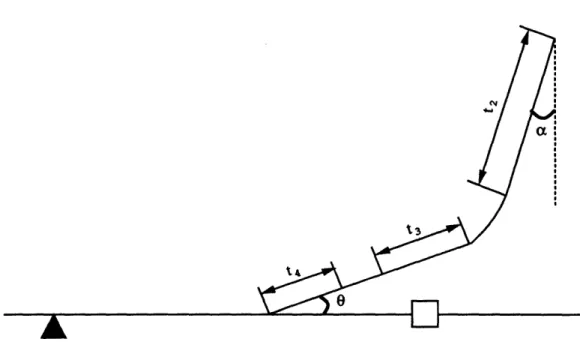
At any time point, we define the following: v: airspeed of aircraft;
r: intended final approach speed;
0: intercept angle;
ti: computed remaining duration of downwind leg;
t2: computed remaining duration of base leg;
Figure 3-1: Pattern 1 Path and Remaining Durations
t4: computed remaining duration of final intercept leg;
z,: x coordinate of aircraft; yp: y coordinate of aircraft;
xb: x coordinate of box;
Yb: y coordinate of box;
3.1.1
Downwind Leg
At any time point, we expect an aircraft on downwind leg to successfully intercept its schedule box if and only if the x and y coordinates of the aircraft and its schedule box are identical when the aircraft intercepts the runway centerline. The mathematical translations of the above condition are:
x, + vti - Vt3 cosO = Xb - r(ti + t2 + t3) (3.1)
vt2
+
vt3 sinO =jyp|
(3.2)Let d =
I,
and1
= xb - x,. From (3.2), we can solve for t2 and getd
- Vt2ta
3=
vsinO
Substitute t3 into (3.1), we obtain an equation that contains ti and t2. After some
manipulations and rearrangements, we have:
v 1 d rd
(v + r) ti + [ -- - 1)r] t2 = 1 + (3.3)
tg9
sin9
tg9
vsin9
One constraint we have is that ti and t2 must be nonnegative, i.e. t1
2
0, t2 0. Alsocorresponding to the requirement that aircraft are not allowed to cross the runway centerline, we have Vt2 < d. Let
v
1 - sine
C2 _ -- r tg9 sin0C
1+
d
rd
tg- vsin0Then the above equations become
(v +r)t1 + C
2t
2=
C
Vt2 < d (*
t
1> 0, t
2> 0
(*) is a linear system. Clearly, feasible final approach paths exist for an aircraft if and only if (*) is consistent.
The consistency of (*) is fully determined by C2 and C, in particular the signs of
C2 and
C.
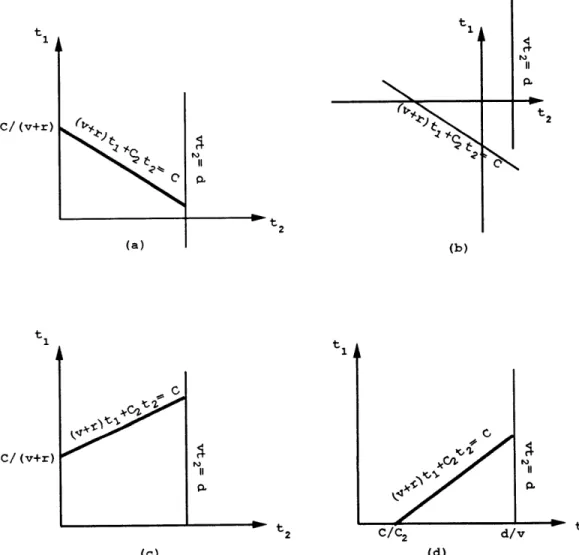
We enumerate all the possible combinations of C2 and C's signs. 1. C2 > 0, C > 0(*) is consistent. This can be seen from Figure 3-2(a). The thick line in the
picture indicates the feasible region. In this case, we can choose ti such that
C-C
2min(
,)
C
v~r -
v+r
Correspondingly, we can choose t2 such that
0
t2min
(-,
d
2. C
2> 0, C < 0
(*) is not consistent. Therefore, there are no feasible final approach paths for
the aircraft. See Figure 3-2(b).
3. C
20, C > 0
(*)
is consistent. We can choose ti such thatC C_-C2 C < t1 < - 2"
v+r
~ ~+r
Correspondingly,d
0
< t2 -V1 C/ (v+r) t 1 C/ (v+r) (c) (d)
Figure 3-2: Different Combinations of
C
and C2
a
See Figure 3-2(c) 4. C2 0, C < 0
In this case, we consider several subcases. (a) C/C2 >
d/v
(*) is not consistent.
(b)
C/C2d/v
(*)
is consistent. See Figure 3-2(d). We can choose ti such that0
< ti <
v
-v + r
Correspondingly,
C
d
C2
-v
It can be seen that in all feasible cases, we have a certain feasible interval for ti, the remaining duration of downwind leg. In other words, there is one degree of freedom. We can eliminate it using different rules. The rule we use here is to minimize the remaining duration of downwind leg, i.e. ti. By doing so we expect to compress the total final approach time as much as possible. Adopting this policy, we obtain for the above feasible cases:
1. C2 > 0, C
>20
C -
C2min
(,
d) -v+
rC
d
t2 = min(-,
-)
C2 v 2. C2 < 0, C >_ 0 tj C t2 = 0 3. C2 <0,C
<0 andC/C2
d/v
C
t2 =
--3.1.2
Base Leg
The governing equations for base leg can be considered as a special case of those for downwind leg. We can simply force ti to be zero in (*) and we obtain
C2t2 = C
vt
2<
d
Discussion 1. C2#
0,
then if0
< C/C 2<
d/v
C
C2
d
- vt2 v sinOElse there will be no feasible paths for the aircraft.
2. C2
=
0, then if C= 0, t2 can be anything between 0 andd/v.
Let us give asmuch maneuvering room to intercept leg as possible. Then we have:
t2= 0 (an immediate turn to intercept leg)
d
t3 = 6
vit
v sin6
3.1.3
Intercept Leg
Again, in (3.1) and (3.2), letting ti and t2 be zero we obtain:
(r
-Vcos9)t 3 =1
vt3
sinO
=d
Discussion
From (3.3), we can see that a feasible path exists for the aircraft if and only if
1
d
rd
0
t gO
e sine
in which case,d
= v sinO3.1.4
Summary
At any point in time, we can obtain
1,
d,v
from surveillance, from which we computeC and C2, the parameters of our model. Then our mathematical model will compute ti, t2 and t3.
3.2
More Complicated Case: No Wind, with Turn
Radius, with Speed Reduction
Next we turn to a more sophisticated case. In this case, we will take into account radius of turn and speed reduction. We assume aircraft turn at a constant rate w. The angle to turn from downwind to base leg is Z. The duration of base turn is Z. The angle to turn from base leg to intercept leg is Z- . The duration of the intercept
turn is . The angle of final turn is 0. The duration of final turn is . Suppose the
deceleration rate is a. The time it takes an aircraft to slow down is . The total time to intercept then is the sum of durations of all legs, durations of all turns and the speed reduction time, i.e.
S
-e
e
v -r
t1+t 2+t+t 4+-+ 2
+-+
2w
w
w
a
where ti, t2, t3 and t4 are remaining durations of downwind leg, base leg, intercept
As before the conditions for an aircraft to intercept its schedule box are given by the following equations.
final aircraft x-coordinate = final schedule box x-coordinate final aircraft y-coordinate = final schedule box y-coordinate where
final aircraft x-coordinate = initial aircraft x-coordinate + Ax final aircraft y-coordinate = initial aircraft y-coordinate + Ay
3.2.1
Downwind Leg
The Ax can be broken down into contributions from different legs and turns. For example, the contribution of downwind leg is v ti. The contribution of base turn is ",which is the radius of turn. The contribution of final intercept leg is -r t4 cosO. It
is easy to see that
v v v v2-r2 r
AX = vt1 + - - - sin) V t3 cos V cosr - r t4 cos - -cos0 (3.4)
w w w 2a
After some rearrangement, we get:
v 2 _ r 2 v - r
AX = v t1 + -v t3 cos# - r t4 cosO -
cos
+
-
sin
2a o
In a similar way we can obtain the equation concerning y-coordinate.
Ay = -(-+ w V t2
+
- cosO w+
(Vt + Vr+2a
r t4) sin#+
W
-(1 - coso)) (3.5)2 -r2 1 r
Ay = v t2 + (Vt +
+
rt 4)sin9+
-+
cosW)+
-(1 - cosO)We obtain the equations that represent the conditions on which the aircraft meet their schedule boxes as the following:
v-r2 v-r.
x, + v t1 + -v t3 cos9 - r t4 cosO - cose
+
sine
=2a W
xb - r(t1+ t2+ t3
+
t4+--) (3.6)v72 _ r2 v (1+CS)+r (
O
V t2 + (V t + + r t4)
sine
+ cosO) + -(1 - cos) =d
(3.7)2a + w
where d
=
|y,|.
Letd'
=d- -(1+ cos) -
(1-cos)
Le
W
v
-r
rir
i' = xb - X, - sine - --W W v- r rir =1-
sine
--(3.7) becomes 22
vt
2+(Vt+
-r
+rt
4)sine=d'
(3.8)
2aAs in the previous case we require that
t
1>
0, t2 > 0, t6 0 and t4 > 0. Inaddition we require that the deceleration start in the middle of the length of speed reduction/intercept leg. Hence we have
V6t = V r+ rt4 (3.9)
2a
(3.8) becomes
vt 2 + 2vt3
sine
=d'
(3.10)Solving for ta, we get
1 V2 - r2 r
6a = - -
+
- t4 (3.11)2 va v
Substitute (3.11) into (3.6) and (3.10), combine the resulting equations and rear-range, we get the following
(v + r) t1 + - [(1 - 2 sin6)r + (1 - 2 cos6)v] t4 =
V
v-r r 1 v-r
sino -- d'+-. [2v cosO+
w v 2 va
(2sin6 + 2cos6 - 3)vr + (2sin6 - 1)r2] (3.12)
The constraints that are equivalent to ti 0, t2 0, t3
2
0 in the prior formula-tion are: ti>
0 t42 0
y2 _r2 (Vt 3+
2a + rt 4)sin9 < d' Let C2 = - [(1 - 2sin9)r + (1 - 2cos6)v] V r 1 t'-rC = 1' - -d + - [2v2cos6 + (2sin6 + 2cos9 - 3)vr
+
(2sin6 - 1)r2] v 2 vaand putting things together, we obtain the following system of equations.
(v + r)t1 + C2t4 t1
t4
t4
As in the previous case, feasible
(**) is consistent. C 0 0 1 d' v2 _r2 2 r sin6 2ra
final approach paths exist for aircraft if and only
Discussion
As an obvious observation,
(**)
is consistent only if}
-2 _,2 > 0.Mathemati-cally, it is the necessary condition for t4 to be nonnegative. Intuitively, it means that
C/ (v+r ) ' C/ (v+r )
St 2 t2
Sd/c2 2c/c2 U 2
Figure 3-3:
C2 >0, C
>0
the aircraft must start far enough away from the runway center line to have least
enough room for the speed reduction.
On the condition that
}
- V2;r2 >0, we can carry out the same discussion
2~~
r~
iO 2as we had for the simplest case. Let U
=
d' V 222 rizO 2ra
1. C2 > 0, C > 0
(**) is consistent. This can be seen from Figure 3-3. In this case, we can choose
ti such that
C -
C
2min
(-,
U)
C
+ C2 < ti < +
v
+r
~ ~~o+ rCorrespondingly, we can choose t
4such that
C
0
< t4< min(---, U)
C2
2. C2 > 0, C < 0
(**) is not consistent. Therefore, there are no feasible final approach paths for
the aircraft. See Figure 3-4.
3.
C2<0,C>0(**)
is consistent. See Figure 3-5. We can choose
ti
such that
C
C - C
2U
Figure 3-4:
C
2 >0,
C
<
0Figure 3-5:
C
2<
0,C
>0
t 1
C, C, a t-a t 4 U C/C2 C/C2 (a) (b)
Figure 3-6: (a)
C2
< 0,C/C
2>
U; (b)
C2
< 0,C/C
2 <U
Correspondingly,0
<t
4U
4. C2 0, C < 0In this case, we consider several subcases. (a) C2 = 0
(**) is not consistent.
(b)
C
2< 0,
C/c
2>
U
(**) is not consistent. See Figure 3-6(a).
(c)
C2 <
0,
C/C2
U
(**)
is consistent. See Figure 3-6(b). We can choose ti such thatC - C
2U
0<t1<
v~ Correspondingly,0
-<t
4<U
C2It can be seen that in all feasible cases, we have a certain feasible interval for ti. In other words, there is again one degree of freedom. We can eliminate it by minimizing the duration of downwind leg, i.e. t1. By doing so we expect to compress the total
final approach time as much as possible. However, if we do so, we obtain for the above feasible cases:
1. C2>0C>0
C-C2
min
(#,
U)
tjv + T 2 t4 = min(-,
U) C2 2. C2 < 0, C > 0 C =o+ r
t4 = 0 3. C2 < 0,C
< 0 and C/C2 < U t1 = 0t
4=-C2
3.2.2
Base Leg
The governing equations for base leg are mostly a special case of those for downwind leg, in that ti vanishes in this case. There are, however, some minor differences in constants. For one thing, the base turn will not be considered.
Mathematically what we need to do is to eliminate the terms in (3.4) and (3.5) (on page 30) that are related to downwind leg and base turn, i.e. v t1 and v/w in
(3.4) and v/w in (3.5).
Corresponding to (3.7) and (3.6), it is not difficult to derive the governing equa-tions for base leg. The constants are now
= d-
-cos6 --
(1-cosO)
v-r r2r
The governing equations are:
C
2
t
4
= C
t4> 0
1d'
v2 _r 2 t4 < --- 2 r sin ~ 2ra Discussion1. C2
#
0, then we only need to check ifC
1
d'
v2-r2
C2 - 2 r sinO 2ra
is satisfied or not. If aircraft could either the above inequality
no, then there will no feasible paths for the aircraft. The be early or late depending on the values of C and C2. If is satisfied, then t4 C2 1 v2 _r2 r t3 = - + -t 4 2 va V d' - 2vta3sin8 t2 = V 2. C2 = 0, then if 0 C = 0, then 1
d'
V2 _ r2 t4 =-- 2 r sinO - 2ra r 1 v2 _r2 t3 = V t4+- -2
va
t2 =d' -2vt
V3sinO
* C
#
0, then there will be no feasible path for the aircraft.3.2.3
Intercept/Deceleration Leg
Once we are on intercept/deceleration leg, we drop the constraint that deceleration must occur at the middle of the length of intercept/deceleration leg.
We need to consider the situations both before deceleration and after deceleration.
Before Deceleration
For initial intercept leg, we simply eliminate the terms in (3.4) and (3.5) (on page 3.4)
that are related to downwind leg, base turn, base leg, intercept turn. We then get:v,2 _.2 r v -r 0 x, - (v t3 + + r t4 + -)cos9 = Xb - r (t3 + t4+ + -) 2a W a W (v t + - +r t4)sinO + -(1 - cosO) = d 2a
Discussion
Let b X r r(v - r) W a d' = d - -(1 -cos6) Solving the above equations, we obtain:ad= (1 - cosO)
--
("-v - r
= + (' c -t_ 1)S-'"g
2a We want t3 > 0 and t4
>
0, which are equivalent to:d' _(v -r )2 ' >
-(1
- cosO) - 2 sinO 2ait<
d' (r _Cs)+(v-r )2 (' < cos 2)+ -sin9 v 2aAfter Deceleration
The governing equations in this case are:
r (1 - cosO)t4 = l'
r t4sin# = d'
Similar to the simplest case, there exists a feasible path for the aircraft if and only if
d' d
tgO sinO
3.3
More Constraints on Pattern Geometries
We mentioned earlier that we require that the aircraft intercept their schedule boxes in front of the outer marker. In addition, we introduce two more constraints. In order to allow for sufficient maneuvering, we require for each landing aircraft the duration of base leg must exceed certain minimum level. We impose a similar restriction on the duration of intercept/deceleration leg. In practice, this minimum level can be 90 seconds, for example.
Without loss of generality, let us assume that minimum durations for both base leg and intercept/deceleration leg are identical, denoted by Tmin. We therefore have:
t2 > Tmin (3.13)
t3 + vr
a
+ t4 Tmin (3.14)which are mathematical translation of the constraint that the durations of base and intercept/deceleration leg must be great than or equal to certain minimum value.
From (3.10) (on page 31), (3.13) implies
which, by (3.11) (on page 31) implies: t4 <d - vTin v2 _ r2 2r
sinO
2ra (3.15) Again by (3.11), (3.14) implies v 1v -
rr + 3v
v+r 2 a v (3.16)Adding (3.15) and (3.16) to (**), we will get a new linear system. For the sake of simplification, let
lb = max(O, (Tmin
-d
-V Tin v2 _r 22r sin9 2ra
The new system then becomes
(v+r)t1 +C 2t4 t1
t
4t
4 (v - r)(r + 3v) 2av=C
> 0 >lb
* ub
3.3.1
Discussion
1.
C2 >0* if lb > C , then there will be no feasible path for the aircraft. In particular,
2,
the aircraft will be late. * if lb < , then
t4 =
min(--, ub)
C2
C - C2t4 v+r
2. C2 = 0, C < 0, again the aircraft will be late. 3. if C2 = 0 and
C
< 0, then t4 = ub C 1 = + 4. C2 < 0* if ub < C/C2, then there will be no feasible landing paths for the aircraft. In particular, the aircraft will be early.
e
if ub
< C/C2,then
t=
ub
C -C
2t
4v
v+r
3.3.2
The "Barrier" Constraint
We now consider the case where we want to impose some lower limit on the intercept point, i.e. we will not allow the intercept to occur beyond certain point. In practice, for example, intercept should always occur before the outer marker.
The barrier constraint has another important application. So far in our model we do not worry about the landing sequence, or more precisely the sequence that landing aircraft intercept the runway center line. In practice, however, it is vital to maintain the predetermined sequence throughout the whole process of final approach. The sequence constraint can be easily modeled as a barrier constraint. Consider aircraft 1 and aircraft 2, where aircraft 1 must intercept the runway center line before aircraft 2 does. Translating this in terms of barrier constraint, it is: the intercept point of aircraft 2 must not be beyond the position of aircraft 1, i.e.
In this case, of course, the barrier x1 is, 2's planned path.
Mathematically, we require that the less than certain value, Dmin. Therefore
v 2 2r
X+vt1 -2 2a +r
instead of a constant, a function of aircraft
x-coordinate of intercept point must be no for downwind leg we have:
t4
]
COS# + v-rsinG Dmin (3.17)That is, when the aircraft intercepts the runway center line, its x-coordinate must be no less than Dmin.
We examine the impact of this constraint on each leg.
Downwind Leg
For downwind leg, we simply add constraint (3.17) to (***) and consider the resulting linear system.
(v + r)t1 + C2 t4
v ti - 2r t4cos6
v -r v 2 _ 2
Dmin -sinO
+
-cosO - x,o
a
t1 > 0
t4 > lb
t4
<
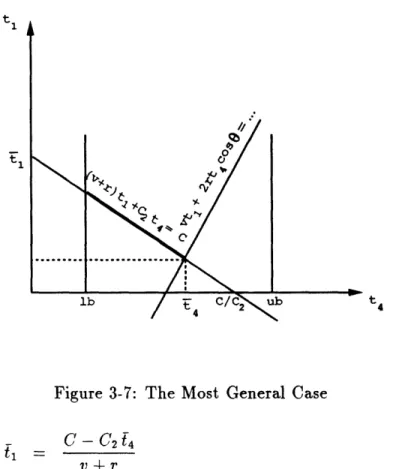
ub(3.19) is the new constraint that we need to take care of. Figure 3-7 shows the
geometric picture of (3.18)-(3.22). It can be seen that we need to consider the inter-section of (3.18) and the equation version of (3.19). It can be shown mathematically that the line that represents the equation version of (3.19) is steeper than the line that represents (3.18) so that the two lines always intersect. Once we find the intersection
(fl, [4),
we can perform our standard discussion. It turns out thatC + v - (x, - Dmin) - (Vr)2(Vr . cosO T4 va C2
+
2 -(v+r)-cos6 (3.23) (3.18) (3.19) (3.20) (3.21) (3.22)Figure 3-7: The Most General Case
C - C2 f4
v +r
(3.24)
Notice that (1,
14) depends on measurement of the current x position of the aircraft,
xp.
Discussion
1.
C
2> 0
* If lb
>C/C
2, then there exist no feasible paths for the aircraft. Indeed,
the aircraft will be late.
*
If lb
<C/C2, then
-
If
[4<
1b, there will be no feasible path for the aircraft. Indeed, the
- If 4 >
lb,
thenC
t4
= min
(ub, t
4,
_ C- C2t4
v + T
2.
C2=
0, C < 0, the aircraft will be late.
3. C2 = 0, C > 0
* If 4 <
ib,
then there will be no feasible path for the aircraft. Indeed, the aircraft will be late.* If [4
1
ib, thent4 = min
(ub,
t4)= C - C2t4
4. C2 < 0
* If ub < C/C2, there will be no feasible path for the aircraft. Indeed, the aircraft will be late.
* If ub
C/C2,then
- If f4 < max
(C/C2, ib),
then there will be no feasible path for theaircraft. - If [4 > max
(C/C2, lb),
then t4=
min
(ub,
14) C - C2t
4 v + r'Base Leg
As usual, we can obtain the governing equations by canceling out ti and certain
constants that are related to base turn in the equations for downwind leg. In this case,
however, some extra attention needs to be directed at the constraint that intercept point must not be beyond the outer marker.
Mathematically the above constraint is:
xP - 2v t3 COSO> Dmin
which by (3.11) (on page 31), implies:
t , -Dmin
2 r cosO
V 2 - r2 2ra
As a result, ub will be different from the previous case. And it is
d
ub = min d
2 r sinO
v2 _r 2 XP - Dmin
2ra ' 2rcosO
The following are the equations for base leg.
C2
t
4
t4 >
t4
< ub
Discussion
1.
C2#
0, then
* If C/C 2 > lb and C/C2
<
ub, thenC t4 = C2 1 v2 - r2 t3 =
-2
va
v
2 _r2 2ra d' - 2vt3 sin0* Else, there exists no feasible path for the aircraft.
(3.25) (3.26) (3.27)
r
2. C2 = 0, then * If C = 0, then t= ub
1
v2 - r2 r t3 = -- -+ -t 4 2 va v d' - 2vt3 sinO t2 = V* If C
#
0, then there will no feasible path for the aircraft.Intercept/Deceleration Leg
Identical to the case without minimum intercept point constraint, we derive the fol-lowing equations before deceleration:
v 2 _ r2 r x - (V t3
+
a+
r t4+ -)cosO V 2-r2 r (V t3 + -+r t4) sin9 + -(1 - cosO) 2a W v - r = xb - r (t3 + t4 + -) a W Let Xb-X-r COSr(v - r) W a d = d - -(1 -cosO) WSolving the above equations we get
d (1 -cos6) - 1 _' -r)2
v - r
+V ( cosO - 1) - (-r)2
S- r2a
lv~ d-
~
r~1 \(-We want t3
2
0 and t42
0, which are equivalent to:d' (v -r) 2