See discussions, stats, and author profiles for this publication at: https://www.researchgate.net/publication/251971375
Performance of iterative multiuser detection in
OWDM-IDMA system
Article · September 2010 DOI: 10.1109/ISVC.2010.5655819 CITATION1
READS62
3 authors: Some of the authors of this publication are also working on these related projects: Compressive SensingView project CP Decomposition
View project Awatif Rouijel Mohammed V University of Rabat 9 PUBLICATIONS 9 CITATIONS SEE PROFILE Benayad Nsiri Faculté des Sciences Ain Chock - Casablanca 57 PUBLICATIONS 94 CITATIONS SEE PROFILE Mohamed Et-tolba National Institute of Posts and Telecommuni… 26 PUBLICATIONS 23 CITATIONS SEE PROFILE
All content following this page was uploaded by Awatif Rouijel on 05 July 2015.
978-1-4244-5997-1/10/$26.00 c 2010 IEEE
Performance of Iterative Multiuser Detection in
OWDM-IDMA System
Awatif Rouijel
GSCM-LRIT laboratory Faculty of Science University Mohammed V Agdal Rabat Email: [email protected]Benayad Nsiri
LIAD laboratory Faculty of Sciences University Hassan II ,Ain Chock MOROCCO Email: [email protected]Mohammed ET Tolba
SC Departement,Telecom Bretagne CNRS (UMR 3192) Technopole Brest Iroise
CS 83818, 29238, Brest Cedex 3, France.
Abstract—Efficiency and adaptivity play a major role in the design of fourth-generation wireless systems (4G). These systems should be efficient in terms of bandwidth and power allocation. Moreover, low complexity transceivers are expected in this type of system.
This paper outlines the basic principles of a promising tech-nique for future telecommunications system, called OWDM-IDMA (Orthogonal Wavelength-Division Multiplexing-Interleave Division Multiple Access). A comparison with other alternative technologies such OWSS (OWDM spread-spectrum) is provided. Some attractive features of OWMD-IDMA are explained by estimating the BER (bit error rate) of system, including low cost iterative multi-user detection, flexible rate adaptation, spectral and power efficiency.
Index Terms—IDMA, iterative detection, CBC, MUD, OWDM, OWSS, DWPT, IDWPT, MAI.
I. INTRODUCTION
In mobile communications, advanced radio access tech-niques to improve spectral efficiency are required for fourth-generation (4G) systems. Multicarrier code division multiple access (MC-CDMA) and OWDM spread-spectrum (OWSS) are considered to be promising [1]. Recently, division multiple access (IDMA) [2], multicarrier interleave-division multiple access (MC-IDMA or OFDM-IDMA) and OWDM interleave-division multiple access (OWDM-IDMA) have been proposed [3].
OWSS is a proposed signaling system for 100-150 MB/s wireless LANs. In OWSS system, the pulses are generated through a combination of orthogonal wavelength-division mul-tiplexing and spread-spectrum concepts. The system offers several advantages including effective equalization due, in part, to the wide spectrum and wide time-support of the pulses used and high data rate [4]; furthermore, it is considered as a potential candidate for 4G systems.
The performance of this technique is mainly limited by mul-tiple access interference (MAI). Multi-user detection (MUD) is a potential solution to the MAI problem. Various MUD techniques have been carried out by many studies and sig-nificant progress has been made [5]-[6]. In particular, IDMA scheme [7] allows a very low-cost chip-by-chip (CBC) MUD algorithm to be used. The related complexity (after being normalized to each user) is independent of the number of
users, indicating its potential for practical use. Indeed with IDMA, different users are, solely, distinguished by user-specific interleavers. These interleavers can be selected ran-domly and orthogonality is not essential. For all these reasons, we are inspired by the both techniques to associate the OWDM modulation with IDMA technique.
In this contribution, we propose to study the performance of a new multiple access technique, called OWDM-IDMA which is the combination of OWDM and IDMA techniques. OWDM-IDMA is developed to solve the problem of the rectangular waveform caused by OFDM modulation; and Multiple access interference (MAI) produced by CDMA. In fact, through the formalism of wavelets and their application to wavelet packets and filter banks, it is possible to construct orthogonal basis in time and frequency whose properties will develop a Multicarrier communication system which uses more accurately the radio-electric spectrum. Moreover, the use of IDMA technique can make the system more robust against MAI, and lead to a significant performance enhancement [2]. The system performance is analyzed. A signal-to-noise (SNR) evolution technique is applied to predict the performance in terms of BER.
The rest of this paper is organized as follows. In Section 2, we present the transceiver architecture of IDMA. In Section 3, the basics of OWDM-IDMA are discussed. Afterwards, we present and investigate the performance of the proposed OWDM-IDMA scheme. Finally, conclusion is given in Section 5.
II. OVERALLTRANSMITTER ANDRECEIVERPRINCIPLE
OFIDMA
The technique of multiple access IDMA can allocate the same frequency band to several users while allowing them to transmit simultaneously. IDMA can be seen as a special case of CDMA where the spreading is done by an arbitrary equal low rate channel code for all users and the separation is done by user-specific interleavers.
A. Transmitter structure
Figure.1 shows the transmitter structure of the multiple access scheme under consideration with K simultaneous users.
Fig. 1. Transmitter structure for IDMA system
The input data sequence dk of the kth user is encoded
basically on a low-rate code C, generating a coded sequence
bk = bk(j); j = 1...J where J is the frame length (Here,
”chip” is used instead of ”bit” as the FEC encoding may
include spreading or repetition coding). Then bk is permutated
by an interleaver πk, producing Xk = Xk(j). The interleavers
πk, are not similar for different users. We assume that the
interleavers are generated independently and randomly. The key principle of IDMA is that the users are solely distinguished by their interleavers [2]. After chip matched filtering, the received signal from K users can be written as:
r(j) =
K
X
k=1
hk(j)xk(j) + n(j) j = 1, 2, ..., J (1)
Where {n(j)} are the samples of a complex AWGN process
with variance σ2 in each dimension, and h
k is the channel
coefficient for the kthuser. The channel coefficients {h
k} are
assumed to be known at the receiver side. B. Receiver Structure
Fig. 2. Receiver structure for IDMA system
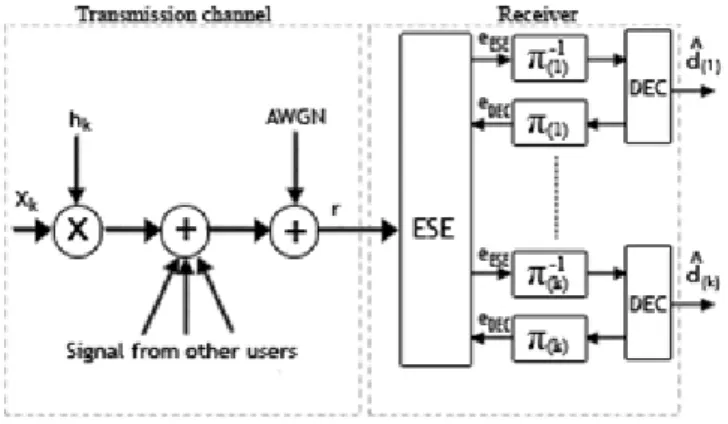
The receiver in figure.2 consists of an elementary signal estimator (ESE) and K single-user a posteriori probability (APP) decoders (DECs). The multiple access and coding constraints are considered separately in the ESE and DECs. In the iterative detection process, the ESE and DECs exchange extrinsic information in a turbo-type iterative manner [2]. The ESE operation can be carried out in a chip-by-chip way [8]. In Figure.3, we consider BPSK modulation, the number of users k=1,8,16,32,64,100, a common length-64 spreading se-quence for all users and the length of the information block is N=256 bits per user. We see that the IDMA scheme can achieve near single-user performance even for K = 64
(measured at BER = 10−3). This represents a very high
loading as the spreading length is only 64.
Fig. 3. Performance of chip-by-chip detectors for IDMA systems over AWGN channels
III. OWDM-IDMA PRINCIPLES
To keep up with the demanding requirements of multimedia, high quality video streaming, and other high bandwidth appli-cations, the trend toward ever increasing data rates is expected to continue. However, because of limited spectrum availability and constrained transmit power, new signaling approaches will be required to sustain the upward climb. Recently, the OWSS technique has been proposed to meet the demanding mentioned previously. OWSS pulses are generated through a combination of orthogonal wavelength-division multiplexing and spread-spectrum concepts [1]. However the performance of this technique is mainly limited by multiple access inter-ference.
As cited above, we propose to study the performance of OWDM-IDMA, which can provide a solution to the problem caused by OWSS technique.
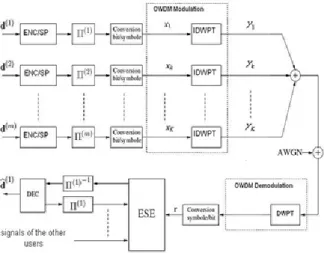
The use of OWDM technology in this scheme offers bet-ter properties. The first ideas of using wavelet transform in communication were made in multidimensional signaling techniques. Wavelet packet waveforms have the property of lo-calization in both frequency and time domains. Using the time domain localization property of wavelet packet waveforms, a multi-carrier IDMA system based on wavelet packets can be designed to achieve both frequency and time domain diversity. Moreover, OWDM-IDMA can alleviate ISI by the OWDM technique and limit multiple access interference by the IDMA technique, using of a low-complexity iterative MUD technique that is applicable to systems with a large number of users. Figure.4 shows the transmitter/receiver structure of an OWDM-IDMA system with K users.
At the transmitter of kthuser, the information data is encoded
into a sequence ck = ck[m]. Each coded bit ck is interleaved
by a user-specific interleaver πk, and then the resultant signals,
again denoted by Xk(n), are modulated by using IDWPT
producing Yk(n), The received signal equals the sum of the
signal can be written as: r(n) = K X k=1 hk(n)Yk(n) + z(n) (2) with Yk(n) = +∞ X n=−∞ M −1 X m=0 xk(n)ψm,n(t) (3)
Where hk is the channel coefficient for user-k, {z(n)} are
samples of an AWGN with variance σ2= N0/2, Yk(n)) is a
chip sequence for user k after OWDM modulation, M denotes the number of sub-channels associated with the transmission, and n represents the transmission time. As shown in Figure.4,
Fig. 4. Transmitter/receiver structure for OWDM-IDMA
the structure of the OWDM-IDMA receiver consists of DWPT for demodulation OWDM, an elementary signal estimator (ESE) and K a posteriori probability decoders (APP DECs). After OWDM demodulation by mean of DWPT, the iterative processes for receiver IDMA can be applied in the receiver signal r(n) to detect the information data of users. Thus, the iterative process does not include the OWDM demodulation. If the number of paths L is large, this structure reduces significantly the calculation complexity of the receiver. Information provided to the ESE detector is then the same kind of IDMA multiuser system on single-path channel. Thus to retrieve the information from each user, the ESE detector considers only the MAI interferences to allow for removal of the demodulated signal.
IV. COMPARISONBETWEENOWDM-IDMAANDOWSS
In what follows, we demonstrate the advantages of OWDM-IDMA over OWSS using numerical results. For this, we consider the uplink scenario. Only AWGN channel is assumed in all figures. The number of Haar wavelets pulses is 16. For simplicity, we only consider uncoded systems. K is the number of simultaneous users in the system.
Figure.5 shows the performance of the OWDM-IDMA system
Fig. 5. The simulated performance curves for OWDM-IDMA .In this example, we assume that Information bit length = 3072, iteration number =10, number of users=1,4,8,16,20.
(with randomly generated interleavers and a common length-16 spreading sequence for all users) using BPSK modulation, iteration number is equal to 10, length of the information block is N = 3072 bits per user, All channel coefficients
are set to hk = 1, and number of users k = 1, 2, , K. The
unique constraint used in selecting the spreading sequence for OWDM-IDMA is that it should contain a balanced number of +1 and -1 (so as to ensure randomness). We simply use +1, -1, +1, -1, for all users.
It is observed from Figure.5 that near single-user performance is achievable for large K values and the performance of OWDM-IDMA degrades slightly when K > 16.
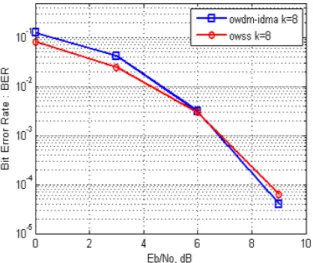
Fig. 6. Performance comparison between OWSS and OWDM-IDMA when K=1
Comparison between OWDM-IDMA and OWSS with dif-ferent user numbers in AWGN channel is shown in Figures.6, and 7. Both OWDM-IDMA and OWSS employ a BPSK
mod-ulation and the information block length for both schemes is Ninfo=3072. The iteration numbers is IT=10. For the OWDM-IDMA scheme, the bits are further spread with a spreading factor of S = 16 and all users employ the same mask sequence as spreading sequence which is used to balance the numbers of +1 and -1. However, for the OWSS scheme, a set of mutual orthogonal Walsh-Hadamard sequences are employed for spreading. Here we use a 16 ∗ 16 Walsh-Hadamard matrix. From Figure.6 and Figure.7, we see that both systems
Fig. 7. Performance comparison between OWSS and OWDM-IDMA when K=8
have similar performance. For the OWDM-IDMA and OWSS system, the curves can be slightly degraded by increasing K. OWSS system can support as many as K=16 users, therefore the maximum loading rate that can reach is 100%. On the other side, the OWDM-IDMA system support more users than spreading factor (K > S) and the loading rate can reach 125% for K=20 users. The trigger point the system’s convergence with a number of users approximately twice as large as the spreading code length, is located at 6 dB (Figure.5).
Figure.8 illustrates the convergence property of the above OWDM-IDMA system in AWGN channel, with K=20 and S=16. It can be seen that convergence is generally achieved within fourteen iterations.
V. CONCLUSION
In this paper, we have outlined the basic principles of IDMA and IDMA techniques. The performance for OWDM-IDMA is almost the same with the random OWSS and have similar advantages, among the advantages are:
• Use of family of pulses that have both wide time support
and wide frequency support.
• The pulses are broad-time, since their time support is
long.
• High bandwidth efficiency [2].
However OWDM-IDMA Technology outperforms OWSS in term of users supported by the system; as it represents a very high loading. We have used simulation results to demonstrate these features of OWDM-IDMA.
Fig. 8. Convergence property of the OWDM-IDMA system in AWGN with K = 20, S = 16 and Ninfo =3072
ACKNOWLEDGMENT
THIS WORK IS SUPPORTED BY THE ”ACADMIE HAS-SAN II DES SCIENCES ET TECHNIQUES”
REFERENCES
[1] Jianjun Yu; Zhensheng Jia; Lei Zong; Lei Xu; Ji, P.N.; Gee Kung Chang; Ting Wang ” Optically Labeled 100Gbit/s packet signals pass-ing through 8 straight-line OWSS nodes and 240km fiber”, Optical Fiber communication/National Fiber Optic Engineers Conference, 2008, 10.1109/OFC.2008.4528421.
[2] Li Ping, L. Liu, K. Y. Wu, and W. K. Leung, ”Interleave-division multiple-access,” IEEE Trans. Wireless Commun. Vol. 4, pp. 938-947, Apr. 2006 [3] I. Mahafeno, C. Langlais, and C. Jego ”OFDM-IDMA versus IDMA with ISI cancellation for quasi-static Rayleigh fading multipath channels,” in Proc. 4th Int. Symp. on Turbo Codes and Related Topics, Munich, Germany, Apr. 3-7, 2006.
[4] Jain, V., K., Myers, B., A.: OWSS: A New Signaling System For 100-150 MB/s Wireless LANs. IEEE Wireless Communications. p. 16-24. Aug. 2003.
[5] M. Moher. ”An iterative multiuser decoder for near-capacity communi-cation”IEEE Trans. Comun, vol 46 pp 870-880, July 1998.
[6] Z.Shi and C.Shlegel, ”joint iterative decoding of serially concatenated error control coded CDMA,” IEEE J. Select. Areas commun. Vol 19, pp.1646-1653, Aug, 2001.
[7] Li Ping, L. Liu, K. Y. Wu, and W. K. Leung, ”Approaching the capacity of multiple access channels using interleaved low-rate codes,” IEEE Comm. Lett., vol. 8, pp. 4-6, Jan. 2004.
[8] Li Ping, L. Liu, K. Y. Wu, and W. K. Leung, ”A unified approach to multi-user detection and spacetime coding with low complexity and nearly optimal performance,” in Proc. 40th Allerton Conference, Aller ton House, USA, Oct. 2002, pp.170-179.
View publication stats View publication stats