HAL Id: hal-03230841
https://hal.archives-ouvertes.fr/hal-03230841
Submitted on 26 May 2021
HAL is a multi-disciplinary open access
archive for the deposit and dissemination of
sci-entific research documents, whether they are
pub-lished or not. The documents may come from
teaching and research institutions in France or
abroad, or from public or private research centers.
L’archive ouverte pluridisciplinaire HAL, est
destinée au dépôt et à la diffusion de documents
scientifiques de niveau recherche, publiés ou non,
émanant des établissements d’enseignement et de
recherche français ou étrangers, des laboratoires
publics ou privés.
From massive detections and localisations of orca at
orcalab over three years to real-time survey joint to
environmental conditions
Marion Poupard, Paul Best, Maxence Ferrari, Paul Spong, Helena Symonds,
Jean-Marc Prévot, Thierry Soriano, Hervé Glotin
To cite this version:
Marion Poupard, Paul Best, Maxence Ferrari, Paul Spong, Helena Symonds, et al.. From massive
de-tections and localisations of orca at orcalab over three years to real-time survey joint to environmental
conditions. e-Forum Acusticum 2020, Dec 2020, Lyon, France. pp.3235-3237, �10.48465/fa.2020.1093�.
�hal-03230841�
FROM MASSIVE DETECTIONS AND LOCALISATIONS OF ORCA AT
ORCALAB OVER THREE YEARS TO REAL-TIME SURVEY JOINT TO
ENVIRONMENTAL CONDITIONS
Marion Poupard
1Paul Best
1Maxence Ferrari
1Paul Spong
2Helena Symonds
2Jean-Marc Pr´evot
4Thierry Soriano
3Herv´e Glotin
11
Univ. Toulon, Aix Marseille Univ. CNRS, LIS, DYNI, Marseille, France
2Orcalab Alert Bay, Canada
3
EA COSMER, UTLN, France
4Dpt Computer Sciences, UTLN, France
[email protected], [email protected]
ABSTRACT
Orcas (Orcinus orca) can produce 3 types of signals: clicks, whistles and vocalizations. This study focuses on orca vocalizations from northern Vancouver Island (Han-son Island) where the NGO Orcalab developed a multihy-drophone recording station to study orcas. The acoustic station is composed of 5 hydrophones and extends over 50 km2of ocean. Since 2015 our team is continuously stream-ing the hydrophone signals, yieldstream-ing nearly 50 TB of syn-chronous multichannel recordings. We trained a Convolu-tional Neural Network (CNN) to detect orca vocalizations, by transfer learning from a bird activity dataset. We re-late the detected presence and absence of the orca vocal-izations to the time of the day, the moon phases and the tides. This real-time detector opens new insight on these streamed submarine recording, allowing online automatic survey of the orca in the whole area. It thus assess in which area the orcas are present. It then could be used to monitor the effect of traffic pressure and anthropophonic pollution on this species. We finally discuss towards the installation of small quadraphonic system acoustic device to complete and detail these observations from Orcalab, in order to get more precise relative positions of the orcas.
1. INTRODUCTION
One of the best ways of studying animals that produce signals in an underwater environment is to use Passive Acoustic Monitoring (PAM). Acoustic monitoring is used to study marine mammals in oceans, and gives us infor-mation for understanding cetacean life, such as their be-haviours, movement or reproduction. Automated analysis for captured sound is essential to deal with large quantities of data.
This study focused on orca (Orcinus orca) in North of Van-couver Island, Canada, in collaboration with Orcalab ONG (OL) which developed a multi-hydrophone recording sta-tion around Hanson Island to study orca.
The northern resident killer whale population is composed of different “pods” composed of different matrilines [1],
and some pods attend Hanson Island due to the concen-tration of salmon. This community consists of more than 200 individuals known (in 2005), and is divided into three acoustic clans [2]. Globally, orca vocalizations are de-scribed in 3 different classes: clicks, whistles and pulsed calls [3], and each pod possesses a dialect composed of pod-specific calls (repertoire of 7–17 discrete calls). Actu-ally, an automatic orcas detector was built, but it was not used on so many records [4].
According to our knowledge, up to now, lot of manual analyses (acoustic and visual inspection of spectrogram) were done on this population, plus preliminary automatic classification [5].
2. MATERIAL & METHODS
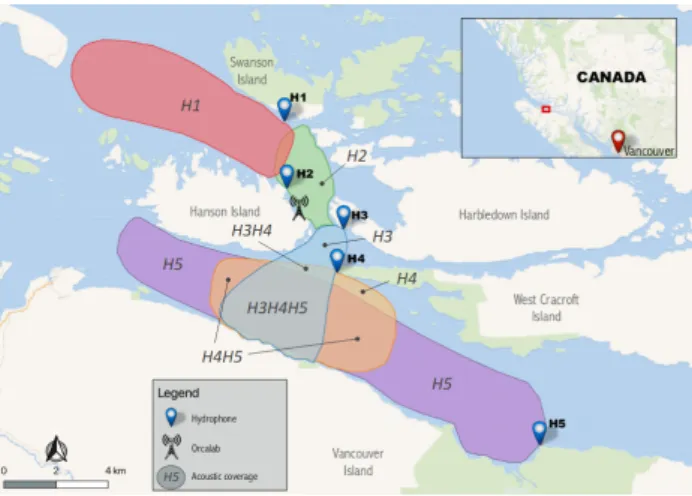
The acoustic station is composed of 5 hydrophones and extends over 50 km2of ocean (Fig.1). Since 2016 we
en-hanced these recordings with online full time 7/24 record-ing to LIS-LAB Dyni NAS storage at Toulon, France, yielding nearly 50 TB of multichannel recordings (in loss-less compressed flac format). OL has also set up video stations and behavioural visual observations (group com-position, behavioural state) were also obtained through a network of observers in OL.
It is essential to develop scalable algorithms to clas-sify and summarize with efficient manipulation tools this unique long-term dataset. In this paper, we investigate ad-vanced methods to detect and automatically learn accurate features of orca calls automatically [6].
First, we propose to extract all calls from a subset of 3 months of recordings, using basic adaptive time frequency filters [6]. We built a dataset composed of 872 orca vocal-ization samples and 6801 noise samples (boats, rain, void, etc), which we split randomly with 20% for the test set, 60% for the training set and 20% for the validation set. With that in hand, we trained a CNN [7] to distinguish orca vocalizations (not clicks) from boats and background noise [8, 9].
After training, when computing predictions, a threshold
Figure 1. Map of the area and the listening range of the 5 hydrophones. Map pins with H1 to H5 in bold print de-note the hydrophone locations. Detection zones indicate which hydrophones can capture orca calls in a particular area, according to experience of ten years of audio-visual observations of the orcas by the Orcalab team.
Figure 2. Receiver Operating Characteristics of the trained deep learning detector.
of 0.9 is applied to the probabilistic output of the model (Fig.2). This reduces the risk of false positives. Once trained, the model was run on 3 years of recordings (2015, 2016 and 2017) in 2 days of computation.
3. RESULTS
Detection results allow to estimate orca activity over time and hydrophone and infer likely movements of orcas, shown Fig.3. The trajectory from H5 to H1 can be deduced by the succeeding high detection rates of the hydrophones at 6 am the 24thof August. After this the group makes different round trips during the day.
Additional insights can be won by relating the occu-pancy of this site to the time of the day, the moon phases and the tide.
More precisely, we computed the probabilities to detect orca calls in each zone during a given time interval, shown in Fig.4. This result shows the global patterns of the orcas’ voicing activity in time and space, based on the continu-ous 3 years of recordings. It reveals variations in the voic-ing activities of up to a factor of four between conditions and zones. The biggest variation concerns the influence of
Figure 3. Example of the evolution of the probability of call detection for each hydrophone during one day (August 24th, 2017). During the morning, a group of orcas comes from the East (Fig.1) on H5, and is moving on H4, H3, H2 then on H1. Different round trips are made during the day.
Figure 4. Probability of voicing of orca in a zone dur-ing a given condition. ’Global’ refers to no specific condi-tion. This probability is defined as the amount of record-ings with orcas calls in a zone Zi during a condition Cj, divided by the total amount of recordings in Zi during Cj.
tide and moon in zone H5. In fact, this area is subject to strong currents during tidal hours. The Johnstone Strait is relatively deep (-450 m), so the trophic chain can change according to the moon phase [10] and influence the orca acoustic activities.
In addition to the statistics carried out on this species, this system could be set up for real-time detection and rough localisation of the orcas around Orcalab. This would allow eco-volunteers to lighten their working time, and maybe help to focus or select visual observations from the various camera placed in the area.
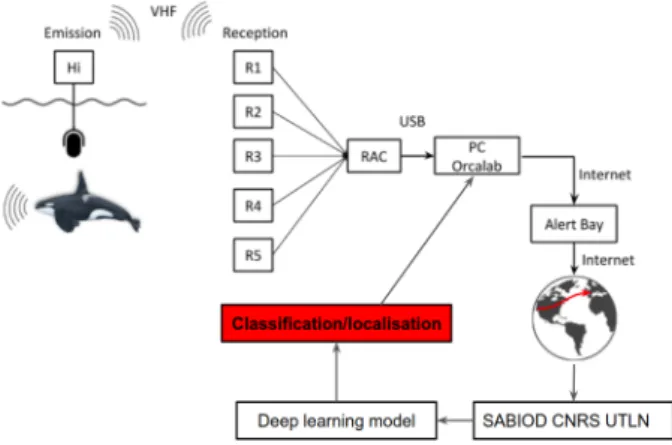
A summary diagram of such system is proposed Fig.5. It figures the orcas emissions and their collection by the hy-drophones, compression and transfer to GPU computers to LIS (could be closer). Then the detection and classifi-cation, and finally the rough localisation of the orcas by comparisons of the detection. The different responses of our model could be accessible via a dedicated website ac-cessible by password to avoid any usage by whale
ing industry which could interfere with orcas.
Figure 5. Representation of the data acquisition, from recording until the detection and the localisation of the or-cas.
4. TOWARDS DETAILED LOCALISATION One current extension of this research is linked to the in-stallation of a small quadraphonic acoustic device on the shore in front of OL. It could improve the monitoring of the whales, by obtaining more precise tracks and observing behaviour in conjunction with ferries and other marine traf-fic. Therefore we developed at Toulon SMIoT team a high velocity sound card (5 channels x 1 MHz sampling rate x 16 bits) to study in detail orca movement and separate their voicings [11], still without interfering with animals. This antenna has been successfully placed in summer 2019 and current process show promising results.
5. CONCLUSION
The massive recording or orca activities give new insights but also offer facilities to learn accurate automatic detec-tor. Moreover, detailed acoustic observations from small hydrophone array joint to visual observations are also use-ful to better learn to classify automatically the orcas pods in the area [8, 9]. Correlating the orcas’ activity (position, speed, density of calls) and group (pod) with the marine traffic and anthropogenic noises in a large scale could sup-port the creation of local measures to mitigate the impact of human activity on the animals.
6. ACKNOWLEDGEMENTS
This research is partly funded by ANR-18-CE40-0014 SMILES, MARITTIMO FEDER GIAS projects on ad-vanced studies on anti collision whale-ship system, and ANR-20-CHIA-0014-01 national Chair in Artificial Intel-ligence for Bioacoustics, ADSIL (H. Glotin). We thank MI CNRS MASTODONS http://sabiod.org Scaled Bioa-coustic Research, SEAMED, Region Sud for co-funding P. Best’s Phd. We thank BIOSONG SAS for the co-funding of M. Poupard’s PhD. We thank SMIoT UTLN and INPS for sound card co-development.
7. REFERENCES
[1] T. Jefferson, P. Stacey, and R. Baird, “A review of killer whale interactions with other marine mammals: Preda-tion to co-existence,” Mammal review, vol. 21, no. 4, pp. 151–180, 1991.
[2] M. Bigg, P. Olesiuk, G. Ellis, J. Ford, and K. Balcomb, “Social organization and genealogy of resident killer whales (Orcinus orca) in the coastal waters of british columbia and washington state,” Report of the Inter-national Whaling Commission, vol. 12, pp. 383–405, 1990.
[3] J. Ford, “Acoustic behaviour of resident killer whales (Orcinus orca) off vancouver island, british columbia,” Canadian Journal of Zoology, vol. 67, no. 3, pp. 727– 745, 1989.
[4] C. Bergler, H. Schr¨oter, R. X. Cheng, V. Barth, M. We-ber, E. N¨oth, H. Hofer, and A. Maier, “Orca-spot: An automatic killer whale sound detection toolkit using deep learning,” Scientific reports, vol. 9, no. 1, pp. 1– 17, 2019.
[5] V. Deecke, J. Ford, and P. Spong, “Quantifying com-plex patterns of bioacoustic variation: Use of a neu-ral network to compare killer whale (Orcinus orca) di-alects,” The Journal of the Acoustical Society of Amer-ica, vol. 105, no. 4, pp. 2499–2507, 1999.
[6] M. Poupard, P. Best, J. Schl¨uter, J.-M. Pr´evot, H. Symonds, P. Spong, and H. Glotin, “Deep learning for ethoacoustics of oreas on three years pentaphonie continuous recording at orealab revealing tide, moon and diel effects,” in OCEANS, pp. 1–7, IEEE, 2019. [7] T. Grill and J. Schl¨uter, “Two convolutional neural
net-works for bird detection in audio signals,” in 2017 25th European Signal Processing Conference (EUSIPCO), pp. 1764–1768, IEEE, 2017.
[8] M. Poupard, P. Best, J. Schl¨uter, H. Symonds, P. Spong, T. Lengagne, T. Soriano, and H. Glotin, “Large-scale unsupervised clustering of orca vocalizations: a model for describing orca communication systems,” in 2nd International Workshop on Vocal Interactivity in-and-between Humans, Animals and Robots, 2019.
[9] P. Best, M. Ferrari, M. Poupard, S. Paris, R. Marxer, H. Symonds, P. Spong, and H. Glotin, “Deep learning and domain transfer for orca vocalization detection,” in IJCNN, Int. Joint conf. on Neural Net., 2020.
[10] B. Roper and D. Scarnecchia, “Emigration of age-0 chinook salmon (Oncorhynchus tshawytscha) smolts from the upper south umpqua river basin, oregon, usa,” Canadian Journal of Fisheries and Aquatic Sciences, vol. 56, no. 6, pp. 939–946, 1999.
[11] V. Barchasz, V. Gies, S. Marzetti, and H. Glotin, “Qualilife highblue: a novel smart low-power high speed and precision recorder for long term biodiversity surveys,” In Proc. of the Acustica Symposium, 2020.