HAL Id: tel-01220087
https://tel.archives-ouvertes.fr/tel-01220087
Submitted on 24 Oct 2015
HAL is a multi-disciplinary open access archive for the deposit and dissemination of sci-entific research documents, whether they are pub-lished or not. The documents may come from teaching and research institutions in France or abroad, or from public or private research centers.
L’archive ouverte pluridisciplinaire HAL, est destinée au dépôt et à la diffusion de documents scientifiques de niveau recherche, publiés ou non, émanant des établissements d’enseignement et de recherche français ou étrangers, des laboratoires publics ou privés.
Seydou Traore
To cite this version:
Seydou Traore. Computational approaches toward protein design. Quantitative Methods [q-bio.QM]. INSA de Toulouse, 2014. English. �NNT : 2014ISAT0033�. �tel-01220087�
THÈSE
THÈSE
En vue de l’obtention duDOCTORAT DE L’UNIVERSITÉ DE
TOULOUSE
Délivré par :l’Institut National des Sciences Appliquées de Toulouse (INSA de Toulouse)
Présentée et soutenue le jeudi 23/10/2014 par :
Seydou TRAORÉ
Computational approaches toward Protein Design
JURY
Catherine ETCHEBEST Professeur Université Diderot-Paris 7 Rapportrice
Raphaël GUEROIS Directeur de Recherche CEA Rapporteur
Juan CORTÉS Chargé de Recherche CNRS Membre invité
Magali REMAUD-SIMEON Professeur INSA Examinatrice
Thomas SCHIEX Directeur de Recherche INRA Membre invité
Thomas SIMONSON Directeur de Recherche CNRS Examinateur
Isabelle ANDRÉ Directrice de Recherche CNRS Co-directrice de Thèse
Sophie BARBE Chargée de Recherche INRA Co-directrice de Thèse
École doctorale et spécialité :
SEVAB : Ingénieries microbienne et enzymatique Unité de Recherche :
Laboratoire d’Ingénierie des Systèmes Biologiques et des Procédés INSA, UMR INRA 792/CNRS 5504, F-31400 Toulouse, France Directeur(s) de Thèse :
Isabelle ANDRÉ et Sophie BARBE Rapporteurs :
Laboratoire d’Ingénierie des Systèmes Biologiques et des Procédés INSA, UMR INRA 792/CNRS 5504, F-31400 Toulouse, France
Computational approaches toward
Protein Design
Seydou
TRAORÉ
2011-2014
PhD Supervisors: IsabelleANDRÉ & Sophie BARBE
Name: Seydou TRAORÉ
Thesis Title: Computational approaches toward Protein Design
Supervisors: Isabelle André & Sophie Barbe
Keywords: Computational Protein Design, Structural Bioinformatics, Combinatorial Optimization
Laboratory:
« Laboratoire d'Ingénierie des Systèmes Biologiques et des Procédés » LISBP, INSA, CNRS, INRA - Toulouse
PhD School: “Sciences Ecologiques, Vétérinaires, Agronomiques et Bioingénieries” (SEVAB) SUMMARY:
Computational Protein Design (CPD) is a very young research field which aims at providing predictive tools to complement protein engineering. Indeed, in addition to the theoretical understanding of fundamental properties and function of proteins, protein engineering has important applications in a broad range of fields, including biomedical applications, biotechnology, nanobiotechnology and the design of green reagents. CPD seeks at accelerating the design of proteins with wanted properties by enabling the exploration of larger sequence space while limiting the financial and human costs at experimental level. To succeed this endeavor, CPD requires three ingredients to be appropriately conceived: 1) a realistic modeling of the design system; 2) an accurate definition of objective functions for the target biochemical function or physico-chemical property; 3) and finally an efficient optimization framework to handle large combinatorial sizes.
In this thesis, we addressed CPD problems with a special focus on combinatorial optimization. In a first series of studies, we applied for the first time the Cost Function Network optimization framework to solve CPD problems and found that in comparison to other existing methods, it brings several orders of magnitude speedup on a wide range of real CPD instances that include the stability design of proteins, protein-protein and protein-ligand complexes. A tailored criterion to define the mutation space of residues was also introduced in order to constrain output sequences to those expected by natural evolution through the integration of some structural properties of amino acids in the protein environment. The developed methods were finally integrated into a CPD-dedicated software in order to facilitate its accessibility to the scientific community.
Nom : Seydou TRAORÉ
Titre de la thèse : Approches computationnelles pour le Design de Protéines
Supervisors : Isabelle André & Sophie Barbe
Mots clés: Ingénierie computationnelle de protéines, Bioinformatique structurale, Optimisation Combinatoire
Laboratoire:
Laboratoire d'Ingénierie des Systèmes Biologiques et des Procédés LISBP, INSA, CNRS, INRA - Toulouse
Ecole doctorale: Sciences Ecologiques, Vétérinaires, Agronomiques et Bioingénieries (SEVAB) RESUME :
Le Design computationnel de protéines, en anglais « Computational Protein Design » (CPD), est un champ de recherche récent qui vise à fournir des outils de prédiction pour compléter l'ingénierie des protéines. En effet, outre la compréhension théorique des propriétés physico-chimiques fondamentales et fonctionnelles des protéines, l’ingénierie des protéines a d’importantes applications dans un large éventail de domaines, y compris dans la biomédecine, la biotechnologie, la nanobiotechnologie et la conception de composés respectueux de l’environnement. Le CPD cherche ainsi à accélérer le design de protéines dotées des propriétés désirées en permettant le traitement d’espaces de séquences de large taille tout en limitant les coûts financier et humain au niveau expérimental.
Pour atteindre cet objectif, le CPD requière trois ingrédients conçus de manière appropriée: 1) une modélisation réaliste du système à remodeler; 2) une définition précise des fonctions objectives permettant de caractériser la fonction biochimique ou la propriété physico-chimique cible; 3) et enfin des méthodes d'optimisation efficaces pour gérer de grandes tailles de combinatoire.
Dans cette thèse, nous avons abordé le CPD avec une attention particulière portée sur l’optimisation combinatoire. Dans une première série d'études, nous avons appliqué pour la première fois les méthodes d'optimisation de réseaux de fonctions de coût à la résolution de problèmes de CPD. Nous avons constaté qu’en comparaison des autres méthodes existantes, nos approches apportent une accélération du temps de calcul par plusieurs ordres de grandeur sur un large éventail de cas réels de CPD comprenant le design de la stabilité de protéines ainsi que de complexes protéine-protéine et protéine-ligand. Un critère pour définir l'espace de mutations des résidus a également été introduit afin de biaiser les séquences vers celles attendues par une évolution naturelle en prenant en compte des propriétés structurales des acides aminés. Les méthodes développées ont été intégrées dans un logiciel dédié au CPD afin de les rendre plus facilement accessibles à la communauté scientifique.
Scientific contributions
PUBLICATIONS
[1 ] D. Allouche, J. Davies, S. de Givry, G. Katsirelos, T. Schiex, S. Traoré, I. André, S. Barbe, S. Prestwich, B.
O'Sullivan. Computational Protein Design as an Optimization Problem. Artificial Intelligence Journal,
March 2014.
[2 ] Traoré S, Allouche D, André I, de Givry S, Katsirelos G, Schiex T and Barbe S. A new framework for computational protein design through Cost function optimization. Bioinformatics, 2013.
[3 ] Traoré S, Allouche D, André I, de Givry S, Katsirelos G, Barbe S and Schiex T. Computational Protein Design as a Cost Function Network Optimization Problem. CP2012 Proceedings. 18th International Conference on Principles and Practice of Constraint Programming, Québec, Canada Oct, 8-12, 2012– Proceeding.
ORAL AND POSTER COMMUNICATIONS
Traoré S, Allouche D, André I, de Givry S, Katsirelos G, Schiex T and Barbe S. A New Framework for
Computational Protein Design through Cost Function Network Optimization. JOBIM 2013, Toulouse, July
1-4, 2013.
Traoré S, Allouche D, André I, de Givry S, Katsirelos G, Schiex T and Barbe S. Cost Function Network
Optimization based Framework for Computational Protein Design. GGMM 2013, Saint-Pierre d'Oléron,
May 12-23, 2013.
Traoré S, Topham C, Barbe S, André I. The contribution of structural computational biology to the study
and the design of enzymes. GenoToul2012, Toulouse, Nov. 23, 2012.
S Traoré, D Allouche, I André, S de Givry, G Katsirelos, S Barbe, and T Schiex. Computational Protein
Design by weighted constraint satisfaction. Journée de l’Ecole Doctorale SEVAB, Toulouse, Nov. 6, 2012.
Allouche D, Traoré S, André I, de Givry S, Katsirelos G, Barbe S, Schiex T. Computational Protein Design
as a Cost Function Network Optimization Problem. 18th International Conference on Principles and Practice
of Constraint Programming, Québec, Canada, Oct 8-12, 2012 (CORE: A).
Allouche D, Traoré S, André I, de Givry S, Katsirelos G, Barbe S, Schiex T. Cost function network and
Quadratic programming: Connections & preliminary results on Computational Protein Design. Workshop
on Nonlinear Optimization and Constraint Programming, Québec, Canada, Oct 8, 2012.
Traoré S, Allouche D, André I, de Givry S, Katsirelos G, Schiex T and Barbe S. Computational Protein
Design by weighted constraint satisfaction. EMBO Conference, Catalytic mechanisms by Biological
Remerciements – Financements de thèse et formations complémentaires
Mes remerciements à:
L’Institut National de la Recherche Agronomique (INRA) & La Région Midi-Pyrénées
Pour le financement de la thèse conjointement par l’INRA et la Région Midi-Pyrénées.
L’Ecole Internationale de Recherche Agreenium (EIR-A)
Pour les formations doctorales complémentaires dont j’ai pu bénéficié. De même j’ai effectué un séjour scientifique de 3 mois au Etats-Unis, financé par l’INRA dans le cadre de l’EIR-A.
Contents
Abbreviations xv
Introduction xvii
1 Computational Protein Design (CPD): Paradigms, Methods and Challenges 1
1.1 The CPD framework . . . 5
1.2 Theoretical advances and applied interest of CPD . . . 24
1.3 Concluding remarks, new trends and challenges ahead . . . 29
1.4 References . . . 32
2 Cost Function Network optimization 39 2.1 Cost Function Networks . . . 43
2.2 Local Consistencies . . . 44
2.3 Weighted Constraint Satisfaction Problem solvers – Complete search . . . 50
2.4 Alternative and complementary strategies . . . 51
2.5 References . . . 54
3 Cost Function Network-based Framework for CPD 55 3.1 CPD as a Cost Function Network optimization problem . . . 59
3.2 CPD as an optimization problem . . . 69
3.3 A new framework for CPD through Cost Function Network optimization . . . . 105
3.4 Fast search algorithms for CPD . . . 133
3.5 References . . . 150
4 Concluding Remarks & Outlook 151 4.1 Outline of the main results and their implications . . . 153
4.2 Addressing the many energetically equivalent conformation issues . . . 154
4.3 Improving the CPD input model(s) . . . 155
4.4 Toward Multiple Objective Optimization & experimental applications . . . 155
4.5 References . . . 158
5 Résumé Long en Français 159 5.1 Introduction . . . 161
5.2 Stratégies de Design Computationnel de Protéines . . . 162
5.3 De nouvelles approches basées sur les réseaux de fonctions de coût . . . 166
5.4 Conclusion et perspectives . . . 169
5.5 Références . . . 171
Abbreviations
AC Arc Consistency
BE Bucket Elimination
BQO Boolean Quadratic Optimization
BS Beam Search
CASA Coulomb Accessible Surface Area
CDD Cyclic Coordinate Descent
CFN Cost Function Network
CP Constraint Programming
CPD Computational Protein Design
CSP Constraint Satisfaction Problem
DAC Directional Arc Consistency
DEE Dead-End Elimination
DEEPer Dead-End Elimination with Perturbations
DFBB Depth-First Branch and Bound
DVO Dynamic Variable Ordering
EA Evolutionary Algorithms
EAC Existential Arc Consistency
EPT Equivalence Preserving Transformations
FDAC Full Directional Arc Consistency
FDPB Finite-Difference Poisson Boltzmann
GA Genetic Algorithm
GB Generalized Born implicit solvent
GMEC Global Minimum Energy Conformation
ILP Integer Linear Programing
KIC Kinematic Closure
LC Local Consistency properties
LDS Limited Discrepancy Search
LK Lazaridis-Karplus model
MA Memetic Algorithm
MAP Maximum A Posteriori
MB Mini-Bucket
MC Monte Carlo
MCSA Monte Carlo Simulated Annealing
MD Molecular Dynamics
MM Molecular Mechanics
MOO Multiple Objective Optimization
MPLP Message Passing Linear Programming
MRF Markov Random Field
MaxSat Maximum Satisfiability problem
NC Node Consistency
OSAC Optimal Soft Arc Consistency
PDB Protein Data Bank
SAT Satisfiability
SCP Side Chain Positioning
UP Unit Propagation
VAC Virtual Arc Consistency
VE Variable Elimination
WCSP Weighted Constraint Satisfaction Problem
WPMS Weighted Partial MaxSAT
Introduction
Over the years, research in biochemistry and biophysics has accumulated knowledge to under-stand fundamental properties of biomolecules and their functions. Among biomolecules of prima-ry importance are proteins. They are involved in a wide range of biological functions such as structural properties, signaling and catalysis. Their shape and the relationships between their structure and function have been widely investigated, enabling a fairly decent physico-chemical description and understanding of their properties and behaviors. With the ever-increasing number of biochemically characterized proteins and the growing number of protein structures available in databases, the exploration of structure-function interrelationships has become more and more approachable. Computational biology has also provided essential information to bridge the gap between static structural data and the huge amount of biochemical and kinetic information. More particularly, computational methods have led to major advances in the prediction of protein struc-tures from their amino acid sequences, implementing principles of protein folding and their ener-getics. Molecular modeling techniques have also been widely used to investigate conformational flexibility and its impact on biomolecular recognition and protein function.
At a more applied level, there has been an increasing interest for proteins of all kinds (enzymes, antibodies, lectins, structural proteins, ...) for different uses in medicine (cancer therapy, autoim-mune diseases, vaccines, neurodegenerative diseases, …), biotechnology (biosensors, biocata-lysts, genetic/metabolic circuits, artificial biosynthetic pathways …) and/or nanotechnologies (construction of nano-devices and molecular machines, ...). Although the properties of natural proteins can be directly exploited, new, designed proteins, with novel functions or improved ac-tivities, are of major interest in all these application areas. Hence, protein engineering has become a key technology that has proven to be efficient and useful to modulate both the structure and the function of polypeptides and generate proteins displaying desired properties.
To increase the chances of success to tailor the wanted proteins, while reducing the human and financial costs, computational methods are in high demand. They allow guiding the evolution of the proteins on regions of their sequence space of particular relevance to achieve the desired function and thus reduce the size of mutant libraries to build and screen experimentally. This in-tegration of computational approaches into engineering strategies has become essential to accel-erate the design of neo-proteins. Computational Protein Design (CPD) methods have been devel-oped for over a decade. They may involve the remodeling of a known protein scaffold in order to modify the protein function/activity, or, the complete (de novo) design of new protein to fulfill a particular function. The primary objective of CPD is the identification of a set of sequences that could fold into a predefined 3D scaffold, what is considered to be the inverse problem of protein folding prediction. In addition, CPD also addresses the requirements in order to find amino acid sequences that will optimize a desired property (physico-chemical property and/or biological function).
In spite of the significant advances in the field, one of the main challenges remains the very-high dimensional search space, which is the composite space of all the possible amino-acid sequences and all the possible spatial conformations of the protein, what optimization algorithms have to handle. Addressing this issue requires fast and efficient algorithms for searching large spaces, the accuracy of which is a fundamental necessity for successful protein design.
chapter of this thesis, we give an overview of the main underlying principles of Computational Protein Design, their current limitations and the challenges ahead, their application to tackle dif-ferent cases of protein design and at last, we provide a comparative analysis of a selection of ex-isting CPD softwares. In the second chapter, we introduce some basic definitions and formal-isms of the Cost Function Network (CFN) framework that will provide fundamental knowledge to understand how we used state-of-the-art CFN methods in the third Chapter to solve CPD problems. In collaboration with specialists in the field of combinatorial optimization, we devel-oped a CFN-based framework that also includes a physical modeling of the CPD problem. To the best of our knowledge, our studies constitute the first reported CFN-based CPD framework in the literature. Motivated by the results obtained, novel CFN-based methods were then derived and implemented into a CPD-dedicated software called osprey to facilitate its access to the scientific community.
Results obtained within the frame of this thesis are reported as a series of three research articles already published and one that will shortly be submitted for publication in an international jour-nal.
1 Computational Protein Design (CPD):
Paradigms, Methods and Challenges
Contents
1.1 The CPD framework . . . . 5 1.2 Theoretical advances and applied interest of CPD . . . . 24
1.3 Concluding remarks, new trends and challenges ahead . . . . 29
Over the past few decades, the Computational Protein Design (CPD) has been proven very useful with respect to the development of proteins for many different applications. Major successes were achieved both in terms of methodological developments as well as biotechnological and biomedical applications.
In this field, pioneering work aimed at redesigning the hydrophobic core of existing proteins us-ing simple knowledge about the stability of proteins [1]–[6]. Remarkably, these early successes led to the development of new properties not yet observed in nature [2], including the creation of a novel protein fold from scratch [7] as well as the amelioration of pharmacological properties of protein drugs [8]. Another milestone in CPD was achieved with the redesign of protein-protein interfaces including systems of biomedical interest [9], [10]. Early studies in this area were rapid-ly followed by the successful engineering of metal-mediated protein interfaces and metalloen-zymes [11], [12], which were chosen as initial models due to the well-established definition of the transition metal coordination. A more recent landmark in CPD was the de novo design of en-zymes from scratch, displaying original catalytic activities for which there is no counterpart in nature [13]–[15].
Such accomplishments were rendered possible thanks to the more and more realistic formulation of the design problem, especially with respect to i) the selection of suitable protein scaffolds for the design needs, ii) the treatment of protein flexibility in the design, in particular emanating from amino acid side-chains and protein backbone, iii) the development of well-adapted energy functions fast enough to allow high-throughput exploration of the sequence-conformation space, but still accurate enough to model properly protein properties and discriminate between sub-optimal sequence-conformation models, iv) the development of objective functions to adequately describe the fitness of the physico-chemical property and/or biological function that is sought. Finally, significant algorithmic advances have been made to efficiently explore the associated sequence-conformation space and accurately predict the optimal sequence-conformation models. However, current trends in realistic representation of the design model require the development of more efficient algorithms to handle the huge sequence-conformation combinatorial space.
The Computational Protein Design Framework 1.1
Given a protein 3D structure scaffold, the structure-based computational protein design aims to find an optimal or an ensemble of near-optimal sequences. It is thus viewed as an ‘inverse folding problem’. In addition to this primary goal, the CPD may seek to satisfy some design specific con-straints. Physico-chemical properties and biological functions can be formulated as constraints (or objectives to the design). Schematically put, the CPD problem is to find, from an element of the structure space (the input scaffold), elements of the sequence-conformation space that are optimal with respect to the desired biological fitness expressed as an objective function. Inherent-ly, structure-based design also requires considering the conformations accessible to the amino acids. Therefore, the search space of CPD is defined by both the possible amino acids and their associated conformations leading then to a composite sequence-conformation space modeling. The CPD problem is then formulated as an optimization problem. The search space is often dis-cretized and the energetics of the design space is captured by a pairwise energy function. The accurate modeling of these two representations of the search space has its own challenges (which will be discussed thereafter in this chapter). The objective function(s), built on top of the energy function is sought to mathematically express the design needs and constraints. The resulting op-timization problem has to be handled by fast and accurate algorithms. Both the size of the search space and the cost distribution of the objective function are limiting factors for the combinatorial optimization.
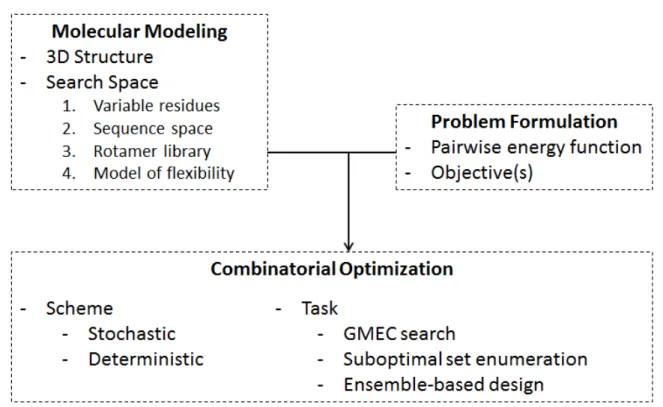
Methodologies involved in a generic CPD framework can be clustered into three main compo-nents (Fig 1-1):
The first one is the modeling of the CPD problem which includes the selection of : (1) a protein 3D structure template (i.e. a 3D scaffold) or the definition of a minimal catalytic site and its graft-ing into a suited 3D protein scaffold for the de novo design of enzyme active site; (2) a search space by defining the variable amino acids of the molecular system to design (namely the muta-ble amino acid residues and the fleximuta-ble residues for which only the conformational variability is explored so as to readjust the protein conformation to mutations); (3) an objective function rele-vant to the design target.
The second component is the optimization phase which aims to find (the) solution(s) in accord-ance with the defined objective function, given an initial input model. Both deterministic and stochastic optimization approaches have been widely applied for the computational redesign of relevant biological systems.
The third phase is then the analysis and ranking of the design results which usually consists in performing further in silico simulations (such as Molecular Dynamics simulations, Free energy calculations,..), both more accurate and more costly in terms of CPU-time than CPD methods, on selected models resulting from the design with the aim of refining them with more realistic phys-ical concepts.
Following the computational design procedure, experimental validation (including stability as-sessment, structural characterization, functional assays…) can then be performed on the most promising designed sequences. In many cases, an additional optimization of the designed en-zymes by subsequent rounds of directed evolution can be conducted to randomly introduce addi-tional mutations which can tune up the targeted property and catch up some imperfections of the CPD modeling [16].
Needless to say that improvement of design methodologies will only be rendered possible by the availability of feedbacks from in silico refinement and experimental evaluation. Both successes and failures provide crucial information to enhance reliability and accuracy of computational methods [17] .
Fig 1-1 A generic CPD flowchart.
The CPD input model to the combinatorial optimization component is defined by the 3D structure template, the defi-nition of the search space (the variable parts of the molecular system to design and their possible states), a pairwise-decomposable function to compute energy of inter and intra molecular interactions along with objective function to be optimized. The scheme of the optimization can be either stochastic of deterministic. Usual tasks to perform are: GMEC search, the enumeration of a suboptimal set of solutions and ensemble-based design. All elements are de-tailed thereafter in this section.
1.1.1 The input protein 3D structure template
The choice of the initial three-dimensional protein structure template is crucial to ensure its suita-bility for the design needs. The protein structure template is mainly selected amongst high resolu-tion 3D structures determined either from X-ray crystallography or soluresolu-tion NMR studies (and deposited in the Protein Data Bank: http://www.rcsb.org). In some cases, when no structure is available, a 3D model can be built by comparative modeling using the existing 3D structures of
homologous proteins. The re-use of an existing structure has a practical advantage, since nature often produces proteins with vastly different functionalities using the same protein fold [18], [19].
In some cases, when de novo design of proteins from scratch is undertaken, it might require novel hypothetical scaffolds which can be built using databases of protein 3D fragments. However, this leads to a tremendous increase in the number of adjustable degrees of freedom (DOFs) for the polypeptide backbone, what results in a highly complex dimensional search space. When consid-ering the de novo design of an enzyme active site, quantum chemical calculations are also used to build beforehand a minimal active site (theozyme) which will be grafted in a next stage onto the chosen protein scaffold [20].
1.1.2 The search space: degrees of freedom of the molecular system
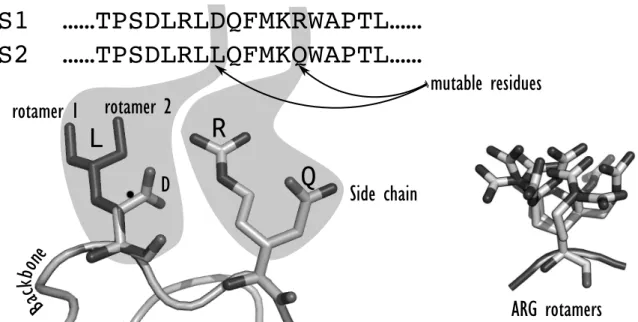
The definition of the search space involves the selection of variable amino acid residues, as well as the way their conformational variability is taken into account. Whole or a subset of amino acid residues of the system can be considered as variable. Some variable residues are considered as mutable and their possible states are defined by two levels of degrees of freedom (DOFs): the amino acid types permitted at each position and their possible conformations. The selection of the mutable residues will pre-condition the chances of success of the design. Depending on the ob-jective of the design, some residues might not be tolerant to mutations. For example, catalytic residues cannot be considered mutable if the enzyme catalytic activity needs to be maintained. To select the group of amino acid types permitted at each mutable position, CPD often takes into account the location of the mutable residues within the protein structure in order to preferentially introduce hydrophobic amino acids in the protein core and hydrophilic ones at the surface and maintain a stable protein [6], [21], [22]. In addition to mutable residues, a set of flexible amino acid residues (where solely change of conformation is allowed) is also selected in order to enable
adaptation of the protein structure to mutations. Amino acid residues have conformational DOFs, arising from the flexibility around their chemical bonds in a continuous angular space. The dihedral !-angles represent the DOFs of the amino acid side chains and the dihedral angles ! and ! from the main polypeptide chain, ! being mainly fixed. The real conformation space of a single amino acid can then be very large and ultimately, the size of the sequence-conformation space of a protein is con-tinuous and huge. Consequently, for the sake of computational tractability, a first common approx-imation is to represent the side chain DOFs by a set of discrete conformations. Therefore, their contin-uous conformational space is approximated using discrete conformations defined by their inner dihedral angles which are called rotamers. These rotamers are low-energy side chain conformations derived from statistical analysis of high
resolu-Fig 1-2 Amino Acid Rotamers (example of phe-nylalanine)
tion crystal structures of the Protein Data Bank (PDB) which highlighted that the side chains of amino acids in protein structures avoid most of the theoretical conformational space and appear frequently as clusters in !-angle space. An illustration for phenylalanine is given in Fig 1-2. In addition to the approximation made on the side chain conformational space, the classical model-ing paradigm for CPD assumes a fixed protein backbone [23]. Therefore, the most basic CPD problem is viewed as a search for the optimal rotamers to fit on a given protein backbone. The search returning the optimal rotamers yields both side-chain conformations and the underlying designed sequence.
These fixed-backbone and discrete rotamer approximations have the advantage to dramatically reduce computation time. The fixed-backbone assumption also avoids reliance on energy poten-tials to discriminate between favorable and unfavorable backbone conformations. Despite these benefits, these conformational limitations have several consequences which limit the power of CPD approaches. Indeed, they artificially limit the natural degrees of freedom available to protein sequences folding into their stable conformations and thus may impair the CPD ability to reduce native-like sequences [24]. In particular, numerous experiments have demonstrated that pro-tein backbones adjust to sequence mutations [24]. Some side-chain conformations may be as-signed with high energies and thus discarded during the search whereas slight backbone adjust-ments could have helped to correct such problems. Therefore, fixed backbone approaches may neglect a significant portion of sequence space which can lead to well-folded and functional pro-teins. Moreover, conformational changes of the protein backbone are crucial for the recognition and the interaction of proteins with their molecular partners such as a ligand, a cofactor, another protein… Therefore, further molecular flexibility has to be integrated in order to improve the accuracy of the predictions of the CPD approaches and extend the use of the latter to different design objectives. However, integration of more flexibility into CPD methods is a considerable challenge due to the huge increase in the combinatorial complexity and the needs for suitable optimization methods and accurate energy functions to discriminate effectively the multiple con-formational states. In spite of these difficulties, several studies have tackled these challenges.
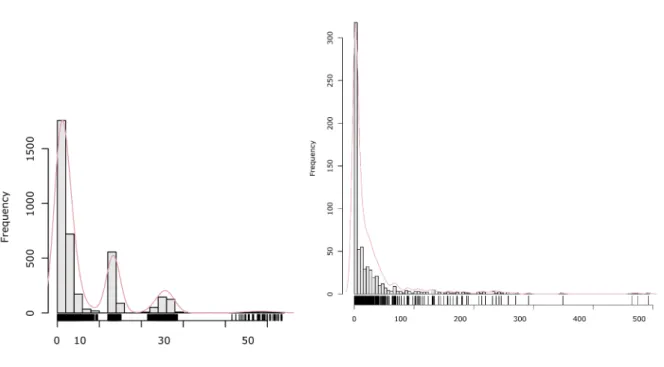
Fig 1-3 Distribution of isoleucine conformations in !-space (adapted from [24]). The red region identifies the subspace covered by rigid rotamers (a) and continuous rotamers (b).
Recent works highlighted the gain in accuracy achieved by allowing additional flexibility result-ing from the definition of a continuous rotamer space what reflects better the clusters of confor-mations observed for amino acids [24]. The case of isoleucine is exemplified in Fig 1-3. In par-ticular, a study showed that the use of continuous rotamers in CPD allows identifying low energy sequences and ultimately more native-like sequences [24].
Various techniques have also been proposed to account for the flexibility of the backbone, both large-scale and local rearrangements. Mayo and coworkers incorporated backbone flexibility into the computational design of a novel protein topology, an !-helical tetramer with experimental validation, using well-characterized parameters of secondary structural elements [25]. However, this approach can only be applied if defined parametrical descriptions are available for the struc-tural feature of interest. Random sampling of the backbone dihedral angles, previously described by Desjarlais and Handel [26] were also found effective in CPD experiments in combination with dihedral substitution using dihedral values extracted from the Protein Data Bank [7]. In a study using this later approach (conducted by Baker and coworkers), the CPD approach alternates be-tween sequence optimization for a fixed backbone and backbone optimization for a fixed se-quence. It has been successfully applied for the design of a novel protein fold [7]. Donald and coworkers also extended their fixed-backbone CPD approach to take into account the backbone flexibility by varying ! and ! dihedral angles continuously within a voxel [27]. Other algorithms handle the backbone flexibility by setting upper and lower bounds on pairs of Cα-Cα distances and on the backbone dihedral angles [28].
The multi-copy backbone approach has been also employed in CPD. It uses several complete conformations of the backbone. These backbone conformations are used as template for multiple independent optimizations. Floudas and coworkers developed a method to calculate optimal se-quences for a set of backbone templates derived from different structures of the same protein or extracted from molecular dynamics trajectories performed on the targeted protein [29]. They ap-plied this approach to fully design the human β-definsin-2, a 41-residues peptide. The accuracy of the approach was assessed by comparison of the predicted sequences to the sequences of homol-ogous proteins.
While above mentioned studies are based on conformational backbone sampling approaches de-veloped in the field of molecular modeling, some recent solutions rely on robotics-inspired meth-ods, namely inverse kinematics (or Kinematic Closure KIC) and Cyclic Coordinate Descent (CCD) algorithms [30]–[33]. These methods divide the protein backbone into small flexible fragments that are connected by fixed points called joints. Accessible conformations of the frag-ments are then searched while maintaining a constraint on joints in order to avoid chain breaks. The flexible backbone method based on CCD loop closure algorithm and fragment insertion method developed by the group of Baker optimizes backbone torsions until the break in the pep-tide chain resulting from the fragment insertion falls below a set threshold [33]. A CPD approach iterating sequence design and loop conformation optimization by this method has been success-fully applied for the redesign of three loops in the protein tenascin. The designed variants were experimentally verified to form stable folded protein structures [34].
Following this success and in order to account for catalytic constraints involved in the design of enzyme’s active site, the group of Baker proposed a method combining fragment insertion with CCD closure together with active site side-chains constraints. This procedure was used to pro-duce a change in specificity of 10!
-fold in a human guanine deaminase for ammelide over gua-nine [35]. The crystallographic structure of the redesigned loop was found within 1 Å !! rmsd of the proposed model.
While backbone flexibility methods described above explore the angular space of the backbone degree of freedom, another trend in CPD is to model the DOFs of the main chain by discrete lo-cal backbone states observed in 3D structures. Inspiration for such lolo-cal perturbations came from observations that natural 3D structures usually undergo small characteristic backbone shift (3% of all residues) in order to accommodate changes in sequences [36]. These so-called backrub and shear motions (Fig 1-4) have been successfully applied to CPD [37]–[39]. The benchmark study on both GrsA-PheA and β1 protein domains [37] led to designed proteins with lower energies than those obtained from fixed-backbone approaches. Smith and Kortemme successfully applied their backrub-based method to model alternative side-chain conformations observed in high-resolution crystal structures and to improve the prediction of conformational adjustments to sin-gle point mutations over fixed backbone methods [38]. Following the same idea, Donald and coworkers have applied their backrub-based CPD method [37], combining sequence design and local backbone motion, to examine local backbone changes in both !-helix N-Cap and the gly-cine-aromatic coupling in antiparallel β-sheet [40]. The approach successfully reproduced in sili-co the N-Cap shift observed in natural protein structure for mutation of Ser/Thr to Asn/Asp. The computed shifts between mutants and wild-type for aromatic-glycine coupling in antiparallel β-sheet were also similar to those experimentally observed.
Although backrub approaches are efficient sampling methods to handle specific local backbone flexibility, the backrub is not a frequent type of motion (only 3% of all residues, mainly in ex-tended structures [36]). Thus, it should be used in combination with other more general backbone flexibility modeling in order to better cover the natural backbone conformation space.
Another fundamental challenge in CPD is the need to accommodate the large translational, rota-tional and conformarota-tional degrees of freedom of a ligand within the already astronomically large sequence design calculations. When the ligand is a peptide, its conformational flexibility can be mostly described by discrete rotamer libraries, what is considered advantageous as it is consistent with the rotamer libraries used for sampling protein amino acid side chains. However, flexibility treatment of organic molecules, on the other hand, is often left to the user to pre-calculate an en-semble of low energy ligand conformers (rotameric combinations) with fixed geometry. Software solutions to construct continuous ligand rotamer libraries, better adapted to the search techniques used to explore protein residue flexibility, are generally lacking. Efforts have also been devoted to develop methods of ligand placement in the active site. These approaches are generally based on: (i) the use of stationary, rigid-body ligand poses in a large number of individual protein de-sign calculations [42]; (ii) the generation of a discrete set of ligand poses filling the active site by rotation and translation [43]; (iii) the targeted placement of small molecule variations with refer-ence to a contacting side chain [43]; (iv) iterative cycles of rigid ligand docking and sequrefer-ence optimization [44].
Fig 1-4 Two examples of local backbone motions (adapted from [39] ): a) The Backrub motion involves a rotation of the central !! with respect to the axis defined by its two neighboring !! atoms. b) The Shear motion involves the
displacement of a 3-peptide segment in a direction parallel to the axis defined by its external !! atoms.
Recently, Donald’s group extended its CPD approach to handle further protein main chain con-formational changes [41]. They integrated within the same framework, approaches to handle mul-tiple types of backbone freedoms denoted as perturbations. They include both backrub and shear motions, loop closure, secondary structure adjustments… Benchmark tests showed the ability of the framework to produce lower energy sequence-conformations than CPD studies which consid-ered no or limited backbone flexibility.
1.1.3 The energy functions
After the brief introduction on the methods for modeling (macro)molecular flexibility in CPD, we will focus in this section on the most common all-atom energy functions used in CPD. All energy terms used in CPD are either inherently additive or generally approximated to be so. This greatly helps to speed up calculations during the energy computation. In addition, because the pairwise energy can be pre-computed and stored, the sampling of the same rotamer or rotamer pairs during the search does not require re-computing the same individual energy contributions. This pairwise representation also determines the type of applicable algorithms as deterministic optimization approaches (discussed in Section 1.1.5) require the matrix to be pairwise. The optimization will then read this matrix to find the optimal combination of rotamer assignments.Thus, given the pairwise formulation of the energetics, the total energy (!total) of any given conformation has the following formulation in general:
! total= !!+ ! !! ! + ! !!, !! !,! (1‐1)
Where !! is a constant energy contribution capturing interactions between fixed parts of the model, ! !! depends on rotamer ! at position ! and ! !!, !! is the pairwise interaction energy between rotamer ! at position ! and rotamer ! at position !.
Interactions between residues of the protein but also with their partners (ligand, cofactors or other proteins or nucleic acids, for example) are estimated by two types of empirical energy functions: i) Physics-based energy functions that are more precise but often heavy in CPU time and ii) Sta-tistical functions that are often faster and derived from experimental structures (Knowledge-based). Hence, the type of commonly used energy expressions in CPD ranges from Molecular Mechanics (MM) force field energy functions to knowledge-based ones and also a combination of both.
The first ones (MM-based) are often altered in order to fulfill the requirements of CPD (fast and yet accurate energy terms in order to be applicable to the enormous sequence-conformation space). The individual energy terms include atomic packing interactions such as dihedral angles and reduced Lennard-Jones (and MM terms for bond stretching and bond-angle contributions are not always used in CPD experiments, because ideal geometry of these components is often used), electrostatic interactions between charges and hydrogen bonds. The solvent is represented by an implicit model, its explicit consideration being too expensive. Other ad-hoc terms are also used, for example to estimate the entropy of the side chains or the propensity of secondary structure elements. However, the latter one is generally accounted in other energy terms such as the elec-trostatic and Lennard-Jones, thus caution should be taken with the use of such additional terms. Knowledge-based terms are used to model a broad range of energy contributions. Hence, both a backbone torsional angle and a rotamer statistical potential that accounts for the self-energy of a given rotamer have been used [45]. A pairwise electrostatic potential is also defined based on the probability of finding two particular amino acids at a given distance [45]. Knowledge-based terms can model complex effects difficult to be considered otherwise in CPD experiments, how-ever, one difficulty in handling such terms lies in the introduction of additional non-overlapping energy terms during the development of energy functions.
A general energy function for CPD can be expressed in the form of a sum over individual empiri-cal energy contributions !! (either Physics-based or Knowledge-based) with a weighting factor !! :
! = !!!!
!
= !!"#!!"#+ !!"!#!!"!#+ !!"#$!!"#$+ ⋯
(1‐2)
The weighting factors are usually optimized to reproduce some structural properties of naturally occurring proteins.
Finally, energy terms are not always straightforward to approximate both in an additive (interde-pendence) and in a pairwise manner. When designing an energy function for CPD, it is very dif-ficult to avoid the overcounting of the same physical effect within the various terms [46]. Such artefacts can bias the objective function toward structural or functional properties not wanted or an unrealistic potential with respect to the target fitness property. This issue thus hardens the goal of bridging the gap existing between the fitness of computationally designed and naturally occur-ring proteins. Hence, for the CPD methodology to be accurate, both the selection of appropriate
energy terms and a correct balance between all these terms is to be accomplished [47]. This task is usually performed by optimizing the energy function using information derived from structural databases. One culprit with such knowledge-based optimization of energy functions is the as-sumption that native sequences are optimal with respect to the fitness function. Indeed, it is well established for example that native sequences are not optimized for stability [48] because they evolved in the complex cellular environment under multiple opposite constraints and functional requirements. Even more, such kind of energy function optimization generates weights that are dependent on the fitness function used for the energy function optimization itself and it thus lim-its lim-its general applicability. An alternative approach is to train weights to predict the energy of mutations and pKa changes [49]. This method has the advantage of being defined as a change in free energy and not a fitness function. Hence, it has a wider applicability because of its independ-ence with respect to any specific fitness function (such as stability or affinity) used in CPD exper-iments.
1.1.3.1 Lennard-Jones or van der Waals potential
A 12-6 Lennard-Jones (LJ) potential is usually used to account for the vdW contributions. Be-cause of the usage of both the fixed backbone and discrete side chain rotamers, the LJ potential is not used as such in CPD in order to avoid artificial steric clashes. Although an extended rotamer library could be used to reduce this effect, it may not be always sufficient [26]. Hence, different weighting factors have been used on the repulsive (decreasing with !!"!!") and attractive (depends on !!"!!) terms in order to address these issues [45], [50]. A uniform scaling of the vdW radii in order to avoid artefacts of CPD approximations has also been used [51], [52]. However, these types of adjustments, while very simple to apply, result in a displacement of the well of the vdW potential. Thus, a linearized LJ more suitable for CPD approximations without displacing the well of the vdW potential was proposed [53].
1.1.3.2 Electrostatics and hydrogen bonds
The design of functional proteins is highly dependent on the modeling accuracy of the polar ef-fect. Polar interactions such as charge-charge interactions (including salt-bridges) and hydrogen bonding are highly important for the secondary structures of proteins and they play a preeminent role in the specificity of intra-molecular and intermolecular interactions. Such interactions need to be precisely modeled if one wants to design realistic and functional proteins, enzymes and pro-tein interfaces. However, accurate modeling of such effects in a CPD study yet remains an un-solved issue as it is strongly dependent on the local structural environment of interacting atoms which can be further modulated by the presence of the solvent.
A distance-dependent Coulombic term is often used to represent electrostatic interactions be-tween two charged atoms. For hydrogen bonds, the simplest model is to account them within the electrostatic terms (implicit hydrogen bond). This formalism also takes into account the apolar part of hydrogen bonds in the computation of the vdW component. However, this simplification does not consider the correct orientation of hydrogen bonds. To address this drawback, an orien-tation-dependent hydrogen bond, based on geometric characteristics of hydrogen bonds observed in crystal structures, has been introduced by Baker and coworkers [54]. This model can be
viewed as an artificial covalent interaction. On a series of tests, their modeling led to more accu-rate results than a sheer Coulomb distance-dependent electrostatic model.
1.1.3.3 Solvent
The interactions of the solvent with macromolecules in the design system can be grouped into three classes: vdW (not directly modeled in CPD to the best of our knowledge), hydrophobic and polar effects. The explicit representation of such effects is highly computer demanding [55], [56]. Hence, such methods are very often avoided in protein design wherein large variations in se-quence must be considered in addition to the enormous conformational space. Thus, implicit sol-vent models are often privileged. They allow calculating solvation energy terms without explicit representation of solvent atoms, which is often modeled as continuum media. Noteworthy, even the most accurate implicit solvent model, the so-called Finite-Difference Poisson Boltzmann (FDPB), is not tractable in CPD [57].
A simple model of solvation is the so-called Coulomb Accessible Surface Area (CASA) where the presence of the solvent is modeled by two terms [58].The first term accounts for the screening of electrostatic interactions between charged atoms by the solvent. The protein and the solvent are considered as having the same dielectric constant. The second term is a surface energy term that favors exposure of polar side-chains and burial of hydrophobic ones. It is proportional to an exposure preference that varies upon the atomic types (derived from experimental values) and the exposed area of the interacting atoms. It is not pairwise, as one atom can be in contact with two (or more) other atoms and its exposed surface depends on the entire structure. A pairwise approx-imation is thus needed [59], [60] in order to avoid overestimating this term. Of note, the most expensive part of this model it the computation of surface areas.
A more accurate implicit solvent model is the Generalized Born model (GB). GB is a continuum electrostatic model in which, each atom is represented as a sphere with radius !! (the burial of the atom in the protein) and has a charge !! at its center and a dielectric constant of !! at its interior. The solvent is represented by a high dielectric constant !!. Again, two terms are involved here. The first term of the GB energy represents the self-interaction of the atoms with the solvent, which is the interaction of an atom with the polarization it creates in the solvent. The second term is the GB pair interaction term. It describes the electrostatic interaction between two atoms through the polarization they create in the solvent environment. This term involves the charges of atoms and the so-called “gb-function” that depends on the entire structure coordinates (and thus, it is an inherently many-body function). Hence, it requires a pairwise approximation of atomic pair interaction terms for the calculations to be efficient. To this end, the GB model of Pokala and Handel which uses real atoms and backbone pseudo-atoms led to six order of magnitude speedup compared to the FDPB continuum model and successfully predicted the !!! of more than 200 ionizable groups from fifteen different proteins [53]. A surface energy term was also taken into account within their GB model (GBSA). Similar continuum models such as Tanford-Kirkwood electrostatic interactions (TK) [61] harnessed by Havarnek and Harbury in order to make it less costly and the Lazaridis-Karplus model (LK) [62] are also in use. These last two examples have the advantage of not requiring the costly computation of surface area.
1.1.4 Fitness or objective functions
In addition to the accurate and efficient definition of the energy function at the atomic level, CPD optimization requires, for a given experiment, the definition of an objective that builds a mapping between the conformation space and the fitness landscape. Both physico-chemical properties (such as thermodynamic stability, foldability, and solubility) and functional properties (such as binding to a small molecule or another macromolecule) can be modeled as objective functions which will be optimized to get a stable and well-folded protein. Of note, during optimization, several objectives can also be combined in a single function (multiple objectives function) and negative design can be used to simultaneously optimize a fitness function that considers two or more competing states.
1.1.4.1 Designing for stability
The development of an objective function for protein stability requires knowledge about the un-folded state of the protein which unfortunately is not easily accessible. The thermodynamic sta-bility is computed to approximate the folding free energy. The stasta-bility of a given sequence-conformation is the difference ∆G between the total free energy of the folded state and the total energy of the unfolded state. The energy of this reference state is thus as important as the abso-lute energy of the folded state itself (∆!!"#$%$ !"#"$). To generate models of the unfolded state, CPD methods usually use the common assumption that, in this state, the protein populates an ensemble of random extended structures. Hence, on average only very local interactions are ac-counted within this state. It is usually dependent on the amino acid composition.
A very simple and common model of the unfolded state is the extended tripeptide model where it is assumed that residues interact only with themselves and neighboring backbone and the sur-rounding solvent [5], [63]. Thus, the entire protein is modeled by a collection of ! tripeptides of the form !"# − !! − !"# or !"# − !! − !"#, where ! is the size of the protein and !! the amino acid at position !. From this modeling, the contribution of the tripeptide !"# − !!− !"#, called its reference energy, only depends on the amino acid type at position !. The same force field for the calculation of the energy of the folded state is used to compute such contribution on a collec-tion of tripeptides for every amino acid type and then it is averaged. The total energy of this state (∆!!"#), which serves as a reference, is computed as a sum of the contribution of individual tripeptides.
Alternatively, the energy of such a state can also be calculated for each amino acid as a reference taking the best intra-rotamer energy of this given amino acid in the studied system and ignoring non-local interactions [64]. Another standard is to derive energy of the unfolded stated by max-imizing the product (over amino acid type) of the Boltzmann factor of the self-energy of each amino acid type in a training data set of 3D protein structures [52]. Other methods such as that proposed by Serrano and coworkers implicitly account for the contribution of the reference state during the optimization of the energy function by fitting the weights of the objective function (free energy of unfolding in that study) to the changes in the stability of a mutant database [65]. The composition dependent reference state energy can also be computed from random
structure fragments (with 13-residue length) extracted from 3D structure datasets [53]. This fragment-based model of the unfolded state, first suggested by Rose and coworkers, was found to be more accurate than the tripeptide model in predicting the relative stabilities of mutations [66]. Finally, the objective function for optimizing the thermodynamic stability (∆!!"#$%&') assumed to be proportional to the folding free energy is given by:
∆!!"#$%&' = ∆!!"#$%$ !"#"$− ∆!!"#
(1‐3) 1.1.4.2 Designing for binding and multiple objective design: a challenging problem
The design for binding (enzyme active site and protein-protein interfaces) is a far more difficult task than altering the stability of a given protein. Since the evolution of new functions in nature might involve loss in stability [67], redesigning a binding interface requires a tight balance be-tween preserving the stability of the protein and improving its binding or creating a new binding interface. Accurate modeling of enzyme’s activity requires sophisticated calculations (such as quantum chemical calculations) that are however intractable for CPD problems due to the huge number of sequence models that need to be evaluated. This task is further hardened by the need sometimes to handle multiple substrates than can intervene in complex reactions. Furthermore, as exemplified by the limited number of successful de novo designs of enzymes in the literature, the concept of creating an enzyme able to catalyze a new chemical reaction is a very harsh problem, for which it is not even possible to ensure beforehand the availability of a suitable scaffold to design for the target reaction.
Also, for practical reason, the entropy of the active site is often neglected and allosteric effects that toggle the enzyme between active and inactive conformations are not always taken into ac-count when designing an objective function. It has also recently been emphasized that the pre-organization of the active site reduces the entropic cost upon binding and importantly electrostat-ic pre-organization is a key to catalysis [68]. Thus, even the unbound state has to be somehow optimal in order to improve binding. Another modeling burden in engineering enzymes is the consideration of residues far away from the active site that still may have a critical long distance impact on the accommodation of active site residues. These mutations can compensate for the destabilizing effect of some mutations previously introduced to favor the binding [67]. Alterna-tively, such amino acid residues located for example at the protein surface can also evolve to op-timize substrate recognition.
A simple scoring of the binding free energy is given by the following objective function (Equa-tion (1-4)) that depends on the energy of the bound state (∆!!"#$%) and the energy of the free partner, ∆!!"#$!"% (corresponding to ∆G!"#$%&'+∆G!"#$%& for a protein-ligand complex) :
∆∆!!"#$"#% = ∆!!"#$%− ∆!!"#$!"%
The amplitude of the binding energy is often small compared to the ∆!!"#$%&' because of a smaller number of residues involved in the binding interaction. Hence, favoring the binding re-quires finding a good balance between the contribution of ∆∆!!"#$"#% (contribution of residues at the binding interface) and the ∆!!"#$%&'. A two-step approach to the design of binding proteins involves the generation of suboptimal sequences within a given threshold of thermodynamic sta-bility loss and next, these sequences are ranked according to their binding. Such approach can involve calculation of an ensemble of structures for selected mutants in both bound and unbound states. An averaged binding energy for selected mutants which can be estimated either by con-ventional CPD approaches or during a refinement through MD simulations at equilibrium using an accurate continuum electrostatic model coupled with MM and surface area terms. Both ap-proaches are based on the fundamental fact that binding is implemented by a thermodynamic en-semble of low energy conformations [69]. Similarly, the so-called !∗ algorithm, is a recently introduced ranking procedure in the CPD framework to approximates the binding constant by means of conformational sampling of a Boltzmann ensemble [70], [71]. Of note, this stage is per-formed at fixe sequence.
Finally, following the fact that most mutations are destabilizing [16], [72], caution should be tak-en whtak-en designing for binding. Indeed, it has betak-en shown that 70% of mutations are ing [73]. The so-called Pareto sets are suitable to handle such consideration because a destabiliz-ing mutation that does not confer a decrease in binddestabiliz-ing energy is not part of the Pareto optimal set [74], [75]. Thus, a sheer CPD approach to the design of function (i.e. mutations are allowed at all steps) is based on the building of multiple objective functions that can enumerate a set of non-dominated solutions (the Pareto optimal set) [74]. A multiple objective function combines a set of objectives into single objective function. Therefore optimization algorithms described hereaf-ter should be applicable with such objective functions. The so-called Weighted Sum approach is the most common aggregate function used in CPD to formulate such multiple objectives problem [74]. Its formulation is given by:
!"#$% = 1 − ! ∆!!"#$%&'+ !∆!!"#$"#%
(1‐5)
In this equation above, ! controls both the weight of the contribution of the free energy of fold-ing and the bindfold-ing energy. In order to enumerate a Pareto optimal set, ! was varied from 0.05 to 0.95 by steps of 0.05 in an earlier report [74].
1.1.5 Optimization algorithms: in the quest of a tradeoff between accuracy and speed
The objective function which is expressed in terms of the energies of rotamers and pairs of inter-actions is the target function to be minimized by the optimization algorithms. Several goals can be sought along this step such as the identification of the Global Minimum Energy Conformation (GMEC), the enumeration of a suboptimal solution set within a given interval of the GMEC, or the identification of a set of local minima, preferably including the GMEC.
From an algorithmic point of view, the CPD problem is NP-hard [76]. Even more, the side chain placement problem (included in the CPD problem) is NP-complete to approximate [77]. Because
of this and of the high dimensional nature of the structure-based computational design, metaheu-ristics, mainly stochastic methods have been extensively developed to solve practical CPD opti-mization problems. The first family of stochastic methods in the CPD field is often variants of the Monte Carlo (MC) or the Genetic Algorithm (GA). Briefly, these approaches are characterized by random local choices made during one cycle of the optimization process. Thus, two independent runs can give different results corresponding to distinct local minima. Hence, such approaches do not guarantee the identification of the GMEC for a single heuristic cycle. However, their reason-able CPU consumption allows performing thousands of runs in order to converge towards the GMEC. Thus, they are suitable to solving complex CPD problems. Another advantage of sto-chastic methods is their ability of approximating thermodynamic properties of the macromolecu-lar system by conformational sampling at equilibrium at room temperature and pressure.
Wodak and coworkers performed a convergence analysis of stochastic methods [63]. From their discussion, a critical point appears to be the number of cycles. This issue is especially critical for the enumeration of a gap free list of solutions within a window of the GMEC. Hence, systematic analysis of the convergence of stochastic methods has to be performed to produce physically meaningful results. Albeit their advantages, the lack of provable guarantee with respect to the identification of the optimum of the objective function and ultimately their limited ability to pre-cisely enumerate a suboptimal set of solutions in the vicinity of the GMEC makes their usage difficult in the context of the development of accurate scoring functions. Indeed, when discrepan-cies are found between experimental results and in silico experiments, errors due to insufficient sampling from stochastic methods (and other metaheuristics) cannot be distinguished from im-perfections stemming from the modeling and the design of fitness scoring functions. Thus, if er-roneous conclusions are made, the development of energy and objective functions may lead to over or underweighting energy terms or including additional terms not appropriate. In addition, because metaheuristics are incapable of recognizing the GMEC, even when they already found it, subsequent runs may continue enumerating solutions (with possible redundancy). This behavior tends to degrade the speed of metaheuristic methods for high dimensional space problems [78]. To alleviate these limitations and render more manageable iterative cycles between in silico op-timizations, experimental testing and the conception of accurate fitness scoring and energy func-tion, the development of complete exact deterministic methods is thus of uttermost interest. The most commonly used deterministic algorithm in CPD is the Dead-End Elimination (DEE), first introduced by Lasters and coworkers [79] for side chain placement problems. DEE being incom-plete (i.e. it does not always converge to a single solution), it is often used in combination with the well-kwown exhaustive search algorithms !∗ in order to extract the solution(s) from the re-maining search space [63], [80]. As an alternative, Integer Linear Programing (ILP) approaches have also been applied to the CPD problem [81] with encouraging performance as well as dy-namic programming [82]. Some CPD experiments have also been performed using methods based on the mean field theory [83]–[86]. However, while being deterministic in the sense that they reproduce the same results in two subsequent runs, the GMEC might not always be identi-fied by mean field-based methods. Of note, mean field-based stochastic methods also exist [87]. Since DEE does not always converge to a single solution when it is faced with complex design problems, an enumeration algorithm such as !∗ is then applied to extract the GMEC from the
![Fig 1-3 Distribution of isoleucine conformations in !-space (adapted from [24])](https://thumb-eu.123doks.com/thumbv2/123doknet/14738211.754558/29.892.116.749.774.1060/fig-distribution-isoleucine-conformations-space-adapted.webp)
![Fig 1-4 Two examples of local backbone motions (adapted from [39] ): a) The Backrub motion involves a rotation of the central ! ! with respect to the axis defined by its two neighboring ! ! atoms](https://thumb-eu.123doks.com/thumbv2/123doknet/14738211.754558/32.892.185.716.117.386/examples-backbone-motions-adapted-backrub-involves-rotation-neighboring.webp)