HAL Id: hal-01793335
https://hal.archives-ouvertes.fr/hal-01793335
Submitted on 18 May 2018
HAL is a multi-disciplinary open access
archive for the deposit and dissemination of
sci-entific research documents, whether they are
pub-lished or not. The documents may come from
teaching and research institutions in France or
L’archive ouverte pluridisciplinaire HAL, est
destinée au dépôt et à la diffusion de documents
scientifiques de niveau recherche, publiés ou non,
émanant des établissements d’enseignement et de
recherche français ou étrangers, des laboratoires
A User Perception–Based Approach to Create Smiling
Embodied Conversational Agents
Magalie Ochs, Catherine Pelachaud, Gary Mckeown
To cite this version:
Magalie Ochs, Catherine Pelachaud, Gary Mckeown. A User Perception–Based Approach to Create
Smiling Embodied Conversational Agents. ACM Transactions on Interactive Intelligent Systems ,
Association for Computing Machinery (ACM), 2017, 7 (1), pp.4. �10.1145/2925993�. �hal-01793335�
A user-perception based approach to create smiling embodied
conversational agents
Magalie Ochs, Aix Marseille Universit´e, CNRS, ENSAM, Universit´e de Toulon, LSIS, Marseille, France
Catherine Pelachaud, CNRS-LTCI T´el´ecom ParisTech, Multimedia group, Paris, France
Gary McKeown, Queen’s University of Belfast, School of Psychology, Northern Ireland, UK
In order to improve the social capabilities of embodied conversational agents, we propose a computational model to enable agents to automatically select and display appropriate smiling behavior during human-machine interaction. A smile may convey different communicative intentions depending on subtle charac-teristics of the facial expression and contextual cues. So, to construct such a model, as a first step, we explore the morphological and dynamic characteristics of different types of smile (polite, amused and embarrassed smiles) that an embodied conversational agent may display. The resulting lexicon of smiles is based on a corpus of virtual agent’s smiles directly created by users and analyzed through a machine learning tech-nique. Moreover, during an interaction, the expression of smile impacts on the observer’s perception of the interpersonal stance of the speaker. As a second step, we propose a probabilistic model to automatically compute the user’s potential perception of the embodied conversational agent’s social stance depending on its smiling behavior and on its physical appearance. This model, based on a corpus of users’ perception of smiling and non-smiling virtual agents, enables a virtual agent to determine the appropriate smiling be-havior to adopt given the interpersonal stance it wants to express. An experiment using real human-virtual agent interaction provided some validation of the proposed model.
Additional Key Words and Phrases: Embodied Conversational Agent; Smiles; Human-Machine Interaction
1. INTRODUCTION
Computers are increasingly used in roles that are typically fulfilled by humans, such as virtual tutors in a learning class or virtual assistants for task realization. When com-puters are used in these roles they are often embodied by animated cartoon or human like virtual characters, called Embodied Conversational Agents (ECA) [Cassell 2000]. This enables a more natural style of communication for the human and allows the computer to avail of both verbal and non-verbal behavior channels of communication. Several studies have demonstrated the acceptance and the efficiency of such agents [Burgoon et al. 2016; Dehn and van Mulken 2000; Kr ¨amer 2008]; indeed, the persona effect reveals that the presence of an ECA improves the experience of an interaction for the user (for instance [Mayer and DaPra 2012; Pardo et al. 2009]). Moreover, when people interact with such virtual agents, they tend to react naturally and socially as they would do with another person [Wang et al. 2005; Nowak and Biocca 2003; Kr ¨amer 2008].
These kinds of human-machine interaction are facilitated by endowing ECAs with social capabilities. A particularly important social cue during social interactions is the smile [Knapp and Hall 2009]. Smiling is an important social signal in negotiating in-terpersonal relationships. Smiling individuals are seen as more relaxed, kind, warm, attractive, successful, sociable, polite, happy, honest, having more of a sense of humor, and being less dominant [Bernstein et al. 2010; Ketelaar et al. 2012; Otta et al. 1996; O’Doherty et al. 2003]. Smiling—often in combination with laughter—plays an impor-tant role in establishing affiliation between conversational partners and establishing social bonds that engage a polite interpersonal environment; this is likely to make an interlocutor more tolerant, more likely to pursue a smooth non-aggressive interaction, and more prepared to repair a conversation when it breaks down [Glenn 2003]. For these reasons smiling is a worthwhile addition to the repertoire of social signals avail-able to an ECA. However there are risks too, smiling or laughing at the wrong time or
in an inappropriate social context could violate social norms and have a negative effect on an interaction [McKeown et al. 2015].
Subtle characteristics of a smile facial expression can influence the way in which the smile’s meaning is interpreted. For instance, a smile may communicate amusement, politeness, or embarrassment depending on which facial muscles are activated. People consciously or unconsciously display these different smiles during an interaction and are able to distinguish them when they are expressed by their interlocutor [Frank et al. 1993]. The smile social signal is “profoundly influential” [Knapp and Hall 2009]; a smile expression can have a strong impact on how an individual is perceived by another person. In particular, smiling behavior, that is, when a smile occurs and which type of smile is expressed during an interaction, may determine the perceived interpersonal stances [Deutsch et al. 1987; Edinger and Patterson 1983; Lau 1982; Moore 1985; Reis et al. 1990; Bernstein et al. 2010; Ketelaar et al. 2012; Otta et al. 1996; O’Doherty et al. 2003]. An interpersonal stance corresponds to an attitude, spontaneously or strategically expressed, that conveys the relationship of a person to the interlocutor (for example “warm” or “polite”) [Kielsing 2009; Scherer 2005]. The effect of any given smile behavior might vary from positive to negative depending on the facial expression characteristics of smile, when it is expressed, and in response to what—the social context. The social context corresponds to the environment where the agent is with different factors influencing its behavior : the situational context (e.g. social occasion), the social role, the cultural conventions, and the social norms. [Riek and Robinson 2011].
In order to improve the social capabilities of ECAs, this paper proposes a compu-tational model designed to enable embodied agents to select and display appropriate smiling behavior during a human-machine interaction. To create such smiling agents, two major issues must be addressed: agents need to be able to produce appropriate smiles, and they must know when in a conversation it is appropriate to produce them. To address the first issue—endowing an agent with the capability to express different types of smile—the key morphological and dynamic characteristics relevant to smiling need to be identified in order to adequately animate the agent’s face (Section 2.1). For this purpose, we have constructed a lexicon of smiling facial expressions containing different types of smile that convey different meanings, such as amusement or polite-ness (Section 4). The second issue—enabling an ECA to select its smiles depending on the potential effect of its expressions on the way users perceive its interpersonal stances—is more complex. Such an agent should be able to decide when and which smiles to express given a stance that it wants to convey to a user (Section 2.2). To address this issue, we have constructed a model to automatically compute, in real-time during an interaction, the effects of different smiling behaviors on how the user will perceive the ECAs’ interpersonal stances (Section 5).
A user-perception methodology—combined with machine learning techniques—was used to create the ECA’s computational model of smiling behaviors. The lexicon of smiles and the model that infers the effects of the ECA’s smiles on the perception of stances, are derived from user perceptions. More precisely, potential users actively participated in the creation of the computational models of smiling behaviors, both to define the characteristics of different smile types and to estimate the effects of smiling behavior on the perceived interpersonal stances. Machine learning techniques were used to extract the information from the data collected from users.
The paper is organized in 4 sections. The first section (Section 2) reviews the litera-ture on smiles with particular respect to the morphological and dynamic
characteris-tics of human and virtual agent smiles (Section 2.1) and the effects of smiling people or virtual agents on other people’s perceptions (Section 2.2). Section 3 addresses the issues concerning the integration of a computational model of smiles into an ECA. In Section 4 we detail the creation of the lexicon of facial expressions conveying different types of smile. Section 5 is dedicated to the model of the effects of the smiling behavior of ECAs on the user perceptions of interpersonal stances. In concluding we discuss the limits of the presented work and the next steps.
2. SMILES IN HUMAN-HUMAN AND HUMAN-MACHINE INTERACTION: EMPIRICAL AND THEORETICAL BACKGROUND
2.1. Morphological and dynamic characteristics of smiles
2.1.1. Human’s smiles.A smile is one of the simplest and most easily recognized facial expressions [Ekman and Friesen 1982]. To create a smile, the two zygomatic major muscles, on either side of the face, have to be activated. However, other muscles may be involved in a smile expression. Depending on which muscles are activated and how they are activated, smiles with different meanings can be distinguished. Ekman [Ekman 2009] identified 18 smile types and proposed that there might be as many as 50 in all. The most common one is the amused smile, also called a felt smile, Duchenne smile, enjoyment smile, or genuine smile. The amused smile is often opposed to the polite smile, also known as a non-Duchenne smile, false smile, social smile, masking smile, or controlled smile [Frank et al. 1993]. Perceptual studies [Frank et al. 1993] have shown that people consciously and unconsciously distinguish between an amusement smile and a polite one. Smiles are typically associated with positive aspects of interaction, but they may also occur in negative situations. For instance, a specific smile appears in the facial expression of embarrassment [Keltner 1995], anxiety [Harrigan and O’Connell 1996], or frustration [Hoque et al. 2012].
The issue of the existence of “types” of emotions and corresponding facial expres-sions remains, of course, a contentious issue within the psychological literature. Facial expressions are continuous in nature and not marked by abrupt step changes from one state to another, but gradual, although often rapid, movements between states–this becomes more apparent when dealing with dynamic and spontaneous facial expres-sion stimuli rather than static photo-based expresexpres-sion stimuli. There are also dangers in starting with the linguistic descriptions and moving towards perception-based im-agery; the choice of words inevitably has an effect on the perception of the expression. Word choice can reify differences in perceptions which can have an impact on the ma-terials in a study. This argument is perhaps easiest to appreciate in the argument over the use of acted and spontaneous expressions of emotion. In an acted situation an ac-tor is asked to express several emotions defined by words that are emotional labels (e.g. happy, sad, angry), the actor then does his or her best to create three emotional expressions that maximally discriminate between these emotions–if they did not cre-ate obviously discriminable expressions they would not be doing their job correctly. However, this sets up a confound in an experimental process when people or machines are later asked to categorize such expressions as they have been devised, by the ac-tor, to be maximally easy to discriminate. One way to get around this situation is to use a spontaneous emotion induction scenario is to devise a task that may produce the desired emotion and associated expressions, but give no explicit instruction to the participant to do so–this produces more ecologically valid expressions [Sneddon et al. 2012]. In a more subtle version of this argument asking people to categorize stimuli on the basis of words sets up preconceptions and expectations of the perceptions they are looking for, this carries the risk that stereotypical perceptions are induced rather than
a possible range of continuous perceptions associated with the phenomena under in-vestigation. In this paper we have opted for a user perception methodology to actively involve the participants in the creation of the models of smiling behavior. However, as we cannot make agents spontaneously generate smiles in response to a task we an-chor this methodology using three “types” of smile–this runs the risk of inducing more stereotypical perceptions and consequently the creation of more stereotypical smile stimuli.
In this paper, the three smile types we focus on are: amused, polite, and embarrassed. These smiles have been explored from both the encoder point of view (i.e. the person who smiles) [Ekman and Friesen 1982; Krumhuber and Manstead 2009] and from the decoder point of view (i.e. the person who perceives the smile) [Ambadar et al. 2009; Krumhuber and Manstead 2009].
Polite, amused, and embarrassed smiles can be distinguished through their differing morphological and dynamic characteristics. Morphological characteristics are struc-tural changes in the face such as the mouth opening or cheek raising, whereas dynamic characteristics correspond to the temporal unfolding of the smile. The dynamics of fa-cial expressions are commonly defined by three time intervals. The onset corresponds to the interval of time in which the expression reaches its maximal intensity starting from the neutral face. The apex is the time during which the expression maintains its maximal intensity. Finally, the offset is the interval of time in which the expression returns from maximal intensity to the neutral expression [Ekman and Friesen 1982]. As proposed in [Hoque et al. 2011], we use the terms rise, sustain and decay to refer to the onset, apex and offset, since the spontaneous smile often displays a “sustained region with multiple peaks” [Hoque et al. 2011].
In the literature on smiles [Ambadar et al. 2009; Krumhuber and Manstead 2009; Ekman and Friesen 1982], the following characteristics are generally considered to distinguish the amused, polite, and embarrassed smiles1:
— morphological characteristics2: cheek raising (Action Unit 6), lip press (Action Unit
24), zygomatic major (Action Unit 12), symmetry of the lip corners, mouth opening (Action Unit 25), and amplitude of the smile. The cited Action Units are illustrated Figure 1;
— dynamic characteristics: duration of the smile and velocity of the rise and decay of the smile.
Concerning the cheek raising, Ekman [Ekman 2003] claims the orbicularis oculi (which refers to the Action Unit (AU) 6 in the Facial Action Coding System [Ekman et al. 2002]) is activated in an amused smile. Without it, the expression of happiness seems to be insincere [Duchenne 1990]. Recently, the role of AU6 in the smile of amusement was challenged by Krumhuber and Manstead [Krumhuber and Manstead 2009]. Their study showed that the orbicularis oculi (AU6) can occur in both spon-taneous and deliberate smiles. However, the perception of amused and polite smiles depends on the presence of AU6. According to Ekman [Ekman 2003], asymmetry is an indicator of voluntary and non-spontaneous expression, such as the polite smile. While a lip press (AU24) is often related to the smile of embarrassment [Keltner 1995]. Krumhuber and Manstead also emphasized that dynamic smile characteristics were important for the perceiver to distinguish different smiles; dynamic cues may be even more important than the AU6 [Krumhuber and Manstead 2009]. The different
1Note that other elements of the face, such as gaze and eyebrows, influence how a smile is perceived. How-ever, in the presented work, we focus on the influence of the smile and we do not consider the other elements of the face.
Fig. 1. Images of an ECA displaying the different Action Units (AU) at their apex: 1) no activated AU, 2) AU6 - FACS name: Cheek Raiser - Orbicularis oculi muscle, 3) AU12 - FACS name: Lip Corner Puller, zygomaticus major muscle - 4) AU24 : FACS name: Lip Pressor - orbicularis oris muscle, 5) AU25 - FACS name: Lips Part, depressor labii inferioris, or relaxation of mentalis or orbicularis oris muscle [Ekman et al. 2002]
smile types may also have different durations. Felt expressions, such as the amused smile, can last from half a second to four seconds, even if the corresponding emotional state is longer [Ekman 2003; Hess and Kleck 1990]. The duration of a polite or embarrassed smile is typically shorter than 0.5 second or longer than 4 seconds [Ekman and Friesen 1982; Ekman 2003; Hess and Kleck 1990]. However, a recent study on spontaneous expression of amused and polite smiles contradicted these values showing that an amused smile may be longer than 4 seconds and that a polite smile may have a duration in the interval [2.5;4.9]3 [Hoque et al. 2011]. Not only the
overall duration, but also the course of the expression is supposed to differ depending on smile type. In deliberate expressions, the rise is often abrupt or excessively short [Hoque et al. 2011; Ekman and Friesen 1982], the sustain is held too long, and the decay can be either more irregular or abrupt and short [Ekman and Friesen 1982]. However, these findings were not confirmed in [Hoque et al. 2011] who showed that amused smiles have a longer sustain period than polite smiles.
No strong consensus exists concerning the morphological and dynamic characteristics of amused, polite and embarrassed smiles. Indeed, there is a disagreement on the fea-tures of smiles, in particular concerning the cheek raising (AU6) and the dynamics of the polite and amused smiles. We then suppose that within each smile type, there are multiple smile expressions (with differences in morphological and dynamic char-acteristics) which express the same meaning. In the study presented in this article, we explore the different smiles that may convey an amused, polite, or embarrassed meaning. We start from the smile characteristics highlighted in the human and so-cial sciences studies presented above to establish the relevant variables that should be used to define ECA smile expressions. In Section 4.1, we present a tool that enables users to create virtual agent’s smiles by manipulating these variables.
2.1.2. Smiling virtual agents.There are several existing ECAs that smile during an in-teraction. Most of them use smiles to express a positive emotion or a positive mood [Poggi and Pelachaud 2000]. Some ECAs smile to express a specific communicative in-tention. For instance, in [Cassell et al. 2001], smiles are used for greetings. In [Kr ¨amer et al. 2013; Bevacqua et al. 2010a], smiles are displayed as backchannels to express understanding and liking during periods in which the user speaks. In [Theonas et al. 2008], the expression of smiles are used to create a global friendly atmosphere. In these examples and generally within the domain of virtual agents, expressed smiles typi-cally exhibit amused smile characteristics as described in the previous section (Section 2.1.1).
Only a few researchers have considered using different smiles in virtual agents to increase the repertoire of available facial expressions. For instance, in [Tanguy 2006], two smile types, amused and polite, are displayed by an ECA. The amused smile reflects an emotional state of happiness whereas the polite smile—called a “fake smile” in [Tanguy 2006]—is supposed to mask sadness with a smile. The character-istics of the smiles are based on the theoretical descriptions of smiles proposed in [Ekman 1992]. The amused smile is represented by lip corners raised, lower eyelids raised (Action Unit 7), and an open mouth. The polite smile is represented by an asymmetric raising of the lip corners and an expression of sadness in the upper part of the face. In [Rehm and Andr´e 2005], virtual agents mask the negative felt emotions of disgust, anger, fear, or sadness with a smile. Two types of facial expression were created according to Ekman’s description [Ekman and Friesen 1975]. The first expression corresponds to the felt emotion of happiness (the amused smile). The second expression corresponds to the negative felt emotions (e.g. disgust) masked by unfelt happiness. The expression of unfelt happiness lacks the AU6 activity and is asymmetric; this would correspond to a polite smile in the terminology of this paper. Niewiadomski and Pelachaud [Niewiadomski and Pelachaud 2007] proposed an algorithm to generate complex facial expressions, such as masked or fake expressions. In particular, it is possible to generate different expressions of joy: a felt and a fake one. The felt expression of joy uses the reliable features (AU6) and includes an amused smile while the second one is asymmetric and would correspond to a polite smile. In a nutshell, based on the description of smiles in the literature, several agents may display a polite or an amused smile. The main limit of the existing works is that each smile type is expressed with a unique facial expression.
The descriptions of human facial expressions identified in psychology are commonly used to create repertoires of virtual agent facial expressions. As highlighted in [Grammer and Oberzaucher 2006], most studies on emotional facial expressions attribute an emotion label to a facial expression. This approach supposes that a one to one correspondence exists between an emotion and a facial expression. This one to one mapping has been questioned since each emotion may be represented by different facial expressions. Other methods have been proposed that may be more suitable to capturing the one to many correspondence between emotions and facial expressions. For instance, [Snodgrass 1992; Grammer and Oberzaucher 2006] have suggested analyzing the relationship between emotional dimensions (such as pleasure and arousal) and muscle activation (i.e. action unit). In [Grammer and Oberzaucher 2006], 2904 different randomly expressive faces have been generated and rated by more than 400 participants. A classification method was then used to categorize which muscular activition happens to convey emotions. The main problem with this method is the number of required participants for a repetitive and time-consuming task of rating each facial expression. In this article, to overcome the requirements of having participants going through repetitive tasks, we propose an alternative methodology to identify the one to many correspondences between smile types and ECA’s facial expressions by asking users to directly create the facial expressions of smile types. As far as we know, no research has explored the development of virtual agent facial expressions that have been created and defined directly by users.
The originality of the work presented in this article is the user-perception approach used to create an ECA’s smile expressions. This method avoids the traditional approach of creating a repertoire of facial expressions by asking users to label predefined facial expressions. Instead, users are placed at the heart of the facial expression creation process. There are additional advantages to this approach as it provides data that
en-able a deeper investigation of the relationship between the different facial expressions and the corresponding smile types. We present the method in details in Section 4.1.
2.2. The impact of smiles on perception
2.2.1. The impact of a smiling human on the perception of inter-personal relationships.Several studies have shown that individuals who smile are perceived more positively than non-smiling persons. Smiling people are viewed as more relaxed, kind, warm, attractive, successful, sociable, polite, happy, honest, having more of a sense of humor, and less dominant [Deutsch et al. 1987; Edinger and Patterson 1983; Lau 1982; Moore 1985; Reis et al. 1990].
In Western society, gender has a significant effect on smiles. Women smile more than men and are also expected to do so [Deutsch et al. 1987; LaFrance and Hecht 1995]. For instance, [Deutsch et al. 1987] revealed that the absence of smile can be detrimental to a woman’s image in comparison to a man, whereas there is no significant difference in image perception between smiling men and women. Non-smiling women are perceived less happy and relaxed than non-smiling men. People expect that women smile more than men, and consequently, a deviation from that expected behavior negatively influ-ences the perception of non-smiling women. No distinction between polite and amused smiles is considered in the study. Moreover, as shown in [Hess et al. 2000], the expecta-tion that women smile more often can lead to a woman’s smile being perceived as less informative in comparison to a man’s smile, while men’s amused smiles are perceived as more intense than those of women.
The type of displayed smile can affect an observer’s perception of the smiler. People showing an amused smile are perceived as more expressive, natural, outgoing, socia-ble, relaxed, likeasocia-ble, and pleasant than when they show polite smiles [Frank et al. 1993; LaFrance and Hecht 1995]. Amused smiling faces are also perceived as being more sociable and generous than polite smiling faces [Mehu et al. 2007].
2.2.2. The impact of smiling virtual agents on user’s perception.In the domain of ECAs, sev-eral studies have explored the effects of the expression of smiles on the user’s percep-tion.
For instance, in [Krumhuber et al. 2007], virtual faces displaying an amused smile were rated as more attractive, more trustworthy, and less dominant than those showing a polite smile. In [Rehm and Andr´e 2005], a virtual agent expressing an amused smile was perceived as more reliable, trustworthy, convincing, credible, and more certain about what it said compared to the agent expressing a negative emotion masked by a smile (corresponding to a polite smile). The conditions in which smiles are expressed may also have an impact. For instance, [Theonas et al. 2008] showed that virtual agent smiles, expressed in an appropriate situation, enable the creation of a sense of comfort and warmth, and a global friendly and lively atmosphere. Smiles may also lead to smiles. For instance, [Kr ¨amer et al. 2013] showed that an ECA’s smiles elicit users’ smiles. Finally, [Krumhuber et al. 2007] noticed an appearance effect: smiles shown by virtual agents with female appearance were judged as less authentic than those displayed by agents with male appearance, regardless of the type of smile.
However, the perception of smiles is not necessarily conscious. In [Rehm and Andr´e 2005], a perception test enabled the authors to measure the impact of polite smile expressions on participants subjective impressions of an ECA. The participants were able to perceive the difference, but they were unable to explain their judgment. These results are in line with the recent work of [Kr ¨amer et al. 2013] showing that users do
not consciously notice ECA smiles even if the virtual smiles have a significant effect on the users.
Finally, research shows that smiles expressed by both humans or virtual agents enhance the social stances perceived by others, particularly for smiling males (virtual or human) and for amused smiles. However, existing research has mainly compared the global perception of an agent expressing no smile, or, either an amused or a polite smile. One important difference in our work is that we investigate the effect of a virtual agent displaying both smiles types at different moments of the interaction. We aim at endowing an ECA with a kind of “smile focused theory of mind” to automatically infer, during the interaction, the potential user’s perception of its social stances depending on its smiling behavior (defined by its smile type, when it smiles, in response to what). Indeed, an important factor in understanding the reaction of a user to a smile within the human context involves having a model of how a person may be expected to react to a specific smile type in a given circumstance. Any deviation from these norms of behavior would mean that something was probably not running smoothly with the conversation and some appropriate repair strategy or a change of conversation topic may be needed. In effect, this comparison of the behavior of an interlocutor against a model of socially normative behavior is part of a perspective taking mechanism or a smile focused theory of mind—the interlocutors are engaged in a mind-reading exercise in which deviations from normative behavior represent clues to changes in interpersonal stances. Such perspective taking and mind-reading behaviors have been recognized as important factors in human communication for some time [Whiten and Byrne 1997; Tomasello 1999; Dunbar 2001; McKeown 2013]. In this article, we present a first attempt to develop such a smile focused theory of mind model (Section 5). The next section concentrates on the specification and integration of the proposed computational model of smiles into an ECA; the model includes components for the generation of smiles and smile behavior and a model that estimates a smile’s effect from the perspective of the user—a rudimentary theory of mind targeted at the specific social signal of smiles.
3. FROM EMBODIED CONVERSATIONAL AGENT’S SMILES TO INTERPERSONAL STANCES
Our objective is to develop a computational model to enable an ECA to select and display the appropriate smiles during an interaction with a user. To develop such a model, smile expressions need to be considered from both production and perception perspectives:
(1) from a production perspective: the smile signal itself conveys different meanings depending on its morphological and dynamic characteristics (Section 2.1). A smile expression can enable an ECA to convey or reinforce a particular message to the user. For example, an amusement smile can communicate information to the user about the emotional state of the virtual agent. Consequently, the ECA should select and display the smile signal appropriate to its communicative intention. If the virtual agent has the intention to show embarrassment, the virtual agent’s face should be animated accordingly to maximize the likelihood that it is perceived by the user as embarrassed.
(2) from a perception perspective: during the interaction, the expressed smile type com-bined with the situation in which the smile is expressed—the context—influences user perception of the ECA’s interpersonal stance (Section 2.2.2). The virtual agent should then select its smiling behavior (in particular when to express a given smile) depending on the stances it wants to convey to the user. This adds a component of interactional complexity by including contextual factors beyond the smile social
signal; it acknowledges that a smile takes place within a broader social and per-ceptual context.
One aim of the work presented in this paper was to embed a computational model of smiles in the Greta system [Bevacqua et al. 2010b]. Greta is an open source interactive system that enables one to develop 3D ECAs capable of communicating expressive verbal and nonverbal behaviors. Moreover, Greta has been integrated in the platform SEMAINE [Schr¨oder 2010]. This open-source platform enables users to naturally converse with ECAs. The SEMAINE platform adds modules to Greta that provide for the management of a real-time dialog with users. The SEMAINE platform was developed specifically for the purpose of enabling artificial listener interactions [Schr¨oder et al. 2012], like the well-known Eliza chatbot [Weizenbaum 1966], with rich non-verbal behavior but poor linguistic competences. In SEMAINE, the communicative intention of the virtual character is automatically selected based on the analysis of user’s visual and acoustic behaviors (for more details, see [Schr¨oder 2010]). The non-verbal behavior of the virtual characters are determined by the Greta system. The architecture of Greta is based on SAIBA [Kop 2006], an international common multimodal behavior generation framework. The architecture is illustrated Figure 2. The intent planner generates the communicative intentions (what the
Fig. 2. SAIBA architecture
agent intends to communicate). For instance, a communicative intention can be the expression of joy. The behavior planner transforms these communicative intentions into a set of multimodal signals (e.g. speech, gestures, facial expressions). It is also responsible for synchronizing the signals across the modalities. The appropriate signals that can be used to express a particular intention are defined in the lexicon. The morphological and dynamic characteristics to adjust the face for the appropriate signals are described in the facelibrary. Finally the behavior realizer outputs the animation parameters for each of these signals.
Our objective was to give the capability to ECAs (such as those developed in the Greta system) to automatically determine their smiling behavior depending on the interpersonal stance they wants to convey to the user. For this purpose, the virtual agents have to have the capability to determine:
(1) how to display different smile types?
(2) when and which type of smile should be expressed during an interaction?
(3) what impact will the expression or non-expression of a smile have on user percep-tion?
In order to respond to the first problem—how to display different smile types—the Facelibrary needs to be enriched with the different types of smile. In the proposed model, we have focused on three smile types: amused, polite and embarrassed (Section 2.1). In the following section, we present a user-perception approach to identify the
morphological and dynamic characteristics of these smile types. The smile character-istics identified using this approach were then integrated into the Facelibrary giving the ECAs the ability to express different smile types.
Addressing the second problem—when and which type of smile should be expressed during an interaction—requires linking the meaning conveyed by each smile type to the ECA’s communicative intentions (the which question). The amused smile is linked to the communication of affective-like intentions such as happiness and liking; the polite smile is associated with the communication of cognitive-like intentions such as greetings, agreement, praise, encouragement, acceptance or understanding4. An
em-barrassed smile may be displayed to communicate embarrassment. Concerning the when question, an ECA may decide that it is not appropriate to express a smile associ-ated to a communicative intention. To determine if a smile is expressed, a third issue needs to be addressed.
This third issue—what impact will the expression or non-expression of a smile have on user perception—required adding a module to the architecture to automatically infer the effect of a smile expression or lack of smile expression on user perception. Based on this module, the behavior planner may select the appropriate smiling behav-ior given an interpersonal stance to convey. This module and the methodology used to developed the smiling behavior, is described in detail in Section 5.
4. EMBODIED CONVERSATIONAL AGENT SMILES
As humans have the capability to express a variety of smiles during interpersonal interactions [Ekman 2009], smiling ECAs should ideally be endowed with some variety in smiling behavior. As highlighted in Section 2.1 smile signals can be categorized depending on the meaning they convey; we focus on three smile types from the range of human smiles: amused, polite, and embarrassed smiles. A first necessary step is to find out how to display different smile types, that is we need to identify how the ECA’s face should be animated to convey either an amused, embarrassed, or polite smile.
4.1. User-created corpus of virtual agent smiles
One of the major challenges in the recognition and synthesis of verbal or non-verbal behavior is collecting datasets. It can be difficult, time consuming and expensive to collect and annotate them. A growing interest in using crowdsourcing to collect and annotate datasets has been observed in recent years [Yuen et al. 2011]. Crowdsourcing consists of outsourcing tasks to an undefined distributed group of people, often using the internet to recruit participants informally or through formal paid mechanisms such as Amazon’s Mechanical Turk [Mason and Suri 2011]. In order to identify the morphological and dynamic characteristics of different virtual agent’s smiles, we have used an informal crowdsourcing technique. We developed a crowdsourcing website, named E-smiles-creator, to collect a corpus of virtual agent’s smiles directly created and annotated by users. The requested tasks in the E-smiles-creator consist of creating different smiles on an ECA’s face.
E-smiles creator. The interface of the crowdsourcing website to create virtual smiles, called the E-smiles-creator, is composed of 4 parts (Figure 3):
(1) the upper section contains a description of the task: the smile that the user has to create, for instance, an amused smile;
(2) the left section contains a video showing the virtual agent animation, in a loop;
4Expressions on other modalities, such as gaze or gesture, are also associated to communicative intentions [Poggi and Pelachaud 2000; Heylen 2006]
(3) the right section contains a panel with the different smile parameters (such as its duration) that the user can change to create the smile (the animation on the left changes accordingly);
(4) the bottom part contains a Likert scale that allows users to indicate their satisfac-tion with the created smile.
Fig. 3. Screenshot of the E-smiles-creator (originally the interface of the application was in French)
Using E-smiles-creator, a user can generate any smile by choosing the combination of seven parameters. Any time the values of one of the parameters changes, a corre-sponding animation is automatically played. Based on human smile research previ-ously reviewed (see Section 2.1), we have considered the following morphological and dynamic characteristics of a smile: AU6 (cheek raising), AU24 (lip press), AU12 (zygo-matic major), the symmetry of the lip corners, AU25 (mouth opening), the amplitude of the smile, the duration of the smile and the velocity of the rise and of the decay of the smile. Accordingly, on the right part of the E-smiles-creator interface (Figure 3, panel 3), the user may select values for these smile parameters. The animation of the smil-ing virtual face corresponds to a smile with the selected parameter values. We have considered two or three discrete values5for each of these parameters: small or large
smile (for the amplitude); open or close mouth; symmetric or asymmetric smile; tensed or relaxed lips (for the AU24); cheekbone raised or not raised (for the AU6); short (1.6 seconds) or long (3 seconds) total duration of the smile, and short (0.1 seconds), aver-age (0.4 seconds) or long (0.8 seconds) beginning and ending of the smile (for the rise
5The selection of discrete values through radio buttons, rather than continuous values through sliders, has been chosen to minimize the complexity of the task (both from the user point of view and from a technological point of view since each smiling facial animation has to be created before and stored in the application). However, to obtain a more fine-grained description of smiles, continuous variables could be considered.
and decay)6. Considering all the possible combinations of these discrete values gives
rise to 192 different animations of a smiling virtual agent face.
The E-smiles-creator was created with a French interface using Flash technology to enable broad distribution on the web. Users were asked to create one animation for each smile type; they then had to rate each created smile according to their level of satisfaction with the smile. The order of smiles and the initial values of the seven parameters were chosen randomly. To ensure the usability of the E-smiles-creator interface, we ran a pre-test with some participants (N=10). A short interview with each participant of the pre-test has enabled us to validate the interface. This new method of creating facial expressions differs from existing approaches in several ways. Commonly, expressions are first created by researchers (possibly ran-domly) and then participants rate them (see Section 2.1). The current method involves the selection of a set of key features from the literature and allows participants to create the expression they believe corresponds to a given meaning. The combinations of parameters create a finite set of video animations, however, this still represents a considerable search space. Rather than forcing the users to view and rate each of the video clips in turn, the interface allows the users to intuitively constrain the search space and quickly narrow in on an appropriate animation.
Participants. Using the web interface, 348 mainly French people created smiles (195 females; mean age of 30 years). Each participant has created one smile for each category (amused, polite and embarrassed). We then collected 1044 smile descriptions: 348 descriptions for each smile (amused, polite and embarrassed).
Results. On average, participants were satisfied with the created smiles (5.28 on a Likert scale of 7 points). User satisfaction was similar for the three smile types (between 5.2 and 5.5). Collating the values users selected for the 7 parameters when creating each of the 3 smiles, we can derive common characteristics for each of them. Amused smiles are mainly characterized by large amplitude (83.6% of the total amused smiles), an open mouth (85.6%), and relaxed lips (92.2%). Most amused smiles also contained cheek raising (78.4%) and a long global duration (84.4 %). Compared to amused smiles, embarrassed smiles often have small amplitude (73.1% of the total embarrassed smiles), a closed mouth (81.8 %), and pressed lips (74.6 %). They are also characterized by the absence of cheek raising (59 %). Polite smiles were mainly characterized by small amplitude (67.7 % of the total polite smiles), a closed mouth (76 %), symmetry (67.1 %), relaxed lips (69.4 %), and an absence of cheek raising (58.9 %)(for more details on the corpus of smiles, see [Ochs et al. 2010]).
Based on this smile corpus and on a decision tree classification technique, described in the next section, we have extracted the morphological and dynamic characteristics of the smile types that a virtual agent may express.
4.2. The morphological and dynamic characteristics of smiles
The E-smiles-creator smile corpus provided a large body of data that could be applied to selecting appropriate facial expressions for an ECA to display in order to express amused, polite, or embarrassed smiles. For this purpose, we adopted a machine learning technique to determine the most suitable morphological and dynamic
char-6The values of the rise and the decay have been defined to be consistent with the values of the duration of the smile.
acteristics of these smiles.
Decision tree. Amongst the different machine learning techniques, we used a decision tree learning algorithm to identify the different characteristics of the amused, polite, and embarrassed smiles in the corpus. This choice is motivated by the fact that the de-cision tree is a “white box” model in the sense that the acquired knowledge is expressed in a readable form [Su et al. 2008]. Indeed, the produced results in the form of a tree are easily understood and interpretable. The decision tree can be translated into a set of rules by creating a separate rule for each path from the root to the leaf. In the ECA architecture (Section 3), the morphological and dynamic characteristics of the signals are explicitly represented in the Facelibrary. Other machine learning techniques based on “black box” models, such as Support Vector Machines (SVM) or Neural Networks, are not as well-adapted to our research goal since the results of such algorithms are difficult to understand and to represent explicitly.
In the decision tree algorithm, the input variables (predictive variables) are the morphological and dynamic characteristics and the target variables are the smile types (amused, polite, or embarrassed). Consequently, the nodes of the decision tree correspond to the smile characteristics and the leaves are the smile types.
The user indicated level of satisfaction for each created smile (a level that varied between 1 and 7). This level of satisfaction was used to create the decision tree, with the assumption that smiles with a high level of satisfaction were more reliable than low level smiles. In order to create a range of non-equivalent smiles in the corpus, we oversampled to give a higher weight to the smiles with a high level of satisfaction7:
each created smile was duplicated n times, where n is the level of satisfaction associated with this smile. So, a smile with a level of satisfaction of 7 is duplicated 7 times whereas a smile with a level of satisfaction of 1 is not duplicated. The resulting data set is composed of 5517 descriptions of smiles: 2057 amused smiles, 1675 polite smiles, and 1785 embarrassed smiles.
Results. The free data mining software TANAGRA [Rakotomalala 2005] was used to construct the decision tree; using a CART (Classification And Regression Tree) approach [Breiman et al. 1984]. The resulting decision tree is represented in Figure 4. The tree is composed of 39 nodes and 20 leaves. All the input variables (the smile characteristics) were used in the classification. The structure of the tree informs us about the discriminative power of the variables. Among the 7 variables, the openness of the mouth, the smile size, and the lips tension, at the top of the tree, correspond to the most important variables in distinguishing amused, polite and embarrassed smiles8. The values within parentheses at each leaf correspond to the
percentage of well-classified smiles in this category and the total smiles that fall within this category. For example, for the leaf indicated by a black arrow Figure 4, 101 smiles have the following characteristics: an open mouth, a small size, lips pressed and a short duration; and 61% of these 101 smiles are classified as polite. The global error rate is 27.75%. With 95% confidence intervals at ±1.2%: the global error rate is in the interval [26.55%, 28.95%]. An analysis of the error rate for each
7Note that an undersampling could be also applied to the corpus by not considering smiles with a low level of satisfaction. We have given priority to oversampling to have the maximum of smile descriptions to model the variability of smile expressions.
8One disadvantage of the decision tree method is the robustness: a change in the input data may change the tree structure. To overcome this limitation, we have conducted perceptive tests to ensure that the identified smiles with their characteristics are correctly recognized by the users (Section 4.4).
Fig. 4. Smiles Decision Tree. At each line, the term within brackets corresponds to the value of the char-acteristic: open or close for the openness of the mouth, small or large for the size of the smile, no tension or tension for the lips tension, short or long for the duration of the smile, sym or asym for the symmetry of the smile, no AU6 or AU6 for the cheek raising, and short, medium or long for the duration of the rise and decay. The terms in bold represent the smile type with the values of the parameters leading to this leaf in the tree. The numerical values within the parentheses correspond to the percentage of well-classified smiles in this category and the total smiles that fall within this category.
smile type shows that the amused smiles are better classified (18% of error with a confidence interval of±1.8%) than the polite (34% of error with a confidence interval of ±1.7%) and the embarrassed smiles (31% of error with a confidence interval of ±1.7%).
4.3. The lexicon of embodied conversational agent’s smiles
The smiles decision tree revealed 20 different smile patterns, corresponding to the 20 leaves of the tree (Figure 4). Ten leaves are labeled as polite smiles, 7 as amused smiles, and 3 as embarrassed smiles. Because some branches of the tree do not contain a value for each morphological and dynamic characteristic, more than 20 smiles could be created from our decision tree. For instance, for the first polite smile pattern that appears in the tree (indicated by a black arrow on Figure 4), the size of the smile, its duration, and the velocity of the rise and decay are not specified. Consequently, this polite smile pattern can be expressed by the virtual agent in 12 different manners.
In order to identify the smile that the ECA should express, in the decision tree, we have selected the leaves leading to the best classified amused and polite smiles (4 leaves for each smile) and the leaves leading to the best classified embarrassed smiles (3 leaves). The objective is to consider, not only one amused, polite, or embarrassed smile but different possible expressions for each smile type. That enables us to increase the variability of the virtual agent’s expressions: the virtual agent may express the same type of smile in different manners during an interaction to avoid repetition of the exact smile pattern. Previous research has shown that the non-repetitive behaviors of an ECA improves the perceived believability [Niewiadomski et al. 2011].
To create the lexicon of ECA’s smiles, for each leaf of the tree, we compute the 95% confidence interval from the percentage of well-classified smiles of the leaf and the number of smiles that fall within the leaf (Figure 4) using the formula:
r = 1.96 r
p ∗ (1 − p) N ∗ 100
such as N is the number of smiles that fall within the leaf and p the percentage of well-classified smiles. The 95% confidence interval is then [p − r, p + r]. For instance, for the first polite smile appearing in the tree (indicated by a black arrow on Figure 4), the percentage of well-classified smiles is 60.41% and the number of smiles that fall within the leaf is 101 (Figure 4). The 95% confidence interval for this leaf is [60.41 − 9.5, 60.41 + 9.5] = [50, 91; 69, 91]. The confidence interval enables us to consider the number of well and badly-classified smiles instead of considering only the probability. For the amused and polite smiles, we have then selected the four smile patterns that have the confidence intervals with the highest suprenum (upper bound) and with the smallest size. For the embarrassed smiles, we have selected the three smile patterns of embarrassment. To determine the smile’s characteristics of these smile patterns that are not defined in the tree, we consider the contingency table representing the frequency of smile types for each characteristic (Table I). For example, 16.4% of the total amused smiles, 73.1% of the total embarrassed smiles, and 67.7% of the total polite smiles have a small size. For instance, if the selected smile pattern is the first polite smile that appears in the tree (indicated by a black arrow on Figure 4), the following characteristics are not specified in the tree: the size of the smile, its duration, and the velocity of the rise and decay. To fill in these values, we refer to the contingency table. Because in this table, it appears that a majority of polite smiles have a small size, long duration, and an average velocity of the rise and decay, we consider a smile with such characteristics and the characteristics described in the branch of the tree leading to the selected smile. The characteristics of the selected smiles following the algorithm
Table I. Contingency table of the smile’s characteristics and the smile types
variable value amused embarrassed polite size smallbig 16,4%83,6% 73,1%26,9% 67,7%32,3% mouth close 14,4% 81.8% 76% open 85,6% 18,2% 24% symmetry sym. 59,9% 40,5% 67,1% assym. 40,4% 59,1% 32,9% lips tension no tension 92.2% 25.4% 69.4% tension 7.8% 74.6% 30.6% AU6 yesno 21.6%78.4% 59%41% 58.9%41.1% rise/decay short 33.4% 28.9% 30.3% average 30.3% 39.6% 37.1% long 36.3% 31,5% 32.6% duration shortlong 15.6%84.4% 43.6%56.4% 42.9%57.1%
described above are illustrated Table II. For embarrassment, only three different smile patterns exist in the tree. To balance the number of smiles for each type, the fourth embarrassed smile of the Table II was generated using the smile pattern of the smile with the id. 11 but three of its characteristics were chosen to be opposite to the ones indicated by the contingency table.
Table II. The characteristics of the selected smiles
id type size mouth symmetry lip press cheek raising rise decay duration
1 polite small close yes no no 0.4s 3s
2 polite large close yes no yes 0.8s 3s 3 polite small close yes no yes 0.4s 3s 4 polite small close no no no 0.4s 1.6s
5 amused large open yes no yes 0.8s 3s
6 amused large open yes no yes 0.8s 1.6s
7 amused small open yes no yes 0.8s 3s
8 amused small open no no yes 0.8s 3s
9 embarass. small open no yes no 0.4s 3s 10 embarass. small close no yes no 0.4s 3s 11 embarass. small close no yes no 0.1s 3s 12 embarass. large open no yes no 0.8s 3s
The decision tree approach and the proposed algorithm permit a better represen-tation of user perception in comparison to methods that select the most frequently created smile types. For instance, if we look at the 4 most frequently created embar-rassed smiles, these only take into consideration the perception of 66 participants who created through the E-smiles-creator interface. On the other hand, using a decision tree approach allows us to encompass all participants’ created smiles. This approach enables us to not only treat each created smile as a whole but to also provide insight concerning the contribution of each feature to the created smiles. This more inclusive approach considers not only the perception of particular users but the perception of all the users who have created smiles. Moreover, the decision tree approach allows better variability in smile expressions. For instance, the four most frequent amused smiles differ only in two characteristics (symmetry and rise/decay) whereas the four amused smiles resulting from our algorithm differ in three characteristics (size, symmetry and duration).
We have now enhanced the lexicon of the ECA with a variety of smiles. However these smiles have been created without considering context. The following section
presents a perception study to ensure that the selected smiles are appropriate in amused, polite or embarrassing situations.
4.4. Perceptual validation of the virtual agent smiles in context
A perceptual evaluation of the selected amused, polite, and embarrassed smiles was performed to validate the smiles (Table II). A similar informal crowdsourcing approach (see Section 4.1) was used through, once again, an interface developed using the Flash technology platform. Different scenarios of polite, amused, and embarrassed situations were presented in written text to the user. Each scenario presented a woman named Greta involved in a particular situation and activity. The scenarios were 3-4 sentences long. An example of the politeness scenarios is “Greta was a hosting a party at her home. The guest list included many people who didn’t know one another. As her guests began to arrive, Greta would greet them at the door and take their coats. Before moving on to other guests, she would offer them a drink and introduced them to other guests present”. To ensure that the scenarios reliably represented the intended states, they were tested with a panel of participants (for more details see [Ochs et al. 2012]).
In the test, six scenarios (from a total of twelve) were presented to the user. For each scenario, three video clips of different virtual agent smiles were displayed. Users were asked to imagine the virtual agent displaying the facial expression in the situation presented in the scenarios. Then they had to rate each of the three facial expressions on its appropriateness for the given scenario and to rank them in order of appropriateness (Figure 5).
Fig. 5. Screenshot of the interface
Seventy-five individuals participated in this evaluation (57 females, mean age of 32). The mean ratings of appropriateness (and standard errors) of each smile in the politeness, amusement, and embarrassment scenarios respectively are presented
in Figure 6. The evaluation revealed significant differences showing that most of
Fig. 6. Mean (and standard deviations in parentheses) ratings of appropriateness of each smile in politeness scenarios, amusement scenarios, and embarrassment scenarios. Smile numbering matches labels presented in Table II
the generated smiles are appropriate to their corresponding context. Only for 2 out of the 12 smiles did the results indicate that the smiles may not match their intended context. One of them, smile 12, corresponds to the last embarrassed smile pattern—that has a relatively high error rate. Smile 2 was rated higher in amusement scenarios than in the politeness scenarios. This lead us to conclude that the large intensity that characterizes smile 2 compared to the other polite smiles, resulted in the participants interpreting it differently than the other polite smiles (for more details on the experiment, see [Ochs et al. 2012]).
Comparisons of validated smiles with related works. The generated and validated smiles (Table II) are fairly consistent with the studies on human smiles (Section 2.1). The lip press occurs only in embarrassment smiles which is consistent with Keltner’s findings [Keltner 1995]. Amused smiles are characterized by cheek raising as stated in [Ekman 2003]. Cheek raising may also appear in the expression of polite smile as claimed in [Krumhuber and Manstead 2009]. Mouth opening occurs in all amusement smiles, but it also occurs more often in embarrassed smiles than in polite smiles [Ambadar et al. 2009]. Amusement smiles are also more often symmetric (3 out of 4 cases) than other smiles [Ekman 2003]. Amusement smiles often have longer rise and decay than other smiles which is consistent with findings by [Hoque et al. 2011; Ekman and Friesen 1982]. This suggests that users in this study and the previous techniques in the literature are drawing upon a common pool of knowledge and that, in this study, common knowledge of human smiles is being applied to virtual agents. The 10 validated smiles have been integrated in the Facelibrary of the ECA architec-ture (presented Section 3) to enable the ECAs to display these smiles during an inter-action. As described in Section 3, the smiles are displayed by the ECA in accordance with its communicative intentions. For instance, an amused smile is expressed when the virtual agent has the intention to communicate a positive emotion of happiness.
However, there are situations when withholding an expression may carry communica-tive weight in conveying a particular interpersonal stance. To give such a capability to an ECA, we have constructed a model to automatically compute the potential percep-tion of the user based on the smiling behavior of the virtual agent. The next secpercep-tion presents this model in more details.
5. EMBODIED CONVERSATIONAL AGENT’S EXPRESSION OF INTERPERSONAL STANCES THROUGH SMILES
The expression of smiles is not essential to communicate an intention. The verbal mes-sage, with a neutral facial expression, may be sufficient to deliver the information. For instance, an ECA may decide to express joy without the display of a smile but only with an utterance such as “I’m happy today!”, although such an utterance would be highly likely to co-occur with a smile. In the same way, an expression of understand-ing or agreement may or may not be accompanied with a polite smile. As highlighted in Section 2.2, the display of smiles or the non-expression of a smile in situations in which a smile might be expected impacts an interlocutor’s perception of the other in-terlocutor’s interpersonal stance. The smiling behavior of the virtual agent during an interaction—the expression or non-expression of a smile—should be selected depend-ing on the interpersonal stance that the virtual agent wants to express. Selectdepend-ing the appropriate smiling behavior therefore requires the ECA to estimate the effects of its smiling behavior on user perception, i.e. to have a kind of “smile focused theory of mind” model (Section 2.2). We have constructed such a model that automatically computes an estimation of user perception of an agent’s interpersonal stances during the interaction. The development of this model involved creating a probabilistic model of user perception of the interpersonal stances occurring in interactions with smiling ECAs. There are two stages to the development of this model:
(1) first of all, the effects of ECA’s smiling behavior on the user perceptions of its inter-personal stances should be identified. Indeed, research on this topic (Section 2.2) has mainly focused on the comparison of the effects of a smiling and non-smiling virtual agent on the global user’s perception of the agent. The previous studies did not consider smiling behavior combining different types of smile. Consequently, we have collected users’ perceptions of ECAs displaying different smiling behaviors (Section 5.1.1);
(2) based on the collected users’ perceptions, we have implemented a probabilistic model to estimate the user’s perception of the ECA’s interpersonnal stances in real-time during the interaction (Section 5.1.2).
The model was then experimentally validated (Section 5.2).
5.1. A probabilistic model of user perceptions of smiling ECA interpersonal stances
5.1.1. User perceptions of smiling ECA interpersonal stances. User perceptions of virtual agents displaying polite and amused smiles were examined to measure the effects of the agents’ smile expressions. We focus on situations in which smiles are expressed when an ECA is speaking9, and on positive situations: using amused and polite smiles.
The amused smile situation is ’telling a riddle’ situation and the polite smile display accompanies the ECA’s salutation at the beginning of its talk; this corresponds to greeting the user (as proposed in [Poggi and Chirico 1998; Cassell et al. 2001]). To balance the effect of the appearance, we use two different ECAs in these studies: one ECA with a female appearance, named Poppy, and one ECA with a male appearance,
9We do not explore the display of smile when the virtual agent is listening, i.e. smiles used as backchannel. For instance see [Bevacqua et al. 2010a] for a study on its effect on user perception.
named Obadiah (Figure 7).
Fig. 7. Screen shots of the two smiling embodied conversational agents
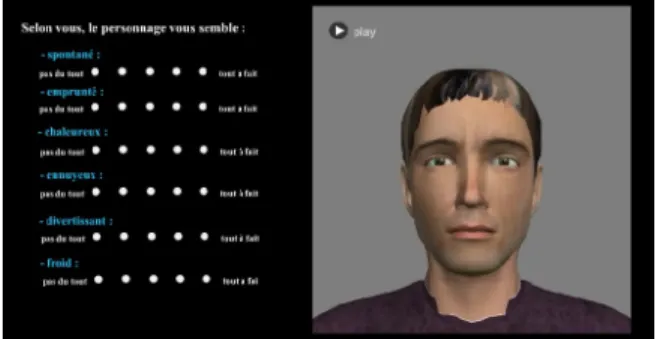
Procedure. User perception data was collected with a similar crowdsourcing method and Flash-based web platform to that discussed in Section 4.1. Initially, each partici-pant watches four videos of the ECA telling a riddle (Figure 8): two video clips of the virtual agent Poppy and two video clips of the virtual agent Obadiah (Figure 7). The four riddles told to the participant were different. The order of the video clips was counterbalanced to avoid order effects on the results. The video clips presented to the
Fig. 8. Screenshot of the interface to collect users’ perception of virtual agents’ social stances
participants involved a brief salutation followed by the virtual agents telling the user a riddle in French. For instance: “Good morning, I know a little riddle, what is the future of I yawn? I sleep!” (translated from French). Four different riddles have been selected based on a brief evaluation of sixteen riddles. We asked 7 individuals (3 females and 4 males) to rate their liking of the sixteen riddles between 0 and 5. Based on the results, we selected the riddles with the maximum rate and the minimum standard deviation. We assumed that the four selected riddles are approximately equivalent. Finally, in terms of verbal behavior of the virtual agent, only the riddle varies from one video clip to another. The beginning of the talk and the tonality of the voice do not vary. Concerning the non-verbal behavior, only the smiles (both the type of smile and the moment when they are expressed) differ from one video clip to another. There were four conditions:
— no smile condition: the ECA expresses no smile during its talk;
— polite smile condition: the ECA displays only the polite smile when the ECA is saying “good morning”;
— amused smile condition: the ECA expresses only the amused smile when it says the response to the riddle;
— both smiles condition: the ECA displays the polite and amused smiles at the moment described in the polite and amused conditions.
Note that the type of smile variable and the moment when the smile is expressed variable are not considered separately. The smile types are associated with particular communicative intentions expressed in specific moment in the video clips; we are not interested in this study in the effects of placing the alternative smile with an inappropriate communicative intention. As a result we have not considered the polite smile in the place appropriate for an amused communicative intention or conversely the amused smile in the place appropriate for a polite communicative intention. After watching each video clip, participants had to rate the interpersonal stance of the ECA on a 5-point Likert scale. In this study, we considered the following stances as being relevant to the scenarios: spontaneous, stiff, cold, warm, boring, and enjoyable. Only the virtual agent Poppy, a female character, was considered in the previous studies (Section 4). To verify that the smiles of the virtual agent Obadiah, a male character, are perceived by the users as expected (amused, polite and embarrassed as for the Poppy agent), in a second part of the test, four videos of the smiling Obadiah ECA were presented to the user. Here, the virtual agent just smiles without speaking. For each video, we asked the user to indicate the type of smile displayed by the virtual agent: polite, amused, none of them. Once again, the order of the presented videos was counterbalanced to avoid order effects.
Participants. Two hundred and forty two individuals participated in this study (158 female) with a mean age of 30 (SD = 10.35). They were recruited via online mailing lists. The participants were mainly from France (N = 223), followed by Belgium (N = 5). There were participants from Germany, Algeria, Tunisia, and Italy. Each participant watched four video clips (two of Poppy and two of Obadiah each telling a different riddle) and four video clips of the virtual agents just smiling (in the second part of the study).
Results. The smile categorization task showed that the smiles were categorized cor-rectly on average, except in one case—the amused smile displayed by the virtual agent Poppy—which was categorized more often as polite than amused (smile with id 6 in Table II)10. As a result the user ratings on the video clips in which Poppy displays this
smile were excluded. In total 483 video clip ratings were considered.
The effects of smiles on user perception were analysed using ANOVAs and post hoc Tukey tests to assess differences in ratings between the conditions (no smile, polite smile, amused smile, and both smiles condition). Table III presents the results. The first two columns indicate the conditions being compared. The condition in the table cells refers to which of these two conditions received the higher rating for the given interpersonal stance (n.s. means non significant, *: p < .05, **: p < .01, ***: p < .001). For example, the first cell in the “warm” interpersonal stance column indicates Amused was perceived as highly significantly more “warm” than the No smile condition.
The differences of user perceptions due to the appearance of the ECA—that is, whether it is Poppy or Obadiah— were assessed with t-tests. The results show that the appearance of the ECA has significant effects on the user’s perception. For
10This smile seems to have been categorized as a polite smile because of its short duration. The forced-choice question in this study (that obliged users to select between polite smile, amused smile or none of them) may explain this difference with the results of the previous study.
Table III. Comparison of the users’ perception of the virtual agents’ social stance in the different conditions
Conditon 1 Conditon 2 Warm Enjoyable Cold Boring No smile Amused Amused∗∗∗ Amused∗ No smile∗ n.s. No smile Polite Polite∗∗∗ n.s. n.s. n.s. No smile Both Both∗∗∗ Both∗∗ No smile∗∗∗ No smile∗∗ Polite Both Both∗∗∗ Both∗ n.s. n.s.
instance, when Poppy is smiling (either smile type), she is perceived as significantly less cold (and warmer) than Obadiah expressing the same smile (p < 0.05). Poppy is perceived as less boring when displaying one smile (either polite or amused) than Obadiah with the same smile (p < 0.05). With the amused smile (with or without a polite smile), Poppy is perceived significantly more spontaneous and enjoyable than Obadiah expressing the same smile (p < 0.01). With regard to these results, we have more precisely analyzed the significant differences for each virtual agent separately. Contrary to the results presented in Table III, it appears that, compared to the expression of only the polite smile, Poppy is perceived significantly more spontaneous, warm (and less cold), and less stiff when she expresses an amused smile (p < 0.05). For Obadiah, the expression of an amused smile (with or without a polite smile) enhances the warm impression of the virtual agent (p < 0.05).
The results reveal the importance of considering both the types of smile and the ap-pearance of the ECA to compute the user perception of an agent’s interpersonal stance. Based on this data we have constructed a model to automatically compute user per-ceptions of an ECA’s interpersonal stance. This model is presented in detail in the next section.
5.1.2. Corpus-based probabilistic model of user perception of smiling ECA interpersonal stances.
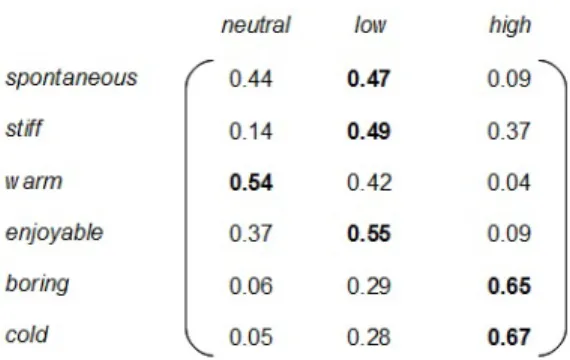
We have argued that ECAs need to model how a user perceives them, in particular, how a user perceives their interpersonal stance. This section proposes a model to automatically compute an estimate of user perception that is dependent on the smile displayed by the virtual agent and on its appearance. The model aims to estimate the probability that a virtual agent is perceived as spontaneous, stiff, warm, enjoyable and boring.
The work in the previous section resulted in user perception data for each of these interpersonal stances along a 5-point Likert scale. We can represent these as natu-ral values ranging from 1 to 5. In a mathematical point of view, interpersonal stances are fuzzy concepts, i.e. lacking a fixed and precise meaning [Dietz and Moruzzi 2010]. Fuzzy variables are generally used to discuss fuzzy concept. A fuzzy variable is a value which may range in an interval defined by quantitative limits and which can be use-fully described with imprecise categories (such as “high” or “low”). In our model, we have defined three fuzzy variables: neutral (associated to the value 1)11, low
(associ-ated to the values 2 and 3), and high (associ(associ-ated to the values 4 and 5). Since our model cannot produce outputs (the estimated user’s perceptions of ECA’s stances) with certainty, probabilities for each of the fuzzy variables are computed. The probabili-ties of obtaining the variables for each interpersonal stance are computed based on the results of the study (previous section). For instance, the probability that the vir-tual agent Poppy is perceived as highly spontaneous when displaying an amused smile
11The neutral variable means that the stance has not been perceived. This variable has been associated to the value 1 since on the Likert scale presented to the participants (Figure 8), this value is labeled “Not at all” to indicate the absence of expression of the stance.