HAL Id: tel-02360159
https://tel.archives-ouvertes.fr/tel-02360159
Submitted on 12 Nov 2019
HAL is a multi-disciplinary open access
archive for the deposit and dissemination of sci-entific research documents, whether they are pub-lished or not. The documents may come from teaching and research institutions in France or abroad, or from public or private research centers.
L’archive ouverte pluridisciplinaire HAL, est destinée au dépôt et à la diffusion de documents scientifiques de niveau recherche, publiés ou non, émanant des établissements d’enseignement et de recherche français ou étrangers, des laboratoires publics ou privés.
Towards an adaptive and genomic understanding of an
exaggerated secondary sexual trait in water striders
William Toubiana
To cite this version:
William Toubiana. Towards an adaptive and genomic understanding of an exaggerated secondary sex-ual trait in water striders. Biodiversity. Université de Lyon, 2019. English. �NNT : 2019LYSEN058�. �tel-02360159�
Numéro National de Thèse : 2019LYSEN058
THESE de DOCTORAT DE L’UNIVERSITE DE LYON
opérée parl’Ecole Normale Supérieure de Lyon
Ecole Doctorale N° 340
Biologie Moléculaire, Intégrative et Cellulaire (BMIC)
Discipline : Sciences de la vie
Soutenue publiquement le 20/09/2019, par :
William Toubiana
Towards an adaptive and genomic
understanding of an exaggerated
secondary sexual trait in water striders
Vers une compréhension adaptative et génomique d’un trait sexuel secondaire chez uneespèce d’insecte semi-aquatique.
Devant le jury composé de :
Dr. Leulier François Group leader ENS de Lyon Examinateur
Dr. Immonen Elina Group leader University of Uppsala Rapporteure
Dr. Perry Jennifer Group leader University of Oxford Rapporteure
Dr. Lüpold Stefan Group leader University of Zurich Examinateur
Table of contents
Abstract ... 6
Résumé ... 7
Introduction ... 9
I. The history of evolutionary thought ... 9
II. The process of selection in evolution... 12
A. Natural selection ... 12
B. Genetic drift ... 13
III. The theory of sexual selection ... 13
IV. Fitness ... 16
V. Sexual dimorphism ... 17
VI. Trait exaggeration ... 18
A. Trait exaggeration and sexual selection ... 18
B. Other types of trait exaggeration... 19
VII. Evo-Devo of exaggerated sexually-selected traits ... 21
A. Growth pathways and their role in variable and non-variable exaggerations ... 22
B. The role of patterning genes in the development of exaggerated, sexually-selected traits ... 23
VIII. Towards a more genomic understanding of trait exaggeration ... 23
IX. Intra-species variation in sexually selected traits ... 25
X. The semiaquatic insects (Gerromorpha) as a model to study the role of natural and sexual selections on trait evolution ... 26
Chapter 1: Fluctuating selection strength and intense male competition underlie variation and exaggeration of a water strider’s male weapon ... 31
I. Abstract: ... 32
II. Introduction ... 33
III. Material & methods ... 34
A. Population sampling and culture ... 34
B. Measurement of Microvelia species and statistics ... 34
C. Behavioral observations and video acquisition ... 35
D. Microvelia phylogenetic reconstruction ... 35
E. Male competition assay ... 35
F. Fight frequency assay ... 35
G. Artificial selection experiment ... 36
H. Condition-dependence experiment ... 36
I. Microsatellite development ... 36
J. Paternity test ... 37
A. Sexual Dimorphism and scaling relationships in Microvelia species ... 37
B. Mating systems in Microvelia species. ... 39
C. Intensity of male competition in M. longipes compared to M. pulchella ... 42
D. Effect of exaggerated leg length on male reproductive fitness in M. longipes ... 43
E. Environmental and genetic contributions to male rear leg variation ... 46
V. Conclusions ... 49
VI. Supplementary material... 51
Chapter 2: The genome of the water strider Microvelia longipes provides insights into the role of sexual selection on gene expression and genome architecture. ... 62
I. Abstract ... 63
II. Introduction ... 64
III. Material and methods ... 66
A. Population sampling and culture ... 66
B. Measurement and statistics ... 66
C. Sample collection, assembly and annotation of the M. longipes genome ... 66
D. Sample collection and preparation RNA-sequencing ... 67
E. Transcriptome assembly, mapping and normalization ... 67
F. Comparative transcriptomics: analyses of variance ... 68
G. Sex-biased and leg-biased expression... 68
H. Gene Ontology analysis ... 70
I. Sex-biased gene distribution ... 70
J. Detection of large sex-biased gene clusters ... 71
K. Detection of clusters of consecutive sex-biased genes ... 72
IV. Results ... 73
A. Assembly and annotation of the M. longipes genome ... 73
B. Male rear-legs experience a burst of growth during the last nymphal instars. ... 73
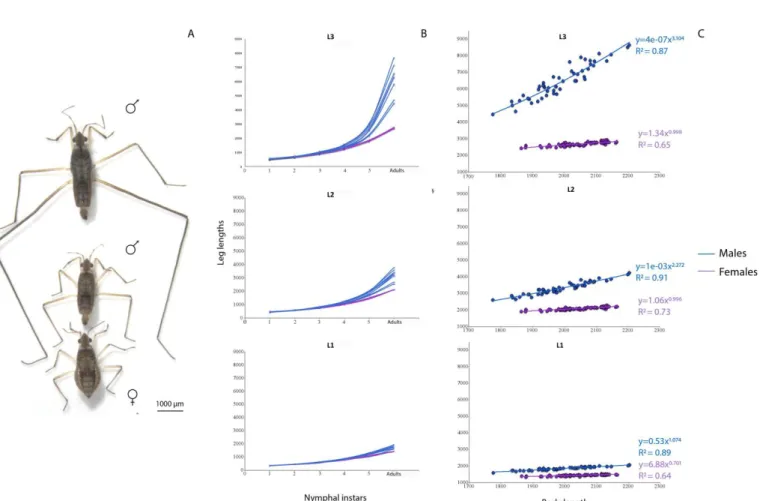
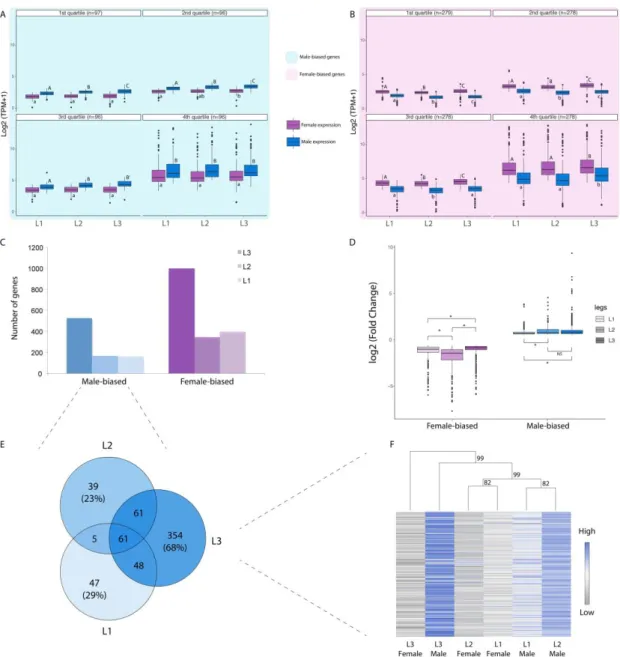
C. Variation in gene expression explains differences in exaggeration between legs and sexes. ... 75
D. Male-biased genes show unique features of trait exaggeration ... 77
E. Divergence in male leg homology is associated with a set of male-specific leg-biased genes ... 78
F. Male exaggerated legs are enriched in genes with leg- and sex-biased expressions. ... 81
G. The influence of sexual selection on M. longipes genome architecture ... 83
V. Conclusion and discussion... 86
VI. Supplementary material... 90
Summary and general conclusions ... 108
General discussion and future directions ... 111
I. The influence of selection on sexual trait evolution ... 111
A. Moving from reproductive fitness to a more integrative view of fitness ... 111
B. How does variation in sexual selection strength influence the evolution of trait exaggeration? ... 112
III. Understanding the genetics underpinning of leg exaggeration through genetic mapping. ... 115
Summary of other scientific contributions ... 117
I. Fitness Effects of Cis-Regulatory Variants in the Saccharomyces cerevisiae TDH3 Promoter. ... 117
II. Predator strike shapes antipredator phenotype through new genetic interactions in water striders. ... 118
III. The mlpt/Ubr3/Svb module comprises an ancient developmental switch for embryonic patterning. ... 119
IV. The genome of the water strider Gerris buenoi reveals expansions of gene repertoires associated with adaptations to life on the water. ... 120
Acknowledgements ... 121
Abstract
From the DNA molecule to the more complex phenotypes, variation is a universal process in life and living organisms. The innumerable differences that exist between species are probably one of the most manifest examples. Yet, all this diversity would never have occurred in nature without some pre-existing divergence within species. One of the most striking examples of intraspecies variation appears in sexual organisms, between males and females. Understanding the environmental and genetic factors influencing sexual divergence is a longstanding question in evolutionary biology. To this end, I focus here on a new insect model system, Microvelia longipes, which has the particularity to have evolved an extreme case of sexual dimorphism in the rear legs. Males display exaggerated long rear legs compared to females but also an extreme variability in these leg lengths from one male to another. We identified that M. longipes males use their exaggerated legs as weapons during male-male competition. Males with longer legs have more chance to access females on egg-laying sites and therefore increase their reproductive success. Moreover, fitness assays and comparative studies between Microvelia species revealed that the intensity of male competition was associated with the exaggeration and hypervariability of the rear legs in M.
longipes males. In a second approach, we studied the developmental and genomic basis of this
sexual dimorphism through a comparative transcriptomic analysis and identified genes and genomic regions associated with male exaggerated legs and ultimately with sexual selection. Overall, the integrative approach used in this work allows to establish Microvelia longipes as a promising new model system to study the influence of sexual selection in adaptive evolution.
Résumé
De la simple molécule d'ADN aux caractères les plus complexes, nous pouvons observer que le processus de variation est un phénomène universel en biologie. Les nombreuses différences qui existent entre les organismes peuplant notre planète en est certainement l'exemple le plus manifeste. Ces différences entre espèces n'auraient cependant pas pu avoir lieu au cours de l'évolution si certaines d’entre elles n’étaient pas déjà présentes au sein même d'une espèce. Ces variations intra-espèces sont particulièrement observables chez les espèces sexuées, entre mâles et femelles. Comprendre les différents facteurs biologiques, environnementaux et génétiques, à l'origine de ce dimorphisme sexuel est le cœur de mon sujet de thèse. Pour cela, j’ai établi au cours de ma thèse un nouveau modèle d'étude, l’insecte semi-aquatique
Microvelia longipes. Ces insectes ont la particularité d’avoir évolué un dimorphisme sexuel
spectaculaire par lequel les mâles présentent une croissance extrême et spécifique au niveau de la troisième paire de pattes. Pour étudier ce phénomène, j'ai choisi une approche intégrative visant à comprendre les causes environnementales et génétiques liées à la croissance exagérée des pattes arrières chez les mâles. En premier lieu, nous avons émis l’hypothèse que cette croissance exagérée était associée à des pressions de sélection sexuelle. Une caractérisation plus détaillée de la taille des pattes a également montré un degré de variabilité extrême entre les males d’une même population. Nous avons mis en évidence la présence de compétition intense entre males, qui utilisent leurs pattes arrière comme arme, pour s’accoupler avec les femelles. Les males à pattes plus longues gagnent souvent dans ces combats, expliquant l’importance adaptative de ces pattes exagérées chez les mâles. De plus, nous montrons que les variations de taille de pattes chez les mâles, de la même espèce ou d’espèces différentes, sont associées à une fluctuation de la sélection sexuelle, qui peut être plus ou moins intense en fonction de l’ardeur que mettent les mâles à se battre. Dans un deuxième temps, nous avons développé une approche transcriptomique comparative entre les sexes et les pattes afin d’identifier les gènes responsables de cette croissance exagérée. Combiné au développement d’un génome de M. longipes de haute qualité, ceci a permis de dresser une liste de gènes dont l’intensité d’expression corrèle de manière significative avec l’exagération de la croissance des pattes chez les mâles et d’identifier des régions génomiques soumises à la sélection sexuelle.
Introduction
I. The history of evolutionary thought
What is the place of human beings in the universe? How did we come up living with such diversity of life?
Are we that different from other living organisms?
Those philosophical questions have crossed people's mind at least once. They have shaped our society for centuries and became the foundations of extant religions. However the belief in a certain divinity, that no one can sense or even agree on, was for the most sceptical ones a proof of its irrationality. The idea of a certain form of evolution, where species change over time, dates from the Antiquity but received a scientific attention only between the 18th and 19th century with the emergence of palaeontology [1]. The comparison of extinct and existing forms of life brings one of the first scientific evidences of a dynamic process in nature, where species go extinct and emerge over time [1]. The attestation to species extinction brought notably the field of biology into a new area, the evolutionary history of life.
Jean-Baptiste Lamarck was the first biologist to formulate a fully coherent theory on biological evolution. In the early 19th century, Lamarck hypothesized that the new forms of
life were continuously generated through modifications acquired by the individuals during their lifetime. These modifications would then be transmitted to the next generation that would in turn acquire new modifications, or not, according to their environment [2]. He named his theory Transformisme in regards to the two main forces acting on organismal evolution; one evolutionary force driving organisms from less complex to more complex forms, and a second force driving the diversification and adaptation of organisms to their local environments. A famous example illustrating his theory is the evolution of giraffe’s neck. Lamarck believed that giraffes were stretching their neck in order to access food on high trees and that this neck elongation would be inherited at the next generation (Figure 1).
At this period, Lamarck’s thought on the evolution of species contrasted with a new theory, published by Charles Darwin and Alfred Russel Wallace in 1858 [3, 4]. This theory, that will later become a reference to the science of evolution, is fully formulated in 1859 by Charles Darwin in his book On the Origin of Species [4]. Lamarck and Darwin’s theories share a lot in common, especially regarding the concept of evolution per se. Both agree, for example, on
the concept of common ancestry where all existing species are linked by an ancestor that was a rather simpler form that complexified during the course of evolution [2, 4]. Their main discordance relied on the process by which species evolve. Instead of believing in the theory of transformation, Darwin argued that the variation observed between individuals of a same species was the source of species diversity through millions of years of variation accumulation (Figure 1). Under this scenario, human beings are notably considered as evolved as any other species. The human race is simply perceived as a species that has taken a certain evolutionary path that is different from the other existing species. The place of human beings in his environment was further detailed by Charles Darwin thirteen years later in his book The Descent of Man, and Selection in Relation to Sex [5].
Darwin acknowledged, nonetheless, that for his theory of evolution to hold, the factors generating phenotypic variation must be inherited to the next generation. The question of heritability became consequently one of the main requirements to validate his theory. It first started with Mendel’s law of inheritance in 1866, demonstrating that some “invisible” factors were able to predictably determine the acquisition of some traits at the next generation in plants [6]. For some time ignored and criticized, Mendel’s genetics will be revived in the early 20th century from a series of works from Walter Sutton, Theodor Boveri, Thomas Hunt Morgan and Ronald Aylmer Fisher. Walter Sutton and Theodor Boveri first developed in 1902 what will be called the “chromosomal theory of heredity” where they propose that the chromosomes are the heredity factors predicted in Mendel’s laws of inheritance [7]. This theory was definitely approved after Morgan’s work on Drosophila mutants that also led to the ideas of genetic linkage, crossing over and to the establishment of the first genetic map by Morgan’s student, Alfred Sturtevant, in 1913 [8, 9]. Later, Ronald Fisher mathematically reconciled Mendel’s model of inheritance
Figure 1: Representation of Lamarck and Darwin’s theories of evolution The top panel illustrates Lamarck’s idea by which two giraffes that cannot access food will stretch their neck over their lifetime to adapt to the environment. The bottom panel illustrates Darwin’s idea where giraffes with different neck lengths occur in the population but only the ones with the longest neck survive.
that was working on discrete phenotypic variations with the evolution of more continuous phenotypes [10]. According to his mathematical predictions, the combined actions of many heritable factors could recapitulate the continuous variations observed in some traits. His work sets the basis of what we will later call the field of population genetics and led to the synthesis of Darwin’s theory and Mendel’s laws of inheritance, also named modern synthesis by Julian Huxley in 1942 [11].
Despite the accumulating evidence regarding the chromosomal support of heritability, this field of research was rather conceptual as it lacked strong molecular approval. It is only in the mid 20th century that James D. Watson and Francis Crick provided the scientific proof and answer to the mechanism of heredity with the discovery of the DNA double helix structure and its nucleotide composition [12]. The later founding finally brought the field of evolutionary biology to its most recent aspects, associating variations in phenotypes to variations in DNA sequences to ultimately trace back the evolution of phenotypes and nucleotide sequences [13].
II. The process of selection in evolution
A. Natural selection
Evolution is an endless process in which changes in DNA sequence, e.g. mutations, inexorably accumulate over time and increase overall phenotypic diversity. Yet phenotypic diversity does not seem to escalate as time goes. Instead, ecologists and palaeontologists revealed that the biodiversity varies according to the period of the history. At the early discovery of fossils, palaeontologists soon noticed that some of these ancient living forms do not resemble the existing species [14]. The evidence of a certain succession in the forms of life prompted naturalists to ask why some species get maintained while some others go extinct. In 1858, Alfred Wallace and Charles Darwin suggested that the natural environment in which species live could actively select for or against some of the diversity that occurs in natural populations over time (Figure 1). As a consequence, the variants conferring more survival advantage to the individuals would tend to be more present in the population at the next generation than the more deleterious ones. They called this active force of the environment Natural Selection [3, 4]. Although the theory of evolution by common ancestry was rapidly accepted, the mechanisms by which Nature would select and shape evolutionary
processes were highly debated until the emergence of the field of population genetics. Ronald Fisher in his book The Genetical Theory of Natural Selection, became a pioneer to use mathematics to conciliate Mendelian genetics with the principle of natural selection [10]. This contributed to the revival of Darwin's theory in the early 20th century that was revised as the modern synthesis [11].
B. Genetic drift
Following the establishment of the modern synthesis and the discovery of the DNA structure in 1953, the field of evolutionary biology integrated a new discipline, namely the molecular evolutionary genetics [15]. It describes the process by which molecules such as DNA, RNA and proteins can change over generations. Applied to studies of population genetics, it led to a new evolutionary theory named the neutral theory of molecular evolution. This theory, mostly introduced by Motoo Kimura, argues that most molecular changes confer no advantage or disfavour at the individual level and therefore evolve neutrally, without any environmental pressures [16]. Evolutionarily speaking, it implies that most genetic variation present in a population results from mutations that arise and increase in frequency by chance, due to their neutral effect on individuals that carry them. In a population, the fluctuation in allele frequency is called genetic drift and is a strong driver of evolution as it can randomly select and get to fixation some alleles present in the population. In some occasions, these neutral changes can even lead to changes in phenotypes [17].
III. The theory of sexual selection
“The sight of a feather in a peacock's tail, whenever I gaze at it, makes me sick!” (Letter 2743
– Darwin, C. R. to Gray, Asa, 3 April (1860), Darwin Correspondence Project).
Even after publishing his theory of evolution by means of natural selection, Charles Darwin was not convinced that selection through differential in survival could explain all the surrounded phenotypic diversity. For some examples, such as the peacock’s tail, he was even thinking that natural selection should have acted against such phenotypes that look detrimental for the survival of the individual bearing it. For these traits that were challenging his theory of natural selection, Darwin imagined that they could be used for a certain function
that would overcome their viability costs. He reasoned that in sexually reproducing animals, one major goal for an individual is to reproduce in order to transmit his characters to the next generation. Heritable characters that would improve the ability of an individual to mate with the opposite sex would therefore be selected and spread in the population over time. This form of sexual selection would here favor the characters increasing the mating success of an individual. Under this assumption, both males and females should evolve elaborated structures to increase their number of partners. Yet, in nature it is generally the male that is the most modified. Darwin argues that “this seems to lie in the males of almost all animals having stronger passions than the females” [5]. The fact that males will be more eager to mate than females, will lead males to evolve features such as weapons to better compete with other opponent of the same sex or acquired more sedulous characters such as ornaments, that will better charm the females (Figure 2). Thus within the sexual selection process, Charles Darwin distinguishes the mechanism of male competition where males will fight between each other to access the females, from the mechanism of female choice where the female will actively choose the male she wants to mate with in the population, based on some attributes (Figure 2). Although these two mechanisms can act independently in some species, they are often linked as female choice usually implies competition in the other sex, either directly (e.g. male fights) or indirectly (e.g. hurrying the finding and seduction of the female before another male) [5]. The fact that males compete between each other to access females was generally acknowledged by other evolutionary biologists to be an important process in evolution. However, the idea that female choice could drive evolution was hardly acceptable for the evolutionary community [18]. Once again, this theory had to wait for the work of Ronald Fisher to renew under the mechanism of positive feedback by which the female preference for a certain male trait and the male trait elaboration will get heritably associated to finally advance together. Fisher called this scenario runaway sexual selection to illustrate that the female preference for a certain elaborated structure in the male trait will lead to the evolution of a more elaborated trait in males that will in turn affect the female preference toward this more elaborated structure.
Figure 2: Examples of male weapons and ornaments. Top picture shows the large antlers of male bull moose engaged in a fight for territory dominance. Bottom picture illustrates the deployment of a male peacock tail to seduce a female.
This endless process is thought to cause the extreme male elaborations observed in nature and can only be stopped when counter selective pressures (e.g. natural selection for survival) will act against the increase in male trait elaboration or female preference [10, 19].
IV. Fitness
The term fitness is central in the field of evolutionary biology. It represents a concept to describe “the ability of organisms to survive and reproduce in the environment in which they find themselves” [20]. In other words, the term fitness predicts the ability of an individual to transmit its genes to the next generation. During its lifetime, an individual faces various obstacles that will directly impact its fitness. After the zygote is produced, the later needs to survive until adulthood and then reproduce to generate a new progeny. This whole process can be disentangled into three major components, namely survival, mating and fertility. Combined, these three fitness components form the total fitness of an individual [20]. Any variations in the viability, mating success or fecundity between different individuals of a population will directly affect their total fitness and therefore be selected for or against by the environment in which they live. As a consequence, fitness can be considered as the ultimate phenotype on which natural selection can act. Although this definition of fitness encompasses the major components of an individual’s life, it cannot be universal as it can vary from species to species according to their life history and evolutionary strategies. For example, some fitness components can be inexistent in some organisms such as asexual organisms that have no mating success. Some fitness components also cannot be clearly comparable between the different taxa. The fitness of survival, for example, can be subdivided into distinct developmental stages that are hardly comparable between insects and mammals. Even between insects, hemimetabolous and holometabolous insects develop differently and therefore may be considered as having different components of survival fitness [21]. Another way to think about fitness has therefore been suggested and involves a more mathematical and probabilistic definition. This definition has been mainly developed by population geneticists that see fitness as a probabilistic value that monitors the frequency of a certain allele or genotype in the population over one to many generations [22]. In large populations, the effect of drift is minimized and the fate of an allele is mainly determined by how its resulting phenotype fits to the environment [23]. Mutations that confer the fittest phenotypes, which are those that are best adapted to a given environment, will be selected and increase in frequency
in the population. By comparing the frequency and the becoming of several alleles or genotypes segregating in a population, evolutionary geneticists can estimate a coefficient of selection that gives the relative “advantage” of one allele or genotype over one or several other alleles or genotypes [20].
In the following, I will focus mainly on the concept of fitness as the process describing the interaction between the three major components of an individual’s reproductive success; namely survival, reproduction and fecundity. The mathematical definition of fitness is nonetheless of relevant consideration for the future directions of my research project and will be evoked later as a perspective.
V. Sexual dimorphism
The theory of sexual selection by Charles Darwin was partly able to explain the evolution of male and female differences as it sheds light on the origin of secondary sexual trait evolution and diversification by male-male competition or female choice. However, it hardly explains why evolution has favored males and females to differ in their mating strategies. Most secondary sexual characters have evolved in males, although some exceptions exist [19, 24, 25]. Females usually retain more juvenile or ancestral characters but tend to be more choosy for the mating partner than males do, even though exceptions exist here too [5, 19, 26]. In 1948, Angus John Bateman published what will become the reference study to explain the evolution of sexual dimorphism. In this study, he placed an equal number of males and females fruit flies Drosophila melanogaster in bottles, and showed that females’ fertility was limited by the number of eggs they produce whereas males’ fertility was mainly restricted by the number of females they reproduce with [27]. This study sheds light on the different strategies favored by each sex and that will be later related to their asymmetric investment in gametes. Males are capable of producing sperm in excess compared to female eggs but do not have the guarantee to fertilize all the eggs produced by the mated female. Therefore, the number of offspring sired by a male is dependent on the number of females he mates with. In contrast, females have a limited number of eggs to fertilize, making them choosier towards the mating partners [19]. Later, the discovery of sperm competition between males reinforced the idea that males suffer more to secure fertilization than females do, causing males to invest into characters that improve their mating and fertilization success. On the other hand, it has
been shown that above a certain number, mating becomes detrimental for females fitness. These differences in sex roles lead to a conflict between the two sexes where males try to increase their number of mating to increase their fitness, whereas females require fewer numbers of mates to achieve their optimal reproductive fitness. This process called sexual conflict over mating rate can favor the evolution of some traits in one sex that could be harmful to the other sex. Such antagonistic co-evolution between the two sexes can drive the two sexes away from their fitness optima and engender sexual dimorphism as a resolution of the conflict [28-30].
VI. Trait exaggeration
A. Trait exaggeration and sexual selection
Extravagant or exaggerated phenotypes have fascinated naturalists for decades and have become one of the main foci in the field of evolutionary ecology [31-34]. Some of these phenotypes can reach degrees of expression so high that the individuals bearing them become almost unrecognizable as members of the same species [5, 19].
Charles Darwin was one of the first to put the concept of trait exaggeration in an evolutionary framework by explaining how such phenotypes can emerge under sexual selection [5]. Since Darwin’s description, exaggerated traits have remained associated with two main components: a comparative reference allowing the trait to be defined as exaggerated sensu
stricto and an evolutionary component explaining the origin and maintenance of such
exaggeration [19, 35]. In the context of sexual selection, exaggeration describes traits that look extravagant in one sex compared to the other and that present seemingly inevitable costs, in terms of survival, to the bearer of the exaggerated trait [5, 19]. These survival costs are theorized to be largely balanced by opposing benefits due to increased mating success [19, 28, 36, 37], thus allowing the trait to evolve and maintain exaggerated degrees of expression (Figure 3A). In this case, trait exaggeration is a reflection of the imbalance, in terms of costs and benefits, between survivorship and mating success, which represent two of the three main components of fitness (Figure 3) [20]. Although survival costs and mating benefits are seldom clear, the cost-based definition of trait exaggeration is widely used in the field of sexual selection [5, 19, 38, 39], (but see [40]). Exaggerated sexually-selected traits can represent modifications in any kind of phenotype (Figure 4), although most famous examples are on structural exaggerations, including horns and mandibles in a number of beetles, stalks in
stalk-eyed flies, the claw of fiddler crabs, the long tail of peacocks or even the deer antlers [32, 41-46]. Exaggerations affecting behaviour and coloration are also quite widespread [19]. In many spiders, for example, males ‘offer’ themselves as food to the female immediately after mating [37, 47, 48]. This suicide behaviour represents an extreme and obvious case of exaggeration, as it ends the male’s survivorship on the spot. However, this male suicide behaviour increases the chances that the egg clutch, laid by the female (after having consumed the male), is fertilised by his sperm. This provides a hypothesis to explain the evolution and maintenance of such an extreme case of exaggeration [37, 47-49].
Bird nuptial parades are also famous examples of behavioural exaggeration, especially in the bird of paradise where males of some species have highly ritualised mating dances to attract females. Other cases include bright coloration found in many arthropods, birds, and fishes [50-52] (Figure 4). These extreme colors are often used by males to attract females that will choose them over less colorful males. In guppies for example, males from the same population develop various color patterns along their body and the less frequent phenotypes are often favored by females that are colorless [53, 54]. This female choice for rare coloration patterns creates a frequency-dependent selection that favors the maintenance of phenotypic variation in the population. Male coloration is often associated with heightened predation risk [52, 55-57] but balanced by benefits due to increased mating success [19, 52, 57] (Figure 3A).
B. Other types of trait exaggeration
Ever since the description of exaggeration in the context of sexual selection [5], the concept has evolved to include additional cases of exaggeration that are thought to be under natural and social selection [35] (Figure 3B-C). The comparative reference in these cases of exaggeration can be defined as the ancestral state of the trait, the expression of the trait in another caste (in the case of social insects), or as the state of trait expression in a homologous counterpart along the body axis [35, 42, 58-60]. For example, in the reproductive caste of social insects, females, also known as queens, exhibit extreme ovarian activity at the expense of their ability to forage or escape predation, and therefore at the expense of survivorship [61-64] (Figure 3B). Extreme cases are known in termites and army ants [61, [61-64], where females are entirely dependent on the care provided by their nestmates. Such exaggerated degrees of fecundity can only evolve in a social context where other colony members are able to fulfill survivorship-related tasks (Figure 3B) [61]. The insect family Gerridae, also known as water striders, have significantly longer legs compared to member of their immediate sister group the Veliidae [65-69].
Figure 3. Effect of various types of trait exaggeration on fitness components. Usually,
negative effects on one fitness components are compensated by gains from another component (A, B) or from a sub-section of the same component (C). Plus signs indicate benefits and minus signs costs. Images: (A) elaborated male antennae in the water strider Rheumatobates riley [36], (B) enlarged abdomen of termite queen (Photo credit: Judith Korb) [70], and (C) elongated legs of the water strider Metrobates hesperius [68].
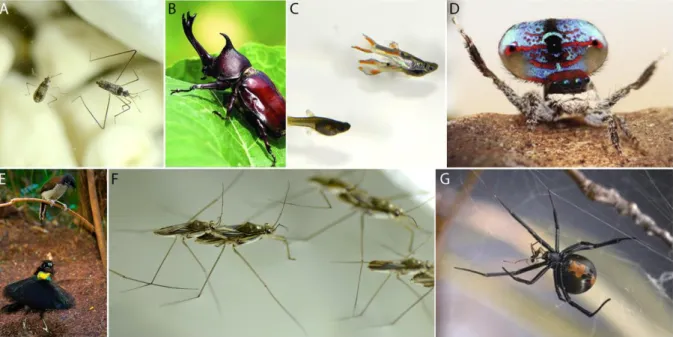
Figure 4. Examples of morphological, behavioural and physiological exaggerations. (a)
Males of the pond skater Microvelia longipes exhibit exaggerated leg length relative to females. (b) Males of the Rhinoceros beetle Trypoxylus dichotomus develop exaggerated
horns size (modified from Ref. [1] with permission from Science). (c) Male-specific color
pattern in Guppies. (d, e) Male peacock spider (d, modified from Ref. [36] with permission
from Current Biology) and bird of paradise (e, modified from Ref. [39], with permission from
PNAS) exhibiting bright coloration and performing nuptial dance. (f) Guarding behaviour in males of the water strider Limnogonus fransciscanus. (g) Male suicide behaviour in the red back spider.
Leg length in water striders can be considered a case of phylogenetic exaggeration. In this case, natural selection alone (except in cases where leg length is under sexual selection) appears to explain increased expression of this trait due to the requirement of locomotion on fluid surfaces (Figure 3C) [67, 71-73].
VII. Evo-Devo of exaggerated sexually-selected traits
The field of Evolutionary Developmental Biology (Evo-Devo) emerged with the development of molecular genetics and the acquisition of recombinant DNA technology in some model organisms [74, 75]. It consists in inferring evolutionary processes, such as ancestral relationship between different organisms, based on the comparison of their developmental processes [76]. The relevance of this developmental comparison was suggested when evolutionary and developmental biologists realized that the phenotypic variation observed within or between species involved features that are acquired during development [76]. With the emergence of molecular technologies, the field quickly started to ask questions about how developmental processes and genetic networks can evolve to give rise to phenotypic diversity. One of the main discoveries of Evo-Devo studies was to show that evolution in phenotypes was possible through the reuse of ancient, highly conserved genes that can change in time and space their expression during development. This has led notably to the concept of toolkit genes, describing the pleiotropic function of certain genes that are capable of forming a complex cascade of control, switching on and off various regulatory genes, according to their expression patterns.
Sexually selected exaggerated traits have also become one of the main foci in the modern field of Evolutionary Developmental Biology [36, 41, 44, 77, 78]. They offer an unequalled opportunity to understand not only the development of exaggeration but also the developmental processes underlying intra-species phenotypic variability [38, 39, 42, 79-81]. Yet this field of study is relatively recent and the bias of Evo-Devo towards the study of the developmental genetic mechanisms underlying morphological evolution directed research studies towards exaggeration of growth-related morphological traits. For this reason, I will introduce this new area of research by summarizing works on the mechanisms of growth and scaling relationships in sexually-selected exaggerated traits but I will also evoke the roles of
some key developmental genes in organ growth that have been overlooked in the context of sexual trait elaborations.
A. Growth pathways and their role in variable and non-variable exaggerations
Most recent studies of the developmental genetic mechanisms underlying trait exaggeration have focused on sexually-selected growth related traits that are hypervariable between individuals of the same sex and that are used as signals [35, 41, 42, 44, 60] [1, 8, 14, 28, 44]. This focus quickly steered the field towards analyzing various growth pathways [35, 42, 43, 60, 82-86], especially in horned and stag beetles. Several recent studies have identified pathways such as the Insulin-like or Juvenile Hormone (JH) pathways as being involved in the development and hyper-variability of morphological cases of sexually selected trait exaggeration [41, 87-89]. Increased tissue sensitivity to these pathways is argued to present a major way for growth-related exaggerated traits to develop and evolve. However the contribution of these pathways to exaggerated traits with low variability between individuals is still not clearly defined. Whether variable or not, tissue growth requires the action of growth pathways, such as Insulin-like signalling, and differences in growth rates across tissues are modulated through differences in their sensitivity to hormonal input [41, 86, 90]. In the rhinoceros beetle Trypoxylus dichotomus for example, males developed exaggerated head horns that are highly variables in males of the same population. The knock down of the Insulin receptor reveals that male horns are the organ that decreased the most in size, suggesting that they are hypersensitive to the Insulin pathway compared to other body parts such as wings or the genitalia. In the super-soldiers of the ant genus Pheidole, the development of exaggerated head size depends on the Juvenile Hormone pathway despite the low variation observed among individuals of this caste [91]. In this case, growth pathways would be important for exaggerated morphological trait regardless of their degree of variability.
Another highly conserved pathway for sex determination in insects was also shown to play a critical role in the development of sex-specific trait exaggeration. In some holometabolous insects like horned beetles, doublesex has been shown to encode for male and female specific isoforms that, when repressed, have opposite functions in the two sexes. In males, knock-down of doublesex generally decreases trait exaggeration whereas it enhances it in females. Overall, doublesex repression seems to decrease the degree of dimorphism between the two
sexes, suggesting that this gene represses female trait exaggeration whereas it activates it in males [92, 93]. A study in stag beetles has also shown that doublesex seems to interact with JH pathway in order to regulate mandible sensitivity to nutritive growth in a sex-specific manner [87].
B. The role of patterning genes in the development of exaggerated, sexually-selected traits
The role of patterning genes in the development of exaggerated traits that are subject to natural selection (such as the long legs of water striders or crickets) is now accepted in the Evo-Devo field [35, 66]. However their importance in the development and evolution of exaggerated traits that are under sexual selection remains unclear. Although rare, some studies have shown the importance of patterning genes in exaggerated sexually selected traits such as the modified antennae of the water strider Rheumatobates rileyi or the elongated tail of the swordtail fish Xiphophorus helleri [94]. Genes like msxC, which is a transcription factor involved in cell differentiation, have restricted temporal and spatial expression, in addition to being controlled by hormonal pathways, and may therefore contribute to the quantitative intra-sexual variation observed in tail length of swordtail fish [94]. Furthermore, a recent study implicates the Hedgehog signalling pathway in the polymorphic horn size in the beetle
Ontophagus taurus [95]. Processes of growth and pattern formation are tightly linked and
their relative contribution could depend on the function and/or the selective pressures acting on the trait. Exploring this question using different model systems and different kinds of traits may expand our understanding of the developmental mechanisms controlling trait exaggeration.
VIII. Towards a more genomic understanding of trait exaggeration
Although recent, evolutionary developmental studies on trait exaggeration are growing relatively fast, thanks notably to the large body of research already established on holometabolous morphological growth [82, 90, 96-101]. The primary focus on the genes and developmental pathways regulating sexually selected exaggerated traits led to overlook their evolution at the genomic scale. Yet, the genomic basis of sexual traits has already been documented by several theoretical and experimental studies [102-105].
The evolution of sex-biased genes and their influence on the evolution of sexual dimorphism is a growing field of research that has been poorly explored in the context of development and trait exaggeration. Sex-biased expression is often assumed to encode, at least to some extent, for the differences observed between males and females [106]. Different experimental studies have shown that variation in sex-biased expression at different developmental stages, in different organs or species is associated with variation in sexual dimorphism at the morphological, physiological or behavioral levels [102, 106-110]. Given the primary role of sexual selection in shaping male and female differences, the evolution of sex-biased gene expression has been hypothesized to result from the selection of male and female reproductive interests. Accordingly, many studies have now shown that sex-biased genes −notably male-biased genes that are supposed to be under strong sexual selection− are fast-evolving both at the coding and expression levels [102]. In a comparative study of birds, for example, the authors found an association between the rapid evolution of the proportion and expression of sex-biased genes, especially male-biased genes, and the increase of sexual dimorphism at the phenotypic level. However they did not find any association with their sequence evolution, although sex-biased genes were generally faster evolving than unbiased genes across species [111]. These results were observed only in adult gonad tissues as in somatic tissues only one locus displayed sex-biased expression [111].
In species where a good genome assembly is available and the sex chromosome(s) can be identified, sex-biased genes can also provide some insights into sex chromosome evolution. A general feature among sexually dimorphic characters lies in their antagonistic selection between males and females. Selected phenotypes favored in male through increased reproductive success are often costly for female fitness, the reverse being also true for females selected phenotypes [28]. Such sexual antagonism has notably led to the theory that sex-biased genes could preferentially accumulate on the X chromosome where the selection is most effective [112]. Because of the hemizygosity of the X chromosome in males, X-linked genes are constantly exposed to selection and male beneficial recessive mutations are more likely to accumulate relatively to autosomal recessive mutations. On the other hand, female beneficial dominant mutations are also more likely to accumulate on the X chromosome, which is twice as often present in females than males [112]. This expectation is however reverted in systems where the females are the heterogametic individuals. Altogether, these assumptions predict an accumulation of sex-biased genes on the X chromosome and an elevated rate of protein evolution among the X-linked genes (also known as faster-X
evolution) relative to autosomal genes [102]. So far, experimental evidence supports this sexualization of the X chromosome across taxa, although male-biased genes turned generally to be under-represented on the X chromosome [112-117]. It is, however, important to note that the general pattern described so far may also result from several non-adaptive processes (e.g. relaxed purifying selection, sex chromosome dosage compensation…) and lead to some misinterpretations regarding the possible effects of sexual selection on genome evolution [102, 118]. Moreover, studies assessing genes with sex-biased expression are often performed in adults where sexual dimorphism has already been established, at least in part, during development [106]. This implies that 1) a large proportion of relevant sexually dimorphic genes have been overlooked [107, 108], 2) adult sex-biased genes have thus far unclear functions in sexual dimorphism, especially when they are identified from whole adult transcriptomes [106]. Addressing similar questions with a greater attention to the developmental stage(s) and tissue(s) selected will help refining the type of selective pressures acting on sex-biased genes and their general influence on genome evolution.
Such genome-wide analysis have already been initiated in horned beetles, for example, where Ledón-Rettig et al. used the sex-specific functions of doublesex isoforms in horn development to characterize their genome-wide sex-specific interactions [119]. They found especially that
doublesex has a general regulatory influence on genes with sex-biased expression. These
regulations seem to be often sex-specific, either by regulating a sex-specific target or by regulating the same gene in opposite directions in males and females [119]. Another study in horned beetles has also found signatures of selection in conditionally expressed genes during horn development [120]. Several other comparative transcriptomics studies have been performed in the developing exaggerated sexually selected traits but with the intention to characterize the genes and pathways involved in their developmental growth [121-125]. More efforts need therefore to be done on the genomic basis of sexual trait exaggeration.
IX. Intra-species variation in sexually selected traits
One striking feature of sexually selected exaggerated traits compared to other traits is their phenotypic variability within individuals of the same population. These traits can sometimes become so variable between males that naturalists were first thinking that extreme morphs of a population were in fact members of different species [5, 19]. As described by Charles
Darwin, and by many other evolutionary biologists after him, males with the highest exaggeration have more chance to secure partners either by male-male competition or by female choice. These observations suggest that exaggerated sexual traits are under directional selection and should therefore present low genetic and phenotypic variance in the population. Yet, these traits have been described to have unexpectedly high genetic variance and to be phenotypically hypervariable compared to other homologous traits in the same or different species [38]. How variation is maintained in sexually selected traits is probably one of the main puzzling questions in the field of sexual selection. Several theoretical studies have been formulated to explain the maintenance of phenotypic and genetic variance in traits under sexual selection, (e.g. handicap theory, genic capture theory) however few studies have been able to experimentally test them [10, 38, 39, 126-130]. Among the different research avenues, identifying the selective pressures and genetic mechanisms controlling phenotypic variance seems to be one of the most urgent questions to understand this paradox. This research topic is the core of my PhD study and will be further detailed in the following sections.
X. The semiaquatic insects (Gerromorpha) as a model to study the role of natural and sexual selections on trait evolution
Gerromorpha is a monophyletic group of insects in the “true bug” order Hemiptera, thought to have arisen in the Triassic about 200 million years ago [131]. Commonly named the semiaquatic insects, they are composed of about 2000 species classified in eight families, living all on the water surface and distributed worldwide except in the poles (Figure 5) [72]. The Gerromorpha share a common ancestor that is thought to have transited from terrestrial to more humid substrate surfaces. Extant species occupy diverse habitats including small water drops on leaves, lakes, streams or even oceans. The adaptation and diversification to this novel environment is associated with various phenotypic changes in morphology (e.g. appendage morphology), physiology (e.g. tolerance to salinity) and behaviour (e.g. locomotion) [72]. The modification of their legs is nonetheless one the most striking and most important changes associated with their habitat transition. All semi-aquatic bugs present longer legs with higher hair density compared to terrestrial insects [68, 71, 72, 132]. These modifications are thought to increase the general floatability of the bugs on the water surface by improving their mass distribution and leg hydrophobicity.
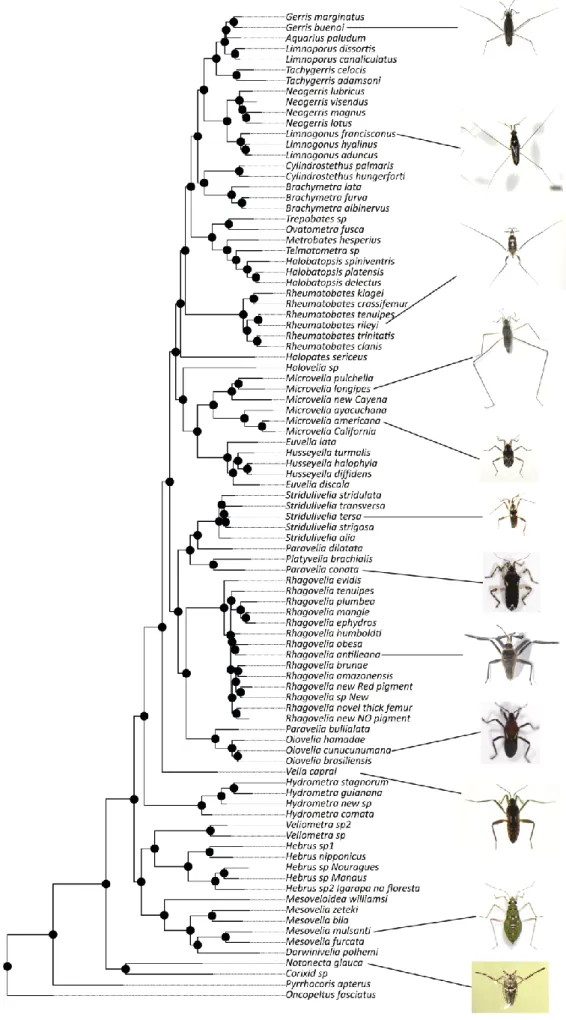
Figure 5: Gerromorpha (water striders) phylogeny. Phylogenetic relationships of 89 species of water striders and 4 other Hemiptera species used as outgroups.
The transition of the semi-aquatic bugs to the life on water follows a certain continuum where the more basally branching groups like the Hydrometridae, Hebridae and Mesoveliidae have the tendency to live near shore, at the interphase between terrestrial and water surfaces such as wet soil. To move on water, these species use the ancestral mode of locomotion, the walking gait, that consists of alternating the movements of the first and rear legs on one side with the mid-leg on the other side of the body [133]. The more derived species have specialized in more open water surfaces and their mode of locomotion has now changed into a rowing movement where the mid-legs are moved simultaneously from the anterior to the posterior part of the individual in order to propel it forward. This new mid-leg function is associated with the evolution of a new leg ground plan where the mid-legs are now longer than the rear legs. In the new mode of locomotion, the first and rear legs act as balancers [133]. In the recent years, Gerromorpha has become a new model in the field of Evo-Devo, allowing a more integrative understanding on the adaptive function of leg diversity. The development of genetic tools such as in-situ hybridization and knockdown using RNA interference (RNAi) sheds light on the evolution of gene expressions and genetic networks controlling the leg elongation and the development of a new ground plan in these insects [65-69]. Despite a growing interest in understanding the adaptive and developmental mechanisms associated with the transition to the water surface habitat [134], these insects are primarily studied as models for sexual selection. A large body of literature is dedicated to the interaction between males and females and the associated evolution of mating behaviour. During the breeding season, their mating activity can become very intense and easy to observe as it often occurs in restricted areas, on the water surface [135, 136]. It has been shown that a conflict could emerge between males and females during mating. In many species, males display harassing behaviour by chasing, grasping and/or leaping upon females in an attempt to mate. Females generally try to escape these mating harassments but when a male succeeds in grasping the female from her back, a vigorous pre-mating struggle ensues. As often, females will be reluctant to mate and will initiate a rejecting behaviour consisting of roles, somersaults and leverage flips in order to dislodge the grasping male. In the occasions when the male persists, copulation occurs. Interestingly, males have evolved all sorts of adaptive sex-specific phenotypes, especially morphological ones, to enhance their ability to grasp and maintain themselves during mating struggles. For example, males of several species have developed spikes on their rear legs to grasp female legs and/or abdomen [72, 137]. One very striking example occurs in the genus Rheumatobates, where males of some species have developed extremely complex leg and antennae structures that serve them to hold the female’s
head when the latter is wrestling [36]. In the semi-aquatic insects, females possess a spermatheca that makes them capable of storing viable sperm for several days. Females therefore need few matings over their lifetime to secure the fertilization of their eggs [72, 136]. As a consequence, a prolonged or an additional number of matings will at some point become costly for the fitness of the female. As a consequence, females of some species will be favoured if they also evolved, in addition to their resistant behaviour, some anti-grasping structures that will act against the adaptive secondary sexual traits developed by the males. The most famous examples of such antagonistic traits are found in species of Gerridae, where females have developed abdominal spines near their genitalia to increase the efficiency of male dislodgement [138-140]. Interestingly, when we compare the degree of abdominal spines erection in different species of the genus Gerris, we observe that the more exaggerated the female’s spines are and more the males of the same species have evolved flattened distal part of the abdomen in association with prolonged genital and pregenital segments. A strong correlation exists therefore between grasping and anti-grasping structures in males and females, highlighting a certain correlated evolution of these sex-specific structures [138]. This process is described as an evolutionary arms race where a positive feedback takes place and leads to the co-evolution and escalation of grasping and antigrasping structures involved in the sexual conflict over mating rate between the two sexes [28].
Other mating strategies have been described in Gerromorpha but with much less attention than the sexual conflict [141]. Some studies report for example that males of another Gerrid,
Gerris elongatus, adopt different alternative mating strategies according to the seasonal
period [142]. In the early breeding seasons, males are very active and produce a series of surface waves that are used as signals to attract or court the female near or far away from their egg-laying sites (e.g. piece of fallen bamboo). In this species, males can establish a territory around the oviposition sites and can sometimes fight with their midlegs for territory dominance against other intruder males. In midseason, the females will tend to lay eggs just after mating and the male will initiate a guarding behaviour to protect her from other male disturbances. Another study in Aquarius remigis described that in addition to male-male competition and male-female conflict, females of this species display some kind of female choice by favouring smaller males that have shorter mating duration [143]. A large body of literature on natural and sexual selection has been documented in the Gerridae family, a derived lineage from the Gerromorpha group. However, much of the diversity in mating systems and behaviours still needs to be explored in more basally branching species. A large
number of secondary sexual characters have already been described anatomically across the semiaquatic insects, but few of them have a characterized function (except in the Gerridae family). In addition, the establishment of key molecular technics (e.g. RNAi interference) associated with the rapid acquisition of new genomic data make this group of species a good emerging system to study the adaptive and genomic basis of sexual dimorphism.
Chapter 1: Fluctuating selection strength and intense male
competition underlie variation and exaggeration of a water
strider’s male weapon
Authors: William Toubiana1 and Abderrahman Khila1
Author affiliations:
1 Institut de Génomique Fonctionnelle de Lyon, Université de Lyon, Université Claude
Bernard Lyon 1, CNRS UMR 5242, Ecole Normale Supérieure de Lyon, 46, allée d’Italie, 69364 Lyon Cedex 07, France
I. Abstract:
Sexually selected traits can reach high degrees of phenotypic expression and variation under directional selection. A growing number of studies suggest that such selection can vary in space, time and form within and between populations. However, the impact of these fluctuations on sexual trait evolution is poorly understood. In the water strider Microvelia
longipes, males display striking trait exaggeration and phenotypic variation manifested as
extreme differences in the rear leg length. To study the origin and maintenance of this exaggerated trait, we conducted comparative behavioral, morphometric and reaction norm experiments in a selection of Microvelia species. We uncovered differences both in the mating behavior and the degree of sexual dimorphism across these species. Interestingly, M.
longipes evolved a specific mating behavior where males compete for egg-laying sites,
consisting of small floating objects, to intercept and copulate with gravid females. Through male-male competition assays, we demonstrated that male rear legs are used as weapons to dominate egg-laying sites and that intense competition is associated with the evolution of rear leg length exaggeration. Field observations revealed rapid fluctuation in M. longipes habitat stability and the abundance of egg-laying sites. Paternity tests using genetic markers demonstrated that small males could only fertilize about 5% of the eggs when egg-laying sites are limiting, whereas this proportion increased to about 20% when egg-laying sites become abundant. Furthermore, diet manipulation and artificial selection experiments also showed that the exaggerated leg length in M. longipes males is influenced by both genetic and nutritional factors. Collectively, our results highlight how fluctuation in the strength of directional sexual selection, through changes in the intensity of male competition, can drive the exaggeration and phenotypic variation in this weapon trait.
II. Introduction
Sexually selected traits represent some of the primary examples of intra- and interspecies phenotypic variation [5, 19]. Males in both vertebrates and invertebrates are known to display extravagant phenotypes that differ in their nature, location, size, and shape [5, 19, 42, 144]. Such degrees of trait expression and variation among individuals are often associated with the type of mating strategy employed. In some systems, conflict over mating rate between the sexes can drive profound morphological modifications, such as male antennae in water striders that are used to grasp the females during pre-mating struggles [36]. In other examples, such as in horned beetles or ruffs, males occur in discrete morphs associated with alternative mating strategies. Large males dominate territories whereas small males tend to sneak [145-147].
An extreme form of variation lies in sexual characters displaying a continuum of trait expression with no distinguishable discrete morphs in the population [42, 144]. A central prediction for these exaggerated traits to evolve is that only large individuals can afford to bear them as they are good indicators of body size, thus representing an honest signal for male quality [39, 41, 148]. Under this prediction, females will favor males with the highest trait expression, which imposes strong directional selection in favor of trait exaggeration [19]. In other situations, the exaggerated trait is used as a weapon in male-male competition, and its size is a good predictor for the outcome of the contest over access to females [149, 150].
In these examples, sexual selection is thought to be directional and persistent over time [39, 126]. These traits are also known to be subject to survivorship costs, which constrain their degree of expression resulting in a net stabilizing selection [144]. These observations raise important questions regarding the maintenance of phenotypic variation in natural populations [19, 38, 39, 126, 128]. A growing number of studies suggest that selection may fluctuate over time and space, and that environmental changes may influence the strength, direction, and form of sexual selection [151-156]. These fluctuations in selection may, in turn, favor genetic variation and elevated plastic response observed in sexual traits, consequently influencing their variation and evolution [39, 151, 152]. Nonetheless, empirical studies have shown that the genetic and plastic influence on phenotypic variation could be highly variable from one species to another. For example, the three male discrete morphs of ruffs are mostly controlled genetically by different alleles in an inverted chromosomal region [157, 158]. Major and minor morphs in dung beetles or wild turkeys, however, can mostly be
recapitulated by changes in the environment such as nutritional intake or male competition [159, 160]. Studies assessing the interplay between selection, genetics and plasticity, within the context of a changing environment are therefore crucial to further the general understanding of the origin and maintenance of highly variable exaggerated sexual traits.
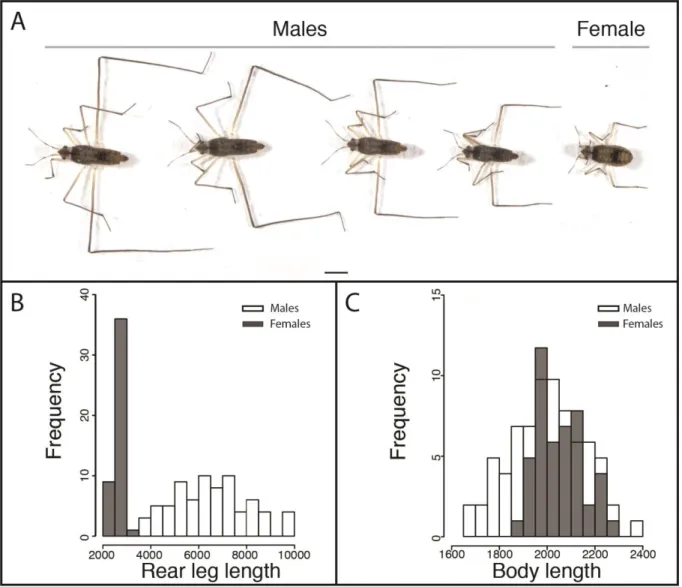
Here we focus on a novel model system, the water strider Microvelia longipes, that displays a strong sexual dimorphism where males have evolved both longer and more variable rear legs than females [72]. The genus Microvelia (Heteroptera, Gerromorpha, Veliidae) comprises some 170 species of small water striders distributed worldwide and occupying various fresh water habitats including temporary rain puddles and stable large water bodies [72]. First, we reconstructed phylogenetic relationships of five Microvelia species and compared their degrees of dimorphism, scaling relationships between leg and body length, and various aspects of mating behavior. We report a clear association between the intensity of male competition and the evolution of trait exaggeration in M. longipes males. We then determined the fitness advantages of these exaggerated legs through fertilization success performed under selective conditions reflecting fluctuations in their natural environment. Finally, we assessed the contribution of the strength of sexual selection, genetic variation, and phenotypic plasticity to the variation of exaggerated rear legs in M. longipes males.
III. Material & methods
A. Population sampling and culture
Microvelia populations were collected during fieldwork in French Guyana in Crique Patate
near Cayenne. The bugs were maintained at 25°C and 50% humidity and fed on crickets.
B. Measurement of Microvelia species and statistics
Rear leg and body lengths of all Microvelia species were measured with a SteREO Discovery V12 (Zeiss) using the Zen software. All statistical analyses were performed in RStudio 0.99.486. Comparisons for mean trait size and trait distributions were performed on raw data whereas log-transformed data were used for scaling relationship comparisons. We used Standardized Major-Axis (SMA) regression to assess differences in scaling relationships (“smatr” package in R, [161]). Differences in intercepts were estimated using a Wald statistic test and we used Likelihood ratio test for differences in slopes [161].
C. Behavioral observations and video acquisition
Male and female interactions of all Microvelia species were observed in a recreated small puddle, using local mud, and were filmed with a Nikon digital camera D7200 with an AF-S micro nikkor 105mm lens. Observations and video acquisitions were taken a couple of hours after the bugs were transferred to the puddle. In M. longipes and M. pulchella male and female interactions were also observed in the field.
D. Microvelia phylogenetic reconstruction
The phylogenetic relationships between the five Microvelia species used in the behavioral assays was generated using the Geneious software version 7.1.9 using plugins MrBayes version 3.2.6 and PhyML version 3.0, as described in [133]. The phylogenetic reconstruction was performed using 14 molecular markers. Supplementary table 1 presents the identity and Genbank accession numbers for these markers. Phylogenetic reconstruction was performed using MrBayes version 3.2.6 and PhyML version 3.0 in Geneious 7.1.9 as described in [133].
E. Male competition assay
We generated five groups of three independent males from M. longipes lab population (N=15 individuals). The males of each group were chosen for their differences in rear leg length (large, intermediate and small legs) and painted on their back. A male from each category fought five times with a male from the two other categories (total number of fights per male=10).
F. Fight frequency assay
To compare the number of fights between males of M. longipes and M. pulchella, we isolated twenty-five adult males and females over a period of two days. Both sexes were then mixed together in the puddle during 30 minutes before observation. The number of fights on and outside floaters was counted during a period of one hour (Supplementary table 2). We repeated the experiment the following day with the same males and females kept together overnight (Supplementary table 2). In order to correct for size differences between the two species, we calculated the number of fights in a reduced sample of ten males and ten females