HAL Id: hal-01894144
https://hal.inria.fr/hal-01894144
Submitted on 12 Oct 2018
HAL is a multi-disciplinary open access
archive for the deposit and dissemination of
sci-entific research documents, whether they are
pub-lished or not. The documents may come from
teaching and research institutions in France or
abroad, or from public or private research centers.
L’archive ouverte pluridisciplinaire HAL, est
destinée au dépôt et à la diffusion de documents
scientifiques de niveau recherche, publiés ou non,
émanant des établissements d’enseignement et de
recherche français ou étrangers, des laboratoires
publics ou privés.
From attributes to faces: a conditional generative
network for face generation
Yaohui Wang, Antitza Dantcheva, Francois Bremond
To cite this version:
Yaohui Wang, Antitza Dantcheva, Francois Bremond. From attributes to faces: a conditional
genera-tive network for face generation. BIOSIG’18, 17th International Conference of the Biometrics Special
Interest Group, Sep 2018, Darmstadt, Germany. �hal-01894144�
Lecture Notes in Informatics (LNI), Gesellschaft f¨ur Informatik, Bonn 2018 1
From attributes to faces: a conditional generative network
for face generation
Yaohui Wang1, Antitza Dantcheva1, Francois Bremond1
Abstract: Recent advances in computer vision have aimed at extracting and classifying auxiliary biometric information such as age, gender, as well as health attributes, referred to as soft biometrics or attributes. We here seek to explore the inverse problem, namely face generation based on at-tribute labels, which is of interest due to related applications in law enforcement and entertainment. Particularly, we propose a method based on deep conditional generative adversarial network (DC-GAN), which introduces additional data (e.g., labels) towards determining specific representations of generated images. We present experimental results of the method, trained on the dataset CelebA, and validate these based on two GAN-quality-metrics, as well as based on three face detectors and one commercial off the shelf (COTS) attribute classifier. While these are early results, our findings indicate the method’s ability to generate realistic faces from attribute labels.
Keywords: Attributes, Soft Biometrics, Generative Adversarial Networks
1
Introduction
Recently attributes or soft biometrics [DER15, Da11, CDR14] such as gender, age, eth-nicity, height and weight have gained popularity due to their semantic interpretation, i.e., they can provide a description that can be readily understood by humans; for example the description “young, female, tall”. While the possibility to extract and classify such attributes has been shown, the inverse problem, namely face generation, given attribute-labels is a novel area of high interest, due to related applications in law enforcement and entertainment. One specific application relates to the generation of realistic faces in cases of witness descriptions, where the descriptions are the only available evidence (e.g., in the absence of facial images). Currently in this context, law enforcement utilizes facial com-posites, which seek to support the process of suspect-identification. Composites are either hand drawn (sketches) or computer-generated3, see Fig. 1. Both methods are slow, tedious relatively unrealistic, as well as impeding efficient face recognition (i.e., match such com-posites with existing mugshot databases maintained by law enforcement agencies). Thus, reliable and automated label-based face generation would be a valuable asset in similar scenarios.
Additionally, label-based face generation accepts the application of visualization of classic fictional characters from novels. Often such characters are verbosely depicted, e.g., “[His] jaw was long and bony, his chin a jutting ‘v’ under the more flexible v of his mouth. His nostrils curved back to make another, smaller, ‘v.’ His yellow-grey eyes were horizontal.” [To12]. However there exists the hypothesis that humans are not able to imagine faces,
1INRIA Sophia-Antipolis, STARS, France,{yaohui.wang, antitza.dantcheva, francois.bremond}@inria.fr 3http://www.iqbiometrix.com
2 Yaohui Wang, Antitza Dantcheva and Francois Bremond
which they have not seen before, and hence an automated visualization based on similar detailed descriptions might be beneficial for an enhanced reading experience.
Fig. 1: Composite images from FACES 4.0 [Sw14].
In spite of the aforementioned applications of interest, limited research concerns attribute-based face generation. In this context, particularly generative adversarial networks (GANs) and variational auto-encoders (VAEs) are instrumental towards such face generation. Motivated by the above, in this paper we propose to generate faces based on attribute-labels. This incorporates two steps: (i) the learning of a text feature representation that captures the important visual details, as well as (ii) given the features, the generation of compelling realistic images. We propose an approach based on deep conditional convolu-tional generative adversarial network (DCGAN) [Pe16], which was introduced to modify images based on attributes (image-to-image translation, see Section 1). We train the pro-posed GAN with the dataset CelebA and generate faces pertained to two attribute-sets: (a) glasses and gender, as well as (b) glasses, gender, hair color, smile and age. We select these two sets of attributes for the associated high descriptiveness, e.g., such attributes are commonly used by humans to describe their peers. For the experiment (a) we generate 256 images and for (b) 2048 images, which we evaluate by 2 common GAN-quality-scores, as well as by three well established face detectors and an attribute classifier. Results indicate the method’s ability to generate realistic faces from attribute labels.
Related work Generative adversarial networks (GANs), as introduced by Goodfellow et al. [Go14], incorporate two networks, a Generator, which generates new data instances and a Discriminator, which evaluates them for authenticity. The generator accepts noise as input and generates new samples of data in line with the observed training data. GANs have succeeded in applications such as image generation, image translation, super-resolution imaging, as well as face image synthesis.
Conditional GANs enhance the GAN-concept by providing both, the discriminator and generator with additional class information, in order to generate samples conditioned on different classes. Such text-to-image translation has been beneficial in domain transfer, super-resolution imaging, as well as image editing. Notable approaches include the condi-tional generative adversarial networks (cGANs) work by Mirza and Osindero [MO14] and the invertible conditional GAN proposed by Perarnau et al. [Pe16].
Limited literature concerns attribute-labels based face generation. The work of Gauthier [Ga14] tackles the topic by proposing a conditional GAN in this context and loosely vali-dating the approach qualitatively on Labeled Faces in the Wild (LFW). Deviating from our work, Gauthier added the attribute-information at the last layer of the Discriminator, did not use the set “real images and fake labels” for training, as well as lacked proficient vali-dation. We note here that we tested their architecture and obtained poor results. A further
related work presents the VAE-based framework Attribute2Image [Ya16] proposed by Yan et al.. Lu et al. [LTT17] also tackle the problem of attributes-based face generation. How-ever, different from them, we apply the state-of-the-art Spectral Normalization [Mi18] in discriminator and obtain higher quality face images.
As stated above, while limited research concerns attribute-based face generation, extensive research relates to attribute based image translation. In this context, image-to-image translationrefers to the alteration of a particular aspect of a given image to another, e.g., changing the hair color. Notable very recent attribute-translation GANs include Cy-cleGAN [CZS17], StarGAN [Ch17], as well as MakeupGAN [Ch18].
Finally, face sketch synthesis (FSS) has gained interest in the design community (e.g., face artistic styles synthesis [Zh18, Zh16]) and is being used for digital entertainment, as well as law enforcement (sketch based face recognition [Kl14]). A recent VAE and GAN-based face synthesis approach from sketches is the work of Di and Patel [DP17].
2
Proposed method
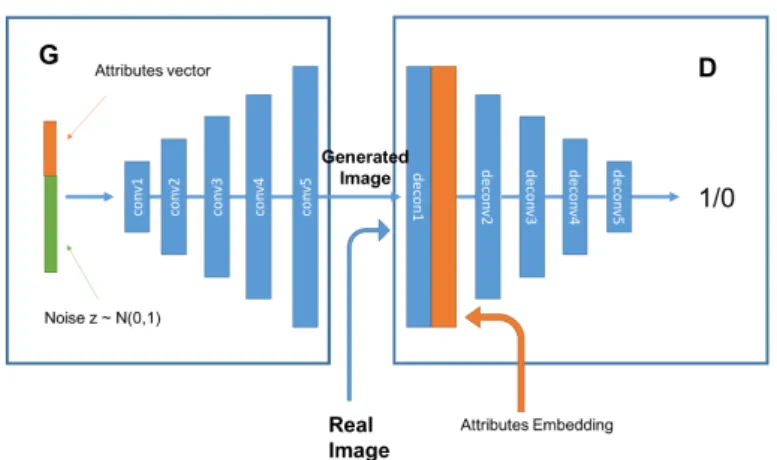
The proposed conditional GAN aims to fit the conditional probability P(x|z, y), as depicted in Figure 2 and specified in the Tables 1 and 2. We let z be the noise vector sampled fromN (0,1) with dimension N = 100, y be the vector representing attribute-labels (with yi∈ ±1, where i corresponds to the ithattribute). We train a GAN, adding attribute-labels in both, generator and discriminator. While the generator accepts as input the combination of prior noise p(z) and attributes vector y, the discriminator accepts both, real or generated images, as well as the attribute-labels. We have the objective function of our model be:
min
G maxD V(D, G) = Ex,y∼pdata[log D(x, y)] + Ez∼pz,y∼py[log(1 − D(G(z, y), y))]. (1)
Fig. 2: Architecture of proposed method consisting of two modules, a discriminator D and a genera-tor G. D learns to distinguish between real and fake images, classifying based on attribute-labels. G accepts as input both, noise and attribute-labels in order to generate realistic face images.
4 Yaohui Wang, Antitza Dantcheva and Francois Bremond
Implementation details Our model is based on the PyTorch implementation of DCGAN. The generator accepts as the input the concatenation of attribute-label-vector y and noise z. On the discriminator-side, we stack the attribute-label-vector with the feature map of the first convolutional layer. We test the insertion of the attribute-label-vector at each discriminator-layer and obtained best results at the first layer-level. We train the model with the Adam optimizer at a learning rate of 0.0002 and a mini batch size of 128. The input and generated image sizes are both 64 × 64. We conduct 2 experiments by applying Batch Normalization(BN) and Spectral Normalization(SN) in discriminator separately. Ta-ble 1 2 show the details of model architecture with SN.
Tab. 1: Architecture of Generator Operation Kernel Stride Filters Norm Activation Concatenation Concatenate z and y on 1st dimension ConvTranspose 4 × 4 2 × 2 512 BN ReLU ConvTranspose 4 × 4 2 × 2 256 BN ReLU ConvTranspose 4 × 4 2 × 2 128 BN ReLU ConvTranspose 4 × 4 2 × 2 64 BN ReLU ConvTranspose 4 × 4 2 × 2 3 No Tahn
Tab. 2: Architecture of Discriminator Operation Kernel Stride Filters Norm Activation
Conv 4 × 4 2 × 2 64 No LeakyReLU Concatenation Replicate y and concatenate to 1st conv. layer
Conv 4 × 4 2 × 2 128 SN LeakyReLU Conv 4 × 4 2 × 2 256 SN LeakyReLU Conv 4 × 4 2 × 2 512 SN LeakyReLU Conv 4 × 4 1 × 1 1 No Sigmoid
Algorithm 1 summarizes the training procedure. When we train the discriminator, we provide two types of negative samples. Firstly the generated images with real labels, secondly real images with fake labels. We observe that such training enforces the discriminator to learn from diverse samples and at the same time enables the generation of realistic samples.
Algorithm 1 Attributes based Conditional DCGAN
Input: mini batch x, matching label y, mismatching label ˆy, number of training epochs N
1: for n = 1 to N do
2: z∼N (0,1)Z{Draw sample of random noise}
3: y←Y {Draw matching attributes label}
4: yˆ← ˆY {Draw mismatching attributes label}
5: xˆ← G(z, y) {Forward through generator}
6: sr← D(x, y) {Forward through discriminator with real image, right attribute labels}
7: sw← D(x, ˆy) {Forward through discriminator with real image, wrong attribute labels}
8: sg← D( ˆx, y) {Forward through discriminator with generated image, right attribute labels}
9: LD← log(sr) + (log(1 − sw) + log(1 − sg))/2 {loss function of discriminator }
10: D← D − α∂LD/∂ D {Update discriminator}
11: LG← log(sf) {loss function of generator}
12: G← G − α∂LG/∂ G {Update generator}
13: end for
3
Experiments
We use the benchmark dataset CelebA [Li15] comprising of 202,599 face images annotated with 40 binaryattribute labels. We perform two experiments: generation of images given (a) two attributes
(glasses, gender) and (b) five attributes (glasses, gender, hair color, smile and age). For (a) we gen-erate 256 images and for (b) 2048 images.
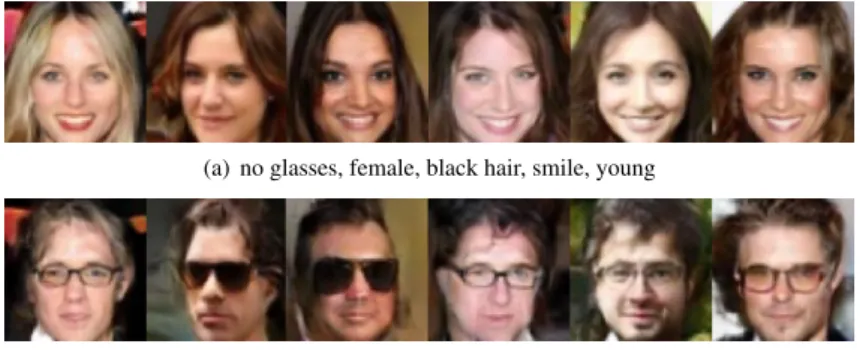
(a) no glasses, female, black hair, smile, young
(b) glasses, male, no black hair, no smile, young
Fig. 3: Example images generated by the proposed approach based on 5 attributes Figure 3 illustrates generated samples of the proposed approach. We observe that the model succeeds specifically in generation of local-attribute-labels based faces (e.g., glasses, smile). Further, based on Figure 4, we found binary labels might be too limiting in describing age. Such labels can guide the model to generate ’younger’ or ’older’ faces, not exactly ’young’ and ’old’ faces. In addition, CelebA depicts celebrities, with face alterations inflicted by makeup and plastic surgery, which might affect the reliability of the pair “age-label and image”.
We have witnessed a ’mode collapse’ after 100 epochs when applying Batch Normalization in discriminator, however when applying Spectral Normalization, ’mode collapse’ appears until 300 epochs. It shows that SN can provide more stable training and higher quality generated images. Evaluation To evaluate how realistic our generated images are, in this section, firstly we report the results based on the pre-trained face and attribute detection models. Then we proceed to present evaluation results of two quality metrics, namely Inception Score (IS) [Sa16] and Fr´echet Inception Distance (FID) [He17], which have been widely used in image quality evaluation for GANs. Face Detection We report face detection results based on 3 different face detectors (Face ++4, DFace5, dlib6 in Table 3. We observe that DFace has the highest detection rates (for experiment (a) 89%, for (b) 96%), while Face++ has the lowest rates ((a) 58.2%, (b) 53%).
Attribute EstimationWe present in Table 4 gender classification results from Face ++ both on gen-erated dataset and subset of 15735 images from original CelebA. We note the higher true gender classification accuracy in the experiment (b) (generating 5 attributes), which indicates that higher prior information allows the model to generate better targeted images. Figure 4 illustrates the box-plot of estimated age for age estimation by Face ++. Here, we note a shift in estimated age for the old / young labels, but the shift is not profound.
GAN quality metrics We proceed with 2 commonly used GAN - quality measures, namely the Inception Score and the Fr´echet Inception Distance, that we firstly proceed to describe.
Inception Score (IS)is a metric for automated quality evaluation of images originated from gen-erative models. The score is computed by an Inception V3 Network pre-trained on ImageNet and
4https://www.faceplusplus.com.cn/ 5https://github.com/kuaikuaikim/DFace 6
6 Yaohui Wang, Antitza Dantcheva and Francois Bremond
Tab. 3: Face detection results. We report the number of detected faces for the three face detectors: dlib, DFace and Face ++. In experiment (a) we generate faces labeled with two attributes correspond-ing to gender and glasses. Experiment (b) involves 5 attributes correspondcorrespond-ing to gender, glasses, age, smile, hair color.
Dataset Number of Generated Detected Faces Detected Faces Detected Faces Attributes Images Rate dlib(%) Rate DFace(%) Rate Face ++(%) Generated (a) 2 256 75.4 89.1 58.2 Generated (b) 5 2048 87.6 96.0 53.0
CelebA - - 97.4 90.8 99.8
Tab. 4: Gender estimation accuracy as computed by Face++. In experiment (a) we generate faces labeled with two attributes corresponding to gender and glasses. Experiment (b) involves 5 attributes corresponding to gender, glasses, age, smile, hair color.
Dataset Number of Detected True Gender False Male False Female Attributes Faces Classification Rate (%) Rate (%)
Rate(%) Accuracy (%)
Generated (a) 2 75.4 66.4 74.6 59.7 Generated (b) 5 87.6 81.8 94.7 67.2 CelebA - 99.8 97.1 95.6 97.9
Fig. 4: Boxplot of the estimated age pertained to generated faces as computed using the Face ++ attribute classifier.
calculates a statistic of the network’s outputs, when applied to generated images. The Inception Score is given by
IS(G) = exp(Ex∼pgDKL(p(y|x)kp(y))), (2)
where x ∼ pgindicates that x is an image sampled from pg, DKL(pkq) is the KL-divergence between
the distributions p and q. The score examines generated images for included meaningful objects, as well as a low label entropy.
Fr´echet Inception Distance (FID)is an improvement of Inception Score. IS has the limitation of not utilizing statistics of real world samples are not used, and compared to the statistics of synthetic samples. Overcoming that, the Fr´chet distance measures the distance between a generated image set and a source dataset, and is calculates as
d2((m,C), (mω,Cω)) = km − mωk22+ Tr(C +Cω− 2(CCω)1
where (m,C), (mω,Cω) represent the mean and covariance of the two respective distributions.
ISand FID for the both experiments are summarized in Table 5. For IS, higher values indicate a higher quality, while for FID the opposite is the case. Again, we observe that an increased prior information (experiment (b) improves the generated image quality. As a comparison Wasserstein GAN (WGAN) reportedly has IS = 8.42 and FID = 55.2; the Boundary Equilibrium Generative Adversarial Networks BEGAN IS = 5.62 and FID = 71.4.
Tab. 5: Inception Score (IS) and Fr´echet Inception Distance (FID) quantitatively validating generated images for the two experiments pertained to 2 and 5 attributes.
Number of Attributes IS FID 2 1.94 63.8 5 2.20 43.8
4
Conclusions
In this work we have presented preliminary results on attribute based face generation based on a DCGAN-approach. Results, evaluated by three well established face detectors, an attribute estimator and benchmark quality scores, suggest the method’s ability to generate realistic faces from attribute labels. The presented approach can be instrumental in the visualization of witness descriptions. Fu-ture work will involve experiments related to matching of generated faces with existing faces.
Acknowledgement
This work was supported by the French Government (National Research Agency, ANR) under grant agreement ANR-17-CE39-0002.
References
[CDR14] Chen, Cunjian; Dantcheva, Antitza; Ross, Arun: Impact of facial cosmetics on automatic gender and age estimation algorithms. In: 2014 International Conference on Computer Vision Theory and Applications (VISAPP). 2014.
[Ch17] Choi, Yunjey; Choi, Minje; Kim, Munyoung; Ha, Jung-Woo; Kim, Sunghun; Choo, Jaegul: StarGAN: Unified Generative Adversarial Networks for Multi-Domain Image-to-Image Translation. arXiv preprint arXiv:1711.09020, 2017.
[Ch18] Chang, Huiwen; Lu, Jingwan; Yu, Fisher; Finkelstein, Adam: PairedCycleGAN: Asym-metric Style Transfer for Applying and Removing Makeup. In: Conference on Computer Vision and Pattern Recognition. 2018.
[CZS17] Chu, Casey; Zhmoginov, Andrey; Sandler, Mark: CycleGAN: a Master of Steganography. arXiv preprint arXiv:1712.02950, 2017.
[Da11] Dantcheva, Antitza; Velardo, Carmelo; D’Angelo, Angela; Dugelay, Jean-Luc: Bag of soft biometrics for person identification. Multimedia Tools and Applications, 51(2):739–777, 2011.
8 Yaohui Wang, Antitza Dantcheva and Francois Bremond
[DER15] Dantcheva, A.; Elia, P.; Ross, A.: What else does your biometric data reveal? A survey on soft biometrics. IEEE Transactions on Information Forensics and Security, pp. 1–26, 2015.
[DP17] Di, Xing; Patel, Vishal M: Face Synthesis from Visual Attributes via Sketch using Con-ditional VAEs and GANs. arXiv preprint arXiv:1801.00077, 2017.
[Ga14] Gauthier, Jon: Conditional generative adversarial nets for convolutional face generation. Class Project for Stanford CS231N: Convolutional Neural Networks for Visual Recogni-tion, Winter semester, 2014(5):2, 2014.
[Go14] Goodfellow, Ian; Pouget-Abadie, Jean; Mirza, Mehdi; Xu, Bing; Warde-Farley, David; Ozair, Sherjil; Courville, Aaron; Bengio, Yoshua: Generative adversarial nets. In: Ad-vances in neural information processing systems. pp. 2672–2680, 2014.
[He17] Heusel, Martin; Ramsauer, Hubert; Unterthiner, Thomas; Nessler, Bernhard; Klambauer, G¨unter; Hochreiter, Sepp: GANs Trained by a Two Time-Scale Update Rule Converge to a Nash Equilibrium. CoRR, abs/1706.08500, 2017.
[Kl14] Klum, Scott J; Han, Hu; Klare, Brendan F; Jain, Anil K: The FaceSketchID system: Matching facial composites to mugshots. IEEE Transactions on Information Forensics and Security, 9(12):2248–2263, 2014.
[Li15] Liu, Ziwei; Luo, Ping; Wang, Xiaogang; Tang, Xiaoou: Deep learning face attributes in the wild. In: Proceedings of the IEEE International Conference on Computer Vision. pp. 3730–3738, 2015.
[LTT17] Lu, Yongyi; Tai, Yu-Wing; Tang, Chi-Keung: Conditional cyclegan for attribute guided face image generation. arXiv preprint arXiv:1705.09966, 2017.
[Mi18] Miyato, Takeru; Kataoka, Toshiki; Koyama, Masanori; Yoshida, Yuichi: Spectral Normal-ization for Generative Adversarial Networks. In: International Conference on Learning Representations. 2018.
[MO14] Mirza, Mehdi; Osindero, Simon: Conditional generative adversarial nets. arXiv preprint arXiv:1411.1784, 2014.
[Pe16] Perarnau, Guim; van de Weijer, Joost; Raducanu, Bogdan; ´Alvarez, Jose M: Invertible conditional GANs for image editing. arXiv preprint arXiv:1611.06355, 2016.
[Sa16] Salimans, Tim; Goodfellow, Ian; Zaremba, Wojciech; Cheung, Vicki; Radford, Alec; Chen, Xi; Chen, Xi: Improved Techniques for Training GANs. In (Lee, D. D.; Sugiyama, M.; Luxburg, U. V.; Guyon, I.; Garnett, R., eds): Advances in Neural Information Pro-cessing Systems 29, pp. 2234–2242. Curran Associates, Inc., 2016.
[Sw14] Sweegers, Carly CG; Takashima, Atsuko; Fern´andez, Guill´en; Talamini, Lucia M: Neural mechanisms supporting the extraction of general knowledge across episodic memories. Neuroimage, 87:138–146, 2014.
[To12] Tolkien, John Ronald Reuel: The Lord of the Rings: One Volume. Houghton Mifflin Harcourt, 2012.
[Ya16] Yan, Xinchen; Yang, Jimei; Sohn, Kihyuk; Lee, Honglak: Attribute2image: Conditional image generation from visual attributes. In: European Conference on Computer Vision. Springer, pp. 776–791, 2016.
[Zh16] Zhang, Shengchuan; Gao, Xinbo; Wang, Nannan; Li, Jie: Robust face sketch style syn-thesis. IEEE Transactions on Image Processing, 25(1):220–232, 2016.
[Zh18] Zhang, Mingjin; Li, Jie; Wang, Nannan; Gao, Xinbo: Compositional model-based sketch generator in facial entertainment. IEEE transactions on cybernetics, 48(3):904–915, 2018.
![Fig. 1: Composite images from FACES 4.0 [Sw14].](https://thumb-eu.123doks.com/thumbv2/123doknet/13488388.413959/3.892.240.657.317.411/fig-composite-images-from-faces-sw.webp)