Publisher’s version / Version de l'éditeur:
Journal of Performance of Constructed Facilities, 17, Nov. 4, pp. 163-166, 2003-11-01
READ THESE TERMS AND CONDITIONS CAREFULLY BEFORE USING THIS WEBSITE.
https://nrc-publications.canada.ca/eng/copyright
Vous avez des questions? Nous pouvons vous aider. Pour communiquer directement avec un auteur, consultez la
première page de la revue dans laquelle son article a été publié afin de trouver ses coordonnées. Si vous n’arrivez pas à les repérer, communiquez avec nous à [email protected].
Questions? Contact the NRC Publications Archive team at
[email protected]. If you wish to email the authors directly, please see the first page of the publication for their contact information.
NRC Publications Archive
Archives des publications du CNRC
This publication could be one of several versions: author’s original, accepted manuscript or the publisher’s version. / La version de cette publication peut être l’une des suivantes : la version prépublication de l’auteur, la version acceptée du manuscrit ou la version de l’éditeur.
For the publisher’s version, please access the DOI link below./ Pour consulter la version de l’éditeur, utilisez le lien DOI ci-dessous.
https://doi.org/10.1061/(ASCE)0887-3828(2003)17:4(163)
Access and use of this website and the material on it are subject to the Terms and Conditions set forth at
Axioms for building and repairing durable concrete structures Mailvaganam, N. P.; Wiseman, A.
https://publications-cnrc.canada.ca/fra/droits
L’accès à ce site Web et l’utilisation de son contenu sont assujettis aux conditions présentées dans le site LISEZ CES CONDITIONS ATTENTIVEMENT AVANT D’UTILISER CE SITE WEB.
NRC Publications Record / Notice d'Archives des publications de CNRC: https://nrc-publications.canada.ca/eng/view/object/?id=129915b9-6a28-454e-8aff-d8d56bc5b15b https://publications-cnrc.canada.ca/fra/voir/objet/?id=129915b9-6a28-454e-8aff-d8d56bc5b15b
Axioms for building and repairing durable concrete structures
Mailvaganam, N.P.; Wiseman, A.
NRCC-46887
A version of this document is published in / Une version de ce document se trouve dans :
Journal of Performance of Constructed Facilities ASCE, v. 17, no. 4, Nov. 2003, pp. 163-166
Axioms for Building Durable Concrete Structures
Noel P. Mailvaganam1 and A Wiseman2
" Good and bad concrete are both made from the same raw materials; while special ingredients in the mix can modify and indeed improve the properties of the concrete to meet special needs, they do not act as substitutes for essential good practices"
— Dr. G Sommerville (The Design Life of Concrete Structures, 1986)
Introduction:
The durability of concrete structures can be defined as their ability to sustain the
serviceability for which they were designed. Today's practicing engineer therefore, pays particular attention to the types of deterioration that could threaten preserving the designed function of a structure. The complexities involved in current designs, the
proliferation of new materials and services and hygienic requirements however, make the design engineer's job demanding.
Basic to the concept of durability is a commitment to quality assurance that involves testing and inspection to ensure the following:
• that the proper materials are selected for the job at hand;
• that the concrete is properly proportioned, mixed, handled, placed and cured;
• that the structure is appropriately designed to meet the demands of the service environment
Specified technical performance will affect the success of the work in arresting deterioration. The specification must be a realistic performance specification for the materials intended to be used and give attention to the preparation, mixing of materials, application methods and curing or protection, with a quality plan for all stages of the work (Anon 1979, Fulton 1977). This requires the engineer to have a fundamental
1 Principal Research Officer, Building Envelope and Structure, Institute for Research in Construction, National Research Council, Building M-20, Ottawa, Ontario, K1A 0R6, Canada.
2 A/Manager, RD&D, Engineering Specialist, Technology, Architectural & Engineering Services, Real Property Services, Public Works and Government Services Canada, Place du Portage, Phase III, 8B1, Hull, Quebec, K1A 0S5, Canada
Key words: durability, service environment, compatibility, serviceability, galvanic corrosion,
understanding of the properties of materials. However, due to the lack of information in the area of long-term performance of today's materials, the engineer must rely on his experience, such published information as he can find, and his common sense when addressing potential structural and material deterioration problems.
Since the engineer must rely on his judgment for the early detection of the warning signs, swift and accurate diagnosis of the problem and specification of remedial measures to prevent further deterioration, it is important that he or she gains a global view of deterioration and protection measures. The following axioms should be taken into
account for both the construction of new concrete structures and the repair of deteriorated structures. They may provide a practical approach to maintaining the design function over the effective life of the structure.
1. Match the materials to the environment
Durability becomes an issue when a material's resistance to deterioration is less than that required to withstand the aggressiveness of the environment in which it is to function. For example, steel will not corrode in a dry and salt-free
environment, but it will do so in the presence of moisture and chloride ions. To ensure the choice of an appropriate material, the environmental conditions to which the material will be exposed must be known so that its behaviour under these conditions can be predicted and addressed in the design. When a designer contemplates using a new material, problems may arise if there has not been sufficient experience with the material to adequately understand its behaviour.
Until reliable standards are established for the newer materials, the designer and specifier, in considering a product, must evaluate, critically, the following (Mailvaganam 1992, Feld 1967, Emmons and Vaysburd 1995, Warner 1984):
• The relevance of the test data in the product literature;
• The products applied and the long-term maintenance cost;
• Compatibility of the product with other materials that form the composite unit;
• Limitations and requirements that will be imposed by weather conditions such as temperature, rain and winds during application;
• The product’s field history under conditions similar to the job at hand. Whenever possible, long-standing examples of successful applications should be available for inspection
2. Do not combine dissimilar materials in an assembly
The incompatibility of diverse materials used in concrete, whether connected or merely adjoining, shows itself in the form of cracking and spalling, seldom leading to structural failure but causing serviceability limitations that result expensive unanticipated
maintenance and repair. Such incompatibility arises when there is a mismatch of properties of the different materials. Consequently, there is a variance in reaction to changing conditions of age, moisture, temperature, loading, vibration and use. Examples of such distress are discussed below.
While galvanic corrosion is a most familiar type of metallic deterioration, it is the most neglected from the standpoint of anode/cathode area relationships (Mailvaganam1992). For example, galvanic corrosion is promoted when two metals with different
electrochemical properties are combined in a building assembly. When moisture is present, a galvanic cell is set up, causing the less noble metal (see list of metals in galvanic series, Table 1) to corrode. This galvanic corrosion phenomenon is common in copper/aluminium roof assemblies and is related to the relative positions of the two materials in the electrochemical series. The copper (the more noble material) flashing on roofs destroys the aluminum (the less noble material) gutters and down spouts.
Gold
Mercury
Silver
Copper
Lead
Nickel
Cobalt
Iron
Tin
Zinc
Chromium
Aluminum
Table 1. Arrangement of metals in galvanic series
1
2
3
4
5
6
7
8
9
10
11
12
Cathodic or more noble metals
(least electrically active)
Metals are listed here in decreasing order of electrical activity. Metals that are less active (more noble) are protected by those that are more active (less noble). The anodic (less noble) material will corrode whereas the cathodic (more noble) material will not.
Metal
Relative nobility
Anodic or less noble metals
(most electrically active)
Patch repairs are offered as an immediate solution to corrosion damage. They can improve the condition of a structure and extend its life to provide an acceptable repair cycle (i.e. repairs every 7-10 years). Patch repairs however, will not stop corrosion elsewhere in the structure and may even promote it due to the “incipient anode” effect. The “incipient anode”effect is caused by patching which removes the anode in the corroded reinforcement, stopping the cathode of the existing cell from functioning and allowing the development of new anodes around the patch (Fig.1). This phenomenon is
commonly observed in structures suffering from chloride induced corrosion where anodes are large and well defined
It is therefore prudent to embed only those metals that are electrochemically similar, or to impose some barrier, such as a coated cathode, to prevent the formation of a galvanic cell. In the case of large cathode/ small anode the cathode can be coated to reduce its effective size, the anode however, should not be coated at all because a pin hole in the coating will lead to large cathode/ small anode condition and severe local attack.
High Modulus Low Modulus Low Modulus High Modulus
(a) Load perpendicular to the interface (b) Load parallel to the interface
Fig. 2: Effects of Mismatching Elastic Moduli (from [13] with permission)
The modulus of elasticity of a material is a measure of its stiffness. Low modulus materials deform more under load than high modulus materials. When materials with widely different moduli are in contact with each other, the significant difference in deformability will cause problems under specific loading conditions. For example, Fig. 2a shows that when load is perpendicular to the bond line, the difference in modulus does not cause problems. However, when the load is applied parallel to the bond line, as in Fig. 2b, deformation of the lower modulus material transfers load to the higher modulus material that may then fracture. This type of problem can occur at the edge of a patch and is particularly likely to happen when dynamic (impact or vibration) forces are present (Mailvaganam 1992, Feld 1967, Emmons and Vaysburd 1995).
Not all failures related to interfaced materials, with widely differing modulus of elasticity materials are caused by external loads. Shrinkage or thermal movements can cause loss of bond unless the modulus of one material is low enough to permit movement without excessive stress at the bond line. The differences in volume change that arise, when a composite of two materials with quite different thermal coefficients undergo a significant temperature change, often cause failure at the bond interface or within the section of lower strength material. Thus, when making large or thick patches or when placing an overlay, it is important to closely match the coefficient of thermal expansion of the repair material with the concrete being repaired. Although this factor is most important under conditions where frequent, large temperature changes occur, it should not be overlooked in situations where such temperature change is infrequent (e.g. cold storage rooms) (Anon 1979, Mailvaganam 1992, Feld 1967).
3. Assess the limitations of a particular material in its functional context
Selection of repair materials is a predictive effort to maximize future performance or durability. The limitations of a material in a specific environment should therefore, be determined. They may be important to the selection criteria. All properties of materials must be considered in the light of both function and the effects of the microenvironment. Since every job has unique conditions and special requirements, the selection of
materials, particularly those used in repairs; must be based on knowledge of their function and of the environment in which the materials have to function. Their physical and chemical properties as well as their limitations with respect to installation and performance must also be considered. In particular, the designer should anticipate the degree of abrasion or exposure to chemical spillage to which a concrete surface will be subjected. For example, parking garage ramps have to be constructed with a special cast concrete and an applied polymeric coating impregnated with an abrasion-resistant material such as emery or corundum to resist abrasion caused by turning wheels.
In choosing a material, the designer should be aware not only of the properties that seem to best address the intended function and location of the structure but also the auxiliary properties that did not constitute the basis for selecting the
material. In fact, these properties often have a significant influence on the plastic properties of concrete so that placing characteristics are enhanced. For example, air entrainment is used chiefly to provide durability with respect to freeze/thaw cycles but it also enhances workability.
4. Provide adequate protection to concrete and the embedded materials to prevent general deterioration
Most concrete deterioration can be attributed to water penetration and moisture saturation of the concrete. Water enters concrete during a shower, spillage, run-off of accumulated water, condensation on the surface when the temperature drops below the dew point or any number of other situations. Moisture fosters deterioration not only because it
promotes chemical reactions but also because it carries dissolved chemicals that can react with the steel, lime and other components in the concrete. It also plays a major role in concrete deterioration through freeze/ thaw cycling (see Fig. 3).
Notwithstanding its vulnerability, concrete and other materials used in construction perform satisfactorily in numerous environments and do not require protective coatings. Steel and reinforced concrete however, are prone to chemical attack in specific corrosion environments and must be protected to prevent general deterioration. This can be
accomplished with a comprehensive approach that provides chemical resistance and waterproofing that includes the following core elements of a prevention program.
• Provision of good drainage, effective drainage hardware and prevention of ponding of water for long periods by providing sufficient slopes and drain holes for horizontal elements such as decks. Accentuation of water-shedding characteristics in the concrete design for vertical elements. For example, the proper design detailing of window ledges can prevent the wall from wetting;
• Control of cracking with sealed controlled joints, correctly placed where cracking is likely to occur and repair of existing cracks by routing and sealing. The designing of the expansion joint sealant to handle both the movement of the concrete and traffic conditions to which it will be exposed;
• Sealing of the surface with a penetrating concrete sealer or an elastomeric traffic deck coating system to prevent the ingress of water and water borne salts. The surface away from contact with water is left uncoated to produces a vapour pressure gradient
that enables most of the water that has entered the concrete to diffuse out of the concrete in the form of water vapor.
• Provision of a durable reinforcement cover (not < 5 Cm) by using a low water/cement ratio (< 0.4), air entrained ( 6%+/- 1%) concrete. Such a high-quality concrete cover is characterized by low permeability to moisture, carbon dioxide, chlorides and other atmospheric sulphurous gases, and the presence of an adequate air void system to resist damage caused by freeze/thaw action.
Quality concrete however, is difficult to achieve with current field quality control
procedures. Consequently, under some environments, the service life of the concrete will be shortened, unless it is protected to prevent deterioration. We should assume that on-going maintenance of the structure will be necessary and implement a preventive maintenance program, which includes periodic inspection, washing of the surface and needed corrective action to existing problems.
5. Ensure the quality and consistency of the installed product:
Specifications are established to define how quality is maintained during construction but testing to ensure maximum quality is costly, time consuming and results in production delays. As a result, the practice of minimum testing is often used to alleviate these problems. Today, just passing the minimum is being construed as best available technology.
Many factors enter into control of the quality of concrete. It is a combination of testing and inspection of various materials selected for use, proper proportioning and adequate mixing of materials, proper handling, placing, and consolidation procedures and proper curing. Curing temperatures and insufficient moist curing affects the water tightness, strength, and abrasion resistance of concrete. With these factors closely controlled through testing and inspection, the objective of quality control to assure satisfactory service throughout the intended operating life will be realized.
The uniformity of the concrete quality is dependent to a very large extent on the speed and accuracy with which variations in the factors influencing such uniformity are observed and allowed for on the site. Tardy recognition of a change in any one of the factors, or delay in making a compensating change in proportioning or procedure, will obviously result in the placing of large volumes of inferior concrete. It is therefore
essential that the personnel employed on the work should be experienced and skilled in the performance of their individual tasks, and that the work should be carried out under the supervision of an experienced engineer.
6. Provide regular inspection of the constructed structure and learn to recognize early distress signals.
The earlier a problem is recognized, the easier and cheaper it is to correct. One should know how to recognize, possibly prevent, or at least minimize the problems before they become major catastrophes. Visual observations and other supporting data are used to determine the mechanism or mechanisms that caused the problem. Since many
deficiencies are caused by more than one mechanism, a basic understanding of the causes of deterioration of concrete is needed to determine what has actually happened to a particular structure. Proper evaluation of the problem is crucial and often the deciding factor in rehabilitation.
Property owners are not technically equipped to perform meaningful evaluations of their structural concrete. They react only when obvious distress or user inconvenience occurs. At this point, usually, a consultant specializing in evaluation of structural concrete is called to perform the necessary evaluation and tests. Recognizing distress at an early stage and rectifying the problem can be very cost-effective. Many national standards recommend regularly scheduled inspections by qualified personnel to monitor the condition of the structure and more importantly, changes since the last inspection. The feedback from such monitoring activity will ensure that maintenance and/ or repair is carried out in a timely manner and a most cost-effective way.
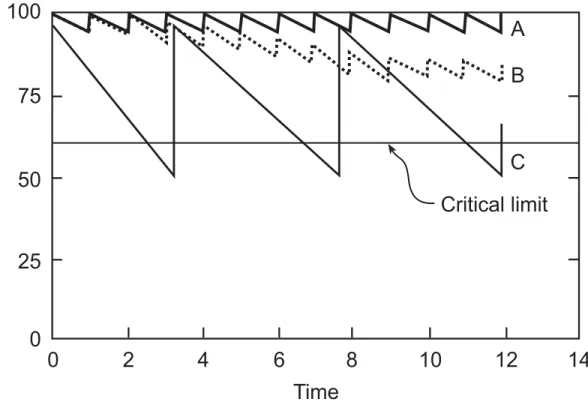
Time
Figure 3. The effects of different types of repairs on a parking garage.
Curve A represents performance over time with repairs carried out to full restoration at frequent intervals.
Curve B also represents repairs carried out at frequent intervals but without full restoration.
Curve C represents infrequent major repairs.
0
2
4
6
8
10
12
100
75
50
25
0
Performance
A
B
C
Critical limit
14
7. Allow for change in use in the design
During the service life of a structure, its environment and occupancy may change. An example of a change in use that would have an impact on a structure would be the
addition of a roof garden to a parking garage at a latter date. As a result, the structure will have to withstand stresses different from those for which it was originally intended. For this reason, it is important to allow for change by providing protective and strengthening measures and hence a margin of safety with respect to the inherent resistance of the selected materials.
8. Provide regular maintenance through routine repair:
Even though most good designs have a certain degree of redundancy, once deterioration reaches a critical limit, immediate repair or rehabilitation is needed to restore the level of
performance to its intended (design) level of service. In most cases, as noted earlier, serviceability limits are exceeded long before structural integrity is compromised.
The typical performance of a structure in time can be represented schematically as shown in Fig. 4. Performance decreases rather rapidly below the critical limit, at which time rehabilitation is needed to restore the level of performance, ideally to its design level of serviceability. Because of the gradual chemical, physical or mechanical changes that degrades each material or component, deterioration reoccurs and eventually another repair will be necessary.
The timing of the rehabilitation with respect to the rate of deterioration is of paramount importance. In practice a structure is repaired when its performance is unacceptable to the users or some time after that when funding is available. Many owners hold the mistaken belief that a major rehabilitation not only corrects deficiencies but also provides trouble free performance for a very long time. Numerous case histories (where the structures were left in a state of disrepair until the structure required extensive repair) show that this practice is the least cost effective.
Fig. 4 shows the benefits of continuous on-going rehabilitation. The performance in time, if repairs are carried out at frequent intervals with full restoration, is represented by curve A. Curve B also represents repairs carried out at frequent intervals but without full
restoration, while C represents infrequent major repairs. Even if full restoration is eventually becoming difficult or impractical (curve B), the great benefits of on-going rehabilitation is realized in the good performance at the fraction of the cost of the major renovation approach (curve C).
Concluding Remarks
Significant advances are being made in correctly matching the newer materials with traditional materials in order to ensure that the combination provides acceptable long-term service in concrete structures. To assure predictable performance, designers must have a good knowledge and understanding of:
• the properties of the materials they intend to specify,
• the ways in which the materials will interact with the in-service environment,
• how they will interact as a composite and
References
Anon, (1979) Concrete Manual, A Water Resources Technical Publication. Eight edition,
U.S. Department of Interior, Washington D.C. Pp. 211-214.
Emmons, P. H., and Vaysburd, A. M., (1995). " Performance Criteria for Concrete
Repair Materials “ Phase I, Technical Report REMR-CS—47, U.S. Army Engineers Waterways Experiment Station, Vicksburg, MS.
Feld, J., (1967) Lessons From Failures of Concrete Structures, ACI Monograph No 1,
pp. 23-39
Fulton, F.S., (1977) Concrete Technology, Portland Cement Institute, Johannesburg
South Africa. PP 307-310.
Mailvaganam, N. P., (1992) Repair and Protection of Concrete Structures, CRC Press,
Boca Raton, Florida, pp.542
Warner, J. (1984) Selection of Repair Materials, Concrete Construction. July Vol. 8,

![Fig. 2: Effects of Mismatching Elastic Moduli (from [13] with permission)](https://thumb-eu.123doks.com/thumbv2/123doknet/14193191.478522/8.918.116.770.100.417/fig-effects-mismatching-elastic-moduli-permission.webp)