Exploring the link between climate change and migration
Sabine L. Perch-Nielsen&Michèle B. Bättig&
Dieter Imboden
Received: 23 October 2006 / Accepted: 20 February 2008 / Published online: 22 April 2008 # ETH Zürich 2008
Abstract Previous research has postulated that climate change will lead to mass migration. However, the linkages postulated between the two have not been explicitly demonstrated but have rather been derived from‘common sense’. In this paper, the connection between climate change and migration via two mechanisms, sea level rise and floods, is investigated and depicted in conceptual models. In both cases, a connection can be traced and the linkages are made explicit. However, the study also clearly shows that the connection is by no means deterministic but depends on numerous factors relating to the vulnerability of the people and the region in question.
1 Introduction
Migration as a consequence of climate change has attracted the interest of researchers and policy makers in the last two decades. Mostly, the topic is examined as a part of a larger discussion on migration caused by environmental factors in general (Bates 2002; Castles
2002; Döös1997; Wood2001; for an overview of previous literature see Lonergan (1998)). A few studies have focussed on climate change as a specific environmental factor leading to migration (McLeman and Smit2006; Meze-Hausken2000), in some cases by investigating case studies in the (prehistoric) past (Fang and Liu1992; Huang et al.2003; Tyson et al.
2002). While overall this literature shows a consensus that environmental factors can play a role among many interacting causes of migration, there is an open debate as to their importance. Some researchers argue that the environment can be a primary factor. Following this assumption, they have introduced the concept of‘environmental refugees’ and have defined (El-Hinnawi 1985), quantified (Jacobsen 1988; Myers 1993) and classified (Bates2002; Lonergan1998) this type of migrants. The connection between the
S. L. Perch-Nielsen
:
M. B. Bättig:
D. ImbodenDepartment of Environmental Sciences, Institute of Biogeochemistry and Pollutant Dynamics, ETH Zurich, Zurich, Switzerland
S. L. Perch-Nielsen (*)
ETH Zurich, CHN E 24, 8092 Zurich, Switzerland e-mail: [email protected]
environment and migration is assumed to be obvious: people will be forced to migrate if drought occurs (El-Hinnawi1985, p. 26), land is degraded (Kavanagh and Lonergan1992, p. 18), or sea levels rise (Myers1993, p. 194).
Other researchers criticise that these approaches often fail to explain in which way exactly these factors force people to migrate. Black (2001) closely examines the examples of environmental refugee flows presented as evidence and points out that the linkages postulated are not explicitly demonstrated. Rather, they are derived from‘common sense’ (Castles 2002). What ‘common sense’ fails to take into account is human reaction and adaptation to environmental change (Lonergan1998). Researchers who have conducted in-depth case studies (e.g. Arenstam Gibbons and Nicholls2006; Meze-Hausken2000) show how complex the relationship between climate change and migration in fact is and how important and diverse adaptation strategies can be.
This paper builds a bridge between such case studies and the very general approach. Its goal is to contribute to understanding the complex relationship between climate change and migration by explicitly tracing the linkages between them. By using conceptual models the connection between climate change and migration is treated on an intermediate level, i.e. with more detail and transparency than the criticised‘common sense’ approach and at the same time generalizing the valuable information provided by single case studies. These conceptual models give an overview of the connection, facilitate communication across the disciplines involved and allow to identify research gaps. In this paper, two mechanisms are investigated by which migration is said to be influenced through climate change, i.e. floods and sea level rise. For each, the possible linkages to migration are systematically and explicitly traced and depicted in conceptual models.
The paper is divided into 5 sections. After the description of the method in Section2, Sections3and 4present the models on floods and sea level rise. The paper closes with a discussion and conclusion in Section5.
2 Method
Tracing the linkages from climate change to migration is a prime example for research that involves knowledge from a variety of disciplines. Building bridges across the different disciplines is the challenge of interdisciplinary research, requiring researchers to integrate diverse basic assumptions, frameworks, methods and languages. However, there is no ‘cookbook’ of procedures or methods available (Turner and Carpenter1999) to achieve this and to overcome the often found “mismatches in space and time scales, in forms of knowledge (e.g., qualitative versus quantitative), and in levels of precision and accuracy” (Benda et al.2002, p. 1127).
The use of conceptual models is suggested as an appropriate method for this purpose. Conceptual models can offer an overall picture of the relevant processes and are also able to treat the connection between climate change and migration on an intermediate level, between the ‘common sense’ approach and the case studies. The models are tools for communication across disciplines helping to formulate questions, clarify system boundaries and identify gaps in existing data (Heemskerk et al.2003).
The type of conceptual models chosen in this paper is a simple form of box-and-arrow, boxes representing relevant factors, arrows representing influences. It is important to note that an arrow contains no information about the strength of the influence. It can reflect a strong effect up to causation or, in contrast, can stand for a weak influence amongst many others.
The first step was the identification of those climatic hazards by which climate change is predicted to affect migration. For this purpose environmental factors postulated as migration ‘push factors’ in the literature on environmental migration were identified, as for instance earthquakes, volcanic eruptions, floods, etc. (Bates 2002; El-Hinnawi 1985; Jacobsen1988; Ramlogan1996; Wood2001). Subsequently, those factors were singled out that are influenced by climate change, resulting in four possible mechanisms: tropical cyclones, floods, droughts and sea level rise.
In this paper we present models for floods and sea level rise. Floods were chosen as they occur on several scales in the interface between climate change and migration: Floods can be caused by increasing heavy rainfalls, by tropical cyclones (storm surges or heavy rainfalls) and by sea level rise (causing higher levels of storm surges). Floods were given priority over tropical cyclones as an example for a hazard with a sudden onset as more information on the direct and indirect effects was available. As a second model sea level rise is presented as it is the mechanism that is assumed to be the most direct and is said to cause most migration (Myers1993). A model on drought would also be of special interest as it has been linked to migration in the past (Findley1994; Mahran1995; Warrick1980). However, drought is the most complex and least understood natural hazard (Wilhite2000) and the lack of agreement on the mechanisms involved impedes a single conceptual model. Readers interested in the mechanism of drought as a driver for migration can find a preliminary model in Perch-Nielsen (2004) and are referred to related literature (Autier et al.1989; Caldwell et al.1986; Corbett1988; Findley1994; Henry et al.2003; McLeman
2006; Paul1995; Prothero1968).
For the selected mechanisms floods and sea level rise, the general ‘common sense’ linkage (Fig.1) was used as a starting point. Then, literature was reviewed, analysed, and synthesised to create a conceptual model that gives more detail by including additional intervening variables.
3 Floods
For millennia, people have sought to protect themselves against the negative impacts of high-magnitude floods: City walls against flooding are reported to have been built as early as 4,000 years ago in China (Wu1989). Today, the need for response remains: in 2003, flood disasters affecting a total of 166 million people were reported worldwide (EM-DAT2005).
3.1 The conceptual model of floods
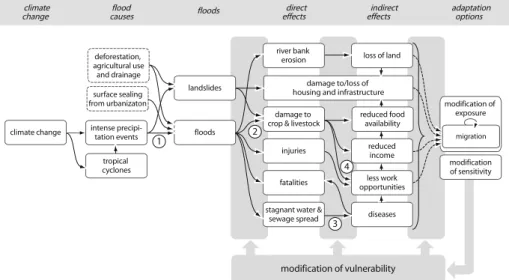
Floods are assumed to cause migration in a simple manner: “A natural hazard displaces people by destroying their land, houses and other tangible goods and assets” (Haque1997, p. 48). The more detailed conceptual model developed is presented in Fig.2.
As laid out in Section 1, climate change can influence floods caused by rainfall or by storm surges. In this model floods caused by rainfall have been chosen as an example. The first linkages on the left show the role of climate change in increasing the risk of floods. Further to the right, the direct and indirect effects are depicted that can finally lead to
climate change floods/ migration
sea level rise
destruction of land & houses
migration but also to different types of adaptation (column on the far right). The choice of adaptation options influences how vulnerable the population in question is towards the next flood event (grey beams, see Section3.3on adaptation options).
The strength of the influences (arrows) varies strongly. In general, the strength decreases from left to right (intense precipitation events have a strong effect on floods while reduced income might only be one of many factors influencing a migration decision). The numbers in the model indicate those linkages that, as an example, are described more in detail in Section3.1.1below. A full account of the influences can be found in Perch-Nielsen (2004).
3.1.1 Examples of linkages
1. Intense precipitation events→ floods
The most important cause for extraordinary discharges of water that cause over-flowing are excessive rainfalls (Smith 2001). When rain falls in the catchment basin, some of it is intercepted by vegetation and evaporates back into the atmosphere. Of the water that reaches the ground, a part is taken up by vegetation and transpired, while another infiltrates the soil and gradually reaches the stream. When the absorption capacity of the vegetation and soil is exhausted by intense rains, surface water runoff is created that reaches the stream quickly. This convergence of runoff can lead to a river flowing over its banks (UN Department of Economic and Social Affairs2002). In the case of urban landscapes the sealing of vast surface areas by paving and buildings reduces infiltration and leads to fast runoff (Smith2001). 2. Flooding→ damage to/loss of housing, infrastructure, crop and livestock
Houses and infrastructure can be damaged and destroyed by the debris-carrying water masses, accompanying landslides or river bank erosion. In urban areas this physical damage is often the main cause of tangible loss (Smith 2001). In rural areas, standing crops, livestock and the agricultural infrastructure can be damaged by the same processes (Kayastha and Yadava1985; Smith2001).
tropical cyclones
stagnant water & sewage spread injuries fatalities loss of land river bank erosion modification of sensitivity damage to
crop & livestock
damage to/loss of housing and infrastructure
modification of vulnerability surface sealing from urbanizaton landslides floods diseases intense precipi-tation events deforestation, agricultural use and drainage climate change reduced food availability reduced income less work opportunities modification of exposure 1 4 3 2 migration climate change adaptation options direct effects indirect effects flood floods causes
Fig. 2 Conceptual model of the influence of climate change on migration through flooding. For explanation of numbers, see Section3.1.1(Influences vary in strength. Boxes with dashed lines are external factors.)
3. Stagnant water & sewage spread→ diseases
Besides directly affecting human health through injuries, flooding can indirectly take a heavy toll on human health by bringing about a sharp increase in diseases. Drinking water contaminated with sewage spread can lead to cholera and dysentery; malaria and yellow fever might break out due to the multiplication of insect vectors in stagnant water (Blaikie et al. 1994). Such diseases often increase the overall number of fatalities (Blaikie et al.
1994; Smith2001).
4. Injuries/diseases/loss of crop & livestock → less work opportunities and reduced income
Injuries and diseases can render people unable to work long after the floods have subsided. In addition, large landowners whose crops have been damaged no longer need labourer in their fields, which can result in wide-spread redundancy (Blaikie et al. 1994; Kayastha and Yadava1985). For a family dependent on agricultural products, the loss of standing crops means a serious decline in family income. The inability to work (be it due to injury or redundancy) has the same effect on families that rely on employment (Blaikie et al.1994).
3.2 The link to migration
At the end of the graph in Fig.2, the curly brace suggests that the various effects of floods do not lead directly to migration but rather to a variety of adaptations. This section examines migration behaviour (from migration theory and case studies) in order to determine which flood effects have been shown to contribute to migration, depicted by the dashed arrows in Fig.2. Also, the extent of migration following floods is looked at and migration destinations are touched upon as this aspect of the migration decision is of political interest: The developed countries are seen as main destination of migrant flows in some studies.
As case studies on migration after floods is scarce, other sources of knowledge were sought after to fill this gap. Because natural hazards with a sudden onset (such as tropical cyclones, earthquakes, etc.) are generally expected to have similar patterns of response and can thus be used as analogues, case studies from such hazards are included in the following analysis.
3.2.1 Migration reasons
Which of the direct and indirect effects of floods contribute to the migration decision? In this section, this question is approached from two sides: first, the found flood effects are compared to typical drivers of migration identified in the migration literature and then, case studies on migration from sudden-onset hazards are reviewed.
As the “history of migration modelling is replete with contradictory theory and conflicting evidence” (Fotheringham et al.2004, p. 1640), the identification of migration drivers is not trivial. Depending on which of the numerous theories is chosen (see overviews in Faist2000; Greenwood1985; Massey et al.1993), relevant migration drivers vary. However, migration drivers that are frequently cited and are thus considered are factors relating to the labour market (unemployment rates, income levels, etc.), taxes, land and housing factors, social welfare, political rights and freedom, and environmental factors (population density, climate, pollution, etc.) (Fotheringham et al.2004; Greenwood1985;
Pedersen et al. 2004). All these factors can act both as ‘pull’ and ‘push’ factors. An additional driver of migration is migration itself. Migration tends to perpetuate itself (‘chain migration’) because first migrants serve as bridges between their regions of origin and destination (McFalls2003). A comparison of these drivers with the flood effects in Fig.2
yields an overlap of four boxes: ‘loss of land’ and ‘damage to/loss of housing and infrastructure’ are land and housing factors and ‘reduced income’ and ‘less working opportunities’ are labour market factors.
Case studies also point towards these factors. The relevance of the loss of land is substantiated by case studies reporting substantial migration from eroding river banks in Bangladesh (Haque and Zaman 1989; Mahmood 1995). The importance of housing and infrastructure is corroborated by two large studies on past hurricanes in Florida (USA). Eighty percent to 90% of the survey respondents selected‘structural damages’ and ‘loss of utilities’ (such as electricity, telephone and water services) as the primary reason for initially moving from their houses (Smith and McCarty 1996, 2006). However, the reasons for initially moving are not necessarily the same as those for subsequent permanent migration. This is shown by results of a survey of people affected by an earthquake in Guatemala: 50% of both migrants and non-migrants had suffered heavy housing damage or destruction (Belcher and Bates1983). It seems that this is where labour market factors come into play. After a tropical cyclone hit the Dominican Republic in 1979, the intention of respondents to migrate did not depend on the damage suffered by their community but did seem to depend on the prevailing crops. Those intending to migrate came from communities where the annual harvest had been destroyed just before bringing it in; those who intended to stay came from communities where farmers grew crops that could be grown and harvested two to four times a year (Belcher and Bates1983).
Naturally, the general migration drivers are not equally important to each household. Migration research emphasises the importance of demographic factors such as age, sex, lifecycle stage as well as that of social, economic, and cultural factors such as social networks, religion, attained skills, housing tenure, employment status, income, health, etc. (Fotheringham et al.2004; Greenwood1985).
These differential effects evidenced in migration theory are also corroborated by case studies on sudden-onset hazards. McLeman and Smit (2006) investigated migration patterns from drought- and flood-stricken Rural Eastern Oklahoma in the 1930s and found that migrants and non-migrants differed in their economic, social and cultural capital endowments. Which endowments have which effects? Most case studies indicate that land and house-owners are less likely to migrate than renters (Belcher and Bates 1983; McLeman and Smit2006; Quarantelli1982), but some also find the opposite effect (Frey and Singer2006). The influence of wealth and income on migration is even less clear. A study in Florida indicates the influence to follow an inverted U curve (Smith et al.2006): those with low incomes stay or immigrate due to low rents, those with middle income have enough means to emigrate and do so and those with high incomes also stay, as they rate the amenity of a house near the coast higher than the risk. While the case study of McLeman and Smit (2006) indicates a similar pattern, Frey and Singer (2006) find altogether different effects of income on migration. A difficulty of all these studies is that it is not known whether the effects of income derive from different exposures to the hazard, different sensitivities or both.
Relating theory and case studies to the model suggests that damage to houses and utilities, loss of land, reduced work opportunities and reduced income can all contribute to migration. However, the review also shows that the effects of floods are only a few of many factors relevant for people’s decision to migrate.
3.2.2 The extent of migration
There is a consensus that before or after the onset of a natural disaster large amounts of people are commonly displaced but that this displacement is usually only temporary: most of the people return to re-create their lives and rebuild their pre-disaster homes (Morrow-Jones and Morrow-Jones 1991; Quarantelli 1982). Despite this agreement on the small extent of permanent migration, explicit and quantitative evidence is rarely referred to.
Studies investigating the intended response of people to a natural disaster generally support the assumption that migration is mostly not considered an option. Burton et al. (1993) report cross-cultural studies carried out in 12 sites that are prone to sudden-onset natural hazards. People were questioned about their intended modes of response in the case of the prevailing hazard occurring. In 11 sites a change of location was not even mentioned as a response at all, in the last site it was only mentioned by 1% of the contestants. The same picture emerges from work in the Dominican Republic. Two weeks after being hit by hurricane David in 1979, 86% of study contestants thought they would continue living in their community and only 8% wanted to leave (Belcher and Bates1983).
However, people’s intentions must not be identical with their actual behaviour. Actual behaviour was examined in two case studies on major earthquakes in Central America: The earthquake that devastated the Nicaraguan capital Managua in December 1972 and initially displaced about half of the population was examined by Burton et al. (1993). A population count two years after the event showed that the population of Managua had grown from 420,000 in 1972 to more than 650,000 in 1974. This was interpreted as an indication that the majority had returned to their homes. In an investigation on the earthquake that affected Guatemala in 1976 people from damaged as well as undamaged areas were interviewed (Belcher and Bates 1983). Two years after the event, slightly more than 90% were still living in the same village or town as before, irrespective of whether the area had been damaged or not. The most comprehensive analysis of actual behaviour so far are the studies by Smith and McCarty (1996,2006). They analysed the demographic effects of hurricane Andrew and the 2004 hurricanes by questioning households about their neighbours’ behaviour. They found that between 12% and 30% of those initially displaced (not of all people affected) left their homes permanently and mostly stayed within the same county or state. They highlight differences to hurricane Katrina that hit New Orleans in 2005: Katrina was likely to generate more permanent migrants as it was far more destructive, caused flooding (for which many are not insured) and also caused the loss of many jobs. The same is valid for hurricane Mitch that devastated most parts of Central America in 1998. It is reported to have led to widespread job loss and migration of men (Delaney and Shrader
2000). Remarkably, both regions had already been experiencing out-migration before the event (Delaney and Shrader 2000; U.S. Census Bureau2007). It must be added that for both these hurricanes, more detailed analysis of the extent and destinations of migration has not been carried out.
Although it is widely accepted that displacement is often temporary, this knowledge is not always applied consistently. For instance Richter (1998) collected data on Africa and estimated the total of‘environmental refugees’ from floods between 1973 and 1997 to be at least seven million. However, closer inspection reveals that his approximation is based on news items reporting on the amount of people rendered temporarily homeless. This amount of people displaced unquestionably underpins the severity of impacts that floods have on human societies. However, as seen above, it cannot be equated with the number of permanent migrants.
3.2.3 Migration destinations
The migration literature lists three central aspects that influence destination choice: the attributes of a potential destination, the distance to it and immigration policies. Distance was early on recognised as an important determinant of destination choice: migrants prefer destinations close by (Faist2000). It is however important to note that‘distance’ is not only meant geographically. Short geographical and linguistic distance as well as colonial relationships and high trade volumes are all positively correlated with migration (Pedersen et al.2004).
The few case studies available again seem to corroborate these assumptions. Very little of the natural disaster research has focused on those people that migrate (Morrow-Jones and Morrow-Jones1991), as it is very difficult to trace the movement away from the hazard site to many different places. A study in the Ghaghara floodplain in India found that permanent migration was usually within the floodplain and only sometimes beyond it, and then to higher land fringing the flood plain (Kayastha and Yadava1985). The studies on the effects of hurricanes in Florida revealed that most permanent migrants stayed nearby: 61–73% moved within the county, 9–23% within the state and only 15–18% moved out of the state (Smith and McCarty 1996, 2006). The 18% of people leaving the state after the 2004 hurricane season amount to 35,000 people. The authors put this number in context with the 300,000–400,000 people moving out of Florida every year. However, they also point out that people displaced by hurricane Katrina moved further away.
A study in Bangladesh investigated displacement induced by river bank erosion. Interviews in one of the worst affected sub-districts showed that 60% of the contestants had been displaced at least once in their lifetime and that of these, approx. 98% had moved less than 5 miles (Haque and Zaman1989). This gives a distorted picture of the situation as by investigating only the worst affected district, people who might have migrated to less prone areas do not appear in the study. Other research indicates that people do also move further away: in surveys in Bangladeshi urban slums (reported by Mahmood1995) up to 50% of the squatter dwellers stated that they had moved to the cities due to river bank erosion.
These few available studies suggest that of those who do migrate, the majority moves short distances and that some move medium distances and thus do not support the expectation of developed countries being the main destination of migrant flows from developing countries (e.g. Myers 1993, p. 200). With regard to international migration, Burton et al. (1993) point out that the choice of destinations for migration is often constrained by political barriers. So while the floods may increase the pressure for migration across national borders, the actually resulting international migration depends strongly on political barriers. However, the currently increasing stream of African migrants trying to reach Europe shows how strong an effect migration pressure can have despite political barriers.
3.3 Adaptation options
The model presented focuses on establishing a connection between climate change, floods and migration. However, in determining whether migration will take place or not, it is essential to take other adaptation options into account. The necessity for this is emphasized by a conceptual model on migration behaviour in response to climate change developed by McLeman and Smit (2006). They conceptualize the migration decision not as a yes/no decision but as a choice between different adaptation options. Which options are available to a household (and whether migration is one of them) is determined by its capital
endowments. The range of adaptation options is wide—be it on a state, community or household level and be it as immediate reaction or as long term preparation for the next hazard onset. People will usually rely on a combination of adjustments and within the same community, households will adopt different mixes (Burton et al.1993). As depicted in the model in Fig.2, adaptation strategies can be divided into two types of categories, i.e. either the prevention of exposure to floods or the modification of human sensitivity towards floods. Sensitivity is defined as the degree to which a system is affected by a given exposure. Table1summarizes adaptation options within these categories.
The large variety of possible adaptations affects the vulnerability (in this paper defined as a function of both exposure and sensitivity) of the population in question to the next flood event. This shows that most of the influences depicted in the model can but need not take place. The grey vertical beams in the model indicate that whether the influences take place or not depends on the vulnerability of the population. Many of the influences drawn can be intercepted by an adaptation, as for instance:
& ‘heavy rainfall → floods’ is also determined by watershed management and engineering;
& ‘floods → loss of crop’ can be influenced by a diversification of crops as well as of the timing of sowing;
& ‘loss of crop → less income’ can be weakened by crop insurance systems; and & whether ‘diseases’ lead to ‘fatalities’ depends heavily on the housing standard,
hygienic conditions and the medical system.
Table 1 Overview of responses to flooding, mainly adapted from Smith (2001); complemented by
information from Blaikie et al. (1994) and Burton et al. (1993) Adaptation options
Exposure modification
Flood abatement: Watersheds can be modified, e.g. by reforestation or terracing. Flood diversion: Rivers can be redirected away from risk areas by engineering structures,
such as levees, channels and detention basins.
Hazard resistant design: The flood proofing of buildings includes raising living spaces above the likely flood level and installing watertight walls and doors. Temporary responses include blocking-up entrances, sealing doors and using sand bags to keep flood waters away from structures.
Migration: This is a long-term strategy that can be adopted by individuals or governments that plan voluntary or forced resettlements. Migration away from a flood-prone location diminishes or eliminates exposure.
Sensitivity modification
Forecasting and warning: Systems of hazard forecasting and warning the population have become widely applied and have proven effective in many countries.
Community preparedness: This means knowing what specific actions to take upon warning (evacuation, emergency health, water and food supply, etc.).
Land use planning: Land use planning has been used to limit further floodplain development. In combination with such planning, building codes are increasingly being implemented. Sensitivity modification on a household level: Households may build up stores of food and
saleable assets, diversify their production strategy as well as their income sources and invest in social support networks.
Loss-sharing: disaster aid: National relief and rehabilitation assistance and international disaster aid. Apart from cash donations, specialist external help is often important. Loss-sharing: insurances: Insurances (for floods, crop, etc.) are key loss-sharing strategies.
As a reaction to major natural disasters, for instance Sri Lanka established a national crop insurance system and the USA subsidised flood insurances.
Evidently, the outcome of the flood does not only depend on the flood itself, but also on the way in which a society is structured, has knowledge and financial resources at its disposal and has prepared for such hazard events. It is the overall vulnerability of the society in question that strongly influences whether the depicted effects take place or not.
4 Sea level rise
While natural hazards have severely affected societies in the last centuries, sea level rise in its projected rate is a relatively new phenomenon for most world regions. In some places though, local subsidence has occurred in the past, enabling case studies about the effects of relative sea level rise.
The IPCC projects eustatic sea level1to further rise by 18 to 59 cm between 1990 and 2095 (IPCC 2007). Along the coasts of the world the population density is nearly three times higher than on average (Small and Nicholls 2003) and coastal populations are growing twice as fast as the global population (Nicholls and Mimura1998).
4.1 The conceptual model of sea level rise
The way in which sea level rise is considered to affect migration is straightforward:“as land is lost because of sea level rise, there will be an increase of out-migration” (Leatherman
2001 p. 204). Adding intervening variables to this and depicting effects of sea level rise proves difficult due to the different time scales on which sea level rise acts. In contrast to floods, sea level rise is a process that has slow and constant direct effects (as inundation), but also acts in discrete time steps via storms and consequent flooding. This makes it more difficult to depict the effects in the conceptual model (Fig.3).
The linkages to the left show the role of climate change in raising the eustatic and relative sea level. To the right the direct and indirect effects are described that lead to migration and other types of adaptation options. These then affect the vulnerability of the society in question and with it whether an influence takes place or not (grey beams). The numbers in the model indicate exemplary linkages that are described in Section4.1.1below. A full account of all influences can be found in Perch-Nielsen (2004).
4.1.1 Examples of linkage descriptions
1. Changes in ice sheet mass→ eustatic sea level rise
The large ice sheets (Greenland, Antarctica) are in a constant exchange of water with the oceans. The processes affecting the volume of ocean water and thus the eustatic sea level include ablation, ice discharge, precipitation over the ice sheets and run-off. Models project that Greenland will contribute to sea level rise by losing mass and Antarctica will gain mass due to increased snowfall. However, ice dynamics that have been recently observed in both regions, but are not included in the models (yet), would increase the contributions of both Antarctica and Greenland (IPCC2007).
1
‘Eustatic’ sea level change is caused by an alteration to the volume of water in the world ocean or the volume of the ocean basins.
2. Subsidence→ relative sea level rise
The relative sea level (i.e. the level of the sea relative to the land) is affected by eustatic sea level rise as well as the vertical movement of land. How large an effect the latter can have is illustrated by the fact that of the 20 coastal megacities projected by 2010, eight have already experienced a relative rise in sea level that exceeds likely eustatic sea level rises. A vertical movement caused by humans is subsidence brought about by extracting water or hydrocarbons from underneath coastal areas. For instance, Tianjin subsided on average 5 cm per year in the late 1980s, primarily due to water extraction (Nicholls1995)2. 3. Relative sea level rise→ erosion
Erosion in this context is the physical removal of sediment by waves and currents (Klein and Nicholls1998). In contrast to inundation, erosion necessarily involves a movement of sedimentary material. The main erosion effects happen in discrete time steps in the form of storms (Pilkey and Cooper2004). Relative sea level rise causes beach erosion by enabling waves to break closer to shore and to act farther up the beach profile (Leatherman2001). On average, the extent of horizontal erosion is about two orders of magnitude greater than the rate of sea level rise (Zhang et al.2004). For the rise projected (18 to 59 cm, IPCC
2007), this would roughly mean a move in shoreline of 20 to 60 m until 2100 or 0.8 to 2.4 m every 5 years.3
2
Tianjin (and Shanghai) now have city areas lying beneath high tides and have constructed extensive dike systems. As the subsidence of land is caused mainly by water extraction, they have also aimed at controlling
water withdrawal (Nicholls and Leatherman1995).
modification of vulnerability climate change adaptation options direct effects indirect effects sea level rise
sea level rise causes
thermal expan-sion of ocean glacier and ice
cap ablation eustatic sea level rise relative sea level rise increasing flood risk changes in ice sheet mass salt water intrusion less agricultural production reduced income past climate change tectonic vertical movement storm frequency and intensity regional oceanic effects deposition of fluvial sediment inundation accomodation land loss protection erosion glacio-hydro-isostatic vertical movement chanelling, diverting, damming river subsidence: removal of water or hydrocarbons 1 4 3 2 damage to infra-struct. & buildings
reduced access to drinking water loss of infrastruc-ture & buildings
retreat
climate change migration
Fig. 3 Conceptual model of the influence of climate change on migration through sea level rise. For explanation of numbers, see Section4.1.1(Influences vary in strength. Boxes with dashed lines are external factors.)
3
It has to be kept in mind that erosion rates are very dependent on the specific coast. For instance, in a detailed study of Gambia, coastal retreat as a result of a 1 m SLR was estimated to lie between 60 and 840 m (Jallow et al.,1996).
4. Damage to and loss of infrastructure and buildings→ reduced income
Damage to or loss of any structures used for economic activity can lead to a reduced income and loss of employment. For instance for Alexandria in Egypt, El-Raey (1997) estimated that a sea level rise of 50 cm could bring about a loss of approx. 200,000 jobs, 80% of which in industry. The tourism sector is particularly susceptible as the coastal zone is a focal point for a substantial part of tourism in general (Nicholls and Hoozemans1996; Turner et al.1996). Income can be negatively affected by damage to tourism infrastructure such as hotels, golf courses, roads, etc. In contrast to some other sectors, the protection with hard options such as dikes, seawalls, etc. will probably not be sufficient. Also beaches and wetlands, as important tourism resources, have to be conserved.
4.2 The link to migration
In the case of sea level rise, migration is a more important adaptation option than for floods. If an inhabitant of a flood plain chooses not to protect against floods, he might continue to be affected, but the consequence is not necessarily migration. In contrast, if a coastal resident at risk does not adapt in any way, land and property can be lost and the direct consequence is migration (Alternatively, in the case of storms, loss of life could also be the consequence of no adaptation). This is presumably one reason why in the literature on ‘environmental refugees’, the final link to migration is hardly ever specifically examined but rather just touched upon. At times, the connection is taken for granted as for instance by Döös (1997, p. 57) who explains that“The people living in the area threatened by permanent flooding will have no choice but to move further inland.” As the direct link between loss of property and migration indeed exists, the extent of migration depends primarily on the adaptation options chosen. As in Fig.2, the curly brace suggests that the various effects of sea level rise lead to a variety of adaptations. There are no dashed lines leading to migration because there are not enough case studies on migration as a response to sea level rise.
4.2.1 Migration reasons
Comparing migration drivers to the effects of sea level rise yields a similar overlap as in the case of floods: potential contributors to floods are‘damage to and loss of infrastructure and buildings’ as well as ‘reduced income’. Verification with case studies is difficult, as case studies explicitly investigating the mechanisms and interacting responses (not) leading to migration are very scarce. The only one found relates to migration from the Chesapeake Bay islands (USA) in the first decades of the twentieth century. Arenstam Gibbons and Nicholls (2006) investigated Holland Island where a rise of approx. 20 cm over 70 years caused erosion and loss of land that led to the abandonment of the island. Their analysis of this small community (max. 300 inhabitants) suggests that before abandonment, people first chose to respond by attempting to prevent erosion or by relocating internally. Interestingly, final abandonment took place before the island became uninhabitable. The authors conclude that the beginning out-migration did not leave sufficient inhabitants to sustain community services such as the church, school and stores, and in this way caused final abandonment. This analogue shows that the reactions towards a rising sea level are not as simple as generally assumed. It also supports the assumption that‘damage to and loss of infrastructure and buildings’ contribute to migration.
Comparing this case study to the model in Fig.3shows that it fits quite well if the model is not read linearly from left to right but in clockwise circles: on Holland Island a rise in
relative sea level caused‘erosion’ and the ‘loss of land’. This led to adaptation in the form of‘protection’ (groin fields) with the goal of modifying vulnerability and intercepting the link‘sea level rise → erosion’. When erosion and its effects persisted internal relocation was chosen as a strategy to intercept the link ‘land loss → damage to infrastructure and buildings’. When finally there was no room on the island left to move to, first families migrated away from the island. From then on, it was not only erosion, but also migration that caused migration. However, the reason for this does not seem to be the migrant networks usually responsible for‘chain migration’, but rather the inability of the few left families to sustain community services. McLeman and Smit (2006) illustrate this last mechanism well in their conceptual model of migration decisions due to climate change. With each migration the community left behind changes and with it also their array of capital endowments and adaptation options.
In addition to the one case study, some assumptions on migration decisions in the context of sea level rise have been implicitly made by economists (for references, see below). In many cases cost-benefit analysis is used to determine the proportion of coast to be protected and with this indirectly give an indication of how many might migrate. The resulting assumption for a migration decision is thus that people migrate if the costs for protection are higher than the benefits (avoided losses).
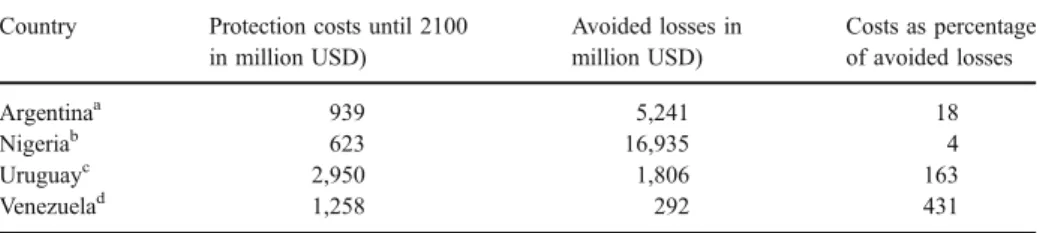
On a global level, Nicholls and Tol (2006) determined the optimal level of protection in percent of the developed coast. For a sea level rise of 20 to 35 cm by the 2080s, near 100% protection was the optimal option for all countries worldwide with the exception of five to ten countries. In an earlier study on OECD countries, Fankhauser (1995) concluded similarly. On a country level, values at risk of sea level rise and protection costs have also been estimated (see Table2). The principle of comparing costs to benefits has been applied to these figures (see last column), showing that while in some cases protection costs only reflect a small fraction of the avoided losses, in other countries they exceed them by far. Results from such cost-benefit approaches have been shown to be sensitive to many factors and assumptions: Yohe et al. (1996) demonstrated that the predicted percentage of sites being abandoned in the USA increased from 7% up to 20% to 45% when a robustness exploration assumed higher protection costs. Similarly, calculations for the East Anglian coast in the UK (Turner et al.1995) showed that retreat increased from 0% up to 17% to 37% when the analysis was applied to 113 coastal sub-areas instead of to the coast as a whole.
Table 2 Costs to protect important areas of a country’s coast compared to the avoided losses
Country Protection costs until 2100
in million USD) Avoided losses in million USD) Costs as percentage of avoided losses Argentinaa 939 5,241 18 Nigeriab 623 16,935 4 Uruguayc 2,950 1,806 163 Venezuelad 1,258 292 431
A high scenario of a sea level rise of 1 m by 2100 is assumed. The estimates for avoided losses refer to the assets present in 1991 and their market value at that time.
a
(Dennis et al.1995)
b
(French et al.1995)
c(Volonté and Nicholls1995) d(Volonté and Arismendi1995)
The results from cost-benefit analyses suggest that protection is an efficient option in many cases including developing countries. However, coarse data sets and regional or national averages might strongly distort the results as they hide the different distributions of value at risk and population density that might well lead to different responses on a local level. To conclude from these results on overall migration from sea level rise is thus premature at this point. In addition, the assumption that the decision to protect or abandon is purely economical has not been tested or verified so far. The‘(emotional) attachment to place’, a strong force witnessed in the case of natural hazards (Gold1980; Haque1997), might push the decision towards protection. Anecdotal support for this hypothesis is provided by the case of Brownwood, a small subsiding peninsula with 500 family houses near Houston (USA), where the cost of protection against flooding was estimated to be approx. three times higher than that of relocation (including compensation of house-owners). The residents defeated the relocation proposal twice in elections. They preferred to keep on living on the exposed site and to evacuate their homes several times a year. A few years later hurricane Alicia hit the peninsula and caused its complete abandonment (Coplin and Galloway1999).
4.2.2 The extent of migration
The potential extent of migration due to sea level rise is large. Nicholls and Leatherman (1995) compiled the number of people at risk from different studies and found that in Bangladesh, Egypt and Nigeria alone, over 20 million people are at risk of being inundated by a 1 m sea level rise (not including population growth). Although significant relative sea level rise has affected coastal communities independent of climate change in some regions, specific information on migration is limited. For the most cases reported upon, only the final outcome—migration or no migration—is available. One case is the Caspian Sea, the sea level of which has changed significantly over the past decades. Between 1930 and 1977 the sea level fell by a total of nearly 3 m, creating large new areas of coastal lands that were subsequently developed. Then, in 1978 the sea level began to rise rapidly by a total of 2.4 m until it stabilized in 1995 (Golitsyn1995). Although it is widely reported that the consequences for the inhabitants of the five coastal states were very serious, quantitative impact assessments seem not to have been performed. In Kazakhstan, 20,000 km2of land were inundated,“hundreds of villages” were under water (George1994, p. 24) and along the whole coast,“thousands of people have already resettled” (Golitsyn1995, p. 369). In contrast to the Caspian Sea, large-scale migrations do not seem to have occurred from the Chinese megacities Tianjin and Shanghai, where the relative sea level has risen significantly over the past decades due to subsidence of the land. Extensive dike systems were built that protect city areas that now lie beneath high tide (Nicholls and Leatherman,1995).
4.2.3 Migration destinations
The one case study available supports the migration theory’s assumption of short distances being preferred: inhabitants from Holland Island in the Chesapeake Bay moved to Eastern Shore towns or other islands in the Bay (Arenstam Gibbons and Nicholls 2006). Unfortunately, there are no other case studies to test these assumptions. In the articles where migration destinations have been mentioned, they have been mostly speculated upon. Moore and Smith (1995) see the developed countries as the destination of small island nations in the south-west Pacific ocean. They conclude that while migration pressures
would further grow (partly as a result of climate change) significant out-migration would probably only occur if developed countries relaxed their immigration regulations for Pacific islanders. Myers (1993, p. 201) sees the developed countries as a destination not only for islands but in general and argues that“the refugees would feel justified in seeking sanctuary in developed nations on the grounds that it would be the developed nations that would have largely set up the problem of global warming.” Döös (1997), on the contrary, does not assume migration to be predominantly international but predicts what could be called a domino migration: people that experience permanent flooding would have no choice but to move further inland, thereby increasing the population density and causing migration from there.
4.3 Adaptation options
As stated, in the case of sea level rise no adaptation equals migration, so the choice of adaptation is crucial for the link between climate change and migration. Early on, the IPCC (1990) defined three categories of adaptation or response options: protection, accommo-dation, and retreat (see Table 3). In the vulnerability terminology, both protection and retreat would be options that modify the exposure, whereas accommodation would be primarily a modification of the sensitivity. As in the case of floods, such adaptation measures change the overall vulnerability, which then again determines which influences depicted in the model take place and which do not (grey vertical beams).
5 Discussion and conclusion
The goal of the paper has been to investigate the influence of climate change on migration on an intermediate level and make the linkage between the two explicit. For this purpose, conceptual models have been presented for two mechanisms that are likely to be increased or intensified by climate change: floods and sea level rise.
The models show that the linkage between climate change and migration can be made explicit and that the‘common sense’ approach can be expanded. Numerous new variables were added between the starting point ‘climate change’ and the end point ‘migration’. However, the most important new variables were those added adjacent to migration, i.e. the various alternative adaptation options. It is the importance of these that is underestimated by the‘common sense’ approach. The conceptual models show how the adaptation options can modify the vulnerability and act on all linkages in the chain (see grey beams in Figs.2
and3). It is shown that migration cannot be looked at separately, but must be analysed in the context of its alternatives. This even more so because in many cases migration is the last of these options to be chosen (Burton et al.1993).
Table 3 Response categories to sea level rise adapted from IPCC (1990, p. 6) Response categories
Protection emphasizes defending“vulnerable areas, especially population centres, economic activities, and natural resources”. This includes hard options such as dikes, seawalls, floodgates, but also soft options such as beach nourishment or wetland restoration.
Accommodation comprises adaptation measures that do not prevent flooding. The vulnerable areas continue to be used. Examples are the modification of land use or building styles.
The models in Figs. 2 and 3 show the explicit linkage but they do not provide any information on the strength of the individual influences (arrows). These can reflect a strong effect or a very weak influence. On the intermediate level of conceptual models it is impossible to determine the strength of these influences because for each community, each place and each household the respective strengths of influences vary: The effect of sea level rise on inundation is weak if there are dikes and strong if there are none; the effect of submerged crops on income is strong if the farmer does not have an insurance. The actual effects of floods and sea level rise on a society are always the result of their interaction with the local social and economic system. Thus, on the level of individual migration decisions, factors such as wealth, power, age, sex, skills, housing tenure, employment status etc. also play an important role.
What picture do the models and reviewed case studies draw of the effect of floods on migration? They suggest that although mass displacement after a natural disaster event is a common phenomenon, mass migration of the permanent type does not take place to a large extent. Of those people affected so strongly that they are initially displaced, a share of almost none up to about 30% migrates permanently. It seems that migration is highest if damage to housing and infrastructure is combined with reduced income or working opportunities in places where out-migration was already taking place before. Highest migration rates have been experienced from riverbank erosion that causes migration by literally cutting the ground under the feet of the occupants. In an overall assessment of the strength of the climate change-migration connection it must be kept in mind that climate change is of course not the cause for all floods but‘only’ leads to an increase in frequency and/or intensity. Overall, the results suggest that floods will not likely be a major mechanism by which climate change will trigger mass migration.
In the case of sea level rise, the overall connection between climate change and migration is stronger because sea level rise is caused to a large extent by climate change (in contrast to floods) and the link between the loss of land and migration is strong. However, this does not mean that it cannot be intercepted: protection of course can prevent the loss of land. Unfortunately, it is not possible to turn to a set of case studies for an impression of how people have adapted in the past. Although relative sea level has risen in several places in the world, only one case study was found that investigated the adaptation process and its outcome. Cost-benefit approaches by economists yield varying results: While some estimate protection to be the most efficient option in most cases worldwide, others indicate that especially when broken down to the local level, abandonment—and with it migration—will also play a substantial role as an adaptation to sea level rise.
From a methodological point of view, the developed conceptual models give a useful overview and provide transparency about the assumed connections. This makes them an appropriate tool for integrating knowledge from different disciplines, structuring the existing data and identifying gaps in existing data. On this basis the conceptual models can serve, for instance, as a basis to search for adaptation options in a systematic way. One by one the influences (i.e. arrows) can be studied: each measure which is found to intercept an arrow represents a possible adaptation option. Turning to limitations, it is clear that more detail and accuracy could be gained with more research. In addition, the conceptual models in their present form are not apt to convey the dynamic process of adaptation. It is difficult to illustrate consecutive adaptation rounds and the way in which first migrants might influence the migration decisions of the ones left behind.
For future research, the models have identified a large research gap regarding the reaction of households, communities and states towards rising sea levels. In the light of the large amount of people potentially at risk of migrating due to sea level rise, high priority
should be given to research in this area. Societally diverse coastal regions affected by relative sea level rise in the past should be investigated. Important questions are how adaptation options to sea level rise are actually chosen, whether the assumption of a purely economic decision can be verified, in which way other factors (e.g. emotional, political) play a role and what migration destinations are chosen.
Acknowledgements The authors would like to thank Simon Mason, Arnim Wiek and three anonymous reviewers for feedback on earlier versions of this paper.
References
Arenstam Gibbons SJ, Nicholls RJ (2006) Island abandonment and sea-level rise: an historical analog from
the Chesapeake Bay, USA’. Glob Environ Change 16:40–47
Autier P, d’Altilia J-P, Callewaert B, Tamboura B, Delamalle J-P, Vercruysse V (1989) Migrations and
nutritional status in the Sahel. Disasters 13:245–254
Bates DC (2002) Environmental refugees? Classifying human migrations caused by environmental change.
Popul Environ 23:465–477
Belcher JC, Bates FL (1983) Aftermath of natural disasters: coping through residential mobility. Demography 7:118–128
Benda LE, Poff NL, Tague C, Palmer MA, Pizzuto J, Cooper S, Stanley E, Moglen G (2002) How to avoid
train wrecks when using science in environmental problem solving. BioScience 52:1127–1136
Black R (2001) Environmental refugees: myth or reality? United Nations High Commissioner for Refugees,
Geneva, pp 1–19
Blaikie P, Cannon T, Davis I, Wisner B (1994) At risk: natural hazards, people’s vulnerability, and disasters. Routledge, New York
Burton I, Kates RW, White GF (1993) The environment as hazard. Guilford, New York
Caldwell JC, Reddy PH, Caldwell P (1986) Periodic high risk as a cause of fertility decline in a changing
rural environment: survival strategies in the 1980–1983 South Indian drought. Econ Dev Cult Change
34:677–701
Castles S (2002) Environmental change and forced migration: making sense of the debate. United Nations
High Commissioner for Refugees, Geneva, pp 1–14
Coplin LS, Galloway D (1999) Houston-Galveston, Texas: managing coastal subsidence. In: Galloway DL, Jones DR, Ingebritsen SE (eds) Land subsidence in the United States, U.S. Geological Survey Circular 1182, pp 35–48
Corbett J (1988) Famine and household strategies. World Dev 16:1099–1112
Delaney PL, Shrader E (2000) Gender and post-disaster reconstruction: the case of hurricane Mitch in Honduras and Nicaragua. Draft Report, World Bank, p 58
Dennis KC, Schnack EJ, Mouzo FH, Orona CR (1995) Sea-level rise and Argentina: potential impacts and
consequences. J Coast Res Special Issue No 14:205–223
Döös BR (1997) Can large-scale environmental migrations be predicted? Glob Environ Change 7:41–61
El-Hinnawi E (1985) Environmental refugees. United Nations Environment Programme, Nairobi, p 41 El-Raey M (1997) Vulnerability assessment of the coastal zone of the Nile delta of Egypt, to the impacts of
sea level rise. Ocean Coast Manag 37:29–40
EM-DAT (2005) The OFDA/CRED International Disaster Database
Faist T (2000) The volume and dynamics of international migration and transnational social spaces. Clarendon, Oxford, p 380
Fang J-Q, Liu G (1992) Relationship between climatic change and the nomadic southward migrations in
Eastern Asia during historical times. Clim Change 22:151–169
Fankhauser S (1995) Protection versus retreat—the economic costs of sea-level rise. Environ Plan A 27:299–319 Findley SE (1994) Does drought increase migration? A study of migration from rural Mali during the 1983–
1985 drought. Int Migr Rev 28:539–553
Fotheringham AS, Rees P, Champion T, Kalogirou S, Tremayne AR (2004) The development of a migration model for England and Wales: overview and modelling out-migration. Environ Plan A 36:1633–1672 French GT, Awosika LF, Ibe CE (1995) Sea-level rise and Nigeria: potential impacts and consequences. J
Frey WH, Singer A (2006) Katrina and Rita impacts on Gulf Coast populations: first census findings. Metropolitan Policy Program, The Brookings Institution, Washington DC, USA, p 22
George D (1994) Kazakh Caspian seismic project facing environmental challenges. Offshore 54:24–25
Gold JR (1980) An introduction to behavioural geography. Oxford University Press, Oxford, p 290 Golitsyn GS (1995) The Caspian Sea level as a problem of diagnosis and prognosis of the regional climate.
Atmos Ocean Phys, English Translation 31:366–372
Greenwood MJ (1985) Human migration: theory, models and empirical studies. J Reg Sci 25:521–544
Haque CE (1997) Hazards in a fickle environment: Bangladesh. Kluwer, Dordrecht, p XV, 380
Haque CE, Zaman MQ (1989) Coping with riverbank erosion hazard and displacement in Bangladesh: survival strategies and adjustment. Disasters 13:300–314
Heemskerk M, Wilson K, Pavao-Zuckermann M (2003) Conceptual models as tools for communication across disciplines. Ecology and Society 7:8
Henry S, Boyle P, Lambin EF (2003) Modelling inter-provincial migration in Burkina Faso, West Africa: the
role of socio-demographic and environmental factors. Appl Geogr 23:115–136
Huang CC, Zhao S, Pang J, Zhou Q, Chen S, Li P, Mao L, Ding M (2003) Climatic aridity and the relocations of the Zhou culture in the southern Loess Plateau of China. Clim Change 61:361–378 IPCC (2007) Summary for policymakers. In: Solomon S, Quin D, Manning M, Marquis M, Averyt K, Tignor
MMB, LeRoy Miller H (eds) Climate change 2007: the physical science basis. Contribution of working group I to the Fourth Assessment Report of the Intergovernmental Panel on Climate Change. Cambridge University Press, Cambridge, United Kingdom, p 996
IPCC Response Strategies Working Group (1990) Strategies for adaptation to sea level rise. Report of the Coastal Management Subgroup of the Intergovernmental Panel on Climate Change. Ministry of Transport and Public Works, The Hague, p 131
Jacobsen JL (1988) Environmental refugees: a yardstick of habitability. Worldwatch Institute, Washington DC, p 46 Jallow BP, Barrow KA, Leatherman SP (1996) Vulnerability of the coastal zone of The Gambia to sea level
rise and development of response strategies and adaptation options. Clim Res, 6:165–177
Kavanagh B, Lonergan S (1992) Environmental degradation, population displacement and global security. Canadian Global Change Program, Ottawa, p 55
Kayastha SL, Yadava RP (1985) Flood induced population migration in India: a case study of Ghaghara Zone. In: Elahi KM, Kosinski LA (eds) Population, redistribution and development in South Asia. D. Reider Publishing, Dordrecht, pp 79–88
Klein RJT, Nicholls RJ (1998) Coastal zones. In: Feenstra JF, Burton I, Smith JB, Tol RSJ (eds) Handbook on methods for climate change impact assessment and adaptation strategies. Version 2.0. United Nations Environment Programme and Institute for Environmental studies. Vrije Universiteit, Nairobi, pp 7–1–7-35 Leatherman SP (2001) Social and economic costs of sea level rise. In: Douglas BC, Kearney MS,
Leatherman SP (eds) Sea level rise: history and consequences. Academic, San Diego, pp 181–223
Lonergan S (1998) The role of environmental degradation in population displacement. Environmental Change Security Project Report, pp 5–15
Mahmood RA (1995) Emigration dynamics in Bangladesh. Int Migr 33:699–726
Mahran HA (1995) The displaced, food production and food aid. In: Eltigani EE (ed) War and drought in Sudan essays on population displacement. University Press of Florida, Gainesville, pp 63–74 Massey DS, Arango J, Hugo G, Kouacouci A, Pellegrino A, Taylor JE (1993) Theories of international
migration: a review and appraisal. Popul Dev Rev 19:431–466
McFalls JA Jr (2003) Population: a lively introduction. Popul Bull 58:1–40
McLeman R (2006) Migration out of 1930s—Rural Eastern Oklahoma insights for climate change research.
Great Plains Q 26:27–40
McLeman R, Smit B (2006) Migration as an adaptation to climate change. Clim Change 76:31–53
Meze-Hausken E (2000) Migration caused by climate change: how vulnerable are people in dryland areas? A
case-study in Northern Ethiopia. Mitig Adapt Strategies Glob Chang 5:379–406
Moore EJ, Smith JW (1995) Climatic change and migration from Oceania: implications for Australia, New
Zealand and the United States of America. Popul Environ 17:105–122
Morrow-Jones HA, Morrow-Jones CR (1991) Mobility due to natural disaster: theoretical considerations and preliminary analyses. Disasters 15:126–132
Myers N (1993) Ultimate security: the environmental basis of political stability. Norton, New York, p XI, 308
Nicholls RJ (1995) Coastal megacities and climate change. GeoJournal 37:369–379
Nicholls RJ, Hoozemans FMJ (1996) The Mediterranean: vulnerability to coastal implications of climate
change. Ocean coast Manag 31:105–132
Nicholls RJ, Leatherman SP (1995) Global sea-level rise. In: Strzepek KM, Smith JB (eds) As climate
Nicholls RJ, Mimura N (1998) Regional issues raised by sea-level rise and their policy implications. Clim Res 11:5–18
Nicholls RJ, Tol RSJ (2006) Impacts and responses to sea-level rise: a global analysis of the SRES scenarios over the twenty-first century. Philosophical Transactions of the Royal Society a—Mathematical Physical
and Engineering Sciences 364:1073–1095
Paul BK (1995)‘Farmers’ and public responses to the 1994–95 drought in Bangladesh: a case study. Natural Hazards Research and Applications Information Center, Boulder, CO
Pedersen PJ, Pytlikova M, Smith N (2004) Selection or network effects? Migration flows into 27 OECD countries, 1990–2000, Discussion paper
Perch-Nielsen SL (2004) Understanding the effect of climate change on human migration: The contribution of mathematical and conceptual models, diploma thesis. Swiss Federal Institute of Technology, Zurich
Pilkey OH, Cooper AG (2004) Society and sea level rise. Science 303:1781–1782
Prothero RM (1968) Migration in tropical Africa. In: Caldwell JC, Okonjo C (eds) The population of tropical
Africa. Longman, London, pp 250–260
Quarantelli EL (1982) General and particular observations on sheltering and housing in American disasters. Disasters 6:277–281
Ramlogan R (1996) Environmental refugees: a review. Environ Conserv 23:81–88
Richter RE (1998) Umweltflüchtlinge in Afrika: Naturkatastrophen und antropogene Einflüsse als Ursachen. In: Scheffran J, Vogt WR (eds) Kampf um die Natur: Umweltzerstörung und die Lösung ökologischer Konflikte. Primus Verlag, Darmstadt, pp 42–73
Small C, Nicholls RJ (2003) A global analysis of human settlement in coastal zones. J Coast Res 19:584–599 Smith K (2001) Environmental hazards: Assessing risk and reducing disaster. Routledge, London and New York Smith SK, McCarty C (1996) Demographic effects of natural disasters: a case study of hurricane Andrew.
Demography 33:265–275
Smith SK, McCarty C (2006) Florida’s 2004 hurricane season: demographic response and recovery’, Annual
Meeting of the Southern Demographic Association Durham, NC, USA
Smith VK, Carbone JC, Pope JC, Hallstrom DG, Darden ME (2006) Adjusting to natural disasters. J Risk Uncertain 33:37–54
Turner MG, Carpenter SR (1999) Tips and traps in interdisciplinary research. Ecosystems 2:275–276
Turner RK, Adger WN, Doktor P (1995) Assessing the economic costs of sea level rise. Environ Plan A
27:1777–1796
Turner RK, Subak S, Adger WN (1996) Pressures, trends, and impacts in coastal zones: interactions between
socioeconomic and natural systems. Environ Manage 20:159–173
Tyson PD, Lee-Thorp J, Holmgren K, Thackeray JF (2002) Changing gradients of climate change in Southern Africa during the past millennium: implications for population movements. Clim Change
52:129–135
UN Department of Economic and Social Affairs (2002) Guidelines for reducing flood losses. In Pilon PJ, Davis DA, Halliday RA, and Paulson R (eds.), p. 79
U.S. Census Bureau (2007) online State & County Quickfacts
Volonté CR, Arismendi J (1995) Sea-level rise and Venezuela: potential impacts and responses. J Coast Res Special Issue No. 14:285–302
Volonté CR, Nicholls RJ (1995) Uruguay and sea-level rise: potential impacts and responses. J Coast Res Special Issue No. 14:262–284
Warrick RA (1980) Drought in the Great Plains: A case study of research on climate and society in the USA. In: Ausubel J, Biswas AK (eds) Climatic constraints and human activities. Pergamon Press, Oxford, pp
93–123
Wilhite DA (2000) Drought as a natural hazard: Concepts and definitions. In: Wilhite DA (ed) Drought: a
global assessment. Routledge, London, pp 3–18
Wood WB (2001) Ecomigration: Linkages between environmental change and migration. In: Zolberg AR,
Benda PM (eds) Global Migrants, Global Refugees. Berghahn, New York, pp 42–61
Wu Q (1989) The protection of China’s ancient cities from flood damage. Disasters 13:193–227
Yohe G, Neumann J, Marshall P, Ameden H (1996) The economic cost of greenhouse-induced sea-level rise
for developed property in the United States. Clim Change 32:387–410