HAL Id: lirmm-01233451
https://hal-lirmm.ccsd.cnrs.fr/lirmm-01233451
Submitted on 29 Mar 2019HAL is a multi-disciplinary open access archive for the deposit and dissemination of sci-entific research documents, whether they are pub-lished or not. The documents may come from teaching and research institutions in France or abroad, or from public or private research centers.
L’archive ouverte pluridisciplinaire HAL, est destinée au dépôt et à la diffusion de documents scientifiques de niveau recherche, publiés ou non, émanant des établissements d’enseignement et de recherche français ou étrangers, des laboratoires publics ou privés.
2-Distance Coloring of Sparse Graphs
Marthe Bonamy, Benjamin Lévêque, Alexandre Pinlou
To cite this version:
Marthe Bonamy, Benjamin Lévêque, Alexandre Pinlou. 2-Distance Coloring of Sparse Graphs. Journal of Graph Theory, Wiley, 2014, 77 (3), pp.190-218. �10.1002/jgt.21782�. �lirmm-01233451�
2-distance coloring of sparse graphs ⋆
Marthe Bonamy
a,1Benjamin L´evˆeque
aAlexandre Pinlou
a,2a LIRMM, Universit´e Montpellier 2, CNRS
{marthe.bonamy,benjamin.leveque,alexandre.pinlou}@lirmm.fr
Abstract
A 2-distance coloring of a graph is a coloring of the vertices such that two vertices at distance at most 2 receive distinct colors. We prove that every graph with maximum degree ∆ at least 4 and maximum average degree less that 73 admits a 2-distance (∆ + 1)-coloring. This result is tight. This improves previous known results of Dolama and Sopena.
Keywords: 2-distance coloring; square coloring; maximum average degree.
1
Introduction
All the graphs we consider here are simple, finite and undirected. Let G = (V, E) be a graph. For any subgraph H of G, we denote V (H) and E(H) the vertices and edges of H. For any vertex v ∈ V , the degree of v in G, denoted d(v), is the number of neighbors of v in G. The maximum degree of G, denoted ∆(G), is maxv∈V d(v). The maximum average degree of G, denoted mad(G),
is the maximum for every subgraph H of G of 2|E(H)||V (H)|. A 2-distance coloring
⋆ Research partially supported by the ANR GRATOS, contract ANR-09-JCJC-0041-01.
1 Ecole Normale Sup´erieure de Lyon´
of a graph G is a coloring of the vertices of G such that two vertices that are adjacent or have a common neighbor receive distinct colors. This is equivalent to a proper vertex-coloring of the square of G. We define χ2(G) as the smallest
k such that G admits a 2-distance k-coloring. Note that any graph G satisfies χ2(G) ≥ ∆(G) + 1. The girth g(G) is the length of a shortest cycle in G.
Two vertices x and y are p-linked if there exists a path x-v1-· · · -vp-y such that
vertices v1, . . . , vp have degree 2, and v1-· · · -vp is called a branch of x (or y).
Borodin, Ivanova and Neustroeva [1] studied sparse planar graphs, and prove the following result:
Theorem 1.1 ([1]) Every planar graph G with g(G) ≥ 15 and ∆(G) ≥ 4 admits a 2-distance (∆(G) + 1)-coloring.
Note that this result was later extended to list-coloring [2].
Dolama and Sopena [3] proved a more general result than Theorem 1.1, which is not restricted to planar graphs anymore. Theorem 1.2 however presents a slight loss in quality compared to Theorem 1.1: since for any pla-nar graph G, (mad(G) − 2)(g(G) − 2) < 4, Theorem 1.2 implies only that Theorem 1.1 holds for g(G) ≥ 16.
Theorem 1.2 ([3]) Every graph G with mad(G) < 167 and∆(G) ≥ 4 admits a 2-distance (∆(G) + 1)-coloring.
We aim at making the upper bound on the maximum average degree op-timal, and prove the following.
Theorem 1.3 Every graph G with mad(G) < 7
3 and ∆(G) ≥ 4 admits a
2-distance (∆(G) + 1)-coloring.
The bound we obtain is optimal. Indeed, as pointed out by Montassier [6], there is a graph G with mad(G) = 7
3, ∆(G) = 4 and χ
2(G) = 6 (see Figure1).
Fig. 1. A graph G with mad(G) = 73, ∆(G) = 4 and χ2(G) = 6.
When restricted to planar graphs, Theorem1.3is an improvement of The-orem 1.1 as it implies that Theorem 1.1 holds with g(G) ≥ 14. It is not comparable to the more general result in [2], since we are not considering list-coloring.
We are going to use a discharging method to prove Theorem1.3. We will prove that there are some configurations a minimal counter-example cannot contain, and, then use discharging rules to show that this graph does not exist.
2
Proof
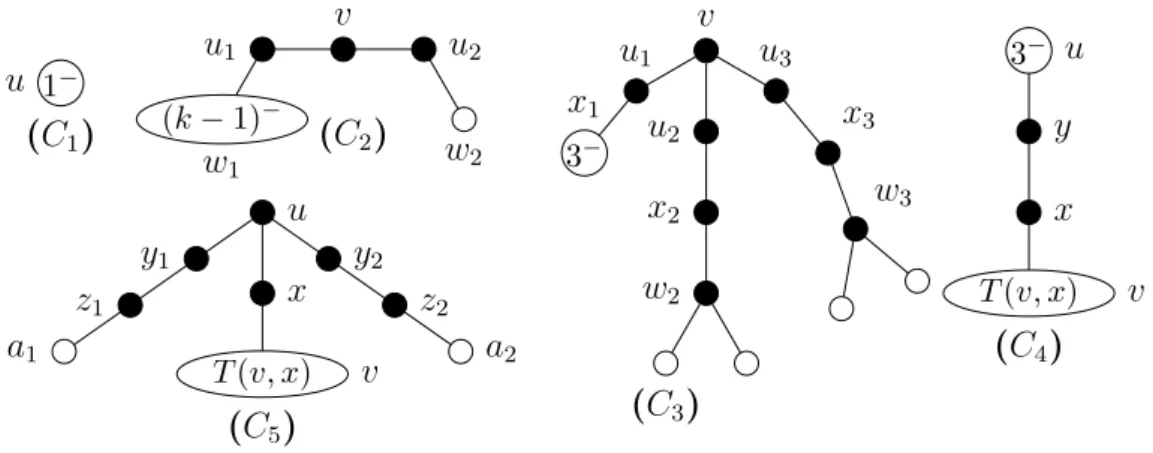
In the figures, we draw in black a vertex that has no other neighbor than the ones already represented, in white a vertex that might have other neighbors than the ones represented. When there is a label inside a white vertex, it is an indication on the number of neighbors it has. The label ’i’ means ”exactly i neighbors”, the label ’i+’ (resp. ’i−’) means that it has at least (resp. at most)
i neighbors. Note that the white vertices may coincide with other vertices. The label ’T (v, a)’ inside a vertex v means that T (v, a) exists, as defined below. A configuration T (v, a4) (see Figure 2), is inductively defined as a vertex
v of degree 4 with neighbors a1, a2, a3, a4, where for i ∈ {1, 2, 3}, vertex v is
2-linked by a path v-ai-bi-wi either to a vertex wi of degree at most 3 or to a
configuration T (wi, bi). T(v, a4) v a1 b1 3− or T (w 1, b1) w1 a2 b2 3− or T (w 2, b2) w2 a3 b3 3− or T (w 3, b3) w3 a4 Fig. 2. A T (v, u4).
Now we define configurations (C1) to (C5) (see Figure 3). • (C1) is a vertex of degree 0 or 1.
• (C2) is a vertex 3-linked to a vertex not of maximal degree.
• (C3) is a vertex of degree 3 that is 2-linked to two vertices of degree 3, and
1-linked to a vertex of degree at most 3.
• (C4) is a vertex u of degree at most 3 that is 2-linked by a path u-y-x-v to
a vertex v such that T (v, x) exists.
• (C5) is a vertex u of degree 3 that is 2-linked to two vertices, and 1-linked
(C2) 1− u (C1) (k − 1) − w1 u1 v u2 w2 v u3 x3 w3 u2 x2 w2 (C3) u1 3− x1 T(v, x) v (C4) x y 3− u T(v, x) v (C5) x u y2 z2 a2 y1 z1 a1
Fig. 3. Forbidden configurations.
In the following lemma, we actually use k instead of ∆(G) in order to ensure that any subgraph of G admits a (k + 1)-coloring even though ∆ can decrease.
A graph is minimal for a property if it satisfies this property but none of its subgraphs does.
Lemma 2.1 Let k ≥ 4 and G such that ∆(G) ≤ k and G admits no 2-distance (k + 1)-coloring, and G is minimal for this property. Then G does not contain any of Configurations (C1) to (C5).
The following lemma will ensure that the discharging rules we introduce later are well-defined.
Lemma 2.2 In a graph G where (C4) is forbidden, and x and y are two
vertices of degree 4 that are 2-linked by a path x-a-b-y, at most one of T (x, a) and T(y, b) exists.
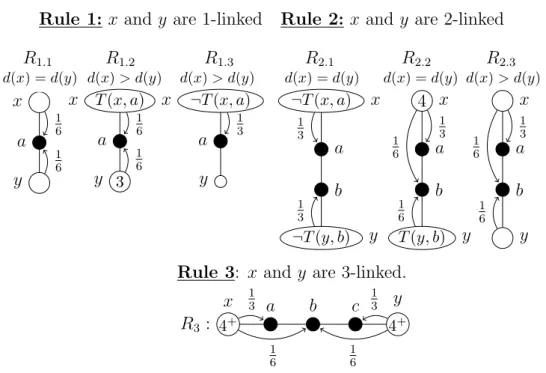
We design discharging rules R1, R2, R3 (see Figure 4). We use them in
the proof of Lemma 2.3, where the initial weight of a vertex equals its degree, and its final weight is shown to be at least 73. For any two vertices x and y of degree at least 3, with d(x) ≥ d(y),
• Rule R1 is when x and y are 1-linked by a path x − a − y.
· (R1.1) If d(x) = d(y), then both x and y give 16 to a.
· (R1.2) If d(x) > d(y) and T (x, a) exists, then both x and y give 16 to a.
· (R1.3) If d(x) > d(y) and T (x, a) does not exist, then x gives 13 to a. • Rule R2 is when x and y are 2-linked by a path x − a − b − y.
· (R2.1) If d(x) = d(y) and neither T (x, a) nor T (y, b) exist, then x (resp.
y) gives 1
· (R2.2) If d(x) = d(y) and T (y, b) exists, then x gives 13 to a and both x
and y give 16 to b.
· (R2.3) If d(x) > d(y), then x gives 13 to a and both x and y give 16 to b. • Rule R3 is when x and y, both of degree at least 4, are 3-linked by a path
x− a − b − c − y. Then x gives 13 to a and 16 to b, and symmetrically for y.
x a y
d(x) = d(y) d(x) > d(y) d(x) > d(y) d(x) = d(y) d(x) = d(y) d(x) > d(y)
R1.1 R1.2 R1.3 R2.1 R2.2 R2.3
Rule 1: x and y are 1-linked Rule 2: x and y are 2-linked
1 6 1 6 T(x, a) x a 3 y 1 6 1 6 ¬T (x, a) x a y 1 3 ¬T (x, a) x a b ¬T (y, b) y 1 3 1 3 4 x a b T(y, b) y 1 3 1 6 1 6 x a b y 1 3 1 6 1 6
Rule 3: x and y are 3-linked.
4+ x R3 : a b c 4+ y 1 3 1 6 1 6 1 3
Fig. 4. Discharging rules R1, R2, R3.
We use these discharging rules to prove the following lemma:
Lemma 2.3 A graph G that does not contain Configurations (C1) to (C5)
verifies mad(G) ≥ 73. Proof of Theorem 1.3
We prove a stronger version of Theorem 1.3 by contradiction. For k ≥ 4, let G be a minimal graph such that ∆(G) ≤ k, mad(G) < 73 and G does not admit a (k + 1)-coloring. Graph G is also a minimal graph such that ∆(G) ≤ k and G does not admit a (k + 1)-coloring (all its proper subgraphs verify ∆ ≤ k and mad < 73, so they admit a (k + 1)-coloring). By Lemma2.1, graph G cannot contain (C1) to (C5). Lemma 2.3 implies that mad(G) ≥ 73.
3
Conclusion
We actually proved a slightly stronger result than Theorem 1.3. However, the addition, namely that every graph G with mad(G) < 7
3 and ∆(G) ≤ 3 admits
a 2-distance 5-coloring, can be derived from a result of Dvoˇr´ak, ˇSkrekovski and Tancer [4].
Note that the proof of Theorem1.3 also provides an O(|V |3) algorithm to
find a 2-distance coloring of a graph G with ∆(G) + 1 colors if G verifies the hypothesis of Theorem1.3: indeed Lemma2.3proves that every graph G with mad(G) < 73 contains (C1), (C2), ... or (C5). Consequently, we can find a
(Ci) in G, remove the corresponding vertices, and extend the coloring to the
initial graph using the proof of Lemma 2.1.
As it was conjectured by Kostochka and Woodall [5] that 2-distance list-coloring requires exactly as many colors as 2-distance list-coloring, future work could aim at extending Theorem 1.3 to list-coloring.
References
[1] Borodin, O. V., A. O. Ivanova and N. T. Neustroeva, 2-distance coloring of sparse plane graphs (in russian), Siberian Electronic Mathematical Reports 1 (2004), pp. 76–90.
[2] Borodin, O. V., A. O. Ivanova and N. T. Neustroeva, List 2-distance (∆ + 1)-coloring of planar graphs with given girth, Journal of Applied and Industrial Mathematics 2 (2008), pp. 317–328.
[3] Dolama, M. H. and ´E. Sopena, On the maximum average degree and the incidence chromatic number of a graph, Discrete Mathematics and Theoretical Computer Science 7 (2005), pp. 203–216.
[4] Dvoˇr´ak, Z., R. ˇSkrekovski and M. Tancer, List-Coloring squares of sparse subcubic graphs, SIAM Journal on Discrete Mathematics 22 (2008), pp. 139– 159.
[5] Kotsochka, A. V., and D. R. Woodall, Choosability conjectures and multicircuits, Discrete Mathematics 240 (2001), pp. 123–143.