HAL Id: hal-01433467
https://hal.archives-ouvertes.fr/hal-01433467
Submitted on 3 Apr 2017
HAL is a multi-disciplinary open access
archive for the deposit and dissemination of
sci-entific research documents, whether they are
pub-lished or not. The documents may come from
teaching and research institutions in France or
abroad, or from public or private research centers.
L’archive ouverte pluridisciplinaire HAL, est
destinée au dépôt et à la diffusion de documents
scientifiques de niveau recherche, publiés ou non,
émanant des établissements d’enseignement et de
recherche français ou étrangers, des laboratoires
publics ou privés.
A Global Optimization Framework For Speaker
Diarization
Mickael Rouvier, Sylvain Meignier
To cite this version:
Mickael Rouvier, Sylvain Meignier. A Global Optimization Framework For Speaker Diarization.
Odyssey 2012, 2012, Singapour, Singapore. �hal-01433467�
A Global Optimization Framework For Speaker Diarization
Mickael Rouvier, Sylvain Meignier
LIUM, Universit´e du Maine – Le Mans, France
{mickael.rouvier, sylvain.meignier}@lium.univ-lemans.fr
Abstract
In this paper, we propose a new clustering model for speaker diarization. A major problem with using greedy agglomerative hierarchical clustering for speaker diariza-tion is that they do not guarantee an optimal soludiariza-tion. We propose a new clustering model, by redefining clustering as a problem of Integer Linear Programming (ILP). Thus an ILP solver can be used which searches the solution of speaker clustering over the whole problem. The experi-ments were conducted on the corpus of French broadcast news ESTER-2. With this new clustering, the DER de-creases by 2.43 points.
1. Introduction
The goal of speaker diarization is to annotate temporal regions of audio recordings with speaker labels, in order to answer the question ”who spoke when”. This oper-ation is performed without knowledge of the number of speakers or their identity. A common approach to this task consists in detecting homogeneous audio segments, which each contains the voice of only one speaker. The segments are then grouped into clusters, where each clus-ter contains segments of only one speaker.
Actually, in speaker diarization of broadcast news, the main methods of clustering are based on hierarchical, ag-glomerative algorithms such as top-down algorithms [1] or up algorithms [2]. Systems using the bottom-up approach (also known as Hierarchical Agglomerative Clustering – HAC) obtained the best results in the ES-TER 2008 and NIST RT-04F evaluation campaigns. The HAC approach is an iterative algorithm that merges the two most similar clusters. This process is repeated un-til the similarity between any two clusters does not rise beyond some threshold value. Similarity is calculated using Gaussian Mixture Models (GMM). Unfortunately, greedy algorithms based on GMMs suffer from many problems.
First, the HAC approach is a greedy algorithm that solves the problem by choosing a local optimum at each step with the hope of finding a global optimum. However, during the greedy search, the selection of the next merge depends strongly on those chosen so far. An error at the beginning is propagated until the end of the clustering, causing an increase in the error rate.
Second, GMM-based speaker models convey not only useful information (related to the speaker) but also useless information that can disrupt the speaker cluster-ing. This useless information can be of various nature and can be related to environment variability or channel-variability, for example.
In the work presented here, we propose a new clus-tering model where clusclus-tering is addressed as a global process – as opposed to the greedy approaches where it is treated as a series of local problems. We propose to replace the greedy, bottom-up search with a global for-mulation, where the basic bottom-up framework can be expressed as a variant of k-center problem. The algo-rithm can be expressed as a problem of Integer Linear Programming (ILP), through a definition of the concept of cluster in ILP terms. An ILP solver can then be used to minimize the result of the objective function.This new model is based on the i-vector paradigm. The i-vector ap-proach was developed in an effort to enhance the classical speaker GMMs used in the field of Speaker Verification (SV), and was recently used in the field of speaker di-arization of telephone conversations [3].
The paper is organized as follows: Section 2 presents the architecture of speaker diarization. Section 3 presents the corpus used for the experiments. Section 4 summa-rizes the i-vector approach. Section 5 presents our global optimization framework for speaker diarization. The re-sults of our experiments are explained in Section 6. Sec-tion 7 then concludes with a discussion of possible direc-tions for future works.
2. Architecture
The diarization system used is the LIUM Speaker Di-arization system[4], freely distributed1. This system
ob-tained the best results during the ESTER 2008 evaluation campaign.
The system is composed of an acoustic Bayesian In-formation Criterion (BIC)-based segmentation followed by a BIC-based hierarchical clustering. Each cluster rep-resents a speaker and is modeled with a full covariance Gaussian. Viterbi decoding is used to adjust the segment boundaries using GMMs with 8 diagonal components for each cluster trained by Expectation-Maximization (EM).
1http://www-lium.univ-lemans.fr/diarization/
Odyssey 2012
The Speaker and Language Recognition Workshop 25-28 June 2012, Singapore
Segmentation, clustering and decoding are performed over 12 MFCC+E, computed with a 10ms frame rate. Music and jingle regions are removed using Viterbi de-coding with 8 GMMs, for music, jingle, silence, and speech (with wide/narrow band variants for the latter two, and clean/noised/musical background variants for wide-band speech).
In the previous steps, features were used unnormal-ized in order to preserve information on the background environment, which may help differentiating between speakers. At this point however, each cluster contains the voice of only one speaker, but several clusters can be related to the same speaker. The contribution of the background environment to the cluster models must be removed through feature normalization in order to merge these clusters into one.
Audio signal MFCC segmentationBIC clusteringBIC clusteringNCLR
Figure 1: Architecture of the LIUM Speaker Diarization system
As shown in Figure 1, the system is completed with a Normalized Cross Likelihood Ratio (NCLR [5]) based on bottom-up clustering. It is performed on the clusters obtained after BIC segmentation: the parameters of each segment are normalized using feature warping and a Uni-versal Background Model (UBM) is adapted (Maximum A Posteriori – MAP) for each cluster.
In this paper, we propose another method of cluster-ing based on the i-vectors. We propose to substitute the last step of the system (the NCLR) with our new model. The previous steps (parameterization, segmentation. . . ) remain the same.
3. Corpus
The data used for the experiments are those of the ESTER 2008 evaluation campaign [6]. The data were recorded from 4 French radio stations, and are divided into 3 cor-pora: the train corpus corresponds to more than 111 shows (90 hours), the development corpus corresponds to 20 shows, and the evaluation corpus contains 26 shows. The train corpus is employed to learn and to condition the i-vectors and the development corpus is employed to set the various thresholds of the systems.
4. i-vector
4.1. i-vector extraction
I-vector approaches have become the state-of-the-art in the SV field. They provide an elegant way of reducing a large-dimensional input data to a small-dimensional fea-ture vector, while at the same time retaining most of the relevant information. The technique was originally
spired by the Joint Factor Analysis (JFA) framework in-troduced in [7].
Given a speaker- and channel-dependent GMM, the corresponding mean super-vector M can approximated by:
M = m + T w (1) where m is the mean super-vector taken from a GMM-UBM; T is a low-rank rectangular matrix spanning the subspace covering the important variability; w is a low-dimensional vector with a normally distributed prior N (0, I).
After iteratively estimating matrix T over a training corpus, equation 1 allows to use the lower-dimensional vector w as a speaker model in place of a large GMM. w is referred to as an i-vector.
The i-vector algorithm is fully described in [8]. 4.2. i-vector conditioning and distance metric 4.2.1. Conditioning
At this step the i-vectors contain both speaker and chan-nel information. The goal is to find a method that is able to carry out channel compensation. In [9, 10], the authors proposed to perform channel compensation in i-vector by using several channel compensation techniques working in this space. The best results were obtained by the pro-cess LDA+WCCN+Fast scoring.
But in [11], the authors propose a more robust method. That i-vector conditioning method is an itera-tive process with two goals.
i) Ensure that the i-vectors are distributed among N(0, I). One consequence of that constraint is that the vector di-mensions of i-vectors are mutually independent.
ii) Apply length normalization to the i-vectors. In [12, 11], it is shown that length normalization made the test and trial i-vector distributions more similar and more Gaussian shaped.
In the training corpus, for each turn of speech ob-tained using the reference we extract an i-vector. The goal of the conditioning algorithm is to compute param-eters for the i-vectors present in the training corpus and apply these parameters to the i-vectors present in the test corpus.
Algorithm 1 describes the training method for the i-vector conditioning parameters. The parameters (the mean µi and the covariance matrix Σi) of the i-vectors
present in the train corpus are saved at each iteration i (step 0). Next, the i-vectors are conditioned using the pa-rameters of the current iteration: step 1 is the classical data standardization, and step 2 is length normalization.
On the test corpus, after the BIC clustering, an i-vector is computed for each cluster. The i-i-vectors are then conditioned iteratively, in a manner similar to that used during the training phase, as explained in algorithm
Algorithm 1: Conditioning algorithm of i-vectors on the train corpus
for i = 1 to nb of iterations do Step 0: Compute the mean µiand the
covariance matrix Σion the train corpus;
for each w in the train corpus: do Step 1: w = Σ− 1 2 i (w − µi); Step 2: w = kwkw ; end end
2. The difference lies in the absence of step 0: the mean µiand covariance matrix Σiused for each iteration in this
phase are the ones saved during the training phase. As in the training phase, step 1 is the data standardization, and step 2is length normalization.
Algorithm 2: Conditioning algorithm for the test phase for i = 1 to nb of iterations do Step 1: w = Σ−12 i (w − µi); Step 2: w = kwkw ; end 4.2.2. Distance metric
Given two i-vectors wi and wj computed for clusters i
and j, the goal is to verify whether the two i-vectors correspond to the same speaker or not. If we assume homoscedasticity (equality of covariances) and Gaussian conditional density models, the most likely class can be obtained by the Bayes optimal solution:
d(wi, wj) = (wi− wj) W−1(wi− wj)0 (2)
where W is the within-class covariance matrix calculated on the conditioned i-vectors of the train corpus. So ac-cording to equation 2, the shorter the distance is, the more likely the two i-vectors belong to the same speaker. The within-class covariance is calculated :
W = 1 n S X s=1 ns X i=1 (wsi − ¯ws) (wsi − ¯ws)0 (3)
where nsis the number of utterances for speaker s, n is
the total number of utterances, wisis the training i-vector
of session i for speaker s, and ¯wsthe mean i-vector for
speaker s over all the sessions.
5. Global Optimization Framework
The solution of speaker clustering given by HAC algo-rithms do not guarantee to provide an optimal solution.
We propose to write our problem of speaker clustering in terms of ILP (Integer Linear Programming).
The goal of clustering is to group N i-vectors into K clusters (where K is to be determined by the algorithm and is of course between 1 and N ). To transform our problem in an ILP, we use the hypothesis that i-vector n can belong to cluster k if the distance between the center of the cluster and the i-vector is less than a set threshold. For our problem, the center of a cluster is necessarily an i-vector. Theoretically, there may be as many clusters as i-vectors. The goal is to minimize the number of clusters, so that all i-vectors are assigned to a cluster.
From this, we can formulate the objective function and constraints of our problem. The objective function is to minimize the number of clusters, K, but also to mini-mize the dispersion of the i-vectors within every cluster. We define two binary variables yk and xk,n. The binary
variable yk indicates whether cluster k is selected. The
binary variable xk,nindicates whether i-vector n belongs
to cluster k. Thus our objective function can be written as: z = N X k=1 yk+ 1 F N X k=1 N X n=1 d(wk, wn)xk,n (4)
The objective function is decomposed in two parts: the first part (PK
k=1yk) calculates the
number of clusters in our problem; the second (PK
k=1
PN
n=1d(wk, wn)xk,n) calculates the sum of
the distances between the center of cluster k and the i-vectors attached to that cluster; where d(wk, wn) is
the distance between the center of cluster k and i-vector n. The resolution of this problem aims at minimizing both the number of clusters and dispersion. F is a normalization factor, to weight the two subparts of Equation 4.
We note that under our assumptions, the center of any cluster is in reality an i-vector, therefore calculating the distance between cluster k and i-vector n is a distance calculation between two i-vectors.
Thus, the speaker clustering model can be written as:
Minimize z Subject To N X n=1 xk,n= 1, ∀k,(5) xk,n− yk ≤ 0, ∀k, ∀n,(6) d(wk, wn)xk,n≤ δ, ∀k, ∀n,(7) xk,n∈ {0, 1}, ∀k, ∀n yk ∈ {0, 1}, ∀k
Equation 5 ensures that all i-vectors have been as-signed to a cluster. Equation 6 ensures that if an i-vector n is assigned to a cluster k, then the cluster k is selected. In
Equation 7, an i-vector n can be selected from a cluster k if the distance is lower or equal to distance δ. d(wk, wn)
corresponds to the distance given by Equation 2 between i-vector n and cluster k.
6. Results and comparison
6.1. i-vectors and ILP
Matrix T of equation 1 is estimated over the train corpus. The matrix is iteratively estimated using the Expectation Maximization (EM) algorithm. We used 60-dimensional acoustic features, with a 10ms frame rate, composed of 19 MFCCs plus log energy and augmented by first and second-order deltas. The GMM-UBM is a gender- and channel-independent GMM composed of 1024 Gaussians computed using the ALIZ ´E speaker recognition toolkit2.
In order to have a balance between the modeling pre-cision and the amount of the data leading to accurate pa-rameters estimation, we have chosen a dimension of 60 for the i-vectors. In fact, if we take an upper dimension for some segments, we cannot have a sufficient number of frames to correctly estimate matrix T .
The ILP clustering algorithm is developed using the GNU Linear Programming Kit3.
6.2. Results
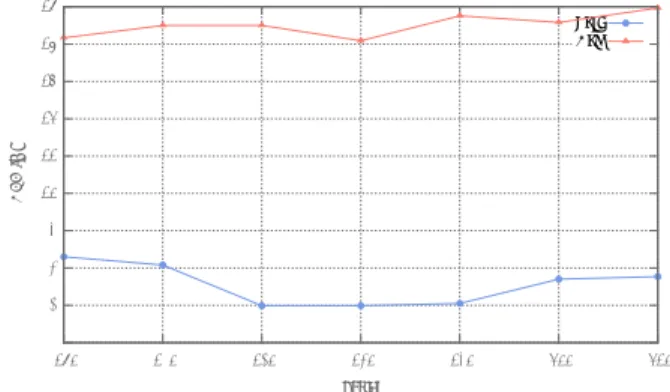
The default set of distance metric thresholds (δ) was de-termined using the ESTER 2008 development corpus. We can observe in Figure 2 that the optimal threshold on the development and test corpora is the same (δ = 180). Preliminary results show that the threshold is practically the same for corpora of various kinds (meeting, TV). We may theorize that as we remove useless information (channel-effect, . . . ), the threshold focuses on speaker in-formation and apparently there is less need to adapt it for different tasks. 6 7 8 9 10 11 12 13 14 15 150 160 170 180 190 200 210 DER (%) Factor Test Dev
Figure 2: Results on ESTER 2008 dev and test corpus, for different distance metric threshold.
2http://alize.univ-avignon.fr/ 3http://www.gnu.org/s/glpk/
We propose, following the same clustering algorithm (HAC), to compare NCLR (NCLR HAC) and i-vector (i-vector HAC). Then, we propose to apply the ILP model on i-vector (i-vector ILP). The system NCLR HAC is the classical system used for the campaign ESTER 2008. The results are reported in Table 1.
Table 1: Baseline system vs i-vectors (DER on evaluation corpus)
NCLR HAC: the baseline system
i-vector HAC: the system using the i-vectors and the HAC clustering i-vector ILP: the system using the i-vectors and the ILP clustering
Corpus NCLR i-vector i-vector HAC HAC ILP Africa 1 9.60% 6.05% 2.79%
Inter 9.23% 11.72% 8.62% RFI 3.61% 2.33% 2.33% TVME 13.31% 13.17% 13.54% ESTER-2 9.42% 9.08% 6.99% The i-vectors with a HAC gives better results than the baseline but worse than the i-vectors with ILP cluster-ing. The ILP algorithm explores more clustering solu-tions than the greedy HAC algorithm and the measure between i-vector is a distance whereas it is a similarity for NCLR. The i-vector ILP system obtains on TVME ra-dio a worse result than the baseline (13.54% and 13.31% respectively). Most of the speakers (56%) use a phone in the shows from TVME radio. The GMM-UBM is gender- and channel-independent; we think that lay be the reason behind this result.
7. Conclusion
In this paper, we proposed a new model of speaker clus-tering based on i-vectors. The ILP, in place of standard NCLR-based clustering, obtains a DER decrease of 2.43 points on the test corpus of the ESTER 2008 evaluation campaign. The i-vectors give more robust models than GMMs for this task, as was already the case for speaker verification.
8. Acknowledgments
The authors would like to thank Pierre-Michel Bousquet for the help and the discussion about the conditioning al-gorithm of i-vector.
This research was supported by ANR (French Na-tional Research Agency) under contract number ANR-2010-CORD-101-01 (SODA project).
9. References
[1] Corinne Fredouille and Gr´egory Senay, “Techni-cal improvements of the E-HMM based speaker
di-arization system for meeting records,” in MLMI, Steve Renals, Samy Bengio, and Jonathan G. Fis-cus, Eds. 2006, vol. 4299 of Lecture Notes in Com-puter Science, pp. 359–370, Springer.
[2] Claude Barras, Xuan Zhu, Sylvain Meignier, and Jean-Luc Gauvain, “Multi-stage speaker diarization of broadcast news,” IEEE Transactions on Audio, Speech & Language Processing, 2006.
[3] Stephen Shum, Najim Dehak, Ekapol Chuang-suwanich, Douglas Reynolds, and Jim Glass, “Ex-ploiting intra-conversation variability for speaker diarization,” in Interspeech, 2011.
[4] Sylvain Meignier and Teva Merlin, “LIUM SpkDi-arization: An open-source toolkit for diarization,” in CMU SPUD Workshop, 2010.
[5] Viet-Bac Le, Odile Mella, and Dominique Fohr, “Speaker diarization using normalized cross likeli-hood ratio,” in Interspeech. 2007, pp. 1869–1872, ISCA.
[6] Sylvain Galliano, Guillaume Gravier, and Laura Chaubard, “The ESTER 2 evaluation campaign for the rich transcription of French radio broadcasts,” in Interspeech. 2009, pp. 2583–2586, ISCA.
[7] Patrick Kenny, Gilles Boulianne, Pierre Ouellet, and Pierre Dumouchel, “Joint factor analysis versus eigenchannels in speaker recognition,” IEEE Trans-actions on Audio, Speech & Language Processing, vol. 15, no. 4, pp. 1435–1447, 2007.
[8] Najim Dehak, Patrick Kenny, R´eda Dehak, and Pierre Ouellet, “Front-end factor analysis for speaker verification,” IEEE Transactions on Audio, Speech & Language Processing, vol. 19, no. 99, pp. 1–23, 2010.
[9] Najim Dehak, R´eda Dehak, Patrick Kenny, Niko Br¨ummer, Pierre Ouellet, and Pierre Dumouchel, “Support vector machines versus fast scoring in the low-dimensional total variability space for speaker verification,” in Interspeech. 2009, pp. 1559–1562, ISCA.
[10] Najim Dehak, Patrick Kenny, R´eda Dehak, Pierre Dumouchel, and Pierre Ouellet, “Front-end fac-tor analysis for speaker verification,” IEEE Trans-actions on Audio, Speech & Language Processing, vol. 19, no. 4, pp. 788–798, 2011.
[11] Pierre-Michel Bousquet, Driss Matrouf, and Jean-Franc¸ois Bonastre, “Intersession compensation and scoring methods in the i-vectors space for speaker recognition,” in Interspeech, 2011.
[12] Daniel Garcia-Romero and Carol Espy-Wilson, “Analysis of i-vector length normalization in speaker recognition systems,” in Interspeech, 2011.