HAL Id: insu-02341638
https://hal-insu.archives-ouvertes.fr/insu-02341638v2
Submitted on 31 Aug 2020
HAL is a multi-disciplinary open access
archive for the deposit and dissemination of
sci-entific research documents, whether they are
pub-lished or not. The documents may come from
teaching and research institutions in France or
abroad, or from public or private research centers.
L’archive ouverte pluridisciplinaire HAL, est
destinée au dépôt et à la diffusion de documents
scientifiques de niveau recherche, publiés ou non,
émanant des établissements d’enseignement et de
recherche français ou étrangers, des laboratoires
publics ou privés.
significant geohazard events
Robin Lacassin, Maud Devès, Stephen Hicks, Jean-Paul Ampuero, Rémy
Bossu, Lucile Bruhat, Desianto Wibisono, Laure Fallou, Eric Fielding,
Alice-Agnes Gabriel, et al.
To cite this version:
Robin Lacassin, Maud Devès, Stephen Hicks, Jean-Paul Ampuero, Rémy Bossu, et al.. Rapid
collabo-rative knowledge building via Twitter after significant geohazard events. Geoscience Communication,
2020, 3 (1), pp.129-146. �10.5194/gc-3-129-2020�. �insu-02341638v2�
Geosci. Commun., 3, 129–146, 2020 https://doi.org/10.5194/gc-3-129-2020
© Author(s) 2020. This work is distributed under the Creative Commons Attribution 4.0 License.
ar
ticle
Rapid collaborative knowledge building via Twitter after
significant geohazard events
Robin Lacassin1, Maud Devès1,2, Stephen P. Hicks3, Jean-Paul Ampuero4, Remy Bossu5,6, Lucile Bruhat7, Daryono8, Desianto F. Wibisono9, Laure Fallou5, Eric J. Fielding10, Alice-Agnes Gabriel11, Jamie Gurney12, Janine Krippner13, Anthony Lomax14, Muh. Ma’rufin Sudibyo15, Astyka Pamumpuni16, Jason R. Patton17, Helen Robinson18,
Mark Tingay19, and Sotiris Valkaniotis20
1Université de Paris, Institut de physique du globe de Paris, CNRS, 75005 Paris, France 2Université de Paris, Institut Humanités Sciences Sociétés, Centre de Recherche
Psychanalyse Médecine et Société, CNRS, Paris, France
3Department of Earth Science and Engineering, Imperial College London, London, UK 4Université Côte d’Azur, IRD, CNRS, Observatoire de la Côte d’Azur, Géoazur, France 5European-Mediterranean Seismological Centre, CEA, 91297 Arpajon Cedex, France 6CEA Centre DAM Ile de France, 91297 Arpajon, France
7Laboratoire de Géologie, UMR 8538, Ecole normale supérieure, PSL University, CNRS, Paris, France
8Earthquake and Tsunami Mitigation Division, Indonesian Agency for Meteorology Climatology and Geophysics,
Kemayoran, DKI Jakarta 10610, Indonesia
9independent researcher: Semarang, Central Java, Indonesia
10Jet Propulsion Laboratory, California Institute of Technology, Pasadena, California, USA
11Department of Earth and Environmental Sciences, Ludwig-Maximilians-Universität München, Munich, Germany 12independent researcher: United Kingdom Earthquake Bulletin, UK
13Global Volcanism Program, National Museum of Natural History, Smithsonian Institution, Washington DC, USA 14ALomax Scientific, Mouans-Sartoux, France
15Local Disaster Management Office (BPBD), Kebumen, Central Java, Indonesia 16Institut Teknologi Bandung, Jawa Barat 40132, Indonesia
17Department of Geology, Humboldt State University, California, USA 18Powerful Earth, UK
19Australian School of Petroleum, University of Adelaide, Frome Street 5005, Adelaide, Australia 20Koronidos 9, 42131 Trikala, Greece
Correspondence:Robin Lacassin ([email protected])
Received: 22 October 2019 – Discussion started: 28 October 2019
Revised: 30 March 2020 – Accepted: 1 April 2020 – Published: 15 May 2020
Abstract. Twitter is an established social media platform valued by scholars as an open way to disseminate scientific information and to publicly discuss research results. Scien-tific discussions on Twitter are viewed by the media, who can then pass on information to the wider public. Social media is used widely by geoscientists, but there is little documenta-tion currently available regarding the benefits or limitadocumenta-tions of this for the scientist or the public. Here, we use the exam-ple of two 2018 earthquake-related events that were widely
commented on by geoscientists on Twitter: the Palu Mw7.5
earthquake and related tsunami in Indonesia and the long-duration Mayotte island seismovolcanic crisis in the Indian Ocean. We built our study on a content and contextual anal-ysis of selected Twitter threads about the geophysical char-acteristics of these events. From the analysis of these two examples, we show that Twitter promotes a very rapid build-ing of knowledge in the minutes to hours and days followbuild-ing an event via an efficient exchange of information and active
discussion between the scientists themselves and the public. We discuss the advantages and potential pitfalls of this rela-tively novel way of making scientific information accessible to scholarly peers and lay people. We argue that scientific dis-cussion on Twitter breaks down the traditional “ivory tower” of academia, contributes to the growing trend towards open science, and may help people to understand how science is developed and, in turn, to better understand the risks related to natural/environmental hazards.
1 Introduction
In the aftermath of a potentially destructive natural event, such as a powerful earthquake, tsunami, volcanic eruption, or major landslide, it is crucial to rapidly determine its key geo-physical and geological characteristics. With such evidence-based understanding, the geoscientific community can cred-ibly explain the phenomenon to the media and stakeholders. Geoscientists can also disseminate the information to peo-ple directly affected by the disaster and engage in discussion with them (e.g. Stewart et al., 2018). A rapid understand-ing is also crucial to evaluate the risk of cascadunderstand-ing events (e.g. triggered earthquakes), such as the 2016 earthquakes in central Italy (Chiaraluce et al., 2017; Patton, 2016), and to direct further scientific action. Decades ago, this understand-ing was achieved at a much slower pace and within closed re-search teams by a progressive acquisition of geophysical data via time-consuming field surveys. This process often took months to reach a good understanding of the event’s char-acteristics. Thanks to worldwide geophysical instrument net-works (e.g. global and regional seismic netnet-works) and satel-lites (e.g. optical or radar imagery), as well as open data, re-searchers now generally have enough information to get a satisfactory first-order description of the geophysical event and an estimation of its potential consequences within days (e.g. Hayes et al., 2011). Scholarly interactions via social me-dia, sometimes involving citizen expertise and observations, may transform both the timeliness and the way our geophys-ical understanding is built and shared (Hicks, 2019; Williams and Krippner, 2019).
Twitter stands as a very efficient and simple tool to pub-licly disseminate scientific information and rapidly engage in discussion about the cause and implications of geological events (Landwehr et al., 2016; Lee, 2019; Takahashi et al., 2015). While Twitter is not the most popular social media platform, compared with platforms such as Facebook (Fal-lou and Bossu, 2019; Williams and Krippner, 2019), it is val-ued by scholars as an interactive and open way to discuss research-related issues and to comment on research results in a concise way (Shiffman, 2017; Van Noorden, 2014). Twitter is also widely used by journalists, who can pass on informa-tion to the wider public (Engesser and Humprecht, 2015).
Here we use the examples of the 28 September 2018 Mw 7.5 Palu earthquake and the related tsunami in
north-west Sulawesi, Indonesia (Bao et al., 2019; Socquet et al., 2019), and the protracted 2018–2019 Mayotte island seis-movolcanic crisis in the Indian Ocean (Cesca et al., 2020; Lemoine et al., 2019; Feuillet et al., 2020). We analyse the timelines of Twitter threads from these events to show that a virtual team of scholars sharing complementary data, ob-servations, and analyses, and engaging in subsequent discus-sions, may lead to a very rapid co-building of knowledge in just 1 to a few days. This process, which crosses laboratory walls (Britton et al., 2019), has the advantage of being trans-parent to the public and to the media. It makes science acces-sible to nonacademics or citizen scientists, who can follow and participate in the discussion. Our findings follow grow-ing trends towards open science and also potentially provide the opportunity for a new type of collaborative scientific ap-proach within dynamic and remotely working “global virtual teams” (Zakaria et al., 2004).
2 Studied events and methodology
For around a decade now, scientists studying natural haz-ards have been using information extracted from social me-dia, websites, or app earthquake reporting to automatically detect and locate hazardous events, such as flooding (e.g. Jongman et al., 2015). Social media posts can also be used to locate earthquakes within tens of seconds of their occur-rence (Bossu et al., 2008, 2018; Earle et al., 2010; Steed et al., 2019). Here, rather than relying on a quantitative sur-vey based on large-scale keywords or hashtags statistics or utilizing website traffic analysis combined with geolocaliza-tion, we built our study on the contextual analysis of quali-tative content of selected Twitter conversational threads. We do this to shed light on actual interactions that people have on Twitter during these events, emphasizing the type of in-formation shared via this social media rather than focussing solely on overarching issues. Examples of recent geologi-cal events that have received extensive Twitter commentary are the April 2015 Gorkha earthquake in Nepal (see anal-ysis of Twitter response by Lomax et al., 2015), the Mex-ico earthquakes of September 2017, the Mt. Agung eruption of 2017 (Indonesia), the tsunami induced by volcanic col-lapse at Anak Krakatau (Indonesia) in December 2018, the July–August 2019 Stromboli eruptions and pyroclastic flows (Italy), the July 2019 Ridgecrest earthquake sequence (Cal-ifornia, USA), and the protracted Lusi mud volcano erup-tion (Indonesia) that started in 2006. We chose to analyse two 2018 events that illustrate complementary aspects of knowledge building via social media.
On 28 September 2018, an magnitude Mw7.5 earthquake
occurred in the north-west of Sulawesi island, Indonesia. The earthquake ruptured the Palu-Koro Fault system, a north– south left-lateral fault zone with a relatively rapid average slip rate of about 4 cm yr−1 (Socquet et al., 2006), which was previously identified as being a high seismic hazard
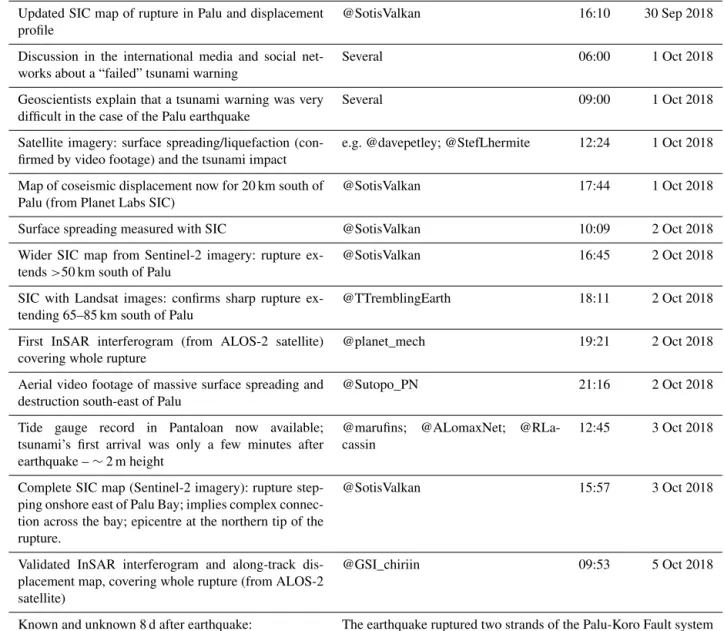
zone (Pusat Studi Gempa Nasional – National Center for Earthquake Studies, 2017; Watkinson and Hall, 2017). This earthquake triggered a tsunami with run-ups reaching 6–8 m high on the Palu Bay coast (Carvajal et al., 2019; Ulrich et al., 2019) as well as widespread liquefaction and surface spreading inland (Valkaniotis et al., 2018; Watkinson and Hall, 2019). To show how key geophysical information was rapidly disseminated and discussed via Twitter, we compiled informative tweets that were posted about the event’s char-acteristics and processes. This list of tweets should not be considered exhaustive, as it is strongly dependent on who we follow on Twitter and what is retweeted. We use it to illustrate how this way of spreading information enhances the dissemination and discussion of scientific results. From this compilation, we built a timeline of the rapid progress of the understanding of the earthquake rupture and of its ef-fects. The timeline (Table A1), which covers the 5 d follow-ing the event, is graphically shown in Fig. 1 (see also Ta-ble S1 in the Supplement, which contains web links to se-lected relevant individual tweets). A Twitter “moment” (La-cassin, 2019) gives online access to the full content of the tweets including images, maps, and videos (a PDF print of the full thread is also available from the Figshare data repos-itory: https://doi.org/10.6084/m9.figshare.11830809.v1). Ta-ble S2 provides complementary web links to the Twitter feeds of several geoscientists who actively participated in the online data dissemination and discussion in the few days fol-lowing the event, giving access to secondary, more detailed discussions.
In contrast to the Palu case, the case of Mayotte, in the Comoros archipelago between East Africa and Madagascar, represented emergent scholarly interaction over a much more protracted time period, without direct damage caused by the unrest and lacking initial responses from official government agencies. The island had been experiencing a long-standing seismic swarm of volcanic–tectonic origin since May 2018 (Patton, 2018; Lemoine et al., 2019; Feuillet et al., 2020), but it was not purported to have any significant seismic or volcanic hazard prior to this crisis. The seismic swarm is still active more than 18 months later and has recently been linked to a migration of magma within the lithosphere and the erup-tion of an undersea volcano (Cesca et al., 2020; Feuillet et al., 2020). We do not analyse the full (18 months) Twitter activity related to the Mayotte seismic swarm but instead focus on a particular long-period seismic event that hap-pened on 11 November 2018. This event triggered a surge in scholarly Twitter discussions in the following days. The surge resulted in a complex and long (> 200 tweets) Twitter thread with many branches opening secondary discussions, more like a wild bush than a well-structured tree. To sim-plify this thread, our first aim was to select and regroup the most relevant and informative tweets linked to these discus-sions. We organized these selected tweets into three succes-sive Twitter moments that are accessible online (Lacassin, 2018a, b, c), and we invite the reader to consult and
re-fer to this long thread (as for Palu, a PDF print of the full thread is also available from the Figshare data repository: https://doi.org/10.6084/m9.figshare.11830824.v1). Our pur-pose is not to carry out the same timeline analysis as for the Palu earthquake but to use the “Mayotte 11 Novem-ber 2018 rumble event” example to outline the efficient knowledge-building dialogue between scientists trying to in-terpret a mysterious event and dealing with the uncertainties surrounding it. To illustrate the time evolution of ideas dur-ing this active dialogue, we generated two word clouds from the selected tweets. We also use the Mayotte case to outline the role of citizen scientists at the start of the discussion, to discuss some pitfalls inherent to using an informal platform like Twitter, and to explore the opportunity to spread infor-mation toward more traditional print, broadcast, and online media.
The evolution of the two threads was quite different. For Palu, the scenario was quite well defined and occurred at a rapid pace over a short amount of time: an earthquake fol-lowed by a tsunami, with the scientists’ focus being on the key observations to explain what happened. For Mayotte, we knew very little at first apart from an initially innocuous mic swarm followed by the detection of a long-period seis-mic signal. There was no accurate location for the signal and no idea about what the signal was. This resulted in the Twit-ter exchanges and the overall thread on Mayotte being more chaotic and open than the more linear Palu thread. There were also very different societal impacts. The Mayotte earth-quakes caused uncertainty, unrest, and stress, but there was no important damage and no injuries or fatalities. In contrast, devastation and death were immediately seen in Palu.
Most authors of this paper contributed to the Twitter ex-changes discussed. Such an “embedded” view has the merit of providing an in-depth understanding of the geophysical observations and of the full context of the online exchanges at the time of the event. To provide an external and more crit-ical view, the paper also includes some authors (MD and LF) who were not involved in these specific Twitter discussions.
3 Results: knowledge building and sharing via Twitter
3.1 The case of the 2018 Palu earthquake
Our compilation of the Twitter exchanges following the Palu earthquake and tsunami reveals how we can rapidly gain a first-order understanding of event characteristics within a few hours to 1 day and a more complete one in less than a week. After the initial tweets issued by responding agencies (e.g. the USGS in the USA and the BMKG in Indonesia), most of the exchanges we quote involved academic researchers from different countries and institutions (see Tables 1, S1) with specialities encompassing seismology, earthquake geology, tectonic geodesy, remote sensing, natural hazards, and sci-ence communication. We will not investigate the sociology
Figure 1.Timeline of information posted on Twitter in the hours and days following the Palu earthquake and tsunami of 28 September 2018. The timeline illustrates the acquisition and dissemination of observations regarding geophysical events and the progress of knowledge build-ing via Twitter. See Table A1 for detailed information on the timbuild-ing; Table S1 in the Supplement provides links to relevant tweets and Twitter accounts; Figs. 2 and 3 display examples of tweets posted by geoscientists. Red dots correspond to information posted by responding agencies, and blue dots correspond to observations and discussions posted by researchers from different countries and institutions.
of the people involved in the Twitter discussions in more de-tail, because it is outside the scope of the present study, but future work should address this critical subject.
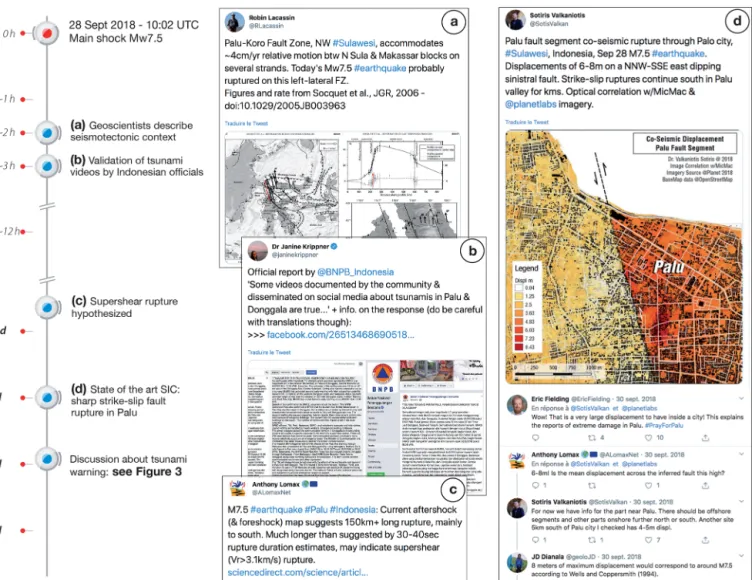
The timeline built from the Twitter feeds (Figs. 1, 2, Ta-ble A1) shows that the geoscience community already knew the following about 1 day after the earthquake:
i. the earthquake happened on the Palu-Koro Fault sys-tem, with a sharply localized strike-slip rupture directly beneath Palu City, and the epicentre was located in the
Minahasa Peninsula on the north-east shore of Palu Bay (from earthquake location and moment tensor solutions provided by monitoring agencies, published papers on the seismotectonic context, and regional fault mapping; this information was shared via Twitter in the 2 h fol-lowing the event – see Fig. 2a);
ii. the rupture entered Palu Bay, but the geometry of its prolongation offshore toward the Minahasa Peninsula was uncertain (from early post-earthquake satellite
im-Figure 2.Screenshots of tweets chosen to illustrate how researchers shared and explained observations regarding the Palu earthquake and tsunami of 28 September 2018. A simplified timeline (from Fig. 1) is shown on the left for reference. (a) Within 2 h geoscientists described the seismotectonic context of the earthquake. (b) Geoscientists shared and translated the official validation of viral videos about the tsunami in Palu. (c) Researchers hypothesized supershear rupture. (d) Geoscientists shared satellite image correlation results showing a sharp rupture with a 5 m left-lateral offset across Palu town, and other researchers started to discuss these results. Refer to Fig. 3 for tweets about the tsunami warning.
agery and preliminary image correlation using pre- and post-event data);
iii. the aftershock zone extended ∼ 150 km in the north– south direction, and the mainshock hypocentre was lo-cated near the northern tip of this zone (from operational earthquake locations provided by monitoring agencies);
iv. a tsunami with run-ups of several metres hit the shores of Palu Bay but was not recorded out of the bay (from reports and videos shared via social media by local peo-ple and the tide gauge records that were available in the hours following the event – see Fig. 2b);
v. there was dramatic surface spreading and liquefaction in and south-east of Palu City (from photos and videos shared by locals).
The exchanges and discussions continued via Twitter, and by 5 d after the earthquake the geoscientific community had assembled a fairly accurate description of the event and its effects. The acquired common and credible knowledge was as follows:
i. the earthquake ruptured two strands of the Palu-Koro Fault system for a total length of ∼ 150 km (from the af-tershock distribution provided by monitoring agencies, radar and optical image analysis results, and early earth-quake source models);
ii. the strand south of Palu Bay had a sharp and extremely localized surface rupture with sinistral offsets of ∼ 5 m (from satellite imagery and state-of-the-art pre-and post-event image correlation, which was later confirmed by field observations posted on Twitter by Indonesian researchers ∼ 15 d after the event – see Fig. 2d); iii. the rupture started on an inland fault east of Palu Bay
and then crossed Palu City from north to south (from satellite and InSAR imagery as well as early earthquake source models);
iv. the earthquake rupture propagated unilaterally south-ward, likely at a supershear speed (faster than S waves), which was a fairly unique observation for earthquakes (from early earthquake source duration and rupture length estimates, with the latter based first on the distri-bution of early aftershocks and then on satellite images – see Fig. 2c);
v. massive liquefaction and lateral spreading occurred in several sectors of Palu City (from aerial video footage shared by local government agencies, satellite imagery, and photos and videos shared by locals on social me-dia);
vi. tsunami waves hit the Palu Bay coast only a few minutes after the earthquake (from tide gauge records and videos shared on social media).
Ensuing Twitter exchanges during the next weeks focussed on the surface rupture description in the field by Indonesian scientists, the bathymetry of Palu Bay, the possible fault ge-ometry across it, and hypotheses about the tsunami source. These hypotheses explored whether the tsunami was due to the seismic rupture itself, due to underwater landslides and coastal collapse, or due to a combination of the two.
In this process of common knowledge building, geosci-entists used a diverse range of data types that were openly shared and discussed on Twitter: published papers and maps about the seismotectonic context, teleseismic data, local seis-mic waveforms, high-resolution optical satellite images, syn-thetic aperture radar (SAR) satellite data analysis, tide gauge records, and field observations from both science groups and local residents. Data sharing and social interaction via Twit-ter appeared to be an effective way of getting prompt and diverse feedback from fellow researchers on early scientific ideas. The satellite image correlation results, available on Twitter 1–2 d after the earthquake, were then rapidly shared as a more formal report via the open repository zenodo.org (Valkaniotis et al., 2018). Some ideas and initial hypotheses about a supershear rupture and the offshore fault geometry in Palu Bay, both discussed on Twitter, provided impetus for accelerated development of in-depth scientific papers (Bao et al., 2019; Ulrich et al., 2019). Indonesian geoscientists, ab-sent from the earlier scholarly exchanges on Twitter (only of-ficial agencies were providing advice), progressively joined
the discussion, providing, for example, tide gauge records and field observations of fault surface rupture and offsets. This created the opportunity to develop new international collaborations. Further highlighting the use of social media, an analysis of the tsunami source by Carvajal et al. (2019) used videos posted on social media platforms such as Twitter and YouTube.
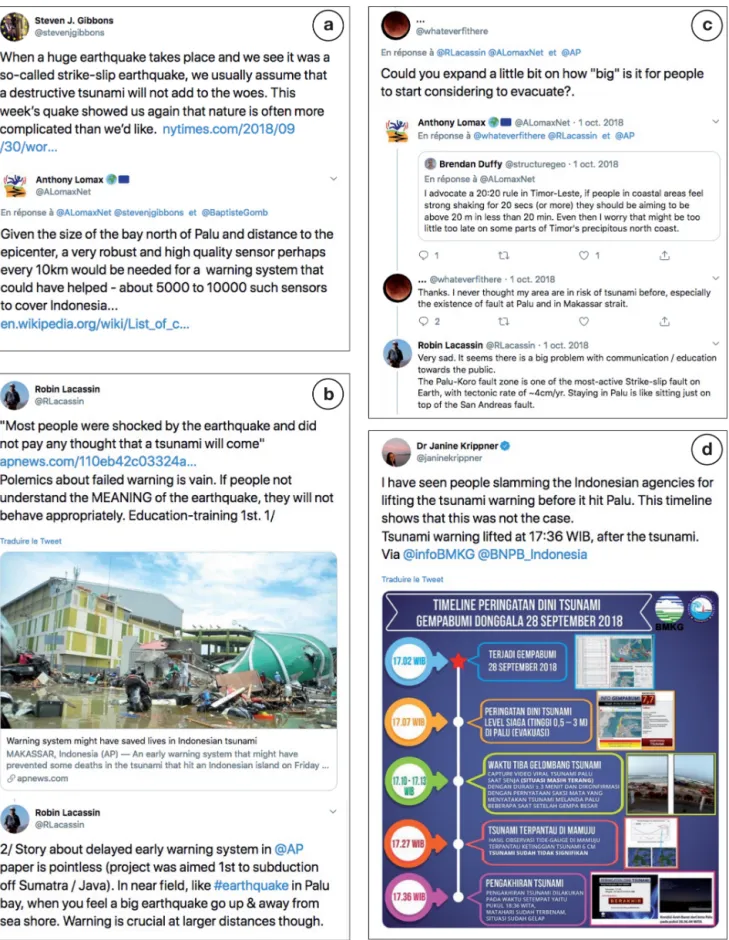
The spread of information via Twitter was not restricted to a small group of geoscience scholars. Journalists used and quoted these Twitter discussions in their articles (e.g. An-drews, 2018a; Wei-Haas, 2018a), using the thread to iden-tify academic experts to interview for their articles. How-ever, some journalists were not interested in the full range of geophysical observations and focussed instead on a “failed tsunami alert” (Fountain, 2018; Wright, 2018). Based on an Associated Press (AP) dispatch, on 1 October 2018, quoting some scientists (Wright, 2018), there were inaccurate reports from international media outlets about a “failed” tsunami warning. According to these reports, a network of tide gauges and buoys would have been able to issue an early tsunami warning after the earthquake, thereby saving lives. The me-dia were quick to blame the Indonesian authorities, saying that such a warning would have been impossible because the Indonesian buoy network was not well maintained. However, geoscientists realized that there was not enough time to issue any warning given the very short distance between the earth-quake source and the areas exposed to the tsunami in the very narrow Palu Bay (Fig. 3). As stated by Carjaval et al. (2019), “the most remarkable features of the tsunamis that devastated Palu were the very short, nearly instantaneous arrival times”. The first tsunami waves indeed hit the coast between 1 and 2 min after the earthquake. After the evidence-based expla-nation given by scholars on Twitter (Fig. 3), the process of fact-checking by some journalists took only a few hours af-ter the publication of the AP dispatch (e.g. Morin, 2018).
As described above, the case of the Palu earthquake and tsunami provides an excellent example of how scholarly dis-cussions on Twitter can provide initial and rapid scientific re-sults, whilst also reinforcing local official authorities on the ground and helping to guide journalistic outputs.
3.2 The Mayotte 11 November 2018 rumble event
On 11 November 2018, more than 6 months after the start of an earthquake swarm between Madagascar and the Comoros archipelago in the Indian Ocean, a peculiar seismic signal radiated from the region of Mayotte. The signal was recorded worldwide by seismic networks, but it was not detected by their automatic event identification algorithms because of its odd spectral characteristics. It was an unusually long, low-frequency, highly monochromatic signal, like a low-pitched hum that travelled as seismic waves across the Earth.
As noted by journalist Maya Wei Haas in her National Ge-ographic article “only one person noticed the odd signal on the U.S. Geological Survey’s real-time seismogram displays.
Figure 3.Screenshots of selected tweets about the tsunami warning in the case of Palu. (a, b) Geoscientists quote media articles regarding a possible “failed” tsunami warning and explain that such a warning was extremely difficult in the case of the Palu earthquake (see text for more details). (c) An example of geoscientists engaging in discussion with local people. (d) A geoscientist reports that Indonesian agencies issued an alert in due time and cancelled it only after the tsunami hit Palu.
An earthquake enthusiast [. . . ] saw the curious zigzags and posted images of them to Twitter” (Wei-Haas, 2018b). This image (Fig. 4a) was then retweeted by a citizen earthquake researcher, Jamie Gurney, who initiated an active discussion between academic researchers (Fig. 4), with some intertions from the media and the public. Analysis of openly ac-cessible seismic waveform data from around the world by seismologists then confirmed the signal originated in the Mayotte region (e.g. Hicks, 2018a).
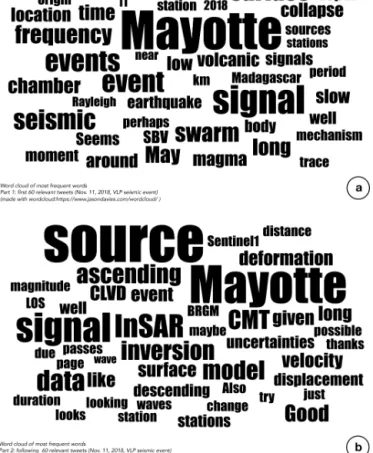
The Twitter discussion involved a group of seismologists but also specialists in earthquake geology, volcanology, tec-tonics, geodesy, geomechanics, hazards, and science com-munication. Their exchanges eventually co-built a rapid ap-praisal of the 11 November signal and of its broader geophys-ical and geologgeophys-ical context. The nature of the researchers’ interactions are exemplified by the three successive Twit-ter moments (Lacassin, 2018a, b, c) that regroup our com-pilation of tweets (see Fig. 4 for a choice of tweets illus-trating the early discussion between researchers). A simple content analysis of the selected tweet threads, illustrated by the two successive word clouds in Fig. 5, shows how the ex-changes started with questions about the odd seismic signal itself (using words such as signal, event(s), wave(s), seismic, and frequency) and its geographic origin (using words such as Mayotte and location) (Fig. 5a) and then moved to a dis-cussion more focussed on the event’s geophysical source (us-ing words such as source, signal, CMT, CLVD, and deforma-tion) and data processing (using words such as data, model, InSAR, and inversion) (Fig. 5b). While many things remain to be understood about the geophysical processes at work offshore of Mayotte, the preliminary waveform modelling shared via Twitter (Hicks, 2018b) and the related discussion resulted in the consensus hypothesis that the 11 November seismic signal was due to a deflation event in a large and deep magmatic chamber combined with resonance and amplifica-tion of the seismic waves. This early hypothesis discussed on Twitter was subsequently supported by later in-depth analy-ses (Lemoine et al., 2019; Cesca et al., 2020; Feuillet et al., 2020).
The Twitter interactions on Mayotte drew the attention of the global geoscience community. Before the 11 November event, the long-standing earthquake swarm near Mayotte had been largely ignored; the swarm had only been studied by only a few researchers, mainly French, because Mayotte is a French territory. As noted by Lemoine et al. (2019) , the 11 November event “awakened the interest of the seismolog-ical community and the media”. We understand that the rapid “explosion” of the informal Twitter discussions that we re-port played a pivotal role in this awakening and helped hasten needed research in the region (Hicks, 2019). A few days after the 11 November event, at a meeting between the French geo-science community and stakeholders (funding agencies and ministry representatives), the Twitter exchanges were used to demonstrate the urgency with respect to funding research and
surveys on the Mayotte earthquake swarm (Nathalie Feuillet, personal communication to RL, 2018).
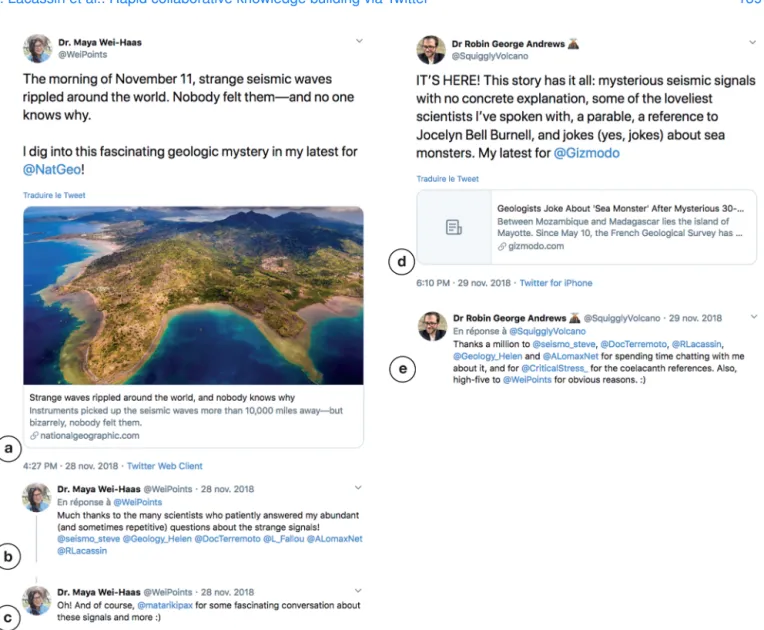
The full interactive process on Twitter was the subject of two long articles in National Geographic (Wei-Haas, 2018b) and Gizmodo (Andrews, 2018b), with journalists gathering information and contacting researchers via Twitter before in-terviewing them via email or phone (Fig. 6). These articles were then used as primary sources by other media and stim-ulated stand-alone reports by more traditional news organi-zations (e.g. Sample, 2018).
The long thread about the Mayotte 11 November seis-mic event reveals the efficiency of knowledge building via scholarly online interactions, but it also outlines some pit-falls that are inherent in the informal aspect of exchanges via Twitter. While after the Palu earthquake and tsunami geosci-entists were posting solid observations (i.e. “knowns”), for Mayotte they were trying to understand a peculiar event with large uncertainties, thereby opening many secondary discus-sions about “unknowns”. The resulting “bushy” nature of the thread makes it difficult to follow and comprehend in real time, and summarizing it a posteriori is challenging. More-over, some of these secondary discussions were casual or humorous and were at risk of being seen as insensitive and taken out of context by the general public. We infer that sci-entific Twitter exchanges dealing with uncertainties and un-knowns, as for Mayotte, are more prone to such pitfalls than those sharing knowns.
4 Discussion: advantages and pitfalls of Twitter for knowledge exchange and co-building
4.1 Argument 1: very rapid co-building of knowledge
The two case studies described above support previous work showing that Twitter allows the rapid building of knowledge (e.g. Choo et al., 2015; Hicks, 2019). In the case of the 2018 Mw 7.5 Palu earthquake, it took only 5 d to obtain a
de-tailed description of the events and only a few days for the 11 November 2018 seismovolcanic event in Mayotte. It takes several months to years for scientific teams to gather relevant information, analyse it, and publish it in an academic jour-nal after a long review–revision process. Thus, using Twitter makes information and basic explanations accessible to the scientific community and to the public more quickly. Com-municating such ideas to the public may have a high im-pact in places where operational infrastructure and associ-ated communication are limited. Moreover, Twitter provides direct and early scientific information for researchers, with-out any geographical and institutional barriers, acting as a “science news feed” that can be used to plan further in-depth research.
However, the knowledge built via Twitter is not exactly comparable to the knowledge built by a longer-term, classi-cal academic approach. Even if a long practice of research allows scientists to estimate the quality of a data set or of a
Figure 4.Screenshots illustrating early Twitter exchanges about the very long-period seismic signal near Mayotte on 11 November 2018. The selected screenshots show that Twitter discussion was initiated by citizen scientists (a–c) and then progressively involved academic researchers (d–f). Those researchers then started an active discussion about the seismic signal and its possible origin (e–j).
methodology almost immediately (if not intuitively), it does not substitute peer review as a process to check the validity of a result and “establish” knowledge. Therefore, a question arises regarding the credibility and legitimacy of the knowl-edge built rapidly and without peer review via Twitter: can it
be believed and on what ground? The fact that the author of a tweet comes from a recognized expert institution increases his/her credibility. Nevertheless, this is not enough to ensure the scientific quality of his/her tweet – and the reverse is also true. As shown in the Mayotte example, nonpractising
re-Figure 5.Word clouds illustrating the evolution of topics discussed on Twitter after the Mayotte 11 November 2018 very long-period (VLP) seismic event. The top word cloud (a) illustrates the first 60 tweets of the selected Twitter moment with most frequent words regarding the VLP signal (signal, event(s), wave(s), seismic, and frequency) and its geographic origin (Mayotte and location). The bottom word cloud (b), which corresponds to the subsequent 60 tweets, shows a discussion more focussed on the geophysical source of the VLP event (source, signal, CMT, CLVD, and deformation) and data processing (data, model, InSAR, and inversion).
searchers and “hobby scientists” can develop a good scien-tific understanding and can legitimately discuss these topics (Fig. 4). Thus, the following question arises: how can we en-sure that the most qualified comments receive the most atten-tion?
Rapid dissemination of early scientific analysis products (for example, using up-to-date remote sensing data) to sci-entists working in the field is another aspect of using social media platforms. This use of social media is similar to the modern trends of using preprint servers for early sharing of scientific results. Twitter interaction is now also forming the basis of collaborations, leading to the development of ideas and the subsequent co-writing of papers within diverse, mul-tidisciplinary teams, e.g. Hicks et al. (2019) and Ulrich et al. (2019) included co-authorships that were instigated from
Twitter discussions. By widening stakeholder interactions, such open discussions may also help to enhance the schol-arly value of open data sets.
A risk to sharing “breaking science” information on Twit-ter and social media is that this same information can en-able publications by the global community before the lo-cal scientists who provided the initial information. There are vulnerabilities for those field teams who are committing re-sources as part of a response initiative and are required to, or feel a duty to, provide timely public information about an event. Elements of such a scenario unfolded following the 2016 Kaik¯oura earthquake in New Zealand, when tweets, blog posts, and media releases by the responding agencies were an important information source for an early publica-tion by researchers without collaborapublica-tion with the responding agency scientists. This publication (Shi et al., 2017) predated publications of field observations and analysis by teams on the ground by several months. This example raises questions about the ownership of scientific knowledge that is shared in the public domain and suggests that some scientists may choose to completely restrict, or be more selective about, publicly posting their scientific analysis into the public do-main.
4.2 Argument 2: science beyond the laboratory
Twitter allows us to step outside the laboratory in many ways. First, it opens the door to professional networking and new academic collaborations between scientists from differ-ent disciplines, institutions, or even countries. In the case of the Palu earthquake, most of the early exchanges involved non-Indonesian academic researchers; Indonesian geoscien-tists then joined the discussion and provided data that could only be acquired locally (e.g. field observations about the earthquake rupture or liquefaction-induced landslides). This led them to engage in a discussion with other members of the international scientific community and paved the way for new collaborations, such as the sharing of tsunami source models for operational hazard analyses. In the short term, however, it might be difficult for local scientists to get in-volved in social media if they are busy with the management of the crisis and/or collecting the first information from the field. Furthermore, scientists from local monitoring organiza-tions or universities may have strict social media usage and communication policies.
Twitter also opens the door to exchanges with the global public. The scientific value of contributions from nonaca-demics varies between examples, but there are always some external inputs that help to clarify or reframe the scientific questions and the way to explain them to the public. Nonaca-demics can launch important discussions. In the case of May-otte, it was a citizen scientist who drew attention to a strange seismic signal (Fig. 4a), and it was the subsequent “explo-sion” of informal Twitter discussions that woke the scientists and the authorities up (Lemoine et al., 2019; Hicks, 2019).
Figure 6.Screenshots of tweets by journalists Maya Wei-Haas and Robin George Andrews. After promoting their media article on the Mayotte 11 November 2018 event (a, d), the journalists acknowledged academic researchers who were first identified and contacted via Twitter and then interviewed via email or phone (b, c, e).
Among Twitter users, journalists “listening in” are particu-larly important as they can pass on some of the scientific content of the discussions in an understandable way. The challenge for them is to have access to information that is as fresh as it is credible. From this point of view, Twitter is an important resource because it can serve as a pool of po-tential experts to give in-depth comment (Fig. 6). Conversely, perhaps this trend reduces the diversity in these pools, with public comment favouring scientists on Twitter rather than those who avoid Twitter and/or use other social media plat-forms. Moreover, how much checking does a journalist do to assess a tweeter’s scientific credibility?
4.3 Argument 3: opening the scientific process to the public
The process of knowledge building on Twitter is open and public, which may help to improve the general public’s and the media’s understanding of how scientific research works. The examples described above show that the process of knowledge co-construction is not linear. Some discussion threads might look like well-structured “trees” (e.g. the Palu earthquake) but others resemble “wild bushes” with many secondary branches of discussions opening up over time (e.g. the Mayotte seismovolcanic crisis). Scientists are seen by the public to use a wide variety of data and following in-direct, unchronological, and unstructured thought paths be-fore reaching a conclusion. As a window to the scientific pro-cess, Twitter also helps to clarify that scientific work is orga-nized into disciplines and subdisciplines and that the
knowl-edge and know-how of these groups may be difficult to ar-ticulate, but they are all necessary to build a global view of a subject. Scientists themselves are familiar with these as-pects of their work but non-scientists may not be, largely be-cause scientific knowledge is often presented retrospectively as having been constructed in a cumulative and chronologi-cal manner. Epistemologists have long denounced this mis-conception (e.g. Kuhn, 1996). Thus, Twitter can contribute to making the “messy part of science” more tangible and vis-ible. Early information on Twitter can also provide excellent teachable material for educators.
One limitation is that the thread has to be “visible” on Twitter, using a proper hashtag for instance. Also, if the pub-lic is not aware of the sphere and the discussion is not ”vis-ible” to them, they will not see it even though it is public. Moreover, some schools of thought, especially those from a public safety standpoint, may argue that scientists should concentrate on disseminating the certainty of known, well-established facts and interpretation about a hazardous event, rather than on communicating uncertainties and cutting-edge research (e.g. Jones, 2020). It is our view that scientists must reach a careful balance between knowledge building and be-ing sensitive to a damagbe-ing geohazard event very soon after it has happened.
4.4 Argument 4: helping people to understand hazards and risk mitigation
Improving people’s understanding of natural phenomena can help to improve risk mitigation, at least indirectly. For ex-ample, in the case of the Palu earthquake, the international media insisted that a ”failed” tsunami warning was responsi-ble for the associated fatalities, but scientists quickly realized and explained that there was not enough time to issue an ef-ficient alert because of the proximity of the earthquake (see above). In fact, the Indonesian agency in charge (BMKG) issued an alert a few minutes after the event and then can-celled it ∼ 30 min later (Fig. 3d, Table A1); in the meantime, the tsunami hit the Palu Bay coasts (Krippner, 2018). Later the same day, BMKG issued a press release to explain their alert management process. This contradictory information is likely to open a debate that will improve the general public’s understanding of what to expect (or not) from early-warning systems. More generally, by bringing facts and evidence-based arguments into the public debate, the scientific com-munity can contribute to the quality of people’s information and, in the long-term, help people to prepare. Twitter discus-sions are opportunities to prevent confusion and misunder-standing by reinforcing and disseminating information and advice given by local government agencies (Bartel and Bo-hon, 2019).
5 Concluding remarks
Using examples of Twitter discussions following two very different geophysical events, we have shown that open sci-entific discussion and hypothesis building on social media can promote and enhance many key aspects of modern sci-ence, including the development of ideas for future project funding, early dissemination and discussion of preliminary results forming the basis of peer-reviewed publications, net-working for developing international collaborations, demon-strating the impact of research, and public dissemination of research and results. Twitter can be seen as a modern method of crowdsourcing scientific ideas; however, this can raise moral issues over the proper acknowledgement of how these ideas were progressively developed. In these concluding re-marks, we combine the results from the present study with our own experience on social media to identify some interest-ing questions and implications for modern scientific methods and communication.
Our analysis has shown that Twitter discussions do not represent a significant change over the common methods adopted in traditional scientific research. For example, sci-entific discussions on Twitter may be compared to traditional in-lab scholar discussions at coffee time and encounters at scientific conferences that are a usual way of exchanging in-formation and new ideas. Twitter democratizes such schol-arly interactions by expanding their interdisciplinarity and geographic coverage, leading to more diverse scientific in-puts. Many of these differences result from an increase in open data, a willingness to openly share ideas, and the glob-alization of science. Moreover, in the examples described in this paper, the group of scientists involved in the discussions had not previously worked together. They formed a group with a diverse range of backgrounds and with different ex-pertise, questioning previous tweets, thereby providing an ef-fective and rapid analogue to traditional peer review.
Nevertheless, there are key differences compared with the traditional scientific method that we should be wary of. Whilst we have demonstrated that the use of Twitter for sci-entific knowledge building and dissemination can be a ful-filling experience, the immediate tangible benefits for sci-entists that may be needed for, e.g. career progression, may not be obvious. For example, research managers less accus-tomed to science on social media may find such efforts to be a distraction from traditional research work. The current academic system rewards scientists mostly based on peer-reviewed publications, so how can scientists be rewarded for such public dissemination and preliminary groundwork? Also, what happens if research papers are published that use the scientific ideas developed on Twitter without appropriate credit? How can credit be given to the incremental develop-ment of scientific ideas from Twitter?
Based on our experience, as science on Twitter is con-ducted fully in the public domain, we should be wary of comments being taken out of context and the potential of
posts to “go viral”. As a Twitter user gains followers, their responsibility and the risk of such issues dramatically in-creases, and as the number of comments/replies from follow-ers grow, so does the time required to reply responsibly. In such cases, should this public-facing approach be left to so-cial media and public relations experts? Alternatively, should media and communication training become a standard for scientists working in fields with public-facing aspects?
Aside from occasional conspiracy theorists and charlatan earthquake/volcanic eruption predictors, we have found from our experience of Twitter that communicating about natural geohazards can be less affected than other topics by the well-recognized disadvantages of the platform - such as trolling and personal abuse. However, challenges still remain for the scientific discussion and dissemination of more controversial subjects, such as human-induced seismicity, petroleum sci-ence, or climate change. Does exposing the “messy part of science” (see above) help to increase public trust in scien-tific evidence? For example, it might be possible for some people to clearly see the uncertainty in some scientific ar-guments and to “prey” on them for political gain. Overall, opening up the scientific processes and involving the general public as stakeholders should help to improve trust in ex-perts. Future development of “best” practices for scientists involved in such subjects will be needed. However, offer-ing communication trainoffer-ing is only one step toward support-ing scientists in the effective conveyance of their work. Cur-rent issues like climate change show us that scientists need to be openly communicating and building trusting relation-ships with global communities, but, at the same time, the re-sponse from a minor group of other scientists can be hostile and damaging. We need to specifically acknowledge and re-ward scientists for these crucial efforts and keep working to change the culture to support science communicators.
Together with the growing popularity of open science and preprint archives, discussing science on Twitter can impor-tantly fill in the traditional “radio silence” from science be-tween a newsworthy/impactful event and the publication of related scientific papers that follows months to years later. Our study has specifically focussed on potentially hazardous geological events, but our experiences reported here can as-sist the usage of social media for many other fields of re-search.
Appendix A
Table A1.Timetable of main events and preliminary geophysical information posted on Twitter about the Palu earthquake and tsunami of 28 September 2018 (Table S1 provides links to the relevant tweets).
Important event, information, or result Tweeted by (@nnn Time posted Day posted
refers to the Twitter account) (hh:mm UTC) (UTC)
Foreshock Mw6.1 (USGS location and time) 07:00 28 Sep 2018
Main shock Mw7.5 (USGS location and time) 10:02 28 Sep 2018
BMKG first tsunami alert @infoBMKG 10:07 28 Sep 2018
BMKG tweet mainshock @infoBMKG 10:09 28 Sep 2018
Preliminary first motion mechanism: strike-slip @ALomaxNet 10:16 28 Sep 2018
USGS tweet mainshock @USGSBigQuakes 10:20 28 Sep 2018
BMKG cancel tsunami alert @infoBMKG 10:36 28 Sep 2018
Strike-slip moment tensor e.g. @geoscope_IPGP 10:47 28 Sep 2018
Seismotectonic context: strike-slip rupture on
Palu-Koro Fault, a major fault system with a ∼ 4 cm yr−1
long-term rate (comparable to the San Andreas Fault)
Several 12:00 28 Sep 2018
First viral videos of tsunami in Palu (unverified and not validated at this time)
Several 12:00 28 Sep 2018
Confirmation of the tsunami and the official validation of viral videos
e.g. @AP quoting Indonesian agency; @janinekrippner; @Sutopo_PN
13:00 28 Sep 2018
Seimotectonic map showing past seismicity @CPPGeophysics 15:20 28 Sep 2018
Tide gauges: very weak signal out of Palu Bay – not working at Pantaloan in the bay itself
e.g. @RLacassin 15:37 28 Sep 2018
BMKG press release about tsunami alert and why they ended it
@infoBMKG 00:40 29 Sep 2018
Synthetic poster of seismotectonic context and seismic-ity
@patton_cascadia 01:07 29 Sep 2018
Supershear rupture hypothesized (will be confirmed later)
@ALomaxNet; @DocTerremoto
Planet Labs imagery suggests rupture right in Palu town @SotisValkan 13:40 29 Sep 2018
First rough Planet Labs satellite image correlation (SIC) reveals fault rupture in Palu (results will go viral)
@SotisValkan 14:04 29 Sep 2018
Videos of dramatic surface spreading/liquefaction (will become viral) as will the ensuing discussion
e.g. @janinekrippner;
@pat-ton_cascadia
15:33 29 Sep 2018
About 1 d after earthquake, we already know
the following: Earthquake on the Palu-Koro Fault system with sharply
localized strike-slip rupture in Palu town itself; the rupture enters the bay north of Palu (but it is uncertain how it prolongates offshore and northward); the aftershock zone extends for ∼ 150 km in the north–south direction, and the mainshock is near its northern tip.
Tsunami with run-up of several metres in Palu Bay (not out of the bay) with dramatic surface spreading
and liquefaction in and south-east of Palu town State-of-the-art SIC: localized strike-slip rupture in Palu
with ∼ 5 m of coseismic slip (will go viral)
Table A1.Continued.
Updated SIC map of rupture in Palu and displacement profile
@SotisValkan 16:10 30 Sep 2018
Discussion in the international media and social net-works about a “failed” tsunami warning
Several 06:00 1 Oct 2018
Geoscientists explain that a tsunami warning was very difficult in the case of the Palu earthquake
Several 09:00 1 Oct 2018
Satellite imagery: surface spreading/liquefaction (con-firmed by video footage) and the tsunami impact
e.g. @davepetley; @StefLhermite 12:24 1 Oct 2018
Map of coseismic displacement now for 20 km south of Palu (from Planet Labs SIC)
@SotisValkan 17:44 1 Oct 2018
Surface spreading measured with SIC @SotisValkan 10:09 2 Oct 2018 Wider SIC map from Sentinel-2 imagery: rupture
ex-tends >50 km south of Palu
@SotisValkan 16:45 2 Oct 2018
SIC with Landsat images: confirms sharp rupture ex-tending 65–85 km south of Palu
@TTremblingEarth 18:11 2 Oct 2018
First InSAR interferogram (from ALOS-2 satellite) covering whole rupture
@planet_mech 19:21 2 Oct 2018
Aerial video footage of massive surface spreading and destruction south-east of Palu
@Sutopo_PN 21:16 2 Oct 2018
Tide gauge record in Pantaloan now available; tsunami’s first arrival was only a few minutes after earthquake – ∼ 2 m height
@marufins; @ALomaxNet; @RLa-cassin
12:45 3 Oct 2018
Complete SIC map (Sentinel-2 imagery): rupture step-ping onshore east of Palu Bay; implies complex connec-tion across the bay; epicentre at the northern tip of the rupture.
@SotisValkan 15:57 3 Oct 2018
Validated InSAR interferogram and along-track dis-placement map, covering whole rupture (from ALOS-2 satellite)
@GSI_chiriin 09:53 5 Oct 2018
Known and unknown 8 d after earthquake: The earthquake ruptured two strands of the Palu-Koro Fault system for a total length of ∼ 150 km: one strand south of Palu bay,
with extremely sharp localized surface rupture and sinistral offsets of ∼ 5 m. It crosses Palu town and enters the bay to the north. However, the rupture does not continue straight
northward – it steps eastward to continue inland. Earthquake rupture started to the north at the hypocentre and
propagated southward, likely at a supershear rate. Massive surface spreading is documented from satellite imagery. Tsunami waves hit Palu Bay coast few minutes after the earthquake. Polemics about a “failed” tsunami warning is in vain. First results of surface rupture field survey by
Indone-sian geologists
Data availability. PDF prints of the full threads of selected tweets are available from the Figshare data repository for the Palu earthquake and tsunami (https://doi.org/10.6084/m9.figshare.11830809.v1, Sup-plement 1) and for the Mayotte VLP seismic event (https://doi.org/10.6084/m9.figshare.11830824.v1, Supplement 2).
Supplement. Table S1 lists the main geophysical events and in-formation shared via Twitter after the Palu event, with links to rel-evant tweets. Table S2 provides web links to the Twitter feeds of geoscientists who participated in the online data dissemination and discussion after the Palu event. The supplement related to this ar-ticle is available online at: https://doi.org/10.5194/gc-3-129-2020-supplement.
Author contributions. This paper follows exchanges on Twitter after the Palu and/or Mayotte events in which most of the authors participated. JG and DFW, as citizen scientists, alerted the scien-tific community to the Mayotte 11 November event and translated Indonesian geohazard information in English respectively. RL con-ceived the study and compiled and analysed the data. All authors commented on the results. RL, MD, and SPH wrote the paper with input from all co-authors.
Competing interests. The authors declare that they have no con-flict of interest.
Acknowledgements. This paper is a collaborative study follow-ing Twitter discussions between co-authors. It is dedicated to the late Sutopo Purwo Nugroho, former chief spokesperson of the In-donesia disaster mitigation agency (BNPB), for his open communi-cation toward the public, in particular via Twitter. Robin Lacassin’s position is funded by CNRS (Centre National de la Recherche Sci-entifique, France). Part of this research was performed at the Jet Propulsion Laboratory, California Institute of Technology under contract with the National Aeronautics and Space Administration. We thank Christopher Jackson and Beth Bartel for their detailed and helpful reviews. This study contributes to the IdEx Université de Paris ANR-18-IDEX-0001. This is IPGP contribution no. 4140.
Review statement. This paper was edited by Mathew Stiller-Reeve and reviewed by Christopher Jackson and Beth Bartel.
References
Andrews, R. G.: Indonesian Tsunami: What Happened, How To Survive One, And How To Help, Forbes, 1 October, available at: https://www.forbes.com/sites/robinandrews/ (last access: 5 July 2019), 2018a.
Andrews, R. G.: Geologists Joke About “Sea Monster” After Mys-terious 30-Minute Rumble Emanates from Waters Near Mada-gascar, Gizmodo, available at: https://gizmodo.com/ (last access: 5 July 2019), 2018b.
Bao, H., Ampuero, J.-P., Meng, L., Fielding, E. J., Liang, C., Milliner, C. W. D., Feng, T., and Huang, H.: Early and persistent supershear rupture of the 2018 magnitude 7.5 Palu earthquake, Nat. Geosci., 12, 200–205, https://doi.org/10.1038/s41561-018-0297-z, 2019.
Bartel, B. and Bohon, W.: The Hazards of Hazard Communication: Importance, Rewards, and Challenges of Science in the Public Sphere: A white paper summary of presentations from session PA23B at the 2018 Fall Meeting of the 485 American Geophys-ical Union, available at: https://www.iris.edu/hq/files/ (last ac-cess: 8 May 2020), 2019.
Bossu, R., Mazet-Roux, G., Douet, V., Rives, S., Marin, S., and Aupetit, M.: Internet Users as Seismic Sensors for Improved Earthquake Response, Eos, Transactions American Geophysi-cal Union, 89, 225–226, https://doi.org/10.1029/2008eo250001, 2008.
Bossu, R., Roussel, F., Fallou, L., Landès, M., Steed, R., Mazet-Roux, G., Dupont, A., Frobert, L., and Petersen, L.: LastQuake: From rapid information to global seis-mic risk reduction, Int. J. Disast. Risk Re., 28, 32–42, https://doi.org/10.1016/j.ijdrr.2018.02.024, 2018.
Britton, B., Jackson, C., and Wade, J.: The reward and risk of social media for academics, Nat. Rev. Chem., 3, 459–461, https://doi.org/10.1038/s41570-019-0121-3, 2019.
Carvajal, M., Araya-Cornejo, C., Sepúlveda, I., Melnick, D., and Haase, J. S.: Nearly Instantaneous Tsunamis Following the Mw7.5 2018 Palu Earthquake, Geophys. Res. Lett., 46, 5117–
5126, https://doi.org/10.1029/2019GL082578, 2019.
Cesca, S., Letort, J., Razafindrakoto, H. N. T., Heimann, S., Ri-valta, E., Isken, M. P., Nikkhoo, M., Passarelli, L., Petersen, G. M., Cotton, F., and Dahm, T.: Drainage of a deep magma reser-voir near Mayotte inferred from seismicity and deformation, Nat. Geosci., 13, 87–93, https://doi.org/10.1038/s41561-019-0505-5, 2020.
Chiaraluce, L., Di Stefano, R., Tinti, E., Scognamiglio, L., Michele, M., Casarotti, E., Cattaneo, M., De Gori, P., Chiarabba, C., Monachesi, G., Lombardi, A., Valoroso, L., Latorre, D., and Marzorati, S.: The 2016 Central Italy Seis-mic Sequence: A First Look at the Mainshocks, After-shocks, and Source Models, Seismol. Res. Lett., 88, 757–771, https://doi.org/10.1785/0220160221, 2017.
Choo, E. K., Ranney, M. L., Chan, T. M., Trueger, N. S., Walsh, A. E., Tegtmeyer, K., McNamara, S. O., Choi, R. Y., and Carroll, C. L.: Twitter as a tool for communi-cation and knowledge exchange in academic medicine: A guide for skeptics and novices, Med. Teachnol., 37, 411–416, https://doi.org/10.3109/0142159X.2014.993371, 2015.
Earle, P., Guy, M., Buckmaster, R., Ostrum, C., Horvath, S., and Vaughan, A.: OMG Earthquake! Can Twitter Improve Earthquake Response?, Seismol. Res. Lett., 81, 246–251, https://doi.org/10.1785/gssrl.81.2.246, 2010.
Engesser, S. and Humprecht, E.: Frequency or Skillful-ness: How professional news media use Twitter in five Western countries, Journalism Stud., 16, 513–529, https://doi.org/10.1080/1461670X.2014.939849, 2015.
Fallou, L. and Bossu, R.: Taking into account the cultural con-text to improve scientific communication – Lessons learned from earthquakes in Mayotte, EGU Seismology, available at:
https://blogs.egu.eu/divisions/ (last access: 30 August 2019), 2019.
Feuillet, N., Jorry, S. J., Crawford, W., Deplus, C., Thinon, I., Jacques, E., Saurel, J. M., Lemoine, A., Paquet, F., Daniel, R., Gaillot, A., Satriano, C., Peltier, A., Aiken, C., Foix, O., Kowalski, P., Laurent, A., Beauducel, F., Grandin, R., Ballu, V., Bernard, P., Donval, J. P., Geli, L., Gomez, J., Guyader, V., Pel-leau, P., Rinnert, E., Besançon, S., Bertil, D., Lemarchand, A., and Van der Woerd, J.: Birth of a large volcano offshore Mayotte through lithosphere-scale rifting, Nature, in revision, 2020. Fountain, H.: Indonesia Tsunami’s Power After Earthquake
Surprises Scientists, New York Times, 30 September, avail-able at: https://www.nytimes.com/2018/09/30/world/asia/ indonesia-tsunami-science.html (last access: 5 September 2019), 2018.
Hayes, G. P., Earle, P. S., Benz, H. M., Wald, D. J., Briggs, R. W., and the USGS/NEIC Earthquake Response Team: 88 Hours: The U.S. Geological Survey National Earth-quake Information Center Response to the 11 March 2011 Mw9.0 Tohoku Earthquake, Seismol. Res. Lett., 82, 481–493,
https://doi.org/10.1785/gssrl.82.4.481, 2011.
Hicks, S.: Tweet – Low-frequency seismic rumblings originated close to the island of Mayotte, Twitter, available at: https:// twitter.com/seismo_steve/status/1062042619264581633 (last ac-cess: 1 October 2019), 2018a.
Hicks, S.: Tweet about preliminary CMT inversion, Twit-ter, available at: https://twitter.com/seismo_steve/status/ 1065976362253647874 (last access: 15 July 2019), 2018b. Hicks, S.: Geoscience analysis on Twitter, Nat. Geosci., 12, 585–
586, https://doi.org/10.1038/s41561-019-0425-4, 2019. Hicks, S. P., Verdon, J., Baptie, B., Luckett, R., Mildon, Z. K.,
and Gernon, T.: A Shallow Earthquake Swarm Close to Hy-drocarbon Activities: Discriminating between Natural and In-duced Causes for the 2018–2019 Surrey, United Kingdom, Earthquake Sequence, Seismol. Res. Lett., 90, 2095–2110, https://doi.org/10.1785/0220190125, 2019.
Jones, L. M.: Empowering the public with earthquake science, Nat. Rev. Earth Environ., 1, 2–3, https://doi.org/10.1038/s43017-019-0007-4, 2020.
Jongman, B., Wagemaker, J., Romero, B. R., and De Perez, E. C.: Early Flood Detection for Rapid Humanitarian Re-sponse: Harnessing Near Real-Time Satellite and Twit-ter Signals, ISPRS Int. J. Geo-Inform., 4, 2246–2266, https://doi.org/10.3390/ijgi4042246, 2015.
Krippner, J.: Timeline of BMKG tsunami warning, Twit-ter, available at: https://twitter.com/janinekrippner/status/ 1046728583627108354 (last access: 9 October 2019), 2018. Kuhn, T. S.: The Structure of Scientific Revolutions, 3rd Edn. (1st
Edn. published in 1962), University of Chicago Press, 1996–212, 1996.
Lacassin, R.: Mayotte earthquake swarm, discussion 2018 mid November, Twitter, available at: https://twitter.com/i/moments/ 1062037784909832192 (last access: 4 July 2019), 2018a. Lacassin, R.: 2/n Mayotte earthquake swarm, 2nd part of
discus-sion – 2018 mid Nov, Twitter, available at: https://twitter.com/ i/moments/1064977870529925121 (last access: 4 July 2019), 2018b.
Lacassin, R.: 3/n Mayotte earthquake swarm, 3rd part of dis-cussion, Twitter, available at: https://twitter.com/i/moments/ 1067410879233368065 (last access: 4 July 2019), 2018c. Lacassin, R.: Palu earthquake – Co-building knowledge
time-line, Twitter, available at: https://twitter.com/i/moments/ 1073575303979692032 (last access: 3 July 2019), 2019. Landwehr, P. M., Wei, W., Kowalchuck, M., and Carley, K. M.:
Us-ing tweets to support disaster plannUs-ing, warnUs-ing and response, Saf. Sci., 90, 33–47, https://doi.org/10.1016/j.ssci.2016.04.012, 2016.
Lee, J.-S. M.: How to use Twitter to further your research career, Nature, https://doi.org/10.1038/d41586-019-00535-w, 2019. Lemoine, A., Bertil, D., Roullé, A., and Briole, P.: The
volcano-tectonic crisis of 2018 east of Mayotte, Comoros islands, Earth-ArXiv, 55 pp., https://doi.org/10.31223/osf.io/d46xj, 2019. Lomax, A., Bossu, R., and Mazet-Roux, G.: Real-Time Science on
Social Media: The Example of Twitter in the Minutes, Hours, Days after the 2015 M7.8 Nepal Earthquake, in 2015 AGU Fall
Meeting, AGU, available at: https://agu.confex.com/agu/fm15/ meetingapp.cgi/Paper/77222 (last access: 7 October 2019), 2015. Morin, H.: Indonésie: polémique “ vaine ” sur le sys-tème d’alerte tsunami, Le Monde, 1 October, available at: https://www.lemonde.fr/sciences/article/2018/10/01/ indonesie-polemique-vaine-sur-le-systeme-d-alerte-tsunami_ 5362931_1650684.html (last access: 5 September 2019), 2018. Patton, J. R.: EarthquakeReport Italy, Twitter, available at: https:
//twitter.com/patton_cascadia/status/792868409734291457 (last access: 8 October 2019), 2016.
Patton, J. R.: EarthquakeReport offshore of Madagascar, the Co-moros Archipelago, Mayotte, Twitter, available at: https://twitter. com/patton_cascadia/status/996465298680115200 (last access: 8 October 2019), 2018.
Pusat Studi Gempa Nasional: National Center for Earthquake Stud-ies: Peta Sumber dan Bahaya Gempa Indonesia Tahun 2017, Pusat Litbang Perumahan dan Pemukiman, Bandung, Indonesia, available at: http://geotek.lipi.go.id/wp-content/uploads/2018/ 02/BUKU-PETA-GEMPA-2017.pdf (last access: 20 October 2019), 2017.
Sample, I.: “Magma shift” may have caused mysterious seismic wave event, The Guardian, 30 November, avail-able at: http://www.theguardian.com/science/2018/nov/30/ magma-shift-mysterious-seismic-wave-event-mayotte (last access: 15 July 2019), 2018.
Shi, X., Wang, Y., Liu-Zeng, J., Weldon, R., Wei, S., Wang, T., and Sieh, K.: How complex is the 2016 Mw7.8 Kaikoura earthquake,
South Island, New Zealand?, Sci Bull. Fac. Agric. Kyushu Univ., 62, 309–311, https://doi.org/10.1016/j.scib.2017.01.033, 2017. Shiffman, S. D.: The Benefits of Twitter for Scientists, American
Scientist, available at: https://www.americanscientist.org/blog/ macroscope/the-benefits-of-twitter-for-scientists (last access: 29 August 2019), 2017.
Socquet, A., Simons, W., Vigny, C., McCaffrey, R., Subarya, C., Sarsito, D., Ambrosius, B., and Spakman, W.: Microblock rota-tions and fault coupling in SE Asia triple junction (Sulawesi, In-donesia) from GPS and earthquake slip vector data, J. Geophys. Res., 111, B08409, https://doi.org/10.1029/2005jb003963, 2006. Socquet, A., Hollingsworth, J., Pathier, E., and Bouchon, M.: Evidence of supershear during the 2018 magnitude 7.5 Palu
earthquake from space geodesy, Nat. Geosci., 12, 192–199, https://doi.org/10.1038/s41561-018-0296-0, 2019.
Steed, R. J., Fuenzalida, A., Bossu, R., Bondár, I., Heinloo, A., Dupont, A., Saul, J., and Strollo, A.: Crowdsourcing triggers rapid, reliable earthquake locations, Sci. Adv., 5, eaau9824, https://doi.org/10.1126/sciadv.aau9824, 2019.
Stewart, I. S., Ickert, J., and Lacassin, R.: Communicat-ing Seismic Risk: the Geoethical Challenges of a People-Centred, Participatory Approach, Ann. Geophys., 60, 17 pp., https://doi.org/10.4401/ag-7593, 2018.
Takahashi, B., Tandoc Jr., E. C., and Carmichael, C.: Communicat-ing on Twitter durCommunicat-ing a disaster: An analysis of tweets durCommunicat-ing Typhoon Haiyan in the Philippines, Comput. Human Behav., 50, 392–398, https://doi.org/10.1016/j.chb.2015.04.020, 2015. Ulrich, T., Vater, S., Madden, E. H., Behrens, J., van Dinther,
Y., van Zelst, I., Fielding, E. J., Liang, C., and Gabriel, A.-A.: Coupled, Physics-Based Modeling Reveals Earthquake Dis-placements are Critical to the 2018 Palu, Sulawesi Tsunami, Pure Appl. Geophys., 81, 5679, https://doi.org/10.1007/s00024-019-02290-5, 2019.
Valkaniotis, S., Ganas, A., Tsironi, V., and Barberopoulou, A.: A preliminary report on the M7.5 Palu 2018
earth-quake co-seismic ruptures and landslides using image correlation techniques on optical satellite data, Zenodo, https://doi.org/10.5281/zenodo.1467128, 2018.
Van Noorden, R.: Online collaboration: Scientists and the social network, Nature, 512, 126–129, https://doi.org/10.1038/512126a, 2014.
Watkinson, I. M. and Hall, R.: Fault systems of the eastern Indone-sian triple junction: evaluation of Quaternary activity and impli-cations for seismic hazards, Geol. Soc. Lond. Spec. Publ., 441, 71–120, https://doi.org/10.1144/sp441.8, 2017.
Watkinson, I. M. and Hall, R.: Impact of communal irrigation on the 2018 Palu earthquake-triggered landslides, Nat. Geosci., 12, 940–945, https://doi.org/10.1038/s41561-019-0448-x, 2019. Wei-Haas, M.: The Science of Indonesia’s Surprise
Tsunami, National Geographic, 1 October, available at: https://www.nationalgeographic.com/environment/2018/09/ indonesia-tsunami-sulawesi-explained-science-geology/ (last access: 5 July 2019), 2018a.
Wei-Haas, M.: Strange waves rippled around the world, and nobody knows why, National Geographic, 28 November, avail-able at: https://www.nationalgeographic.com/science/2018/11/ strange-earthquake-waves-rippled-around-world-earth-geology/ (last access: 5 July 2019), 2018b.
Williams, R. and Krippner, J.: The use of social media in volcano science communication: challenges and opportunities, Volcanica, 1, i–viii, https://doi.org/10.30909/vol.01.02.i-viii, 2019. Wright, S.: Warning system might have saved lives in
Indone-sian tsunami, Associated Press, 1 October, available at: https:// apnews.com/110eb42c03324a08bff5b3e6b58c309e (last access: 5 September 2019), 2018.
Zakaria, N., Amelinckx, A., and Wilemon, D.: Working To-gether Apart? Building a Knowledge-Sharing Culture for Global Virtual Teams, Creat. Innov. Manag., 13, 15–29, https://doi.org/10.1111/j.1467-8691.2004.00290.x, 2004.