HAL Id: hal-00870921
https://hal.archives-ouvertes.fr/hal-00870921
Preprint submitted on 8 Oct 2013
HAL is a multi-disciplinary open access archive for the deposit and dissemination of sci-entific research documents, whether they are pub-lished or not. The documents may come from teaching and research institutions in France or abroad, or from public or private research centers.
L’archive ouverte pluridisciplinaire HAL, est destinée au dépôt et à la diffusion de documents scientifiques de niveau recherche, publiés ou non, émanant des établissements d’enseignement et de recherche français ou étrangers, des laboratoires publics ou privés.
Financing Higher Education: a contributory education
scheme
David Flacher, Hugo Harari-Kermadec, Léonard Moulin
To cite this version:
David Flacher, Hugo Harari-Kermadec, Léonard Moulin. Financing Higher Education: a contributory education scheme. 2013. �hal-00870921�
FINANCING HIGHER EDUCATION: A CONTRIBUTORY SCHEME
David Flacher, Hugo Harari-Kermadec, Léonard Moulin
Documents de Treball de l’IEB 2013/34
FINANCING HIGHER EDUCATION: A CONTRIBUTORY SCHEME
David Flacher, Hugo Harari-Kermadec, Léonard Moulin
The Barcelona Institute of Economics (IEB) is a research centre at the University of Barcelona which specializes in the field of applied economics. Through the
IEB-Foundation, several private institutions (Applus, Abertis, Ajuntament de Barcelona,
Diputació de Barcelona, Gas Natural and La Caixa) support several research programs.
Postal Address:
Institut d’Economia de Barcelona Facultat d’Economia i Empresa Universitat de Barcelona
C/ Tinent Coronel Valenzuela, 1-11 (08034) Barcelona, Spain
Tel.: + 34 93 403 46 46 Fax: + 34 93 403 98 32
http://www.ieb.ub.edu
The IEB working papers represent ongoing research that is circulated to encourage discussion and has not undergone a peer review process. Any opinions expressed here are those of the author(s) and not those of IEB.
Documents de Treball de l’IEB 2013/34
FINANCING HIGHER EDUCATION: A CONTRIBUTORY SCHEME
David Flacher, Hugo Harari-Kermadec, Léonard Moulin
ABSTRACT: In this paper, we study the higher education financing based on the classical contributory versus self-funded pension funding scheme. We provide a brief discussion of how a system based on student debt can be seen ’funded’ and why it fails to ensure equity and efficiency and funding for the longer term. We also define a contributory financing scheme for higher education based on income tax and social security contributions, and study its strengths and weaknesses. By contributory, we mean a scheme that ensures free access to university, providing for students’ expenses and the costs of research and teaching. We show that such a system would be efficient and equitable, and we discuss under what conditions it would be efficient. We show also that it would prevent polarization in the higher education system. We conclude with an implementation of our contributory financing scheme in the case of France (it increases university funding by €5bn and provides €19bn for students’ expenditure) and illustrate the effect of such a scheme on some typical households.
JEL Codes: H81, I21, I22, I24
Keywords: Universal Autonomy Allowance, contributory scheme, funded education scheme, financing higher education, equity, efficiency.
David Flacher CEPN - CNRS (UMR 7234) Université Paris 13 99 avenue Jean-Bastiste Clément 93430 Villetaneuse, France E-mail: [email protected] Hugo Harari-Kermadec IDHE - CNRS (UMR 8533) ENS Cachan 61 avenue du Président Wilson
94235 Cachan Cedex, France E-mail: [email protected] Léonard Moulin CEPN - CNRS (UMR 7234) Université Paris 13 99 avenue Jean-Bastiste Clément 93430 Villetaneuse, France E-mail: [email protected]
1
Introduction
Higher education underwent a deep transformation in the 1990’s that has resulted in national and international ’education market’. The Bologna process combined with regional standards for cycle lengths (Bachelor, Master, PhD) and credit transfer, opened a European space for higher education. In France, since the LRU (law on liberty and responsibility of universities, published 10 August 2007) and associated reforms, universities are progressively entering the field of competition and being invited to ensure self-funding. This kind of financial autonomy is already present in some of the OECD countries, where a substantial part of the funding for higher education comes from tuition fees. Under this system, each student is invited to invest financially in her human capital by takingon a debt if need be, in order to produce a return on this investment in the labour market. We referto such financing schemes a self-funded system for higher education.
Following the correspondence with pension scheme systems and discussions, we propose a con-tributory funding system for higher education and compare these schemes in relation to their effi-ciency, equity and ability to fund higher education. Of course, as in the case of pension schemes, this raises the deeper issue of the relative efficiency of a market based system versus a socialized system based on inter-generational solidarity and public service. In this sense, it is a political issue since it involves two different perspectives on education: as a source of future income, or as a social good. It is an issue that is receiving great attention in the media; in the recent years, large increases in tuition fees have led to student demonstrations in many countries: England has increased its tuition fees ceiling from £3,300 to £9,000 and has increased students’ borrowing capacity; the Canadian state of Quebec has seen a major social movement against the project of a progressive increases in tuition fees from $CDN2,168 to $CDN3,793. In France, Université Paris IX - Dauphine and Sciences Po, two public institutions, have imposed high fees.
In this paper, we summarize the main arguments in favour of at funded system and its limits (Section 2). In Section 3, we define the theoretical bases of a contributory system and study its pro and cons. Section 4 proposes a costing of this system for France.
2
Funded education scheme
In an article on the relevance of increases in tuition fees, Flacher et al. (2012) develop a critical analysis of a funded education scheme: a financing scheme based mainly on individual investment and tuition fees, augmented by student debt where necessary. In that article, arguments in favour of letting universities establish their tuition fees freely fall into three categories: 1) free access benefits the upper classes, which are over-represented among students, and maximizes the private returns to education; 2) tuition fees are economically efficient since they induce self-selection based on students’ private information on their skills. They are encouraged to exert effort and to choose their education in order to make the investment profitable. It urges education institutions to become competitve as a result of market mechanisms and the expectation of students as consumers. Finally, 3) tuition fees provide an opportunity for the financing requirements of the universities in some countries (including France) to be met without putting weight (or even reducing) public expenditure.
These arguments have many and major limitations.
1) A financing scheme based on tuition fees cannot ensure equity of higher education defined as the conjunction of the following characteristics: a compensation principle (equality of chances to access minimum resources), contribution equity among all beneficiaries (progressive
participa-tion from direct and indirect beneficiaries), and a set of positive liberties allowing the success of students from minorities or popular classes1. To compensate for the actual difference in tuition
fees would require large grants2 as well as a strong progressivity of the fees. In addition, monetary
transfers between institutions would be required to compensate unequal recruitment related to the economic, social and cultural contexts and different employment perspectives, in order to prevent a polarization of the higher education system that would reinforce social reproduction3. Finally,
costs would have to be split according to individual and collective returns and taking into account national fiscality.
2) Does increasing the tuition fees ceiling lead to a more efficient higher education system? This is not clear. Firstly, models that provide support for this view assume that each potential student behaves like a ’good stastician [computing] her chances to earn more or less in the future according to her estimation of her talents’ (Gary-Bobo and Trannoy 2005, p. 201, our translation) and as a rational agent. In practice, students do not have access to sufficient information on eitheir themselves or the universities, or on the labour market and its potential evolutions. Students’ rationality, therefore, is strongly limited, by both their access to information and their capacity to rationally make use of it. Secondly, since Bourdieu’s (1974, p. 28) seminal work, it is well-know that social background has a major impact on student choice and reinforces social reproduction: ’the fact that one has positive or negative odds to be, to have or to do something [predisposes], by predestining, one to act in a way that fulfils these odds’ (p.28). From this point of view, behaviour in the face of the need to go into differs greatly for different social backgrounds. This is not only because of the inexistence of this need for wealthy families but also because of debt aversion, which, even in the presence of conditional reimbursement, leads to a distortion of the choices unfavourable to popular backgrounds (Field, 2009). Similar conclusions can be found in Boudon (1974; 1994) and in the literature on relative risk aversion (RRA)4 which assumes that reluctance to suffer a
drop in status is stronger than the desire for social ascent. Therefore, education ambition depends on individual social background, a conclusion empirically tested in Holm and Jaeger (2008). For these reasons, according to Flacher and Harari-Kermadec Flacher et Harari-Kermadec (2013), students from a popular social background suffer self-depreciation bias leading to underestimation of the private returns and, in turn, a reluctance to pay high tuition fees. Also, tuition fees may discourage applications for public jobs which offer lower wages (Field, 2009). Finally, competition for ranking and means favours dominant institutions which could afford to off lower tuition fees or provide grants to attract bright students (including those from popular background) and which also earn high fees from wealthy students. Conversely, universities with lower initial reputation or budgets becomes trapped into a vicious cycle where they attract only middle or lower skilled, less bankable students (Winston, 1999). Thus, polarization of higher education, according to both
1See Flacher et al. (2012) for a complete discussion on equity and on the pro and cons of the tuition fees more
generally.
2If the correction of social inequalities is insufficient, the high living costs during studies may induce some students to abandon their studies, to transfer to shorter, less academic courses, or take on paid work to the detriment of their academic success.
3Leading universities can attract both rich students and donations. This increased income can be used to improve
teaching and research quality as well as campus services. It can finance social grants for exceptional students. Thus, the attraction of the leading university is reinforced. On the other hand, lower ranked universities are unable to compete for wealthier or more academically endowed students. As a result, inequality in the access to higher education increase makes the system less equitable. For Winston (1999, p. 21), ’most high-subsidy schools are also high-cost schools’, and the ranking of higher education insititutions is a cumulative process (Winston, 1999, p. 27). See also Vinokur (2009).
means and education levels, can be expected from the liberalization of tuition fees.
3) More private funding does not necessarily provide more means for universities. For example, public funding tends to reduce as tuition fees rise and especially because accompanying mechanisms (grants, subsidized loans) can be very expensive for public finances. Moreover, competition among universities induces non-educational spending (marketing, management, see Vinokur (2009), p. 445). The results from limited experience of the introduction of tuition fees in some prestigious institutions (e.g. Sciences Po in France) cannot be extrapolated since these institutions enjoy favourable positions, which, by definition, cannot be generalized, whatever the accompanying mechanisms.
definition, cannot be generalized, whatever the accompanying mechanisms. The literature on tuition fees often considers income contingent loans (ICL) as a way to prevent skilled, but financially poor students from dropping out of higher education for financial reasons. In our view, ICL do not respond to the issues described above. ICL modulate monthly repayments by income or even postpone them if income is below a certain level. Under some conditions, debts can be written off. Nevertheless, loans do not reduce the negative influence of rises in tuition fees. They do not cover both fees and living costs, which discourages potential students from popular and middle class backgrounds; they also tend to compete (in principle and for means) with direct social support since since their costs can be very high Chowdry et al. (2012). ICL can hardly improve either contributive equity or positive liberties since their only partially affects the debt burden.
According to Kane (1994), the effect of reducing access to higher education (caused by high tuition fees) can extend beyond the directly concerned generation. In the face of these disadvan-tages of a funded education scheme based on tuition fees, in the following we propose a theoretical basis for a pay-as-you-go financing scheme. Similar to schemes that provide pensions, such schemes would be characterized by free access to education, public funding of universities, and universal support for students’ costs of living, financed through social welfare contributions from the em-ployment active population and retirees. Such a financing scheme would ensure equity and, with appropriate conditions for entry to higher education, efficiency and long run funding for higher education.
3
Contributory education scheme: theoretical basis
3.1
Definition of the contributory education
In the preceding section, we have described a self-funded education scheme whose ideological foun-dation is that education is an investment in human capital, an investment to be made profitable. Conversely, we define a contributory education scheme that considers education to be a social good. This system, financed completely through social welfare contributions, offers students, whatever their social background, the learning and living conditions required to fulfil their higher education careers. This scheme should be seen as a social contract based on intergenerational solidarity and contributive equity. It would allow students to complete their education careers in exchange for future participation in the financing scheme, according to their contributive capacities. Since education provides positive externalities, its funding should be assumed by the whole community. Thus, contributions would be applied broadly and might be modulated according to the qualifi-cation achieved as a result of higher eduqualifi-cation. In this perspective, individual contributions to the scheme would take account of the private returns to education; they would constitute an a posteriori rather than an a priori self-funding scheme.
This principle can be linked to the specific situation of some of the French ‘Grandes Ecoles’, which educate civil servants. Students at Ecoles Normales Supérieures (ENS), Ecole Nationale d’Administration (ENA) and some other institutions (e.g. TPE, ENSAE, ENSAI), are waged trainee civil servants who enter a ten year contract with the State. If the student breaks the contract, reimbursement of part of the earned wages is required. We propose to extend this exchange of full cost coverage (both learning and living costs) for the commitment to contribute to the financing scheme once active, to the whole student population. In this perspective, contributory education is an alternative to ’this project of construction of a students market where tuition fees act as prices, and to the financing of higher education through debt’ condemned by Vinokur (2009, p. 443).
In brief, the contributory education scheme assumes: 1) that all the students will finance their costs of living during their studies through a universal autonomy allowance (Section 3.1.1); and 2) that institutions will receive sufficient means without resorting to tuition fees (Section 3.1.2). 3.1.1 Universal Autonomy Allowance (UAA)
In the following, we refer to universal autonomy allowance (UAA) as a grant awarded without regard for individual resources, to any student admitted to higher education. The UAA would supply the material resources required by the student to follow her/his career under proper con-ditions, i.e. independent of family support. It is inseparable from free access to higher education since it is supposed to allow students to finance their living expenditure. It depends logically on the supply of accommodation, which is the major item in a student’s budget.
Claim 1. (i) Learning cost as well as universal autonomy allowance are socially financed on a contributory basis. (ii) The level of the universal autonomy allowance depends on the housing situation.
3.1.2 Increasing resources for universities
Higher education in France suffers from deep duality in its funding. The last available data before a major change in accountability show that the mean cost per student was €8,970 at a university and €13,880 for the preparatory classes to the Grandes Ecoles (or CPGE)5. The inequalities between
diplomas are larger: according to Courtioux (2009), mean public spending reaches €37,294 per student at post-graduated level, varying from €17,805 for a university masters degree to €127,527 for the same qualification form a prestigious engineering Grande Ecole6.
This disparity reinforces social segregation: in 2006, half (49.6%) of the CPGE population was composed of students with parents working as executives or practising in an intellectual profession, compared to 5.7% of the offspring of manual workers. The resulting proportions of the population at a university were respectively 31.3% and 10.2%. Therefore, polarization of the French higher education system is linked to social background and institutional resources. The children of working class parents, when they are admitted to higher education, receive low cost training. According to Trannoy (2006, p. 747), ’it would be quite paradoxical not to align the resources of institutions
5See: MEN-MESR-DEP. After 2006-2007, the new public accountability rules (LOLF) integrate technological
institutions (IUT, a technology community type college) into university budgets, leading to a strong increase in the mean. However, even with this new accountability, public spending remains very unequal: in 2009-2010, the State spent €10,220per student at university (including IUT) and €14,850 for students at CPGE.
6Costs are computed for the generation born in 1970, with 2005 as reference year. This dispersion must be seen
training students from underprivileged backgrounds to the level of CPGE and Grandes Ecoles’. For this reason, we would propose increasing universities’ resources by €5,000 per student. These additional resources would be used to improve learning conditions and to develop programmes to support students in difficulties.
On the basis of CERC (2003) and OECD data, Trannoy (2006, p. 747) is of the view that ’the French university is clearly the poor relation of French higher education, it is underfunded with respect to its French and international competitors’. This statement is reinforced by the fact French higher education overall is underfunded. In France, only 1.4% of GDP (including 1.2% from public spending) goes to the higher education sector compared to 2.7% (1%) in the USA, 2.5% (1.5%) in Canada and 1.2% (0.6%) in the UK. The OECD mean is 1.5% of the GDP (including 1% from public spending). Accordingly, mean spending per student differs widely: $US14,079in France, $US29,910 in the USA, $US20,903 in Canada and $US15,310 in the UK with the mean for the OECD countries at $US13, (OECD, 2011). These disparities in spending per student are accompanied by important differences in the number of graduates in the population. Among 25-64 year olds, the graduate rate is 39.5% in the USA, 47% in Canada, only 26.2% in France and 30.5% in England (OECD 2010, p. 234; OECD 2011, p. 248).
Those numbers should be read with some caution: national economic structures may affect levels of spending, and more informative would be figures for median spending rather than mean spending. Moreover, differences in recording of statistics, higher education structures, pedagogical choices and teachers’ salaries make comparisons difficult. Finally, the examples do not provide information about optimal levels of spending. However, they do underline the gap between France and other OECD countries with the highest graduate rates. This would suggest a lack of funding in France, especially of universities. Accordingly, we would propose raising levels of spending per student by €5,000 in order to reach the level of spending in the CPGE.
Claim 2. Spending per year and per undergraduate student should increase by €5,000.
3.2
Contributory education: extension of the public sphere.
3.2.1 Intergenerational solidarity and pensions analogy
In section 2, we showed that many authors, like Maurin (2007), defend the idea that students should contribute to their training, either immediately through tuition fees or after graduation through loan repayments (possibly subsidized). We consider this proposition as a self-funding scheme (simi-lar to a pension scheme), where each agent funds its own training in an inter-temporal trade-off. We propose, instead, a contributory education scheme based on intergenerational solidarity in which today’s active workers pay for today’s students. This scheme extends the intergenerational soli-darity of the contributory pension scheme to younger ages and reinforces it since today’s students are tomorrow’s workers who will contribute to financing tomorrow’s pensions. Rather than relying on their parents and their personal creditworthiness, students are supported by the whole social welfare system. In addition, if students need support as retired workers, they also need funded universities. Therefore, we propose funding the contributory scheme through social contributions as well as taxation.
Once price and debt are not the main determinants of studies, academic career choices can be oriented by a profession outlook (broader than a wage outlook) and by a cultural outlook based on the symbolic value of diplomas. Incitations This is not to dismiss the information from the labour market, but rather to put them into perspective. Thus, the economic efficiency as well as the social relevance of higher education are not left to the market and become political and democratic issues
that include the numbers of places in different university streams and access conditions for those streams.
Funding UAA and increasing universities’ resources by mandatory levies would contribute to the definition of education as a (mainly) social investment with social outcomes. These externalities would not reduce to graduates’ extra tax contributions through their higher income: education increases social productivity, citizenship, heath and other non measurable positive returns and, according to Psacharopoulos and Patrinos (2004) “If one could include externalities, then social rates of return may well be higher than private rates of return to education”.
Funding UAA and increasing universities’ resources by mandatory levies would contribute to the definition of education as a (mainly) social investment with social outcomes. These externalities would not reduce to graduates’ extra tax contributions through their higher income: education increases social productivity, citizenship, heath and other non measurable positive returns and, according to (see Flacher et al. (2012)). Since individual costs and education are separated, pupils from popular background are not discouraged from entering higher education. For those who do enter, UAA increase their chances of success - especially for students enrolled in long and very demanding programmes - by reducing the need for students to take up employment to support their studies. UAA would provide students with independence and reduce the burden low income households’ budgets.
Since the contributoryive education scheme shifts decisions from the market to public policyties, in what follows, we discuss on the following how these policties might be made can be efficient and equitable (sections 3.4 and 3.3).
3.2.2 Education public services versus tradable services, a typology
Vinokur (2007) compares two education systems that are similar to those discussed here: the merchant model for education (recommended by OECD in the 1980s) versus a socialized model (recommended by OECD in the 1960s). Table 1 presents the two models. The only difference between the socialized model and our contributory education scheme lies in the access to employ-ment7.
From the 1980s, the merchant model prevailed in many countries: US, UK, Canada and Chile, for example, adopted the main characteristics of this model such as charging for higher education, increased student debt and competition among universities. In Germany some of the lander experi-mented with tuition fees before reverting to free education. A few countries adopted a contributory education scheme. In France, although most institutions charge very low fees for tuition, student grants and university resources are notoriously inadequate. Norway is an interesting case: higher education is free and grants and subsidized loans for living costs are widely available. Debts are cancelled in the case of some academic careers, professions or settlement locations. Levy (2004) states, the absence of tuition fees combined with subsidized loans points to a public policy aimed at inter-generational income redistribution to minimize income discrepancies. Since higher educa-tion is free, student loans do not contribute to human capital and we would agree with Vinokur’s (2007, p. 213) statement that ’The portion of the active generation that received support from the loans funds by its reimbursement a portion of education of the following generation; what remains
7On access to employment in France, some professions follow the socialized model, especially in the public
services. Regulation in other professions is discussed regularly: e.g. the case of the health professions, on the grounds of geographic discrepancies and pricing practices leading to inequity in treatment. The labour remains the major means of allocating jobs. A more complete discussion on access to employment is beyond the scope of this paper.
Merchant model Socialized model
Nature of education Private good Public good
Merchant service? Merchant service Non merchant service
Profit-making? non-profit-makingProfit and Non-profit-making
Price or rate Charged Free or almost free
Supply Market driven Determined on the ground ofeconomic and social needs
Selection Academic and/orpecuniary Academic
Financing Private Public
Cost of living
chargeability By the family or by debt Autonomy allowanceWage / grant /
Access to
employment Labour market
Positions administered, national salary scales (aiming
to equality)
Table 1: Socialized versus merchant models for education. Source: inspired from Vinokur (2007).
is funded by the progressive taxation of all the incomes of the active generation, the collective funding of the cost of the training of the youth, namely the externalities. This example shows that a system of loan can, in a favourable context, be a part of a cost sharing that does not aim at reduction of the public part of the funding but at ensuring in the long run, and with transparency, the double political goal of intergenerational repartition of living means and of securing of capacity reproduction.’ However, it seems to us that, at least in the French context, debt aversion remains a significant barrier to students from low income backgrounds. It leads also to inequity since well off students are able to avoid loans.
In this perspective, a contributory education scheme features the principles of the public ser-vice ‘à la française’, namely 1) equality of treatment for users, 2) public serser-vice continuity, 3) adaptability, neutrality and transparency.
Based on the equalization of resources among institutions nationwide, and on universal support, the contributory education scheme would enable every student to follow the careers of choice, whatever the student’s social background or geographic location. It would fulfil the requirement for equity of treatment whereas self-funded schemes tends to polarize higher education, reinforcing the positions of favoured households and areas (see Flacher et al. (2012)). The level and modalities of contributions and their allocation must be transparent in order to adapt public services to needs, and contributions to capacities. Nationwide rules and funding for education would enable clear understanding and citizens’ participation compared to liberalization which creates numerous specific situations and an atomized landscape.
In order to be effective, however, an education financing scheme must 1) be equitable, 2) generate the required resources and 3) be allocatively and productively efficient. In the follow-ing sections, we discuss the effectiveness of a contributory education scheme accordfollow-ing to these dimensions.
3.3
Equity and funding capacity for higher education of the contributory
scheme
In order to be equitable, a higher education financing scheme must fulfil 1) a compensation principle (equality of chances of access to minimum resources), contribution equity (progressive participation from direct and indirect beneficiaries) and a set of positive liberties allowing participation whatever the social background. In this perspective, UAA is a major way to improve equity.
As defined previously, a contributory education scheme reinforces the compensation principle: by increasing the resources of underfunded institutions which concentrate students from low-income background; and by endowing students with autonomy from their families8. Thus, this financing
scheme takes account of both direct costs - i.e. absence of tuition fees - and indirect costs - decent means to cover students’ living costs through UAA. Intergenerational transfers inside the family, which contribute strongly to the reproduction of inequalities, would be put aside. UAA allows adequate learning conditions for each student and prevents the ineffective accumulation of waged work on top of study9. This would reduce drop-out rates and their associated costs.
When funded through widely based progressive taxation, contributory education could improve contributive equity. According to Glennerster et al. (1968, p. 26), ’progressive taxation would allow to fund higher education spending on those that have taken personal benefits’. This type of taxation would raise more funds than a system of tuition fees and income contingent loans (Glennerster et al., 2003). However, these authors limit their taxation proposition to graduates; equity demands a wider basis to take account of the social returns from education. If the allowance is universal, the contribution scheme should redistribute income according to the capacities of individual graduates (capacities linked to their training) and of the whole society (who enjoy the overall level of education). Additional resources for higher education, therefore, should be collected through national taxation rather than local or worse university re-collection, to minimize costs and to secure information on income. Moreover, since this part of the contributory scheme aims to rebalance institutions’ means, the appropriate scale is national. From the perspective of pure economic transfer, this scheme is close to the ICL system10, in particular, since repayment often
is achieved through income taxation. Nevertheless, the logics of the two systems are opposed about the nature of education (social right/good vs human capital) and the contribution (inter-generational solidarity versus individual loan repayment). The situation of children from wealthy backgrounds who do not need loans and, therefore, will not contribute to the ICL once graduated, is also different since they will contribute quite massively to progressive funding in the case of reproduction of their parents’ social position. In exchange, they obtain free higher education, economic autonomy from their parents and a better educated society. At the other extreme of the wealth distribution, students from low-income backgrounds will not face stigmatization since UAA will be universal and will not be debt aversion, as pointed by Field (2009).
Student benefits from the contributory scheme engage them in reciprocity to contribute once
8And graduates from employers: since the UAA is dependent on social contributions rather than loans, young
workers are not motivated by the debt burden to generate cash. See, e.g. Lazzarato (2011).
9According to the French student life observatory (OVE), almost half of students take up paid employment
during the academic year (16% for less than 3 months, 12% between 3 and 6 months, 22% for more than 6 months). In 68% of cases, this work has no connection with their studies, see OVE (2011, p. 18). A recent study by the French Institute of Statistics (INSEE, 2012) shows that taking on regular work significantly reduces the probability of passing the end-of-term exam. On the basis of the Emploi database, for the years 1992 to 2002, Beffy et al. (2009)show that the mean rate of success is 66% for non-waged students vs 38% for students working more than 16 hours a week. They show that it is waged work that reduces academic achievement.
employment active. Accordingly, we propose that graduates from the French higher education system contribute whatever their settlement. A specific tax based on their income declarations should be raised against these graduate exports. This would reduce the moral hazard induced by free education (particularly in the presence of UAA). More generally, a wide rebalancing and increasing funding of public higher education would reduce the private returns from higher edu-cation stemming from institutions enjoying the privilege of collecting tuition fees, which, in turn, may result in these fees being reduced11.
Finally, contributory education, and especially UAA, helps to increase positive liberties. So-cial reproduction depicts higher education as closed to the popular classes, a view that can be reconsidered only if there is material support for renewed discourse on equality of chances. The contributory education scheme reduces the causes of self-exclusion from higher education or from the more elitist and longer education programmes that affect dominant groups (whether these causes are economically rational or not). Since well-off students are not likely to renounce higher education (and their social position) on the single basis that its private returns are reduced, our proposition is likely to increase fairness and efficiency since the overall effect will be to enlarge participation on the basis of academic performance.
These benefits of the UAA are based on its being a simple and transparent system designed to cover all the costs of higher education; however, it is not enough to deal with all the inequalities related to education. If additional resources for universities should be used to improve the insertion of students, this leaves aside a major part of the inequalities in the access to higher education. We thus propose that:
Claim 3. To ensure equity in the access to higher education, a contributory education system must (a) rely on progressive and national taxation that includes non-resident graduates from the higher education system, (b) charges on both the private and social returns to education, (c) orientate to academic results with accompanying measures to compensate for previous inequalities.
3.4
Efficiency of the contributory education scheme
In section 3.2.1, we discussed the efficiency of the contributory education scheme from a macroe-conomic point of view (stability with respect to demography, emacroe-conomic disturbance and financial markets). Here we take a microeconomic perspective: are students encouraged to achieve higher education and persist with their studies? Misuse of the UAA includes adverse selection and moral hazard, but gives students a ‘second chance’. Moreover, the financing scheme must ensure efficient spending, and must control costly competition.
3.4.1 Adverse selection
Adverse selection emerges (i) if students enjoying UAA (or even free or partially supported studies) enrol on a course for which they are not qualified, (b) if individuals are able to skip the financing scheme and enjoy the social returns from education without contributing. To deal with the second point, the UAA must be mandatory. Every student12, therefore, engages to contribute on the basis
of her benefits, both private and social.
To reduce this second source of adverse selection, information on the employment prospects and noneconomic returns of particular study disciplines must be supplied to students. With very
11Nevertheless, such a privilege should be questioned since asymmetric regulation of this kind leads to inefficiency
and artificial polarization.
specific exceptions, receiving the UAA and receiving a wage would not be allowed. The UAA must be suspended if diligence is lacking.
Academic selection must be a careful process to avoid enrolment mistakes. Universal selection exams reproduce social selection and should be corrected for (even passive) class, gender or ‘race’ discrimination (see Flacher et Harari-Kermadec (2013)). This selection (for undergraduate degree) might be limited to the matching between high school options and results, and university course being applied to. If (as applies now in the case for French universities) selection is forbidden, UAA extension after the first year may be conditional on exam success (but including exceptions). We propose here to create an orientation committee responsible for awarding the UAA. In line with other social security branches, this committee should be composed of representatives of university professors13(and high school teachers for enrolment in the first grade), students and social partners,
and be subject to monitoring by the State. The committee is designed to reduce misdirection and, therefore, student failures. The committee reports on students’ academic projects on the basis of their previous achievement14. Students who did not follow the recommandation and failed to reach
the required standard would have the UAA withdrawn. 3.4.2 Moral hazard and second chance
Since students receive the UAA as soon as they enter higher education, moral hazard must be controlled for. Students might make insufficient effort to be successful in their course, leading to repeated inefficient registrations. In order to address both anti-selection and prolonged periods of study, UAA extension must be conditioned on exam achievement, diligence and absence of a concurrent wage. The orientation committee could allow for one repeated year per cycle, on the basis of evidence such as success in a proportion of the exams. The aim would be to ensure that the student is involved and given the capacity to pursue her studies. If this evidence is missing, the UAA would be suspended until the conditions were fulfilled. As already mentioned, students who decide not to follow the Committee’s recommendations would lose this second chance.
In line with previous discussions on students’ social backgrounds, we would stress here that knowledge about the higher education system and the opportunities it provides is not homoge-neously distributed. The threat of suspension of the UAA might reduce the (already perhaps low) ambitions of students from low-income background. Suspension of the UAA must take into account the inequalities in the orientation and integration into higher education15. UAA extension
could also be facilitated in case of early discovery of an orientation mistake16.
IFrom this perspective and to compensate for social inequities, especially if universities are allowed to select their students, additional resources provided to universities should be dedicated to the creation of: an integration year for students who lacking the required educational background; and reorientation courses for students who experience failure.
These conditions for UAA efficiency can be summarized as follows:
Claim 4. (i) UAA is mandatory for all students, whatever they nationality17, as is the corresponding
13To ensure independence, professors should not report on students applying to their universities. More generally,
universities should not receive any pecuniary incentive to keep students.
14We do not propose to follow the Swedish system where universities accept all students who apply, but impose
what subjects are study according to social needs (see Trannoy, 2006, p. 770).
15Here, we differ from Gary-Bobo and Trannoy (2005) who propose to suspend ICL on the first failure. Since
students are not economically equal, suspension would have different effects, depending on their social background.
16This is similar to Grégoir (2008, p. 24) comment on Netherlands system: ‘in case of orientation mistake, early
interruption in the year cancels student’s debt’.
engagement to contribute once employment active, whatever the country of residence18; (ii) UAA
will not be paid in conjunction with any other income from an activity (except those related to training, under the supervision of the Committee) and will be conditional on diligence; (iii) UAA will be suspended in case of academic failure, especially if universities cannot select their students. This suspension may be lifted under some conditions, such as agreement to following re-orientation recommendations; (iv) compensating procedures will be created for social discrimination, such as adaptation and reorientation courses.
3.4.3 Reducing inefficient competition and polarization
As mentioned in Section 2, the marketization of higher education leads to inefficient spending in order to compete, such as advertising and prestige building, as well as to wage inflation and inequalities among university personnel. The pedagogic efficiency of these costs can be questioned; they induce polarization between underfunded and rich institutions. This dynamic is opposed to a national wide public higher education service. Conversely, additional means should be allocated to institutions concentrating students from less financially well off backgrounds, in coherence with previous comments on compensating procedures. An a priori allocation of means might prevent these problems.
4
Assessment of the contributory education scheme
4.1
Universal autonomy allowance: assessment and funding
UAA level In 2009-2010, France counted 2,316 000 students, 33% of whom lived in the parental home19. Since UAA covers living costs, its level must depend on the housing situation, since the
payment of rent strongly increases the budget.
According to Némoz and Bousquet (2007, p. 13), ‘students average income per month is €743 for those not living at the parental home and €377 for the others’. According to OVE (2011), the former spend €401 per month in addition to their rent; the latter’s spending is harder to quantify (parents support many costs). Setting the UAA to €600 per month on top of rent, and over 12 months, would allow students to devote all their time to their studies and to study in good physical conditions.
This allowance must be completed for those supporting a rent. Némoz and Bousquet (2007) evaluate that the average rent per month for students is €347, with higher figures for the Paris region (€434) and Paris city (€467). OVE (2011) estimate that the average monthly student rent is €515. We propose to set the additional allowance for renting at €400 per month for students not living in the parental home and paying rent. This additional allowance could be adjusted for location, as in the case of current individual housing benefits, but an average level is sufficient for the national assessment in this paper.
Students from less developed countries would not face disproportionate contributions since the level of participation is based on income not debt. This financing scheme would be a component of development assistance and would reduce brain drain from low income countries by preventing debt burdens. If foreign students can enjoy UAA and contribute later, foreign graduate in migrants to France would also participate in funding higher education through taxation.
Finally, bilateral agreements could be set up between countries with similar financing scheme to simplify contri-bution collection.
18This condition holds also for ICL and, therefore, does not add complications to this financing scheme.
Global UAA would be €600 per month for students living in the parental home and €1,000 per month for the others. These levels are close to the student benefits in Sweden and Denmark20
and are significantly higher than those proposed by Gary-Bobo and Trannoy (2005) (€670 per month). Table 2 summarizes the situation.
Current situation Universal autonomy allowance
non hosted hosted non hosted hosted
Expenditure (apart from rent) €396 €377 €600 €600
Rent €347 - €400
-Total spendings €743 €377 €1000 €600
Table 2: Student spending and rent (based on Némoz and Bousquet, 2007, for the current situa-tion).
On the basis of OVE (2011) data on students’ residential patterns, we estimate that 66% of students would pay rent. From this, we can deduce that the gross cost of the UAA would be €24bn per year21.
Our calculation does not take into account that this new funding scheme might increase the number of students. While UAA might increase student registration, it might also reduce failure during the first years (in particular by avoiding concurrence between waged work and studies) and, therefore, during the whole study period22. The additional means for those years should also reduce
repeats. Since students would not be allowed to work, the labour market would be affected and reductions in unemployment benefit spending could be expected. Rather than quantifying these contrary dynamic effects, we suppose that the student population will remain globally stable. Social benefits and UAA Current social benefits for students and their families must be redefined for the contributory education scheme. They affect different lines of State and social security budgets.Based on 2010-2011 data23:
1. State direct social benefits include grants and loans to a cost of €1,544m and individual and social housing benefit of €193m and €1,113m respectively. Reduction in these benefits corresponds to €2,850m.
2. Indirect benefits include social support for universities (€380m), support for university as-sociations and health services (€22m) as well as tuition fees for exempted students (€77m). We propose suppressing the housing part of the social support to universities24and also the
current tuition fee exemptions, which will correspond to €305m.
3. Fiscal benefits include the additional fiscal quote per student-child in the household (€1,374m) and a taxation reduction for every in the household enrolled in the higher education (€190m),
20According to Lichtenberger and Aïdara (2011, p. 14), ’national solidarity enshures to students an income of
€800 per month’.
2112 months * [(2/3)*2 316 000*1000 + (1/3)*2 316 000*600] = €24bn.
22Note that the current rate of success in the Bachelord degree without repeat is only 38% (according to MESR,
2011); according to Trannoy (2006), the cost a repeat at this level is estimated to €9,000.
23MESR (2011) p. 19.
24This support covers housing and food. The corresponding expected expenditures in the 2008 budget were
a total of €1,564. We would emphasize that these fiscal benefits are strongly anti-redistributive since the benefit25 increases with income for the last two deciles (see INSEE (2011, p. 19)).
The UAA replaces all these benefits (corresponding to €5bn) with a uniform allowance for all students, whatever their parents’ income. This represents a cost of the UAA of €19bn.
UAA funding Funding the UAA will be complex since it integrates the reactions of different agents to fiscal incentives. The current French fiscal/social contribution system is very unequal and is even regressive at the highest incomes (see Landais et al., 2011). We propose instead that the assessment includes progressive funding (to take account of the wide-ranging externalities from education26. Introducing UAA should result in a more equitable taxation and benefits system,
without stigmatization because of its universality.
Contributions to UAA funding could be adjusted according to educational achievement (accom-plished in France) and graduates working aboard, in order to take account of the private returns from education. By lack of fiscal and academic data, our assessment is limited to an extension of the family branch of social security that currently covers child education benefits. Although we reproduce this contribution form, we advocate to constitute a separate branch for higher education. Family social security benefits rose to €32bn in 2012, funded by employers contributions equal to 5.4% of the wage27. The required €19bn for UAA correspond to an additional 3.1 points of
contribution (Table 3).
Current Situation with universal autonomy allowance
Employers contribution 5.4 % 8.5 %
to the family branch
Total funds €32bn €51bn
Table 3: Evolution of employers’ contributions to fund the UAA through social contributions.
4.2
Additional means for universities: assessment and funding
Section 3.1.2 showed that the French State spends some €9,000 per undergraduated student en-rolled at university versus €14,000 per student attending the preparatory classes for the Grandes Ecoles. Increasing university spending to match the level for preparatory classes would cost €5,000 per student at a university - 734,000 in 2009-2010 according to MESR (2011)28. The additional
means needed is €3,670m, and cancelling tuition fees would require a further €1bn. We propose increasing income taxation by €5bn to fund these changes29.
25Up to €2,385 per child.
26This idea is wide spread in the literature (see e.g. Behrman et Stacey, 1997; Friedman, 1955; McMahon, 1999;
Wolfe et Haveman, 2002). According to Friedman (1955), ’A stable and democratic society is impossible without widespread acceptance of some common set of values and without a minimum degree of literacy and knowledge on the part of most citizens. Education contributes to both. In consequence, the gain from the education of a child accrues not only to the child or to his parents but to other members of the society; the education of my child contributes to other people’s welfare by promoting a stable and democratic society’.
27See CNAF (2010, p. 20).
28This gross calculus does not take into account spending heterogeneity among university course programmes.
Standard licence appears cheap (€8,486 per year according to Courtioux, 2009).
29Again, we do not consider here two contrary effects: an expected increase in the number of students and an
Finding this €5bn only from income tax could be achieved in two ways: increasing each income tax band in proportion, or resetting the bands to achieve more equitability. Landais et al. (2011) propose tools to simulate some settings. To fund €5bn by a proportional increase requires a 7% increase in each marginal taxation rate Thus, the lowest rate would remain at 0%; the remaining rates would increase from 5.5% to 5.9%;from 14% to 15%; from 30% to 32.1%; and from 41% to 43.9%. A more progressive system could be considered, as presented in Table 4.
Current income bands Current rates Proportional rates More progressive evolution
0 - €5,963 0 % 0 % 0 % €5,963 - €11,896 5.5 % 5.9 % 5 % €11,896 - €26,420 14 % 15 % 13 % €26,420 - €44,000 30% 32.1 % 35 % €44,000 - €70,830 30% 32.1 % 38% €70,830 - €150,000 41 % 43.9 % 50 % > €150,000 41 % 43.9 % 60 % Receipts €51bn €56bn €56bn
Table 4: Income tax system to fund an additional €5bn.
4.3
Impact on households?
Here, we study the effect of the introduction of the UAA and funding of additional means for universities, on the budgets of some ‘typical’ households (workers, middle, upper middle, high income). For each household, we compare the net income (net of mandatory contributions and higher education benefits) before, during and after children’s enrolment in higher education. To evaluate the order of magnitude of the effect, we make the following assumptions:
• Social contributions to increase the funding of UAA have an indirect effect on net salaries due to inelasticity of the labour supply. Indeed, in the long run, increasing employers’ contributions does not seem to affect the capital share in the distribution of added value30.
In the absence of empirical evaluations of the impact of an increase in contributions, we suppose that the cost is shared equally by employers and employees.
• We consider single-parent and two-parent households, with and without children, with various incomes. We also consider students living in the parental home or not. We consider five ‘typical’ households. We used INSEE data on income distribution through professions to calibrate families (see Tables 5 to 9).
• For each household, we consider a 40 year sequence comprised on three successive situations: – before child’s enrolment in higher education: household contributes income tax accord-ing to one of the rates referred to in Section4.2. It enjoys the additional half-share tax reduction per child in the current scheme; we add the UAA in the contributory educational scheme;
– enrolment in higher education of one child or more: in contrast to the current situation, the household does not enjoy any benefit since the UAA provides autonomy to the student(s)31;
– after child’s graduation: we consider that the child is no longer supported by the house-hold.
• We compare net income in the current situation versus the contributory scheme. We use median net income of the considered social class before benefits, the fiscal shares of the household, tax bands, and higher education benefits32.
• We simulate the two income tax evolutions introduced in Section 4.2 to fund additional means for universities.
• The last rows of Tables 5 to 9 show the approximate global effect of the contributory edu-cation scheme on the family budget (income-tax+benefit, including student allowance). For simplicity, we do not take account of the effect of age on income.
• For simplicity, we show only simulations for three to five year study programmes, without repeated years or drop outs. Second children are always three years younger than first child. The simulations are summarized in tables 5, 6, 7, 8 and 9.
We consider here the case of a single-parent household with two children. The students do not live in the parental home. The first child is a new enrolled student (Bachelor level) and the second child is studying at Masters level. Therefore, they are not both enrolled in higher education at the same time. UAA benefits to the family are: net income on the whole sequence increases by 5.64% under the proportional tax rate evolution and by 6.06% under the more progressive evolution.
Current situation Tax evolution Contributory education scheme
before HE during HE after HE before HE during HE after HE
Net income 15,410 15,179
Tax shares 2 1 2 1
Marginal tax rate 5.5% 5.5% 14% ProportionalProgressive 5.9%5% 15%15%
Income tax 0 0 541 Proportional 0 564
Progressive 0 419
HE benefits 0 12,506 0 0 24,000 0
Income - tax + benefits 15,410 27,916 14,869 Proportional 15,179 38,615 14,615
Progressive 15,179 38,760 14,760
Global effect ProportionalProgressive 4.97%5.31%
Table 5: Case n°1 - single-parent working class family with two children, each one living outside the parental home when student.
31Accordingly, households without child face the same situation as households with child enrolled in higher
education studies.
32In France, grant level are adjusted according to: household’s annual income and the costs supported by the
family (distance between the parental home and the university, number of children, disabilities, etc. The minimum grant is represented by cancellation of tuition fees and social security contributions. Additional support can amount of €4,600 per year. See CNOUS-CROUS and B.O. n°13 du 29 mars 2007.
Next we consider a two-parent household with two children and in receipt of the median income in France. On becoming students, both children leave the parental home. Both study up to completing a Masters degree. Both are enrolled in HE at the same time for a period of two years. The contributory educational scheme has a positive effect on the budget of this family: income on the whole sequence increases by 4.88% under the proportional tax rate evolution and by 5.53% under the more progressive evolution.
Current situation Tax evolution Contributory education scheme
before HE during HE after HE before HE during HE after HE
Net income 34,600 34,081
Tax shares 3 2 3 2
Marginal tax rate 5.5% 5.5% 14% ProportionalProgressive 5.9%5% 15%13%
Income tax 721 721 1.809 Proportional 763 1,867
Progressive 578 1,605
HE benefits 0 5,314 0 0 24,000 0
Income - tax + benefits 33,879 39,193 32,791 Proportional 33,318 56,214 32,214
Progressive 33,503 56,476 32,476
Global effect Proportional 4.66%
Progressive 5.27%
Table 6: Case n°2 - Medium class family with two children living outside of the parental home when students.
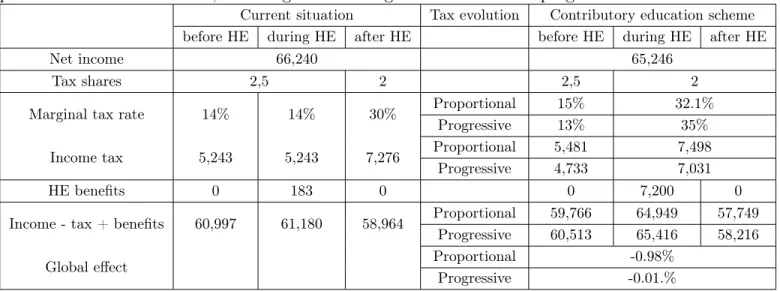
In this simulation, we consider an upper-middle class household with two parents and one child. The child lives in the parental home during her studies. She achieves a Masters degree. The contributory education scheme slightly reduces the budget of this family: by -1% under the pro-portional tax rate evolution; the budget is unchanged under the more progressive evolution.
Current situation Tax evolution Contributory education scheme
before HE during HE after HE before HE during HE after HE
Net income 66,240 65,246
Tax shares 2,5 2 2,5 2
Marginal tax rate 14% 14% 30% Proportional 15% 32.1%
Progressive 13% 35%
Income tax 5,243 5,243 7,276 Proportional 5,481 7,498
Progressive 4,733 7,031
HE benefits 0 183 0 0 7,200 0
Income - tax + benefits 60,997 61,180 58,964 Proportional 59,766 64,949 57,749
Progressive 60,513 65,416 58,216
Global effect Proportional -0.98%
Progressive -0.01.%
Table 7: Case n°3 - Upper-medium class family with one child living at the parental home when student.
Next we consider an upper-middle class household with two parents and two children. The children leave the parental home during their studies. Both study to Masters level. The contributory education scheme increases the budget of this family by 1.45% under the proportional tax rate evolution and by 2.4% under the more progressive evolution.
Current situation Tax evolution Contributory education scheme
before HE during HE after HE before HE during HE after HE
Net income 66,240 65,246
Tax shares 3 2 3 2
Marginal tax rate 14% 14% 30% Proportional 15% 32.1%
Progressive 13% 35%
Income tax 4,573 4,573 7,276 ProportionalProgressive 4,7634,108 7,4987,031
HE benefits 0 4,554 0 0 24,000 0
Income - tax + benefits 61,667 66,221 58,964 Proportional 60,483 81,749 57,749
Progressive 61,138 82,216 58,216
Global effect Proportional 1.4%
Progressive 2.32%
Table 8: Case n°4 - Upper-medium class family with two children leaving the parental home when students.
Finally, we consider a household in the 9th decile with two parents and two children. The children leave the parental home during their studies. Both study to Masters level. The contributory education scheme slightly reduces budget of this family by -1.02% under the proportional tax rate evolution and by -1.76% under the more progressive evolution.
Current situation Tax evolution Contributory education scheme
before HE during HE after HE before HE during HE after HE
Net income 129,240 127,301
Tax shares 3 2 3 2
Marginal tax rate 30% 30% 30% Proportional 32.1% 32.1%
Progressive 13% 35%
Income tax 19,219 19,219 24,786 Proportional 19,999 25,952
Progressive 20,089 28,050
HE benefits 0 4,554 0 0 24,000 0
Income - tax + benefits 110,021 114,575 104,454 Proportional 107,302 125,349 101,349
Progressive 107,212 123,251 99,251
Global effect Proportional -1.42%
Progressive -2.15%
Table 9: Case n°5 - Family from the 9th decile with two children leaving the parental home when students.
These and other simulations not reported here, show that many families would benefit from the contributory education scheme, from lower class to medium class households. Upper-middle class families would benefit from the proposed evolution with some exceptions (see Distribution des revenus, INSEE, 2012). Very high income households (9th decile and above) and households without children (or without children enrolled in higher education), as well as employers, are net contributors in coherence with equity and the social returns to education.
5
Conclusion
In this paper, we proposed a contributory education scheme to replace the self-funded scheme which does not ensure equity, efficiency or resources for higher education in the long run. We discussed the strengths and weaknesses of the contributory scheme from a theoretical perspective. We conclude from the discussion in this paper that the contributory scheme should combine free access, a universal autonomy allowance and additional resources for universities. Reference to the pension funding scheme allows us to distinguish between two kinds of services: merchant ver-sus socialized. The contributory scheme, which is related to the second kind of education service, protects education from financial disturbance and polarization of education institutions. It allows for additional means for study programmes that concentrate students from popular backgrounds, and restores equity by allowing every student good economic conditions during period of study. This should reduce socially oriented drop outs and repeat years, as well as self-exclusion from long study programmes and/or more prestigious courses and universities. A progressive and wide fund-ing system (includfund-ing contributions from foreign graduates and graduates who choose to migrate after the end of their studies), based on both the private and social returns to education, reinforces contributive equity. Finally, we showed how such a scheme could be efficient, reducing adverse selection and moral hazard. The universality of the allowance and corresponding engagement to contribute would prevent wealthier students from opting out of the scheme. The conditions of the allowance (diligence, non-concurrence with waged activity, academic achievement, complying with the recommendations of the orientation committee) are aimed at motivating students.
We proposed an assessment for this contributory scheme (additional €5bn for university re-sources and €19bn for the UAA) and a funding system (respectively on the basis of income tax and the family’s social security status). We found that increasing income tax rates by 7% and the fam-ily social contribution by 3 points would suffice. Some simulations show that the only household that do not directly benefit from the evolution are the wealthiest. The expected additional social returns would benefit the whole population. However, due to the lack of precise data, our simula-tions suffer from some serious limitasimula-tions. 1) We do not take account of the dynamics of income, or the dispersion within income bands. 2) The response to the increase in social contributions should be addressed more precisely. 3) The situation of household whose children do not enter higher education remains untreated. 4) Other funding systems may be more satisfactory than an extension of the current income tax and might integrate adjustments for educational achievement. Addressing these limits is beyond the scope of this article, but open avenues for other research from different perspectives.
The contradiction between spending efficiency and integration difficulties or wrong subject choices requires more investigation, as does students’ accommodation. More generally, equity of higher education needs a system of pedagogic and economic affirmative actions linked to previous education stages, which goes beyond this paper and the economics as a discipline. A major strength of the contributory scheme, as opposed to a merchant self-funded scheme, is that it would allow for explicit and transparent debate on educational issues.
References
Nicholas Barr : Alternative funding resources for higher education. The Economic Journal, 103 (418):718–728, May 1993.
sur la réussite et la poursuite des études universitaires. Économie et Statistique, 422(1):31–50, 2009.
Jere R. Behrman et Nevzer Stacey : The social benefits of education. University of Michigan Press, 1997.
Raymond Boudon : Education, opportunity, and social inequality: Changing prospects in Western society. Wiley-Interscience, New York, 1974.
Raymond Boudon : The art of self-persuasion: The social explanation of false beliefs. Polity Press, Cambridge, 1994.
Pierre Bourdieu : Avenir de classe et causalité du probable. Revue française de sociologie, 15:3–42, 1974.
Richard Breen et John H. Goldthorpe : Explaining educational differentials: Towards a formal rational action theory. Rationality and Society, 9(3):275–303, 1997.
CERC : Education et redistribution. La documentation française, Paris, 2003.
Haroon Chowdry, Lorraine Dearden, Alissa Goodman et Wenchao Jin : The distributional impact of the 2012-13 higher education funding reforms in england. Fiscal Studies, 33(2):211– 236, 2012. ISSN 1475-5890. URL http://dx.doi.org/10.1111/j.1475-5890.2012.00159.x. CNAF : Rapport d’activité. Rapport technique, Allocations familiales - Caisse nationale, 2010. Pierre Courtioux : Peut-on financer l’éducation du supérieur de manière plus équitable ?
Rap-port technique, EDHEC, Janvier 2009.
Erica Field : Educational debt burden and career choice : Evidence from a financial aid experi-ment at nyu law school. American Economic Journal: Applied Economics, 1(1):1–21, 2009. David Flacher et Hugo Harari-Kermadec : Tuition fees, self-esteem and social heterogeneity.
Education economics, 21(2):191–210, 2013.
David Flacher, Hugo Harari-Kermadec et Léonard Moulin : Faut-il (vraiment) augmenter les frais d’inscription à l’université ? Revue française d’économie, 27(3):145–183, 2012.
Milton Friedman : Economics and the Public Interest, chapitre The role of government in education, pages p. 123–144. Piscataway, NJ : Rutgers University Press, 1955.
Don Fullerton et Gilbert E. Metcalf : Tax incidence, volume 4 de Hand-book of Public Economics, chapitre 26, pages 1787 – 1872. Elsevier, 2002. URL http://www.sciencedirect.com/science/article/pii/S1573442002800052.
Robert J. Gary-Bobo et Alain Trannoy : Faut-il augmenter les droits d’inscription à l’université ? Revue française d’économie, 19(3):189–237, 2005.
Howard Glennerster, Stephen Merrett et Gail Wilson : A graduate tax. Higher Education Review, 1(1):26–38, 1968.
Howard Glennerster, Stephen Merrett et Gail Wilson : A graduate tax revisited. Higher Education Review, 35:25–40, 2003.
Jonathan Gruber : The incidence of payroll taxation: Evidence for chile. Journal of Labor Economics, 15(3):72–101, 1997.
Stéphane Grégoir : Les prêts étudiants peuvent-ils être un outil de progrès social? Rapport technique, EDHEC, Lille, Nice., Octobre 2008.
Anders Holm et Mads Meier Jaeger : Does relative risk aversion explain educational inequality ? a dynamic choice approach. Research in Social Stratification and Mobility, 26(3):199–219, 2008.
INSEE : La répartition des dépenses publiques de l’enseignement supérieur et des aides associées. Rapport technique, INSEE, Direction des Statistiques Démographiques et Sociales, Unité des Études Démographiques et Sociales, Division Études Sociales, 2011.
Thomas J. Kane : College entry by blacks since 1970 : The role of college costs, family background, and the returns to education. The Journal of Political Economy, 102(5):878–911, 1994.
Camille Landais, Thomas Piketty et Emmanuel Saez : Pour une révolution fiscale - Un impôt sur le revenu pour le XXIème siècle. La République des idées, Le Seuil, Paris, 2011.
Maurizio Lazzarato : La fabrique de l’homme endetté : essai sur la condition néolibérale. 2011. Jan S. Levy : Student finance schemes in norway. a case study. Rapport technique, IIEP, Unesco,
Paris, 2004.
Yves Lichtenberger et Alexandre Aïdara : Faire réussir nos étudiants, faire progresser la france: Propositions pour un sursaut vers la société de la connaissance. Rapport technique Projet 2012, Contribution n°12, Terra Nova, 23 août 2011.
Eric Maurin : Université : un autre financement est possible. Rapport technique, La vie des Idées, 2007. URL http://www.laviedesidees.fr/Universite-un-autre-financement.html. Walter W. McMahon : Education and Development : Measuring the Social Benefits. Oxford
University Press, 1999.
MESR : L’état de l’enseignement supérieur et de la recherche en france. Rapport technique, Ministère de l’enseignement supérieur et de la recherche, 2011.
Sophie Némoz et Luc Bousquet : En-quête du logement étudiant : synthèse contributive à la consultation de recherche sur le logement et la condition étudiante en france et dans l’union européenne. Rapport technique, PUCA, 2007.
OCDE : Panorama des statistiques de l’ocde. Rapport technique, OCDE, 2010.
OCDE : Regards sur l’éducation 2011 : Les indicateurs de l’ocde. Rapport technique, OCDE, Paris, 2011.
OVE : La vie etudiante - reperes. Rapport technique, Observatoire de la vie etudiante, 2011. George Psacharopoulos et Harry A. Patrinos : Returns to investment in education: A further
Alain Trannoy : Financement des universités, financement des études. Revue d’économie poli-tique, 116(6):745–782, 2006.
Annie Vinokur : Study now, pay later : partage des coûts, endettement étudiant et restruc-turation de l’enseignement supérieur. In Annie Vinokur, éditeur : Pouvoirs et financement en éducation,. L’Harmattan, Paris, 2007.
Annie Vinokur : La querelle des droits d’inscription. Revue du MAUSS, 33(1):441–453, 2009. Gordon C. Winston : Subsidies, hierarchy and peers : The awkward economics of higher
educa-tion. The Journal of Economic Perspectives, 13(1):13–36, Winter 1999.
Barbara L. Wolfe et Robert H. Haveman : Social and nonmarket benefits from education in an advanced economy. In Conference Series, numéro Jun, pages 97–142, 2002.