Bankruptcy, Guns or Campaigns:
Explaining Armed Organizations' Post-War Trajectories
MASAHSETTS INSTITUTE by
Sarah Zukerman Daly M.Sc., Development Studies London School of Economics, 2004
ARCHIVES
B.A., International RelationsStanford University, 2003
SUBMITTED TO THE DEPARTMENT OF POLITICAL SCIENCE IN PARTIAL FULFILLMENT OF THE REQUIREMENTS FOR THE DEGREE OF
DOCTOR OF PHILOSOPHY IN POLITICAL SCIENCE AT THE
MASSACHUSETTS INSTITUTE OF TECHNOLOGY FEBRUARY 2011
0 2011 Sarah Zukerman Daly. All rights reserved.
The author hereby grants to MIT permission to reproduce and to distribute publicly paper and electronic copies of this thesis document in whole or in part in any medium now known or
hereafter created.
Signature of Author: _
Department of Political Science
August 21, 2010
Certified by: _______ __________
Roger Petersen Arthur and Ruth Sloan Professor of Political Science Accepted by:
Roger Petersen aur and Ruth Sloan Professor of Political Science Chair, Graduate Program Committee
Abstract
This project seeks to explain what happens to armed organizations after they sign peace accords. Why do they dissolve, return to war, or form non-violent socio-political entities (political parties or civic associations)? To explain variation in post-war outcomes, my argument centers on the human geography of armed groups. Recruitment, deployment, and post-war migration patterns generate distinct configurations of a) collective capacity, b) relations with civilians, and c) inter-armed group dynamics. I propose that, if a rebel or paramilitary unit recruits in a geographically concentrated area and deploys its fighters in their home communities, the organization will persist and transform into a socio-political entity after disarming. If instead the organization recruits in a dispersed manner, deploys its soldiers away from their towns of origin, and the soldiers either return home or displace to a third locale, the group will disintegrate; it will lose its capacity for collective action. By bankrupting some organizations and preserving others, demobilization has differential effects on armed group capacity. Where it weakens a group, it destabilizes the territorial bargains between the ex-armed group and state and between the group and its contiguous, non-state armed actors. As a result, resumed war becomes likely. If instead, the distribution of power within the system is maintained, the groups will, over time, fully demilitarize and be brought into the state's legal framework. This dissertation is based on rich data collected during fourteen months of fieldwork in Colombia from 2006 to the present during which time I went inside each demobilizing organization to reconstruct and map its post-war trajectory. Exploiting Colombia's unparalleled comparative laboratory for this research, I test the effect of recruitment, deployment, and post-war migration patterns on organizational outcomes using two strategies. First, I conduct a detailed, controlled comparison of armed groups in three regions of Colombia based on interviews of over 200 ex-combatants, civilians, and
victims. The second strategy combines these qualitative sources with quantitative ones to evaluate the proposed hypotheses on the entire universe of municipality-armed group dyads in Colombia (n=1040). For this analysis, I rely on municipal-level violent event data, interviews of nearly 100 Colombian experts on the armed conflict, a database of seven years of news articles, and statistical evidence from a series of surveys of former paramilitaries (n=31,472). The empirics provide strong support for the proposed model. The project has significant implications for debates on reintegration, state-building, consolidating peace, reconciliation, decriminalization, and transitions to democracy.
Table of Contents
Page Acknowledgments
Part I.
1. Introduction
2. Theory of Post-War Trajectories of Armed Organizations 3. Research Design & Methods
4. Historical Narrative of Colombia's Violence
Part II. 5. Bankruptcy 6. Campaigns 7. Guns Part III. 8. Colombia's Insurgencies, 1964-1984 9. Conclusion
Appendix A. Challenges of Remilitarization Research Appendix B. Elite Interviews & Document Collection Appendix C. Survey Methodology
137 195 235 269 285 290 292
Acknowledgements
This has been a rewarding and extraordinary experience. I would like to thank my dissertation advisors - Professors Roger Petersen, Jorge Dominguez, Chappell Lawson, and Barry Posen. Without their inspiration, guidance and encouragement, I would not have achieved even a small measure of what I hoped for this project. I wish to acknowledge their generosity in mentoring me, providing invaluable insights on my research and writing, and endowing me with their infectious spirit of inquiry. I am hopeful that their commitment to analytic rigor, creative research design, and causal processes about important realities on the ground is reflected in this project. The project's errors and limitations remain my own.
I also would like to thank several individuals who were critical to my experience in the field in Colombia. For their willingness to share their time, contacts, data, and penetrating perspectives, I am extremely grateful to Frank Pearl, Alejandro Santo Domingo, Juan Antonio Pungiluppi, Alejandro Eder, Fabio Sanchez, Juan Pablo Trujillo, Juan Carlos Garz6n, Eleuterio Cahuec, Karlymg Rodriguez, Daniel Acosta, William Quintero, Paola Gonzalez, Camila Cuellar, Marcelo Alvarez, Diego Garcia, Gustavo Pita, Juan Carlos Cord6n, Karen Aparicio, Hernindo Corral, Jose Manuel Hernindez, Jorge Gaviria, Jaime Bermudez, Jimena Holguin, and Luis Fernando Cepeda.
Ex-combatants, victims and community members shared their difficult stories with me. They invited me into their domains, permitted my inquiries, and offered their histories to me. I am deeply grateful to them. I am further indebted to Andrea Pineros and Isabel Cardona and would like to acknowledge the assistance of Tomis Martin and Andres Ucros. An additional thank you to my academic affiliation in the field, la Universidad de los Andes.
I enjoyed and benefited immensely from my time at various research centers which provided fertile environments for the development of my research and sound guidance on my dissertation. I thank the exceptional scholars and staff at the Center for International Security and Cooperation at Stanford University, the Belfer Center for Science and International Affairs at Harvard University, the Center for International Studies at MIT, and the International Peace Research Institute, Oslo. I am grateful for my invaluable relationships with my friends and colleagues at these institutions and elsewhere.
I also received useful feedback at various seminars and workshops at MIT, Harvard University, the International Peace Research Institute of Oslo, the Naval War College, Stanford University, Yale University, Universidad de los Andes, Arizona State University, American University, New York University, and the Households in Conflict Network. My project further benefitted from excellent comments and advice from David Abernethy, Ana Arjona, Robert Bates, Gina Bateson, Fotini Christia, Andrew Coe, Teresa Cravo, Martha Crenshaw, Lynn Eden,
Kristin Fabbe, James Fearon, Vanda Felbab-Brown, Francisco Flores, Scott Gates, Kelly Greenhill, Chase Harrison, Carl Henrik Langeback, David Holloway, Lise Morjd Howard, Macartan Humphreys, Patrick Johnston, Bruce Jones, Robert Keohane, Ralf Leiteritz, Steve Levitsky, Janet Lewis, Austin Long, Reo Matsuzaki, Steven Miller, Vipin Narang, Desiree Nilson, Ragnhild Nordas, Melissa Nobles, Brenna Powell, Andrew Radin, Angelika Rettberg,
Robert Rotberg, Fabio Sinchez, Scott Sagan, Stephen Saideman, Nicholas Sambanis, Anoop Sarbahi, Ben Ross Schneider, Lee Seymour, Paul Staniland, Stephen Stedman, Abbey Steele, Yuhki Tajima, Kimberly Theidon, Maya Tudor, Juan Vargas, Jocelyn Viterna, Jeremy Weinstein, Melissa Willard-Foster, and Elisabeth Wood.
possible and for recognizing its potential contribution. The Harry Frank Guggenheim Foundation, Smith Richardson Foundation, Stanford University's CISAC, Harvard University's Belfer Center, the MIT Entrepreneurship Center's Carroll L. Wilson Fund, the United States Institute of Peace, National Science Foundation, Social Science Research Council, Fulbright U.S. Program and MIT's Center for International Studies contributed funding to this project.
Finally, to my husband, Bobby, and my family, for keeping wind to my back during this process. Thank you.
Part I.
Chapter 1 Introduction
I. The Puzzle: Three Divergent Outcomes
Juan Pinilla, Camilo Ospino L6pez, and Felipe Villegasi all fought in the Colombian paramilitaries and disarmed, demobilized, and reintegrated during the peace process of 2003-2006. Their trajectories diverged, offering insights into the varying outcomes of demilitarizing groups during war to peace transitions.
Campaigns
Juan Pinilla surrendered his gun and demobilized with the Bloque Cacique Nutibara (BCN) on the November 2 5th, 2003. Juan had done the things that most in his Medellin
shantytown did. He joined a neighborhood posse at age 10, a gang at age 12 and an armed faction, either rebel or paramilitary, at age 14. On his way home one night, he witnessed the rape of his neighbor, Ana Maria. He was powerless to stop it. After the rapists stormed his home and threatened him with torture and execution if he opened his mouth, Juan created a rival gang
(combo) with his childhood companions. He had observed that the most popular and feared kids
in the city were those with motorcycles, arms, and money - those that belonged to the gangs. With his combo, he rid the area of the rapists' group and cleansed the thieves, drug addicts and petty criminals from his beloved neighborhood. Several years later, his gang joined the ranks of the Bloque Cacique Nutibara paramilitaries who promised them protection and pay. As a paramilitary, Juan operated as a hitman, assassinating everyone on his lengthy to-do list:
1 A majority of my interviews were conducted in confidentiality and the names of interviewees are withheld by mutual agreement and changed in the text in order to protect my respondents and to adhere to the Human Subjects
Protocol. I therefore do not cite my interviewees' names unless they granted me permission to do so. These names have been altered (Ex-paramilitaries, interviews by author, Medellin, Bogotd, and Apartad6, January - July, 2008).
guerrilla militiamen, rival paramilitary fighters, leftist sympathizers, and unauthorized drug dealers.
When Don Berna ordered Juan to disarm as part of a peace process, he obeyed. After relinquishing his gun, he and his BCN comrades returned home to live amidst the communities they had abused, patrolled, extorted, and governed; the communities they had never left. Their
former armed employer, the BCN, endured, transforming into a powerful, non-violent, proto-state organization with a monopoly of 'social work' in Medellin's poor neighborhoods and possession of several local government posts. All 4,000 of his fellow ex-combatants joined. The organization laundered its extensive, illicitly accrued resources and financed its continued reign over Medellin. Its now 'licit' domination remained unchallenged for several years.
Bankruptcy
On December 1 0th of the following year, Camilo Ospino L6pez, disarmed with 1,434
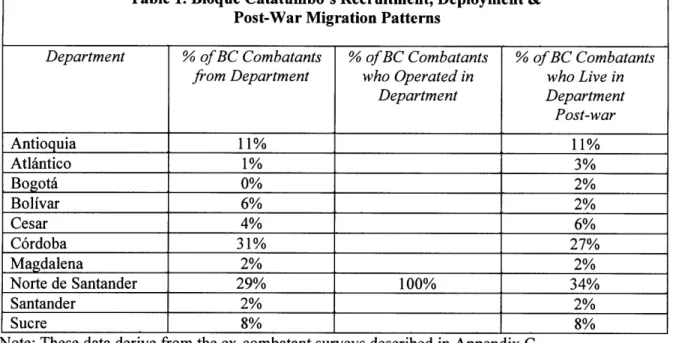
fighters from another paramilitary group, the Bloque Catatumbo, on the Venezuelan border. Camilo was from the far off coastal region of Sucre. Before joining the autodefensas, he had completed his mandatory military service and returned home to find his parents massacred by the guerrillas for not complying with their extortion dues. Driven by a desire for revenge, Camilo tried to rejoin the Colombian armed forces. He also craved the respect, status, and adventure he had reveled in with a gun. He was turned away. The local mayor recommended him instead to a paramilitary commander in the region who had a reputation for paying his foot soldiers well. Soon after joining the paramilitaries, he was deployed to the drug and rebel producing
Catatumbo region near the Venezuelan border, some 800 kilometers from his home. For three years, he trudged through jungles and mountains, embattling the guerrillas and civilian communities.
After surrendering their guns, he and his ex-combatant colleagues and leaders dispersed back to their homes in the coastal regions of Urabi, Cordoba, Sucre, and Atlantico and his paramilitary brigade dissolved. Already uprooted by the war, Camilo chose not to return home as there was little left for him there. With no ties to the Catatumbo region, he decided to migrate instead to Bogoti which promised anonymity and work in the capital's shantytowns. He evaporated into civilian life and maintained no ties to his former comrades. Camilo's expired Bloque Catatumbo left a power vacuum on the Venezuelan border that quickly filled with a miscellany of actors from the underworld: rearmed paramilitary factions, pre-existing criminal mafias and narco-trafficking cartels who became embroiled in persistent fighting.
Guns
Two years later, a third soldier, Felipe Villegas, disarmed with the last of the 34
paramilitary factions - Bloque Elmer Cardenas (BEC) and its 1,536 fighters on the Panamanian frontier. Felipe had joined the paramilitaries fifteen years prior after demobilizing with the EPL guerrillas. The EPL's political party - Hope, Peace and Liberty - was massacred by the FARC who accused it of betraying the revolution.2 Fearing for his life, he joined his former enemy's
ranks - the paramilitaries - who promised him protection in exchange for his military savvy, penetrating intelligence and widespread social web. His years in the BEC were spent managing the paramilitary group's extortion and trafficking activities and recruiting fighters native to the region.
After disarming, Felipe and his local, ex-combatant comrades continued to live where they had patrolled and joined the BEC's civilian reincarnation, 'Constructors of Peace.' Felipe worked on one of Constructors of Peace's palm plantations and spent all of his free time with his former paramilitary companions. He kept his radio and resumed his daily reports to his battalion 2 EPL stands for Popular Liberation Army; the FARC are the Revolutionary Armed Forces of Colombia.
ex-commander, alias, 'El Gato.' 'El Gato' was his source of guidance, employment, and security. He was not alone in turning to 'El Gato' for assistance. When members of the community
wanted to build a school, punish a thief, find work, or collect a debt, they went to see 'El Gato.' Two years after disarming, rumors circulated of the 'Paisas,' a remilitarized faction comprised of BEC's neighboring Bloque Heroes de Tolovi. Threatening pamphlets, a series of assassinations, and civilian protests announced its emergence and encroachment of BEC territory. Felipe was called back to full-scale war by 'El Gato' who remilitarized his battalion in the form of the Gaitanista Self-Defense Forces of Colombia.
11. Introduction
Bankruptcy, Guns, or Campaigns. These are the puzzling, divergent trajectories of demilitarizing groups, which my project seeks to explain. Militia, paramilitary, and rebel groups disarm across the globe and yet we have a surprisingly weak understanding of why they dissolve, endure, and redeploy for war or peaceful politics. In Nepal, the Maoists crowned their transition from underground insurgency to open politics with a victory in the 2008 elections while in Guatemala, the URNG could not muster sufficient support to succeed as a legitimate political actor. In Afghanistan "militia leaders in the north still command the loyalty of thousands of fighters who can be mobilized quickly" (RFE 2007) while in Sierra Leone, the RUF "is obsolete" (UN 2003). This variation remains underexplored and poorly theorized. And yet, the war
termination literature points to the centrality of disbanding armed groups and turning them into political entities and the UN considers "demobilizing combatants [to be] the single most
important factor determining the success of peace operations. Without demobilization, civil wars cannot be brought to an end and other critical goals - such as democratization, justice and
development - have little change for success" (UN 2004). A better understanding of the mechanisms that generate distinct post-war outcomes is a prerequisite for productive theory-building on post-conflict state-theory-building, consolidated peace, reconciliation, and transitions to democracy.
This project seeks to fill this gap and explain what happens to armed organizations after they sign peace agreements and disarm. Why do they dissolve, return to war or transform into non-violent socio-political entities such as political parties or civic associations? To do so, it adopts an organizational approach that impacts how we think about many important questions in social science and challenges the micro and macro level analyses that dominate the civil war research agenda. This project emphasizes the explanatory leverage of human and social geography, contesting the causal priority afforded physical terrain and natural resources in the peace scholarship. Methodologically, the analysis assumes a multi-method, sub-national approach and disaggregates organizations to their most critical units.
To explain variation in armed groups' post-war trajectories, my argument identifies two key factors. First, I find that where armed groups recruit and deploy their fighters determines the combatants' network structures and post-war migration and thus, whether the organization survives or disintegrates. It also determines the group's embeddedness in the civilian population and its ability to maintain political influence without arms. I conclude that non-local rebel and paramilitary groups, which recruited their fighters from dispersed regions, are prone to
disintegration. In contrast, local militarized groups, which drew a majority of their recruits from the communities in which they fought, are comprised of combatants who are strongly linked to each other, remain concentrated in the zone of deployment post-war, and are entrenched in their communities. These local groups thus face a high probability of persisting and forming
legitimate political entities after disarming.
Second, by bankrupting some organizations and preserving others, demobilization has differential effects on armed groups' collective capacities. Where it weakens a group, it destabilizes the territorial bargains between the group and state and between the group and its contiguous, non-state armed actors. It also creates high levels of noise and optimism around the extent to which it has done so. As a result, renegotiating bargains becomes difficult and resumed war likely. If instead, the distribution of power within the system maintains, the militarized
groups will, over time, fully disarm and be brought into the state's legal framework.
This Introduction advances in two sections. It specifies how the project contributes to key questions in Political Science and challenges existing theoretical explanations of post-war outcomes. The chapter concludes with a road map for what lies ahead.
III. Micro and Macro Approaches
Scholars who write about peace analyze either the individual or country units of analysis. The micro approach seeks to explain variation in individual ex-combatants' reintegration
success. It studies why former fighters vote, find jobs, avoid psychological trauma, and behave as normal civilians and points to characteristics of the ex-combatants such as their age,
education, and exposure to violence during the war.3
Despite a recent push to the micro level, the majority of civil war research remains at the country level. The macro approach seeks to explain why countries experience recurrent war or
3 Humphreys and Weinstein 2007 finds that former soldiers who experienced greater violence in Sierra Leone prove less likely to reintegrate successfully. Blattman and Annan Forthcoming concludes that soldiering has detrimental effects on economic, but not psychological, reintegration and Blattman 2009 argues that abduction leads to increases in political participation in Uganda. An ongoing study by Mvukiyehe, Samii, and Taylor investigates the micro-dimension of peacekeeping in Burundi. Several policy-oriented works evaluate UN and World Bank DDR program
peace and focuses on the role of security guarantees and addressing the grievances that lead to war in the first place.4
Missing is a literature on the organizational dynamics of conflict resolution and peace building. How can we study the peace process in El Salvador without knowledge of the FMLN and ORDEN? How can we research reintegration in Sierra Leone without exploring the trajectories of the RUF and Civil Defense Forces? Organizations are critical actors in the post-war environment and can enable us to understand why organized violence reappears and why peace consolidates and what that peace looks like. Accordingly, this project places the organization at the center of its causal story of war to peace transition.
While an exciting, new literature has emerged on organizations during war, studying their onset, recruitment, repertoires of violence, and governance strategies, this literature has not broadened the analysis to armed organizations after a peace is signed.5 For this reason, I have devoted several years to extending this research agenda to the post-war period, getting inside the opaque, secretive, armed structures, and understanding how individual fighters live within their constraints. I have collected original, fine-grained data on demilitarizing groups that enable me to build theory and test hypotheses at this level of analysis at which little work has been done.
IV. An Organizational Approach
'Organizational weapons' are "a source of power [which when] tapped ... may be ... diverted to other, more far-reaching aims." - Philip Selznick6
By placing the organization at the center of the analysis, this project generates theory on several critical spheres of conflict studies: a) the inner workings of rebel and paramilitary groups;
4 Walter 1997, 2004; Toft Forthcoming.
5 Kalyvas 2006; Wood 2003, 2006; Petersen 2002; Kasfir 2009; Weinstein 2006; Lichbach 1995.
b) the alliances and disputes between these groups; c) their dynamics with the state; and d) the interactions between them and civilian communities (Figure 1). The project then synthesizes these usually separately analyzed spheres to gain traction on the macro post-war landscape.
Figure 1. Inputs into the Analysis7 Internal Dynamics Dynamics Between of Organizations
State & Former (Between Top Armed Commanders, Mid-Organizations ranking Leaders
and Foot Soldiers) Dynamics Between
Former Armed Dynamics Between
Organizations & Contiguous Illegal
Civilian Post- Ex-Armed Groups
Communities Demobilization Organizational Trajectories
I will briefly break down the project's contribution in each of these spheres and then suggest how, combined, the project refines our existing thinking on civil war and peace.
First, the project offers a lens into the opaque interior of armed structures. It demonstrates how strategic decisions at the upper rungs of leadership, such as those of soldier deployment, interact with micro decisions at the lower tiers of command, such as those of migration, to generate distinct organizational outcomes: survival or bankruptcy. The project further explores where institutional stickiness and lock-in dominate, rendering group trajectories path-dependent, and where instead there exists maneuverability for policy to impact outcomes.
7 In turning this dissertation project into a book manuscript, I plan to also consider the dynamics between the armed
organization and external states and the international community. 8 For path dependency theory, see North
Second, by examining the dynamics between former armed entities and between these entities and the state, the project facilitates revisions to interstate conflict theories of intrastate war.9 Using micro, field-based data,10 it indicates the conditions under which illegal non-state actors can be treated justifiably as states and when this analogy with the international system reaches its limits.
Finally, the project enhances our process-oriented understanding of the relationship between ex-combatants and their communities and generates new insights into civilians' rejection, tolerance and even endorsement of coercive rule and its legacies. The project confers agency upon non-combatants rather than treating them as passive by-standers to the fate of their communities' governance.
Weaving together these pieces, the project finds the common, critical thread to be human geography; where individuals are, and who they are tied to, matter immensely in explaining inter and intra group dynamics. Mapping this geography yields interesting refinements of our
conventional wisdoms of war and peace.
V. Divergence from Conventional Wisdoms of Post-War Outcomes
This study questions the deterministic role afforded resources in explaining post-war outcomes. The political economy of war theories predict that resource-rich groups are more likely to remilitarize and splinter, and are less likely to form socio-political entities than are resource-poor units." While focusing on processes during war, resource determinism offers four
9 Interstate theories applied to intrastate realm include Walter 1997; Fortna 2004.
10 This sub-national data contrasts with most existing studies of intrastate violent outcomes which use national-level data: democracy scores, natural resources, life expectancy, GDP, etc. See, for example, Walter 2004; Collier and Hoeffler 2004; Collier et al. 2003; Doyle and Sambanis 2000; Elbadawi and Sambanis 2001, 2002; Hegre et al.
2001; Reynal-Querol 2002; Gleditsch et al. 2002; Murdoch and Sandler 2002; Reynal-Querol 2002; Ron 2005;
Sambanis 2002; Fearon 2004.
implications for the post-war environment: a) armed units endowed with natural resource wealth, criminal opportunities or external support attract opportunistic joiners and thus suffer greater principal-agent problems and vulnerability to organizational fragmentation; b) resource-rich groups commit greater and more arbitrary violence against the non-combatant populations 2 and,
as a result, are less likely to muster the civilian backing necessary to be able to form legitimate political organizations; c) these groups are driven by material motivations and are thus unlikely
to want to form socio-political organizations; and d) loot-based groups, in stark contrast to
socially-endowed, ideological armed units, are fundamentally greedy and thus lack incentives to commit to peace; war constitutes a more efficient means to their desired end: supra-profits. These claims have been heralded by scholars, journalists, and practitioners alike. A majority of leading academic articles on civil war focus exclusively on the presence of natural resources and their link to conflict outcomes.'4 References to thugs, warlords, and narco-terrorists abound in
journalistic accounts and imply that these labels have explanatory value.'5 And practitioners
aiming to separate allies from enemies, hang tightly to these motivational labels.
In resource determinism's critical case of cocaine-saturated Colombia, the geographic distributions of drugs, trafficking routes, gems, oil, and extortion opportunities provide a
surprisingly weak guide to organizational outcomes: war recurrence, bankruptcy, or campaigns. I find that resources can explain military strength and expansion, international legitimacy, and corruptive capacity, but cannot account for variation in the inner workings of armed groups, their
2) 'organizational economics' (Weinstein 2002, 2006); and 3) capacity (Seymour 2008; Johnston 2008). I group the
first two strands together. The only difference in their predictions is that the greed theory assumes organizational endurance while the organizational economics variant asserts that resource-rich groups suffer principal-agent problems and splinter.
12 Weinstein 2006; Weinstein and Humphreys 2008. 13 De Zeeuw 2008.
14 Humphreys 2005; Lujala 2003; Ross 2006; Ostby, Hegre and Raighleigh 2008; Skaperdas 2002; Keen 2000;
Auty 2004; de Soysa 2000; Bellows and Miguel 2008.
relations with civilian populations, their interactions with the state, or their inter-illegal armed faction dynamics. A quick look at armed groups' trajectories around the world provides credence to this finding. There are cases of resource-rich groups that disappeared (Sierra Leone's RUF), remilitarized (Angola's UNITA, Peru's Sendero Luminoso), and became political parties (Mozambique's RENAMO, Sudan's SPLA/M, Lebanon's Hezbollah). Similarly, there are examples of resource-poor groups that disintegrated (Colombia's EPL), returned to fighting (Nicaragua's Contras), and formed peaceful socio-political organizations (Nepal's Maoists, El Salvador's FMLN). Important variation exists within similarly resource-endowed groups.
The study also disputes the explanatory hegemony currently held by credible
commitment problems in accounting for patterns of resumed war. This theory asserts that the post-civil war environment is anarchical, and thus ex-adversaries cannot credibly commit to disarmament.16 Specifically, ex-combatants cannot trust that the government will keep its peace promises after they surrender their weapons (Walter 1997; Fearon 2004). Accordingly, absent security guarantees, ex-combatants opt for rearmament while wars, which end with peace terms that reduce the security dilemma, are more likely to avert renewed violence. These peace terms
include external guarantees by credible and committed third-parties and internal guarantees of security sector reform, power-sharing arrangements, and de facto partitions.'7
This project undermines the explanatory power of commitment problems by
demonstrating that there are shocks to the system that cannot be predicted or prevented. In these cases, 'credible commitment' is not the dominant mechanism. Demobilization can constitute one such shock. It can suddenly alter organizational capacity, bankrupting some ex-armed groups
16 See Posen 1993; Snyder and Jervis 1999 for the civil war onset corollary of this thesis.
17 On external guarantees, see Walter 1997, 1999; Doyle and Sambanis 2000; Fortna 2004. On security sector
reform, see Toft forthcoming; Call 2007; Hoddie and Hartzell 2003; Licklider 2009. For key works on power-sharing, see Lijphart 1977; Horowitz 1991; Roeder and Rothchild 2005. Kaufmann 1996 champions the partition solution.
while preserving others, but then its effect ends. It follows that the anticipated distribution of power in the next period mirrors that immediately following demobilization. There is no
expectation of afuture shift in strength and thus the parties should be able to reach a bargain (Powell 2006). Additionally, the effect of demobilization on relative power is notforeseen.1 8 Armed groups would not have demobilized had they predicted they would be bankrupted or weakened by doing so. The credible commitment argument purports to explain the post-conflict environment and yet, it cannot offer analytic leverage on the success and subsequent failure of bargaining. While certain interstate logics have been applied indiscriminately to domestic contexts, those of informational problems and mutual optimism have received scant attention in the intrastate domain.19 This project constitutes a first attempt to incorporate information
asymmetries within organizations into our models of war to peace transitions.
This project also questions pure, agency-based causality and confers support to institutional approaches. While leaders' decisions and strategies are key to explaining the organizational forms that emerge, this project finds high levels of path-dependency. Leaders' future decisions are constrained by how they have engineered the organizational 'machine,'20 specifically, where they recruited and deployed their soldiers. These variables therefore gain causal priority.
An additional divergence from dominant accounts lies in the study's shift away from the 'popular support' approach. The conventional view holds that civilians will support
ex-combatants if they endorsed the armed group's platform or if the ex-combatants used 'less' violence
18 There is little work on the effects of unforeseen shocks on bargaining. Muhammet Bas and Andrew Coe are
working on modeling this phenomenon.
19 For these theories application to the interstate arena, see Fearon 1995 for information problems. For mutual optimism theory, see Blainey 1988.
21
while at war. Implicit is an assumption that there are acceptable levels of violence and that, irrespective of the use of massacres, kidnappings, homicide, and coerced taxation, ideological affinity will translate into civilian endorsement. Against these common claims, this project finds so-called popular support puzzling. Why would a family, victimized by years of extortion, their son 'disappeared' by the actions of a rebel group, 'support' the group? Because the family shared its Marxist ideology? Because its combatants did not exterminate the entire village, only their son? I find that civilians rarely 'support' violence and ideological affinity does not generate non-combatant tolerance for ex-non-combatants' influence over civilian affairs; rather human ties, sticky social institutions, and retrospective voting do. The term 'popular support' needs to be explained and imbued with meaning before it can be claimed to be a cause.
Finally, by focusing on armed organizational legacies, this project challenges the
common assumption of a semblance between the variables that lead to war in the first place and those that lead to its recurrence. It also questions the academic standard operating procedure of treating war as a two-party game between the state and rebel group2 3 and demonstrates the
importance of looking at the multitude of actors in civil wars, especially at the prevalent and entirely understudied paramilitary structures.2 4 Finally, it highlights the analytic efficiency of
disaggregating these structures to their most causally relevant units of analysis.
21 Manning 2004, 2007; de Zeeuw 2008; Siderberg 2007.
22 All of our datasets and even our theories lump together war onset and war recurrence. Both are coded '1' and
explained using the same logic.
23 See, for example, Mason and Fett 1996.
24 An exception is a new project on pro-state militias: http://www.abdn.ac.uk/militias/. See Carey, Mitchell, and
VI. Road Map
The project divides into three sections.
Part ]
Part I, comprising Chapters 2-4, introduces the dissertation's theory, research design and empirical data. Chapter 2 outlines the schematics of the argument and locates the project's focus on the organization in contrast to previous studies, which have examined the post-war landscape at either the macro or micro units of analysis. Chapter 3 specifies how I test the proposed logic against the strongest alternatives. It introduces the chapter's multi-method approach, which nests detailed process tracing of battalions in three regions within a quantitative analysis of all
battalion-community dyads in Colombia. It further justifies the sub-national research design, which facilitates the collection of detailed information about where armed organizations recruit and deploy, their relative power, and their post-war trajectories. This chapter further presents the rich sources from which the project draws including survey, interview, violent event, and
ethnographic data. Chapter 4 introduces the comparative laboratory for this research: the Colombian paramilitaries. Thirty-six paramilitary organizations, comprising 31,671 fighters signed peace accords with the government and disarmed between 2003 and 2006. They exhibited significant divergence in their post-war paths, allowing me to exploit within country variation to maximize my number of cases while holding many confounding factors constant. This fourth chapter provides the historical background on the Colombian paramilitaries in general and on the three regions that feature prominently in the project's empirical analyses.
Part II
Part II - Chapters 5-7 - disentangles the determinants of armed organizations' post-war trajectories. Chapter 5 - Bankruptcy - explores the challenges of war to peace transitions for
organizational survival. It shows how armed groups' recruitment and post-war migration
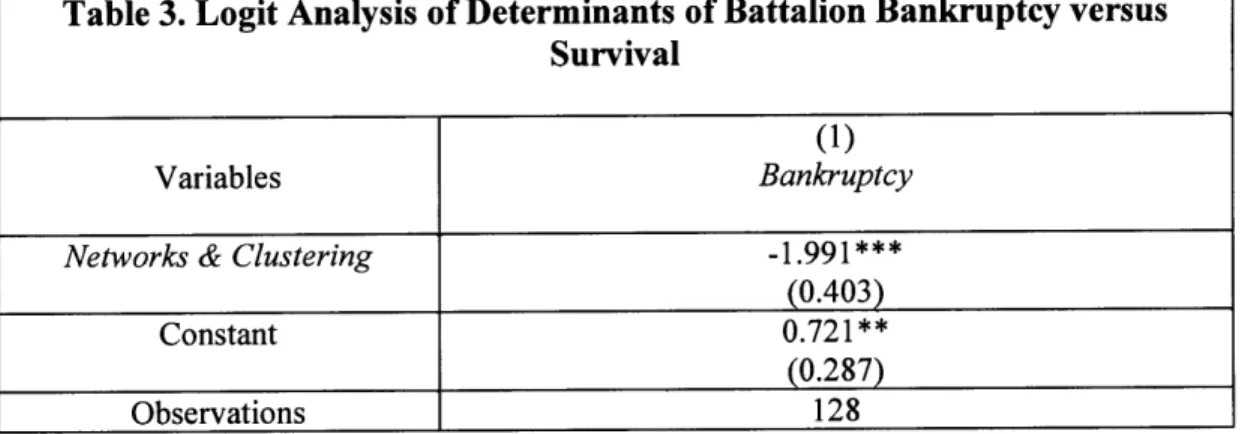
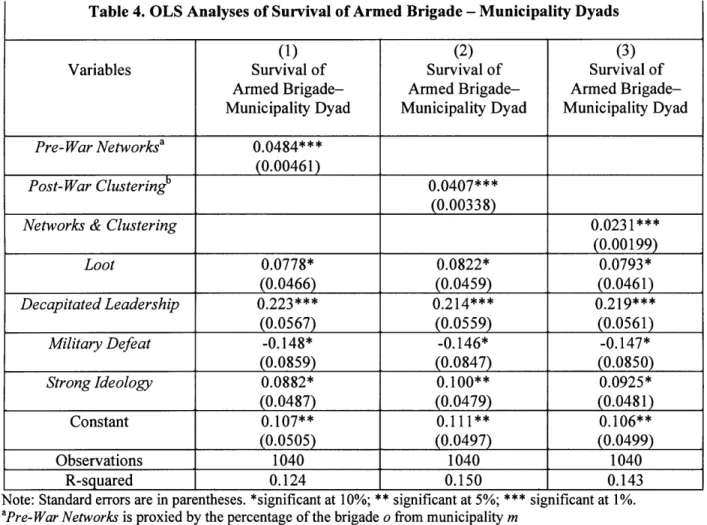
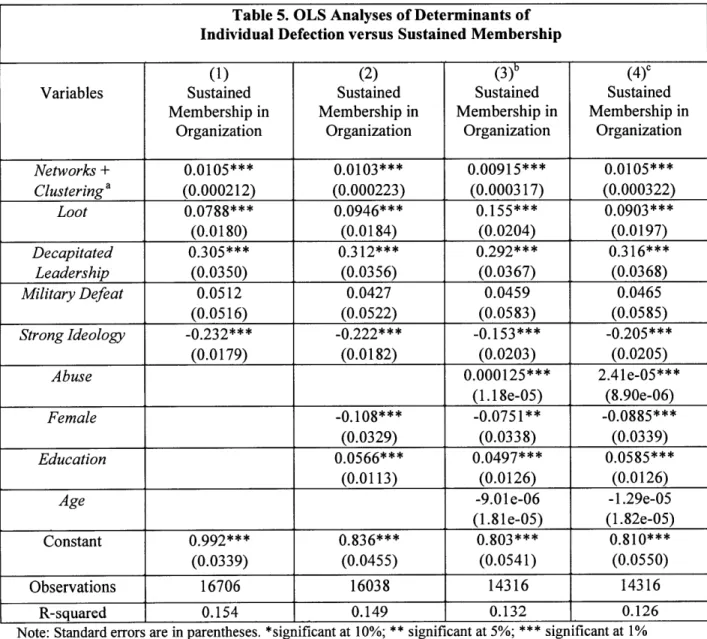
strategies account for some groups going bankrupt after disarming while others retain a capacity for collective action through the two mechanisms of multifaceted networks and physical
clustering of former combatants. It therefore highlights the inner workings of armed
organizations in the aftermath of a peace accord. Chapter 6 - Campaigns - focuses on variation in former armed groups' leverage over social and political civilian affairs and on why non-combatants endorse or reject ex-non-combatants' influence. The model centers on deployment strategies and their effects on a) the social networks between combatants and civilians, b) victims' levels of anger at their perpetrators, c) the perceived shadow of the future of ex-fighter-civilian interactions, and d) the stickiness of institutions of authority. This chapter shows how configurations of deployment and migration produce varying levels of embeddedness, which in turn translates into differing abilities to rule without opposition. The chapter maps the dynamics between formerly militarized actors and non-combatants communities. Chapter 7 - Guns - turns to the inter-armed group processes to understand divergence in remilitarization and
demilitarization. It shows how demobilization may prompt changes in the distribution of power and thereby destabilize the system of mutually-dependent bargains between non-state actors and between the state and each rebel or paramilitary faction. It explores how the bankruptcy of some organizations and survival of others, as documented in Chapter 5, alters the parameters
underpinning the formal and informal peace bargains and, in so doing, fractures the delicate peace architecture. Remilitarization is the result. It contrasts this trajectory with that of dyads whose power differential withstands the upheaval of demobilization and thereby cements the demilitarization regime.
Part II draws on evidence from the three comparative case studies to qualitatively evaluate the logic and from extensive survey data to quantitatively assess the model. Each of these chapters presents in greater detail the schematics of the argument and takes a different slice
of the organizational evolution of the armed group: its survival, its involvement in society's civil and political life, and its return to violence. Each sets the argument against the alternatives and provides rigorous tests of the observable implications. Part II thus tests the validity of the theory as applied separately to each of the post-war trajectories.
Part IHI
Part III, comprising Chapters 8 and 9 takes the theory beyond the Colombian
paramilitaries to assess its explanatory weight in other contexts. Chapter 8 uses sub-national data on the emergence of rebellion in Colombia to evaluate the project's logic against the dominant accounts of civil war recurrence. Contrary to the conventional wisdom, it does not find
mountainous, impoverished areas, saturated with lootable resources to be most prone to insurgency. Instead, the conditions able to account for the geographic variation in rebellions' emergence are the organizational legacies of war: dense social capital and networks for violence and reservoirs of insufficiently demobilized and reintegrated ex-combatants. The project's final chapter skims the world for evidence of the theory's generalizability and specifies the impact of the project on the study of war to peace transitions and the study of violence more generally. It concludes with the policy implications for practitioners aiming to dismantle rebel and
paramilitary structures, harness their collective capacities, neutralize their coercive logics, and redeploy them for peaceful politics.
Chapter 2
Theory of Post-War Trajectories of Armed Organizations
I. A Theory of Post-War Trajectories
What happens to armed organizations after they sign peace accords and disarm? Why do they disappear, remilitarize or become non-violent socio-political entities (political parties or civic associations)? This chapter outlines the broad brushstrokes of the project's theory while Chapters 5-7 fill in the fine-grained details of the three outcomes: bankruptcy, campaigns, and guns.
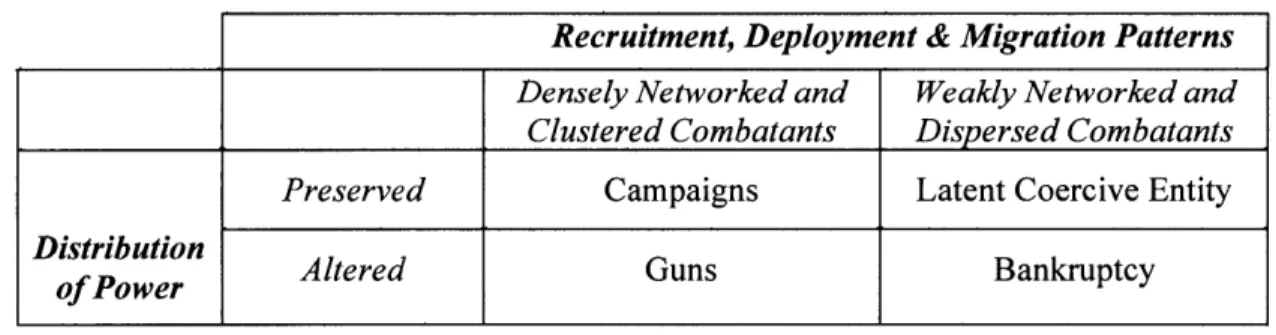
In this project, I argue that rebel and paramilitary groups' recruitment, deployment, and post-war migration patterns interact to generate distinct post-demobilization trajectories (Figure 2). Concurring with Hunter 1997's critique of modes of transition theory, I opt for a dynamic approach that explains variation in ex-armed groups' paths over time.2 5
Figure 2. Variation in Post-Demobilization Trajectories26
Recruitment, Deployment & Migration Patterns
Densely Networked and Weakly Networked and
Clustered Combatants Dispersed Combatants
Preserved Campaigns Latent Coercive Entity
Distribution Altered Guns Bankruptcy
of Power
25 Stepan 1988 offers a path dependent explanation for states' divergent civil-military relations post-dictatorship. Hunter 1997 critiques Stepan's approach arguing that it is necessary to look not only at continuity in military prerogatives but also at change. I concur and therefore aim to explain both the ex-armed organizations' initial post-demobilization trajectories and their evolution over time.
26 In Colombia, in the aftermath of demobilization, we observe 40% of the paramilitary structures going bankrupt,
Organizational Challenges of War to Peace Transitions
In order to secure a peace accord, an armed group must pose a sufficient threat to the state such that the state prefers to bargain than continue fighting. To pose a sufficient threat, the armed group must overcome the key organizational challenges of asymmetric information, externalities,2 8 and adverse selection.2 9 During an armed group's transition from war to peace,
these challenges resurface. Specifically, uncertainty and misinformation are pervasive. While at war, combatants live according to orders. They awake, eat, walk, steal, torture, kill when ordered to; they act as part of a collective, not as individuals. Then, one day they are ordered to disarm and, from night to day, they become civilians again. In the aftermath of demobilization, the group's organizational mission and goals also become in flux and its regime of cooperation is disrupted. Ex-fighters do not know if their former group will transmute, what it will become, if they will be called back to fight, and if they will face judicial ramifications for their participation. It follows that the common knowledge, shared perceptions of trustworthiness, and informal norms that maintained cooperation during combat are destabilized, requiring a recalibration of the entire network of mutually reinforcing expectations and programmed responses (Miller 1992; March and Simon 1958). At the same time, combatants may recognize that their competency in the use of violence (extreme asset specificity) will render them redundant in a demobilized organization or in civilian society (Chai 1993). The organization's fighters also often come to
27 Asymmetric information exists in organizations because "the knowledge of which we must make use never exists
in concentrated or integrated form but solely as the dispersed bits of incomplete and frequently contradictory knowledge which all the separate individuals possess" (Hayek 1948, p. 78).
28 Externalities result because each member's productivity is a function of others' efforts; the benefits of the labor
are divided equally, but the costs of the work effort are individual thus creating opportunities for individual shirking. Team production (producing violence, community work, political campaigns, etc.) is especially prone to
externalities.
29 Adverse selection arises because potential recruits' skills and commitment are often unobservable, proxied only
by rough indicators. Moreover, information is asymmetric; only the potential recruits know their true value. Given
these conditions, organizations end up with lower quality hires (Coase 1960; Moe 2001; Miller 1992). Weinstein
believe that, by signing a peace accord, their commanders are shirking.30 Commanders rarely consult their subordinates before agreeing to demobilize and thus, the rank and file and mid-ranking leaders are transformed from combatants to non-combatants without anyone seeking their consent.3' Moreover, commanders often negotiate peace terms that serve their individual
self-interests rather than those of their subordinates. Incentives to desert escalate and sustaining the group's capacity for organized collective action becomes difficult.
Organizational Survival vs. Bankruptcy
I argue that one type of organization finds itself well-positioned to overcome these challenges: an organization whose combatants enjoy multifaceted networks and remain
physically concentrated after disarming, enabling the organizations to retain a structure and
disciplined collective action.
Multifaceted bonds are pre-war networks that foster trust, deepen 'identity-movement'
linkage, guarantee repeated interactions, and thus produce norms of reciprocity that keep individuals linked to and cooperating with the organization. The dense social ties further confer to the organization an endowment of institutionalized normative authority, information about members' reputations, and a rich array of positive and negative sanctions that enable ex-armed
groups to continue policing contributions and effectively monitoring participants even after they have demobilized (Ghosh and Ray 1996). Finally, recruitment through multifaceted networks mitigates the adverse selection problem by providing more accurate information as to the
30 See North and Weingast 1989 for a discussion of the conditions under which employees trust their managers. During war-to-peace transitions, armed leadership rarely complies with these conditions. For example, UNITA
leaders left their men to go to Luanda where they were rewarded with houses and cars (Africa Confidential 2002). 3 In a survey conducted of 120 former fighters who returned to arms post-demobilization, 54% responded 'No' to the question, "If you had not received the order to demobilize, would you have demobilized?" (Zukerman and Gonzalez 2008).
recruits' 'true selves' (degree of honesty, commitment to the cause, and competence ).33 Thus,
organizations characterized by these multidimensional bonds are more likely to be staffed with employees that will act in the organization's interest even after the fighting has ended.
Combined, these assets render densely networked organizations more likely to survive the challenging conditions of war to peace transitions.3 4
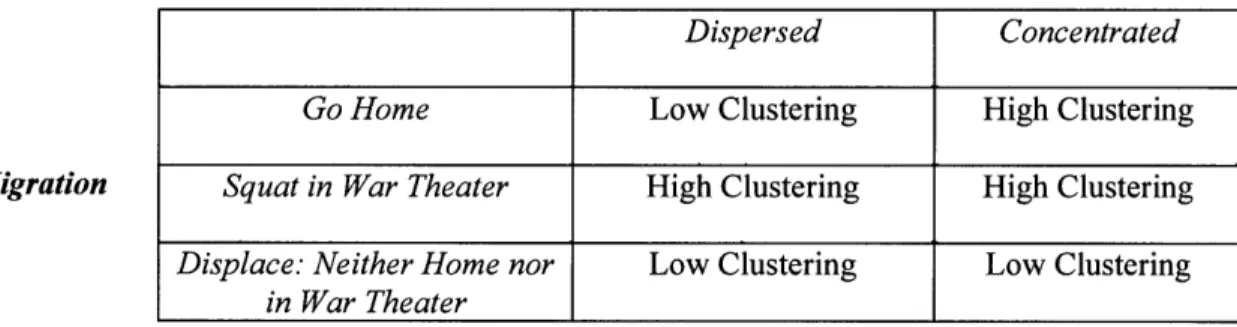
Physical Clustering, meanwhile, protects and strengthens the social capital between
comrades35 and, by facilitating continued face-to-face interactions, lowers information
asymmetries, reduces transaction costs of monitoring, and renders sanctioning of misbehavior credible. It thus reduces incentives for subordinates and commanders to defect. To police, punish, and reward, one must possess information on the subject's whereabouts. Networks and physical clustering provide this. Additionally, geographical concentration of former fighters generates a longer shadow of the future; these ex-comrades will continue to interact into the indefinite future as displacement is highly costly. Last, former commanders and foot soldiers' close personalized exchange creates a host of side-payments to influence each other's behavior including "social acceptance, personal services, or other motivating factors" (Miller 1992).36 By defecting, former combatants lose their friends and, in some cases, their families. They also signal untrustworthiness. Their former comrades cannot tell if their decision not to participate in the organization implies that they wish to remain neutral (stay home) or to instead defect to the
3 For adverse selection theory, see Simon 1957; Williamson 1975, Alchian and Demsetz 1972. Networks also
socialize people to specific sets of values, ideologies and worldviews.
34 The role of community ties in achieving collective action has also been emphasized in the study of mobilization and cooperation within ethnic groups (Fearon and Laitin 1996).
* I treat social capital as a neutral category and "political multiplier" in line with Berman 1997 and Putnam 2000. Berman 1997 shows that when we define robust civil society neutrally as high levels of associationalism, it is equally likely to strengthen bad equilibrium points such as fascism, terrorism, authoritarianism, or remilitarization as it is good ones such as democracy (or socio-political entities). See also Popkin 1979; Coleman 1988; Tarrow 1998 for how social capital can act as receptacles of collective action to be appropriated for future forms of cooperation.
36 Other authors writing on the effect of interpersonal ties on cohesion include Laumann 1973; Gross and Martin
other side (provide information to the government or enemy force). Even though disarmed, it can be suicidal for ex-fighters to desert as they possess valuable information, which can jeopardize their comrades' amnesty, extradition rulings, illicit earnings, or civilian political futures. Their comrades may choose to silence them through assassination rather than risk this information's revelation. Thus, physically clustered groups' intimate knowledge about their participants deters defection; ex-combatants must continue to signal loyalty and remaining part of the organization is the best way to do so (Gould 1995). In sum, iterated interactions through physical
concentration and multifaceted bonds linking combatants to their formerly armed organization enable the local group to sustain disciplined collective action. These networks and geographical clustering, as will be elaborated upon in Chapter 5, are a function of armed organizations' recruitment, deployment and post-war migration patterns.
Mechanism #1: Recruitment Patterns & Post War Migration
Strong Networks + Organization
Phystical Clustering Survives
Recruitment,
Deployment & Migration Patterns
Thin Networks + Organization Goes
Physical Dispersion Bankrupt
Where these bonds and physical clustering are lacking, organizations are prone to disintegration. Without dense ties, these organizations' fighters have more diffuse trust and weaker norms of reciprocity. Geographically dispersed, expectations of future interactions diminish and ex-combatants face little incentive to cooperate; defection snowballs. Isolated, superiors do not know where to find their subordinates so monitoring costs escalate. Lacking social solidarity and face-to-face interactions, "each [ex-]soldier is theoretically freed from
constraint and may pursue individual rather than group ends;" organizational bankruptcy becomes likely (Bearman 1991).
Campaigns
If its networks and geographic distribution favor organizational survival, the resultant structure may reinvent itself as a socio-political organization with leverage over civilian affairs. Its ability to do so depends on its embeddedness in the communities, which is a function of its deployment strategy. Groups, which station their fighters in their home communities, comprise combatants who are tied to the civilian population through familial, friendship, neighborhood, and other networks. Evidence suggests that these networks reduce victims' levels of anger and facilitate reconciliation. Moreover, given the high cost of displacement, the community members recognize that the combatants will continue to reside in their neighborhoods for at least the medium term, thereby extending the shadow of the future and encouraging cooperation. I propose that this embeddedness allows local demilitarizing organizations to exercise influence over civilian affairs without the manifest use of arms. It affords the former combatants the authority and endorsement to potentially gain votes, regulate economic activities, dictate social norms, and administer local justice without community resistance.
If deployed far from their homes, combatants lack these ties to the civilian communities and the prospect of enduring future interactions. Accordingly, non-combatants resist and reject the non-local groups' presence and governance and denounce their 'silent guns.' Not embedded in the communities, these non-local armed groups prove unable to form legitimate socio-political entities after disarming.
Mechanism #2: Deployment Patterns
Survives as
Locally Embedded in
Socio-Deployed Communities Political
Recruitment, Organization
Deployment &
Migration PatternsLiteLvrg
Pe Non-Locally Not Embedded Little Leverage
Deployed in Communities over Civilian
Deploed inAffairs
In sum, recruitment, deployment, and post-war migration patterns determine if a former rebel or paramilitary group disappears or not and, if it survives, if it is able to form a legal socio-political organization. The distribution of power determines if the group returns to violence or not.
Guns
Altered Distribution of Power
At time= 1, militarized entities (state and non-state) broker formal and informal deals, which result in cooperation and the successful demobilization of the non-state armed groups. Demobilization shocks the capacity of some groups - thinly networked and dispersed ones
-while preserving others. It thereby upsets the distribution of power between certain dyads and changes the parameters underwriting the interdependent bargains. The bargains' terms therefore require renegotiation. However, due to organizational pathologies and information short-circuiting within organizations, there is wide variance surrounding and thus disagreement about the estimates of relative power, complicating the bargaining process. Mutual optimism and remilitarization result. This is not a story about bargaining indivisibilities or commitment
has demobilized and when there are private information and incentives to misrepresent within an organization. Thus, if the demobilized group's power shifts relative to its neighboring armed actors (either it is weakened or strengthened by demobilization), a return to violence is likely. Its altered strength is not commensurate to that prevailing when it negotiated the terms of its peace accord.
It should be noted that local groups' organizational assets - multifaceted networks and physical clustering - are critical to the group sustaining the collective action required for remilitarization. Specifically, these assets constrain the individual former fighters in the
following ways: 1) they link the ex-fighters' status to the network; 2) they apply social pressure to cooperate with their former comrades to whom they are densely connected; 3) they afford the leadership the credible sanctions necessary to re-recruit; and 4) they provide reassurance that, if a faction of the web remobilizes, others will follow and that it will be safe to follow (Petersen 2001).
Mechanism #3: Distribution of Power
Change in Power
Relative to State and _ Remilitarizes
Neighboring Non-State Actors Intact or Rump
Organization
No Change in Power
S-< Relative to State and Remains with
Contiguous Non-State Silent Guns
Actors
I assume in this analysis that the state seeks the Weberian goal of a monopoly of the use of violence within its borders. Thus, following a peace negotiation, it seeks to act as a revisionist actor, expanding its power and reasserting its authority in regions under illegal armed group control. However, it can do so either through contestation or through co-optation. Drawing on
Stepan 1988's conception of civil-military relations during democratic transitions, I treat the ex-paramilitary organization as a military exiting from power with its prerogatives and power to a greater or lesser extent intact. I propose that the state chooses a level of 'articulated military contention" - the extent to which it will challenge these prerogatives - based on the extent of the demobilized group's bankruptcy. If the demobilized group is weakened relative to the state, the state will be emboldened by its superior force and the power void left by the decaying army. Accordingly, it will not respect the group's territorial sovereignty and will seek to circumvent the group's authority in its zone of control. The government will do so (often with international community backing) by building schools, infrastructure, police stations, health clinics etc.
(reconstruction) or by engaging in more direct forms of contestation. Its actions will be perceived as offensive and can spark defensive, if feeble, redeployment by the weakened ex-rebel or
paramilitary unit.
Preserved Distribution of Power
Where demobilization does not shock the distribution of power, but instead leaves the (usually networked, clustered) group's relative power unchanged, the state will ally with it and assert its presence in the former armed group's zones of operation by cooperating with the group and recognizing its sovereignty. Additionally, the bargains will hold between the ex-rebel or paramilitary group and its contiguous non-state armed actors.37
It should be noted that, under the following, empirically rare set of circumstances, the bargains will also hold in the case of a weakly networked, physically dispersed organization: a) the unit's contiguous factions weaken to commensurate degrees; and b) the state, due to its resource constraints and state-building priorities, lacks the capacity or will to deploy its
institutions to the group's territory; either the areas are non-strategic or deployment is too expensive.
Where the distribution of power is preserved, the groups will initially exist with what I call 'silent guns.' They have disarmed, but remain in an unstable state of latent coercive capacity from which they can easily remilitarize. Their combatants maintain arms in caches or under mattresses and their elite regiments remain on alert. Over time, if the power differentials
maintain, the bargains will crystallize and the groups will be brought fully into legality, passing from 'passive guns' to no guns. The ex-armed groups' prerogatives will decrease as will the likelihood of conflict in later periods.
Remilitarization at this point proves difficult, costly, and slow and is thus unlikely; the organization's ex-combatants have been socialized back into civilian life. The mechanisms that sustain the local group's organizational collective action - dense bonds and physical
concentration - are subject to decay, decreasing over time.38 This creates a dynamic element to the organizational capacity. Specifically, over time, former combatants' civilian networks strengthen and pose what McAdam 2001 calls "negative influence attempts" to remobilizing. Moreover, the ex-soldiers' self-concepts become less closely correlated with the group and their dependence on the group diminishes. It follows that the collective structure weakens and
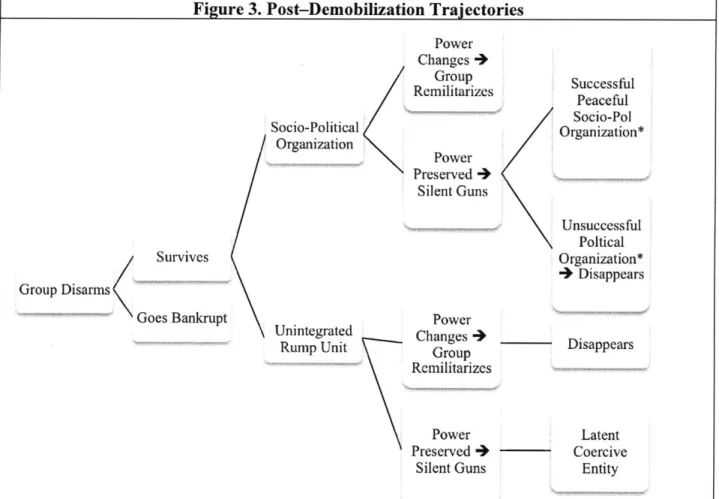
ultimately becomes co-opted, contributing to state capacity. Figure 3 illustrates these proposed post-war trajectories of demilitarizing organizations.
38 This is similar to what happens during military transitions. Hard-liners may wish to instigate a coup, but may no
Figure 3. Post-Demobilization Trajectories
Socio-Political Organization
Survives
Group Disarms
Goes Bankrupt Unintegrated
Rump Unit
Successful Peacefuil
Power Latent
Preserved 4 Coercive
Silent Guns Entity
*Note: It is beyond the scope of the project to explain the success or failure of the socio-political organization over time.
II. Assumptions and Scope Conditions
Armed Organization & War Outcomes.
This study examines paramilitaries, militias, warlords, and rebels that are territorial in nature, fought asymmetric wars,39 and have signed peace accords with the government. I focus only on groups that end their fighting through negotiated settlements. I do not include militarily defeated groups because their post-war trajectories - extinction - are over-determined. However, I do analyze weakened organizations many of which, despite being coded 'defeated' by the war
39 Kalyvas 2005. Military asymmetry between armed actors contrasts with 'symmetric nonconventional warfare,'
which can be observed in civil wars that accompany processes of state collapse. According to Kalyvas, these latter wars [entail] the disintegration of the state army and its replacement by rival militias."
Power Changes 4 Group Remilitarizes Power Preserved 4 Silent Guns Power Changes 4 Group Remilitarizes Socio-Pol Organization* Unsuccessful Poltical Organization* 4 Disappears Disappears
outcome literature's dichotomous scale,40 proved sufficiently strong to be party to a peace treaty and to form socio-political entities and/or remilitarize. Chapter 5 explores the 'military defeat' hypothesis explicitly. I use the word 'post-conflict' or 'post-war' at the organizational not the
country level to refer to the fact that the groups under investigation have signed a peace accord and are thus in a post-conflict stage. The country, however, may still be at war with other armed factions.
Unit ofAnalysis.
I examine several units of analysis. First, I look at the armed organization, which signs a separate peace accord with the government. In the empirical cases explored in this project, these organizations comprise approximately 1500-3000 combatants and divide into territorial units (battalions) that usually span several communities. I then break these organization into each of the places in which they operated, generating battalion-community dyads. This enables me to explain local, regional, and national dynamics and to account for factions of an organization taking divergent trajectories. I also evaluate the argument on the individual ex-combatant unit of analysis. The data determines which level of analysis I use. Wherever possible, I use the
battalion-community dyadic level as this is where the exciting causal processes are taking place.
Remilitarization
While I speak to the peace literature on "rearming," I do not use the term 'rearm' because post-conflict environments and their formerly armed organizations swim in weapons.
Organizations, which are not truly disarmed, cannot rearm. However, they can remilitarize. I should emphasize that remilitarization refers to the same armed group returning to fighting
4 0
and/or illegal activity withinfive years of the peace accord.4 1 The distinction between new and
renewed groups is important because new groups, at least initially, lack capacity and confront
Olson's collective action problem. Thus the policy implications for how to fight these groups is distinct from those for a remilitarized insurgent or counterinsurgent group. The project's focus on groups that return to war rather than new armed actors also stems from the fieldwork-based conviction that organizational legacies are important and thus the causes of remilitarizing are not the same as those of militarizing for the first time.42
Non- Violent Socio-Political Organizations: Political Parties or Civic Associations.
Socio-political influence may take a variety of organizational forms ranging from a formal political party to a co-opted existing party or a civic association. Existing studies focus exclusively on power-sharing arrangements. I assert that post-war groups may form political parties, but are also likely to continue to buy off parties, form NGOs, or hire lobbyists that defend their interests without directly competing in the electoral process. Accordingly, I extend the analysis of armed groups' transitions into non-violent socio-political entities beyond the formal political arena.
Path Dependence
While process and path dependency play an important role in my argument, the path is not deterministic; rather commanders choose their recruitment and deployment strategies during the war and ex-combatants choose where to migrate post-war. Agents make these strategic decisions. However, they are subject to a strong lock-in effect at which point the process gains
41 The five-year period has become standard in the quantitative literature on civil war. I employ it as a result of my
observation of a decaying function to organizational legacies and because it is practically infeasible to follow the ex-combatants throughout their lives and account for their individual trajectories. Most peace studies only study the first months or year after demobilization. Thus, this study extends the time horizon. Nonetheless, the longer term post-conflict dynamics are poorly understood and merit greater study.