positive study findings: cross sectional study
(Epidemiological Study of Randomized Trials—ESORT)
The MIT Faculty has made this article openly available.
Please share
how this access benefits you. Your story matters.
Citation
Odutayo, Ayodele; Emdin, Connor A; Hsiao, Allan J; Shakir,
Mubeen; Copsey, Bethan; Dutton, Susan; Chiocchia, Virginia, et al.
“Association Between Trial Registration and Positive Study Findings:
Cross Sectional Study (Epidemiological Study of Randomized Trials
—ESORT).” BMJ (March 2017): j917 © 2017 British Medical Journal
Publishing Group
As Published
http://dx.doi.org/10.1136/bmj.j917
Publisher
BMJ Publishing Group
Version
Final published version
Citable link
http://hdl.handle.net/1721.1/109731
Terms of Use
Creative Commons Attribution-NonCommercial 4.0 International
open access
1Centre for Statistics in Medicine, Nuffield Department of Orthopaedics, Rheumatology and Musculoskeletal Sciences, University of Oxford, Oxford OX3 7LD, UK
2Applied Health Research Centre (AHRC), Li Ka Shing Knowledge Institute of St Michael’s Hospital, Toronto, ON, Canada
3Faculty of Medicine, Harvard University, Boston, MA, USA 4Department of Economics, Massachusetts Institute of Technology, Cambridge, MA, USA
Correspondence to: A Odutayo [email protected] Additional material is published online only. To view please visit the journal online.
Cite this as: BMJ 2017;356:j917 http://dx.doi.org/10.1136/bmj.j917 Accepted: 31 January 2017
Association between trial registration and positive study findings:
cross sectional study (Epidemiological Study of Randomized
Trials—ESORT)
Ayodele Odutayo,
1,2Connor A Emdin,
3Allan J Hsiao,
4Mubeen Shakir,
3Bethan Copsey,
1Susan Dutton,
1Virginia Chiocchia,
1Michael Schlussel,
1Peter Dutton,
1Corran Roberts,
1Douglas G Altman,
1Sally Hopewell
1ABSTRACT
ObjeCtive
To assess whether randomised controlled trials (RCTs) that were registered were less likely to report positive study findings compared with RCTs that were not registered and whether the association varied by funding source.
Design
Cross sectional study. stuDy sample
All primary RCTs published in December 2012 and indexed in PubMed by November 2013. Trial registration was determined based on the report of a trial registration number in published RCTs or the identification of the trial in a search of trial registries. Trials were separated into prospectively and retrospectively registered studies.
main OutCOme measure
Association between trial registration and positive study findings.
results
1122 eligible RCTs were identified, of which 593 (52.9%) were registered and 529 (47.1%) were not registered. Overall, registration was marginally associated with positive study findings (adjusted risk ratio 0.87, 95% confidence interval 0.78 to 0.98), even with stratification as prospectively and retrospectively registered trials (0.87, 0.74 to 1.03 and 0.88, 0.78 to 1.00, respectively). The interaction term between overall registration and funding source was marginally statistically significant and relative risk estimates were imprecise (0.75, 0.63 to 0.89 for non-industry funded and 1.03, 0.79 to 1.36 for industry funded, P
interaction=0.046). Furthermore, a statistically significant interaction was not maintained in sensitivity analyses. Within each stratum of funding
source, relative risk estimates were also imprecise for the association between positive study findings and prospective and retrospective registration.
COnClusiOn
Among published RCTs, there was little evidence of a difference in positive study findings between registered and non-registered clinical trials, even with stratification by timing of registration. Relative risk estimates were imprecise in subgroups of non-industry and industry funded trials.
Introduction
Clinical trial registration is a key method used to improve accountability in the conduct and reporting of research.1 The rationale is that transparency can be improved by registering the trial design in the public domain before reporting results. Researchers and the general public can then have access to a comprehensive list of completed and ongoing trials and can compare the prespecified details in the register with those in the published study.23
A small study of published reports of randomised controlled trials (RCTs) in cardiology showed that trials that were reported as registered were less likely to report positive study findings.4 The study was limited by focusing on cardiology. A meta-epidemiological study also found a trend towards larger treatment effects in trials that were not registered or were retro-spectively registered.5 Neither study examined its results based on the funding source of the trial.45
We conducted a detailed study of primary reports of RCTs published in December 2012 in PubMed indexed journals, without restriction by journal, disease, or spe-cialty. We sought to examine the association between trial registration and positive study findings and whether this relation varied by funding source (indus-try versus non-indus(indus-try funding).
Methods
study sample and data extraction
This analysis was part of a larger study on the epidemi-ology and quality of reporting of RCTs467 We used a modified version of the Cochrane highly sensitive search strategy (phase 1 with added terms: “cross-over studies” and “multicentre study”) to identify primary reports of RCTs published in December 2012 and indexed in PubMed by 17 November 2013.89 The web appendix shows the full search strategy. RCTs were defined as pro-spective studies that assessed healthcare interventions in human participants, or groups of participants, who
WhAT IS AlReAdy knoWn on ThIS TopIC
Trial registration may be associated with positive study findings and larger treatment effects in randomised controlled trials
Existing studies were, however, small and did not account for important confounders
WhAT ThIS STudy AddS
Among published randomised controlled trials, there was little evidence of a difference in positive study findings between registered and non-registered clinical trials Subgroup analyses comparing the association between trial registration and positive study findings in non-industry funded and industry funded clinical trials were inconclusive
were randomly allocated to study interventions. We excluded cost effectiveness analyses, interim analyses, diagnostic studies, pharmacokinetic studies, pharmaco-dynamic studies, and physiology studies.
We reviewed the titles and abstracts of retrieved records in duplicate. The full text of studies identified in the title and abstract screen were reviewed. Data extraction was done for general trial characteristics (number of study centres, study design, number of arms, and number of participants randomised in the trial). We also extracted details on funding source. Trials that were solely or par-tially funded by commercial sources, irrespective of the size of the contribution, were classified as industry funded. In addition, if commercial sponsors provided the trial with an investigational agent without charge, we classified the trial as industry funded. This classification was used even if the sponsor was not involved in other aspects of the study. Box 1 defines the methodological items. A pool of eight reviewers independently extracted data in duplicate. Disagreements were resolved by con-sensus or by a reviewer who did not perform the original extraction. We applied no language restrictions when conducting the search. Full texts of studies published in languages other than English were reviewed and extracted once by the same person (AJH) where possible.
exposure and outcomes
Trials were coded as registered if this was stated in the published study and a trial registration number was pro-vided. As recommended during peer review, we
additionally searched trial registries for trials that were not reported as registered or did not provide a trial regis-tration number in the published article. We searched the World Health Organization International Clinical Trials Registry Platform (WHO ICTRP), the EU Clinical Trials Register, clinicaltrials.gov, and the International Stan-dard Randomised Controlled Trial Number (ISRCTN) Reg-istry. The search was conducted using the following search strategy: the title of the trial; the name of the prin-cipal investigator or a combination of keywords (eg, the intervention name, health condition, trial identifier), or both.10 We matched results in trial registries with pub-lished articles based on the name of trial investigators, the sample size of the trial, the number of study arms, and the types of interventions used in the trial. Finally, we reviewed the trial registry entry to obtain details about the timing of registration and the timing of study commence-ment. RCTs that were registered before or within one month of study commencement were coded as prospec-tively registered to be consistent with the Food and Drug Administration requirement on trial registration. Where only the month and year of study commencement were provided in the trial registry without listing the specific day, we assumed it was the first day of the month. All remaining RCTs that were registered with a trial registra-tion number were coded as retrospectively registered.
Trials were coded as having positive study findings if an investigator defined primary outcome in the trial publication was statistically significant (effect estimate with confidence interval that does not cross the line of no effect or a P<0.05) in favour of the experimental intervention. If studies were non-inferiority trials, they were coded as having positive study findings if there was no statistically significant difference between the experimental and control interventions. If studies had multiple primary outcomes, we assessed each outcome and if at least one was statistically significant, we coded the study as having positive study findings. If no pri-mary outcome was reported, we assessed the main out-come that was emphasised in the abstract and results for statistical significance. Classification of trial regis-tration status and study outcomes was performed sepa-rately in two independent phases of data extraction.
Our primary analysis was to assess an association between trial registration and positive study findings. We assessed trial registration as an overall exposure and stratified by prospective and retrospective registration. We additionally assessed whether the association between reporting of trial registration and positive study findings varied by funding source (industry versus non-industry funding) through a test for interaction.
Data analysis
We generated summary statistics for the general charac-teristics and methodological quality of RCTs included in our study. The χ2 test was used to compare categorical variables and the t test or Wilcoxon rank sum test was used to compare continuous variables. Although we ini-tially used logistic regression, the percentage of RCTs with positive study findings was more than 50%. It is therefore likely that the odds ratio will overestimate the box 1: Definitions used to assess methodological quality of publications of rCts
primary outcome
Primary outcome defined explicitly or an outcome used in sample size calculation; or a main outcome described explicitly in primary study objectives: yes or no
sample size calculation
Sample size calculation stated to have been undertaken: yes or no random sequence generation
Method used to allocate participants to study groups: computer, random number table, coin toss, not reported or inadequate, other
allocation concealment
Method used to prevent the individual enrolling participants from knowing or predicting the allocation sequence in advance: envelope, central, pharmacy, not reported or inadequate, other
blinding, how?
Method used to prevent participants, caregivers, investigators, or outcomes assessors from knowing the intervention a participant received. Trial is unblinded if explicitly stated as such or blinding not possible: blinded, details given, blinded, no details, unblinded, or not reported
blinding, who?
Reported, details given (eg, patient, caregiver), reported, no details given (eg, double blinded), unblinded, or unclear
attrition
Loss to follow-up reported for each group: yes, details given, yes, details not given, or no intention to treat
Reported as having been analysed in their assigned groups: intention to treat, or no intention to treat
risk ratio and overestimate the association between trial registration and positive study findings. We therefore used multivariable Poisson regression with robust stan-dard errors to obtain risk ratios and to assess the associ-ation between reporting of trial registrassoci-ation and positive findings. The Poisson regression model was adjusted for variables that have been shown to affect study find-ings,1112 including study sample size (continuous) and funding source (industry funded versus non-industry funded versus unclear), random sequence generation (yes versus not reported), allocation concealment (yes versus not reported), type of intervention (pharmacolog-ical versus non-pharmacolog(pharmacolog-ical), and number of cen-tres (single versus multiple versus unclear). To assess for consistency of the association by funding source, we tested for an interaction between trial registration and study funding (non-industry funded versus industry funded). If a statistically significant interaction was found, we examined the estimates for the association between reporting of trial registration and positive study findings within the relevant subgroups of funding.
In a sensitivity analysis, we included trials with unclear funding in the regression model to test for an interaction by funding source. We also excluded trials that were not registered in a WHO primary registry. P values less than 0.05 were considered statistically sig-nificant. Statistical analyses were conducted with R Sta-tistical Software (3.2.0) and Stata 14.
patient involvement
No patients were involved in setting the research ques-tion or the outcome measures, nor were they involved in developing plans for design or implementation of the study. No patients were asked to advise on interpretation or writing up of results. There are no plans to dissemi-nate the results of the research to study participants or the relevant patient community.
Results
general characteristics and reporting of methodological items in the overall cohort
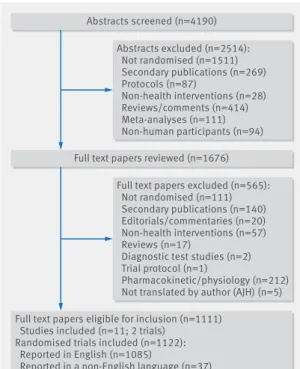
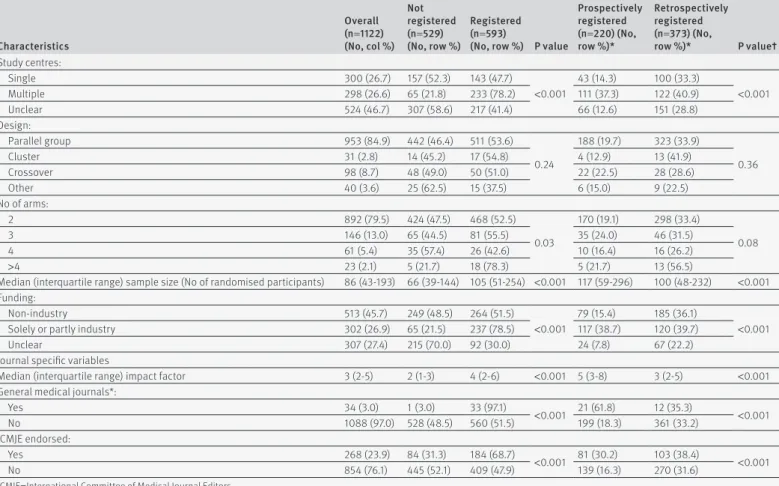
The search yielded 4190 abstracts, of which 1676 were included in the full text review (fig 1 ). Of these, 1111 full text articles met the inclusion criteria. Eleven articles included two independent trials, thereby increasing the total number of randomised controlled trials (RCTs) to 1122. Three hundred trials (26.7%) were single centre, 298 (26.6%) were multicentre, and 524 (46.7%) had an unclear number of centres (table 1 ). With respect to design characteristics, 953 trials (84.9%) were parallel group studies and 892 (79.5%) had two intervention arms (table 1 ). The median sample size was 86 (interquartile range 43-193) and 513 trials (45.7%) were non-industry funded, compared with 302 trials (26.9%) and 307 trials (27.4%) that were solely or partly industry funded or had unclear funding, respectively (table 1). The RCTs were published in 543 unique journals. The median impact factor was 3 (interquartile range 2-5) and only 34 of 1122 (3.0%) were published in general medical journals (New England Journal of Medicine, Lancet, Journal of the American Medical Association, The BMJ, Annals of Internal Medicine, and PloS Medi-cine). Two hundred and sixty eight RCTs (23.9%) were published in journals endorsed by the International Committee of Medical Journal Editors (ICMJE) (table 1).
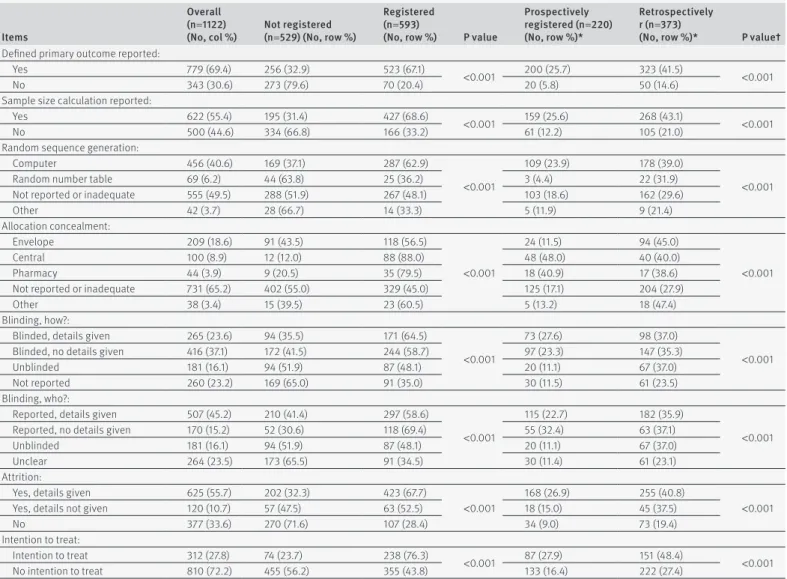
Sample size calculations were reported in 622 trial publications (55.4%) and the primary outcome was defined in 779 trials (69.4%) (table 2 ). Only 567 trial pub-lications (50.5%) and 391 (34.8%) trial pubpub-lications reported the method for random sequence generation and allocation concealment, respectively (table 2 ). Eight hundred and sixty two trial publications (76.8%) and 858 trial publications (76.5%) reported the method used for blinding and who was blinded, respectively (table 2 ). Finally, loss to follow-up for each study group was reported in 745 trials publications (66.4%) and an inten-tion to treat analysis was reported in 312 trial publica-tions (27.8%, table 2).
Characteristics of trials based on registration
Overall, 529 RCTs (47.1%) were not reported as regis-tered in the publication and 593 RCTs (52.9%) were reg-istered. Of the registered trials, 222 (37.4%) were registered prospectively and 373 (62.9%) retrospectively.
Trials that were registered were more likely to be mul-ticentre, have a larger sample size, and be industry funded (table 1 ). They were also more likely to be pub-lished in general medical journals and in journals endorsed by the ICMJE (table 1 ). Trials that were regis-tered were more likely to specify a primary outcome and provide details about sample size calculations, random sequence generation, allocation concealment, blinding, and attrition (table 2 ). They were also more likely to report an intention to treat analysis (table 2).
positive study findings
Among the 529 RCTs that were not registered, 322 (60.9%) reported a positive study finding compared with 309 of the 593 RCTs (52.1%) that were registered.
Abstracts screened (n=4190)
Full text papers reviewed (n=1676)
Full text papers eligible for inclusion (n=1111) Studies included (n=11; 2 trials)
Randomised trials included (n=1122): Reported in English (n=1085)
Reported in a non-English language (n=37) Abstracts excluded (n=2514): Not randomised (n=1511) Secondary publications (n=269) Protocols (n=87) Non-health interventions (n=28) Reviews/comments (n=414) Meta-analyses (n=111) Non-human participants (n=94)
Full text papers excluded (n=565): Not randomised (n=111) Secondary publications (n=140) Editorials/commentaries (n=20) Non-health interventions (n=57) Reviews (n=17)
Diagnostic test studies (n=2) Trial protocol (n=1)
Pharmacokinetic/physiology (n=212) Not translated by author (AJH) (n=5)
Fig 1 | identification of included studies
In an unadjusted analysis, trials that were registered were less likely to report a positive study finding (risk ratio 0.86, 95% confidence interval 0.77 to 0.95). The association was marginally statistically significant after multivariable adjustment (adjusted risk ratio 0.87, 0.78 to 0.98, fig 2 and table 1 in the web appendix). Similar find-ings were obtained when the RCTs that were registered were stratified into retrospectively and prospectively reg-istered studies (fig 2 and table 1 in the web appendix).
The interaction between trial registration and funding source was marginally significant (P interaction=0.046 for non-industry versus solely or partly industry funded studies, table 3 ). Among non-industry funded studies, registered trials (overall) were less likely to report posi-tive study findings compared with trials that were not registered (adjusted risk ratio 0.75, 0.63 to 0.89, table 1 in the web appendix). In contrast, an association between trial registration and positive study findings was not found among industry funded studies (adjusted risk ratio 1.03, 0.79 to 1.36 for overall registration, table 1 in the web appendix). The test for interaction was not sta-tistically significant when studies were stratified by pro-spective and retropro-spective registration (table 3).
sensitivity analysis
If trials with unclear funding were included in the regression model to test whether the association
between trial registration and positive study findings varied between non-industry and industry funded tri-als, the P value for the test of interaction was 0.053 and strata specific relative risk estimates were unchanged. The interaction terms for trial registration and positive study findings were statistically significant for non-in-dustry funded studies versus studies with unclear fund-ing (P interaction=0.005). However, this was not a prespecified subgroup comparison and was not exam-ined further. Five trials were registered but not in a WHO primary registry (eg, Hong Kong University Clini-cal Trial Registry). When these trials were excluded, our overall results were unchanged and the test for interac-tion comparing non-industry and industry funded trials was not significant (P interaction=0.05) and strata spe-cific relative risk estimates were unchanged.
discussion
In an analysis of 1122 published randomised controlled trials (RCTs), there was little evidence of a difference in positive study findings between registered and non-reg-istered clinical trials, nor when trials were stratified as prospectively registered and retrospectively registered. Subgroup analyses were inconclusive as to whether the association between trial registration and positive study findings varied between non-industry funded and industry funded trials.
table 1 | general characteristics of included studies
Characteristics Overall (n=1122) (no, col %) not registered (n=529) (no, row %) registered (n=593)
(no, row %) p value
prospectively registered (n=220) (no, row %)* retrospectively registered (n=373) (no, row %)* p value† Study centres: Single 300 (26.7) 157 (52.3) 143 (47.7) <0.001 43 (14.3) 100 (33.3) <0.001 Multiple 298 (26.6) 65 (21.8) 233 (78.2) 111 (37.3) 122 (40.9) Unclear 524 (46.7) 307 (58.6) 217 (41.4) 66 (12.6) 151 (28.8) Design: Parallel group 953 (84.9) 442 (46.4) 511 (53.6) 0.24 188 (19.7) 323 (33.9) 0.36 Cluster 31 (2.8) 14 (45.2) 17 (54.8) 4 (12.9) 13 (41.9) Crossover 98 (8.7) 48 (49.0) 50 (51.0) 22 (22.5) 28 (28.6) Other 40 (3.6) 25 (62.5) 15 (37.5) 6 (15.0) 9 (22.5) No of arms: 2 892 (79.5) 424 (47.5) 468 (52.5) 0.03 170 (19.1) 298 (33.4) 0.08 3 146 (13.0) 65 (44.5) 81 (55.5) 35 (24.0) 46 (31.5) 4 61 (5.4) 35 (57.4) 26 (42.6) 10 (16.4) 16 (26.2) >4 23 (2.1) 5 (21.7) 18 (78.3) 5 (21.7) 13 (56.5)
Median (interquartile range) sample size (No of randomised participants) 86 (43-193) 66 (39-144) 105 (51-254) <0.001 117 (59-296) 100 (48-232) <0.001 Funding:
Non-industry 513 (45.7) 249 (48.5) 264 (51.5)
<0.001
79 (15.4) 185 (36.1)
<0.001
Solely or partly industry 302 (26.9) 65 (21.5) 237 (78.5) 117 (38.7) 120 (39.7)
Unclear 307 (27.4) 215 (70.0) 92 (30.0) 24 (7.8) 67 (22.2)
Journal specific variables
Median (interquartile range) impact factor 3 (2-5) 2 (1-3) 4 (2-6) <0.001 5 (3-8) 3 (2-5) <0.001
General medical journals*:
Yes 34 (3.0) 1 (3.0) 33 (97.1) <0.001 21 (61.8) 12 (35.3) <0.001 No 1088 (97.0) 528 (48.5) 560 (51.5) 199 (18.3) 361 (33.2) ICMJE endorsed: Yes 268 (23.9) 84 (31.3) 184 (68.7) <0.001 81 (30.2) 103 (38.4) <0.001 No 854 (76.1) 445 (52.1) 409 (47.9) 139 (16.3) 270 (31.6)
ICMJE=International Committee of Medical Journal Editors.
*Percentages obtained from 3×2 table including trials prospectively registered, retrospectively registered, and not registered. †Generated from χ2 test comparing proportion of trials prospectively registered, retrospectively registered, and not registered.
strengths and weaknesses of this study
The major strength of our study is its large sample size, which allowed us to examine trial registration in import-ant subgroups. We also examined all trials published and indexed in PubMed within a one month period, which enhances the generalisability of our findings.
Our study also has limitations. Firstly, by sampling a one month period in PubMed, we inherently included
trials across the spectrum of medical journals. There-fore, the quality of reporting in several trials was poor. However, we accounted for differences in the quality of reporting in registered and non-registered trials through the use of multivariable regression. Secondly, 25% of the studies included in our analysis had unclear fund-ing sources. This limited the number of non-industry and industry funded trials we were able to identify in our analysis and contributed to imprecise relative risk estimates. None the less, the sample sizes of our sub-groups were comparable to, if not larger than, the total number of trials in each of the previous methodological studies examining whether trial registration was asso-ciated with positive study findings.4513 Thirdly, we ana-lysed trials published in 2012 and it is likely that many of these studies were initiated well before then. Trial registration practices and patterns may have changed over the time that trials in our analysis were initiated and conducted. However, trial registration is now prev-alent and it would be more difficult to assess the associ-ation between trial registrassoci-ation and positive study findings with a more contemporary cohort of clinical table 2 | methodological items of included studies
items
Overall (n=1122)
(no, col %) not registered (n=529) (no, row %)
registered (n=593)
(no, row %) p value
prospectively registered (n=220) (no, row %)*
retrospectively r (n=373)
(no, row %)* p value†
Defined primary outcome reported:
Yes 779 (69.4) 256 (32.9) 523 (67.1)
<0.001 200 (25.7) 323 (41.5) <0.001
No 343 (30.6) 273 (79.6) 70 (20.4) 20 (5.8) 50 (14.6)
Sample size calculation reported:
Yes 622 (55.4) 195 (31.4) 427 (68.6)
<0.001 159 (25.6) 268 (43.1) <0.001
No 500 (44.6) 334 (66.8) 166 (33.2) 61 (12.2) 105 (21.0)
Random sequence generation:
Computer 456 (40.6) 169 (37.1) 287 (62.9)
<0.001
109 (23.9) 178 (39.0)
<0.001
Random number table 69 (6.2) 44 (63.8) 25 (36.2) 3 (4.4) 22 (31.9)
Not reported or inadequate 555 (49.5) 288 (51.9) 267 (48.1) 103 (18.6) 162 (29.6)
Other 42 (3.7) 28 (66.7) 14 (33.3) 5 (11.9) 9 (21.4) Allocation concealment: Envelope 209 (18.6) 91 (43.5) 118 (56.5) <0.001 24 (11.5) 94 (45.0) <0.001 Central 100 (8.9) 12 (12.0) 88 (88.0) 48 (48.0) 40 (40.0) Pharmacy 44 (3.9) 9 (20.5) 35 (79.5) 18 (40.9) 17 (38.6)
Not reported or inadequate 731 (65.2) 402 (55.0) 329 (45.0) 125 (17.1) 204 (27.9)
Other 38 (3.4) 15 (39.5) 23 (60.5) 5 (13.2) 18 (47.4)
Blinding, how?:
Blinded, details given 265 (23.6) 94 (35.5) 171 (64.5)
<0.001
73 (27.6) 98 (37.0)
<0.001
Blinded, no details given 416 (37.1) 172 (41.5) 244 (58.7) 97 (23.3) 147 (35.3)
Unblinded 181 (16.1) 94 (51.9) 87 (48.1) 20 (11.1) 67 (37.0)
Not reported 260 (23.2) 169 (65.0) 91 (35.0) 30 (11.5) 61 (23.5)
Blinding, who?:
Reported, details given 507 (45.2) 210 (41.4) 297 (58.6)
<0.001
115 (22.7) 182 (35.9)
<0.001
Reported, no details given 170 (15.2) 52 (30.6) 118 (69.4) 55 (32.4) 63 (37.1)
Unblinded 181 (16.1) 94 (51.9) 87 (48.1) 20 (11.1) 67 (37.0)
Unclear 264 (23.5) 173 (65.5) 91 (34.5) 30 (11.4) 61 (23.1)
Attrition:
Yes, details given 625 (55.7) 202 (32.3) 423 (67.7)
<0.001
168 (26.9) 255 (40.8)
<0.001
Yes, details not given 120 (10.7) 57 (47.5) 63 (52.5) 18 (15.0) 45 (37.5)
No 377 (33.6) 270 (71.6) 107 (28.4) 34 (9.0) 73 (19.4)
Intention to treat:
Intention to treat 312 (27.8) 74 (23.7) 238 (76.3)
<0.001 87 (27.9) 151 (48.4) <0.001
No intention to treat 810 (72.2) 455 (56.2) 355 (43.8) 133 (16.4) 222 (27.4)
*Percentages from 3×2 table including trials prospectively registered, retrospectively registered, and not registered. †Generated from χ2 test comparing proportion of trials prospectively registered, retrospectively registered, and not registered.
Overall Prospectively registered Retrospectively registered 0.87 (0.78 to 0.98) 0.87 (0.74 to 1.02) 0.88 (0.78 to 1.00) 0.3 0.5 1 2 3 Group Positive findings not favoured in registered trials Positive findings favoured in registered trials
Adjusted risk ratio (95% CI) Adjusted risk ratio
(95% CI) 309/593 (52.1) 115/220 (52.3) 194/373 (52.0) Registered 322/529 (60.9) 322/529 (60.9) 322/529 (60.9) Not registered RCTs with positive findings/total RCTs (%)
Fig 2 | association between reporting of trial registration and positive study findings. rCt=randomised controlled trial
trials. Finally, our analysis relied on reported informa-tion in trial publicainforma-tions and it is unclear whether this is reflective of the prespecified trial design and conduct. We were also unable to account for unpublished stud-ies, which may differ from the published literature. Future studies should focus on gaining access to clini-cal trial protocols and comparing the rate of positive primary outcomes in registered and non-registered clin-ical trials.
strengths and weaknesses in relation to other studies
Trial registration was introduced as a method to improve transparency and accountability in research, yet evi-dence as to whether trials that are registered are less likely to report positive study findings is limited. Exist-ing studies on the association between trial registration and positive study findings are restricted to a small cross sectional study of cardiovascular trials and a meta-epi-demiological study. In neither study was the analysis examined based on the funding source of the trial.
By examining a large unselected group of trials, irre-spective of medical specialty, journal, intervention type, or disease type, we found little evidence of an association between trial registration and positive study findings in the overall analysis. Firstly, RCTs that were registered were less likely to report positive study findings compared with RCTs that were not registered, but the risk ratio estimates were modest and the 95% confidence intervals were close to the line of no effect. When stratified by the timing of trial registration, there was little evidence of a difference in positive study find-ings between prospectively registered trials and non-registered trials, but the association for retrospec-tive registration was statistically significant. We noted that the association between trial registration and pos-itive study findings may vary between non-industry and industry funded trials. Although the test for interaction was statistically significant, the relative risk estimates were imprecise therefore limiting any clear conclusions.
In addition to the limited evidence for an association between trial registration and study findings, the qual-ity of reporting in the trials included in our analysis was poor. In particular, important methodological items such as the method for random sequence generation and allocation concealment were infrequently reported in published trials. This limits the utility of the RCTs for policy makers and systematic reviewers. Accordingly, there must be ongoing efforts to improve the quality of reporting in published trials and to increase the propor-tion of journals that adopt and adhere to reporting guidelines such as CONSORT (Consolidated Standards of Reporting Trials).14 These efforts are needed along-side initiatives to increase trial registration.
implications for clinicians, policy makers, and future research
Our findings show that among all trials, there was little evidence of a difference in the frequency of positive study findings between registered and non-registered trials. These findings are important given the efforts of
tab le 3 | s ubgr ou p an aly si s for as soc iation betw een repor ting of tri al regi st ration and po siti ve st udy finding s Fu nd in g so ur ce an y re gi st ra tion v n ot re gi st ere d pr os pe cti ve re gi st ra tion v n ot re gi st ere d re tr os pe cti ve re gi st ra tion v n ot re gi st ere d RC Ts w ith po si tiv e fin di ng s/a ll RC Ts (% ) Ad ju st ed r is k r at io ( 95 % CI) P v alue int er ac tio n RC Ts w ith po si tiv e fin di ng s/a ll RC Ts (% ) Ad ju st ed ris k r at io (9 5% C I) P v alue int er ac tio n RC Ts w ith p os iti ve fin di ng s/ al l R CT s ( % ) Ad ju st ed ris k r at io (9 5% C I) P v al ue in te ra ct io n No n-in du st ry fu nd ed Re gi st er ed : 1 22 /2 64 (4 6. 2) n ot r eg is te re d§ : 15 5/ 24 9 ( 62 .2 ) 0. 75 (0. 63 to 0. 89 ) 0.0 46 Re gi st er ed : 3 7/ 79 ( 46 .8 ) n ot re gi st er ed : 1 55 /2 49 ( 62 .2 ) 0. 75 (0. 58 to 0. 97 ) 0.1 10 Re gi st er ed : 8 5/ 18 5 ( 45 .9 ) n ot re gi st er ed : 1 55 /2 49 ( 62 .2 ) 0. 75 (0. 62 to 0. 90 ) 0. 074 Sol el y or pa rt ly in du st ry fu nd ed Re gi st er ed : 1 27 /2 37 (5 3. 5) n ot r eg is te re d: 35 /6 5 (53 .8 ) 1.0 3 ( 0. 79 t o 1 .3 6) Re gi st er ed : 6 3/ 11 7 (5 3. 8) no t re gi st er ed : 3 5/ 65 ( 53 .8 ) 1.0 6 ( 0. 78 t o 1 .4 5) Re gi st er ed : 6 4/ 12 0 ( 53 .3 ) n ot re gi st er ed : 3 5/ 65 ( 53 .8 ) 1.0 2 ( 0. 76 t o 1 .3 5) RC T= ra ndom is ed c on trol le d t ria l.
the WHO and ICMJE and the financial investment of research regulatory authorities to provide a platform for trial registration and to promote policies that support trial registration. Our findings are also important for researchers and other consumers of the scientific litera-ture who may assume that trial registration alone increases accountability for the accurate reporting of trial results.
There may be multiple reasons for our results. Firstly, it has yet to be determined whether the information reported in trial registries is an accurate reflection of the trial protocol that was approved by the research ethics committee.15 It may be that study outcomes are not fully specified in the trial registry and, for instance, import-ant details about the time point for analysis or the method of analysis may be missing in the registry. Dis-crepancies between the trial registry and study protocol reduce the accountability to conduct and report the study in accordance with what was planned.
Secondly, it may be that trials are registered but the trial registration number is omitted from the published article during submission to the journal or after peer review. In our study, 15% of trials were not reported as registered but were identified in a search of trial regis-tries. The omission of the trial registration number in the published article also reduces the accountability that is inherent in trial registration. Finally, it may be that comparisons between the trial registry and RCTs are not routinely performed by peer reviewers or jour-nal editors. Without these comparisons the utility of trial registration may be easily diluted by outcome switching.16 Indeed, investigators recently found dis-crepancies between trial registries and published arti-cles and these differences favour statistically significant results.17
Registration of clinical trials is only the first step in improving the accountability in the reporting of research. It is necessary for journal editors, reviewers of journal articles, and researchers to report the trial regis-tration number in the published article and to compare the results in the published article to that of the trial registry entry. These efforts ensure the benefits of trial registration are not undermined.16
Conclusion
Taken together, in a large study of published RCTs, we did not observe an association between trial registra-tion and positive study findings. Further efforts are needed to ensure that all trials are registered and the details given in the registry are reported in the pub-lished article.
Contributors: CAE and AO conceived and designed the study. AO performed the study analysis. All authors acquired data, analysed and interpreted data, drafted the manuscript, and performed a critical review of the manuscript for intellectual content. AO had full access to all the data in the study and takes responsibility for the integrity of the data and the accuracy of the data analysis. AO is the guarantor. Funding: This study was not funded. AO, CAE, AJH and MS were supported by the Rhodes Trust. AO was additionally supported by the Clarendon Fund.
Competing interests: All authors have completed the ICMJE uniform disclosure form at www.icmje.org/coi_disclosure.pdf and declare: no support from any organisation for the submitted work; no financial
relationships with any organisations that might have an interest in the submitted work in the previous three years; no other relationships or activities that could appear to have influenced the submitted work. Ethical approval: Not required.
Data sharing: Data and code are available from the corresponding author on request.
Transparency: The lead author (AO) affirms that the manuscript is an honest, accurate, and transparent account of the study being reported; that no important aspects of the study have been omitted; and that any discrepancies from the study as planned (and, if relevant, registered) have been explained.
This is an Open Access article distributed in accordance with the Creative Commons Attribution Non Commercial (CC BY-NC 4.0) license, which permits others to distribute, remix, adapt, build upon this work non-commercially, and license their derivative works on different terms, provided the original work is properly cited and the use is non-commercial. See: http://creativecommons.org/licenses/by-nc/4.0/. 1 De Angelis C, Drazen JM, Frizelle FA, et al. International Committee
of Medical Journal Editors. Clinical trial registration: a statement from the International Committee of Medical Journal Editors. Lancet 2004;364:911-2. doi:10.1016/S0140-6736(04)17034-7. 2 Hartung DM, Zarin DA, Guise J-M, McDonagh M, Paynter R, Helfand M.
Reporting discrepancies between the ClinicalTrials.gov results database and peer-reviewed publications. Ann Intern Med 2014;160:477-83. doi:10.7326/M13-0480.
3 Becker JE, Krumholz HM, Ben-Josef G, Ross JS. Reporting of results in ClinicalTrials.gov and high-impact journals. JAMA 2014;311:1063-5. doi:10.1001/jama.2013.285634.
4 Emdin C, Odutayo A, Hsiao A, et al. Association of Cardiovascular Trial Registration With Positive Study Findings: Epidemiological Study of Randomized Trials (ESORT). JAMA Intern Med 2014;29. doi:10.1001/ jamainternmed.2014.6924.
5 Dechartres A, Ravaud P, Atal I, Riveros C, Boutron I. Association between trial registration and treatment effect estimates: a meta-epidemiological study. BMC Med 2016;14:100. doi:10.1186/ s12916-016-0639-x.
6 Emdin CA, Odutayo A, Hsiao AJ, et al. Association between randomised trial evidence and global burden of disease: cross sectional study (Epidemiological Study of Randomized Trials--ESORT). BMJ 2015;350:h117. doi:10.1136/bmj.h117.
7 Odutayo A, Altman DG, Hopewell S, Shakir M, Hsiao AJ, Emdin CA. Reporting of a Publicly Accessible Protocol and Its Association With Positive Study Findings in Cardiovascular Trials (from the Epidemiological Study of Randomized Trials [ESORT]). Am J Cardiol 2015;116:1280-3. doi:10.1016/j.amjcard.2015.07.046.
8 Robinson KA, Dickersin K. Development of a highly sensitive search strategy for the retrieval of reports of controlled trials using PubMed. Int J Epidemiol 2002;31:150-3. doi:10.1093/ije/31.1.150. 9 Chan AW, Altman DG. Identifying outcome reporting bias in
randomised trials on PubMed: review of publications and survey of authors. BMJ 2005;330:753. doi:10.1136/bmj.38356.424606.8F. 10 Glanville JM, Duffy S, McCool R, Varley D. Searching ClinicalTrials.gov
and the International Clinical Trials Registry Platform to inform systematic reviews: what are the optimal search approaches?J Med Libr Assoc 2014;102:177-83. doi:10.3163/1536-5050.102.3.007. 11 Savović J, Jones HE, Altman DG, et al. Influence of reported study
design characteristics on intervention effect estimates from randomized, controlled trials. Ann Intern Med 2012;157:429-38. doi:10.7326/0003-4819-157-6-201209180-00537.
12 Lundh A, Sismondo S, Lexchin J, Busuioc OA, Bero L. Industry sponsorship and research outcome. Cochrane Database Syst Rev 2012;12:MR000033. doi:10.1002/14651858.MR000033.pub2. 13 Rasmussen N, Lee K, Bero L. Association of trial registration with the
results and conclusions of published trials of new oncology drugs. Trials 2009;10:116. doi:10.1186/1745-6215-10-116.
14 Moher D, Hopewell S, Schulz KF, et al. CONSORT 2010 explanation and elaboration: updated guidelines for reporting parallel group randomised trials. BMJ 2010;340:c869. doi:10.1136/bmj.c869. 15 Zarin DA, Ide NC, Tse T, Harlan WR, West JC, Lindberg DA. Issues in the
registration of clinical trials. JAMA 2007;297:2112-20. doi:10.1001/ jama.297.19.2112.
16 Goldacre B. Make journals report clinical trials properly. Nature 2016;530:7. doi:10.1038/530007a.
17 Mathieu S, Boutron I, Moher D, Altman DG, Ravaud P. Comparison of registered and published primary outcomes in randomized controlled trials. JAMA 2009;302:977-84. doi:10.1001/jama.2009.1242.
Supplementary information: details of search
strategy and table showing full regression models for association between trial registration and positive study findings