HAL Id: hal-02006239
https://hal.univ-lorraine.fr/hal-02006239
Submitted on 4 Feb 2019HAL is a multi-disciplinary open access archive for the deposit and dissemination of sci-entific research documents, whether they are pub-lished or not. The documents may come from teaching and research institutions in France or abroad, or from public or private research centers.
L’archive ouverte pluridisciplinaire HAL, est destinée au dépôt et à la diffusion de documents scientifiques de niveau recherche, publiés ou non, émanant des établissements d’enseignement et de recherche français ou étrangers, des laboratoires publics ou privés.
RESSOURCES21 Activity report 2015-2016
Michel Cathelineau, Frédéric Villiéras, Isabelle Abildtrup
To cite this version:
Michel Cathelineau, Frédéric Villiéras, Isabelle Abildtrup. RESSOURCES21 Activity report 2015-2016. [Research Report] Université de Lorraine; Centre national de la recherche scientitique (CNRS); Institut national de la recherche agronomique (INRA). 2017. �hal-02006239�
LABORATORY OF EXCELLENCE RESSOURCES21
STRATEGIC METALS IN THE 21
STCENTURY
ANR-10-LABX-21-01
Laboratoire d'Excellence RESSOURCES21 - Université de Lorraine
Ecole Nationale Supérieure de Géologie - BP 40 - 54501 Vandoeuvre-lès-Nancy Cédex - France www.ressources21.univ-lorraine.fr
Conception graphique : Anne-Sylvie André-Mayer Mise en page : Anne-Sylvie André-Mayer, Isabelle Abildtrup Relecture : Agnès Samper, Anne-Sylvie André Mayer, Michel Cathelineau
Responsable d’édition : Isabelle Abildtrup
CONTENTS
Foreword ... 3
Context and General Objectives ... 5
A quick summary of the first five years .. 6
Schedule overview ... 7
Human resources ... 8
National and international visibility .... 10
Scientific events International exchanges Political representation
Research highlights 2015-2016 ... 17
Nickel program PhD completedSmall projects on metal cycles
Dissemination of knowledge ... 46
EducationWider Society learning
Industry interactions ... 51
European industrial projectsSATT - Extra&Co Eramin, a mirror group
Equipments - Facilities ... 54
LIEC : an artificial riverChemical facilities at CRPG LA-ICP-MS
Budget ... 58
Publications ... 59
Posters………65
ANR-10-LABX-21-01
FOREWORD
RESSOURCES21
is an excellence laboratory
centre (LabEx) in the field of Geosciences,
operated by the OSU (Observatory in Science
of the Universe-CNRS-INSU) so-called OTELO
which federates the Geosciences laboratories
from the Lorraine University.
The present report provides a summary of
the first 3 years of research on the natural
geochemical cycle of Nickel and associated
elements, especially in supergene deposits.
The choice of these metals has been guided
by the fact that nickel in New Caledonia, as
well as gold in Guyana, are the only metals
produced by French companies in French
territories. Ni is also accompanied by other
metals, seldom extracted up to now, such as
Co, Mn, Cr, Sc. The process of
co-beneficiation is from now on, one of the
major challenges for society, as most deposits
are extracted for only one metal (sometimes
a few), leaving wastes with other metals at a
low content, which nevertheless could
constitute the reserves for tomorrow, when
better extraction processes are available.
In this report, we provide LabEx publications
about metals’ cycles, as well as highlights
about the LabEx’s communication and
interactions with the industry and society.
Dr. F. Villiéras and Dr. M. Cathelineau
http://ressources21.univ-lorraine.fr/
This report is available from this website as a downloadable pdf file.
Context and General Objectives
RESSOURCES21,
Laboratory of Excellence (LabExR21), has been allocated 9 million euros in funding for 2011 to 2019, as part of the so-called program “Investissements d’avenir“ (Investments for the future) launched by the French National Research Agency from the French Ministry of Research and Higher Education.
The LabEx RESSOURCES21 has enabled laboratories working in Geosciences from the Lorraine area (OSU OTELO) to structure their research landscape and place themselves at the cutting edge of international innovation.
The LabEx RESSOURCES21 has three missions divided in three complementary fields:
Science:
the common ambition, shared by the multidisciplinary team of researchers leading the project is:(1) to understand all the processes associated with the mechanisms of enrichment and dispersion of metals, (2) to develop innovative tools and new concepts for a better extraction of resources.
Education:
Training students at all levels in the field of mineral resources from exploration to extraction, taking into account all the environmental aspects. This has been enhanced through the enrichment of existing programs and the development of new university level training programs such as masters. Diffusion of know-how and knowledge
i) to industry thanks to a specific relationship with industrial partners, ii) to general audience, through exhibitions and conferences, and iii) to political representatives.
Context of the project
Constant global population growth, new technologies, and the growing needs of emerging economies like China and India, are all contributing to a perpetually increasing demand for rare metal resources.
Every day new applications using many metals, such as the rare earth elements (Nd, Dy, Eu, Tn,...), the rare metals (Nb, Ta, Sn, W, …), metals such as Sb, Ge, Ga, In; are used both in modern manufactured products and in techniques related to carbon-free energy. Several years ago access to natural metal resources, which were both abundant and easily accessible, caused little concern. Recent economic and political changes have pointed out the needs to ensure the supply of these resources, at the European and national levels, for the next decades. In this context, it becomes necessary to
redefine the notion of resources in terms of geologic context, metal concentration in rocks, separation and concentration techniques, and recycling, while integrating the aspects of ecotoxological impact and environmental management and remediation.
This subject is therefore of economic and strategic importance. It presents researchers with numerous challenges: in geology, geochemistry, 3D-modeling, in better separating metals present in low concentrations in ores, recycling better, keeping the environmental impact and ecotoxicology of increasingly used and extracted metals low, in developping new sensors and systematic observations.
The objectives of the LabEx RESSOURCES21
The research project LabEx RESSOURCES21 proposes an integrated scientific and educational approach to the understanding, extraction and environmental management of strategic metal resources for the 21st
century. RESSOURCES21 faces many challenges in terms of geology, mineral processing, environmental and ecotoxicological impact.
Scientific activities of the Laboratory of Excellence “Strategic Metal Resources in the 21st
Century-RESSOURCES21” project focus on three main research themes identified as priorities:
1. the understanding of the natural and anthropogenic cycles of strategic metals, and the processes of concentration (ore deposits) or dispersion in the environment;
2. the development of innovative tools for a better ore processing and better extraction of metals; 3. the evaluation of the environmental impact of
these metals, once scattered throughout the ecosystem.
To achieve these main goals, three complementary consolidation tasks can be added:
- the development of new analytical tools for the determination, the distribution and the concentration of trace elements within rocks and minerals, as well as for the dating of geological events ;
- 3D-Modelling of ore geometries, of metal transport at complementary scales, in order to understand the distribution of metals and how ore deposits form over space and time;
- Inventing and perfecting biogeochemical environmental sensors to monitor the spread of hazardous elements, with the aim of being able to predict pollution.
Context and General Objectives
Means and research programs
To achieve its goals, the LabEx RESSOURCES21 analyses the international industrial context, identifies the pertinent scientific questions, and develops its own programs. Several types of actions are financed or co-financed:
- short-term research programs dedicated to stimulate emergent research,
- post-doctoral and PhD fellowships,
- integrated 3-year programs on a group of metals having similar geochemical behaviour in the
lithosphere and in the environment: two of these programs have already started, one dedicated to Ni (Co, Sc), the other to REE (Nb-Ta-U-Th).
- exchanges of researchers (invitation of researchers having an international renown, fellowships for young researchers sent abroad in collaboration with universities or industrial partners).
The endowment to research programs includes funds for post-doctoral positions, doctoral fellowships, and operating costs, as well as the co-funding of major equipments.
A quick summary of the first five years
Research programs and dissemination of
results
The teams of LabEx RESSOURCES21 have focused their studies on several groups of metals, from the point of view of the processes of concentration: metals necessary to the photovoltaic sector (Ga, Ge, In); rare metals (Nb, Ta, Sn, W) associated to the felsic peraluminous magmatism; the concentrations of metals in laterites developed on ultramafic rocks (Ni, Co, Sc); rare earth elements in carbonatites and alkaline intrusions, and the general environmental impact of REE. Besides, the teams have continued to work on strategic metals of high economic importance (Ni, U, Au) for which they had already acquired an international reputation; on the impact of metals as traces in the environment (Cd, Ag, Cu, Ti) or on metalloids (As). PhD theses and postdoctoral research programs have been covering the whole metal cycle, several types of metal deposits (Ge containing sulphide deposits, Sn-W deposits, Sc in laterites) or environmental issues (behaviour of rare earth elements in the environment, development of bio-sensors).
Several PhD theses were achieved and defended in 2015-2016 on the Germanium cycle, the behaviour of Sn-W at the magmatic stage, the modelling of discontinuities and hydraulic properties.
Scientific meetings
The researchers of LabEx organized the SGA international conference on ore deposits (700 attendants) in Nancy; and in November 2016 an international workshop dedicated to Sn-W ore deposits (70 attendants) was also organized in Nancy.
Reports
2012-2013 and 2012-2014 Reports: An exhaustive
report (in French) on the activity of the LabEx on the first two years (2012-2013) was already published in early 2014 and is available for free downloading on the RESSOURCES21 website, as well as the mid-term
report (in English) published in 2014
Human Resources
Senior researchers
Irvine ANNESLEY was recruited in
September 2015 as a Professor at Ecole Nationale Supérieure de Géologie (ENSG). His research
activities develop at the
GeoRessources laboratory. His recruitment intends to (i) sustain research activities on the geology of uranium, (ii) emphasize the use of geomodeling tools in metallogeny projects, (iii) strengthen the initial training of the students at ENSG, reinforce the Master GPRE with exploration tools, and (IV) consolidate the network with the anglo-saxon industry.
Eswaraiah CHINTHAPUDI is a senior researcher in the
Minerals and Materials Technology Institute of Bhu-baneswar, Odisha, INDIA. He joined the LabEx’s team in September 2015 and is in charge of a LabEx RESSOURCES21 research chair.
Alexandre CHAGNES lectured during 10 years at ENSCP before joining the LabEx’s ore processing team in 2016. He has been assigned as a Professor at Ecole Nationale Supérieure de Géologie (ENSG) to improve geometallurgy and geotechnology. He carries out his research in the GeoRessources laboratory on hydrometallurgy processes. He created a large research group “the GDR Prométhée” composed of CNRS, CEA and BRGM labs that aims at structuring the French research on Hydrometallurgy. (from Georessources Newsletter Dec 2016)
Saeed FARROKHPAI - Before joining the project
RESSOURCES21, Saeed was a researcher at the University of Queensland in Australia. He has been involved in the Nickel program at the GeoRessources Laboratories since june 2015, as a senior researcher in charge of a LabEx RESSOURCES21 chair. His work focuses on "Pre-concentration of value elements (Ni and REE) from low grade ores and waste products".
New PhD students 2015 - 2016
NICKEL Program
Séverine LOPEZ- Having obtained a Masters degree in
Environmental microbiology and health, Séverine joined the LSE laboratory in October 2015 as part of the LabEx 2015-2018 PhD recruitment. Her thesis research, conducted in the framework of the Nickel program, is entitled “Determinism of the microbial communities’ structure in ultramafic soils in a context of nickel agromine”. She is supervised by Emile BENIZRI and Jean-Louis MOREL.
Rare Earth Elements Program
François TURLIN - After obtaining a masters degree at
the ENSG (Ecole Nationale Supérieure de Géologie), he integrated the LabEx RESSOURCES21 in the Rare Earth Elements program, for the period covering 2014 to 2017. His activities are supervised by Anne Sylvie André-Mayer, Olivier Vanderhaeghe and Félix Gervais in the GeoRessources laboratories. The title of his project is « Magmatic REE ores, tracers of growth and differentiation of the continental crust : Example of the Proterozoic orogenic province of Grenville, Quebec».
Nicolas GROSJEAN - Holder of a masters degree in
BioMANE at the Lorraine University, his PhD activities, supervised by Dr. Elisabeth Gross, Dr. Marie Le Jean and Dr. Damien Blaudez, are conducted in the project entitled « Study of genes’ response to REE in model organisms». He is assigned for 3 years in the LIEC laboratory.
Nina BOTHAMY joined the LabEx RESSOURCES21’s
team in the CRPG laboratory in 2016. Up to 2019, her activities, supervised by Pr. Albert GALY, will focus on “New biogeochemical tracers: REE stable isotopes (NTB-REE)”.
Other projects
NewOreS
Eleonora CAROCCI holds a master of “Seismic and
Volcanic Risk - Geological and Technology Sciences“ from Perugia University in Italy. She joined the RESSOURCES21 team for a PhD thesis cofunded with the European project called NewOreS. She is assigned for 3 years, for the period 2016-2019. Her activities, supervised by Pr. Laurent TRUCHE, Dr. Marie-Christine BOIRON, Dr. Julien MERCADIER and Michel CATHELINEAU, take part to the project entitled "Magmato-hydrothermal transport and deposit of W (Sn, Nb, Ta) in magmatic-metamorphic fluids around plutons”
New Postdocs 2015-2016
NICKEL Program
Yoram TEITLER - After 2 years of postdoctoral research
at the CET “Centre for Exploration Targeting” at Perth in Western Australia, Yoram started a postdoc at RESSOURCES21 in October 2015 in the framework of the Nickel program. His research focuses on “Scandium concentrations in lateritic profiles in New Caledonia”.
Celestino QUINTELA-SABARI - The postdoctoral
project of Celestino with RESSOURCES21 started in December 2015 at the LSE laboratory. His activities concern the «Ecological reclamation of Ni-mined Technosoils». Before joining the LabEx, he used to workintheSoil Microbiology Group, IIAG-CSIC in Spain.
Laetitia MINGUEZ - After a year of postdoc at the IGB,
Leibniz-Institute of Freshwater Ecology and Inland Fisheries (Neuglobsow, Germany), Laetitia was recruited in April 2016 in the framework of the Nickel program for the LIEC laboratory. Her research activities aim at understanding the ”Ecotox and Ecology of Nickel on aquatic organisms”.
Rare Earth Elements Program
Maria KOKH - After her PhD at the « Ecole Doctorale
SDU2E Sciences de l'Univers, de l'Environnement et de l'Espace", at the University of Toulouse III Paul Sabatier, Maria joined the LabEx team in June 2016.
Her research aims at understanding the
“Hydrothermal and supergene mobility of REE”.
Anna ROMERO FREIRO - After obtaining a European
doctorate of Earth Sciences at the University of Granada (Spain) and at the Vrije Universiteit in Amsterdam (The Netherlands), Anna joined the LIEC laboratory in June 2016. Her research, conducted in the framework of the rare earth elements program, is entitled “Predicting and understanding Rare Earth Elements (REE) effects at the sediment-water interface”.
Other Postdoctoral fellows
Naomie JANOT has been leading, since 2015, the
project entitled "Environmental geochemistry of strategic metals" at the LIEC laboratory.
Rémy BELISSONT is enrolled in the project intitled
"Experimental approach of elementary isotopic partition of Ge in sphalerite” in the LabEx’s team of GeoRessources.
LabEx RESSOURCES21 prospective programs
Julien MERLIN has obtained his PhD in the Ecole des
Mines de PARIS, the Mining school of Paris. He joined the Mining school of Nancy (Ecole des Mines de Nancy) in September 2016. His research, supervised by Pr. Yann Gunzburger, is entitled “Mapping of the industrial actors of the French mining industry : sources of underlying controversies, modalities of dialogues and opportunities for the improvement of mining projects”.
National and international visibility
Scientific events
Mineral Resources and sustainable
development: changes to prepare for the future.
4th and 5th June 2015 - Paris
Jean-Marc Montel and Frédéric Villiéras from RESSOURCES21 spoke at the Collège de France conference in Paris.
Held on the 4th and 5th June 2015, the two-day
conference was organised by Georges Calas, Annual Chair of Sustainable Development – Environment, Energy and Society at the Collège de France.
RESSOURCES21 participants:
Frédéric Villiéras : Materials and mineral engineering and sustainability of the resource - oral presentation
Jean-Marc Montel: The geologist of the future, the conductor of the mining industry - oral presentation.
Mineral Resources Thematic School - CNRS
Ecole Thématique Ressources Minérales
7th to 9th June 2016
This school is designed to enhance interactions between researchers, students, and industrial partners. It is also dedicated to educate the Master and PhD students, with contributions dealing with most recent state of the art of a specific dimension on mineral resources, from field to the lab, focusing this year on experimentation in metallogeny.
RESSOURCES21 participants:
Marie-Christine Boiron: Circulations fluides et concentrations métalliques : l’analyse in-situ des paléofluides - oral presentation. Anne-Sylvie André-Mayer: Formations pour les matières premières minérales: quelles formations pour quels métiers ? - oral presentation.
François Turlin (PhD student), Hilaire Dakouré (Master student) – poster presentations
International Workshop in Sn-W and rare metal deposit metallogenesis
30th November - 1st December 2016
This international workshop took place at the Faculty of Sciences, Nancy. It consisted in a 2 days event of scientific contributions (21 orals, 14 posters), covering analytical evolution of mineral system models, through mineral chemistry, granite and related geochemistry, geochronology of ore and gangue minerals, stable isotope geochemistry, fluid inclusions.
The last afternoon was dedicated to the PhD defense of Matthieu HARLAUX on “Tungsten and rare-metal (Nb, Ta, Sn) hydrothermal metallogenic systems in the late-Variscan orogenic context: example of the French Massif Central”.
At the end of the workshop, each chairman made a summary of the advances on each theme by the different speakers, as well as a list of potential lacks of knowledge which could justify future research. Some details were finally provided on the near opening of the calls for proposals for the Eranet ERAMIN2, with some invitations to the laboratories to exchange on the basis of the ideas emitted during the workshop.
Organizers: Michel Cuney, Julien Mercadier, Christian Marignac, Michel Cathelineau, Marie-Christine Boiron, Matthieu Harlaux
SGA 2015 - 13th SGA Biennial Meeting
Nancy, 24 to 27th June 2015
The 13th biennial meeting of the SGA was organized in June 2015 by the CNRS (Centre National de la Recherche Scientifique) and a consortium of Universities, that included the Université de Lorraine in Nancy, the KU Leuven, the Université de Liege and RWTH Aachen University representing the regions of Lorraine, Flanders, Wallonie and North-Rhine-Westphalia along the borders of France, Belgium and Germany, regions that retain a strong historical heritage of both coal and iron mining activities. The very first biennial meeting of the Society for Geology applied to Mineral Deposits, was held in Nancy in 1991. The 13th SGA-meeting was thus the opportunity to celebrate the 50th anniversary of the society, as well as to come back to the site of the very first SGA conference. Some of the SGA2015 participants had also been among the main actors of that first meeting in 1991, which at the time was centered on the basics of metallogeny: “Source, Transport and Metal deposits”. This year, the main focus of the conference was to work towards a better, responsible and reliable way to meet both the global increase in the demand for mineral raw materials and the requirements of a sustainable world: “SGA2015: Mineral Resources in a Sustainable World”.
The main conference took place in the Centre Prouvé, located in the heart of Nancy, and was inaugurated in 2014. The 20,000m2 congress centre provided
SGA2015 delegates with highly adaptable and functional conference space, facilities and equipment.
Repartition per country of the SGA2015 delegates. Australia and Canada were the two foreign countries after France.
The 712 conference attendees included: 603 registered delegates of 60 nationalities, 8 plenary speakers,
32 accompanying persons 19 exhibitors,
50 volunteers
The incitative fees for students allowed the SGA conference to welcome more than 200 hundred French and foreign students. Through the SGA Foundation, 77 students coming from 20 countries, and two young scientists from economically disadvantaged countries, were selected and awarded travel grants.
Main conference program
International research on mineral deposits and related topics was presented and discussed within 16 scientific sessions, 5 symposia and 8 plenary talks.
Symposia
The symposia honored four scientific researchers which contributions to economic geology have made their scientific renown:
Jan Pasava, Sediment-hosted deposits Michel Cuney, Uranium deposits
James Franklin, Volcanogenic Massive Sulfide ore deposits
Jean-Laurent Mallet, 3D Modeling
Plenary sessions
The plenary sessions widened the vision around minerals resources, and included both exploration needs and environmental and social challenges: Pär Weihed, the human need of metallic raw
materials - Why exploration matters!
Sven Petersen, News from the seabed: the current ups and downs in marine mineral resources. Julie Hunt, Geometallurgy: bridging gaps and
breaking down silos.
Michel Bouchard, Social licence to operate, the environmentalandsocialchallengesofthemining industry.
Scientific sessions
During the scientific sessions, convenors and delegates created a dynamic scientific atmosphere, through 212 high-quality oral presentations and 300 posters. All of this scientific content is presented in the five volumes of the SGA2015 proceedings, which include 518 extended abstracts over 2134 pages, e.g. the state of the art covering the entire spectrum of scientific topics from economic geology to mine environment and geometallurgy. These abstract volumes testify of the high scientific quality of the 13th SGA-meeting. These proceedings have been proposed to the delegates through an USB key, and 20 delegates asked for the printed versions (5 kg…!).
These proceedings (both Books and USB keys) received ISBN Numbers, and as they have been evaluated by Thomson Reuters ISI, they are now listed on WOS. ISBN USB Key: 978-2-85555-065-7
ISBN Books: 978-2-85555-066-4
SGA2015 Proceedings numeric files available now at
National and international visibility
Scientific events
SGA 2015 - 13th SGA Biennial Meeting
This conference created intergenerational links between established researchers, including many well-known leaders in the field of metallogeny, and numerous Masters and Doctoral students.
Fifty of these young scientists, from nearby schools and Universities (ENSG, ERASMUS Mundus Emerald and Earth Sciences Department from the Lorraine and Liege Universities) served as dynamic and friendly volunteers.
Exhibitors
Throughout the week, the main 1600 m2 hall of the
conference was shared between poster sessions and exhibitors, offering the nineteen exhibitors numerous opportunities for exchange with the delegates, including during coffee breaks.
1 - SGA/SPRINGER 2 - AREVA
3 - CODES - ARC CENTRE OF EXCELLENCE IN ORE DEPOSITS 4 - ZEISS 5 - SGA 2017 6 - LABEX RESSOURCES21 7 - IFREMER 8 - BRGM 9 - SGA2015: 10 - ERAMET 11 - CAMECA 12 - SARM
13 - OPTIC ELECTRONIC OPEA 14 - THIN SECTION LAB/BROT 15 - SEG
16 - GEORESSOURCES 17 - IAGOD
18 - CENTRE FOR EXPLORATION TARGETING PERTH 1SGA2015 - BRUKER
Social events
Several social events were offered to the delegates during the week, allowing more informal scientific exchange and memorable and enjoyable moments.
Ice breaker, at Nancy Town Hall, Place Stanislas
Wine and Cheese and Beer-Charcuterie parties during the poster sessions
Gala dinner
300 delegates and volunteers enjoyed a typical French meal accompanied by French music. This dinner provided the occasion to thank Sabine Lange for her contribution to the SGA, to celebrate the birthday of Jan Pasava and of course the 50th anniversary of the
SGA, created in 1965.
© P. Eilu/GTK
© P.Lagrange/CREGU
Workshops
Six workshops were proposed to the delegates and were enjoyed by 123 participants.
Workshop n°3. Agromining: from soils to refined metal
products. Guillaume Echevarria (LSE) and Marie-Odile Simonnot (LRGP)
Workshop 4. Spectroscopies for field work. J. Cauzid
(GeoRessources) © P. Lagrange/CREGU
Workshop 5. Fluids and metals. J. Dubessy
(GeoRessources) © P. Lagrange/CREGU
Workshop n°6. Modeling mineral deposits in 3&4D. JJ.
Royer and Gervais Perron © P. Lagrange/CREGU
Workshop n°7. Latest advances in our understanding
of the genesis of Ni-Cu-Pge mineral systems and associated review of exploration targeting. J. Barnes, M. Le Vaillant (CSIRO), Marco Fiorentini (CET, UWA). © P. Lagrange/CREGU
Workshop n°8. SEG. Geology and Geochemistry of
gold deposits. R. Goldbfard (USGS) and S. Simmons (EGI-University of Utah). © P. Lagrange/CREGU
Field trips
Four of the twelve originally proposed SGA2015 fieldtrips took place in the days just after the conference.
Morocco
Ten delegates visited a selection of precious and base metal deposits of the Anti-Atlas and Jebilet Precambrian and Variscan belts, Morocco.
Trip organizers. M. Bouabdellah (University of Oujda), Jean Cauzid (Université de Lorraine-GeoRessources), with the collaboration of L. Maacha, A. Saquaque, and M. Zouhir, geologists at Managemgroup, the mining company owner of the mines.
French Massif Central
This field trip allowed 15 participants to discover the most typical rare metal granite, pegmatite, and subvolcanic rare metal occurrences of the NW French Massif Central, a ferberite stockwork and their relationships with the two mica peraluminous granite complexes.
SGA2015_Field trip Massif Central. © N. Mohammadi/UNB. Trip organizers. M. Cuney and Ch. Marignac (GeoRessources, CNRS and Ecole des Mines)
Vosges Mountains
Twenty-two delegates participated in this field trip centered on Cu-Pb-Ag-As Polymetallic Deposits of Sainte-Marie-aux-Mines, Vosges, France, and had the opportunity to discover both geological and archeological features of this old mining district.
Trip organizers. M. Ohnenstetter and S. Bourlange (GeoRessources, Université de Lorraine), P. Fluck (Mulhouse).
Kupferschiefer in Poland
Ten SGA2015 delegates enjoyed the geology of the European Kupferschiefer, Lubin, Poland.
Trip organizers. A. Piestrzynski, W. Zygo, T. Cwiertnia (AGH-UST, Krakow, Poland).
National and international visibility
Scientific events
National and international visibility
International exchanges
Laurie Wolff, Development Manager at the RESSOURCES21 LabEx, spent two weeks at the Centre for Exploration Targeting (CET), in Perth, Australia, where she re-joined her GeoRessources colleague Anne-Sylvie André Mayer (see below). With Australia being one of the biggest players in the field of mining, on an economic, industrial as well as academic level, the visit was an opportunity for her to discover and familiarise herself with new economic and scientific models in the field, and brought about an exchange of ideas for good practice. The trip likewise generated new collaborations and partnerships, including the initiation of a proposal for the creation of a CNRS LIA ‘International Associated Laboratory’ and the launch of two responses to European Horizon 2020 project calls. Anne-Sylvie André-Mayer and Laurie Wolff also worked together to strengthen the visibility of France and Lorraine at the different local partners that they visited (universities, embassies, consular departments, the French–Australian Chamber of Commerce, industry networks, CSIRO), resulting in a number of excellent prospects for development.
Anne-Sylvie ANDRÉ-MAYER Gledden Visiting Fellowship at the University of Western Australia
The Gledden Visiting Fellowship, awarded for a duration of two months, is one of the UWA’s most prestigious distinctions. This recognition is linked to the already strong partnership that GeoRessources has with the Centre for Exploration Targeting (CET), most notably through the WAXI (West African eXploration Initiative) international project, initiated in 2006 and now entering its 3rd phase (2014-2018). Anne-Sylvie
ANDRÉ-MAYER is Assistant Director of the GeoRessources laboratory and Professor of Metallogeny at ENSG, University of Lorraine.
The CAUMON family in the USA Guillaume CAUMON, head of the
RING team at GeoRessources and a professor at the École Nationale Supérieure de Géologie, University of Lorraine; his wife, Marie-Camille
CAUMON, a research engineer at
GeoRessources and Technical Manager of the Molecular Spectroscopy (Raman) facility; and their two daughters, recently spent three months in the United States. The “Congé pour
Recherches ou Conversions Thématiques” (sabbatical leave for research or thematic exchange), during which time he visited the Center for Wave Phenomena (CWP) at the Colorado School of Mines, allowed Guillaume to benefit from an environment ideally suited to quiet thought, and reading and writing. Guillaume liked very much the atmosphere at CWP; relaxed but organised, serious but fun. Everyone in the family benefited from the three-month stay; their two daughters attended an American elementary school, and Marie-Camille spent one month at the Center for Hydrate Research.
Distinction
The medal of the Société de
l'Industrie Minérale was awarded
to Lev FILIPPOV, researcher at the GeoRessources laboratory and Professor at ENSG, in recognition of his significant contribution to SIM activities in the research and valorisation of mineral depositis, and in the training of students for the mineral industry. Lev received his medal during the opening ceremony of the SIM congress in Mons on the 21st October 2015.
Rémi BELISSONT, National Academy of Metz prize
Rémi Belissont received the prize from the Académie nationale de
Metz “Commissions Sciences et Techniques” for his PhD thesis
entitled “Germanium and associated elements in sulphides: crystallochemistry, modes of incorporation, and isotopic fractionation”, which he defended on the 15th March 2016. Rémi was awarded the prize on the
9th December 2016, during the formal sitting of the
Académie in the salons of the Hôtel de Ville in Metz.
Now a doctoral student in the Treatment of Resources and Residues team, Yann Foucaud was selected by the jury for the “Prix
Jeunes” of the Société de l’Industrie Minérale (SIM) for his
end-of-studies work on the “Characterisation and flotation of Tabuaço tungsten skarn”, supervised by Inna Filippova. The work was conducted as part of the European FAME project, and will also be the subject of Yann Foucaud’s PhD research, which he will pursue over the next three years as a member of the team at GeoRessources. The prize was awarded at the SIM congress in Grenoble on the 14th October 2016. (from Georessources Newsletter Dec
National and international visibility
Political representations
Assembly of French actors in the field of mineral rawmaterials
25th September 2015
Following the 2014 LabEx RESSOURCES21 initiative to relaunch national meetings, we were called upon by the Ministry for Higher Education to widen our scope of action and organise, in collaboration with ERA-MIN and the three ministries (MENESR, MEIN and MEDDE), an assembly for French actors on the theme of mineral raw materials. For the first time, the initiative brought together members of all the different French mirror groups, including ERA-MIN, PEI-MP, CSF and KIC. Held on Friday 25th September in the offices of the Ministry
of Higher Education and Research in Paris, the day allowed us to review and take stock of the evolution of the landscape and existing structures, relationships with various European organisms, and, above all, to discuss strategies and policies for research within our community.
Public Hearing at the National Assembly “Implementation of a policy for rare earth elements and strategic and critical raw materials”
6th of July 2015
Is there a risk of a shortage of rare earth elements and critical raw materials, and, if so, how can we best guard against it? How can we make the best possible use of the solutions found for strategic raw materials, in particular in terms of recycling? Does France need to envisage the creation of strategic stocks, as other countries are already doing? What responsibilities fall respectively on the State and industry? These were some of the many questions posed to Michel Cathelineau during the public hearing at the National Assembly.
Parliamentary Office for Evaluation of Scientific and Technological Options - OPECST
29th February 2016
What is the best policy for strategic and critical rare earths and raw materials?
Third round table: What are the future prospects for research and education?
http://videos.assemblee- nationale.fr/video.3683068_56d3f89e01630.opecst-- quelle-politique-pour-les-terres-rares-et-les-matieres-premieres-strategiques-et-critiques--29-fevrier-2016 RESSOURCES21 participants: Michel Cathelineau, Yann Gunzburger
Research highlights 2015-2016
Nickel project
THE
CYCLE OF Ni AND ASSOCIATED
ELEMENTS (Co, Sc): SUMMARY OF THE
3-YEAR PROJECT
ECHEVARRIA Guillaume and CATHELINEAU Michel
General framework
The LabEx RESSOURCES21 has decided to develop integrated three-year projects under its strategic framework, with the aim of covering the whole geochemical cycle of a group of metals, and to enhance the development of multidisciplinary approaches. The proposal for a research program on the nickel cycle was induced by two important observations:
- Before any consideration is given to the reactivation of mining operations in France, it is important to note that the main substances of economic interest for French companies and the political class (cf. report to the French senate dated March 2011) are gold in Guiana and nickel in New Caledonia, the latter being much more important than the former from an economic and societal point of view. Developing our understanding of the nickel cycle, from the exploration of ores to processing issues and environmental impact, is therefore of high strategic importance for France. - Furthermore, the numerous industrial demands related to Ni in New Caledonia are not all covered by the calls for proposals from the CNRT (Centre National de Recherche Technologique). The potential and expertise of the LabEx RESSOURCES21 groups already working on this subject is very strong. The project will enable these teams to unite around a single theme, to enhance the visibility of this potential among the international scientific community.
Objectives
The studies proposed in this project aim at contributing to a better understanding of the behaviour of the Ni-Co-(Sc) system and the lithospheric and biogeo-chemical cycles of these metals. The project will consider the processes of transport and entrapment of these metals in primary deposits (laterites and saprolites), and develop new concepts for the extraction of secondary reserves (soils and technosoils).
The stakes and innovative aspects of the project consist of the followings:
• Testing a new concept of ore genesis to explain metal enrichment in saprolites and laterites, taking into account both of the low-temperature
'hydrothermal' history linked to early deformational stages (syntectonic Ni and associated silicates) and the supergene processes. Modelling tools will allow us to test contrasting models (per ascensum and per descensum), in order to put forward new genetic concepts that will help improve the exploration and our understanding of ore volumes in New Caledonia. • Scandium is a metal found in most geological formations but it has no specific ore. Because Sc is relatively non-mobile under supergene conditions, it is enriched in residual soils. Preliminary studies conducted in New Caledonia point to the preferential accumulation of scandium within laterites. The objective here is to better understand: (i) the mechanisms of multi-metal incorporation, especially Sc, in goethite/hematite (e.g., Al, Cr, Co, Ni, Zn, Sc), through the development of in situ quantitative methods for the analysis of trace elements; and (ii) the effects of acid leaching or bio-hydro processing. While the preliminary studies conducted in New Caledonia suggest preferential accumulation of scandium within laterites, its geochemical behaviour during supergene alteration remains poorly understood.
• Pre-concentration of valuable elements (e.g., Ni and REE) from fine-grained low-grade ores and waste products:
Many mining companies process low-grade ores (such as Ni laterites) using separation techniques such as pyrometallurgy (smelting), or hydrometallurgy (leaching in alkaline or acidic conditions e.g., with pressure acid leaching (PAL) or heap leaching (HL)). However, these procedures consume large amounts of energy and reagents (e.g., acid), have a high maintenance cost and can create environmental problems. In order to reduce the problems associated with the pyrometallurgical or hydrometallurgical procedures, new approaches including separation of gangue minerals will be tested.
• Ni and environment
- Understanding how hyper-accumulating plant species function and identifying the most suitable species for Ni phytoextraction or phytoremediation represent key steps towards optimizing their agronomical efficiency and value, and defining strategies for the development and implementation of materials for the construction of technosoils. The objective is to optimize the biological refunctionalizing and sustainability of the ecosystem, either for phytomining or simply for stabilizing communities (plants, microbes).
- Better understanding the transfer of metals from the soil ecosystems to the hydrosphere and assessing their
toxicity: The origin of high metal contents in ecosystems that have developed on ultramafic soils can be either natural or geologic, and these elements can be potentially transferred towards aquatic environments.
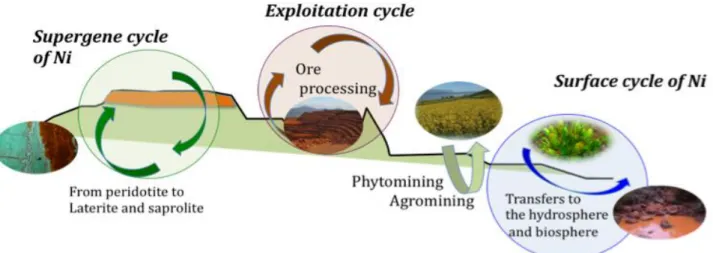
In conclusion, the main research axes of this three-year project describe the surficial cycles of Ni and associated elements, including their anthropological cycles, in order to promote the development of new concepts and approaches.
Figure 1. Geochemical cycle of Nickel from the formation of primary concentrations (saprolite, laetrite) to the extraction and ore processing, and its environmental impacts.
Ni-SILICATE ORES: AN ALTERNATIVE AND
MULTISTAGE METALLOGENIC MODEL
CATHELINEAU Michel, QUESNEL Benoit, BOIRON Marie-Christine, in coll. Geosciences Rennes and Koniambo S.A.
General framework
Nickel silicate ores are generally thought to be closely associated with the weathering of peridotite, especially in the development of laterites. Thus, the main ore genesis model for Ni ores in New Caledonia is based on a single per descensum model where most elements (Mg, Ni, and Si) are leached from the surface, particularly during lateritic soil development (Trescases, 1975). Nickel is then concentrated either in the fine-grained laterite where goethite is the main Ni bearer, the so-called “lateritic ore”, or below the laterites, in the saprolite level, occurring as fractures filled by kerolite (Mg-Ni silicate). However, the several types of Ni-silicate veins suggest a metallogenesis through multiple stages. Following this approach, a re-appraisal of the metallogenic model was carried out on the basis of structurally controlled samples, and on the relative chronology of mineral formations and crack seals.
Objectives
In the new Koniambo mining site, recently re-opened as part of the Koniambo Nickel project, Ni silicate ores had not been described in detail, with the exception of a few pioneering descriptions by Fandeur (2009). Recent observations in a new open pit (“Cagou pit”) from the Koniambo mining district, have shown that the two main types of Ni silicates occur in the saprolite level. The first (type 1), consists of mineralized faults
and fractures showing a kerolite infilling that is cm to dm in width, typically corresponding to what is described elsewhere in New Caledonia, e.g. a main vein infilling made of talc-like Ni-Mg (kerolite, as defined by Brindley et al., 1977). This kerolite fracture infilling occurs in sets of discontinuities. The second (type 2) consists of rather spectacular occurrences of “target-like” green (pimelite) and white (Mg-kerolite) coatings on joint planes, that occur always close to the type 1. The aim of this study is to propose a genetic model of the different types of ores, based on a mineralogical, chemical, and structural study.
Methods
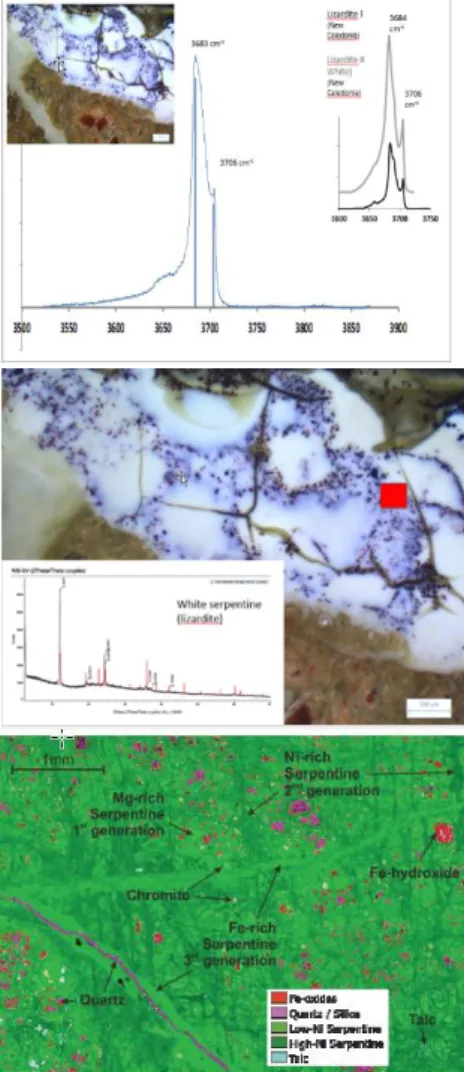
All the studied minerals are kerolite, also called talc-like (very fine particles of hydrated talc), as defined by Brindley & Wan (1975) and Brindley et al. (1977). They were identified by TEM, microprobe analysis, XRD and Raman spectroscopy. All the analysed kerolites show a significant stoichiometric deviation from talc, in particular an excess in octahedral Ni (+Mg) occupancy correlated to a deficiency in the tetrahedral occupancy. They display the features of the solid solution defined on the basis of Raman spectroscopy analysis for kerolites (Cathelineau et al., 2015a). Stable isotopes (18 O) were determined on quartz.
Results
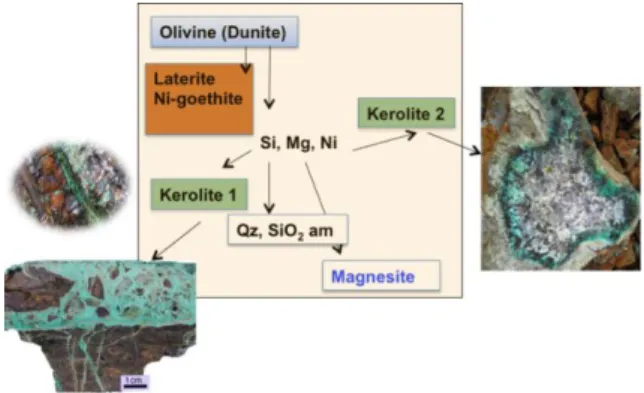
Type 1: Sets of fractures and breccia sealed by Ni-rich silicates and quartz occur within sap-rock of the New Caledonian regolith developed over ultramafic rocks. The crystallization sequence in fractures is as follows: 1) serpentine stage: lizardite > polygonal serpentine > white lizardite, 2) Ni stage: Ni-Mg kerolite followed by red-brown microcrystalline quartz, 3) supergene stages: Ni-Mg kerolite exhibiting a strong chemical
zonation due to Ni-Mg substitutions, as Ni contents cover a large range (from 10 wt.% NiO to 27 wt.% NiO). The red-brown microcrystalline quartz corresponds to the very last stage of the Ni-sequence and is inferred to have precipitated within the 50-95°C temperature range on the basis of stable isotope data. It constitutes also the main cement of breccia that has all the typical features of hydraulic fracturing. The whole sequence is therefore interpreted as the result of hydrothermal fluid circulation under medium to low temperatures, along with fluctuating fluid pressures. The Ni-silicate veins appear thus as the result of recurrent crack and seal processes, corresponding to upward medium temperature fluid convection, hydraulic fracturing and subsequent fluid mixing, and finally, mineral deposition (Cathelineau et al., 2016).
Figure 1. Formation of the two main types of silicate ores (type 1 : crack and seal and breccia at the left hand side, and type 2 cocarde type on the right hand side).
Type 2: kerolite from target-like ores display two narrow ranges of Ni concentrations: NiO from 0 to 0.5% in white Mg-kerolite, and NiO from 43 to 49% in Ni-kerolite (pimelite), e.g. two ranges close to those of the end member values for the Ni-Mg kerolite solid solution.
The precipitation of the newly formed Mg- and Ni-kerolites, implies a mechanism of mineral precipitation from interstitial water. The most likely mechanism is water evaporation when the water table level is low. Thus, the evaporation of waters containing silica, magnesium and nickel issued by the dissolution of all Mg (Ni) silicates in the dissolution pipes, may result in the saturation of pimelite + Mg-kerolite (Cathelineau et al. 2015b). The mineral distribution at the origin of the spectacular target-like colour zoning, seems to come from a kind of “chromatographic” process due to the saturation of pimelite at the edge, and then to saturation at the centre of the block joint. The centre of the joint is the last zone to dry, and there, the remaining silica and magnesium precipitates from water once nickel is already precipitated as pimelite near the joint boundaries. Pimelite is by far more insoluble than Mg-kerolite, thereby explaining that this mineral may precipitate despite a Ni/Mg ratio in water close to 10-3; this process was already described by Gali et al. (2012). The process is probably recurrent
and is repeated a large number of times before reaching a significant amount of precipitated mass, but is limited to joints with a sufficiently low permeability, preventing quick dissolution and any release of elements. Conversely, in open joints, the renewal of the solution is such that the precipitated minerals are alternately dissolved. It is interesting to note that there is a break in the stability of the Ni-Mg kerolite solid solution, which does not seem to be any more stable in these surficial conditions, thus favouring the formation of the two end-members.
The high number of joints contributes to “fracture” the permeability in the first hundreds of meters of the peridotite. Zones characterized by quick vertical water transfer, lack mineral precipitation, and are mostly characterized by residual iron oxyhydroxydes. Conversely, the more deeply seated joint networks may be affected by the re-precipitation of nickel as pimelite, mostly when located near clusters of early type 1 ore fractures. Pimelite occurs in a variety of joints, the distribution of which is rather distinct from the kerolite-fractures, confirming that this represents a Ni-enrichment in open spaces, genetically distinct from the early Ni-concentration. The abundance of ore 2 pimelite joints in the bottom zone of the regolith suggests that ore 2 significantly contributes to the grade of the main ore type extracted today in the open pits, besides Ni-oxi-hydroxides in the saprolite. Thus, type 1 ores in discontinuities represent isolated and rich clusters but only a very small part of the extracted ores. In addition, these ores are not considered when estimating the reserves, due to their scarcity and erratic distribution, as well as to their very high, but not representative, grades.
Perspectives
The present-day distribution of minerals appears as the result of complex superimposed processes, and not only as the result of a unique downward migration of a nickel front during the main stage of laterite formation.The whole sequence of fracture infillings is therefore interpreted as the result of the evolution of a hydrothermal system, from medium to low temperatures, under a fluctuating fluid pressure, and at depth > 0.5 km. Such systems still require to be better described and understood, to relate them in space and time with the geodynamic evolution of ophiolitic nappes. Economic concentrations in saprolites depend therefore not only on the surficial transfers, but also on the spatial distribution of early discontinuities within ophiolites. Such discontinuities act as major drains during a succession of reactivation stages.
Published works
Cathelineau, M., Caumon, M.-C., Massei, F., Brie, D., Harlaux, M., (2015a). Raman spectra of Ni–Mg kerolite: effect of Ni–Mg substitution on O–H
stretching vibrations. J. Raman Spectrosc. 46, 933– 940. doi:10.1002/jrs.4746
Cathelineau, M., Quesnel B., Gautier P., Boulvais P., Couteau ·C., Drouillet M. (2015b) Nickel dispersion and enrichment at the bottom of the regolith: formation of pimelite target-like ores in rock block joints (Koniambo Ni deposit, New Caledonia) Mineralium Deposita 07/2015; DOI:10.1007/s00126-015-0607-y
Cathelineau M., Myagkiy A., Quesnel B., Boiron M.-C., Gautier P., Boulvais P., Ulrich M., Truche L., Golfier F., Drouillet M. (2016) Multistage crack seal vein and hydrothermal Ni enrichment in serpentinized ultrabasic rocks (Koniambo massif, New Caledonia). Mineralium Deposita (in press).
GEOCHEMISTRY AND MINERALOGY OF
SCANDIUM IN LATERITES: THE NI-CO
LATERITES OF NEW CALEDONIA
TEITLER Yoram - CATHELINEAU Michel
General framework
Scandium (Sc) is a strategic metal and a potential game changer for the mining industry. Laterized ultramafic rocks are considered as some of the most prospective lithologies for Sc ores (~100 ppm or higher). However, so far, the gitology of Sc in laterites is poorly understood, as the few studies conducted on lateritic Sc(1-3) provide limited understanding on the
processes responsible for Sc upgrade. It is generally assumed that the Sc released from the dissolution of primary silicates is trapped in newly formed goethite, resulting in the residual enrichment of Sc in laterites.
Objectives
This project aims to identify, in the lateritic Ni-Co deposits of New Caledonia, the other strategic metals (Sc, REE) that have a potential for co-extraction, and to characterize the processes involved in their enrichment to economic grades.
Figure 1. Location of investigated mining districts.
Methods
Five mining districts distributed across New Caledonia have been investigated in the present study (Figure 1), encompassing representative prospective bedrock types (peridotites, mafic intrusives) and alteration styles. A multidisciplinary approach is applied to address this under-explored research theme:
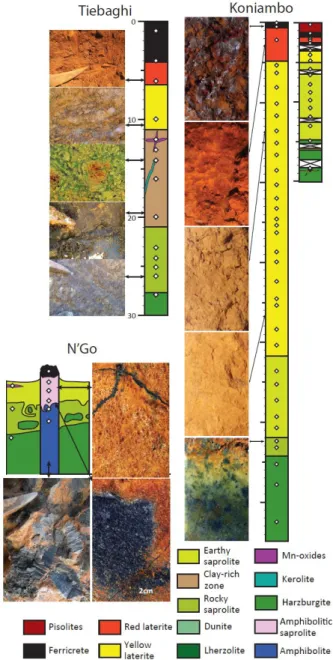
(i) Deposit- to mine-scale study and sampling of representative lateritic profiles across New Caledonia (Figures 1, 2)
(ii) Determination of the most prospective rock types and alteration styles (whole-rock geochemistry) (iii) Detailed characterization of the fate of Sc throughout the paragenetic sequence (petrology, in-situ mineral chemistry, speciation: LA-ICP-MS, synchrotron)
(iv) Translation into a genetic model for lateritic Sc, optimization of exploration strategies.
Results
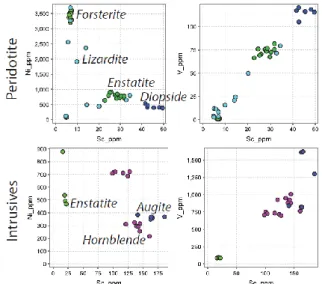
The main outcomes of this ongoing project are summarized in Figures 3-4 and include:
(i) Amphibolite is the most fertile type of protolith (initial Sc > 100 ppm). Altered amphibolites yield the highest Sc contents (> 250 ppm) but represent discrete occurrences of limited volumes.
(ii) Mature laterites developed after harzburgite or lherzolite may be prospective for Sc (max. ~100 ppm).
Figure 3. Distribution of Ni, Co and Sc (whole-rock geochemistry) in representative lateritic profiles.
(iii) Complex paragenetic sequences are observed. During the lateritization process, Sc is dominantly trapped in goethite rather than in hematite or Al-bearing secondary phases. However, Sc distribution is, to some extent, uncorrelated with Fe and appears more complex than previously thought, suggesting a process of transfer and re-enrichment within the lateritic profile.
Figure 4: Trace element mineral chemistry of primary silicates in peridotite and intrusive rocks.
Perspectives
The fate of Sc during lateritization will be further investigated based on trace element chemistry and speciation analyses of iron oxides. A genetic model for scandium enrichment processes in laterites, so far poorly constrained despite the raising interest of industry for this commodity, will be proposed.
This project, which encompasses multiple academic, industrial and governmental partners, will provide a comprehensive evaluation of the potential for strategic metal co-mining in New Caledonia.
References
Aiglsperger, T., Proenza, J.A., Lewis, J.F., Labrador, M., Svojtka, Rojas-Puron, A., Longo, F., Durisova, J. (2016) Critical metals (REE, Sc, PGE) in Ni laterites from Cuba and the Dominican Republic. Ore Geology Reviews 76 (1) 127-147.
Ulrich, M. (2013) Enrichissement en Scandium des profils latéritiques de Nouvelle-Calédonie : Origine, spéciation et potentiel d'exploitation. Unpublished report.
Chasse et al. (2016) Mineralogical and Geochemical Mechanisms Concentrating Scandium in Lateritic Deposits. Goldschmidt conference abstracts 2016
REVEALING THE CONDITIONS OF NI
MINERALIZATION IN LATERITE PROFILES
OF NEW CALEDONIA: INSIGHTS FROM
SUBSURFACE REACTIVE GEOCHEMICAL
TRANSPORT MODELLING
MYAGKIY Andrey
TRUCHE Laurent - CATHELINEAU Michel - GOLFIER Fabrice
General framework
New Caledonia is famous for being one of the world’s largest nickel laterite deposits forming from intense chemical and mechanical weathering of a peridotite bedrock.
Being released from ultramafic parent rocks to groundwater, nickel is extremely mobile, controlled to a great extent by sorption, substitution and dissolution/precipitation processes.
The knowledge of the different retention processes along with the factors controlling them, appears to be the key to a detailed understanding of laterite formation and Ni concentration.
Objectives
For the first time, through this study, is presented a numerical modelling of the development of a nickel laterite profile. Such regolith is known to form from ultramafic bedrock. We give new profound understanding of the Ni vertical mobility in a soil profile. Retention and relative enrichment processes are still poorly studied. ,Downward progression of the lateritization front is allowed by the leaching of the soluble elements (Si, Mg and Ni) bringing an insight into the drainage system, represented by a porous column of peridotite.
Particular emphasis was made on the detailed understanding of Ni redistribution as a function of time and depth triggered by Ni-bearing silicate precipitation (i.e. garnierite) and by sorption or recrystallization processes with goethite.
Methods
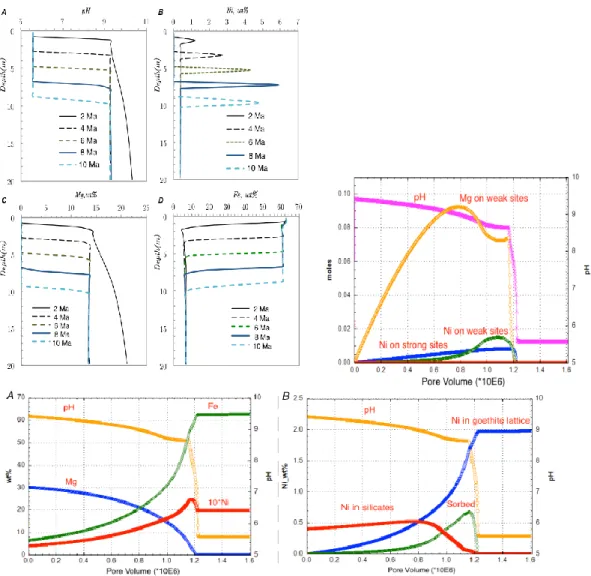
A simulation of a reactive multicomponent 1-D transport model was realized. Simulations were based on the code PHREEQC (V 3.1.4). The modeling of the supergene enrichment of lateritic Ni deposits was set by assuming the weathering of a 1-D vertically oriented column of serpentinized olivine, following steady state flows of meteoric waters. .Olivine dissolution has been assumed to be kinetically controlled, whereas the precipitation of secondary weathering products is considered to occur according to local equilibrium. We looked at Ni mineralizations and compared them. Adsorption-desorption processes on weak and strong sites were calculated with the surface complexation model of Dzombak and Morel, which assembles sorption data on ferrihydrite.
Results
Our long-term simulations (10 Ma) clearly demonstrate that the vertical progression of the pH front controls Ni enrichments and the thickening of the iron-rich zone. In the limonite zone, Nickel is mostly substituted for iron and may not be explained by adsorption processes, which are also influenced by the competition for sorption sites with other elements along with Ni. To account for this, the modelling of Ni co-precipitation with goethite was applied. Such a model appears to be of importance in an attempt to explain Ni mineralization processes, revealing what are the main keys to understanding trace element mobility in ultramafic environments.
Figure1. Mass fraction of secondary weathering products after 50,000 PV (2 Ma), 150,000 PV (6 Ma) and 250,000 PV (10 Ma). Yellow dotted line represents current pH front in the column.
Perspectives
1-D modelling appears to be a powerful tool towards understanding the general behavior of trace elements upon the formation of laterite. It also demonstrates that in situ Ni mineralizations should be explained by
more complex processes, such as lateral transfers, convective flows and preferential pathways.
Therefore, 2D/3D reactive transport simulations will be conducted to assess these aspects based on a coupling approach between geochemistry, hydrodynamics and heat and mass transfer.
Figure 2. pH as the main factor controlling mobility of trace elements and retention processes.
PRE-CONCENTRATION OF VALUABLE
ELEMENTS (E.G., NI) FROM LOW GRADE
ORES AND WASTE PRODUCTS
FARROKHPAY Saeed; FILIPPOV Lev
General framework
Nickel laterites are becoming the most important source of nickel for the world demand. Nickel is often extracted from the laterite ores by a variety of process routes including smelting or leaching. If the nickel content is upgraded prior to the process then less material has to be transported and processed. This means less energy and reagent usage, and at the same time, higher production rate of nickel. In addition, most of the ores that will be discovered in the future will contain valuable elements in very low grades.
These elements are finely disseminated among several minerals in the ores and will require new techniques to recover and separate them from the gangues minerals.
Objectives
The objective of this project is to develop alternative methods for pre-concentration of nickel in laterite ores. The specific aims are to understand the mineralogy of laterite ores and liberation of the nickel containing minerals. Nickel in laterite ores is often finely disseminated in various minerals in very fine size. Therefore, fine grinding may be useful to liberate these particles. However, particles resulted from fine grinding are often very small, and recovery of such particles is low in the conventional flotation cells. New flotation cells such as reactor-separator with more probability of particle-bubble attachment can be
useful to recover these fine particles. In addition, selective flocculation of fine particles could be also the key parameter to improve the flotation performance of laterite ores. For example, agglomeration of laterite particles has been shown as a critical step for successful heap leaching of nickel laterite ores in Australia.
A collaboration with Eramet has been established in this project, and they provide different type of laterite ores. Facilities at Eramet Research such as QEMSCAN will be also used for ore characterisation.
Results
Literature review: The challenges in processing nickel
laterite ores using flotation were comprehensively reviewed and results were published in the
International Journal of Mineral Processing (vol 151,
pages 59-67, 2016). Literature review showed that flotation has not been successful to recover nickel from laterite ores and further investigation is needed in this regard. Better liberation of nickel containing particles, using new flotation cells and selective aggregation of fine particles were suggested as possible options to physically pre-concentrate nickel in laterite ores.
Figure 1. Characterisation of the Weda Bay laterite ore sample.
Characterisation: The first laterite received from
Eramet was sample of Weda Bay ore from Indonesia. Different techniques available at GeoRessources and Eramet were used to understand the mineralogy of the sample. The Weda Bay ore sample contains 2-3 % nickel and the main minerals are serpentine, goethite and quartz. Figure 1 shows a summary of the characterization results.
Table 1. Aggregation of laterite ore particles.
Polymer Settling rate mm/min Microscopy image D50 (µm) - Very slow 10 Nonionic 35.0 270 Anionic (low charge) 14.0 155 Anionic (High charge) 0.8 40
Aggregation: As highlighted, agglomeration of laterite
particles has been shown as a critical step for successful heap leaching of nickel laterite ores in Australia. While basic mechanisms governing aggregation in simple mineral systems are well understood, very little is known about the behaviour of complex ores such as nickel laterites. In this work, the effect of polymers with different charge density was tested on the nickel laterite ore suspension. The methodology involved settling tests, characterisation of the flocs using microscope, and evaluation of flocs stability. It was found that the flocs resulted from the nonionic polyacrylamide were large and stable, with high settling rate. The flocs resulted from the highly charged polymer were small, with very low settling rate. The size of the flocs obtained experimentally was found in a good agreement with those calculated theoretically using Stokes’ law. Table 1 presents a summary of the result of aggregation of laterite ore sample.