HAL Id: hal-00297663
https://hal.archives-ouvertes.fr/hal-00297663
Submitted on 24 Jan 2008
HAL is a multi-disciplinary open access
archive for the deposit and dissemination of
sci-entific research documents, whether they are
pub-lished or not. The documents may come from
teaching and research institutions in France or
abroad, or from public or private research centers.
L’archive ouverte pluridisciplinaire HAL, est
destinée au dépôt et à la diffusion de documents
scientifiques de niveau recherche, publiés ou non,
émanant des établissements d’enseignement et de
recherche français ou étrangers, des laboratoires
publics ou privés.
Arabian Sea Oxygen Minimum Zone
J. H. Andersson, C. Woulds, M. Schwartz, G. L. Cowie, L. A. Levin, K.
Soetaert, J. J. Middelburg
To cite this version:
J. H. Andersson, C. Woulds, M. Schwartz, G. L. Cowie, L. A. Levin, et al.. Short-term fate of
phytodetritus in sediments across the Arabian Sea Oxygen Minimum Zone. Biogeosciences, European
Geosciences Union, 2008, 5 (1), pp.43-53. �hal-00297663�
www.biogeosciences.net/5/43/2008/ © Author(s) 2008. This work is licensed under a Creative Commons License.
Biogeosciences
Short-term fate of phytodetritus in sediments across the Arabian
Sea Oxygen Minimum Zone
J. H. Andersson1,*, C. Woulds2, M. Schwartz2,**, G. L. Cowie2, L. A. Levin3, K. Soetaert1, and J. J. Middelburg1
1Netherlands Institute of Ecology (NIOO-KNAW), Centre for Estuarine and Marine Ecology, POB 140, 4400 AC Yerseke,
The Netherlands
2University of Edinburgh, School of Geosciences, West Mains Road, EH9 3JW, Scotland
3Integrative Oceanography Division, Scripps Institution of Oceanography, La Jolla, CA 92093-0218, USA
*now at: Danish Meteorological Institute, Lyngbyvej 100, 2100 Copenhagen, Denmark
**now at: University of West Florida, 11000 University Parkway, Pensacola, FL 32514, USA
Received: 23 July 2007 – Published in Biogeosciences Discuss.: 31 July 2007
Revised: 28 November 2007 – Accepted: 14 December 2007 – Published: 24 January 2008
Abstract. The short-term fate of phytodetritus was investi-gated across the Pakistan margin of the Arabian Sea at wa-ter depths ranging from 140 to 1850 m, encompassing the oxygen minimum zone (∼100–1100 m). Phytodetritus
sedi-mentation events were simulated by adding ∼44 mmol13
C-labelled algal material per m2 to surface sediments in
re-trieved cores. Cores were incubated in the dark, at in situ temperature and oxygen concentrations. Overlying waters were sampled periodically, and cores were recovered and sampled (for organisms and sediments) after durations of two and five days. The labelled carbon was subsequently traced into bacterial lipids, foraminiferan and macrofaunal biomass, and dissolved organic and inorganic pools. The majority of the label (20 to 100%) was in most cases left unprocessed in the sediment at the surface. The largest pool of processed carbon was found to be respiration (0 to 25% of added car-bon), recovered as dissolved inorganic carbon. Both temper-ature and oxygen were found to influence the rate of respi-ration. Macrofaunal influence was most pronounced at the lower part of the oxygen minimum zone where it contributed 11% to the processing of phytodetritus.
1 Introduction
Phytodetritus arriving in pulses is a major food source for the benthic communities living at ocean margins and deep-sea basins (Gooday, 2002). The occurrence of such intense phytodetritus pulses requires episodic production events and a short transit time through the water column where it would otherwise be degraded, i.e. the settling speed needs to be
Correspondence to: J. H. Andersson
high. Aggregation of phytoplankton into larger particles
(Kriest and Evans, 1999) and ballasting (Francois et al., 2002) contribute to high settling speeds. As diatoms easily form aggregates, they are the most important part of phytode-tritus settling to the sea floor (Beaulieu, 2002).
Following the fate of naturally occurring phytoplankton blooms and the resulting detritus deposition on the sea floor is logistically difficult due in part to the unpredictable nature of these sedimentation events. Time-series observations of sediment processes (e.g. as total sediment oxygen consump-tion) have yielded inconclusive results when compared to measured deposition fluxes (Smith, 1992; Sayles et al., 1994; Soetaert et al., 1996). An experimental approach, where
al-gae enriched in13C are added directly to the sediment
sur-face facilitates the establishment of carbon budgets, whilst it also enables studying several parts of the benthic food web, such as uptake into bacteria, fauna and respiration, simulta-neously (Moodley et al., 2002; Witte et al., 2003b; Moodley et al., 2005).
The biogeochemistry of the Arabian Sea is strongly in-fluenced by the two monsoon periods. Periods vary, but the southwest monsoon occurs from late May to early September and the northeast monsoon from December to March (Wig-gert et al., 2005). Primary productivity increases dramat-ically in these two periods due to higher nutrient levels, caused during the southwest-monsoon by coastal upwelling of nutrient-rich waters and during the north-east monsoon by convective mixing together with subsequent advection by large-scale circulation (Naqvi et al., 2002; Kawamiya and Oschlies, 2003). At the end of the algal blooms, detritus sinks through the water column and on to the sea floor (Haake et al., 1993). The sediments of the Arabian Sea therefore re-ceive fluxes of organic material that display strong seasonal variability.
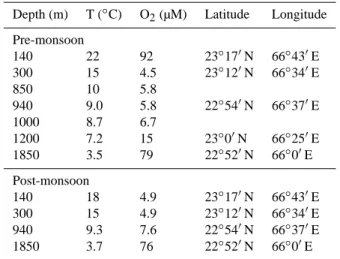
Table 1. Station characteristics. Temperature and oxygen concen-trations taken from CTD casts.
Depth (m) T (◦C) O2(µM) Latitude Longitude
Pre-monsoon 140 22 92 23◦17′N 66◦43′E 300 15 4.5 23◦12′N 66◦34′E 850 10 5.8 940 9.0 5.8 22◦54′N 66◦37′E 1000 8.7 6.7 1200 7.2 15 23◦0′N 66◦25′E 1850 3.5 79 22◦52′N 66◦0′E Post-monsoon 140 18 4.9 23◦17′N 66◦43′E 300 15 4.9 23◦12′N 66◦34′E 940 9.3 7.6 22◦54′N 66◦37′E 1850 3.7 76 22◦52′N 66◦0′E
Another prominent feature of the Arabian Sea is the mid-water Oxygen Minimum Zone (OMZ), from a mid-water depth of around 100 m down to 1100 m, due to respiration of or-ganic matter in combination with input of intermediate wa-ters, with a low oxygen content, from the Southern Hemi-sphere (Naqvi, 1987; Warren, 1994). The OMZ coincides roughly with maxima in sedimentary organic carbon, sug-gesting a link between organic carbon preservation and oxy-gen availability (Cowie et al., 1999).
The short term fate of phytodetritus has been studied at several places in the ocean (Blair et al., 1996; Moodley et al., 2000, 2002; Witte et al., 2003b), but no study has yet directly compared sites in suboxic and oxic environments. At present low-oxygen environments are only a minor part of the world ocean (Helly and Levin, 2004), but are biogeochemically im-portant for a number of processes such as organic carbon preservation (Hartnett et al., 1998; Burdige, 2007) , metal cycling (Aller, 1994), removal of biologically available
ni-trogen through denitrification and natural production of N2O,
contributing to global warming (Naqvi et al., 2000). It is also important to note, that the area of oxygen-poor waters is likely to expand due to global warming, both as a direct effect of decreased solubility and indirectly because of en-hanced stratification (Keeling and Garcia, 2002).
In this paper we present results from an experimental study on the short-term fate of phytodetritus on the sea floor, at sites spanning the OMZ on the Pakistan margin of the Arabian Sea, before and after the SW monsoon. Phytodetritus sedi-mentation events were simulated by adding a known amount
of13C labelled diatoms and subsequently tracing the13C into
bacteria, via incorporation into phospholipid-derived fatty acids (PLFAs) specific to bacteria, into foraminifera and macrofauna, and into dissolved organic and inorganic carbon pools. Site depths ranged from 140 to 1850 m, which en-compass the OMZ and provided us with a natural laboratory
where the effect of oxygen and temperature could be tested under natural conditions.
2 Material and methods
2.1 Study site
Experiments were conducted on cruises CD146 and CD151, before and immediately after the summer monsoon of 2003 on-board RRS Charles Darwin. Thus it was possible to as-sess changes in benthic community response associated with the biannual monsoon-driven delivery of OM to the sedi-ment. Experiments were conducted at sites along an offshore transect off the Indus River, across the Pakistan margin of the Arabian Sea (Table 1).
2.2 Experimental conditions
Cores (i.d. 10 cm) were taken using a multiple-barrel “mega-corer”, providing virtually undisturbed samples (Barnett et al., 1984), and immediately transferred to a temperature controlled laboratory set to in situ temperature, where the experiments were conducted.
For the purpose of incubation experiments, cores were fit-ted with core top seals, and all air bubbles were excluded. The undersides of the seals featured magnetic stir bars, ports for oxygen and temperature microsensors, and a further five ports; one for slurry introduction, two to allow water
sam-pling, and two for the “oxystat” system. The “oxystat”
system was designed to maintain core-top oxygen levels at seafloor conditions despite sediment oxygen consumption. On each core the two oxystat ports were connected to each other via 8 m gas-permeable tubing (the oxystat gill), sub-merged in a reservoir of filtered seawater (the oxystat reser-voir). This reservoir was sparged with an air and nitrogen mix tuned to maintain oxygen levels slightly above those at the seafloor. A peristaltic pump circulated core top water out of each core barrel, through its dedicated oxystat gill, and back. Diffusion across the tubing in the reservoir replen-ished core top water with dissolved oxygen which had been consumed. Sub-aerial parts of the oxystat system were made of gas impermeable tubing.
Diatoms grown in a 13C enriched medium were freeze
dried onto silica or kaolin ballast and injected into the bar-rels, as a slurry dissolved in purified water, through a port in
the core lid. The labelled diatoms consisted of 75%13C,
ex-cept at the 1850 m station in the post-monsoon season, where
a different batch of algae was used consisting of 31%13C.
This resulted in a loading of between 3.6 and 5.8 mg of13C
added to each core (43.9±6.8 mmol13C m−2).
Each experiment was conducted simultaneously on two replicate cores, and incubated in the dark for 2 or 5 days, exact durations varied slightly due to logistical constraints. All cores were incubated with a gentle stirring of the over-lying water. Samples of the overover-lying water were taken at
the beginning and end of, and at pre-determined intervals, during each experiment. The samples were immediately
poi-soned with 50 µL of a saturated solution of HgCl2 to vials
with volumes of 5 mL, in order to prevent further micro-bial activity. After termination of each experiment, cores were sectioned at 0.5 cm intervals to 2 cm depth, then at 1 cm intervals to 10 cm depth, and then at 2 cm intervals to 20 cm depth. One half of each slice was placed in a cen-trifuge tube for porewater extraction, and the other half was placed in a petri dish for faunal sampling. After centrifuga-tion, the supernatant was transferred to vials for subsequent
δ13C−DOC and δ13C−DIC analysis (see below). The
re-maining sediment, used for the analysis of δ13C−POC and
bacterial lipids, were transferred to plastic bags and freeze dried. Fauna samples were sieved using filtered sea water, and residues from 300 µm, 150 µm and 63 µm sieves were re-tained. From the 300 µm and some 150 µm residues all fauna were extracted by sorting at 12–20 X magnification to the lowest possible taxonomic level, and frozen in pre-weighed tin capsules or combusted glass vials.
In addition to the shipboard incubations, labelling exper-iments were also conducted in situ using a benthic chamber lander (Elinor). The lander system has been described in de-tail by Glud et al. (1995). On arrival at the sea floor the lan-der inserted a 30×30 cm chamber into the unlan-derlying sedi-ment. Pre-programmed syringes, a stirring motor, an oxygen electrode and an external oxystat gill allowed maintenance of ambient oxygen levels, slurry introduction, sample with-drawal and stirring comparable to the shipboard experiments.
In these experiments, 19–27 mg13C was added, giving a dose
of 18–25 mmol13C m−2. After a 2-day incubation a shovel
closed the bottom of the chamber, weights were dropped and the lander ascended to the surface. Sediment from the lander chamber was sub-sampled using two short megacore tubes. These cores were sectioned and the samples were processed as described above.
2.3 Analytical methods
2.3.1 Sediments and fauna
Aliquots of 200–400 µgC of gently disaggregated
freeze-dried sediment were weighed into silver capsules.
De-carbonation was achieved by carefully adding 2–5 drops of double distilled 6 M HCl. Samples were dried overnight at
60◦C and stored in a vacuum desiccator prior to analysis.
Faunal samples were air dried at 45◦C and stored in a
vac-uum desiccator. Soft bodied fauna were de-carbonated in two layers of tin capsule using 2–5 drops of 1 M HCl,
fol-lowed by drying at 40◦C. Macrofauna and Foraminifera were
de-carbonated with 6 M HCl, the original tin capsule having been placed inside silver capsules. All samples were anal-ysed on a dedicated Europa Scientific (Crew, UK) Tracer-mass isotope ratio Tracer-mass spectrometer with a Roboprep Du-mas combustion sample converter.
2.3.2 Bacteria
Bacterial biomass and uptake were quantified by measuring the concentration and isotopic composition of three PLFAs, iC14:0, iC15:0 and aiC15:0 specific to bacteria, follow-ing Middelburg et al. (2000).
PLFAs were extracted from 4 g freeze-dried sediment us-ing a modified Bligh and Dyer extraction (Boschker et al., 1999). The lipid extract was fractionated on silicic acid into different polarity classes by sequential elution with chloro-form, acetone and methanol. The methanol fraction contain-ing the PLFAs was derivatised to yield fatty acid methyl es-ters (FAMEs).
The isotopic composition and concentrations were deter-mined using a Varian 3400 gas chromatograph equipped with a HP5 column, coupled via a combustion interface to a Finni-gan Delta+ isotope ratio mass spectrometer (IRMS).
2.3.3 Dissolved inorganic/organic carbon
Samples for the determination of dissolved inorganic and or-ganic carbon were stored refrigerated in darkness and upside-down in head-space vials. The vials were sealed with butyl rubber membranes covered with Teflon to prevent gas diffu-sion through the membrane. Concentrations of dissolved in-organic carbon were measured by coulometric titration. Iso-topic compositions were measured independently by inject-ing head-space gas directly in a continuous stream of helium into a Finnigan Delta+ IRMS via a ConFloII interface fol-lowing Moodley et al. (2000).
Concentrations and isotopic composition of dissolved or-ganic carbon (DOC) were measured on the same samples
used for the determination of δ13C−DIC. Dissolved
inor-ganic carbon was removed by adding sulphuric acid in excess and subsequent stripping with helium. The samples were
analysed with a Skalar FormacsLT TOC analyser coupled
through a ConFloII interface to a Finnigan Delta S IRMS. The calibration standards were prepared with potassium ph-talate dissolved in purified water (MilliQ).
2.4 Data treatment
Incorporation of 13C is reflected as excess (above
back-ground) 13C and is expressed in terms of total uptake in
millimoles of13C per square meter as well as specific
up-take (i.e. 1 δ13C=δ13Csample−δ13Ccontrol, where δ13C is
ex-pressed relative to Vienna Pee Dee Belemnite (VPDB)).
To-tal uptake was calculated as the product of excess 13C (E)
and carbon concentrations. Excess13C is the difference
be-tween the fraction13C of the control (Fcontrol) and the
sam-ple (Fsample) : E=Fsample−Fcontrol, where the fraction of13C
(F ) was calculated from the ratio (R) of13C/12C,
● ● ● ● 0 20 40 60 80 100 120 0 2000 4000 6000 140 0 20 40 60 80 100 120 0 2000 4000 6000 300 0 20 40 60 80 100 120 0 2000 4000 6000 940 0 20 40 60 80 100 120 0 2000 4000 6000 1200 0 20 40 60 80 100 120 0 2000 4000 6000 1850 δδ 13 C −− D O C (‰) Time (h) ● 2d−A 2d−B 5d−A 5d−B
Fig. 1. Isotopic composition of dissolved organic carbon in the overlying water from the pre-monsoon cruise. A, B indicate repli-cate cores.
The carbon isotope ratio (R) was derived from the
mea-sured δ13C values as:
R = (δ13C/1000 + 1) · RVPDB, (2)
where RVPDB=0.0112372.
Incorporation into bacterial biomass was calculated in the following way, Ibact= P3 i=1IPLFA,i FPLFA·CPLFA (3)
where FPLFA=0.12 is the fraction of the three PLFA’s to total
bacterial PLFA’s (Moodley et al., 2005) and CPLFA=0.038
is the fraction of PLFA carbon to total bacterial car-bon (Boschker and Middelburg, 2002).
3 Results
The oxystat system designed to maintain the oxygen concen-tration on the shipboard incubations, regulated the oxygen concentrations to within 10% of in-situ values.
The δ13C−DOC values in overlying waters were elevated
well above background values (−20±1‰, assuming that nat-ural sedimentary DOC has a similar isotopic composition to that of POC in underlying sediments) at the start of all incu-bations (Fig. 1), indicating that the added phytodetritus was
a source of some DOC as well as POC. The δ13C−DOC
values decreased over time as a result of dilution with un-labeled DOC present in the porewater. In several cases the
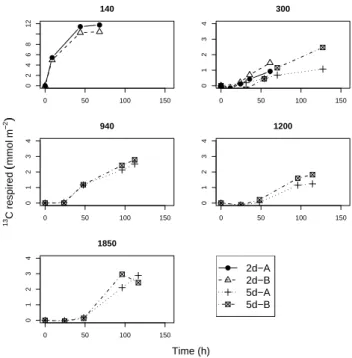
● ● ● ● 0 50 100 150 0 2 4 6 8 12 140 ● ●●● ● 0 50 100 150 0 1 2 3 4 300 0 50 100 150 0 1 2 3 4 940 0 50 100 150 0 1 2 3 4 1200 0 50 100 150 0 1 2 3 4 1850 13 C re sp ir e d (( m m o l m −− 2)) Time (h) ● 2d−A 2d−B 5d−A 5d−B
Fig. 2. Respiration of the added tracer during the pre-monsoon cruise. Note the different scale for station 140. See Table 1 for details about the stations. A, B indicate replicate cores.
● ● ● ● 0 50 100 150 0 2 4 6 8 140 ● 2d−A 2d−B 5d−A 5d−B ● ●● ● ● 0 50 100 150 0 2 4 6 8 300 ● ● ● ● ● 0 50 100 150 0 2 4 6 8 940 ● ● ● ● ● 0 50 100 150 0 2 4 6 8 1850 13 C re sp ir e d (( m m o l m −− 2 )) Time (h)
Fig. 3. Respiration of the added tracer during the post-monsoon cruise. See Table 1 for details about the stations. A, B indicate replicate cores.
δ13C−DOC increased again after the initial decrease as a
● ● ● ● ● ● ● ● ● ● 0 10 20 30 40 50 60 0.0 1.0 2.0 3.0 140 ● ●●● ●● ● ● ●●● 0 10 20 30 40 50 60 0.0 1.0 2.0 3.0 940 13 C re sp ir e d (( m m o l m −− 2)) Time (h)
Fig. 4. Respiration of the added tracer during the post-monsoon cruise in in situ incubations. See Table 1 for details about the sta-tions.
As the overlying water was sampled for δ13C−DIC and
DIC at several times during the incubations, it was possi-ble to investigate the extent and timing of respiration more closely than components such as faunal and bacterial uptake, which were sampled only at the end of the 2- and 5-day
in-cubations. The evolution of excess 13C in DIC over time
was in general very comparable between replicate cores al-though these were collected purposely from different casts. The most intense respiration was found at the shallowest sta-tion, at 140 m. This is also the station where respiration of the added phytodetritus was evident already from the start of the incubation (Fig. 2 and 3). Later, however the respiration rate slowed down. The fast initial response followed by gradual slowing down and an apparent eventual halt is found in both the pre- and post-monsoon data at the 140 m station. Respira-tion of added phytodetritus at 300 m in the OMZ also started immediately, but with a much lower rate. In contrast, respira-tion at the deeper starespira-tions all showed an initial lag phase with very low rates of respiration but a marked increase after this phase. Overall, the length of the lag phase increased with in-creasing water depth; about one day at station 940 inin-creasing to about two days at the 1200 m and 1850 m stations (Fig. 2). Due to technical difficulties with the lander, the number of successful in situ deployments was limited. However, respi-ration of added algal material was evident at both the 140m and 940m stations with relative differences in rates similar to those observed in the shipboard incubations (Fig. 4).
Downcore profiles of sediment δ13C−POC, obtained at
the end of the experiments show limited downward mixing of the added algae (Fig. 5) in both 2- and 5-day incubations. Moreover, there was no apparent change over time. Despite
● ● ● ● ● ● ● 0 500 1000 1500 4 3 2 1 0 140 − 2d ● ● ● ● ● ● −20 40 80 4 3 2 1 0 0 500 1000 1500 4 3 2 1 0 140 − 5d −20 40 80 4 3 2 1 0 ● ● ● ● ● ● ● 0 500 1000 1500 4 3 2 1 0 300 − 2d ● ● ● ● ● ● −20 40 80 4 3 2 1 0 0 500 1000 1500 4 3 2 1 0 300 − 5d −20 40 80 4 3 2 1 0 0 500 1000 1500 4 3 2 1 0 940 − 5d −20 40 80 4 3 2 1 0 0 500 1000 1500 4 3 2 1 0 1850 − 5d −20 40 80 4 3 2 1 0 δδ13 C−−POC(‰) Depth (cm)
Fig. 5. Excess δ13C−POC from the post-monsoon cruise. Insets zoom in on a limited range in delta values to allow distinguishing small differences between stations with limited and no vertical dis-placement of added algal13C.
the limited vertical displacement, small amounts of labelled material were brought down from the surface to deeper layers at all stations except in the core of the OMZ (300 m station) where all the added phytodetritus remained in the topmost sediment layer (0–0.5 cm).
The δ13C−DIC of pore-waters was highly enriched
rela-tive to background values. Enrichment was highest in the top centimeters, exponentially decreasing with depth in the sed-iment (Fig. 6). Except for one profile from 140 m in the pre-monsoon cruise exhibiting sub-surface peaks, all porewater profiles appear to be the combined result of respiration at the sediment-surface and downward diffusion into the sediment.
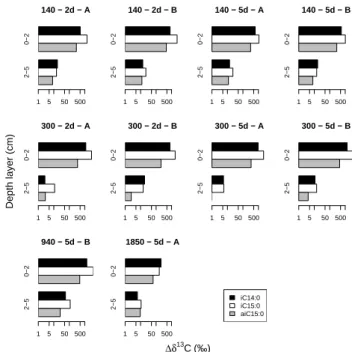
Transfer of13C from phytodetritus to bacteria was
high-est in the upper two centimeters (Fig. 7). Label assimila-tion in bacteria was also detectable in the 2–5 cm depth layer, but contributed <1% to the depth-integrated bacterial uptake. The labelling pattern of the three bacteria-specific fatty acids, iC14:0, iC15:0 and aiC15:0 was consistent across stations and depth layers in the sediment. The fatty acid with the
highest specific uptake (1 δ13C) in general is iC15:0.
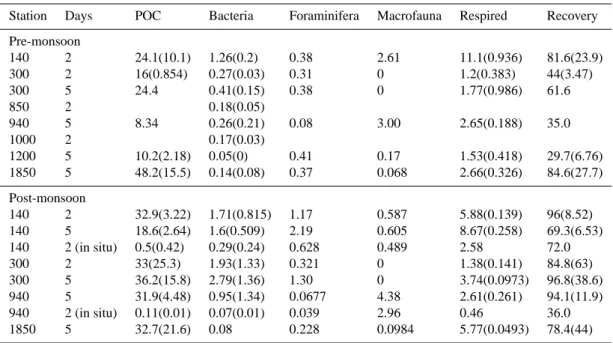
Bacte-rial uptake was quite similar across the stations above 1000 m depth. Uptake was much lower at greater station depths, even after five days (Table 2). Bacterial uptake of the added al-gal carbon was on average comparable to macrofaunal and foraminiferal uptake (Woulds et al., 2007). At the 300 m station, where exceptionally low oxygen levels resulted in a near-total absence of macrofauna, bacterial and foraminiferal
● ● ● ● ● ● ● ● ● ● ● ● 0 1000 2000 3000 10 8 6 4 2 0 140 ● ● ● ● ● ● ● ● ● ● ● 0 200 400 600 10 8 6 4 2 0 300 0 400 800 1200 10 8 6 4 2 0 300 0 200 600 1000 10 8 6 4 2 0 940 0 200 400 600 10 8 6 4 2 0 1200 0 500 1000 1500 10 8 6 4 2 0 1850 ● 2d−A 2d−B 5d−A 5d−B δδ13C−−DIC(‰) Depth (cm)
Fig. 6. Isotopic composition of the porewater DIC at the end of the experiments at five different water depths from the pre-monsoon cruise. Results are shown for a maximum depth of 10 cm, although samples were analysed to a depth of 20 cm. A, B indicate replicate cores.
uptake was similar. At the 940 m station, the macrofauna was much more prominent and dominated the carbon processing. Respiration was measured in incubations lasting both 2 and 5 days. To allow the comparison of all incubations, all respiration values were linearly interpolated from the two closest sampling times to a common time of 44 h (Fig. 8). As some incubations nominally lasting 5 days had to be termi-nated earlier due to limited processing manpower, these were interpolated to 86 h (Fig. 9). Respiration after 44 h was most intense at the shallowest station and decreased with station depth. However, after 86 h the decrease with station depth is only evident at the 140 to 300 m stations. Note that a dif-ferent batch of algae was used for the 1850 m station in the post-monsoon cruise, which apparently was more easily min-eralised.
4 Discussion
4.1 Experimental approach
Potential artifacts in shipboard incubations of oceanic sedi-ments have been reported repeatedly (e.g. Glud et al., 1994) and include possible changes due to decompression or warm-ing of the sediment durwarm-ing retrieval and incubation of the cores. At most stations, we also performed in situ incuba-tions to be able to verify the shipboard results. However, the
2−5 0−2 1 5 50 500 140 − 2d − A 2−5 0−2 1 5 50 500 140 − 2d − B 2−5 0−2 1 5 50 500 140 − 5d − A 2−5 0−2 1 5 50 500 140 − 5d − B 2−5 0−2 1 5 50 500 300 − 2d − A 2−5 0−2 1 5 50 500 300 − 2d − B 2−5 0−2 1 5 50 500 300 − 5d − A 2−5 0−2 1 5 50 500 300 − 5d − B 2−5 0−2 1 5 50 500 940 − 5d − B 2−5 0−2 1 5 50 500 1850 − 5d − A iC14:0 iC15:0 aiC15:0 ∆δ13C(‰) Depth layer (cm)
Fig. 7. Specific uptake of13C into bacterial fatty acids in two depth layers at all stations during the post-monsoon cruise. A, B indicate replicate cores. Note the use of a logarithmic x-axis.
● ● ● ● ● ● ● ● ● ● ● ● 0 500 1000 1500 0 5 10 15 20 25 44h Waterdepth (m) Algal−13C respired (%) ● ● ● ● ● ● ● ● ● ● ● ● ● ● ●●●● ● ● PrePost In−situ
Fig. 8. Interpolated percentage of total label respired after 44 h across the ocean margin. A different batch of algae was used for station 1850 during the post-monsoon cruise. All shipboard experi-ments were performed in duplicate.
distribution of added phytodetritus in the in situ incubation chamber was very patchy, as highlighted by large differences
Table 2. Mean (and standard deviations) of phytodetrital processing rates in mmol13C m−2and recovery in % of the added carbon. Recovery is calculated as the sum of macrofaunal uptake, respired carbon and bulk excess POC, as POC already includes the contribution from both bacteria and foraminifera. Contribution from macrofauna and foraminifera were taken from Woulds et al. (2007). The absolute amount of algae added to in situ incubations were higher than in the shipboard incubations, but lower on a per area basis.
Station Days POC Bacteria Foraminifera Macrofauna Respired Recovery Pre-monsoon 140 2 24.1(10.1) 1.26(0.2) 0.38 2.61 11.1(0.936) 81.6(23.9) 300 2 16(0.854) 0.27(0.03) 0.31 0 1.2(0.383) 44(3.47) 300 5 24.4 0.41(0.15) 0.38 0 1.77(0.986) 61.6 850 2 0.18(0.05) 940 5 8.34 0.26(0.21) 0.08 3.00 2.65(0.188) 35.0 1000 2 0.17(0.03) 1200 5 10.2(2.18) 0.05(0) 0.41 0.17 1.53(0.418) 29.7(6.76) 1850 5 48.2(15.5) 0.14(0.08) 0.37 0.068 2.66(0.326) 84.6(27.7) Post-monsoon 140 2 32.9(3.22) 1.71(0.815) 1.17 0.587 5.88(0.139) 96(8.52) 140 5 18.6(2.64) 1.6(0.509) 2.19 0.605 8.67(0.258) 69.3(6.53) 140 2 (in situ) 0.5(0.42) 0.29(0.24) 0.628 0.489 2.58 72.0 300 2 33(25.3) 1.93(1.33) 0.321 0 1.38(0.141) 84.8(63) 300 5 36.2(15.8) 2.79(1.36) 1.30 0 3.74(0.0973) 96.8(38.6) 940 5 31.9(4.48) 0.95(1.34) 0.0677 4.38 2.61(0.261) 94.1(11.9) 940 2 (in situ) 0.11(0.01) 0.07(0.01) 0.039 2.96 0.46 36.0 1850 5 32.7(21.6) 0.08 0.228 0.0984 5.77(0.0493) 78.4(44)
in excess 13C-POC and bacterial uptake between subcores
(Table 2) at the 140 m site. As a consequence of patchy avail-ability of phytodetritus, a large fraction of bacteria residing at the sediment surface was unable to participate in the process-ing of this material. Upscalprocess-ing measurements made on small
subcores, such as excess13C-POC and bacterial uptake rates,
introduces large uncertainty in total chamber estimates. Incubation of sediments from low-oxygen environments poses a major challenge because measures should be taken to maintain oxygen levels close to ambient. Therefore, wa-ter from each core was pumped through gas-permeable sili-con tubing placed in a reservoir where oxygen sili-concentrations were kept at in situ concentrations. This ensured ambient oxygen levels and thus a close-to-natural functioning of the benthic community. However, since the partial pressure of carbon dioxide was higher in the cores compared to the con-trolled reservoir, it is possible that carbon dioxide effluxed from the experimental cores and consequently that absolute values of respiration are underestimated.
While core incubations are able to replicate both the tem-perature and oxygen conditions of the in situ environment, the stirring rate is constant and is set to prevent
resuspen-sion. Should resuspension occur in the natural
environ-ment, it could alter the fate of phytodetritus by keeping it exposed longer to decomposition in the benthic boundary layer (Beaulieu, 2003).
The natural status of phytodetritus arriving at the seafloor has been found to be highly variable in terms of degradation
● ● ● ● ● ● ● ● 0 500 1000 1500 0 5 10 15 20 25 86h Waterdepth (m) Algal−13C respired (%) ● ● ● ● ● ● ●● ● ● PrePost
Different algae used
Fig. 9. Interpolated percentage of total label respired after 86 h across the ocean margin. A different batch of algae was used for sta-tion 1850 at the post-monsoon cruise, which apparently was more easily mineralised. All experiments were performed in duplicate.
state and composition, and it is thus not easy to select the appropriate pre-treatment of experimental phytodetritus such
that it resembles natural conditions best (Beaulieu, 2002). Similarly, it was not possible to select proportionally rep-resentative amounts of labeled C to add to the different sites. Instead, we chose to add the same material and the same quantity to all sediments, allowing a direct comparison among sites. Adding the same amount of phytodetritus at all depths does not simulate natural inputs, as these would generally be lower at greater depths due to respiration within the water column (Andersson et al., 2004). Our experiments were therefore designed to directly compare the relative po-tential for phytodetritus processing at different study sites. However, it has been shown that degradation of particulate organic material is slowed down in suboxic water columns such as the one found in the Arabian Sea (Devol and Hart-nett, 2001). Thus, in OMZ areas, the flux of organic mate-rial arriving at the seafloor is of a more similar magnitude at different depths, than it would be for an entirely oxic water column.
That the nature of reactive organic matter added may be important to experimental results was possibly demonstrated in the response recorded during the post-monsoon period at the 1850 m station. Due to problems with algal cultures, a different batch of labeled diatoms was used, which appar-ently was much more readily respired. Moreover, the
im-mediate 13C enrichment of DOC in incubations at all
sta-tions (Fig. 1) indicates that DOC was added with the freeze-dried algal material despite thorough rinsing procedures. Al-though this unintended addition of 13C-DOC amounted to
less than 5% of total added13C in all cases, the combined
results highlight that benthic carbon processing studies using artificially introduced phytodetritus are not necessarily com-parable, because the results may depend on the type of al-gae used, their preconditioning and the specific carbon load-ing (Buhrload-ing et al., 2006).
Summing up the contribution from all the compartments, i.e. uptake into bacteria, foraminifera, macrofauna, respira-tion and unprocessed algal carbon remaining in the sediment a recovery can be calculated. POC measurement includes the contribution from both unprocessed algal carbon and car-bon taken up by bacteria and foraminifera (macrofauna was picked out). Thus, the recovery was calculated by the sum of the POC pool, the uptake into macrofauna and the DIC pool. The recovery was high in most of the experiments from the post-monsoon cruises and some of the pre-monsoon sta-tions (Table 2). Apparent label losses are primarily due to
uncertainty in the measurement of excess13C-POC. Another
potential loss of13C-DIC was losses of gaseous13C−CO2
through the silicon tubing (see above).
4.2 Fate of phytodetritus
Our results clearly show that, within 2-to-5 day timescales, a minor fraction of total added carbon was processed at all sites, and the fate of the majority of the processed carbon was respiration, in both pre- and post-monsoon seasons. The
no-table exception was at the 940 m station where in both pre-and post-monsoon seasons, uptake by the abundant macro-fauna dominated the phytodetritus processing. The occur-rence of the amphinomid polychaete Linopherus sp. at this station accounted for most of the macrofaunal uptake and in-fluenced the entire carbon processing (Woulds et al., 2007). When present, animals such as these amphinomid poly-chaete have a large impact on the mineralisation pathway, by subducting organic matter below the oxic zone (Levin et al., 1997). This demonstrates that short-term carbon cy-cling pathways can differ dramatically, with possible conse-quences for the fate of carbon (e.g. burial vs respiration).
At the 140 m site there was a marked shift in the up-take patterns from pre- to post-monsoon due to an upward shift in the upper boundary of the OMZ, which caused bot-tom waters to become considerably less oxygenated (Ta-ble 1). Concurrent with this decrease in oxygen, the uptake shifted from macrofauna-dominated to more equally divided between bacteria, foraminifera and macrofauna. The shift in uptake pattern indicates that changes in oxygen, from fully oxygenated to hypoxic conditions, has a major impact on the pathway of benthic phytodetritus processing (Woulds et al., 2007). Respiration also responded to the shift in oxygen con-centration, but in a less dramatic sense.
Specific uptake into bacterial lipids expressed as 1 δ13C in
the 0–2 cm layer was always less than 3500‰. Using Eqs. (1)
and (2) this corresponds to a fraction of13C of 4.8%. Thus,
even the most active of the bacterial lipids did not experi-ence more than 5% turnover during five days of incubation. The turnover calculation assumes an equal contribution of all bacteria in the 0–2 cm layer.
Transfer of labeled carbon below the surface layer was limited, even at stations where macrofauna was present. Even though the impact of fauna might be less than that found elsewhere (Witte et al., 2003a; Kamp and Witte, 2005), the fauna left a clear imprint at station 940 in the profiles of
δ13C−POC, bacterial lipids and in the porewater profiles of
δ13C−DIC (Figs. 5, 7, 6), where the penetration of label was
deeper and values were more variable.
4.3 Factors governing respiration
The importance of benthic respiration as a fate for phytode-tritus on the timescale of days to months is still largely un-known and results reported from the literature are ambigu-ous. Moodley et al. (2002) examined the fate of phytodetritus in a deep-sea environment (NE Atlantic, 2170 m) on a rela-tively short timescale, by incubating sediment amended with labelled algae for 35 h. They found that 1.5% of the added algae were respired during these 35 h. However, 40% of the algal carbon was left unaccounted for after the experiment, implying that it might have been lost prior to injection. As-suming that this was the case the respiration would increase to 2.4%. Moodley et al. (2005) later repeated this experi-ment at several locations, with a large range in water depths
and temperatures, and found that ∼15% of the added algal carbon was respired at all locations after 24 h. Similarly, in our study , respiration accounted for up to 25% of the added algae within 5 days at the 140 m station. It was the dominant fate of the processed phytodetritus. This result is similar to the study of Moodley et al. (2005) where respiration domi-nated the budget of processed phytodetritus as well, in sites ranging from estuarine to deep-sea environments.
Chemical reaction rates increase with increasing temper-atures, including microbially mediated reactions in marine sediments such as organic matter mineralisation (Westrich
and Berner, 1988). Effects of temperature on short-term
processing of phytodetritus have been studied by Moodley et al. (2005), where they found that a decrease in temper-ature slowed down respiration considerably. By decreasing
the temperature from 16◦C in situ to a temperature of 6◦C,
the contribution of respiration decreased from 17 to 3% of the added algal carbon respectively. In our experiments the
length of the lag time in the appearance of excess13C into
the DIC pool showed a smooth transition from warm, shal-low sediments where no delay was observed to a lag time of almost two days at the deepest and coldest station. The in-crease in lag time with increasing station depth, and concur-rently decreasing temperatures (Table 1), might be explained by a decoupling in the temperature response between the dif-ferent functional groups of bacteria taking part in the miner-alisation process. One group is responsible for performing the initial hydrolysis of organic matter to DOC and another
group the respiration of these compounds to CO2. Such a
de-coupling might result in an accumulation of low-molecular weight DOC at low temperatures (Weston and Joye, 2005).
Bottom water oxygen concentrations may have an effect on sediment organic matter (OM) processing, but literature evidence is scattered and sometimes conflicting. Hartnett et al. (1998) and Hedges et al. (1999) have reported cor-relative evidence that oxygen exposure time determines the extent of OM processing. Experimental studies examining the effect of oxygen on OM degradation have shown it to be small when the material is fresh and larger when it is more refractory (Hulthe et al., 1998; Kristensen et al., 1995), but these experiments were not done with undisturbed sed-iment originating from naturally suboxic environments. In this study, the effect of oxygen on respiration was not as pro-nounced as the effects of temperature, but was apparent at the 300 m station where oxygen levels were so low that vir-tually no macrofauna could exist. An unexpected decrease in oxygen levels at the 140 m station (Table 1), from 92 µM in the pre-monsoon cruise to 5 µM in the post-monsoon cruise, might have caused the respiration to decrease. However, not to the same level as at the 300 m station, which would be ex-pected if the only factor determining respiration factor was oxygen. Concurrent with the decrease in oxygen at the 140 m station was also a decrease in temperature, which probably had a similar effect as the change in oxygen on the respira-tion.
5 Conclusions
Between 20 and 100% of the added algal carbon was left unprocessed in the sediment, mainly at the surface. Respi-ration accounted for the largest fraction of processed carbon, between 0 and 25%, and was governed by both temperature and bottom-water oxygen levels The decrease in tempera-ture from shallow to deeper situated sediments caused a pro-gressively longer lag period in the respiration of the algal carbon. Macrofaunal influence was most pronounced at the lower part of the oxygen minimum zone (940 m), where high amounts of food overlaps with a sufficient concentration of oxygen. At this station macrofaunal uptake accounted for 11% of total phytodetritus processing.
Acknowledgements. We thank A. Gooday, K. Larkin and P. Lamont
for sorting and picking foraminiferal and macrofaunal samples. We are also grateful to E. Breuer and O. Peppe for running the lander and megacorer. We acknowledge all the valuable support given by L. Moodley for both experimental planning and discussion about results.
This research was supported by Netherlands Organization for Scientific Research (812.02.004;833.02.2002) and carried out on-board RRS Charles Darwin financed by UK Natural Environment Research Council. This is publication number 4130 from the Netherlands Institute of Ecology (NIOO-KNAW).
Edited by: S. W. A. Naqvi
References
Aller, R. C.: The sedimentary Mn cycle in Long-Island Sound – its role as intermediate oxidant and the influence of bioturbation, O2, and CORGflux on diagenetic reaction balances, J. Mar. Res.,
52, 259–295, 1994.
Andersson, J. H., Wijsman, J. W. M., Herman, P. M. J., Middelburg, J. J., Soetaert, K., and Heip, C.: Respiration in the deep ocean, Geophys. Res. Lett., 31, L03304, doi:10.1029/2003GL018756, 2004.
Barnett, P. R. O., Watson, J., and Connelly, D.: A multiple corer for taking virtually undisturbed samples from shelf, bathyal and abyssal sediments, Oceanol. Acta, 7, 399–408, 1984.
Beaulieu, S. E.: Accumulation and fate of phytodetritus on the sea floor, Oceanogr. Mar. Biol., 40, 171–232, 2002.
Beaulieu, S. E.: Resuspension of phytodetritus from the sea floor: A laboratory flume study, Limnol. Oceanogr., 48, 1235–1244, 2003.
Blair, N. E., Levin, L. A., DeMaster, D. J., and Plaia, G.: The short-term fate of fresh algal carbon in continental slope sediments, Limnol. Oceanogr., 41, 1208–1219, 1996.
Boschker, H. T. S. and Middelburg, J. J.: Stable isotopes and biomarkers in microbial ecology, FEMS Microb. Ecol., 40, 85– 95, 2002.
Boschker, H. T. S., de Brouwer, J. F. C., and Cappenberg, T. E.: The contribution of macrophyte-derived organic matter to microbial biomass in salt-marsh sediments: Stable carbon isotope analysis of microbial biomarkers, Limnol. Oceanogr., 44, 309–319, 1999.
Buhring, S. I., Lampadariou, N., Moodley, L., Tselepides, A., and Witte, U.: Benthic microbial and whole-community re-sponses to different amounts of13C-enriched algae: In situ ex-periments in the deep Cretan Sea (Eastern Mediterranean), Lim-nol. Oceanogr., 51, 157–165, 2006.
Burdige, D. J.: Preservation of organic matter in marine sediments: Controls, mechanisms, and an imbalance in sediment organic carbon budgets?, Chem. Rev., 107, 467–485, 2007.
Cowie, G. L., Calvert, S. E., Pedersen, T. F., Schulz, H., and von Rad, U.: Organic content and preservational controls in surficial shelf and slope sediments from the Arabian Sea (Pakistan mar-gin), Mar. Geol., 161, 23–38, 1999.
Devol, A. H. and Hartnett, H. E.: Role of the oxygen-deficient zone in transfer of organic carbon to the deep ocean, Limnol. Oceanogr., 46, 1684–1690, 2001.
Francois, R., Honjo, S., Krishfield, R., and Manganini, S.: Factors controlling the flux of organic carbon to the bathy-pelagic zone of the ocean, Global Biogeochem. Cy., 16, 1087, doi:10.1029/2001GB001722, 2002.
Glud, R. N., Gundersen, J. K., Jorgensen, B. B., Revsbech, N. P., and Schulz, H. D.: Diffusive and total oxygen-uptake of deep-sea sediments in the Eastern South-Atlantic ocean – in-situ and lab-oratory measurements, Deep-Sea Res. I, 41, 1767–1788, 1994. Glud, R. N., Gundersen, J. K., Revsbech, N. P., Jorgensen, B. B.,
and Huttel, M.: Calibration and performance of the stirred flux chamber from the benthic lander Elinor, Deep-Sea Res. I, 42, 1029–1042, 1995.
Gooday, A. J.: Biological responses to seasonally varying fluxes of organic matter to the ocean floor: A review, J. Oceanography, 58, 305–332, 2002.
Haake, B., Ittekkot, V., Rixen, T., Ramaswamy, V., Nair, R. R., and Curry, W. B.: Seasonality and interannual variability of particle fluxes to the deep Arabian sea, Deep-Sea Res. I, 40, 1323–1344, 1993.
Hartnett, H. E., Keil, R. G., Hedges, J. I., and Devol, A. H.: Influ-ence of oxygen exposure time on organic carbon preservation in continental margin sediments, Nature, 391, 572–574, 1998. Hedges, J. I., S, H. F., Devol, A. H., Hartnett, H. E., Tsamakis, E.,
and Keil, R. G.: Sedimentary organic matter preservation: A test for selective degradation under oxic conditions, Am. J. Sci., 299, 529–555, 1999.
Helly, J. J. and Levin, L. A.: Global distribution of naturally oc-curring marine hypoxia on continental margins, Deep-Sea Res. I, 51, 1159–1168, 2004.
Hulthe, G., Hulth, S., and Hall, P. O. J.: Effect of oxygen on degra-dation rate of refractory and labile organic matter in contintental margin sediments, Geochim. Cosmochim. Acta, 62, 1319–1328, 1998.
Kamp, A. and Witte, U.: Processing of C-13-labelled phytoplankton in a fine-grained sandy-shelf sediment (North Sea): relative im-portance of different macrofauna species, Mar. Ecol. Prog. Ser., 297, 61–70, 2005.
Kawamiya, M. and Oschlies, A.: An eddy-permitting, coupled ecosystem-circulation model of the Arabian Sea: comparison with observations, J. Mar. Syst., 38, 221–257, 2003.
Keeling, R. F. and Garcia, H. E.: The change in oceanic O2
inven-tory associated with recent global warming, Proc. Nat. Acad. Sci. USA, 99, 7848–7853, 2002.
Kriest, I. and Evans, G. T.: Representing phytoplankton aggregates in biogeochemical models, Deep-Sea Res. I, 46, 1841–1859, 1999.
Kristensen, E., Ahmed, S. I., and Devol, A. H.: Aerobic and anaero-bic decomposition of organic matter in marine sediment: Which is fastest?, Limnol. Oceanogr., 40, 1430–1437, 1995.
Levin, L., Blair, N., DeMaster, D., Plaia, G., Fornes, W., Martin, C., and Thomas, C.: Rapid subduction of organic matter by mal-danid polychaetes on the North Carolina slope, J. Mar. Res., 55, 596–611, 1997.
Middelburg, J. J., Barranguet, C., Boschker, H. T. S., Herman, P. M. J., Moens, T., and Heip, C. H. R.: The fate of intertidal mi-crophytobenthos carbon: An in situ13C-labeling study, Limnol. Oceanogr., 45, 1224–1234, 2000.
Moodley, L., Boschker, H. T. S., Middelburg, J. J., Pel, R., Herman, P. M. J., de Deckere, E., and Heip, C. H. R.: Ecological signif-icance of benthic foraminifera:13C labelling experiments, Mar. Ecol. Prog. Ser., 202, 289–295, 2000.
Moodley, L., Middelburg, J. J., Boschker, H. T. S., Duineveld, G. C. A., Pel, R., Herman, P. M. J., and Heip, C. H. R.: Bacteria and Foraminifera: key players in a short-term deep-sea benthic re-sponse to phytodetritus, Mar. Ecol. Prog. Ser., 236, 23–29, 2002. Moodley, L., Middelburg, J. J., Soetaert, K., Boschker, H. T. S., Herman, P. M. J., and Heip, C. H. R.: Similar rapid response to phytodetritus deposition in shallow and deep-sea sediments, J. Mar. Res., 63, 457–469, 2005.
Naqvi, S. W. A.: Some aspects of the oxygen-deficient conditions and denitrification in the Arabian Sea, J. Mar. Res., 49, 1049– 1072, 1987.
Naqvi, S. W. A., Jayakumar, D., Narvekar, P., Naik, H., Sarma, V. V. S. S., D’Souza, W., Joseph, S., and George, M. D.: Increased marine production of N2O due to intensifying anoxia on the
In-dian continental shelf, Nature, 408, 346–349, 2000.
Naqvi, S. W. A., Sarma, V. V. S. S., and Jayakumar, D. A.: Carbon cycling in the northern Arabian Sea: Significance of salps, 226, 35–44, 2002.
Sayles, F. L., Martin, W. R., and Deuser, W. G.: Response of benthic oxygen-demand to particulate organic-carbon supply in the deep-sea near Bermuda, Nature, 371, 686–689, 1994.
Smith, K. L.: Benthic Boundary-Layer Communities and Carbon Cycling at Abyssal Depths in the Central North Pacific, Limnol. Oceanogr., 37, 1034–1056, 1992.
Soetaert, K., Herman, P. M. J., and Middelburg, J. J.: Dynamic response of deep-sea sediments to seasonal variations: A model, Limnol. Oceanogr., 41, 1651–1668, 1996.
Warren, B. A.: Context of the suboxic layer in the Arabian Sea, Proc. Indian Acad. Sci., Earth planet. sci., 103, 301–314, 1994. Weston, N. B. and Joye, S. B.: Temperature-driven decoupling of
key phases of organic matter degradation in marine sediments, Proc. Nat. Acad. Sci. USA, 102, 17 036–17 040, 2005.
Westrich, J. T. and Berner, R. A.: The effect of temperature on rates of sulfate reduction in marine sediments, Geomicrob. J., 6, 99– 117, 1988.
Wiggert, J. D., Hood, R. R., Banse, K., and Kindle, J. C.: Monsoon-driven biogeochemical processes in the Arabian Sea, Prog. Oceanogr., 65, 176–213, 2005.
Witte, U., Aberle, N., Sand, M., and Wenzhofer, F.: Rapid response of a deep-sea benthic community to POM enrichment: an in situ experimental study, Mar. Ecol. Prog. Ser., 251, 27–36, 2003a.
Witte, U., Wenzhofer, F., Sommer, S., Boetius, A., Heinz, P., Aberle, N., Sand, M., Cremer, A., Abraham, W. R., Jorgensen, B. B., and Pfannkuche, O.: In situ experimental evidence of the fate of a phytodetritus pulse at the abyssal sea floor, Nature, 424, 763–766, 2003b.
Woulds, C., Cowie, G. L., Levin, L. A., Andersson, J. H., Middel-burg, J. J., Vandewiele, S., Lamont, P. A., Larkin, K. E., Gooday, A. J., Schumacher, S., Whitcraft, C., Jeffreys, R., and Schwartz, M.: Oxygen as a control on sea floor faunal communities and their roles in sedimentary carbon cycling, Limnol. Oceanogr., 52, 1698–1709, 2007.