A 1394 Bus Interface for the Chidi Media Processor
By Yuan-Min Liu
Submitted to the Department of Electrical Engineering and Computer Science
in Partial Fulfillment of the Requirements for the Degree of
Master of Engineering in Electrical Engineering and Computer Science
at the Massachusetts Institute of Technology
August 7, 1998
O Copyright 1998 Massachusetts Institute of Technology. All rights reserved.
Author
(Department
of Electrical Engino9ing and Computer Science August 7, 1998 Certified by Accepted by " Michael Bove Jr-/The visor Arthur C. Smith Chairman, Department Committee on Graduate ThesesMASSACHUSETTS INSTITUTE OF TECHNOLOGY
NOV 16 1998
LIBRARIES
A 1394 Bus Interface for the Chidi Media Processor By
Yuan-Min Liu
Submitted to the
Department of Electrical Engineering and Computer Science August 7, 1998
in Partial Fulfillment of the Requirements for the Degree of Master of Engineering in Electrical Engineering and Computer Science
Abstract
The Chidi reconfigurable media processor requires a low-cost, scalable data link for media and sensor I/O. This paper describes a 1394 Serial Bus interface for the Chidi processor, which allows for routing of data between network nodes and supports capture of DV camera output. The scope of the research covers design and implementation from the 1394 software drivers down to the physical layer. Off-the-shelf chips are used to implement the 1394 physical and link layers. Logic implemented on a Field Programmable Gate Array facilitates transfer of data from Chidi's general purpose processor and system memory to the link layer and vice versa.
This research was funded by the Digital Life Consortium at the MIT Media Laboratory
Thesis Supervisor: Dr. V. Michael Bove, Jr.
Acknowledgements
This project would not have been possible without the guidance and support of Dr. V. Michael Bove, Jr. and John Watlington. I've probably learned as much from them in the past year than in my previous four years at MIT and I sincerely thank them for the opportunity.
I would also like to acknowledge the help of the entire Chidi team - Dr. Tom Nwodoh, Mark C. Lee, Ken Kung, and Chris McEniry, Peggy Chen, Josh Stults, Chris Yang, and Peter Yang. Special thanks to Mark, without whom I wouldn't have been able to stomach dinner at the Kendall Food Court night after night.
Table of Contents
1. B ackground ... ... 6 1.1 Chidi ... ... 6 1.2 1394 Serial B us... 7 1.2.1 1394 Bus Protocol... ... ... 8 1.2.2 W hy 1394? ... ... ... 11 2. Purpose ... 13 3. Design ... 15 3.1 H ardw are... ... 15 3.1.1 P hysical L ayer... 15 3.1.2 Link Layer ... 16 3.1.3 1394 FIFO Buffer ... .. ... 183.2 Processor-to-Link Interface Logic on SAG ... ... ... 19
3.2.1 Transfer Function Implementation... ... 20
3.2.2 FPGA Development... 22
3.2.3 Data Transmitter/Receiver Sub-Module ... ... 25
3.2.4 Link Interface Sub-Module ... 30
3.2.5 Hardware Registers Sub-Module ... . ... 37
3.2.6 Bus Mastership Requesting Logic Sub-Module ... ... 40
3.2.7 Busctrl Sub-M odule ... ... ... 41
3.3 Softw are ... ... 47
4. C onclusion ... ... ... 52
4.1 Future W ork ... 52
Appendix A -TSB 12C01A Link Layer Controller Addressing ... 54
Appendix B - 1394 Bus Initialization ... ... 55
Appendix C - Address Generator Implementation ... ... 56
Appendix D - Altera FPGA Optimization... 57
List of Figures
Figure 1 : Chidi Top Level Diagram... ... 6
Figure 2 : Typical 1394 Bus Cycle ... ... 8
Figure 3 : 1394 Bus Protocol Layers ... ... 9
Figure 4 : Data Strobe Encoding... 10
Figure 5 : Typical Chidi 1394 Network... 12
Figure 6 : 1394 Interface Block Diagram ... 15
Figure 7 : TSB 12C01A Link Layer Controller... ... 18
Figure 8 : 1394 FIFO Buffer... ... .... . ... ... 19
Figure 9 : Processor-to-Link Interface Block Diagram... 20
Figure 10 : Altera FLEX 10K Internal Architecture ... ... 22
Figure 11 : Altera FLEX 10K Logic Element Structure ... ... 23
Figure 12 : GPP Read from READ-1394 FIFO Timing Diagrams... ... 26
Figure 13 : GPP Write to WRITE-1394 FIFO Timing Diagrams ... ... 27
Figure 14 : Write from memory to WRITE-1394 FIFO Timing Diagrams ... 28
Figure 15 : Read to memory from READ-1394 FIFO Timing Diagrams ... 29
Figure 16 : Link Interface Block Diagram... ... 31
Figure 17 : Link FSM State Diagram ... 33
Figure 18 : Link Register Read and Write Timing Diagrams ... 34
Figure 19 : Link ATF/ITF Write Timing Diagram ... ... 35
Figure 20 : Link GRF Read Timing Diagram... 36
Figure 21 : Advance FIFO Example Case ... ... 36
Figure 22 : Busctrl Module Block Diagram... ... 42
Figure 23 : Busctrl Pipeline Registers ... ... 44
Figure 24 : Busctrl State Machine Diagram... 46
Figure 25 : 1394 Software Hierarchy... 47
Figure 26 : FW_SEND_QUEUE example... 48
Figure 27 : FW_SEND_QUEUE_MEM example ... ... 49
List of Tables
Table 1 : Data Transmitter/Receiver Signal Descriptions... 25Table 2 : Link Interface Signal Descriptions ... ... 30
Table 3 : Link Layer FIFO Access Addresses ... ... 32
Table 4 : Hardware Register Addresses ... ... 37
Table 5 : Control Register Field Descriptions ... ... 38
Table 6 : Interrupt Register Field Descriptions... ... 39
Table 7 : Busctrl Module Signal Descriptions ... 43
Table 8 :TSB 12C01A Internal Registers ... ... 54
Table 9 : TSB 12C01A Internal FIFO s ... ... ... 54
Table 10 : Camera Registers (taken from 1394-based Digital Camera Specification) ... 58
1. Background
The Object-based Media group at the MIT Media Lab is currently developing Chidi, a reconfigurable media processor which resides on a PCI card. [4] A typical use of Chidi involves inputting video data over a host PCI bus, performing computation on the data, and outputting the results to the PCI bus. The Floe operating system [5] provides 'resource managing' to allow a network of individually configured Chidi nodes to work in parallel.
1.1 Chidi
In Chidi, both the general purpose processor (GPP), a PowerPC 604e processor, and reconfigurable processor (RP) are used to perform computations. The GPP performs general computations for user applications, whereas the RP can be configured and used to perform specialized operations for which the GPP is not well suited. Resource management is handled by the Floe operating system running on the GPP. It schedules tasks for both the GPP and the RP
and sets up the Stream Address Generator. Figure 1 shows a top-level block diagram of Chidi.
Figure 1 : Chidi Top Level Diagram
The RP is an FPGA, with -100K gates, which can be configured as necessary to perform specialized operations on streams of data, as necessary. Examples of functions that the RP could
implement are transforms, texture mappings, and image remappings. The Data Shuffler block builds the data out of memory into streams that the RP can use.
Both the GPP and RP share a single block of DRAM memory, controlled by the MPC106 and accessible over the PPC data bus. The MPC106 also provides a PPC/PCI Bridge for communication with the host system.
The Stream Address Generator emulates a PowerPC processor to control the flow of streams of data between memory and the RP and also between memory and the 1394 I/0 interface.
The 1394 I/O interface, which is the focus of this paper, provides a data link for media I/0. Among the 1394-compliant devices that are currently available or soon-to-be available are digital video cameras and camcorders and digital video disc players.
In addition to the obvious use as a link to digital media input and output, the 1394 interface has potentially a second use in networks of Chidi nodes operating under the Floe operating system. Floe supports parallelism for a network of specialised processors. In a network of PCI-based Chidi card, the initial communication path between nodes would be across the PCI bus of the host machine and then the local network to the machines hosting the other Chidis. However, the 1394 interface provides an alternative communication link between Chidi nodes.
1.2 1394 Serial Bus
As mentioned above, Chidi requires a direct interface to media and sensor I/O and a communication link between cards bypassing the local network. Goals of designing the interface are that the solution be low-cost, scalable, and provide bandwidth for real-time video input. The IEEE 1394 Serial Bus provides a moderate speed at a low cost, and is becoming widely accepted as the networking solution for digital media.
The 1394 serial bus provides up to 400 Mb/s bandwidth over a non-cyclic point-to-point network. In the cable environment, the physical layer of 1394 bus nodes consists of a repeater and multiple ports, so nodes can be chained together in a tree topology. The tree is limited to 63 nodes and the maximum node-to-node cable length is 4.5 meters. The physical cable consists of two shielded twisted pairs, and a power and ground pair. The cable power is provided to all the physical layers in the network, so that even when a device is powered down, its physical layer can still act as a repeater.
1394 supports both asynchronous and isochronous data transfers. The most important difference between the two types of transfers is that isochronous transfers are guaranteed a certain bus bandwidth, while asynchronous transfers must gain control of the bus through arbitration, and as a result, do not have guaranteed bandwidth. How does this work? First, the bus time is divided up into 125 us cycles. Then, each isochronous channel reserves the bandwidth that it needs, in terms of the fraction of the 125 us cycle that it needs, with a node that acts as the isochronous resource manager. Then, at the start of each cycle, the isochronous channels transmit over the bus, using only the bandwidth already allocated to them. After all of the isochronous transfers have been completed, the nodes can arbitrate for use of the remaining time to send asynchronous packets. isochronous asynchronous I I at k akti I I I I 1394 Bus Cycle
Figure 2 : Typical 1394 Bus Cycle
1.2.1 1394 Bus Protocol
The 1394 Serial Bus protocol is divided into three stacked layers: the transaction layer, link layer, and physical layer. The transaction layer defines a request-response protocol to perform the read, write, and lock bus operations. The link layer provides an acknowledged datagram service to the transaction layer for packet transmission and reception. The physical layer provides serial bus arbitration and turns the logical symbols provided by the link layer into the electrical signals on the serial bus cable. In addition, a Serial Bus Management module provides control of bus resources.
Figure 3 : 1394 Bus Protocol Layers
Transaction Layer
The transaction layer defines three different transaction types for data transfer: read, write, and lock. In a read transaction, a requester asks for data at an address within a remote node, and the remote node responds with data to the requester. In a write, a requester sends data to an address within one or more remote nodes. In a lock transaction, a requester sends data to a remote node to be processed with data at a specific address within the remote node and then transferred back to the requester.
Link Layer
The link layer provides the packet delivery service for the transaction layer. In the delivery of a packet, called a subaction, the link layer requests the physical layer to gain control of the bus. When the physical layer responds with control of the bus, the link layer provides it the packet to be transferred. An acknowledgement is returned to the link layer that indicates the response of the packet receiver.
Physical Layer
The physical layer has three primary functions: transmission and reception of data bits, arbitration, and provision for the electrical and mechanical interface. Data is transmitted over the serial bus using data-strobe encoding. Figure 4 shows an example of data-strobe encoding. NRZ data is sent over the Data signal. The Strb signal changes state only whenever two consecutive Data bits are the same. Thus, a clock signal that transitions each bit period can be derived from the exclusive-or of Data and Strb. Data-strobe encoding is used to improve the skew tolerance of the information transferred across the serial bus.
Data ,i L_ ra _
StrI,
Data .or Strb 7
Figure 4 : Data Strobe Encoding
Arbitration
When nodes compete for bus access, the node closest to the root always wins arbitration, since the root receives the closest node's request first and grants to the first node from whom it sees a request. However, the serial bus ensures that access opportunities are split evenly among competing nodes. The fairness protocol can be explained with the following rules:
1) A node will observe a minimum period of bus idleness, called a subaction gap, before attempting bus arbitration.
2) Once granted the serial bus, a node may not arbitrate for the bus again until it sees a longer gap, called an arbitration reset gap.
The result of these rules is that eventually, every active node will get a chance to transmit over the bus once before an arbitration reset gap. Only after each node has had an opportunity to win the bus will the stay idle long enough for an arbitration reset gap.
Isochronous arbitration works under a similar premise. A cycle start packet is sent at the beginning of each isochronous cycle by a node which acts as a cycle master. After a cycle start packet is seen, nodes sending isochronous data wait only for isochronous gaps, which are shorter than asynchronous gaps. So, all isochronous packets get sent before aysnchronous packets. Since isochronous channels are only allocated as bandwidth is available, this arbitration scheme ensures that a packet can be sent on each isochronous channel for every cycle.
Serial Bus Management
The functions of Serial Bus Management include bus management and isochronous resource management. In a 1394 network, at most one node acts as a bus manager and at most
one node acts as an isochronous resource manager. The bus manager keeps information regarding the topology of the network and the speed of all the nodes in the network. The information can be used to optimize bus performance. The isochronous resource manager provides a central location to track the use of isochronous resources by implementing two registers,
BANDWIDTH_AVAILABLE and CHANNELS_AVAILABLE. A node allocates to itself isochronous bandwidth and channels by modifying the registers via read and write transactions.
1.2.2 Why 1394?
With its simple connectors and cables, the 1394 serial bus provides a low-cost interconnect for Chidi nodes. 1394 also provides guaranteed bandwidth to time-critical applications, so that even as the number of nodes in the network grows, we can ensure that data reaches it destination, as long as the total bus bandwidth hasn't been exceeded.
Because of its low costs and support for isochronous transfer, 1394 has been chosen by the Digital Video Consortium as the standard bus technology for digital video applications. For example, digital video camera producers, such as Sony, have added 1394 ports to their designs. As digital video devices become equipped with 1394 capabilities, it seems natural to use 1394 as the media interface for Chidi. In addition, since 1394 appears that it will be a consistent technology for the future, revisions of the Chidi board won't have to design for a different bus technology. Figure 5 shows a typical use of a 1394 bus by a Chidi network.
Figure 5 : Typical Chidi 1394 Network
Of course, there are limitations to using 1394. For example, the maximum cable length, hence the point-to-point distance of network devices, is 4.5 meters. This is an obvious problem if Chidi host machines are not sitting close together. Long-distance 1394 technology is currently under development to link devices whose placement exceeds network constraints. [3]
Possible 1394 solutions already exist on the marketplace, such as Adaptec's FireCard AHA-8940 1394 PCI Host Adapter. The AHA-8940 is a PCI card which allows a host machine to connect to a 1394 bus. Such existing adapters would certainly provide the connection to digital 1/O that we are interested in, but ultimately isn't what we are looking for. First, one adapter would be needed for each Chidi card, meaning two PCI cards would be necessary to hook up each node to a 1394 network. Second, support for the adapter is currently restricted to Windows and Macintosh.
2. Purpose
One of the principal uses of the Chidi processor is to process streams of video data through its reconfigurable processor sub-unit. An important issue is where the video data comes from. Data can be made available to Chidi via the PCI bus of its host machine. Presumably, however, this data is "old". What if we want to use Chidi to process "current" data? A direct interface to a 1394 bus network provides an additional source for digital multimedia input, including camcorder and camera output. The ability to bring in video direct from digital camcorder and camera devices solves the problem to providing "current" data.
The first obvious use of a 1394 bus interface is a gateway to digital media input and output -- a 1394 Bus Interface provides Chidi with a direct link to a network of 1394 devices, which can include digital video cameras, digital video recorders, and countless other types of digital media devices. However, for our purposes, the 1394 network provides an additional use. The 1394 technology can also be used to link Chidi processors which would allow Chidi-to-Chidi communication at a higher rate than over the local network of the host machine.
The two main goals in coupling 1394 bus technology with Chidi are to provide Chidi with both digital camera input and node-to-node communication at a high rate. In order to facilitate digital camera input, the following 1394 transfer modes must be supported:
- asynchronous no-data/quadlet packet send from GPP
- asynchronous no-data/quadlet packet receive to GPP
- isochronous block receive to memory
As discussed earlier, status and control commands are sent to digital cameras via asynchronous no-data and asynchronous quadlet packets. Replies from the cameras are provided in the same format, while data packets are sent out by the camera as isochronous data block packets. For node-to-node communication, these additional transfer modes are necessary:
- asynchronous block send from memory
- asynchronous block receive to memory
The functionality used to provide digital camera commands would be shared for sending and receiving status and control commands in node-to-node communication. Block transfers support the transfer of large buffers of data.
This paper discusses the design and implementation of an IEEE1394 Serial Bus Interface for the Chidi Media Processor. The purpose of which is to facilitate digital media input and Chidi-to-Chidi communication, by integrating the functions specified above into the Chidi architecture. The scope of the research covers design of the interface from the 1394 physical layer up to the low-level driver libraries to be used by software applications.
3. Design
The design of the 1394 Bus Interface is divided into hardware and software. The software runs on the General Purpose Processor and implements the 1394 Serial Bus transaction and serial bus management layers, providing higher level applications with interface control. The hardware implements the link Serial Bus link and physical layers and interfaces the link layer to the PowerPC Bus and by doing so, the General Purpose Processor. The hardware and software together provide the support for the necessary functions as described in the previous section.
3.1 Hardware
The 1394 interface starts with three 1394 cable ports which connect into the Physical Layer, where functions such as bus arbitration, data synchronization, and data repeating are taken care of. Above the Physical Layer is the Link Layer which provides the 1394 packet delivery service. FIFO modules provide buffering between the Link Layer and the PPC Data Bus, Chidi's main data bus provides a path to memory and both the GPP and RP. The Processor-to-Link Interface Logic controls interfacing of the FIFOs with the PPC Bus and the Link Layer. Figure 6 shows a block diagram for the 1394 interface.
- - - - - -
-PPC Dta Bus 1 I data
LAYER LAYER
I READ- 1394 FIFO
I
ti stu Status -Ontt .-oCttABLadd TS
PROCESSOR-tV-LINK
I INTERFACE
PPC Addt Bu-,
SAG Chip
Figure 6 : 1394 Interface Block Diagram
3.1.1 Physical Layer
The physical layer provides the actual physical interface between bus nodes and also is responsible for several functions, including bus arbitration, data synchronization, data encoding
and decoding, and data repeating, Data strobe encoding is used for data bits transmitted over the bus in order to improve skew tolerance. Three 1394 connectors provide ports for point-to-point links with other bus nodes.
The aforementioned physical layer functions are implemented with an off-the-shelf 1394 physical layer transceiver, Texas Instruments' TSB21LVO3. The TSB21LVO3 provides the highest currently available 1394 bus speed at 200 Mb/s. Other physical layer chips are also available, but the TSB21LVO3 is used because it is the fastest and also provides three bus ports.
The TSB21LVO3 implements all of the necessary analog physical layer functions for a 1394 network node. It provides a data interface to link layer controllers, such as the one used in this implementation which will be introduced in the following section. Data to be transmitted over the 1394 bus is fed to the TSB21LVO3 through this interface. In addition, it allows access to internal control and status registers on the physical layer chip. Status registers provide information, such as the physical ID assigned to the node and the state of the bus lines. The control registers indicate to the physical layer how to handle a bus-reset and is also used to alter its arbitration fairness values.
Control of various bus functions pertaining to bus configuration and arbitration are provided by accessing the TSB21LVO3 internal registers. Bus resets are initiated by setting a particular register bit. Other bits are also used to set a node as a possible bus manager and to force a node as the bus root. The gap count used by the physical layer in bus arbitration is also stored in a write-able register. (Decreasing the gap count value lets a 1394 bus node take control of the bus sooner.)
3.1.2 Link Layer
The link layer provides a data packet delivery service for the two types of 1394 packets: asynchronous and isochronous. In asynchronous packets, a variable amount of data with command information is transferred to an explicit address and an acknowledge is returned. Isochronous packets contain a variable amount of data transferred over channels at regular intervals with no acknowledge.
Asynchronous packets carry 64 bit addresses, of which 16 bits identify the destination node and the remaining 48 bits identify an address within the node. Except during broadcasts, an acknowledge packet is sent upon reception of an asynchronous packet by the destination. Instead of being sent to an explicit address, isochronous packets are broadcast over the entire bus and identified by a channel_ID, from which bus devices decide whether or not the packet should be read. See Appendix E for a summary of packet formats.
In a Chidi network, both asynchronous and isochronous transfers are used. Command and control communication utilizes asynchronous packets, since they are not sent every cycle (i.e. they would be sent 'as necessary'). Data transfers can be sent asynchronously or isochronously depending on the size and rate of the transfer block. For example, if a node were sending just an 8 byte block, an asynchronous packet would suffice. However, a continuous stream of data between nodes or from a device, such as a DV camera would be better suited to isochronous transfer. On a network with few nodes, there is less competition for bus bandwidth, in which case isochronous capabilities might not be necessary at all, but in order to scale to larger networks, isochronous transfers become a necessity. Therefore, it is important that both forms of communication are
supported in the design.
There are various link layer chips commercially available. Some are relatively powerful, but aren't applicable to Chidi. For example TI's PCI-to-1394 link chip isn't applicable to Chidi, since our design interfaces with Chidi's local bus and not the PCI bus. Therefore, two less powerful link-layer controllers were considered, the TSB21LV31 and TSB12C01A. The TSB21LV31 is "tailored and optimized" for use as a peripheral link-layer controller. It provides separate 16-bit asynchronous and 8-bit isochronous interfaces, which allow data and control packets to be separated. The TSB 12C01A provides a simpler host interface with just one 32-bit data interface used for both asynchronous and isochronous communication. In order to use both the asynchronous and isochronous ports on the TSB21LV31, the control signals necessary would double and separate FIFO blocks would be needed for each interface, taking up at least twice as much board area. With pins and board space, not to mention power - a 64 x 32 x 2 FIFO draws 2.5 watts - at a premium, the simpler TSB 12C01A was chosen to implement the 1394 link-layer.
The TSB12CO1A interfaces directly to a set of TI physical layer chips, including the TSB21LV03 which is being used to implement the physical layer in this system. Figure 7 shows a block diagram of the link to physical layer interface. A 4-bit wide data bus and 2-bit control bus run between the link layer and physical layer chips. The physical layer provides a 50 Mhz clock (SCLK) to the link layer. SCLK is used as the clock rate between the two devices.
Internally, the TSB12C01A contains three variable length 32-bit wide FIFOs, an asynchronous transmit FIFO (ATF), isochronous transmit FIFO(ITF), and general receive FIFO (GRF). The ATF is used to hold data to be transmitted asynchronously, while the ITF contains data to be transmitted isochronously. The GRF provides buffering for packets received, regardless of transfer type, over the 1394 bus. The total FIFO size in the TSB12CO1A is 509 32-bit words, which is distributed among the three FIFOs.
32 TSB 12C)IA
data /O-3 TSB21LV31
d Aa TrantsmittLr
c Bus ITF Clde Itedace
nteace onitor CRC Ir
Ga
GRF elk
int...oe
grfemp --- Registers
Figure 7 : TSB12CO1A Link Layer Controller
The TSB12CO1A also provides 1394 cycle master capabilities and takes care of error detection. When configured as cycle master, the chip generates cycle-start packets based on its internal clock. (In order to support isochronous communication, exactly one node in a 1394 bus network broadcasts a cycle-start packet every 125 us to the rest of the network which indicates the beginning of a new isochronous cycle.) In addition, the TSB 12C01A generates and transmits a 32-bit cyclic redundancy check (CRC) based on the header and data of each packet it transmits. Received packets are checked against the CRCs provided with them.
A host bus interface allows the TSB12COI1A to connect to the rest of the system. The interface consists of a 32-bit data bus, an 8-bit address bus and handshaking signals, which run at a maximum clock rate of 33 MHz. (see Figure 7). The address bus specifies either an internal register location or an internal FIFO location for data to be written to or read from. The internal registers direct the operation of the TSB 12C01A. See appendix B for an overview of the internal register and their functions. The TSB12CO1A is interrupt driven and also provides a dedicated output signal that indicates when there is data in the GRF.
3.1.3 1394 FIFO Buffer
The link layer bus is 32 bits wide and runs at 33 MHz, while the Chidi main data bus is 64 bits wide at 66 MHz. Two 64 x 64 bit FIFOs provide buffering for moving data between the busses. The WRITE-1394 FIFO is used for data going into the link layer and the READ-1394 FIFO buffers data headed out of the link layer for the main bus. The FIFOs are implemented
using two 64 x 36 x 2 bidirectional FIFOs, with one connecting to the lower 32 bits of the 64-bit PPC bus, and one for the upper 32 bits. This allows the 64 bit words from the main bus to be easily broken up into 32 bits to fit the link data interface. Mailbox registers on the FIFO chips provide bypass paths to and from the link layer.
3V stna I 5V sna l
IDT72n_612
Btdtr FFOPR Data Bu ILVT16245 I TSB I2CtdA Iala 3w,
l Voltae. IDT723612 Bidit FiROD
I v
W RITE-1394 FT1 F{ S. READ-1374 FFO
Figure 8 : 1394 FIFO Buffer
A set of LVT 16245 low-voltage transceivers provide buffering between the FIFOs' 5 volt data pins and the 3 volt PPC bus. The buffering keeps the FIFOs from possibly driving 5 volts to the MPC106 and PPC604e (GPP), which are 3 volt devices.
3.2 Processor-to-Link Interface Logic on SAG
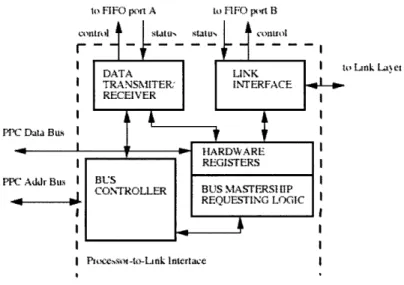
The goal of the Processor-to-Link Interface Logic (PLI) is to abstract the 1394 link layer from the GPP so that it has the appearance of a generic local bus slave. To that end, the PLI performs the following functions: 1) control the interface between FIFO side B and the link layer, 2) control the interface between FIFO side A and the PPC data bus, and 3) arbitrate for the PPC Bus as both a bus master and a bus slave. As mentioned above, the PLI logic is housed on the SAG FPGA, along with other logic modules essential to Chidi, but unrelated to the 1394 interface
The PLI logic is divided into sub-modules, as described in Figure 9. The Link Interface module controls the FIFO to link layer interface. The Data Transmitter/Receiver (DTR) sub-module handles the FIFO to PPC data bus interface. The Busctrl sub-sub-module handles PPC bus arbitration. In addition, a 1394 Hardware Registers sub-module provides the GPP with control of the Processor-to-Link Interface. The Bus Mastership Requesting Logic sub-module determines when the PLI needs control of the PPC Bus.
U t)f pn B
---- I
U
Us La L1e
Figure 9 : Processor-to-Link Interface Block Diagram
3.2.1 Transfer Function Implementation
Now that the basic structure of the interface has been established, we can discuss implementation of the five necessary transfer functions. Again, those functions are:
1) asynchronous no-data/quadlet packet send from GPP 2) asynchronous no-data/quadlet packet receive to GPP 3) isochronous block receive to memory
4) isochronous block send from memory
5) asynchronous block send from memory 6) asynchronous block receive to memory
Asynchronous no-data/quadlet packet send from GPP
In order for the GPP to send an asynchronous no-data/quadlet packet, the GPP first writes packet information (packet length and packet type) to the Control Register in the 1394 Hardware Registers sub-module. Once the Control Register has been set, the GPP is then allowed to write data to the WRITE-1394 FIFO. After the GPP has written all of the quadlets in the packet to the FIFO, it must wait until a ready_next_packet interrupt from the PLI, before transmitting another packet.
Asynchronous block send from memory / Isochronous block send from memory
To have data buffers in memory transmitted through the 1394 interface, the GPP writes information to the PLI describing the transfer, which the PLI uses to transfer the data from the
memory to the WRITE-1394 FIFO. First, the GPP sets the Input Start Register (buffer starting address), Input Stop Register (buffer ending address), and Memory Packet Length Register (buffer transmit packet size) in the 1394 Hardware Registers sub-module. With this information, the PLI transmits the buffer in multiple packets of the size specified in the Memory Packet Length Register. Interrupts are signalled to the GPP to write packet headers and when the entire buffer has been transferred.
Asynchronous no-data/quadlet packet receive to GPP / Isochronous block receive to
memory /Asynchronous block receive to memory
Data received into the READ-1394 FIFO is automatically written by the PLI into a specifically allocated buffer in memory. The location of the buffer is set in two hardware registers: Output Start Register (buffer starting address) and Output Stop Register (buffer ending address). In addition, a third register, Output Stop Half Register provides the address at the midpoint of the buffer. Interrupts are generated when data has filled the buffer up to the value in Output Stop Half and when data has reached Output Stop. These interrupts signal to the GPP to determine the contents of the buffer. For example, when the receive_buffer_half_full interrupt has been generated, the GPP looks at the first section of the buffer, while the PLI continues to fill up the second half of the buffer. Similarly, when the receive_buffer_full interrupt is generated, the GPP can read the second section of the buffer, while the PLI continues writing from the
beginning again. By scanning through the buffer, the GPP reads in the packets which were meant to be received by the processor, and keeps track of the location of the received block data.
An additional interrupt, received_datawaiting, is signalled after 1394 packet reception has ceased for a certain amount of time and data has been received in the buffer since the last receive_buffer_half_full or receive_bufferfull interrupts. This alerts the processor of received
data that should be read, since a half full or full interrupt is not likely to occur until later.
Accessing Link Layer Registers
The FIFO buffers provide mailbox registers which bypass the actual FIFO memory. These bypass paths to and from the PPC bus and the Link Layer are used for accessing the Link Layer's internal registers. Using the bypass paths separates configuration accesses from data accesses and also allows register accesses to not have to wait for the FIFO buffers to clear.
3.2.2 FPGA Development
This section discusses the characteristics of the specific FPGA used to implement the Processor-to-Link Interface Logic and also covers the development process used in programming the FPGA. In following sections, as the Interface Logic is presented, design optimization techniques specific to the FPGA used will also be mentioned.
The firmware providing the interface between the General Purpose Processor and the commercially available 1394 link layer and physical layer chips is implemented on an FPGA named the Stream Address Generator (SAG). In addition to housing the aforementioned interface, the SAG also generates addresses for input and output streams to and from the Reconfigurable Processor (RP). Although the 1394 Interface section of the SAG takes up only -700 logic cells, an Altera 10K50 FPGA (2880 useable logic cells) was selected for this implementation, with the bulk of its resources being used up for Chidi stream address generation.
Altera FLEXIOK Devices
Altera's FLEX10K family of programmable logic devices provide integrated embedded arrays and logic arrays in a single device. The embedded array is used to implement memory
[1E _t aft M f t, IOEI Rowe OiE ILE]
,,,-loik [LAB]y
...
..
..l...
.
functions or complex logic, while the logic array are used for general gate logic. Typical gate size of devices in the 10K family range from 10,000 to 250,000. The number of available 1/O pins in
10K devices ranges from 134 to 470 pins.
The embedded array is made up of a series of embedded array blocks (EABs), which can be configured as memory (RAM, ROM) or complex logic functions, such as multipliers or microcontrollers. EABs can be used individually or together to create larger designs. Similarly, the logic array is comprised of logic array blocks (LABs), which themselves are made up of eight logic elements (LEs). Figure 10 shows a diagram of the basic internal architecture of the 10K devices. Each LE contains a four-input LUT, which can quickly compute any function of four variables, and a flip-flop with a synchronous enable. In combinational functions, the LUT output bypasses the flip-flop, which can be programmed for D, T, JK, and SR operation, and drives the output of the LE. Figure 11 gives the FLEX 10K Logic Element structure.
Carry-In Cascade-In I)AA2I DATA3 DATA4 L AXBCI R.1 LABCTRL2 Chip-% ide Reset LAB(rLu LABCrRL4 L:\B(SFRL to FastTrack Interconnect to LAB Local Interconnect
Carry -Oul Cscade-Out
Figure 11 : Altera FLEX 10K Logic Element Structure
Development Process
The FPGA development process used for this project is made up of three main steps: VHDL development, synthesis compilation with Synopsys Design Compiler, and project compilation using Altera Maxplus2.
VHDL Development
The first main step in the FPGA development process is to create a description of the design using VHDL (VHSIC Hardware Description Language), a language for describing digital systems. The VHDL code is then analyzed and simulated, in order to test for code functionality. Since, at this stage, the design has yet to be synthesized into gates, this simulation reveals only functional behavior and provides no insight into performance or size of the design.
Synthesis Compilation using Synopsys Design Compiler
After the VHDL description has been functionally tested, the next step is to synthesize the design for Altera FLEX10K devices with the Synopsys Design Compiler. Altera design libraries are used to create architecture-specific optimization and mapping. The design is then presented as an EDIF netlist file which is read by Maxplus2.
Project Compilation using Altera Maxplus2
In Maxplus2, the design specified by the EDIF file created by Design Compiler is compiled for the specific device being used, in this case, FLEX 10K50. The Maxplus2 compiler places and routes the design into actual FLEX 10K elements. Once a project has been compiled, device timing performance can be analyzed. In the case that the analysis returns unsatisfactory results, constraints can be provided to the compiler, in order to increase performance. The principal methods to increase speed of compiled projects in Maxplus2 included setting global timing constraints, setting logic cliques, and explicitly placing logic and pin assignments.
Synthesis compilation also can be done using the Altera Maxplus2 software, thus removing the hassle of moving the design between different programs. However, Synopsys Design Compiler is used since it is the better synthesis compiler.
3.2.3 Data Transmitter/Receiver Sub-Module
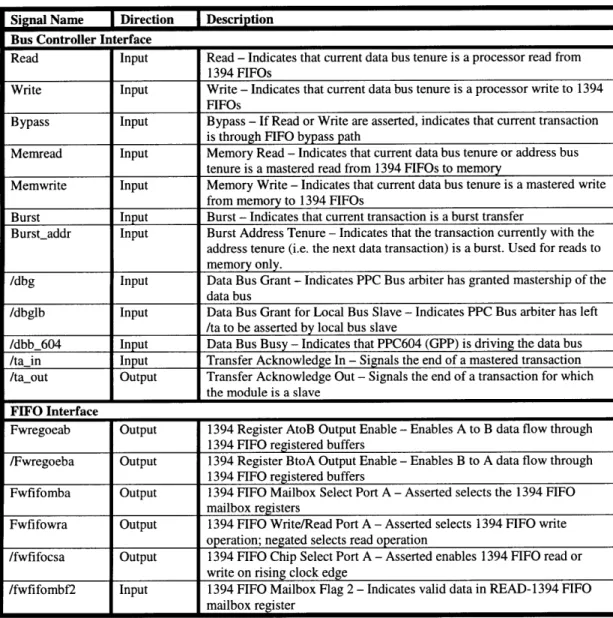
The Data Transmitter/Receiver provides controls for the PPC Bus side of the FIFO buffer. It reacts to PPC bus arbitration signals and input signals which indicate the type of transaction on the current PPC bus data tenure. It supports four main actions: GPP read from READ-1394 FIFO, GPP write to WRITE-1394 FIFO, read from READ-1394 FIFO to memory, and write to WRITE-1394 FIFO from memory. Table 1 lists the Data Transmitter/Receiver inputs and outputs.
Table 1 : Data Transmitter/Receiver Signal Descriptions
Signal Name Direction Description
Bus Controller Interface
Read Input Read - Indicates that current data bus tenure is a processor read from 1394 FIFOs
Write Input Write - Indicates that current data bus tenure is a processor write to 1394 FIFOs
Bypass Input Bypass - If Read or Write are asserted, indicates that current transaction is through FIFO bypass path
Memread Input Memory Read - Indicates that current data bus tenure or address bus tenure is a mastered read from 1394 FIFOs to memory
Memwrite Input Memory Write - Indicates that current data bus tenure is a mastered write from memory to 1394 FIFOs
Burst Input Burst - Indicates that current transaction is a burst transfer
Burst_addr Input Burst Address Tenure - Indicates that the transaction currently with the address tenure (i.e. the next data transaction) is a burst. Used for reads to memory only.
/dbg Input Data Bus Grant - Indicates PPC Bus arbiter has granted mastership of the data bus
/dbglb Input Data Bus Grant for Local Bus Slave - Indicates PPC Bus arbiter has left /ta to be asserted by local bus slave
/dbb_604 Input Data Bus Busy - Indicates that PPC604 (GPP) is driving the data bus /ta in Input Transfer Acknowledge In - Signals the end of a mastered transaction /ta_out Output Transfer Acknowledge Out - Signals the end of a transaction for which
the module is a slave
FIFO Interface
Fwregoeab Output 1394 Register AtoB Output Enable - Enables A to B data flow through 1394 FIFO registered buffers
/Fwregoeba Output 1394 Register BtoA Output Enable - Enables B to A data flow through Fwfifomba Output 1394 FIFO Mailbox Select Port A - Asserted selects the 1394 FIFO
mailbox registers
Fwfifowra Output 1394 FIFO Write/Read Port A - Asserted selects 1394 FIFO write operation; negated selects read operation
/fwfifocsa Output 1394 FIFO Chip Select Port A - Asserted enables 1394 FIFO read or write on rising clock edge
/fwfifombf2 Input 1394 FIFO Mailbox Flag 2 - Indicates valid data in READ-1394 FIFO mailbox register
GPP Read from READ-1394 FIFO
The Data Transmitter/Receiver supports a processor read from 1394-READ FIFO which can be used to read FIFO Mailbox Register 2. This transaction is used to read the contents of link layer registers. (A processor read from the actual FIFO port isn't supported since all received packets are transferred to memory).
When both the read and bypass inputs are asserted, the read_bypass state machine is activated. It waits for /dbglb to be asserted then it waits for the /fwfifombf flag to be asserted. (The Link Interface module provides the link layer register data to the mailbox register.) Once the mailbox flag is asserted, /fwfifocsa is set to read the data out of the bypass path and onto the bus,
and /ta_out is asserted, signalling that the transaction is comple
GPP Read dlL _r111T Lr1J-Lr1J-rr d I I I I I ISM I I I I I I F FPP OfNpul 4 iW 1 d i i GPP Nisibo- Read I I I I I I I I I rIL ivAd kvp-mrflI.mb(2 I I I I I I I I .wrnKab , . . . ,--NrI?4~JIIaab ________________________ FPP I114% dat . . . V I I I I I IA
Figure 12 : GPP Read from READ-1394 FIFO Timing Diagrams
GPP Write to WRITE-1394 FIFO
When the write input is asserted, the write state machine jumps to the wait_dbb state where it waits for the /dbb_604 signal to be asserted. After /dbb_604 is asserted, which means the processor is driving valid data on the PPC Bus, the /fwfifocsa signal is asserted along with fwfifowra. In addition, /ta_out is asserted completing the transaction.
GPP tile
urite I I I I
I I I I I I I I
dblb 604 , , ni n n
rItn 1111
pre a ttaI~lk a , i i i i , , n
IP
~
I I I I i GPP MiibnO Wrift I I I I I I I I I I I I I I I I I PPC 110sdataNfkb 6 Ni I ' ' ' '# ' ' S Ir4I I I lim .I I I _ I Ird~r Ii I I I i i I t I I I I I I Iin weI flas l J tikrlara NI I A& outio I - C~ VV B.1114AFigure 13 : GPP Write to WRITE-1394 FIFO Timing Diagrams
Processor writes to a link layer register via FIFO Mailbox Register 1 are made by asserting the bypass input. If the bypass input is '1', then fwfifomba is asserted during the transaction enabling the write to the mailbox register.
Write to WRITE-1394 FIFO from memory
The memwrite input signals that the current data tenure is a write of data from memory to the WRITE-1394 FIFO. If burst is not also asserted, then the memwrite signal moves the write_mem state machine from the wmem_idle to the wmem_write_single state, where it waits for /ta_in, which means that the data from memory has been placed on the bus, to be asserted before returning to idle. If burst is asserted, then the write_mem state machine initially transitions to wmem_write_burstl. On successive assertions of /ta_in, it moves to wmem_write_burst2, wmem_writeburst3, and wmem_write_burst4 and back to wmem_idle. In both cases, when /ta_in is asserted and the write_mem state does not equal wmem_idle, /fwfifocsa is asserted,
I I I I I I I I Ir I r I I I I I I I I I I I I I I1T I I I I l I I Il. I I I I I I I I I I I I I I I I I I I I I I I I I I I
Burst Write from memory
bu i I ! I i I l i l l I I
I I I I I I I I I I I I I I I I I
I I I I I I I I I I II
filt~ailt
(, IIna - ''
Figure 14 : Write from memory to WRITE-1394 FIFO Timing Diagrams
Read from READ-1394 FIFO to memory
The asserted memread input indicates that data in the READ-1394 FIFO is to be transferred to system memory. When the Data Transmitter/Receiver receives an asserted memread input and deasserted burst input, it asserts /fwfifocsa when /dbb_604 goes high. When burst is asserted, /fwfifocsa is also asserted three more times to provide data for the succeeding three words in the burst. The data read out of the FIFO is valid only for one clock cycle, so the assertion of /fwfifocsa is timed to provide data that is valid when latched by the memory controller.
This function differs slightly from the previous three in that memread is actually asserted when the address tenure has a 1394 memory or when the data-tenure has a 1394 read-to-memory. The reason for this is to provide the memread signal earlier, so that the /dbb_604 signal is caught by the Data Transmitter/Receiver. Because of register delays between the PPC Bus interface and this sub-module introduced for higher performance, the rising edge of /dbb_604 would be seen before memread if memread were asserted solely during the data tenure.
Write from menorv
tIL
utnisrAtt
inro
P111t 1ics dala
t in (iT BUS Aw)
NnVr..lwah
nFIVOinpul fhsfre~rrba
tfo Mm ra Nrionata
Read to memory I I I I I I I I I I I I I usata -I I - -I I - I I I I I I I I I burst .a r I_ _ l _ l I I I l - - -w l I I I I I I I I Finput PC thlsdatal I I I I I I I I I I I I I I I I I I I I I I I I I I In hi PPC B1LiSl l I l Burst Read to m~nory
e a I I I I I I I I I I I I I I I I I I I I I I
II I I I I . I .I I I I I I I I I I I
IlB.r.tai e=. I IIlr I
twlbblc I I I I I i I I I I I l I I I I I I I I
I I I 1 I I I I I I I I I I I I I I I I I I I I
{F~tclh¢ 1 1 1 I I I I I I I I I I I I I I I I I I I I I I I I
I I I II I I I I I
3.2.4 Link Interface Sub-Module
The Link Interface provides the interface between the FIFOs and the link layer. It controls the flow of data from the WRITE-1394 FIFO and the Write Mailbox Register to the link layer and from the link layer to the READ-1394 FIFO and the Read Mailbox Register. The Link Interface responds to the FIFO and link layer status signals by asserting control signals to move data between the FIFOs and link layer.
Table 2 : Link Interface Signal Descriptions
Signal Name Direction Description
PLI Logic Interface
Reg_read Input Link Register Read - Indicates that a link layer register read is the current data transaction
Regwrite Input Link Register Write - Indicates that a link layer register write is the current data transaction
Regaddrin <5..0> Input Link Register Address Input - The address of the link layer register to be accessed. Valid when regread or regwrite are asserted.
Data_length <8..0> Input Packet Data Length - Length in quadlets of the next packet to be written from FIFO to link layer. Should be provided before the first quadlet is transferred. Async Input Packet Async/Isoch - When asserted, indicates that the next packet to be written
from FIFO to link layer is asynchronous. Negated indicates that packet is isochronous
Next_packet Output Next Packet -Indicates that the data_length input for the next packet may now be
provided
FIFO Interface
/FwfifocsbO Output 1394 FIFO Chip Select Port B Low - Must be asserted to enable low FIFO Port B access on rising clock edge
/Fwfifocsb 1 Output 1394 FIFO Chip Select Port B High - Must be asserted to enable high FIFO Port B access on rising clock edge
Fwfifowrb Output 1394 FIFO Write/Read Port B - Asserted selects FIFO Port B write operation; negated selects FIFO Port B read operation
Fwfifombb Output 1394 FIFO Mailbox Select Port B - Asserted select FIFO Port B mailbox registers
Fwfifoenb Output 1394 FIFO Enable Port B - Asserted enables FIFO Port B read or write on rising clock edge
/Fwfifoefb Input 1394 FIFO Empty Flag Port B - Asserted indicates that WRITE-1394 FIFO is empty
/fwfifoafb Input 1394 FIFO Almost Full Flag Port B - Asserted indicates that READ-1394 FIFO is almost full
/fwfifombfl Input 1394 FIFO Mailbox Flag 1 - Asserted indicates that WRITE-1394 FIFO mailbox register has received valid data
Link Layer interface
/fwcs Output Link Cycle Start - Enables access to Link Layer configuration registers or internal FIFO
/fwwr Output Link Read/Write Enable - Asserted (low) selects a Link Layer write operation; deasserted (high) selects a Link Layer read operation
/fwca Input Link Cycle Acknowledge - Asserted indicates that Link Layer access is complete Llc_addr <5..0> Output Link Address - Link Layer address bus addresses internal FIFOs and
configuration registers
Fwgrfemp Input Link GRF Empty - Asserted (high) indicates that the Link Layer GRF is empty Fwclk Input Link Layer Host Bus Clock - 33.33 MHz Link Layer Host Interface bus clock.
The four main parts of the Link Interface are the Link FSM, words left counter, register address latch, and address selector. Figure 16 shows a block diagram of the Link Interface sub-module.
hardearPed
LnkLink la~c addicres
gr addrtc
data lengthF
The register address latch latchFOs tatthe link address to be accessed when a register read or
Vi lemp Oink latt -/-Link la4nConfltrol
Link Interface
Figure 16: Link Interface Block Diagram
Register Address Latch
The register address latch latches the link address to be accessed when a register read or write is requested. It is enabled when either of the regread or reg_write inputs are asserted. The latch output is passed on to the address selector.
Words_left_counter
The words left counter counts down the number of quadlets left to be transferred from the FIFO to the link layer controller in the packet currently being written. The counter is loaded with the data_length input at the start of each packet. At the same time the data_length input is loaded into the counter, the async input bit is latched. The counter decrements as each quadlet is read from the FIFOs and written to the link layer. The value kept by the counter and the latched async bit are used by the address selector to determine the link layer address to be written to.
Address selector
The address selector outputs the six bit address to the link layer during reads and writes. It selects from among a set of hardwired addresses and the output of the register address latch. The latched register address is selected during link register reads and writes. One of the hardwired addresses is used for reads from the GRF or writes to the ATF or ITF. Table 3 lists and describes the set of link FIFO addresses for the TSB 12C01A Link Layer Controller.
Table 3 : Link Layer FIFO Access Addresses
Address Name Description
0x80 ATF first Location to write first quadlet of an asynchronous packet
0x84 ATF_ continue Location to write second to next-to-last quadlets of an asynchronous packet
Ox8C ATF_ update Location to write last quadlet of an asynchronous packet
0x90 ITF first Location to write first quadlet of an isochronous packet
0x94 ITF_continue Location to write second to next-to-last-quadlets of an isochronous packet
0x9C ITF update Location to write last quadlet of an isochronous packet
OxCO GRF_data Location to read received remote data
Link FSM
The Link FSM performs five different sequences of operations: read_reg, write_reg, read, write, and advance_fifo. Figure 17 shows the state diagram for the Link FSM.
1wfifoeb = I and words eft = 0 and writeF1fo_ptr = 0
Figure 17 : Link FSM State Diagram
Read_reg
If the Link FSM receives and asserted reg_read input from the higher level PLI logic, then it initiates the read_reg sequence. It reads from the link layer using the address provided in the register address latch and writes the returned value into the FIFO mailbox registers.
Write_reg
On a link layer register write, the reg_write input is asserted along with the destination register address so that the address can be latched. Sometime afterwards, the write_reg sequence is triggered by the FIFO mailbox 1 flag being asserted, which indicates that data to be written to a link register is available in the FIFO mailbox register. After this signal has been asserted, the data is read out of the FIFO mailbox and provided to the link layer controller with the latched register address.
h ilk Xq 0 LJ1J1JLJnk LJ1J1l 441k w Id I I I I I I II I I I I I I frvlk -rr3r1rI ,-rl- 3Y-r f' 11, r j-Lrr~r rjr iYilz 3 IE I I I 1i . . . ,fQ~CCX31 I . . ..I;iZ , I l I I I 'i I~l i i rxe i i i i i . , , , I I I I u18W
Figure 18: Link Register Read and Write Timing Diagrams
Write
If data is present in the WRITE-1394 FIFO, the Link Interface will write the next available 32 bit word into the link layer by reading from the WRITE-1394 FIFO and writing to the link layer controller. Writes to the link layer controller must be accompanied with an address,
specifying an internal location. When writing to a transmit FIFO (ATF or ITF), different
addresses are used to indicate the position of the quadlet being written within the packet currently being transferred. The Link Interface determines the address it selects by looking at the
words_left_counter and the async bit. These reveal whether a quadlet is first, middle, or last in a packet and whether the packet is asynchronous or isochronous. Hence the link address can be derived (see table 3).
Quadlets are written alternately out of the high FIFO then from the low FIFO. The write_fifo pointer keeps track of the current 32-bit FIFO being read from. It resets to the high FIFO, then after a quadlet has been read out of the high fifo, it switches to the low FIFO. After
i ink 1 ITV Vk h 1I IIiI I I I I I I I I I I I I l l I III I I I I I I I I I I I I I I I III I I I I 11 F I I I I I I I 1 I I I i | I | I i ! ! c X I I 1
iPm1I4e-I t
tothehig
FI
i,
and h o I
I I I I I I i I I I i i I i I iaif,. . ., . , . . . . . . . . . . I I I I i I I I I I I I I i i I I i i i I I I I I I I i i I F igeI i Lik ii I Ihe the -i I I I s It I Ie fo i t I iF I i I i I II
remote data has been received into the link layer, the link FSM begins the read sequence if the READ-1394 FIFO is not alread almost full. It reads at the GRF address and writes the received quadlet into the READ-1394 FIFO. The link layer alternates between writing the received quadlet to the high FIFO and the low FIFO.
link GRF Jkad
I I I I I a I I I I I I I I I I I I
The advancefifo sequence is used to restart the writefifo pointer back to the high FIFO by discarding the next word in the low FIFO. This is necessary when a packet made up of an odd number of quadlets has just been written. Figure 21 shows an example of when it is necessary to advance the FIFO.
J jflVJahigh
FIFO
low FIFO
n+1 n
Figure 21: Advance FIFO Example Case
After packet n has been written to the link layer, the writefifo pointer points at quadlet d. However, quadlet d is just used for padding and is not to be written to the link, so it must be discarded and the writefifo pointer should be set to point at quadlet e. This case is detected when the words left counter indicates the end of a packet and the pointer points at the low FIFO. The quadlet is discarded by reading from the FIFO without initiating a write transaction to the link layer.
3.2.5 Hardware Registers Sub-Module
A set of registers located on the SAG provide the processor with control of the 1394 Bus Interface. Table 4 lists the registers along with their addresses as seen from the GPP. Note that the registers are addressed using one hot encoding. Since the address space was large compared to the space needed, one hot encoding was utilized to decrease address decoding times.
Table 4 : Hardware Register Addresses
Chidi Memory Space Address Hardware Register
0x6000 0008 Control Register
0x6000 0010 Input Start Register
0x6000 _0020 Input Stop Register
0x6000 _0040 Output Start Register
0x6000 _0080 Output Stop Half Register
0x6000 0100 Output Stop Full Register
0x6000 0200 Memory Packet Length Register
0x6000 0400 Interrupt Status Register
0x6000 0800 Interrupt Mask Register
0x6000_1000 to 0x6000 1080 Link Layer Registers
Control Register
The Control Register holds information regarding the next packet to be read out of the WRITE-1394 FIFO to the Link Layer. It contains the data length in quadlets of the packet and also a bit indicating whether the packet is asynchronous or isochronous. Before the Link Interface begins reading the packet out of the FIFO and into the Link Layer, it reads the value in the control register. As discussed earlier, it needs this info in order to determine the packet type and also when the packet begins and ends, because these effect the address provided to the Link Layer controller on writes. The control register holds information regarding only one packet, thus there can be at most two packets in the WRITE-1394 FIFO at any given time - one in the process of being transferred to the Link Layer and the other for whom the control register holds valid info. This characteristic could be modified to allow a greater number of packets by adding more control registers. For each extra control register added, one more packet can fit into the FIFO.
Table 5 : Control Register Field Descriptions
Bit(s) Field Name Description
0 to 8 Data_length Length in quadlets of the next packet to be read out of the WRITE-1394 FIFO
9 Async If asserted, next packet to be read out of the WRITE- 1394 FIFO is asynchronous. If not asserted, then isochronous
10 Writing_header Bit should be set when writing to data_length and async fields prior to writing the header quadlet of a packet during a memory buffer transfer
11 GRF_read enable Bit must be set to enable Link Interface reading of Link Layer GRF
Input Start Register and Input Stop Register
These registers are used when the GPP requests the PLI to transfer a block of memory over the 1394 bus. The Input Start Register holds the memory address of the first word in the buffer to be transferred, while the Input Stop Register contains the address of the word after the last word in the buffer to be transferred.
An internal address counter, called the Input Counter, points to the address of the next word to be transferred. Whenever the address specified in Input Counter does not equal the value in the Input Stop Register, the PLI will move the 64-bit word addressed by Input Counter from memory to the WRITE-1394 FIFO and increment Input Counter. When Input Counter equals Input Counter Stop, the input_counterdone interrupt bit is set. Writes to either the Input Stop Register or the Input Start Register locations load the Input Counter with the data that is written. So, in order to effect a block transfer, first, the Input Stop Register is written and then the Input Start Register is written.
Memory Packet Length Register
The Memory Packet Length Register is utilized when the SAG is writing a data buffer in memory over the 1394 bus. The GPP writes the packet data length that should be used for the packets that the memory buffer will be broken up into. So, if the register contains the value mempacket_length , then after mempacket_length quadlets have been written from memory to the WRITE-1394 FIFO, the PLI sets the write_header interrupt. This interrupt signals to the GPP that a complete packet has been written into the WRITE-1394 FIFO and that a header needs to be written for the start of the next packet.