TROPICAL AGRICULTURAL SCIENCE
Journal homepage: http://www.pertanika.upm.edu.my/Article history: Received: 28 November 2018 Accepted: 11 March 2019 Published: 30 May 2019 ARTICLE INFO E-mail addresses:
[email protected] (Fawzi Rostane Meklati) [email protected] (Amel Meribai) [email protected] (Nora Yezli)
[email protected] (Tarik Benabdelaziz) * Corresponding author
Colostrum and Milk Fatty Acids Profiles from Imported
Prim’Holstein Cows
Fawzi Rostane Meklati1,2*, Amel Meribai3, Nora Yezli1 and Tarik Benabdelaziz4
1Scientific and Technical Research Center for Physical and Chemical Analysis (CRAPC) BP 384 Bou-Ismail
RP 42004, Tipaza, Algeria
2National High Veterinary School Rabie Bouchama, 16004 Algiers, Algeria
3University of Sciences and Technologies Houari Boumediene (USTHB), 16004 Algiers, Algeria
4 Department of Agricultural Sciences, Faculty of Nature, Life Sciences and Earth Sciences Mohand Akli
Oulhadj University,10000 Bouira, Algeria
ABSTRACT
Colostrum could provide significant fatty acids (FAs) essential for the development of living organisms. Yet to date, only a few works was performed to evaluate the composition of this important resource. In order to enrich data availability on the first milk, the objective of this work was to study bovine colostrum by comparing its composition in FAs with that of cow’s mature milk. In this study, colostrum was sampled in warm season during the first day of postpartum from imported Prim’Holstein cows, and comparing it with mixed milk produced from a dairy-farm located in Tipaza region, northern Algeria. The proportion of saturated short-chain fatty acids was higher in mature milk than in colostrum (P<0.05). Medium and long chain saturated fatty acids present greater contents (P<0.01) in colostrum, with predominance (P<0.01) of myristic (C14:0) and palmitic (C16:0) acids. Among monounsaturated fatty acids, oleic acid (C18:1 n-9) revealed more elevated proportions (P<0.05) in milk. Polyunsaturated fatty acids were more marked (P<0.01) in colostrum, with high linoleic acid (C18:2 n-6) levels, while α-linolenic acid (C18:3 n-3) contents were weaker. The n-6/n-3 ratio as well as the atherogenicity index (AI) values confirmed that both were to the advantage of bovine colostrum. Even though the AI is significantly higher in colostrum, the value (1.89±0.01) obtained nevertheless remains lower than those previously reported.
Keywords: Bovine colostrum, fatty acids, lactation,
INTRODUCTION
The mammary secretion collected during the first 7 days of postpartum is commonly known as «colostrum». It has a reddish-yellow appearance, thick, viscous and is denser than milk. Colostrum is a part of the newborn calf’s diet, as it contains immunoglobulins (IgG, IgA, IgM, IgE and IgD) and immune cells (leukocytes, epithelial cells) which, through their richness, provide protection against pathogens. Colostral volume of Holstein cows collected after calving is widely flexible, with reported values from 2.8 to 26.5 L (Morin et al., 2001). It is well established that colostrum fed to calves, has greatest importance on passive immunity, with 3-4 L volume required to deliver an adequate immunoglobulin mass (McGuirk & Collins, 2004). Nutrients (proteins, lipids, lactose, minerals), hormones, growth factors, enzymes such as lactoperoxidase and alkaline phosphatase are also found in abundance for calf development (McGrath et al., 2016; Penchev, 2008).
In these last few years, many industries have introduced colostrum-based food supplements, drinks and chewing gums to the market. Bovine colostrum based food is also used in gastrointestinal treatments and to improve immune system defense. Indeed, it contains components which are important for human organism with multiple applications in preventive purposes but also to reduce side effects during antibiotic therapy or chemotherapy (Borad & Singh, 2018; Dzik et al., 2017). In addition, bovine colostrum can provide an important source of fatty acids (FAs) in the human diet
(Dzik et al., 2017; Yurchenko et al., 2016). However, it would be interesting to know the proportion of FAs that is beneficial for human healthcare and that would be included in its composition. Among constituents of udder secretions, fat is made up of more than 98% of triglycerides, source of more than 400 FAs, some of which would have a protective effect against cardiovascular diseases and various types of cancers (Lindmark-Månsson, 2008).
The FAs of mammary secretions take their origin either from the diet or from de
novo synthesis in the gland. They can be
released from body fat deposits. Several factors would influence the variation in the lipid fraction. We can quote the season, breed, dietary intake, health status, parity and lactation stage (Palmquist, 2006).
Few experiments have already been initiated in order to study the FAs fractions of bovine milk or other animal species such as camel (Meribai et al., 2018). However, despite the growing importance of bovine colostrum for human nutrition (Borad & Singh, 2018; Dzik et al., 2017), very scarcer data on its FAs composition are available (Parodi, 1983; Yurchenko et al., 2016).
In this context, this study contributes to the comparison by gas chromatography coupled with mass spectrometry (GC-MS) of the FAs fractions of colostrum and mature milk from Prim’Holstein cows imported into Algeria mainly from Netherlands. The results achieved enrich existing information on nutritional aspects and also characterize postpartum mammary secretion under real dairy-farming conditions.
MATERIALS AND METHODS Study Location
The experiment was carried out on a private dairy farm located near the Ben Nassah region (36°36’25.2”N latitude and 2°42’38.8”E longitude), Attatba’s municipality (Tipaza province), from central Northern Algeria. The region is characterized by a hot-dry climate in the period from June to August, with temperatures ranging from 31°C to 34°C.
Dairy cattle size in course of lactation was estimated at 133 Prim’Holstein cows, 49 among them in 4th lactation number.
Animals from this farm, which is conducted in semi-intensive farming, had previously been imported, mainly from Europe. Animal Management
The experiment was conducted under the real breeding conditions practiced by the farmer. Animals were selected on the basis of the same genetic type (Prim’Holstein breed), parity, a healthy status against mastitis after clinical exploration or by using the California Mastitis Test (CMT). Total mixed ration (TMR) consisting of alfalfa hay delivered ad libitum, and concentrate feed are as detailed in Table 1.
Table 1
Concentrate feed formulation
Concentrate composition Percentage (%)
Corn grains 40
Wheat bran 30
Barley grains 28
Mineral-vitamin supplement 2
Total 100
Mature milk (n=12) is a mixture from the evening milking. It is intended for the manufacture of butter and fresh cream. On the other side, the mammary secretion collected during the first 24 h of postpartum is the colostrum (n=12) studied. Sampling was performed over the same period in warm season (from June to August); each batch was collected in sterile, sealed and labelled containers. These latter were stored at 4°C during transportation for the laboratory analysis.
Fatty Acids Composition of Colostrum and Mature Milk
Lipid from mammary secretions was extracted according to Hara and Radin (1978) procedure modified by Feng et al. (2004), then converted into fatty acid methyl esters (FAMEs) using a solution of boron trifluoride (BF3) in methanol
(14% w/v) in accordance with Morrison and Smith’s (1964) method. The FAMEs were analyzed by an Agilent GC 6890 gas chromatograph coupled to a MSD 5973A mass spectrometer (Agilent Co. Ltd, USA), using a polyethylene glycol (PEG) fused silica capillary column (HP-Wax, 60 m x 0.25 mm, 0.25 µm film thickness, Agilent Co. Ltd, USA).
GC-MS spectra were obtained using the following conditions: carrier gas helium; flow rate 0.5 mL/min; 1 µl injection volume in 1:20 split mode. The injection temperature was set at 250°C. The initial oven temperature was 40°C for 4 mins, increased to 140°C at 10°C/min (held for 1 min) and then increased by 5°C/min to
a final temperature of 220°C (held for 40 mins). The electron impact mass spectral analysis was carried out at 70 eV ionization energy. Identification of common FAs was performed by comparing the retention time with those of standard compounds (Supelco® 37- Component FAME Mix
certified reference material) and NIST’02 [US National Institute of Standards and Technology (NIST), Gaithersburg, MD, USA] mass spectral database.
Atherogenicity Index (AI)
The assessment of the risk to human health resulting from the FAs composition of mammary secretions (colostrum and milk) was investigated using the atherogenicity index (AI) according to the following formula proposed by Ulbricht and Southgate (1991):
AI = (aS12) + (bS14) + (cS16) (dP) + (eM) + (fM’)
where: S12 = C12:0, S14 = C14:0 and S16 = C16:0; P = sum of n-3 and n–6 PUFAs; M = oleic acid and M’ = sum of other MUFAs. a-f are empirical constants: b = 4 and a, c, d, e, f = 1.
Therefore, the final calculation of the AI becomes: AI = (C12:0) + (4 × C14:0) + (C16:0) (C18:2 + C18:3) + (C18:1) + (C14:1 + C16:1 + C17:1) Statistical Analysis
Data were compiled using Microsoft Excel 2007 software. FAs profiles of colostrum and milk were statistically processed by Statistica® software version 6.1 (Statsoft, France) using the Student’s t-test. Results are expressed as mean ± standard deviation, and considered significant at p<0.05. RESULTS AND DISCUSSION
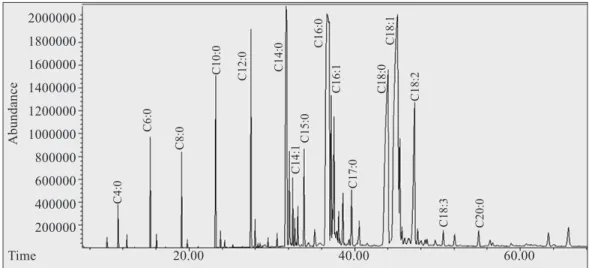
Changes in FAs composition of colostrum and milk samples are reported in Table 2 and also in Figures 1 and 2.
Saturated fatty acids (SFAs), which are predominant among FAs mammary secretion, are widely known to be harmful in excessive intake. However, they should no longer be considered in their whole but rather on an individual form because not all of them would have the same deleterious effects, some may, exert a hypocholesterolemic action (Ulbricht & Southgate, 1991).
Statistical analysis revealed no changes in SFAs contents, with higher values in colostrum than in mature milk. The proportion of short-chain saturated fatty acids (SCSFAs) in milk (6.21±0.13%) was greater (P<0.05) than in colostrum (4.32±0.25%). These results are consistent with those obtained from other studies (Bitman & Wood, 1990; Contarini et al., 2014). They could be explained by the weakness de novo synthesis ability in mammary gland during the first hours of postpartum, a period in which animals are in a negative energy balance situation with limited availability of volatile fatty acids
precursors (acetates and β-hydroxybutyrates) that are derived from ruminal fermentation. This situation would lead to a weakening in the ability to synthesize SCSFAs in udder (Palmquist et al., 1993). In addition, SCSFAs (C6:0, C8:0, C10:0, C10:0), mainly
arising from de novo synthesis in mammary gland, displayed higher values in mature milk with respective levels of +0.38%, +0.51%, +0.88%. According to Ebringer et al. (2008), these FAs appear to be very relevant to be regarded, by the significant
Table 2
Fatty acids composition of bovine mammary secretions (%)
FAMEs
Colostrum Milk P value
Commun name Formula
Butyric C4:0 0.39±0.06 0.51±0.00 0.114 Caproic C6:0 1.02±0.07 1.40±0.04 0.023 Caprylic C8:0 0.91±0.04 1.42±0.03 0.005 Capric C10:0 2.00±0.07 2.88±0.07 0.006 Lauric C12:0 3.34±0.08 3.40±0.00 0.377 Myristic C14:0 10.96±0.14 9.06±0.12 0.005 Pentadecanoic C15:0 1.50±0.00 1.75±0.00 <0.001 Palmitic C16:0 25.10±0.30 18.77±0.07 0.001 Margaric C17:0 1.13±0.00 1.12±0.06 0.796 Stearic C18:0 14.93±0.20 18.96±0.75 0.018 Arachidic C20:0 0.50±0.12 0.40±0.02 0.372 SFAs 61.78±0.08 59.67±0.89 0.079 SCSFAs1 4.32±0.25 6.21±0.13 0.011 MCSFAs2 15.81±0.22 14.21±0.12 0.012 LCSFAs3 41.65±0.38 39.24±0.64 0.045 Myristoleic C14:1 0.79±0.02 1.34±0.02 0.001 Palmitoleic C16:1 2.58±0.03 1.94±0.00 0.001 Heptadecenoic C17:1 0.51±0.02 0.55±0.03 0.207 Oleic C18:1 n-9 27.99±0.04 30.97±0.90 0.042 UFAs 38.22±0.08 40.33±0.89 0.079 MUFAs 31.85±0.07 34.80±0.84 0.039 Linoleic C18:2 n-6 5.94±0.04 4.93±0.05 0.002 α-Linolenic C18:3 n-3 0.43±0.03 0.59±0.00 0.015 PUFAs 6.36±0.01 5.53±0.05 0.002 n-6/n-3 13.99±1.05 8.31±0.09 0.017 AI 1.89±0.01 1.45±0.04 0.005
Saturated fatty acids (SFAs), unsaturated fatty acids (UFAs), monounsaturated fatty acids (MUFAs), polyunsaturated fatty acids (PUFAs)
1 Short-chain saturated fatty acids C 4-C10 2 Medium-chain saturated fatty acids C
12-C15 3 Long-chain saturated fatty acids C
16-C20 Atherogenicity index (AI)
part they would play in adiposity, as well as by their hypocholesterolemic action and multiple antiviral activities. However, butyric acid (C4:0), whose presence is specific to the cow’s udder secretions (Ebringer et al., 2008), exhibited a constant level. Percentages recorded were close to those obtained from other previous experiments conducted in Algeria involving Prim’Holstein cows’ imported from Europe
(Meklati et al., 2017). Nevertheless, other researches (Nardone et al., 1997; Parodi, 1983), reported markedly higher percentages for this FA (8.9-9.5%) during the colostrum secretion period. Finally, in vitro studies demonstrated that butyric acid would be beneficial to human health by being useful in the prevention and treatment of ulcerative colitis, Crohn’s disease and colon cancer (Di Sabatino et al., 2005; Pouillart, 1998).
Figure 2. Example of a chromatogram (GC-MS) for a mature milk sample Figure 1. Example of a chromatogram (GC-MS) for a bovine colostrum sample
2000000 1800000 1600000 1400000 1200000 1000000 800000 600000 400000 200000 Abundance Time C4:0 C6:0 20.00 C8:0 C10:0 C12:0 C14:0 40.00 60.00 C14:1 C15:0 C16:0 C16:1 C17:0 C18:0 C18:1 C18:2 C18:3 C20:0 2000000 1800000 1600000 1400000 1200000 1000000 800000 600000 400000 200000 Abundance Time 10.00 15.00 20.00 25.00 30.00 35.00 40.00 45.00 50.00 55.00 60.00 C4:0 C6:0 C8:0 C10:0 C12:0 C14:0 C15:0 C16:0 C16:1 C17:0 C18:0 C18:1 C18:2 C18:3 C20:0 C14:1
Medium-chain saturated fatty acids (MCSFAs), displayed, for their part, values inversely proportional to SCSFAs with higher (P<0.05) levels in colostrum. Nevertheless, these results disagree with those of Contarini et al. (2014), in which no significant variation was reported between colostrum collected at 24 h and mature milk. In addition, myristic acid (C14:0), the most abundant FA among the MCSFAs of mammary secretions, revealed a greater content in colostrum. However, these values (10.96±0.14%) remain lesser than those recorded in colostrum (13.1%) by Nardone et al. (1997) on animals exposed to high air temperatures, thus similar to our experimental conditions in warm season, during the first 24 h of the postpartum period. The contribution of myristic acid to human nutrition is still a debate topic until now. Indeed, Zock et al. (1994) indicated that it would increase total plasma cholesterol and LDL cholesterol levels, whereas Rioux et al. (2002) had suggested that myristic acid played a major functional part in the cell, being involved in protein acylation processes. In colostrum, C12:0 and C15:0 FAs values (3.34±0.08%, 1.50±0.00% respectively) were similar to those obtained by Nardone et al. (1997). According to Craninx et al. (2008), C15:0 and C17:0 could be partially de novo synthesized in mammary gland from propionate.
Long-chain saturated fatty acids (LCSFAs) showed higher contents (P<0.05) in colostrum. These findings are in agreement with those of Contarini et al. (2014). This abundance in LCSFAs could
be explained by the richness of colostrum in palmitic acid (C16:0). In addition, the analysis of FAMEs revealed an influence of the type of udder secretions on palmitic acid (C16:0) variation levels, with values in the order of 25.10±0.30% in colostrum. Several studies (Mi et al., 2016; Nardone et al., 1997; Parodi, 1983) have reported marked proportions of this FA during the first 24 h of postpartum in bovidae (within the range 28.7-30.9%).
In colostrum, myristic (C14:0) and palmitic (C16:0) acids appear to offset the reduced levels of de novo SCSFAs synthesized in the mammary gland. De
novo synthesis is the source of more than
half of C16, while the remaining palmitic acid is derived from blood circulatory or body lipids, which may explain the high contents of C16:0 recorded during the first 24 h postpartum (Bitman & Wood, 1990; Craninx et al., 2008). However, as reported by Williams (2000), this FA has hypercholesterolemic properties, raising both total and LDL-cholesterol levels. The LCSFAs of type C17:0 and C20:0, which are part of udder secretion, did not display any significant variation. Several studies highlighted that these FAs, considered as minority, varied slightly during the different lactation stages (Garnsworthy et al., 2006; Stoop et al., 2009). Stearic acid (C18:0) presented an opposite tendency to C14:0 and C16:0, with elevated proportions in mature milk (18.96±0.75%). These results are in accordance with literature, on which a lower C18:0 content on the first day (D1) of colostrum secretion was recorded (Leiber
et al., 2011; Mi et al., 2016). Nevertheless, these findings are contrary to those obtained from other sources (Bitman & Wood, 1990; Kay et al., 2005). Garnsworthy et al. (2006) revealed that there was no noticeable variation in the percentage of C18:0 from triggering to late lactation. The impact of stearic acid on human health is still controversial: According to Forouhi et al. (2014), the presence of this FA may be related to an increasing incidence of type 2 diabetes, while Hunter et al. (2010) had highlighted the protective effect of C18:0 against cardiovascular diseases with a favourable influence on plasma LDL-cholesterol concentrations.
The level of UFAs was not influenced by the type of udder secretion. However, it remains predominant in milk, sustained by high concentrations of MUFAs (C14:1, C17:1, C18:1), except C16:1. The latter displayed more marked values in colostrum, which could be explained by the action of the desaturase enzyme, responsible for the conversion of palmitic acid (C16:0) to palmitoleic acid (C16:1). Indeed, during the colostrum secretion period, the high concentrations of C16:1 would eventually come from C16:0 (Parodi, 1983). In addition, C16:1 proportions during the experiment are in line with those of Nardone et al. (1997). On the contrast, oleic acid contents (C18:1) are greater in mature milk. This result confirms those already obtained by Leiber et al. (2011), while beyond the first day of mammary secretion, several references have reported more elevated
C18:1 values in colostrum (Bitman & Wood, 1990; Kay et al., 2005). These authors suggested that this FA derived from plasma circulatory and body fats, with strongly higher concentrations when animals at early lactation were in a negative energy balance. In addition, long-chain FAs exert an inhibition on de novo synthesis of short- and medium-chain FAs (Craninx et al., 2008).
Oleic acid is reputed to play a positive contribution to human healthcare (Ebringer et al., 2008). It reduces LDL cholesterol and plasma triglycerides, as well as raises plasma HDL cholesterol contents. Therefore, this FA could be of interest in reducing the cardiovascular risk factors and coronary heart disease in healthy subjects or those with moderate hypercholesterolemia (Lopez-Huertas, 2010).
Polyunsaturated fatty acids (PUFAs) include omega 3 3) and omega 6 (n-6) families, each one of them possessing unique biochemical properties and divergent cardiovascular effects (Ramsden et al., 2013). The PUFAs displayed greater proportions (P<0.01) in colostrum, supported by high levels of linoleic acid (C18:2 n-6). Similar observations were reported by Meklati et al. (2017) and Meribai et al. (2018) on milk from cows farmed in Algeria with elevated amounts of this FA, within range from 3.43±0.02 to 5.50±0.02%. The proportions reported by Leiber et al. (2011) are in the same order, with maximum values recorded on the first day of udder secretion, then gradually declining even beyond the 10th
revealed that the amount of this FA in the first 24 h of colostrum secretion did not differ from that of milk at 5 months. Values of α-linolenic acid (C18:3 n-3) recorded in colostrum are smaller, in contrast to those reported in literature (Contarini et al., 2014; Leiber et al., 2011). Increasing PUFAs is usually a desirable outcome to improve the dietary profile of milk. Indeed, this FA seems to provide some significant benefits, particularly in the prevention of cardiovascular disease, or being also essential to the brain development, retina, and immune system (Barceló-Coblijn & Murphy, 2009; De Caterina, 2011).
The n-6/n-3 ratio indicated that it is significantly higher in colostrum (14.0±1.0) than in mature milk (8.3±0.1). According to Yang et al. (2017), the n-6/n-3 ratio measured on cow’s milk showed average values (10.3±0.8), close to those recorded in this study. The n-6/n-3 ratio for cow’s milk was markedly higher than that of other animal species such as yak or camel (Yang et al., 2017). However, a targeted ratio of linoleic acid (n-6) to α-linolenic acid (n-3) would most likely be within a 2:1 ratio range (Connor, 2000), whereas it is only within an 8:1 ratio in our mature milk experiments. On the other side, the results recorded in mammary secretions are in contrast to those mentioned by Leiber et al. (2011). This difference could be explained by the nature of the diet studied by these authors, with a ration enhanced with oilseeds that increased the proportion of α-linolenic acid in milk, thus bringing the n-6/n-3 ratio to desirable
levels. In addition, the n-6/n-3 ratio of milk varied significantly depending on the type of diet distributed, and the lactation stage with values in the range of 3.35-4.27 (Nantapo et al., 2014).
Atherogenicity index (AI) is used to assess the nutritional quality of milk by being strongly correlated with the occurrence of cardiovascular disease. The high value of the index increases the risk of developing coronary heart disease (Ulbricht & Southgate, 1991). The AI measured in colostrum was more elevated than in milk. This is in compliance with the large proportions of SFAs, and more specifically for myristic (C14:0) and palmitic (C16:0) acids. A typical value of AI for milk and dairy products was evaluated around 2 (Ulbricht & Southgate, 1991). Moreover, the scores (1.45-1.89) obtained in the present study are favourably inferior to those reported in the milk of Friesian and Jersey cows at different lactation stages by Nantapo et al. (2014) with values in the range of 4.08- 5.13. Breed and lactation stage would be among the factors that could explain the changes in the AI value of milk. As reported by Kuczyńska et al. (2012), the AI value (2.08) of Holstein cow’s milk was higher than that of this study. In addition, according to Bobe et al. (2003), cows with a low milk AI index (1.51) had lower C14:0 and C16:0 proportions than those with a high milk AI (2.83). The AI variation of mammary secretions would therefore be closely correlated with de novo synthesis capacities in udder.
CONCLUSION
Colostrum released within 24 h of postpartum has a distinct fatty acids composition, very different from that of mature cow’s milk. The AI and n-6/n-3 ratio reported higher values in colostrum. The latter has displayed a specific abundance of polyunsaturated fatty acids, especially linoleic acid (C18:2 n-6), which could enhance growing of the interest in colostrum as a promoting product with highly beneficial health properties. These data may be relevant to take into account in the formulation of colostrum, supplements and alternative products for human food intake. Further investigations will be required to assess the variation of the FAs composition during the remaining days of the colostral period.
ACKNOWLEDGEMENT
The authors are grateful to all the dairy farm staffs for their kind collaboration throughout this research. The authors have no conflict of interest in this research.
REFERENCES
Barceló-Coblijn, G., & Murphy, E. J. (2009). Alpha-linolenic acid and its conversion to longer chain n−3 fatty acids: Benefits for human health and a role in maintaining tissue n−3 fatty acid levels.
Progress in Lipid Research, 48(6), 355–374. doi:
10.1016/j.plipres.2009.07.002
Bitman, J., & Wood, L. D. (1990). Changes in milk fat phospholipids during lactation. Journal of
Dairy Science, 73(5), 1208-1216. doi: 10.3168/
jds.S0022-0302(90)78784-X
Bobe, G., Hammond, E. G., Freeman, A. E., Lindberg, G. L., & Beitz, D. C. (2003). Texture
of butter from cows with different milk fatty acid compositions. Journal of Dairy Science,
86(10), 3122-3127. doi:
10.3168/jds.S0022-0302(03)73913-7
Borad, S. G., & Singh, A. K. (2018). Colostrum immunoglobulins: Processing, preservation and application aspects. International Dairy Journal,
85, 201-210. doi: 10.1016/j.idairyj.2018.05.016
Connor, W. E. (2000). Importance of n-3 fatty acids in health and disease. American Journal Clinical
Nutrition, 71(suppl), 171–175. doi: 10.1093/
ajcn/71.1.171S
Contarini, G., Povolo, M., Pelizzola, V., Monti, L., Bruni, A., Passolungo, L., … Degano, L. (2014). Bovine colostrum: Changes in lipid constituents in the first 5 days after parturition. Journal of
Dairy Science, 97(8), 5065–5072. doi: 10.3168/
jds.2013-7517
Craninx, M., Steen, A., Van Laar, H., Van Nespen, T., Martın-Tereso, J., De Baets, B., & Fievez, V. (2008). Effect of lactation stage on the odd- and branched-chain milk fatty acids of dairy cattle under grazing and indoor conditions. Journal of
Dairy Science, 91(7), 2662–2677. doi: 10.3168/
jds.2007-0656
De Caterina, R. (2011). n-3 fatty acids in cardiovascular disease. New England Journal
of Medicine, 364(25), 2439-2450. doi: 10.1056/
NEJMra1008153
Di Sabatino, A., Morera, R., Ciccocioppo, R., Cazzola, P., Gotti, S., Tinozzi, F. P., … Corazza, G. R. (2005). Oral butyrate for mildly to moderately active Crohn’s disease. Alimentary
Pharmacology and Therapeutics, 22(9), 789–
794. doi: 10.1111/j.1365-2036.2005.02639.x Dzik, S., Miciński, B., Aitzhanova, I., Miciński, J.,
Pogorzelska, J., Beisenov, A., & Kowalski, I. M. (2017). Properties of bovine colostrum and the possibilities of use. Polish Annals
of Medicine, 24(2), 295-299. doi: 10.1016/j.
Ebringer, L., Ferenčík, M., & Krajčovič, J. (2008). Beneficial health effects of milk and fermented dairy products – Review. Folia Microbiology,
53(5), 378–394. doi:
10.1007/s12223-008-0059-1
Feng, S., Lock, A. L., & Garnsworthy, P. C. (2004). Technical note: A rapid lipid separation method for determining fatty acid composition of milk.
Journal of Dairy Science, 87(11), 3785-3788.
doi: 10.3168/jds.S0022-0302(04)73517-1 Forouhi, N. G., Koulman, A., Sharp, S. J., Imamura,
F., Kröger, J., Schulze, M. B.,…Wareham, N. J. (2014). Differences in the prospective
association between individual plasma phospholipid saturated fatty acids and incident type 2 diabetes: The EPIC-InterAct case-cohort study. Lancet Diabetes Endocrinology, 2(10),
810-818. doi: 10.1016/S2213-8587(14)70146-9 Garnsworthy, P. C., Masson, L. L., Lock, A. L.,
& Mottram, T. T. (2006). Variation of milk citrate with stage of lactation and de novo fatty acid synthesis in dairy cows. Journal of Dairy
Science, 89(5), 1604–1612. doi: 10.3168/jds.
S0022-0302(06)72227-5
Hara, A., & Radin, N. S. (1978). Lipid extraction of tissues with a low-toxicity solvent. Analytical
Biochemistry, 90(1), 420-426. doi:
10.1016/0003-2697(78)90046-5
Hunter, J. E., Zhang, J., & Kris-Etherton, P. M. (2010). Cardiovascular disease risk of dietary stearic acid compared with trans, other saturated, and unsaturated fatty acids: A systematic review.
American Journal of Clinical Nutrition, 91(1),
46–63. doi: 10.3945/ajcn.2009.27661
Kay, J. K., Weber, W. J., Moore, C. E., Bauman, D. E., Hansen, L. B., Chester-Jones, H., … Baumgard, L. H. (2005). Effects of week of lactation and genetic selection for milk yield on milk fatty acid composition in Holstein cows. Journal of Dairy
Science, 88(11), 3886-3893. doi: 10.3168/jds.
S0022-0302(05)73074-5
Kuczyńska, B., Puppel, K., Gołębiewski, M., Kordyasz, M., Grodzki, H., & Brzozowski, P. (2012). Comparison of fat and protein fractions of milk constituents in Montbeliarde and Polish Holstein-Friesian cows from one farm in Poland.
Acta Veterinaria Brno, 81(2), 139-144. doi:
10.2754/avb201281020139
Leiber, F., Hochstrasser, R., Wettstein, H. R., & Kreuzer, M. (2011). Feeding transition cows with oilseeds: Effects on fatty acid composition of adipose tissue, colostrum and milk. Livestock Science, 138(1-3), 1–12. doi: 10.1016/j.livsci.2010.11.016
Lindmark-Månsson, H. (2008). Fatty acids in bovine milk fat. Food and Nutrition Research, 52, 1-3. doi: 10.3402/fnr.v52i0.1821
Lopez-Huertas, E. (2010). Health effects of oleic acid and long chain omega-3 fatty acids (EPA and DHA) enriched milks. A review of intervention studies. Pharmacological Research, 61(3), 200-207. doi: 10.1016/j.phrs.2009.10.007
McGrath, B. A., Fox, P. F., McSweeney, P. L. H., & Kelly, A. L. (2016). Composition and properties of bovine colostrum: A review. Dairy Science
Technology, 96(2), 133-158. doi: 10.1007/
s13594-015-0258
McGuirk, S. M., & Collins, M. (2004). Managing the production, storage, and delivery of colostrum.
Veterinary Clinics of North America Food Animal Practice, 20(3), 593-603. doi: 10.1016/j.
cvfa.2004.06.005
Meklati, F. R., Meribai, A., & Ben-Mahdi, M. H. (2017). Lactation stage effect on nutritional quality of Algiers area cow’s milk. International
Journal of Dairy Science, 12(3), 236-242. doi:
10.3923/ijds.2017.236.242
Meribai, A., Meklati, F. R., Kouidri, A., & Nouani, A. (2018). Fatty acid profile comparison and hygienic quality of cow and camel (Camelus
of Food and Agriculture, 30(5), 413-420. doi:
10.9755/ejfa.2018.v30.i5.1685
Mi, J. D., Zhou, J. W., Ding, L. M., Wang, L., & Long, R. J. (2016). Short communication: Changes in the composition of yak colostrum during the first week of lactation. Journal of Dairy Science,
99(1), 818–824. doi: 10.3168/jds.2015-9824
Morin, D. E., Constable, P. D., Maunsell, F. P., & McCoy, G. C. (2001). Factors associated with colostral specific gravity in dairy cows. Journal
of Dairy Science, 84(4), 937–943. doi: 10.3168/
jds.S0022-0302(01)74551-1
Morrison, W. R., & Smith, L. M. (1964). Preparation of fatty acid methyl esters and dimethylacetals from lipids with boron fluoride-methanol.
Journal of Lipid Research, 5(4), 600-608.
Nantapo, C. T. W., Muchenje, V., & Hugo, A. (2014). Atherogenicity index and health-related fatty acids in different stages of lactation from Friesian, Jersey and Friesian X Jersey cross cow milk under a pasture-based dairy system.
Food Chemistry, 146, 127–133. doi: 10.1016/j.
foodchem.2013.09.009
Nardone, A., Lacetera, N., Bernabucci, U., & Ronchi, B. (1997). Composition of colostrum from dairy heifers exposed to high air temperatures during late pregnancy and the early postpartum period.
Journal of Dairy Science, 80(5), 838-844. doi:
10.3168/jds.S0022-0302(97)76005-3
Palmquist, D. L. (2006). Milk fat: Origin of fatty acids and influence of nutritional factors theron. In P. F. Fox & P. L. H. McSweeney (Eds.), Advanced
Dairy Chemistry: Lipids (pp. 43-92). New York,
NY: Springer-Verlag US. doi: 10.1007/0-387-28813-9
Palmquist, D. L., Beaulieu, A. D., & Barbano, D. M. (1993). Feed and animal factors influencing milk fat composition. Journal of Dairy Science,
76(6), 1753-1771. doi :
10.3168/jds.S0022-0302(93)77508-6
Parodi, P. W. (1983). Positional distribution of fatty acids in triglycerides from prepartum mammary gland secretion and early postpartum milk.
Journal of Dairy Science, 66(4), 912-919. doi:
10.3168/jds.S0022-0302(83)81876-1
Penchev, I. G. (2008). Differences in chemical composition between cow colostrums and milk.
Bulgarian Journal of Veterinary Medicine, 11(1), 3-12.
Pouillart, P. R. (1998). Role of butyric acid and its derivatives in the treatment of colorectal cancer and hemoglobinopathies. Life Sciences, 63(20), 1739-1760. doi: 10.1016/S0024-3205(98)00279-3
Ramsden, C. E., Zamora, D., Leelarthaepin, B., Majchrzak-Hong, S. F., Faurot, K. R., Suchindran, C. M., … Hibbeln, J. R. (2013). Use of dietary linoleic acid for secondary prevention of coronary heart disease and death: Evaluation of recovered data from the Sydney Diet Heart Study and updated meta-analysis. BMJ, 346, 2-18. doi: 10.1136/bmj.e8707
Rioux, V., Galat, A., Jan, G., Vinci, F., D’Andréa, S.,
& Legrand, P. (2002). Exogenous myristic acid
acylates proteins in cultured rat hepatocytes.
Journal of Nutritional Biochemistry, 13(2),
66-74. doi: 10.1016/s0955-2863(01)00196-6 Stoop, W. M., Bovenhuis, H., Heck, J. M. L., & Van
Arendonk, J. A. M. (2009). Effect of lactation stage and energy status on milk fat composition of Holstein-Friesian cows. Journal of Dairy
Science, 92(4), 1469–1478. doi: 10.3168/
jds.2008-1468
Ulbricht, T. L. V., & Southgate, D. A. T. (1991). Coronary heart disease: Seven dietary factors.
Lancet, 338(8773), 985–992. doi:
10.1016/0140-6736(91)91846-M
Williams, C. M. (2000). Dietary fatty acids and human health. Annales de Zootechnie, 49(3), 165-180. doi: 10.1051/animres:2000116
Yang, J., Zheng, N., Wang, J., & Yang, Y. (2017). Comparative milk fatty acid analysis of different dairy species. International Journal of Dairy
Technology, 71(2), 544-550. doi:
10.1111/1471-0307.12443
Yurchenko, S., Sats, A., Poikalainen, V., & Karus, A. (2016). Method for determination of fatty acids in bovine colostrum using GC-FID.
Food Chemistry, 212, 117-122. doi: 10.1016/j.
foodchem.2016.05.103
Zock, P. L., De Vries, J. H. M., & Katan, M. B. (1994). Impact of myristic acid versus palmitic acid on serum lipid and lipoprotein levels in healthy women and men. Arteriosclerosis Thrombosis
and Vascular Biology, 14(4), 567-575. doi: