HAL Id: hal-01707264
https://hal-centralesupelec.archives-ouvertes.fr/hal-01707264
Submitted on 12 Feb 2018
HAL is a multi-disciplinary open access
archive for the deposit and dissemination of
sci-entific research documents, whether they are
pub-lished or not. The documents may come from
teaching and research institutions in France or
abroad, or from public or private research centers.
L’archive ouverte pluridisciplinaire HAL, est
destinée au dépôt et à la diffusion de documents
scientifiques de niveau recherche, publiés ou non,
émanant des établissements d’enseignement et de
recherche français ou étrangers, des laboratoires
publics ou privés.
Qualitative Simulation of Hybrid Systems with an
Application to SysML Models
Slim Medimegh, Jean-Yves Pierron, Frédéric Boulanger
To cite this version:
Slim Medimegh, Jean-Yves Pierron, Frédéric Boulanger. Qualitative Simulation of Hybrid Systems
with an Application to SysML Models. 6th International Conference on Model-Driven Engineering
and Software Development, Jan 2018, Funchal, Portugal. �10.5220/0006535202790286�. �hal-01707264�
Qualitative Simulation of Hybrid Systems
with an Application to SysML Models
Slim Medimegh
1, Jean-Yves Pierron
1and Frédéric Boulanger
21CEA LIST, Laboratory of Model Driven Engineering for Embedded Systems, P.C. 174, Gif-sur-Yvette, 91191, France 2LRI, CentraleSupélec, Université Paris-Saclay, 3 rue Joliot-Curie, 91192 Gif-sur-Yvette, France
{slim.medimegh, jean-yves.pierron}@cea.fr, [email protected]
Keywords: hybrid systems, qualitative simulation, symbolic execution, model transformation.
Abstract: Hybrid systems are specified in a heterogeneous form, with discrete and continuous parts. Simulating such systems requires precise data and synchronization of continuous changes and discrete transitions. However, in the early design stages, missing information forbids numerical simulation. We present here a symbolic execu-tion model for the qualitative simulaexecu-tion of hybrid systems, which consists in computing only qualities of the behavior. This model is implemented in the Diversity symbolic execution engine to build the qualitative be-haviors of the system. We apply this approach to the analysis of SysML models, using an M2M transformation from SysML to a pivot language and an M2T transformation from this language to Diversity.
1
INTRODUCTION
Embedded software has become essential in most industrial sectors, leading to heterogeneous models of a whole system, with discrete and continuous parts. Simulating such hybrid systems requires precise data and computational power for detecting changes in the continuous values and synchronizing them with dis-crete transitions. However, in the early stages of the design, the exact value of some parameters is not known yet, while it is already necessary to analyze the behavior of the system to make design decisions.
For continuous variables, the laws of evolution are often described by differential equations. Qualitative simulation can be an alternative to numerical simula-tion for such models. Its principle is the discretiza-tion of the domain of variadiscretiza-tion of the continuous vari-ables and their derivatives, leading to a qualitative de-scription of their evolution: positive, negative, null, increasing, decreasing, constant, at a maximum etc. In this way, one can get a tree of abstract behaviors, each node describing the qualitative evolution of the variables during a phase of the behavior. Combined with a model of the discrete part of the system, this yields a discrete model of the behavior of the whole system to which formal techniques can be applied.
When the exact differential equations are not known, an abstract qualitative model of the laws of evolution of the continuous variable, described as an automaton, can be used.
In this article, we present a new symbolic execu-tion model for qualitative simulaexecu-tion, which relies on a qualitative model of the continuous behavior of the system, and on symbolic integration of the first two derivatives of the state variables. This model of ex-ecution is implemented in the Diversity (Gallois and Lanusse, 1998) (Rapin et al., 2003) tool in order to compute the qualitative behavior of hybrid systems. We use SysML to model the qualitative behavior of our system, and model driven engineering techniques such as QVTop (Eclipse Modeling Project, 2017b) and Acceleo (Eclipse Modeling Project, 2017a) in or-der to have a complete tool chain that takes a SysML model and produces a Diversity model.
This article has two main parts: in the first one, we present the context of our work and our symbolic exe-cution model for qualitative simulation, in the second part we present how to use SysML in this context.
2
QUALITATIVE SIMULATION
AND HYBRID SYSTEMS
2.1
Hybrid Systems
Hybrid Dynamic Systems consist of continuous dy-namic systems, discrete event systems and an inter-face that handles the interaction between both types of systems (Lynch et al., 2003). Such systems
re-sult from the hierarchical organization of monitor-ing/control systems, or from the interaction between algorithms for discrete planning and continuous con-trol. These systems can be modeled using hybrid au-tomata, which are defined by a set of continuous vari-ables and states, and discrete transitions with guards and assignments to these variables. The evolution of the continuous variables can be described by different kinds of differential equations. Polyhedral hybrid au-tomata have linear differential equations and guards. Rectangularhybrid automata have constant differen-tial equations and guards that are comparisons to con-stants. Timed hybrid automata have differential equa-tions and guards involving time, and can be handled by Uppaal, Kronos and recently TiAMo. Some tools and methods deal with other types of hybrid systems: Hytech (Henzinger et al., 1997) for rectangular hy-brid automata with linear guards on the transitions, and CheckMate for non linear continuous evolutions with linear guards (Chutinan and Krogh, 2003).
2.2
Qualitative Simulation
Qualitative simulation comes from artificial intelli-gence, where it is used for reasoning about continuous aspects of systems. The goal is to reason about the be-havior of a continuous variable without computing its value. For hybrid systems, the model of the discrete part of the system is not influenced by the qualitative abstraction process. However, continuous variables and their derivatives are discretized in order to sider only their qualitative changes. Therefore, con-tinuous behaviors become discrete transitions, and the resulting system allows behaviors that are disallowed by the actual physics. However, it may overapproxi-mate (in a safe way) the possible behaviors.
Principle of Qualitative Simulation Qualitative simulation is based on the principle of discretization by partitioning the variation range of the continuous variables of the system and their derivative to com-pute their qualitative state (increasing, decreasing, constant etc.) This principle can be extended to the nth derivative to distinguish more qualitative states. Once the discrete states corresponding to this quali-tative partitioning are created, we build the possible transitions between them by taking into account con-tinuity and derivative constraints. For instance, each variable or derivative can not go from negative to pos-itive without going through zero, and a variable can go from negative to zero or from zero to positive only if its derivative is positive etc. Finally, the differen-tial equation system is abstracted into a transition sys-tem whose states are based on the partitioning of the
changes of continuous variables and derivatives, and whose transitions are the physically possible evolu-tions between these states. The result of the qualita-tive simulation is an abstraction of the solutions to the differential equations system.
Extension to Hybrid Automata In a hybrid sys-tem, the differential equations that describe the con-tinuous part of the system interact with a discrete sys-tem. For qualitative simulation, the discrete part of the system is not influenced by the discretization pro-cess described above. However, this discrete behav-ior reacts to changes in the discretized continuous be-havior and puts constraints on it. For instance, in the bouncing ball example shown in Figure 6, the discrete control reacts to the qualitative change of the height of the ball and forces a qualitative change of the speed of the ball to make it bounce when it hits the ground. Combining the unchanged discrete part of the system with the discretized qualitative model of its continu-ous part results in an entirely discrete model which can be analyzed with tools for discrete systems.
Qualitative Simulation With Diversity Diversity is a symbolic execution engine developed at CEA LIST to produce symbolic scenarios corresponding to classes of system behaviors. Properties can be proved on this set of scenarios and concrete numerical tests can be generated from them. To guarantee termina-tion or to limit the number of generated test cases, the size and the number of behaviors can be bounded, and redundant behavior detection can be used.
Diversity can be used for qualitative simulation according to two strategies (Gallois and Pierron, 2016): qualitative simulation with differential equa-tions, and qualitative simulation without differential equations. In the first approach, the differential equa-tions are known, and the QEPCAD tool (Brown, 2003) is used to determine the conditions for a qual-itative change. When a change is possible, the cor-responding branch is tagged with the conditions, else the corresponding branch in the execution tree is cut.
In the second approach, the differential equations are not available or it is too difficult to deal with their complexity. In this case, we build a qualitative model of the equations by considering qualitative relations between the variables and their derivatives. Of course, the results are less precise than in the first approach, but this can be used at very early stages of the de-sign. In this article, we deal with this second ap-proach. We therefore use Diversity to symbolically execute the model of a hybrid system, which com-bines the model of its discrete part and the discretized qualitative model of its continuous part.
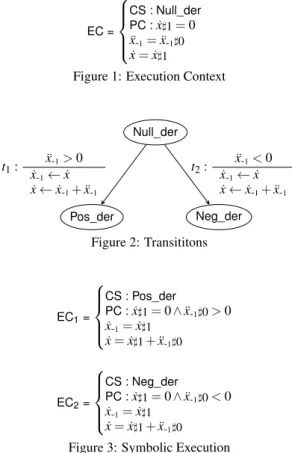
Symbolic Execution In Diversity Symbolic execu-tion was proposed in (King, 1976) and (Clarke, 1976) in order to construct structural tests for sequential pro-grams. It uses symbols as input data instead of nu-merical values. Diversity uses an adaptation of sym-bolic execution to generate tests from specifications based on automata. The input language of Diver-sity is based on Symbolic Transition Graph with As-signments (STGA). It allows the representation of all the behaviors of the specification in an abstract way. Transitions represent events that allow or result from the evolution of the system. They have a guard, which conditions their firing depending on system variables. The Diversity execution engine redefines symbolic execution for STGAs by assigning symbolic values to variables instead of numerical ones, and yields sym-bolic states named execution contexts. As illustrated in Figure 1, an execution context includes: (1) a Con-trol State; (2) a Path Condition, which is the condition to reach the symbolic state from the initial state; (3) a symbolic memory which associates to each variable an expression based on symbolic inputs.
The result of a symbolic execution is an execution tree where each path represents the symbolic evolu-tion of the variables. The path condievolu-tion is the con-junction of all the execution conditions. The ] nota-tion is used to index successive symbolic values.
EC = CS : Null_der PC :x˙]1= 0 ¨ x-1= ¨x-1]0 ˙ x= ˙x]1
Figure 1: Execution Context
Null_der Pos_der Neg_der t1: ¨ x-1> 0 ˙ x-1← ˙x ˙ x← ˙x-1+ ¨x-1 t2: ¨ x-1< 0 ˙ x-1← ˙x ˙ x← ˙x-1+ ¨x-1 Figure 2: Transititons EC1= CS : Pos_der PC :x˙]1= 0 ∧ ¨x-1]0> 0 ˙ x-1= ˙x]1 ˙ x= ˙x]1+ ¨x-1]0 EC2= CS : Neg_der PC :x˙]1= 0 ∧ ¨x-1]0< 0 ˙ x-1= ˙x]1 ˙ x= ˙x]1+ ¨x-1]0
Figure 3: Symbolic Execution
Figure 2 shows transitions t1 and t2from source
state Null_der, the control state of the execution con-text EC of Figure 1. The symbolic execution of t1and
t2produces two execution contexts described in
Fig-ure 3, which correspond to the two possible behaviors.
2.3
Related Work
Kuipers’ algorithm for qualitative simulation, QSIM (Kuipers, 1986), is based on an algebra of signs. Numerous improvements have been added to QSIM in order to address the combinatory explosion of the number of predicted states:
• Methods for changing the level of description in order to eliminate behaviors with no qualitative distinctions (Kuipers and Chiu, 1987).
• Reasoning on “high order derivative” to provide a curvature constraints (Kuipers and Chiu, 1987) (de Kleer and Bobrow, 1984).
• Adding energy constraint that decomposes the system into a conservative part and a non conser-vative one (Fouché and Kuipers, 1992).
However, some problems such as obtaining and us-ing adequate temporal information still remain. This problem was approached in (Shen and Leitch, 1990) and (Berleant and Kuipers, 1992). The most famous tool for qualitative simulation is Garp3 (Bredeweg et al., 2009). It runs model fragments, which describe part of the structure and behavior of the system, and produces a state graph which contains all the possible transitions based on the relationships between entities that are described in the model fragments.
However, the problem we address is how to predict the qualitative behavior of continuous vari-ables of hybrid systems without differential equa-tions. (Bredeweg et al., 2009) describes the variation of the second derivative as small arrows and dots next to the derivative symbol. From a user point of view, it is not easy to analyze the behaviors generated by this simulator, that is why we propose to compute the dif-ferent qualitative states by taking into consideration the second and first derivatives. (Missier and Trave-Massuyes, 1991) proposed a temporal filter based on order of magnitude representation and second order Taylor formula to evaluate the duration for qualitative states, but we are not interested in temporal informa-tion because we are in the first steps of the design; time is not critical at this stage. We therefore rely on a qualitative symbolic integration with the Euler method, assuming a unitary integration step. In order to eliminate the indeterminacy problem of the algo-rithm of (Kuipers, 1986), our model of execution is based on symbolic values.
2.4
A New Symbolic Execution Model
For Qualitative Simulation
For improving the qualitative simulation without dif-ferential equations in Diversity, we developed a model of execution that constraints the evolution of the state variables, and computes their qualitative behavior.
= 0 > 0 < 0 der= 0 der > 0 der < 0 der <0 der >0
Figure 4: Qualitative changes
= 0 x-1← x x← x-1+ ˙x-1 < 0 x-1← x x← x-1+ ˙x-1 > 0 x-1← x x← x-1+ ˙x-1 ˙ x-1< 0 x˙-1> 0 ˙ x-1> 0and ˙ x-1= −x ˙ x-1< 0and ˙ x-1= −x ( ˙x-1< 0)or ( ˙x-1> 0andx˙-1< −x) ( ˙x-1> 0)or ( ˙x-1< 0andx˙-1> −x)
Figure 5: Qualitative changes based on symbolic integration
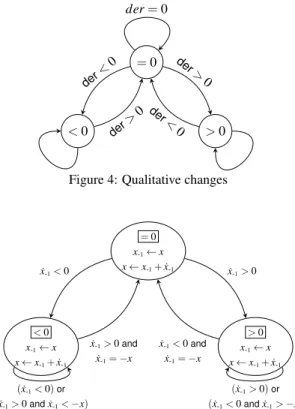
Model Of Execution In our previous work (Med-imegh et al., 2016), we presented a qualitative model of execution with continuity and derivative con-straints for the changes of the state variables. For instance, the value of a state variable cannot change from Negative to Positive without being Null, and it cannot change from Negative to Null unless the first derivative is positive. The same rules apply to the first derivative with regard to the second derivative. These constraints can be modeled in a state machine as illus-trated in Figure 4. A similar automaton controls the changes of the first derivative. Unfortunately, these state machines are nondeterministic. For instance, in the > 0 state, if the first derivative is Negative, we can either go to the = 0 state or stay in the current state.
In this paper, we present a new symbolic execu-tion model in which we integrate the derivatives of the state variables in a symbolic way. We use a sim-ple Euler integration since we do not compute exact numerical values. We model each continuous state variable by six values: the current (x) and previous
(x-1) values of the variable, the current ( ˙x) and
previ-ous ( ˙x-1) values of its first derivative, and its current
second derivative ( ¨x). In this new model of execution, we add the previous second derivative ( ¨x-1), which is
needed to integrate the first derivative. The symbolic integration with the Euler method, assuming a unitary integration step gives x = x-1+ ˙x-1, and ˙x= ˙x-1+ ¨x-1.
With these rules, the qualitative value of a state variable is controlled by a state machine as illustrated in Figure 5. A similar automaton controls the change of the first derivative with respect to its previous value ( ˙x-1) and the previous second derivative ( ¨x-1).
Con-trary to our previous work, these state machines are deterministic. For instance, in the > 0 state of x, if ˙x-1
< 0 and ˙x-1 = -x-1, we go to the = 0 state, if ˙x-1> 0 or
˙
x-1< 0 and - ˙x-1< x, we stay in the current state.
Implementation of Our Execution Model in Di-versity This execution model with symbolic inte-gration relies on five automata: the first one is the system automaton in which the user models his sys-tem and specifies the different values of the current second derivative; the second automaton keeps track of the qualitative value of the second derivative ( ¨x), which is driven by the system automaton; the third automaton keeps track of the qualitative value of the first derivative ( ˙x), which is symbolically integrated from the previous first and second derivatives; the fourth automaton keeps track of the qualitative value of the state variable (x), which is symbolically inte-grated from the previous value and first derivative; and finally, the fifth automaton computes the quali-tative variation of the variable by observing the au-tomata for the qualitative value of the variable, its derivatives, and their previous value.
The order in which these automata are executed is important: we execute the automaton of the sys-tem first, then the automaton for the second deriva-tive, then the automaton for the first derivaderiva-tive, then the automaton for the value of the state variable, and finally the automaton for the qualitative behavior.
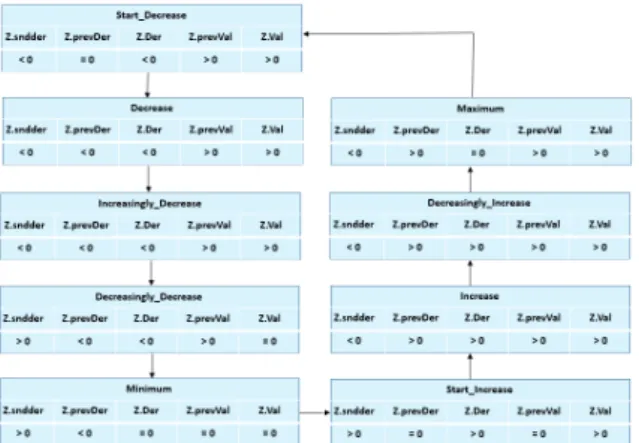
Computing Second Order Qualitative Behaviors In our previous (Medimegh et al., 2016), we showed how to compute the qualitative behavior of a state variable by observing the qualitative state of this vari-able and its derivatives. For instance, when the second derivative is Negative and the first derivative is Null, with a Positive previous derivative, we have the qual-itative behavior Maximum.
With that qualitative model, we identified 13 qual-itative states of behavior: Constant when ˙x-1, ˙xand
¨
x are null; FlexStartIncrease when ˙x-1 = 0, ˙x= 0
but the dynamics is transitioning toward an increase; FlexStartDecrease when ˙x-1 = 0, ˙x= 0 and ¨x< 0,
which is similar to the previous case when transition-ing toward a decrease; StartIncrease when ˙x-1 = 0
and ˙x> 0, the first derivative has just become posi-tive (notice that there is no condition on the second derivative, which may have come back to 0); Start-Decrease when ˙x-1 = 0 and ˙x< 0; Increase when
˙
x-1> 0 and ˙x> 0, the first derivative being positive;
Decrease when ˙x-1< 0 and ˙x< 0, the first derivative
being negative; Maximum when ˙x-1> 0, ˙x= 0 and
¨
x< 0, the three conditions are necessary to distin-guish this case from other qualitative states such as inflection points; Minimum when ˙x-1< 0, ˙x= 0 and
¨
x> 0, same remark as for the Maximum; FlexIn-crease when ˙x-1> 0, ˙x= 0 and ¨x> 0, an inflection
point during an increase; FlexDecrease when ˙x-1< 0,
˙
x= 0 and ¨x< 0, an inflection point during a decrease; StopIncrease when ˙x-1> 0, ˙x= 0 and ¨x= 0, the state
variable reaches a plateau at the end of an increase; StopDecrease when ˙x-1< 0, ˙x= 0 and ¨x= 0, the state
variable reaches a plateau at the end of a decrease. By additionally taking into account x-1and x, it is
possible to distinguish sub-cases in these qualitative states, for instance “reaching a null maximum” when reaching a maximum with x-1< 0 and x = 0.
There are impossible cases. Two are due to the continuity of the variable: the conjunction of x-1< 0
and x > 0, and the conjunction of x-1> 0 and x < 0 are
impossible. Two others are due to the continuity of the first derivative (no angular points). Ten others are due to the fact that each variable change is constrained by the previous value of its first derivative.
In the new model of execution, we add several qualitative states to make it easier for the user to in-terpret the different qualitative behaviors. These new qualitative states correspond to higher order qualita-tive variations because they qualify the variation of the first derivative. We identify the following four additional qualitative states: Increasingly_Increase, when ˙x-1 > 0 and ¨x-1 > 0; Decreasingly_Increase
when ˙x-1 > 0 and ¨x-1 < 0; Increasingly_Decrease,
when ˙x-1 < 0 and ¨x-1 < 0; Decreasingly_Decrease
when ˙x-1< 0 and ¨x-1> 0.
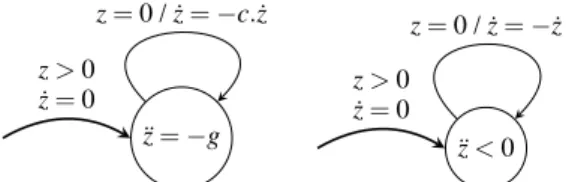
Illustrative Example Of The Bouncing Ball This technique was applied to the bouncing ball, a typical example of hybrid system. In this example, we have only one state variable, the height of the ball above the ground, noted z. The usual way to model the bouncing ball is to consider that it has only one state, in which it is in free fall, with ¨z = −g and g = 9.81m.s−2. The bounce is modeled with a single transition, which is triggered when the ball hits the ground (z = 0), and
reverses the speed of the ball with a damping factor 0 < c ≤ 1. This model and its qualitative abstraction are shown in Figure 6.
¨z = −g z= 0/˙z = −c.˙z z> 0 ˙z = 0 ¨z < 0 z= 0/˙z = −˙z z> 0 ˙z = 0
Figure 6: Hybrid (left) and qualitative (right) automata of the bouncing ball
¨z < 0 ¨z > 0 z> 0
˙z = 0
z= 0
z> 0
Figure 7: Adjusted Model for the Bouncing Ball
The quantitative behavior of this model is an ab-straction of what really happens, because if the ball were really changing its speed instantaneously, there would be an exchange of a finite amount of energy in zero time between the ball and its environment, which corresponds to an infinite power. We have shown (Medimegh et al., 2016) that in the case of the bouncing ball, the model can be automatically ad-justed by replacing the bouncing transition by a series of transitions. The algorithm for this is as follows:
• changing the derivative from < 0 to > 0 is illegal. The only legal path is to go from < 0 to = 0 and then from = 0 to > 0, so we replace the illegal transition by a legal one.
• changing the derivative from < 0 to 0 and from 0 to > 0 requires a positive second derivative, so we make it positive during the bounce (the second derivative can be discontinuous).
The resulting state machine is shown in Figure 7, where the additional state has a gray background.
The additional state, reached when z = 0, sets the second derivative to Positive because this is required to make the first derivative change from Negative to Null. When the first derivative becomes null, our new symbolic execution model finds a path to make the first derivative positive because the second derivative is still positive. The velocity of the ball becomes then positive, as requested by the initial un-physical tran-sition, we can go back to the free fall state of the ball, with a reversed velocity.
With this adjusted model and the symbolic execu-tion model for qualitative simulaexecu-tion, we obtain the qualitative behavior shown in Figure 8.
Figure 8: Qualitative behavior of the bouncing ball
3
QUALITATIVE SIMULATION
OF SYSML MODELS
To make our approach usable for system design-ers, and to insulate them from changes in our execu-tion model and input format, we built a tool chain to use SysML as input for qualitative simulation. We choose SysML because it allows the modeling of multi domain specifications. It is also used by a large community of engineers to model the system at the early design stages.
Our approach relies on a qualitative model of the continuous behavior, not on the exact differen-tial equations. This qualitative model is already dis-cretized, so we can use the state machines diagram to model the behavior of the hybrid system.
Figure 9: The Tool Chain
3.1
Presentation of the Tool Chain
We model a hybrid system with a SysML state ma-chine diagram, using the Papyrus Eclipse plug-in. Then, we transform the SysML model using a QVT operational model to model transformation into a Hy-Div model. HyHy-Div is a pivot meta-model that we de-signed to capture a high level representation of the hy-brid system, independently of the source model (we could use Simulink/Stateflow instead of SysML). We then use an Acceleo model to text transformation to transform the HyDiv model into Xlia, the input lan-guage of Diversity, as shown in Figure 9.
The SysML Model The hybrid system is modeled as a SysML Block with attributes for the variables and the behavior of the system. The variables have the Derivative_Typeand the behavior is defined by a State Machine. In this state machine, the guards are writ-ten in OCL. We specify the Effect of a transition by a Specification to which we attach an Operation with an OCL constraint. We use the same technique for the Entryactions of the states.
Figure 10: The HyDiv Metamodel
The HyDiv Model HyDiv is a textual domain spe-cific modeling language for hybrid systems, imple-mented with Xtext. It provides us with a compact representation of the system which is decoupled from both the input formalism (SysML in this article) and the model of execution that will be used in Diversity. Figure 10 shows its meta-model, in which the system has different attributes: a name, a folder to indicate its location, statesVars to indicate its state variables, initializationsto indicate the initial value of the vari-ables, and states to describe the states of the hybrid system. Each State has an initial attribute, a name, entryAssignments to describe the actions to perform when entering the state, and transitions toward other states. Each Transition has a name, a target state, guards to tell when the transition can be fired, and actionsto be performed by the transition.
QVT Operational Transformation The first step to perform the qualitative simulation of a system is to transform its SysML model into HyDiv. The QVT operational transformation from SysML to HyDiv makes the following mappings:
• a SysML Block is mapped to System;
• an Attribute of a block with Derivative_Type or Integeras type is mapped to StateVar;
• a State of a state machine attached to a SysML block as a type of an attribute is mapped to State; • a Transition of a state is mapped to Transition; • a Guard of a transition is mapped to Guard; • an Effect of a transition is mapped to Action; • an Entry of a state is mapped to Assignment;
3.2
The RC Circuit Example
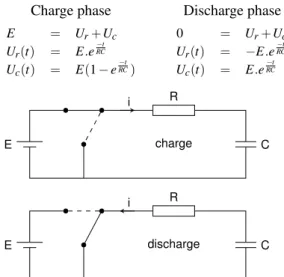
We applied our method to the RC circuit shown in Figure 11. We have two coupled variables: the volt-ages Urand Ucacross resistor R and capacitor C.
Charge phase E = Ur+Uc Ur(t) = E.e −t RC Uc(t) = E(1 − e −t RC) Discharge phase 0 = Ur+Uc Ur(t) = −E.e −t RC Uc(t) = E.e −t RC E R C i charge E R C i discharge
Figure 11: Charge and Discharge phases of the RC Circuit
Computing First Order Qualitative Behaviors In this system, we need to consider only the first deriva-tive of the voltage, which is proportional to the cur-rent because of the capacitor. The switch will force the current to be positive in the charge phase and negative in the discharge phase, but we have no in-formation about the second derivative of the voltage. Our approach can compute the qualitative behavior of the state variables taking into account only the first derivative. Some qualitative states such as StartIn-crease, StartDeStartIn-crease, Increase and Decrease are the same because they do not depend on changes of the second derivative. However, other qualitative states such as StopIncrease and StopDecrease will not be identified since they need a null second deriva-tive. In that first order qualitative model, we add two qualitative states that describe the discontinuity of the first derivative: Angular_Increase, when ˙x-1< 0,
˙
x> 0, and Angular_Decrease, when ˙x-1> 0, ˙x< 0.
In this example, the voltage Uc is continuous but
the voltage Ur is discontinuous. In the charge phase,
Ur decreases from E to 0 and Ucincreases from 0 to
E. In the discharge phase, Ur increases from −E to
0 and the voltage Uc decreases from E to 0. Since
we are not interested in the exact values in qualita-tive simulation, +E and −E will be considered re-spectively as a > 0 and < 0 symbolic values. As we did with the bouncing ball, the RC Circuit can be au-tomatically adjusted for continuity by replacing the switching transition from the charging phase to the discharge phase and vice versa:
• changing the value of Urfrom > 0 to < 0 is illegal.
The only legal path is to go from > 0 to = 0 and then from = 0 to < 0, so we replace the illegal transition by the sequence of these two transitions. • changing from > 0 to 0 and from 0 to < 0 requires a negative first derivative, so we make it negative when switching from charging to discharging. We do the same to change the value of Ur from < 0
to > 0 when switching from the discharging to the charging phase, but with a positive first derivative. SysML RC Circuit Block The RC circuit is mod-eled in a SysML block as shown in Figure 12. It has 3 attributes, the first two are the variables of the system: Ucand Ur. Their type is Derivative_Type which
rep-resents a value and its first and second derivative. The last attribute is typed as a state machine that specifies the behavior of the RC circuit.
Figure 12: Block Definition Diagram of the RC circuit
Figure 13: State Machine Diagram of the RC circuit RC Circuit State Machine The equations of the RC circuit are modeled by a state machine with 5 states and 5 transitions as shown in Figure 13:
• the t0transition sets the initial values of the states
variables Ucto = 0 and Urto > 0, and sets the first
derivative of Ucto > 0 and Urto < 0;
• t1flips the switch to the discharge position, and
sets the first derivative of Urto < 0 and Ucto < 0;
• t2flips the switch to the discharge position, and
sets the first derivative of Urto > 0 and Ucto < 0;
• t3 flips the switch to the charging position, and
sets the first derivative of Urto > 0 and Ucto > 0;
• t4flips the switch back to charging, and sets the
first derivative of Ucto > 0 and Urto < 0.
Our QVT operational transformation turns this SysML model into a HyDiv model.
Diversity Model Of The RC Circuit Then our Ac-celeo transformation produces the Xlia source code of the Diversity model of the system from this Hy-Div model. This transformation encodes the seman-tics of our model of execution. It generates the au-tomaton for the system, as well as the automata for
the state variables and their derivatives, and the au-tomaton which computes the qualitative variation of these variables.
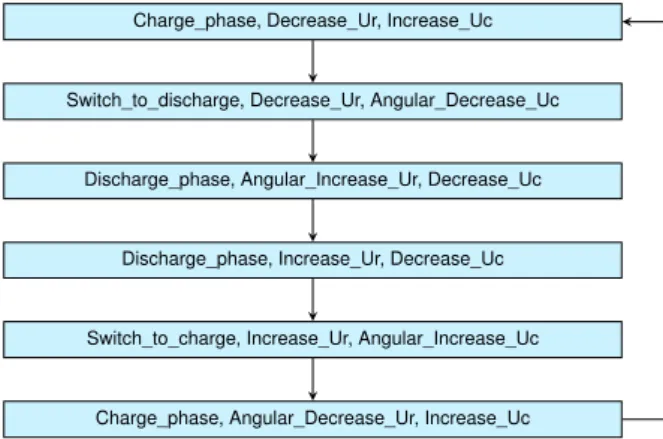
Qualitative Behavior Computed by Diversity Running Diversity on the Xlia model, we obtain the qualitative behavior shown in Figure 14.
Charge_phase, Decrease_Ur, Increase_Uc
Switch_to_discharge, Decrease_Ur, Angular_Decrease_Uc
Discharge_phase, Angular_Increase_Ur, Decrease_Uc
Discharge_phase, Increase_Ur, Decrease_Uc
Switch_to_charge, Increase_Ur, Angular_Increase_Uc
Charge_phase, Angular_Decrease_Ur, Increase_Uc
Figure 14: Qualitative behavior of the RC circuit
We see clearly in this figure that the voltage Ur
across resistor R and the voltage Ucacross capacitor
C are varying in opposite ways:
• in the Charge_phase, Ur is in a Decreasing_state
while Ucis in an Increasing_state;
• in the Switch_to_discharge, Ur is still in a
De-creasing_state because it must go to −E while Ucis in an Angular_Decreasing_state because the
capacitor starts discharging;
• in the Discharge_phase, Ur is in an
Increas-ing_statewhile Ucis in a Decreasing_state;
• in the Switch_to_charge, Uris still in an
Increas-ing_statebecause it must go to +E while Ucis in
an Angular_Increasing_state because the capaci-tor starts charging.
4
DISCUSSION
Among the qualitative behaviors found by Diver-sity for the bouncing ball, we have presented the one which corresponds to the real physical model of the ball. However, other behaviors are found. In our previous work in (Medimegh et al., 2016), we described two behaviors that were impossible and should be eliminated. Thanks to our new model of execution, which computes qualitative variations of the first derivative such as Increasingly_Increase, we were able to eliminate them. For instance, when the
ball is falling, its speed is negative and decreasing (be-cause the second derivative is negative), so it is neg-ative and increasing in magnitude. The new model of execution identifies the qualitative variation of the height of the ball as Increasingly_Decrease. Start-ing from a positive symbolic value, the height of the ball has therefore to become null at some point, which eliminates the behavior where the ball was falling for-ever toward the ground without for-ever reaching it.
There are still some behaviors found by Diver-sity that differ by a few sequences of states. This is due to the way Diversity detects Redundancy. During the symbolic execution of a model, Diversity builds a tree, each branch corresponding to a choice for the symbolic value of the variables. When Diversity finds an execution context that was met before, it cuts the execution of this branch, and makes it point to the state that was met before. This turns the tree into an execution graph, and makes it possible to capture infinite behaviors in a finite structure. However, de-pending on the order in which the variables change, the redundancy detection can be delayed, which cre-ates several execution paths for the same physical be-havior. These executions paths make the results more difficult to analyze, and we plan to filter the results of Diversity in order to keep only one path for each possible physical behavior of the hybrid system.
5
CONCLUSION
We have presented a new symbolic execution model for the qualitative simulation of hybrid sys-tems with only a qualitative model of the equations, with a symbolic integration of the derivatives of the state variables. We compute only qualitative values for the state variables and their derivatives by parti-tioning their domain into Negative, Null and Positive. Our symbolic execution model is composed of several state machines. The first one represents the qualitative behavior of the hybrid system in an ab-stract way by specifying the changes of the value of the second derivative of every state variable. That is why this approach is called without differential equa-tions. Then, for every state variable, we have four state machines: the first one keeps track of the qual-itative value of the second derivative ( ¨x), which is driven by the system automaton; the second one keeps track of the qualitative value of the first derivative ( ˙x), which is symbolically integrated from the previous second derivative and the previous first derivative; the third automaton keeps track of the qualitative value of the state variable (x), which is symbolically integrated from the previous first derivative and value of the state
variable; and finally, the fourth automaton computes the qualitative variation of the variable by observing the automata for the qualitative value of the variable, its derivatives, and their previous value. The first three automata enforce the continuity of the variable and of its first derivative, as well as the compatibility of the changes of the variable with regard to its derivative, and of the changes of the first derivative with regard to the second derivative.
We applied our approach to the typical hybrid sys-tem example of the bouncing ball and to an RC circuit with two linked state variables. We have shown that we are able to find the different qualitative behaviors of these hybrid systems, and that the execution model can be adapted to first order models.
We apply this approach to the analysis of SysML models, using an M2M transformation from SysML to the pivot HyDiv language, and an M2T transforma-tion from this language to Diversity. We have there-fore a complete tool chain for analyzing the qualita-tive behavior of SysML models of hybrid systems.
We plan to enrich the symbolic execution model with a filter to eliminate redundant symbolic behav-iors that correspond to the same physical behavior in the execution tree generated by Diversity. Another track to explore is to design a SysML profile for qual-itative simulation without differential equations, in or-der to make the qualitative modeling of hybrid system in SysML easier and more expressive.
There are obviously limitations to the analysis of hybrid systems using qualitative simulation without differential equations, because behaviors that depend on specific numerical values of some parameters can-not be found. However, this approach can be applied to systems that cannot be analyzed because their dif-ferential equations are too complex to be analyzed. It can also be applied in the early phases of the design of a system, when some parameters or the exact form of the differential equations are not known yet.
REFERENCES
Berleant, D. and Kuipers, B. (1992). Qualitative-numeric simulation with q3. Recent advances in qualitative physics, 98:285–313.
Bredeweg, B., Linnebank, F., Bouwer, A., and Liem, J. (2009). Garp3—workbench for qualitative modelling and simulation. Ecological informat-ics, 4(5):263–281.
Brown, C. W. (2003). Qepcad b: A program for computing with semi-algebraic sets using cads. SIGSAM Bull., 37(4):97–108.
Chutinan, A. and Krogh, B. H. (2003). Computational techniques for hybrid system verification. IEEE Trans. Automat. Contr., 48:64–75.
Clarke, L. A. (1976). A system to generate test data and symbolically execute programs. IEEE Trans. on software engineering, (3):215–222.
de Kleer, J. and Bobrow, D. G. (1984). Qualita-tive reasoning with higher-order derivaQualita-tives. In AAAI, pages 86–91.
Eclipse Modeling Project (2017a). Acceleo. Eclipse Modeling Project (2017b). Qvt.
Fouché, P. and Kuipers, B. J. (1992). Reasoning about energy in qualitative simulation. IEEE Trans. on Systems, Man, and Cybernetics, 22(1):47–63. Gallois, J.-P. and Lanusse, A. (1998). Le test
struc-turel pour la vérification de spécifications de sys-tèmes industriels: L’outil agatha. In Fiabilité & maintenabilité, pages 566–574.
Gallois, J.-P. and Pierron, J.-Y. (2016). Qualitative simulation and validation of complex hybrid sys-tems. In ERTS 2016, TOULOUSE, France. Henzinger, T. A., Ho, P.-H., and Wong-Toi, H. (1997).
Hytech: A model checker for hybrid systems. In Computer Aided Verification: 9th International Conference, CAV’97, pages 460–463. Springer. King, J. C. (1976). Symbolic execution and program
testing. Com. of the ACM, 19(7):385–394. Kuipers, B. (1986). Qualitative simulation. Artificial
intelligence, 29(3):289–338.
Kuipers, B. and Chiu, C. (1987). Taming intractible branching in qualitative simulation. Readings in qualitative reasoning about physical systems. Lynch, N., Segala, R., and Vaandrager, F. (2003).
Hy-brid i/o automata. Information and computation, 185(1):105–157.
Medimegh, S., Pierron, J.-Y., Gallois, J.-P., and Boulanger, F. (2016). A new approach of quali-tative simulation for the validation of hybrid sys-tems. In GEMOC at MODELS 2016.
Missier, A. and Trave-Massuyes, L. (1991). Tempo-ral information in qualitative simulation. In AI, Simulation and Planning in High Autonomy Sys-tems, pages 298–305. IEEE.
Rapin, N., Gaston, C., Lapitre, A., and Gallois, J.-P. (2003). Behavioural unfolding of formal specifi-cations based on communicating automata. In Proc. 1st Workshop on Automated Technology for Verification and Analysis.
Shen, Q. and Leitch, R. (1990). Integrating common-sense and qualitative simulation by the use of fuzzy sets. In 4th International Workshop on Qualitative Physics, pages 220–232.