Publisher’s version / Version de l'éditeur:
Vous avez des questions? Nous pouvons vous aider. Pour communiquer directement avec un auteur, consultez la
première page de la revue dans laquelle son article a été publié afin de trouver ses coordonnées. Si vous n’arrivez pas à les repérer, communiquez avec nous à [email protected].
Questions? Contact the NRC Publications Archive team at
[email protected]. If you wish to email the authors directly, please see the first page of the publication for their contact information.
https://publications-cnrc.canada.ca/fra/droits
L’accès à ce site Web et l’utilisation de son contenu sont assujettis aux conditions présentées dans le site LISEZ CES CONDITIONS ATTENTIVEMENT AVANT D’UTILISER CE SITE WEB.
Internal Report (National Research Council of Canada. Division of Building Research), 1959-07-01
READ THESE TERMS AND CONDITIONS CAREFULLY BEFORE USING THIS WEBSITE.
https://nrc-publications.canada.ca/eng/copyright
NRC Publications Archive Record / Notice des Archives des publications du CNRC :
https://nrc-publications.canada.ca/eng/view/object/?id=219accc3-d74d-4384-b186-f27764dfbbb7 https://publications-cnrc.canada.ca/fra/voir/objet/?id=219accc3-d74d-4384-b186-f27764dfbbb7
NRC Publications Archive
Archives des publications du CNRC
For the publisher’s version, please access the DOI link below./ Pour consulter la version de l’éditeur, utilisez le lien DOI ci-dessous.
https://doi.org/10.4224/20338278
Access and use of this website and the material on it are subject to the Terms and Conditions set forth at
Building in Iceland
Rセᄋ 20¥W 15
65·
LEGEND
--_. ROADS TRAVERSED BY CAR FROM EGILSSTADIR TO REYKJAVIK - - PLANE FLIGHT FROM REYKJAVIR
TO EGILSSTADIR [:=JICECAP ",,,,,,A,\
-
"セ
GEGILSSTADIR / ' " ...- " / »: \ /HALLORMSSTADUR '. /" セskifセordur _ __/ILAKE) LAGARFLJOT セ /" "\L
¥\
-
1
6 " セセMM ",セhveravellirセG ' ' }-4 OETTIFOSS: \ GRENJAOARSTAOUR\ セセ⦅ ../' REYKJAHLID \"i MYVATN\エセamセ[[a[Gイケ :'\ GAROUR セ \ セセ セセ セ "--, Lセ '..._... ...'," Nセ ,<:! .. |セMMMセ。ofsjokLu
,LL\J.i
..-:> MMONNNNMセセ . CJ:--MMセ--cD
ARCTIC CIRCLE.0
,--I , J .' I MMMTセMMM -:/,,1 --' / ' OセO ,-,' Zセセ[lセ[I ... ,,,,1 ... / 'oJ ---» > I tセhngv LLiR - ) "', -- セ THINGVALLAVATN (LAKE セMM]MM .,.- l
GQ|reykjセhlャd
_ _ ._._ \REYKIR___ , - . MYRDALS-GセイM --_ 10 ICELAND SCALE' I' 750,000 • 0 10 5 0 10 20 30 40 50 60 KILOMETRES 64·'r--
_
zo·w 15The Division of Building Researoh has long looked forward to establishing personal contact with building research activities in Iceland. These are conducted by the Icelandic Productivity and Technical Assistanoe Centre, known as the Technical College Building, in Reykjavik.
An opportunity for such a visit arose in the late swmmer
of
1958
on the author's return trip to Canada fram Cambridge, England, where he had spent the previous year at the Scott Polar Researoh Institute. From 30 August to7
September,1958,
Mr.
Brown spent a most profitable week with officialsof the Technical College BUilding and in making a tour of the country.
< The information in this report is presented in
two parts. The first comprises brief notes on several
aspects of the country's geology, climate, history, resources and exports. The second part is a "reoord of information on various aspects of building research in Iceland whioh was aoquired by Mr. Brown during his several discussions with Ioelanders engaged in this field.
The author of the report is a Researoh Officer in the Northern Building Section of the Division of Building Researoh; his special interest is the distribution of perma-frost in Canada. This personal contact has provided a
valuable link between building researoh workers in Iceland and Canada. It is hoped that this report will help in some small way to aoquaint Canadians with this interesting and progressive country.
Ottawa July
1959
R.F. Legget Director
(i)
BUILDING IN ICELAND
by
R.J.E. Brown
INTRODUCTION
.
From August 30 to September
7, 1958,
the writer visited Ioeland. During this period, three and a half Gays were spent in travelling by automobile from the east side of the island to Reykjavik via the north ooast. The remaining time was spent in Reykjavik.This small oountry, situated in the North Atlantic Ooean just south of the Arotio Cirole and in the path of the Gulf Stream, has a 0001 marine olimate similar to parts of Newfoundland and a
unique ァセッャッァゥッ。ャ framework. Geologioally, it is a young oountry and voloanio foroes are now very aotive. In addition, there are several ioe oaps in Ioeland, inoluding the largest one in Europe. The existenoe of "fire" and."ioe" in oombination where aotive voloanoes are oovered by ioe produce some unique natural pheno-mena.
The only resouroe of any oonsequenoe is fish whioh abound in great numbers near the ooast. The Ioelanders have a high standard of living but suffer a severe trade defioit
beoause of their almost complete dependenoe on this one exportabl. commodity.
In the fall of
1957,
the first oontaot by letter was established between the Division of Building Research and the Isnadatmalastofnun Islands ("Icelandic Productivity and Teohnioal Assistance Centre" - shortened to "Teohnical College Building") in Reykjavik. This agenoy is conoerned with the establishment of standards in various branohes of industry inoluding oonstruotion. To follow up this oontact, the writer visited Mr. Sveinn Bjornsson and Mr. Jon BrYnjolfsson, offioials of the Teohnioa1 CollegeBuilding to disouss building problems in Ioeland. A visit was made also with
Mr.
Haraldur Asgeirsson, head of the ooncrete researoh laboratory of the University Researoh Institute. In addition, a day was spent in making a general survey of buildings in Reykjavik.There is no permafrost in Ioeland but frost phenomena are prevalent and a useful disoussion was held with Dr. Sigurdur Thorarinsson, a geologist, who is the foremost authority on
these features in the oountry. In addition to the kindness of those mentioned above in giving the writer some of their time and information, thanks are due espeoially to the Honorary Consul General of Canada, Mr. Hallgrimar h。ャャァイセウウッョL C.B.E., President and Managing Direotor of the Ioelandio Shell Oil Company, for arranging the tour from Egilsstadir to Reykjavik, and to offioials of the Company who were of oonstant assistanoe throughout the tour. It was through these arrangements and this assistanoe that the writer was able to see a great deal of the
oountry, in partioular some of the interesting geologioal features. Ioeland bas same unique building problems and also same in oommon with those in Canada. It is hoped that this brief
survey, oontaining firstly general information, and seoondly notes on various aspeots of building in Ioeland, will to some extent aoqwnnt the reader with this little known but interesting oountry.
( iii) TABLE OF CONTENTS PART I
-
GENERAL INFORMATION 1. INTRODUCTION ••••••••••••••••••••••••••••••••••••• 1 2. GEOLOGy... 1(a) Voloanio aotivity (b) Earthquakes
(0) Ioe oaps
(d) Glaolal bursts
(e) Hot springs and geysers
(r)
Drainage(g) Frozen ground
3.
CLIMATE ••••••••••••••••••••••••••••••••••••••••••4
(a) General(b) Ooean ourrents and temperatures Co) Drift ioe
(d) Weather (e) Conolusion
4.
HISTORy ••••••••••••••••••••••••••••••••••••••••••5
(a) Outline (b) Thingvellir (0) Cata strophe s5.
CONSTITUTION •••••••••••••••••••••••••••••••••••••8
6.
POPULATION •••••••••••••••••••••••••••••••••••••••8
7.
EDUCATION ••••••••••••••••••••••••••••••••••••••••9
8.
RELIGION •••••••••••••••••••••••••••••••••••••••••9
9.
HYGIENE ••••••••••••••••••••••••••••••••••••••••••9
10. COMMUNICATIONS •••••4 • • • • • • • • • • • • • • • • • • • • • • • • • • • • •9
11. RESOURCES AND EXPORTS (a) Fishing (b) Agrioulture (0) Forestry (d) Exports (e) Co-operatives (f) Conolusion
••••••••••••••••••••••••••••
10PART II BUILDING IN ICELAND
12. ICELANDIC PRODUCTIVITY AND TECHNICAL
ASSISTANCE CENTRE ••••••••••••••••••••••••••••••
13
13.
CONCRETE RESEARCH ••••••••••••••••••••••••••••••13
14.
BUILDING DESIGN ••••••••••••••••••••••••••••••••14
15.
HOUSE DESIGN •••••••••••••••••••••••••••••••••••16.
BUILDING SERVICES••••••••••••••••••••••••••••••
15
16
(a) HeatIng (b) Insula tion (0) Sewage17.
UTILIZATION OF HOT SPRINGS••••••••••••••••••••• 16
18. BUILDING CODES AND TOWN PLANNING IN REYKJAVIK •• 19 19. BUILDING PRACTICE •••••••••••••••••••••••••••••• 20 20. ROADS••••••••••••••••••••••••••••••••••••••••••
20REFERENCES ••••••••••••••••••••••••••••••••••••••••••• 22
APPENDIX A - CONTACTS APPENDIX B ITINERARY
PART I
GENERAL INFORMATION
- . q
1. inセroduc TION
Ioeland is 300 miles long from east to west and 195 miles long from north to south with an area of 40,000 square miles and a fjord-indented ooastline of 3,125 miles. It lies approximately between 63° 25' N. and 66° 33' N. and between 13° 30' W. and
24° 30' W. The Aratia Cirole is less than
5
miles north of the northernmost point of the mainland.Most of the interior is uncultivable, consisting of extensive fields of lava, glacial sand and gravel outwash and volcanoes both active and extinat. The average elevation of the interior plateau is 2,100 feet above sea level. The highest
elevation is an ice-oovered volcano on the south coast, the summit of whioh is 2,119 metres (approximately 7,000 feet) above sea
level. Lowlands oontaining cultivated area oocur in the south-west, west and northeast.
2. GEOLOGY
(a) Volcanio activitz
Geologioal1y, iッ・セョ、 is the youngest country in Europe. It oonsists mainly of horizontal basaltic lava layers deposited . in the Tertiary period. It is intersected from the north to south-west by a broad oentral zone of submergence oontaining the most produotive volcanio area in the world. There are more than one hundred and fifty volcanoes that have been active in post-glacial time representing nearly every type found on earth. One of these, the lava dome, is found only here and in Hawaii. The one in
Ioeland is now extinct. There are also cone volcanoes, explosion craters, tephra rings, lava fissures, and orater rows.
More than thirty vo1oanoes have been active in historioal time and one hundred and thirty volcanic eruptions have been
reoorded. There is an eruption on the average every fifth year. One-tenth of the country has been oovered by lava sinoe the
Wurm
Glaoiation; two per cent has been covered during historioal time. One example of an active volcano is Mt. Hekla in the southwest whose first reoorded eruption was in 1104 and has erupted fifteen times sinoe then. The latest was in 1947-1948 lasting with inter-mittent bursts for thirteen months and producmg one oubio kilometre
of lava. The eruptions of 1104, 1693, and 1766 oaused widespread devastation and subsequent famine because of lava flows and ash deposition.
In
1783,
lava issued from a northeast - southwest trendingvoloanic fissure to the southwest of Vatnajokull Icecap.
Approxi-mately
30
to100
craters, eaoh30
to100
metres high, were built.The eruption lasted seven months and lava desoended into two river
valleys. The total area of land covered by lava was
15
oubickilometres - enough lava to cover England to a depth of
4
inches.Some farms were destroyed by lava although the ash fall was more
devastating. It fell over most of the country, stunting grass and
poisoning pasture land so that livestock died. Fifty per cent of
the cattle,
76
per cent of the ponies, and71
per oent of thesheep in Iceland died. Nine thousand people, one-fifth of the total
popUlation, died from the reSUlting famine. (b) Earthguakes
Earthquakes are frequent although they are confined to a
few limited and speoific areas. Severe earthquakes have been
experienced in only five areas in historical times but these areas
bave
70
per cent of the population. In1896,
there was a disastrous'quake which wholly destroyed
17
per cent or1,309
and damaged73
per cent or
5,655
of a total of7,748
buildings in the southernlowlands.
(0) Ice caps
One-eighth of Ioeland
(11,800
square kilometres) is coveredby ice. The largest ioe cap is Vatnajokull covering
8,500
squarekilometres equalling the total area of all the glaoiers in
oon-tinental Europe. Three other smaller ice caps in the south central
part are Hofsjokull, Langjokull, and Myrdalsjokull (Frontispiece). (d) Glacial bursts
The first type, oalled ltglscilinmogenlt, is oaused by the
catastrophic drainage of ice-dammed lakes. Almost everyone of
the big outlet glaciers of v。エョ。ェッォオャセ blocks one or more tributary
valleys which are ice free and where water accumulates to form
lakes dammed by the ice. The lake level rises until the water can
overflow some 001 or - in case its depth becomes more than
nine-tenths of the thickness of the 、。セョァ ice barrier - the water may
lift it and force its way beneath the glacier and overflow the
lowland in front of it. One such lake is drained two or three times
each year.
The second type, called "volcanogen", is much more
disas-trous and caused by SUbglacial volcanic activity. Of the active
volcanoes under Vatnajokull, the most famous 1s Grtmsvotn in the
3
-kilometres in area and 500 metres deep. Between eruptions, it
is filled with water from ablation and by subglacial vo1canio
。」エゥカゥエケセ Water is dammed in the same way as in normal ioe-dammed
lakes. Every ten years the basin is emptied by a violent glacier
burst whioh issues from many tunnels at the ice front. These
last about one week and the maximum run-off is 50,000 cubic metres per second whioh is one thousand times the flow of the
Thames River at low tide. These bursts are usually accompanied
by violent eruptions in the south part of the basin. The common
opinion is that the eruptions are the primary cause of a glacier
burst but Thorarinsson (5)* believes that these bursts are not
always accompanied by eruptions and it is possible that the drainage of the basin and sudden release of pressure is primary
and starts the eruption. This may explain the striking regularity
in the length of interval between eruptions of nine to eleven
years. The amount of water in each corresponds roughly to the
amount of acoumulation in the Grimsvotn area in 10 years.
(e) Hot springs and geysers
Associated with volcanio aotivity are the numerous areas
or hot spring activity and geysers. The steam and hot water from
many hot 'springs are being utilized for heating dwellings and
green-houses (Section 17 on Page 16 ). There are also many water and
mud geysers in Iceland. ("Geysir'" is an Ioelandio word.) The largest water geyser in Iceland is the Great Geysir, 80 miles from Reykjavik which erupts periodically to a height or 160 to 180 feet.
(f) Drainage
There are several large rivers and many small ones having
sources in the ice caps and oarrying melt water to the sea. These
glacial streams carry large volumes of sediment in suspension and
are fast flowing. None of them is navigable because of the many
waterfalls and long stretches of cataracts and rapids. One of
the longest rivers, Jokulsa
a
Fjollum flows north from theVatnajokull to the north coast of Iceland. In its course is
Dettifoss, one of the highest waterfalls in the country which is
200 feet high. There are plans to harness it some day for
hydro-electric power.
The largest lake in the oountry is Tbingvallavatn, about
9
miles long from north to south by4
miles wide from east to west.A lava plain extending to the northeast from this lake was the
site of the Ice1andio parliament for more than 800 years. Another
of the larger lakes is Myvatn ("lake of midges") in tho northeast. It is surrounded by a lava plain in whioh the rook surfaoe resembles
solidified waves of the sea. There are also voloanic cones and
lava pinnacles forming islands in the lake.
(g) Frozen ground
It is believed that there is no perennially frozen ground in Ioeland at present, although it may have been present during
the oolder climate prevailing in the nineteenth oentury. There
are, however, a variety of periglaoial features suoh as polygons (3), stone oircles and frost mounds, due in part undoubtedly to the close proximity of mean annual temperatures to 32°F and the
higb number of freeze-thaw oycles. One of the most interesting
types of frost mound, or hummock, is the thufa (plural thufur)
(Fig. 1). These thufur are covered with vegetation, varying
in height from one to two feet and occurring in large oonoentrations. When such an area is to be oultivated, the mounds are levelled but they re-form after a few years (4).
(The author's visit with Dr. Sigurdur Thorarinsson W8.s the day
before he left for Grimsvotn on Vatnajokull to investigate a
jokulh1aup (glaoier burst). He is well known abroad, partioularly
in Soandinavia but prefers to stay in Iceland. He is the foremost
authority in the geology of Ioeland partioularly the interaotion
of glaoial and volcanio aotion. The information he gave the author on
frozen ground phenomena in Ioeland is all available in the publi-oations listed in the references.)
3. CLIMATE
(a) General
Climatically, Ioeland is a land of paradox. It lies near
the polar regions so it is never hot but it lies in the path of
the Gulf stream so it is never oold. The mean monthll air
tempera-ture for July is about 50°F and for January, about 30 F. At the
same latitude in Canada, the mean monthly air temperature for July is also about 50°F but in January it varies from -10°F to -30°F. (b) Ooean currents and temperatures
The island is situated at the oonfluence of two ocean
currents. Because of a submarine ridge extending between Sootland
and Iceland, a branch of the North Atlantic Drift (the oontinuation of the Gult Stream) is deflected westward and flows along the
south and west coasts of Ioeland. Sea temperatures off the south
coast average 43°F. The harbours on these coasts are ice free
throughout the year. At Cape Horn in the northwest this ourrent,
because of its higher salinity, is sUbmerged under the East Ioe-landio Polar Current (a branch of the East Greenland Current) which flows east along the north coast and southward along the east
coast. This ourrent oarries drift ice. Sea temperatures off the
- 5 ...
(0) Drift ice
From 1600 to 1900, years of severe drift ice were more frequent than during the first three or four oenturies of
settle-ment. The last fifty years have been the most free of ice sinoe
1550. The last thirty years are probably the longest practically
ice-free period sinoe the beginning of settlement. (d) Weather
Prevailing wind direction is from the southeast. The
weather varies depending on the strength of the high pressure
system over Greenland. If this is strong, the depressions are
foroed to the south bringing southeast winds and mild wet weather
to the southern parts of the country. If the high over Greenland
is weak, then the depressions move further north resulting in olear weather over the south and cool wet weather in the north. At Reykjavik, the mean annual temperature is 39°F and the mean
January temperature is 31QF.
The mean annual preoipitation at
Reykjavik is 50 inches; the amount of this that falls as snow
varies from year to year. Thunderstorms are rare.
(e) Conolusion
Years of severe climate mean adversity for Ioeland because the oountry is so near to the northern limit of what a white
oivilized people oan endure while maintaining high cultural standards.
4. HISTORY
(a) Outline
Ioeland was settled and oolonized from 874 to 930 A.D. partly by Norwegians and partly by people from the northern parts
of the British Isles. A republic or oommonwealth was established
in 930 when a Central Parliament (AI thing) was established at
Thingvel11r. The republio ended in 1263, when a Treaty of Union
was made with the Crown of Norway.
Norway and Iceland beoame united to Denmark in 1389.
Ioe1and had only provincial autonomy, although it maintained that it aocepted supremaoy of the Danish king but not the Danish
government. A oonstitutional struggle ensued which lasted until
1874.
In 1874, Iceland was granted a constitution by the King
of Denmark by which the people were allowed a small voioe in their
weI]. Some bills that were passed by the Althing were vetoed in
Copenhagen. In
1903
a new oonstitution provided a Danish ministerfor Ioeland, solely oocupied with Ioelandio affairs and residing in Reykjavik.
In
1918
the long struggle for constitutional freedomcame to an end with the Aot of Union whioh was passed by the parliaments of both countries aoknowledging Ioeland to be a
sovereign state united to Denmark by one king. Denmark managed
Ioeland's foreign affairs. The Aot of Union provided that after
1940,
either party oould request negotiation regarding Iceland'sfuture and should no agreement be conoluded within three years then either parliament could, by a two-third majority, resolve the Aot to be cancelled subject to confirmation by a three-quarter
majority in a plebisoite. Denmark was under occupation so no
negotiation oould be entertained and Iceland adopted a temporary regenoy because its monarch in Denmark could not exercise his
powers. On June
17, 1944,
a plebiscite was taken and theindependent Republic of Iceland was declared. In November,
1946,
Ioeland joined the United Nations. (b) Thingvellir
Thingvellir means "The Plain of Parliament" and has been
closely linked over the oenturies with the national life. The
Althing, the oldest eXisting parliament in the world assembled
from
930
to1798
at Thingvellir in the open air. It moved toReykjavik in
1798.
The site is a lava plain about
5
miles wide and about25
ュゥセ・ウ long extending north from Thingvallavatn, the largest lake
in Iceland,
30
miles northeast of Reykjavik. The plain is enolosedby mountains and voloanio peaks. There are many rifts and faults
in the lava covering the plain. Extending along the west side of
the plain is a sheer north - south trending fault scarp of oolumnar
basalt lava oalled "Almannagja". Below the scarp and separated
from it by a narrow gorge through which the road proceeds, is the down-dropped portion below the fault which has been eroded into
a range of low rounded hills. One of these knobs, oalled the
"Logberg", has a connnanding view of the plain. From here, the law speaker proclaimed all existing laws and important deolarations.
The Althing convened every summer in the open air. Several thousand people from all parts of the oountry came for
the session. For legislative purposes, it acted through a
oommittee of
144
men. Besides being a legislative assembly, the7
-that could not be settled by local authorities in the country
were brought before this general meeting. The Althing, as a
court of appeal, acted through four courts. Skirmishes and even
full-scale battles were fought here when riotous chiefs would not abide by the verdict of the courts.
The session lasted about two weeks. The plain was studded
with tents because all visitors had to camp but the more powerful leaders had their so-called ftbudirs" (booths) built of turf and
stone. Many of the ruins of these booths are still in evidence.
Present buildings at Thingve11ir include a small church, parsonage. and hotel.
(c) Catastrophes
Iceland has been affected by many natural catastrophes
during its history. A few of the more important ones are listed
below to show how much the people are under the influence of the unusual natural conditions:
13°0
1301
1311
1343-1389
1402
1618
1619
1625
1636
1660
1693
Mt. Hekla erupted - violent earthquakes, cattle diseases, epidemics and famines Epidemics
Volcanic eruption Mt. Hekla erupted Mt. Hekla erupted
Black Death - two-thirds of total population perished
Volcanic eruptions and earthquakes Volcanic eruptions
Volcanic eruptions
Mt. Hekla erupted - ashes carried to Scotland and Norway
Mt. Katla erupted Mt. Hekla erupted
1707
Smallpox killed one-third of total population1732
1755
1757
1766
1783
1875
5.
CONSTITUTION Earthquakes Mt. Katla erupted9,000
died of starvation and diseaseMt. Hekla erupted
Skaptarjokull erupted devastating meadows so that oattle died of starvation and people of famine
Voloanio eruptions.
Ioeland is a republio in which legislative powers are vested
in the Parliament (Althing). Exeoutive power is exercised by the
president under the advioe of the ministers who are responsible to
the Althing. Justice is administered by the judiciary and the
highest court of appeal is the Supreme Court in Reykjavik. There
is therefore a three-fold division of power similar to that in the United States, i.e. executive, legislative, and judicial.
The President of Iceland is elected every four years.
Asgeir Asgeirsson, the second president of the republic proclaimed
in
1944,
now holds this office. He needs only a majority not aplurality and appoints the ministers. There is no vice-president.
If the president dies, his power is delegated to three men jointly: the prime minister, speaker of the Althing, and president of the supreme court.
The ministers vary in number from two to six. There must
be at least two. The minister who forms the government is the
prime minister. The Althing is elected every four years. There
is universal suffrage and fifty-two members are elected to the two
houses of the Althing. One-third of these members sit in the upper
house. The Supreme Court oonsists of five jUdges appointed by the
Minister of Justioe.
6.
POPULATIONThe present popUlation of Ioeland is between
150,000
and160,000
which is twice the number of one hundred years ago. ThepopUlation of ReykjaVik is now nearly
60,000
compared to300
in- 9 ..
support themselves by agriculture,
25
per cent are employed inindustry,
25
per cent in fishing, 20 per cent in commerce, andconmunications, etc. Nearly two-thirds of the population live on
the coast. In 1951, the birth rate was 26/1,000 and the death rate
WNXOャLPPPセ In 1940, there were 27,000 people of i」セャ。ョ、ゥ」 origin
living in North America.
7. EDUCATION
Education is compulsory from 7 to
15
years of age. Sohoolsin Iceland include primary, secondary, agricultural, technical and
grammar schools at Reykjavik and Akureyri. There is a university
with five faculties at Reykjavik. These are theology, medicine,
lsw and economics, philosophy and philology, and engineeringo
8. RELIGION
The Evangelical Lutheran Church is the state churoh with a bishop presiding over twenty deaneries and a number of clerical
livings. Religion is free and there are two independent Lutheran
ッッョァイ・ァ。エセッョウ and three other confessions represented.
9.
HYGIENEThere are about fifty government-appointed district physicians
augmented by one hundred and twenty medical practitioners. There are
small district hospitals in the provinces and special hospitals in Reykjavik and Akureyri including the State Hospital, sanatorium for tuberculosis, mental hospitals, etc.
The tuberculosis sanatorium is in Reykir, twelve miles from
Reykjavik, and has one hundred and thirty patients. The corporation
to operate the hospital is organized and financed by the patients
and shows a slight profit each year. One-third of the patients are
chronically ill and are there permanently or until they are sent to
old people's homes. The remaining two-thirds are there for six
months to two years and begin working three to six hours per day. The main rehabilitation training is in plastic, wood working and
sewing and the products are sold on the open market in competition
with other manufacturing concerns. The professional staff includes
a doctor and two nurses. There are five to six deaths per year
from tuberculosis. Iceland used to have the highest death rate from
this disease in Europe but now has one of the lowest. Every person
is required to be X-rayed once each year. 10. coiセications
There are about 3,000 miles of roads in Iceland and no イ。ゥQセ
roads. In
1948,
there were over 10,000 automobiles in the country.11. RESOURCES AND EXPORTS (a) Fishins
By far the most important economic resource of Iceland
is fish. An indication of how important this resource is to the
country can be obtained from a comparison of the deep see fish
catch per person of total population by エャセ・・ maritime oountries
-England 20 kilos per person, Denmark 25 kilos per person and
Iceland 3,245 (one kilo equals 2.2 pounds).
Fish abound :J.n large numbers on the continental shelf off the coast where the cold East Greenland Current and the warm North
Atlantio Drift converge. The main drawbaok is the storminess of
the sea because of the absence of offshore islands. The main species
are ood and herring.
The development of fishing was responsible for the growth
of Reykjavik into the largest city in the country. It is separated
by a lava plain fram the most flourishing farm land in Iceland. The introduotion of the larger steam trawlers in 1930 resulted in a sizable increase in the oatch per person of population and the
continued. growth of Reykjavik. Siglufjordur, on the north coast
became the centre of the herring fishery. Herring oil and herring
meal are produced there. The main drawback is the unevenness of
the catch whioh is caused in part by olimatic fluctuations. (b) Agrioulture
Although fishing constitutes almost the total export, there
are nearly twioe as many people engaged in farming. In 1890, 90
per oent of the population was on the land and today it is still 30
per oent as compared to
16
per cent in fishing. There are estlmatedto be 1.8 million hectares (a hectare equals 2.2 acres approximately)
of arable land on volcanio loesslal soils. There are now about
40,000 farms on the ooast and in river valleys and about 48,000
heotares are under cultivation. Soil erosion is a major problem.
The ohief orop is grass and two to three crops oan be raised
each year. Livestook includes sheep, cattle and ponies. Sheep
are the most numerous and there are now about 800,000 in the country.
Ioeland is self-sufficient In mutton and has a surplus. There is
enough fresh milk to satisfy the home oonsumption but it is difficult
to market. Therefore, much of it is made into oheese.
Horticulture is increasing with the use of greenhouses heated
by steam from the numerous hot springs. There are now about
600
potato gardena in the vioinity of Reykjavik but imports of this vegetable are still required.
11
-Because of the continual movement of rural people to the cities, agriculture is heavily subsidized by the State in the form of low tax rates, and cheap telephone and bus service. There is a government research station and experimental farm near Reykjavik where specially selected strains of barley, oats,
and summer rye are being grown. One major factor in the growing
importance of agriculture is the improvement in the natural
conditions. Since
1875
there have been no large-scale volcaniceruptions and no subsequent large-scale economic losses. Since
1896,
only two earthquakes have done material damage.(c) セウエイャ
When the first settlers arrived in Iceland there were
several forested areas. Over the centuries these were depleted
because wood was used for building and fuel. Today there is
only a total of about 250 acres of birch forests scattered through
the lowlands and on mountain sides. There are also a few conifers.
Sheep are the ohief enemy because they nip off the young saplings. Driftwood and peat are used for fuel.
TPere are at present four government tree nurseries under ,
the Forestry Department. The largest isat Hallormsstadur (Frontispieoe.
in a river valley inland from the east coast. It was begun in
1905
with seeds and seedlings of birch, spruce, and larch from Canada,
Norway, and Siberia. The tallest trees are
30
feet high with trunks5
inches in diameter. The preserve is fenced off to protect itfrom sheep. Another is in Asbyrgi (Frontispiece), a horseshoe-shaped
depression with sheer rock walls which is believed to be either a
tectonic depression or a former course of the river, Jokulsa
8
Fjollum. The entrance is fenced off to protect the trees fram sheep.
(d) Exports
Fish and fish products constitute almost all the exports
from Ioeland. These include ioed fresh fish, quick-frozen ood
fillets and salted cod, herring meal and oil. Mutton, sheepskins,
and wool constitute the meagre agrioultural exports.
Some interesting projects in developing other resources for
export are underway in Iceland. One of these is the collection of
diatomaceous earth from the bottom of Lake Myvatn. It is pumped
through a pipe into a collecting basin Where it 1s drained and allowed
to dry over the summer. It is then used as a flocculating agent in
fertilizer. Vast deposits both in lake bottoms and off the sea
coast have been discovered and it is hoped that this will become an exportable commodity.
Although there are now several hydro plants in operation,
there is much water power that is still unharnessed. There are
plans to utilize this power both for aluminum refining and the manufacture of heavy water.
(e) Co-operatives
Iceland has one of the most highly developed groups of
co-operative societies in the world. The first co-operative was
formed in the 1880's and there are now
55
in the country. Akureyri,the second largest settlement in Iceland has the highest 、・カ・ャッーセ
mente There are co-operative textile mills, shoe factory, glove
and bag factory, white tile factory, margerine factory, soap and dental cream factory, coffee roasting plant and freezing plants.
(f) Conclusion
Because of her extreme paucity of natural resources, Iceland must import everything she needs except fish and some farm products.
The chief diffioulty is that the unstable winter cod fishing and the uncertain herring catches in summer have to be relied on so muoh to obtain a sufficient balance of export against all the manufactured and consumer goods which have to be imported.
... 13 ...
PART IIBUILDING IN ICELAND
_
...⦅MMBGセMMMMBBMM12. ICELANDIC PRODUCTIVITY AND TECHNICAL ASSISTANCE CENTRE
This government agency is located in Reykjavik (Fig. 2); its
purpose is to promote progress in Icelandic industrv and to
introduce improved techniques in industry (2). There is, however,
little actual building research being conducted in Iceland,
although testing of various materials is being carried out. The
agency in Canada most similar to this centre in Iceland is the
Canadian Government Specifications Board. In Iceland there is only
one committee at present doing technical standardization work. This deals with concrete and works in close co-operation with the
other Scandinavian countries (1). The Produotivity Centre has
started a technical library of periodicals and books.
13.
QONCRETE RESEARCHA 'discussion was held with Mr. Haraldur Asgeirsson, Depart... ment of Industrial Testing and Research, University Researoh
Institute, ReykjaVik. The following points emerged from our talk.
Up to the present, the main emphasis of building research in Iceland
has been in concrete. The biggest problem is in the selection
ot
aggregate. Often the sand that must be used is of the wrong sort,
usually too acid (volcanic origin) resulting in crumbling and failure
of the concrete. Frost deterioration is also a serious problem.
The amount of concrete used per oapita is the highest in
the world ...
555
kilos (one kilo equals 2.2 pounds) per capita in1956
compared with 320 for the USA and 223 for England. Iceland isnot happy about this situation because it reflects the country's almost complete dependence on this building material to the neglect
of others (I).
Unlike the situation in most countries, labour is the big expense constituting two-thirds of the total cost of building. All the concrete used in Iceland is now of local manufacture using
local materials. In August
1958,
Iceland's first cement plant wasopened at Akranes, about
40
miles from Reykjavik. The plant shouldhave been located nearer ReykjaVik but factors other than economic
influenced the location. It is still almost as economical to
Asgeirsson uses standard American and German concrete
testing equipment and has a staff of five technicians. He is
experimenting with two types of aggregate: 1) volcanio glass
(palaoonite), which is found around Reykjavik but does not measure up to ASTM standards; and 2) basaltic sand, which is found in other
parts of Ioeland. Because of the two different types of aggregate,
it is difficult to produce a standard for concrete. There are many
experiments being conducted on foam plastic and lightweight concrete. Frost deterioration of concrete is a serious problem
because the mean annual temperature in Reykjavik is 31°F and there
are as many as one hundred freeze-thaw cycles per annum. The mild
and moist climate is suitable, however, for curing concrete. Asgeirsson produced some concrete samples from a hydro dam where there were areas of poor aggregate and a high number of
freeze-thaw oyoles. セャ・ concrete was poorly bound and crumbled.
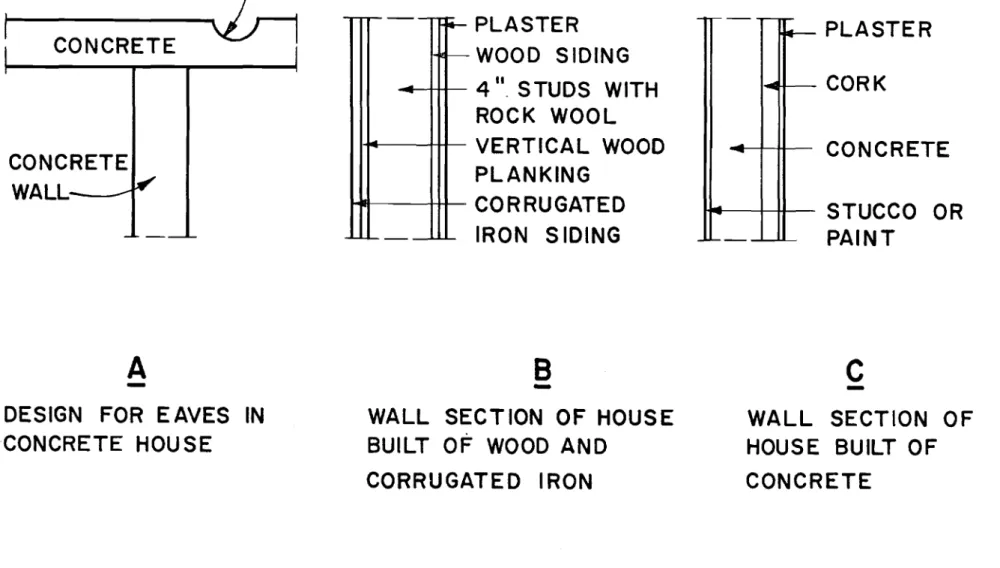
The main design for eaves in ooncrete houses is shown in
Fig. l3A. Moisture migrates through the concrete towards the eaves
causing cracking and spalling both in the overhang and the concrete wall.
14.
BUILDING DESIGNIceland has a variable climate with the possibility of frost,
rain, thaw, snow and hot sun in rapid order. As a result, rain
penetration and masonry deterioration are serious problems. The
strong winds often oause rain to penetrate through to the point where sills and curtains are wet.
Although there have been no serious earthquakes in recent years, they are taken into account in design beoause they can happen
at any time. Reinforoed ooncrete has been the most oommonly used
material in Reykjavik since 1915 and is now being used in their tremendous building program, giving the city a characteristically
integrated appearance. As the old houses and shops of wood and
corrugated iron are cleared away, concrete ones will replace them. Among the first of the new public buildings to be erected in the present "new era of bUilding" were the National Theatre started in 1928 and the National University completed in 1940. These represented the beginning of an autoohthonous Ioelandic arohiteoture.
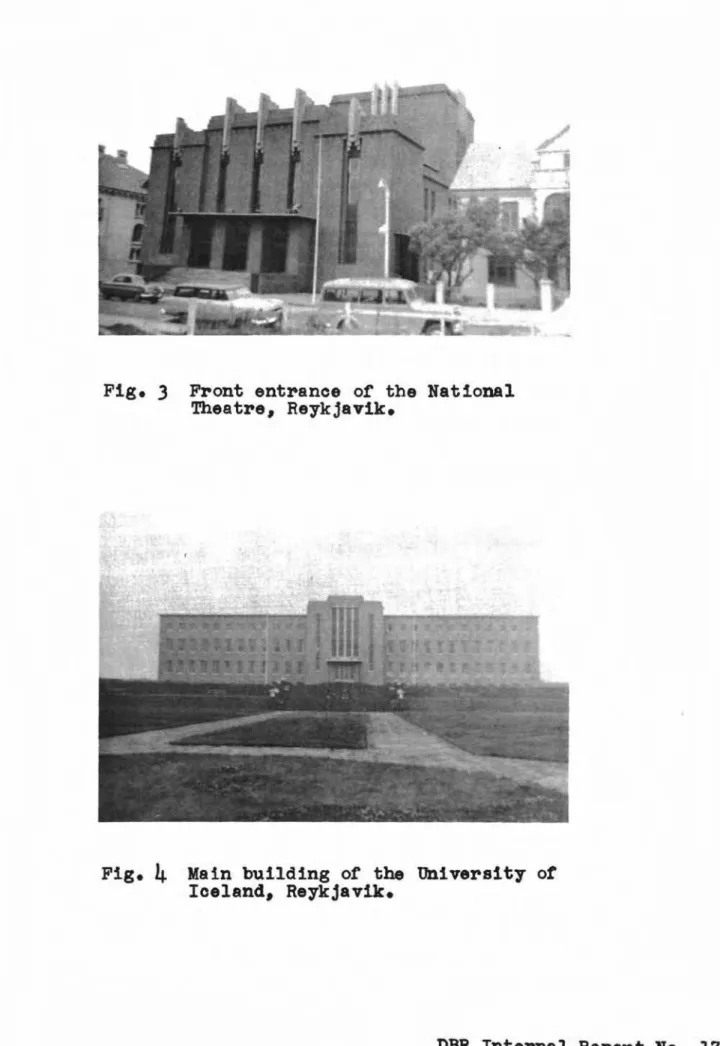
The Theatre (Fig. 3) is of reinforced concrete designed by the state Architect, the late Prof. G. Samue1sson, who was
experi-menting with this material. The design incorporates a necessary
and usually awkward gridiron as part of a strong funotional design. The auditorium seats 700 and is without windows but is surrounded by
- 15
MThe lobby is finished in polished spar found only in
Iceland and rapidly becoming unobtainable; it reflects and refracts light and lends itself to hard surfaces end sharp detail.
The University (Fig.
4)
has a concrete exterior anddolerite is used inside. This native grey stone is cut into squares
for the floor of the entranoe hall. Expanses of glass brick are
used in the many windowed wings. There is a large square skylight
of double Iceland spar. The convocation room is finished in white
birch.
Four other buildings that are built along the same severe
lines are the Gardur Hotel, the National Museum of Natural History,
the Seaman's School and the City Hospital.
15.
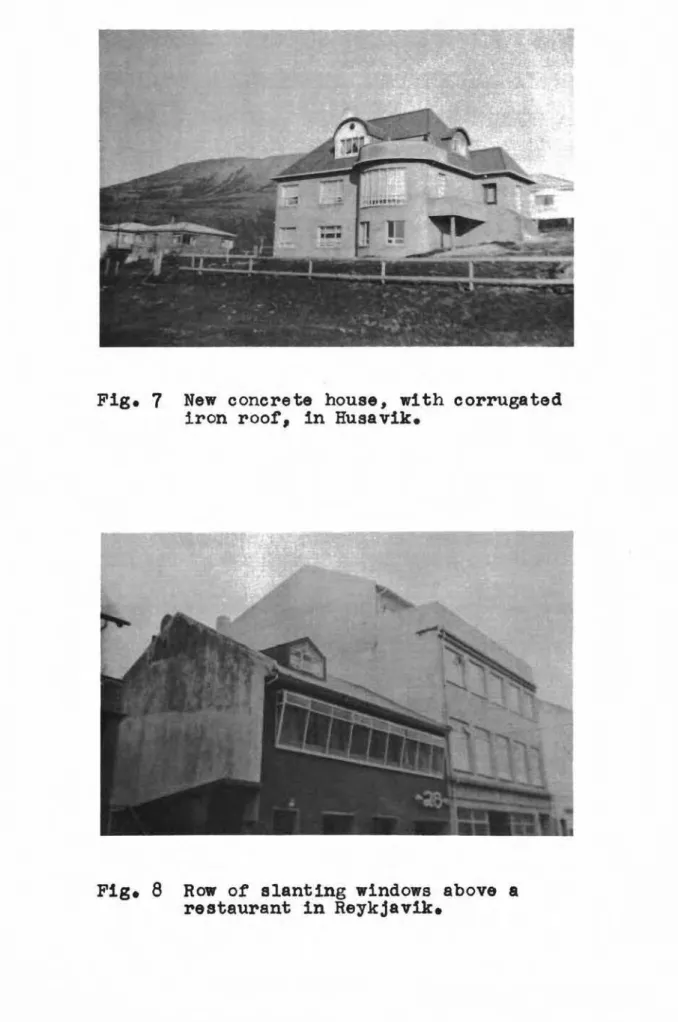
HOUSE DESIGNTypical of the evolution in house design and materials in Iceland is the pattern of development in Husavik, a settlement on
the north coast (Frontispiece). Prior to 1920, the houses were
exolusively frame (Fig.
5).
During the 1920's, it was the practiceto place corrugated iron siding over wood (Fig.
6).
Concrete wasused almost exolusively after 1930 (Fig.
7).
Foundation walls aregenerally ten inches thick and the superstructure walls eight inohes.
An example of a typical wall section of
a
house built of wood andcorrugated iron is shown in Fig. l3B, and a typical section of a
house built of concrete is shown in Fig. l3C.
Corrugated iron is used almost exclusively as roofing
material; asphalt shingles and tiles are rarely used (Figs. 6 and
7).
The roofs are always painted to prevent salt corrosion of the metal. Paint used outside on roofs and ualls is SUbject to severe blistering and chipping resulting in the need for a new coat every few years.
Paint is often used now rather than stucco on wall exteriors.
Wall-paper is scarce and the interior walls are usually painted. Vapour
barriers are not used in housos because of lack of experience with
them and also their high cost. The claim was made, however, that
there 1s little trouble with condensation.
Many windows are used and they are large, with every
advantage being taken of the southern exposure. Windows are
located mostly on the south and east sides of houses and apartments. Most windows are neither sash nor casement but are built solidly
into the wall with only one movable pane which can be loosened for
ventllation. Another interesting innovation in windowB can be seen
in Fig.
8,
which shows a row of slanting windows and a window inin Iceland have basements. For any basementless building founded on a flat slab, the soil is excavated to a depth of a few feet and crushed volcanic scoria is used as backfill.
At Grenjadarstadur (Frontispieoe) in the north, is the site
of one of the few remaining old Icelandio farms. This partioular
farm is one hundred years old. The roof has five peaks (to simulate
the mountain peaks). Eaoh of the five sections is separated by a
wall of lava blocks with peat insulation. The various rooms are
connected by dark passages. Farm houses are built of concrete now
but old sheep barns of turf and stones are still being used. Soil
is piled up on the north sides of these bUildings to prOVide extra protection against the wind.
16.
builセing SERVICES(8) Heatina
Fifty per cent of the buildings in Reykjavik are beated with hot water from the thermal springs at Reykir located 12 miles from
the city. The remaining buildings use oil which must be imported
and is very expensive. Eventually, the entire City of Reykjavik will
be heated with hot water. Peat is still'used for fuel in some rural
areas.
(b) iョウオャ。エゥセ
tセ・ present regulation is that heat loss must not exceed
1.0 callm Isec but this was considered too lenient for wall panels. It is hoped that this amount can be reduced to 0.7.
Insulation materials include cork, pumioe and rock wool.
Foam plastic is being introduced as an insulating material. There
1s a factory in Iceland which manufactures inSUlating slabs of
pumice stone to line the inside of concrete houses. Unlike American
cinder blocks, pumice cannot be used in exterior construction. (c) Sewage
There are no treatment plants in Iceland. Even in Reykjavik
the raw effluent is dumped into the sea. 17. UTILIZATION OF HOT SPRINGS
Reykjavik has a municipally-owned hot water distribution system for heating a large number of its buildings, utilizing the hot springs ooourring at Reykir and Reykjahlid (Frontispieoe),
17
-villages about 11 and 12 and a half miles from Reykjavik respeotively.
In 1930, a small hot-water distribution plant was built two miles .
from Reykjavik. This was used to heat the state Hospital, a large
public school, a swimming pool and between forty and fifty houses. It is still in use but is overshadowed by a larger one begun in
1939 and completed in 1943. In the early 1930ls, the oity bought the
rights to all the thermal springs within ten miles for 150,000 kronur
(present rate of exchange ia 16 kronur
=
$1.00 but the 1930 exohangeis not known).
The holes drilled at Reykir numbered
46,
at Reykjahlid 25 andnearer to Reykjavik 29. The average depth of the borings is 1,000
tt and the deepest is 2,500 ft, varying from 4 to 9 in. in diameter. The average temperature of the water in the holes is 190°F, varying
from 180°F to 210°F. The total yield of water trom the 71 holes
in the Reykir-Reykjah1id area is about 5,280 imperial gallons per minute.
The water flows from the borings under its own pressure and
is piped to pumping stations at Reykir and Reykjahlid. The water
from the Reykjahlid pumping station is sent through a 10-in. pipe over a ridge to Reykir where the water from both areas is gathered. The Reykjahlid station whioh has two eleotrioal pumping units, is partly automatio and partly remote controlled from the main pumping
station at Reykir. This station has three electrio pumping units.
Eaoh pump has a 300-hp motor and delivers 1,980 imperial gallons
per minute. There is also a reserve power station at Reykir equipped
with a QLPUセィー diesel engine and a 860-KVA generator.
The hot water is pumped fram Reykir west to Reykjavik through
two l4-in. steel pipes in a ooncrete duot. The pipes are lagged and
covered with pitoh and paoked in moss and soil (Fig. 10). There
are double expansion joints every 1,335 ft to allow for temperature ohanges and three stations where one pipe oan be cut off for repairs
leaving the other to oarry water. This pipeline delivers water at
the rate of 4,620 imperial gallons per minute to eight ooncrete
storage tanks standing on a hill at the edge of the oity. This is
augmented by looal borings delivering water at the rate of 800
imperial gallons per minute. The aggregate volume of the tanks i8
2,184,000 imperial gallons which is about one-quarter of the maximum
daily oonsumption. The function of these tanks is to equalize the
pressure throughout the oity and the flow throughout the day. The looation of the tanks above the city permits gravity
flow to the street-mains and house oonnections. In oase of maximum
oonsumption, a booster pumping station built in the line oan be
utilized to inorease the pressure by two atmospheres. This pumping
station, whioh is situated just below the tanks is automatioally oontrolled by a manometer in the city.
The thirty miles of street-mains vary from 1 to
18
in. indiameter. The total length of the house connections is about
twenty miles and these pipes vary fram
3/4
to 2 1/2 in. in diameter.The mineral content of the water is so low that it is piped directly
into the heating systems of the houses. There it cools and leaves
the houses through the drainage pipes. Some of the water is used
for washing and bathing, etc.
All the pipes are well insulated to maintain high water
temperatures. The main line from the storage tanks is in a conorete
duct above ground and insulated with special turf mats. The
street-maina are laid three ft below the ground surface in concrete ducts
which are insulated with porous lava slag. Glass-wool is used for
the house oonnections.
The degree of cooling of the temperature of the water fram
source to consumer varies throughout the year. During the winter,
the temperature drop from the Reykir pumping station to the storage
tanks is only about 5°F. From the tanks to the furthest house in
the oity, the cooling is somewhat more because of the lower velooity
and volume. Nevertheless, the temperature of the water in the houses
is 167°F to 175°F and higher. Sixty thousand tons of ooal, which
would have to be imported, are saved per year by using water from the hot springs, as well as making Reykjavik a smokeless city.
When the system was first installed, it heated
84
per centof the city buildings. The city has grown so qUickly that the
percentage has dropped considerably but it is being enlarged
continually. Four thousand houses are now heated by the system and
three hundred new houses will be connected to it in 1959.
Reykjavik has the oldest and largest distriot hot water
heating systenl in Iceland. There are four others in the country
now with plans for additional ones where there is subsurface thermal activity.
At Hveravellir, (meaning "place of hot springs"), in the north of Ioeland, there are geysers, one of which erupts two or
three times per day. Two farms in the distriot use the boiling
water for heating (Fig. 11). There is a plan to pipe it ten miles
northward to Husavik and the farms along the route of the proposed
pipeline will also use it. There are several greenhouses at
Hveravellir in whioh cabbages, tomatoes, cucumbers and grapes are
grown. Ioeland grows enough greenhouse tomatoes to satisfy her
own needs. In the south, oranges, bananas and coffee are grown in
greenhouses on an experimental basis.
At Hveragerdi, twenty-nine miles from Reykjavik, there are
acres of greenhouses in キィゥセィ various sorts of vegetables and
fruits are grown. Recent drilling here has released a steam which
- 19 ..
18. BUILDING CODES AND TOWN PLANNING
m
jZゥeykjavAセThere is no national building code in Iceland but each
municipality, including Reykjavik, has its ovm regulations. The
bUilding laws in Reykjavik are strict. Eaoh plan must be ohecked
by the Building Committee with regard to appearance, height, and distanoe from the street, in relation to the town planning soheme. The drawings must be passed by the City Engineer and a building
inspeotor must supervise construction. The site of Reykjavik is
restricted on the landward side by another municipality which has
a different code. The planned amalgamation will produoe the
problem of obtaining uniformity.
Iceland was the first Scandinavian country to adopt
precise legislation for town planning and its execution. The
act was passed in
1921.
One clause of the zoning by-law statesthat no wooden buildings are allowed within the city limits, although there are no restrictions outside the city.
The bUilt-up area in ReykjaVik has increased threefold sinoe
1945.
As the population increases the green areas within the citylimits will be built up. The present airport will be abandoned
because it is too near the city. There is a plan to build another
airport near the city but many people insist that the oity should
use Keflavik, the NATO air base thirty-one miles away. In this
event, the road to ReykjaVik would have to be paved.
In Reykjavik, housing is very oritical. Although new
apartments are going up very quickly, the demand still far exoeeds
the supply. As in Sweden, many people own their own apartments.
Figure
9
shows an apartment building that is typioal in design tomany that have been erected in reoent years. In
1958,
constructionwas begun on a new エケセ・ of apartment building, or vertical multiple
housing unit (Fig.
12).
These units are built with gliding mouldsand work is done twenty-four hours per day. In May and June of
1958,
one such struoture was erected at the rate of twelve storiesin seventeen days. Much critioism has been levelled against these
"Skyscrapers" (so called beoause they are the highest buildings in
the oountry) beoause they interrupt the skyline. They do appear
to be the answer, however, to the oritical shortage of accommodation, as the population of Reykjavik is growing at a rapid rate.
The Icelandic Produotivity and Technioal Assistance Centre
reports that
35
per cent of Ioeland's total bUdget is used inconstruction - a very high figure of whioh the Icelanders are not
proud. An average house in Reykjavik oosts from $8,500 to $14,000.
A five-room apartment costs about $11,000 to buy. The cost of
bUilding is high, averaging 1.000 kronur per cubio metre (about
$60.00 under the present offioial rate of exchange). All steel,
The following ッッュ「ゥィセエゥッョ of oiroumstances will give the
City of Reykjavik peculiar characteristics: a cultural background
unbroken for over one thousand years; almost no architectural tradition or landmarks to influence modern ideas; climatic and seismio oonditions neoessitating buildings of great strength; the eventual heating of all Reykjavik by hot water making it absolutely smokeless.
19.
BUILDING PRACTICEIn
1944,
one-third of all compulsorily insured industrialwork in Iceland was in conneotion with oonstruotion undertakings
and house building
(6).
A little more than one-third of this wasabsorbed by the building trade and various handicrafts oonneoted
with building or the repair of houses, such as masonry work, painting,
fitting of pipes, and eleotrical installations. These trades were
of little importance until towns and Villages began to arise, but since the olose of the nineteenth century, their growth bas been
strong and steady. However, much more labour is absorbed by other
kinds of work, espeoially road and street construction, laying of water works, the hot water supply of Reykjavik, and oonstruction of harbours and piers.
There is an Industrial Counoil in every town composed of eleoted representatives for various industries to look after the
interests of local trades and be their spokesman when needed. In
1932
"The Federation of Ioelandic Artisans" was created, having a membership of all those who are engaged in trades and industries. The work of the Federation is to promote Icelandic industrialenter-prise and trade, to represent them and the members there, and be
the leader and guiding spirit in industrial matters of the nation.
For this purpose, the representatives for various trades and industries meet together every two years.
In Iceland there are co-operative building societies to which the State Building Fund grants loans for oonstruction to
their members. Loans are granted on first and second mortgages
and may add to
85
per cent of the total value of the building underspecial circumstances; they are redeemable in
42
years withamortiza-tion and interest at 4 per cent. The first block of houses under
this act was built near Reykjavik in
1932
and the number hasincreased steadily sinoe then. 20. ROADS
Iceland bas the highest mileage of roads per oapita of the
Scandinavian countries. So muoh of the annual allotment for roads
is used for maintenance that none remains for paving. The equipment
21
-base at Keflavik. There are few spare parts. The main streets of
Reykjavik and Akureyri are paved but the side streets and the roads
between towns are unpaved. Gravel, oonsisting of vo1oanio material
suoh as pundoe, ash, breooias, tuffs and soorias, is used as grade. Frost damage to roads is severe; frost penetrates to depths
varying from
50
to100
oentimetres during the winter. In the spring,the roads are unusable. Some break-up of the pavement oocurs in
Reykjavik and Akureyri. Rain and traffio are also oauses of
deterioration.
Sinoe
1940,
there has been an extensive 「イゥセM「オゥQ、ゥョァprogram. A new oonorete suspension bridge was built in
1944
aoross one of the larger rivers in Ioe1and. The ooncrete anchoring
piers of this bridge show some cracking and spa11ing from frost aotion.
1.
2.
3.
6.
REFERENCES
Icelandio Productivity and Technical Assistance Centre. "IdnadarDlal", Vol. 5, No.3, 1958. (In Icelandio with English translation of the Table of Contents).
Icelandic Productivity and Teohnical Assistanoe Centre. "Regulations for Isnadatmalastofnun Islands", Ministry of Industries, Reykjavik, May 29, 1957.
Thorarinsson, Sigurdur. "Anchored stone Pollgons at LoW' Levels within the Iceland Basalt Regions', Jokull, 3, Reykjavik, 1953, p. 37-38.
Thorarinsson, Sigurdur. "Notes on Patterned Ground in
Iceland with Particular Reference to the Icelandio 'FlaS''',
Miscellaneous Paper
N0.3,
Department of Geology andGeography, Museum of Natural History, Reykjavik. Reprinted from Geografiska AnnaleI' H. 3-4, 1951, p. 144-156.
Thorarinsson, Si§urdur. "The Thousand Years Struggle Against Ice and Fire , Misoellaneous Paper No.
14,
Department of Geology and Geography, Museum of Natural History, Reykjavik, 1956.Thorsteinsson, Thorsteinn, Editor (Director of the Statistical Bureau of Iceland). Iceland QYセL A Handbook Published on the Sixtieth Anniversary of Lan sbanki Islands (The National Bank of Iceland), Fourth Edition, (New edition will be
Fig. 1 "Thufur" or frost hummocks one to two feet high with grass oover near
Blondous.
Fig. 2
The
Ioelandic Produotivity and Teoh-nical Assistance Centre.Fig.
4
Main building of the University or Iceland, Reykjavik.Fig.
5
Frame house with stone-blook foundation built before 1920 inHusavik.
Fig.
6
Frame house with oorrugated iron siding and roof built in the 1920'8 in Husav1k.Fig.
8
Row of slanting windows above a restaurant in Reykjavik.Fig.
9
A new apartment building in Reykjavik with individual wings built diagonallyso that two sides will faoe south.
Fig. 10 Conorete duot carrying hot water fram
Reykir to Reykjavik (note expansion joints in the foreground).
and greenhouses.
Fig. 12 An apartment building in
Reykjavik built with gliding moulds.
EAVES
I
NIセ
CONCRETE
WALL-A
-ror-- - ---rRi-
PL A STE R
I -
WOOD SIDING
... III
4
II.STUDS WITH
ROCK WOOL
-
...
VERTICAL WOOD
PLANKING
I.... III
CORRUGATED
..LL.L. - ----LJ.L
IRON SIDING
B
-セMM .-- セ セ..
-PLASTER
CORK
CONCRETE
STUCCO OR
PAINT
c
-DESIGN FOR E AVES IN
CONCRETE HOUSE
WALL SECTION OF HOUSE
BUILT OF WOOD AND
CORRUGATED IRON
WALL SECTION OF
HOUSE BUILT OF
CONCRETE
FIGURE 13
TYPICAL HOUSE
SECTIONS
CONTACTS
1. Isnadatmalastofnun Islands ("Icelandio Produotivity and Teohnical Assistance Centre" - shortened to "Teolmical College Building"), Reykjavik.
(8)
Mr.
Sveinn Bjornsson, Managing Director, civil engineer, undergraduate training at University of Iceland, graduate work at Illinois Institute of Technology, Chioago.(b)
Mr.
Jon Brynjolfsson, mechanical engineer, training at University of Copenhagen. One of six members on Building Council in Ioeland, he represents the Technical College Building.(0) Mr. Loftur Loftsson, chemical engineer, training at MoGill University and M.I.T., directs teohnical assistance work to industry.
(d)
Mr.
Gudmundur H. Gardarsson, eoonomist, training atUniversity of Iceland and Kiel University, Germany, offioe manager oonoerned with retail distribution of building materials.
2. Department of Industrial Testing and Research, University Research Institute, Reykjavik.
(a)
3.
(a) (b) (0 )
Mr. Raraldur Asgeirsson, civil engineer, graduate of University of Illinois, head of the concrete research laboratory.
Ioelandio Shell Oil Company
Mr.
R.F. Hallgrimsson, DireotorMr.
Isak Slgurgeirsson, Public Relations OffioerMr. I.F. Hallgrimsson, Eastern Representative (resident in Eskifjordur)
4.
Department of Geology and Geography, Museum of Natural History, ReykjaVik.(a) Dr. Sigurdur Thorarinsson, glaoial and volcanic geologist, seoretary of Iceland gセ。ッゥッャッァゥッ。ャ Society.
A-2
5.
Department of Highways, Maintenanoe Division, Reykjavik.(a) Brother-in-law of Mr. Bjornsson, mechanical engineer just
returned to Reykjavik from Woroester Polyteohnical Institute, Massaohusetts.
6.
District Heating System, ReykjaVik.ITINERARY
Saturday, 30 August
1258
The writer left Glasgow at
8:45
p.m., British Summer Timeon Icelandair, and arrived in Reykjavik at
10:45
p.m., Ioelandtime (which is one hour behind British time). At the airport to
meet him were Mr. Sveinn Bjornsson, Managing Director,
Isnadat-malastofnun Islands (Icelandic Productivity and Technical Assistance
Centre) and エセN Isak Sigurgeirsson, Publio Relations Officer,
Icelandic Shell Oil Company and representing the President and Managing Director of the same company, Mr. H.F. clallgrimsson (the latter is also the Honorary Canadian Consul General in Reykjavik).
Aocommodation was provided at the Gardur Hotel in Reykjavik; this building is actually a university residence for men and women
which is used as a hotel for tourists fram
4
June to29
September.Sunday, 31 August
19$8
The morning was spent walking around Reykjavik looking at
the following sites: the National Bank,' Telegraph and Telephone
Exchange, House of Althing (Parliament), Lutheran Cathedral (Domkirch), Statue of Ingolfur Arnarsson who was the first colonist in Ioeland
in
874
A.D., National Library and Archives, and the National Theatre.In the afternoon, a visit was made by bus to Thingvellir
(ItPl a i n of Par-Lf.amerrt "}; 31 miles from Reykjavik (See Section
4
(b».Monday,
1
September19$8
At
10:00
a.m., Mr. Sveinn Bjornsson called for the writerat the Gardur Hotel and took him to his office. The morning was
spent discussing building in Iceland, meeting the staff, and in
disoussion with one of his offioers, Mr. Jon Brynjolfsson.
The early part of the afternoon was spent in writing up
notes. At
5:35
p.m., the writer left Reykjavik by plane forEgilsstadlr,
250
miles to the northeast and arrived at7:05
p.m.(Frontispieoe). Mr. I.F. Hallgrimsson, Eastern Representative of
the Icelandio Shell
011
Company met him and they drove along theeast shore of Lagarfljot (lake) to the Government Forest Experimental Station at Hallormsstadur (See Section 11 (c)).
B-2
Tuesday, 2 September 19$8
At 9:30 a.m., the writer left Egilsstadir by taxi, crossing the longest bridge in the country (300 metres) to the north end of
Lagarfljot and arrived at Reykjahlid on Lake Myvatn at
1:45
p.m.(Frontispiece). Mr. Sigurgeirsson and his wife met him and in the
afternoon they drove along the east ehore of Lake Myvatn to Gardur
to see various lava and volcanio formations. Accommodation was
provided for that night at the hotel in Rekjahlid.
Wednesday, 3 September 1958
The entire day was spent driving with the Sigurgeirssons to Akureyri (Frontispiece), stopping to see the following sights:
Dettifoss Waterfall (See Section 2 (f», Asbyrgi (See Section 11 (c»,
Hs1lbjarnarstadir (unconsolidated Pliocene deposits containing
layers of marine shells), Husavik (fishing port and herring plant),
Hveravellir (See Section
17),
Laxamyri (hydro power dam - see Section11
(d», Grenjadarstadur (an old Icelandic farm - see Section14).
Overnight accommodation was provided at a hotel in Akureyri.
In the morning, a visit was paid to Akureyri to see the outdoor heated swimming pool, public gardens and the new Lutheran
church. The remainder of the day was spent in driving back to
Reykjavik (Frontispiece).
Mr.
Brynjolfsson called at the hotel and took the writerto meet
Mr.
Asgeirsson. The morning and lunchtime were spentdLaoua aLng problems of concrete in Iceland and the writer was shown
through
Mr.
Asgelrsson's laboratories (See Section 13).At 2:00 p.m., Mr. Brynjolfsson took the writer to meet Dr.
Thorarinsson with whom an hour was spent discussing frozen ground
phenomena and other geological features in Iceland (See Section 2 (g». At 4:00 p.m., Mrs. Bjornsson drove the writer and Mr.
Brynjolfsson to Reykir to visit the Tuberculosis Rehabilitation
Sanitorium (See Section 11) and the pumping station which pumps
In the evening, the Bjoranssons entertained at their home where the writer met Mr. Bjoransson's brother-in-law, a mechanical engineer with the Highways Department; various highway problems in Iceland were discussed (See Section 20).
Saturdal'
6
Se£tember l22§The morning was spent sightseeing in Reykjavik. In the
afternoon, the writer made a walking tour to inspeot the various building developments in Reykjavik, taking notes and photographs.
Sundel,
7
SeEtember1258
The writer left Reykjavik at