Continuous representations and models
from random walk diffusion limits
JU
12
2015
by
LIBRARIES
Tatsunori B. Hashimoto
RCIHIVES
Submitted to the Department of Electrical Engineering and Computer
Science
in partial fulfillment of the requirements for the degree of
Doctor of Philosophy
at the
MASSACHUSETTS INSTITUTE OF TECHNOLOGY
June 2016
@
Massachusetts Institute of Technology 2016. All rights reserved.
Signature redacted
A u th o r ...
Department of ElectricA Engineor4Rg and Computer Science
Signature redacted
May 3, 2016
C ertified by ...
Tommi S. Jaakkola
/N
Professor
Sig
nature redacted
Thesis Supervisor
Certified by...
David K. Gifford
Professor
Thesis Supervisor
Accepted by...Signature
redacted..
'
L4WliJA.
Kolodziejski
MASSACHUSETTS INSTITUTE Of TECHNOLOGY
Continuous representations and models
from random walk diffusion limits
by
Tatsunori B. Hashimoto
Submitted to the Department of Electrical Engineering and Computer Science on May 3, 2016, in partial fulfillment of the
requirements for the degree of Doctor of Philosophy
Abstract
Structured data such as sequences and networks pose substantial difficulty for tradi-tional statistical theory which has focused on data drawn independently from a vector space. A popular and empirically effective technique for dealing with such data is to map elements of the data to a vector space and to operate over the embedding as a summary statistic. Such a vector representation of discrete objects is known as a 'continuous representation'. Continuous space models of words, objects, and signals have become ubiquitous tools for learning rich representations of data, from natural language processing to computer vision. Even in cases that the embedding is not explicit, many algorithms operate over similarity measures which implicitly embed the original dataset. In this thesis, we attempt to understand the intuition behind continuous representations. Can we construct a general theory of continuous representations? Are there general principles for semantically meaninguful represen-tations?
In order to answer these questions, we develop a framework for analyzing con-tinuous representations through diffusion limits of random walks. We show that measureable quantities of discrete random walks with a latent metric structure have closed form diffusion limits. These diffusion limits allow us to approximate attributes of the discrete random walk such as the stationary distribution, hitting time, or co-occurrence using closed-form expressions from diffusions. We establish limits which guarantee asymptotic consistency of such estimators, and show they work well in practice.
Using this new approach, we solve three classes of problems: first, we derive prin-cipled network algorithms which connect statistical estimation tasks such as density estimation to network algorithms such as PageRank. Next, we demonstrate that con-tinuous representations of words are a type of random walk metric estimator with
close connections to manifold learning. Finally, we apply our theory to single-cell
RNA seq data, and derive a way to learn time-series models without trajectories by
using stochastic recurrent neural networks.
Thesis Supervisor: Tommi S. Jaakkola
Title: Professor
Thesis Supervisor: David K. Gifford
Title: Professor
Acknowledgments
This thesis and my PhD were made possible only through the contributions of many
mentors, colleagues and friends.
I am fortunate to have had two incredible advisors: Tommi Jaakkola and David
Gifford who pushed me to be rigorous and productive in my research. Dave and
Tommi's patience with my ever-changing research directions allowed me to explore
a wide-variety of research problems related to machine learning and biology, only
a small part of which is included in this thesis. I'm also thankful for their role in
my development as a researcher: Dave, for pushing me to be more productive and
work on biologically relevant problems, and Tommi for demanding both rigor and
real-world impact in my work.
I'm also thankful for my third thesis commitee member and undergraduate
advi-sor, Edoardo Airoldi, who provided substantial encouragement for going into a PhD
program, as well as valuable feedback on the thesis document.
Most of the content in the thesis would not have been possible without my
co-authors and friends: Yi Sun and David Alvarez-Melis. Yi has been a great friend
and roommate for many years and his combination of mathematical rigor and
un-derstanding of probability theory was invaluable to much of the work in this thesis.
Without him, I would not have known about several key results such as the
Stroock-Varadhan lemma. David was invaluable to the work in chapter 4, which required
combining graph limits with natural language processing (NLP). David's knowledge
of the NLP and psychometric literature elevated the work from a simple theoretical
exercise to a genuinely useful paper on word embeddings.
My co-authors for several computational biology papers not included in this
the-sis were also invaluable to my development as a PhD student: Richard Sherwood,
who was the biological mastermind behind assay development, has been a great
col-laborator who is patient enough to explain the basic biology and cares about the
underlying statistics. Rich was the best biological collaborator I could have hoped
for. Matthew Edwards, who always seriously discussed my half-baked ideas, has
been a great friend and made the lab a fun place to be, especially with his barbeque.
Daniel Kang, who was the first undergraduate I supervised, surprised me by
learn-ing the material so quickly and was the best programmer I've had the pleasure of
working with.
The entire Gifford and Jaakkola labs made PhD an enjoyable time, and I'm
espe-cially thankful for those members who I've pestered (Jonas, Logan), who organized
lab activities (Matt, Haoyang), and those who would come play boardgames or go
to the muddy charles when research progress was slow (pretty much everyone).
Finally, I'd like to thank my parents without whom I (literally) would not be
here, and my fiancee Victoria Hung. My parents for encouraging me to go into PhD
rather than industry, and making my time at MIT as stress-free as can be. Vicky
has been an essential part of my life these five years, complementing and correcting
for my many faults. I'm so lucky to have found such a kind, skilled scientist for a
partner. PhD wasn't so hard when it was with you.
Contents
Nomenclature 17
1 Introduction and background 19
1.1 Introduction . . . . 19
1.1.1 Graph vertex embeddings . . . . 20
1.1.2 Word embeddings . . . . 22
1.1.3 Recurrent networks as diffusions . . . . 23
1.1.4 Prior publication . . . . 24
2 Density estimation on metric graphs 25 2.1 Relation to prior work . . . . 26
2.2 Main results and proof outline . . . . 27
2.2.1 Problem setup . . . . 27
2.2.2 Statement of results . . . . 28
2.2.3 Outline of approach . . . . 29
2.3 Convergence of the simple random walk to an It6 process . . . . 30
2.4 Convergence and computation of the stationary distribution . . . . . 33
2.4.1 Graphs satisfying condition (*) . . . . 33
2.4.2 Extension to general metric graphs . . . . 35
2.5 Distance recovery via shortest paths . . . . 36
2.6 Em pirical results . . . . 37
2.7 Conclusions . . . . 40
3 Metric recovery on graphs 43 3.1 Continuum limits of random walks on networks . . . . 45
3.1.1 Definition of a metric graph . . . . 45
3.1.2 Continuum limit of the random walk . . . . 46
3.2 Degeneracy of expected hitting times in networks . . . . 47
3.2.2
Expected hitting times degenerate to the stationary distribution 48
3.3 The Laplace transformed hitting time (LTHT)
.
. . .
3.3.1
Consistency . . . .
3.3.2
B ias . . . .
3.3.3
Robustness . . . .
3.4 Link prediction tasks . . . .
3.5 Conclusion . . . .
4 Word embeddings as metric recovery
4.1 Introduction . . . .
4.2 Word vectors and semantic spaces . . . .
4.3 The semantic space of log co-occurrences . . . .
4.4 Semantic spaces and manifolds . . . .
4.5 Recovering semantic distances with word embeddings
4.5.1
Word embeddings as metric recovery . . . . .
4.5.2
Metric regression from log co-occurrences . . .
4.6 Empirical validation . . . .
4.6.1
Datasets . . . .
4.6.2
Results on inductive reasoning tasks . . . . .
4.6.3
Word embeddings can embed manifolds
.
. . .
4.7 D iscussion . . . .
5 Population-level estimation of diffusion processes
5.1 M otivation . . . .
5.2 Prior work . . . .
5.2.1
Population level inference . . . .
5.2.2
Diffusive RNNs . . . .
5.2.3
Computational biology . . . .
5.3 Population-level behavior of diffusions . . . .
5.4 Recoverability of the potential
. . . .
5.4.1
Stationary observations . . . .
5.4.2
Many time observations . . . .
5.4.3
Few time observations . . . .
5.5 Inference . . . .
5.5.1
Loss function and regularization . . . .
5.5.2
Diffusions as a recurrent network . . . .
5.5.3
Optimization . . . .
5.6 R esults . . . .
51
52
55
57
59
60
61
62
64
65
67
69
69
71
73
73
74
75
76
77
77
79
79
80
80
81
82
83
84
85
88
88
90
90
91
5.6.1 Effectiveness of the stationary pre-training 5.6.2 Learning high dimensional flows . . . .
5.6.3 Analysis of Single-cell RNA-seq . . . . 5.7 D iscussion . . . .
6 Open problems and future work
6.1 Robustness of embeddings to non-metric data . . . .
6.2 Equicontinuity as an open conjecture . . . .
6.3 Finding further generalizations of continuous embeddings as relaxations
A Density estimation
A. 1 Conjecture on eventual uniform equicontinuity of the rescaled
station-95
95 96 9799
ary distribution . . . .A.2 Full proof of Theorem 2.2.1 . . . .
A.2.1 Definition of the objects . . . .
A.2.2 Quantities used in the Stroock-Varadhan criterion A.2.3 Statement of the Stroock-Varadhan criterion . . .
A.2.4 Verification of the Stroock-Varadhan conditions .
A.2.5 Completing the proof of Theorem A.2.1 . . . .
A.3 Generalizing to metric graphs . . . .
A.4 Recovery of distances via ball-radii . . . . A.4.1 Outline of proof approach . . . . A.4.2 The case of exact knowledge of e.. . . . .
A.4.3 The case of stochastic estimates of E . . . ..
B Metric estimation
B.1 Uniform equicontinuity of the marginals . . . . B.2 Hitting tim es . . . . B.2.1 Typical hitting times are large . . . . B.2.2 Exponential mixing on metric graphs . . . .
. . . . 99 . . . 100 . . . 101 . . . 102 . . . 103 . . . 106 . . . 109 .. ... 111 . . . 115 . . . 115 . . . 115 . . . 117
121
. . . 121 . . . 123 . . . 123 . . . 127B.2.3 Expected hitting times degenerate to the stationary distribution129 B.2.4 The case of one dimension . . . 134
B.3 Computing the LTHT . . . 137
B.4 Reweighting the random walk . . . 138
B.4.1 General construction and application to Brownian motion . . 138
B.4.2 Technical moment estimates . . . 139
B.5 Consistency at / =
w(log(gn))
via shortest paths . . . 143B.6 Consistency of LTHT . . . 144
B.6.1 LTHT of the Brownian motion . . . 144
. . . . . 92
. . . . . 92
. . . . . 93
B.6.2 Proof of Corollary 3.3.3 . . . 145
B.6.3 Proof of Theorem 3.3.4 . . . 148
B.7 1-D bias calculation . . . 155
B.8 Basic noise resistance . . . 157
B.9 Resource allocation index . . . 160
B.9.1 RA index reduction . . . 160
B.9.2 RA index robustness . . . 161
C Word embeddings
165
C.1
Metric recovery from Markov processes on graphs and manifolds . . . 165C.2 Consistency proofs for word embedding . . . 168
C.3 Symmetry and windowing co-occurences . . . 173
C.4 Empirical evaluation details . . . .
...
. . . 176
C.4.1 Implementation details . . . 176
C.4.2 Word embedding corpora . . . 176
C.4.3 Datasets for semantic tasks . . . 177
C.4.4 Solving inductive reasoning tasks . . . 178
C.5 Full table of analogy results . . . 179
C.5.1 Top-30k vocabulary resctriction . . . 179
C.5.2 Top-100k vocabulary . . . 180
D Population level diffusion
185
D.O.1 Hypothesis test proof . . . 185
D.O.2 Boundary conditions for identifiability . . . 186
D.O.3 Details on parameters and methods . . . 188
D.O.4 Alternative methods . . . 188
List of Figures
1-1 An informal description of the convergence of random walks to dif-fusions. In panel A) we have a simple random walk over a graph. In B), as the size of the graph (n) and the number of points in each neighborhood (k) grows we can jump anywhere within the ball. In
C), if we take many steps the sum of many independent jumps begins
to resemble a Gaussian limit. . . . ... . 22 2-1 Accuracy vs sample and neighborhood size. Path integral (green,
ma-roon) is from von Luxburg and Alamgir [2013]. Our estimator (red, blue, black) is nearly perfect at all sample sizes and neighborhood sizes. 33 2-2 Examples of four density estimates: our method (red) using no metric
information is indistinguishable from metric k-nearest neighbor (blue) and close to ground truth (black). Path integral estimator of von Luxburg and Alamgir [20131 (green) shows higher error in all cases. . 33
2-3 Estimate performance degrades in high dimensions due to over-smoothing
(blue and red), but the estimator is still highly accurate up to log con-centration parameter (black). . . . 35
2-4 Example isotropic metric graphs. Our estimator (black) agrees with the true density (red) in all cases. Degree and stationary distribution (green and maroon) based density estimates work for some cases (right two panels) but cannot work if the degree is tied to spatial location
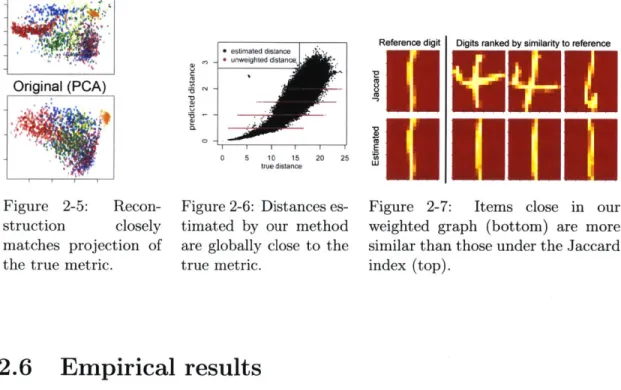
(left). . . . . 35 2-5 Reconstruction closely matches projection of the true metric. . . . . . 37 2-6 Distances estimated by our method are globally close to the true metric. 37 2-7 Items close in our weighted graph (bottom) are more similar than
those under the Jaccard index (top). . . . . 37 2-8 Density estimates in the graph correlate well with sales rank, unlike
2-9 Embeddings from estimated distances recover the separation between
different product categories. . . . .
39
3-1 Estimated distance from orange starting point on a k-nearest neighbor
graph constructed on two clusters. A and B show degeneracy of hitting
times (Theorem 3.2.5). C, D, and E show that log-LTHT interpolate
between hitting time and shortest path. . . . .
51
3-2 The LTHT recovered deleted edges most consistently on a citation
netw ork . . . .
59
3-3 The two-step LTHT (defined above Theorem 3.3.6) performs best at
word similarity estimation, outperforming even the basic log-LTHT
(one-step). . . . .
59
4-1 Inductive reasoning in semantic space proposed in Sternberg and
Gard-ner
[1983].
A, B, C are given, I is the ideal point and D are the choices.
The correct answer is shaded green. . . . .
62
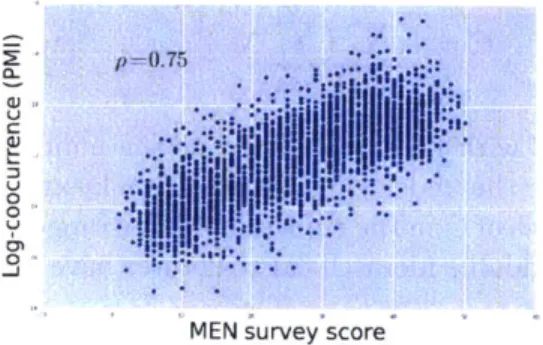
4-2 Normalized log co-occurrence (pointwise mutual information) linearly
correlates with human semantic similarity judgements (MEN survey).
65
4-3 Dimensionality reduction using word embedding and manifold
learn-ing. Performance is quantified by percentage of 5-nearest neighbors
sharing the same digit label. . . . .
76
5-1 In population-level inference we observe samples (colored points) drawn
from the process at different times. The goal is to infer the dynamics
(blue vectors). In this toy dataset each point can be thought of as a
single cell and the x and y axes as gene expression levels of two genes.
78
5-2 Stationary pre-training improves both runtime and goodness of fit
.89
5-3 RNN predictions are similar to the true dynamics on 50D data . . . 895-4 Example prediction of baselines on same data . . . .
89
5-5 Quadratic high dimensional flow . . . .
91
5-6 Styblinski flow in high dimensions . . . .
91
5-7 Gene expression (D4) . . . .
91
5-8 Held-out goodness of fit (lower is better), as measured by Wasserstein
distance. 'Oracle' represents the error from Monte Carlo sampling
for the true gradient flow. The RNN parametrization performs best
across a wide range of tasks. . . . .
91
5-9 DO and D7 distributions of Oct4 (y-axis) and Krt8 (x-axis) . . . .
91
5-10 Learned differentiation dynamics . . . .
91
5-12 Observed data and learned model for single-cell RNA-seq data . . . . 91
5-13 D4 predictions of Krt8 recapitulate bimodality . . . . 94 B-i Distance estimates for various values of /3 on re-weighted walks on a
simulated dataset . . . 141 B-2 Simple random walk is biased toward region with high density . . . . 142 B-3 Re-weighted walk diffuses evenly on the true metric . . . 142 B-4 Visualization of the marginal distribution Pij(t) of a random walk
over a k-nn graph on a Gaussian restricted to a disk, starting at the blue initial point and run for 40 steps. The re-weighted walk diffuses evenly from the starting point, ignoring biases due to density p and neighborhood size E. . . . 142
B-5 Distance estimates for various values of
/3
on re-weighted walks on a simulated dataset . . . 142 B-6 Modified LTHT rapidly converges to RA index. . . . 161B-7 Conditioning on t > 1 substantially outperforms naive LTHT. . . . . 161 D-1 5-gene model prediction of Krt8 also reproduces the underlying
bi-modality of the data . . . 189
D-2 Predicted marginal distributions of the top 5 differentiating genes at
day 4 . . . 190
D-3 Predicted marginal distributions of the top 10 differentiating genes at
day 4 . . . 191 D-4 Predicted against actual pairwise gene expression distributions at the
D4 timepoint. The RNN models the correlational structure of the true dynam ics. . . . 192
List of Tables
2.1 Top 4 clusters formed by mapping each item to its mode (first row). Each group is a coherent genre. . . . . 4.1 Examples of new inductive reasoning tasks from Sternberg and
Gard-ner [1983]. . . . ... . . . . 4.2 Semantic similarity data derived from multiple sources on multiple
tests show evidence for latent embeddings consistent with the GS model 4.3 Accuracies on Google, SAT analogies and on two new inductive
rea-soning tasks. . . . . 4.4 Semantic similarity alone can solve the Google analogy tasks . . . . .
C.1 glove corpus question coverage . . . .
C.2 wiki corpus question coverage . . . . C.3 w2v corpus question coverage . . . . C.4 wiki corpus analogy accuracy . . . . C.5 wiki corpus analogy accuracy for MSR and SAT datasets . C.6 wiki corpus for classification and sequence . . . . C.7 glove corpus analogy accuracy . . . . C.8 glove corpus analogy accuracy for MSR and SAT datasets C.9 glove corpus for classification and sequence . . . . C.10 w2v corpus analogy accuracy . . . . C.11 w2v corpus analogy accuracy for MSR and SAT datasets . C.12 w2v corpus for classification and sequence . . . . C.13 glove corpus question coverage . . . . C.14 wiki corpus question coverage . . . . C.15 w2v corpus question coverage . . . . C.16 wiki corpus analogy accuracy . . . . C.17 wiki corpus analogy accuracy for MSR and SAT datasets C.18 wiki corpus analogy accuracy for MSR and SAT datasets
. . . 179 . . . 179 . . . 179 . . . 179 . . . 179 . . . 180 . . . 180 . . . 180 . . . 180 . . . 180 . . . 181 . . . 181 . . . 181 . . . 181 . . . 181 . . . 181 . . . 182 . . . 182
39
6466
72 72C.19 wiki corpus for classification and sequence . . . 182
C.20 glove corpus analogy accuracy . . . 182
C.21 glove corpus analogy accuracy for MSR and SAT datasets . . . 182
C.22 glove corpus for classification and sequence . . . 183
C.23 w2v corpus analogy accuracy . . . 183
C.24 w2v corpus analogy accuracy for MSR and SAT datasets . . . 183
Nomenclature
Graphs
G, A unweighted, directed graph with n vertices
NBn(x) Out-neighbors of vertex x
NB'"(x) In-neighbors of vertex x
F(x) Limiting neighborhood radius of x (e.g. in the k-nn graph, this is (p(x)Vdn/k)l/d) en(x) Neighborhood radius of x (e.g. in the k-nn graph, this is thedistance to the
k-th nearest neighbor)
gn Scaling limit, the rate at which en(x) -÷ 0 as n -+ oo.
6
Estimatior for En(x)P Estimatior for the density p(x) based upon Gn
Other
Tr Trace of a matrix
Var, Cov Variance
/
covariancex of a random variableRandom walks
W(t) or Wt Brownian motion at time t
Xn(t) A discrete random walk over n objects at time t Y(t) A diffusion process at time t
7ry(x) Density of the stationary distribution of a random walk Y at position x
Tp, Discrete hitting time on a n vertex graph started at vertex xj and stopped at
Xi
Tk Hitting time started at x stopped at a domain E
t Rescaled time. As the graph grows large, neigbhorhoods shrink and so a single step in the random-walk moves ever smaller distances. t is re-scaled by g2 to prevent this from happenig (See entry for gn).
Spaces
Rd d-dimensional Euclidean space
D Closure of the domain
OD Boundary of the domain
D C Rd Compact, path-connected domain
D Skorokhod space (the space of right-continuous functions) X Set of discrete objects (vertices or words)
Z Integers
C Continuous functions
C([O,
T], Rd) Continuous functions mapping [0, T] -* RdChapter 1
Introduction and background
Discrete-time random walks lie at the heart of many domains in machine learning, ranging from graph algorithms to biological processes. This thesis unifies many algorithmic approaches for inference on random walks by approximating discrete-time and space random walks using diffusion processes. Much like how a random walk over a lattice converges to a Brownian motion, we exploit the fact that random walks over large domains behave as diffusions.
Many empirically effective random-walk based algorithms over discrete structures, such as the PageRank algorithm for graph vertex importance and word2vec for word embeddings are poorly understood from a statistical point of view. The diffusion process based techniques in this thesis develops connections between classical statis-tical ideas such as density estimation or manifold learning, and discrete algorithms such as PageRank and word embeddings. These connections allow us to understand new, empirically effective algorithms through the lens of parameter estimation for a well-specified metric model.
In this chapter, we will first introduce the ideas behind diffusion based random walk inference as well as the basic intuition for the diffusion limit. For now we will
focus on intuition and defer precise technical discussions to Chapter 2.
1.1
Introduction
Structured non-metric inputs such as DNA sequences, social networks and natu-ral language texts pose difficulties for traditional statistical and machine learning techniques which are designed to process real valued vectors. One approach for rig-orously analyzing such structured data has been to infer latent embeddings which
For example, if we are asked to determine the most important vertices of a social
network, we may first assign a vector to each vertex in the graph such that connected
vertices are close to each other, and then return the modes of the density of these
embedded vertices as important vertices.
However, these embedding methods have thus far been ad-hoc and domain
spe-cific. For example, the techniques for embedding networks [Alamgir and von Luxburg,
2011] and English words [Mikolov et al., 2013a] rely upon completely different
justifi-cations. We show that there is a straightforward, unified approach to understanding
and estimating latent metric structures by analyzing embeddings that exploit random
walk structure. These techniques are simple, widely applicable and answer several
open questions in nonparametric statistics and machine learning.
Conceptually, our work consists of three main ideas:
1. Random walks over discrete objects encode metric structure by frequently
tran-sitioning between more similar words or graph vertices.
2. Metric random walks over large spaces behave similarly to diffusion processes
which are simple to analyze
3. Many algorithms such as PageRank, or word2vec for word embeddings, can be
reduced to methods to infer properties of the underlying metric random walk.
We begin by analyzing the problem of performing density estimation given only
the undirected connectivity structure of a k-nearest neighbor graph, and use this to
develop the theory of diffusion process limits in Chapter 2. Having established a basic
framework for connecting random walks and diffusions, we solve the problem of fully
recovering a latent embedding from a geometric graph using weighted hitting times
in Chapter 3. Applying these methods to a practical machine-learning problem, we
show that word embeddings are a special type of scalable weighted graph embedding
in Chapter 4.
Finally, having established results for discrete random walks and their relationship
to diffusions, we show that a particular type of recurrent neural network naturally
generates diffusion processes. Using this connection we analyze a problem of
mod-eling the differentiation of embryonic stem cells using single-cell RNA-seq (Chapter
5).
1.1.1
Graph vertex embeddings
Many graph algorithms rely upon an implicit assumption of a metric graph, which
is a graph where latent attributes of a vertex determine its connectivity. For example,
a k-nearest neighbor graph is a type of metric graph, and finding similar vertices using the number of common neighbors attemps to recover latent vertex similarities.
One instance of such a metric assumption is the assumption that a simple random walk over the graph will frequently transition to similar vertices. For example, if our graph is the integer lattice, then a random walk will remain 'close' over short timespans. Our goal is to formalize the implicit metric assumption, and then to derive results under this assumption.
Informally, our metric assumption will be the following:
1. Each graph vertex is assigned a coordinate in a metric space
2. Graph vertices connects to neighbors that are sufficiently close
3. The graph is sufficiently large
The simplest example of such a metric graph is the integer lattice, where a vertex has a multidimensional integer coordinate, and is connected to neighbors within a distance of one. We will prove a surprising property of metric graphs: simple random walks on metric graphs converge to diffusion processes.
The convergence of a simple random walk over a lattice to a Brownian motion is a classic diffusion limit. For example, if Xi - Bernoulli(0.5) then S, = Er Xi is
the one-dimensional simple random walk after n steps, and as n grows this simple random walk behaves as a Brownian motion, n-1/2St, -+ W [Lawler and Limic,
2010, Chapter 3.1].
In the case of a general metric graph, a similar phenomenon holds. Figure 1-1 is an informal sketch of this convergence to a diffusion process for a k-nearest neighbor graph. As the graph grows large, the discrete-space and discrete-time random walk over a graph (Xe) resembles a continuous-space discrete time process Y (Figure 1-1, Panels A and B). After a time-rescaling which considers many discrete steps per unit time we obtain a Gaussian limit which turns our random walk into a diffusion process (Figure 1-1, Panels C and D).
A surprising result is that not only does this diffusion process limit exist under
very general conditions, we show that the limiting process can be written down in closed form and does not depend on the precise connectivity rules used to construct the graph (Theorem 2.3.3).
The main idea of our graph diffusion limit is that even though we do not observe the latent metric, the diffusion limit can reveal the underlying metric properties of the graph. For example, in Chapter 2 we show that the stationary distribution of a discrete random walk can be interpreted as a type of density estimation procedure over the latent metric of a graph, and in Chapter 3 we show tliat a exponentially
A.
'~~B
''C~
X - /
7
n,k -*oo aT-oo-E(X d (Y d E(Y*,)
Random walk on graph Neighborhood restricted jumps Drift-diffusion process
Figure 1-1: An informal description of the convergence of random walks to diffusions. In panel A) we have a simple random walk over a graph. In B), as the size of the graph (n) and the number of points in each neighborhood (k) grows we can jump anywhere within the ball. In C), if we take many steps the sum of many independent jumps begins to resemble a Gaussian limit.
weighted hitting time (termed the log-LTHT) can be used to robustly recover the latent metric structure of a graph.
1.1.2
Word embeddings
Word embeddings are a class of techniques which use the co-occurrence of words across a large text corpus in order to assign a vector representation to each word. Generally, word embedding methods ensure that frequently co-occurring words are close in the embedded space.
These simple un-supervised representations were found to capture surprising se-mantic structures such as analogical reasoning [Mikolov et al., 2013b]. For example, if we define the vector for the word 'man' as vec(man) and apply the following oper-ations: vec(king)-vec (man)+ vec(woman) ~vec(queen).
Word embeddings have been remarkably useful across NLP tasks but remain poorly understood. The main approach to understanding the semantic properties of word embeddings have been to examine the properties of text corpora, which has lead to a very narrow view of semantic embeddings as being driven by text co-occurrences. Our goal in this thesis is to develop a theory of word embeddings that can be used to generalize semantically meaningful vector representations beyond natural language processing.
In order to achieve this goal, we ground word embeddings in semantic spaces studied in the cognitive-psychometric literature, taking these spaces as the primary objects to recover. To this end, we relate log co-occurrences of words in large corpora
to semantic similarity assessments and show that co-occurrences are indeed consistent with an Euclidean semantic space hypothesis.
Fundamentally, we take metric recovery as the key theoretical goal. This per-spective unifies existing word embedding algorithms, ties them to manifold learning, and demonstrates that existing algorithms are consistent metric recovery methods of co-occurrence counts from random walks.
To formalize this, we use the diffusion limits developed in Chapter 2 as a way to analyze the observed occurrence of words in a corpus. We show that log co-occurrences between vertices on a graph with a latent metric converge to the squared distance in the latent metric.
Further, we propose a simple, principled direct metric recovery algorithm that is comparable to the state-of-art in both word embedding and manifold learning. Finally, we complement recent focus on analogies by constructing two new inductive reasoning datasets - series completion and classification - and demonstrate that word embeddings can be used to solve them as well.
1.1.3
Recurrent networks as diffusions
Using many of the diffusion process techniques, we analyze a central problem in de-velopmental biology: understanding the forces which control gene expression changes during differentiation.
We model the gene expression of a single cell over differentiation as a high-dimensional diffusion process which is stopped and observed at a given time point through single-cell seq. This problem is particularly challenging since RNA-seq measurement kills the cell, preventing longitudinal trajectory measurements of individuals.
We show that cross-sectional samples from an evolving population suffice for re-covery within a class of processes even if samples are available only at a few distinct time points. We provide a stratified analysis of recoverability conditions, and estab-lish that reversibility is sufficient for recoverability. This reversibility condition is closely related to a concept known as the "epigenetic landscape" in developmental biology, and we show that the landscape can be recovered from existing single-cell
RNA-seq data.
For estimation, we derive a natural loss and regularization, and parameterize the processes as diffusive recurrent neural networks. Using our diffusion limit, we show that a particular recurrent neural network architecture naturally models reversible diffusions, and use this as a way to develop fast, scalable inference for single-cell RNA-seq data.
1.1.4
Prior publication
This thesis is derived from several prior publications with collaborators who have
been invaluable to developing the results in this thesis.
The graph diffusion process limits in Chapters 2, 3 are expanded versions of
Hashimoto et al. 12015c,a] with corrections for typographical errors and is based on
joint work with Yi Sun and Tommi Jaakkola. Chapter 4 specializes these limits for
word embeddings and is based upon work in submission done jointly with David
Alvarez-Melis and Tommi Jaakkola. Chapter 5 applies diffusion limits to
develop-mental biology and is joint work with David Gifford and Tommi Jaakkola.
Chapter 2
Density estimation on metric graphs
Data for unsupervised learning is increasingly available in the form of graphs or networks. For example, we may analyze gene networks, social networks, or general co-occurrence graphs (e.g., built from purchasing patterns). While classical unsuper-vised tasks such as density estimation or clustering are naturally formulated for data in vector spaces, these tasks have analogous problems over graphs such as centrality and community detection. We provide a step towards unifying unsupervised learning by recovering the underlying density and metric directly from graphs.
We consider "unweighted directed geometric graphs" that are assumed to have been built from underlying (unobserved) points xi, i = 1,...,n. In particular, we assume that graphs are formed by drawing an arc from each vertex i to its neigh-bors within distance E (zx). Note that the graphs are typically not symmetric since the distance (the er-ball) may vary from point to point. By allowing E (xi) to be stochastic, e.g., depend on the set of points, the construction subsumes also typ-ical k-nearest neighbor graphs. Arguably, graphs from top k friends/products, or co-association graphs may also be approximated in this manner.
The key property of our family of geometric graphs is that their structure is completely characterized by two functions over the latent space: the local density
p(x) and the local scale e(x). Indeed, global properties such as the distances between
points can be recovered by integrating these quantities. We show that asymptotic behavior of random walks on the directed graphs relate to the density and metric. In particular, we show that random walks on such graphs with minimal degree at least w(n2/(2+d) log(n)d+2) can be completely characterized in terms of p and E using
drift-diffusion processes. This enables us to recover both the density and distance given only the observed graph and the (hypothesized) underlying dimension d.
example, in k-nearest neighbor graphs, each vertex has degree exactly k. There is
no immediate local information about the density, i.e., whether the corresponding
point lies in a high-density region with small ball radii, or in a low-density region
with large ball radii. The key insight of this paper is that random walks over such
graphs naturally drift toward higher density regions, allowing for density recovery.
While the paper is primarily focused on the theoretical aspects of recovering the
metric and density, we believe our results offer useful strategies for analyzing
real-world networks. For example, we analyzed the Amazon co-purchasing graph where
an edge is drawn from an item i to
j
if
j
is among the top k co-purchased items with
i. These Amazon products may be co-purchased if they are similar enough to be
complementary, but not so similar that they are redundant. We extend our model
to deal with connectivity rules shaped like an annulus, and demonstrate that our
estimator can simultaneously recover product similarities, product categories, and
central products by metric embedding.
2.1
Relation to prior work
The density estimation problem addressed by this paper was proposed and partially
solved by von Luxburg and Alamgir [2013] using integration of local density gradients
over shortest paths. This estimator has since been used for drawing graphs with
ordinal constraints in von Luxburg and Alamgir 120131 and graph down-sampling in
Alamgir et al. [2014]. However, the recovery algorithm is restricted to 1-dimensional
k-nearest neighbor graphs under the constraint k = w(n
2/
3log(n)3). Our paper
provides an estimator that works in all dimensions, applies to a more general class
of graphs, and strongly outperforms that of von Luxburg-Alamgir in practice.
On a technical level, our work has similarities to the analysis of convergence of
graph Laplacians and random walks on manifolds Woess
[1994],
Hein et al. [2006]. For
example, Ting et al.
[2010b]
used infinitesimal generators to capture the convergence
of a discrete Laplacian to its continuous equivalent on k-nearest neighbor graphs.
However, their analysis was restricted to the Laplacian and did not consider the
latent recovery problem. In addition, our approach proves convergence of the entire
random walk trajectory and allows us to analyze the stationary distribution function
directly.
2.2
Main results and proof outline
2.2.1
Problem setup
Let X
= {X1, x2, .. .}be an infinite sequence of latent coordinate points drawn
in-dependently from a distribution with probability density p(x) in Rd. Let E,(xi) be
a radius function which may depend on the draw of X. In this paper, we analyze
a single draw of X. Let G,,
=
(X,, E,) be the unweighted directed neighborhood
graph with vertex set X,
=
{,
...
,
x,} and with a directed edge from i to
j
if and
only if
lxi
-
xj I < E6(xi).
Fix now a large n. We consider the random directed graph model given by
observing the single graph G,. The model is completely specified by the latent
function p(x) and the possibly stochastic en(x). Under the conditions (*) to be
specified below, we solve the following problem:
Given only G, and d, form a consistent estimate of p(xi) and 1xi - xj I up to
proportionality constants.
In the case that the graph is disconnected, we will recover the corresponding quantity
up to scaling for each separate connected component.
The conditions we impose on p(x), E&(x), and the stationary density function
7rx"
(x) of the simple random walk X,(t) on G, are the following, which we refer to
as
(*).
We assume (*) holds throughout the paper.
" The density p(x) is differentiable with bounded V log(p(x)) on a path-connected
compact domain D C Rd with smooth boundary OD.
" There is a deterministic continuous function F(x) > 0 on D and scaling
con-stants
gnsatisfying
g9
-0 and gnnF log(n)
d -0so that, a.s. in the draw of X,
gn-- En(x)converges uniformly to T(x).
* The rescaled density functions nrrxn (x) are a.s. eventually uniformly
equicon-tinuous.
Remark. We conjecture that the last condition in (*) holds for any p and T satisfying
Let NB,(x) denote the set of out-neighbors of x so that y is in NB,(x) if there is
a directed edge from x to y. The second condition in (*) implies for all x
E
X, that
INB,(x)I
=w(nT log(n)N).
(2.1)
2.2.2
Statement of results
Our approach is based on the simple random walk X,,(t) on the graph G,. Let
7rx,,(x) denote the stationary density of X,
(t).
We first show that when appropriatelyrenormalized, 7rx, (x) converges to an explicit function of p(x) and '(x) up to a scaling
constant c.
Theorem 2.2.1. Given (*), a.s. in X, we have
p(x)
n7rx,(x) -+ C_ 2 , (2.2)
for
the normalization constant c 1 = f p(x)2g(X)-2dx.Combining this result with an estimate on the out-degree of points in Gn gives
our general result on recovery of density and scale. Let V be the volume of the unit
d-ball.
Corollary 2.2.2 (Density and metric estimator). Assuming (*), the estimators
cINBlN(X)d+217rXn(X)W
-+ p(x) and
c
2NBn(x)Id7rx,(x)-
d2-+(x)
with
1d= d22 c /2 y) n2g ) d
cv,/=g-
c
2 2nconsistently recover the underlying density a.s. in X up to a scale depending on the normalizer c defined in (2.2) which cannot be identified from the graph alone. Proof. Immediate from the out-degree estimate p(x)E(x)d d =
JNBn(x)
I/n
andThe-orem 2.2.1.
Remark. If en(x) is constant, every edge is bidirectional, so rx7 (x) is proportional
Our estimator for the density p(x) closely resembles the PageRank algorithm
without damping Page et al. [19991. For the k-nearest neighbor graph, it gives the
same rank ordering as PageRank and reduces to PageRank as d -+ 00.For the k-nearest neighbor density estimation problem posed in von Luxburg and
Alamgir [20131, we obtain the following.
Corollary 2.2.3. If e(x) is selected via the k-nearest neighbors procedure with k
-w(nk log(n)2) and satisfies the first and last conditions in
(*),
for c
1and c
2depending on c as in Corollary 2.2.2 we have a.s in X that
d
c 7rx,(x)d+2 -p(x) and
c2rx,(x) d+ )
Proof. By Devroye and Wagner [19771, the empirical Fn(x) induced by the k-nearest
neighbors procedure satisfies the second condition of (*) with
(x) = and g, = (k/n)l/E. /d~()1/d
2.2.3
Outline of approach
Our proof proceeds via the following steps.
1. As n
-+o, the simple random walk X,(t) on
G,converges weakly to an
1t6 process Y(t), yielding weak convergence of stationary measures. (Theorem
2.3.4)
2. The stationary density
wy(x)is explicitly determined via Fokker-Planck
equa-tion. (Lemma 2.4.1)
3. Uniform equicontinuity of n7rx, (x) yields convergence in density after rescaling.
(Theorem 2.2.1)
An intuitive explanation for our results is as follows. For large n, the simple
random walk on Gn, when considered with its original metric embedding, closely
approximates the behavior of a drift-diffusion process. Both the process and the
approximating walk move preferentially toward regions where p(x) is large and diffuse
more slowly out of regions where F(x) is small. Occupation times therefore give us
information about p(x) and F(x) which allow us to recover them.
Formally, the convergence of Xn(t) to Y(t) follows by verifying the conditions
of the Stroock-Varadhan criterion (Theorem A.2.3) for convergence of discrete time
Markov processes to It6 processes Stroock and Varadhan
[1971a].
This criterion
states that if a process reflects at the boundary and the variance an, expected value
bn, and higher order moments An,a of a jump are continuous and well-controlled in
the limit, the process converges to an It6 process. Via the Fokker-Planck equation,
we can express the stationary density of this process solely in terms of p(x) and
|NBn (x) 1. This allows us to estimate the density using only the unweighted graph.
Let D and OD be the closure and boundary of the support D of p(x). Let B(x, 6)
be the ball of radius e centered at x. Let hn
=
gn be the time rescaling necessary for
Xn(t) to have equal timescale to Y(t).
2.3
Convergence of the simple random walk to an
Ito process
We will verify the regularity conditions of the Stroock-Varadhan criterion (see Stroock
and Varadhan [1971a, Section 6]).
Theorem 2.3.1 (Stroock-Varadhan). Let Xn(t) be discrete-time Markov processes
defined over a domain D with boundary OD. Define the discrete time drift and
diffusion coefficients by
ii1 1 az3s, X) (I - Xi)(y - X) yENBn(x)b' (s, x)
h N~X B (yi- i yENBn(x)A n ,a ( S , X )
1
N
B
(-)
yENBn(x)If we have ai (s, x) "
4ad (s, x), b(s, x)
a_4b'(s, x),
1(s,x)
X,"-4 0, and
regu-larity conditions to ensure reflection at OD (Theorem A.2.2 and Theorem A.2.3),
the time-rescaled stochastic processes Xn( [t/hJ) converge weakly in Skorokhod space
D([0, oo), D) to an It6 process with reflecting boundary condition
dY(t)
=o-(t,
Y(t))dW
+ b(t,
Y(t))dt,
with Wt a standard d-dimensional Brownian motion and
O-(t, Y(t))O-(t, Y(t))TRemark. The original result of Stroock-Varadhan was stated for
D([0,
T], D) for all
finite T; our version for D([0, oc), D) is equivalent by Whitt
f1980,
Theorem 2.8].
The technical conditions of Theorem 2.3.1 enforcing reflecting boundary
condi-tions are checked in Theorem A.2.8 to Theorem A.2.12. We focus on convergence of
the drift and diffusion coefficients.
Lemma 2.3.2 (Strong LLN for local moments). For a
function
f(x) such that
supxEB(J,e) If(x)I <
E,
given (*) we have uniformly onx E Xn
thatNB
(y-yENBn(x)
a.s.
p(y)
hI
IyEB(x,--n(X))
) PEn (x)Proof. Denote the claimed value of the limit by p(x). For convergence in expectation,
we condition on IN B (x)
I
and apply iterated expectation to get
E
K
-NB(y-yENBn(x)INBn(X)I
=
E
E
[f(y
-x)
|NBn(X)I]
= '(X).For y E B(x, En(x)), we have
f(y
-x)
; En(X), so Hoeffding's inequality yieldsP( -f(y - X) - P(X) ;> t hnyE N Bn WINn)~ 2h 2 N Bn(X)l2t2
< 2
exp -=e
(exp (-2g2r(X)-2NBn(X)
It
2))
(2.3) = o(n-2t2W())for INBn(x)I = w (n2/(d+2) log(n)d/(d+2)) by (2.1). Borel-Cantelli then yields a.s.
convergence.
Remark. This limit holds for stochastic En (x) if g;;lEn (x) a.s. converges uniformly to a deterministic continuous F(x). An example of such a graph is the k-nearest neighbors graph.
Theorem 2.3.3 (Drift diffusion coefficients). Almost surely on the draw of X, as
n -
oc,
we havelim a'n(s, x) = 6ij 2
n-4o0
3
lim bn (s, x) = - z(x)2
lim An(s, x) = 0,
where
6jj
is the Kronecker delta function.
Proof. By Lemma 2.3.2, an, bn, and An,1 converge a.s. to their expectations, so it
suffices to verify that the integrals in Lemma 2.3.2 have the claimed limits. Because p is differentiable on D, for any x E D we have the Taylor expansion
p(x + y)
=
p(x) + y- Vp(x) +
o(1y1
2)
of p at x, where the convergence is uniform on compact sets. For n large so that
B(x, En(x)) lies completely inside D, substituting this expansion into the definitions of an, bn, and An, and integrating over spheres yields the result. Full details are in
Theorem 2.3.3. l
Theorem 2.3.4. Under (*), as n -+ oc a.s. in the draw of X the process Xn([t/hnJ) converges in D([0, oc), D) to the isotropic D-valued ItM process Y(t) with reflecting boundary condition defined by
dY(t) = V(Y(0))(Y(t))2dt + dW(t). (2.4)
3p(Y(t)) v/3
Proof. Lemma 2.3.2 and Theorem 2.3.3 show that Xn([t/hnJ) fulfills the conditions
of Theorem A.2.3. The result follows from the Stroock-Varadhan criterion using the drift and diffusion terms from Theorem 2.3.3.
> -6
- random walk knconst
C 0 random walk, k=Iog(n) -random walk, knsqrt(n) path integral, klag(n) - path integral, k=sqrt(n)
2.5 3.0 3.5 4.0
log_10 number of points
Figure 2-1: Accuracy vs sam-ple and neighborhood size. Path integral (green, maroon) is from von Luxburg and Alam-gir [20131. Our estimator (red, blue, black) is nearly perfect at all sample sizes and neighbor-hood sizes.
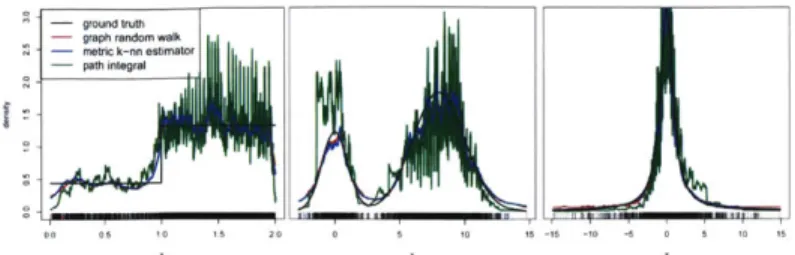
- ground trutrh
- graph random walkII
metrc k-rn estiator
-path integral
Figure 2-2: Examples of four density estimates: our method (red) using no metric information is indistinguish-able from metric k-nearest neighbor (blue) and close to ground truth (black). Path integral estimator of von Luxburg and Alamgir [20131 (green) shows higher error in all cases.
2.4
Convergence and computation of the stationary
distribution
2.4.1
Graphs satisfying condition
(*)
The It6 process Y(t) is an isotropic drift-diffusion process, so the Fokker-Planck equation [Risken, 1984] implies its density f(t, x) at time t satisfies
+ X2 [a"(t,x)f(t,)]
Otf (t, X)
=Ox,[b
(t,
2x)f
(t, x)]
(2.5)where b'(t, x) and a"(t, x) are given by
b(t, x) = 3 Cp.)2 and a"(t, x) = -E
p(x) 3
Lemma 2.4.1. The process Y(t) defined by (2.4) has absolutely continuous
station-ary measure with density
ry(X) = cp(X)2(X)-,
Proof. By (2.5), to check that
7ry(x) = Cp(X)2g(X)-2,it suffices to show
E
(Oxp(x)
P( (x) (x)2 ) - 1 xi((x)2c
(X)2))
0.
L
We now prove Theorem 2.2.1 by showing that a rescaling of 7rx (x) converges to
7ry(x).Proof of Theorem 2.2.1. The a.s. convergence of processes of Theorem 2.3.4 implies
by Ethier and Kurtz 11986, Theorem 4.9.12] that the empirical stationary measures
n
d/pn
= Z xn(xi) 6Xii=1
converge weakly to the stationary measure dp = iry(x)dx for
and 6 > 0, weak convergence against 1B(x,5) yields
Z
7rxn(Y) -+ 6YEXn ly-xj<( <6-x<
Y(t). For any x
e X
7ry (y)dy.
By eventual uniform equicontinuity of n7rx (x), for any e > 0 there is small enough
6 > 0 so that for all n we have
rxn(y) -
IXn
n
B(x,
6)Iirxn(x)
YEXn,ly-xl<6
<;
n-ljXn
n
B(x, 6)1,
which implies that
lim
grx,(x)p(x)n
n-+oo = lim lim V-16-dnrxn(x) 6-+0 n-+oo liM liM V-16-|xn
B(x,|xx 6-+0 n-+oo d 17 n(X = limVi16-d6-+O Ily-x|<67ry(y)dy = 7ry(x).
p(y)dy
I 0 t 1. -1()00 - ph=2001 Figure 2-3: Estimate performance degrades in
high dimensions due to over-smoothing (blue and red), but the estimator is still highly accurate up to log concentration parameter (black).
Figure 2-4: Example isotropic metric graphs. Our esti-mator (black) agrees with the true density (red) in all cases. Degree and stationary distribution (green and ma-roon) based density estimates work for some cases (right two panels) but cannot work if the degree is tied to spatial
location (left).
Combining with Lemma 2.4.1 yields the desired
7ry(x) p(X)
lim n7rx, (x) - =- l.
n -- ,o P~x
-7(X)2
2.4.2
Extension to general metric graphs
To obtain our stationary distribution in Theorem 2.2.1 we require only convergence to some It6 process via the Stroock-Varadhan criterion. We can achieve this under substantially more general conditions. We define a class of metric graphs on X, termed isotropic over which we have consistent metric recovery without knowledge of the graph construction method.
Definition 1 (Isotropic metric graph). A graph edge connection procedure on X, is isotropic if it satisfies:
Distance kernel: The probability of placing a directed edge from i to j is defined by a kernel function h(rij) mapping locally scaled distances
rij = xi - xj IE7(xi)-.
with &n(x) obeying (*).
Nonzero mass: The kernel function h(r) has nonzero integral
joj
h(r)rd-ldr > 0.grDMd truth
d.9




![Figure 4-1: Inductive reasoning in semantic space proposed in Sternberg and Gardner [1983]](https://thumb-eu.123doks.com/thumbv2/123doknet/14472154.522513/62.918.202.751.535.715/figure-inductive-reasoning-semantic-space-proposed-sternberg-gardner.webp)
![Table 4.1: Examples of new inductive reasoning tasks from Sternberg and Gardner [1983].](https://thumb-eu.123doks.com/thumbv2/123doknet/14472154.522513/64.918.237.717.101.196/table-examples-new-inductive-reasoning-tasks-sternberg-gardner.webp)