HAL Id: hal-01066032
https://hal.archives-ouvertes.fr/hal-01066032
Submitted on 18 Mar 2017
HAL is a multi-disciplinary open access
archive for the deposit and dissemination of
sci-entific research documents, whether they are
pub-lished or not. The documents may come from
teaching and research institutions in France or
abroad, or from public or private research centers.
L’archive ouverte pluridisciplinaire HAL, est
destinée au dépôt et à la diffusion de documents
scientifiques de niveau recherche, publiés ou non,
émanant des établissements d’enseignement et de
recherche français ou étrangers, des laboratoires
publics ou privés.
Towards a consistent thermodynamic model of
magnetocaloric material from experimental
characterization
Morgan Almanza, Afef Kedous-Lebouc, Vincent Hardy, Salvatore Miraglia
To cite this version:
Morgan Almanza, Afef Kedous-Lebouc, Vincent Hardy, Salvatore Miraglia. Towards a consistent
thermodynamic model of magnetocaloric material from experimental characterization. 6th IIR/IIF
International Conference on Magnetic Refrigeration THERMAG VI, Sep 2014, Victoria, Canada.
�hal-01066032�
6
thIIF-IIR International Conference on Magnetic Refrigeration
Victoria, BC, 7-10 September 2014
1
TOWARDS A CONSISTENT THERMODYNAMIC MODEL OF MAGNETOCALORIC MATERIAL
FROM EXPERIMENTAL CHARACTERIZATION
M. ALMANZA
(a,b), A.KEDOUS-LEBOUC
(a),V. HARDY
(c), S. MIRAGLIA
(b) (a)Univ. Grenoble Alpes, G2Elab, F-38000 Grenoble, France CNRS, G2Elab, F-38000Grenoble, France
(b)Univ. Grenoble Alpes, I. Neel, F-38000 Grenoble, France
CNRS, I. Neel, F-38000 Grenoble, France
(c)
CRISMAT - CNRS UMR 6508 - ENSICAEN, France
ABSTRACT—Magnetocaloric material (MCM) measurements and data treatments are essential for modeling and developing magnetic refrigeration system. The paper discusses the thermodynamic relevance of the material model considered and proposes a suitable strategy.Models consistent with thermodynamicsare essential for computation of coefficient of performance (COP) of refrigeration system. The study is supported by the knowledge of intrinsic material characteristics and analyses of thermodynamic behaviors. It is applied on a second order phase transition material𝑃𝑟0.65Sr0.35MnO3.
1. INTRODUCTION
MCM practical characterization leads to magnetization, heat capacity[1] and adiabatic temperature change as a function of temperature and applied field. These raw data are subjected to several measurement errors. In addition,they should be processed and analyzed to be properly used. Firstly, the data are connected to the internal field to have intrinsic properties 𝑀 𝐻, 𝑇 , 𝑐𝐻 𝐻, 𝑇 , Δ𝑇𝑎𝑑𝑖𝑎(𝐻, 𝑇),using demagnetizing factor 𝑁and the relation 𝐻 = 𝐻𝑎𝑝𝑝𝑙𝑖𝑒𝑑 − 𝑁𝑀.This method is
relevant when applied on a long parallelepipedspecimen providing a homogeneous field distribution in a sample. This condition is fulfilled in a magnetometer but not in a calorimeter in which the field is generally applied along the transverse direction to enhance heat transfer.Afterwards these data are fitted and interpolated to provide mathematical modelswith the risk of introducing user information not in accordance with thermodynamics. All of this breaks the deep data connectionsthrough thermodynamics laws, which can be expressed with the closed differential forms of the state function. In this paper, we define the thermodynamic consistency which guarantees the energy conservation. Then, we analyze itand point out the problem in the case of the interpolated and fitted data ofa Pr0.65Sr0.35MnO3 sample. Finally,we propose a solution which merges data and thermodynamics
with least square method (LSQ) to build an estimated entropy from which 𝑀, 𝑐𝐻, Δ𝑇𝑎𝑑𝑖𝑎can be derived.
2. THERMODYNAMICS
The system considered is an elementary volume of MCM which is sufficiently small to be considered infinitely near an equilibrium state. The thermodynamics laws give the following relations in which𝑢,𝑠and 𝑠𝑖𝑟𝑟correspond to the internal energy,
entropy and irreversible entropyper unit of volume.𝐵is the magnetic flux density. For reversible material and adiabatic conditions, Eq. (1) and (2), through magnetization and demagnetization leads to the same temperature and does not introduce hysteresis in the magnetization curve. Based on this analysis, the tested MCM is considered reversible and the term 𝑠𝑖𝑟𝑟is null.
𝑑𝑢 = 𝑇𝑑𝑠 − 𝑇𝛿𝑠𝑖𝑟𝑟 − 𝑀𝑑𝐵 (1) 𝑇𝑑𝑠 = 𝛿𝑄 + 𝑇𝛿𝑠𝑖𝑟𝑟 (2) 𝑐𝑦𝑐𝑙𝑒𝑇𝑑𝑠= 𝑐𝑦𝑐𝑙𝑒 𝑀𝑑𝐵(3)
𝑑𝑢being a closed differential form of degree 1,𝑇 and𝑀 are the partial derivatives of 𝑢 with respect to𝑠 and 𝐵 andthe cross derivatives are equal. This condition could be seen asenergyconservation on an elementary cycle and leads to Eq. (3).For a second order transition material, when𝐻 and 𝑇are taken as states variables, the Maxwell relation 𝜕𝐻𝜕𝑠 = 𝜇0𝜕𝑀𝜕𝑇is deduced from Eq. (1).It
expresses the transfer between the thermal and magnetic energy, when the terms𝜕𝑠
𝜕𝑇 and 𝜕𝑀
𝜕𝐻is linked to exchange conservative energy
in respectively thermal and magnetic form.The main issue is that entropy is not directly accessible. Only 𝑇 𝜕𝑠 𝜕𝑇 and 𝑀 are measurable. Moreover calorimeteric measurements are less accurate than magnetometry but𝑀 data has to be differentiated.In practice,we get derivative of 𝑠with uncertaintiesnoted as𝜖1 and 𝜖2, e.g. ifadiabatic thermodynamic cycle is numerically simulated,
uncertainties behave as source term producing or absorbing heat and magnetic work (4). And because the COPis badly conditioned, uncertainties hardly affect the COP evaluated from heat exchange.
𝑐𝑦𝑐𝑙𝑒 𝑇𝑑𝑠 = 𝑐𝑦𝑐𝑙𝑒 𝑇𝜕𝑠𝜕𝑇+ 𝜖1 𝑑𝑇 + 𝑇𝜕𝐻𝜕𝑠 + 𝜖2 𝑑𝐻
Thermal capacity and 𝜕𝑀/𝜕𝑇 has to be derivable from the same and unknown entropyfunctionandto be in accordance with measurements. All the informationis merged using weighted least squares (LSQ) method.LSQconsistsinminimizing 𝐴𝑆 − 𝐵 𝑇 𝑊(𝐴𝑆 − 𝐵)where 𝑆is the column matrix of entropy grid valuesand 𝑊is the weighted matrix. Each line of system(𝐴𝑆 =
6
thIIF-IIR International Conference on Magnetic Refrigeration
Victoria, BC, 7-10 September 2014
2 The choice of weighted matrix depends on the accuracy of measurements and their number. Indeed, magnetometer and calorimeter data is balanced. Ascalorimeter data are less numerous than those of the magnetometer, their weights are increased. In addition, we assume that transition is better caught near zero field with the magnetometer and increase the data weights in this range.
3. MEASUREMENT,RESULT AND DISCUSSION
The studyis conducted on a second order phase transition materialPr0.65Sr0.35MnO3.Measurements are performed on both
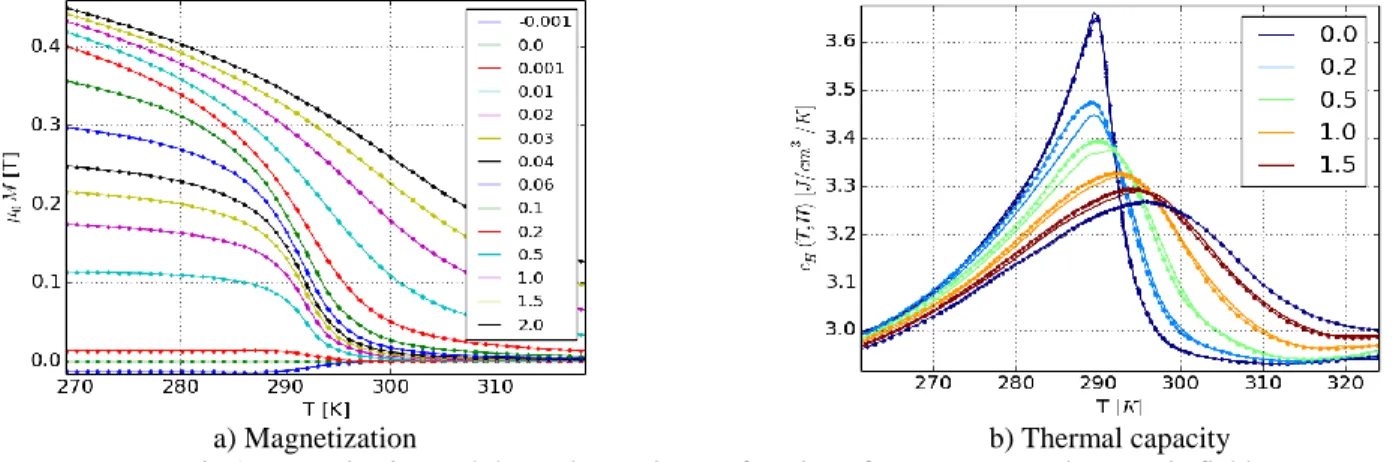
magnetometer and calorimeter with respectively demagnetizing factor of 0.45 and 0.06. The 2D interpolation is done with smooth spline of degree two. Fig. 1 shows all the data and their analysis.
a) Magnetization b) Thermal capacity Fig.1.Magnetization and thermal capacity as afunction of temperature and magnetic field
Dots: raw measured data vs applied field 𝜇0𝐻𝑎𝑝𝑝𝑙𝑖𝑒𝑑, lines: interpolated data function vs internal field𝜇0𝐻.
The LSQ method is applied to correct the 𝑐𝐻 to be in accordance with magnetization to thermodynamics (Fig. 2). Then numerical
simulations of Brayton Cycle[2] and computation of COP using two theoretically equivalent methodsare done. The results given in Fig. 3 highlight that themagnetic method (𝑄𝑐𝑜𝑙𝑑/𝑊𝑚𝑎𝑔)is much more robust than the thermal one (−𝑄𝑐𝑜𝑙𝑑/(𝑄𝑐𝑜𝑙𝑑 + 𝑄ℎ𝑜𝑡)).
The LSQ method allows the discrepancy on COP computed with thermal method to be strongly reduced:from the range of 1000 to -200with interpolated data to a rationalrange of 250 to 280 with LSQ data.
Fig. 2.Thermal capacity vs 𝑇 and 𝜇0𝐻
DotsLSQ data,line 2D interpolated data
Fig. 3. COP: dashinterpolated data, line LSQ data ● thermic method "𝑇𝑑𝑆 ",■magnetic method"𝑀𝑑𝐵" This study shows that the thermodynamic consistency is weak through experiment, interpolation, and numerical method for the cycle computation. To face this, accurate modelsof materials characteristics are required. In this paper we highlight that the magnetic method is more robust and propose the LSQ method to improve the COP estimation via the thermal method.
This work is supported by the French National Research Agency through the ANR-10-STOCK-E-008 project MagCool
REFERENCES
[1] F. Guillou, « Différents matériaux à effet magnétocalorique: Aspects fondamentaux et applicatifs », UNIVERSITÉ de CAEN, 2011.
[2] A. Kitanovski et P. W. Egolf, « Thermodynamics of magnetic refrigeration », Int. J. Refrig., vol. 29, no 1, p. 3‑ 21, janv. 2006.