READ THESE TERMS AND CONDITIONS CAREFULLY BEFORE USING THIS WEBSITE. https://nrc-publications.canada.ca/eng/copyright
Vous avez des questions? Nous pouvons vous aider. Pour communiquer directement avec un auteur, consultez la
première page de la revue dans laquelle son article a été publié afin de trouver ses coordonnées. Si vous n’arrivez pas à les repérer, communiquez avec nous à [email protected].
Questions? Contact the NRC Publications Archive team at
[email protected]. If you wish to email the authors directly, please see the first page of the publication for their contact information.
NRC Publications Archive
Archives des publications du CNRC
This publication could be one of several versions: author’s original, accepted manuscript or the publisher’s version. / La version de cette publication peut être l’une des suivantes : la version prépublication de l’auteur, la version acceptée du manuscrit ou la version de l’éditeur.
Access and use of this website and the material on it are subject to the Terms and Conditions set forth at
Optimizing Performance in Heavy Equipment Teleoperation
Lapointe, Jean-François; Robert, J.-M.; Boulanger, Pierre
https://publications-cnrc.canada.ca/fra/droits
L’accès à ce site Web et l’utilisation de son contenu sont assujettis aux conditions présentées dans le site
LISEZ CES CONDITIONS ATTENTIVEMENT AVANT D’UTILISER CE SITE WEB.
NRC Publications Record / Notice d'Archives des publications de CNRC:
https://nrc-publications.canada.ca/eng/view/object/?id=22cb4b1c-a1bb-41f7-b587-71c881e13f71 https://publications-cnrc.canada.ca/fra/voir/objet/?id=22cb4b1c-a1bb-41f7-b587-71c881e13f71National Research Council Canada Institute for Information Technology Conseil national de recherches Canada Institut de technologie de l’information
Optimizing performance in heavy equipment
teleoperation
Lapointe, J.-F., Robert, J.-M., and Boulanger, P.
May 2001
* Proceedings of Minespace 2001, Quebec, Quebec. April 30 - May 3, 2001. NRC 44886. Published to the web (http://www.cim.org/library).
Copyright 2001 by
National Research Council of Canada
Permission is granted to quote short excerpts and to reproduce figures and tables from this report, provided that the source of such material is fully acknowledged.
Optimizing Performance in Heavy Equipment
Teleoperation
Jean-François Lapointe
1, Jean-Marc Robert
2, Pierre Boulanger
11
National Research Council of Canada
2
École Polytechnique de Montréal
1500 Montreal Road, Building M-50
C.P. 6079, succ. Centre-Ville
Ottawa, Ontario Montréal, Québec
Canada K1A 0R6
Canada H3C 3A7
[email protected] [email protected]
[email protected]
ABSTRACT
Many advances have been made concerning the automation of heavy equipment teleoperators such as those found in mining. Complete automation, however, is not achieved yet and the operation of these vehicles still relies on the presence of a human operator.Fortunately, a lot of research has been done in order to improve the performance of these human-machine systems. This paper presents the characteristics of different control modes and input devices used for the control interface of those telemanipulators. We describe the benefits and drawbacks of each particular control interface on the overall system performance, based on a review of research in the field. We conclude with some recommendations and a discussion of future research needs, given the new potential advances offered by virtual environment technology and embedded computing.
KEYWORDS
Performance, heavy equipment, human-machine systems, control interface, virtual environments, control mode, input device, teleoperation, human factors1. INTRODUCTION
Teleoperation aims to augment human capacity in terms of range, strength or precision and/or to isolate the operator from a hostile environment. The actions of the human operator and the corresponding perception of their effects on the teleoperator and its environment are the two main components of a human-machine interface for teleoperation, as shown in Figure 1.
Figure 1 Illustration of teleoperation
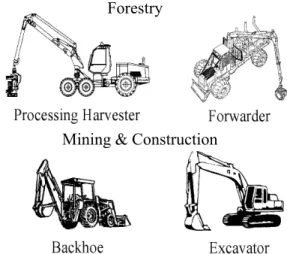
Although teleoperation can evoke the image of the space shuttle arm or other exotic manipulators, the vast majority of teleoperators are familiar to people, such as those used in mining, construction and forestry (Figure 2).
Figure 2 Examples of common teleoperators
Forestry
There are about a hundred thousand of these teleoperators sold worldwide each year [UBC, 1993; Drushka, 1997]. These teleoperators are hydraulic machines with a four degree-of-freedom (DOF) manipulator arm that is controlled directly from the cab through the use of joysticks. Three of the four DOFs are used to position the end effector tool in the teleoperator workspace, while the fourth DOF is used to orient it in the vertical plane of the arm (mining and construction teleoperators (Figure 2) or in the horizontal plane (forestry teleoperators, Figure 2).
Continuous advances in embedded computing and multidimensional input devices (with more than 2 DOFs) combined with their falling prices open new horizons for the application of advanced human-computer interaction techniques to mining, construction and forestry teleoperators. These advances should improve human performance, by reducing learning time and operator fatigue as well as increasing productivity. Task analyses of the operators of these machines have showed that manipulation (i.e. positioning and orienting) of the end effector tool (such as a bucket or grapple) is common to every of these machines. These analyses also revealed that tool manipulation requires the attention of the operator more than 50% of the operating time [Cook, 1993; Lapointe, 1995].
This paper reviews the control interface of these teleoperators, i.e. on the control interface and the relation between the input devices and control modes used by human operators to control the displacement of a manipulator arm.
Several authors have carried out studies to optimise the use of particular input devices within different control modes [Stark, 1987; Sheridan, 1992; Lawrence, 1993; Goldenberg, 1995]. Also, previous work has been done to clarify the different options available in teleoperation and human-computer interaction in general [Buxton, 1983; Foley, 1984; Parsons, 1989; Card, 1990; Fisher, 1990; Jacob, 1992; Goldenberg, 1995; Zhai, 1993, 1998]. We are not, however, aware of the existence of a taxonomy of the control interfaces used in teleoperation which also combines a review of the advantages and disadvantages of their different components, given a particular task or context. We believe tough that this information more than important when comes the time to design a new teleoperator, or the control interface of an existing teleoperator.
This paper presents the characteristics of different control modes and input devices used to control telemanipulators in order to help interface designers choose the best control interface. This review draws from human factors experiments and guidelines found in the literature.
2. TAXONOMY OF CONTROL
INTERFACES
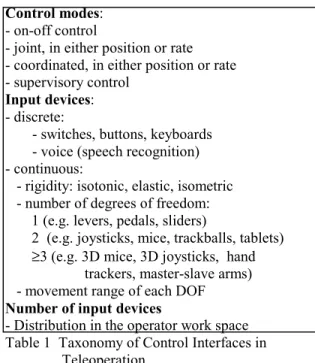
Table 1 presents a taxonomy of input devices and control modes of human-machine interfaces for teleoperation. This taxonomy is general and is not restricted solely to heavy equipment teleoperators.
Control modes:
- on-off control
- joint, in either position or rate - coordinated, in either position or rate - supervisory control
Input devices:
- discrete:
- switches, buttons, keyboards - voice (speech recognition) - continuous:
- rigidity: isotonic, elastic, isometric - number of degrees of freedom:
1 (e.g. levers, pedals, sliders) 2 (e.g. joysticks, mice, trackballs, tablets)
≥3 (e.g. 3D mice, 3D joysticks, hand trackers, master-slave arms) - movement range of each DOF
Number of input devices
- Distribution in the operator work space Table 1 Taxonomy of Control Interfaces in Teleoperation
2.1 Control modes
Control modes can be categorised in a number of groups (see Table 1) that are explained below.
On-off control is a binary control mode whereby
the operator activates the displacement of one or more joints of a manipulator or of its tool between two positions or along a particular path at a constant speed.
Joint control refers to the direct displacement of
manipulator joints.
Coordinated control, also called resolved motion
control, refers to the direct displacement of the tool of a manipulator. This control mode requires an inverse kinematic model of the manipulator so that a controller can calculate joint positions or speeds from the corresponding tool position or
speed. This mode relieves a novice operator of developing a mental model of the manipulator’s inverse kinematics, initially reducing learning time and improving productivity.
Position control, also called zero order control,
refers to the direct control of the position of manipulator joints or end effector relative to an input signal.
Rate control, also called first order or velocity
control, refers to the direct control of the speed of a manipulator’s joints or tool relative to an input signal.
Supervisory control is an evolutionary step between conventional man-in-the-loop teleoperation, where the operator must continuously control the action of the manipulator, and full autonomy. It refers to any semi-autonomous control mode where the operator supervises the actions of the manipulator during the autonomous part of its work, controlling it from time to time between each autonomous sub-task [Sheridan 92].
2.2 Input Devices
Control interfaces are controlled by a certain number of input devices normally located within reach in the human operator’s workspace. Input devices may be divided in two types: discrete and continuous.
Discrete devices have a finite number of states.
Their output is therefore symbolic and is normally associated with a particular function. As shown in Table 1, examples of discrete devices are switches, buttons and keyboards. Voice can also be considered as a discrete device, each word being a particular output signal or symbol.
Continuous devices generate an output signal
that varies proportionally to the activating stimuli. They can be characterised by their rigidity, the number of DOFs, and the range of movement of each DOF.
The rigidity refers to the ease of displacement of an input device, which affects the sensing mode associated with the device. An input device with no rigidity is called an isotonic device. An isotonic device is displaced freely without resistance, and its output signal is proportional to its displacement. Conversely, an input device with an infinite rigidity is called an isometric or force device. It is a fixed device and its output signal is
proportional to the applied force. In between these extremes, we find the elastic device, which can be displaced while opposing a force proportional to the displacement.
2.3 Combinations of Input Devices
The number of different possible combinations of input devices, their distribution in the workspace, and their assignment to human limbs increases as the number of controlled DOFs increases. Among all of the possible configurations, only a few will lead to useful or optimal human-machine interactions.
We describe in the next section that the space of possibilities of these configurations remains widely unexplored, although some guidelines have emerged from previous studies.
3. LITERATURE
OVERVIEW
It is known that discrete devices are well suited for on-off control or for discrete tool functions such as the opening and closing of a grapple.The same holds true for continuous input devices as they fit naturally with continuous control modes such as position and rate control, in either joint or coordinated mode. There is no finite (fixed) set of input devices that caters to supervisory control mode, as it incorporates every imaginable semi-autonomous control mode.
Other parameters that influence the choice of the control interface are the duration of the task, as well as the size, the speed, and the number of DOFs of the manipulator arm to control.
3.1 On-off control
On-off control is rarely used in teleoperation to position and orient the manipulator. It is, however, frequently used to control tool functions such as the opening and closing of a clamp or grapple.
3.2 Position control
To be efficient, position control requires isotonic input devices, i.e. devices that exert no resistance when moved, such as sliders (1 DOF), mice, trackballs, tablets (2 DOF), gloves, 3D mice and master slave arms (≥3 DOF). Master-slave arms often provide force feedback, but they can be considered as isotonic, since they normally move without resistance in free space. One and 2 DOF devices are good but they do not provide an integrated solution for 3D position control.
In spite of their advantages, 3D isotonic devices are recognised to be fatiguing to operate because of their large operating volume and because of their lack of support for hand movements [Zhai, 1993b].
Therefore, position control with 3D isotonic devices is not recommended for long duration manipulation tasks.
Also, real-time position control requires a manipulator that can follow the movement indicated by the input device(s) in real-time. For a manipulator the size of a human arm, this translates to a minimum of about 1 m/s for speed and 1g for the acceleration of the end effector [Draper, 1989; Fisher,1990].
Finally, in the case of large manipulators (i.e. larger than a human arm), precision can be an issue, since the absolute precision of the manipulator is inversely proportional to the size ratio between the manipulator and the operator arm. This is due to the fact that the operator hand generally controls the input device. A solution could be to explore different alternative transfer functions that could depend on the speed/acceleration profile of movement.
3.3 Rate control
Rate control is preferable to position control when the manipulator has a greater range and moves slower than a human arm, as is the case with heavy equipment [Kim, 1987; Stark, 1987; Sheridan, 1992]. It is important to note that the use of rate control is facilitated when combined with self centering input devices, since the user does not have to recenter the device to stop movement of the manipulator. For this reason, isometric and elastic devices are preferable to isotonic devices for rate control [Zhai, 1997].
3.4 Joint control
Joint control is the oldest way of controlling a manipulator arm and the easiest to implement. This control mode gives full control to the operator over the movement of the manipulator and its different sections or joints. Joint control, however, is not natural and intuitive for an operator, who must acquire through practice a mental model of the inverse kinematics of the manipulator to become efficient.
3.5 Coordinated control
Coordinated control, also referred to by the names coordinated motion control and boom-tip control,
is a natural mode to control the position or speed and direction of displacement of the tool. Through the use of an inverse kinematic model of the manipulator, a controller maps the motions in the coordinate frame of the manipulator`s workspace into joint motions. The operator therefore is required to consider motions only in the workspace, which is perceptually easier.
Several experiments have demonstrated that, compared to joint rate control, coordinated rate control reduces the learning time of operators and improves the performance of novice users [Stark, 1987; Lawrence 1993; Lapointe, 1999]. It also allows easy control for straight line motion, which can be useful, for example in forestry, to minimize butt damage while cutting, in the case of feller-bunchers [Clark, 1994]. Coordinated control, however, can be difficult to implement when an inverse kinematic model is not solvable. Fortunately, the kinematic models of the teleoperators illustrated in Figure 1 are solvable due to the limited ranges of joint motions and easy to implement.
3.6 Optimal number of input devices
Heavy equipment teleoperators are normally equipped with manipulators that have at least 3 DOFs. One may wonder about the optimal combination(s) of input devices and control modes needed to control these manipulators. The answer to this question is far from obvious and depends primarily on the number of DOFs to be controlled and their geometric arrangement. Many experiments with 2 DOF control interfaces have shown that integrating the control of the two DOFs on one device gives benefits when they have a similar type of control (position or rate), and when there is a similitude between their configuration and the task to accomplish [Wickens, 1992]. These results, however, do not necessarily translate to the 3D world since they only concern 2 DOFs. One therefore does not know if this integration is good for more than 2 DOFs, and too little research has been done to answer these issues for all the 3D cases.
In the case of the space shuttle arm, for example, the 6 DOF control interface uses two 3 DOF input devices for the rate control of the manipulator. Another study concerning 4 DOF forestry teleoperators has shown that the use of coordinated rate control improves performance compared to the traditional joint rate control when using two 2 DOF devices and that the integration
of the 4 DOFs on one imput device further improves the perfomance of novice operators when using coordinated rate control [Lapointe, 1999]. Another study concerning the piloting of helicopters (which requires 4 DOFs) found that the main drawback in integrating several DOFs on one input device is called coupling, which concerns the difficulty of separating the inputs on one or more DOF without accidentally acting on the others, [Aiken, 1986].
4. THE SITUATION IN HEAVY
EQUIPMENT TELEOPERATION
Heavy equipment teleoperators such as those illustrated in Figure 2 all rely on joint rate control, with in most cases two 2 DOF joysticks to manipulate the arm and its tool. This situation is imposed by the underlying hydraulic components and the lack of embedded computing that could make use of more advanced human-machine interactions.
The literature indicates that coordinated rate control improves the performance of novice operators and is currently the best candidate for this type of teleoperator, given that the operator has a direct view of the scene [Lawrence, 1993; Lapointe, 1999]. There are however some drawbacks, since the improvement in performance seems to be of short duration as the performance of joint rate control shows a threefold improvement after a few hours of training [Lapointe, 1999]. Finally, joint rate control provides a higher level of control than coordinated rate control in the periphery of the manipulator workspace.
5. RECOMMENDATIONS
Given that heavy equipment operators often operate for years, and therefore develop good skills in joint rate control, the advantages offered by coordinated rate control for the control of those 4 DOF manipulators must be weighed against the simplicity and the lower cost of the conventional joint rate control. For a detailed cost/benefit and market analysis, we refer the readers to the one made by Clark [Clark, 1995]. Altough coordinated rate control has not made big strides in the market recently, the situation could change in the future when the teleoperators will come already equipped with all the sensors, actuators and the embedded computing power necessary to provide coordinated rate control.
In the mean time, the use of virtual environment technology for training has proven its efficiency as a way to improve the control performance of heavy equipment operators [Lapointe, 2000]. Already, commercial solutions are available and we therefore recommend the use of such training tool to improve the performance of operation in heavy equipment teleoperation.
Finally, we believe that it is worthwhile to investigate other combinations of indirect control (even if done from the cab) that could take advantage of the possibilities of virtual environment technology.
6. FUTURE RESEARCH
As described in the preceding sections, the previous research in teleoperation has resulted in several guidelines. Human factors research is further needed to advance the knowledge of important aspects of the control interface in teleoperation.
Fortunately, the recent rise of virtual environments has given a welcomed boost to control interface research, especially for multidimensional (>2 DOF) input devices. We think that the combination of virtual environment technology and embedded computing could lead to more advanced human-machine interfaces for heavy equipment teleoperators. Even though the context of most virtual environment research is somewhat different from the context of teleoperation research, many findings can be applied to both fields.
For example, 3D isotonic devices are fatiguing to use because of their unsupported hand movement. However, we are not aware of any quantitative guidelines concerning a reasonable continuous working time for these devices. This information would be useful if we want to apply new position control modes with 3D isotonic devices.
Also, further research is needed to design and validate new control interfaces for heavy equipment teleoperation, based on various combinations of control modes and multi-dimensionnal input devices. These new interfaces could also take advantage of the automation of some part of the tasks.
Also, given a model of the teleoperator and its surrounding, virtual environment technology can
provide new advanced human-machine interfaces. For example, the operator could control a machine from different viewpoints (egocentric and exocentric control) in order to improve situational awareness and task planning. By adding embedded computing we can also combine traditional man-in-the-loop teleoperation with more advanced supervisory control, through the use of sensor-based robotic technologies such as automatic collision avoidance [Greenspan, 1997; Trivedi, 1993].
The space of possibilities is very large, particularly if we consider that for a given number of DOFs to control, many combinations of input devices are possible. This indicates that the prospects for improved human-machine interface in teleoperation are very good for the coming years.
7. REFERENCES
Aiken, E.W., "A Review of the Effects of Side-Stick Controllers on Rotorcraft Handling Qualities", Journal of the American Helicopter Society, July 1986, pp. 27-33.
Buxton, W., "Lexical and Pragmatic Considerations of Input Structures", Computer Graphics, Vol. 17, No. 1, 1983, pp. 31-37.
Card, S.K., Mackinlay, J.D., Robertson, G.G., "The Design Space of Input Devices", Proc. of CHI’90, ACM Conf. on Human Factors in Computing Systems, 1990, pp. 117-124.
Clark, Marvin, "Coordinated Motion Control of a Feller-Buncher", Technical Note TN-223, Forest Engineering Research Institute of Canada, November, 1994.
Clark, Marvin, “The Application of Coordinated Motion Control to Forest Machinery: A Cost/Benefit and Market Analysis”, Industry Canada’s Technological Innovations Workshop, Quebec, March 30-31, 1995.
Cook, T.M., " Teleoperation of Heavy Equipment: Essential Visual Information", Proc. Of the ANS Fifth Topical Meeting on Robotics and Remote Systems, 1993, pp. 161-164.
Draper, J.V., Handel, S., "End-Effector Velocity and Input Frequency Effects on Teleoperator Performance", Proc. of the Human Factors Society 33th Annual Meeting, 1989, pp. 584-588.
Drushka, K., Konttinen, H., "Tracks in the Forest
– The Evolution of Logging Machinery ",
Timberjack Group Oy, Helsinki, Finland, 1997. Foley, J.D., Wallace, V.L., Chan, P., "The Human Factors of Computer Graphics Interaction Techniques", IEEE Computer Graphics and Applications, Vol. 4, No. 11, 1984, pp. 13-48. Fisher, P., Daniel, R., Siva, K.V., "Specification and Design of Input Devices for Teleoperation", Proc. of ICRA’90, the IEEE Int. Conf. on Robotics and Automation, 1990, pp. 540-545. Goldenberg, A. A., Wiercienski, J., Kuzan, P., Szymczyk, C., Fenton, R. G., Shaver B., "A Remote Manipulator for Forestry Operation", IEEE Transactions on Robotics and Automation, Vol. 11, No. 2, April 1995, pp. 185-197.
Greenspan, M., Ballantyne, J., Lipsett, M., " Sticky and Slippery Collision Avoidance for Tele-Excavation", Proc. IROS’97, pp. 1666-1671. Jacob, R.J.K., Sibert, L.E., "The Perceptual Structure of Multidimensionnal Input Device Selection", Proc. of CHI’92, ACM Conf. on Human Factors in Computing Systems, 1992, pp. 211-218.
Kim, W.S., Tendick, F., Ellis, S.R., Stark, L.W., "A Comparison of Position and Rate Control for Telemanipulations with Consideration of Manipulator System Dynamics", IEEE Journal of Robotics and Automation, Vol. RA-3, No. 5, 1987, pp. 426-436.
Lawrence, P.D., Sassani, F., Sauder, B., Sepehri, N.,Wallersteiner, U., Wilson, J., "Computer-Assisted Control of Excavator-Based Machines", SAE Technical Paper Series # 932486, Int. Off-Highway & Powerplant Cong. & Exp., September 1993, pp. 1-10.
Lapointe, J.F., Robert, J.M., Freedman, P., "Analyse ergonomique du travail de l’opérateur d’abatteuse-tronçonneuse", Proc. of the 27th Annual Congress of the Human Factors Ass. of Canada, 1995, pp. 111-116.
Lapointe, J.F., "Étude de la performance humaine en téléopération: le cas forestier", PhD thesis, École Polytechnique de Montréal, April 1999. Lapointe, J.F., Robert, J.M., "Using VR for Efficient Training of Forestry Machine Operators", IFIP Journal of Education and Information Technologies, Vol. 5, No. 4, December 2000, pp. 237-250.
Parsons, H. M., "Teleoperator Interfaces for Remote Control Centers/Test Beds", Proceedings
of the Human Factors Society 33rd Annual Meeting, 1989, pp. 579-583.
Sheridan, T.B., "Telerobotics, Automation, and Human Supervisory Control", The MIT Press, 1992.
Stark, L., Kim, W.S., Tendick, F., Hannaford, B., Ellis, S., & al., "Telerobotics: Display, Control, and Communication Problems", IEEE Journal of Robotics and Automation, Vol. RA-3, No. 1, February 1987, pp. 67-75.
Trivedi, M. M., Chen, C. X., "Developping Sensor-based Robotic Systems Using Virtual Reality Concepts", Proc. of the ANS 5th Topical Meeting on Robotics and Remote Systems, April 1993, pp.165-172.
University of British Columbia - industry liaison office, "Coordinated Motion Control of Articulated Hydraulic Machinery", 1993, 16 p. Whitney, D.E., "Resolved Motion Rate Control of Manipulators and Human Prostheses", IEEE Transactions on Man-Machine Systems, Vol. 10, No. 2, June 1969, pp. 47-53.
Wickens, C.D., "Engineering Psychology and Human Performance", 2nd ed., Harper-Collins, New York, 1992.
Zhai, S., Milgram, P., "Human Performance Evaluation of Manipulation Schemes in Virtual Environments", Proc. of the 1st IEEE Virtual Reality Ann. Int. Symp. (VRAIS’93), pp.155-161. Zhai, S., "Investigation of Feel for 6 DOF Inputs: Isometric and Elastic Rate Control for Manipulation in 3D Environments", Proc. of the Human Factors and Ergonomics Society 37th An. Meet., October 1993b, pp. 323-327.
Zhai, S., Smith, B.A., Selker, T., "Improving Browsing Performance : A Study of four input devices for scrolling and pointing tasks", Proc. of INTERACT’97, pp. 286-293.
Zhai, S., Milgram, P., "Quantifying Coordination in Multiple DOF Movement and its Application to Evaluating 6 DOF Input Devices", Proc. of CHI’98, pp. 320-327.