Building and Controlling Fluidically Actuated Soft
Robots: From Open Loop to Model-based Control
by
Robert Kevin Katzschmann
Dipl.-Ing., Karlsruhe Institute of Technology (2013)
Submitted to the Department of Mechanical Engineering
in partial fulfillment of the requirements for the degree of
Doctor of Philosophy in Mechanical Engineering
at the
MASSACHUSETTS INSTITUTE OF TECHNOLOGY
June 2018
c
○ Massachusetts Institute of Technology 2018. All rights reserved.
Author . . . .
Department of Mechanical Engineering
May 4, 2018
Certified by . . . .
Professor Daniela L. Rus
Professor of Electrical Engineering and Computer Science
Thesis Supervisor
Accepted by . . . .
Professor Rohan Abeyaratne
Chairman, Department Committee on Graduate Theses
Building and Controlling Fluidically Actuated Soft Robots:
From Open Loop to Model-based Control
by
Robert Kevin Katzschmann
Submitted to the Department of Mechanical Engineering on May 4, 2018, in partial fulfillment of the
requirements for the degree of
Doctor of Philosophy in Mechanical Engineering
Abstract
This thesis describes the creation and control of soft robots made of deformable elastomer materials and powered by fluidics. We embed soft fluidic actuators into self-contained soft robotic systems, such as fish for underwater exploration or soft arms for dynamic manipulation. We present models describing the physical characteristics of these continuously deformable and fully soft robots, and then leverage these models for motion planning and closed-loop feedback control in order to realize quasi-static manipulation, dynamic arm motions, and dynamic interactions with an environment.
The design and fabrication techniques for our soft robots include the development of soft actuator morphologies, soft casting techniques, and closed-circuit pneumatic and hydraulic powering methods. With a modular design approach, we combine these soft actuator morphologies into robotic systems. We create a robotic fish for underwater locomotion, as well as multi-finger hands and multi-segment arms for use in object manipulation and interaction with an environment. The robotic fish uses a soft hydraulic actuator as its deformable tail to perform open-loop controlled swimming motions through cyclic undulation. The swimming movement is achieved by a custom-made displacement pump and a custom-made buoyancy control unit, all embedded within the soft robotic fish. The fish robot receives high-level control commands via acoustic signals to move in marine environments.
The control of the multi-segment arms is enabled by models describing the geometry, kinematics, impedance, and dynamics. We use the models for quasi-static closed-loop control and dynamic closed-closed-loop control. The quasi-static controllers work in combination with the kinematic models and geometric motion planners to enable the soft arms to move in confined spaces, and to autonomously perform object grasping. Leveraging the models for impedance and dynamics, we also demonstrate dynamic arm motions and end-effector interactions of the arm with an environment. Our dynamic model allows the application of control techniques developed for rigid robots to the dynamic control of soft robots. The resulting model-based closed-loop controllers enable dynamic curvature tracking as well as surface tracing in Cartesian space.
Thesis Supervisor: Professor Daniela L. Rus
Acknowledgments
A great number of people helped me throughout my PhD and made it possible for me to write this thesis. First of all, I would like to thank my advisor, Prof. Daniela Rus, for providing me with excellent daily advice, many resources, and an exceptional environment to work in a field we both share a deep passion for: soft autonomous robots. Daniela is unique in her ability to motivate and encourage to move our research forward; she always has good advice when things do not look like they are going to work out. Looking back at the past five years, we worked on a large variety of problems, many of which I was not able to capture in this thesis. We went through many great adventures, went on expeditions to try our robots, both underwater and in direct contact with humans. I will miss being a PhD student in your lab, and I hope we will have many mutual fruitful future collaborations. I would also greatly like to thank my thesis committee consisting of Prof. Russ Tedrake, Prof. John Leonard, and Prof. Peko Hosoi for all their advice and for their eagerness in supporting me through the main portion of my PhD. I remember some great conversations and discussions, and with some of you I actively collaborated during my PhD and hope to continue doing so in the future. My gratitude also goes to my past supervisors Prof. Torsten Kröger, Prof. Oussama Khatib, and Prof. Tamim Asfour, who provided me with great advice during my master thesis (Diplomarbeit) and encouraged me to stay on the academic track and pursue a PhD.
I would like to thank all my direct collaborators during the PhD, including Brandon Araki, Prof. Antonio Bicchi, Cosimo Della Santina, Youbin Kim, Dr. Shuguang Li, Austin de Maille, Joseph DelPreto, Prof. Mehmet Dogar, David Dorhout, Bianca Homberg, Prof. Robert MacCurdy, Dr. Andrew Marchese, Dr. Santani Teng, and Prof. Hsueh-Cheng Wang. I learned many things from each of you while we were making and controlling new robots together.
Without all the members of our lab, the Distributed Robotics Laboratory, this journey would have been much harder and more difficult. I would also like to thank all of my current lab members: Alexander Amini, Brandon Araki, Thomas Balch, Cenk
Baykal, Lillian Chin, Cosimo Della Santina, Joseph DelPreto, Dr. Igor Gilitschenski, Dr. Shuguang Li, Dr. Jeffrey Lipton, Lucas Liebenwein, Mieke Moran, Felix Naser, Teddy Ort, Dr. Alyssa Pierson, John Romanishin, Wilko Schwarting, Dr. Hayim Shaul, Andrew Spielberg, Dr. Cristian Vasile, and Alexander Wallar. I am lucky to be in a lab environment that is very supportive and collaborative. The atmosphere of the lab is always warm and welcoming, it provides for great discussions, both in terms of science and just about anything else. I will always remember our daily lunches altogether, our yearly lab outings to the mountains for hiking or rafting, and our regular celebrations with lots of coffee and cake. I would like to thank our lab admin Mieke Moran, who ensures on a daily basis that everyone in the lab has everything needed and that we always stay well-fed.
I also want to mention all my previous lab members that have already graduated or finished their assignments, all of you also helped to create a great PhD journey for me, and I enjoyed it very much working with all of you: Prof. Javier Alonso-Mora, Byoungk-won An, Stuart Baker, Thomas Bertossi, Dr. Stephane Bonardi, Prof. Changhyun Choi, Sebastian Claici, Prof. Mehmet Dogar, Dr. Marek Doniec, David Dorhout, Prof. Daniel Feldman, Prof. Stephanie Gil, Dr. Kyle Gilpin, Bianca Homberg, Prof. Ross Knepper, Prof. Robert MacCurdy, Dr. Andrew Marchese, Prof. Ankur Mehta, Prof. Shuhei Miyashita, Tobias Nägli, Dr. Sedat Ozer, Prof. Liam Paull, Dr. Guy Rosman, Dr. An-drés Salazar-Gómez, Jenny Shen, Daniel Soltero, Prof. Cynthia Sung, Prof. Michael Tolley, Dr. Mikhail Volkov, and Prof. Jingjin Yu.
Many thanks also go to all the other CSAIL staff, including Ron Wiken, Adam Conner-Simons, Rachel Gordon, and Lauralyn Smith. I want to acknowledge all the help I received from everyone in The-Infrastructure-Group, Human Resources and Headquarters.
A big thank you goes out to all my friends for always standing by my side and supporting me for all those years. I especially would like to express gratitude to my friends Alex, Mikhail, Joao, Affi, Sara, Uyanga, Felix, Joseph, Philipp, Christian, Gregor and everyone else I forgot to mention. You all were amazing, you were there for me during different phases of my life, thank you for all the fun times, great
conversations, and special adventures we had together.
I would like to thank all my family members back in Germany. I miss our regular family gatherings with lots of cakes, fun conversations, and just hanging out together on the weekends. I am very proud of my family for holding together so strongly and being there for each other. I always received so much support and encouragement from everyone.
To my love Grace, thank you so much for your support, advice, and encouragement. You stood by me during success and failure, tirelessly encouraging and supporting me every day. Thank you for all the inspiring discussions and all the loving words. I am looking forward to many more fun times of creating things together and going on new adventures with you.
To my son Colin, you have always borne with a father still in graduate school, happily accompanying me to work when a deadline was close or just because I really wanted to finish building something. Thank you for always cheering me up with your deep curiosity and strong interest in learning new things. I am looking forward to continue instilling your desire to make things. Together we will create many more robots in the future!
To my brother Philip, thank you for all the advice and support you have given me since I was born. I could not have wished for a more supportive and encouraging brother than what I found in you. You are my rock in the ocean, whenever I call you up, you have time and patience for me, thank you so much!
To Tanti and Onkel Heinz, I miss both of you very much and would wish to be closer to home so we could spend more time together. I learned many things from you, especially a great outlook on life. I admire the cordiality and sincerity that you both live and taught me. I happily remember all the care and love I received from both of you.
Finally, my deepest gratitude goes to my mother Wilhelmina and my father Ulrich, who have always encouraged me to follow my dreams. I could not have wished for more loving and caring parents than what I found in both of you. I admire you greatly for all you have shown and taught me in my life so far, and I am looking forward to
Contents
List of Figures 18 List of Tables 19 List of Algorithms 21 List of Processes 23 List of Notations 25 1 Introduction 31 1.1 Vision . . . 31 1.2 New Capabilities . . . 34 1.2.1 Safe Interactions . . . 351.2.2 Controlled Continuous Deformation . . . 36
1.2.3 Dexterity Through Compliance . . . 36
1.2.4 Simplification of Mechanisms . . . 37
1.2.5 Biomimicry . . . 38
1.3 Applications . . . 38
1.3.1 Manipulation . . . 38
1.3.2 Observation of Marine Life . . . 39
1.4 Challenges . . . 40
1.4.1 Why are Soft Robots Hard to Model and Control? . . . 40
1.5 Our Approach . . . 45
1.5.1 Overview of Our Approach . . . 45
1.5.2 Design and Fabrication . . . 46
1.5.3 Modeling and Control . . . 47
1.5.4 Control Demonstrated in Applications . . . 48
1.6 Thesis Contributions . . . 49 1.6.1 Overview of Contributions . . . 49 1.6.2 Contributions in Detail . . . 49 1.7 Thesis Outline . . . 52 2 Related Work 55 2.1 Design . . . 56 2.1.1 Actuation . . . 56 2.1.2 Sensing . . . 59 2.1.3 Design Tools . . . 60 2.2 Fabrication . . . 61 2.3 Control . . . 62 2.3.1 Kinematics . . . 63 2.3.2 Planning . . . 64
2.3.3 Closed-Loop Grasping Control . . . 65
2.3.4 Dynamic Model-Based Feedback Control . . . 65
2.4 Devices and Applications . . . 67
2.4.1 Soft Locomotory Robots on Land . . . 67
2.4.2 Soft Locomotory Robots Underwater . . . 68
2.4.3 Soft Grippers . . . 69
2.4.4 Soft Manipulator Arms . . . 70
3 Design and Fabrication of Fluidic Elastomer Robots 73 3.1 Overview . . . 73
3.1.1 Outline of this Chapter . . . 74
3.2.1 Operating Principles . . . 75
3.2.2 Actuator Morphologies . . . 76
3.3 Fabrication . . . 85
3.3.1 Lamination Casting with Heterogenous Embeddings . . . 85
3.3.2 Retractable Pin Casting . . . 88
3.3.3 Lost Wax Casting . . . 90
3.4 Fluidic Power Sources . . . 94
3.4.1 Transmission Fluids . . . 94
3.4.2 Circuit Continuity . . . 95
3.4.3 Portability . . . 96
3.5 Closed-Circuit Fluid Control . . . 96
3.6 Soft Robots and Systems . . . 98
3.6.1 Ribbed Fish Tail . . . 98
3.6.2 Pleated Finger . . . 102
3.6.3 Pleated Gripper Hand . . . 106
3.6.4 Ribbed Multi-Segment Arm . . . 107
3.6.5 Pleated Multi-Segment Arm . . . 107
3.6.6 Cylindrical Multi-Segment Arm . . . 108
3.6.7 Pleated Gripper on Cylindrical Multi-Segment Arm . . . 110
3.6.8 Soft Hemisphere on Cylindrical Multi-Segment Arm . . . 111
3.6.9 Localization and Pneumatic Actuation of Manipulator Arms . 111 3.7 Contributions to Design and Fabrication . . . 114
4 Application for Biomimetic Swimming 115 4.1 Goal and Challenge . . . 115
4.2 System Overview . . . 116
4.3 Embedded System for Independent Operation . . . 117
4.4 Control Architecture . . . 118
4.5 Cyclic Hydraulic Actuation for Swimming . . . 119
4.7 Underwater Communication for Remote-Control . . . 122
4.8 Experimental Setting . . . 124
4.9 Underwater Communication Tests . . . 126
4.10 Buoyancy Control Tests . . . 127
4.11 Swimming along a 3D trajectory . . . 128
4.12 Human-Robot Interaction . . . 130
4.13 Oceanic Experiments . . . 131
4.14 Contributions of the Biomimetic Swimming Application . . . 135
5 Model-Free Quasi-Static Feedback Control 137 5.1 Overview . . . 137
5.2 Kinematic Modeling . . . 138
5.2.1 Piecewise Constant Curvature . . . 138
5.2.2 Single-Segment Inverse Kinematics . . . 139
5.2.3 Forward Kinematics . . . 139
5.2.4 Multi-Segment Inverse Kinematics . . . 141
5.3 Control System . . . 142
5.3.1 Main Controller . . . 143
5.3.2 Configuration Controller . . . 144
5.4 Task-Space Planning and Control . . . 145
5.4.1 Whole Arm Planning . . . 146
5.4.2 Grasp-and-Place . . . 149
6 Model-Based Dynamic Feedback Control 155 6.1 Overview . . . 156
6.2 Model Mapping Rigid to Soft . . . 156
6.2.1 Kinematics . . . 157
6.2.2 Dynamics . . . 159
6.2.3 Impedance and Actuation . . . 163
6.2.4 Complete Model . . . 165
6.3 Model-Based Control Design . . . 169
6.4 Curvature Dynamic Control . . . 170
6.5 Cartesian Impedance Control . . . 173
6.6 Contact Planning . . . 177
7 Applications on Planar Multi-Link Soft Manipulators 181 7.1 Experiments with Model-free Control . . . 181
7.1.1 Confined Environment . . . 181
7.1.2 Grasping Delicate Objects . . . 184
7.1.3 Grasp-and-Place . . . 185
7.2 Experiments with Model-Based Dynamic Control . . . 191
7.2.1 Simulations with a finite element model . . . 191
7.2.2 Physical Experiments . . . 198
8 Conclusion 211 8.1 Summary of the Thesis . . . 212
8.1.1 Design and Fabrication of Soft Robots . . . 213
8.1.2 Application to Biomimetic Swimming . . . 215
8.1.3 Model-Free Quasi-Static Control . . . 216
8.1.4 Model-Based Dynamic Control . . . 216
8.1.5 Experiments and Applications . . . 217
8.2 Summary of Contributions . . . 218
8.2.1 Design and Fabrication of Soft Robots . . . 219
8.2.2 Applications for Biomimetic Swimming . . . 219
8.2.3 Model-Free Quasi-Static Control . . . 219
8.2.4 Model-Based Dynamic Control . . . 220
8.2.5 Applications of our Models and Controls to Soft Manipulation 220 8.3 Limitations . . . 221
8.3.1 Design and Fabrication of Soft Fluidic Actuators . . . 221
8.3.2 Biomimetic Swimming of a Single Actuator . . . 222
8.3.4 Manipulation using Dynamic Model-Based Control . . . 224
8.4 Lessons Learned . . . 225
8.4.1 Practical Insights First . . . 225
8.4.2 Leverage Natural Impedance for Complex Tasks . . . 226
8.4.3 Building Blocks for Variety of Soft Robotic Designs . . . 227
8.4.4 Curse of Softness: Always Operating Close at Actuation Limits 228 8.4.5 Classical Control Techniques Applicable to Soft Robots . . . . 228
8.4.6 Natural Proportional-Derivative Control . . . 229
8.4.7 Intentional Use of Contact with Environment . . . 229
8.5 Supplementary Materials Online . . . 230
8.6 Related Projects by the Author . . . 230
8.7 Future Work . . . 231
8.7.1 Soft Robotic Fish . . . 231
8.7.2 Manipulation . . . 232
A Appendix: Soft Robotic Fish 235 A.1 Color of Exposed Parts . . . 235
A.2 Acoustic Modem Design . . . 236
A.2.1 Transmitter . . . 236
A.2.2 Signal Transmission . . . 236
A.2.3 Receiver . . . 237
A.2.4 Communication Frequency . . . 237
A.2.5 Modulation and Encoding . . . 238
A.2.6 Detection Algorithm . . . 238
A.2.7 Adjustable Gain Control . . . 239
A.3 Acoustic Tests . . . 240
A.3.1 Acoustic Communication Characterization for Design . . . 240
A.3.2 Acoustic Modem Evaluation in Controlled Environments . . . 242
A.3.3 Acoustic Ocean Experiments . . . 243
List of Figures
1-1 Overview of the thesis and our approach. . . 45
1-2 Applications of the soft robotic systems developed in this thesis. . . . 48
3-1 Operating principle of a bending elastomer segment. . . 75
3-2 Operative principle of producing material strain through fluidic power. 77 3-3 A conceptual representation of the ribbed segment morphology. . . . 79
3-4 A conceptual representation of the cylindrical segment morphology. . 80
3-5 A conceptual representation of the pleated segment morphology. . . . 82
3-6 Experimental setup of the comparative characterization. . . 83
3-7 Experimental characterizations of three actuated segment morphologies. 84 3-8 Fabrication process for a ribbed manipulator morphology. . . 87
3-9 Lamination casting of a soft fish tail. . . 88
3-10 Retractable pin casting of a cylindrical manipulator morphology. . . . 90
3-11 Fabrication process for the pleated actuator morphology. . . 92
3-12 Fish tail fabrication process. . . 93
3-13 Actuation principle of fish’s soft tail. . . 96
3-14 An overview of two pneumatic cylinders. . . 97
3-15 Soft robots developed in this thesis. . . 98
3-16 Renderings of actuated soft fish tail and gear pump. . . 99
3-17 Wax core fabrication. . . 100
3-18 Fabrication of soft fish tail. . . 101
3-19 Fabricated external gear pump. . . 102
3-21 Fabrication steps of soft finger. . . 104
3-22 Views of an individual pleated finger. . . 105
3-23 Sensor Characterization. . . 106
3-24 Views of the entire composed hand. . . 106
3-25 A ribbed soft manipulator prototype. . . 108
3-26 A pleated soft manipulator prototype. . . 108
3-27 Cylindrical manipulator without end effector. . . 109
3-28 Highly compliant cylindrical soft robot. . . 110
3-29 Cylindrical manipulator with hemisphere. . . 110
3-30 Cylindrical manipulator with pleated gripper. . . 111
3-31 Soft robotic manipulation system with localization and actuation. . . 113
4-1 System overview of the soft robotic fish. . . 117
4-2 Signal flow within the fish robot. . . 119
4-3 Buoyancy Control Unit. . . 122
4-4 Buoyancy control system of the soft fish robot. . . 122
4-5 Acoustic communication between diver and soft robotic fish. . . 124
4-6 Vertical dive experiment with the soft robotic fish. . . 128
4-7 Additional buoyancy control experiments. . . 128
4-8 Underwater exploration of the soft robotic fish. . . 129
4-9 Quantitative ocean experiments with the soft robotic fish. . . 129
4-10 Underwater observatory. . . 132
4-11 Close-up view of marine life. . . 133
5-1 Visualization of the single segment inverse kinematics algorithm. . . . 140
5-2 State flow diagram of the main controller. . . 143
5-3 Block diagram of the manipulator’s configuration controller. . . 145
5-4 Visualization of the whole arm planning algorithm. . . 148
5-5 State flow diagram of the grasp-and-place planner. . . 150
6-1 Piecewise constant curvature soft robot and augmented representation for mapping a rigid to a soft robot. . . 158 6-2 Kinematic representation of a planar constant curvature segment. . . 158 6-3 Examples of rigid robots matching a single Constant Curvature segment.160 6-4 Deformation levels of a dynamically consistent augmented robot
match-ing a smatch-ingle constant curvature segment. . . 161 6-5 Impedance model of a segment with constant curvature. . . 164 6-6 Block scheme of the curvature controller for trajectory tracking. . . . 171 6-7 Block scheme of the Cartesian impedance controller. . . 173 6-8 Contact planner for approaching and exploring surface. . . 178
7-1 Experimental validation of autonomous navigation through a confined, pipe-like environment. . . 183 7-2 Experimental characterization of the pleated gripper’s capture region. 185 7-3 The multi-segment arm with attached pleated gripper grasps an object. 186 7-4 All 25 experimental grasping trials with soft manipulator arm. . . 188 7-5 A time series representation of an experimental grasp-and-place trial. 190 7-6 Simulation results of the tracking of a sinusoidal reference are shown in
curvature space. . . 195 7-7 Evolution in curvature space shown for tracking a sinusoidal reference
trajectory. . . 195 7-8 Two sequences of the robot’s behavior during a simulation of the two
considered controllers. . . 197 7-9 The evolution of the soft robot’s tip is shown in Cartesian space. . . . 198 7-10 The evolution of the curvature of each segment is shown over time. . 199 7-11 A dynamically controlled soft robot approaches and then traces along
an environment. . . 199 7-12 Steady state in degree of curvature reached by the tip segment in
7-13 Experimental performance of the curvature controller tracking a
sinu-soidal trajectory. . . 203
7-14 Experimental evolutions over time using the curvature controller in tracking a sinusoidal trajectory. . . 204
7-15 Photo sequence of one oscillation resulting from the application of the curvature controller. . . 205
7-16 Experimental evolutions of the curvature controller tracking an S-shaped trajectory. . . 205
7-17 Experimental evolutions using the curvature controller in tracking a partially sinusoidal trajectory. . . 206
7-18 Experimental evolutions using the Cartesian impedance controller in regulating the end effector position. . . 207
7-19 Photo sequences of robot reaching surface and tracing along it until desired end-effector position is reached. . . 209
7-20 Experimental evolutions using the Cartesian impedance controller in tracing a surface towards a desired end-effector position. . . 210
A-1 Acoustic reflections. . . 241
A-2 Motor’s broad spectrum noise. . . 241
A-3 Acoustic range tests. . . 243
A-4 Performance of tone detection algorithm. . . 244
List of Tables
3.1 Geometric parameters of an actuator segment . . . 83 4.1 Communication experiments with the soft robotic fish. . . 131 4.2 Dive summaries. . . 134 4.3 Summary of fish’s tail strokes during an average dive in the open ocean.134 6.1 Rigid robot equivalent to a single constant curvature segment. . . 160 7.1 Experimental validation . . . 184 A.1 Color measurements of exposed parts of the soft robotic fish. . . 235
List of Algorithms
3.1 Iterative channel deformation . . . 76
5.1 Single segment inverse kinematics . . . 139
5.2 Forward kinematics . . . 141
5.3 Optimization-based inverse kinematics . . . 142
5.4 Whole arm planner outline . . . 147
5.5 Plan grasp . . . 152
List of Processes
3.1 Lamination casting with heterogeneous embeddings . . . 86 3.2 Retractable pin casting . . . 89 3.3 Lost wax casting . . . 91
List of Notations
DOF degree(s) of freedom SMA Shape Memory Alloy FEA Fluidic Elastomer Actuator 𝐿0 length (unstrained)
∆𝐿 length (difference)
𝑝𝑐 pressure of entrapped fluid in cavity
¯
ℎ undeformed diameter of cylindrical elastomer chan-nel
¯
𝑡 undeformed wall thickness of cylindrical elastomer channel
ˆ
ℎ deformed diameter of cylindrical elastomer channel ˆ
𝑡 deformed wall thickness of cylindrical elastomer channel
∆p𝑐 vector of all consecutive incremental pressure
in-creases
𝑝max𝑐 maximum channel pressure 𝜎el stress in elastomer
𝜖el strain in elastomer
¯
𝑐 undeformed circumference of channel 𝑝atm atmospheric pressure
ˆ
𝑐 deformed circumference of channel ∆𝑝𝑐,𝑖 incremental pressure increases i
V𝑐 supplied volume
𝑉𝐸𝑙𝑎𝑠𝑡𝑖𝑐 potential energy
V volume
SoFi soft robotic fish 𝜅 curvature
𝜗 orientation of base of soft robot 𝑠 point along constant curvature arc x x position in Cartesian space y y position in Cartesian space
𝑤 position and orientation of end-effector or other controlled point along arm
IK inverse kinematics
A point describing base of arc B point describing tip of arc 𝜛 weighting vector
* optimal
error error
h point on the robot’s envelope H all points on the robot’s envelope e point on the surrounding environment E all points on the surrounding environment
𝛼 angle
𝑟𝑜 radius of object
𝑛 total number of constant curvature segments within soft arm
PCC piecewise constant curvature CC constant curvature
𝑆 reference frame attached to end of segment 𝑖 i-th reference segment or frame
𝜇 mass of a soft fluidic actuator 𝜏 torque by fluidic actuator
𝑞 generalized coordinates, for planar case it is degree of curvatures
𝐿 length of segment R real numbers 𝜌 radius of curvature
𝜉 state space of equivalent rigid robot, the augmented state
ℎ number of joints per constant curvature segment 𝑚 nonlinear map constraining end points and point
masses between rigid and soft robot DH Denavit Hartenberg
𝜃DH angle about previous z axis, from old x axis to new
x axis (classic DH parametrization)
𝑑DH offset along previous z axis to the common normal
(classic DH parametrization)
𝑎DH length of the common normal (classic DH
parametrization)
𝛼DH angle about common normal, from old z axis to new
z axis (classic DH parametrization) R revolute joint or rotation
P prismatic joint or translation T transpose
𝐵 inertia matrix
𝐶 Coriolis and centrifugal matrix 𝐺 gravitational forces
𝐽 Jacobian
𝑓 wrenches or forces ext external
ct contact
𝑥 coordinates of set of contact positions 𝑘 number of contact points
∆ thickness of segment section 𝛿 small distance/displacement imp impedance 𝐸 energy 𝜚 infinitesimal stiffness 𝜍 infinitesimal damping 𝑘 stiffness vector 𝑑 damping vector 𝐾 stiffness matrix 𝐷 damping matrix 𝜈 vector of length 𝑛
𝑅 matrix that has as column space the Range of 𝐵𝜉
𝑁 matrix that has as column space the Kernel of 𝐵𝜉
𝑑r rank of 𝐵𝜉
𝑈 diagonal matrix collecting all the non-null eigenval-ues 𝐵𝜉
𝑀 matrix containing 𝑅 and 𝑁 ¯
𝑞 desired evolution in generalized coordinates 𝑞
𝑡 time
𝑒 error variable defined by 𝑞 - ¯𝑞 𝑉 Lyapunov candidate
𝐾C Cartesian stiffness matrix of impedance attached to
end-effector
𝐷C Cartesian damping matrix of impedance attached
to end-effector d desired (subscript)
Λ Cartesian inertia matrix
𝑣n nullspace velocity in operational space
𝑁 nullspace Jacobian R(𝑛−𝑘)×𝑛
𝑍 opportunely defined matrix N nullspace
𝑛 vector with parallel or perpendicular direction to the environment
‖ parallel to the environment ⊥ perpendicular to the environment
t target
𝜖 manually defined threshold
𝐼ct integral gain for tangential motion along
environ-ment
FEM finite element model meas measured
in input
kn known
f final
SIMC Skogestad Internal Model Control (tuning rule) PID proportional-integral-derivative 𝑘P proportional gain 𝑘I integral gain 𝑘D derivative gain 𝜔 frequency 𝑝L2 𝐿2 norm
mag absolute magnitude
𝑎Gain exponential gain of sigmoidal force field
𝛿pen penetration depth relative to surface
𝑙 placement of the piston within pneumatic cylinder 𝜁 linear actuation gain from fluidic pressure to torque
𝛼 amplitude of sinusoidal trajectory 𝑐 number of potential contacts
Chapter 1
Introduction
1.1
Vision
For millions of years biological organisms have exploited their continuous body defor-mation or undulation in various forms for manipulation and mobility tasks. Elephants use their trunks to explore the environment or to pick up objects. Exploration is achieved by undulating and extending their trunk, either to sweep over a surface while staying in supporting contact with that surface or to swing the trunk dynamically to reach somewhere. An elephant can reach with its trunk backwards to spray wash its body, move adaptively through narrow openings, follow a smell and pick up food, or even fend off predators and fight back. Similarly, octopuses use their tentacles to elegantly walk, swim, and grasp underwater. The undulation of a soft body as a means of animal underwater locomotion is prevalent within nature and has proven to be highly advantageous throughout evolution. This incredibly successful evolutionary development can be found everywhere in nature, from microscopic flagella on bacteria to the body of a whale as it swims.
However, despite the near ubiquitous existence of these natural systems, little progress has been made in robotics to create similar artificial organisms. The infancy of muscle-like actuators and the high complexity of modeling and controlling continu-ously deforming soft structures are some of the key challenges of creating artificial organisms. It is typical that engineers compare the performance of their designs,
no matter how crude those might be, to natural counterparts that are somewhat similar. Researchers do this by metrics such as the level of biomimicry or the degree of success in achieving tasks that natural systems would typically do. However, animals move very differently from rigid robots: they perform dynamic tasks efficiently, and interact robustly, compliantly, and continuously with the external world through their body’s elasticity [Roberts and Azizi, 2011, Roberts, 2016]. Robots were traditionally developed to move with greater precision, higher forces and power, and have longer endurance than natural systems like human workers or animals; but traditional robotic systems are still greatly lacking in aspects of adaptability to the environment, compli-ant interactions with humans and objects, and the flexibility to achieve multiple tasks with the same robotic mechanism.
Within the area of robotics, an emerging field called soft robotics seeks to explore the design, actuation, and control of soft and flexible bodies to achieve greater flexibility and adaptability when compared to the more traditional field of rigid robotic structures. Soft robots are a type of robot that is partially or fully made of highly compliant materials, similar to those found in living organisms. Soft robots are inspired by the movement of living organisms and the way they adapt to their surroundings. The bodies of living organisms are to a great extent compliant and easily adaptable, which inspires the design of soft robots. Research on soft robots especially targets the aspects of flexibility, adaptability, and agility needed in robotic tasks while providing for safer interactions with humans [Rus and Tolley, 2015, Laschi et al., 2016, Polygerinos et al., 2017].
Soft robotic technologies not only enhance traditionally rigid locomotion and manipulation approaches, but actually provide innovative solutions where there were none available before. The field of robotic locomotion studies systems that can crawl, walk, swim, fly, or use other modalities to move about in space. The field of robotic manipulation investigates systems that can handle and change objects or interact with living beings by picking up, moving, and placing them. Locomotion and manipulation can be greatly enhanced when compared to approaches with rigid robots by new actuation functions such as bending, stretching, or undulation of
continuously deforming structures. Soft continuum robots have the advantage of being more compliant and are equipped with a higher degree of freedom than rigid robots consisting of the same number of parts. This attribute should allow soft robots to autonomously execute tasks that require high dexterity and have substantial uncertainties within the task.
There have been great advances in developing soft robotic hardware architec-tures [Laschi et al., 2012, Seok et al., 2013, Holland et al., 2017]. However, rigid robots still outperform their soft counterparts in many regards of locomotion and manipulation, such as adaptable motions in unstructured terrain, higher flexibility for manipulation tasks, and better grasping performance [Wilson et al., 2013, Seok et al., 2015] – all the features we believe soft robots should comparatively excel at. Current approaches to design, motion planning, inverse kinematics, and control are still limited and do not exploit the full capacity of soft locomotors and soft manipulators. Soft robotic research is primarily focused on the structure, including actuators and sensors, which is the body of the system. Equally important, however, is the capability of the controller that is the brain of the robot to enable even more functionalities and allow soft robots to achieve their full potential. While high-resolution actuators and sensors that can be embedded within the compliant bodies are required for further development, we also need better models and controllers to deliver the promise of soft-bodied machines. One of the main motivations for building soft robots is the hope to become better with respect to dynamic movements and compliant interactions with the environment. We need to improve the controlled actuations of soft structures by designing appropriate and comprehensive models. Just like biological organisms, which have a brain and nervous system containing lifelong trained motor skills and experienced memories, the models we develop for soft robots should have a capacity to adapt and learn. We are also motivated and inspired by the many advances in modeling and controlling rigid robots [Andersson, 1989, Leidner et al., 2014, Kuindersma et al., 2016, Hong et al., 2017, Haddadin et al., 2017], and would like to see those applied to soft robots.
possible – for example, by providing a biomimetic swimming underwater observatory or by the creation of compliant manipulator systems that can dynamically and safely interact with the world. Therefore, the objective of this thesis is to advance and innovate in both the creation and the control of soft robots. We use soft fluidic actuators to create controllable robots with compact actuation and useful endurance. We intentionally incorporate and leverage the natural softness of the compliant elements of the robots when solving locomotion and manipulation tasks through new designs, fabrication methods, models and controllers. We are enabling new capabilities of soft robots by developing algorithms and models for the control of both quasi-static and dynamic motions.
1.2
New Capabilities
A set of new capabilities is enabled through the theoretical and experimental work presented in this thesis. Trivedi et al. [2008], Kim et al. [2013], Rus and Tolley [2015], and Laschi et al. [2016] have highlighted many of the possible advantages of deformable bodies for robotic systems. Soft robots have many potential capabilities – for example, safe interactions, controlled continuous deformation, dexterity through compliance, simplification of mechanisms, and biomimicry. Safer interaction between robots and humans is attained by the structural softness and decreased weight of the robots. Continuous flexing and deformation of robotic limbs in a controlled manner permits complex locomotion with a minimum of parts, reaching into tight spaces and compliant manipulation of objects. More dexterity is also achieved through this added compliance: for example, a compliant prosthetic hand can handle a variety of objects with only a single actuator driving it. Traditional robotic designs have a larger part count than their soft counterpart; a single body fulfills several functions at the same time. Biomimicry through continuously deforming motions achieves motion behaviors that are practically impossible to recreate with a set of discrete joints and links.
1.2.1
Safe Interactions
We believe that in the future humans and machines will be working side by side, collaborating and interacting. In a human-centered environment, safety becomes an immediate concern. Traditional robots are often considered too rigid for human-centered environments where the tasks are unpredictable and the robots have to ensure that their interaction with the environment and with humans is safe. The majority of commercially deployed industrial robots are still isolated from humans, confined to operating behind screens. During the design of new robots, the competing goals of safety and performance have to be taken into account [Wyrobek et al., 2008]. Much research is aimed at equipping rigid robots with soft capabilities [De Santis et al., 2008]. For example, the inclusion of compliant elements within transmissions has the function of decoupling actuator and link inertia when necessary to minimize collision forces [Bicchi and Tonietti, 2004]. Common approaches to variable-impedance actuation, reviewed by Vanderborght et al. [2013], include series elastic actuators [Pratt and Williamson, 1995] and variable stiffness actuators [Tonietti et al., 2005, Wolf and Hirzinger, 2008]. However, despite these safer design morphologies, robots are still fundamentally composed of rigid components and rely on control software to guarantee safety if collisions with humans or environments occur. Soft robots are the natural progression in robotic design towards inherent safety. Soft robots, with their highly deformable body components, offer the potential for better mechanical compatibility between robots and humans [Lipson, 2014]. A rigid robot has rigid links which act as impactful weights during a collision, applying a concentrated momentum onto the object or person in the way. In contrast to this, a soft robot of similar size would typically be lighter and more deformable. Because of that, the soft robot will not apply a strong impact during an accidental collision. The compliant contact surface will gradually deform around the object or person the robot is colliding with and only over some finite time, not instantaneously, transfer a momentum via a larger area, not just a few contact points.
1.2.2
Controlled Continuous Deformation
Traditionally, robots are composed of rigid links and revolute or prismatic joints, but not of soft materials. Kinematic and dynamic modeling and control solutions and their applications to commercial or industrial tasks require repetitive and reliable operations with high precision. Continuously deforming soft and compliant bodies were not available for a long time, in part due to lack of materials and fabrication techniques, and also due to the lack of understanding of how these bodies can be properly modeled and controlled. In this thesis, we show to we enable controlled continuous deformation of soft bodies for use in the construction of new robotic systems that can approach tasks differently, leveraging their compliance and their conforming deformations for enveloping objects and interacting with the world. Although robots with finite degrees of freedom and electro-mechanical actuators show promising capabilities, especially for repetitive industrial tasks, they often cannot match the speed nor the dexterity of biological organisms. Traditional robotic designs can only approximate naturally continuous body motion with multiple discrete links separated by fixed joints. Soft robots offer the potential to lift the limitations imposed by rigid-body kinematics, as their bodies can deform continuously under actuation. These features make soft robots well-suited to emulate the kinematics and dexterity displayed by some natural systems. The continuous deformation of the soft robotic bodies not only allows for an actively actuated bending, contracting or extending, but whether the body is actuated or not, it always allows for a compliant interaction with the environment or living beings from all directions.
1.2.3
Dexterity Through Compliance
A robot which can deform its body continuously is able to envelop an object and build up a surface contact, unlike a rigid-bodied robot which is only able to make discrete contact with the object while enveloping it. Soft robots can work with unstructured environments and manipulate unknown objects by conforming to those environments or objects while following the same control strategy for each object. The uncertainty
in the shape of an unstructured object or environment is mitigated through the compliance of the soft robot. By comparison, rigid robots have to be extremely precise in their motion and measure the contact forces accurately in order to successfully achieve a task. Therefore the ability to conform to an environment or to envelop an object is already increased by moving from a finite-degrees-of-freedom system to an infinite-degrees-of-freedom system: a soft, compliant robot. Therefore, the dexterity of a soft manipulator in picking up and placing objects is already made possible to some extent just by the soft body’s inherent compliance. The soft body also brings its own challenges in terms of how to model its deformation: dealing with the infinite dimensionality is a challenge. This thesis presents models, planners, and controllers – all of which are specifically designed to enable the dexterity of actuated compliant bodies.
1.2.4
Simplification of Mechanisms
The dream of engineers to create machines inspired by natural systems goes back a long way [Hirose et al., 1993], and includes humanoids [Hirai et al., 1998, Kaneko et al., 2008, Kuindersma et al., 2016], snake-like robots [Dowling, 1996, Buckingham, 2002], four-legged robots [Raibert, 1986], insects [Wood, 2008], and hands [Cutkosky and Kao, 1989]. The robotic mechanisms designed to imitate natural motions such as undulation (for example, the swimming motion of a fish) were traditionally built heterogeneously out of a number of links and actuated joints, surrounded by some artificial skin, and all was held together by fasteners or glue [Anderson and Chhabra, 2002]. The soft robot body approach advances the body of a system by replacing these links and joints with a small set of continuously deformable bodies that are designed to mimic the deformation behavior intrinsically [Suzumori et al., 2007]. These new designs are built out of soft rubber-like materials, which are either cast or printed, allowing for new advantages during fabrication with low part counts and less assembly time [Marchese et al., 2014c]. Soft materials can also couple sensing, actuation, computation, and communication [McEvoy and Correll, 2015]. Rapid prototyping allows quick iteration of those designs [Cho et al., 2009, Kim et al., 2014]. The mechanisms are low-cost in
production and can easily be replaced and duplicated.
1.2.5
Biomimicry
Biomimicry is the design and production of materials, structures, and systems that are modeled on biological entities and processes. Biomimetic systems seek to reproduce the capabilities of natural systems through copying motions, appearance, and behaviors. In the process of developing biomimetic systems, new technologies are developed that enable the imitation of natural systems. The biomimicry of the deforming movements of soft robots enables the imitation of natural systems such as snakes [Luo et al., 2014], elephant trunks [Hannan and Walker, 2003], or fish [Marchese et al., 2014c]. Biomimicry plays an important role in the emerging field of “ethorobotics” [Krause et al., 2011]. For this emerging field, biomimetic robots are useful for the study of biological systems through imitation, disguised observation, and intended interaction. Initial experiments have shown that observed biomimicry causes animals to react differently to robots, allowing for new types of animal-robot interactions [Miklósi and Gerencsér, 2012].
1.3
Applications
There are many areas of application for soft robots. We will focus on two particular applications for which this thesis will offer contributions. These areas are dynamic manipulations with soft arms as well as the observation of marine life through a biomimetic robotic fish.
1.3.1
Manipulation
The capabilities of soft robots also enable more adaptable and compliant manipulation compared to rigid systems. Much work has focused on making soft grippers. Dollar and Howe [2006, 2010] presented one of the earliest examples of underactuated and flexible grippers, a hand made of soft and rigid elements and actuated by cables. This hand
was able to easily grasp a wide array of objects. In order to make the fingers softer, a puncture-resistant soft pneumatic gripper was developed by Shepherd et al. [2013b]. Deimel and Brock [2016] developed a pneumatically actuated anthropomorphic soft hand capable of dexterous grasps. All these soft hands were standalone, which means that they were either moved manually by a human operator or were mounted to a rigid robot arm. The actuation of these systems is basic open-loop control. New applications add such soft fingers or hands to soft robotic arms and allow for autonomous manipulation and interaction with inherently safe and compliant systems. In particular, the lack of models for controlling multi-segment soft structures has limited this development. Dynamic controllers have the potential to enable a wide range of dynamic tasks. These tasks range from exploring three-dimensional spaces through contact, learning the geometry of the world, swiftly picking up delicate objects, and moving heavy objects. Dynamic controllers leverage models to enable these dynamic interactions with the world.
1.3.2
Observation of Marine Life
One area of application studied in this thesis is the use of soft robotic fish for observations in marine life environments. Traditionally, this has only been done with rigid, propeller-driven underwater robots. With these rigid systems, there has been much technological progress in regards to nature filmmaking, but it can still be very hard to document sea animals up close without disturbing them. Close-up and minimally disruptive observations of marine life are particularly useful when studying animals’ behaviors, swim patterns, and interactions within their habitats [Krause et al., 2011, Miklósi and Gerencsér, 2012]. A biomimetic underwater observatory for long-term studies could facilitate deeper understanding of marine life, especially their social behaviors and how environmental changes affect the delicate balance within the marine world. One possibility to achieve this is using underwater vehicles which can swim alongside marine life to allow close-up observations. Current systems for the study of the underwater world are typically built out of a rigid shell and propelled by fast spinning propellers. These so-called remotely operated vehicles (ROVs) or autonomous
underwater vehicles (AUVs) typically use propellers or jet-based propulsion systems [Bogue, 2015]. However, these propulsion systems generate substantial turbulence and have the potential to scare marine life and prevent close-up observations [Southall et al., 2007]. In addition, the mere appearance of these vehicles, typically large and rigid like a submarine, does not integrate well into the marine environment. The complexity of most traditional ROVs also requires costly fabrication and intricate control strategies, and their large bulk restricts their tethered deployment to deeper water using specially equipped vessels. Smaller ROVs also generally require tethers, which can be cumbersome and restricts operation.
Controlled soft robots have the potential to enable observations of marine life with less disruption of the animals. A small and agile soft robot, swimming with its continuously deforming and undulating tail, appears more biomimetic and has shown first successes in preliminary studies [Halloy et al., 2007, Bonnet et al., 2016]. Using such a robot enables researchers to swim closer alongside marine animals. In the future, similar soft robots enabling this capability in other fields of biology are now conceivable.
1.4
Challenges
1.4.1
Why are Soft Robots Hard to Model and Control?
Performing manipulation or underwater locomotion with soft robots poses several challenges. Since robots are highly compliant, their motions are not necessarily as precise as the motions of rigid-bodied manipulators. Rigid robots are intentionally built stiff so that the kinematics of the robot can be defined by the readings of positional encoders embedded in the joints and the dynamics can be determined by torque sensors also embedded in the joints. Rigid robots are usually fully-actuated, that means each degree of freedom (DOF) of the robot is confined to the rotation joint axes and all these joint axes can be controlled individually. Soft robots are not available for purchase, so each soft robot has to be built from scratch, including the
ways of powering these bodies, sensing their deformations, and sensing forces. There is only limited literature in existence on how to design and fabricate soft robots, so part of the challenge is to develop design and fabrication principles that allow for easy, repeatable, and reliable fabrication of soft robots.
The structural compliance within soft robots introduces degrees of freedom that are not actuated; soft robots are underactuated systems. It is a challenge to precisely steer a soft robot into a particular configuration without knowing how impedance, dynamics, gravity, and external forces will affect the robot’s body. The lack in modeling these behaviors leads to uncertainty in positioning. We require therefore an approach to modeling that takes the physical behavior of the robot into account and mitigates the uncertainty. The uncertainty in the modeling of these soft bodies requires intelligent ways of simplifying just enough to make the modeling computationally tractable while not loosing too much fidelity and control. The limited strength and actuation power of these systems further add to the underactuatedness of these soft mechanisms and limit controllability. Similarly, the nonlinear deformation behavior of soft bodies negatively affects the overall controllability of soft robots. Rapid prototyping of those systems can lead to large tolerances and variability after manufacturing. The models have to be re-identified for each prototype instance. In addition, soft robots change their properties over time due to external influences, for example heat, sunlight, moisture, and contacting chemicals. This creates an additional challenge of time-variability of the parameters of soft robots. This also needs to be accounted for when modeling the system and needs to be addressed with repeated calibrations. Another challenge is the relatively low puncture resistance of soft robots that have interior balloon-like chambers and are actuated through air or water. These pneumatically or hydraulically actuated systems are sensitive to punctures and ruptures in their bodies, caused by sharp objects or over-actuation.
Each soft robot needs a power source that converts energy into actuation. Such actuation can be achieved by having a motor pull on cables embedded within the soft robot; or by applying a voltage to an electroactive polymer that makes up the soft robot; or by applying a fluidic pressure in internal chambers of the soft body. The fluidic
pressure is produced by a fluidic supply, such as a pneumatic cylinder or a compressor pump. In this thesis, we will focus on fluidic supplies as the source of actuation for soft robots. The body elements of soft robots powered by a fluidic pressure source are called fluidic elastomer actuators. The bulkiness of the fluidic supplies as well as the bulkiness of the connected power source pose challenges concerning portability, wearability, and accessibility of theses soft robotic systems.
1.4.2
Why are Current Solutions Inadequate?
Current approaches to design, fabrication, motion planning, inverse kinematics, and control are still limited and do not exploit the full capacity of soft locomotors and soft manipulators. Recent reviews [Trimmer, 2014, Lipson, 2014, Majidi, 2014, Rus and Tolley, 2015, Laschi et al., 2016, Polygerinos et al., 2017] provide an overview of what current soft robotic solutions can and cannot provide. As these reviews show, soft robotic research is primarily focused on the structure, including actuators and sensors, but equally important is the modelling and control of the robot to enable more functionalities and allow soft robots to achieve their full potential. In the following, we will discuss the shortcomings by separately addressing the areas of design and fabrication as well as modeling and control.
1.4.2.1 Current Design and Fabrication
Current engineering tools for the design and fabrication of robots are well-suited for rigid-bodied robots, but when elastic materials are introduced as building blocks, the common engineering tools do not provide a solution on how to design and integrate these blocks. As explained in Section 1.4.1, only during the last few years researchers have started to report on how to design and fabricate soft robots. While there is a large variety of possible material choices and powering sources, there are barely any studies on the effectiveness of certain materials and power combinations. While for rigid robots there are many design recommendations on what combinations of actuators work best for which application, these recommendations do not readily
apply to soft robots, requiring new investigations and studies. IN addition, methods for repeatable production of soft robots do not yet exist, an important feature when developing model-based control approaches which to a large degree rely on the time-invariance of the system’s parameters. Therefore, in order to create soft robots made of fluidic elastomer actuators, we must overcome many technical challenges. The most important challenges are as follows:
1. We need new methods for the construction of robots. We advocate for modularity as a design principle for the composition of complex structures out of components with well defined functions. That is, we need to identify and develop appropriate functional modules as well as provide ways of assembling these into multi-body robots.
2. Consistently reproducing the crucial properties of soft robots, for example their elasticity or internal channel geometry, is difficult when using current fabrication techniques. Accordingly, we must develop fabrication techniques that allow for repeatability and scalability without limiting the complexity of possible features and shape profiles.
1.4.2.2 Current Modeling and Control
A recent review by Polygerinos et al. [2017] describes the state of the art in modeling and control, covering morphologicial control, kinematic closed-loop control, and dynamic feedforward control solutions. Model-based closed-loop control, that is the control of a soft robot using a model when closing the control loop, has not been addressed yet. Soft robots cannot just be approximated by rigid links and revolute or prismatic joints to describe their kinematics and dynamics, this approach done naively does not match the motions of a soft robot. Taking it to the other extreme, modeling the deformations through a high-dimensional finite element model makes this control problem almost intractable and challenging to implement. For further explanations on why the modeling and control is hard, see Section 1.4.1. Therefore, we need to improve on how we perform controlled actuations of the soft structures
by designing appropriate and comprehensive models. We are motivated and inspired by the advances in modeling and controlling of articulated robots with embedded compliance [Andersson, 1989, Leidner et al., 2014, Kuindersma et al., 2016, Hong et al., 2017, Haddadin et al., 2017]. These articulated robots are rigid robots with added spring-damper elements at the discrete joints. We would like to see the advances of the research on articulated robots with embedded compliance applied to continuously deforming soft robots. Falkenhahn et al. [2015] and Marchese et al. [2016] propose feedforward controllers that account for the dynamics of a soft robot. Model-free quasi-static control of soft robots was shown in Katzschmann et al. [2015], Marchese et al. [2014a] and is further elaborated in this thesis in Section 5. The state of current modeling and control can be summarized as follows:
1. Soft robots do not have a predictable way of positioning themselves, while this is typically a fundamental ingredient to manipulation with rigid robots. The challenge in controlling the configuration of soft limbs such as arms and fingers for manipulation is due to the limb’s inherent elasticity, the sensing of the limb’s state, and the compliance of its fluidic power system. Models accounting for these aspects and controllers leveraging these resulting models are needed. 2. Planning for soft robots is a relatively unexplored field with people only very
recently starting to publish on. In order to autonomously complete manipulation tasks, we need to develop algorithms for motion and manipulation planning. 3. The task of manipulation not only necessitates the development of new hardware
but also requires control structures which enable model-based closed-loop control. To the best of our knowledge, these model-based methods for controlling the deformation of fluidic elastomer robots have not been proposed yet. Instead, current robots primarily rely on the concept of morphological control [Nakajima et al., 2014, Cheney et al., 2013] or feedforward control [Falkenhahn et al., 2015, Marchese et al., 2016]. In particular, when dynamic manipulation or interaction with the world is required, we need to develop dynamic models to allow for model-based control. Without a model, we can not predict the behavior of a
soft manipulator and realize reasonably precise motions.
1.5
Our Approach
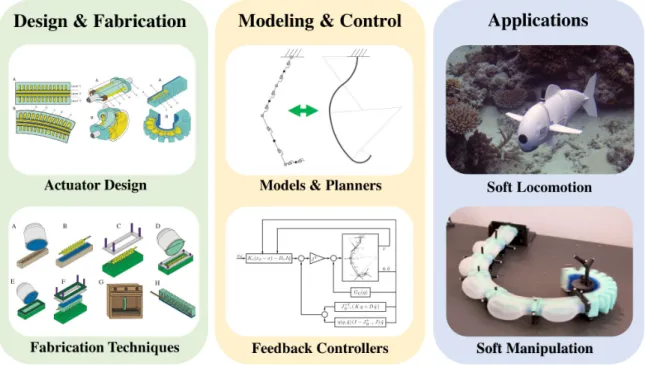
This thesis addresses some of the challenges described in Section 1.4 by innovating in design, fabrication, modeling and control. Those innovations are validation in applications for locomotion and manipulation. An overview of our approach to the challenges is given in Figure 1-1.
Figure 1-1: Overview of the thesis and our approach: The design and fabrication the soft robotic systems enables the creation of soft robots, for which we then develop models and controls specific to locomotion and manipulation tasks.
1.5.1
Overview of Our Approach
Our approach starts by understanding and describing the morphologies of soft actuators and the use of soft elastomer materials in the design and fabrication of these fluidically-driven soft actuators. Fluidically-fluidically-driven actuators are bodies made of soft rubber-like materials that have interior chambers for pressurization through fluids, such as air or
water. Under pneumatic or hydraulic pressurization, these chambers deform in a pre-designed manner to create desired deformations and motions. The fluidically-driven actuators are treated as combinable modules and can be embedded into self-contained, multi-module systems to bring them to practical use and test out models and controllers for such soft robots. We develop models for the actuation, kinematics, impedance, and dynamic characteristics of these continuously deformable soft systems. We leverage these models in the algorithms of motion planners as well as in the formulations of closed-loop feedback controllers. The closed-loop feedback controllers achieve dynamic motions and interactions with an environment. We create systems to apply the models and controllers to systems such as a soft robotic fish for underwater locomotion and an autonomously controlled soft manipulator for dynamic motions, surface tracing and grasping. In the following, we describe our approach for design, fabrication, modeling, and control. We then detail how we approach the experimental validation within soft applications.
1.5.2
Design and Fabrication
We study the design and fabrication of these soft robots and develop soft actuator morphologies, soft casting techniques, as well as pneumatic and hydraulic powering methods under closed-circuit fluid control [Marchese et al., 2015]. With a modular design approach we combine soft actuator morphologies into robotic systems [Marchese et al., 2014a, Katzschmann et al., 2015, Homberg et al., 2015, 2018, Katzschmann et al., 2018b]. We create a robotic fish for underwater locomotion, and soft manipulators, such as multi-finger hands and multi-segment arms, for the use in object manipulation and interaction with the environment. To enable the use of the soft actuator morphologies in underwater locomotion, we make robotic fish that uses a soft actuator as its tail to perform cyclic undulating swimming motion. The open-loop controlled swimming movement of the robotic fish prototype is enabled by a custom-made displacement pump and a custom-made buoyancy control unit, all embedded within a self-contained design mimicking a fish-like underwater robot [Katzschmann et al., 2014, 2016]. This underwater robot receives high-level control commands via acoustic signals in order to
move in coral reef environments and to film marine life [Katzschmann et al., 2018b].
1.5.3
Modeling and Control
To improve the use of the soft actuator morphologies for manipulation tasks and inter-actions with an environment, we develop models describing the geometry, kinematics, structural impedance, and the full dynamics. We make use of these insights for both model-free feedback control [Katzschmann et al., 2015, Marchese et al., 2014a] and model-based feedback control of the developed soft manipulators [Della Santina et al., 2018, Katzschmann et al., 2018c].
The model-free feedback controllers only use kinematics models and work in combination with geometric motion planners. The model-free feedback controllers enable a soft manipulator arm to move in confined spaces [Marchese et al., 2014a] and enable a soft arm with a gripper attached to it to autonomously perform pick-and-place operations of objects [Katzschmann et al., 2015].
Leveraging the models describing the impedance and dynamics of soft multi-segment arms, we propose controllers that are designed for performing dynamic arm motions and end-effector interactions with an environment [Della Santina et al., 2018]. The first controller aims to achieve dynamic trajectory following of curvatures. Curvatures are the deformations of each segment of a multi-segment arm. The second controller is an impedance controller that allows to control the position of the end effector in free space and to move along a surface, while staying in contact with that surface. Both controllers rely on a model linking the soft robot to a classic rigid serial manipulator with a parallel elastic mechanism. This model makes use of an augmented formulation that allows the application of control techniques developed for rigid robots to the use in the dynamic control of soft robots. Prior tools developed for the models of rigid robots [Ott, 2008, Sciavicco and Siciliano, 2012] can be exploited under this model formulation. We also evaluate the effectiveness of both dynamic controllers by assessing the characteristics of the controllers theoretically within the modeling hypotheses.
1.5.4
Control Demonstrated in Applications
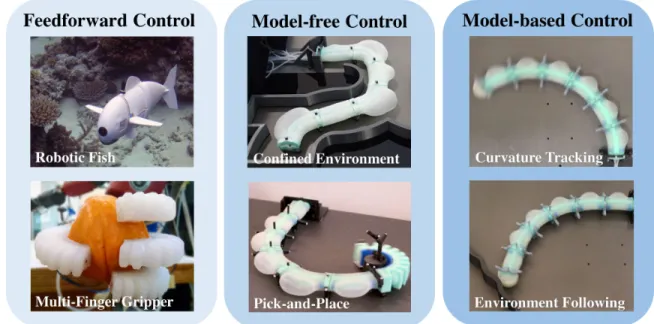
Figure 1-2: Applications of the soft robotic systems developed in this thesis. The systems are sorted by the control approach taken: Feedforward control, model-free control, and model-based control.
We demonstrate the developed soft systems, models and controllers in applications for locomotion underwater and manipulation on a plane. We depict these applications, sorted by their level of control complexity, in Figure 1-2. We design experiments with each system to demonstrate the successful use of the theoretical insights of this thesis. The soft robotic fish [Katzschmann et al., 2014, 2018b] and the soft hand [Homberg et al., 2015, 2018] perform feedforward control to achieve the task of swimming or object grasping, respectively. The model-free control and planning approaches are validated in experiments on a multi-segment arm for motions in a planar maze [Marchese et al., 2014a] and grasping on a plane [Katzschmann et al., 2015]. Finally, for a multi-segment arm, we show that we can dynamically control the arm’s deformations with minimal error and also control the same arm to interact with an environment by tracing along its surface without getting stuck [Della Santina et al., 2018].
1.6
Thesis Contributions
1.6.1
Overview of Contributions
Our key technical insights and contributions with this thesis are (i) a systematic description of the design, fabrication, powering, and use of soft elastomer materials in the design of driven actuators; (ii) an approach for embedding fluidically-driven actuators into fully self-contained systems for applications such as a soft robotic fish or soft manipulator arms; (iii) computationally tractable modeling approaches, describing the kinematics, impedance, and dynamic characteristics of continuously deformable soft manipulators; and (iv) validated motion planners and closed-loop feedback controllers for the performance of motions in confined environments, grasping objects, achieving dynamic motions, and interacting dynamically with environments.
Parts of the work on the design and fabrication and the work on the model-free quasi-static control in confined environments was developed in collaboration with Marchese [Marchese et al., 2014a, 2015]. This work is now documented in [Marchese, 2015] and the thesis here at hand. The work on the dynamic model-based control of multi-segment soft arms was developed with equal contributions by Della Santina and Katzschmann.
1.6.2
Contributions in Detail
In the following, we list out the detailed contributions, in order of the general structure of this thesis work.
1.6.2.1 Design and Fabrication
We contribute to the design and fabrication techniques of soft robots through the development and presentation of viable morphologies of soft fluidic actuator, soft fabrication techniques with focus on casting, as well as fluidic powering methods under closed-circuit control. We cover both pneumatics and hydraulics as fluidic powering methods. With a modular design approach we combine these soft actuator
morphologies into robotic systems. To be specific, the contributions are as follows:
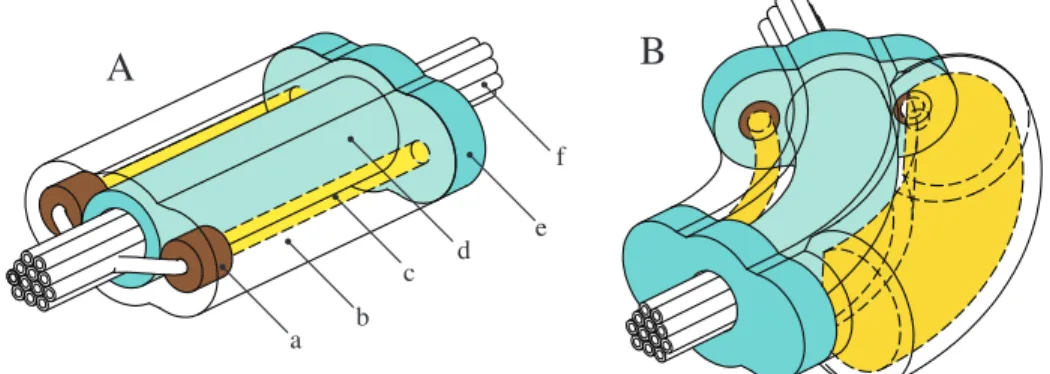
∙ We classify three viable fluidic elastomer actuator (FEA) morphologies. That is, an FEA with a (i) ribbed channel structure and embedded transmission lines, (ii) cylindrical channel structure and hollow interior, (iii) seamless pleated channel structure.
∙ We present three fabrication processes to reliably manufacture these FEAs. These are (i) a lamination-based casting process with heterogeneous embedded components, (ii) a retractable-pin-based casting process, (iii) a lost-wax-based casting process.
∙ We further present the design, powering and fluidic control of soft robots built for locomotion and manipulation using these design and fabrication approaches.
∙ The resulting soft robots are (i) a soft robotic fish with an undulating soft tail and custom pump mechanism for cyclic undulation of the tail for underwater locomotion; (ii) a modular, proprioceptive soft hand that has integrated bend and force sensors; and (iii) a set of soft multi-segment manipulator arms for reaching in confined spaces, pick-and-place, and dynamic interaction tasks.
1.6.2.2 Applications for Biomimetic Swimming
We present the full integration of an end-to-end system that locomotes in a biomimetic manner underwater, is remote controlled, and can serve as an underwater observatory for the study of marine life. This biomimetic soft robotic fish is able to swim along three-dimensional trajectories with the use of its soft tail and a buoyancy control system. The application is to observe the biocenosis of coral reefs in the ocean. The key contributions of this robotic fish prototype are:
∙ 3D controllable motion for prolonged operation underwater;
∙ autonomous depth control via dive planes and a miniaturized piston-based buoyancy control unit;
∙ underwater remote control via a miniaturized end-to-end acoustic communication system;
∙ performing at depths of 0 to 18 m, as evidenced by ocean experiments.
1.6.2.3 Model-Free Control
We show that planar manipulation with a completely soft fluidic elastomer manipulator is possible and provide an approach for the planning and model-free closed-loop control of the arm’s motion:
∙ A planner for whole body continuous motion of a soft planar manipulator that considers the tasks of controlling the pose of the end effector while avoiding collisions between the soft arm’s bulging skin and a confined environment. ∙ A planning algorithm to grasp-and-place randomly positioned objects on a planar
surface using a seven-DOF soft manipulator.
∙ A closed-loop configuration control for a soft fluidic elastomer robot consisting of (i) a kinematic model and an algorithm for estimating the manipulator’s configuration in real-time, (ii) a novel device for providing continuous, closed-circuit adjustment of the manipulator’s fluid, and (iii) a cascaded curvature controller for the execution of the motion plans.
1.6.2.4 Model-Based Control
We realize dynamic, model-based control of soft robots. We contribute a closed loop dynamic feedback controller for a continuous soft robot capable of:
∙ dynamically tracking desired segment deformations over time; ∙ moving in Cartesian space and compliantly tracking a surface.
This is enabled by a dynamic model we call the augmented formulation. The augmented formulation links a soft robot to a classic rigid-bodied serial manipulator and enables the application of classical control techniques and insights to the control of soft robots.