Working Paper Series
ESD-WP-2005-09
A
NALYSIS OF THE
M
ALAYSIAN
T
OLL
R
OAD
P
UBLIC
-P
RIVATE
P
ARTNERSHIP
P
ROGRAM AND
R
ECOMMENDATIONS FOR
P
OLICY
I
MPROVEMENTS
John L. Ward
1and Joseph M. Sussman
21IBI Group
2JR East Professor of Civil and Environmental Engineering and Engineering Systems Division, MIT
Abstract
Malaysia has relied on toll road public-private partnerships (PPPs) for over twenty years to provide important highway infrastructure. The program has been active with nearly 1800 kilometers either constructed or concessions agreed to. The public has been less supportive of the program due to low transparency and little public involvement. Public protests are common, which may lead to long-term program instability. The CLIOS Process, developed at MIT, is applied to Malaysia’s toll road PPP program to develop new policies that can better meet these public concerns while maintaining the financial viability of the sector. With increases in transparency and public involvement, the political risks of the program should be reduced and long-term stability for the government and concessionaires improved. We argue that the focus should be at the regional transportation planning level where toll road PPPs can be compared with alternatives for meeting transportation needs rather than at the national level where Malaysian toll road PPPs are currently handled.
INTRODUCTION
In 1983, Malaysia shifted its policies from emphasizing state ownership of enterprises to advocating privatization of state industries, including roads. Since then, the government has relied heavily on toll road public-private partnerships (PPPs) to achieve its highway expansion goals. In the past two decades, 1800 km of toll roads have either been constructed or concession agreements signed with the private sector for their construction, providing much of the highway expansion over this time. In this regard, the program is successful and it is expected that the government will continue to rely on toll road PPPs.
The program is not without controversy. The lack of transparency in the concessionaire
selection process has led to accusations of cronyism. Public involvement is minimal during this process, also. This has resulted in protests over tolls with the government reducing or delaying planned increases, especially in the wake of the 1997 Asian financial crisis. Continuance of these policies could lead to destabilization of the toll road PPP sector as political opponents take advantage of public dissatisfaction.
This paper has two purposes. First, it recommends alternative policies for the Malaysian toll road PPP program that are expected to strengthen its long-term prospects. These
recommendations were developed as part of broader research into Malaysia’s toll road program in Ward (1) using the CLIOS Process, discussed later in this paper and described in Dodder, et al.(2), and Sussman, Sgouridis, and Ward (3). Second, the Malaysian experience can serve as an example for the United States as it expands the use of toll road PPPs over the coming years. Several topics will be covered in the paper. First, a general PPP background and framework are developed for analyzing a toll road PPP program. The Malaysian PPP program is then described including its history, strengths, and weaknesses. A discussion of the CLIOS Process, the results of its application, and suggestions for improvements to the Malaysia toll road PPP program, both at the national policy and project deployment levels, follow.
PUBLIC-PRIVATE PARTNERSHIP BACKGROUND
Toll road PPPs are arrangements where the private sector takes more responsibility for designing, constructing, financing, operating, or maintaining a road than under traditional arrangements. A common arrangement is the Build-Operate-Transfer (BOT) or Design-Build-Finance-Operate (DBFO) model where the private sector will finance the construction,
operation, and maintenance of a road using toll revenue to recoup costs for a specified time period. Other arrangements are possible like the Operations and Maintenance (O&M)
arrangement for the Chicago Skyway which is being leased to the private sector for 99 years in exchange for $1.8 billion (4). While toll road PPP’s have only recently been used in the United States, they are common in many other countries, particularly, but not exclusively, in the developing world.
Benefits
Financial benefits are chief among the reasons for using toll road PPPs. More infrastructure can be provided by cash-strapped governments by involving the private sector. The lifecycle costs should also improve since the same company will be responsible for construction, operations,
and maintenance costs rather than in traditional arrangements where the construction company’s concern over long-term maintenance costs are secondary. An O&M lease similar to the Chicago Skyway’s lease can also provide needed funds to the government.
Equity investment in a toll road PPP can improve the long-term financial stability of the road compared to a government toll road which may rely solely on bond funding. Equity provides a repayment cushion. If revenue is lower than projected, the initial losses are incurred by the equity investors while bondholders may still be receiving their payments as scheduled (5). The tradeoff is that the equity investors will expect a greater return on their investment than the bondholders but the added stability may be well worth the cost given the high risk associated with revenue projections.
Private sector operation can reduce political considerations that prevent the toll road from operating at high efficiency. Maintenance often gets short shrift when budgets are tight and deferring it can further increase the cost. By separating maintenance from government budgetary processes, it can be performed on a cost efficient schedule using toll revenue. Toll increases also lag when requiring government approval since politicians are hesitant to incur voter anger over the increases despite bond payment problems that may occur from insufficient revenue (6). The private sector will be more willing to raise tolls although concession agreements may limit their ability to do so.
The greater financial incentives will also increase the concessionaire’s incentive to be innovative in road operation. California Route 91 and Toronto’s 407 ETR are two examples where
innovation occurred to enhance road efficiency and provide greater value to the customer (7).
Costs
A political cost may be created, depending on public attitudes towards toll road PPPs. A public accustomed to free roads will be wary of any toll road proposal, especially private sector roads since the public’s perception may be that tolls are unnecessarily high to line the concessionaire’s pockets. The public may prefer a government run toll road with the expectation that tolls would only go to paying for road construction or other transportation projects. Politicians supportive of toll road PPPs could suffer at the polls as opponents take advantage of public opinion. Of
course, increasing necessary tax revenue for roads through other means will be unpopular too but as the costs are more diffuse, the level of political activity likely will be less than when the costs are concentrated on a specific, narrow population (8).
With multiple concessionaires, creating a standardized, integrated road network may become more difficult. While Gomez-Ibanez and Meyer (9) note the issues surrounding physical design and price standardization, an increasing issue with the growth of Intelligent Transportation Systems is operational integration and standardization. Concessionaires will pursue strategies that improve revenue and these may not always be consistent from the customer’s point of view. Malaysia’s Electronic Toll Collection (ETC) problems demonstrate what may occur. Several concessionaires in around Kuala Lumpur deployed ETC systems to improve operations.
Unfortunately, they used different standards, requiring customers to use numerous transponders to navigate the toll road system (10). This has only been recently resolved by government decree with the Touch ‘N Go system.
Risks
Toll road PPP’s are accompanied by a set of risks that must be balanced between the public and private sectors to provide the best social value. Indeed, the principle behind PPPs is that they are a mechanism for equitably and effectively sharing various kinds of risk. The government’s goal should not be to simply transfer as much risk as possible to the private sector. The goal should be to create an arrangement that satisfies both government and private sector goals in such a way that both parties are better off than they would be without a PPP arrangement. This may mean the government shoulders some risk to achieve goals beyond economic efficiency. Much risk should be transferred to the private sector but the government must remember that this must be accompanied by a commensurate possibility of reward. The ideal amount of risk to transfer is often difficult to determine but some general rules apply.
Major risk categories include revenue risk, construction risk, financial risk, and political risk. Revenue risk is the risk that toll revenue will be insufficient to meet financial obligations. It is the major component of total risk and is typically borne by the private sector. Construction risk is caused by construction delays and cost overruns for which the private sector is responsible. Exchange rate risk and the debt/equity structuring of the PPP are part of financial risk with most risk borne by the private sector. Political risk covers a plethora of risks such as changes in regulations, governments, and public opinion that may have significant impact on the
performance of the PPP. There is not a standard division of political risk between public and private sectors. Spain is moving towards placing most risk for regulatory change on the private sector (11) while Malaysia compensates its concessionaires if it does not permit increases in tolls that are in the concession agreement (12).
While many of these risks are transferred to the private sector in a PPP, the government may assume some of the risk to achieve its goals. For example, domestic capital may be insufficient to meet the goals of an ambitious expansion program while the necessary level of foreign investment may create a greater than desired exposure to exchange rate risk. The government may provide guarantees to limit exchange rate exposure to draw in the necessary capital at an acceptable cost to the private sector, transferring the additional costs to taxpayers. The government could also assume revenue or political risks to ensure social and environmental goals are met. For example, the government may provide low interest loans to prevent tolls from making too great an impact on low income groups.
Supportable PPPs
A successful toll road PPP program must account for these factors and balance the needs of the public with the goals of the private sector. To this end, toll road PPP programs should try to meet several principles for long term success:
• A supportive, transparent institutional framework is necessary. Concessionaires must know that the government will meet their agreements while the public must be confidant that the process has produced a fair outcome.
• Risk should be allocated to the party best positioned to manage them as can best be determined, given the government’s goals.
• The government should minimize the use of subsidies unless it is the only way to build a needed road or if there are more urgent social needs. Toll road investment is a risk and
that risk includes significant financial losses. A corollary is that the private sector should have the opportunity for greater than expected returns.
• The public must be involved in the process. The public can ruin a partnership if neither public sector nor private sector involves them meaningfully in the process.
• The government should support innovation by integrating it into their bid procedures. Permitting innovative, unsolicited proposals is one method to promote innovation.
MALAYSIA’S TOLL ROAD PPP PROGRAM
With a framework established for understanding toll road PPPs, we turn to Malaysia which has relied on toll road PPPs for major highway infrastructure for over two decades. General national characteristics and a brief historical background are provided to help the reader understand how the toll road PPP program was created and why certain policies were chosen. Then, the toll road PPP policy and proposal process is described using the concepts of the previous section. Finally, the program’s strengths and weaknesses are provided.
Malaysia is a nation in Southeast Asia slightly larger than New Mexico with two major geographic areas. Most of the population of 24 million lives on Peninsular Malaysia, to the south of Thailand, and most economic activity occurs there. The states of Sabah and Sarawak lie on an island to the east shared with Indonesia and while the states are a sizable portion of
Malaysia’s total area, their population and economic importance is modest.
The ethnic makeup of Malaysia consists of ethnic Malay (referred to as Bumiputera) at 58% of the population, Chinese with 24%, and Indians making up most of the remainder. The economic shares of each group are far different, which has driven many key policies since the late-1960s. In 1970, Bumiputera controlled a mere 4% of corporate assets while the Chinese owned most of the 34% of assets held by non-Bumiputera Malaysians (13). Race riots erupted in 1969 between the Bumiputera and Chinese over equity issues such as this economic imbalance.
History
The government’s response to the 1970 riots was to launch the New Economic Policy in 1971. One part of this policy was the stated goal to reach corporate equity ownership levels of a
minimum 30% Bumiputera and 40% other Malaysian and a maximum 30% foreign ownership, a goal which remains to this day. Another major part of this policy was to improve the economic competitiveness of Bumiputera. The principal means for this was reliance on state-owned enterprises (SOEs) with preferential employment for Bumiputera to develop their technical and managerial skills.
This strategy ended in the early-1980s when Mahathir bin Mohammed became prime minister. First, many SOEs were performing poorly while requiring large amounts of public resources and the government felt competition was needed to fix this (14). Second, the government expected that the greater managerial work experience among Bumiputera developed over the past decade would allow them to be more competitive. A policy titled “Malaysia Incorporated” was
introduced in 1983 with the privatization of SOEs as the centerpiece. One requirement was that the equity of newly privatized entities must meet the 30% Bumiputera, 40% other Malaysian, 30% foreign equity ownership requirement. The government could own equity in trust for the Bumiputera.
The Malaysian government included toll road PPPs along with other parts of the transportation system such as ports and public transit in the privatization policy. There are approximately 24 toll road PPPs that have either been completed or concession agreements signed, providing nearly 1800 centerline kilometers. Many are in the country’s economic and political center, the Kuala Lumpur Metropolitan Region (KLMR), but PPPs are also used for interurban service and in some of the other cities.
Malaysia created an institutional and legal framework supportive of toll road PPPs. The primary law for toll road PPPs is the Federal Roads (Private Management) Act of 1984 which permits private companies to collect and retain tolls on federal roads. This law is administered by the Prime Minister’s Economic Planning Unit (EPU) and its Privatization Committee. The law provides much latitude to the EPU in its implementation.
The Proposal Process
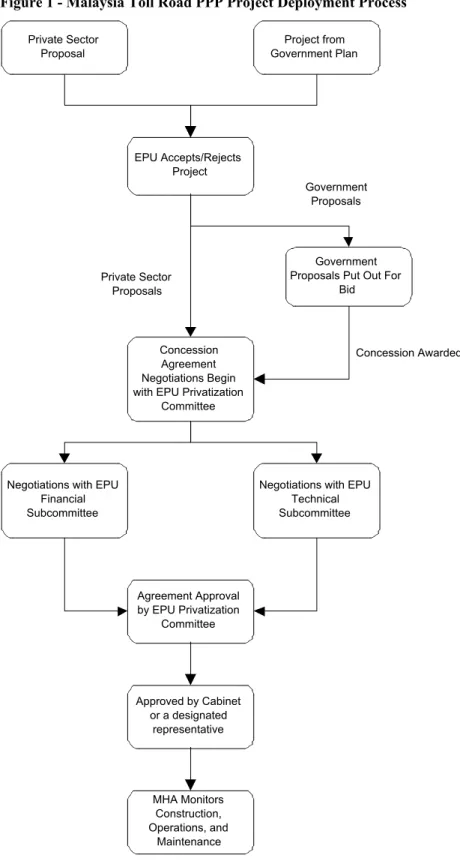
As shown in Figure 1, proposals for a toll road PPP may come from two sources: government plans or private sector proposals. There are no limits on the types of road proposals that may come from the private sector, a policy characterized as “first-come, first-served” but the
government may reject ones that do not meet government goals. For government proposals, the government may select the companies allowed to bid rather than have a fully open competition. Once the concession is awarded, the concessionaire will negotiate a contract with both technical and financial subcommittees of the EPU’s Privatization Committee. After the agreement is signed, the Malaysia Highway Authority (MHA) monitors construction, operations, and maintenance for the government.
The concession agreement is not rigid for the life of the contract; renegotiations are common due to changing economic conditions, such as the Asian financial crisis in 1997, or unfavorable public opinion. Reductions in expected future income for the concessionaire due to the
renegotiations are compensated for by the government. Cash payments and an extension of the concession period are the two most common forms of compensation. The government has also used construction contracts for untolled, non-PPP roads or the award of additional concessions. In comparison to planning processes in the United States, Malaysia’s has much less public participation and transparency and a weaker environmental approval process. Public
participation is not required for the process. According to the website for one embattled project, the Penang Outer Ring Road (PORR), it was the first toll road PPP to include public
participation during the approval process, occurring in the 2002-2003 timeframe (15). The process is also secretive, aided by the Official Secrets Act of 1986 which permits the government to classify a wide variety of documents. If there is a competition, the evaluation criteria are not always clear and historically they have been used to reward politically connected
concessionaires. The largest concession, the North-South Expressway, was awarded to the firm with the third lowest proposed toll (16). At the time, this firm was owned by the leading political party, UMNO (17). Environmental damage does not appear to prevent a toll road from being approved although the process seems to concentrate on finding an acceptably low damage solution with the proviso that the road will be built.
Figure 1 - Malaysia Toll Road PPP Project Deployment Process Private Sector Proposal Project from Government Plan EPU Accepts/Rejects Project Government Proposals Put Out For
Bid
Concession Agreement Negotiations Begin with EPU Privatization
Committee
Government Proposals
Private Sector Proposals
Negotiations with EPU Financial Subcommittee
Negotiations with EPU Technical Subcommittee Agreement Approval by EPU Privatization Committee Approved by Cabinet or a designated representative MHA Monitors Construction, Operations, and Maintenance Concession Awarded
Strengths and Weaknesses
Malaysia’s toll road PPP program displays several strengths. The most obvious strength is that the government has used the toll road PPP program to provide a lot of infrastructure despite the
support for the program from the conception of the road to its operation. The private sector can propose toll roads rather than waiting for a government proposal, which increases the rate of network expansion and resulting economic development. It is unclear how detailed the proposals need to be or if the government merely approves or rejects the proposal or if it may modify the proposal with the private sector company before approving or rejecting. The EPU is given flexibility in negotiating the terms of the contract so that the project can be feasibly carried out. If conditions drastically change to the disadvantage of the concessionaire, the government is usually willing to renegotiate the terms of the contract. Institutional roles are clearly delineated; the EPU handles all proposals, coordinating as needed with other departments, and the MHA monitors the post-negotiation phases.
While Malaysia’s program has been successful in providing hundreds of kilometers of needed roads, it also has a few weaknesses which may impact the long-term stability of the sector. The chief weaknesses involve the management of political risk with the low transparency and minimal public involvement throughout the process. This breeds the belief that the concessions are awarded based on political connections rather than societal benefit. Protests have occurred that forced the government to limit proposed toll rate increases and to renegotiate agreements with concessionaires (18). Since the government compensates the concessionaire for foregone revenue, the result is to shift some of the financial burden from users to taxpayers at large. There are some other weaknesses with Malaysia’s process that are linked to the previous two problems. However, the lack of transparency does make it difficult to determine their extent. Financial viability may have greater importance in decision-making than the road’s place within an integrated regional transportation network. This may result in more highway infrastructure than desirable since the government can have it built without using its own funds unlike other transportation infrastructure. The award criteria are also difficult to discern. The prime criterion is assumedly the lowest toll but the minimal transparency and past decisions such as with the North-South Expressway make this assumption questionable.
DIAGNOSIS BASED ON CLIOS PROCESS
An alternative to existing Malaysian toll road PPP policies was developed using the CLIOS Process (2)(3). This process is intended to tackle complex, sociotechnical problems in an
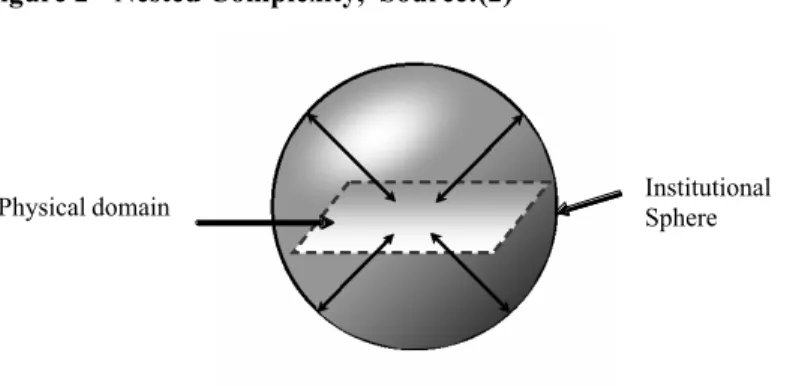
integrated manner. Its approach to systems is to view them as a physical “domain” nested within an institutional “sphere”, as shown in Figure 2, and that strategic alternatives that are chosen to change the outcome of the system can involve either the physical domain or institutional sphere. We applied the CLIOS Process to Malaysia’s toll road PPP program, considering the realities of the political situation.
As shown in Figure 3, the CLIOS Process has three stages encompassing 12 steps. The first stage involves representing the physical system and institutional sphere so that relationships between components, feedback loops, or other interactions can be recognized. With a system representation in hand, the process continues to the next stage where strategic alternatives are
designed and evaluated based on the system representation. A robust bundle of strategic
alternatives is then selected that should perform reasonably well across a variety of scenarios. The final stage involves implementing the strategic alternatives in both the physical domain and
on the institutional sphere, monitoring their performance, and preparing to go through the
process again based on the results. The quantitative and qualitative tools required for the process will depend on the system under analysis.
Figure 2 - Nested Complexity, Source:(2)
Institutional Sphere Physical domain
In order to apply the CLIOS Process as a diagnostic tool for toll road PPPs, it was necessary to conceptually divide the toll road PPP program into two parts and then apply the CLIOS Process separately to each part. First, a general Malaysian toll road PPP policy, dubbed here “Enabling PPP Policy” and similar to federal legislation in the United States, must be developed that
delineates the conditions under which a PPP may be used. This drives the creation of a legal and institutional framework that is consistent with the aims of the policy. Concerns for the Enabling PPP Policy may include transparency, foreign financing requirements, the ability of domestic markets to support large scale toll road PPP programs, and even equity distribution between ethnic groups. The second part of the program is called here “PPP Project Deployment”. This part involves choosing projects and structuring their concession agreements in a way that is consistent with both the Enabling PPP Policy and with the objectives of the transportation plan. Public support, specific financing structures for the project, right-of-way acquisition, and toll rate regulation will be of more importance here. In both parts, the context is that the government agencies can use the CLIOS Process to develop new policies in place of their existing processes.
Enabling PPP Policy
Key steps in the development of the new Enabling PPP Policy using the CLIOS Process include developing the issue checklist, refining the system goals with the aid of selected performance measures, and representing the institutional sphere so that institutional issues could be identified more quickly. These steps are expected to raise the priority of issues like operations, ITS technology, and economic development by better understanding how the transportation system works and how it interacts with the traveler and other areas of society. Selection of strategic alternatives was aided by the refined goals with an eye towards ease of implementation and expected performance. The institutional sphere representation was also helpful in selecting strategic alternatives that are expected to be acceptable politically rather than selecting purely on technical performance.
The following strategic alternatives were chosen for the Enabling PPP Policy in the first
application of the CLIOS process. Other alternatives were considered but the ones selected are expected to provide a robust, well-performing policy package. Most of these strategic
alternatives are targeted towards managing the toll road PPP program’s political risk. An in-depth discussion of why these alternatives were selected is provided in Ward (1):
Selected Strategic Alternatives:
• Any PPP arrangement is permitted – DBFO, O&M, etc.
• Open competition is required for non-innovative toll road PPPs with published selection criteria and the release of the relevant information from each proposal for the selection criteria. Enough information must be provided to reassure the public that the process is fair.
• Private sector toll road proposals will be accepted if the government deems them innovative.
• Toll road PPPs must comply with standards for ETC, ATIS, and CVO technologies to ensure efficient system operation.
5. Seek Insights about System Behavior
6. Identify Performance Measures, Refine System Goals, and Build
Quantitative Model 7. Identify and Design
Strategic Alternatives for Performance Improvements
8. Flag Important Areas of Uncertainty Structure Behavior IMPLEMEN TA TION DESIGN, EVALUATION AND SELECTION R EPR ESEN TA TION
4A. Describe Components on the Physical Domain and
Organizations on the Institutional Sphere
4b. Describe Links Among Components And Organizations
10. Design Strategy for Implementation in the Physical Domain and Implement
11. Design Strategy for Implementation in the
Institutional Sphere and Implement 12. Post-Implementation Evaluation
and Modification
9. Evaluate Strategic Alternatives And Select Robust Bundles That Perform “Best” Across Uncertainties
3. Populate the Physical Domain and the Institutional Sphere on the CLIOS Diagram
2. Identify Major Subsystems of the Physical Domain and Major Actor Groups
on the Institutional Sphere 1. Describe System: Issue Checklist and
• Stakeholders including citizen groups, shippers, and carriers, will be allowed to participate in a non-binding manner in the technical design phase of PPP Project Deployment. Other stakeholder involvement is optional.
• A quick environmental assessment must be successfully completed before environmental approval negotiations can begin and a comparison with the no-build alternative will be part of this assessment. An in-depth investigation will be done during the technical design phase.
• The minimum 30% Bumiputera/ maximum 30% foreign equity ownership requirement remains.
• The PPP Project Deployment process is handled at the regional level.
This selection of alternatives still provides considerable flexibility to the government for the PPP Project Deployment process and should also be more acceptable to the public than the current process. The Enabling PPP Policy should increase the value to society of the projects developed using the revamped PPP Project Deployment process, to be discussed next, by recognizing the need for local involvement in the process while still providing a wide range of alternatives for the agency managing the PPP Project Deployment process. With this flexibility and expected public acceptance, the Enabling PPP Policy should be robust enough to perform well in a variety of future scenarios.
Given Malaysia’s toll road history, the policy’s allowance for innovative toll roads may be problematic. It should be permitted as an incentive to the private sector to develop new ways for meeting transportation needs. It should not be a loophole to reward companies but given past occurrences, the public may view it as such. A credible agency would need to have oversight over determining if a proposal is innovative and the EPU probably does not have this.
Unfortunately, space limitations do not permit us to fully explore this issue here. While innovative proposals should be encouraged, the focus for the rest of this paper will be on toll road PPPs that come from government plans.
PPP Project Deployment
With an Enabling PPP Policy in place, PPP Project Deployment can be explored. Two assumptions made for this process are that:
1) Toll road PPP decisions are now made during regional strategic transportation planning (RSTP)
2) The CLIOS Process is used for RSTP, as described in Sussman, Sgouridis, and Ward (3).
For the first two stages of the CLIOS Process, toll road PPPs are treated as one of many possible strategic alternatives. Once the transportation planning agency decides to use a toll road PPP, the focus becomes how to deploy the toll road PPP in a manner consistent with the aims of the Enabling PPP Policy. In this section, we consider how this may occur in a generic manner for Malaysia as well as applying it to the Kuala Lumpur Metropolitan Region (KLMR) to provide a concrete example.
Kuala Lumpur, Malaysia’s capital, is Malaysia’s top metropolitan area with a regional
government center outside Kaula Lumpur’s city limits called Putrajaya; the creation of a technology development center named Cyberjaya, a Malaysian version of Silicon Valley, near Putrajaya; and the 7-year old Kuala Lumpur International Airport. This region includes portions of the state of Selangor as well as the Federal Territory of Kuala Lumpur, increasing the
institutional complexity.
An important first step even before applying the CLIOS Process is to identify the agencies involved with RSTP and PPP Project Deployment. As noted earlier, the current toll road PPP program is run by the Prime Minister’s EPU. While this ensures uniformity throughout the country, it can lead to an emphasis on national concerns at the expense of regional issues. This will foster some regional distrust of the process. By distributing decision-making power to regional transportation planning agencies, toll road PPPs should better meet regional concerns while also being better integrated into the regional transportation network, one reason the new Enabling PPP Policy shifts it to the regional level. For most of Malaysia’s metropolitan regions, State Planning Committees (SPCs) are the appropriate agencies for this planning work. KLMR is a special case due to its multi-jurisdictional nature. A regional transportation agency that coordinates the actions of the Federal Territory of Kuala Lumpur with the State of Selangor is more appropriate for ensuring regional concerns are met.
This shift in decision-making power will surely face institutional resistance from federal
agencies. Given the modest resources given to SPCs and the proposed KLMR planning agency, the EPU and other national agencies will still play an important role which may reduce some of the resistance. As pointed out by Naidu and Yaacob (19), the EPU has the experience in
negotiating concession agreements and inexperienced state or regional negotiators may produce worse results for the public without the EPU’s assistance. The Ministry of Natural Resources and Environment will influence the environmental approval process for PPP projects thanks to the requirements of the Enabling PPP Policy. If government financial support is needed, it will be requested through the Ministry of Finance since individual states do not have the financial resources for their own PPPs. The multi-jurisdictional nature of KLMR further complicates these issues. These arrangements will give the national government an influential role over the proceedings but greater regional decision-making power should ameliorate local concerns. The RSTP process covers long-term transportation concerns, similar to the long-range transportation plan created by Metropolitan Planning Organizations in the United States; of course, they are concerned with more than just toll road PPPs. The Representation Stage for RSTP is unchanged with the inclusion of PPP Project Deployment. In the Design, Evaluation, and Selection stage, toll road PPPs would be handled as one strategic alternative that can be compared with a free road, a government toll road, transit, or others of that nature. The strategic alternative that best meets the needs of the region in a robust manner should be chosen. While the ability to have the private sector, and thus toll road users, pay for it should be considered, it should not be the only factor in the decision.
The main changes caused by including PPP Project Deployment in RSTP are during the
Implementation stage. Given that a toll road PPP is the chosen strategic alternative, it is put out for bid using the procedures developed in the Enabling PPP Policy, including requirements for
transparency and public participation. Once a winner is selected using the award criteria made public per the Enabling PPP Policy, the regional transportation agency would handle concession agreement negotiations with the winner. The EPU would provide significant help to ensure that a deal is reached that is expected to meet both public and private sector goals in a financially acceptable manner. Construction and operation would be monitored by the MHA to ensure that the terms of the concession agreement are met, although these functions, particularly operations monitoring, may eventually be assumed by regional agencies. If the concessionaire wishes to renegotiate the concession agreement due to unforeseen, drastic changes in operating conditions, it would have to meet with the regional transportation agency to discuss its concerns.
Appropriate national agencies would be involved depending on the subject of the renegotiations. A critical change for the new PPP Project Deployment process will be a more robust stakeholder involvement process. Currently, there is no requirement for the public to be involved in the process. The Penang state government claims that the public involvement process for PORR was the first of its kind in Malaysia (15). This type of involvement where the public is allowed to comment on the project for a period of time should be replicated elsewhere. These comments should be treated as advisory. This low level of public involvement may be acceptable to the government whereas pursuing anything further would meet too much political resistance as it threatens the government’s decision-making power. Stakeholder involvement also implies that stakeholders such as freight carriers and other affected businesses should be included but the current government seems to meet their needs adequately already.
Another proposed change involves transparency. As noted earlier, the existing process is fairly secretive. Given this behavior, achieving a level of transparency similar to the United States would be difficult due to institutional resistance. Mild improvements in transparency such as making public the award criteria and the information from each bid related to those criteria should improve public confidence in the process.
Benefits and Costs of the New Process
With the additional transparency, the political and financial performance of the sector should improve. Financially, more companies will be able to compete for toll roads as the process becomes less constrained by political considerations. The ethnic ownership and limited foreign ownership requirements will limit full competition between potential concessionaires but these are necessary in the near term to achieve other government goals.
With greater transparency and public involvement, political risk should be reduced. This risk has been problematic for the toll road PPP program as toll increases have been limited due to public pressure, leading to compensation from the government to the concessionaires. As the public has a greater voice in the process and has greater exposure to the reasons behind certain decisions, their mistrust of the program should lessen. Proposed toll increases may still be reduced or delayed in the future but with greater public knowledge of the workings of the program, these events should be less frequent. This arrangement should keep the revenue risk with the private sector rather than shifting some of the burden to taxpayers-at-large as happens with guaranteed compensation.
concessions to favored companies, these companies will use their political influence to prevent increases in transparency or public involvement. The power to award concessions provides key politicians a lever to gain support from the business community and these politicians will fight to retain this lever. Government officials involved in concession negotiations or the regulatory process may not like sacrificing the flexibility to do as they see fit and will also work to prevent the changes or they may not follow the spirit of the new policies.
The increased public involvement could lead to cost increases from design changes that far exceed gains from additional competition. The higher costs could make the investment unwise, reducing the total infrastructure built as a few potential toll roads would not be expected to generate the necessary revenue. Political sensitivity is difficult to determine but in difficult economic times or if the majority party is declining in power, it should be expected that public concerns will be given more importance even if technically or financially unwise. This is not to say all additional costs should be avoided; some may be due to the internalization of costs that were previously externalities.
CONCLUSION
Malaysia has relied on toll road PPPs to provide necessary highway infrastructure for over two decades. The program is successful overall but there are some problems due to the lack of transparency and low public involvement that pervades the program. This has led to reductions or delays in proposed tolls, although the government has reduced this risk by providing
compensation to the concessionaire. While these actions may build confidence in the program by the private sector, it may also distort the financial risk to investors. This policy may also be an expensive way for the government to manage political risk.
Given the direct financial impact on travelers, the government must ensure that a toll road PPP program operates in a transparent manner. This will reduce the long-term risk to the sector from political instability. This has only been a minor issue in Malaysia due to the large amount of power held by the national government and the amount of deference accorded it by the public. The Malaysian approach would be more problematic in nations where the national government had less power or the public held less trust in government actions.
New policies developed using the CLIOS Process are proposed in this paper to meet Malaysia’s challenges that are also intended to be consistent with the political climate. Greater
transparency, more public involvement, and the shift in decision-making power to regional or local agencies are the three major changes. While not nearly as strong as similar policies in the United States, the proposed changes should increase public confidence in the government’s decisions and the long-term stability of the toll road PPP industry in Malaysia.
REFERENCES
(1) Ward, John L. Toll Road Public-Private Partnerships in Malaysia: Using the CLIOS
Process for Policy Improvements. Master’s Thesis. Massachusetts Institute of Technology.
May 2005.
(2) Dodder, Rebecca, et al. The Concept of the “CLIOS Process”: Integrating the Study of Physical and Institutional Systems Using Mexico City as an Example. Unpublished Manuscript. 26 January 2005.
(3) Sussman, Joseph, Sgouris Sgouridis, and John Ward. A New Approach to Transportation
Planning for the 21st Century: Regional Strategic Transportation Planning as CLIOS.
Accepted for Publication in the Transportation Research Record: Journal of the
Transportation Research Board. TRB Paper Number: 05-0051.
(4) Spielman, Fran. Privatizing Skyway to Bail Out City. Chicago Sun-Times, Oct 16, 2004, News, Pg 3.
(5) Poole, Robert. The Orange County Toll Roads: Largely Successful. Policy Brief 38, Reason Foundation, March 2005.
(6) Samuel, Peter. Should States Sell Their Toll Roads? Policy Study 334, Reason Foundation, May 2005.
(7) Miller, John B. Principles of Public and Private Infrastructure Delivery. Boston: Kluwer Academic Publishers, 2000.
(8) Olson, Mancur. The Rise and Decline of Nations: Economic Growth, Stagflation, and
Economic Rigidities. New Haven: Yale University Press, 1982.
(9) Gomez-Ibanez, Jose A. and John R. Meyer. Going Private: The International Experience
with Transport Privatization. Washington D.C.: The Brookings Institution, 1993.
(10) Lin, Sandi. An Institutional Deployment Framework for Intelligent Transportation Systems. Master’s Thesis. Massachusetts Institute of Technology, May 2003.
(11) Vassallo, Jose M. and Juan Gallego. Risk-sharing in the New Public Works Concession
Law in Spain. Presented at 84th Annual Meeting of the Transportation Research Board,
Washington, D.C., 2005. TRB Paper Number 05-0459.
(12) Padeco Co., Ltd. Asian Toll Road Development Program: Review of Recent Toll Road
Experience in Selected Countries and Preliminary Tool Kit for Toll Road Development.
Prepared for the World Bank and Japan Ministry of Construction. May 1999.
(13) Adam, Christopher and William Cavendish. Background. Privatizing Malaysia: Rents,
Rhetoric, Realities. Ed. Jomo K.S. Boulder: Westview Press, 1995. 11-41.
(14) Mohamed, Rugayah. Public Enterprises. Privatizing Malaysia: Rents, Rhetoric, Realities. Ed. Jomo K. S. Boulder: Westview Press, 1995. 63-80.
(15) Welcome to PORR – Our Side of the Story. Penang State Government..
http://porr.penang.gov.my/. Accessed Feb 19, 2005
(16) Kuppusamy S. Employee Welfare. Privatizing Malaysia: Rents, Rhetoric, Realities. Ed. Jomo K.S. Boulder: Westview Press, 1995. 172-196.
(17) Gomez, Edmund Terence and Jomo K.S. Malaysia’s Political Economy. Cambridge: Cambridge University Press, 1999.
(18) Abdul-Aziz, A.R. Privatisation of Highways in Malaysia: The Peril of not Consulting End-Users. International Journal for Construction Marketing 3.2, March 2002.
http://www.brookes.ac.uk/other/conmark/IJCM/Vol3-1/Vol3-Issue2/Papers/
Infrastructure: The Malaysian Experience. Choices for Efficient Private Provision of
Infrastructure in East Asia. Ed. Harinder Kohli. Washington D.C.: The World Bank, 1997.