Publisher’s version / Version de l'éditeur:
Vous avez des questions? Nous pouvons vous aider. Pour communiquer directement avec un auteur, consultez la première page de la revue dans laquelle son article a été publié afin de trouver ses coordonnées. Si vous n’arrivez pas à les repérer, communiquez avec nous à [email protected].
Questions? Contact the NRC Publications Archive team at
[email protected]. If you wish to email the authors directly, please see the first page of the publication for their contact information.
https://publications-cnrc.canada.ca/fra/droits
L’accès à ce site Web et l’utilisation de son contenu sont assujettis aux conditions présentées dans le site LISEZ CES CONDITIONS ATTENTIVEMENT AVANT D’UTILISER CE SITE WEB.
Environmental Science and Technology, 48, 14, pp. 8135-8142, 2014-06-10
READ THESE TERMS AND CONDITIONS CAREFULLY BEFORE USING THIS WEBSITE.
https://nrc-publications.canada.ca/eng/copyright
NRC Publications Archive Record / Notice des Archives des publications du CNRC :
https://nrc-publications.canada.ca/eng/view/object/?id=8603ab61-af75-4212-ae45-b99c5e982abb https://publications-cnrc.canada.ca/fra/voir/objet/?id=8603ab61-af75-4212-ae45-b99c5e982abb
NRC Publications Archive
Archives des publications du CNRC
This publication could be one of several versions: author’s original, accepted manuscript or the publisher’s version. / La version de cette publication peut être l’une des suivantes : la version prépublication de l’auteur, la version acceptée du manuscrit ou la version de l’éditeur.
For the publisher’s version, please access the DOI link below./ Pour consulter la version de l’éditeur, utilisez le lien DOI ci-dessous.
https://doi.org/10.1021/es500141h
Access and use of this website and the material on it are subject to the Terms and Conditions set forth at
Differences in soil solution chemistry between soils amended with
nanosized CuO or Cu reference materials: implications for nanotoxicity
tests
McShane, Heather V. A.; Sunahara, Geoffrey I.; Whalen, Joann K.;
Hendershot, William H.
Differences in Soil Solution Chemistry between Soils Amended with
Nanosized CuO or Cu Reference Materials: Implications for
Nanotoxicity Tests
Heather V. A. McShane,*
,†Geoffrey I. Sunahara,
‡Joann K. Whalen,
†and William H. Hendershot
††
Department of Natural Resource Sciences, McGill University, 21,111 Lakeshore Drive, Ste-Anne-de-Bellevue, Quebec H9X 3V9, Canada
‡
National Research CouncilCanada, 6100 Royalmount Avenue, Montreal, Quebec H4P 2R2, Canada
*
S Supporting InformationABSTRACT: Soil toxicity tests for metal oxide nanoparticles often include micrometer-sized oxide and metal salt treatments to distinguish between toxicity from nanometer-sized particles, non-nanometer-sized particles, and dissolved ions. Test result will be confounded if each chemical form has different effects on soil solution chemistry. We report on changes in soil solution chemistry over 56 daysthe duration of some standard soil toxicity testsin three soils amended with 500 mg/kg Cu as nanometer-sized CuO (nano), micrometer-sized CuO (micrometer), or Cu(NO3)2(salt). In the CuO-amended
soils, the log Cu2+activity was initially low (minimum −9.48)
and increased with time (maximum −5.20), whereas in the
salt-amended soils it was initially high (maximum −4.80) and decreased with time (minimum −6.10). The Cu2+activity in the
nano-amended soils was higher than in the micrometer-amended soils for at least the first 11 days, and lower than in the salt-amended soils for at least 28 d. The pH, and dissolved Ca and Mg concentrations in the CuO-salt-amended soils were similar, but the salt-amended soils had lower pH for at least 14 d, and higher Ca and Mg concentrations throughout the test. Soil pretreatments such as leaching and aging prior to toxicity tests are suggested.
■
INTRODUCTIONIn terrestrial toxicity tests, organisms will be exposed to a suspected toxicant for a period of weeks or months (e.g., Organisation for Economic Cooperation and Development 1984, 2004),1,2 In nanotoxicity tests, exposure to the nano-meter-sized (nano) particles is often contrasted with that of exposure to the material in its micrometer-sized (micrometer) form.3−5If testing for the effects of soluble metal-based ENPs, then metal salt treatments are included to distinguish between toxic effects from released metal ions and those attributed to nanoparticles.4,6,7 In these salt treatments, organisms are exposed to the concentration of metal ions expected to be released in the ENP-amended treatments during the exper-imental period. During the test period, the different amend-ments will begin to equilibrate with the test soils. Equilibration processes may modify the soil solution chemistry in the different treatments,8−10 and resulting differences between exposure media could obscure nanoparticle-specific effects. Data on these changes will facilitate the design of robust terrestrial nanotoxicity tests.
Nano CuO is a sparingly soluble metal oxide nanomaterial. Its effects on organisms are investigated because of its present and potential use in commercial applications (e.g., Anita et al., 2011, Rastogi et al, 2011),11,12and the known toxicity of excess
Cu to organisms.13,14 Most nano CuO toxicity tests to date have been conducted in aquatic media, and have included micrometer CuO and Cu salt treatments to distinguish between nanospecific and non-nanospecific effects (e.g., Dimkpa et al., 2011, Shi et al., 2011, Wang et al., 2012).7,15,16Measurements were taken during a relatively short exposure periodless than 3 daysand changes in solution chemistry during the tests were not considered. However, research suggests that in longer terrestrial tests, changes in properties thought to affect toxicity, such as Cu2+ activity, pH, and dissolved cation
concen-trations,17−19may be not be comparable in soils amended with different sources of Cu.8,20,21
In soils amended with nano CuO, micrometer CuO or Cu salts, differences in soil solution chemistry are likely to develop if equilibration processes or rates are dissimilar. Schematic 1 illustrates some of the major processes likely to occur as these CuO particles and Cu salts equilibrate with the soil. Soluble metal oxides in unsaturated solutions gradually dissolve, with an associated increase in metal ion activity.20In aquatic nano CuO
Received: January 9, 2014 Revised: June 3, 2014 Accepted: June 10, 2014 Published: June 10, 2014
toxicity tests, the initially low dissolved Cu concentrations in nano CuO treatments had increased by the end of tests, with a greater increment in media amended with smaller par-ticles,7,15,22 and a similar increase in Cu2+ activity could
reasonably be anticipated in soils amended with nano or micrometer CuO. In contrast, studies demonstrated that Cu2+
activity in soils amended with an undersaturated aqueous solution of Cu salts was initially high and declined with time,21,23 observations explained by the high proportion of Cu2+ions in the amendment solution (Visual MINTEQ V2.53,
2008, http//www.lwr.kth.se/English/OurSoftware/vminteq), and the likelihood that the ions gradually penetrated into soil microsites, and underwent redistribution and sorption reac-tions.21
The pH and dissolved cation concentrations may also differ in soils freshly amended with CuO particles or Cu salt solutions. The dissolution of CuO in soils will likely be dominated by proton-consuming hydrolysis at the particle surface (Scheme 1a),17a hypothesis supported by the observed
increase in soil pH following amendment with CuO nano-particles.6,24Previous research with natural sesquioxides,25and recent research on ZnO nanoparticles in soils,26has suggested that proton complexation at the oxide surface may be a further mechanism contributing to an increase in pH if the metal oxide point of zero charge is higher than the soil pH. In contrast, the soil pH decreases and dissolved cation concentrations increases on addition of an undersaturated but concentrated solution of Cu salts.89,27It is thought that the changes in the salt-amended soils occur because the added Cu2+ ions displace protons and
cations from exchange sites, and metal ions entering the soil solution undergo hydrolysis reactions (Scheme 1b).
The objective of the current study was to determine whether Cu2+activity, pH, and dissolved cation concentrations differed
significantly between soils amended with different Cu materials during a 56 day period, which is the length of the standard earthworm reproduction test.2Two natural soils were amended with a single concentration of Cu as nano CuO, micrometer CuO, or a Cu salt (Cu(NO3)2). A standard artificial soil was
included to facilitate reproduction of these tests by other laboratories.2
■
EXPERIMENTAL SECTIONCopper Oxide Material Characterization. Tests were performed on three CuO materials: “nano1” (nominal purity 99.5% and size 25−50 nm, U.S. Research Nanomaterials Inc., Houston, TX, U.S.A.), “micrometer1” (nominal purity 99% and size 40 nm, MKnano, Mississauga, ON, Canada) and “micrometer2” (nominal purity 98% and size <5 μm, MKnano, Table S-1, Supporting Information, SI). Particle size, shape, zeta potential, crystallinity, specific surface area, and purity were determined (SI Tables S-1 and S-2).
Chemicals. All reagents were ACS grade or higher. Ultrapure water (18 MΩ cm) was used in all experiments. Labware preparation is described in the SI.
Test Soils.Tests were conducted on two natural soils (FMT and BEN), and one artificial soil (ART). Selected phys-icochemical characteristics of the three soils are reported in SI Table S-3. The FMT soil was a sandy loam, pH 5.3, and the BEN soil was a sandy loam, pH 6.4. The soils had similar cation exchange capacities and organic matter content The ART soil, pH 6.4, was prepared to the specifications described by the Organization for Economic Cooperation and Development.2
Soil Preparation and Aging. Soils were amended with 500 mg Cu per kg soil because preliminary plant growth tests with barley (Hordeum vulgare L.) indicated that this concentration of a Cu salt in the BEN soil reduced root length by 50%. Details of the experimental procedure can be found in Section 1 of the SI. Briefly, three replicates were amended separately for each treatment. The CuO-amended soils were prepared by mixing CuO powder (nano1, micrometer1, or micrometer2) with air-dried soil in polypropylene bottles to produce a nominal concentration of 500 mg Cu per kg of dry soil. Soils were then moistened to 90 ± 1% field capacity, as described in Section 1 of the SI. The Cu salt-amended soils (salt1) were prepared by adding Cu(NO3)2·2.5H2O (Fisher
Scientific, Nepean, ON, Canada) solution to air-dried soil in sufficient water to reach 90 ± 1% field capacity. Unamended soil samples (negative control treatments) received water only. The final concentration of Cu in each replicate was determined by ICP-MS analysis following hot acid digestion28(SI Table S-4). Polypropylene bottles were stored at room temperature (22 °C) for the duration of the experiment, opened daily to Scheme 1. Major Processes Predicted for the Equilibration
of Freshly Applied (a) CuO Powder, and (b) an Unsaturated Solution of Cu(NO3)2with Soils
a
a
Solid-line arrows indicate the proposed main direction of the reactions. Rates 1 and 2 refer to the rate of surface hydrolysis of CuO. Fixation processes such as the sorption-desorption reactions illustrated in Schematic 1b are expected to continue as the soils age, Cu2+ions penetrate into soil microsites, and equilibration proceeds. DOM = dissolved organic matter, Me = metal.
Environmental Science & Technology Article
dx.doi.org/10.1021/es500141h | Environ. Sci. Technol. 2014, 48, 8135−8142
facilitate gaseous exchange, and moisture replenished on a weekly basis. Measurements were made 1, 2, 4, 7, 11, 14, 27, and 56 d following soil amendment with Cu compounds. On each sampling date, a subsample of soil was extracted in 0.01 M KNO3, which is commonly used as a proxy for the soil
solution29 and was appropriate because N-based compounds were not of interest in the present study. A separate test, described in the SI, determined that the extraction procedure did not cause a detectable change in Cu2+activity. Extracts were
centrifuged, and the supernatant filtered through a 0.45 μm nylon filter (Mandel Scientific Company Inc., Guelph, ON, Canada). Dissolved Ca and Mg concentrations were measured using inductively coupled plasma mass spectrometry (ICP-MS), and Cu2+activity and pH were measured as described below.
Cu2+ Activity Measurement. The Cu2+ activity was
measured using a Cu ion selective electrode (ISE) following the method described in Rachou et al., 2007.30This method was selected because the Cu ISE works on the principle of ion exchange through a Cu-specific membrane, so avoids the confounding effect of dissolved Cu complexes, and, potentially, suspended CuO nanoparticles, in soil extract solutions. Previous studies reported that interference from ions likely to be present in significant concentrations in the soil solution, such as Ca2+ and Al3+, is slight,31and although the Cu ISE is sensitive to both Cu+ and Cu2+ ions, the Cu+ activity under
aerobic conditions is a number of log units lower than that of Cu2+ ions (Visual MINTEQ). In the present study, the test soils were regularly aerated and mixed to reduce the occurrence of anaerobic sites. Further methodological details are provided in Sections S-1 and S-3 of the SI.
Statistical Analyses. Temporal changes in solution chemistry were analyzed by repeated measures analysis of variance (ANOVA), using the Greenhouse-Geisser corrected p value. If the time* treatment effect was significant, then the differences between treatments were analyzed separately for each time period using a Tukey’s HSD test. Results were deemed significantly different at p ≤ 0.05. Statistical analyses were performed using SYSTAT for Windows, Version 13 (SYSTAT Software Inc., Chicago, IL, U.S.A.). Data are expressed as the mean ± standard deviation.
■
RESULTS AND DISCUSSIONNanoparticle Characteristics. Results of characterization tests on the three CuO materials are shown in SI Table S-1. The nano1 particle diameter measured with transmission electron microscopy (TEM) ranged from 22 to 322 nm, with a median value of 43 nm (Figure 1).
The mean hydrodynamic diameter measured with dynamic light scattering (DLS) was 621 ± 210 nm, suggesting some agglomeration in the powder form. The two micrometer-CuO powders could not be successfully measured using either TEM or DLS due to the presence of numerous large particles. The specific surface areas of the nano1, micrometer1, and micrometer2 powders were 9.84, 1.28, and 0.77 m2 /g,
respectively (SI Table S-2).
Soil Cu Concentrations. The Cu concentration in the CuO-amended soils ranged from 458 ± 11 mg Cu/kg soil in the micrometer2 ART soil to 522 ± 25 mg Cu/kg soil in the nano1 BEN soil (SI Table S-4). The Cu concentration in the salt1 soils ranged from 424 ± 24 to 452 ± 16 mg Cu/kg soil. Changes in Cu2+Activity in the Oxide-amended Soils.
The mean log Cu2+ activities in the unamended soils ranged
from −9.36 ± 0.15 in the BEN soils to −8.28 ± 0.41 in the FMT soils (Figure 2a−c).
Consistent with Scheme 1a, Cu2+activities in the nano1 soils
increased with time, reaching a maximum of −5.35 ± 0.05 in the day 56 nano1 FMT soils. They were significantly higher than the Cu2+activities in the micrometer-amended soils for at
least the first 11 days. The Cu2+activity continued to increase
in all CuO-amended soils throughout the test, but the rate varied with the CuO material, soil type, and time. This is shown more clearly in Figures 2d−f, in which Cu2+activity is plotted
on a linear scale. By the end of the test, Cu2+activities in all
CuO-amended FMT soils were similar, but Cu2+ activities in
the nano-amended BEN and ART soils remained significantly higher than those in the equivalent micrometer1 soils. None of the CuO-amended soils had reached a steady state with respect to Cu2+activity within the first 28 d. The increase in log Cu2+
activity in all soils was more gradual between days 28 and 56. However, Figure 2d−f demonstrates that Cu2+ activities
continued to rise in all FMT CuO-amended samples and in the BEN nano1 samples during this period. As soils were not sampled between days 28 and 56, it could not be established whether the Cu2+activity stabilized in any of the soils during
this period.
The higher initial Cu2+ activities in the nano1 soils are
consistent with results of aquatic nanotoxicity tests in which dissolved Cu concentrations in solutions amended with nano CuO were up to 141 times higher than those in solutions containing a similar mass of micrometer CuO after 72 h or less.7,22 The increase in dissolved Cu concentrations in these aquatic studies was attributed to particle dissolution. Although the nanoparticles were not tracked in the current study, the increase in Cu2+ activity in the CuO-amended soils, and the
more rapid initial increase in treatments amended with smaller
Figure 1.Transmission electron microscopy images of the three CuO powders. Panels show (a) nano1 material, (b) micrometer1 material, and (c) micrometer2 material. The scale bar is shown on each image.
particles, suggests that dissolution was also occurring in the CuO-amended soils. By the end of the test, the Cu2+activities
in the nano1- and salt1-amended FMT soils were not significantly different (Figure 2a). The rate of CuO dissolution is inversely correlated with pH,7,32so these results suggest that the nanoparticles were dissolving more rapidly in the more acidic FMT soils, although this needs to be confirmed by investigating the relationship between soil pH and CuO particle dissolution.
The increase in Cu2+ activity in the CuO-amended soils
varied with time and between the different materials and, over the course of the test, was not related to the initial BET-measured specific surface area of the CuO powders (Figure 2,
SI Table S-1). A weak correlation between specific surface area and increase in Cu2+activity was also reported in cell media.33 Dissolution is a complex process, dependent on characteristics of both the medium and the particle.34As well as surface area and solution pH, the properties affecting the rate of dissolution of metal oxide surfaces include particle microporosity, surface curvature, and proportion of crystal discontinuities.34−36These properties are likely to be important in determining the rate of nanoparticle dissolution,34,37but their routine measurement in complex media such as soils is not yet technically feasible. The rate of nanoparticle dissolution in soils is also pertinent to risk assessment; once nanoparticles are completely dissolved, existing soil quality standards for Cu can be applied. However,
Figure 2.Temporal changes in log Cu2+activity in three soils amended with different Cu materials. a−c: log Cu2+activity for all Cu sources, d−f: Cu2+activity on a linear scale in CuO-amended soils. Treatments:□, nano1 CuO; ×, micrometer1 CuO;◊, micrometer2 CuO;△, Cu salt1; and○, unamended soil. Vertical lines indicate standard deviations (n = 3). Small standard deviations are obscured by symbols. Significant differences (p ≤ 0.05, shown on log scale graphs only) between nano1 and salt1 soils are indicated by an asterisk (*) above salt symbols, between nano1 and both micrometer-amended soils by an asterisk above the nano1 symbols, and between the nano1 and micrometer1 soils by an asterisk above the micrometer1 symbols.
Environmental Science & Technology Article
dx.doi.org/10.1021/es500141h | Environ. Sci. Technol. 2014, 48, 8135−8142
until techniques are developed to track nanoparticles in complex media, predicting the rate of dissolution and consequent changes in Cu2+ activity in soils freshly amended
with particulate Cu materials remains challenging, particularly if based solely on commonly available pretest characterization techniques.38 As yet, the fate of metal-based nanomaterials in soils must therefore be largely determined through indirect rather than direct measurements.
In contrast to the oxide-amended soils, Cu2+activities in the
salt1 soils were initially high and decreased with time (Figure 2a−c). After 24 h, the Cu2+activities in the salt1 soils were 1.35
to 3.42 log units higher than those in the equivalent nano1 soils, with a maximum activity of −4.80 ± 0.02 in the FMT soil. Although Cu2+ activities subsequently declined, they were
significantly higher in the BEN and ART salt1 soils than in the equivalent nano1 soils to the end of this study. The initially high Cu2+ activities in the salt-amended soils were expected;
modeling software indicated that more than 99% of Cu was added as free Cu2+ ions (Visual MINTEQ), and high initial
Cu2+ activities have been reported in other soils freshly amended with Cu salts.9,21 The subsequent decline in Cu2+
activity as the salt-amended soils aged was also previously reported,21,39 and is thought be the result of ongoing fixation processes such as the complexation and adsorption reactions
illustrated in Scheme 1b that occur as the soils age and the added Cu2+ ions equilibrate with the soil. Even though Cu2+ activities increased in the CuO-amended soils and decreased in the salt-amended soils, they remained significantly higher in both the BEN and ART salt-amended soils at the end of the test. The implications of potential differences in Cu2+ activity
between treatments amended with different sources of Cu for nanotoxicity tests are discussed below.
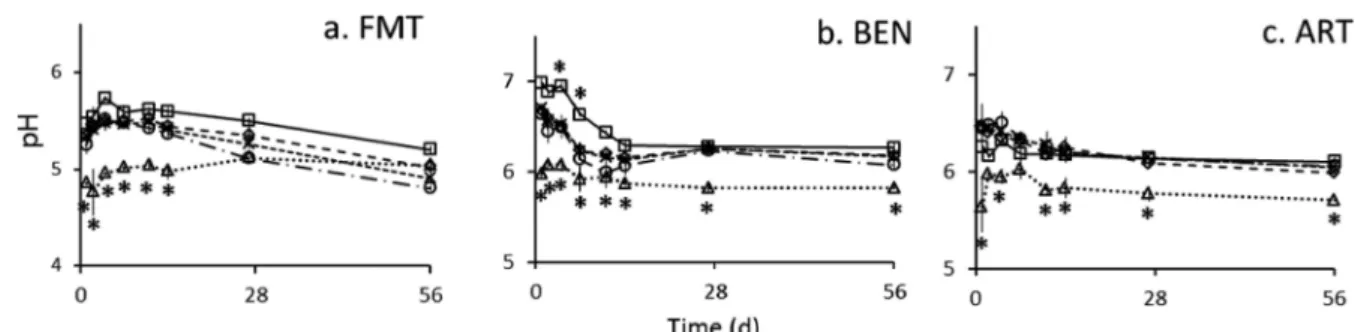
Changes in pH and Dissolved Cation Concentrations. 'The observed changes in soil solution chemistry in the salt-amended soils are consistent with the processes illustrated in Scheme 1b. The pH of the nano1 soils were not significantly different from those of the equivalent micrometer-amended and unamended soils on most sampling days. The only exception was the nano1-amended BEN soil, in which the pH was significantly higher on days 4 and d 7 (Figure 3). Interestingly, an increase in soil pH was also observed following 7 h incubation with nano CuO,24or 28 d incubation with ZnO.6In contrast, the pH of the salt1 soils was initially up to one pH unit lower (i.e., 10-fold higher H+ activity) than those of the nano1 soils. Although the pH of the FMT salt1 and nano1 soils were similar by day 28, the pH of the BEN and ART salt1 soils remained significantly higher than those of the equivalent nano1 soils throughout the test. In the absence of other reactive
Figure 3.Temporal changes in pH in three soils amended with three different Cu materials. Treatments:□, nano1 CuO; ×, micrometer1 CuO;◊, micrometer2 CuO;△, Cu salt1; and○, unamended soil. Vertical lines indicate standard deviations (n = 3). Small standard deviations are obscured by symbols. Significant differences (p < 0.05) between nano1- and salt1 soils are indicated by a lower asterisk (*), and between the nano1- and micrometer-amended soils by an upper asterisk.
Figure 4.Temporal changes in dissolved Ca (a−c) and Mg (d−f) concentrations in the three Cu-amended soils. Treatments:□, nano1 CuO; ×, micrometer1 CuO,◊, micrometer2 CuO;△, Cu salt1; and○, unamended soil. Vertical lines indicate standard deviations (n = 3). Small standard deviations are obscured by symbols. Significant differences (p < 0.05) between nano1 and salt1 soils are indicated by an upper asterisk (*), and between nano1 and micrometer-amended soils by a lower asterisk.
sites, each unit decrease in pH theoretically increases the Cu2+
activity 100-fold (eq 1).17
+ ⇆ +
+ +
Cu2 2H O2 Cu(OH)2 2H (1)
Although in soils, this quantitative relationship will be modified by pH-dependent sorption of Cu2+ions to reactive sites such as
organic ligands and oxide surfaces, the higher Cu2+activities in
the salt-amended soils may be partly explained by their lower pH.
The dissolved Ca and Mg concentrations in the nano1 and micrometer-amended soils were similar to those in the unamended soils (Figure 4), suggesting that the soil buffered the slow changes in soil solution chemistry that occurred as the CuO particles equilibrated with the soils. No other studies were found in the available peer-reviewed literature that reported on changes in cation concentration in soils amended with particulate metal oxides. In contrast, the dissolved Ca and Mg concentrations were significantly higher in the salt1 soils than in the other treatments throughout the present study, and are in agreement with the decrease in soil pH and increase in dissolved cation concentrations following amendment with Cu salts reported in other studies.8,9
Measuring Soil Free Ion Activity.Measuring free metal ion activity during exposure tests presents a challenge for nanotoxicologists. Techniques recently used to measure Cu2+
ion activity in test media amended with nano CuO have included the Cu ISE (Kakinen et al., 201140 and the present study), Cu biosensors,40 Cu chelation,15,41 ultrafiltration,4 centrifugation,33and diffusive gradient in thin films.42Factors determining the technique selected include the test medium (e.g., aqueous solution, sediment, soil), the expected metal ion concentration, and the technique available (an ISE sufficiently accurate for most environmental studies is only available for Cu, and under certain conditions for Ag). However, as measured ion activities and dissolved metal concentrations are operationally defined,29 results obtained using different techniques may not be comparable. The situation is further complicated by the potential for interactions between the nanoparticles and the equipment used to measure ion activity, which makes it difficult to validate any technique in nanoparticle-amended soils. For this reason, in the current study the differences between Cu2+ activities in the different
treatments, identified using the Cu ISE, were discussed in relative rather than absolute terms. Further research on the relative effectiveness of the different methods to predict uptake and toxicity from non-nano sources of Cu in soils amended with Cu-containing nanoparticles is required so that, where possible, methods to measure metal ion activity in different media during nanotoxicity tests are standardized, thus facilitating comparison of results from different studies.43
Considerations for Nanotoxicity Study Design. The challenge of conducting terrestrial toxicity studies on actively transforming materials has previously been discussed in the context of volatiles.44However, although there is an increasing awareness that nanoparticle transformations will modify their interactions with organisms,10,45−47 little attention has been paid to the implications for nanotoxicological studies of changes in test media resulting from material transformations during nanotoxicity tests. The present study provides an example of these transformations in soils. In previous nano-CuO toxicity studies, the treatments to control for effects of ionic Cu were based on the Cu2+ activity or dissolved Cu
concentration in the nano-CuO treatment at a certain point in
time.4,7,48 The present results suggest that the initial similarity in Cu2+ activities in soils freshly amended with different Cu
materials will be ephemeral because of differences in material equilibration rates and processes. Consequently, test organisms in the different treatments may be responding to dissimilar concentrations of Cu2+ions in each experimental treatment.
Given the major influence of pH on metal solubility and speciation,29 differences in soil pH in the oxide and salt treatments may further confound interpretation of results. It may be difficult to unravel the effects on toxicity of the different Cu2+ activities and pH values in the treatments. Taking the
results of the current study as an example, it may be anticipated that toxicity in the salt-amended soils would be greater than in the oxide-amended soils because of higher Cu2+activity, but it
is also possible that higher concentrations of protons, Ca2+, and
Mg2+ions could reduce uptake of Cu2+ ions by blocking sites
on biological tissue surfaces.19,49A further consideration in soils with different pH values is the potential for differences in vigor if the test species is pH-sensitive.
Although the scope of the present study was constrained, the results suggest that unless material transformations are taken into consideration, nano-CuO toxicity tests may not accurately reflect the nanoparticle-specific effect on organisms. Some techniques to reduce or modulate differences between the test and reference treatments are described below.
Recommendations.A number of actions can be taken to reduce or mitigate differences between soil solution chemistry (specifically, Cu2+ activity, pH, and dissolved cation
concen-trations) in the different treatments during nano-CuO toxicity tests. To reduce the difference between the solution chemistry in the salt- and oxide-amended soils, the pH of salt-amended soil can be buffered by applying lime, and the dissolved cation concentrations reduced by leaching soils prior to the toxicity test.9,50Once limed and leached, the salt-amended soils can be air-dried and stored until required. Salts such as Cu-acetate that can buffer changes in soil pH may also be considered. To adequately encompass the range of Cu2+ activities in the
nanoamended soils, preliminary tests can determine their range, and micrometer-Cu and Cu salt treatments that encompass this range included in the toxicity test. It is also important that the Cu2+ activity is measured in all treatments during the test, at
least at both the start and end of the toxicity tests.
The inclusion of adequate reference treatments in terrestrial nanotoxicity tests is necessary to correctly determine whether nanoparticles pose a threat to soil organisms. This study demonstrates that care must be exercised when designing nanotoxicity tests for soluble nanoparticles such as CuO, to ensure that artifacts due to the temporal changes in soil solution chemistry during equilibration of the different treatments do not obscure the effects of the nanoparticles on organisms. The increase in dissolved metal ion concentrations in ZnO-amended media6,51,52and the decrease in soil pH and increase in dissolved cation concentrations following the addition of Zn, Cd, or Ni salts to soils,8,9observed in previous stueies, suggest that similar considerations are required for other soluble metal-based nanoparticles.
■
ASSOCIATED CONTENT*
S Supporting InformationSection S-1: Experimental details (Labware preparation, experimental procedure, Cu2+ activity measurement); Figure
S-1: Cu ISE calibration curves; Section S-2: Quality control data for ICP-MS analysis; Table S-1: CuO material
character-Environmental Science & Technology Article
dx.doi.org/10.1021/es500141h | Environ. Sci. Technol. 2014, 48, 8135−8142
istics; Table S-2: Metal contaminants in CuO materials; Table S-3: Soil characteristics; Table S-4: Total Cu concentrations in the test soils; Section S-3: Effect of extraction process on Cu2+
activity; and Table S-5: Electrical potential in unextracted and extracted CuO samples in water or 0.01 M KNO3. This
material is available free of charge via the Internet at http:// pubs.acs.org.
■
AUTHOR INFORMATIONCorresponding Author
*Phone: +1 514 398 7890; fax: +1 514 398 7990; e-mail: [email protected].
Notes
The authors declare no competing financial interest.
■
ACKNOWLEDGMENTSThis work was supported by a Strategic Projects Grant to Dr. Nathalie Tufenkji from the Natural Sciences and Engineering Research Council of Canada, and a NE3LS grant from the Fonds de recherche sur la nature et les technologies du Québec to Heather McShane. Thanks also to Hélène Lalande for laboratory assistance, Adamo Petosa for help with DLS measurements, Monique Riendeau for BET and XRD analysis, and Jean-Philippe Masse for TEM imaging.
■
REFERENCES(1) Organisation for Economic Cooperation and Development. In
Guidelines for the Testing of Chemicals/Section 2: Effects on Biotic Systems. Test No. 207: Earthworm, Acute Toxicity Tests; OECD
Publishing: Paris, France, 1984.
(2) Organisation for Economic Cooperation and Development. In
Guidelines for the Testing of Chemicals/Section 2: Effects on Biotic Systems. Test No. 222: Earthworm Reproduction Test (Eisenia fetida/ Eisenia andrei); OECD Publishing: Paris, France, 2004.
(3) Coleman, J. G.; Johnson, D. R.; Stanley, J. K.; Bednar, A. J.; Weiss, C. A.; Boyd, R. E.; Steevens, J. A. Assessing the fate and effects of nano aluminum oxide in the terrestrial earthworm, Eisenia fetida.
Environ. Toxicol. Chem. 2010, 29, 1575−1580.
(4) Atha, D. H.; Wang, H.; Petersen, E. J.; Cleveland, D.; Holbrook, R. D.; Jaruga, P.; Dizdaroglu, M.; Xing, B.; Nelson, B. C. Copper oxide nanoparticle mediated DNA damage in terrestrial plant models.
Environ. Sci. Technol. 2012, 46, 1819−1827.
(5) McShane, H.; Sarrazin, M.; Whalen, J. K.; Hendershot, W. H.; Sunahara, G. I. Reproductive and behavioral responses of earthworms exposed to nano-sized titanium dioxide in soil. Environ. Toxicol. Chem. 2012, 31, 184−193.
(6) Kool, P. L.; Ortiz, M. D.; van Gestel, C. A. M. Chronic toxicity of ZnO nanoparticles, non-nano ZnO and ZnCl2 to Folsomia candida (Collembola) in relation to bioavailability in soil. Environ. Pollut. 2011,
159, 2713−2719.
(7) Shi, J.; Abid, A. D.; Kennedy, I. M.; Hristova, K. R.; Silk, W. K. To duckweeds (Landoltia punctata), nanoparticulate copper oxide is more inhibitory than the soluble copper in the bulk solution. Environ.
Pollut. 2011, 159, 1277−1282.
(8) Speir, T. W.; Kettles, H. A.; Percival, H. J.; Parshotam, A. Is soil acidification the cause of biochemical responses when soils are amended with heavy metal salts? Soil Biol. Biochem. 1999, 31, 1953− 1961.
(9) Smolders, E.; Oorts, K.; van Sprang, P.; Schoeters, I.; Janssen, C. R.; McGrath, S. P.; McLaughlin, M. J. Toxicity of trace metals in soil as affected by soil type and aging after contamination: Using calibrated bioavailability models to set ecological soil standards. Environ. Toxicol.
Chem. 2009, 28, 1633−1642.
(10) Cornelis, G.; Doolette, C.; Thomas, M.; McLaughlin, M. J.; Kirby, J. K.; Beak, D. G.; Chittleborough, D. Retention and dissolution
of engineered silver nanoparticles in natural soils. Soil Sci. Soc. Am. J. 2012, 76, 891−902.
(11) Anita, S.; Ramachandran, T.; Rajendran, R.; Koushik, C. V.; Mahalakshmi, M. A study of the antimicrobial property of encapsulated copper oxide nanoparticles on cotton fabric. Text. Res.
J. 2011, 81, 1081−1088.
(12) Rastogi, R. P.; Singh, N. B.; Shukla, S. K. Nano-size copper oxide encapsulated urea−formaldehyde resin film for arsenic (III) removal from aqueous solutions. Indian J. Eng. Mater. Sci. 2011, 18, 390−392.
(13) Gaetke, L. M.; Chow, C. K. Copper toxicity, oxidative stress, and antioxidant nutrients. Toxicology 2003, 189, 147−163.
(14) Kabata-Pendias, A. Trace Elements in Soils and Plants, 4thed.; CRC Press: Boca Raton, FL, 2011.
(15) Dimkpa, C. O.; Calder, A.; Britt, D. W.; McLean, J. E.; Anderson, A. J. Responses of a soil bacterium, Pseudomonas
chlororaphis O6 to commercial metal oxide nanoparticles compared
with responses to metal ions. Environ. Pollut. 2011, 159, 1749−1756. (16) Wang, Z. Y.; Xie, X. Y.; Zhao, J.; Liu, X. Y.; Feng, W. Q.; White, J. C.; Xing, B. S. Xylem- and phloem-based transport of CuO nanoparticles in maize (Zea mays L.). Environ. Sci. Technol. 2012, 46, 4434−4441.
(17) Lindsay, W. L. Chemical Equilibria in Soils; John Wiley and Sons: New York, 1979.
(18) Yruela, I. Copper in plants: Acquisition, transport and interactions. Funct. Plant Biol. 2009, 36, 409−430.
(19) Thakali, S.; Allen, H. E.; Di Toro, D. M.; Ponizovsky, A. A.; Rooney, C. P.; Zhao, F.-J.; McGrath, S. P. A terrestrial biotic ligand model. 1. Development and application to Cu and Ni toxicities to barley root elongation in soils. Environ. Sci. Technol. 2006, 40, 7085− 7093.
(20) Stumm, W.; Furrer, G. The Dissolution of Oxides and Aluminium Silicates; Examples of Surface-Coordination-Controlled Kinetics. In Aquatic Surface Chemistry; Stumm, W., Ed.; John Wiley & Sons: New York, 1987.
(21) Ma, Y. B.; Lombi, E.; Nolan, A. L.; McLaughlin, M. J. Short-term natural attenuation of copper in soils: Effects of time, temperature, and soil characteristics. Environ. Toxicol. Chem. 2006,
25, 652−658.
(22) Aruoja, V.; Kahru, A.; Dubourguier, H. C. Toxicity of ZnO, TiO2, and CuO nanoparticles to microalgae Pseudokirchneriella
subcapitata. Toxicol. Lett. 2008, 180, S220−S220.
(23) Smolders, E.; Oorts, K.; Lombi, E.; Schoeters, I.; Ma, Y.; Zrna, S.; McLaughlin, M. J. The availability of copper in soils historically amended with sewage sludge, manure, and compost. J. Environ. Qual. 2012, 41, 506−514.
(24) Rousk, J.; Ackermann, K.; Curling, S. F.; Jones, D. L. Comparative toxicity of nanoparticulate CuO and ZnO to soil bacterial communities. PLoS One 2013, 7 (3), e34197 DOI: 10.1371/ journal.pone.0034197.
(25) Hendershot, W. H.; Lavkulich, L. M. Use of zero-point of charge (ZPC) to assess pedogenic development. Soil Sci. Soc. Am. J. 1978, 42, 468−472.
(26) Heggelund, L. R.; Diez-Ortiz, M.; Lofts, S.; Lahive, E.; Jurkschat, K.; Wojnarowicz, J.; Cedergreen, N.; Spurgeon, D.; Svendsen, C. Soil pH effects on the comparative toxicity of dissolved zinc, non-nano and nano ZnO to the earthworm Eisenia fetida. Nanotoxicol. 2014, 8, 559− 572.
(27) Oorts, K.; Ghesquiere, U.; Swinnen, K.; Smolders, E. Soil properties affecting the toxicity of CuCl2and NiCl2for soil microbial processes in freshly spiked soils. Environ.. Toxicol. Chem. 2006, 25, 836−844.
(28) Hendershot, W. H.; Lalande, H.; Reyes, D. Trace Element Assessment. In Soil Sampling and Methods of Analysis, 2nded.; Carter, M. R., Gregorich, E. G., Eds.; CRC Press: Boca Raton, FL, 2008; pp 109−119.
(29) Sauvé, S. Speciation of metals in soils. In Bioavailability of Metals
in Terrestrial Ecosystems, Allan, H. E., Ed.; Society for Environmental
(30) Rachou, J.; Gagnon, C.; Sauvé, S. Use of an ion-selective electrode for free copper measurements in low salinity and low ionic strength matrices. Environ. Chem. 2007, 4, 90−97.
(31) Sauve, S.; McBride, M. B.; Hendershot, W. H. Ion-selective electrode measurements of copper(II) activity in contaminated soils.
Arch. Environ. Contam. Toxicol. 1995, 29, 373−379.
(32) Majima, H.; Awakura, Y.; Yazaki, T.; Chikamori, Y. Acid dissolution of cupric oxide. Metall. Trans. B 1980, 11, 209−214.
(33) Midander, K.; Cronholm, P.; Karlsson, H. L.; Elihn, K.; Moller, L.; Leygraf, C.; Wallinder, I. O. Surface characteristics, copper release, and toxicity of nano- and micrometer-sized copper and copper (II) oxide particles: A cross-disciplinary study. Small 2009, 5, 389−399.
(34) Borm, P.; Klaessig, F. C.; Landry, T. D.; Moudgil, B.; Pauluhn, J.; Thomas, K.; Trottier, R.; Wood, S. Research strategies for safety evaluation of nanomaterials, part V: Role of dissolution in biological fate and effects of nanoscale particles. Toxicol. Sci. 2006, 90, 23−32.
(35) Auffan, M.; Rose, J.; Bottero, J.-Y.; Lowry, G. V.; Jolivet, J.-P.; Wiesner, M. R. Towards a definition of inorganic nanoparticles from an environmental, health and safety perspective. Nat. Nanotechnol. 2009, 4, 634−641.
(36) Putnis, C. V.; Ruiz-Agudo, E. The mineral−water interface: Where minerals react with the environment. Elements 2013, 9, 177− 182.
(37) Fan, C.; Chen, J.; Chen, Y.; Ji, J.; Teng, H. H. Relationship between solubility and solubility product: The roles of crystal sizes and crystallographic directions. Geochim. Cosmochim. Acta 2006, 70, 3820− 3829.
(38) Tiede, K.; Hassellov, M.; Breitbarth, E.; Chaudhry, Q.; Boxall, A. B. A. Considerations for environmental fate and ecotoxicity testing to support environmental risk assessments for engineered nanoparticles.
J. Chromatogr. A 2009, 1216, 503−509.
(39) Sauvé, S.; McBride, M. B.; Norvell, W. A.; Hendershot, W. H. Copper solubility and speciation of in situ contaminated soils: effects of copper level, pH and organic matter. Water Air Soil Pollut. 1997,
100, 133−149.
(40) Kakinen, A.; Bondarenko, O.; Ivask, A.; Kahru, A. The effect of composition of different ecotoxicological test media on free and bioavailable copper from CuSO4and CuO nanoparticles: comparative evidence from a Cu-selective electrode and a Cu-biosensor. Sensors 2011, 11, 10502−10521.
(41) Zhou, D.; Jin, S.; Li, L.; Wang, Y.; Weng, N. Quantifying the adsorption and uptake of CuO nanoparticles by wheat root based on chemical extractions. J. Environ. Sci. 2011, 23, 1852−1857.
(42) Buffet, P.-E.; Tankoua, O. F.; Pan, J.-F.; Berhanu, D.; Herrenknecht, C.; Poirier, L.; Amiard-Triquet, C.; Amiard, J.-C.; Berard, J.-B.; Risso, C.; Guibbolini, M.; Romeo, M.; Reip, P.; Valsami-Jones, E.; Mouneyrac, C. Behavioural and biochemical responses of two marine invertebrates Scrobicularia plana and Hediste diversicolor to copper oxide nanoparticles. Chemosphere 2011, 84, 166−174.
(43) Tourinho, P. S.; van Gestel, C. A. M.; Lofts, S.; Svendsen, C.; Soares, A.; Loureiro, S. Metal-based nanoparticles in soil: Fate, behavior, and effects on soil invertebrates. Environ.. Toxicol. Chem. 2012, 31, 1679−1692.
(44) Hurdzan, C. M.; Lanno, R. P. Determining exposure dose in soil: The effect of modifying factors on chlorinated benzene toxicity to earthworms. Chemosphere 2009, 76, 946−951.
(45) Unrine, J. M.; Tsyusko, O. V.; Hunyadi, S. E.; Judy, J. D.; Bertsch, P. M. Effects of particle size on chemical speciation and bioavailability of copper to earthworms (Eisenia fetida) exposed to copper nanoparticles. J. Environ. Qual. 2010, 39, 1942−1953.
(46) Coutris, C.; Joner, E. J.; Oughton, D. H. Aging and soil organic matter content affect the fate of silver nanoparticles in soil. Sci. Total
Environ. 2012, 420, 327−333.
(47) Unrine, J. M.; Colman, B. P.; Bone, A. J.; Gondikas, A. P.; Matson, C. W. Biotic and abiotic interactions in aquatic microcosms determine fate and toxicity of Ag nanoparticles. Part 1. Aggregation and dissolution. Environ. Sci. Technol. 2012, 46, 6915−6924.
(48) Aruoja, V.; Dubourguier, H. C.; Kasemets, K.; Kahru, A. Toxicity of nanoparticles of CuO, ZnO and TiO2 to microalgae
Pseudokirchneriella subcapitata. Sci. Total Environ. 2009, 407, 1461−
1468.
(49) Di Toro, D. M.; Allen, H. E.; Bergman, H. L.; Meyer, J. S.; Paquin, P. R.; Santore, R. C. Biotic ligand model of the acute toxicity of metals. 1. Technical basis. Environ. Toxicol. Chem. 2001, 20, 2383− 2396.
(50) Schwertfeger, D. M.; Hendershot, W. H. Spike/leach procedure to prepare soil samples for trace metal ecotoxicity testing: method development using copper. Commun. Soil Sci. Plant Anal. 2013, 44, 1570−1587.
(51) Du, W. C.; Sun, Y. Y.; Ji, R.; Zhu, J. G.; Wu, J. C.; Guo, H. Y. TiO2and ZnO nanoparticles negatively affect wheat growth and soil enzyme activities in agricultural soil. J. Environ. Monitor. 2011, 13, 822−828.
(52) Li, M.; Zhu, L. Z.; Lin, D. H. Toxicity of ZnO nanoparticles to
Escherichia coli: Mechanism and the influence of medium components. Environ. Sci. Technol. 2011, 45, 1977−1983.
Environmental Science & Technology Article
dx.doi.org/10.1021/es500141h | Environ. Sci. Technol. 2014, 48, 8135−8142