HAL Id: hal-01166298
https://hal.archives-ouvertes.fr/hal-01166298
Submitted on 1 Dec 2015
HAL is a multi-disciplinary open access
archive for the deposit and dissemination of
sci-entific research documents, whether they are
pub-lished or not. The documents may come from
teaching and research institutions in France or
abroad, or from public or private research centers.
L’archive ouverte pluridisciplinaire HAL, est
destinée au dépôt et à la diffusion de documents
scientifiques de niveau recherche, publiés ou non,
émanant des établissements d’enseignement et de
recherche français ou étrangers, des laboratoires
publics ou privés.
OpenAlea: Scientific Workflows Combining Data
Analysis and Simulation
Christophe Pradal, Christian Fournier, Patrick Valduriez, Sarah
Cohen-Boulakia
To cite this version:
Christophe Pradal, Christian Fournier, Patrick Valduriez, Sarah Cohen-Boulakia. OpenAlea:
Scien-tific Workflows Combining Data Analysis and Simulation. SSDBM: ScienScien-tific and Statistical Database
Management, Jun 2015, San Diego, United States. �10.1145/2791347.2791365�. �hal-01166298�
OpenAlea: Scientific Workflows Combining Data Analysis
and Simulation
Christophe Pradal
UMR AGAP, CIRAD and InriaMontpellier, France
[email protected]
Christian Fournier
INRA Montpellier, France[email protected]
Patrick Valduriez
Inria and LIRMM, Montpellier,France
[email protected]
Sarah Cohen-Boulakia
Inria, Montpellier, France LRI CNRS 8623, U.Paris Sud[email protected]
ABSTRACT
Analyzing biological data (e.g., annotating genomes, assem-bling NGS data...) may involve very complex and inter-linked steps where several tools are combined together. Sci-entific workflow systems have reached a level of maturity that makes them able to support the design and execution of such in-silico experiments, and thus making them increas-ingly popular in the bioinformatics community.
However, in some emerging application domains such as system biology, developmental biology or ecology, the need for data analysis is combined with the need to model com-plex multi-scale biological systems, possibly involving mul-tiple simulation steps. This requires the scientific work-flow to deal with retro-action to understand and predict the relationships between structure and function of these complex systems. OpenAlea (openalea.gforge.inria.fr) is the only scientific workflow system able to uniformly address the problem, which made it successful in the scientific commu-nity. One of its main originality is to introduce higher-order dataflows as a means to uniformly combine classical data analysis with modeling and simulation.
In this demonstration paper, we provide for the first time the description of the OpenAlea system involving an original combination of features. We illustrate the demonstration on a high-throughput workflow in phenotyping, phenomics, and environmental control designed to study the interplay between plant architecture and climatic change.
1.
INTRODUCTION
Classical bioinformatics analysis (e.g. annotating genomes, building phylogenetic trees, assembling NGS data) involves the management and processing of huge data sets together
.
with the chaining of numerous complex and interlinked tools. Scientific workflow systems aim at facilitating and rational-izing the design and management of such tasks. They clearly separate the workflow specification from its execution and offer useful capabilities on both aspects. Among others, they may provide a user interface to design workflows by compos-ing tools [15], a scheduler to optimize the processcompos-ing of huge amounts of data [6], a provenance module [4] to keep track of the data used and generated during an execution and ensure the reproducibility of the experiments [18].
However, the complexity of biological analysis increases in emergent interdisciplinary domains. This is especially the case in domains addressing the study of complex multi-scale systems that require numerical simulations. In system biology for instance, analyzing the emergent behavior of a large number of interactions within a biological system re-quires simulating the interplay between the topological and geometrical development of the structure and its biologi-cal functioning. This involves coupling models from differ-ent disciplines, integrating experimdiffer-ental data from various sources at different scales (gene, cell, tissue, organism and population), and analyzing the reconstructed system with numerical experiments.
While scientific workflow systems have mainly been de-signed to support data analysis and visualization [15, 8, 9, 1], only a few systems have attempted to support iteration or simulation [1, 15]. Most of the systems use either con-trol flow edges or define loops in the workflow specification with specific routing nodes (e.g. switch [7]). Kepler [1] uses black box actors with different models of computation to provide iteration processes. These solutions can lead de-signing overly complex workflows that are difficult to un-derstand, reuse, and maintain [1]. Expressing control flow (iteration) in scientific workflows is actually a difficult prob-lem due to the absence of state variable and side-effect.
To address this problem, we have introduced the concept of λ-dataflow, which is inspired from the λ-calculus used in Functional Programming.
λ-dataflow makes use of higher-order constructs in the context of dataflows theory and thus allows to represent control flow using algebraic operators [6] (e.g., condition-als, map/reduce...). λ-dataflow allows to model retro-action. The OpenAlea system [17] that we introduce in this paper is
a workflow system based on λ-dataflow which is able to uni-formly deal with classical data analysis, visualization, mod-eling and simulation tasks.
In this paper, we show how the notion of λ-dataflow al-lows OpenAlea to uniformly deal with workfal-lows involving data analysis and simulation steps. Our demonstration in-troduces the capabilities of OpenAlea on a workflow involv-ing high-throughput phenotypinvolv-ing, phenomics, and environ-mental control, to study the interplay between plant archi-tecture and climatic change. OpenAlea is a Python open source project (openalea.gforge.inria.fr) that provides sup-port to a large community of users and developers.
2.
USE CASE
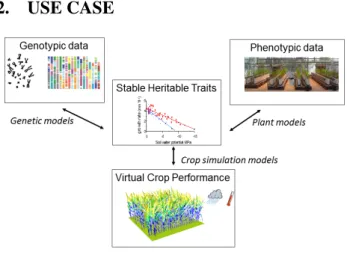
Figure 1: Use case
We consider a use case in the context of crop plant breed-ing [16], where high throughput data analysis needs to deal with simulation models at different scales (genes, organism and population). The objective of a breeding program is to produce plants that perform better than others (higher or more stable yields) in a given environment. This is challeng-ing as environmental conditions vary a lot among croppchalleng-ing areas, and are subjected to rapid change in a global warming context.
Model-assisted breeding [10, 14] aims at tackling this is-sue. It combines plant models, which reduce phenotypic plasticity (that is, the response to external environmental changes), to a set of environment-independent plant param-eters (stable traits), genetic models that link genetic profile (allele set) to stable traits, and simulation models that run virtual experiments to predict crop performance in a large set of environmental conditions (e.g., different light expo-sure, hydric conditions, nutriments...). Traits and plant pa-rameters (such as the size of the plant, the length of its leaves, the number of tillers, ...) depend both on the plant genetic profile and on the response of the plant to environ-mental conditions, expressed as its phenotypic plasticity.
Model-assisted breeding recently gained interest thanks to the development of automated phenotyping platforms that allow the measurement of plant traits for a large number of accessions in controlled conditions. For example, the M3P-PhenoArch facility1 allows to characterize daily plant growth and transpiration for 1,600 individuals at a time, to-gether with precise control of water availability to the plants.
1
http://www6.montpellier.inra.fr/lepse/M3P
It respectively generates 52 GB of data per day, 2.75 TB per essay (for a typical 50 days experiment) and 11 TB per year. Managing such experiments is particularly challenging due to the volume of data involved, and the multi-disciplinary nature of the tasks, as it requires biological data produc-tion, data analysis, mathematical and biological modeling, and computer simulation. From a scientific workflow per-spective, the main issue remains to combine (model-assisted) data analysis and model simulation with retro-action. In the use case, the simulated model is the growth of a set of plants, driven by environmental conditions (i.e. light and temper-ature). The growth of each plant depends on its param-eters (plant traits), the environmental conditions modified by the other plants that compete for resource acquisition. The retro-action is due to the relationship between structure and function: the plant growth is impacted by the amount of light intercepted by the plant while the light intercepted by the plant, to its turn, depends on the plant growth. As a con-sequence, analyzing plant response to light first requires to estimate light amounts intercepted by each individual plant during their growth, using light simulation models and 3D plant reconstruction. Then, a light-driven growth model is to be inferred by fitting it to the observations. Finally, sim-ulations allow to study how the light-growth feedback loop operates in a larger range of environmental conditions.
3.
OPENALEA
This section introduces the OpenAlea system, with its programming and execution models.
Figure 2: (a) OpenAlea workflow for simulating Maize and Wheat crop performance based on pheno-typic and environment data, and two image outputs (b and c). Colors represent the organ’s type in (b) and the amount of intercepted light in (c).
Actors and workflows.
An actor in OpenAlea is an elementary brick (a.k.a. com-ponent or activity) that has a name, a function object (a functor, a program, a web service or a composite actor), and explicitly defined input and output ports. A seman-tic type [1] is associated to each port (with a corresponding color).
A workflow is represented as a directed multi-graph where nodes are actors, and directed edges are data links between output and input ports (see Figure 2(a)). A workflow can become a (composite) actor in another workflow to allow composition.
Dataflow variable.
One of the major originality of OpenAlea lies in the way iteration is handled by introducing a specific kind of actor, called dataflow variable X. It allows to specify that, at a given port, an actor receives an unbound variable rather than a value. Connecting an X to an actor transforms a workflow into a lambda function, and allows to express higher-order programming providing control flow behavior using a set of algebraic operators. The three iteration types can be expressed as [7, 5]: (1) counting loops without de-pendencies (map operator), (2) counting loops with depen-dencies (reduce and for operators) and (3) conditional loops (while operator). In Figure 2(a), the dataflow variables and the algebraic operators are represented using yellow and white nodes, respectively.
Execution (model-driven).
Dataflow execution in OpenAlea is orchestrated in a model-driven manner (rather than input-model-driven): the execution of a given workflow is launched in response to requests for data of one of its actors. Such an actor can satisfy the request when the upstream subworkflow has been executed, that is, when all the relevant actors connected to its input ports have been executed. When such an actor has received its data on its input ports, it executes and places data on its output ports. OpenAlea is able to deal with extremely large datasets to perform big data analysis in parallel environments.
Additionally, it allows actors to be lazy and blocked. When an actor is blocked, the execution is not propagated to the upstream subworkflow and when the actor is lazy, the execu-tion is performed only if the actor’s inputs have not changed compared to its previous execution. This type of orchestra-tion performs only the operaorchestra-tions needed to produce the required result, executing the subset of the graph relevant to the output [3].
Algebraic operators and
λ-dataflow evaluation. An algebraic operator is an actor that iterates over first-order function calls, and thus takes one or more functions as inputs. Ports that require a function have an associated semantic type Function (colored in white). For instance, the first input port of the map and reduce operators requires a function as input (see Figure 2.(a)).λ-dataflow evaluation differs from the classical evaluation when the workflow contains at least one dataflow variable X. The execution is then decomposed into two stages. First, for each port of type Function, a subworkflow is computed if the upstream subworkflow contains at least one dataflow vari-able. This subworkflow is defined by all the actors needed to produce the data on this port, i.e. the upstream
sub-workflow and the connected output port. This subsub-workflow is dynamically transformed into a function (i.e. an actor) of one or several variables corresponding to its dataflow vari-ables. Second, the evaluation of this function by algebraic operators consists in replacing the variables by real data and evaluating the subworkflow using the model-driven al-gorithm.
Reproducibility.
OpenAlea allows to make experiments reproducible by providing two capabilities. First, it is able to capture both prospective and retrospective provenance (following the PROV-DM model2), that is, it is equipped of a provenance module that keeps track of the complete description of the work-flows as well as the full history of the data produced and consumed during each execution.
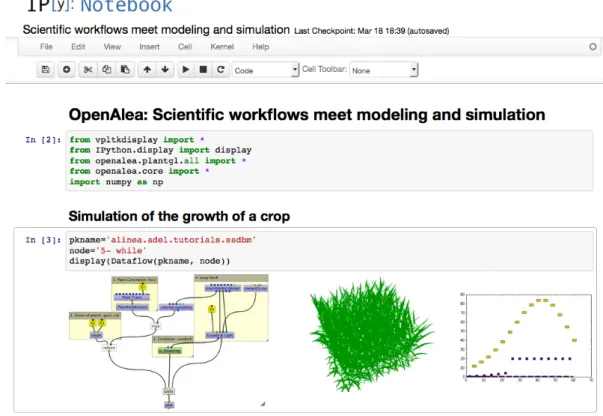
Second, and very originally, OpenAlea’s architecture is based on IPython and makes use of IPython notebooks [19] to generate executable papers (see Figure 4). More precisely, OpenAlea workflows can be executed within IPython note-books, through a web interface. Workflow results (including 2D plots, 3D scene graph, mathematical equations...) can be displayed within the notebook document and be shared with other users.
4.
DEMONSTRATION
This section describes the main points of our demonstra-tion.
We consider the workflows depicted in Figure 2 and 3 which implement the use case introduced in Figure 1. More precisely, the step Stable Heritable Traits of the use case is implemented by the module entitled Plant Traits in the workflow of Figure 2. A virtual crop is then designed (output of the reduce module). The crop growth is simulated and its performance assessed using a light interception model (im-plemented by the module Growth & Light ). As for the step Virtual Crop Performance of the use case, it is evaluated by the amount of intercepted light at flowering time, still com-puted by the workflow of Figure 2. This workflow is reused as a composite module entitled virtual experiment in Figure 3, allowing to explore the genotypic variability by modifying the Plant Traits. Finally, both Genotypic data and Pheno-typic data are taken into account to simulate Virtual Crop Performance for a large range of traits.
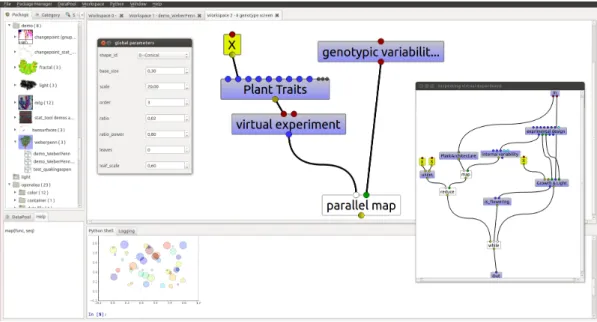
In our demonstration, we show how users can create or interact with highly expressive workflows (able to perform analysis, modeling and simulation tasks), both using the vi-sual programming environment (Figure 3) and the IPython notebooks (Figure 4) of OpenAlea.
Reusing or designing a workflow.
OpenAlea offers a visual programming environment where users are provided with a set of predefined workflows and libraries of tools to be combined to form new workflows (see the left part of Figure 3, ”Package Panel”). Users can create new wrapped tools by implementing them in Python. Each tool and workflow is associated with some documentation and saved. Ports of actors are typed and widgets can be associated with data types to allow users interacting with the data (see the widgets depicted in Figure 3.
2
Figure 3: OpenAlea visual programming environment
(Re)Running a workflow.
To execute a workflow, users have to click on their output of interest (as OpenAlea is model-driven). For instance in Figure 2, by clicking on the plot actor, users trigger the exe-cution of all the actors of the workflow, from top to bottom. If users click again on any actor of the same workflow, they can visualize or access to intermediate results. OpenAlea determines whether or not any calculation has to be redone (default Lazy mode). If no input or parameter change has occurred, data is not recomputed. Otherwise, the subwork-flow impacted by the change is executed again. In Figure 2(a), the is flowering actor is a non-lazy or eager actor, col-ored in green. It is always recomputed, even if its input data has not changed.
Using algebraic operators for simulation.
Algebraic operators are higher-order actors that take func-tion as argument. In our demonstrafunc-tion, we use three dif-ferent operators: map, reduce and while. Other types of algebraic operators in OpenAlea follow the same principle while users can define their own operators.
The map operator is a higher-order function map :: (α → β) → [α] → [β]. Its argument are a function f :: α → β (first port) and a set of elements of type α (second input port). The map operator applies f to each element of the set and returns the set of resulting elements of type β.
Similarly, the reduce operator takes a function g of two variables and a sequence of elements [xi] and returns one
element. while is an iteration operator that takes three inputs: an initial element t0, a boolean function cond and
function h. It initializes a variable t with t0 and iteratively
applies the function h on t while cond(t) is true.
In the workflow in Figure 2, the map actor takes a λ-subworkflow f and a sequence of parameters S. The λ-subworkflow f , composed of two actors (Plant Traits and PlantArchitecture), takes a parameter set that corresponds to one plant trait (e.g., leaf growth dynamic) and generates an object that represents a fully parameterised individual plant model to be simulated. The sequence S is produced
by the actor internal variability, and represents the intra-genotype (inter-individual) variability of the trait. During the execution, the map actor produces a sequence of individ-ual plant models.
The reduce operator concatenates this sequence of plants into one graph corresponding to the crop canopy. Finally, the while operator simulates the development of the crop by iterating a growth function, that takes into account en-vironmental data (meteo01.csv), the state and the specific parameters of each plant and the light intercepted by each 3D organs. The later is computed from the 3D geometry of the canopy. The simulation stops at the flowering stage.
Last, this workflow is reused as a composite workflow (see Figure 3) and run on a large set of genotypes to select the most efficient plant variety in a given environment.
From workflow to executable paper.
Execution of OpenAlea workflows can be embedded into IPython notebooks (Figure 4), able to produce executable papers, where users can share, visualize and interact with input and output produced by each step of an in-silico ex-periment in a web-based application.
5.
CONCLUSION
Faced with the need of coupling data analysis with mod-eling and simulation, OpenAlea provides a unique solution able to extend the dataflow model of computation by intro-ducing higher-order language constructs in a visual program-ming environment. Introducing first-class functions allows to design highly expressive workflows in a fully uniform way. First-class functions are increasingly popular and have also been introduced in several imperative languages like PHP, VisualBasic, C# or C++.
As for related work, considering Functional Programming in the context of scientific workflow systems [2, 20, 11] is not new and the number of solutions taking this direction has even increased in the last years. Functional Programming coupled with workflows is mainly used to reach to kinds of
Figure 4: OpenAlea IPython notebook
goals.
First, Functional Programming is used to represent and formalize the semantics of workflows and their relationships with their executions. Interestingly, Kelly et al. [11] have in-troduced the λ-calculus (new) model of computation (MOC). In this context, authors have actually demonstrated that side-effect free workflow models can be defined as a sub-set of Functional Programming. Functional languages have been used to formalize workflow models in concrete workflow systems: this is the case in the Ptolemy II [13] system but also in the Taverna system where the semantics of Taverna’s workflows have been recently rethought in functional terms [20].
Another (possibly complementary) aim to achieve when using Functional Programming is to deal with high-level data parallel structures. This is the case of the very recent Cuneiform system [2], which works on the Hi-WAY platform based on Hadoop YARN.
Like Cuneiform, the aim of the OpenAlea system is to ex-ploit high-level data parallel structures. However, we want our system to be directly usable by end-users who are not computer scientists. Our originality here thus lies in al-lowing the use of functional programming and higher-order construct within a visual programming environment, as a mean to express control-flow constructs.
While OpenAlea is in used since 2007 (160,000 downloads, 1,200 distinct visitors a month, 20 active developers) leading to several biological findings (e.g., [12]), this paper is the first to provide an overview of the major capabilities of the OpenAlea system and the first to introduce the λ-dataflow concept.
This demonstration deals with the study of plant response
to climatic change illustrating the research challenges in ar-eas of high and incrar-easing interest including big data analysis and reproducible science.
Acknowledgements
This work has been done in the context of the Computa-tional Biology Institute (http://www.ibc-montpellier.fr). It has been partly funded by the ProvRecFlow project.
6.
REFERENCES
[1] S. Bowers, B. Ludascher, A. H. Ngu, and T. Critchlow. Enabling scientific workflow reuse through structured composition of dataflow and control-flow. In ICDE Workshops, pages 70–70. IEEE, 2006.
[2] J. Brandt, M. Bux, and U. Leser. A functional language for large scale scientific data analysis. In BeyongMR, ICDT/EDBT Workshop, 2015. [3] V. Curcin and M. Ghanem. Scientific workflow
systems-can one size fit all? In Proc. of Biomedical Engineering Conference, pages 1–9, 2008.
[4] S. B. Davidson, S. C. Boulakia, A. Eyal, B. Lud¨ascher, T. M. McPhillips, S. Bowers, M. K. Anand, and J. Freire. Provenance in scientific workflow systems. IEEE Data Eng. Bull., 30(4):44–50, 2007.
[5] J. Dias, G. Guerra, F. Rochinha, A. L. Coutinho, P. Valduriez, and M. Mattoso. Data-centric iteration in dynamic workflows. Future Generation Computer Systems, 2014.
[6] J. Dias, E. Ogasawara, D. De Oliveira, F. Porto, P. Valduriez, and M. Mattoso. Algebraic dataflows for
big data analysis. In Proc. of IEEE Big Data, pages 150–155, 2013.
[7] E. Elmroth, F. Hern´andez, and J. Tordsson. Three fundamental dimensions of scientific workflow
interoperability: Model of computation, language, and execution environment. Future Generation Computer Systems, 26(2):245–256, 2010.
[8] J. Freire, C. Silva, S. Callahan, E. Santos,
C. Scheidegger, and H. Vo. Managing rapidly-evolving scientific workflows. Proc. of IPAW, pages 10–18, 2006. [9] J. Goecks, A. Nekrutenko, and J. Taylor. Galaxy: a
comprehensive approach for supporting accessible, reproducible, and transparent computational research in the life sciences. Genome Biology, 11(8):R86, 2010. [10] G. Hammer, M. Cooper, F. Tardieu, S. Welch,
B. Walsh, F. van Eeuwijk, S. Chapman, and D. Podlich. Models for navigating biological
complexity in breeding improved crop plants. Trends in plant science, 11(12):587–593, 2006.
[11] P. M. Kelly, P. D. Coddington, and A. L. Wendelborn. Lambda calculus as a workflow model. Concurrency and Computation: Practice and Experience, 21(16):1999–2017, 2009.
[12] M. Lucas, K. Kenobi, D. Von Wangenheim, U. Voβ, K. Swarup, I. De Smet, D. Van Damme, T. Lawrence, B. P´eret, E. Moscardi, et al. Lateral root
morphogenesis is dependent on the mechanical properties of the overlaying tissues. Proc. of the Nat. Academy of Sciences, 110(13):5229–5234, 2013. [13] B. Lud¨ascher and I. Altintas. On providing declarative
design and programming constructs for scientific workflows based on process networks. 2003.
[14] C. D. Messina, D. Podlich, Z. Dong, M. Samples, and M. Cooper. Yield–trait performance landscapes: from theory to application in breeding maize for drought tolerance. Journal of Experimental Botany, 62(3):855–868, 2011.
[15] P. Missier, S. Soiland-Reyes, S. Owen, W. Tan, A. Nenadic, I. Dunlop, A. Williams, T. Oinn, and C. Goble. Taverna, reloaded. In M. Gertz, T. Hey, and B. Ludaescher, editors, Proc. of SSDBM, Heidelberg, Germany, 2010.
[16] B. Parent and F. Tardieu. Can current crop models be used in the phenotyping era for predicting the genetic variability of yield of plants subjected to drought or high temperature? J. of Experimental Botany, 65(11):6179–6189, 2014.
[17] C. Pradal, S. Dufour-Kowalski, F. Boudon, C. Fournier, and C. Godin. Openalea: a visual programming and component-based software platform for plant modelling. Functional plant biology,
35(10):751–760, 2008.
[18] G. Sandve, A. Nekrutenko, J. Taylor, and E. Hovig. Ten simple rules for reproducible computational research. PLoS comp. biology, 9(10):e1003285, 2013. [19] H. Shen. Interactive notebooks: Sharing the code.
Nature, 515(7525):151–152, 2014.
[20] D. Turi, P. Missier, C. Goble, D. De Roure, and T. Oinn. Taverna workflows: Syntax and semantics. In e-Science and Grid Computing, IEEE International Conference on, pages 441–448. IEEE, 2007.