Design and Implementation
of An Electronic Special Interest Magazine
by
Gitta B Salomon
B.A., Mathematics
University of California, Los Angeles
1983
Submitted to the Department of Architecture
in Partial Fulfillment of the Requirements of the Degree of
Master of Science in Visual Studies
at the Massachusetts Institute of Technology
September 1986
@Massachusetts Institute of Technology 1986
Signature of the Author
Gitta B Salomon
Department of Architecture
June 17, 1986
Certified by
Andrew B. Lippman
Associate Professor of Media Technology
Thesis Supervisor
Accepted byMASSACHU SETS ISTiTUTE
OF TECHNOLOGY
AUG 2 9 1986
Nicholas Negroponte
Chairman
Departmental Committee on Graduate Students
Design and Implementation
of An Electronic Special Interest Magazine
byGitta B Salomon
Submitted to the Department of Architecture on June 17, 1986 in partial fulfillment of the requirements of the degree of Master of Science in Visual
Studies
Abstract
Electronic publishing has been established as a unique means for provid-ing information in an interactive and personalized manner. Although schol-arly journals have been published electronically, large circulation magazines have not. The trend in these popular magazines towards more specialized content makes their electronic publication particularly attractive.
This thesis explores the possibilities for such a publication. A system has been developed which assembles and displays an electronic magazine containing both editorial content and advertisements of specific interest
to an individual. Useful methods of interaction with the magazine are provided. The material is presented in a stylized and entertaining manner, in keeping with the nature of popular magazines.
Thesis Supervisor: Andrew B. Lippman Title: Associate Professor of Media Technology
The work reported herein was supported by a grant from the IBM Corporation.
Contents
1
Introduction
7
1.1 An Overview . . . .. . . 7
1.2 Organization . . . .. . . . . .. . 8
2 A Brief Look at Conventional Magazines 10 2.1 O rigins . . . . . - . . . . 10
2.2 Modern Magazines . . . .. . .. 11
2.2.1 The rise of the special interest magazine . . . . 11
2.2.2 Characteristics of the modern magazine . . . . 13
2.2.3 Indications for the future . . . . 16
3 A Survey of Electronic Publishing 18 3.1 Online retrieval systems . . . .. 19
3.2 Cable Television and Direct Broadcast Satellites . . . . 20
3.3 Videotex . . . .. . . . - - - . . .. . 21
3.3.1 Teletext . . . . 22
3.3.2 Viewdata . . . . 24
3.4 Optical Discs . . . . 26
3.5 Electronic Mail, Computerized Conferences, and Electronic Bulletin Boards . . . . 27
3.6 Electronic Journals . . . . 30
4 The Electronic Special Interest Magazine 32 4.1 The Hardware Environment . . . . 32
4.2 Proposed Method For Publication . . . . 33
4.3 Contents... .. .. 34
4.3.2 The unique nature of the EMAG advertisement
4.4 Design Elem ents . . . . 38
4.4.1 General characteristics of the design . . . . 38
4.4.2 Design specifics . . . . 43
4.5 Functionality and Interaction . . . . 47
4.5.1 The touch sensitive display . . . . 49
4.5.2 Options from the table of contents . . . . 51
4.5.3 Options from a typical page . . . . 53
4.6 Personalization . . . . 55
4.6.1 The user profile . . . . 55
4.6.2 The user history . . . . 58
4.7 Edition Creation Rules . . . . 60
4.7.1 Data form ats . . . . 60
4.7.2 Program operation . . . . 66
5 Room for Growth 70 5.1 Inclusion of sound and video . . . . 70
5.2 Increased functionality . . . . 72
5.3 Increased individual customization . . . . 73
6 Concluding Remarks 75
A Programming Details 77
Bibliography 81
Acknowledgements 87
List of Figures
4.1 The table of contents.. . . . . 39
4.2 A typical feature page . . . . 45
4.3 A typical department page. . . . . 46
4.4 The expanded advertisement . . . . 48
4.5 Finding other articles by a particular author . . . . 52
4.6 The typical feature entry within the table of contents . . . . 53
4.7 Examination of the feature entry lead . . . . 54
Chapter 1
Introduction
1.1
An Overview
Electronic publishing typically refers to the synthesis of computing power and conventional mass media distribution systems, such as television, radio and print. The publications which arise from this combination are essen-tially new communications media, which exhibit novel forms and styles and allow for significant user interaction and personalization.
In the Electronic Publishing Group at the Massachusetts Institute of Technology Media Laboratory, electronic publication systems are developed under the assumptions that the majority of computer processing will occur locally, and that large scale local storage and high quality display equipment are available to the user.
This thesis is concerned with the design and implementation of an elec-tronic special interest mass circulation magazine. The investigation is based on Popular Photography, but could easily be applied more broadly. Mag-azines of this nature are particularly suitable to electronic publication
be-cause they are increasingly concerned with reaching very specific audiences.
The implementation adopts the view that the editors and subscriber
work together to produce a magazine that satisfies the requirements of a
special interest group of one, namely the specific subscriber. The data, or magazine content, is sent by the magazine editors to the user. A
com-puter program on the user's end holds the skeletal structure of the
mag-azine within a set of rules, and locally manipulates the contents received
to assemble the magazine. In addition, an alterable personal profile guides
selection and ordering of particularly appropriate material for the user's
unique edition. Once assembled, the magazine is presented for viewing on
a touch sensitive display. The user is provided with a variety of options
which allow the magazine to be examined in standard ways or in directions
made possible by computer control.
In the past, electronic publications have often been criticized for poor
presentation of material. The electronic adaptation of a highly stylized
popular magazine poses an even greater challenge. Therefore, special
con-sideration was given to the incorporation of design elements into this
sys-tem, the goal being to preserve the entertainment value expected of this
type of publication.
1.2
Organization
This remainder of this thesis is organized as follows:
Chapter 2 offers a brief history of magazines and their role within mass
Chapter 3 presents an overview of relevant electronic publishing
devel-opments to date.
Chapter 4 contains a discussion of the design and functionality of the
electronic magazine which was developed.
Finally, Chapter 5 presents a discussion of directions and possibilities
Chapter 2
A Brief Look at Conventional
Magazines
2.1
Origins
The word magazine derives from the French magasin, which means
store-house, or location for a variety of materials
[19].
The word was first applied to French periodicals in the 17th century, which were basically cataloguesof items supplemented with book reviews. In the 18th century, literary
periodicals appeared in England and were circulated locally, and in the
American Colonies. The first American periodical was conceived of in 1740
by Benjamin Franklin, but was not actually published until 1741.
Prior to the Civil War, magazine revenue came solely from subscriptions.
Lack of interest on the part of readers and authors resulted in the death of
most periodicals within a year of their initiation.
After the Civil War, magazine content gravitated towards non-fiction
subscription rates were radically decreased and magazines achieved large
nationwide circulations. This, in turn, attracted national advertising and
the general interest magazine thrived.
The forerunners of today's specialized magazines also first appeared at
this time. Due to increases in the public's education, leisure time, and
buying power. public interests greatly diversified, thereby providing the
impetus for publication of these magazines.
2.2
Modern Magazines
The demise of the magazine was predicted several times during the current
century. After World War I, it was generally felt that the automobile would
monopolize all leisure time, leaving none for magazine reading[10]. Later,
radio and sound movies were assumed completely capable of replacing the
medium. The wide scale acceptance of television during the 1950's was
perhaps the most critical threat to its survival. However, responsiveness of
the industry allowed the magazine to evolve into a unique medium, which
has proved itself quite capable of survival.
2.2.1
The rise of the special interest magazine
Whereas the general interest magazine had previously flourished as the sole
means of national advertising, the arrival of television all but completely
destroyed this genre of periodical. Television offered nationwide coverage
at reasonable rates, and advertisers simply found it too expensive to also
achieved substantial success, namely Reader's Digest and TV Guide. It
was at this time that special interest magazines first became dominant in
the industry. Through specialized content they sought to attract specific
audiences composed of, for example, sports enthusiasts, hobbyists, or the
fashion-conscious. These magazines provided the advertiser with a
reader-ship composed of potential customers. This arrangement proved beneficial
to readers as well; they often found specialized advertising as interesting as
editorial content on the same subjects[29,48].
Regional and Split-Run publishing
Towards the end of the 1950's, in an attempt to rescue the national
gen-eral interest magazine, regional editions, and "split-run" publishing were
initiated. By including distinctive material in certain editions, even these
general interest magazines became specialized. Advertisers were offered
lower rates and access to unique markets based on geography, life-style or
special interests. Look started its appropriately titled regional magazone,
and Time instigated demographic editions which were geared towards
spe-cific groups such as college students, doctors, or businessmen[54]. In an
extreme move in the opposite direction, the Saturday Evening Post sent
letters to almost half of its subscribers in 1968, asking them to cancel their
subscriptions. The Post hoped to eliminate all but the wealthiest of
read-ers, which they could then offer to advertisers at a premium. However, the
Technical support for specialized magazines
Recently, the large printing firm R.R. Donnelley and Sons developed a
sys-tem to specifically aid publishers in producing specialized publications. The
system, called Selectronic' Services, sorts and organizes distinct printed
sec-tions into customized periodicals, which address the specific interests of an
individual, or a specific demographic group[13]. The system is essentially a
computer controlled mechanical "binder", which employs a series of
physi-cal stations, each responsible for attachment of a certain section. It is used
to produce individualized farm journals. A unique issue is pre-addressed to
the particular subscriber and progresses down the "binding" assembly line, where, for example, the sections on dairy and cattle to which the individual
has expressly subscribed are physically incorporated.
2.2.2
Characteristics of the modern magazine
The ability of magazines to attract special audiences is, perhaps, the
ele-ment that most distinguishes them from other media. However, magazines
have a number of other characteristics that are worthy of mention.
One study(23] found that both users and non-users perceive magazines
to fulfill specific roles in society. Magazines were viewed primarily as
providers of entertainment, and secondly as a means to learn more about
daily life. Generally, magazines are seen to maintain a role within the media
spectrum that falls somewhere between those of television and books[53].
'"Selectronic" is a registered trademark of R.R. Donnelley and Sons, Company, Chicago, Illinois.
Magazines, like most print media, require the active involvement of
readers. A magazine that holds some interest for an individual must be
consciously purchased, and content is only received through the deliberate
perusal of each page. This is unlike television, where programming is often
passively consumed due to failure to change the station(49].
The magazine is a continuing publication and is essentially received in
"installments." As such, it provides a forum for discussion through the
presentation of reader responses, and often undertakes projects that span
more than a single issue and aim for cumulative impact[411.
Magazines tend to have greater permanence than television, radio or
newspapers, but less than books. The average magazine reader examines a
single issue on at least three or four different days[19], and Better Homes
8 Gardens has reported that 2.2 million of its readers save some portion of
each issue for future reference[10]. A more generalized study by the Opinion
Research Corporation showed that 72% male and 79% female readers tend
to keep a magazine issue for future reference[5].
While a magazine is not as quick to report on events as either television
or radio or newspapers, it can offer greater depth on a subject, and in a
shorter period of time than required for book publication. In what has been
referred to as the "information overload age"
[51],
a medium providing this service is highly desirable. An individual can receive the necessary amountof information on a subject from a certain magazine, and due to
special-ization, that magazine alone provides this information; no other magazine
or medium exactly duplicates it. Television may even serve to support the
stim-ulate greater interest in viewers, who then seek more serious information
through magazines.
Magazines are often strongly associated with the personality and
opin-ions of the Editor-in-Chief. This is because, more so than any other
medium, the magazine editor can have direct influence over every layout, every idea and every word that appears in each edition[10]. This prevalent
editorial tone, in addition to subject matter, further defines a magazine's
appeal to specific groups.
Characteristics of the magazine reader
The majority of magazine readers tend to possess specific and definable
characteristics. For instance, magazine readers are primarily of higher
in-come classes, as individuals of higher social standing tend to read more, and assign greater credibility to printed sources[49]. Additionally, because
these members of society possess large amounts of leisure time in which
to cultivate special interests, they have greater use for a variety of
maga-zines. In fact, approximately 50% of all users read at least four different
magazines, while 32% read two to three, and a minority of 18% read only
one[4 1].
A closely related finding indicates that magazine readers tend to possess
a higher level of education. A magazine reader will typically have well over
five years more schooling than the non-reader[41].
One source][49] views the most predominant characteristic amongst
mag-azine readers to be their strong "sense of community." That is, readers tend
with some special interest group. The associated special interest magazine commonly functions as a group leader and actually serves to hold the com-munity together. The reader usually actively engages in subjects written about or depicted within the magazine's advertisements, or holds opinions that coincide with those of the editors. The magazine may be used to re-inforce the reader's perception of social group membership. For example, reading a science-oriented magazine is often seen as an indication that one
"belongs" to the scientific community.
2.2.3
Indications for the future
Increases in wealth, education and leisure time among Americans through-out this century have continued to produce a rise in the number of potential magazine readers. This, in turn, has succeeded in sustaining the magazine against competition from other media.
In recent years, while total magazine circulation has remained the same, the number of distinct magazines in existence has increased[10], supporting the claim that specialization is the dominant trend. Although many do not live long, well over 200 new consumer magazines have been introduced every year as of late[10]. Their success is ultimately tied to their ability to either anticipate the public's beliefs and tastes, or create them[52].
Industry predictions are that magazines will continue to grow into even more specialized media[191. Recently, "publishing groups" that provide several small special interest periodicals have become prevalent[10].
appropri-ate for magazines, David Lipman of the St. Louis Post-Dispatch has said
he would not be surprised
... to see papers of the future evolve into a multitude of
spe-cialist packages aimed at particular segments of the audience...I believe technology will eventually make such products feasible for delivery either in printed form or on a television-type unit[45].
This thesis adapts the television-type unit proposed to the special
in-terest popular magazine. The implementation seeks to preserve the unique
Chapter 3
A Survey of Electronic
Publishing
Within this chapter, several applications of electronic publishing are
de-scribed. The material presented does not attempt to cover the entire
spec-trum of systems developed, or even to completely describe every aspect of
any specific system. Rather, the goal is to provide some background on the
range of work done to date, and to raise issues of particular relevance and interest which were influential in the development of the electronic special
interest magazine.
Electronic publishing first became attractive for several reasons. While
standard publication's costs rose and the amount of material requiring
pub-lication grew, computer memory and telecommunications costs decreased.
The computer's capability for handling information in multiple
formats-ranging from sound to text to graphics-presented electronic publishing
as a potentially more effective and interesting way to transfer
informa-tion[17,55]. Above all, the incorporation of computer control provided
3.1
Online retrieval systems
Online retrieval systems constitute one of the earliest forms of electronic publishing. They are essentially conventional publications made available via centralized computer, and are typically equipped with standard and computer-enhanced methods for examination of the information. Online retrieval systems generally fall into one of three categories:
" bibliographic databases " source databanks " full text services
Bibliographic databases are basically "secondary publications", or ref-erence materials, which have been computerized. Source databanks are typically numeric databases and contain items such as stock quotations and credit reports. Of greatest interest are the full text databases, which present entire documents "on-line."
Mead Data Central offers four full text databases: LEXIS, NEXIS, EX-CHNG and MEDIS. LEXIS was established in 1972 and provides full text of all U.S. legislation and court proceedings, as well as some material from Europe and the United Kingdom[17]. NEXIS, established in 1979, is a news service which provides full text news stories from over 140 publications[28]. It effectively allows the user to acquire the "same story" on a particular subject from several popular United States newspapers and magazines.
compa-nies and industries, and MEDIS offers full text of medical journals,
newslet-ters and textbooks[28].
These full text services allow key word searches, searches by date, and
logical operations. Retrieved information can either be displayed in full, or
examined in bibliographic or shortened versions. This ability to "browse"
before requesting the entire document is a benefit commonly made available
through electronic publication.
3.2
Cable Television and Direct Broadcast
Satellites
Cable and Direct Broadcast Satellites are currently used to bring television
programming to properly equipped homes. Cable TV, as the name implies, requires the installation of a cable for reception. Direct Broadcast Satellites
relay television signals from a ground distribution station to a satellite, and
then back to individual stations equipped with a receiving dish.
"Narrowcasting", or the transmission of programming of special interest
to limited audiences, is made possible by the large number of channels these
broadcasting methods can supply. MTV, which presents solely music videos
and is geared at those under 35, is one example of such programming[14].
Similarly, entire cable stations are devoted completely to news, such as
Ted Turner's Cable News Network, or even more narrowly, to only local
news and information presented in a passive text scroll. In yet another
Family Circle magazine, supplied relevant audio and called the station
"The Women's Channel"[21]. These types of electronic publications are
non-interactive apart from channel selection., and the programming made
available, although more specialized than standard broadcast fare, is not
greatly personalized.
Cable TV does have the potential for greater interactivity and
per-sonalization. In addition to receiving a broadcast, a cable subscriber can
transmit signals back to the broadcasting location. The first major
sys-tem in the United States to utilize this capability was the QUBE service
in Columbus, Ohio. The system, which was in use through January 1984, allowed subscribers to participate in "opinion poll" type programs, and
or-der goods and services from local merchants through the use of a control
pad[17]. Additionally, QUBE featured a special version of "narrowcasting"
where certain programming will only be sent to specific homes. For
exam-ple, a university could specify that a broadcast be sent only to its faculty members[45).
3.3
Videotex
Videotex is the general name for a group of systems based on transmitting
data from a central computer for display on a standard television. If the
data is received via broadcast, it is referred to as teletext. If it is
transmit-ted through phone lines, the service is designatransmit-ted viewdata or interactive
videotex.
consideration of the technical capabilities and limits of television as a
dis-play device. Effectiveness of these systems is ultimately linked to
rele-vant and supportive visualization of the contents(2. Early systems
de-veloped in England had limited, non-expandable character display
capa-bilities, because emphasis was placed on immediate availability[451. One
of the greatest flaws in these systems was in assuming that viewers would
rather watch poor text than much more attractive television broadcasts[17].
Consequently, systems developed soon after in France, Canada and Japan
offered somewhat greater graphics capabilities.
3.3.1
Teletext
Teletext uses the standard vertical blanking interval (i.e. the five "blank"
lines at the start of each frame) within normal television signal for
trans-mission of data. The only special purpose equipment required for access to
this information is a decoder and video generator.
One well-known example of teletext is closed captioning for the hearing
impaired. The information contained within the vertical blanking interval
is a textual representation of the material spoken during the broadcast.
This information is overlayed onto the picture by a decoder.
Teletext is also used to present information not necessarily related to the
current broadcast. The viewer uses a decoder to access available "frames"
of information. The viewer first consults an index frame which provides
codes for available information frames. When the viewer specifies a code,
interval. It then "grabs" the requested item and displays it. Both the
decoder and the viewer must wait for the requested information to appear,
because it is cycling through the broadcast. Typically, it takes on the
order of ten seconds to cycle each fifty pages of material[45). Consequently,
to avoid lengthy delays which induce negative attitudes in users, teletext
systems are characterized by relatively small amounts of material(2]. This
amount can be significantly increased by devoting an entire cable television
channel to teletext broadcast, resulting in "full screen" teletext.
The first teletext systems, Ceefax and ORACLE (Optional Reception of
Announcements by Coded Line Electronics), appeared in England in 1976
and are still used to transmit frequently updated news, games and items
of interest to consumers. However, due to restrictions in the number of
characters which can legibly be displayed per screen in this viewing
situa-tion and hardware environment, and the previously mensitua-tioned restricsitua-tions
on the actual number of screens, the combined textual material in these
systems equals approximately four pages of standard newspaper text[45].
Because of this limitation, material tends to be broad in scope and often
resembles mere headlines. Users are often encouraged to look elsewhere for
greater detail[2].
Teletext systems offer little person'alization in either content or in
func-tionality. A viewer cannot select more than a single page at any one time.
This necessarily implies that the user cannot arbitrarily wander through
the available information. In a sense, teletext offers the same amount of
interactivity and personalization as television-the channels can be chosen
the same information as anyone else[45].
Greater potential for teletext systems may reside in their ability to augment other systems. An interesting application involving "personal-casting" [6] employed computer interpretation of broadcast closed caption-ing to assemble television programmcaption-ing of specific interest to an individual.
3.3.2
Viewdata
Viewdata refers to two-way systems based on the telephone and an adapted television set equipped with a decoder. The information available to the system is stored within a central computer, and upon request is sent via phone lines to the viewer's television. Unlike teletext, viewdata allows a large number of pages, limited only by the central computer's storage capacity. Additionally, these pages are retrieved and transmitted at a very rapid rate. Response times are typically a fraction of a second[45], but necessarily fluctuate with the number of simultaneous users[2]. However, viewdata usually involves greater costs than teletext, which may prohibit its use. The viewer commonly must pay per frame accessed, as well as any incurred telephone charges.
Viewdata typically utilizes a menu-based tree structure for data orga-nization and retrieval. Levels of indexes are presented to the viewer, and a tree is searched until the desired material is located. This method of interaction is easy to learn and requires little system overhead. However, it is geared towards task accomplishment, not entertainment or arbitrary
perusal; it is useful when the user has a clear idea in advance of the
informa-tion desired. Furthermore, this structure tends to have a poor success rate.
At a search depth of only four levels, one study showed that most subjects
had to "back up" because they had made a mistake. Keyword-relational
methods of interaction were found to be more successful and, over time,
more popular[39].
The first viewdata system, Prestel, was previewed by the British Post
Office in 1977, became operational in 1979, and by the beginning of 1984
had 317,000 available frames[2]. Information within the system is obtained
from a variety of Information Providers (IPs) who are responsible for
in-dividual database and frame design. The material available includes news,
games and specifics such as train times and restaurant listings. The
supply-ing IP receives a portion of the revenue from each frame accessed. For this
reason, the individual IP is usually unwilling to direct the viewer to
infor-mation of potential relevance within other IP's databases. Consequently,
the viewer may find complementary information unnecessarily difficult to
locate[45].
Just as in traditional publications, advertising is an important and
nec-essary part of viewdata. However, there are some essential differences. For
example, exposure to advertisements'within viewdata is an active rather
than passive exercise. The viewer can request to be presented with
in-formation on specific products and services. Additionally, the distinction
between information and advertisement is often vague in these systems.
For instance, a frame presenting train times and costs is effectively both.
ad-vertisements and acquire demographic information on users. Consequently, specific groups can be targetted based on their interests[21.
3.4
Optical Discs
Videodiscs and the recently developed compact disc read only memory
(CD-ROM) make exceptionally large storage available to localized electronic
publishing. Videodiscs provide 54,000 single frames or 30 minutes of motion
video[36], while a single 120mm diameter CD-ROM has a capacity of 600
megabytes, the equivalent of 200,000 pages of text[8]. The strength of these
media lies in the ability to randomly access the large amounts data they
hold.
Several electronic publication investigations undertaken at the
Architec-ture Machine Group at M.I.T. utilize videodiscs. The Movie-Map allows
interactive, surrogate travel through Aspen, Colorado[25]. The viewer
de-cides which streets to "drive on", in what order, during which season, and
at what speed and angle of view. The Movie-Manual[3,16 is an electronic
"book" stored on videodisc, which incorporates video, sound and text to
create a dynamic manual for repair and maintenance of automatic
transmis-sions. The electronic newspaper projeht, NewsPeek, creates a personalized
paper through the use of remote news databases, such as the
aforemen-tioned Nexis, and local videodisc libraries of relevant images[26].
These systems support highly personalized user interaction through the
use of a touch sensitive display. The user is allowed to indicate a new
made available at a predefined branch point[3]. However, this capability
requires a great deal of advance planning of content and its placement on
the videodisc or videodiscs. The Movie-Manual also allows the viewer to
make annotations to sections of the manual. These annotations are played
back for the specific individual upon subsequent viewing, thereby increasing
the level of personalization.
CD-ROM is just emerging as a potential storage device for electronic
publications. Among the first applications for this medium are an entire
20 volume encyclopedia on a single disc, and a monthly disc-publication of
financial facts on 10,000 different corporations[8]. Unfortunately, CD-ROM
currently possess a few drawbacks; namely, access is too slow for real-time
applications, there are no industry standards for data formatting, and the
ability to store video and audio is still in the development phase.
3.5
Electronic Mail, Computerized
Confer-ences, and Electronic Bulletin Boards
Electronic mail, computerized conferences and electronic bulletin boardscan all be classified as computer-based message systems. They are employed
in both business and personal matters, and in recent years have experienced
a great increase in use due to the popularity of the personal computer[2]. These systems possess a number of common characteristics which
dis-tinguish them from conventional communication media. Each allows
does not require that the recipient be reached directly at a particular
in-stant to insure delivery of the message[2]. Therefore, the user need not
be concerned with common communication deterrents, such as time zone
differences. Additionally, the user can send and examine correspondence at
his or her convenience and individual pace. However, these systems are not
flawless, and have often been criticized for their impersonality, rigidness,
inability to address social needs, and lack of useful communication cues,
such as non-verbal feedback[20,39].
Specifically, electronic mail systems are used to compose, edit, send,
receive and store primarily person-to-person messages. They are
monly characterized by a simple command set which allows for easy
com-position and transmittance of correspondence120]. Such systems are
pro-vided in many private companies to support internal communication and
are also available through cross-company computer networks, linking users
in geographically disparate locations. Home computer users can access
mail systems through microcomputer networks such as The Source and
CompuServe[39]. Electronic mail systems often prove invaluable in
sit-uations where rapid and reliable communication could not otherwise be
conducted 501.
Computerized conferences, like traditional conferences, provide a means
for individuals to discuss and debate a predefined subject. These systems
allow both "public" and "private" messages to be exchanged within a
com-mon topic file. They often provide special software, tailored to support the
needs of a particular group, and generally employ a moderator who invites
Individual needs tend to be strongly supported by computerized
confer-ences. Generally, these conferences extend over longer periods of time than
traditional conferences, thereby allowing the individual greater control over timing and preparation of responses[39]. In addition, information regarding
how far a member has progressed within a conference is often maintained.
The computer can then position the individual at the beginning of "new"
material when he or she next accesses the system[37).
Computerized conferences provide other benefits not afforded by their
conventional counterparts. For example, they allow all members to have
an equal share in the discussion, regardless of the actual number of
confer-ence participants; there is no equivalent to "speaking in turn" within these
systems[39]. Additionally, conference members are given the option to
sub-mit input anonymously. Finally, such conferences allow the development
and progression of an idea to be easily traced. Each individual has access
to the series of documents received and can re-examine them at will[20). In a sense, bulletin boards are a less structured form of computerized
conferencing. They can be private, providing access to a limited number
of users, or public, enabling large groups to share information. Bulletin
boards are used to post, file, and retrieve messages primarily sent from
an individual to an entire group, wHere the targetted group has a
cen-tral focus or theme. For example, bulletin boards exist which only
ad-dress political issues, while others are oriented towards specific computer
user groups[50]. Individual bulletin boards commonly offer greater
special-ization within their overall theme. For example, within a bulletin board
public domain software, a user can request only those programs written in the Pascal programming language for 8-bit computer systems[91.
3.6
Electronic Journals
Electronic journals are essentially another form of electronic message sys-tems. However, they are distinct by virtue of their intent, the lengthy communications supported, and the types of interactions they facilitate-vallee84.
In scientific communities, new developments are often slowly commu-nicated due to the necessary channels which papers must traverse. Each paper must be created, edited, refereed and then distributed. Often times, this slowness seriously limits progress in rapidly changing disciplines. The electronic journal is often viewed as a means for accelerating and reducing the cost of this lengthy scholarly publication process.
The first electronic journal project was undertaken at the New Jersey Institute of Technology. In 1978, a refereed papers journal was incorpo-rated into the broader computer conferencing experiment know as the Elec-tronic Information Exchange System
(EIES)[20).
Although the study was inconclusive[17], it did provide some 'useful insights. One of the system's main goals was ease of use, and to this end, users were offered simple as well as advanced command sets, and the ability to create personal commands. However, users indicated that the command language was too complex, and commands too numerous to easily learn and master[31). Use was also impeded by long system response delays, attributed to the large numberof projects and users involved in EIES. Additionally, the journal's lack of
status and prestige probably gave it low priority for potential authors441.
The Birmingham and Loughborough Network Development (BLEND), financed by the British Library, was a three year electronic journal project initiated in January 198117:. Papers were submitted and refereed through
the system, and posted in an archive file if formally accepted[50]. The
system allowed the user access to several different text editors, as well as an
optical character recognition system for input of already typed manuscripts.
Even though the system had several problems, including very slow BAUD
rates and bureaucratic hassles, 20 papers were submitted within the first
two years[44]. As with EIES, the BLEND results were largely
inconclu-sive[18]. It was found that lack of system simplicity prevented greater use.
Professors basically were not willing to devote any extra time to mastering
the system, and felt it should be as easily accessible as the telephone[44]. As with EIES, the BLEND project was largely inconclusive.
Neither of these electronic journal experiments applied the computer
control afforded them to effectively create powerful alternatives to the
stan-dard journal. Essentially, both systems mimiced the conventional journal
production process, and employed the computer only in the limited role of
"time-saver." Electronic journals can, however, provide important
advan-tages over traditional journals. For example, it has been suggested that
these journals include "citation trails," whereby older works are utilized to
Chapter 4
The Electronic Special Interest
Magazine
This chapter contains a description of the features and functionality of the
electronic special interest magazine (EMAG) developed. The investigation
is based on Popular Photography and throughout the following description,
references to this magazine are made for illustrative purposes. The
imple-mentation, however, is in no way restricted to this magazine, and could be
widely applied, as is often noted.
4.1
The Hardware Environment
The EMAG runs on a 68000 based Sun Microsystems computer. The
dis-play is generated on an RGB frame buffer with resolution 768 by 512 and
8 bits of color. An encoder is used to convert the frame buffer's output
into NTSC, and the magazine is finally displayed on a standard television
The system could be easily reconfigured to include a CD-ROM reader
or videodisc player, if either is required for data storage.
4.2
Proposed Method For Publication
The design and development of the EMAG was based on a hypothetical
model for its publication. The implementation assumes that upon
subscrip-tion, the user receives a set of software which contains issue-independent
information. This software contains knowledge of the EMAG viewing
envi-ronment, the procedure for establishing the user profile, the rules necessary
to put an issue together and the magazine's specific stylistic requirements, such as which fonts are used for titles in the table of contents and which
are used for captions.
The content for each EMAG edition is separately transmitted by the
editorial staff to the subscriber as a "data set." This material might be
sent via phone line, floppy disk, CD-ROM, or digitally encoded videodisc.
Once received, this data is manipulated by the programs described above
to create and present the individualized issue.
It is also assumed that each data set received by the subscriber contains
the contents of all previous issues for the current year, the last five years, or
some time frame determined, presumably, by limitations in data storage.
The amount of this material actually selected and presented to the viewer
in the assembled personal edition is dependent on several factors. These
factors might include the user's past viewing record and personal profile, and ostensibly, the duration of the particular subscription.
In the same way that popular magazine's frequently update their for-mat, the electronic magazine subscription would, of course, allow for soft-ware supplements and updates.
Obviously, this proposed method of publication does not accommodate the occasional magazine reader. The design of the EMAG was never in-tended to support such use. It is generally anticipated that in the future publisher's will have to maintain both electronic and non-electronic forms of publications[24].
4.3
Contents
At the most generalized level, the EMAG is composed of the traditional magazine elements. It is divided into three basic sections; namely, the table of contents, the features section, and the departments section. For the most part, the elements present within each of these sections closely approximate the content found in their conventional print counterparts. However, each section additionally includes non-standard material, as will be described.
In general, the features section contains articles which deal with a spe-cific topic in substantial depth, both textually and pictorially. Such articles are usually the main focus of any magazine issue.
Each individual department within the departments section consists of articles that appear regularly and address a specific subject, or present a single writer's views. For example, Popular Photography includes depart-ments devoted to color darkroom technique, photographic workshops and
the Editor-in-Chief's comments. Departments are also commonly referred
to as "columns."
The one standard component not found in the EMAG is a cover. In
conventional magazines, the cover is used to attract buyers at the
maga-zine stand, to compete with other media in the home environment, and, to a certain extent, to advertise its contents[30]. None of these reasons
necessitate its inclusion.
The following sections consider unique aspects of the EMAG's content.
Details of the material contained in the table of contents are presented in
Figures 4.1 and 4.6. Similarly, descriptions of the contents of typical feature
and department pages are supplied in Figures 4.4.2 and 4.4.2, respectively.
Specifics concerning the actual visual presentation of this material are
dis-cussed in Section 4.4.
4.3.1
The old and the new
The EMAG distinguishes itself from standard magazines in that each
edi-tion contains previously "published" material. This is important and useful
for several reasons.
One of these reasons is the basis for Reader's Digest. The magazine's
founder Dewitt Wallace was convinced
... that many people liked to clip interesting articles, stories and
anecdotes from various magazines and re-read them from time to time 19].
The overwhelming success[30] of the Reader's Digest attests to this claim.
As mentioned earlier, it has been shown that a very large percentage of
special interest magazine readers do keep issues for future reference.
How-ever, specific material of interest is often difficult to locate. The EMAG
allows for easy access to such material.
Maintaining previously published material is also important because
it establishes a strong dialogue from issue to issue. When a Letter to the
Editor addresses a specific article which first appeared at an earlier date, the
EMAG presents that letter alongside the indicated article in later issues.
Similarly, an article published in parts over several issues is eventually
presented as one cohesive work. In this way, a viewer can make comparisons
and connections not easily made in a conventional magazine. The EMAG
effectively amplifies a major role of the conventional magazine: to provide
a forum for ideas and debate over
time[1O1.
This inclusion of earlier material also frees the user from the feeling
that an issue is a complete unit and should be examined as such. The
viewer can leave articles of interest unread without fear that they will be
lost or forgotten; they may actually be more "complete" in the future.
Additionally, since much magazine content tends to have long-lasting value,
a viewer with newly-cultivated and constantly changing interests can easily
4.3.2
The unique nature of the EMAG advertisement
Advertising is an integral part of both feature and department pages in the EMAG. This emphasis is based on the finding that, in special interest magazines, readership of ads often surpasses that of editorial content
[29].
The EMAG extends this notion, and provides the viewer with substantive and comprehensive advertisements.Most special interest magazines are commonly filled with advertisements for products and services in which the reader is interested, because they are directly related to the specific focus of the magazine. Within the EMAG, the advertisements are of potentially even greater interest to the viewer, because they are selected and presented based on each individual's more specific concerns within the boundaries of the magazine's concentration. The specific method employed in the selection process is addressed in Sec-tion 4.6 on personalizaSec-tion.
Because the content of the ad is assumed in advance to be appealing to the viewer, attention-getting and flashy advertising is essentially unnec-essary. This is quite different from standard advertising which typically emphasizes form and presentation environment and seldom stresses actual product information(52]. In contrast, the contents of EMAG advertisements are predominantly informational (see Figure 4.4). The typical advertise-ment is fundaadvertise-mentally composed of a review and/or in-depth description of the product or service. This type of approach has been employed before within a different style of publication. The Whole Earth Catalogues consist completely of evaluations of items, which are not referred to as
advertise-ments, but alternatively as "access" devices[7]. This formulation served as motivation for the structure of the EMAG advertisement.
As will be discussed later, EMAG advertisements have no size limita-tion, which further facilitates their ability to provide sufficient information to the satisfaction of even the most interested viewer.
4.4
Design Elements
Good typography and design are, despite all appearances to the contrary, eminently possible with modern technology[47].
This section describes the rationale behind the specific design charac-teristics of the EMAG . Careful design and organization are necessary to assure its readability and ultimate value as a publication. Due to the im-portant entertainment function the magazine must fulfill, a stylized and attractive appearance is essential.
4.4.1
General characteristics of the design
A number of design elements are common to each of the magazine's sections
and will therefore be discussed prior to a description of specific section characteristics.
Screen organization
Each screen of the EMAG is divided into two sections. This is due in part to avoid disorientation of the reader. Magazines and books are usually
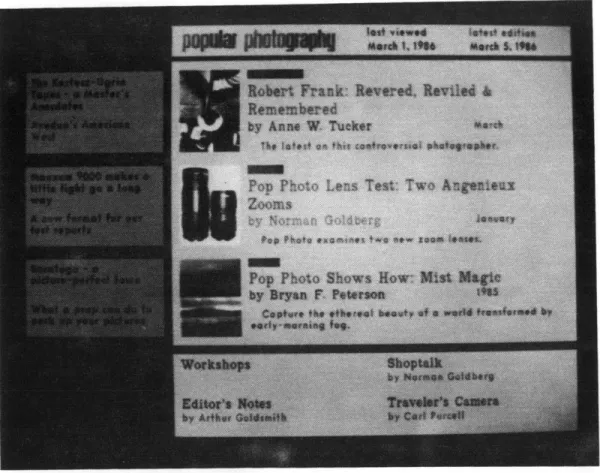
Figure 4.1: The table of contents is divided into several discrete sections
as shown. At the top of the magazine section (the larger section to the
right) general EMAG information is displayed. This includes the
maga-zine's name, the date on which it was last examined by the current viewer,
and the date associated with the issue currently under scrutiny. This latter
date reflects the time at which material was most recently received. Beneath
this section, a large area is devoted to information concerning features
con-tained within the edition (see Figure 4.6 for a more detailed description of
a single feature entry.) The smaller section at the bottom contains a titles
and, when applicable, authors' names for currently available departments.
Non-conventional information can be found in the supplementary section
(the leftmost area). This information includes listings of correlated
arti-cles, or articles related in subject matter to the specific features depicted
at right. For example, the article about Richard Avedon is correlated to the
first feature about the photographer Robert Frank. Upon request, specific
titles of entries within departments are also supplied in this section.
vertically oriented, whereas television screens are not. The EMAG utilizes the horizontal television screen, but divides it into two distinct locations. The rightmost section is of standard magazine proportions and contains more conventional magazine material. The area to the left is used for additional information, unique to the EMAG. These areas will be referred to as the magazine section and supplementary section, respectively and can be seen in Figure 4.1. The magazine section is demarcated by a very light gray background, while information in the supplementary section is produced on a darker gray background to emphasize the distinction between these two regions.
The use of color
Colored type is used to impart information to the viewer throughout the magazine. It has been shown in both computer display design[34,38,40] and magazine design[4,12] that color can be very successfully employed to this end. However, it is most effective when used sparingly and when colors are carefully chosen to allow for ease of readability. To accommodate this, the colors chosen are not highly saturated or spectrally extreme[{34].
Specifically, feature titles are presented in light green. They are easily distinguished from department titles, which are characterized by dark green type. In the magazine section, red is attached to the names of some au-thors to stress that they have written more than one viewable article. Red is used in the supplementary section to indicate that the specified item is currently being viewed in the magazine section. Advertisements
incorpo-rate the colors orange and brown to distinguish them from the text of the main article.
The presentation of text
Quality of type on a standard television is an important concern for elec-tronic publications such as the EMAG. Limitations in the number of legible characters displayable at one time, and the availability, in some cases, of only upper case letters has proven detrimental to electronic publications in the past[40,35]. Yet, it seems illogical to base systems such as the EMAG on specialized equipment when the television already holds a predominant place in the average home.
One solution to this problem is the use of soft, or grayscale fonts[42), where each character is composed of more than one bit of color information. This method allows for the construction of legible text-intensive screen displays. It also allows for the construction of font sets which resemble styles found in standard print media.
The fonts used in EMAG do not reflect those used by Popular
Photog-raphy, but are taken from two-bit soft font sets developed at the Media
Laboratory. They sufficiently illustrate the benefits of using high quality and varied fonts. The hypothetical publication scheme previously described allows for the inclusion of bit maps of a magazine's distinctive fonts within the software set. Therefore, the EMAG does not force any sacrifice of typographic style.
In standard magazine design, the use of different fonts styles ("struc-tural" contrast) and sizes is often employed to create distinctions between,
for example, a title and the actual text of an article. This promotes quick and easy reading[12,33]. The EMAG utilizes fonts in the same way to achieve these desirable results. Titles are presented in a large font. Au-thor's names are presented in the same style font, but are of smaller size and are in boldface. Large sections of text are produced in a considerably smaller and contrasting font.
As recommended for screen displays[40], large textual sections are pro-duced without right hand justification. Text is also presented in a single column, unless the width of this column would exceed 60 characters and spaces. This has been determined to be the optimum line length for stan-dard printed materials[46], and is assumed to be equally valid for text displayed on a screen.
To maintain viewer orientation within an article, a graphical marker is used to indicate when the end of a text passage is reached.
The presentation of photographs
All photographs used in the EMAG were digitized to 8 bits of grayscale
from the actual pages of Popular Photography or from slides. Each image was contrast corrected, reduced to 4 bits of grayscale information(to allow for the use of non-grayscale color as mentioned above) and stored in several sizes. Regardless of the stored size, the proportions of each photograph were always preserved. Although far from the resolution of standard magazine photographs, the photographs in the EMAG continue to solicit a notable number of positive comments concerning their quality.
Currently, color photographs are not included in the EMAG, but there
is no substantive reason for their exclusion.
4.4.2
Design specifics
Details of the designs employed in the table of contents, as well as the
feature and department pages, are now considered.
The table of contents
The design of the EMAG table of contents (see Figure 4.1) closely
resem-bles that of conventional magazines[30]. A few specifics of the design are
notable.
The magazine's name is produced in its logo typeface for easy
identifi-cation.
Unlike conventional magazines, the EMAG provides an indication of
article size. The relative length of each feature article is expressed by a
graphical bar at the top of each such entry, as shown in Figure 4.6. This
bar is composed of two shades of gray which indicate the proportional
amount of text and illustrations present in the article, respectively.
In an earlier version of the EMAG, color coding of titles was used to
impart information regarding the date an article was received, but this
proved distracting and detrimental to the overall display. As indicated
earlier, a generalized date is currently presented for each feature. This has
proved much more informative.
one time in the table of contents. This allows for the visually desirableL4)
uncluttered presentation of a sizeable amount of informative material
con-cerning each feature.
Feature and department page layout
In the following discussion, the terms "page" and "screen" are
interchange-able.
The EMAG currently allows several different layouts for feature and
department pages and can easily accept more. In general, it is assumed
each page will include text and a illustration. The layout is then selected
based on the horizontal or vertical orientation of the illustration. As the
end of an article is reached, often only text or only illustrations remain.
Special layouts handle this situation.
The program designs a page by first fitting the illustration into the
selected layout. Text associated with the article, relevant ads and related
material is then formatted around it. In this way, a photograph is never
distorted, and pages based on the same layout structure have a distinct
appearance.
An article will usually fill several consecutive screenfuls. The layout of
each is determined in a similar same manner.
As indicated above, the presentation of an EMAG article mimics the
linear presentation of an article in a standard magazine. However, the
display of ads and related material within an EMAG article follows a unique
structure made possible by computer control. In any one layout, this type of
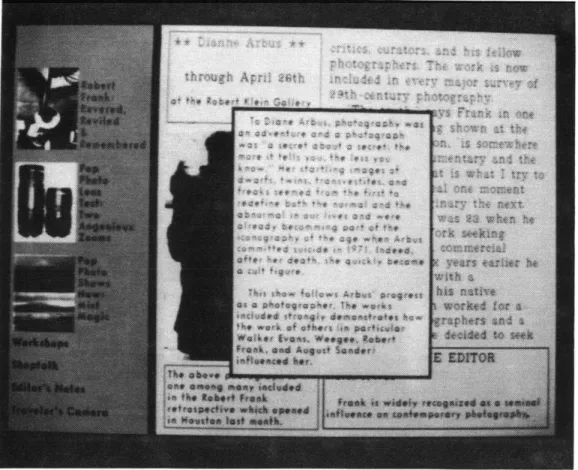
Figure 4.2: A page from the feature on Robert Frank is shown above. As in
most feature pages, the continuing main text of the article and a photograph
are presented. At the upper left, an advertisement for the Diane Arbus show
at a local gallery is included. A Letter to the Editor received in response to
this feature is presented at lower right. The simultaneous presence of this
letter and the feature it addresses is made possible through the EMAG's
"continuous publication" facility. The general layout of this feature page
was selected based on the horizontal orientation of the illustration. The
proportions of the illustration were then used to define the areas allocated
to textual material.
Figure 4.3: A typical page from the EMAG department "Shoptalk" is shown
above. It contains the text of the article, a photograph of the author, and
advertisements for an equipment show in the viewer's area and a camera
being sold at a local photo store. The supplementary section contains an
abbreviated table of contents.
it's focus, as shown in Figures 4.4.2 and 4.4.2. The full contents of an ad
or related article is shown in a "pop-up" window which is disclosed upon
request (see figure 4.4). These windows are scrollable. and consequently
can contain a virtually unlimited amount of material. New ads and related material with similar "depth" are displayed on each page. This design allows for the inclusion of many ads, each possessing substantially greater detail than found in conventional magazines. Both reader and advertiser
can benefit from this design.
4.5
Functionality and Interaction
The EMAG is designed to include both the functionality of a
conven-tional magazine, as well as unique computer-supported capabilities.
Conse-quently, the EMAG supports most styles of conventional magazine reading.
The viewer can choose to sequentially look through every page of an issue, "flip" through just the illustrations, or read the first line or paragraph of
every feature.
However, the EMAG also promotes "connectivity", a quality viewed as
essential to good electronic publications[561. Connectivity refers to
com-puter-specified links between various elements. In a sense, the EMAG is
a database, and several worthwhile classifications can be specified. For
example, it's possible to find every article within an edition written by a
certain author, or of a certain type. The latter is possible because special