How can high-end makeup brands suit the
Generation Z’ sense of beauty?
Bachelor Project submitted for the degree of
Bachelor of Science HES in International Business Management
by
Trina BERISHA
Bachelor Project Advisor:
Dr. Timothy CONNERTON
Geneva, 23 August 2019
Haute école de gestion de Genève (HEG-GE) International Business Management
Declaration
This Bachelor Project is submitted as part of the final examination requirements of the Haute école de gestion de Genève, for the Bachelor of Science HES-SO in International Business Management.
The student accepts the terms of the confidentiality agreement if one has been signed. The use of any conclusions or recommendations made in the Bachelor Project, with no prejudice to their value, engages neither the responsibility of the author, nor the adviser to the Bachelor Project, nor the jury members nor the HEG.
“I attest that I have personally authored this work without using any sources other than those cited in the bibliography. Furthermore, I have sent the final version of this document for analysis by the plagiarism detection software stipulated by the school and by my adviser”.
Executive Summary
The Bachelor Project explores the beauty industry, analyses the major makeup brands on the market and studies the Generation Z as a consumer. High-end makeup brands are facing gaps in reaching the Generation Z, and since it is about to become the biggest global consumer, there is a need to understand and suit this generation’s sense of beauty. The objective is to identify the efforts several brands initiated and draw recommendations for high-end makeup brands to appeal to this generation. (1)
The Generation Z is a conscious consumer who favours authentic brands with ethical values. These young consumers are little influenced by the name of a brand or a celebrity’s fame. They prefer intimate interactions with a closer entourage throughout their purchase experience. Despite their strong use of the online world, they choose to go in-store to explore, test and buy their makeup. This generation expects high-end makeup brands to flow with the evolution of the technology to deliver the highest quality as well as new experiences. (2)
A major brands analysis outlines the current efforts employed to reach the Generation Z. The brands start working with the Generation Z itself; they choose to include young ambassadors to represent their image to the young audience as well as to empower their employees from this generation and capture their talent and vision. Most of the high-end brands already adjusted their values to embrace the Generation Z’ sense of beauty, which is beauty for all. They invest on their digital presence and are on a mission to modernize their companies. (3)
The first recommendation the study draws to better reach and suit the Generation Z is to stay relevant and avoid an inappropriate shift. Then, brands should work on their creativeness when delivering a product as well as an experience, in-store as well as online. One of the core value brands should embrace is freedom and deliver it through their philosophy as well as through the consumer’s experience. Finally, the study recommends brands to tell their stories in an appealing and modern way so that the Generation Z can connect on an emotional level and value the brand’s authenticity and existence.
Contents
How can high-end makeup brands suit the Generation Z’ sense of beauty? ... 1
Declaration ... i
Executive Summary ... ii
Contents ... iii
List of Tables ... iv
List of Figures ... iv
1.
Introduction ... 1
1.1
Purpose of the Study ... 1
1.2
Brief History of Makeup ... 2
2.
Literature Review ... 7
2.1
The Generation Z Definition ... 7
2.2
Generation Z Behavior & Expectations ... 8
2.3
The Cosmetic Industry ... 10
2.4
High-end makeup ... 13
2.5
Celebrities, Influencers, Ambassadors ... 15
2.6
Generation Z redefines the sense of beauty ... 19
2.7
Boys wear Makeup ... 20
3.
Research Methodology ... 21
4.
Major Brands Analysis ... 24
4.1
Major Brands Overview ... 24
4.2
Dior ... 26
4.3
Urban Decay ... 27
4.4
Fenty ... 28
4.5
Kylie Cosmetics ... 29
4.6
Comparative analysis ... 30
4.7
Social Media Power ... 32
5.
Primary Data Analysis ... 33
5.1
Interview 1 Overview ... 33
5.2
Interview 2 Overview ... 34
5.3
Survey Analysis ... 35
6.
Discussion ... 47
6.1
Literature Review ... 47
6.2
Major Brands ... 48
6.3
Primary Data ... 49
7.
Conclusion ... 53
List of Tables
Table 1 Non-exhaustive list of major high-end makeup companies ... 25
Table 2 Brands comparative analysis ... 31
List of Figures
Figure 1The portrait of Cleopatra reveals the glamor of ancient Egypt ... 2Figure 2 A natural and modest look was sought by Roman women ... 3
Figure 3 Makeup in medieval times was considered dishonest ... 3
Figure 4 The pink blush of Madame de Pompadour was famous ... 4
Figure 5 Queen Victoria preserved a modest makeup style ... 4
Figure 6 The red lipstick became a symbol of power ... 5
Figure 7 Claudette Colbert was an American actress ... 5
Figure 8 Backstage at Chanel Haute Couture Show ... 6
Figure 9 Major leadesr in the cosmetics industry ... 11
Figure 10 Generation Z is shaping the future face of beauty ... 19
Figure 11 Joel Louzado ... 20
Figure 12 Bretman Rock ... 20
Figure 13 Bella Hadid in Dior Backstage Campaign ... 26
Figure 14 Urban Decay All Nighter Campaign ... 27
Figure 15 Fenty Face by Rihanna ... 28
1. Introduction
1.1 Purpose of the Study
The Generation Z is growing fast and is expected to be the largest consumer in the coming years. The Generation Z' consumer behaviour does not appear to be the same as their predecessors and the buying process is less predictable. Therefore, there is a need to understand the drivers, needs and wants of this generation so that companies would have the opportunity to reach this audience and offer products and experiences better suiting this generation’ expectations.
The definition of beauty by Generation Z is impacting the beauty industry, where the rules and conventions are broken. This generation consider makeup to be a way of self-expression and self-love, moreover, makeup should be for everyone; for women and men all ages, sizes and colours. According to Generation Z, makeup’s role is to highlight your own beauty, it encourages to love and embrace your imperfections because beauty is imperfection.
The global beauty industry is constantly growing; however, the study focuses on the two biggest markets when probing the Generation Z as well as analysing the brands; the Europe and United States. The high-end makeup encompasses traditional brands as well as more modern ones, since there are more and more brands entering the market the past years. The former brands need to adjust their strategies, what are the efforts put in place? The youngest brands had a greater chance to include this generation in their target market, how successful are they to this audience?
The study’s purpose is to look at the current movement; how the Generation Z is influencing the market along with how the brands are responding back. The objective is to identify the different gaps for reaching and appealing this population. Then, collect insights and data on the brands’ strategical efforts as well as on the Generation Z’ behaviour and expectations, what does this generation desire from the high-end makeup brands? The study aims at drawing recommendations for brands to better understand, reach and suit this generation.
1.2 Brief History of Makeup
The history of makeup is thousands of years old and can be traced through different time periods all around the world. Since ancient times, makeup has been used to enhance beauty and it has played important roles in societies. In early times, the use of makeup was also part of cultural rituals such as showing tribal allegiances, its application was often associated with spiritual or religious sense, another desire was to differentiate social classes such as royalty. Today more than ever, makeup is considered as a tool of self-expression and self-love, its application and trends have artistic freedom thanks to its history. Makeup has always been part of our society, for woman as well as for men, where the definition of beauty and the rules around have been evolving through times. The history has shaped the way makeup is consumed in today's products and brands. To have an overview of its path there are key periods to mention.
Egyptian
One of the earliest societies applying makeup was Egypt and they had a
very open view on the face paint and makeup was worn by men and woman of all classes. They used natural ingredients and manufactured their own products to make up their eyes, lips and cheeks, some cosmetics such as kohl and henna remained popular until today. (4) As seen in hieroglyphics, the famous style was the lined eyes with kohl, it is a mixture of burnt almonds, ash, lead, ochre and copper. Women as well as men used to paint their eyes with coloured kohl, mostly in dark green, blue or black. Then, to get the red for their cheeks and lips, they used to blend fat with red ochre, and to colourtheir eyelids, they produced their own eyeshadows from different substances such as malachite. (5)
6000 BC
Figure 1The portrait of Cleopatra reveals the glamor of ancient Egypt
The Ancient Greeks and Romans
Wearing too much makeup was not well perceived in ancient Greeks and Romans. Their philosophy around it was “less is more”, therefore, women wore modest and natural look. The men believed that woman’s place was at home and wearing an excess of makeup was not tolerated. Women aimed to a clear and unblemished skin so they used
to apply a light dusting or poisonous lead to cover up discoloration. Also, they slightly coloured their lips and cheeks with red pastes created from plants or fruits. (4)
Medieval Times
During medieval times, “honest women” were not supposed to change their look and so wearing makeup was deceitful. A strong association between makeup and deception was made by early Christian writers, therefore wearing makeup was proclaimed sinful.
Women created homemade recipes to reach a healthy and flawless skin, in a time where a good hygiene was hard to maintain. (4)
Elizabethan Era
Elizabethan era can be distinguished by an extravagant style that was
15th Century 4000 BC
16th Century
Figure 2 A natural and modest look was sought by Roman women
Figure 3 Makeup in medieval times was considered dishonest
health issues such as skin damage or death. Moreover, their cheeks and lips were colored in rouges, to
do so they applied a mixture of egg whites and ochres. Women kept their eyebrows very thin in an arched shape, sometimes they even shaved them so that their forehead was larger. (5)
Victorian Era
As time goes on, the history of makeup became less colorful. From the middle ages until the end of the 19th century, pale skin was desired and makeup turned to be vulgar, only prostitutes and lower class women have dared to color their lips, cheeks or eyes. The Victorian era was the period of Queen Victoria's reign 1837 until her death in 1901 in United Kingdom. Beauty was about being reserved and natural, and because of the makeup’s association with prostitutes, the Queen has publicly declared that the application of makeup to be vulgar and improper. However, women applied a minimum amount of
powder to prevent the shiny skin and maintain a little glow. They also used technics to create a rosy glow naturally by pinching their cheeks and biting their lips. (4)
19th Century
Figure 4 The pink blush of Madame de Pompadour was famous
Figure 5 Queen Victoria preserved a modest makeup style
Suffragettes and prostitutes
Since makeup became associated mainly with actresses and prostitutes during the Victorian Era, the lipstick was considered impolite and taboo. However, in 1912, women were protesting and seeking the right to vote and as a symbol of independence from men, they wore a red lipstick during the suffragette movements. This audacity has been perceived as dramatic but at the same time women showed they could wear makeup for themselves without negative connation. Since then the
lipstick became a symbol of confidence and empowerment and the formation of the lip colour into a stick was produced for the first time by Guerlain the same year. (6)
Stage and Hollywood
The rise of the movie industry in Hollywood influenced significantly cosmetics in 1920s and made it more popular. Fanzines, which is short for “fan magazine”, were written by and for people who are passionate about a specific person or topic. (7) So, the Fanzines played an essential role in the makeup’s broadening, since they encouraged women to pick up their favorite look from stars and recreate it by helping themselves with
their “get the look” guides. Thanks to mass marketing and affordable products, every woman could access to makeup, but when going to purchase makeup was still deemed embarrassing. (4) Moreover, since the Victorian
20th Century
1912
1920s
Our Current Era
Today, women have today the freedom to wear no makeup, to wear it subtly or heavily, which can depend on their mood or inspirations or the events they are going to attend and so they can decide the look they want to create. The history allows them a choice of multitude styles or a combination of different styles, but most of the beauty trends have roots in the very beginnings of human history. (5)
Thanks to the digital world, makeup has seen a new revolution and is booming in the 21st century. Social media and platforms such as Instagram and YouTube represent millions of users taking part in the makeup world. They share reviews on products and show through videos how to apply makeup so others can replicate the look. The division of gender around makeup is also evolving, the line between who ‘can and can’t’ wear makeup is becoming ever more blurred. There are more and more men applying some makeup, sharing their passion for it with videos online and wanting to be part of the makeup
industry dominated by women. The loop seems to be looped, as in the Ancient Egypt, makeup is for everyone, women and men again. (4)
21th Century
2. Literature Review
2.1 The Generation Z Definition
A generation is defined to be as a group of people born at a similar time and that have lived through a period characterized by events that historically marks and influences that generation. The impactful experiences in their lives and the similarities in their behaviours will allow them to define how they perceive themselves and the world around them. Therefore, generational cohort is an important tool to be analysed by brands and marketers to efficiently interact with a generation.
The generational analysis is not an exact science, generations themselves are inherently diverse and complex groups, which is the reason why there are slight variations on the birth years. Pew Research Center has been studying the Millennial for more than a decade and they decided to determine the cut-off point between the Millennials and Generation Z. They identify the Millennials as being born between 1981 and 1996, and the Generation Z between 1997 to 2012.(9) As more data may be collected in the future, it may redefine the birth years but the present thesis will remain with the definition suggested by the Pew Research Center, which mean the oldest of that generation are 22 years in 2019.
Generation Z is fundamentally moving towards more traditional values, they are old souls in young bodies. The financial crisis early this century taught them to be pragmatic planners looking for stable careers, they are unlikely to engage risky behaviours. The uniqueness for Generation Z is that all the technology evolution, going from the television, the computer, and the smartphone, have been part of their lives from the start. Indeed, they have never known a world without internet and unlimited digital access; it is the most connected generation. The fact that they have always been into a technological environment impact significantly their behaviours, attitudes, and lifestyles. According to Barkley reports, Generation Z will account for 40% of all consumers by 2020 and influence up to $143 billion in direct buying power, with the potential to impact more than $665 billion in family spending.(10) They will have an important impact on global markets, which represent an opportunity for brands to learn about them, understand
2.2 Generation Z Behavior & Expectations
Since this generation is about to have a huge spending power, it is expected to heavily influence companies’ marketing strategies and practices. Generation Z behave differently compared to earlier generations and has more power than them to redefine productions and consumptions based on their high expectations and a focus on the shopping experience. Marketers will need to understand their behaviours and meet their expectations if they want to reach this powerful generation of consumers.
During their shopping experience, Generation Z will favour using smart technologies such as self-checkouts, the informative touch points, as well as new cashless payment methods via smartphones without direct use of bank cards or contactless payments. The main advantages of using that smart technology while shopping are the speed and ease of transactions, flexibility and convenience for finding information on products and avoiding queues in stores.(11) Also, when shopping online, they mostly referred to social media apps and customized smartphone applications. Generation Z as a consumer will find itself better equipped and informed than store associates to place orders. They check inventory, read reviews, and compare prices; therefore, they are very demanding and will have little patience.
According to CrowdTwist research, Generation Z shop in stores more than the Millennials despite their attraction to digital and being online. They are likely to make a purchase online after seeing the products in store, especially for apparel and accessories. It works also the other way around, they will browse online before buying in-store. Generation Z wants just-in-time products or services that can be consumed instantly. They expect a tight integration between the online and the physical store, allowing in-store return from online purchase or online purchase with in-store pickup. This means that brands must extend to the physical store and have a cross platforms marketing to engage consumers, who are expecting the technology to work.(2)
The digital world and their view on the world, has facilitated Generation Z’s tendency for brand disloyalty, they don’t really care about brand logos on their t-shirt. This generation is more driven by price than by brand loyalty, they are more likely to switch for another brand and favour a lower-priced alternative. To conquer Generation Z’s loyalty, brands need to rethink their reward programs. Generation Z expects personalized promotions, they don’t mind receiving texts or notifications about special offers but they expect more
Generation Z is looking for stylish and unique products, and during their purchase decisions they are likely to be influenced by their friends and influencers. The online sphere of influence lead to Generation Z being more likely to purchase through mobile apps and social media. Generation Z value the opinion of influencers on social media, they use YouTube to get information and education through tutorials and look up to Instagram for brands and products. They know the YouTubers are paid, however, they appreciate the personal connection and transparency during the interaction. They don’t necessarily value celebrities over influencers since they better identify themselves to influencers. In Forbes’s study, it appears that 36% of Generation Z questioned were considering influencers’ choice and opinion in their decision making. (13)
The younger generation is not just about the web and digital experiences, they expect transparency and authenticity. Generation Z are socially conscious consumers and expect brands to respect and advocate the causes and values they support. According to CNBC reports, 67% of those surveyed agreed that “being true to their values and beliefs makes a person cool.” Their preoccupation for authenticity lead them to favour intimate social media rather than just following traditional celebrities and favour authentic brands rather than just following large brands. In the same report, data shows that 89% “would rather buy from a company supporting social and environmental issues over one that does not.” As a brand, there is the need to clearly define what is the brand and then align with the brand’s mission in a consistent way so that Generation Z can identify the brand as being authentic.(14)
2.3 The Cosmetic Industry
According Zion Market Research report, global cosmetic products market was valued at around USD 532 billion in 2017 and is expected to reach approximately USD 863 billion in 2024. Despite the fluctuations in the economy, cosmetic industry is one of the sectors that has remained unaffected from fluctuations.(15)
According to cosmetics Europe, the European cosmetic market was valued at 77.6 billion euros in 2017. Europe remains the premier global cosmetics market, ahead of the U.S., which accounted for 67.2 billion euros. Also, Makeup accounted for 11.17 billion euros out of the European cosmetic market.(16)
The cosmetic industry mainly includes skin care, hair care, perfume and makeup. Since the 20th century, multinational corporations such as L’Oréal or Estee Lauder have lead the market and controlled the production of beauty products. Indeed, there are 182 beauty companies falling under the umbrellas of 7 leaders in manufacturing cosmetic products.
The 7 global companies are Estée Lauder Companies, L'Oréal, Unilever, Procter and Gamble, Shiseido, Johnson and Johnson, and Coty, who control the advertising as well as the way we think about beauty. “Business Insider” created an infographic illustrating the major beauty brands and the parent companies that they fall under. On the picture below not all the sub-brands are listed but those responsible for skin care, hair care, perfume, and makeup.(17)
Figure 9 Major leaders in the cosmetics industry
The Zion Market Research report has also notice there are more and more products manufactured and advertised as being organic and sustainable since consumers are more sensitive about the environmental impact through their consumption. This concern lead to an increase in popularity for the brands that highlight those characteristics on their products labels. Furthermore, the products testing on animals worries consumers
Many trends in the industry have shaped the way of consuming and applying the beauty products. Technology and innovation is embracing the beauty industry to deliver high tech devices making the routine more enjoyable and providing new beauty solutions never reached before. Also, brands involve consumers in the product development process so that they have an open conversation and gather consumers’ feedbacks. This way they better manage to meet their needs and deliver personalized experience by catering to individuals’ preferences. The beauty industry thrives on newness with innovative brands born daily, there are constantly new products and an endless stream of trends on social media.
Going back to the targeted audience; Generation Z, and according to Piper Jaffrey’s survey; the semi-annual 35th Generation Z survey of more than 6,000 U.S. teens in spring 2018, it appears that this generation is spending more on beauty products than on apparel. His findings show beauty spending is up 20% from just a year ago as teens continue to splurge on makeup and skincare. Generation Z is constantly subject to online presence through the social media, which is the main reason why they are obsessed with their appearance and take care of it.(18)
2.4 High-end makeup
The cosmetic industry is broad and covers many product categories, since the thesis studies high-end makeup, there is a distinction to draw between the mass-market, also said drugstore, and the high-end brands. As a general definition, mass-market brands such as Revlon or Maybelline use more synthetic and less expensive ingredients into their products. Their packaging and in-store experience are minimalists. They mainly are available at drugstores or supermarkets for a lower price compared to the high-end brands. (19)
High-end brands such as Dior or NARS invest in the technology and chemistry of their products. Therefore, they provide premium formulations by including higher quality ingredients and more pigments. Their products may perform better on the different types of skin and last longer. Moreover, high-end brands will focus on the marketing efforts by delivering high-end packaging and personalized experience when distributing the products through their online, physical store or distributors such as department stores or multi-branded store like Sephora. (19)
Makeup consumers can choose to mix both types of makeup, mass-market and high-end, in their makeup bag. Mass-market makeup products are designed so that they are affordable and may be good alternatives for simple needs and everyday look. Whereas high-end makeup aim at suiting individual’s needs, which may satisfy specific goals in regard with the performance of the product on the skin. The choice of the makeup brands to purchase will probably depend on the goals, the skin’s needs and the budget. (19) The price being a clear cutoff point between mass-market and high-end, the main question is if it is worth it or not. There was a trend in 2016, where makeup influencers applied and compared the mass-market makeup with the high-end one with the goal to find the best equivalents. Experts recognize there is almost no difference in products such as lipstick or mascara and drugstore products may work just as well as the high-end one. However, the formulation and pigmentation in high-high-end brands has proven to be better quality and respective of the skin’s needs, which may worth the extra money in long-term. (20)
The line between high-end makeup and mass-market makeup can be challenging to define since new brands entering the market are mixing components from both categories and lead to mid-end products. (21) Nevertheless, and against its price, high-end brands bear evident qualities and promises:
• Brand Name
The brand name plays its part when choosing high-end makeup from designers or the new cool brands.
• Fragrance
High-end products often add fragrances to their formulas so that they enhance the consumer’s experience. The ones that do not do it claim that is better for your skin so.
• Applicators
The makeup applicators play a core role in the outcome of the look. Therefore, high-end brands include better applicators such as brushes or sponges for the makeup products.
• Pigmentation
The performance of the makeup is strongly related of its pigmentation. The application of the makeup won’t require much quantity and will last longer on the skin.
• Packaging
The high-end packaging versus the low-end one is clearly visible. All parts of the packaging play a role in the consumer’s experience as it makes it more enjoyable and special.
• Experience
High-end brands are distributed in stores that delivers a personalized experience with access to makeup artists and makeup application before purchasing the products.
2.5 Celebrities, Influencers, Ambassadors
Celebrities
A celebrity is someone famous who receives recognition and attention from the public. The status of fame is often gained in the entertainment business. (22) People may become famous thanks to their talent but also because of the media’s attention they attract in their lives. Chris Rojek, a Professor of Sociology and Culture at Brunel University, West London, is an influential author of Celebrity, Leisure and Popular Culture. He distinguishes three types of celebrities based on how they achieved their fame; achieved, ascribed and attributed. (23)
1. Achieved celebrities
Achieved celebrities gained fame and public recognition thanks to their talent and skill in their field. It is often the case for actors, singers and sports stars, some examples are Emma Stone, Dua Lipa or Neymar.
2. Ascribed celebrities
Ascribed celebrities gained fame because of their lineage such as royalty, socialites with affluent relatives, and parents’ children who are celebrities. Respectively, some examples are Prince Harry and Prince William, then Paris Hilton and, Will Smith’s son, Jaden Smith.
3. Attributed celebrities
Attributed celebrities gained fame by amassing the public’s and media’s attention or by being part of celebrities’ clan. The best example is Kim Kardashian and her family, another one is Nicole Richie.
Social Media Influencers
Even though the term “influencer” in history used to define influential spokespersons who established personalized relations between the consumers and the products, today the modern influencers are referred to the social media influencers. An influencer in social media is someone who has built a reputation and gained social media following thanks to his or her knowledge in its field. Social media channels such as Instagram, Facebook or YouTube allow influencers to create and publish content in different ways. Their content may inspire, entertain or inform their followers, which allow to establish a direct conversation with their audience. Influencers can drive engagement and set trends. Influencers have the power to influence their audience’s opinion as well as their purchase decisions, which lead them to collaborate with brands by creating sponsored content and promoting their products. (24) Social media influencers can be categorized by size and scope and the article from Mediakix distinguishes six tiers:
1. Nano-Influencers
1000 – 10’000 followers are a small, niche audience
2. Micro-Influencers
10’000 – 50’000 followers are a wider audience
3. Mid-Tier Influencers
50’000 – 500’000 followers are a large audience
4. Macro-Influencers
500’000 – 1’000’000 lead to a premiere status
5. Mega-Influencers
1’000’000 – 5’000’000 followers put influencers in a category of celebrities
6. Celebrities
Famous personalities who gained prestigious status on social media with more than 5’000’000 followers
Influencers can also be defined by business sectors such as fashion or beauty as well as by a social media channels such as Instagram Influencers or YouTube Influencers. The influencers may not amass the same influence through every platform. Most of the case, they have a primary channel from which they built their career and on which they have the greatest number of followers. (24)
Influencer marketing is a form of social media marketing involving products placements and endorsements from influencers such as traditional celebrities as well as social media influencers. Celebrities can reach a massive audience but they can be less accessible compared to social media influencers who focus on building close and trustful relationships with their followers. The easiest way to distinguish them is the channel through which they built their career; traditional channels or social media platforms. (25) Social media influencers became very popular and have larger social media followers than the traditional celebrities. Therefore, they are the new celebrities and brands benefit from collaborations allowing them to grow their presence on social media and raise brand awareness. The influencer marketing industry is significantly growing and is expected to reach 5 -10 billion by 2020. (24)
Brand Ambassadors
A brand ambassador is someone who represents and promotes your brand in the market. There are two types of brand ambassadors; the first are famous and renowned people that a brand hire to be the brand’s image. They can be traditional celebrities as well as social media influencers with who a brand establishes a marketing strategy. The second type of ambassadors, are people that freely recommend the brand to others. These individuals are likely to be consumers and employees that share their enthusiasm for the brand to their entourage through word-to-mouth or online through positive reviews. (26)
Celebrities vs. Social Media Influencers vs. Brand Ambassadors
The growth of social media has led to the success of social media marketing and the rise of three core players; traditional celebrities, social media influencers and brand ambassadors. The distinction of each may be blurry and the line between traditional celebrities and social media influencers is hard to draw. (27) A celebrity may have a strong influence on social media and be hired as a brand ambassador while a social media influencer can gain a fame status and promote a brand’s products. Nevertheless, the following summary should help draw the major distinctions:
1. Celebrities
They are known for their talent and skills in their field such as music, film, art or modelling. They have often endorsed brands but have not necessarily shown a genuine connection with their audience on social media.
2. Social media influencers
They are focused on engaging with their audiences on social media and creating content within their field. They usually are not dedicated to one brand but rather sponsor multitude of brands in their industry.
3. Ambassadors
Ambassadors can fall into two categories; paid or unpaid. They can be celebrities as well as social media influencers, but not only since the consumers and employees can also be considered as such.
2.6 Generation Z redefines the sense of beauty
The definition of beauty has evolved through the generations and new makeup brands are taking the chance to better appeal to the Generation Z’s expectations. Indeed, over the last years there has been launches of many beauty brands and concepts seducing the younger generation. The article titled “How is Gen Z shaping the future face of beauty?” look at three key drivers in the beauty industry – beauty is imperfection, beauty is bold and beauty is Instagram.(28)
First, Generation Z is writing modern rules that favour more liberal views on race, gender, identity, sexuality and self-expression, and those
rules play into current beauty trends. Today, makeup is for everyone, meaning it has no gender and young men are into makeup too. Moreover, Generation Z’s sense of beauty is not anymore about hiding and covering up imperfections but rather love your imperfections and be yourself, because beauty is imperfection. The growing presence of influencers has been part of this change of culture around beauty, influencers encourage others to be themselves. Therefore, brands are looking to shift their message for self-expression and break down gender barriers.
Second, Generation Z was born into a world of poverty, war and economic crisis, therefore, they will actively look for brands making changes for a better world. The values and mission of a brand will significantly impact the purchase behaviour of Generation Z, they want brands that add value to their life, that are authentic and meaningful. The universal singer, Rihanna, was one of the first to launch its makeup brand “Fenty Beauty” and her mission was to offer all possible shades for every skin colour. She launched a range of 40 colours of foundations, under the label ‘beauty for all’.
Third, Instagram is being part of the beauty buying process from the start to the end. To start, the Generation Z is going to check the beauty trends and beauty gurus on
Figure 10 Generation Z is shaping the future face of beauty
2.7 Boys wear Makeup
On social media, male beauty influencers are breaking gender roles and mastering the artistry of makeup. They encourage the confidence in young men to accept and celebrate their beauty, men too now want to have the freedom to wear or not makeup. Makeup may represent a way in which men are breaking the gender norms and years ago, they could have not express themselves the same way as today. Since Generation Z has taken the lead to write their own rules, it allows more acceptance and tolerance for beauty open to all; girls and boys. The two testimonies below are illustrating this movement. Joel Louzado is Indo-Canadian man who lived his youth hiding who he really was by fear to be rejected by its entourage and society. Even though their parents knew about his sexuality as well as his passion for makeup, he was embarrassed to wear some makeup in front of them. He used to wait until everyone home is asleep to let himself apply makeup, take pictures and post them on social media so that he felt less alone. He says: “It is a privilege to be able to do something that’s unacceptable in a culture without having to worry about your safety and mental health.” (29) Bretman Rock, 20 years old, is famous for his makeup artistry and his videos on social media. Growing up in a Catholic Latino home, Bretman was taught that makeup is not supposed to be wore by boys.
However, he was not fitting the excepted stereotype for boys in society and did his coming out to its close entourage. Today, he feels free to be himself and honoured to live his passion for fashion and makeup he is sharing with his more than 13 millions of followers on Instagram. (30)
Figure 11 Joel Louzado
3. Research Methodology
3.1 Type of Research
The study is an exploratory research; therefore, it implies to explore the research question with the goal of providing a better understanding of the problem. The study identifies the struggle for high-end makeup brands to reach the Generation Z, and the question on how they could appeal to that young audience may not present one finale solution. Nevertheless, the study aims at bringing new data and insight to this field.
3.2 Source of Data
Primary Data
The primary data are collected from interviews with professionals of the beauty industry and a survey addressed to the Generation Z. The data collected are related to Generation Z’s behaviour and its expectations from the beauty industry. On the other hand, the data identify the efforts employed by professionals and the remained gaps.
Secondary Data
The secondary data are mainly collected from articles, reports and websites. They relate to the history and the evolving aspects of the beauty industry. The data collected study the brands on the market, especially what are the most appealing brands to the Generation Z.
3.3 Instruments for Data Collection
The collection of primary data has been helped by the following instruments: • Questionnaire
The questionnaire is a series of questions for which it aims to receive responses from the target audience, the Generation Z.
Instagram is a major tool to contact the Generation Z. The platform helps to reach a broader audience and facilitate the effort put to invite them to respond to the questionnaire.
3.4 Research Methods
The study follows the Survey Method and employs the two following methods: • Interviews
The interview with professionals can allow them to share their experiences, bring more insights and reveal issues or challenges faced to reach the Generation Z. The interviews’ format is semi-structured so that there is as set of questions initially prepared but additional questions might be asked during the interview to clarify or expand the topic. (interviews)
• Questionnaire
The questionnaire aims to describe certain characteristics of the Generation Z as makeup consumers and identify some of their expectations. The questionnaire includes open-ended and closed-ended questions, ranking question as well as multiple choice questions. (32)
3.5 Limitations of the Study
The study carries out the following limitations faced during the research:
• The focus group failed to happen because of the lack of motivation or availability of Generation Z people during the research.
• The respondents of the online survey may not be representative of the Generation Z population in Europe either in United States.
• The respondents are expected to live in majority either in Switzerland or in Miami, Florida because of the researcher's network.
• The professionals of the industry may not share their organization’s current strategies.
To overcome the missed focus group, informal discussion with people of the Generation Z helped the study to note several ideas or experiences that this audience would like to be offered by the beauty industry. The ideas were included in a second part of the survey so that their attractiveness could be tested. Moreover, a blank section is left for welcoming new ideas.
4. Major Brands Analysis
4.1 Major Brands Overview
The 20th century had a significant influence on the beauty industry, since most of our
makeup manufacturers were established during this era. Most of high-end brands created from that time are still on the market and many more were created in the 21st
century. According to the non-exhaustive list below for makeup brands’ year of foundation, we may identify in early of the 20th century the foundation of the leader groups
such as L’Oréal or Estée Lauder as well as haute couture houses launching their own makeup line, as did Chanel or Christian Dior. Later in the same Century, we observe the launch of new makeup brands from the professionals of the industry such as Urban Decay or Anastasia Beverly Hills. How those more traditional brands can appeal to Generation Z today?
Then, in the 21st century, there are more and more celebrities creating their own cosmetics brands to enjoy one of the most growing sector in the business world; the beauty industry. Rihanna Fenty as well as Kylie Jenner took the opportunity to create their own beauty brands and promote their vision of beauty while successfully running their businesses. An undeniable advantage is their strong influence on millions of followers, especially through social media, which allow them to put less effort in marketing by reaching their target audience instantly. Their fan base is actively engaged and trust them for their taste in style and beauty. Even though Kylie Cosmetics is not in the line for a high-end makeup brand, her success-story may bring some insights on how to reach the Generation Z.
To have a better understanding of new makeup brands’ foundation and see what are the efforts few brands put in place to reach the Generation Z, the research zoom at three brands from different time periods; Dior, Urban Decay and Fenty Beauty with a comparison to Kylie Cosmetics.
Table 1 – Non-exhaustive list of major high-end makeup companies
Companies’ Year of Foundation
1909 L’Oréal Group
1924 Chanel
1935 Lancôme
1946 Estée Lauder Group
1947 Christian Dior Cosmetics
1954 Clarins Group 1957 Givenchy Parfums 1976 Benefit 1984 MAC 1994 NARS 1995 Urban Decay
1997 Anastasia Beverly Hills
1998 Too Faced
2000 Giorgio Armani Beauty
4.2 Dior
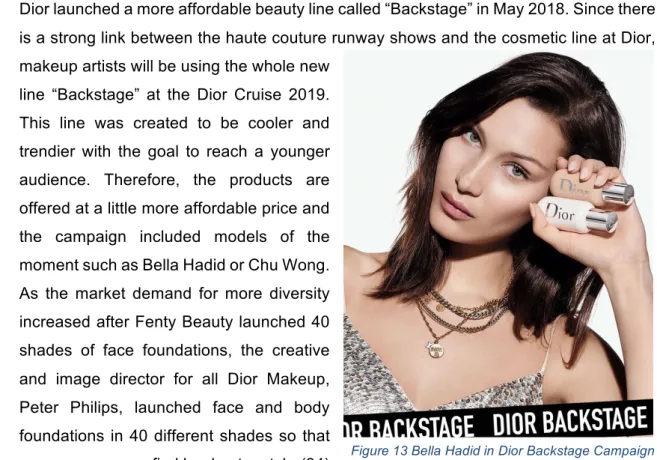
Parfums Christian Dior founded in 1947 is the perfumery and cosmetics line of the French fashion house, Christian Dior. The line belongs to the perfumes and cosmetics portfolio of the world's largest luxury group, the LVMH Group. In 1953, Dior launched his first and iconic lipstick called “Rouge Dior” with which it marks the entrance of the haute couture house in the world of cosmetics. Dior has continued to launch new beauty products since then and in 1969, the first full range of Dior makeup was created. (33) Dior launched a more affordable beauty line called “Backstage” in May 2018. Since there is a strong link between the haute couture runway shows and the cosmetic line at Dior, makeup artists will be using the whole new
line “Backstage” at the Dior Cruise 2019. This line was created to be cooler and trendier with the goal to reach a younger audience. Therefore, the products are offered at a little more affordable price and the campaign included models of the moment such as Bella Hadid or Chu Wong. As the market demand for more diversity increased after Fenty Beauty launched 40 shades of face foundations, the creative and image director for all Dior Makeup, Peter Philips, launched face and body foundations in 40 different shades so that every woman can find her best match. (34)
The iconic ambassadors of Dior makeup have been international stars like Natalie Portman or Kate Moss and since Dior desires to keep the younger generation interested, they include younger beauty ambassadors too. In 2016, Bella Hadid, an American model born in 1996, joined the face of Dior. She appeared in an online video series, through which the public can enjoy the backstage experience of her runaway shows and know about her favorite products. (35) In 2019, the star Jorja Smith is the new global makeup ambassador for Dior. Jorja Smith was born in 1997 in England to an English mother and a Jamaican father, is a R&B singer with a strong personality. (36) The younger ambassadors have also millions of followers on social media which allow a powerful
4.3 Urban Decay
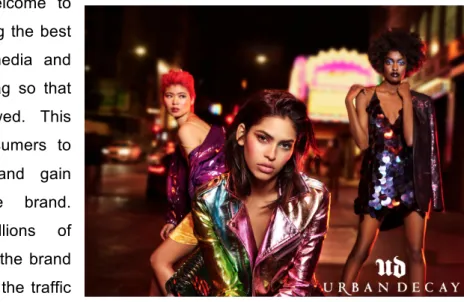
Urban Decay is an American cosmetics brand founded in 1996 in California and acquired by L’Oréal in 2012. The reason of its creation is because beauty industry in the mid-1990s was dominated by pink, red and beige tones. Therefore, four partners decided to shake the beauty industry and found their own makeup brand Urban Decay known to be edgy, colourful and different. Urban Decay founders never stopped experimenting new colours to creates endless options; shades of colours are offered in neutrals or dark but also in vivid bright, glimmering or metallic. They name their products inspired by the urban landscape such as Roach, Smog, Rust, Oil Slick, and Acid Rain, which are delivered in a high-end and creative packaging that captures the audience. (37)
Urban Decay appeals to woman who dares to express their personalities and have a taste of dangerous and fun. The brand target women aged between 15 to 40, especially those that want bold colours and looking for cruelty-free makeup products. To engage with its audience Urban Decay organizes “The Shorty Social Good Awards” every year and everyone is welcome to
participate by creating the best content on social media and using a given hashtag so that the posts are viewed. This strategy allows consumers to show their talent and gain recognition by the brand. Moreover, the millions of participants increase the brand awareness thanks to the traffic generated on social media. (38)
Wende Zomnir is one of the founders of Urban Decay who helped to build the brand and to shape the beauty industry. In an interview with Forbes Magazine, Wende explains how she felt about applying makeup at the age of 16. She used to receive comments on how she was hiding behind a mask of makeup but she didn’t feel that way, she was
4.4 Fenty
The singer Rihanna launched her cosmetics brand, Fenty Beauty, in 2017, she developed and produced her brand in collaboration with LVMH. Forbes estimated LVMH's stake of 50%, whereas Rihanna about 15%. Rihanna’s fortune is however estimated at $600 million, she continues to grow her empire and announced in May 2019 the launch of Fenty, a new high-end clothing brand with LVMH. Fenty Beauty products sold for an estimated $570 million in 2018, since her launch in September 2017, Fenty Beauty is sold on its online website and at Sephora, another brand owned by LVMH. (40)
Fenty Face by Rihanna
Rihanna’s goal wasto provide inclusivity women of all skin tones, therefore, her face foundation was launched in 40 shades and expanded to 50 shades by today. Her philosophy, “Beauty for all”, include women of all shades, personalities, attitudes, cultures and races. (41) Another important fact is that women of color had been traditionally excluded from prestigious makeup brands or offered only few shades darker than the medium shade “beige”. Therefore, women of color embraced Fenty for its inclusivity and encouraged others brands to follow the lead.
In addition to its large range of shades, Fenty Beauty’s advertising was strongly diverse by promoting new models of different ethnicities and body shapes. Fenty Beauty also want to break down the rules in regard of the gender division and engaged men for advertising campaigns. (42) The success of Fenty Beauty pushed competitors to expand their products and offer more shades to promote inclusivity. As discussed, Dior launched the Dior Backstage line with 40 shades of face and body foundation in 2018, this phenomena on the market has been referred as the “Fenty Effect”. (43)
4.5 Kylie Cosmetics
Kylie Jenner founded Kylie Cosmetics in 2015, she started with three different “Kylie Lip Kits” and then expanded to more products such as eyeshadows, blushes, highlighters. The three first years, Kylie Cosmetics was sold only online and in few pop-up stores, but in November 2018, she announced an exclusive distribution deal with Ulta and her brand will be placed to more than a thousand stores in the United States. Kylie is working on growing her company and announced the launch of her vegan Kylie Skin line in May 2019, a full set of products for the skincare. In 2018, Kylie Cosmetics generated an estimated $360 million in revenue, today the company is worth at least $900 millions and Kylie owns 100% of it, which made Kylie Jenner the youngest self-made billionaire ever. (44)
Kylie Jenner was seen on the reality TV show “Keeping Up with the Kardashians” for more than a decade, which means she has shared her childhood and teenage life with millions of viewers. She has built a personal and loyal connection with her fans over time, she has 144 million followers on Instagram by today and is the 7th
most followed person on the
platform. Kylie Jenner being the ultimate influencer, she does not need to turn to a third party to promote her brand, instead she uses her face for Kylie Cosmetics visuals and announces her launches through social media. To drive demand, she launches collaborative makeup collections with her famous family members and seasonal collections such as for Christmas or Summer. Kylie promotes her brand through her personal Instagram profile as well as the business one. This way, Kylie increases her chances to convert her followers to consumers of her products. (45)
4.6 Comparative analysis
In comparison with Kylie Cosmetics, the three other brands mentioned are high-end makeup brands delivering premium experience and quality, thus, targeting consumers with a bigger purchasing power. Kylie Cosmetics’ simpler formula of and less expensive package do not include the brand as a high-end one. Kylie Cosmetics consists of a dozen employees, while the manufacturing and packaging is outsourced to a private-label producer, Seed Beauty, which also produces ColourPop, a mass-market brand. Since the renowned name of Kylie Jenner is one of the strongest strength, she can position her brand in mid-end category, where the price can be found between the high and low-end. (44)
Kylie Cosmetics targets a young audience with a lower purchasing power and in comparison, with other celebrities’ beauty brands, her consumers spend less in makeup products. According to Slice Intelligence research shared exclusively with WWD in January 2018, Fenty Beauty consumers spend more on makeup products in comparison with other brands of famous personage such as Kylie Jenner, Kim Kardashian or Kat Von D. Fenty Beauty’s consumers spend on average $471 per year on makeup, whereas Kat Von D’s consumers spend $371, KKW’s ones spend around $278 and Kylie Cosmetics’ about $181. (46)
The table below outline the main characteristics and differences each brand going from Dior to Kylie Cosmetics. Since ColourPop is mentioned as a mass-market brand, it is included to the table so that it allows to draw the pricing cutoff point from the three makeup categories; high, mid and low-end brands. In addition to their prices, the table below provide a concise comparison in different areas such as bestsellers, Instagram followers and parent companies of the brands.
Table 2 – Brands comparative analysis
DIOR URBAN DECAY BEAUTY FENTY COSMETICS KYLIE COLOUR POP
Lip Gloss Price Dior Lip Glow 34 $ Lip Plumper 22 $ Gloss Bomb 18 $ Cupcake Gloss 15 $ Ultra-Glossy Lip 7 $ Best Sellers Dior Rouge lipstick, Diorshow Mascara, Forever face foundation Naked eyeshadows palettes, All-Nighter spray Pro Filt’R face foundation, Gloss Bomb
Lip Kits, High Glosses Ultra-Glossy Lip, Lippie Stix Famous for Fashion house renown and expert savoir-faire Boldness and vivid colours Inclusivity and diversity Social media renown and fascination for lips Cruelty-free and budget-friendly Instagram
Followers 5,8 million 11,1 million 8,4 million 21,9 million 8,3 million
Number of Employees 10’400 employees 500 employees Unknown 12 employees Unknown Parent
Company LVMH L’Oréal LVMH Private
Seed Beauty
4.7 Social Media Power
The Kylie Cosmetics success-story can teach and inspire other brands to pay more attention to social media and to Generation Z. Kylie's success can be explained by her passion for makeup, her opportunity to leverage her fame from social media and launch her brand herself. Most importantly, she identified the opportunity to appeal to a younger market, while most of makeup brands were targeting adults. Kylie created her brand to reach and offer her makeup products to teenagers and young people, in other words, to Generation Z; and who could better reach the Generation Z than the one being part of that generation. Kylie Jenner being born in 1997 is an iconic influencer to her generation. (47)
Kylie Jenner as well as Rihanna are signals to consider for the future of retail industry which will be shaped with new rules thanks to social media and the power of influencers. Technology is giving access to a bigger scale and points of distribution, products and distribution can be managed through social media, but the industry is not paying enough attention to it. Social media allows entrepreneurs to escalade the steps and create their business without the need of merchants to sell their products in physical retail stores. Anyone that embraces charisma, authenticity and has technical competences on social media, can start her or his business online. Instagram and Amazon are already developing new technologies to help new influencers and entrepreneurs launch their businesses. (48)
5. Primary Data Analysis
5.1 Interview 1 Overview
The first interviewer is Maryne, she lives in Geneva and is 25 years old and counts 7 years of experience in the beauty industry as makeup artist for several high-end makeup brands such as Dior or Urban Decay. For two years now, she is employed by Estée Lauder as Retail Sales Manager for three brands; the makeup brand, BECCA and the skincare brands, Glamglow and Origins. Since the three brands have a distribution deal with Sephora, she mainly is in charge for the sales agreements as well as monitoring the performance of the three brands through Sephora stores in the French part of Switzerland. The questions and answers are available at the appendix 1.
Ahead of the interview, there is information to mention for an overview of the company. The Estée Lauder Companies is a multinational manufacturer and marketer of prestige makeup, fragrance, skincare and hair care products. Estée Lauder started to produce cosmetics in New York in 1946. Today, the company counts a portfolio of 29 brands, distributed internationally.(49) BECCA was founded in Australia in 2001 and acquired by Estee Lauder in 2016. The brand promotes inclusivity by providing shades for every skin tones and is famous for the glow its products provide. (50)
As reported by PETA (People for the Ethical Treatment of Animals), Estée Lauder still practices animal testing in 2019 on many brands of its portfolio. Estée Lauder says being committed to the elimination of animal testing, however, they do test on animal on the markets where the law requires it.(51). BECCA, on the other hand, is a cruelty-free cosmetics brand and its products are not sold where animal testing is required by law. (52)
An article published in February 2019 explains Estée Lauder’s mission to modernize and focus on empowering employees from Millennial and Generation Z to better reach the young consumers. To do so, Estée Lauder created an internal corporate program in 2015, referred as a Reverse-Mentorship Program, where a Millennial or a Generation Z employee is teamed up with a more senior one. (3)
5.2 Interview 2 Overview
The second interviewer is Flaka, she lives in Geneva and, after graduating in 2006, she started her career at Clarins as an intern. She built her career in the company for more than 10 years now, and her current position is General Manager of the Travel Retail EMEA, which is the 5th biggest market for the Clarins Group. The questions and answers
are available at the appendix 2.
Ahead of the interview, there is information about the company’s profile to keep in mind. Clarins Group is a French family company founded by Jacques Courtin-Clarins in 1954. The three sectors of activities are cosmetics and makeup, perfumes and fashion. Clarins' brand portfolio includes Clarins, My Blend, Mugler and Azzaro.
The beauty division designs and manufactures high-end makeup and skincare, and is well known for its anti-aging expertise. The secret of its success hides behind the plants, Clarins’ laboratories develop the products from the best plant extracts and essential oils. Today Clarins, with 28 distribution subsidiaries around the world, is present in more than 141 countries. (53)
As reported by PETA (People for the Ethical Treatment of Animals), Clarins still practices animal testing on its products, which means it is not cruelty-free company. Its policy on it is not easy to find except on its USA website where the company’s answers that they do not test on animal except on the market where the law requires such testing. (54) In January 2019, Clarins has launched a new skincare line called “My Clarins” designed to appeal young women aged from 18 to 29. The line offers nine new products that are vegan-friendly and delivered in a packaging made of recycled materials. Since the line is vegan friendly, it does not allow animal testing and so is not distributed to the market where animal testing is required by law. (55)
5.3 Survey Analysis
Survey Design
The survey has been designed on the SurveyMonkey website, the questionnaire is available at the appendix 3. The survey was divided in three parts; the first part asked mainly about brands preferences and consumers behaviour habits. The second part test selected ideas from informal discussions on what can brands offer to better suit the Generation Z. The last part collected personal data for statistical purpose such as living place and gender.
Target Audience
The Generation Z, as defined by Pew Research Center, begins on the year birth 1997. Since it explains as well that the break-point between two generations is not an exact science and because the debate is still open, the year of birth of my survey starts with1995. The fear of losing insight from this generation motivated the survey to broader the year range. After the data were collected, the results were compared from the range year of 1995-2005 to the 1997-2005 and there was no noticeable difference in the answers. Therefore, the analysis retains the range year 1995-2005.
Response Collection
The survey is addressed to the Generation Z audience with a total of 21 questions. The invitation to respond to the survey was mainly sent to people living in Switzerland and in Miami, Florida, which may not be representative of either the European market nor the US market. Moreover, it was promoted with the help of Instagram and several Instagram users accepted to create a swipe up link in their stories to reach a broader audience. The results count a total of 93 respondents and the results are illustrated by the charts provided by the SurveyMonkey website.
1. Population Analysis
Chart 1. What is your birth year?
There is a total of 93 participants, 55 of them are born in 1995 and 1996. The more we look down the latest years, the less there are respondents. The oldest participants were born in 1994 and are 24 years old in the present year. Then, the participants born in 1997 are 22. The youngest participant was born in 2005 and is 14 years old, this person can be identified because of the informal discussion and invitation sent via a direct message on Instagram. The youngest participant is a boy and lives in Colorado, United States. He is passionate about makeup and creates artistic looks, which he posts about on his Instagram page.
Chart 2. What is your gender?
The significant majority of the participants are women. There has been a feminine domination in the makeup world that can be explains the apparent results.
Nevertheless, there are 3 men participants. Even though the study identifies the gender-neutral movement for makeup, the survey did not collect enough data to represent thoroughly the population of men applying makeup.
Chart 3. Where do you live?
The results regarding the geographic locations are in majority in Europe with 77,42% and 22,58% in USA. Another question with a blank box allowed participant to notice the country or state they are living and, as expected, most of participants live in Switzerland and in Miami, Florida.
2. Consumer Behaviour Analysis
Chart 4. Where do you most often purchase your makeup?
The 88,17% of the participant purchase their makeup products in a physical store rather than online. This result confirms the preference of the Generation Z to purchase their makeup in-store, even though they expect digital experience and social media presence.
Chart 5. In which state of mind do you most often go in-store?
To understand their behaviour and intentions when going in-store, the question asks whether they go to a makeup store to explore, test as well as purchase products or if they go only test the products without concluding the purchase, or if they go in-store knowing from start which product they want to buy. There is only a minority going in-store with no intention to make a purchase. Otherwise, 86 out of the 93 participants go with the intention to purchase, and 35 of them know exactly what product they want to purchase.
Chart 6. Rank the places for purchasing your makeup in your preference order
According to the chart 4, it is not surprising to the physical store as the first place chosen to purchase makeup products. The online store comes at the second place, ahead the pop-stores and Instagram shopping.
Chart 7. Rank the sources you trust most when purchasing your makeup
The participants trust their family and friends in the first place, then, the makeup artists. This preference may show the desire of this generation to have a personal connection and trust people they can relate to. Another interesting result is that they are more likely to look at the beauty influencers first rather than the celebrities.
Chart 8. What factors matter the most when purchasing your makeup?
The three most factors selected are quality in the first place, then, price and experience. The three least factors selected are brand image, packaging and beauty trends. The brand image being a core value for prestigious makeup brands, it may not motivate the Generation Z to buy the product for the name of the brand.
Chart 9. Select the values high-end makeup brands should embrace to attract you
The three most selected values to attract Generation Z are authenticity, diversity and freedom. The Generation Z expect authentic and honest brand they can trust. Moreover, they have a definition of beauty that hold with diversity and freedom values.
Chart 10. Do you actively check brands’ policy on animal testing before purchasing their products?
According to the chart 10, 36,56% of participant will actively look at the brand’s policy on animal testing. This number reveals how much sensitive the Generation Z is to the subject and take the time to check the information before considering buying the makeup product. Also, this portion of participants might directly look after cruelty-free brands in their makeup consumption.
Chart 11. If you discover the brand you are about to purchase does animal testing, do you cancel your purchase to switch with a cruelty-free certified brand?
The following question may apply to participants who do as well as those who do not check the brand’s policy on animal testing ahead the purchase decision. The question aims at showing if the person receiving the information in any ways, does cancel the purchase to switch to a cruelty-free certified brand. Here, 62,37% responded they would cancel the purchase and switch the brand, which shows how much the subject matters and influence the purchase decision.
3. Generation Z’ Appealing Ideas Analysis
The second part of the survey presented 6 creative ideas that high-end makeup brands could adopt to better suit Generation Z' expectations in the brand’s products and services as well as the delivered experiences. The ideas were collected from informal discussion with the Generation Z audience and several ideas are not at all offered on the market. Each idea’s relevance and attractiveness is tested near the participants, and the listed charts below are presented from the least attractive to the most attractive.
Chart 12. "Instagrammable moments" in-store
The brands have already offered in-store experiences that are “Instagrammable”, the goal is to have a creative décor or new stores’ design that motivate the young consumers to take pictures or videos and post them on their Instagram pages. According to the result, this trend may not seem anymore as the major key to attract them, maybe because they expect more.