COMPUTING SHAPE
USING A THEORY OF HUMAN STEREO VISION by
William Eric Leifur Grimson
B.Sc., University of Regina (1975)
Submitted in Partial Fulfillment of the Requirements for the Degree of
Doctor of Philosophy at the
Massachusetts Institute of Technology June 1980
@ Massachusetts Institute of Technology, 1980
Signature of Author -Department of Mathematics June 2, 1980 Certified by David C. Marr Thesis Supervisor Accepted by ARCHIVES MASvAC COF TiCHNCi-fi-.LO"GYTT NS7 L
,JU 1I 1980
Michael Artin Chairman. Departmental Committee on Graduate Students
COMPUTING SHAPE
USING A THEORY OF HUMAN STEREO VISION by
William Eric Leifur Grimson
Submitted to the Department of Mathematics on June 2, 1980 in partial fiulfillment of the requirements
for the Degree of Doctor of Philosophy
Abstract
This thesis is concerned with the construction of a complete specification of the shapes of the visible surfaces of a scene, given a stereoscopic pair of images of that scene as input. This problem is investigated within the framework of a computational theory. There are two parts to the problem.
A theory of human stereo vision was recently developed by Marr and Poggio (1979). Part I of this thesis deals ith a computer implementation of that theory. The implementation served both as a source of feedback for the theory itself, outlining problems and illuminating previously overlooked difficulties, and as a method of testing the adequacy of the theory. By running the program on a series of images from the human stercopsis literature and comparing the results with the perceptions of stereo observers, it was shown that the program, as a reflection of the Marr-Poggio theory, adequately accounted for a wide range of stereoscopic perception.
Part I1 deals with a computational theory of surface interpolation. One of the consequences of the Marr-Poggio theory, and of most early visual processes, is that explicit surface information is available only at a certain restricted set of positions in the image. In order to construct a complete specification of the surface shapes, it is necessary to account for implicit information in the formation of the images. A theory of this process was developed and implemented. In particular, a series of results relating the shapes of surfaces and the initial representation of the images were proven. From these results, a set of mathematical constraints on the interpolation problem were derived. An algorithm for interpolating the surfaces was developed, using results from nonlinear programming, and that algorithm was implemented in a computer program and tested on a range of images.
Thesis Supervisor: David C. Marr Title: Professor of Psychology
Acknowledgements
Many people have contributed to this work and provided advice and encouragement to its author. I would like to express my gratitude to:
David Marr, whose constant and timely encouragement and enthusiasm and whose insightful advice were invaluable, whose high standards are a constant inspiration, and without whom, this work would not have happened.
Tommy Poggio, who, together with David Marr, developed the stereo theory upon which this thesis relies, who is never stumped for an answer, and whose excitement for scientific discovery is contagious.
Mike Brady, who carefully read drafts of the thesis, and who provided valuable criticism on many points; Berthold Horn, who also provided valuable criticism on the thesis, and who frequently enlightened me on the details of image formation; and Whitman Richards, who en-lightened me on many aspects of psychophysics.
Patrick Winston, who exhibited unending enthusiasm about this project, who provided financial support, and who carefully maintains an atmosphere within the AL Lab that is both stimulating and supportive.
Shimon Ullman, Keith Nishihara and the other "Visionaries", who provided many useful com-ments and criticisms, and who are excellent "sounding boards" for ideas, both good and bad.
Denis Hanson, who convinced me that even a "prairie boy" could make it at MIT.
Matt, Mary, Tomas, Lorraine, Chuck, Candy, Bob Sj., Bob W., Brian, Ken and John, who help make the AI Lab an exciting place to be; with whom I've had many discussions, and without whom, the time spent in completing this work would have been far less enjoyable.
Ellen Hildreth, who read more drafts of this thesis than I did, who provided many valuable comments, and who helped me keep my sanity throughout it all.
and my parents, who taught me long ago that few things are more valuable and lasting than a thirst for knowledge.
Table of Contents
Abstract 2
Acknowledgements 3
Table of Contents 4
1. Introduction 7
1.1 The Computational Approach 8
1.2 Synopsis 12
2. The Stereo Theory 17
2.1 What is Stereo 17
2.2 The Marr-Hildreth Theory of Edge Detection 22
2.3 The Marr-Poggio Theory of Stereopsis 33
2.3.1 Outline of the Marr-Poggio Theory 33
2.3.2 The Matcher 36
2.4 Summary 38
3. The Stereo Implementation 39
3.1 Input 42
3.2 Convolution 43
3.3 Detectioin and Description of Zero-Crossings 43
3.4 Matching 49
3.5 Vergence Control 52
3.6 The 2 -Dimensional Sketch 53
3.7 Summary of the Process 54
4. Analysis and Development 57
4.1 Performance on Random Dot Patterns 57
4.2 Natural Images 66 4.3 Statistics 72 4.4 Discussion 77 4.4.1 Pool Responses 78 4.4.2 Matching Errors 78 4.4.3 Depth Discontinuities 79 4.4.4 Constraint Checking 79 4.4.5 Representations 80
4.4.6 Random Dot Patterns versus Natural Images 82
4.4.7 Failures of the Algorithm on Natural Images 83
4.5 Development of the Implementation 88
4.5.1 From Which Image Do We Match 88
4.5.2 Oriented Filters 89
4.5.3 Statistics 91
4.6 Edge Effects 93
4.7 Transformations of Disparity 98
4.7.1 Exact Distance 98
4.7.2 Relative Distance 100
4.7.3 Surface Orientation 101
5. The Constraints on Interpolation 105
5.1 The Computational Constraint 107
5.2 Image Formation 107
5.2.1 From the Object to the Image 108
5.2.2 Grey-Level Formation 111
5.3 No Information Is Information 114
5.3.1 The One-Dimensional Case 117
5.3.2 The Two-Dimensional Case 136
5.3.3 Summary 140
6. The Computation Problem 143
6.1 Formulating the Surface Consistency Constraint 143
6.1.1 The Form of the Functional 146
6.1.2 The Problem is Well-Defined 149
6.1.3 The Physical Meaning of the Criteria 153
6.1.4 The Space of Functions 155
6.1.5 Possible Functionals 156
6.1.5.1 Case 1: One Dimension 157
6.1.5.2 Case 2: Two Dimensions 158
6.2 Subjective Contours 160
6.3 Relevance to the Human System 162
6.3.1 Psychophysics 163
7. Constrained Optimization 167
7.1 The Role of Algorithmic Criteria 167
7.2 Methods of Solution 169
7.2.1 Partitions 170
7.2.2 Piecewise Linear Interpolation 170
7.2.3 Polynomial Interpolation 170 7.2.4 Shepard's Method 174 7.2.5 Quasi-Interpolants 175 7.2.6 Spline Interpolation 176 7.3 Mathematical Programming 178 7.3.1 Nonlinear Programming 179
7.3.2 The Arrow-Hurwicz Gradient Method 182
7.4 The One-Dimensional Case 183
8. The Interpolation Algorithm 189
8.1 Performance 200
8.2 Discontinuities 202
8.3 Putting It All Together 204
9. Analysis and Refinements 215
9.1 Discontinuities 215
9.1.1 Occlusions in the Stereo Algorithm 216
9.1.2 The Primal Sketch Revisited 217
9.1.3 Interpolation over Occluded Regions 219
9.2 Noise Removal 219
9.3 Acuity 220
9.4 Retinal Mappings 221
9.5 Multiple Representations 223
INTRODUCTION
CHAPTER
1
INTRODUCTION
Although the world in which we exist is three-dimensional, the projection of light rays onto the surface of the retina presents our visual system with an image of the world which is inherently two-dimensional. Yet we must be able to navigate within this three-dimensional world, and in fact we do so without difficulty. One of the requirements of visual processing is then to reconstruct a three-dimensional representation of the world, from its two-three-dimensional projection onto our eyes.
There are several sources of information in the retinal images which can be used for this three-dimensional reconstruction. For example, one can use shading information (Horn, 1970, 1975; Ikeuchi, 1979), the motion of objects over time (Ullman, 1979a), surface contours (Stevens, 1979), texture gradients (Stevens, 1979; Kender, 1978, 1979; Bajcsy and Leiberman, 1976; Ikeuchi, 1980), focusing (Horn, 1968), or stereo vision (Marr and Poggio, 1979). All of these processes can be viewed as transforming representations of the images into representations of the surface shapes.
Most of these processes, especially as performed by the human visual system, consist of two stages. In the first stage, explicit surface information is computed at particular points in the image. In the second stage, the surface is interpolated between these known points to obtain a complete specification of it, shape. In the first part of this thesis, the particular method of stereo vision is examined as a method for computing surface information at a sparse set of points in the image. In the second part of the thesis, the general problem of surface interpolation is considered. This problem is investigated independent of the particular process used to compute the initial surface information,
THE COMPUTATIONAL APPROACH
and is valid for surface interpolation as applied to many visual processes, such as stereo, structure from motion, and structure from surface contours.
The initial motivation for this study of visual processes arose from a desire to understand and model the human visual system. As a result, as much as possible, our theory is designed to be consis-tent with known evidence about that system, concerning its structure and its input-output behavior. Aspects of the method by which the human visual system analyzes information can be characterized as belonging to one of two categories:
(1) aspects relevant to the processing of visual information by any general visual processor, and (2) aspects specific to the demands of implementation in a biological system (for example, the fact
that information must be carried by neurons which can, in general, interconnect to a number of other neurons).
Although the human system forms the basis for our study, it is the first category which is of primary interest to us. Certainly, if an accurate model of the human visual system can be formed, it will provide a method for solving the visual problem in genera. situations. At the same time, insight may be gained into the processing of the human visual system - a goal of considerable value and interest in its own right. However the human system should serve as a tool for understanding the general processing involved in computing surface descriptions, without digressing into details of a specific neural model for such processing in the human system. Over the past few years, an approach to the study of vision has emerged, which makes a clear distinction between aspects of visual processing relevant to any visual processor, and those specific to the hardware in which the process has been implemented. This is the computational approach of Marr (1976a, 1976b, 1980, also Marr and Poggio 1977a). It is this approach which will be examined in the next section, and which will be utilized in this thesis.
1.1 The Computational Approach
The computational approach views the human visual system as performing computations over internal symbolic representations of visual information. Marr (1978) and Marr and Nishihara (1978) argue for at least three such representations in the course of visual processing:
THE COMPUTATIONAL APPROACH (2) The 2 1-D Sketch, which describes properties of the visible surfaces for every point in the image,
and
(3) The 3D Model, which now makes explicit the three-dimensional shape of objects in the scene, in object-centered coordinates.
An important property of these representations is that each makes explicit information which it is possible to obtain from the previous description of the image, and which is useful for the construc-tion of the next representaconstruc-tion. That is, directly from an image, one can describe places where intensity changes which will be useful for processes such as stereo and texture analysis for obtaining descriptions of surfaces, and so on. Two criteria for judging our representation of surfaces obtained through stereo vision will be: first, the computability of this description, and second, its suitability for higher level processing (see Marr and Nishihara for application of these criteria for judging shape representations).
Critical to the computational approach is the distinction between several levels of description of a process. Since we are dealing with the manipulation of symbolic descriptions, we can distinguish between the meaning of the symbols and the physical embodiment of those symbols. In other words, one can study the computation performed by the system (almost) independent of the mechanisms which actually perform the computation. In the computational approach, we study the visual system at three different levels: the computational theory, the algorithm, and the underlying implementation of the computation (Marr and Poggio, 1977a).
Important at the level of the computational theory are the physical constraints that restrict the problem sufficiently to allow the process to do what it does. In general, the problems faced by modules of early visual processing appear to be insoluble if one attempts to solve them from the image alone. Ullman's (1979a) rigidity assumption in the interpretation of three-dimensional struc-ture from motion, Marr and Hildreth's (1979) condition of linear variation and spatial coincidence assumption in the analysis of intensity changes and Marr and Poggio's (1979) assumptions of unique-ness and continuity are examples of such physical constraints restricting the problem at hand. The critical step in the formulation of the computational theory is the enunciation of these additional constraints on the process, that are imposed naturally as a consequence of the way the world is made, and which constrain the result sufficiently to allow a unique solution to be found.
THE COMPUTATIONAL APPROACH
Once the additional information has been isolated, one can incorporate it into the design of a process. There are a number of ways in which the process may utilize a constraint. It may be transformed into an assumption, which is taken always to be true, with or without verification (optical illusions often illustrate situations in which these assumptions break down). An example of this is the case of linear variation (Marr and Hildreth, 1979). The process might explicitly "look for" the satisfaction of the constraint, and if it is consistent with visual input, then assume the constraint to be true. An example of this is the case of rigidity (Ullman, 1979a). Alternatively, the constraint may be explicitly embedded in the process, such as in the continuity and uniqueness assumptions in stereo (Marr and Poggio, 1979).
I stated earlier that visual processing will be viewed as transforming visual information from one representation to another. All the processes of early vision take as their input properties of the image and produce as their output properties of surfaces -either relating to their geometry or their reflectance. It will be seen that in the stereo process, it is important to determine what kind of repre-sentation of the image will form the input to the process, by what means will the process transform this information into a representation of surfaces, and what is the nature of this surface representation. Although these questions can be addressed for visual processing in general, it is desirable to have the theory be consistent with processing in the human system. Thus, psychophysical evidence concerning the nature of these representations, and the processes by which they are transformed, will
be crucial for answering these questions.
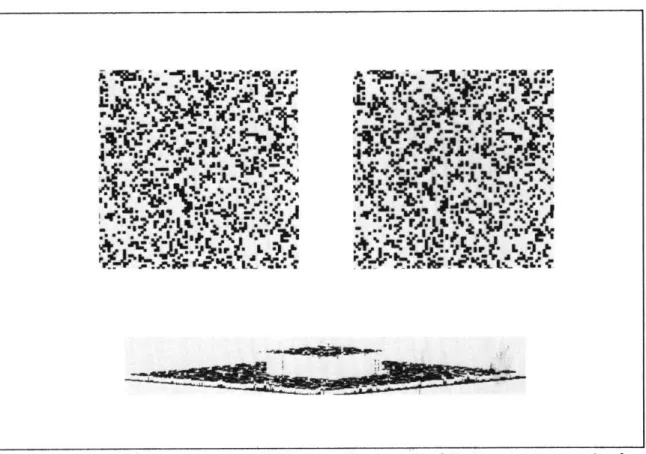
A major assumption is being made at the level of the computational theory: that the human visual system is an inherently modular system, allowing us, for example, to study the process of stereo vision in isolation. At first glance, it is not at all clear how separate stereoscopic processing is from the monocular analysis of each image. If stereo processing were an isolated module, then one could study stereo independent of other visual processing, such as texture analysis, shading, and so on. One method for testing whether a process can be studied in isolation is to present the visual system with images in which, as far as possible, all kinds of information except one have been removed, and then seeing whether we can make use of just that one. For stereo this can be demonstrated by the random-dot stereogram, invented by Julesz (1960). Each of the images in Figure 1.1 is a collection of black and white squares, which are identical except for the fact that a centrally located square-shaped region is
THE COMPUTATIONAL APPROACH
Figure 1.1. Random Dot Stereogram. Each image is a collection of black and white dots. When viewed stereoscopically, a central square is perceived as separated in depth from the rest of the pattern, although each monocular image cnntains no cue to this effect.
shifted horizontally in one image relative to the other. Other than this disparity, the images contain no information whatsoever about the visible surfaces. Yet, when the pair is viewed stereoscopically and fused, one clearly and vividly perceives a square floating in space above the plane of the background. This illustrates that disparity alone can cause the sensation of depth. The fact that neither image contains any recognizable monocular organization implies, as well, that the stereo process may be
studied in relative isolation from other visual processes.
The idea that a large computation should be split up and implemented as a collection of small sub-parts that are as nearly independent of one another as the overall task allows, is what Marr (1976b, 1980) calls the principle of modular design and forms a cornerstone to the approach. Its impor-tance lies in the fact that otherwise, a small change in one place in a process will have consequences in many other places. This means that the process as a whole becomes extremely cumbersome, and difficult to debug and analyze.
Having considered a computational theory of the processing involved in a visual task, one can then turn to the design of a particular algorithm to achieve the task. One is ultimately interested in the algorithm used by the human visual system. However, a second purpose for studying an algorithm is that it serves as an excellent source of feedback for the computational theory. Any implementation of a thonrv hv n narticular algorithm helps to point out otherwise unnoticed difficulties with the task, as ~_~
SYNOPSIS
well as helping to indicate the sufficiency of the theory. Furthermore, any assumptions made by the theory can frequently be tested by an implementation of the theory. Chapter 4 of this thesis will detail how this particular implementation of a theory of human stereo vision helped refine the theory both through the act of implementation and through the use of the implementation on trial data.
Marr (1976b, 1980) outlines two principles which one can use to guide the design of algorithms, and which probably ought to be satisfied by any serious candidate for an early visual process in the human visual system. The first one is the principle of graceful degradation and says that whenever possible, degrading the data will not prevent one from delivering at least some of the answer. The second principle is the principle of least commitment and says that one should never do something that may later have to be undone.
It is important to note that for any computational theory, there may be several possible rithms for solving it. In many cases, one can distinguish between the acceptability of different algo-rithms. For models of the human visual system, we shall take a set of algorithmic criteria, outlined in Chapter 7, as one set of criteria for algorithmic acceptability. That is, we shall seek algorithms which seem biologically feasible, (Ullman, 1979b).
The third level of description is that of the implementation. We are ultimately interested in understanding the neural implementation used by the human system. It would be nice to be able to give general rules about processes at the level of the neural implementation; unfortunately, with only a few theories developed to the point where specific neural implementations have been proposed (for example, Marr 1969), and none having been confirmed experimentally in every detail, it is not yet possible to formulate such rules.
1.2 Synopsis
The thesis is divided into two major parts, corresponding to the two stages involved in trans-forming images into surface representations.
In the first part, a specific method for computing surface information at particular points in the image is considered. In particular, an implementation of the Marr-Poggio theory of human stereo vision (1979) is described.
In Chapter 2, we consider what is involved in the stereo computation. The essence of the stereo problem is to select an element from one image, find the corresponding element from the other
SYNOPSIS image, measure the disparity between them, and use this disparity to compute the distance from the viewer to the element in the scene. The two basic questions are what are the elements to be matched, and how are these elements matched. It has been argued that the image elements to be matched must be in one-to-one correspondence with well-defined locations on a physical surface in the scene (Marr, 1974; Marr and Poggio, 1979). The Marr-Hildreth theory of edge detection (1979) proposes that such elements are obtained by filtering the image with a collection of different sized operators. The form of these operators is V2G, the Laplacian of a Gaussian, and the zero-crossings of their
output correspond to those locations in an image which can be matched by the stereo process. This determines the transformation of the image intensities into the input representation required by the stereo process.
The second problem to solve is the question of how to match these elements. The Marr-Poggio stereo theory (1979) applies two constraints - uniqueness and continuity - to the problem. These constraints, together with evidence from psychophysics and neurophysiology, led to the development of a specific algorithm which is discussed in Chapter 2.
At this point, we have dealt with the computational theory of the first two steps in our process. One of the important steps in the design of a computational theory is the implementation of that theory. In Chapter 3, the implementation of the Marr-Poggio theory of stereo vision is outlined. This consists of explicitly specifying the implementation of each of the steps in the theory.
In Chapter 4, the implementation is used to test the adequacy of the theory. To do this, the performance of the implementation is compared to human perception over a wide range of test cases from the human stereopsis literature. The performance of the algorithm on natural images is also illustrated.
The matching component of the Marr-Poggio theory is based in part on an analysis of the statistical distribution of zero-crossings. The assumptions used by Marr and Poggio in performing this analysis are not entirely valid, and a correct reworking of the statistical arguments is performed. These statistics have been evaluated for actual images and are compared with the predictions made by the analysis. This allows us to consider the relevance of the consequent assumptions made by the theory.
During the development of the stereo implementation, a number of observations were made concerning aspects of the theory. These are outlined and their effect on refinements of the theory
SYNOPSIS
are discussed. Included are discussions on the type of representation used by the 21-D sketch, the accuracy of the disparity values output by the stereo program, the symmetry of the matching function, the use of oriented versus non-oriented filters, and others.
The second part of the thesis considers the problem of surface interpolation - of transforming the sparse surface representation into a complete one. This problem is relevant to many visual processes other than stereo, for example, structure from motion and structure from surface contours. Hence, the problem is considered in the general case, independent of the method used to obtain the input representation. The only assumption applied to the problem is that the points at which explicit surface values are known correspond to the zero-crossings obtained from the convolved images.
In Chapter 5, the implicit information about surface shape contained in the zero-crossing descriptions of the images is considered. Horn's image formation equation (1970, 1975) is developed and used to prove a set of theorems relating the shape of a surface to the zero-crossings detected by the Marr-Hildreth operators. The major point about these theorems is that they describe the probability of a surface being inconsistent with what is known about the form of the image intensities, specifically, about the positions of local changes in image intensity.
In Chapter 6, this set of theorems is used to develop a computational theory of surface inter-polation. Since the information available about the image formation process is insufficient to exactly reconstruct the original surface, the best that can be done is assign some measure of the probable inconsistency of a surface to each possible surface. In this sense, one would like to compare surfaces, in order to determine the least consistent one. The standard method of doing this is to assign some real number to each surface, by applying a functional to the surface. Then, to compare two surfaces, one need only compare the corresponding real numbers obtained by the functional. In this way, a measure of the inconsistency of any particular surface can be obtained. Thus, to find the least consis-tent surface, one need only derive a method for choosing the surface which minimizes this functional which measures surface inconsistency.
There are two aspects to this problem. The first is to determine under what conditions the problem is well-defined, in the sense of having a unique solution. A set of simple theorems is used to determine the conditions on the finctional under which this will be true. The second is to determine the actual form of the functional.
SYNOPSIS Several possibilities for the form of this functional are considered, seeking one which satisfies the conditions developed above. One candidate for choosing the least inconsistent surface is given by:
(f)
={
f
+
2fy
+
f'
dzdy}.
This functional satisfies all the conditions necessary to guarantee a unique solution, and satisfies the conditions imposed by the theorems of Chapter 5.
This provides a computational theory of the second stage in our process, the creation of com-plete surface specifications.
In Chapter 7, an algorithm for solving this computational problem, independent of the par-ticular form of the functional, is developed. Although there are several possible algorithms for solving the computational problem, the methods of nonlinear programming are used, because such methods are more biologically feasible, (Ullman 1979b). In particular, the Kuhn-Tucker theorem relates the solution of a constrained optimization problem to the saddle-point of an associated Lagrangian. To find the saddle-point, the Arrow-Hurwicz system of difference equations can be applied. These results are used to create an algorithm for interpolating the surfaces.
In Chapter 8, the implementation of the interpolation algorithm is considered. The biological feasibility of the algorithm is discussed and the performance of the algorithm on both synthetic and real depth maps is examined.
Finally, in Chapter 9, the interpolation algorithm is analyzed and possible refinements to the theory are discussed. These include the detection of surface discontinuities, and the use of such discontinuities to refine the surface approximation; the removal of noisy disparity values from the depth map; the role of acuity in determining accurate depth values, and the effect of acuity on the interpolated surfaces; and the role of retinal mappings in the stereo matching problem.
THE STEREO THEORY
CHAPTER
2
THE STEREO
THEORY
2.1 What
Is
Stereo
If two objects are separated in depth from a viewer, then the relative positions of their images will differ in the two eyes. This is illustrated in Figure 2.1. The process of stereo vision, in essence, measures this difference in the relative positions and uses it to compute depth information about the objects in the scene.
To avoid confusion, three terms relating to stereopsis are defined here. The term disparity will refer to the angular difference in position of the image element in the two eyes. Distance will refer to the objective physical distance from the viewer to the object, usually measured from one of the two eyes. Finally, the term depth will refer to the subjective distance to the object as perceived by the viewer.
It can be seen from Figure 2.1 that disparity varies as the relative depth positions of objects varies. Suppose the eyes are fixating at a particular point, such as that indicated by the circle in the figure. Disparities such as that associated with the crosses in the figure (denoted by d3 in the figure)
are usually referred to as crossed or convergent disparities. Those. like the one associated with the ellipse (denoted by d, in the figure) are referred to as uncrossed or divergent disparities. Objects at the same depth as the fixation point (such as with disparity d2 in the figure) are said to have zero disparity.
WHAT IS STEREO
Figure 2.1. Definition of Disparity. The disparity of a point refers to the angular difference in position of the image element in the two eyes. Given a fixation point, such as the circle in the figure, disparities may be crossed (d3). uncrossed (di), or zero (d2).
increases in magnitude.
This relationship between distance and disparity suggests that one could determine the distance to objects in a scene, by measuring their disparity. The stereo system is concerned with exactly this process.
How does one measure this disparity? Marr (1974) notes that there are three steps involved: (1) A particular location on a surface in the scene is selected from one image;
(2) The same location is found in the other image; and
(3) The disparity between the two corresponding image points is measured.
WHAT IS STEREO geometric transformation, and hence does not pose any major difficulties. If a location could be identified beyond doubt in the two images, then steps (1) and (2) could be avoided and the whole process would be simple. For instance, if a location in the scene could be illuminated with a spot of light, the identification of the corresponding image locations would be simple. That is, by ap-propriately choosing what locations in an image are to be matched, the actual matching or correspon-dence can be greatly simplified. Unfortunately, we are not equipped with lasers in our foreheads, and hence cannot perform depth computations based on the matching of spots of light So we need a more passive method for sensing the environment.
Thus, the problem of the identification of corresponding image points cannot be avoided, and this problem forms the heart of the stereo computation. There are two aspects to this problem: what locations in the image are selected to be matched; and by what process are corresponding locations from the two views actually matched.
A major problem for theories of stereo vision is the question of what elements are matched in the two views. Are they intensities? objects? something else? The answer to this question will have a strong influence on the second problem of how to match these elements. In fact, there is a trade-off between the two aspects of the problem: between the complexity of the monocular analysis used to extract the elements to be matched, and the complexity of the process which matches them.
At one end of the spectrum, the problem of finding the corresponding locations can be greatly simplified, at the expense of determining which locations to match in the first place. If the number of potentially matching elements is kept small in each view, the problem of finding corresponding elements becomes simple. One method for accomplishing this is to perform object recognition before stereo. Thus one would first process each monocular view, identifying the various objects contained therein. Since in most scenes, the probability of having two or more "identical" objects is small, the matching problem is simple. To determine the disparity, a particular object, say a desk, would be located in one image, the same desk would be found in the other image, and the disparity would be computed. The solution of the correspondence problem - which element in one view matches which element in the other - is, however, performed here at the expense of identifying and locating objects
in a scene, a non-trivial task. Under such a scheme, the stereo process would be a later visual process, following earlier processes which would analyze each monocular image. Of course, we have already
WHAT IS STEREO
seen that this is not the case for the human stereo system. The example of Julesz random-dot patterns showed that the process occurs very early in the visual process and is relatively independent of other forms of visual processing.
At the other end of the spectrum, the correspondence problem is more difficult, while the problem of determining which elements to match is simplified. For example, if the human stereo process is an early one, then much more primitive matching elements could be used; for example, local descriptors of sudden changes in image intensities. If the tokens to be matched arise at a very early stage in the analysis of an image, then the density of such objects in the images is significant. In this case, the number of potentially matching elements will increase. Furthermore, the difference between the possible tokens to be matched is very small. Thus, for any single descriptor of the left image, there is likely to be a large number of possible matching descriptors in the right image. All but one of these will be incorrect, and thus the correspondence problem is non-trivial, although the identification of elements to be matched is fairly simple.
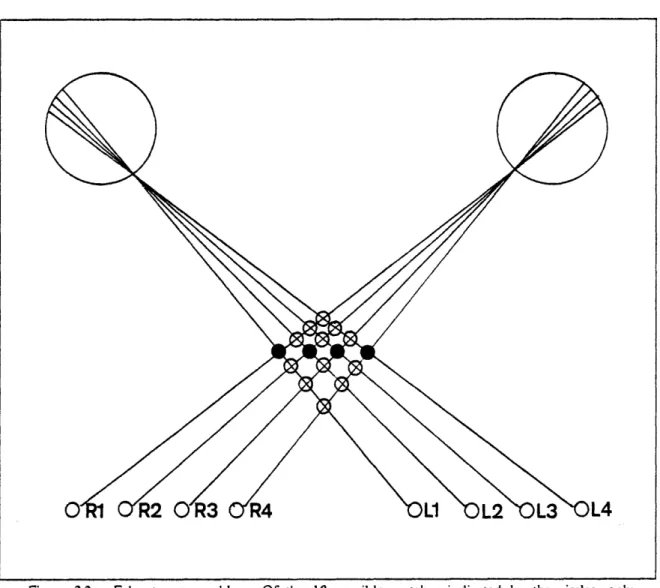
This introduces the major problem of stereopsis. The task of identifying corresponding locations in the two images is a difficult one because of what is called the false targets problem. An example of it is shown in Figure 2.2 (after Marr and Poggio, 1979). The question is, to which dot viewed from the left eye do dots viewed from the right eye correspond? Each eye sees four dots, but which are the correct matches? A priori, any of the 16 possible matches is a plausible candidate, but in fact when we observe such a stereo pair, we make the correspondence shown with the filled circles, and not any of the correspondences shown with open circles. These alternate candidates are therefore called false targets.
This is somewhat surprising, since there seems to be little reason to distinguish one match as more favorable than another on the basis of the elements being matched. Moreover, as Marr observes,
there is another solution to this particular correspondence problem which seems just as "valid". This is the four central vertical matches, in which R1 is paired with L4, R2 with L3, R3 with L2, and R4 with L1. But we never "see" this match perceptually, as a set of circles in a line receding from us. Why?
To answer this question, additional information is needed to help to decide which matchings are correct, by constraining them in some manner. The only way to do this is to examine the basis in the
WHAT IS STEREO
Figure 2.2. False targets problem. Of the 16 possible matches indicated by the circles, only those indicated by the filled circles are actually perceived.
physical world for making a correspondence between two images. Marr and Poggio (1979) (also Marr 1974) describe two physical constraints which are relevant to the stereo process:
(1) A given point on a physical surface has a unique position in space at any one time.
(2) Matter is cohesive, it is separated into objects, and the surfaces of objects are generally such that the changes in the surface are very small compared with their distance from the viewer.
Let us briefly return to the example of Figure 2.2. Since, in principle, any one of the 16 possible candidates could be a match, there are 21 or 65, 536 possible matches for this situation. The first constraint essentially states that in general, excluding accidental alignment of objects, there should not be more than one match along any line of sight from either eye. The number of such matches
THE MARR-HILDRETH THEORY OF EDGE DETECTION
is greatly reduced; from 6.5, 536 to 24. The second constraint essentially states that, barring other information, the most likely of these 24 matches is the one actually chosen in Figure 2.2. This is because this match corresponds to the "smoothest" object (relative to the other 23 matches).
The major point about the observations of Marr and Poggio is that they are properties of physi-cal surfaces, and they constrain the way in which positions on the surface behave. If they are to be used to deal with the correspondence between two images, we must ensure that the items to which they apply are in one-to-one correspondence with well-defined locations on a physical surface. We shall turn to this point in the next section.
Thus, the computational problem for the stereo process may be summarized as follows. First, for each view of the scene, construct a description of the elements that are to be matched. We have seen that for the human system, the descriptors must be extracted at an early stage of visual processing. As a consequence, each description may contain a large number of identical elements, which makes the correspondence problem, and the removal of false targets, a significant problem. The second step consists of solving this correspondence problem, determining which descriptor from one view matches which descriptor from the other view.
2.2 The Marr-Hildreth Theory of Edge Detection
We have argued from the evidence of random dot patterns that the extraction of a description of the scene, from which the matching may take place, must be, at least in part, an early visual process, occurring prior to object recognition. That is, while the evidence of random dot stereograms does not imply that only early analysis is done, it does imply that stereo vision must be capable of operating on primitive descriptions. The creation of a description of surface locations suitable for matching between the images is somewhat difficult. As we have seen, if a surface location could be chosen in some absolute way - such as shining a narrow beam of light onto it - the problem would be simple. However, we are not able to do this. Thus the problem of identifying surface locations from their image projections must be addressed. The difficulty is precisely that assertions about surface locations must be made based solely on information in the image. '
It will not be possible to unambiguously identify surface locations from the images themselves at all points in the images. A smooth featureless surface will-be of no avail to this process, because the image intensities will be indistinguishable over this surface. Any surface containing scratches, texture
THE MARR-HILDRETH THEORY OF EDGE DETECTION or other markings will, however, give rise to locally sharp changes in reflectance which can be used to define surface points. Since only certain features of a surface will be well defined in the images, it is claimed (Marr 1974, Marr and Poggio 1979) that the computation of disparity takes place by comparing symbolic descriptions of those features in the two images.
The solution to the first problem, selecting a surface location, will be solved by creating a sym-bolic description of those features of the surface which give rise to identifiable physical locations. The design of a module to match the symbolic descriptions, by determining which descriptors correspond to the same physical location, will solve the correspondence problem.
It has been remarked that the features of an object of likely interest to the matcher which solves the correspondence problem are associated with locally sharp changes in reflectance, and hence with locally sharp changes in the image intensities. It can be argued (Marr, 1976b) that such a early symbolic description of intensity changes in an image is useful for other early visual processes besides stereopsis. This description has been called the Primal Sketch (Marr, 1976b) and was used, for example, in the solution of the motion correspondence problem (Ullman 1979). Recently, (Marr and Hildreth, 1979) a theory of the process of extracting these low-level primal sketch descriptions has been developed. This theory has developed in part due to findings concerning the human visual system, and in part due to the development of the stereo theory dealt with in this thesis. The relevant points of the Marr-Hildreth theory of edge detection are outlined below.
It would be pleasant if one could design a single filter to extract all the features of interest from a scene. Unfortunately, such intensity changes take place over a wide range of scales (Marr, 1976b). For example, if we look at individual picture elements (pixels), we find intensity changing from pixel to pixel. However, such changes are occuring at too small a scale to be of interest to us. Most edges in the real world are sharp edges, and the associated intensity function will be composed of a few steep changes over a small number of pixels. At the same time, other edges, such as shading edges, are spatially extended, and the intensity function will increase slowly over a large number of pixels. Moreover, these different types of intensity changes are not distinct in the image; one can have high contrast edges superimposed on a spatially extended shadinn edge.
As a consequence of this wide range of intensity changes, one cannot hope to find a filter which will be simultaneously optimal at all scales. The findings of Campbell and Robson (1968),
THE MARR-HILDRETH THEORY OF EDGE DETECTION
concerning the existence of separate spatial-frequency channels in the human visual system, suggest that one should seek a method of dealing separately with the changes occurring at different scales. As a consequence, Marr and Hildreth suggest that one first take some local average of intensity at several resolutions, and then detect the changes in intensity that occur at each resolution. They determine both the optimal smoothing filter and a method for detecting intensity changes at a given scale.
The optimal smoothing filter must satisfy two physical constraints. First, the filter is intended to reduce the range of scales over which intensity changes take place. This suggests that the filter's spectrum should be band-limited. Second, the aspects of an object which give rise to intensity changes are all spatially localized. This suggests that the filter should perform an average over a small localized portion of the image. These two requirements are in conflict and are related by a type of uncertainty principle. It has long been known that under these circumstances, the optimal filter for minimizing band-width in space and frequency is the Gaussian, (see for example Leipnik, 1960). Thus, the image I is initially convolved with a two dimensional Gaussian operator G. For each channel, the size of the operator G will vary. This essentially smoothes the image.
Having determined a suitable smoothing filter, Marr and Hildreth then addressed the issue of detecting intensity changes at a particular scale. Any intensity change along a particular orientation will cause an extremum in the first directional derivative, and a zero-crossing in the second directional derivative, perpendicular to the orientation of the change (Marr 1976, Marr and Poggio 1979). Thus, the task of detecting intensity changes becomes equivalent to that of detecting the zero-crossings of the second derivative of intensity in the appropriate direction. That is, intensity changes in G * I are characterized by the zero-crossings in the second directional derivative D2(G * I). This operator is
roughly band pass, and so it only examines a portion of the image's spectrum. By the derivative rule of convolutions, the above operator becomes (D2G) * I.
The final thing left to do is to determine the direction in which the directional derivative must be taken. Although this is possible (Marr and Hildreth 1979), it may not be necessary. In fact, a number of practical considerations led Marr and Hildreth to argue that the initial operators not be directional in nature. If this is the case, then the operator to be used is the Laplacian, since it is the only non-directional linear second derivative operator. It was then shown (Appendix A, Marr and Hildreth 1979) that provided two simple conditions on the intensity function in the neighbourhood of
THE MARR-HILDRETH THEORY OF EDGE DETECTION an edge are satisfied, the zero-crossings of the second directional derivative taken perpendicular to an edge will coincide with the zero-crossings of the Laplacian along that edge. As a consequence, Marr and Hildreth propose that at each given scale, intensity changes may be detected by searching for the zero-crossings in the convolution V2G * I. This will give us precisely the symbolic descriptions of
changes in the image that we required. Note that I use the term zero-crossing to refer to a non-trivial zero point in the convolved image. Thus, those positions such that the value of convolved image at this point is zero and its gradient is non-zero are taken as the primitive descriptions of the image. In this manner, the convolution values actually pass through zero, rather than simply remaining at zero. This distinguishes between an actual edge in the scene, and the zero response obtained by the operator over a region of uniform intensity.
It is interesting to note that although the use of these operators was motivated by computational and practical arguments, the use of non-oriented filters was arrived at independently on psychophysi-cal grounds by Mayhew and Frisby (1978).
The form of the operator is given by:
r2
-
2a2
r
2
V2
G(r,0)
= 2a2
exp
--r2
This is a rotationally symmetric function, and its cross-section is shown in Figure 2.3. Note that its central panel width, denoted by w, and defined as the width of the central negative region, is given by
w2-d = 2V2/a.
If the visual input to the operator is a one-dimensional grating, then the response of the operator is equivalent to that obtained by applying the equivalent dimensional operator to the one-dimensional input. This equivalent one-one-dimensional operator is obtained by projecting V2G onto a
line, and is given by
DxxG
= -I
2 aexp
22.
C3
202
The central panel width of this operator is
w-d -= 2a.
THE MARR-HILDRETH THEORY OF EDGE DETECTION
Figure 2.3. The Primal Sketch Operator. The top figure shows the one-dimensional operator. This
operator applies in the case of images whose intensity values are constant along each vertical slice
of the image. The bottom figure shows a cross-section of' the equivalent. rotationally-symmetric.
two-dimensional operator. The sizes of the operators are determined by the values of wil- and
THE MARR-HILDRETH THEORY OF EDGE DETECTION At this point, it is interesting to note the evidence of Wilson and Giese (1977), and Wilson and Bergen (1979), concerning the existence and characteristics of such operators in the human visual system. They have found strong evidence that at each point in the visual field, there exists at least four and possibly five independent channels in the human early visual system. (This is consistent with the earlier evidence of Campbell and Robson 1968, and other investigators.) The point of interest in this context is that the form of the channels, as analyzed by Wilson and collaborators, very closely fits the shape of a difference of two Gaussians. Further, a difference of Gaussians is a close approximation to a Laplacian applied to a Gaussian (Appendix B, Marr and Hildreth, 1979). Thus, the operator for detecting features of a visual scene which was developed on basic information processing grounds is seen to be closely related to the operator which appears to be used by the human visual system. Wilson and collaborators also observe that the peak sensitivity wavelength of these channels increases linearly with retinal eccentricity, from some initial value in the fovea.
Given the form of the operators, it only remains to determine the size of these filters. Wilson and Bergen's data indicated difference of Gaussian filters whose sizes - specified by the width w of the filter's central region - range from 3.1' to 21' of visual arc. The variable w is related to the constant a of V2G by the relation:
a
=--Wilson and Bergen's values were obtained by using oriented line stimuli. To obtain the diameter of the corresponding circularly symmetric center-surround receptive field, the values of w must be multiplied by V21. Finally, we want the resolution of the initial images to roughly represent the resolution of processing by the cones of the retina, and the size of the filters to represent the size of the retinal operators. In the most densely packed region of the human fovea, the center-to-center spacing of the cones is 2.0 to 2.3pum, corresponding to an angular spacing of 25 to 29 arc seconds (O'Brien, 1951). Accounting for the conversion of Wilson and Bergen's data, and using the figure of 27 arc seconds for the separation of the cones in the fovea, one arrives at values of w in the range 9 to 63 image elements, and hence, values of a in the range 3 to 23 image elements.
Although Wilson and collaborators have found definite evidence only for four different sized channels, it has recently been proposed (Marr, Poggio and Hildreth, 1979) that a further, smaller channel may be present. In the human system, this channel would consist of a single retinal receptor,
THE MARR-HILDRETH THEORY OF EDGE DETECTION
although because of the diffraction in the eye, the actual size of the equivalent operator would be larger. In the implementation, since diffraction is not a factor, this channel would have a central width of w = 1.5', roughly corresponding to 4 image elements.
Two other features of zero-crossings can be computed, and will be of use in the stereo matching problem. One is the sign, or contrast, of the zero-crossing. This is computed simply by noting whether the convolution values change from positive to negative or negative to positive while scanning across the zero-crossing. The second feature is the local orientation of a set of zero-crossings on the image plane. This is found by computing the gradient of the convolution values across the zero-crossing and taking the orientation of the projection of the gradient onto the image as the orientation of the zero-crossing.
Thus, the problem of what is to be matched in determining disparity in a scene has been solved. Specifically, the image will be filtered with operators whose form is a Laplacian of a Gaussian and the convolution values will be searched for zero-crossings. This will give rise to a series of zero-crossing contours, and it is this symbolic description of changes in an image which will be matched to obtain disparity information.
THE MARR-HILDRETH THEORY OF EDGE DETECTION
Figure 2.4. Examples of Convolutions. A natural image is indicated at the top. Below are examples of the convolved image, after application of different sized V2G operators, with
central panel widths of 36, 18, 9 and 4 picture elements. The original image was 480 picture elements on a side.
THE MARR-HILDRETH THEORY OF EDGE DETECTION
6 *
4a·P~~ 4
Iw w·.!~i~ !•• ~i !!ii 4ii~•••ii *:ii :i i!i ...
• ' !÷iiiii~! i • !••ii~ii~••~ ~i!i 4 iiii iii
i•,• , i!!,!!• • ••4!ii,,,,,*•,i!4 i,,•,, / 4 S ~E ~ 5 4 4 4 * *6 S S ~ ~ S 4 *
4
1~~.
0
1 0~--THE MARR-HILDRETH --THEORY OF EDGE DETECTION
Figure 2.5. Examples of Convolutions. A random dot pattern is indicated at the top. Below are examples of the convolved image, after application of different sized V2G operators, with central panel widths of 36, 18, 9 and 4 picture elements. The original image was 320 picture elements on a side.
THE MARR-POGGIO THEORY OF STEREOPSIS
2.3 The Marr-Poggio Theory of Stereopsis
2.3.1 Outline of the Marr-Poggio Theory
We saw earlier that there were two major aspects to the stereo process: the extraction from the images of symbolic elements to be matched; and the actual process of matching those elements.
In the previous section, we determined the basic descriptors to be matched by the stereo process and how to create them from the image. We now turn to the solution of the correspondence problem. Marr and Poggio (1979) have developed a theory of human stereopsis which directly addresses this problem. In this section, the theory is outlined outline and some of the evidence in support of it is indicated.
Put succinctly, the problem is how to determine which of the descriptors in the left image corresponds to a particular descriptor in the right image and vice versa.
The two constraints outlined previously are physical constraints, applying to locations on a sur-face. When they are translated into computational constraints, it is necessary to ensure that the items to which they apply in the image are in one-to-one correspondence with well-defined locations on a physical surface. In the previous section, we have seen how to obtain descriptions of the images which satisfy this condition.
The stereo problem is then reduced to that of matching two primitive symbolic descriptions. The two physical constraints can now be translated into two rules on how the left and right descrip-tions are combined (Marr and Poggio, 1979):
(1) Uniqueness. Except in rare cases, each item from either image may be assigned at most one disparity value. This condition relies on the assumption that an item corresponds to something that has a unique physical position. The exceptions can occur when two features lie along the line of sight from one eye, but are separately visible in the other eye.
(2) Continuity. Disparity varies smoothly almost everywhere. This condition is a consequence of the cohesiveness of matter, and it states that only a small fraction of the area of an image is composed of boundaries that are discontinuous in depth.
We must now consider how actually to apply these rules. As has been stated, the major problem for stereo vision is the solution of the correspondence problem, which requires the elimination of false
THE MARR-POGGIO THEORY OF STEREOPSIS
targets. Marr and Poggio note that the difficulty of this problem is directly proportional to the range and resolution of disparities considered, and to the density of matchable features in an image. In other words, the greater the range over which a match is sought, the greater the number of false targets. At the same time, the finer the resolution at which features are detected, the greater the number of false targets. Thus, one way to avoid the false targets problem is to make the "features" of the image rare. This could be done this by making them very complex or specific, so that even if the total density of features were very high in an image, the density of individual types of features would be very small. However, we have already seen from the evidence of Julesz random-dot stereograms, that this is very unlikely to be a feature of the human system. The other way of making "features" rare is to reduce drastically the density of all features in the image, by decreasing the spatial resolution at which it is examined.
In light of this observation, the existence of independent spatial-frequency-tuned channels, which we discussed in the previous section, suggests that successively finer filtered copies of the image can be used during fusion.
What does this imply computationally? Consider the symbolic descriptions generated by the largest of the channels described in the previous section. Since this channel is tuned to very low spatial frequencies, this means that the density of "features" in the symbolic description is low. As a conse-quence, the range over which a match may be sought without encountering too many false targets is large. However, this is at the price of reduced resolution of the disparities associated with each match. For a smaller channel, there is a trade-off of these two effects. In particular, the density of false targets will increase, causing the range over which one can safely search for a match to decrease. However, although disparity range is lost, disparity resolution is gained. Thus, for the smallest channel, very high resolution disparity information would be obtained, but the range over which one could safely search for this information will be severely curtailed.
Thus, Marr and Poggio suggest a scheme for solving the fusion problem which has as a first stage, the following operation:
(1) Each image is analyzed through channels of various coarsencsses, and matching takes place be-tween corresponding channels from the two eyes, for disparity values of the order of the channel resolution.
THE MARR-POGGIO THEORY OF STEREOPSIS To take advantage of this range of trade-off over the set of channels, some method of combining the information from the different channels is needed. In the end, one would like to be able to obtain fine resolution disparity information. But since the range over which the smallest channel can safely operate is small, it would seem that one must accurately align the two images in order to allow the matching to take place for the smallest channel. Fortunately, the information needed to align the images is available. In particular, the coarse resolution disparity information obtained by matching the larger channel descriptions can be used to align the two images. This will bring the images into a range of alignment where the smaller channels can safely operate, thereby allowing a refinement of the disparity values. In the human visual system, this alignment of the images is accomplished by changing the positions of the eyes, through the use of vergence movements. Note that since the human system performs a global vergence of the two eyes, only the region of the fovea will be likely to be brought into alignment in this manner. In order to obtain fine disparity values throughout the image, each region must be separately brought into the fovea and matched.
Thus, Marr and Poggio suggest that as a second step in the process, the following operation is performed:
(2) Coarse channels control eye vergence movements, thus causing finer channels to come into correspondence.
The disparity information obtained from stereo will be needed by other processes of the visual system. For example, Marr and Nishihara (1978) have argued on computational grounds that the visual system requires an "orientation/depth map" of the visible surfaces of a scene. This is necessary since descriptions of the shapes of objects must be derived via a description of their visible surfaces, and information about these is obtained from a number of different and independent sources. This representation of depth, called the 21-D sketch, is essentially a memory, into which information from various sources is combined and maintained. Thus, the next stage in the Marr-Poggio scheme is: (3) When a correspondence is achieved, it is held and written down somewhere.
Finally, once the correspondence for a section of.the image has been found, one would like to be able to reuse that information. That is, once the disparity for a region of the image has been computed, one would like to be able to use that information again to fuse that region, without the expense of recomputing the correspondence. Thus, Marr and Poggio suggest as a final stage:
THE MARR-POGGIO THEORY OF STEREOPSIS
(4) There is a backwards relation between the memory and the filters, that allows one to fuse any piece of a surface easily once its depth map has been established in the memory.
The scheme proposed by Marr and Poggio can be split into two sections, corresponding to the two major steps to be solved in the stereo problem: the extraction of a symbolic description of the images which forms the input to the stereo process; and the determination of the correspondence between these descriptions.
We have indicated that the extraction of a symbolic description may be accomplished by the method of Marr and Hildreth (1979). Note that the Marr-Poggio theory requires the extraction not only of zero-crossings, labelled by contrast and rough orientation, but also of terminations - places of sharp changes in the orientation of zero-crossing contours - also labelled by contrast. Having determined the symbolic descriptions which must be matched, we now turn to the development of the matcher.
2.3.2 The Matcher
The heart uf the matching problem concerns the difficulty of false targets. We have noted that computational simplicity can be preserved only if false targets are rare. The use of several inde-pendent spatial-frequency-tuned channels provides a way of accomplishing this, over a large range of disparity. In other words, by performing the matching for different resolutions, and using the results of the larger channels to drive the alignment of the smaller channels, fine disparity information can be achieved over a wide range of disparity while avoiding the problem of false targets.
In general terms, the matching process consists of matching symbols of the same type, for each set of filters of a given size. The type of a zero-crossing is determined by its sign and orientation. We have already seen how to compute these attributes. The sign of the zero-crossing is important as a matching attribute, as can be seen from the experiments of Julesz (1963) concerning the impossibility of fusing of a pattern and its negative image.
In designing the matching process, one would like to be able to ensure that false targets are rare, in order to avoid problems associated with choosing between several possible matches. To do this, Marr and Poggio performed a statistical analysis of the zero-crossings to determine the probability distribution of the interval between adjacent zero-crossings of the same sign in the filtered image. Based on this probability distribution, one can design a matching process which will in essence avoid