CONIC SECTORS FOR SAMPLED-DATA FEEDBACK SYSTEMS*
Peter M. Thompson - Division of Engineering and Applied Science California Institute of Technology
Pasadena, CA, USA
Gunter Stein - Laboratory for Information and Decision Systems Michael Athans Massachusetts Institute of Technology
Cambridge, MA, 02139, USA
ABSTRACT
A multivariable sampled-data feedback system contains an analog plant controlled by a sampled-data compensator. Conic sectors that can be used to analyze sampled-data feedback systems are presented and then proved to be valid. Also included is the gain of the sampled-data operator.
Keywords: Sampled-data feedback systems Multivariable feedback systems Conic sector
Gain of operators Closed loop stability Robustness
This research was carried out at the M.I.T. Laboratory for Information and Decision Systems with support provided by NASA under grant
NGL-22-009-124 and by the General Electric Corporate Research and Development Center. This paper has been submitted for publication to Systems and Control Letters.
-2-1. INTRODUCTION
The usefulness of conic sectors for analyzing feedback systems [1,2,3,4] depends on the determination of a particular conic sector for the feedback system of interest. Conic sectors that are useful for the analysis of sampled-data feedback systems are now described. These results are compared with
previously reported results for analog feedback systems [3,4].
Preliminaries are presented in Section 2. Conic sectors useful for analog feedback system are reviewed in Section 3. The major results of this paper are the new conic sectors useful for sampled-data feedback systems presented in Section 4. Proofs of the new results are in Section 5, and
2. PRELIMINARIES
The notation leading up to and including conic sectors is now defined. The use of conic sectors for determining closed loop stability and robustness is reviewed. For more detail see [1] to [5].
r m r
A
relation
K
is any subset of the product space
L
x
L
where
L
is the
2e
2e
2e
extended normed linear space of square integrable functions e: R +Rr
(from the set of real numbers > 0 to the set of r-dimensional vectors) that
have finite truncated norms for all
Te
R:
I
lelll
I
| (t) II dt (1)The subscript "E" indicates the Euclidean vector norm. In the limit as T +-X
the truncated norm is the L2 function norm denoted by
I
e| I
L
The inverse relation always exists and is defined by
K
(u,e)e L
x
Lr
(e,u)e
K
(2)
2e
2e
~
The gain of the relation K is defined by
I K|
|L
sup IT (3)2
where the supremum is taken over all nonzero e in the domain of K., all
corresponding K e in the range of K, and all
Te R+. The relation
K
is
L2e-stable if
I
IKI IL <- .
An operator
K
is a special case of a relation
NOTE TO PRINTER:
Use script boldface for symbols e, u etc.
Use roman boldface for symbols
e A, H etc.
-4-that satisfies the two conditions (1) the domain is equal to L
rand
2e
(2) for each e in the domain there exists a unique u in the range such
that (e,u)e K.
Define K to be a relation and C and R to be operators. If
I1u - C
e112
|
<
R
el
2-
lel2
(4)
T
~
T
~
:
for all (e,u)e
K,
T
e
R.+,
and some E>O then
K
is strictly inside cone
(C, R.)
with center C and radius R. On the other hand, if
lie
-
C
U
112
I>
R
ul
2
(5)
for all (u,e)e
-
K
Iand all
TeR+,
then -K
Iis outside cone (C, R).
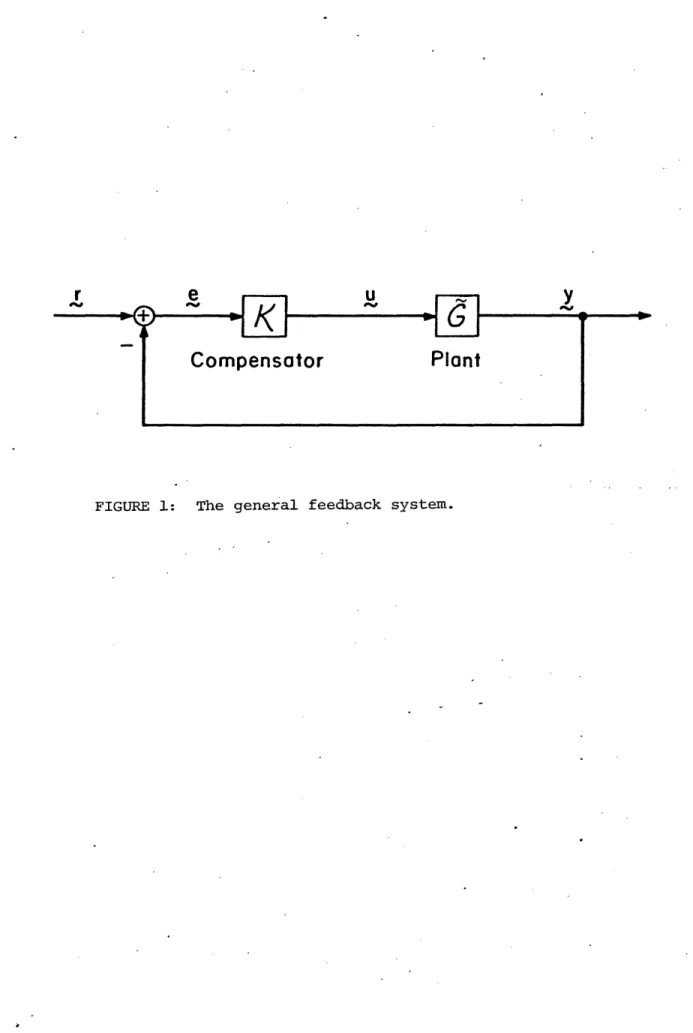
A general feedback system is shown in Figure 1. It is defined
algebraically by
(e,u)e K
(u,y)e
G
e=r-y
(6)
where e,r,y
e
Lr
and u
e
Lm
- - - 2e 2e
Define the closed loop relations
(r,e)e
E
(7)
(r,u)e UThe feedback system is closed loop stable if
E
and U are L2 -stable. A sufficient condition for this to be true [1,3] is that a cone (C, exists such thatK
is strictly inside cone(C,1
)
-G
is outside cone (C,R)
Alternatively, a sufficient condition for
E
and U to be L2e-stable is that
a cone (G,R) exist such that
-K
Iis outside cone (GR)
G
is
strictly inside cone (G
R)
This completes the preliminary section. Now it is reviewed how
conic
sectors are applied to analog feedback systems.3. ANALOG FEEDBACK SYSTEMS
For an analog feedback system the relations K and G of Figure 1 are causal linear time invariant (LTI) operators, and hence can be represented by the Laplace transform matrices K(s) and G(s). Lemma 1 gives sufficient conditions for a LTI operator to be strictly inside of a cone. Lemma 2 (which can be considered a corollary of Lemma 1) gives the gain of a LTI operator, and Lemma 3 gives sufficient conditions for the inverse of a LTI operator to be outside of a cone.
Lemma 1 [4, Lemma A4] Define the LTI operators
K,
C, and R. Assume thatR
Iis
also a LTI operator, and thatK-C, R,
andRI
are L-stable.
K
is
2e
strictly inside cone (C,R) if
[R(jW)]>
1
a
[K(jw)-C(jw)]
(10)
min - i1/2 max - _
for all w and some s>O.
Lemma 2 [e.g. 2]
The gain of the LTI operator K is
I
IKI
IL
max
KmaxLK(jw)](11)
Lemma 3 [4, Lemma A2] Define the LTI operators K, C, and R. Assume that R is also a LTI operator, and that K(I+CK) , R, and R are L -stable. Then,
2e
-KI is outside cone (C,R) if
a [R K(I+C K) (jo)]< 1 for all X (12) max
The minimum and maximum singular values of a complex-valued matrix are denoted by & . and a , respectively. For scalars both a . and
a
mmn
max
min
max
are equal to the absolute value. See [6,7] for more information about singular values.
In Lemma 1 it is not necessary that K be L2e -stable, but K-C must be. Stability is determined by the location of the open-loop poles. In Lemma 3 the open-loop stability requirement is replaced by the closed-loop stability requirement that K(I+CK) is L2 -stable. This is determined by the location of the closed loop poles or by the multivariable Nyquist criterion.
Lemmas 1,2, and 3 can be used to analyze analog feedback systems, in particular to determine multivariable robustness margins. See, for instance,
[5]. Our attention now shifts to sampled-data feedback systems. Results similar to these three lemma are now presented.
-8-4. SAMPLED-DATA FEEDBACK SYSTEMS
For sampled-data feedback systems the relation
G
of Figure 1 is a causal LTI operator and the relationK
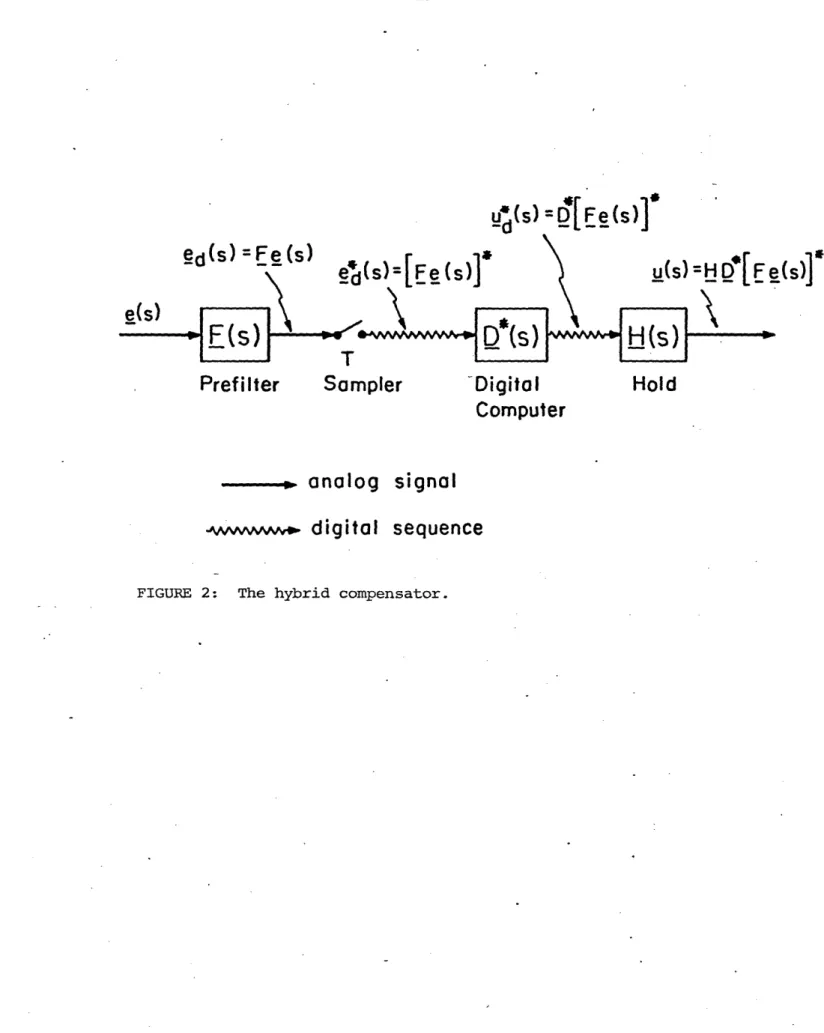
is a causal sampled-data operator. A block diagram ofK
is shown in Figure 2. The prefilter and hold arerepresented by Laplace transform matrices F(s) and H(s), respectively; and the digital computer is represented by the z-transform matrix D(z). The star notation [8] is defined:
D (s) = D(z)
jWT
z=e (13)[F e(s)]*
XT
F e(s-jw n);
W
-Tn
s s TThe input-output transformation of the sampled-data operator is
u(s) = H D* [F e(s)] * (14)
The sampled-data operator K is a linear time varying (LTV) operator.
It
cannot be represented by a transfer function matrix.
Results analogous to Lemmas 1,2, and 3 are now presented. Theorem 1
gives sufficient conditions for a sampled data operator to be strictly inside
of a cone.
Theorem 2 gives an upperbound for the gain, and Theorem 3 gives
sufficient conditions for the inverse of a sample-data operator to be outside
of a cone.
The proofs are presented in Section 5.
The abbreviation
Zis short for
ZTheorem 1: Define the sampled-data operator Kand the LTI operators
C and R. Assume that R
Iis also a LTI operator, and that
K,
C,
R and R.
Iare L -stable.
Then K is strictly inside cone (C,R) if
2e
a.
1
[R~jw)]
r2
2
1
a R(jw)]>
I 2 ClI2IL
(H2
D(*F
)+
C
H
D*F
-C)
min1-
max -k
-- n
max
2 -k- k -k
(15)
for all w and some £>0
Furthermore, the choice of center C =
1
H D*F (called the "optimal center")
- T--
-minimizes the lower bound for
Ci [R(jw)].
mn
--Theorem 2:
An upperbound for the gain of the sampled-data operator is
11KII.
<
maxC
2 (H Mk)
(16)O<w<<
T
k n max
T
Furthermore, this upperbound equals the gain when H, D*, and F are
single-input single-output (SISO).
Theorem 3:
Define the sample-data operator K and the LTI operators C
and R. Assume that R
Iand (I+CK
)
are also operators, and that
K(I+CK)
,
R
and
R
are L2stable. Then -K
Iis outside cone (C,R) if
a
[R(jW)]<
1
(H
D*
F
1/2 for all
w
(17)
max - max k--cZ"-k
where
DC (s) = D [I+(F C H)* D*(s)]- 1 (18)
In Theorem 1 it is assumed that both
K
and C are
L
-stable, which is
2e
-10-though poor choices result in large radii; and the optimal center minimizes the radius. In Theorem 3 the less restrictive assumption is made that K(I+CK ) is L2 -stable, which is a closed loop stability
as-sumption. This closed loop system has the input-output transformation
y(s) = H D* [F r(s)]* (19)
CZ cA
which is similar in structure to the open-loop sampled-data operator (14), and is stable if the poles of D (z) are inside the unit circle.
After some thought (possibly after considerable thought) Theorems 1, 2, and 3 should appear to be natural extensions of Lemmas 1,2, and 3. This is easiest to visualize when F(jw) is bandlimited to Iwl< T , in which case the lemma and theorems give the same results, except that for the latter the radius is periodic. When F(jw) is not bandlimited,then the radii and gain
the Laplace transform matrices H(s)D*(s)F(s)-C(s) ; n=0 K (s) = --n = (20) 1 H(s)D*(s)F(s-jW n) n?0 T - - - s
for the following manipulation of equation (14):
u(s) - C(s)e(s) = E Kn(s)e(s-jW n) (21)
n
A critical step used in the proofs is highlighted in the following lemma.
Lemma 4: Define the K (s) of (20) and assume that for Ijw sufficiently large that1
X
I
IK
(jw)i
< for some a,3 > 0 (22)n -- 'n
~an
I- 1+1BThen it follows that
00 21 / |Iy Kn(jn)e(jw-jw n) 1 2 d 2T -- s E -00 00
<
--X
IIK (Jw-Jw
k)
11
2IJle(jW)
I
d
(23)
-2 Lk n EProof of Lemma 4: Use is made of the Cauchy-Schwartz inequality [9, p.30] and Lebesque Dominated Convergence [10, p.44].
1
The matrix norm
I IA
=
o
(A).
-
-12-00
<
I
||
|K
(jew)
I
d(24)
-00
1
-2.
I[n
-nI
(
27T
I2
I
1
s
se(je-Jek)|
IIde
(25)
(By the Cauchy-Schwartz inequality. Define a = IIK
(jw)lI,
b = Ie(jw-jw n) E Define a and b as Z2 vectors with components an and b for all integers n. Then,n n
2~ri-c [I I K(26)
= 27
J
[
I
IK
(jw)II]
Ile(j(-jw
s k)|| dw (26)[By Lebesque Dominated Convergence, which is guaranteed by the assumption (22)].
-00oo
This completes the proof.
Remark: The assumption (22) used to guarentee Lebesque Dominated Convergence is true if F(s) and H(s) each have at least a one-pole rolloff, i.e., for wlj sufficiently large,
IIF(j)
|i
and IIH(jw) Ii are bounded byProof of Theorem 1: The objective is to show that K is strictly inside cone (C,R). Except for the use of Lemma 4, this proof is similar to
[4, Lemma A4]. Define the truncated function
_
(R
e)(t) ; t<Te (t) (28)
--T (28)
For all e e L2e and all T e Rt:
|I
(K-C)el
1
2 =I
(K-C)R
IeIi
(29)rl
2
:2~-
e
I IZ
(30)
I
f
K
-nR
1e
(jw)l
dw
(by Parsevals' theorem) (31)
2TF E 2--c
n
<2
|[
Z
II
I
K
(j-jw-
k)I
]IR-1
(jW)
I
I
dw (32) (by Lemma 4) 00<
f
(1-)
e (jw)
|E
dw
[by
(15)]
(33)
-00 =(1-)
Ile
1IL
(by Parsevals' theorem) (34)<
IIRel
-£'
lel l2 where E' = EIIRI L (35)This verifies the inequality (4), which determines strict inequality, and completes the proof.
-14-Proof of Theorem 2: The objective is to verify the upperbound for the gain of the sampled-data operator and to show that the upperbound actually is the gain for the SISO case. The upperbound is a special case of Theorem 1 when the center C(s)=O, and a separate proof is not included. For the SISO case the following input signal achieves the upperbound as the truncated time
e(t) =
X
la ncos [ (w -wsn)t + Arg(an)] (36) nwhere
a = d*(-jw )f(-jw +W n) (37)
n o o s
X = frequency that maximizes (16)
This complete the proof.
Remark: The gain of the multivariable sampled-data operator remains to be found. We conjecture that the gain is given by (16), but we have been unable as of yet to find a signal [i.e. a vector version of (36)] that achieves the upperbound given by (16).
Proof of Theorem 3: The objective is to show that -KI is strictly outside
cone (C,R).
This is true if and only if the composite operatorRK(I+CK )I
has gain < 1. This proof shows the latter. The assumption that (I+CK)
guarantees that the feedback system with the closed loop operator RK(I+CK)
Iis well-posed [11].
Let
K (s) = - R(s)H(s)D* (s)F(s-jw n) for all n (38) -h T -- - c -- sand
e(t) ;
t<
e (t) = (39IIRK(I+CK)
e l
<
RK(
I+CK)
Ie 12
(40)
2 -CO 00 1< - e (j W) I2d [by (17)] (43) =1e|l
2 (44)-16-6. CONCLUSIONS
Conic sectors that are useful for the analysis of multivariable feedback systems are presented in this paper. The conic sectors are analogous to those for multivariable analog feedback systems, and are distinguished by the use of the frequency domain inequality of Lemma 4.
The usefulness of the new conic sectors is demonstrated in [5], where it is shown how they can be used to determine closed loop stability,
robustness margins, and steady state response to commands in sampled-data designs.
ACKNOWLEDGEMENTS
This work is based on Peter M. Thompson's Ph.D. thesis [5], which was prepared under the supervision of Professors Gunter Stein and Michael Athans. The help of Professor Shankar Sastry and Dr. Marcel F. Coderch is also
REFERENCES
[1] G. Zames, On the Input--Output Stability of Time-Varying Nonlinear Feedback Systems, Parts I and II, IEEE Trans. Automat. Control, 11
(1966) 228-238 and 465-476.
[2] C.A. Desoer and M. Vidyasagar, Feedback Systems: Input-Output Properties (Academic Press, New York, 1975).
[3] M.G. Safonov, Stability and Robustness of Multivariable Feedback Systems, (The MIT Press, Cambridge, Massachusetts, 1980).
[4] M.G. Safonov and M. Athans, A Multiloop Generalization of the Circle Criterion for Stability Margin Analysis, IEEE Trans. Automat. Control, 26 (1981) 415-422.
[5] P.M. Thompson, Conic Sector Analysis of Hybrid Control Systems, Ph.D. Thesis, Lab. for Information and Decision Systems, MIT, 1982, Report LIDS-TH-1242.
[6] V.C. Klema and A.J. Laub, The Singular Value Decomposition: Its Computation and Some Applications, IEEE Trans. Automat. Control, 25 (1980) 164-176.
[7] M.G. Safonov, A.J. Laub, and G.L. Hartmann, Feedback Properties of Multivariable Systems: The Role and Use of the Return Difference Matrix, IEEE Trans. Automat. Control 26 (1981) 47-65.
[8] G.F. Franklin and J.O. Powell, Digital Control of Dynamic Systems, (Addison Wesley, Reading, MA, 1980).
[9] S.K. Berberian, Introduction to Hilbert Space, (Chelsea Publishing Co., New York, 1976).
[10] R.G. Bartle, The Elements of Integration, (John Wiley and Sons, Inc., New York, 1966).
[11] J.C. Willems, The Analysis of Feedback Systems, (The MIT Press, Cambridge, MA., 1971).
-18-Compensator
Plant
es)
(s)es
F(s)
=Fe(s
ed(s) :Fe(s)
el(s)=[Fe (s
)]
u(s) HD=e
E[!e
e(s)