HAL Id: hal-00487990
https://hal.archives-ouvertes.fr/hal-00487990
Submitted on 31 May 2010
HAL is a multi-disciplinary open access archive for the deposit and dissemination of sci-entific research documents, whether they are pub-lished or not. The documents may come from teaching and research institutions in France or abroad, or from public or private research centers.
L’archive ouverte pluridisciplinaire HAL, est destinée au dépôt et à la diffusion de documents scientifiques de niveau recherche, publiés ou non, émanant des établissements d’enseignement et de recherche français ou étrangers, des laboratoires publics ou privés.
Shared Representations for Innovation: Experience
Feedback on Two Innovation-oriented Projects
Florie Bugeaud, Alain Giboin, Eddie Soulier
To cite this version:
Florie Bugeaud, Alain Giboin, Eddie Soulier. Shared Representations for Innovation: Experience Feedback on Two Innovation-oriented Projects. Workshop ”The mediation role of shared representa-tions in cooperative activities: new challenges”, in conjunction with the 9th International Conference on the Design of Cooperative Systems (COOP’10), May 2010, Aix-en-Provence, France. �hal-00487990�
Shared Representations for Innovation:
Experience Feedback on Two
Innovation-oriented Projects
Florie Bugeaud
1,2, Alain Giboin
3, Eddie Soulier
11
University of Technology of Troyes, ICD / Tech-CICO FRE CNRS 2848, 12 rue Marie Curie, 10010 Troyes, France
2
Orange Labs, RD/BIZZ/BUC/RTS, 38-40 rue du Général Leclerc, 92974 Issy-Les-Moulineaux
3
INRIA, 2004 route des Lucioles, BP93, 06902 Sophia Antipolis, France
[email protected] ; [email protected] ; [email protected]
Abstract. To facilitate the cooperation among the participants of two different innovation
projects, we proposed them to rely on specific shared representations: (project #1) the “Service System” and (project #2) the “Unified Framework”. In this paper, we present how these shared representations were experienced in the projects, and bring up a work in progress aimed at better characterizing the effectiveness of shared representations for innovation.
1
Introduction
Our work deals with the design and evaluation of adapted mediation supports within innovation contexts. Innovation contexts could concern innovation on conceived or used tools, innovation on proposed or used method/approach, innovation on designed products, or innovation on supported or proposed processes. We try to conceive cooperative systems to answer the innovation actors’ (innovators’) difficulties. We make the hypothesis that, in all the innovation contexts we address, we must be able to answer the cooperation,
communication and creativity difficulties by the provision of a shared representation through three steps:
1.• Identification of the context (actors, objectives, tasks), difficulties, and definition of hypothesis.
2.• Proposition and conceptualization of an intermediary object (Vinck et al., 1996) which could not only be a mediation support but also an operational tool for the design and the implementation of innovative services/solutions.
3.• Design and evaluation of an adapted formalism/model (e.g. the improvement of the perception of processes within an organization through their modeling has already been demonstrated (Marciniak, 1991)), approach and supporting tool (i.e. cooperative system).
It is important to note that we are more interested in the evaluation of the impact of the proposed shared object and its formalisation on the collaboration than in the evaluation of the cooperative system functioning itself. This interest is linked to the originality of our approach. Indeed, we work on the notion of “process” through two main, distinct, but often confusing dimensions: the semantics of processes (i.e. processual entities) and the modeling of business processes (i.e. organizations’ procedures). This paradigm and this mechanism are what we finally try to develop and evaluate. It is thus important to introduce and describe the dimensions related to mediation that not only should be considered when designing a new cooperative system involving the representation of a shared object but also when evaluating this object as an intermediary object. The relevance of the proposed medium, the adequacy and usability of its formalisation could be measured for example with the number and disciplines of the participants in the collective task, the degree of guidance offered to the users to perform the task, the number of ideas and the degree of their articulation, the degree of individual and collective comprehension, representation and memorization.
We applied the previous steps (identification of the context, proposition of a mediation support, design and evaluation) to two case studies which are good examples of cooperative activities in the innovation universe. These projects are two distinct examples which have in common the high level method we used to address the problems, and the non-traditional intellectual orientation we propose based on the opposition of objects and processes. The first case study concerns the opportunities research upstream of a telecom operator’s innovation cycle. The second case study concerns the co-design of Web 2.0 solutions for technology watchers by an interdisciplinary design team.
2
Experiencing the “Service System” Shared
Representation (Project #1)
The project#1 is a current real life project of research which is experienced within the organization of a French telecommunication operator. The objective of such a services provider is typically to make innovation (i.e. to create and propose some innovative products/services to their customers). This operator tries to improve its process of opportunies research upstream of its design cycle. Our work aims at supporting this early phase and guiding the innovators’ works and decision-making thanks to the provision of a new research object. The role of this new concept is to allow the involved innovators to better exchange their knowledge, better individually and collectively represent the service situation of the customer or customers segment they want to study, and finally find ideas of new services.
2.1
Step 1 - Identification of the Services Design context and
difficulties
Telecom operators usually implement a services design process that involves very different interacting actors. We studied this design process and thought about the innovation conditions for a telecom operator. We have detected an important lock during the upstream phase of “opportunities research”. This sub-process aims at identifying ideas of new services/solutions in order to meet the customers’ expectations and to ensure the operator market position. It is based on the design reasoning of its innovators (Bugeaud et Soulier, 2009), and it gathers a lot of data and documents. But these innovators meet some difficulties because of the remote and interprofessional nature of their work. They have to co-design services but they have neither an adapted approach nor a supporting tool. Their marketing, ergonomic, uses, technical and other views have to converge in order to describe the current situation and propose new adapted solutions. These ideas are then evaluated by an anticipation committee that checks their relevance and transfer them towards the design, development, deployment and then market launch phases.
But the basic problem at this upstream stage of opportunities research does not really lie in the remote and inter-professional nature of their network (these lead to important business difficulties that are common to many collaborative networks) but in the concept of service that remains a poorly understood and multidimensional object (Tannery, 2001). This can be explained by the fact that the telecom operators business has evolved from network and telephony seller to services providers, but also by the many existing levels of abstraction, characteristics and definitions of the word “service”. Moreover, this confusion has increased with the emergence of technology-oriented concepts such as web services or Service Oriented Architectures. The innovators not only use the word
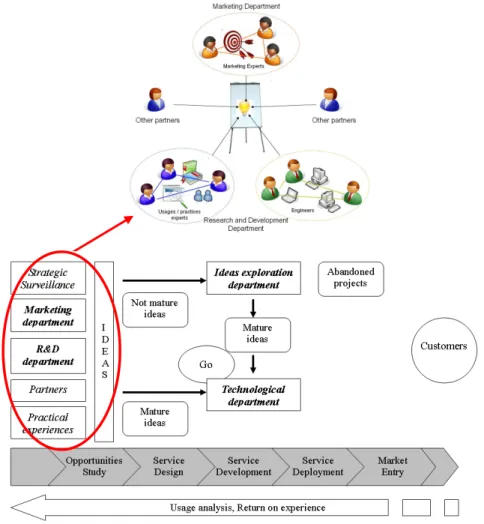
“service” very often and in a very different manner (i.e. according to their own profession), but they also are interested in and describe the business processes of their clients to the detriment of the overall service situation and the end-users service experience. So there are a lot of issues around the notion of service that leads to confusion and high expectations. The object on which innovators must agree is not stabilized. They need for a shared representation of the service situation they address in order to help them and guide their mutual understanding and decision-making (fig.1).
Figure 1. Convergence of the views and emergence of new ideas upstream of the design cycle
2.2
Step 2 - Proposition and conceptualization of an intermediary
and operational object: the Service System
The understanding of the concept of service by the innovators determines their intervention in the research opportunities phase which feeds the process of services/solutions design and thus affects innovation.
Based on the SSME (Services Science Management and Engineering) discussions (Spohrer et al., 2007), we proposed to conceive the service as a
Service System (Bugeaud et al., 2009). This dynamic configuration expresses a
particular phenomenon (i.e. an experience) and is linked to the combination of heterogeneous entities. The concept of Service System helps us to provide a suitable shared representation through its co-modeling and its simulation (see 2.3). These steps provide a common vision to the innovators (i.e., at the same level of abstraction) based on the service situation they study and for which they are trying to detect new opportunities. The final goal of this “shared representation” is to better conceptualize things and more specifically to remove the lock around the service and the service experience in order to better include the innovators in the services design process and thus to promote innovation.
However, the formalization of this concept requires a particular approach. The semantics of objects usually disconnects the conceptual representations from the field of experiences. It is based on the idea that the reality is linked to conceptual things. This paradigm of the substance, which considers the processes/actions only as properties or second-class entities, is a classic vision in Knowledge Engineering, Ontology Engineering, and also in CSCW. Conversely, the pragmatism and ethnomethodology fields fail the question of representation. In this work, we adopt an intermediary position through which we propose a theory of meaning that is not based on objects/substances but on processes. Reality is thus a continuous flow based on structures of emergence and not on an apriori known metalanguage. But there is in the West a cultural and historical habituation to the object-oriented thinking. It is interesting to note that in the Eastern tradition, there is no concept but processes/flows. The question is therefore whether such a processual representation may be substituted to an object/substantial representation and if so would it be more efficient (see 2.3)?
Some recent ontologies of processes criticize the current ontological attempts on concepts and try to substitute different items (e.g. ontologies about non-traditional properties or tropes). We proposed a new paradigm about “process-oriented knowledge” and a formalism to represent Services Systems: a
mereological ontology of processual entities (Soulier, 2009; Seibt, 2009). This
proposal responds to the hypothesis that we may be able to not only describe flows/processes (rather than objects and their attributes) and hence to provide an experiential representation (rather than a conceptual representation) of the addressed situation, but also that we may provide a common vision to the innovators involved in the design process of new services. The Service System (i.e. object to be designed) and the Service Experience (i.e. projection of a service experience as seen by the designer) are two necessities in the innovators’ and designers’ perspectives to better understand how the product could be proposed and how this product could be used. It allows the convergence of the innovators’ views and brings the artefact and the usages closer.
2.3
Step 3 - Design and evaluation of the OntoStoria² formalism,
approach and tool
A method and a web-based design studio have been created to build such Services Systems ontologies and simulate them in order to facilitate the innovators’ communication, collaboration and creativity.
There are various conceptual models on the concept of service (e.g. Eiglier, 2004; Gallouj & Weinstein, 1997) but they still define it by its content and not by its dynamic nature. Moreover, an ontological representation can be considered based on the existing hierarchy between core services and peripheral services. But traditional ontologies (i.e. domain ontologies) describe concrete, countable and located entities and do consider the processes/actions as properties or second-class entities. Our work defines the Service System as a collection of processual entities (Soulier, 2009) which express a dynamic phenomenon (generally described in the services providers’ documentation through an interactional and verbal form). We therefore propose an ontological alternative considering dynamic categories rather than abstract classes and static concepts. This proposition is based on the processes ontologies discussions, and the mereological (based on the formal study of the “part-whole” relation rather than the traditionally used “is-a” semantic relation) (Varzi, 2003) and General Process Theory (GPT)(Seibt, 2009) principles. We created a method, called OntoStoria², to represent Services Systems. It is based on a semantic semi-formal description of dynamic categories implementing information and knowledge related to the studied Service System through: the extraction of key information from the upstream available documents, the use of the Galois Lattice rules to build a network of dynamic entities (this is an essential step to move from the conceptual space to a dynamic/pragmatic space thanks to the link between objects and actions), the application of classical and mereological criteria on the actions for the characterization of the entities and their interactions, and then the generation of an ontology. The details of this method will be the subject of further publications.
To go further, we propose to simulate the studied Service System thanks to an
animation. This kind of animation is often more effective in terms of
memorization and understanding than “flat” models. Some existing tools generate such animations based on Business Process Modeling (e.g. OnMap from Nomia). We imagine a similar simulation approach for the studied Services Systems. However the Service System ontology does not allow to easily create an animation. Several steps are thus necessary: the identification of the Service System universe using the ontology, the identification and description of all the successive scenarios which could happen in this service situation, then the characterization of a typical customer’s profile and goals, and finally the simulation of the scenario. Moreover, innovators can replay the simulation with
multiple user profiles. They can thus simulate almost all service interactions that could happen in the real service situation.
To amplify the benefits of the Service System modeling and simulation, we have created a Services Systems Design Studio. It is a web-based tool associated with a database server. It can be used in an asynchronous way (through the remote and inter-professional network of innovators) or in a direct access way (an innovator or a group of innovators). It uses the traditional mechanisms of social networks for the asynchronous access: profiles, tags, etc.
Finally, we have evaluated the impact of the Service System as an operational and intermediary object on the collective representation, and the impact of the processual principles and the Service System animation on the collective and individual representations. (The overall assessment of OntoStoria² as a collaborative system will be the subject of further publications.) The criteria used to evaluate this proposition are: the relevance of the Service System as a shared representation, the adequacy of the mereological and processual principles for the representation of dynamic phenomena, and the usability of a simulation for this performative construct. These macro-criteria have given rise to three sub-evaluations that have been published elsewhere (Bugeaud et al.,2010). As the e-health domain is a key domain for services providers and a rich field in terms of Services Systems, we have led a first experiment with a group of telecom innovators (sociologists, marketers and engineers) about the remote monitoring of diabetics patients. This Service System has been the subject of numerous studies but it has not been represented in a consensual way. During a first step, the group of innovators made an opportunities research session by phone (to recreate the remote and inter-professional nature of the activity). They had to co-describe the service and find new ideas of solutions. During a second step, we presented them the Service System concept and our ontological model. We invited innovators to annotate these propositions and to discuss them. At the end of each session, we asked them a set of questions such as: do you think you have reached unanimous definition and description of this service? Have you shared and/or learned something? Did ideas appear? We also tried to know which differences they had noted between the brainstormings. The result shows interesting consequences of the use of the Service System and its models such as the reduction of the disagreement between the innovators and the improvement of the individual and collective representations of the remote monitoring of diabetics patients. Indeed, the innovators used the same level of abstraction and were aware about the economic, social, technical dimensions, etc., of the studied service. The comparison of the exchanged information, the perceptions of the users regarding the process and the quality of the representation, but also the number of ideas (e.g. a classical vocal server may be more relevant for old diabetics who are not familiar with PDAs and the Internet) encouraged the continuation of our experiment.
3
Experiencing the “Unified Framework” Shared
Representation (Project #2)
The project#2 is a current research project which is realized by an interdisciplinary design team, the so-called ISICIL consortium (Gandon et al., 2009) and funded by the French National Research Agency (ANR). It proposes to study and to experiment with the usage of new tools, relying on Web 2.0 advanced interfaces for interactions and on Semantic Web technologies for interoperability and information processing, to assist tasks of corporate intelligence and technical watch. Business Intelligence relies on a collection of applications, technologies and methodologies that support access to and analysis of information in order to manage the competitiveness of firms.
3.1
Step 1 - Identification of the ISICIL context and difficulties
In a collaborative research project such as the ISICIL project, there are often two main difficulties:
• Understanding and representing the strategy, organisation, business processes and so on of the project end-users despite the fact that the transition from the business view to the design of applications is still a major difficulty in the field of Information Systems,
• Making a remote and interdisciplinary consortium of researchers and engineers collaborate.
ISICIL acknowledges the problems in reconciling Open Web practices with corporate processes. Beyond its technical objectives, one of the scientific objectives of ISICIL is to ensure that advanced web interfaces are not only nice but also anchored in the corporate reality, usable and effective in the tasks they are designed for. Moreover, given the fact that this reality is moving, ISICIL has to anticipate and to take into account the strategic, business, functional and applicative evolutions that end-users are facing. Therefore, beyond the design of adapted interfaces and the proposition of appropriate algorithms and models for trust and privacy management, it is necessary to reconcile Web 2.0 applications and corporate organizational and business reality.
These difficulties are increased by the recent trends on business and IT alignment, processes and services emergence, urbanization and, today, enterprise architecture works. One of the current difficulties in the field of Information System design is the transition from the business view to the applications design. This difficulty is increased by the IS evolving nature and the emergence of some computer concepts such as service-oriented architectures or web services. At the same time, the industry has discovered that the structuring of activities into processes has many qualities. These trends make urgent the need for mechanisms of transition from one layer to another. Moreover more and more companies want
to improve not only their Information System ad-hoc projects but also the global governance of their IS. The Enterprise Architecture (EA) is a way to achieve this high-level goal. This approach requires the definition of requirements, applicative mapping, targeted processes and use cases. Moreover, the Enterprise Architecture presents three main layers that are far from being well connected: business layer, logical layer (composed of a functional layer and an applicative layer) and technological layer.
This has for consequences an important confusion and a need of mutual understanding at all the levels of abstraction. It is necessary to provide, in the early phases of such a research project, shared representations from which the consortium members could collaborate.
3.2
Step 2 - Proposition and conceptualization of an intermediary
and operational object: the Shared Framework
One of our contributions to the ISICIL project concerns the association of two kinds of analysis: the usages analysis and the processes modeling. The usages analysis objectives are to understand the users' characteristics and the different usages/scenarios concerning the tasks they accomplish (or they will have to accomplish) and to capture their requirements. However, this approach presents some limitations due to the interest in individuals/actors, and can be described as a psycho-cognitive approach. First, the vision of the proposed tool is related to the representation that an actor is able to formalize (as use cases) based on the potential use of this tool. But complex and innovative tool often exceeds the ability of the actor to represent and describe it exhaustively. Secondly, this approach offers a technological and human view of the activity but it does not take into account the economical aspect. Yet, this economical aspect can often overcome some constraints (e.g., when a company can outsource a part of the activity that could not be achieved in-house for various reasons). Thus, we provide a framework for the formalization of the processes. Their analysis allows us to complete the usages approach thanks to the provision of insights into the economical facet of the activity (without neglecting the technical aspects).
However, the notion of “process” conveys a notion of flow or dynamicity that we cannot always get with the traditional modelling techniques. In a general way, we find two kinds of attitude: people who join the modelling of persistent objects (stable semantics) and those who join the modelling of IS thanks to processes (syntax, pragmatics). We found this tension among the members of the ISICIL consortium where we meet business, usage and IT points of view. Some partners are interested in the structures of concepts which are useful to find information and some others are more interested in the activity of the studied actors/users. Although the level of granularity is different from the projet#1 (here we are interested in the business processes, i.e. procedures of the company, and not in the
semantics of processes, i.e. processual entities), it is another demonstration of the problem which opposes objects and processes. Then the question is, Do we have to represent concepts or activities? Or do we have to bring back activities to a classification when we are interested in the description of the IS and the EA of an organization? It is an interesting lock that we suggest rising by the contribution of a shared representation based on all the EA layers.
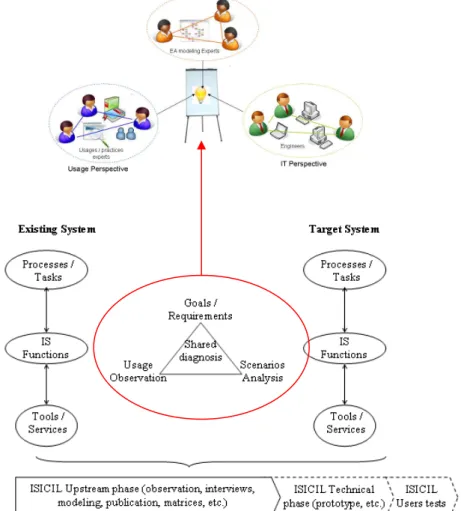
We proposed and implemented a unified framework (a kind of models repository based on the ARIS platform from IDS Scheer) considering the processes strategic, business, organisational, functional, applicative and technical contexts (Gandon et al., 2009). This framework connects the business, usages and IT perspectives. Its enrichment allows the provision of an integrated and complete vision of the ISICIL end-users (a French telecom operator, and a French environment and energy management agency) organizations, activities, practices and tools to all the members of the ISICIL consortium. Based on this description, the ISICIL members can exchange ideas and discover lacks and opportunities to propose adapted Web 2.0 tools. The methods and transition process we propose (see 3.3) build some bridges between the architectural layers.
Such a cartography allows people who are not computer specialists to better understand the link between the value creation processes, the tasks of the organization’s actors as well as the information processing associated to these activities (IS function) and the potential existing supporting tools. Two methods have been created to manage the framework (see 3.3).
3.3
Step 3 - Design and evaluation of the ISICIL Shared Framework
models, methods and tool
We have suggested combining a modeling tool and a web-portal publication tool. We therefore used ARIS Business Architect from IDS Scheer to model and enrich the ISICIL repository and the ARIS Business Publisher to publish an ISICIL web portal giving access to all models and their information. We also proposed a complete approach based on two methods managing the framework: “from the business modeling techniques to a SOA implementation” and “from the existing EA capture and analysis to the target EA”. This framework is a platform of co-design which has a mediation role at two levels of abstraction. The former is a “human level” because it concerns the cooperation of the ISICIL members. Once the repository has been so filled, we have generated an online publication and have sent its URL to all the consortium members. We have invited them to use it and exchange information, remarks, ideas, etc. This framework is therefore a unified view which is available for each member no matter who and where s/he is. The later is a “technical level” because it concerns the effective modeling of all the elements we have detected and described within the ISICIL end-users organisations and the technical linking between the business, functional, applicative and technical architecture levels.
The enrichment of our modeling framework is based on the result of several interviews that we have made with some representative actors of the Information and Technical Watch Processes of the ISICIL end-users. Thanks to these discussions, we discovered and modeled key elements such as their objectives, products/services, organization/actors, domains of processes, key data/business objects, tasks and their context, functionalities and applications/tools. Moreover, in order to take into account the ISICIL end-users' requirements and evolutions, we have proposed the following rules: during the enrichment of the business processes descriptions, if there is no existing tool to support an existing or a new task, we use UML modeling to describe the target/future scenario(s). Finally, a shared diagnosis between the project actors has been required to validate the modeling work and to co-analyze the existing EA and the possible developments/tracks of evolution.
We have published the models on the web portal and made them available to all the ISICIL members throughout their modelling and improvement. However,
the reading and translation of these models in terms of opportunities for the ISICIL project remain difficult. We therefore have created several convergence
matrices based on these models and their objects relationships. These matrices
allow the ISICIL engineers to not only detect opportunities and develop new solutions based on the other members’ upstream contributions but also to consider the overall chain from business processes and activities to web services and their implementation in an IT platform.
This medium has allowed each ISICIL partner to be situated and also to situate the others within the project and with regard to their respective contribution. It also has allowed going further than the notion of “needs” which is bound to the conception of a system and not to the task and its contextualization. Every proposition of Web 2.0 tools stemming from the ISICIL consortium or BI suppliers have been positioned in these contexts and the realized matrices.
Although the use of this framework allowed to answer the question of the medium relevance, to guide the ISICIL members, and to provide a context and the link between business and IT views, it would be relevant to realize other measures to correctly demonstrate its role (e.g. number of on-line connections to the repository, number of realized models, number of propositions stemming from the analysis of the models and/or matrices, etc.). A validation plan has to be implemented.
4
On-going Work: Better Characterizing the
Effectiveness of Shared Representations for
Innovation
We concluded the presentation of the shared representations experienced in the two innovation projects considered here, by the need (1) to further validate the representation effectiveness for the first project (by establishing a second validation plan) and (2) to develop a validation plan for the second project. For the second project, our goal is to better characterize what is the effectiveness of a shared representation, and specifically to enrich the set of criteria for evaluating the representation effectiveness that have been used hitherto, and to structure these criteria in a coherent framework.
To achieve this goal we decided to rely on the existing literature surveying the characteristics of effective shared representations, boundary objects, intermediary objects, or related notions (see, e.g., Borch & Kristiansen, 2007; Bresciani et al., 2008; Trompette & Vinck, 2009). So far we mainly considered existing work on effective boundary objects. An analysis of this work has allowed us to discover other criteria than those we used, but also to highlight “evaluation approach scopes” that can be used to structure the criteria identified. By “evaluation approach scope”, we mean the extent of the context of boundary object taken into
account in assessing the object effectiveness, i.e. contextual elements such as the actors “carriers” of the objects, the process involving the object, etc.; this explains the use, in the “broad-scope” approaches, of such terms as “boundary spanning activity”, “boundary spanner”, “boundary spanning role”, “boundary work”, “boundary process”, “boundary project”, etc. For us, this “contextual broadening” means that the representation assessment should not focus only on the boundary object as such but on the “system” that integrates this object, or “boundary system”. In other words, we favor the broad-scope approaches and the criteria coming from these approaches.
The validation plan we envision will rest on three such broad-scope approaches, the last two approaches being based on the first one: Carlile’s (2002) approach, Fong’s (2007) approach, and Holford et al.’s (2008) approach. Carlile (2002) argues that boundary objects can either be beneficial or deleterious depending on the social context at hand. Carlile identifies what can be called three levels of boundary objects’ effectiveness for knowledge sharing: (1) Syntactic
level: Boundary objects as providing a common language (or shared syntax) for
actors to represent their knowledge (e.g., repositories). (2) Semantic level: Boundary objects as providing a means for actors to express different interpretations, thereby allowing the possibility for novelty to emerge (e.g., standardized forms and methods). (3) Pragmatic level: Boundary objects as facilitators of processes which allow the actors to change the contents of the object in order for it to continue to be useful to all involved participants (e.g., models and maps). We see that the representations developed in our two projects apparently fall into the third category.
Relying on Carlile’s work together with complementary work on boundary objects, Fong (2007) characterizes boundary objects considered as “communication interfaces” between organization members along ten attributes: (1) medium, (2) granularity, (3) freshness, (4) malleability, (5) inclusivity, (6)
synchronization, (7) importance, (8) understandability, (9) traceability, and (10) accessibility. Characterizing effective boundary objects is determining which
attributes of these objects or “communication interfaces” are most important in some environments compared to others. Ordinal or nominal scales are provided for determining the value of each attribute. For example: Synchronization describes the extent to which duplicates of the same artefact are linked, such that a local change in one artefact will be propagated globally to all similar artefacts. An ordinal scale is provided for synchronization, with three levels (low, medium and high) referring to the amount of effort and time required to ensure synchronization work. A case study performed by Fong showed that the most important attributes for a boundary object are inclusivity, traceability, and synchronization. Our projects show that we should not overlook the other attributes (e.g., malleability for the second project).
Noting that Carlile’s level of analysis “tends to imply [boundary objects] as being independent variables to the subject-actor, while simultaneously implying the subject-actor to be dependent on [the boundary objects]”, and drawing upon Latour’s (1993) work on the nature and relationship of the object and subject, Holford et al. (2008) propose “to shift more emphasis on the active and dynamic role the actor has over the [boundary object]”, i.e., to consider that “the object is as much affected and transformed by the subject, as is the subject affected and transformed by the object”. As a consequence, Holford et al. “reword the factors identified by Carlile for effective [boundary objects] as follows: (1) the actors must provide a common language for them to effectively represent their respective knowledge across the help of a co-constructed or conegotiated [boundary object]; (2) the actors must provide a means to express their different interpretations across the help of a co-negotiated [boundary object]; and (3) the actors must continually co-negotiate and cotransform the [boundary object] so as to maintain an on-going pertinence to all involved participants.” We assumed above that our two projects were at level three of Carlile's scale. Holford et al.’s scale being a rewording of Carlile's scale, we could deduce that the projects are also located on level 3 of the reworded scale. However, this remains to be verified: all actors were not equally involved in the process of co-negotiating and cotransforming the boundary object so as to maintain the on-going pertinence.
The Carlile’s, Fong’s and Holford et al.’s approaches are a starting point to develop a plan for validating the actual effectiveness of our shared representations. We have now to proceed with the task of integrating, or making interoperate, these approaches, a task required in order to get an operational validation plan.
5
References
Borch, S.E. and Kristiansen, R (2007). Business Process Models as Design Artefacts in ERP Development’. Proceedings of the 30th Information Systems Research Seminar in Scandinavia IRIS 2007.
Bresciani, S., Blackwell, A.F. and Eppler, M. (2008). ‘A Collaborative Dimensions Framework: Understanding the Mediating Role of Conceptual Visualizations in Collaborative Knowledge Work’. Proceedings of the 41st Annual Hawaii International Conference on
System Sciences.
Bugeaud, F., and Soulier, E., (2009). ‘A collaborative environment to support and stimulate telecoms innovations through co-created models and virtual animation’. Proceedings of the
6th International Conference on Intellectual Capital, Knowledge Management and Organisational Learning (ICICKM’09) Mini-track Virtual Environments and Collaboration (ICICKM'09), Montreal, Canada, 1-2 october.
Bugeaud, F., and Soulier, E., (2010). ‘Services Systems design upstream of an innovation cycle: supporting method and evaluation’. 11th IFAC/IFIP/IFORS/IEA Symposium on Analysis, Design, and Evaluation of Human-Machine Systems, Workshop EAM, Valenciennes, France, 31 august – 3 sept, forthcoming publication.
Carlile, P.R. (2002). A Pragmatic View of Knowledge and Boundaries: Boundary Objects in New Product Development, Organization Science; 13: 442-455.
Eiglier P. (2004), Marketing et stratégie des services, Paris, Economica.
Fong, A. (2007). Developing a Boundary Object Model to Analyze Communication Interfaces: Applications for System Integrators, MS Thesis, Department of Aeronautics and Astronautics, Massachusetts Institute of Technology, August 2007.
Holford, W.D., Ebrahimi, M., Aktouf, O., Simon, L. (2008). Viewing Boundary ‘Objects’ as Boundary Constructions, Proceedings of the 41st Annual Hawaii International Conference on
System Sciences, IEEE Computer Society Washington, DC, USA, 339-349.
Gallouj, F. and Weinstein, O. (1997). Innovation in services.Research Policy, vol.26, p.537-556. Gandon F., Abdessalem T., Buffa M., Bugeaud F., Comos S., Corby O., Delaforge N., Ereteo G.,
Giboin A., Grohan P., Herledan F., Le Meur V., Leitzelman M., Leloup B., Limpens F., Merle A., and Soulier E. (2009). ‘ISICIL: Information Semantic Integration through Communities of Intelligence online’. Proceedings of the 10th IFIP Working Conference on
Virtual Enterprises (PRO-VE'09), Thessalonique, Greece, 6-8 october.
Herledan F., Botherel V., and Grohan P. (2009). ‘Représentation des processus métiers par des saynètes’. Proceedings of the 20èmes Journées Francophones d'Ingeniérie des Connaissances (IC'09), Hammamet, 25-29 may.
ISICIL (2009), http://isicil.inria.fr/
Latour, B. ‘(1993). We Have Never Been Modern, Harvard University Press, Cambridge, MA.. Marciniak R. (1991). ‘Les mesures de l'efficacité des projets informatiques : modélisation et
validations’. Thèse de doctorat en Science de Gestion, I.A.E. Aix en Provence.
Seibt, J. (2009). ‘Forms of Emergent interaction in General Process Theory’. Synthese, Vol.166, pp.479-512.
Soulier, E. (2009). ‘Storytelling, Plateformes Sociales et Ontologies de Processus pour la simulation du Mouvement’. Habilitation à diriger des recherches.
Spohrer, J., Maglio, P., Bailey, J. and Gruhl, D. (2007). ‘Steps Toward a Science of Service Systems’. IEEE Computer, vol. 40, no.1, pp. 71-77.
Tannery, F. (2001). Le management stratégique des services : synthèse bibliographique et repérage des questions génériques. Finance Contrôle Stratégie, Vol.4, No2, pp.215-259. Trompette P. and Vinck D., Revisiting the notion of Boundary Object, Revue d'anthropologie des
connaissances 2009/ 1, Vol. 3, n° 1, p. 3-25.
Varzi A.C. (2003-2009). Standford Encyclopedia of Philosophy Mereology.
Vinck, D., Jeantet, A. and Laureillard, P. (1996). ‘Objects and Other Intermediaries in the Sociotechnical Process of Product Design : an exploratory approach’. In: The role of design in the shaping of technology, vol. 5, pp. 297-320, COST A4 Social Sciences, edited by J. Perrin and D. Vinck. Bruxelles: EC Directorate General Science R&D.